




Abstract
The study reported in this article used a qualitative research design to explore the mental health impact of loadshedding on small-business owners in Alexandra township, Gauteng. This exploratory study involved in-depth, semi-structured interviews conducted with small-business owners during the height of the loadshedding crisis in 2023. Data were analysed using reflexive thematic analysis. Several themes were identified, suggesting that loadshedding adversely affected small-business owners, disrupting workflows, creating economic challenges, and provoking various psychological effects at different ecosystemic levels. Participants reported anxiety, stress, frustration, and feelings of helplessness, influencing their psychological well-being. Systemic repercussions included the economic and psychological effects of loadshedding on their families, employees, and the broader community. The combination of these psychological challenges and the lingering effects of the post-COVID-19 economic climate has deepened the vulnerability of small-business owners, hindering their recovery efforts. The study calls for assessing the availability and effectiveness of support mechanisms, including governmental interventions, for small-business owners facing the challenges of unreliable energy supply, given the negative psychological consequences
Introduction
Reliable access to electricity is crucial to people’s everyday lives and work schedules. People rely on electricity to meet basic human needs such as food and job security and health services (Pretorius, 2019). However, in many developing countries, reliable access to electricity is not guaranteed. South Africa has faced ongoing intentional power cuts, known as ‘loadshedding’, since 2008. This refers to scheduled, rotating power outages designed to prevent the collapse of the national grid during electricity supply shortfalls (Coetzee & Els, 2016). These regulated power interruptions aim to reduce the demand for electricity on the energy generation system by temporarily switching off power distribution to particular areas according to a schedule (Schoeman & Saunders, 2018). Higher stages indicate more severe and frequent outages (see Eskom load shedding, n.d.), and stages may be changed with little, if any, prior warning. This strategy is necessitated by the inability of the Electricity Supply Commission (Eskom), South Africa’s main electricity supplier, to meet the growing electricity demand (Schoeman & Saunders, 2018) in a country unable to address infrastructural challenges, including frequent power shortages arising from capacity challenges and failures in power stations (Ateba et al., 2019; Steenkamp et al., 2016). The problem is exacerbated by cable theft, illegal connections, especially in resource-constrained communities, and other illicit acts (Ateba et al., 2019; Mabunda et al., 2023). Loadshedding peaked from 2021 to 2023, following the COVID-19 pandemic, which had already undermined the country’s socioeconomic stability and potentially created mental health challenges in the South African population (Lentoor, 2022). Although loadshedding appeared to ease in 2024, infrastructure failure continues, and load reduction – particularly in poorer communities and townships – has remained in force in specific regions. At the start of 2025, the country experienced a sudden resurgence of severe loadshedding, causing uncertainty about the government’s ability to end loadshedding permanently (BusinessTech, 2025).
Research shows the long-term consequences of unreliable energy provision for the daily lives and the mental health of the South African population (see, for example, Marchetti-Mercer, 2023, 2024; South African Depression and Anxiety Group [SADAG], 2023), but comprehensive empirical research in this area is still lacking (Bantjes & Swartz, 2023).
Small businesses, often part of the informal sector, play a crucial role in the South African economy, particularly in economic growth, job creation, and poverty reduction (Ayandibu & Houghton, 2017; Ibrahim, 2022; Worku, 2013). They create employment for local people in communities, contributing to local and national economies and development (Ibrahim, 2022). Reliable electricity is crucial to sustain such businesses’ operations. They often lack backup power (solar power or generators) because of financial constraints. Loadshedding and load reduction significantly affect daily operations, sales and profit (Mabunda et al., 2023; Nkwinika & Munzhedzi, 2016; Oseni & Pollitt, 2013). Some studies have examined the economic impact of loadshedding on small businesses in some South African townships (e.g., Mabunda et al., 2023; Musabayana, 2023), but there is still limited empirical information on the psychological effects of loadshedding on South African small-business owners, especially in townships.
To address the gap in psychological research in this area, this article discusses a 2023 qualitative research study into the mental health impact of loadshedding on small-business owners in Alexandra, the oldest township in the Gauteng province, South Africa, with its vibrant informal economy (Moyo, 2005). It was deemed a relevant site for data collection because informal small businesses are a key source of household income in Alexandra (Masuku, 2023) and offer a pertinent example of the psychological impact of the ongoing energy crisis on small-business owners operating in townships, where many South Africans and immigrants reside. The study, therefore, sought to explore how loadshedding has affected the lives of small-business owners in the Alexandra township, with particular attention to the mental health impact.
Alexandra is in the northern part of the City of Johannesburg Metropolitan Municipality. The township, established in 1912, is overcrowded and poverty-stricken, with an estimated population of nearly a million (Mafisa, 2019; Nyapokoto, 2014). Most Alexandra residents are Black Africans, speaking languages such as isiZulu and Northern Sotho (Statistics South Africa, 2011). Many residents live in tiny, shared backyard dwellings, shacks, or hostels, without access to sanitation, or legal electricity connections (Hendricks, 2022; Masuku, 2023). Economic opportunities are limited, with high unemployment rates (Mafisa, 2019; Masuku, 2023). Employed residents rely mainly on menial jobs (factory and domestic work) and informal trading (Mafisa, 2019; Masuku, 2023). Informal small businesses are a primary source of household income and employment in Alexandra (Masuku, 2023).
Literature review
Energy disruption is a global issue. Many developed and developing countries have had or continue to have some form of electricity crisis, although the extent and rate of loadshedding varies from country to country (Ngoma et al., 2018). Most developing countries, especially in sub-Saharan Africa, experience regular power cuts, negatively affecting already unstable economies (Blimpo & Cosgrove-Davies, 2019; Nduhuura et al., 2021; News24Wire, 2019). South Africa’s loadshedding peaked in 2023, with blackouts on 335 days, and a nationwide total of 6947 hours of loadshedding (Ram, 2024).
The impact of loadshedding extends beyond its obvious economic consequences. It also influences various aspects of daily life, including household routines, safety, security, health, education, commuting, and travelling (Masinga & Madzivhandila, 2023). It damages electrical appliances such as television sets, refrigerators, and geysers, adding to the financial burden for owners who wish to repair or replace them (Majola, 2022; Meles, 2020). Perishable foods spoil without refrigeration during loadshedding, forcing households to throw away food (Masinga & Madzivhandila, 2023). Loadshedding also poses safety challenges related to increased criminal activity, including theft, robbery, assault, hijacking, and housebreaking (Marchetti-Mercer et al., 2024; Nduhuura et al., 2021). It disrupts health care service delivery because it affects patient care quality and puts patients at risk (Gehringer et al., 2018; Ndaguba, 2018). Educational institutions also face challenges arising from power outages (Malatji & Baloyi, 2023).
Loadshedding has proven catastrophic to the South African economy, especially small businesses, which rely heavily on electricity and do not have backup power (Ado & Josiah, 2015; Mabunda et al., 2023; Musabayana, 2023; Schoeman & Saunders, 2018). This is against the backdrop of the negative economic impact of the COVID-19 pandemic (Langry & Rena, 2023). Moreover, small businesses’ effectiveness, like that of households, is compromised by damaged appliances, food spoilage, and reduced security (Alumo Energy, 2020; Pillay & Beharry-Ramraj, 2024). Consequently, loadshedding interrupts small businesses’ production processes and financial flows (Mabunda et al., 2023; Pillay & Beharry-Ramraj, 2024). It often leads to reduced working hours for employees and the possibility of retrenchment (Mabunda et al., 2023; Pillay & Beharry-Ramraj, 2024). Loadshedding thus puts at risk the economic security of the employees and families of small-business owners, threatening their quality of life (Prottas & Thompson, 2006). Job insecurity and loss of control over operating issues can lead to stress and poor mental health for small-business owners and their families (Galderisi et al., 2017; Prottas & Thompson, 2006). These experiences align with the literature on occupational stress, where adverse working conditions have been linked to increased anxiety, psychological distress, and burnout (Rothmann & Rothmann, 2010). According to the Job Demands-Resources model, employees are more likely to face stress and psychological problems when job demands exceed the available resources (Bakker & Demerouti, 2007).
The World Health Organisation (WHO, 2022) defines mental health as ‘a state of mental well-being that enables people to cope with the stresses of life, realise their abilities, learn well and work well, and contribute to their community’. Thus, mental health is not merely the absence of mental illness but exists on a continuum of well-being that varies for individuals. Mental health is shaped by the social, economic, and political systems within which people operate. Craig et al. (2022) suggested that there is a widespread prevalence of mental health problems in the South African adult population, especially in poorer communities. As already pointed out, loadshedding disrupts daily life, heightens economic instability, and exacerbates stress and uncertainty, negatively influencing people’s mental health. The unpredictability and frequency of power outages interfere with productivity and financial security, strain interpersonal relationships, and may erode overall societal functioning.
Early in 2023, the South African Depression and Anxiety Group (SADAG) conducted a survey to explore the mental health impact of loadshedding. Their findings suggest that loadshedding induces psychological challenges, including anxiety, depression, panic, anger, and feelings of helplessness. However, Bantjes and Swartz (2023) caution against assuming a direct link between loadshedding and psychopathology without more evidence-based research, even though there are strong indications that the psychological impact of loadshedding on the South African population is widespread (Marchetti-Mercer, 2023, 2024).
Theoretical framework
We used Bronfenbrenner’s (1975) ecological systems theory as a conceptual lens to understand the impact of loadshedding on small-business owners in Alexandra, examining multiple interconnected systems shaping their experiences and behaviours. While this theory was originally a developmental theory, it has been widely adopted in health research (Eriksson et al., 2018; Khumalo, 2024).
Bronfenbrenner’s (1975, 1977, 1978, 1986) theory identifies five system levels. The microsystem involves direct interactions with the immediate environment (e.g., home, for children and students, their school, for adults, the workplace, or not having a job). The mesosystem links these settings, such as home-school or work-home relationships. The exosystem includes broader contexts (e.g., media and institutions) that indirectly affect individuals. The macrosystem reflects societal norms, values, and laws (Bronfenbrenner, 1977, 1978). Bronfenbrenner (1986) eventually added the chronosystem to capture how individuals and their environments change over time. These levels are relevant to the mental health effects of loadshedding on small-business owners in townships, and are applied as outlined here.
At the microsystem level, the frequent power outages (loadshedding) disrupt daily work operations. This may lead to financial strain, which is known to cause psychological distress (Lund et al., 2010; Nasr et al., 2024). An inability to meet customer demands may lead to emotional exhaustion and irritability, both recognised features of occupational burnout (Maslach & Leiter, 2016). This aligns with the Demand-Resource model (Bakker & Demerouti, 2007) discussed above, which links burnout to workers’ lack of resources when they deal with continuous job demands. In the mesosystem, strained relationships between business owners, their employees, and customers may intensify emotional distress. This may spill over into family dynamics, affecting relationships in the home, possibly leading to increased conflict (Pietromonaco & Collins, 2017). At the exosystem level, external influences such as governmental energy policies, Eskom’s operations and unreliable infrastructure may reinforce feelings of uncertainty and helplessness. These systemic issues may contribute to a broader sense of disempowerment, which has been linked to adverse mental health outcomes, including anxiety and depressive symptoms (Patel et al., 2018). The macrosystem, characterised by socioeconomic inequality, may exacerbate psychological distress, particularly for already marginalised communities (Lund et al., 2010), such as the Alexandra community. Finally, the chronosystem, including prolonged and unpredictable loadshedding, may compound psychological distress over time. Ongoing energy instability, rooted in South Africa’s political and economic context, may be associated with anticipatory anxiety and long-term psychological stress (Fitouri et al., 2024).
Methodology
Research design
This qualitative study employed an exploratory research design to address the limited prior research in this area. The following research questions were posed at the beginning of the study: First, in what ways has loadshedding affected the experiences of small businesses in Alexandra township? Second, how has loadshedding affected the mental health of small-business owners in Alexandra?
Sampling
A purposive sampling technique was used to select participants whose businesses were probably affected by loadshedding. This method was chosen because it allowed the authors to select participants based on specific criteria and characteristics needed for the study. The criteria included small-business owners operating in Alexandra township whose businesses were likely to be impacted by loadshedding, who spoke English or Setswana and were over 18 years old. A snowball sampling technique was also employed – participants who met the criteria were asked to share the first author’s details with other business owners who might be interested in participating in the study. Snowball sampling was thus used to reach other potential participants who met the study’s criteria and whom the author did not initially have access to. The sample size for this study was eight small-business owners over the age of 18 years with businesses in Alexandra township which had operated for 2 years or more (see Appendix 1, Table 1, Participant demographics). The sample is small, but saturation was reached after eight interviews, as participants began to provide similar responses without offering new perspectives.
Data collection
Semi-structured face-to-face interviews of approximately 60–80 min were conducted with participants. Interviews were audio-recorded with participants’ consent and transcribed verbatim. Interviews were carried out mainly in English, but sometimes the vernacular was used. The interviewer (the first author) is fluent in several South African languages and could translate or interpret as needed.
Ethical considerations
Ethical clearance was obtained from the Human Research Ethics Committee (Non-Medical) of the University of the Witwatersrand, Johannesburg. Participants were provided with all the information about the study and its purpose before signing an informed consent form. Participation was voluntary; participants had the right to withdraw from the study without consequences. Confidentiality was maintained throughout, and findings have been anonymised.
Data analysis
Reflexive thematic analysis, as described by Braun and Clarke (2022), was employed to analyse the data. This entails identifying patterns of meaning (‘themes’) across the data sets comprising the interview transcripts. The method acknowledges that the researcher is not a neutral observer, but an active participant who shapes and influences the entire research process. Verbatim quotes from participants are used to support the analytical claims (Morrison & James, 2009).
Reflexivity played a crucial role in the research process, particularly in the analysis phase. The interviewer (the first author, originally from Alexandra) had firsthand experience of the impact of loadshedding on residents and local businesses. The second author has been personally affected by the country’s ongoing energy crisis. Hence, we acknowledge the possibility of preconceived notions about how loadshedding influences the psychological functioning of small-business owners in Alexandra, before gathering the empirical evidence.
Results
Thematic analysis of the data suggests that loadshedding affects small-business owners in Alexandra in several ways, both financially and psychologically. Seven themes emerged from the reflexive thematic analysis: (1) operational challenges arising from loadshedding, (2) the financial impact of loadshedding, (3) the impact of loadshedding on employees, (4) the strain on business owners’ families, (5) the psychological impact on business owners, (6) the impact of loadshedding on the larger community, and (7) perceived government accountability for loadshedding.
Operational challenges arising from loadshedding
Loadshedding disrupts participants’ daily business operations, negatively affecting customer services and leading to financial losses. Disruptions affect electricity-dependent equipment in businesses such as laundromats, salons, and fast-food outlets. Without backup power, such businesses cannot run; for instance, laundromats cannot operate washing machines, and salons cannot use hair dryers or clippers: ‘I cannot cut customers’ hair when there is loadshedding because my hair equipment uses electricity’ (Theo). When they cannot deliver their core services, businesses must turn away customers or limit services, resulting in a loss of clientele and income: ‘Customers expect me to be done at a certain time, and if I am not, they complain or go elsewhere’ (Veronica). Rea added: ‘If customers get turned away due to loadshedding, they rarely return’.
The financial impact of loadshedding
Our study confirms that loadshedding puts financial strain on small-business owners, their employees, and families because of lower profits, increased costs, and salary challenges. Businesses may have to stop operating during loadshedding: lost clients mean reduced profits; owners and employees are left idle: ‘I don’t have a generator. I just sit and do nothing and wait for electricity to come back’ (Theo). Customers prefer businesses with backup power, reducing income for businesses that do not have it: ‘Most customers go back with their laundry; when they get to the store and find out that there is loadshedding, they decide to go to other laundries where there is electricity, which means I lose profit’ (Khutso). Backup power solutions such as generators or gas stoves are expensive, increasing operational costs. Stanley explained: ‘Generators use petrol, and petrol prices keep increasing. Some of our machines need a lot of power, which makes fuel costs unsustainable’.
The impact of loadshedding on employees
When businesses struggle to maintain operations during loadshedding, employees may face the knock-on effects of unpredictable work hours, financial uncertainty, and increased workloads outside of or during loadshedding. Participants described how employees often had to face working overtime to compensate for business disruptions. Rea explained: ‘We no longer have standard business hours. Sometimes, we work until 1:00 am to make up for lost time’. Stanley added: ‘During Stage 6 loadshedding, employees work until 10:00 pm’. Employees earning hourly wages lose income when loadshedding reduces their working hours: ‘If loadshedding lasts four hours, employees lose four hours’ worth of pay’ (Khutso); ‘I sometimes release employees early, meaning they don’t receive full salaries’ (Refilwe). These employees also risk retrenchment: ‘We might have to retrench employees if loadshedding continues’ (Stanley). If businesses cannot afford to hire extra staff, employees are overworked: ‘Full-time workers work long hours because we cannot afford casual staff’ (Stanley).
The strain on business owners’ families
Loadshedding affects small-business owners and their families by restricting their ability to provide financially for dependants. Family spending was reduced to prioritise essential expenses, leading to a lifestyle change: ‘These days, I work on budget; I only buy important things. I am no longer able to save money like I used to, our family lifestyle has changed completely because of loadshedding’ (Stanley); ‘I just buy the basics so that we can have food in the house, and [the children] go to school’ (Khutso).
Most participants reported that loadshedding limits the money allocated to their family’s needs, including remittances: I am a breadwinner. Many people at home depend on my money in this salon. I have family in a different province, and I have to send money every month because I am the only one with an income. I don’t even remember the last time I sent them a decent amount of money; I send them whatever amount I have, depending on how the business did during that month. (Rea)
The financial fallout described above altered family dynamics around families’ economic expectations. Negative dynamics include misunderstandings, conflict, and strained relationships. Tebogo mentioned that his wives’ failure to understand his loadshedding-related financial challenges contributes to conflict:
I used to make a profit of about R6,000 or more. [. . .] now I hardly make a profit of R2,000. I am no longer able to send them [his wives] enough money. [. . .] my family is no longer happy because I am no longer able to provide for them the way I used to. I am not able to buy them food and other needs. . . . They do not understand that things are difficult for me, my wives even think that I am cheating and spending money with other women.
Theo also lamented that his family sees him as a failure: ‘Things are no longer good, I look like a failure in my family’s eyes as I am failing to provide for my children, since my business is not doing well due to loadshedding’.
The psychological impact on small-business owners
Participants reflected on the added psychological burden arising from loadshedding’s effect on their business operations. Several reported heightened stress and anxiety due to their financial struggles. The uncertainty surrounding their businesses led to emotional distress, including feelings of helplessness, guilt, and withdrawal from their families and communities: ‘It affected [my mental health] badly because I stress a lot about my business losing customers due to loadshedding, which is something that I have no control over’ (Veronica); ‘things are extremely difficult for me. I am struggling to cope with everything’ (Musa).
For many, the inability to provide financially for their families caused emotional distress – they felt they were failing their loved ones, resulting in feelings of failure and guilt. Rea explained: ‘I feel like I am failing my family... I opened my business to provide for them, but now I can’t, and it’s all because of loadshedding’. Similarly, Stanley stated: ‘I feel bad as a parent; I feel like I have failed my children because it is our duty as parents to provide for them’.
Persistent financial strain also affected participants’ physical well-being, leading to symptoms such as insomnia, weight loss, and anxiety attacks: I can’t even sleep at night when I think about what loadshedding is doing to my business . . . Look at me, do you see how skinny I am? This is not my body, I lost a lot of weight because of stress (Tebogo).
As their financial situation worsened, participants experienced increasing feelings of helplessness and loss of hope, often pushing them to consider shutting down their businesses. Musa expressed despair: ‘I am losing hope; sometimes I don’t see the need to continue operating as I hardly make any profit’. This hopelessness was compounded by a lack of control: ‘The fact that I have no control over the working hours of my business is frustrating . . . Our government needs to do better; we cannot continue like this’ (Stanley).
The impact of loadshedding on the larger community
Loadshedding extends beyond individual businesses, affecting the broader community’s economic stability and employment opportunities, and safety.
Many businesses in Alexandra have lost income, harming the wider local economy: ‘Loadshedding is affecting the community of Alexandra a lot; small businesses are losing money’ (Rea). The likelihood of job losses has increased – struggling businesses cannot hire or retain employees. Stanley remarked: ‘We will have to stop hiring casual workers because we will not be able to afford to pay extra people’.
Dark streets during power outages contribute to increased crime: ‘Crime is high during loadshedding in Alexandra . . . We are scared to go out on the street because we fear being mugged’ (Theo); ‘People see opportunities to steal and rob others when it is dark’ (Musa).
Perceived government accountability for loadshedding
Many small-business owners blame the government for loadshedding and expect it to implement financial interventions to support struggling businesses. Participants called for government assistance, particularly financial support. Tebogo argued: ‘Small business owners need the government to help us boost our businesses . . . We need help in terms of funding’. Similarly, Refilwe asserted: ‘[l]oadshedding is killing small businesses in Alexandra; the government must intervene’. Some business owners even perceived loadshedding as an intentional act of sabotage by the government: ‘People try to create jobs for themselves, and the government sabotages their businesses with loadshedding’ (Stanley); ‘Our own government is sabotaging small businesses with loadshedding’ (Rea).
Discussion
Most prior studies on loadshedding emphasise the economic impact of loadshedding, focusing on disruptions to operational challenges, service delivery, loss of income, and financial strain (Ado & Josiah, 2015; Alumo Energy, 2020; Mabunda et al., 2023). By contrast, the psychological impact of these larger contextual factors has often been ignored. We aimed to investigate the impact of loadshedding on small-business owners in a South African township, focusing on its effects on their psychological well-being and mental health. The data analysis suggests that the ramifications are widespread and operate at different ecosystemic levels, ranging from the immediate familial and work environments of the participants to broader social structures.
Participants’ experiences indicate that loadshedding has directly affected the daily work operations of small businesses in Alexandra at the microsystem level. The disruptions in workflow, loss of income, and financial strain reported demonstrate how crucial the microsystem is in shaping personal and professional experiences (Bronfenbrenner, 1975; Swart & Pettipher, 2016). Participants’ inability to meet customer demands reduced their income and evoked frustration and feelings of hopelessness. Inability to deal with work demands may put business owners more at risk for possible burnout (Bakker & Demerouti, 2007). Inability to access alternative power sources (e.g. generators), primarily because of high costs, exacerbates these challenges, making small-business owners more financially vulnerable (Ado & Josiah, 2015). Several participants reported heightened stress and anxiety arising from their financial struggles; thus, economic insecurity and business instability may result in overall psychological distress, including stress, anxiety, and feelings of helplessness and hopelessness (Maswanganyi, 2024; Nasr et al., 2024). Some participants also reported physical manifestations of psychological stress (insomnia, weight loss, and anxiety attacks).
At the mesosystem level, loadshedding affects employer-employee relationships, family dynamics, and business networks. Reduced income makes it harder for small-business owners to pay salaries, leading to salary cuts, job insecurity, and potential employee retrenchment (Mabunda et al., 2023). Financial strain affected participants and their employees. We did not interview these employees, but loss of income and the risk of retrenchment would probably create similar psychological stress for them. Financial strain influences the relationship between business owners and employees, possibly exacerbating workplace tensions. Participants reported that economic hardship extended into their family life, leading to conflict and strained relationships because of financial difficulties and lifestyle changes. Financial stress has a negative impact on family relationships and functioning (Davis & Mantler, 2004; Prottas & Thompson, 2006). Marth et al.’s (2022) extensive systematic review shows strong associations between family conflict and increased risk of mental health conditions such as depression, anxiety, and substance abuse.
Exosystemically, external influences have made business owners feel disempowered. Some participants blame the government for loadshedding and expect it to intervene and provide adequate financial support. This highlights the broader political debate regarding the government’s accountability in the energy crisis. Policy failures have contributed to economic hardship (Grobler, 2023). Their sense of helplessness in the face of larger systemic issues may have put participants further at risk for anxiety and depressive symptoms (Patel et al., 2018). Furthermore, participants reported increased crime rates, leaving their small businesses vulnerable to theft and robberies during power outages (Mabunda et al., 2023), increasing their sense of vulnerability and stress in a country with already high safety concerns (Marchetti-Mercer et al., 2024). Moreover, the economic downturn linked to loadshedding, as well as the aftermath of the pandemic, has affected customers’ purchasing power, reducing small businesses’ sales and profits. These external economic pressures contribute to the financial struggles of small-business owners (Sitharam & Hoque, 2016).
At the macrosystem level, the existing economic inequalities shape the struggles of small-business owners (Eberhard, 2020). Small informal businesses have less capital than large businesses, reflecting the country’s economic inequality. These inequalities, especially after COVID-19, have exacerbated small businesses’ economic vulnerabilities, making it harder for them to recover (Langry & Rena, 2023).
The historical and political context of South Africa’s energy crisis relates to the chronosystem: loadshedding is no longer an occasional inconvenience but a chronic and systemic issue, despite the 2024 respite. This ongoing instability may heighten the risk of developing continuous traumatic stress, which may be linked to long-term psychological stress (Marchetti-Mercer et al., 2024). Clearly, small-business owners in Alexandra are especially vulnerable to the disruptions caused by loadshedding, reflecting loadshedding’s overall impact at different systemic levels.
Concluding remarks
Small-business owners working in townships are a strong driver of the South African informal sector, providing important services to millions. So far, little attention has been given to how ongoing energy cuts have disrupted their working lives and the impact on their psychological functioning, social relationships, and overall mental health. This study examined the effect of loadshedding on the lives of this segment of the South African population, particularly the psychological impact. It shows that the effects of loadshedding extend beyond disrupting workflow and finances for small-business owners – it also affects their psychological and personal well-being, and that of their families and employees. This study emphasises the economic and mental health implications of loadshedding and the interconnections between economic stability, workplace dynamics, psychological health, and personal well-being. It contributes to existing knowledge by providing new insights into how loadshedding impacts the lives and mental health of small-business owners in impoverished communities such as Alexandra. We acknowledge the limited scope of the study – we still do not fully understand the pervasive impact of years of loadshedding and continued unreliable energy provision on the mental health of South Africans, calling for further psychological inquiry.
Future studies should also assess the availability and effectiveness of government interventions and policies designed to assist small-business owners during loadshedding. Understanding existing interventions enables researchers to help policy-makers refine and enhance such support systems to make them more beneficial and responsive to small-business owners’ realities. Policy-makers should develop targeted interventions to enhance psychological resilience and coping skills among small-business owners, especially in places such as Alexandra, to help them manage stress and anxiety during loadshedding. Policy-makers must implement interventions to strengthen economic resilience and encourage sustainable growth in the small-business sector.
Footnotes
Appendix 1
Participant demographics.
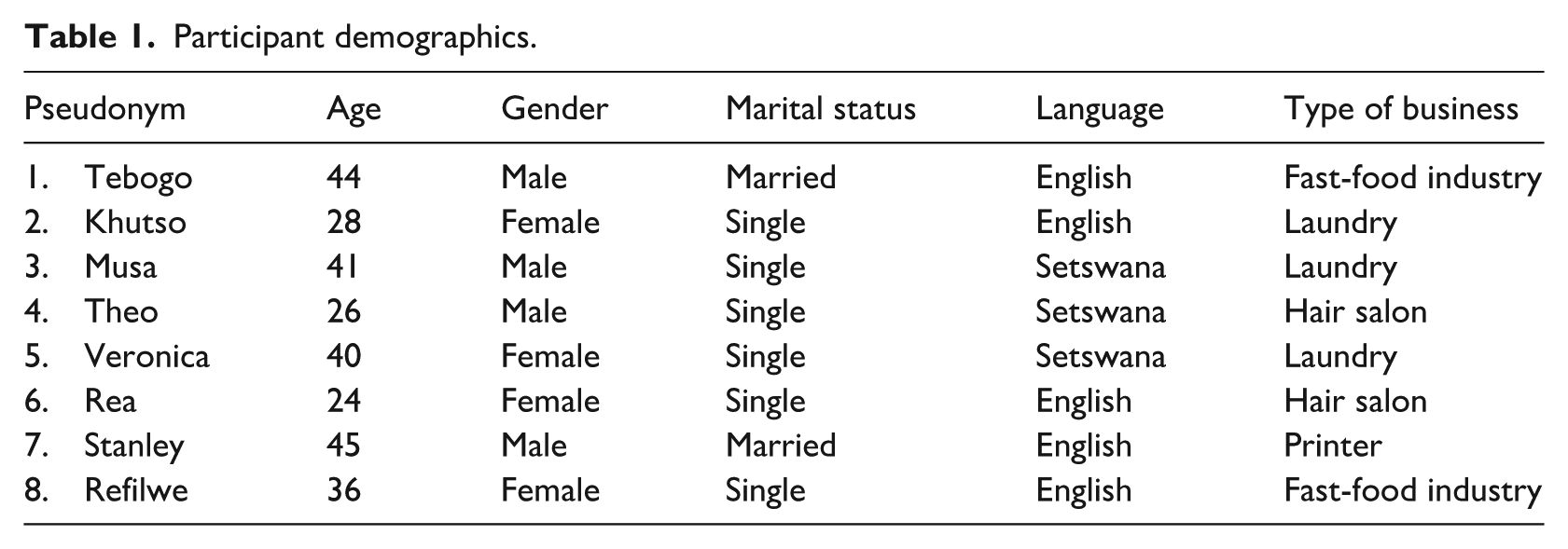
| Pseudonym | Age | Gender | Marital status | Language | Type of business |
|---|---|---|---|---|---|
| 1. Tebogo | 44 | Male | Married | English | Fast-food industry |
| 2. Khutso | 28 | Female | Single | English | Laundry |
| 3. Musa | 41 | Male | Single | Setswana | Laundry |
| 4. Theo | 26 | Male | Single | Setswana | Hair salon |
| 5. Veronica | 40 | Female | Single | Setswana | Laundry |
| 6. Rea | 24 | Female | Single | English | Hair salon |
| 7. Stanley | 45 | Male | Married | English | Printer |
| 8. Refilwe | 36 | Female | Single | English | Fast-food industry |
Declaration of conflicting interests
The authors declared no potential conflicts of interest with respect to the research, authorship, and/or publication of this article.
Funding
The authors received no financial support for the research, authorship, and/or publication of this article.
