




Abstract
University coursework master’s studies are an inherently stressful and demanding educational experience that potentially impacts students’ successful completion of the qualification. Accordingly, the ability of university students to self-regulate and manage academic strain, adversities and role demands remain a top concern for higher education institutions. This study sought to identify the core resilient coping mechanisms that distance learning industrial and organisational psychology first-year coursework master’s students employ to handle the adversities and strain of a demanding master’s coursework programme. We adopted a mixed-method research design with a survey questionnaire that captured participants’ (N = 19) narrative responses on an open-ended question and their responses on 11 question items pertaining to key facets of their resilient coping resources. The qualitative findings added evidence of participants’ capacity for resilient coping through the employment of psychological adaptive mechanisms (support seeking, boundary management, academic resilience and grit, and holistic self-care). The quantitative descriptive statistics revealed an overall average coping profile that was mostly attributed to positive emotions and psychological wellbeing, grit and personal mastery and support seeking efforts. Participants’ noncoping was attributed to low levels of mental and emotional vitality while their resilient coping was attributed to study meaningfulness and engagement. The research enriched the graduate coping literature and reiterates the importance of integrating targeted academic support in the coursework curriculum to help students develop and reflect on the resilient coping mechanisms that advance their self-care and academic wellbeing and ensure their success as prospective professional industrial psychologists.
Keywords
Introduction
Researcher interest in studying the coping mechanisms of higher education students remains topical and important for promoting student wellbeing and academic success (Coetzee et al., 2025; Feyisa et al., 2022; Fitzgibbon & Murphy, 2023; Freire et al., 2020; Gustems-Carnicer et al., 2020; Waterhouse & Samra, 2025; Zhang et al., 2024). University coursework master’s studies are an inherently stressful and demanding educational experience that potentially impacts students’ successful completion of the qualification (Coetzee et al., 2025; Fitzgibbon & Murphy, 2023; Van Niekerk et al., 2024). Distance learning industrial and organisational psychology (IOP) master’s coursework students are mostly working adults with family care responsibilities who need to adapt to and navigate the immense pressure of balancing university-work-home life demands in the pursuit of their goal to register as a professional industrial psychologist (Coetzee et al., 2022, 2025; Van Niekerk et al., 2024). Accordingly, the ability of university students to self-regulate and manage academic strain, adversities and role demands remain a top concern for higher education institutions (Cho & Hayter, 2020; Fitzgibbon & Murphy, 2023; Freire et al., 2020; Gustems-Carnicer et al., 2020; Lee, 2024; Zhang et al., 2024). Limited, yet essential research findings suggest that fostering resilient coping mechanisms as an integral facet of IOP master’s students’ coursework learning and progress potentially warrants students’ academic wellbeing and success towards a professional future as industrial psychologists (Cilliers & Flotman, 2016; Coetzee et al., 2022, 2025; Oosthuizen et al., 2023; Van Niekerk et al., 2024).
The notion of resilient coping is of interest to this study. Resilient coping reflects a university context-specific form of positive adaptive psychological functioning induced by proactive approach-based coping mechanisms (i.e., adaptive cognitive and behavioural strategies to reduce, manage, minimise, or tolerate stress). Approach-based coping mechanisms portray a purpose-driven growth orientation, self-efficacious autonomy in mastering personal and environmental challenges, and active response strategies such as boundary management and planning, academic resilience (psychological flexibility and active adaptation in educational context), holistic (spiritual, emotional, physical) self-care, seeking instrumental and emotional support, and positive reappraisal of a stressful situation (Butler & Kern, 2016; Cleofas & Mijares, 2022; Freire et al., 2016, 2020; Gustems-Carnicer & Calderón, 2013; Keyes et al., 2002; Ryan & Deci, 2001; Waterhouse & Samra, 2025; Zhang et al., 2024).
The wellbeing research literature highlights five key psychological mechanisms of resilient coping: (1) positive emotions and wellbeing (Butler & Kern, 2016; Coetzee et al., 2025; Freire et al., 2016; Shapiro, 2023); (2) mental and emotional vitality (Coetzee et al., 2025; Penninx et al., 1998; Richman et al., 2009); (3) grit and personal mastery (Coetzee et al., 2025; Duckworth et al., 2007; Feyisa et al., 2022; Young & Archer, 2023); (4) study engagement and meaning (Coetzee et al., 2025; Scheier et al., 2006); and (5) support seeking (Acoba, 2024; Coetzee et al., 2025; Julian et al., 2022).
Positive academic emotions and wellbeing (optimism, emotional stability and feeling pleased with studies), mental vitality (hopefulness and mental vigour for learning and problem-solving), and emotional vitality (goal-directedness, emotional self-regulation, enthusiasm and vigour in mastery) are positively associated with approach-based coping response mechanisms, goal-directed behaviour, self-esteem, physical health, professional identity-based motivation, overall wellbeing and lower stress, self-efficacy in meeting role demands, and academic achievement and performance (Gustems-Carnicer & Calderón, 2013; Kaur et al., 2024; Shapiro, 2023).
Grit and personal mastery (perseverance and passion for long-term goals despite adversity, self-efficacious problem-solving and accomplishment in living towards an authentic goal), study engagement and meaning-making (purposive-driven completion of studies as being meaningful and worthwhile), and support seeking behaviour (reaching out to others for help and support) along with self-beliefs, habits and goals are key resilient coping mechanisms that foster psychological (eudaimonic) wellbeing and flourishing (Butler & Kern, 2016; Duckworth et al., 2007; Freire et al., 2016; Huppert & So, 2013; Rusk & Waters, 2015; Ryan & Deci, 2001; Seligman, 2011; Shapiro, 2023). Research reveals problem-solving competency self-beliefs and a growth-oriented mind-set as helpful in persevering through problems and challenges encountered in educational studies (Morales-Navarro et al., 2024).
The open systems approach of the centeredness theory of wellbeing (CT: Bloch-Jorgensen et al., 2018) explains resilient coping as the realisation of one’s talents, potentialities and meaningful goals across five interconnected life domains (self, work, family, relationships, and family). Authentic interests, goals, and values of the ‘self’ mitigate experiences of stress while promoting wellbeing through resilient coping. Intrinsically self-generated meaningful goals and cognitive reframing of stress through mindful employment of key resilient coping mechanisms help individuals master the gap between current and ideal states of wellbeing by them managing a sense of mental balance across the life domains (Bloch-Jorgensen et al., 2018; Coetzee et al., 2025).
Pursuing the IOP master’s coursework programme reflects an authentic identity-based motivational connection (career calling) to the future goal of registering and practicing as a professional industrial psychologist deemed competent to help optimise the performance and wellbeing of organisations, teams, and individuals (Coetzee et al., 2022, 2025). Aligned with CT, such career calling facilitates a state of mindfulness in the aspiration-centred self that self-regulates stress-induced emotion for actualising meaningful goals across life domains (Bloch-Jorgensen et al., 2018; Zhou et al., 2020). In this regard, resilient coping denotes an approach-oriented personal resource that facilitates centeredness (mental balance) and optimal self-regulation in the pursuit of meaningful life domain goals.
Resources of resilient coping are protective mechanisms against inherent stressors of university studies because of them modulating the stress impact and facilitating psychological flexibility, grit (courage to persevere), positive adaptation, and wellbeing (Freire et al., 2016, 2020; Gustems-Carnicer & Calderón, 2013). Research indicates that adaptive coping mechanisms among university students positively predict their overall psychological wellbeing (Moreno-Montero et al., 2024). Subjective wellbeing from coping has been positively associated with greater educational and occupational success, stronger friendships, and better physical health (Butler & Kern, 2016).
Research on the resilient coping mechanisms of distance learning IOP coursework master’s students is sparse. Wellbeing, resilience, and coping studies on professional psychology master’s students, both in the South African and international context, are mostly done in the clinical and counselling fields (Domínguez et al., 2022; Edwards et al., 2014; El-Ghoroury et al., 2012).
A qualitative study (Cilliers & Flotman, 2016) among South African distance learning first-year IOP master’s students highlighted systemic factors affecting students’ psychological wellbeing including some approach-based coping strategies and attributes that seem to safeguard students from distress. Coetzee et al. (2025) identified a range of attributes, goals, needs and coping strategies among South African distance learning first-year and second-/third-year IOP master’s programme students. However, recent studies exploring specific resilient coping mechanisms of IOP first-year master’s students are scant and need further exploration (Coetzee et al., 2025).
The present study addresses this gap in research by its objective to explore the resilient coping mechanisms that IOP first-year master’s students employ to handle the adversities and strain of a demanding coursework programme. The research objective alluded to two research questions that needed answering:
Research Question 1 (RQ1). What are the factors and personal response strategies that contribute to the IOP master’s students’ academic wellbeing and stress coping?
Research Question 2 (RQ2). What is the extent of students’ resilient coping on the five resilient coping mechanisms of (1) positive emotions and wellbeing; (2) mental and emotional vitality; (3) grit and personal mastery; (4) study engagement and meaning; and (5) support seeking?
The findings may add to and create new knowledge about developing students’ resilient coping in IOP coursework master’s education and instituting targeted academic support for student academic wellbeing and success.
Method
Participants
The researchers adopted a mixed-method research approach with purposive sampling to invite the full cohort (N = 25) of distance learning first-year (M1) registration students to participate in the study. In terms of inclusion criteria, students had to be officially registered for the coursework modules of the Master of Industrial and Organisational (IOP) programme in the particular year of this study. Students had completed assignment assessments and practical contact sessions across all modules by the time the study was conducted. Most of the cohort of students (56% African; 20% Indian and coloured; 24% White) identified as female (72%) and male (28%). The students were in full-time employment. Only 19 (n = 19) participated in the study, thus yielding a response rate of 76%.
Instrument
Guided by the research objective and two research questions, the survey research design combined qualitative (narrative responses on a single open-ended question) and quantitative (responses on 11 scale items) data in a single study (Züll, 2016). The single open-ended question ‘Elaborate on the factors and personal strategies that contributed to your M1 student academic wellbeing and stress coping’, guided participants to share their lived experiences regarding the complexities of resilient coping strategies in the context of programme-related factors. This qualitative aspect of the survey questionnaire allowed for a better understanding of perceived programme factors and coping while yielding rich responses for the qualitative theme analysis (Creswell, 2013; Hansen & Świderska, 2024).
Quantitatively, the 11 scale items explored participants’ sense of resilient coping as measured by five specific psychological mechanisms described by the research literature: (1) positive emotions and wellbeing: two items, for example, ‘During the past month, to what extent did you feel emotionally stable and sure of yourself in the context of your studies?’; (2) mental and emotional vitality: four items, for example, ‘During the past month, how much energy or vitality did you have?’; (3) study engagement and meaning: two items, for example, ‘Do you have a lot of reasons to complete your master’s studies?’; (4) grit and personal mastery: two items, for example, ‘During the past month, how confident have you felt in dealing with problems of life and studies?’; and (5) support seeking: one item, for example, ‘To what extent do you receive help and support from others when you need it?’. Currently, no established scale was available to measure these constructs within the context of IOP master’s programme. The number of items for each scale construct was guided by the conceptual definition of the constructs as captured in the research literature and deemed adequate for the explorative nature of the study (see Matthews et al., 2022). The Cronbach alpha (internal consistency reliability) for the overall scale was .68.
Procedure and ethical considerations
Data collection commenced upon ethical clearance (CREC#3: 3377) and permission (2024_RPC_062) from the Research Ethics Committee for this study. The M1 coursework students individually received an invitation to participate in the research via a university no-reply email with the URL link to the online survey questionnaire. Participation was anonymous and voluntary. Participants’ individual responses were automatically captured on an Excell spreadsheet generated by Microsoft Office Forms and stored by the researchers in an online, password-protected folder. The mixed-method, anonymous questionnaire approach (Züll, 2016) ensured confidentiality, objectivity and unbiasedness in the data collection and analysis.
Data analysis
The qualitative data analysis was informed by the constructionist perspective whereby the researchers employed Braun and Clarke’s (2006, 2019) procedure for reflexive thematic analysis to create meaning through analysing and interpreting participants’ responses to the open-ended question. The descriptive-interpretive approach of thematic analysis allowed categorising the data to inductively generate and label the patterns of themes that emerged within the narrative data set (Braun & Clarke, 2019; Byrne, 2022; Creswell, 2013). Researcher (investigator) triangulation involved a reiterative process of recurring researcher discussions through a constant comparative methodology of theme development to ensure the trustworthiness, integrity, rigour, validity, credibility and transferability of data and theme analyses, meaning-making, and interpretation (Braun & Clarke, 2019; Carter et al., 2014; Creswell, 2013; Nowell et al., 2017). The principle of meaning saturation (i.e., the point at which no further dimensions and insights were identified) was applied to ensure that the final list of core coping themes had content validity (Hennink & Kaiser, 2022).
Being an exploratory study involving a small sample of participants, the descriptive quantitative data analysis entailed reporting the means and standard deviations of participants’ scores on the resilient coping items. The mean scores were then graphically depicted in terms of each resilient coping facet to get an exploratory overview of the resilient coping profile of the participants. A post hoc analysis of variance (ANOVA) analysis assisted in assessing the practical significance of the means and standard deviations within the mean score coping categories. The researchers utilised SPSS Statistics for Windows Version 29.0.0 (IBM Corp, 2023) to calculate the quantitative statistics.
Results
As depicted in Figure 1, four key higher-order qualitative themes (support seeking, boundary management, academic resilience and grit, and holistic self-care) emerged from making meaning of participants’ narratives regarding their resilient coping strategies. Details of these themes with relevant narrative segments used to illustrate the meaning are outlined below.
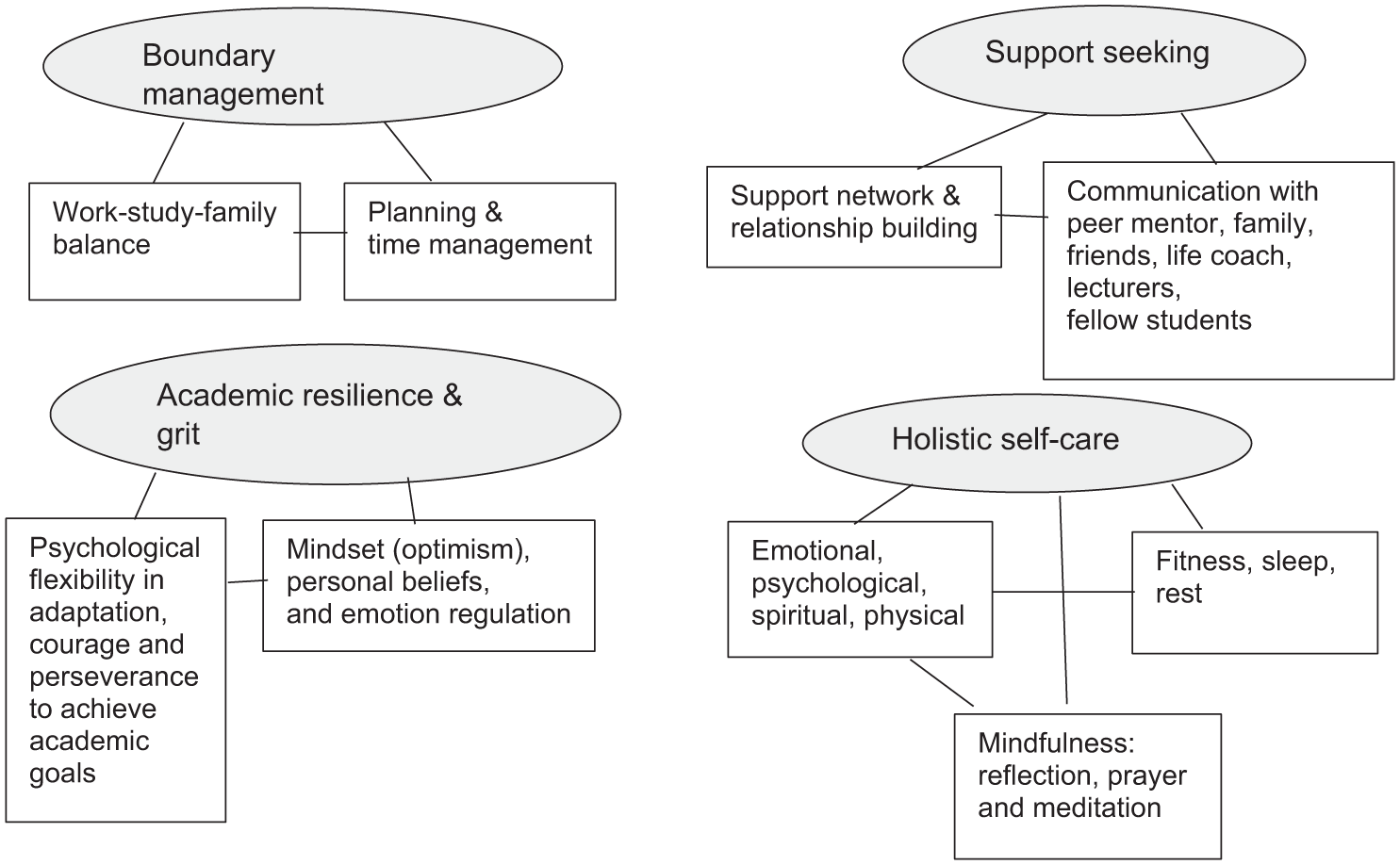
Thematic map of the core narrative themes.
Qualitative Theme 1: support seeking
Most participants emphasised academic, professional, and social support seeking as an important coping mechanism to handle the stress and demands of the Master of IOP coursework (M1) year. Participant 3 explained, ‘I have a wonderful support system that has been there for me throughout this whole process’, which was echoed by Participant 11: ‘Having a strong support network’ and Participant 12: ‘My support system and peer mentor provided me with a lot of assistance during this challenging year’. Peer mentors, family, friends, life coaches, lecturers and fellow students were indicated as core support network advocates for relieving the M1 year stress. Participant 5 mentioned, ‘Peer mentor, family, life coach’, while Participant 8 noted, ‘Family, friends and partner (social support)’. Some mentioned the importance of communication and consultation to build relationships in support seeking. For example, Participant 14 recounted, ‘Communication, support from family, colleagues, and friends’, while Participant 17 elaborated, ‘The ability to learn to communicate and build relationships with peer buddy, life coaches and fellow students, the support from home and work’. Participant 19 affirmed, ‘To have peers and participation in group discussions, consultations with lecturers helped to alleviate stress’.
Qualitative Theme 2: boundary management
Participants’ narratives reiterated the importance of planning and time management to cultivate a healthy balance between work-life-study demands and attain study goals. Participant 8 explained, ‘Planning adequately, having a balance between work, studies and family’, while Participant 10 elaborated, ‘. . . opened a daily planner for my personal life events and my studies. I also wrote everything on a planning calendar. I started to plan my week on a Monday morning (personal, academic)’. For Participant 11, time management helped to set boundaries in terms of ‘minimizing the time spent socializing and attending to my hobbies . . . and managing my project plan’. Participant 14 explained that time management helped to set up ‘. . . routines and sacrificing what is not in alignment with the goal’.
Qualitative Theme 3: academic resilience and grit
Most participants connected their coping with facets of academic resilience and grit, including psychological flexibility in adaptation (resilience), and courage and perseverance to achieve academic goals despite adversity (grit) as explained by Participant 3:
I think my perseverance, no matter how difficult assignments have been and how tired I have felt. I keep getting up and get going. I am not going to give up, I refuse to. This has helped me to keep going.
Participant 15 echoed, ‘Resilience, not giving up’. Participants further connected their academic resilience and grit to an optimistic mind-set and regulating their emotions and personal beliefs. In this aspect, Participant 1 stated, ‘Being optimistic and knowing that I’m closer to the finish line’. Participant 6 explained, ‘Always processing my emotions, if my marks were not what expected I cried, I reflect and celebrate small wins’, while Participant 14 suggested, ‘I would say mindset and personal beliefs’.
Qualitative theme: holistic self-care
Participants noted the value of holistic self-care in resilient coping. Participant 8 explained, for example: ‘Ensuring a holistic approach to the year i.e., emotional, psychological, spiritual’. Self-care practices related to practices of mindfulness such as those highlighted by Participant 13: ‘Sleep, reflection, prayer’. Participant 10 explained, ‘Daily prayer is part of my daily activities to reduce stress’ while Participant 15 elaborated, ‘It has been a difficult and challenging time. However, prayer has seen me through’. Participant 18 affirmed, ‘. . . rest i.e., sleep and meditation’. Participant 18 further indicated keeping fit, rest and sleep as important self-care practices for resilient coping.
Quantitative descriptive statistics
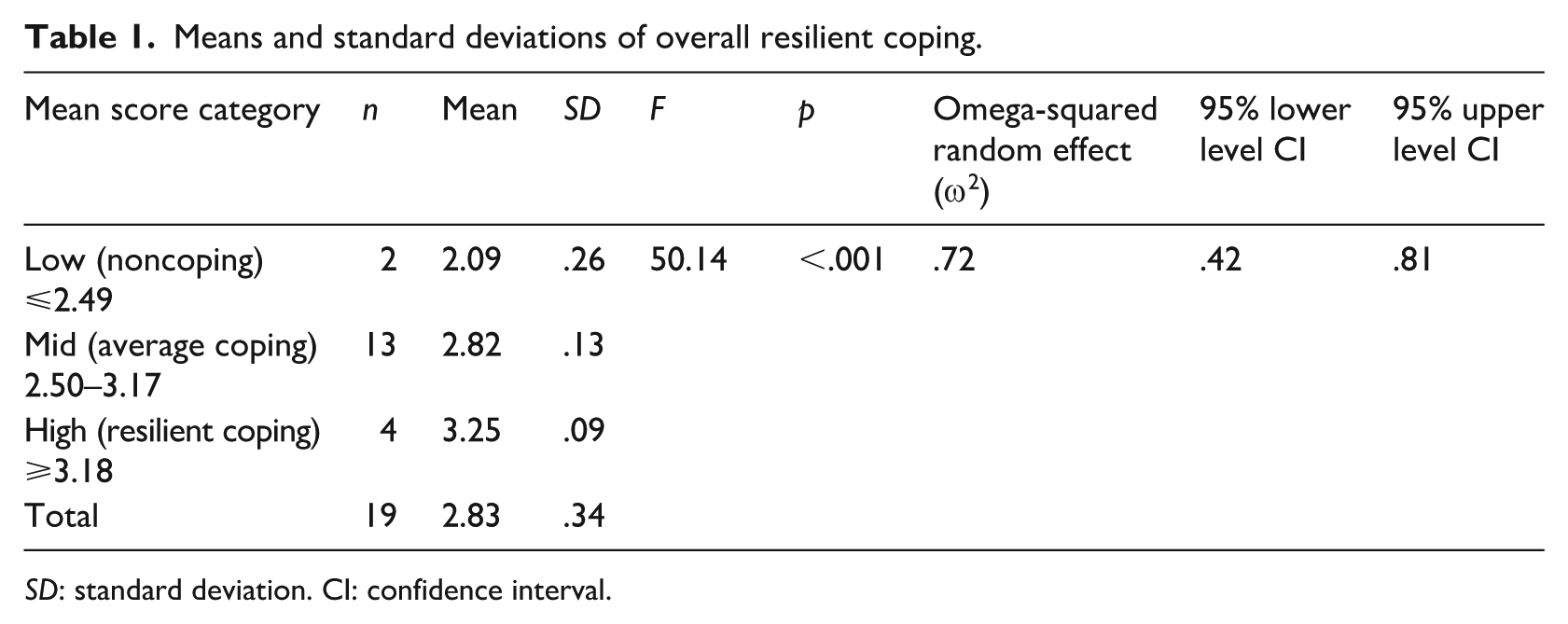
Table 1 reports the means and standard deviations of the overall mean score categories (low, mid, high). Low scores were one standard deviation (SD) below the overall mean (n = 2; 11%; score range ⩽ 2.49) and denoted noncoping. Most participants (n = 13; 68%; score range = 2.50–3.17) had mid-range scores (within 1 SD of the overall M: average coping). High scores (n = 4; 21%; score range ⩾ 3.18–4.00) were more than 1 SD above the overall mean and indicated resilient coping. The between groups’ effect was practically significant (large effect: ω2 = .72; F = 50.14; p ⩽ .001).
Means and standard deviations of overall resilient coping.
SD: standard deviation. CI: confidence interval.
Figure 2 shows that the participants had an overall average coping profile (M = 2.83) that was mostly attributed to their mid-range mean scores for positive emotions and wellbeing (M = 2.58), grit and personal mastery (M = 2.95), and support seeking (M = 2.83). Participants’ noncoping was attributed to their overall low mean score for the mental and emotional vitality (M = 2.38) facet. Their resilient coping was attributed to their high overall mean scores for study engagement and meaning (M = 3.79).
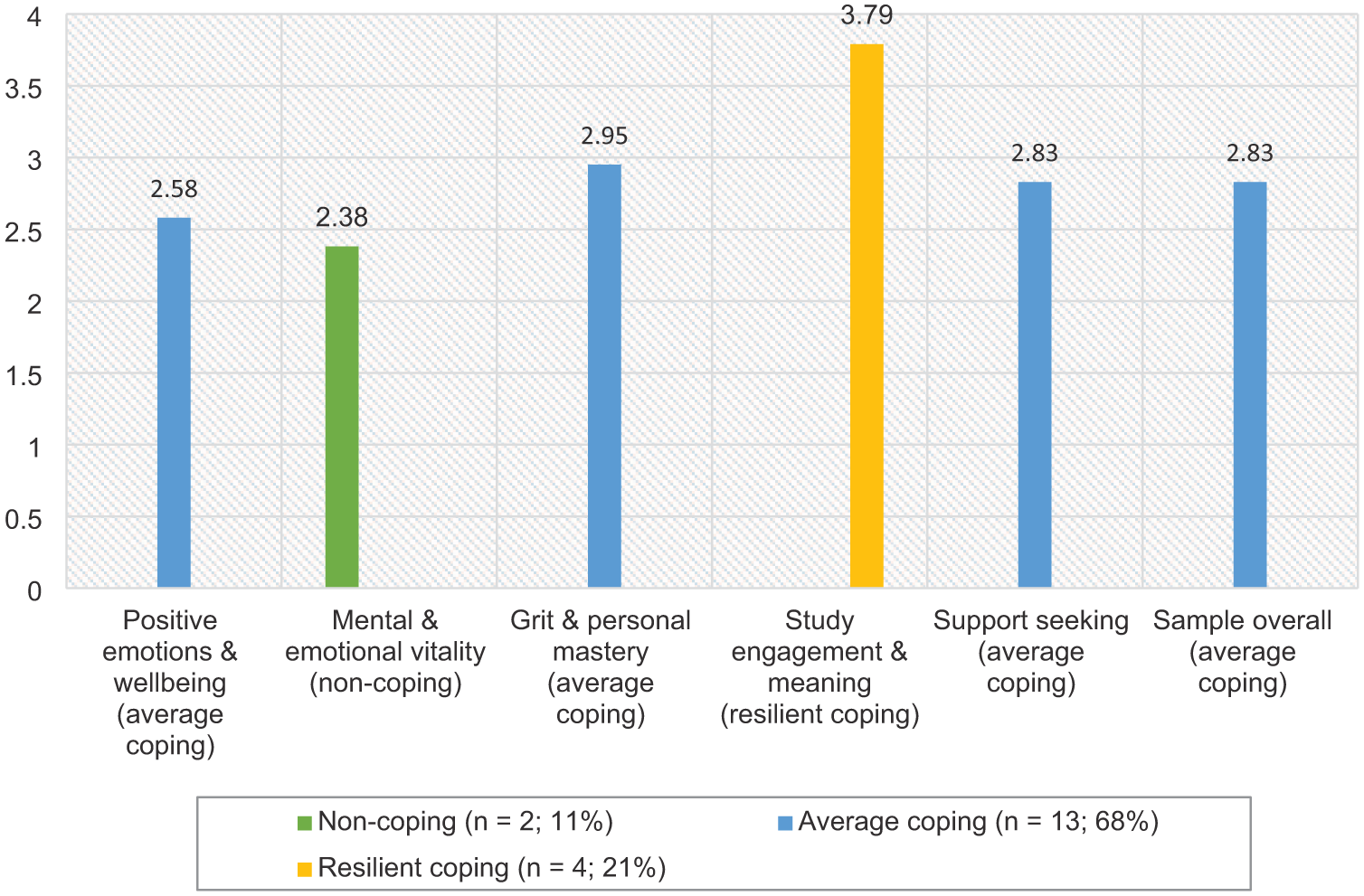
Sample resilient coping profile: overall average mean scores.
Discussion
This study explored the resilient coping mechanisms that distance learning IOP first-year coursework master’s students employ to handle the adversities and strain of a demanding master’s coursework programme. The first research question pertained to the factors and personal response strategies that contribute to the IOP master’s students’ academic wellbeing and stress coping. The qualitative findings revealed a variety of approach-based coping response strategies (proactive, adaptive strategies to adjust to, reduce, manage, or tolerate stress) that seemingly help to sustain participants’ academic wellbeing. The narrative findings affirm that educational contexts present enduring academic-related demands and challenges (strains) that have the potential for arousing stress and anxiety (Cilliers & Flotman, 2016; Fitzgibbon & Murphy, 2023; Freire et al., 2020; Waterhouse & Samra, 2025). Aligned with the centeredness theory (CT) of wellbeing (Bloch-Jorgensen et al., 2018), the approach-based coping behaviours seemingly explain the participants’ strategies to actively manage the programme’s academic strains behaviourally and cognitively for self-actualisation and wellbeing in interconnected life domains (i.e., work, study, self, community, relationships; Coetzee et al., 2025; Dailey et al., 2022).
Proactively seeking support from, including open communication, and cultivating positive relations with peer mentors, family, friends, life coaches, lecturers and fellow students emerged as crucial resilient coping response strategies. This finding affirms prior empirical evidence that such active support seeking reinforces students’ efficacy and resilience in coping with and adjusting to academic stressors (Cho & Hayter, 2020; Cilliers & Flotman, 2016; Domínguez et al., 2022). Support seeking alludes to individuals’ basic need for social connectedness as a protective shield from loneliness, distress, anxiety, depression, and anger in stress-inducing contexts (Dailey et al., 2022).
The findings indicated proactive planning and time management as an important boundary management mechanism to control work-life-study balance for academic wellbeing and attaining the academic goal of passing the M1 year coursework studies. Active boundary management indicates personal wellbeing and lower stress levels from individuals’ ability to also enjoy leisure time or time for family, friends, and hobbies (Cho & Hayter, 2020). In addition, participants highlighted academic resilience, grit, and holistic self-care practices as important mechanisms for navigating and adapting to the additional role and study demands posed by the coursework study programme. These coping mechanisms generally lower individuals’ levels of stress by enhancing their efficacy in handling academic-induced strains (Cho & Hayter, 2020). Self-care practices such as relaxation, rest or sleep, exercise, sport and recreation, boundary and time management, spiritual or religious activities, personal therapy or counselling (life coaching), use of social support, mindfulness and developing skills in regulating personal beliefs, mind-set and emotions are essential preventive resilient coping mechanisms for sustaining the personal, academic, and professional wellbeing of graduates in the psychology fields (Edwards et al., 2014; Myers et al., 2012).
The quantitative study explored participants’ extent of resilient coping in terms of five specific mechanisms of resilient coping. The results revealed that the participants’ experienced the M1 coursework year as draining their mental and emotional vitality and adversely impacting their coping efficacy. Vitality (mental and emotional) is a crucial inner resource that help individuals cope with challenges, meet role demands and harness the psychological energy for goal-directed actions (Shapiro, 2023). Mental vitality relates to a sense of hopefulness and mental vigour for active study engagement while emotional vitality alludes to mastery, enthusiasm, and vigour for managing negative emotions such as feeling tired, worn out while doing the master’s studies (Penninx et al., 1998; Richman et al., 2009; Shapiro, 2023). In this aspect, the findings suggested that study meaningfulness and engagement act as important resilient coping mechanisms to regain vitality and persevere and bounce back from study adversities. The findings align with CT (Bloch-Jorgensen et al., 2018) by corroborating research showing that students exhibit stronger academic resilience and experience less stress when they feel engaged in their academic work and are committed to meaningful academic goals (Cho & Hayter, 2020; Coetzee et al., 2025). Prior research further indicates engagement and meaningfulness as positive antecedents of vitality, grit, and wellbeing (Shapiro, 2023). Meaningful study engagement denotes a heightened immersion in study activities which in turn, provides the mental and emotional vitality and grit that make it more likely that individuals attain their goals (Jachimowicz et al., 2018).
Despite the stress induced by the IOP coursework programme’s academic strains, the findings revealed that participants experienced the M1 year coursework programme also as cognitively enriching and stimulating because of the meaning they attach to passing the coursework as the first hurdle towards attaining their goal of registering as professional industrial psychologists. An authentic, professional identity-based career goal often shields physical, mental, and emotional fatigue caused by role overload, work stress, and emotional exhaustion (Zhou et al., 2020). In this aspect, the findings added new insights regarding the set of resilient coping mechanisms that seemingly provided a reservoir of coping energy for managing academic and personal wellbeing in the pursuit of academic and professional goals.
Drawing from CT (Bloch-Jorgensen et al., 2018), the qualitative and quantitative findings highlight the importance of resilient coping response strategies and mechanisms to decipher and master chaos within the self in response to the external stress-inducing situation created by the master’s programme. Resilient coping mechanisms seem to enhance the ability to reframe stress into an enhancive stress mind-set (i.e., viewing programme-induced stress as a driver towards achieving meaningful goals) that promotes self-actualisation and psychologically centred wellbeing in life domains. In this regard, the present study offers a fresh perspective on resilient coping strategies and mechanisms that are under-researched in the IOP master’s course work context.
Participants’ moderate state of positive emotions, psychological wellbeing, grit and personal mastery, and support seeking signals the need for targeted academic support interventions that help students adapt to the coursework study programme demands and challenges. Multiple points of tangible academic support and communication during the coursework year on academic strains such as course assignments and meeting assignment and project deadlines may help students strengthen these psychological resources for resilient coping (Cho & Hayter, 2020). Training in resilient coping and effective stress management as part of the personal and professional development curriculum may further enhance their coping efficacy (Edwards et al., 2014; Myers et al., 2012). Such training may be effective in reducing negative emotional states and promote mental and emotional vitality for stronger protective states of wellbeing, grit, and personal mastery.
The relatively small sample size and the participants being from a specific cohort of M1 coursework students at a distance learning higher education institution limit the generalisability of the study findings. The exploratory survey approach towards obtaining narratives from a single open-ended question further limits the potentiality of richer information that could have been garnered from an interview and discourse analysis process. The small sample of participants limited the quantitative data analysis to descriptive statistics. Future research could assess the effectiveness of resilient coping mechanisms of M1 coursework students across longitudinal studies that track data from several cohorts of M1 students and by employing more robust scale measures and/or structured interviews for deeper thematic discourse analysis. Longitudinal studies may enable collecting data from a larger sample of students to test the psychometric properties of the resilient coping items utilised in this study or by employing other standardised measures of resilient coping and wellbeing that allow for robust inferential statistical procedures for data analysis.
Conclusion
Despite the study’s limitations, the exploratory mixed-method research and purposive sampling approach yielded rich data for meaningful data interpretation that adds empirical evidence towards considering the stress-inducing factors of a distance learning first-year IOP coursework master’s programme and the dire need for academic student support initiatives that help student develop a sound repertoire of resilient coping mechanisms to enhance their coping efficacy. The findings added evidence of IOP coursework master’s students’ capacity for resilient coping through the employment of psychological adaptive mechanisms. At the heart of the findings is the call for integrating targeted academic support in the coursework curriculum to help students develop and reflect on the resilient coping mechanisms that advance their self-care and academic wellbeing and ensure their success as prospective professional industrial psychologists.
Footnotes
Acknowledgements
The authors would like to acknowledge the study’s participants for their time and consent to use their data for research purposes.
Author contributions
All authors contributed equally to the writing of the article.
Data availability statement
Data are available upon reasonable request from the corresponding author.
Declaration of conflicting interests
The authors declared no potential conflicts of interest with respect to the research, authorship, and/or publication of this article.
Funding
The authors received no financial support for the research, authorship, and/or publication of this article.
Disclaimer
The views and opinions expressed in this article are those of the authors and do not necessarily reflect the official policy or position of any affiliated agency of the authors.
