



Abstract
This study investigated the mediating role of playful work design in the relationship between empowering leadership and work engagement among a diverse sample of employees (N = 261). A quantitative, cross-sectional design was employed, and correlation and mediation analyses were conducted to test the research hypotheses. The findings revealed that empowering leadership indirectly influences work engagement through playful work design as a mediator. Specifically, when leaders grant employees autonomy and decision-making authority, employees are more likely to incorporate elements of fun and competition into their work, resulting in higher levels of engagement. The results highlight the importance of organisations promoting empowering leadership practices to foster environments that promote proactive employee behaviour in designing their work and enhancing well-being. The study further contributes to the limited research exploring the mechanisms through which empowering leadership influences work engagement, particularly through playful work design as a mediator. The study’s limitations include its limited consideration of contextual factors that may shape the effects of empowering leadership and playful work design on work engagement. Future research should examine environmental moderators to better understand the dynamics and boundary conditions of these relationships.
Introduction
Imagine the following scenario: It is lunchtime, and the sales manager closes her laptop, heading to the elevator to join her colleagues on the sixth floor. On her way, she encounters a cheerful colleague celebrating a personal milestone – setting a record for contacting 10 prospective clients within 15 minutes. Arriving on the sixth floor, she eagerly anticipates a lively game of pool with her team during the lunch break. Across the room, the sounds of laughter and friendly taunting fill the air as colleagues from the finance and human resources departments prepare for a spirited table tennis match to determine the office champions. The atmosphere is playful, competitive, and collaborative; a culture that fosters fun and engagement while contributing to the company’s record-breaking sales performance.
The scenario above illustrates the concept of playful work design (PWD), a construct that encourages employees to proactively infuse their work with playful elements, enhancing its meaning and engagement (Bakker & Van Woerkom, 2017). PWD represents a form of proactive work behaviour, where individuals take the initiative to incorporate fun and enjoyment into their tasks, fostering greater well-being and productivity. Leading organisations worldwide have embraced PWD as part of their workplace culture. For instance, Google’s Zurich office features a large slide for employees to travel between floors, Comvert’s headquarters in Italy includes an indoor skate bowl, and YouTube’s California office boasts a putt-putt green (CorD Magazine, 2022). These initiatives demonstrate how playful work environments can inspire employee creativity, collaboration, and motivation.
PWD not only fosters a more challenging and fulfilling work experience (Bakker et al., 2020) but also enhances work engagement (Liu et al., 2022; Scharp et al., 2022)—a positive, affective state characterised by high energy levels and dedication to one’s work. While much of the existing literature focuses on work engagement as an outcome of PWD (e.g., Scharp et al., 2019), we argue that specific organisational conditions must be present for employees to integrate playfulness into their work. We propose that empowering leadership plays a crucial role in shaping the extent to which employees adopt PWD practices that drive higher levels of engagement.
Empowering leadership, defined by Scharp et al. (2021) as the top-down transfer of power that encourages autonomy, initiative, and decision-making, aligns closely with the principles of PWD, as it requires employees to take ownership of creating a playful work environment. Although empowering leadership is widely known to predict engagement (Amundsen & Martinsen, 2014; Greco et al., 2006; Hsu et al., 2022; Kim et al., 2018; Wu & Lee, 2017), little is known about how this relationship unfolds. Empirically, prior research has shown that empowering leadership is positively associated with proactive work behaviours (Li et al., 2016) and that PWD fosters work engagement (Petrou et al., 2022; Tims et al., 2012). However, to our knowledge, few (if any) studies have examined PWD as a mediator, specifically in the empowering leadership–engagement pathway. We therefore contribute to this gap by exploring whether PWD serves as a mechanism through which empowering leadership enhances engagement, thus offering a fresh lens into the dynamics of proactive behaviour in empowering contexts. By positioning PWD as a mediator, we answer calls from leadership scholars (Cheong et al., 2019; Lee et al., 2018) to better understand the psychological and behavioural mechanisms through which empowering leadership exerts its effects. This adds explanatory depth to existing leadership–engagement models (e.g., Breevaart et al., 2014; Kahn, 1990), which emphasise the importance of leadership in shaping the motivational conditions that foster engagement.
This study further extends theory on PWD. While previous research within the job demands-resource (JD-R) framework has focused on proactive job crafting behaviours (Tims et al., 2012; Wrzesniewski & Dutton, 2001), we extend this body of work by incorporating PWD as a novel form of proactive employee behaviour. As noted by Scharp et al. (2019), PWD is a relatively new concept that deserves attention for its potential to enhance motivation through intrinsic fun. By situating PWD within the JD-R model, we enrich understanding of how proactive work behaviours beyond traditional job crafting (e.g., increasing resources or demands) can foster engagement. Finally, existing studies on PWD have largely been conducted in Western, European contexts (e.g., Bakker et al., 2020; Liu et al., 2022; Scharp et al., 2019), with limited knowledge on how this construct manifests in African contexts, particularly in South Africa. Building research on proactive measures like PWD in non-Western contexts like South Africa adds to its utility, application and relevance across global organisational contexts.
Empowering leadership
Empowering leadership has garnered significant attention within the positive organisational scholarship literature due to its demonstrated impact on workplace outcomes. Meta-analytic findings at both individual and team levels reveal that empowering leadership positively influences employees’ performance, organisational citizenship behaviours, and creativity (Lee et al., 2018). While conceptually related to other leadership styles such as participative leadership, transformational leadership, and ethical leadership, empowering leadership is characterised by its emphasis on fostering employee autonomy and self-initiation (Cheong et al., 2019). According to Sharma and Kirkman (2015), empowering leadership refers to a set of leadership behaviours that include delegating authority, promoting autonomous decision-making, and inviting employee input. Various dimensions of empowering leadership have been proposed, including showing individual concern (Arnold et al., 2000), enhancing the meaningfulness of work (Ahearne et al., 2005), and enabling employees to be self-directed (Harris et al., 2013).
In this study, we adopt Amundsen and Martinsen’s (2014) conceptualisation of empowering leadership as a two-dimensional construct comprising autonomy support and development support. Autonomy support encompasses leadership behaviours that encourage and enable employees to self-manage and make independent decisions. Leaders who support autonomy provide employees with the freedom to take initiative, solve problems, and determine how to approach their work without excessive control or micromanagement. Development support, in contrast, involves leadership behaviours that focus on enhancing employees’ skills, competencies, and self-efficacy (Amundsen &Martinsen, 2014). This includes providing constructive feedback, offering opportunities for growth, and fostering an environment that prioritises both personal and professional development. Together, these dimensions highlight the dual focus of empowering leadership on enabling autonomy and nurturing capability, which are essential for fostering engaged and proactive employees.
Empowering leadership and engagement
Empowering leadership fosters work engagement based on social exchange theory (SET), which posits that individuals engage in reciprocal exchanges with others to gain rewards (Blau, 1964). When leaders empower employees by promoting autonomy, decision-making, and encouraging input, employees perceive these actions as investments in their well-being and growth. This leads to increased work engagement as employees reciprocate with higher involvement, creativity, and commitment to organisational goals (Wu & Lee, 2017). A central mechanism in this relationship is leading by example, where leaders set a positive example through behaviours such as involving employees in decision-making and showing concern for their well-being. This fosters trust, psychological safety, and a work environment conducive to higher engagement (Hsu et al., 2022).
Empowering leadership provides employees with critical resources such as autonomy and opportunities for skill development, which fulfil their psychological needs for competence and self-determination. By meeting these needs, empowering leadership stimulates intrinsic motivation, reduces boredom, and fosters greater engagement (Kim & Beehr, 2022). As a result, employees are more likely to take ownership of their tasks, approach challenges proactively, and contribute creative solutions that enhance organisational outcomes (Peng et al., 2024). In addition, empowering leadership improves person-job fit by aligning employees’ roles with their skills and abilities, thereby reducing stress and mitigating burnout, which further boosts engagement (Greco et al., 2006). Based on these insights, we hypothesise that:
H1: There is a positive relationship between empowering leadership and work engagement.
The mediating role of PWD
PWD is a proactive, bottom-up approach in which employees redesign their tasks to make work more engaging, enjoyable, and challenging by integrating elements of play (Bakker et al., 2020; Scharp et al., 2019). Employees may engage in PWD through two elements, ‘designing fun’ or ‘designing competition’. Designing fun (ludic play) involves employees approaching their work activities with a sense of humour and imagination, resulting in higher levels of amusement, entertainment, and fun (Scharp et al., 2023). A typical example includes a flight attendant incorporating humour into their work duties by rapping out the safety instructions to passengers before lift-off (CBS, 2009). Designing competition (agonistic play), entails employees intentionally making their tasks more competitive and challenging by instilling a set of rules or objectives to complete work tasks (Scharp et al., 2023). This may involve a call centre agent setting personal goals to achieve the greatest number of calls in the least amount of time to outperform their fellow coworkers.
The process of playfully ‘redesigning’ one’s job aligns with the basic tenants of JD-R theory, which proposes that employees may redesign (through play) their level of JD-Rs to reduce stress and improve their overall work engagement (Bakker & Demerouti, 2017; Demerouti et al., 2001). Job demands, such as increased workload and role ambiguity, are those healthy-impairing aspects of the job that induce stress and burnout, while job resources, such as leadership support and autonomy, are those health-promoting aspects that contribute to higher levels of employee engagement and job satisfaction (Demerouti et al., 2001). PWD therefore focuses on transforming employees’ existing JD-Rs without altering their core nature (Bakker & Van Woerkom, 2017).
The benefits of PWD include reducing stress, preventing burnout, and increasing job satisfaction by meeting employees’ psychological needs for competence and autonomy (Scharp et al., 2019; Sørensen & Spoelstra, 2012). Furthermore, by fostering creativity, self-leadership, and a sense of flow, PWD has been shown to enhance work engagement and overall job performance (Dishon-Berkovits et al., 2023; Skowronski, 2012).
While empowering leadership directly influences work engagement, its impact is likely mediated by mechanisms that translate leadership behaviours into employees’ internal motivation and proactive work strategies. One such mechanism is PWD, which involves employees intentionally redesigning their tasks to make work more enjoyable and engaging (Bakker & Van Woerkom, 2017). Empowering leaders cultivate the autonomy, trust, and supportive environment necessary for employees to engage in PWD. By delegating authority and encouraging innovation, empowering leaders give employees the freedom to shape their work in ways that align with their personal strengths and interests (Scharp et al., 2022). Employees who feel empowered are more likely to engage in PWD as a means of exercising their autonomy, leading to enhanced intrinsic motivation and greater work engagement (Kim & Beehr, 2022).
Furthermore, PWD amplifies the resources provided by empowering leadership, such as skill development and decision-making autonomy, by allowing employees to proactively integrate fun and creativity into their work tasks. This aligns with the principles of SET (Blau, 1964), which suggests that employees reciprocate empowering leadership behaviours by investing effort into work activities that enhance their own well-being and performance (Wen et al., 2023). Research by Bakker et al. (2020) demonstrates that employees engaging in PWD experience higher levels of energy and enthusiasm, which contribute to greater work engagement. Similarly, Peng et al. (2024) found that empowered employees who actively incorporate playful elements into their tasks display increased creativity and persistence, further enhancing engagement. These findings underscore the mediating role of PWD, as it transforms the empowering behaviours of leaders into tangible psychological benefits and proactive efforts that drive work engagement. Accordingly, we hypothesise the following:
H2: There is a positive relationship between empowering leadership and PWD
H3: PWD mediates the relationship between empowering leadership and work engagement.
Method
Research design and approach
This study used a quantitative cross-sectional correlational research design as it focuses on the relationships between variables at a single point in time.
Participants
Non-probability convenience sampling was used to recruit participants. Data were collected from 261 employees working across the Netherlands (n = 25, 10%), South Africa (n = 67, 26%), United Kingdom (n = 114, 44%), and the United States (n = 55, 21%). This cross-national sample enhances the generalisability of the findings by capturing employee experiences across culturally and institutionally diverse work environments. Including participants from both Global North and Global South contexts (e.g., South Africa) further adds to greater inclusivity in organisational research. In terms of gender, there were slightly more self-identified women (n = 145, 56%) than men (n = 114, 44%). The participants’ average age was 36.84 (SD = 11.05) years. They had worked for 15.55 years (SD = 11.39) on average across their careers, 4.58 (SD = 4.93) years on average in their current job, and 5.91 years (SD = 6.18) on average in their current organisation. The participants were from various industries, including health care, advertising, legal, telecommunications, and software engineering. Majority of the participants held a university degree (n = 180, 69%), followed by a diploma/certificate (n = 44, 17%), and grade 12/secondary school (n = 37, 14%).
Procedure
The data for this study were collected using a questionnaire hosted on Google Forms. The questionnaire included an informed consent form and the instruments required for data collection. The study was advertised on Prolific, an online platform that facilitates participant recruitment for research studies, surveys, and experiments (Prolific, 2012). Prolific allows researchers to set specific eligibility criteria to ensure the sample aligns with the study’s requirements. For this study, the criteria included being a registered Prolific participant, residing in the Netherlands, South Africa, the United Kingdom, or the United States, and being at least 18 years old. Eligible participants were notified through the platform and invited to participate. Each participant was compensated approximately £2.50 (equivalent to approximately R20.24 or $1.05) for their time and effort.
Measuring instruments
Empowering leadership
The 18-item Empowering Leadership Scale (ELS) (Amundsen & Martinsen, 2014) was used to measure empowering leadership. The scale measures two dimensions (autonomy support and development support) and responses are captured on a 7-point frequency scale (1 = Never, 7 = Very often). Amundsen and Martinsen (2014) reported Cronbach alpha coefficients ranging from .91 to .94 for the ELS. We report on the psychometric properties of the data collection instruments in the results section.
Playful work design
PWD was measured using the 12-item PWD Questionnaire (Scharp et al., 2019). The scale measures two dimensions (designing fun and designing competition) and responses are captured on a 5-point frequency scale (1 = Never, 5 = Very often). Scharp et al. (2019) reported Cronbach alpha coefficients ranging from .72 to .81 for designing fun and .82 to .88 for designing competition.
Work engagement
Work engagement was measured using the 9-item Utrecht Work Engagement Scale (UWES: Schaufeli et al., 2006). It measures three dimensions of work engagement: vigour, dedication, and absorption. Responses are captured on a 7-point frequency scale (0 = Never, 6 = Always). Cronbach alpha values for the three dimensions range between .60 and .88 (Schaufeli et al., 2006).
Data analysis
The data were analysed with R version 4.3.1 (R Core Team, 2023) and Process Macro version 4.2 (Hayes, 2022) in SPSS version 29 (IBM Corp. Released, 2023). Pearson’s product-moment correlation was used to test the relationships between the variables. The mediation model was investigated using the product of the paths leading from the independent variable (X) to the mediator variable (M) – path a – and the mediator variable (M) to the dependent variable (Y) – path b. The product of these paths indicates the direction and strength of the mediation effect. The indirect effect’s sampling distribution is not normally distributed (Hayes, 2022). As a result, we applied percentile bootstrapping with 5000 resamples (Efron, 1981) to generate an empirical distribution and assess the statistical significance of the indirect effect (Hayes, 2022).
Ethical considerations
The ethical clearance number received from the Department of Industrial Psychology and People Management Research Ethics Committee is IPPM-2023-752(M). The first section of the questionnaire included a participant information form explaining the purpose of the study and what information was required from them. The participants had to indicate on the consent form that they understood the terms and conditions of the study and provided consent to use their data in the study. Furthermore, we obtained their consent to include their responses as components of the compiled data on the Open Science Framework. Participating in this study was voluntary, and we assured them of anonymity and confidentiality.
Results
Descriptive statistics
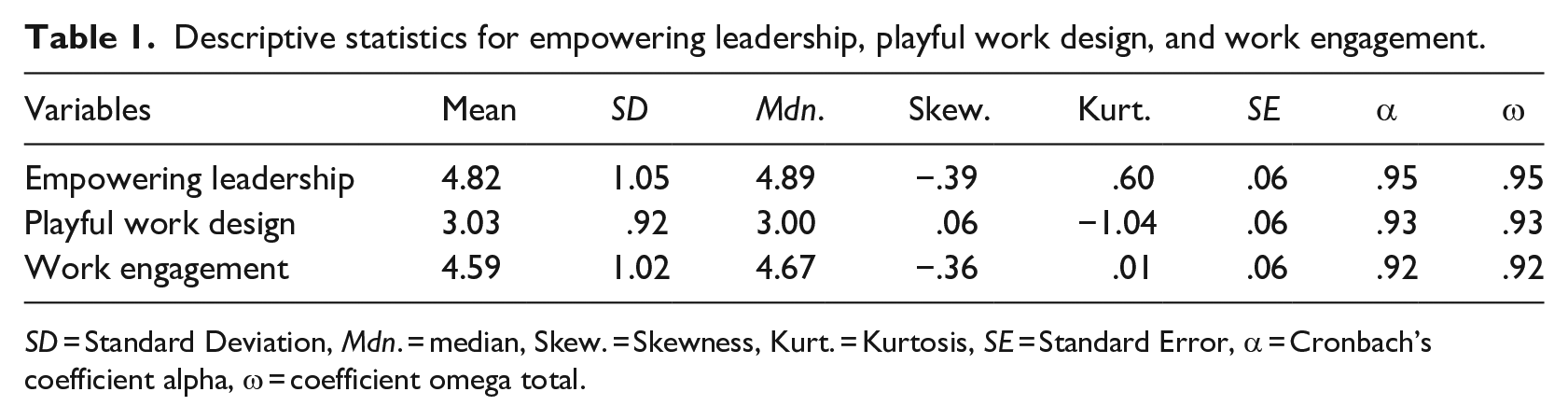
Table 1 presents the descriptive statistics for the data collection instruments. The participants scored as follows: Empowering Leadership (M = 4.82, SD = 1.05), Work Engagement (M = 4.59, SD = 1.02), and PWD (M = 3.03, SD = 0.92). All the instruments displayed acceptable internal consistency with alpha and omega coefficients ranging from .92 to .95.
Descriptive statistics for empowering leadership, playful work design, and work engagement.
SD = Standard Deviation, Mdn. = median, Skew. = Skewness, Kurt. = Kurtosis, SE = Standard Error, α = Cronbach’s coefficient alpha, ω = coefficient omega total.
Pearson correlation coefficients
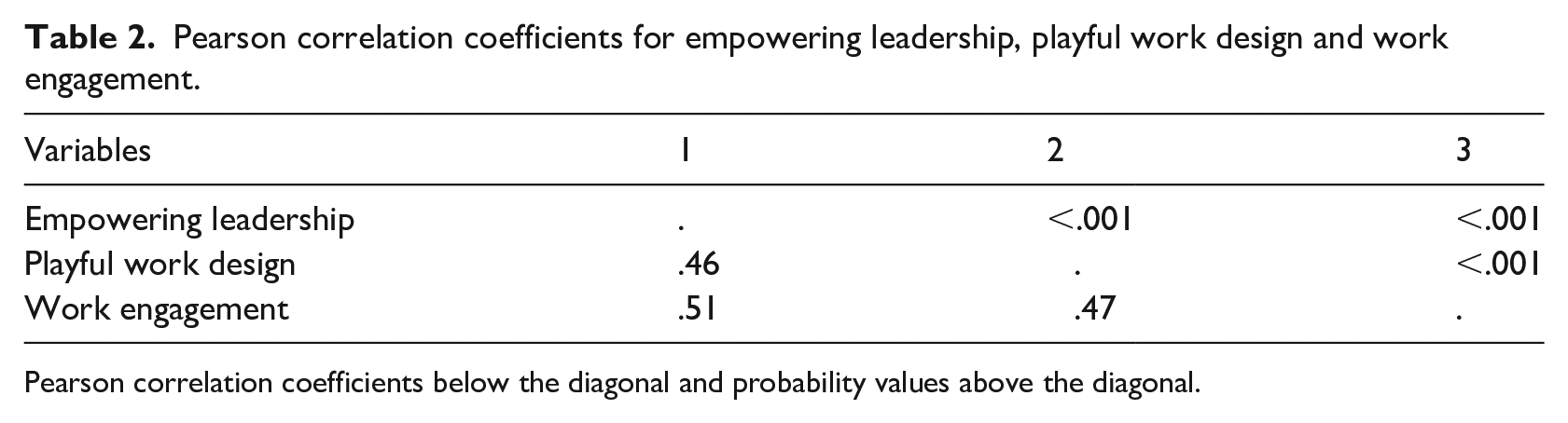
Table 2 presents the Pearson Correlation coefficient matrix. All the correlation coefficients were statistically significant at p < .001. Empowering Leadership had a statistically significant positive relationship with PWD (r = .46), and Work Engagement (r = .51). PWD had a statistically significant positive relationship with Work Engagement (r = .47).
Pearson correlation coefficients for empowering leadership, playful work design and work engagement.
Pearson correlation coefficients below the diagonal and probability values above the diagonal.
Mediation analysis
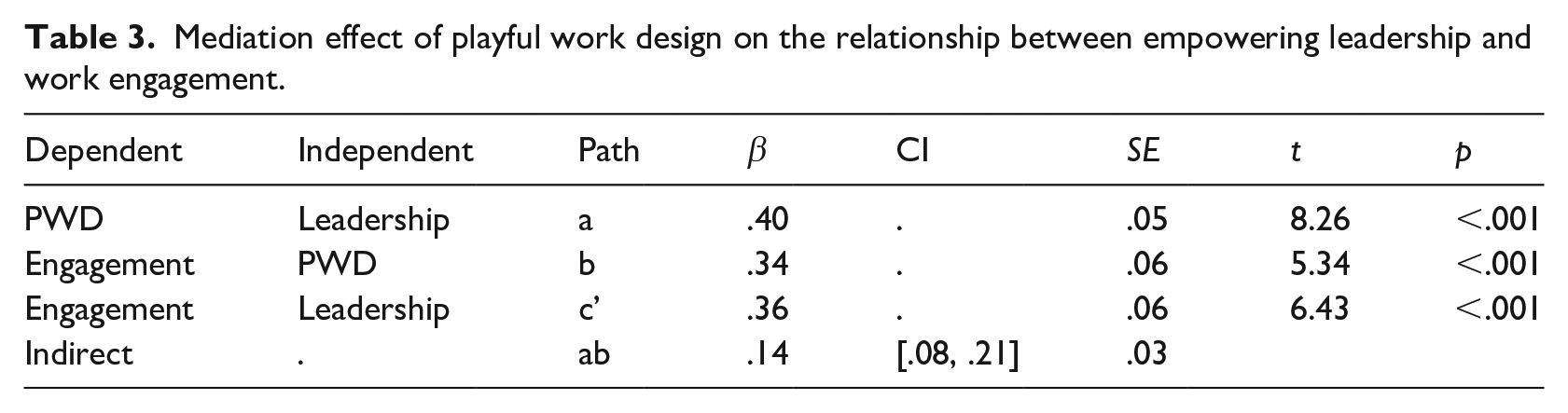
We investigated the indirect effect of PWD on the relationship between Empowering Leadership and Work Engagement. We combined the two scale scores (designing fun and designing competition) into a single PWD score in this study due to their strong correlation (r = .59). After adjusting for measurement error, the deattenuated correlation increased to r = .76, indicating that the PWD questionnaire reflects a unidimensional construct. Table 3 presents the model’s path coefficients. The indirect effect was statistically significant (βab = .14, 95% confidence interval [CI] = [.08, .21]) supporting the mediation hypothesis. The results showed that Empowering Leadership increased PWD (βa = .40, p < .001) and PWD increased Engagement (βb = .34, p < .001).
Mediation effect of playful work design on the relationship between empowering leadership and work engagement.
Discussion
Empowering leadership and PWD
Our findings support the hypothesis that empowering leadership is positively related to work engagement (H1). This aligns with SET (Blau, 1964), which posits that employees reciprocate the trust and autonomy granted by empowering leaders with greater engagement and commitment to their work (Wu & Lee, 2017). As empowering leaders provide resources such as autonomy, psychological safety, and opportunities for skill development, employees experience greater intrinsic motivation, and reduced burnout (Greco et al., 2006; Kim & Beehr, 2022).
Moreover, empowering leadership fosters trust and psychological safety through behaviours like involving employees in decision-making and demonstrating genuine concern for their well-being (Hsu et al., 2022). These actions not only promote engagement but also align employees’ roles with their skills and interests, enhancing person-job fit. In this study, we extend prior research by demonstrating that empowering leadership creates conditions that consistently lead to higher work engagement, reaffirming earlier findings by Peng et al. (2024) and further solidifying the critical role of empowering leadership in motivating and engaging employees.
The mediating role of PWD
Our findings provide robust support for the mediation hypothesis, confirming that PWD mediates the indirect relationship between empowering leadership and work engagement. Specifically, empowering leadership fosters employee autonomy and encourages the application of PWD principles, ultimately leading to higher engagement levels. These results align with the assertion by Scharp et al. (2022) that creating autonomous work environments allows employees to integrate playful elements into their tasks, which enhances their engagement. Similarly, Bakker et al. (2020) argue that when employees are given the freedom to incorporate play into their work, they experience increased levels of engagement.
From the perspectives of the JD-R model and conservation of resources (COR) theory, empowering leaders can leverage PWD as a resource by fostering autonomy and providing employees with opportunities to take initiative. This not only reduces the depletion of resources but also enriches employees’ work experiences, ultimately contributing to a more engaged workforce (Gao & Jiang, 2019). Empowering leadership thus provides the necessary foundation for PWD to thrive, translating leadership behaviours into meaningful, proactive employee strategies that enhance engagement.
Our results extend prior research by demonstrating that PWD serves as a crucial mechanism through which empowering leadership promotes work engagement. This supports the findings of Bakker et al. (2020), who showed that empowering environments encourage employees to redesign tasks to incorporate elements of fun and challenge, resulting in greater engagement. Similarly, Scharp et al. (2022) emphasise that empowering leaders cultivate autonomy and trust, enabling employees to proactively shape their tasks in alignment with their personal strengths and interests. This process meets critical psychological needs, including competence, autonomy, and self-determination, which are known drivers of intrinsic motivation and engagement (Kim & Beehr, 2022).
PWD facilitates creative task transformation by incorporating elements of play such as competition or humour, which can reduce stress and increase job satisfaction (Scharp et al., 2019; Sørensen & Spoelstra, 2012). For instance, agonistic play, characterised by competitive challenges, enhances task enjoyment, and engagement (Caillois & Barash, 1963), while ludic play fosters a light-hearted and supportive work atmosphere (Barnett, 2007). Our study contributes to this growing body of knowledge by highlighting PWD as a mediating factor that connects the empowering behaviours of leaders to increased work engagement. These findings emphasise the critical role of leaders in fostering innovation and autonomy to create environments conducive to PWD.
Moreover, our findings are consistent with SET, which posits that employees reciprocate empowering leadership behaviours by investing additional effort and creativity into their work (Blau, 1964). Specifically, employees who engage in PWD amplify the resources provided by empowering leaders, such as decision-making autonomy, by channelling them into proactive and engaging strategies. This aligns with research by Bakker and Van Woerkom (2017), who found that playful task redesign enhances creativity, enthusiasm, and persistence, all of which contribute to higher levels of engagement. Wen et al. (2023) further corroborate this view, emphasising that PWD fosters a positive cycle of resource gain, where employees leverage their autonomy and creativity to achieve higher engagement.
Practical and theoretical implications
The study offers several practical and theoretical contributions. From a theoretical perspective, it extends existing research by identifying PWD as a mediating mechanism in the relationship between empowering leadership and work engagement. This highlights the importance of considering proactive employee behaviours, such as PWD, as central to understanding how leadership styles influence work engagement. It also contributes to JD-R theory (Demerouti et al., 2001) by demonstrating how job resources, such as leadership, have motivational power and result in increased employee engagement. Practically, the findings suggest that organisations should promote empowering leadership practices to foster environments where employees feel supported to take initiative in designing their work. Training programmes for leaders could emphasise empowering behaviours such as granting autonomy, encouraging decision-making, and fostering trust. Similarly, organisations might introduce interventions or workshops to help employees develop PWD skills, enabling them to enhance their engagement through task redesign.
Limitations
This study has some limitations to acknowledge. First, the cross-sectional design restricts our ability to draw causal conclusions about the relationships between empowering leadership, PWD, and work engagement. Longitudinal or experimental research could provide stronger evidence of directionality and help determine whether the positive effects of empowering leadership and PWD are sustained over time or potentially diminish. Considering emerging evidence, these constructs may have paradoxical effects, such as increased role strain, decision-making burden, or overstimulation when sustained at high levels (Cheong et al., 2019). Second, although our sample was geographically diverse, it was limited to four countries and drawn from the Prolific platform, which may introduce limitations related to sample representativeness, attentiveness, or overexposure to research participation (Peral & Davidovitz, 2024). Third, the study did not explicitly account for environmental or organisational factors (e.g., workload pressure and leadership climate) that may influence how empowering leadership and PWD relate to engagement. Including such moderators in future research could provide more contextualised insights. Finally, the exclusive use of self-report measures may introduce common method bias and social desirability effects. Triangulating with supervisor, peer, or behavioural data could enhance the robustness and validity of future findings.
Conclusion
The research found that PWD mediates the relationship between empowering leadership and work engagement. These results indicate that when leaders empower their employees to incorporate a PWD into their daily tasks, they will likely be more engaged at work.
Footnotes
Declaration of conflicting interests
The author(s) declared no potential conflicts of interest with respect to the research, authorship, and/or publication of this article.
Funding
The author(s) received no financial support for the research, authorship, and/or publication of this article.
