




Abstract
Exercise dependence occurs when an individual loses control of their exercise behaviour resulting in adverse consequences to their health and overall well-being. This study examined the relationship between dark personality traits, motivation, and mood states in exercise dependence. Using an online questionnaire and cross-sectional research design, data were collected from 486 South African university students aged 18–62. Based on the results of Pearson’s correlation and standard multiple regression, we found direct and positive relationships between exercise dependence, dark personality traits, motivation, and two mood states. In addition, task orientation (β = .296, p < .001), vigour (β = .261, p < .001), psychopathy (β = .252, p < .001), and ego orientation (β = .122, p = .029) predict exercise dependence. Research findings expand on exercise dependence literature and have profound theoretical implications.
Introduction
There is a strong relationship between regular exercise and health benefits for physical and mental well-being. However, under certain circumstances, individuals can develop exercise dependency. A dependency on exercise is a dysfunctional pattern of behaviour characterised by an exaggerated training volume, negative life consequences, loss of control over the exercise behaviours, and an increased risk of mental health issues (Hausenblas & Down, 2002; Juwono & Szabo, 2021; Lichtenstein et al., 2017; Szabo & Demetrovics, 2022; Weinstein & Szabo, 2023). While research on exercise dependence (ED) is fairly limited, it is a widespread problem that can affect 2%–43% of regular exercisers (Cook et al., 2013; Cook & Luke, 2017), 84% among athletes (McNamara & McCabe, 2012) and 6.4% to 14.2% among individuals who engage in different types of exercise (Di Lodovico et al., 2019).
Individuals with ED have obsessive-compulsive tendencies to engage in excessive physical activity (Gulker et al., 2001; Lichtenstein et al., 2017; Spano, 2001). Despite the negative impacts of ED on their social, personal, and professional lives, they often disregard medical advice and continue to train when ill or injured (Adams, 2009; Godoy-Izquierdo et al., 2021; Trott et al., 2020; Veale, 1987). Withdrawal symptoms, akin to those seen in other forms of addictions, emerge when exercise is ceased (Adams, 2009; Godoy-Izquierdo et al., 2021; Trott et al., 2020; Veale, 1987). Similar to other addictive behaviours, ED has seven key components or symptoms, namely, (1) increased tolerance for exercise, (2) withdrawal symptoms in the absence of exercise, (3) lack of control over exercise behaviours, (4) prioritising exercise over social, work or recreational obligations, (5) an excessive amount of time exercising, (6) the inability to maintain the intended exercise routine, and (7) continuing to exercise despite physical, psychological, and interpersonal problems (Berczik et al., 2012; Hausenblas & Down, 2002; Weinstein & Weinstein, 2014).
Since the initial report of exercise dependency by Glasser (1976), there have been major developments within the field, with over 1000 published articles in the last 12 years (Weinstein & Szabo, 2023). However, there are still major gaps and research issues in relation to ED, such as the lack of clinical diagnosis of ED and the lack of research focusing on the physiological aspects of ED (Weinstein & Szabo, 2023). Currently, the assessments of ED, such as the Exercise Addiction Inventory (EAI) (Griffiths, 2005; Szabo et al., 2019) and the Exercise Dependence Scale (EDS-R) (Hausenblas & Downs, 2002), are based on the Diagnostic and Statistical Manual of Mental Disorders, Fourth Edition (DSM-IV) criteria for substance abuse. However, this approach to examining ED is based on the assumption that exercise can be depicted as analogous to alcohol or drugs in substance use disorders while ignoring factors such as mind-set, goals, and personality, which play a key role in exercise and performance (Dinardi et al., 2021). To gain a more clear and precise understanding of ED, it is vital to consider key aspects that are related to sport and exercise as well as the different risk factors of ED.
Personality traits are defined as inherent individual neuropsychological structures (McCrae & Costa, 1997) that can influence behaviour. Several empirical studies were done to understand how personality can influence exercise behaviours and showed that it can be used as a resource in manipulating exercise behaviours (Allport, 1937; Tolea et al., 2012; Yap & Lee, 2013; Zhang et al., 2024). However, these studies mainly focused on personality traits such as narcissism, perfectionism and the Big Five personality traits (Bircher et al., 2017; Costa & Oliva, 2012; González-Hernández et al., 2023; Weinstein & Szabo, 2023). For the purpose of this study, the relationship between the dark triad (DT) personality traits and ED is explored.
The DT can be defined as three personality traits where individuals ‘share a tendency to be callous, selfish, and malevolent in their interpersonal dealings’ (Paulhus & Williams, 2002, p. 100). The DT encompasses narcissism, which is associated with self-importance, entitlement and aggressive tendencies (Krizan & Herlache, 2018; Miller et al., 2016), Machiavellianism, which describes a strategic and manipulative individual with low moral standards (Jauk & Dieterich, 2019) and psychopathy, which describes a person that is manipulative, aggressive impulsive, and lacks empathy (Jauk & Dieterich, 2019; Nogueira et al., 2019). The DT traits are generally aligned with negative behaviour. However, within the exercise and sport context, the DT traits often relate to the need to improve and seek out behaviours that provide a sense of regularity and organisation (Dębska et al., 2021; Nogueira et al., 2019).
While there are several studies that focus on the relationship between narcissism and ED, research highlighting the link between the DT personality traits and ED is sparse. The presence of the DT personality traits is associated with the likelihood of ED (Gardiner & Lawson, 2023; Remilly et al., 2023). As such, gaining a more comprehensive understanding of the intricate relationship between DT traits and ED is essential, as theoretical and practical insights can allow for a better understanding of the underlying psychological mechanisms that drive maladaptive exercise behaviours.
Apart from personality, the relationship between motivation and ED is also explored in this study. Research in the field of sports and exercise science has investigated achievement motivation as a determinant influencing individuals’ engagement in physical activity extensively. Motivation plays a critical role in determining an individual’s level of physical activity and serves as a significant precursor and risk factor to ED (Edmunds et al., 2006; González-Cutre & Sicilia, 2012). The Achievement Goal Theory (AGT) (Nicholls, 1984, 1989) posits that individuals are driven by specific goals and can direct their motivation through two primary orientations: an ego- and/or a task orientation. These orientations are based on criteria to evaluate their competence and determine the success of their participation in a given activity within a performance context (Klain et al., 2014). Central to AGT is competence that manifests either as task-oriented goals (emphasising the development and acquisition of competence) or ego-oriented goals (focusing on demonstrating competence and surpassing others) (Harwood et al., 2015; Senko et al., 2011). AGT and goal orientation are pertinent to the sports context as it has an influence on an individual’s beliefs, decision-making processes, and motivation (Klain et al., 2014). Exercise motivation plays a crucial role in fostering the adoption of exercise behaviours (Teixeira et al., 2012), and consequently, it may significantly contribute to the emergence of ED.
Achievement goals play a central role in determining the likelihood of ED. Research indicated that various motivational factors, such as ego and task goals, serve as predictors of beliefs related to ED (Hannus, 2012). Specifically, a mastery-oriented climate is linked to task-oriented goals, which positively influence exercise adherence (Hannus, 2012). In contrast, a performance-oriented climate is associated with ego-oriented goals, which negatively impact exercise adherence (Klain et al., 2014). Furthermore, manipulated achievement goal climates significantly affected perceptions of success and specific achievement-related emotions, suggesting a potential influence on physical activity participation and ED (Lochbaum & Stevenson, 2014). In addition, a study found that higher levels of ED led to a decrease in sport-specific achievement motivation, with increased ED correlating with reduced motivation for success in sports (Musa et al., 2021).
One of the main symptoms of ED is withdrawal effects, which are related to the display of negative moods and mood deterioration (Adams, 2009; Berczik et al., 2012; Costa et al., 2013). As such, the relationship between mood states and ED is also explored in this study. Studies have shown that ED is linked to mood states such as tension, depression, anger, fatigue, and weakness (García et al., 2015). In addition, exercise dependency has been associated with positive and negative mood states, with exercise frequency and mood state being correlated (Aghababa et al., 2021). Overall, these findings highlight the intricate relationship between mood states and ED, emphasising the importance of considering psychological factors in understanding and addressing exercise dependency.
The purpose of this article is to investigate the relationship between ED and the DT personality traits, motivation, and mood states among South African university students.
Methods
Research design and setting
This cross-sectional and descriptive study was conducted to determine the relationship between DT personality traits, motivation, mood states, and ED. The study was conducted among student populations at 10 public universities across South Africa.
Study sample
Using a sample size calculator by SurveyMonkey, 385 students were required to achieve the study’s objectives with a 95% confidence interval and a significance level of 0.05. A convenience sample of 486 students across 10 universities participated by completing a voluntary online questionnaire.
Data collection
Recruitment of participants involved two strategies. A digital advertisement was displayed on university and gym noticeboards, while university sports team coaches were asked to disseminate the study information to their teams. The advertisement included details about the study and a link to the SurveyMonkey-hosted questionnaire, which required 15–20 minutes to complete. The online questionnaire featured a biographical section and four standardised psychometric measures. The socio-demographic component gathered information on participants’ age, gender, and educational background, as well as more specific questions regarding exercise habits, types of exercise, and personal exercise goals. Participants were also instructed to complete validated psychometric tools:
Ethical considerations
Ethical approval for this research was secured from the Health Research Ethics Committees of the University of Fort Hare (REC-100118-054) and North-West University (NWU-00084-23-S1). All study protocols were in accordance with the institutional ethical standards. Eligible participants were invited to participate after being informed about the study’s objectives, their right to withdraw at any stage, and the safeguards in place to maintain confidentiality and anonymity in light of the survey’s online administration and the data’s research purposes.
Data analysis
Data analysis was conducted using SPSS Version 29 (IBM Corporation, 2023). Initial data screening was conducted to verify data errors, code data, and detect missing values. Preliminary data screening was conducted to ensure no violations of assumptions of normality, linearity, and homoscedasticity. Frequencies, means, and standard deviations were calculated for socio-demographic variables. Each of the four psychometric tests was scored according to the guidelines or manuals to determine the scale and sub-scale scores for ED, ED groups, DT personality traits, motivational variables, and mood states. The reliability of the various scales and subscales was determined with Cronbach’s Alpha as a measure of the internal consistency of the scales. Pearson product-moment correlation coefficient tests were conducted to determine the relationship between the variables. Standard multiple regression was used to examine if dark personality traits, motivation, and mood states can predict ED (dependent variable).
Results
Descriptive statistics
The descriptive statistics and correlational analysis of the results are presented in Table 1. The sample consisted of 486 participants (n = 176 male and n = 303 female) with a range of ages between 18 and 62 (M = 22.86; SD = 6.022). Examination of the data set indicated that the 62-year-old research participant, while an outlier in the sample, was a doctoral student. Results confirmed that the average training session was 60.71 minutes (SD = 45.236) with moderate exercise intensity (M = 1.87; SD = 0.69). In this study, 10.2% were at-risk for ED, 59.4% were non-dependent symptomatic, and 30.4% were non-dependent asymptomatic. More information on the mean and standard deviation of the sample can be found in Table 1.
Pearson’s correlation and descriptive statistics of sample.
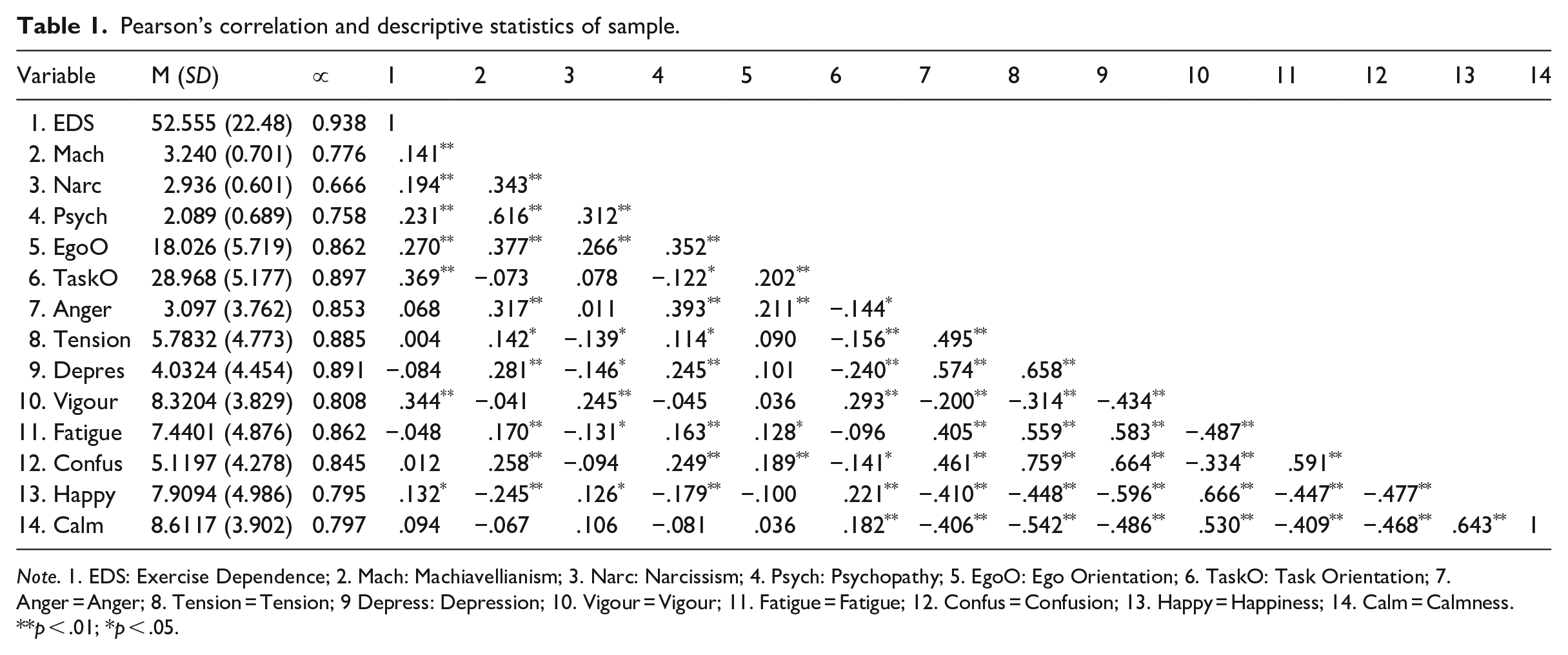
Note. 1. EDS: Exercise Dependence; 2. Mach: Machiavellianism; 3. Narc: Narcissism; 4. Psych: Psychopathy; 5. EgoO: Ego Orientation; 6. TaskO: Task Orientation; 7. Anger = Anger; 8. Tension = Tension; 9 Depress: Depression; 10. Vigour = Vigour; 11. Fatigue = Fatigue; 12. Confus = Confusion; 13. Happy = Happiness; 14. Calm = Calmness.
p < .01; *p < .05.
Correlations between dark personality, motivation, mood states, and ED
Correlational analysis (Pearson’s r) assessing the relationship between ED, dark personality traits, motivation, and mood states is reported in Table 1. Overall, significant positive correlations were observed between ED, dark personality traits, motivation, and two mood states, which were mostly weak to moderate correlations. Specifically, significant weak positive correlations were observed with Machiavellianism (r = 0.141, p = .010), narcissism (r = .194, p< .001), psychopathy (r = .231, p< .001), ego orientation (r = .270, p< .001), and happiness (r = .132, p= .020). In addition, significant moderate positive correlations were observed between ED with task orientation (r = .369, p< .001) and vigour (r = .344, p< .001).
While it is not pertinent to the aim of this study, it is imperative to note the correlations between other variables, namely, the DT traits, motivation, and mood states. For Machiavellianism, weak positive correlations were observed with negative mood states, that is, tension (r = 0.142, p = .012), depression (r = .281, p< .001), fatigue (r = .170, p= .003), and confusion (r = .258, p< .001). In addition, a weak negative correlation was noted with happiness (r = −0.245, p< .001) and a moderate positive correlation with ego orientation (r = .377, p< .001) and anger (r = .317, p< .001).
For narcissism, weak negative correlations were observed with tension (r = −0.139, p = .015), depression (r = −0.146, p= .010), and fatigue (r = -0.131, p= .021), as well as weak positive correlations with ego orientation (r = .266, p< .001), vigour (r = .245, p< .001), and happiness (r = .126, p= .026).
For psychopathy, moderate positive correlations were observed with ego orientation (r = 0.352, p < .001) and anger (r = .393, p= .001). In addition, weak positive correlations were observed with tension (r = .114, p= .045), depression (r = .245, p< .001), confusion (r = .249, p< .001), and fatigue (r = .163, p= 4). Weak negative correlations were observed among psychopathy with task orientation (r = −0.122, p= .031) and happiness (r = .179, p= .002).
Weak positive correlations were noted among ego orientation and three mood states, that is, anger (r = 0.211, p < .001), fatigue (r = .128, p= .025), and confusion(r = .189, p< .001). Finally, for task orientation, weak positive correlations were observed with vigour (r = .293, p< .001), happiness (r = .221, p< .001), and calmness (r = .182, p= .001). Weak negative correlations were noted between task orientation with depression (r = −0.240, p< .001), tension (r = −0.156, p= .006), anger (r = −0.144, p= .012), and confusion (r = −0.141, p= .013).
Predicting ED
Standard multiple regression analyses with the forced blocked entry method were conducted to determine if dark personality traits, motivation, and mood states are predictors of ED (Table 2). Based on the results of correlation, three DTP traits, both task and ego orientation and one mood state, vigour, correlate strongly with ED. Thus, these six independent variables (Machiavellianism, narcissism, psychopathy, ego orientation, task orientation, and vigour) were included as independent variables in the analysis. ED was included as the dependent variable.
Results of standard regression analysis with exercise dependence.
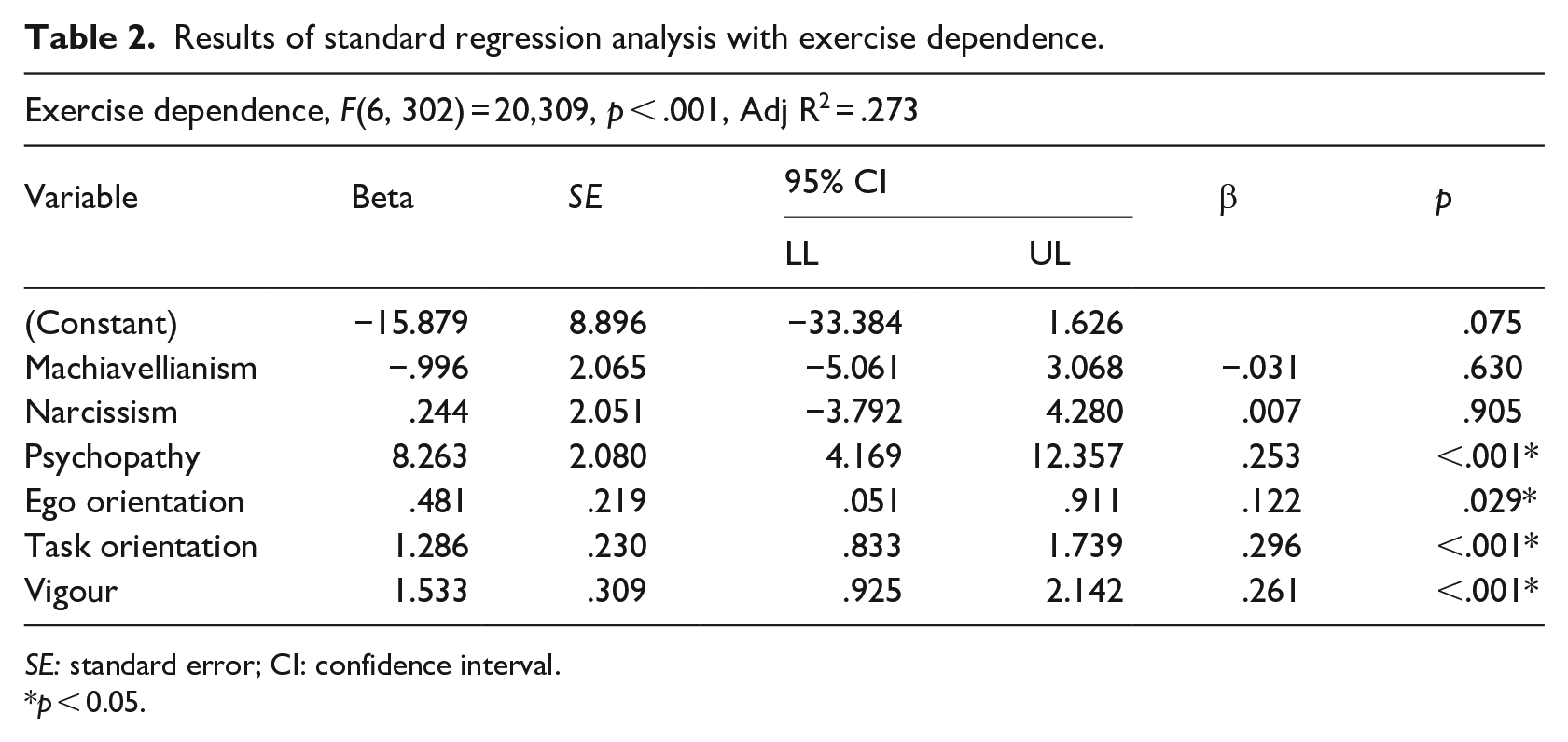
SE: standard error; CI: confidence interval.
*p < 0.05.
The model explained 27.3% of the variance in ED (R2 = .273, F(6, 302) = 20.309, p < .001) with psychopathy (p< .001), ego orientation (p= .029), task orientation (p< .001), and vigour (p< .001) being significant predictors of ED.
The highest predicting factor of ED was task orientation (β = .296), followed by vigour (β = .261), psychopathy (β = .252), and ego orientation (β = .122). No issues with multicollinearity were detected as the VIF for all variables was <10 and tolerance was <.1. A summary of the results is displayed in Table 2 above.
Discussion
ED is a negative pattern of behaviour that both athletes and regular exercisers face, evident from the high prevalence rates (Egorov & Szabo, 2013; Petit & Lejoyeux, 2013; Trott et al., 2020). To expand our knowledge on the development, continuation, and maintenance of ED, this study aimed to elucidate the relationship between ED and the DT personality traits, motivational factors, and mood states. Overall, key findings suggest that ED has a significant relationship with dark personality traits, motivation, and two positive mood states. Furthermore, it was determined that psychopathy, motivational factors, and vigour contribute significantly to the prediction of ED.
ED and the DT
Research findings of this study showed that ED has a positive relationship with narcissism, Machiavellianism, and psychopathy, implying that higher levels of DT personality traits put exercisers at a higher risk of developing ED. This corroborates research by Nogueira et al. (2019) and González-Hernández et al. (2023) that demonstrated the direct and significant relationship between DT traits and ED.
From the three DT personality traits, narcissism and its link to ED have been widely researched, and several studies have highlighted the strong relationship between ED and narcissism (Cook et al., 2020; Costa & Oliva, 2012 ; Miller & Mesagno, 2014; Nogueira et al., 2019). Individuals who display high levels of narcissism are more likely to engage in exercise and develop exercise dependency. Narcissistic individuals thrive in environments where they gain attention, display vanity, and show superiority (Nogueira et al., 2019). Exercise and physical activity are some of the behaviours that narcissists use to exhibit their prominence and enhance their self-worth (Miller & Mesagno, 2014). As such, narcissism is one of the risk factors for ED.
Unlike narcissism, research focusing on the link between ED with Machiavellianism is fairly limited. In this study, Machiavellianism correlated positively with ED, indicating that individuals with higher levels of Machiavellianism are also more likely to develop ED. This supports previous research findings that focused on dark personality as a risk factor for ED (Nogueira et al., 2019). Machiavellian individuals rely on manipulation, strategy, misrepresentation, and cruelty to achieve their goals (Nogueira et al., 2019; Sabouri et al., 2016). Within the sports context, Machiavellianism has been linked to cheating attitudes, devaluating the efforts of other athletes (Jones et al., 2017), aggression (Baar & Wubbels, 2011), and performance-focused cruelty (Mirzaaghazadeh et al., 2016). Despite the negative connotations of Machiavellianism, this personality trait has also been linked to competitiveness, improving confidence in your own abilities, and as a psychological advantage (Houston et al., 2015).
In relation to ED, psychopathy is the least studied personality trait in the DT. While there are 24 studies (Colangelo et al., 2023) that investigated psychopathy within the sports context, only one study (Nogueira et al., 2019) focused on the link between psychopathy (as part of DT traits) and ED. In this study, psychopathy also showed a positive relation with ED, and it predicted ED. As a result, individuals with high levels of psychopathy tend to have a predisposition for ED. Generally, psychopathy is related to adverse behavioural traits such as lack of empathy, manipulation, grandiosity, and thrill-seeking behaviours (Colangelo et al., 2023; Malesza & Kaczmarek, 2021; Nogueira et al., 2019). However, ‘successful psychopathy’ occurs when an individual is motivated to seek success, such as by displaying confidence and charisma and attracting positive attention (Colangelo et al., 2023; Welsh & Lenzenweger, 2021).
Motivation and ED
From an exercise psychology perspective, motivation plays a crucial role in maintaining regular exercise and encompasses the psychological drive that both initiates and sustains physical activity (Lin et al., 2023; Stussi et al., 2019). Understanding the various facets of motivation, such as achievement goals, is essential for comprehending ED. In this study, research findings showed a positive relationship between both task and ego orientation with ED. In addition, both of these motivational variables were predictors of ED, suggesting that individuals with high task orientation and high ego orientation are more likely to develop ED.
Task orientation is an achievement goal that is associated with perceived competence, intrinsic motivation, persistence, and success in sports due to high effort (Harwood et al., 2015; Teixeira et al., 2012). Overall, individuals with high levels of task orientation are self-motivated, persistent, and dedicated to achieving their personal exercise goals. As such, these individuals have the tendency to intensify their exercise engagement and frequency to achieve success, thereby increasing their likelihood to develop and maintain ED.
The second achievement goal was ego orientation, which is characterised by competitiveness, comparing yourself to your peers, valuing ability over performance, and the perspective that winning has a greater importance than personal improvement (Albert et al., 2024). In the sport and exercise setting, ego-orientated individuals place greater significance on performing better than others (Daumiller et al., 2021; Elliot & McGregor, 2001). In this study, ego orientation was a statistically significant predictor of ED and there was a direct positive relationship with ED. This suggests that an ego-orientated individual is more likely to engage in a more rigorous exercise regime and excessive exercise if the outcome involves displaying their superiority.
Mood states and ED
Mood states were fundamental in the development and sustenance of ED (Berczik et al., 2012; Costa et al., 2013; Hamer & Karageorghis, 2007). These mood states can significantly influence an individual’s relationship with exercise, acting as both a motivating factor and a potential catalyst for compulsive exercise behaviour. Positive mood states, such as feelings of euphoria, often reinforce the desire to engage in physical activity. Conversely, negative mood states, such as depression or stress, can drive individuals to exercise as a coping mechanism. In this study, research findings suggest that two positive mood states, that is, vigour and happiness, had a positive correlation with ED. This contradicts previous research studies that suggested ED is related to mood deterioration and negative mood states (Berczik et al., 2012; Costa et al., 2013). The research findings of this study can be supported by the affect regulation hypothesis of ED (Berczik et al., 2012; Costa et al., 2013; Hamer & Karageorghis, 2007).
In this study, vigour was the only mood state that predicted ED. This confirms a study by Costa et al. (2013) that explored the role of exercise frequency, mood states, age, and gender differences in ED. Research findings of this study suggest that exercise engagement is linked to feeling more energetic and enthusiastic and having an overall sense of well-being. However, over a period of time, the exerciser might need to intensify and increase their exercise to feel these positive effects. As such, these individuals are more likely to develop ED.
Limitations and recommendations for future research
This study enhances the understanding of ED by exploring the relationships between DT personality traits, motivation, and mood states. Nonetheless, it is important to acknowledge its limitations. First, the reliance on a convenience sample of South African university students limits the applicability of the findings to broader populations. Future research might benefit from studying diverse groups, such as non-student populations, regular exercisers, and athletes. Second, the use of a quantitative, cross-sectional research design prohibits researchers from identifying causality between variables. This study only showed the correlation between DT traits, motivation, mood states, and ED and predictor variables of ED. Future studies can adopt a mixed-methods research design where individuals at risk for ED can be invited to focus groups and interviews. This would allow researchers to gain insight into participant’s exercise behaviours to be able to identify specific risk factors of ED.
Conclusion
This study aimed to identify and analyse the role of the DT personality traits, motivation and mood states in ED. This study replicates previous research findings that showed that narcissism and Machiavellianism are connected to ED. Research findings highlighted a positive correlation between psychopathy, task and ego orientation, and mood states with ED. Furthermore, this study made significant contributions to ED literature by showing that psychopathy, task orientation, ego orientation, and vigour were strong predictors of ED. Thus, the findings of this study could potentially be used to identify and treat individuals who are at a higher risk of developing exercise dependency.
Footnotes
Declaration of conflicting interests
The author(s) declared no potential conflicts of interest with respect to the research, authorship, and/or publication of this article.
Ethical considerations and consent to participation
The Health Research Ethics Review Committee at the University of Fort Hare (REC-100118-054) and the North-West University (NWU-00084-23S1) approved our study on 29 March 2023 and 20 July 2023, respectively. Respondents gave consent prior to accessing the full questionnaire.
Funding
The author(s) disclosed receipt of the following financial support for the research, authorship, and/or publication of this article: This work was supported by the National Research Foundation of South Africa (grant no. PMDS2205035898).

Data availability
The authors confirm that the data supporting the findings of this study are available within the article.