




Abstract
In this article, I argue that although our society became free in 1994, there is a way in which many psychologists and psychology students remain unfree. The unfreedom of interest is of the epistemic kind. To move from a state of being epistemically unfree to being a free psychologist, I contend that we must jettison American-centric White epistemology, White ignorance and ways of thinking about and doing psychology towards situated epistemologies and practice.
Keywords
Introduction
It is curious that an individual can live in a free country, not be physically imprisoned, and yet somehow be unfree. Being unfree suggests being subject to the control of another person or force, since freedom in the first instance is self-determination (Gill, 1971). Given the state of global psychology, in an important respect many psychologists exhibit a certain freedom deficit. As Tsegay Serequeberhan (2019) wrote, ‘the thinking of the dominant segment of Westernized Africa has internalized, as a positive fact, the claimed superiority of the West’ (p. 18). While he was not referring to psychology as such, my contention is that the internalisation of the assumed superiority of the West seems applies also to psychologists in Africa. This apparent internalised inferiority when thinking of Africa in relation to the West is observable among even some of us who live in a nation in which we enjoy strong constitutional civil and political freedoms. What this inferiority signals is that political freedom is different from the freedom I have in mind. The lack of freedom with which I am concerned is epistemic self-colonisation or self-incarceration (Akomolafe & Ladha, 2017). In this context of knowledge, this form of unfreedom can be referred to as colonial mentality. Conversely, the freedom under scrutiny is of the epistemic kind (Ndlovu-Gatsheni, 2018); in other words, decolonial mentality with regard to epistemology.
Epistemic unfreedom can be defined as metaphorical entrapment in knowledge frameworks whose main purpose is to support the domination and power of some groups (if not also the domination of a part of oneself). As epistemic self-colonisation this is the condition where a therapist or academic who is regarded or regards herself as expert is not an epistemic sovereign, and instead assumes the role of an agent who perpetuates colonial mentality. As an expert, the person might well benefit from her occupation, yet the work she does perpetuates the economic impoverishment, cultural oppression, or mental subjugation of others.
While it is true that what many of us may sometimes uncritically take as well-founded what we read, or hear, or see, an indicator of epistemic incarceration begins when a person does not challenge the founding logic of what is taken as valid or reliable knowledge. This unquestioning attitude is particularly perverse in the circumstances where that logic of knowledge perpetuates the oppression of others (if not a part of oneself). Accordingly, a teacher of psychology in a society such as ours who does not question the colonial and racist foundations of psychology effectively perpetuates the unfreedom of and existential, material, cultural and political assault against her students.
It is not unreasonable to assume that if we remain ‘neutral’ or unquestioningly accept the foundations of our disciplines or professions we may be complicit with the disciplinary or professional world in which we function world as it is. When the hegemonic ideas, structures, tools, and interpretations have supported or continue to support coloniality or whiteness as a natural standard, patriarchal imagination, or WEIRD epistemic and cultural values, our ‘neutrality’, silence, or lack of resistance perpetuate and support these ideas. (WEIRD values refers to values derived from Western, Educated, Industrialised, Rich, and so-called Democratic societies; Henrich et al., 2010).
Epistemic self-colonisation or self-incarceration is akin to conceptual incarceration as defined by Wade Nobles (1978). According to Nobles (2013), writing from an African American perspective, conceptual incarceration implies that ‘the knower is given a set of predetermined concepts and definitions to use in the process of knowing . . . In this regard, alien or Eurocentric ideas inhibit us from fully understanding African reality’ (p. 233). And, according to DeReef Jamison (2008), also from an African American position, ‘the placing of European American conceptions and formulas as the universal standard can conceptually incarcerate Black psychologists as they seek to study African American life experiences’ (p. 110). We should not miss the role of the self in conceptual incarceration here. The logic of colonisation is imposed from outside the individual, however we must admit how the self takes over an internalises colonial ‘common-sense’ when it comes to, for instance, what is knowledge, how to acquire it, accepted standards of valid knowledge, and who is seen as a knower.
The opposite of conceptual incarceration is conceptual self-determination, and one moves from a state of epistemic subjugation, through epistemic decolonisation, to epistemic freedom. Like epistemic decolonisation, epistemic freedom is grounded in asking questions about knowledge and truth. Epistemic freedom suggests resistance against the oppressive, ruling analytical frameworks and interpretations. The inclination of epistemically free subjects is to seek or develop emancipatory ideas, concepts, methods, and interpretations for themselves. While these freeing tools may be shared with others, the quest for emancipatory knowledge can well be an individual pursuit. Characterised by a deep appreciation that knowledge and its modes of production can serve oppression, the quest for epistemic freedom enables us to see more clearly how we arrive at knowledge, what is it we know, and the ends to which we use knowledge. When we are epistemically emancipated we are able to recognise that, for example, knowledge can be used to oppress or to resist, support the status quo or work for a different kind of social and economic arrangements (see Gordon, 2014).
(South) African psychology freed from WEIRD, American-centric epistemologies
Although our society, South Africa, became politically free in 1994, it appears that many psychologists in our society remain epistemically unfree, captured, or self-colonised. When one is a teacher of psychology, this epistemic state is transmitted to students. When one is a therapist, epistemic (self)-colonisation informs the model of psychological health. What is of interest is, then, not only freedom from epistemic domination by others over oneself and epistemic self-colonisation, but also freedom to create, use, question and circulate knowledge.
World psychology is dominated by America(n)-centric psychology, and more broadly Western-centric thought and life-ways. In such a world, to move from a state of knowledge-related incarceration to being an epistemically free psychologist or psychology student begins with learning to critically reflect on the unwelcome power of America(n)-centric ways of thinking about human and other-than-human life (some of) which psychology studies. Equally important, a person must confront their own perpetuation of these ways of thinking., I focus mainly on America(n)-centric psychology instead of Western/Euroamerican-dominated more broadly because, while Europe was the birthplace of psychology as a discipline, the United States of America currently dominates psychology, not just ideationally but practically and most textbooks we use to teach undergraduate psychology come from America. From the view of a situated psychology (see Cushman, 1990; Kiguwa, 2023), the aims of the project of epistemic freedom is for a (South) African psychology freed from White, American-centric, epistemologies.
The article is structured in the following manner. It begins with a short narrative of my return to teach psychology after over a decade of turning my back on the discipline. Next it turns to what epistemic freedom has to do with teaching psychology and is related to something important that occurred a few years ago: the apology issued by the American Psychology Association (APA) for its part, and on behalf of American psychology as a whole, in perpetuating and supporting racism. That is followed by a section on how those who teach in psychology departments in African countries might go about teaching America(n)-centring psychology, if teaching it at all is necessary.
Returning to teach psychology differently
In the winter of 2021, amid COVID-19, I returned to teaching psychology. I had agreed to join Stellenbosch University (SU), a historically White Afrikaans-language medium institution, and still predominantly White university, as my employer. This is a university that was the home of Afrikaner psychologists and other intellectuals who offered scholarly support to the system of apartheid. (There had been some Afrikaner intellectuals at SU who resisted the logics of apartheid, but they were in the minority.) However, I chose to accept a position at Stellenbosch University precisely because of the place it historically was, but also – against another side of the self that might choose Black-majority spaces – what I saw it could be, even though researchers at the university continued to reproduce racist science (Nieuwoudt et al., 2020). I was one of the academics that led a global effort to have that academic article retracted because it was ethically unjustifiable, methodologically poor, and weak (see Boswell et al., 2019). My principal motivation to join SU was that I could teach White students (who are the majority) and Black students (who, being a cultural minority, may still need to see someone like me in front of them), and to question WEIRD, America(n)-centric psychology to begin freeing them from its domination.
A decade-and-half had passed since I had turned my back on teaching, following 11 years of lecturing at a historically Black university. An accumulation of feelings of frustration were behind my decision to quit teaching. I could no longer bear the absurdity, sense of imprisonment, as well as experience of the meaninglessness of channelling concepts, tools, and conclusion in textbooks I knew were based on studied ignorance of the conditions in my society. Whitestream psychology was more than merely distressing me. What I was teaching was not simply disconnected from the realities of the place and time in which I live and the realities of the students I was meant to educate. I was another peddler for Western European and North American psychologists to distribute their ideas in my country, ideas which are Western-centric, White supremacist, anti-African and culturally inferiorising. Nhlanhla Mkhize (2021) has said that the ‘Psychology training curriculum progressively alienates Black/African students from their historical and cultural backgrounds’ (p. 423). I was aiding and abetting that alienation. Like many other psychology teachers in African universities who relied on Western European and North American textbooks and academic articles, it took me a while to recognise that I was supporting Euroamerican epistemic domination, whether I admitted it or not, and to move towards being free epistemically.
If (South) African psychologists want to build a different ‘psychology’ from the WEIRD one, teaching and mentoring undergraduates is where that future starts. My return to teaching was, therefore, auspicious as, in 2022, I won a teaching prize for the 4 weeks that I taught the first years during that first winter of 2021. I was pleased to have received this prize because it was for lectures that were billed as African psychology which I taught as part of PSY144 (Psychology in Context). It was the first time that I taught African psychology to undergraduate students.
What I teach in African psychology is a refusal to quietly succumb to colonial and White supremacist WEIRD psychology. It is also a project meant to nurture epistemic freedom. When students approach me with questions, when they are not simply taking what I say as God’s truth, questions which I invite and embrace, I interpret the approach as a willingness and an openness to learn something new and even unsettling to what they learn in others classes. In the African psychology lectures I offer, the aim is to inspire students to question many things that are misleading, incomplete or missing in the America(n)-centric psychology texts which continue to dominate within African universities. The class I teach is therefore intended to stimulate a place- and time-based psychological thinking in students of all backgrounds. The goal is to nurture in students something other than what I suspect they would get elsewhere.
Epistemic freedom and the teaching of psychology
Whereas some of the major obstacles in the path of the freedoms of African people during previous centuries were, among others, political colonialism, weak state institutions, and economic underdevelopment, one major issue we face in the knowledge economies of the 21st century, is, per definition, that of knowledge (which is wrapped up with escalation of information, misinformation and disinformation). Although the old troubles have yet to be fully surmounted, the epistemic (and information) terrain has become a major site of struggle. There are many questions here, for example: whose knowledge counts; what is the relationship between information and truth; how does interpretation relate to experience; and, indeed, what is it to know? Struggles against epistemic colonisation and for epistemic freedom are indubitably significant for those who were historically excluded from universities and knowledge creation opportunities, but who have, from a certain historical point, entered universities and taken up these opportunities.
Epistemic freedom, when looking at the global knowledge order from African countries, according Sabelo Ndlovu-Gatsheni (2018), is ‘about the right to think, theorize, interpret the world, develop own methodologies and write from where one is located and unencumbered by Eurocentrism’ (p. 3). I do not know if a right such as the freedom to think is contained in any country’s constitution, even one as extolled as the South African one. Such a right is, however, implicitly linked to another, namely that ‘everyone has the right to freedom of expression, which includes – academic freedom and freedom of scientific research’ (Republic of South Africa, 1996, p. 7). To interpret the world in the light of one’s situatedness, a freedom that I posit is bound with subjective decolonisation, is one that a self-determining psychology professional and psychology student cannot do without. This right to think, make theory, and offer explanations of one’s own is the basis of free knowledge-making beyond America(n)-centric thought about human (and other-than-human) life.
Epistemic freedom as a process encompasses moving through freedom from epistemic colonisation towards freedom to create and share knowledge. That implies taking the step of freeing oneself from thinking America(n)-centric is psychology, to producing methodically situated psychological knowledge so that the world can benefit from other ways of being, relating, thinking and living.
Epistemic fights in psychology are part of the same fabric as other fights in other disciplines (for instance, law and urban planning), and these intra-discipline clashes never happen in a vacuum, away from contestations around, for instance, economic orders, cultures, politics, and wars. In psychology, the epistemic project of the discipline has been closely allied to the material-ideological and socio-cultural ends of the Euroamerican domination and the supremacist whiteness of colonial-capitalist development. The link is bi-directional. The knowledge created by psychologists has largely supported, for instance, colonial-capitalist economic development, and this ‘development’ has buttressed the legitimacy and growth of psychology.
In our society, the association of psychology to oppressive political, social and economic structures has been a focus of sustained critique among those who are aware of the history of the discipline in the world and country (Anonymous, 1986; Duncan et al., 2001; Lazarus, 1988; Long, 2014; Manganyi, 1973, 2013; Naidoo, 1996; Nicholas & Cooper, 1990; Seedat, 1993). The epistemic edifice of psychology, which includes what counted as legitimate research questions, tools, and interpretations, was closely tied to the structures of colonialism and apartheid. In this vein, a while ago, Bulhan (1985), an influential figure among progressive psychologists, showed that As Europe conquered much of the world, the European imposing as the only honorable model of humanity, the discipline of psychology too emerged as a powerful specialty and a scientific arbiter of human experience. The discipline of psychology did not of course emerge in a social vacuum unrelated to Europe’s history of conquest and violence. From its beginning to the present, the discipline has been enmeshed in that history of conquest and violence. (p. 37)
In ‘Psychology and apartheid: the struggle or psychology in South Africa’, Cooper and associates (1990), writing before the inception of political democracy, asked, How has psychology, with such apparent facility, come to serve – in mines, the schools, the hospitals, the prisons, the ‘homeland’ reserves – the interest of the apartheid system? How is it that psychology as a discipline, a body of knowledge and as a profession has been so compatible with the system of social control based on racism, coercion and brutality? (p. 1)
More recently, Kessi (2017) stated that, ‘the work of psychologists contributed to the legitimisation of slavery, colonisation, apartheid, and the genocide of millions of Africans and colonised people from the global south’ (p. 507). The association of psychology to varied forms of oppression such as economic, gender and racist oppression is undeniable.
The apology by the American Psychological Association for perpetuating racism
It is likely that there are psychologists who do not identify as racist yet have lived with ignorance of the colonialist and racist history of their discipline, in our society and in other parts of the world such as Asia, Latin America, North America, and Europe. For some of these, the idea that psychology supported and promoted racism and White supremacy may come as new knowledge and, perhaps difficult to integrate. The relationship of psychology to racism, capitalism, and coloniality, and the discipline’s complicity and active support of supremacist whiteness can, however, no longer be denied.
In 2021, the American Psychological Association (APA) apologised for its role and that of American psychology for perpetuating racism, racial discrimination, and the idea that humans are arranged in a hierarchy with White people at the top (APA, 2021a, p. 1). The apology was to people of colour in the United States. (It should also be noted that, in addition to the apology, the APA and American psychology resolved to examine and chart a path forward to address their roles in racism; APA, 2021b). APA (2021a) recognised that the ‘history of psychology was rooted in oppressive psychological science and the intention was to protect Whiteness, White people, and White epistemologies’ (p. 2). American psychological knowledge, grounded in White epistemologies, was knowledge that supported whiteness and White people’s lives.
It would be a mistake, though, to believe that we have left the psychology rooted in White epistemology in the past. While one can delve into how psychology has continued to support or remain silent about, for instance, colonial land theft or capitalist exploitation, the major problem of concern is White epistemology. Thomas Teo (2022) has said that ‘the term white epistemology is justified when knowledge benefits one ethno-cultural group to the detriment of another’ (p. 2). He also maintained that ‘a white epistemology is not confined to white people’ and ‘indeed, one could use concomitantly the terms dominant, hegemonic, traditional, or Euro-American indigenous epistemology’ (Teo, 2022, p. 2). In contrast to Teo’s argument, though, I regard White (American-centric) epistemology as essentially supportive of White (American-centric) knowledge as normative. White (American-centric) epistemology is, simply stated, White racist epistemology. By way of epistemic violence, as well as more overt forms of White supremacist violence, White (American-centric) epistemology incorporates ‘white ignorance’ (which is another link to White supremacy) and cognitive injustice against Black groups generally and Africans specifically (see Mills, 2007). American-centric White epistemology is, therefore, taken to refer to the knowledge-making processes and outcomes whose defining logic is primarily to benefit Whites and handicap other race and national groups. Broadly, then, White epistemology implies White racism and racial discrimination embedded in and via knowledge, knowledge-making institutions, and knowledge-making activities. Within psychology, dominated as it is by American psychology, White racist epistemology is realised in, for example, using textbooks and other material by mainly American and/or White authors, underfunding research by Black and African researchers or not funding them at all, using racially biased and/or American samples in studies, dismissing or marginalising Black and African people’s ways of life and thinking about a topic while elevating White ways of life and thinking, and swamping the world with academic articles and books by American and American-centring authors, and hampering entry for Black and African graduates into research and teaching jobs. In short, the operations and effects of White epistemology are sometimes subtle and sometimes overt, now systemic and now subjective, but ultimately for the benefit of dominant groups, in America but also other countries.
Since the deep, historical links of psychology with racism has been accepted by none less than American psychology, we may ask why so many psychologists and psychology organisations in former coloniser countries such as Australia, Britain, France, Germany, and Portugal have not yet demanded of themselves to challenge oppressive politico-economic and knowledge systems in their countries that fed into their psychologies? The question is related to another, one that is more directly related to psychologists in our society today: why is there still an apparent reluctance to turn away from the White racist epistemic domination of American psychology on our thinking, teaching, research, and therapeutic practices, knowing that White supremacist WEIRD epistemology pervade American psychology?
Decades before the APA issued its apology, Cooper and colleagues (1990) asked the question ‘what has been the role of American psychology in supporting and abetting this process (of social control based on racism, coercion and brutality)?’ (p. 1). It is necessary to underline, then, that the apology about the role of American psychology and the APA in perpetuating racism was directed to people of colour in the United States, not to Black South Africans or anybody else. Ought the APA and American psychologists be made to recognise that the racism that was promoted and perpetuated by American psychology and the APA affected people far beyond the borders of that country? It is not unreasonable to want American psychology to realise its complicity with the global condition of a discipline that has been grounded in White epistemology and racism, because America dominates world psychology and American psychology supported and perpetuated racism. It is not unreasonable also because racism, which can be seen in psychology and in other areas of society, is a form of systemic oppression and interpersonal bigotry that cuts across national borders. Therefore, American psychology’s support for racism implies support for global racism that reaches far beyond the borders of America and boundaries of psychology. It might be argued that the next apology that the APA and American psychology must issue should go to Africans, Blacks and other people who have been targets of colonialism and racism the world over for the support given to these oppressive systems by the APA and American psychology.
An opposing argument can be mounted against a demand for an apology by those who are outside of the United States but have been harmed by American psychology and the APA. Although American psychology and the APA supported and perpetrated racism, it can be argued, American psychology and the APA cannot be held responsible for racism in and through psychology outside of America. Even if it is the case that there is a clear relationship between the discipline of psychology and racism (and/or colonialism and coloniality, as a sizable and ever growing body of literature shows; e.g., Adams et al., 2017; Beals et al., 2021; Bhatia, 2018; Bou Zeineddine et al., 2022; Bulhan, 1985, 2015; Canham et al., 2022; Maldonado-Torres, 2017; Malherbe et al., 2021; Pickren, 2020; Pillay, 2017; Readsura Decolonial Editorial Collective, 2022), non-Americans who have been targets of racism, colonialism, and coloniality must take care of themselves for addressing racism in their societies. In other words, it can be argued that, even if American psychology was racist, no one forced any non-American to learn, teach, or use American psychology.
So, what shall we do about American psychology in psychology departments in Africa?
If some of the responsibility to obliterate the racism in and through psychology that was exported to the rest of the world by America resides with those who teach psychology in universities in African countries, the question is should psychology departments continue to teach American psychology, given the likelihood of reproducing notions of human hierarchy, racism, White supremacy, and American-centrism? (While this question is directed at the teaching of psychology, similar questions can be directed at other kinds of psychology professionals such as therapists, counsellors, educational psychologists, psychometrists but also students of psychology.)
Delinking from American psychology is an option to consider. That option would entail beginning afresh, cleansing psychology of the racism and coloniality that issues from work from that country. It may even mean rethinking the entire enterprise we call psychology. To fully recognise that one is associated with a discipline that supported White racism requires to engage in rationalisations. Even so, repudiating American psychology will be a long and hard-going effort. I do not see many of us choosing this path. The unavoidable fact is that American psychology, even with all its admitted support for White supremacy and White epistemology, is too powerful to completely throw out. Even more disturbingly, American psychology is deeply lodged in many of us. Besides, we are trapped in the linguistic colonial matrix. That this article is written in English signals to the linguistic domination that compounds the tremendous difficulty we face if we were to begin studies of human relations and minds from scratch and in our languages. It would take an epistemological revolution to not have American psychology taught in psychology departments in African countries. If there will be no revolution, the question to ask is, how to live with American psychology.
One possibility is to have learning units with names such as ‘Introduction to American psychology’ and ‘American personality psychology’. This renaming process would make it clear that what is taught is America(n)-centric knowledge. Such courses will then be taught alongside courses or units labelled ‘Introduction to African psychology’ and ‘African personality psychology’.
A different route is to see ourselves, psychological knowledge we learn, create and use, as well as the society in which psychological knowledge is produced as irretrievably entwined. That suggests that hegemonic American psychology will always be interwoven with prevailing American notions about humans and other-than human life. This is not abnormal – to have American psychologists take America and its problems, idiosyncrasies and achievements as the main concerns for their work is to be expected. What is abnormal (or likely to [re]produce colonial mentalities) is for psychologists and psychologist students in African and other societies around the planet to implant American concerns, questions, theories, and conclusions about life in the middle of African societies. The sane thing for psychology teachers to do in African settings would be to have teaching and learning materials take existence and lifeways in their societies as the source of their epistemological concerns. To illustrate, in Figure 1 represent a way a psychology department could organise a programme of teaching and learning. If American psychology, which the APA has admitted supported racism, is not completely jettisoned, it needs to be placed alongside other, preferably antiracist and anti-colonial psychologies. At the centre of such a programme would be Africa(n)-centring epistemology, ways of being, and practice. In this way, epistemic freedom from epistemologically White, American-centric psychology is likely to be nurtured.
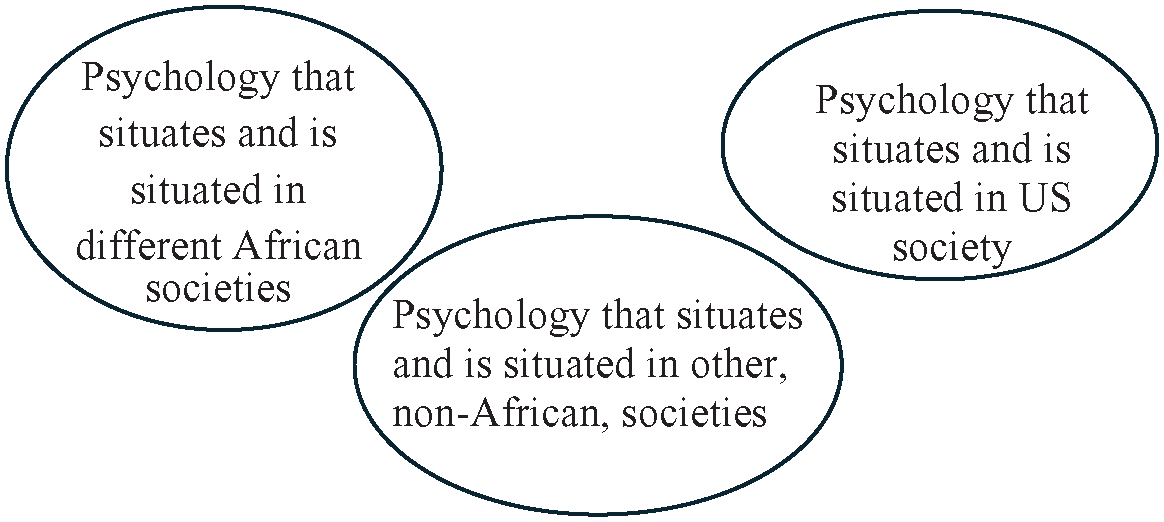
Situating and situated psychology.
There are, that is, multiple ways in which an individual or department can think about, organise and teach psychology so that place, history, and people’s ways of being are centred. That is also to say there are different ways to see the world in which psychology and psychologists are situated. To help visualise the possible ways a teacher or student of psychology might situate herself and her work, I have indicated elsewhere what I called four orientations (Ratele, 2017a, 2019) While the demarcation of different orientations within African psychology helps when trying to understand one’s own or others’ situatedness within psychology and psychology’s locatedness in the world, these orientations are to be considered as open, dynamic and useful for thinking with, not fixed and definitive (Ratele, 2017b).
Since I have mainly used American psychology as an example in talking about WEIRD and African psychology, the orientations framework can be represented as shown in Figure 2. The figure makes clear that these are stances, not subdisciplines or branches of psychology. The simple though crucial point is that what distinguishes these orientations are the ways time (or temporality) and place could be variedly apprehended by psychology teachers (or researchers, organisational psychologists, therapists, and students). How time and place are thought about and conveyed in psychology is rarely overtly stated. It often requires a close reading by an observer to see the temporal and place-embeddedness of psychological theories and research. One of the objectives of the orientations framework is, then, that psychologists and psychology students make explicit, at least to themselves, about what they think of the place and time written into or erased from psychology but also in which they as subjects live, study or work.
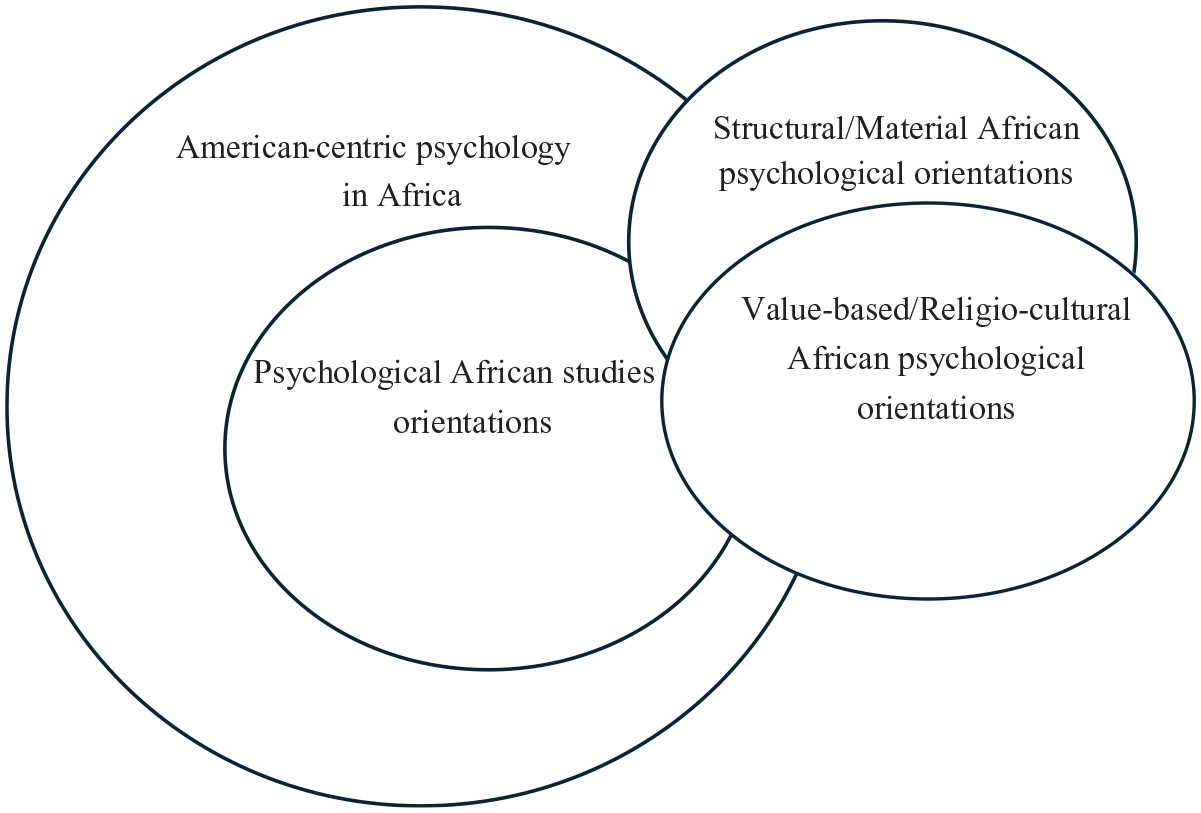
Africa(n)-centring psychological orientations and America(n)-centric psychology in Africa.
Conclusion
This article has argued that even though our nation became politically free 30 years ago, there appears to be a way in which many psychologists in our society remain epistemically colonised. The freedom with which the article grappled is freedom from epistemic domination by American psychology and self-colonisation towards epistemic freedom.
I used American psychology as an example to talk about epistemic domination and freedom because America(n)-centric dominates psychology. More importantly, American psychology was used because something of great significance came out of America in 2021. The APA issued an apology for its part and on behalf of American psychology for upholding and propagating racism and the idea of a human hierarchy where White humans are at the top and the rest below. The epistemic project of American psychology is, it turns out, the racist knowledge department of White supremacy.
Among several implications of the APA apology is that it is possible to be a psychologist, meaning implicitly obliged to fairly understand or heal people, and yet to perpetuate racist supremacy and epistemic injustice. Where psychology is suffused with White epistemology, racism and naturalised notion of human hierarchy, teachers of psychology can enable the oppressiveness of psychology to continue or enable students to challenge this oppressiveness. The same is true for researchers and psychotherapists. As such, the right to think freely, grounded in the place and time in which we exist, is the basis of epistemic decolonisation and freedom. What one hopes for is, then, that in time there will be a visible shift from epistemologically White, America(n)-centric psychology and its influential ideas to more situated psychologies, so that the world may benefit from the widest range of ideas about being human and social life.
Footnotes
Declaration of conflicting interests
The author(s) declared no potential conflicts of interest with respect to the research, authorship, and/or publication of this article.
Funding
The author(s) received no financial support for the research, authorship, and/or publication of this article.
