




Abstract
The process of transforming South African psychology requires several coordinated initiatives. One initiative likely to unlock the transformation process in exponential ways is through attaining race-based representativity in the South African psychology workforce. Using graduation data, this article reports on the pace of racial transformation and representativity among professional psychology graduates from the University of KwaZulu-Natal. Since its inception in 2004, the University of KwaZulu-Natal has made concerted efforts to transform the racial, gender, and socio-economic diversity of its student and staff body. The institution has produced at least 469 professional psychology master’s degree graduates in clinical, counselling, educational, industrial, and research psychology during this time. However, only 43.9% of these professional psychology graduates have been Black African, while the average year-on-year increase in Black African graduates was only 9.7% between 2005 and 2020. A forecasting model predicts that the University of KwaZulu-Natal is only likely to achieve national race-based representativity among its professional psychology graduates in the 2026 graduation cohort, and provincial representativity in the 2028 cohort. This article discusses why race-based representativity remains foundational in transforming professional psychology, and how and why the pace of racial transformation among professional psychology graduates at the University of KwaZulu-Natal has been relatively slow, despite transformational efforts and successes at an institutional level.
Introduction
This article centralises the construct of race and the transformative imperative to attain proportional racial representation (i.e., representativity) among professional psychology practitioners in South Africa (Pillay & Nyandeni, 2021). Although race is a biological myth (Sussman, 2020), it was used to justify slavery (Baker, 2021), perpetuates scientific racism (Saini, 2019), and has become embedded in the socio-economic, political, and ideological structural inequalities of historical and contemporary society (Zack, 2014). As a result, race and racism are centrally relevant to scientific and professional psychology (Cooper, 2014).
Although colonialist and race essentialist policies and practices predated the South African Nationalist government in 1948 (Parry, 1983), it was this government’s Population Registration Act of 1950 which officially codified race and race hierarchies in South African society. Whereas racial classification attempts prior to 1948 ‘produced a dense conceptual fog’ (p. 91), the Population Registration Act of 1950 aimed to ‘produce fixed, stable and uniform criteria for racial classifications which would then be binding across all spheres of a person’s life’ (Posel, 2001, p. 98). Of relevance here is how racial classification in 20th-century South Africa violated basic human rights, and proscribed educational and occupational opportunities (e.g., in professional psychology) for Black South Africans.
Founded in 1948, the South African Psychological Association (SAPA) was the country’s first professional psychology association, and ‘believed in White exclusivity, rejecting initially in July 1957 the first application for membership by a Black psychologist’ (Cooper, 2014, p. 839). When a Black psychologist was admitted to SAPA as a member in 1962, the Whites-only Psychological Institute of the Republic of South Africa (PIRSA) emerged as a breakaway organisation, flourishing between 1962 and 1982. While SAPA and PIRSA worked together on matters of shared interest, like advocating for psychology to be a recognised health profession in South Africa through the Health Professions Act 56 of 1974 (Department of Health, 1974), PIRSA also advocated for a profession that prioritised the needs of White Afrikaners (Long, 2014). Despite some evidence of racial integration within SAPA and the psychology profession during the Apartheid era, most scientific and professional psychological work during this era affirmed the privileges bestowed to White people through centuries of colonial exploitation, consolidating these privileges through unethical scientific practices which ‘legitimised’ exploiting Black people (Painter et al., 2006).
Calls for a more relevant and transformed psychology profession increased during the decline of the Apartheid state during the 1980s and 1990s. Notably, ‘[t]he credibility of the psychological profession . . . [in South Africa depended] on it being able to offer effective services to a broad spectrum of people in diverse circumstances’ (p. 1), especially given that ‘psychologists are predominantly white middle-class people providing psychological services to mainly whites living in urban, middle-class areas’ (Rock & Hamber, 1994, p. 6). At the turn of the 21st century, the crisis of race-based inequity within the profession persisted with 90% of South African psychologists being White (Mayekiso et al., 2004). In response to this crisis, the Professional Board for Psychology (2000) asserted that ‘that there shall be at least 50/50 admission to graduate professional psychology programmes by 1 January 2004’ (p. 3). Professional psychology training programmes interpreted ‘50/50 admission’ to mean that ‘programmes should have an intake ratio of 50/50 (i.e., Black/White students)’ (Pillay & Siyothula, 2008, p. 733), with ‘Black’ compositely referring to African, Coloured, and Indian individuals. 1
Overall, questions that dominated South African psychology prior to and during the transition to democracy included whether Western psychological theories were relevant for the mental health needs of all South Africans, how psychology could embrace Afrocentricism and indigenous epistemologies, how psychology could meet the needs of poor and working-class South Africans, and how professional psychologists could become more representative of the population they serve (Long, 2013). These questions still dominate South African psychology today. Although the transformation, relevance, and credibility of (South African) psychology extends beyond race, representativity remains central (Durrheim, 2024; Remedios, 2022) given that despite only making up 7.3% of the South African population (Statistics South Africa, 2023), White psychologists still constitute the majority of psychologists registered with the Health Professions Council of South African (HPCSA) (65.7% in 2022; Padmanabhanunni et al., 2022). In contrast, African individuals make up 81.4% of the South African population (Statistics South Africa, 2023), but only 17.2% of all psychologists registered with the HPCSA (Padmanabhanunni et al., 2022). When considering Coloured and Indian individuals, 8.2% of the South African population were classified as Coloured and 2.7% Indian (Statistics South Africa, 2023). In terms of psychologists registered with the HPCSA, 6% are Coloured and 7.2% are Indian (i.e., a slight overrepresentation of Indian psychologists, and a slight underrepresentation of Coloured psychologists when compared with national population estimates). Recently, the Professional Board for Psychology (2022) identified that professional psychology training programmes should commit to transforming ‘the profession such that at least 75% of students selected . . . are black South Africans’ (p. 4). The onus thus fell, and still falls, on professional psychology training programmes to transform the racial profile of the South African psychology workforce through their recruitment and selection practices. This article focuses on the progress made by one South African professional psychology training institution in contributing towards the representativity of the South African professional psychology workforce.
Method
Research setting
The University of KwaZulu-Natal (UKZN) was formed in 2004 through the merger of the Universities of Durban-Westville and Natal (Makgoba, 2007) and positioned itself as a leader in African scholarship. An essential part of this positioning has been to transform the student body to reflect the racial demographic of the province and country (i.e., 84.8% and 81.4% Black African, respectively) (Statistics South Africa, 2023; University of KwaZulu-Natal [UKZN], 2017). Whereas Black African students only constituted 49.6% of the UKZN student population in 2004, this grew to 82.8% in 2022 (UKZN, 2022). In terms of graduates, 44.9% of UKZN graduates in 2005 were Black African, growing to 78.7% in 2020 (UKZN, 2022). Between 2005 and 2020, UKZN produced 154,294 graduates (61.8% Black African, 2.2% Coloured, 26.4% Indian, and 9.5% White).
UKZN offers professional psychology master’s degree programmes in clinical, counselling, educational, industrial, and research psychology and has done so since inception. At present, it is the only university in KwaZulu-Natal which offers professional training in clinical, counselling, industrial, and research psychology (Professional Board for Psychology, 2023), and thus serves as an important professional psychology training site in KwaZulu-Natal and South Africa, with KwaZulu-Natal being the second most populous province in South Africa (Statistics South Africa, 2023). The Discipline of Psychology on the UKZN Durban (Howard College) campus offers professional training in clinical, counselling, and industrial psychology, while the Discipline of Psychology on the UKZN Pietermaritzburg campus offers professional training in clinical, counselling, educational, and research psychology. Although structurally located within the same school at UKZN and offering the same curriculum, the professional psychology training programmes on the UKZN Howard College and Pietermaritzburg campuses mostly operate independently (e.g., different heads of department, separate selections processes, independent teaching and assessment). A selection policy guides the recruitment and selection practices for admission into both the UKZN Howard College and Pietermaritzburg campus professional psychology master’s degrees (UKZN, 2020). Historically, the policy incorporated the Professional Board for Psychology’s (2000) resolution of ‘50/50 admission’ for Black students ‘by 1 January 2004’ (p. 3). Guided by the demographics of the province (Statistics South Africa, 2023), UKZN amended their professional psychology selection policy in 2020 to specify that over a 3-year rolling cycle, a minimum of 80% Black African (and not just Black) students should be admitted to the professional psychology programmes (UKZN, 2020).
Given the abovementioned focus on representativity among Black African students at UKZN generally and in the professional psychology training programmes, and the underrepresentation of Black African psychologists in South Africa (as identified above), the overall aim of this study was to interrogate the contribution UKZN has made to the pool of Black African professional psychology master’s degree graduates since its establishment in 2004. With the above background in mind, this research focused on three research questions, namely: (1) What proportion of UKZN professional psychology master’s degree graduates between 2005 and 2020 are Black African? (2) How has the probability of being a UKZN Black African professional psychology master’s degree graduate changed between 2005 and 2020? (3) In what year is the proportion of UKZN Black African professional psychology master’s degree graduates likely to match the national and provincial proportions of Black Africans?
Participants
All graduates from the UKZN professional psychology master’s degree programmes since 2005 were eligible for inclusion in the study. While UKZN enrolled its ‘first’ cohort of students in 2004, there would have been pipeline students from the pre-merger Universities of Durban-Westville and Natal. The researchers reasoned that graduation data from 2005 onwards would mostly constitute professional psychology graduates who had undertaken their studies at the newly merged institution. There was no active participation on the part of research participants, given the data mining approach used.
Instruments
The primary source for the data was physical copies of the 2005–2020 UKZN graduation programmes. UKZN professional psychology master’s degree class registers, internal UKZN student records, the online register of health professionals, professional psychology graduates’ online accounts (e.g., publicly available and accessible professional websites), and the UKZN library’s open access repository of postgraduate dissertations were used to complement the primary data source where information (e.g., category of professional training) was unclear.
Procedure
We first compiled an Excel spreadsheet to document names, year of graduation, and category of professional psychology training for each graduate, and then gathered race-based information from UKZN student records. To enhance the accuracy of the data, we engaged in data checking and cleaning. The UKZN graduation programmes from 2009 are missing and attempts to locate copies of these from relevant institutional stakeholders were unsuccessful. Therefore, data from the 2009 graduation cohort were excluded from this study. Consequently, year-on-year changes for 2010 (see results for research question 2) represent the change from 2008 to 2010.
Ethical considerations
UKZN graduation programmes are housed in the UKZN Archives, a UKZN library service that is open to the public. Although in the public domain, gatekeepers’ permissions were nonetheless sought from the UKZN Registrar, and the heads of the Disciplines of Psychology at the UKZN Howard College and Pietermaritzburg campuses to access graduation programmes, class registers, and UKZN student records for the purposes of the study. The names and identities of all participants were delinked from the data early in the research process and are not revealed in any of the study’s findings. Only the primary researcher has access to the file which links graduates’ names to the data set. Ethical clearance was sought and granted through the UKZN Humanities and Social Sciences Research Ethics Committee (HSSREC/00001063/2020).
Data analysis
A final sample of 469 professional psychology graduates from UKZN between 2005 and 2020 was generated. Variables in the final spreadsheet were Race, Gender, Campus, Registration Year (First Year of Master’s degree), Graduation Year, Time to Complete (Throughput), and Professional Programme Type. Descriptive statistics, trend analysis, and a time series forecasting model were conducted using the statistical software SPSS (V28) to answer the research questions.
Results
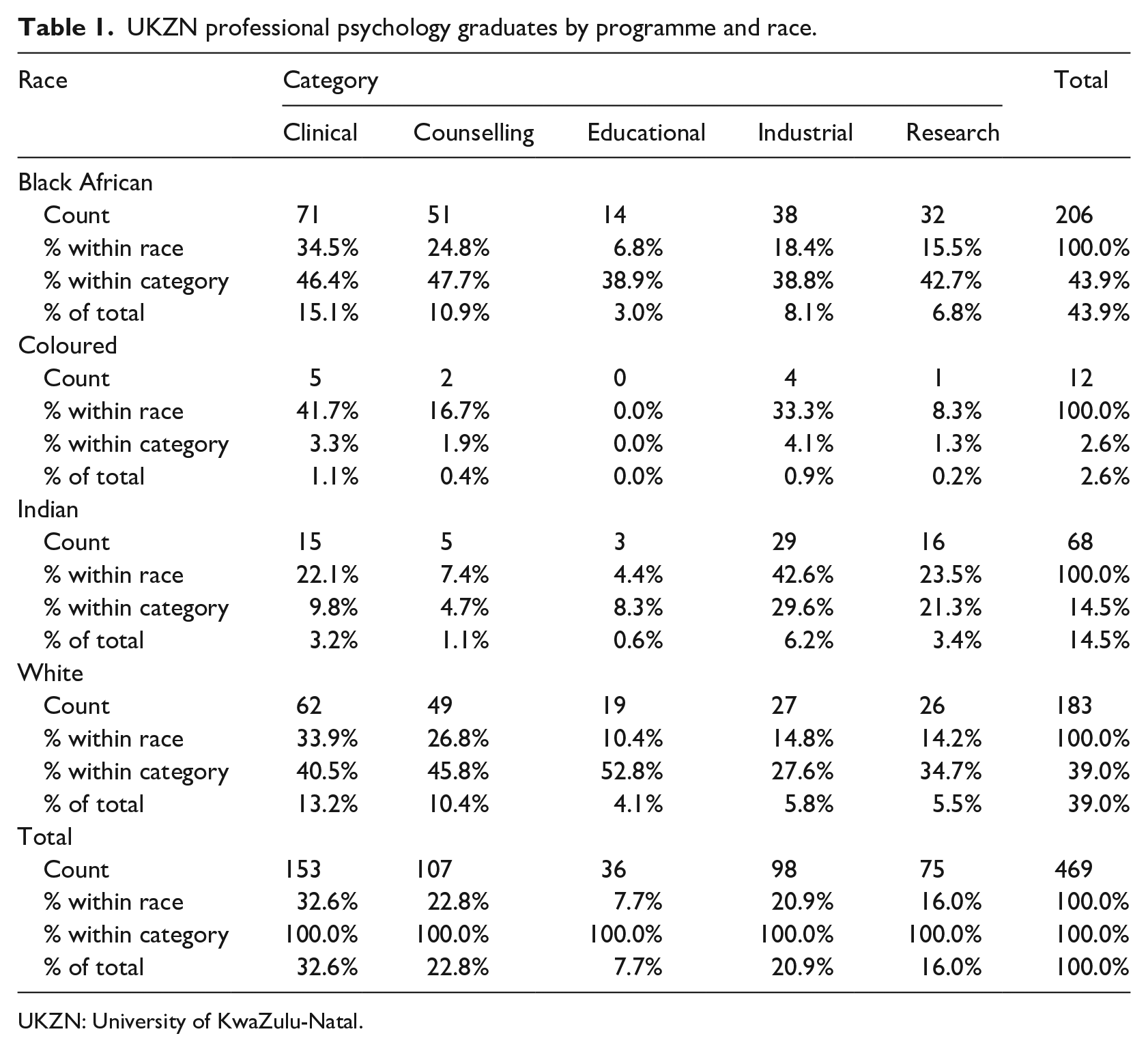
The first research question considers the racial demographics of UKZN professional psychology graduates using descriptive statistics (see Table 1). Between 2005 and 2020, UKZN produced at least 469 graduates in professional psychology master’s degree programmes. Of these graduates, 206 (43.9%) were Black African, 12 (2.6%) were Coloured, 68 (14.5%) were Indian, and 183 (39.0%) were White. Numbers of graduates per category of professional training are also documented in Table 1. When comparing Black African graduates across professional categories of training, the proportions of Black African graduates in counselling, clinical, and research psychology have been the highest at 47.7%, 46.4%, and 42.7%, respectively.
UKZN professional psychology graduates by programme and race.
UKZN: University of KwaZulu-Natal.
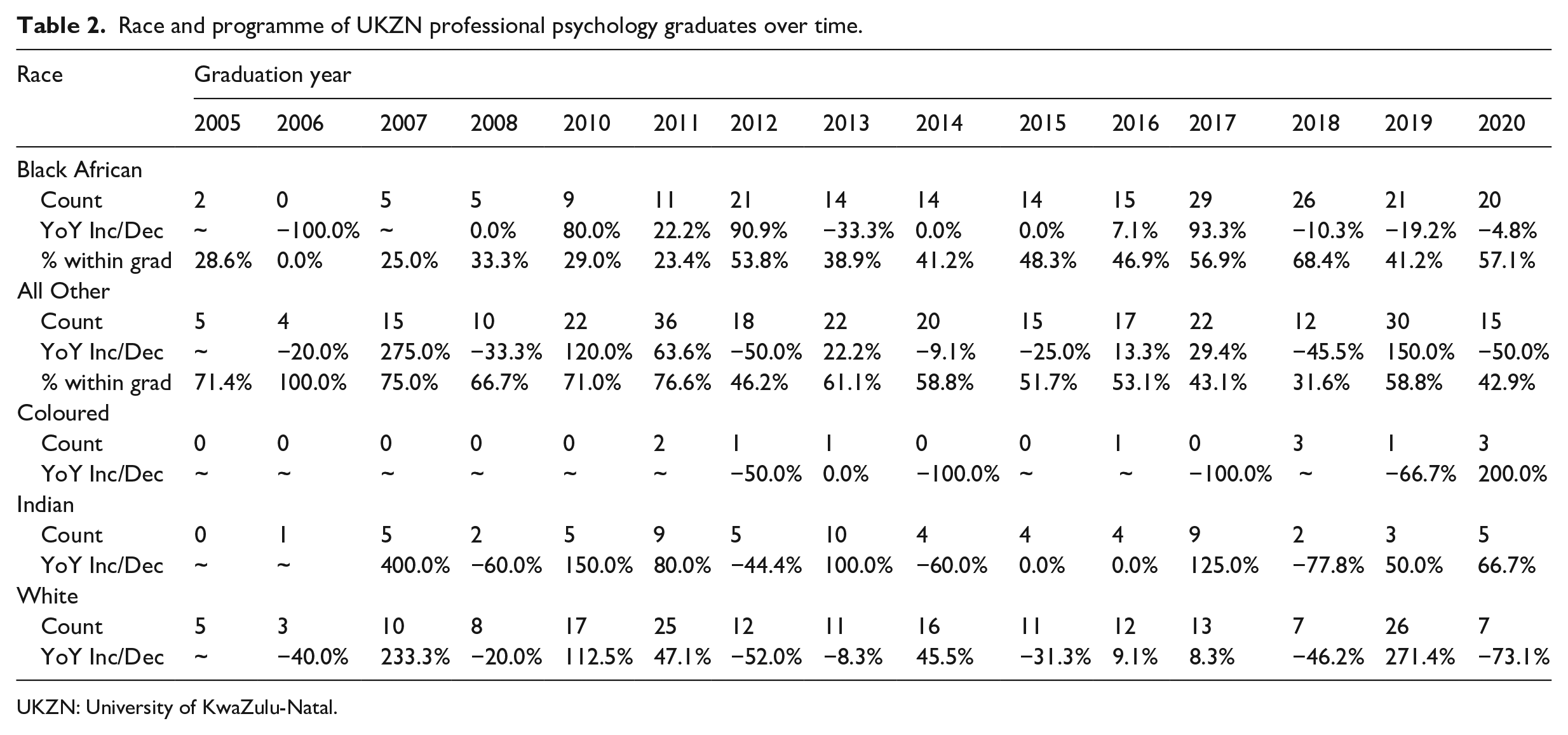
The second research question examines trends and how the probability of being a UKZN Black African professional psychology graduate changed between 2005 and 2020. The trends and probability of being such a graduate are explored in Table 2, and Figures 1 and 2. The analysis considered the absolute number of each group for each year (Count), the year-on-year increase or decrease (YoY Inc/Dec), and percentage (% within Grad) (see Table 2). The trend lines in Figure 1 show how the representation of Black African professional psychology graduates changed over time when compared with all other graduates, while the trend lines in Figure 2 show how the representation of Black African, Coloured, Indian, and White professional psychology graduates changed over time.
Race and programme of UKZN professional psychology graduates over time.
UKZN: University of KwaZulu-Natal.
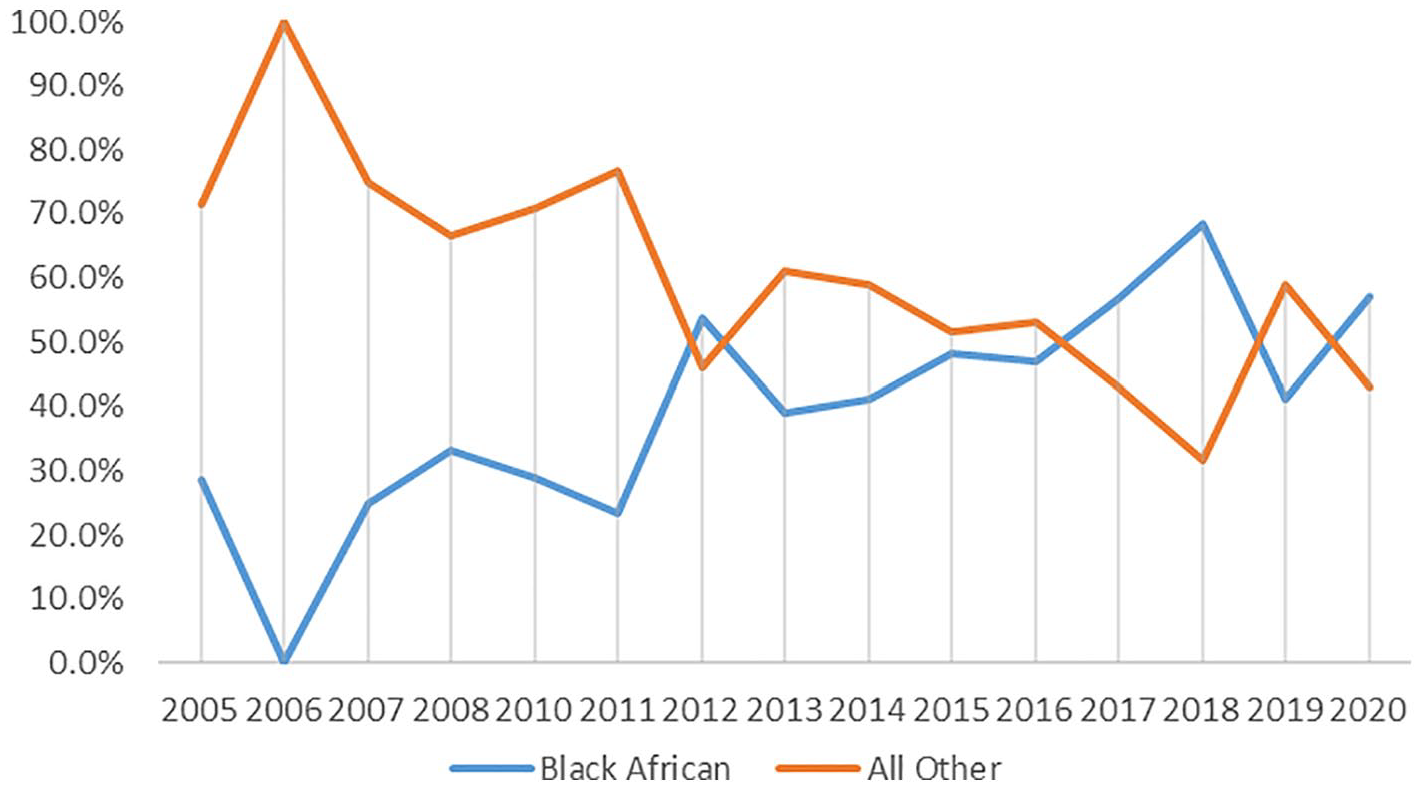
Percentage of UKZN professional psychology graduates by Black African and all others over time.
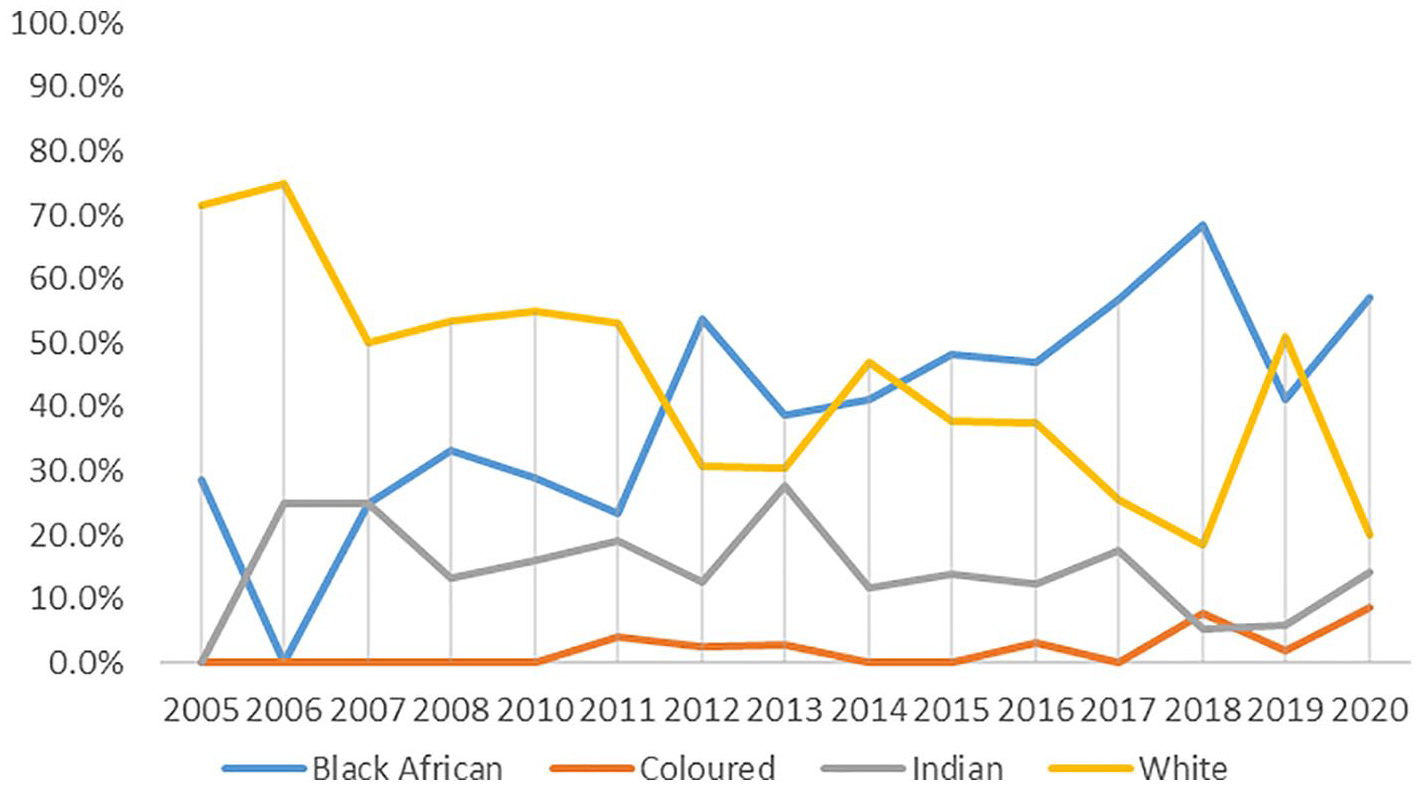
Percentage of UKZN professional psychology graduates by race over time.
Tables 1 and 2, and Figure 2 indicate that the proportion of Coloured students remained consistently small throughout the analysis period. Overall, Coloured students only represent 2.6% of all professional psychology graduates trained at UKZN. When considering Indian graduates, relative to other graduation years, this group of students had the highest number of graduates in 2013 (27.8%), however, in every other recorded year, Indian graduates made up comparatively smaller numbers, averaging 14.5% of graduates over the entire period.
An inverse relationship is observable between the proportion of Black African and White graduates in professional psychology programmes between 2004 and 2020. Whereas most graduates in each graduation year between 2005 and 2011 were White, this majority decreased in the years that followed, except for 2014 and 2019.
The final research question used forecasting techniques on time series data to determine when the proportion of UKZN Black African professional psychology graduates is likely to match national and provincial proportions of Black Africans (i.e., 81.4% and 84.8%, respectively) (Statistics South Africa, 2023). The data used in this study provide a set of observations relating to graduates over time for multiple individuals. As such, it has longitudinal (graduates) and time-based (annual graduations) elements (Jebb et al., 2015). Tables 1 and 2, and Figures 1 and 2 are used to show trends over time in our variables of interest. Collectively, these show an increasing trend over time on the number of UKZN Black African professional psychology graduates, both absolute (count) and percentage (percentage of Black African graduates). This is an important observation as it shows that our variable of interest for our third research question (the percentage of Black African professional psychology graduates) has not been stationary over time. Importantly, ‘[a] stationary time series will have no predictable patterns in the long-term’ (Jebb et al., 2015, p. 7). In addition to the visual analysis above, it is necessary to confirm that a particular variable meets certain criteria for the analysis that follows. With time series data, it is necessary to consider if the data are integrated of order 0 (and is stationary), or non-stationary (integrated order 1 or above). While there are many ways of testing for this, the ‘Expert Modeler’ approach provided by SPSS considers several autoregressive integrated moving average (ARIMA) models to determine the optimal number of autoregressive (AR), moving average (MA), and orders of integration (I) needed to estimate a reasonable forecast (International Business Machines Corporation, 2021). The purpose of this analysis is that of predictive modelling. Specifically, we wanted to forecast, given historical trends, when in the future it is likely that the proportion of Black African professional psychology graduates from UKZN will match the national and provincial proportion of Black Africans. The residual autocorrelation function (ACF) and partial autocorrelation function’s (PACF) plots were reviewed to ensure that the required stationarity condition was present.
Table 3 provides the forecasts, where our interest is in the year in which it is predicted that the percentage of UKZN Black African psychology graduates will be 81.4% or more (national representativity), or 84.8% (provincial representativity). The first time national representativity is exceeded in the forecast is 2026, while the first time provincial representativity is exceeded is 2028. However, a fair degree of variation around these estimates is observable (note the upper and lower confidence limits). Even in 2030, the lower confidence limit estimate remains relatively low, at only 67.92%. While not shown here, due to space constraints, the first time that the 81.4% point is breached in the lower confidence limit estimate is only in 2035.
Forecast for percentage of UKZN Black African professional psychology graduates.
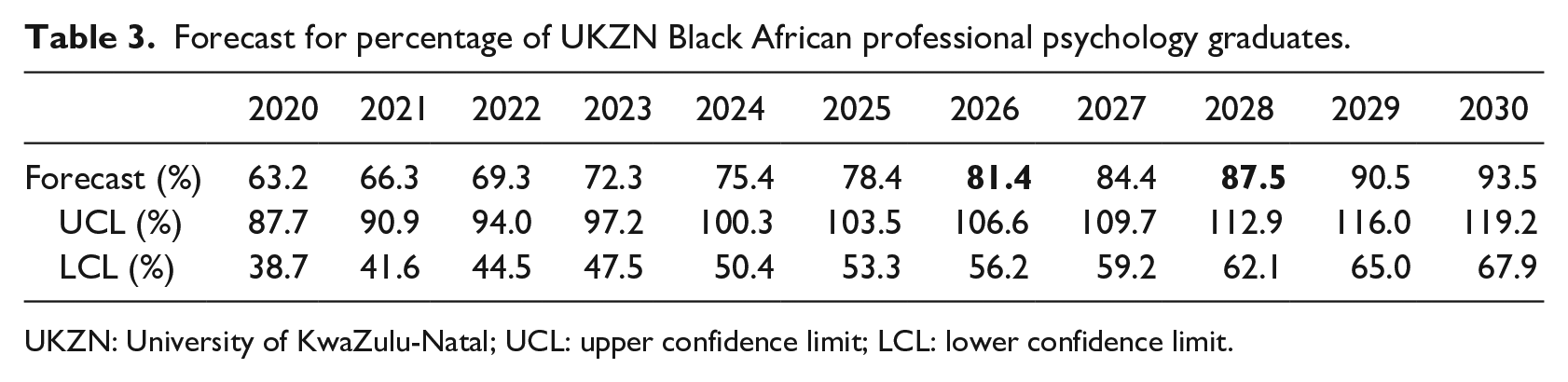
UKZN: University of KwaZulu-Natal; UCL: upper confidence limit; LCL: lower confidence limit.
Overall, the forecasts predict that UKZN is likely to achieve proportional racial representation at national and provincial levels among Black African professional psychology graduates for the first time in the 2026 and 2028 graduation cohorts. Figure 3 shows this visually.
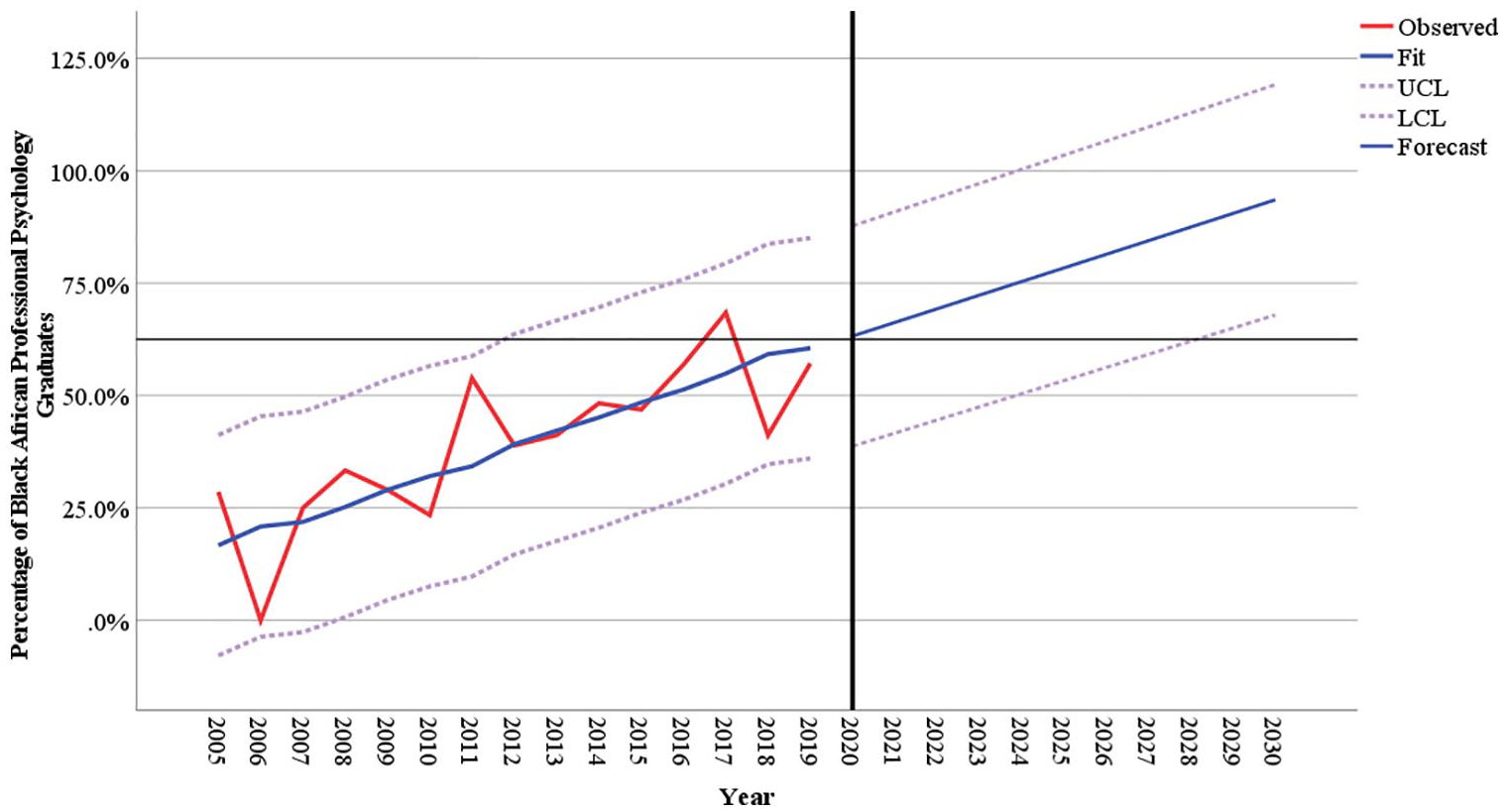
Forecast of future UKZN Black African professional psychology graduates.
Discussion
First, we interrogate the relatively slow pace of attaining representativity among UKZN Black African professional psychology graduates (i.e., research questions 1 and 2). Second, we explore the results from the third research question, which estimates when representativity among UKZN Black African professional psychology graduates could be expected, and the larger contextual importance of transformation and representativity in the profession.
Slow pace of transformation: the (im)probability of being a Black African professional psychology graduate
The results from our study indicate that UKZN has struggled to produce a representative pool of Black African professional psychology graduates since 2005. The likelihood of being a Black African professional psychology graduate has only increased on average by 9.7% each year between 2005 and 2020. In terms of the overall pool of UKZN professional psychology graduates, only 43.9% of these have been Black African, which just exceeds half the proportion of Black African individuals in KwaZulu-Natal (i.e., 84.8%) (Statistics South Africa, 2023). By contrast, when considering all graduates from UKZN between 2005 and 2020, 61.8% of these have been Black African. Although still short of the current national and provincial estimates for Black African individuals (Statistics South Africa, 2023), the total graduation figures from UKZN are closer to representativity when compared with those produced in the professional psychology programmes. Gains towards representativity in professional psychology graduates from UKZN are being made. However, the results from research questions 1 and 2 suggest that UKZN has been unable to produce Black African professional psychology graduates at the same rate that it has been able to produce Black African graduates overall. The possible reasons for these shortfalls can be attributed to factors pertaining to the nature of professional psychology recruitment and selection criteria and processes, and the availability of Black African individuals in the recruitment pool (Mayekiso et al., 2004; Padmanabhanunni et al., 2022; Pillay & Kramers, 2003; Pillay & Kramers-Olen, 2014; Pillay & Nyandeni, 2021; Pillay & Siyothula, 2008; Traub & Swartz, 2013). In terms of factors pertaining to the nature of selection criteria and processes, applicants with a strong academic record who can communicate and demonstrate the presence of ‘desirable’ qualities, such as warmth, empathy, stress management skills, self-reflexivity, and mastery of past psychological trauma (Cerrai, 1997; Ivey & Partington, 2014) are typically prioritised for selection. Proficiency in English, and educational and socio-economic advantage necessarily underpin the ways in which applicants communicate and demonstrate ‘desirable’ qualities, and this may partially account for the ‘barriers’ that Black African applicants from disadvantaged educational and socio-economic backgrounds experience when applying for admission to professional training. Padmanabhanunni et al. (2022) synthesise a trio of related educational and socio-economic background factors (i.e., language, familiarity with role-plays and other selection activities, and the capacity to communicate and demonstrate self-reflectivity and mastery of psychological trauma in English) as potential barriers to selection for Black African applicants.
In terms of factors pertaining to the availability of Black African individuals in the recruitment pool, Pillay and Kramers (2003) initially identified how, when compared with White students, Black African students may experience additional family and sociocultural pressure to find employment and start earning sooner rather than delaying for the purposes of postgraduate study. The financial difficulties and sociocultural pressures preventing Black African students from pursuing postgraduate study persist today (Department of Higher Education and Training [DHET], 2023a; Dominguez-Whitehead, 2017), effectively limiting the diversity of high-quality Black African applicants for professional psychology training programmes in South Africa.
If the Professional Board for Psychology’s (2000) mandate of ‘50/50 admission to graduate professional psychology programmes by 1 January 2004’ (p. 3) is used as a benchmark (i.e., at least 50% admission of Black African, Coloured, and Indian students into professional training), then UKZN consistently fell short of this target prior to 2012 (i.e., 12 years after the Professional Board for Psychology’s communication), but attained this target thereafter, except for the 2019 graduation year. Although the value of producing Coloured and Indian professional psychology graduates, as part of the pool of Black psychologists in South Africa should not be overlooked, the focus of this article is on the extent to which UKZN has contributed to the eligible pool of Black African professional psychology graduates, and Black African professional psychology graduates in relation to national and provincial representativity. The justification for this focus lies in the fact that ‘client ethnicity [race] is still strongly linked to the ethnic groups to which practitioners belong’ (Health Professions Council of South Africa [HPCSA], 2017, p. 28). In other words, clients are most likely to seek the services of psychologists who they identify with in terms of race and ethnicity. Until clients seek services from practitioners in non-racialised ways, if desirable and reasonable to expect, professional psychological services will not be equitably accessible to Black Africans until representativity in the profession is attained. The problem of equitable access to psychological services is further emphasised when considering that even in 2022, 65.7% of HPCSA registered psychologists were White, while only 17.2% were Black African (Padmanabhanunni et al., 2022).
Why representativity in the psychology profession matters
The outcome from the forecasting techniques with our time series data suggests that UKZN may attain national representativity (i.e., 81.4%) for Black African professional psychology graduates in its 2026 graduation cohort, and provincial representativity (i.e., 84.8%) in its 2028 graduation cohort. The lower confidence limits on these forecasts, however, indicate that these targets may only be realistically reached even later (i.e., beyond 2030). Importantly, current conceptions of transformation in higher education, and by implication professional bodies such as psychology, extend beyond a narrow aim of attaining race-based proportional representation (Boti, 2022; DHET, 2023b; South African Human Rights Commission [SAHRC], 2016). Although representativity is embedded in the South African constitution for the purposes of demographic legitimacy, and reinforced through government legislation (e.g., Employment Equity and Broad Based Black Economic Empowerment Acts) (Boti, 2022; Malan, 2010), representativity is only the basis for deeper forms of sociocultural, institutional, and systemic transformation (DHET, 2023b; SAHRC, 2016). Recently, DHET (2023b) identified three periods of transformation in South African higher education. Whereas the first period (between 1994 and 2003) centralised ‘demographic equity in student and staff access’ (p. xii) (i.e., the focus of this article, and the notions of representativity as enshrined in the South African constitution and related legislation), the third and current period of transformation in higher education prioritises much deeper institutional, curricula, spatial, and systemic changes in individual and collective experiences of belonging, social justice, redress, and access and success. Although DHET (2023b) does not explicitly state that the three periods and tasks associated with these periods are sequential, this is implied. Therefore, South African higher education and the psychology profession is only likely to be successful in attaining deeper and more meaningful forms of transformation when the tasks associated with the first period of transformation (i.e., racial representativity) have been firmly established and consolidated.
Conclusion
Despite being able to produce Black African graduates at close to national and provincial rates of representativity, UKZN has not yet been able to achieve this goal among its professional psychology graduates. As a result, deeper forms of transformation within the psychology profession, especially in settings where UKZN graduates work, are also likely to lag until race-based representativity can be achieved. Notwithstanding the limitations of the study (i.e., missing graduation data, a focus only on race as an indicator of transformation), forecasting techniques on time series data suggest that the goals of attaining national and provincial representativity for single graduation years could only be attained in 2026 and 2028, respectively. Although the lower confidence limits from the forecasting techniques suggest that these goals may only be achieved beyond 2030, UKZN’s recent specification of an 80% Black African admission target for professional psychology programmes at UKZN (UKZN, 2020) should consolidate existing gains made towards transforming the representativity among its professional psychology students and graduates.
Attaining representativity in the psychology profession is foundational for the transformation of the profession. Despite being a myth, race is a persistent social construct which pervades the ways in which privileges and opportunities are afforded to some, and/or serves to oppress and deprive others. The goals of a more deeply transformed psychological science and profession place less focus on racial representativity and race-based client/psychologist consultation patterns, but, at this point in South Africa and the profession, clients seem more likely to select to consult with psychologists who they identify with in terms of relevant identity markers (e.g., race, gender, ethnicity, language, sexual orientation), with race probably being the most salient. This study exposes the difficulties associated with attaining representativity in the psychology profession, despite an institution’s attempts to contribute to this goal. The findings point to the need for all professional psychology training programmes in South Africa to interrogate their histories of racial transformation among their professional psychology graduates, and to expose where gaps in the representativity agenda can be closed. As a result, it is recommended that all South African professional psychology training programmes consider reporting on the race-based trends among their professional psychology graduates.
Footnotes
Declaration of conflicting interests
The author(s) declared no potential conflicts of interest with respect to the research, authorship, and/or publication of this article.
Funding
The author(s) received no financial support for the research, authorship, and/or publication of this article.
