




Abstract
Researchers have paid limited attention to the role of adaptive cognitive appraisals in conferring resilience. In this study, we demonstrate the influence of positive appraisals of problem-solving ability and social support on mental health outcomes. A random sample of students at a university in South Africa (n = 322) participated in the study. They completed the Perceived Stress Scale, the Multidimensional Scale of Perceived Social Support, the Problem-Solving Inventory, the Beck Hopelessness Scale, and the Satisfaction with Life Scale. Mediation analysis found that problem-solving appraisal and social support jointly and separately mediated the effects of perceived stress on hopelessness. The combined effect of social support and problem-solving appraisal on life satisfaction was significant; however, only social support was found to mediate the relationship between perceived stress and life satisfaction. The findings indicate that adaptive appraisals of self and others are potential sources of resilience that can buffer individuals from the adverse impact of stressful life events.
Keywords
Introduction
The COVID-19 pandemic and its prevention measures that are implemented have presented significant psychological stressors capable of adversely impacting mental health. In a comprehensive systematic review and meta-analysis encompassing 225 eligible studies from 50 countries, Leung and colleagues (2022) reported heightened levels of anxiety, depression, post-traumatic stress disorder (PTSD), alcohol use disorder, and suicidality in the aftermath of the COVID-19 pandemic. Factors associated with distress included high perceived vulnerability to infection, limited access to personal protective equipment, history of psychiatric disorders, comorbid physical health conditions, and knowing someone who had contracted COVID-19 (Leung et al., 2022). National lockdowns and home confinement were found to aggravate mental health disorders, particularly among those with familial or marital conflict, and/or inadequate housing to cope with the restrictions (Leung et al., 2022). Based on their systematic review and meta-analysis of COVID-19 mental health symptoms in 167 developing countries, Chen et al. (2022) reported that the prevalence rate of mental health symptoms among students and frontline health care workers was higher than the general population. Depression and psychological distress were the most commonly reported symptoms. Further support for the association between the pandemic and adverse mental health outcomes comes from longitudinal research undertaken in a range of countries, including China (Li et al., 2021), Argentina (Fernández et al., 2022), and Canada (De France et al., 2022).
Despite the increase in adverse mental health outcomes during the pandemic, there was also evidence that a significant proportion of the population was able to cope effectively. Studies undertaken in the Netherlands (van der Velden et al., 2020) and Spain (González-Sanguino et al., 2021), for example, found that although psychological distress increased at the outset of the pandemic, these levels subsequently declined to pre-pandemic levels. Similar findings have been reported among individuals who have contracted COVID-19. Bourmistrova et al. (2022) found no or mild long-term psychiatric symptoms among a cohort of COVID-19 survivors, and the levels of distress among this cohort were comparable to those of the general population. Houben-Wilke et al. (2022) investigated the impact of long-term COVID on mental health and found that symptoms of PTSD, depression, and anxiety improved over time for people with long-term COVID. Studies on student populations have also underscored the role of protective factors in mental health, including coping styles and perceived social support (Freeman et al., 2020; Fruehwirth et al., 2021; Li & Peng, 2021). Given the risk of future disease outbreaks, it remains imperative to investigate the factors that confer resilience and promote coping in the context of adversity. Resilience pertains to the ability of individuals to navigate their way to resources that sustain well-being. It encapsulates the processes and outcomes of successfully adapting to challenging or threatening experiences (Stainton et al., 2019). Rather than merely being the absence of psychological distress, resilience represents a dynamic process of positive adaptation in the face of adversity and can be cultivated and strengthened over time (Vos et al., 2021).
Existing studies have identified fortitude, ego-resilience, a sense of coherence, and social support as protective factors or resilience resources in the context of the COVID-19 pandemic (Grey et al., 2020; Padmanabhanunni & Pretorius, 2021a, 2021b; Pretorius & Padmanabhanunni, 2022a; van der Velden et al., 2020). The current study aimed to extend this work by investigating whether adaptive cognitive appraisals – specifically appraisals of problem-solving ability and appraisals of support received from others – serve as protective resources for mental health.
There are several reasons for focusing on adaptive cognitive appraisals. First, the extent to which an event is experienced as stressful is determined by the individual’s appraisal of the situation (Lazarus, 2006). Perceived stress is defined as the extent to which an individual appraises their life as unpredictable, uncontrollable, and overwhelming (Cohen, 1988). It has been consistently found to be a predictor of mental health outcomes among various populations, including sexual assault survivors (Catabay et al., 2019), women with high-risk pregnancies (Fiskin, 2022), and those in quarantine during the pandemic (Torales et al., 2020). Second, evidence from empirical studies on psychopathology (Hitchcock et al., 2015; Padmanabhanunni et al., 2017) indicates that dysfunctional cognitive appraisals underlie mental health disorders. Third, appraisals impact executive functioning and influence an individual’s choice and implementation of coping strategies (Lazarus, 2006). Finally, most research on the role of cognitive processes in mental health outcomes has focused on maladaptive appraisals, which are thoughts, assumptions, or beliefs that negatively influence outcomes (Hitchcock et al., 2015; Padmanabhanunni et al., 2017). Conversely, adaptive or positive appraisals are thoughts, assumptions, or beliefs that positively influence outcomes, and it is the interaction between positive and negative appraisals that tends to influence distress (Beck & Haigh, 2014).
Appraisals of one’s ability to solve problems have consistently been associated with mental and physical health outcomes (Heppner et al., 2004; Rudd et al., 1994). Problem-solving appraisal is defined as ‘a generalized set of beliefs about one’s problem-solving ability’ (Heppner et al., 2004, p. 358). It is a self-directed process through which an individual attempts to find solutions to everyday stressors and major adverse life events (Pretorius & Padmanabhanunni, 2023). There is strong empirical support for the role of perceived problem-solving ability in mental health outcomes – including depression, hopelessness, and suicidality (Heppner et al., 2004; Rudd et al., 1994) – as well as in physical health outcomes (Elliott et al., 1991). Diminished problem-solving appraisal has been found to be a stable predictor of psychological distress (Elliott et al., 1991).
The individual’s view of other people has important implications for how they relate to and use the social environment for coping. Social support, which is defined as support that is accessible to an individual through their social connections, has been extensively studied (Shumaker & Brownell, 1984). Perceived social support, which refers to subjective appraisals of the extent to which members of the individual’s social network are able to provide support in times of need, is the most commonly measured index of social support (Shumaker & Brownell, 1984). Perceived support has been more strongly associated with mental health outcomes than actual received support (Harandi et al., 2017; Wang et al., 2018). Perceived social support can come from family and friends, romantic partners, co-workers, and more formal sources such as mental health care providers (Padmanabhanunni et al., 2023b).
This study investigated the role of appraisals of problem-solving ability and appraisals of support received from others in mental health outcomes. We examined the influence of such appraisals on a positive (life satisfaction) and a negative indicator (hopelessness) of psychological well-being. Based on the literature review, we expected that:
High levels of social support and more positive problem-solving appraisals would be associated with higher levels of life satisfaction and lower levels of hopelessness.
Social support and problem-solving appraisal would jointly and separately mediate the relationship between perceived stress and the indices of psychological well-being.
Method
Participants and procedure
Participants (n = 322) were a random sample of students at a university in South Africa. We constructed an electronic version of the instruments using Google Forms. The link to the survey was distributed via email by the Registrar’s office to a random sample of 1500 students; thus, the sample of 322 students represents a response rate of 21.5%. The survey took approximately 20 minutes to complete and data collection took place from March to July 2022. By early 2022, South Africa had alerted the world to the Omicron variant, leading to a sharp increase in cases towards the end of 2021 and global concerns regarding its transmission and vaccine efficacy. By the time of data collection, the country still grappled with vaccine rollout challenges, public apprehension, and the socio-economic repercussions of the pandemic. Restrictions varied throughout this period as the government sought to balance public health needs with socio-economic realities (Padmanabhanunni et al., 2023a). The majority of participants were women (77%), and the mean age was 26.01 (SD = 10.19). A quarter (25.5%) had tested positive for COVID-19, and the majority (86.6%) had been vaccinated.
Instruments
Participants completed a brief demographic survey and the Perceived Stress Scale (PSS) (Cohen, 1988), the Multidimensional Scale of Perceived Social Support (MSPSS) (Zimet et al., 1988), the Problem-Solving Inventory (PSI) (Heppner, 1988), the Beck Hopelessness Scale (BHS-9) (Balsamo et al., 2020), and the Satisfaction with Life Scale (SWLS) (Diener et al., 1985). The demographic survey included items pertaining to age, gender, and area of residence, whether the participant had been vaccinated, ever tested positive for COVID-19, and whether the participant had lost a family member or loved one due to COVID-19 infection.
The PSS is a 10-item measure of the extent to which respondents perceive situations to be stressful. Participants respond on a 5-point scale ranging from never (0) to very often (4). An example of an item from the scale includes, ‘In the last month, how often have you felt that you were unable to control the important things in your life?’. Scores are summed with higher scores indicating greater levels of perceived stress. The author reported reliability coefficients ranging from .75 to .91, and the relationship between perceived stress and health behaviours provided evidence of validity (Cohen, 1988).
The MSPSS consists of 12 items and assesses perceived support from family, friends, and significant others. Responses are reported on a 7-point scale ranging from very strongly disagree (1) to very strongly agree (7). An example of an item from the MSPSS is: ‘My family really tries to help me’. The total score can range from 12 to 84, with higher scores indicating higher perceived social support. The authors reported a reliability coefficient of .88. The relationship between social support and depression provided evidence for concurrent validity, as did the relationship between social support and anxiety (Zimet et al., 1988).
The PSI is a 32-item measure of the extent to which respondents perceive themselves to be effective problem solvers. An example of an item from the PSI is: ‘When I have a problem, I get so upset I can’t think straight’. Participants respond on a 6-point scale ranging from strongly agree (1) to strongly disagree (6). Scores are summed and high scores reflect perceptions of ineffective problem-solving. The authors reported an alpha coefficient of .90, and provided evidence of validity (Heppner & Petersen, 1982). The PSI has been used in South Africa with reported alpha coefficients of .89 (Heppner et al., 2002) and .84 (Pretorius, 1996).
The BHS-9 is a 9-item version of the 20-item scale (Beck et al., 1974). It measures negative expectancies about oneself and the future. It is scored on a dichotomous (1 = true and 0 = false) scale. An example of an item from the BHS is: ‘The future seems vague and uncertain to me’. The total score is calculated by summing the number of hopelessness-indicative responses, with scores ranging from 0 to 20. Higher scores indicate greater levels of hopelessness. Balsamo and colleagues (Balsamo et al., 2020) used item-response theory to shorten the BHS into a unidimensional scale. The authors reported a Mokken scale reliability of .86 and an alpha coefficient of .86 (Balsamo et al., 2020).
The SWLS is a 5-item scale that measures the cognitive component of subjective well-being. Responses to the 5 items are made on a 7-point scale that ranges from strongly disagree (1) to strongly agree (7). An example of an item from the SWLS is: ‘In most ways, my life is close to my ideal’. Scores are summed to obtain a total score and higher scores indicate greater life satisfaction. The authors reported an alpha coefficient of .87. The validity of the instrument was demonstrated through correlations between SWLS scores and other measures of well-being (Diener et al., 1985). In South Africa, the SWLS was used with a student and teacher sample, and the reliability coefficients reported were .89 and .90, respectively (Padmanabhanunni & Pretorius, 2021a; Pretorius & Padmanabhanunni, 2022b).
Ethics
The study was conducted in line with the principles of the Declaration of Helsinki. The Humanities and Social Sciences Ethics Committee of the University of the Western Cape provided ethical approval for the study (ethics approval reference number: HS22/2/9, February 2022). Participation was voluntary and anonymous. All participants provided informed consent and no incentives were provided for participation in the study.
Data analysis
IBM SPSS Statistics Version 28 for Windows (IBM Corp., Armonk, NY, USA) was used to obtain the intercorrelations between the study variables (Pearson’s r), descriptive statistics (means and standard deviations), and reliabilities (Cronbach’s alpha and McDonald’s omega). Omega was obtained using the OMEGA macro in SPSS (Hayes & Coutts, 2020). We used indices of skewness and kurtosis to assess the assumption of normality. Skewness values between −2 and +2, and kurtosis values between −7 and +7 would reflect that the data are approximately normally distributed (Hair et al., 2010). A regression-based approach was used for the mediation analysis, using the PROCESS macro developed by Hayes (2017) for SPSS. The significance of the indirect effect of perceived stress on indices of psychological well-being was evaluated using bootstrapped 95% confidence intervals. Age and gender were found to be related to the predictor variable (stress), and age was also related to the dependent variables (hopelessness and life satisfaction). Thus, age and gender were used as covariates in the mediation analysis.
Results
Skewness (−0.46 to 1.21) and kurtosis (−0.74 to 0.59) values were within an acceptable range for all variables, thus confirming that the data are approximately normally distributed. The reliabilities, intercorrelations between study variables, and descriptive statistics of the scales are reported in Table 1. All the scales demonstrated satisfactory reliability (α and ω: .84–.93).
Descriptive statistics, intercorrelations, and reliabilities of study variables.
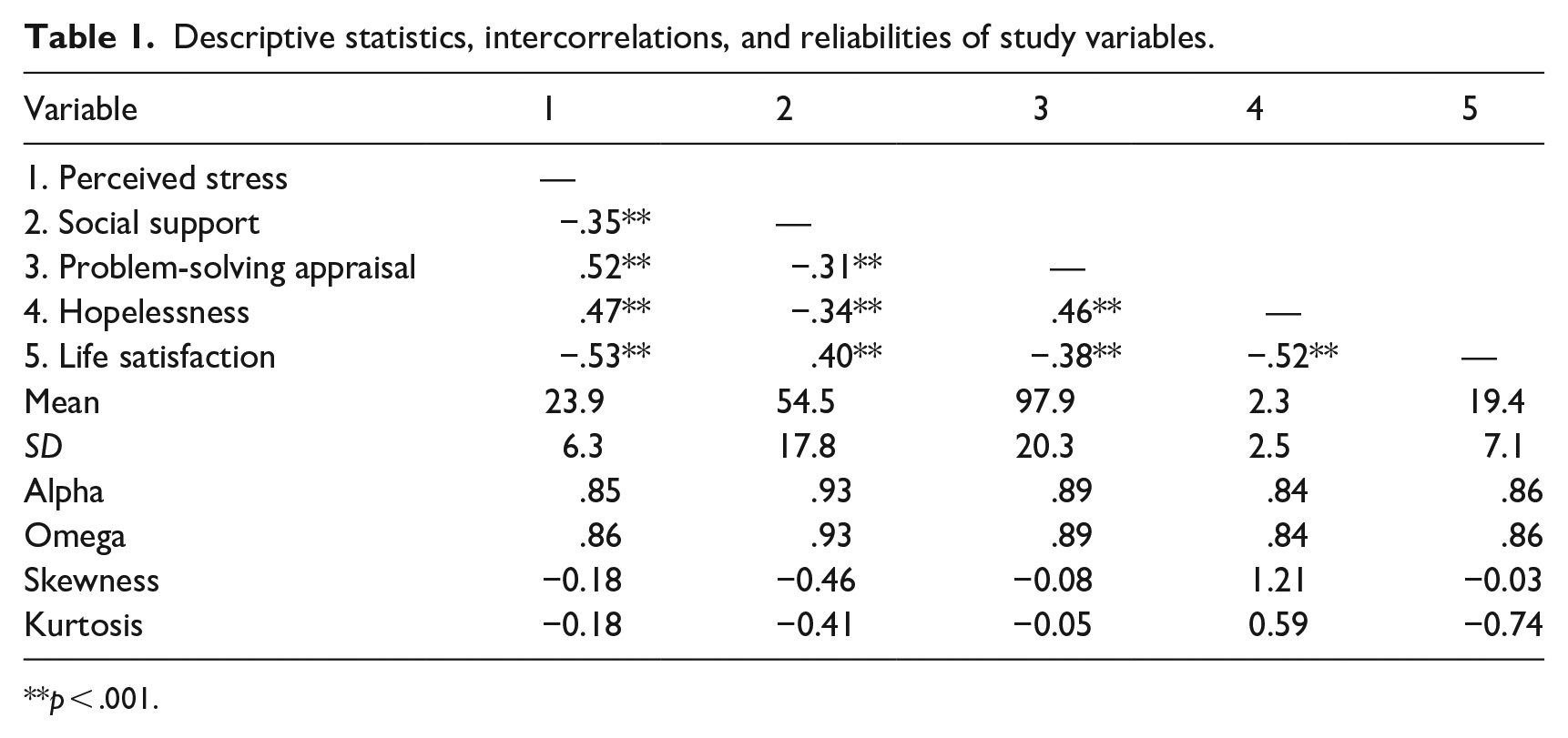
p < .001.
There was a significant positive association between perceived stress and hopelessness (r = .47, p < .001) and a significant negative relationship between perceived stress and life satisfaction (r = −.53, p < .001). Similarly, there was a significant positive association between problem-solving appraisal and hopelessness (r = .46, p < .001) and a significant negative association between problem-solving appraisal and life satisfaction (r = −.38, p < .001). Social support was significantly negatively associated with hopelessness (r = −.34, p < .001) and positively associated with life satisfaction (r = .40, p < .001). In terms of effect size, all the obtained coefficients can be regarded as moderate.
Age was negatively related to perceived stress (r = −.32, p < .001) and hopelessness (r = −.17, p = .002) and positively related to life satisfaction (r = .18, p = .002). Women reported higher levels of perceived stress (M = 24.25, SD = 6.14) than men (M = 22.26, SD = 6.47, t = 2.33, p = .020).
The direct effects of perceived stress, social support, and problem-solving appraisal, as well as the indirect effects of perceived stress on indices of psychological well-being, are reported in Table 2.
Direct and indirect effects of perceived stress, social support, and problem-solving appraisal.
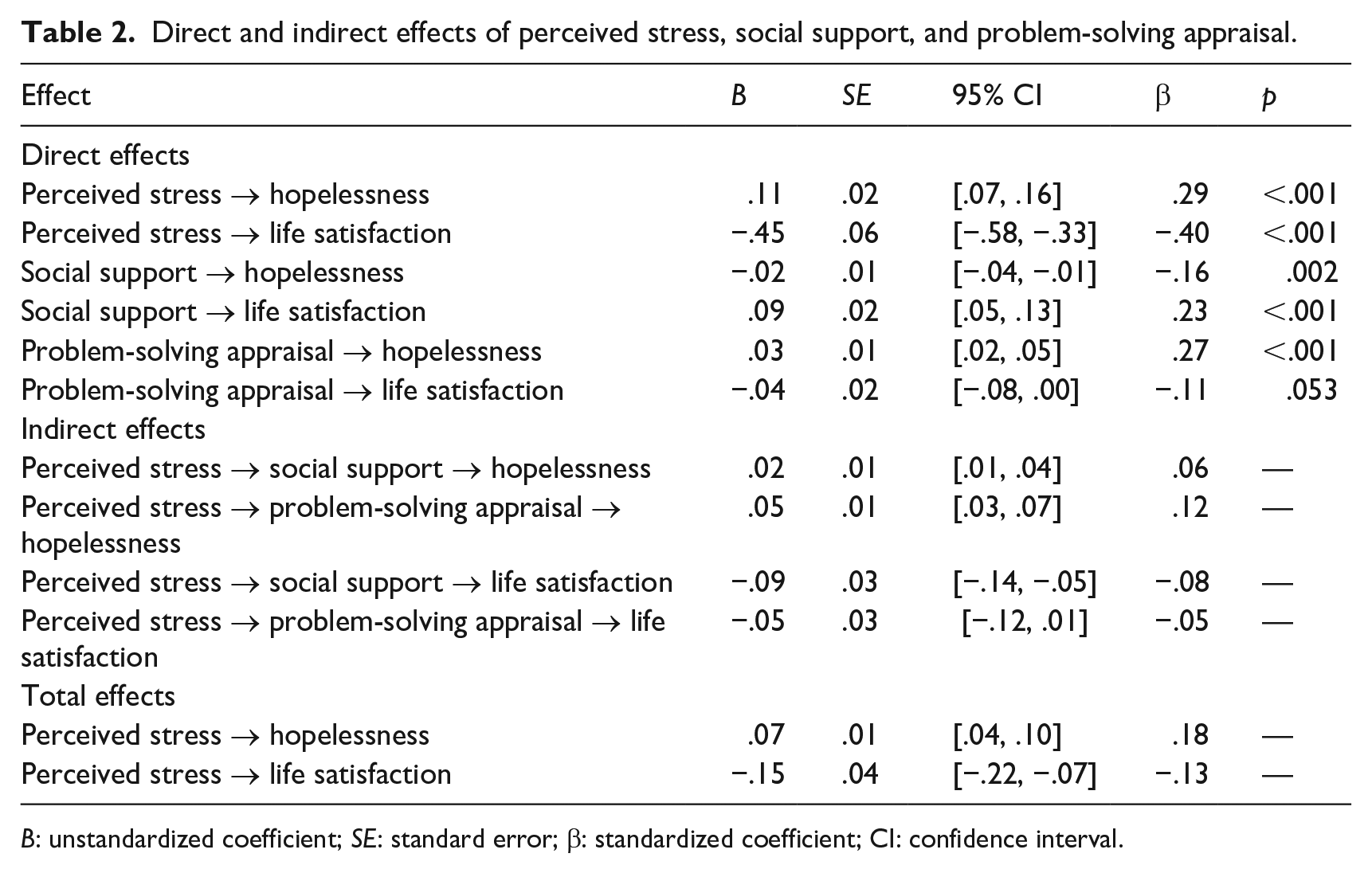
B: unstandardized coefficient; SE: standard error; β: standardized coefficient; CI: confidence interval.
The zero-order correlation between problem-solving and life satisfaction was significant; however, it was nonsignificant when considered jointly with social support in the mediation model. Apart from the relationship between problem-solving appraisal and life satisfaction, all other direct effects were significant. In particular:
As expected, perceived stress was positively associated with hopelessness (β = .29, p < .001) and negatively associated with life satisfaction (β = −.40, p < .001).
Social support was negatively associated with hopelessness (β = −.16, p = .002) and positively associated with life satisfaction (β = .23, p < .001).
Problem-solving appraisal was positively associated with hopelessness (β = .27, p < .001).
In terms of the mediating role of problem-solving appraisal and social support, we found the following:
Social support partially mediated the relationship between perceived stress and hopelessness (β = .06, 95% CI [.01, .04]) as well as between perceived stress and life satisfaction (β = −.08, 95% CI [−.14, −.05]).
Problem-solving appraisal partially mediated the relationship between perceived stress and hopelessness (β = .12, 95% CI [.03, .07]).
Social support and problem-solving appraisal jointly mediated the relationship between perceived stress and hopelessness (β = .18, 95% CI [.04, .10]) as well as between perceived stress and life satisfaction (β = −.13, 95% CI [−.22, −.07]).
The results obtained with the PROCESS macro are graphically summarized in Figure 1.
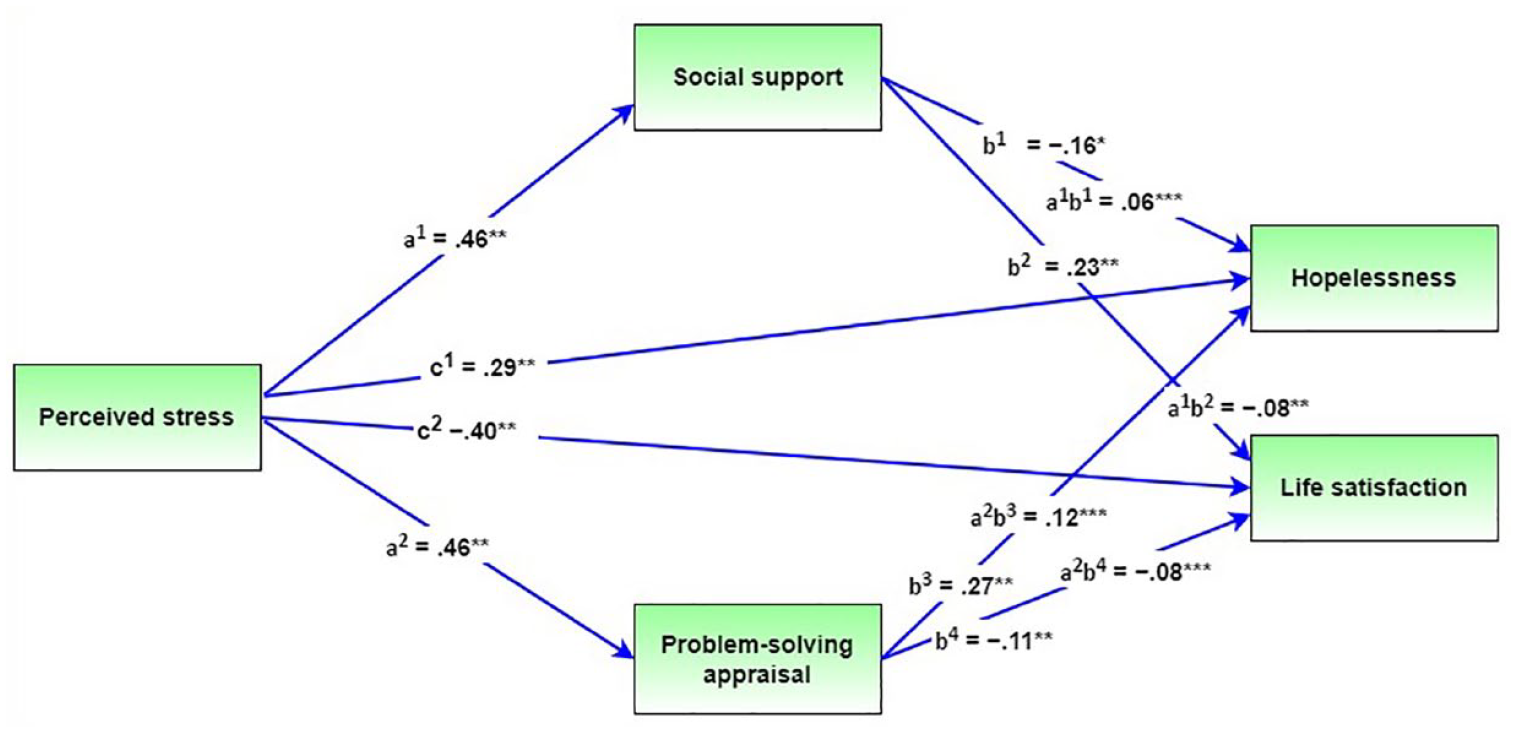
Conceptual diagram of the direct and indirect effects of perceived stress, social support, and problem-solving appraisal on hopelessness and life satisfaction.
Discussion
A significant literature base has demonstrated that individuals’ cognitive appraisals of stressful situations impact their mental health and well-being (Pretorius & Padmanabhanunni, 2023; Zuo et al., 2021). However, few studies have investigated the influence of adaptive cognitive appraisals on psychological outcomes. The current study extends research in this area by investigating the role of appraisals of problem-solving ability and appraisals of support received from others in mental health outcomes. There were several salient findings.
First, the study found that high levels of perceived stress were associated with higher levels of hopelessness and lower levels of life satisfaction. These findings align with the existing literature (Fiskin, 2022; Hirsch et al., 2019). The theory of hopelessness (Liu et al., 2015) proposes that when individuals experience repeated stressful events, those with a negative attributional style may appraise these adverse events as related to stable and global characteristics of self (e.g., as being inherently incapable). This appraisal can lead to a sense of helplessness and precipitate negative expectations regarding the future, which in turn can lead to depression, anxiety, and suicidality, as well as lower levels of life satisfaction (Zuo et al., 2021). Second, appraisals of being an effective problem solver were associated with lower levels of hopelessness and higher levels of life satisfaction. Problem-solving appraisal also partially mediated the relationship between perceived stress and hopelessness. Self-appraisals have been found to have a direct impact on the situation being appraised. Johnson and colleagues (Johnson et al., 2010) found that positive self-appraisals conferred resilience against suicidal ideation through their impact on the individual’s perceptions of adverse events. Similarly, it is likely that a positive appraisal of problem-solving ability can reduce the likelihood of a potentially stressful situation being negatively appraised and thereby modulate negative affective states. This type of appraisal can lower feelings of hopelessness, facilitate effective coping, and enhance life satisfaction.
Third, greater positive appraisals of social support received from others were associated with lower levels of hopelessness and higher levels of life satisfaction. Social support also partially mediated the relationships between perceived stress and hopelessness as well as between perceived stress and life satisfaction. Further, social support and problem-solving appraisal jointly mediated the relationship between perceived stress and hopelessness. According to the thriving-through-relationships model (Feeney & Collins, 2015b), well-functioning close relationships with significant others serve two core functions: to buffer individuals from the impact of stressors and to enable them to emerge from circumstances of adversity in a way that promotes flourishing and growth.
The transactional model of stress (Lazarus, 2006; Lazarus & Folkman, 1984) asserts that our emotional and behavioural responses to stressors are predominantly influenced by our cognitive evaluations of those stressors. This model differentiates between two key appraisal processes: primary and secondary. The primary appraisal serves as the initial assessment of the situation, while the secondary appraisal involves an individual’s assessment of their available resources and their capability to handle the stressor. Within this context, the concept of problem-solving appraisal can be seen as aligning with the secondary appraisal process.
It is probable that appraisals of others as accessible, caring, and supportive in times of need would reduce feelings of hopelessness. Such appraisals could also enable individuals to reach out to significant others for support, leading to a reappraisal of the adverse situation as a challenge that can be overcome and the attribution of positive life events to global stable characteristics of the self (e.g., as capable). In turn, these appraisals can produce feelings of hope and lead to greater life satisfaction. Further, individuals with higher levels of perceived support may be more likely than those with low levels to believe that supportive others are readily available and accessible, which can mitigate negative inferences from stressful life events and generate positive expectations for their future (Feeney & Collins, 2015a).
An overarching theme from the findings of the current study is the concept of resilience in the face of adversity, especially as it intersects with problem-solving appraisal and social support. Resilience can be understood as the ability to adapt and thrive amid challenges, underpinned by cognitive and social processes (Stainton et al., 2019). Appraisals of oneself as an effective problem solver can combat feelings of hopelessness and bolster an individual’s resilience by reinforcing the belief in their own capacity to navigate challenges. This belief can transform potential setbacks into opportunities for growth, as individuals view these as surmountable challenges rather than obstacles. Furthermore, the appraisal of strong social support systems enhances resilience by providing both tangible assistance and emotional validation in times of distress. The combined effects of both problem-solving appraisal and perceived social support can generate a resilience framework wherein individuals are better equipped to handle adversities such as those posed by the pandemic, not just by enduring them, but by adapting and potentially growing through them (Vos et al., 2021).
In light of the current mental health challenges faced by students, the findings of this study are particularly timely and relevant. Students grapple with a myriad of stressors, both academically and personally. Academic institutions should prioritize interventions that reinforce positive self-appraisals and enhance students’ sense of connectedness. Initiatives could include workshops focused on building problem-solving skills, peer-mentoring programmes, and mental health campaigns that emphasize the importance of seeking and providing support. Furthermore, embedding mental health modules within curricula, offering counselling services, and fostering an environment where seeking help is normalized are vital strategies. By acting on these findings, institutions can play a pivotal role in not just supporting student mental health in the present, but in fostering a resilient student community for the future.
The study has certain limitations. First, the study relied on a student sample, which limits generalizability to other populations. Second, the study used a cross-sectional survey design, which limits the extent to which the results of the current study can be interpreted as reflecting substantive evidence of the protective impact of positive appraisals of oneself and others. However, the findings are supported by the existing literature (Catabay et al., 2019; Zuo et al., 2021) regarding the protective role of adaptive appraisals. Third, the use of a self-reported questionnaire raises issues of social desirability and response bias. Fourth, it is possible that stressors apart from the COVID-19 pandemic may have accounted for the mental health outcomes observed. Finally, a bi-directional relationship may exist between the study variables, and longitudinal research is needed to draw firm conclusions.
Conclusion
The current study identifies positive appraisals of problem-solving ability and adaptive appraisals of social support as potential sources of resilience that can buffer individuals from the adverse impact of stressful life events. The findings indicate that adaptive cognitive appraisals may represent a central target for interventions aimed at bolstering coping during times of societal crisis.
Footnotes
Data availability statement
The data that support the findings of this study are available from the corresponding author, upon reasonable request.
Declaration of conflicting interests
The author(s) declared no potential conflicts of interest with respect to the research, authorship, and/or publication of this article.
Funding
The author(s) disclosed receipt of the following financial support for the research, authorship, and/or publication of this article: This research was funded by the South African Medical Research Council (SIR grant).
