




Abstract
Counselling psychology in South Africa has recently emerged from a tumultuous period, stemming from regulatory efforts in 2011, which negatively impacted on the profession’s status and viability. While the definition and scope of counselling psychology arguably demonstrate improvements in aligning with global practices, concerns persist surrounding the work opportunities and professional experiences of counselling psychologists, particularly those in the early stages of their careers. This study aimed to gain an in-depth understanding of the professional experiences of early career counselling psychologists in South Africa. The pool of participants were 10 early career counselling psychologists (females = 7, males = 3, period in service = 1–10 years). The participants completed semi-structured interviews on their early career professional experiences, as well as the meanings they attributed to these experiences. An interpretative phenomenological analysis of the data revealed three group experiential themes: (1) the complexity of finding and securing work; (2) navigating an array of personal, professional, and systemic challenges, and (3) self-acquiring support. The findings suggest that despite the unique and valuable skills and knowledge counselling psychologists possess, the participants struggled to successfully transition into the workforce, resulting in feelings of anxiety, frustration, and professional disillusionment. The findings indicate enhanced support is needed at various levels to address the needs and bolster the wellbeing, utilisation, and retention of counselling psychologists in their transition into the South African workforce.
Counselling psychology in South Africa has recently emerged from a tumultuous period when attempts by the regulator to define the different categories of professional psychology in 2011 seriously detracted from the status and viability of the category (Bantjes et al., 2016; Young & Saville Young, 2019). While the definition and scope of counselling psychology is now arguably better aligned to the practice globally, concerns persist about the work opportunities and professional experiences of counselling psychologists, especially those at the start of their careers. Dorociak et al. (2017) suggest that as psychologists advance along their career paths, their experiences of their work may change. Lifespan studies on psychologist professional development are scarce, yet some international literature has highlighted various issues faced by early career psychologists (e.g., Green & Hawley, 2009; O’Shaughnessy & Burnes, 2016). According to Smith et al. (2012), ‘early career psychologists represent an important untapped resource’ (p. 4), due to their enthusiasm and energy, their most recent professional knowledge and skills, and familiarity with the latest technology (Good et al., 2013). In South Africa, the literature has mainly focused on professional programme selections and training, with some exceptions on post-training experiences (see Du Plessis et al., 2013; Haine & Booysen, 2020; Pillay et al., 2012). For example, Du Plessis et al. (2013) qualitatively explore the early work experiences of a small sample of clinical psychologists who enter academia for the first time, while Pillay et al. (2012) quantitatively examine the work experiences of clinical psychologists employed in public health facilities. Haine and Booysen (2020) qualitatively explore the work experiences of a small, combined, sample of clinical and counselling psychologists.
Importantly, Du Plessis and colleagues (2013) highlight the practicalities of entering academia, the challenge of integrating a professional and academic identity, and the personal nature of the career growth process. Furthermore, Pillay et al. (2012) suggest that supportive work contexts and opportunities to conduct research are important correlates in psychologist career satisfaction. Haine and Booysen’s (2020) work suggests employment opportunities in the health care system influence the professional socialisation of early career psychologists in addition to their personal choices. Although this research provides some insights into the work demands and support needs of early career psychologists working in academia and public health facilities in South Africa, the findings may differ substantially from the experiences of early career psychologists in other practice settings, and moreover, for early career psychologists specifically in the category of counselling psychology. To this end, this article specifically explores the professional experiences of a sample of early career counselling psychologists in South Africa.
Method
Participants
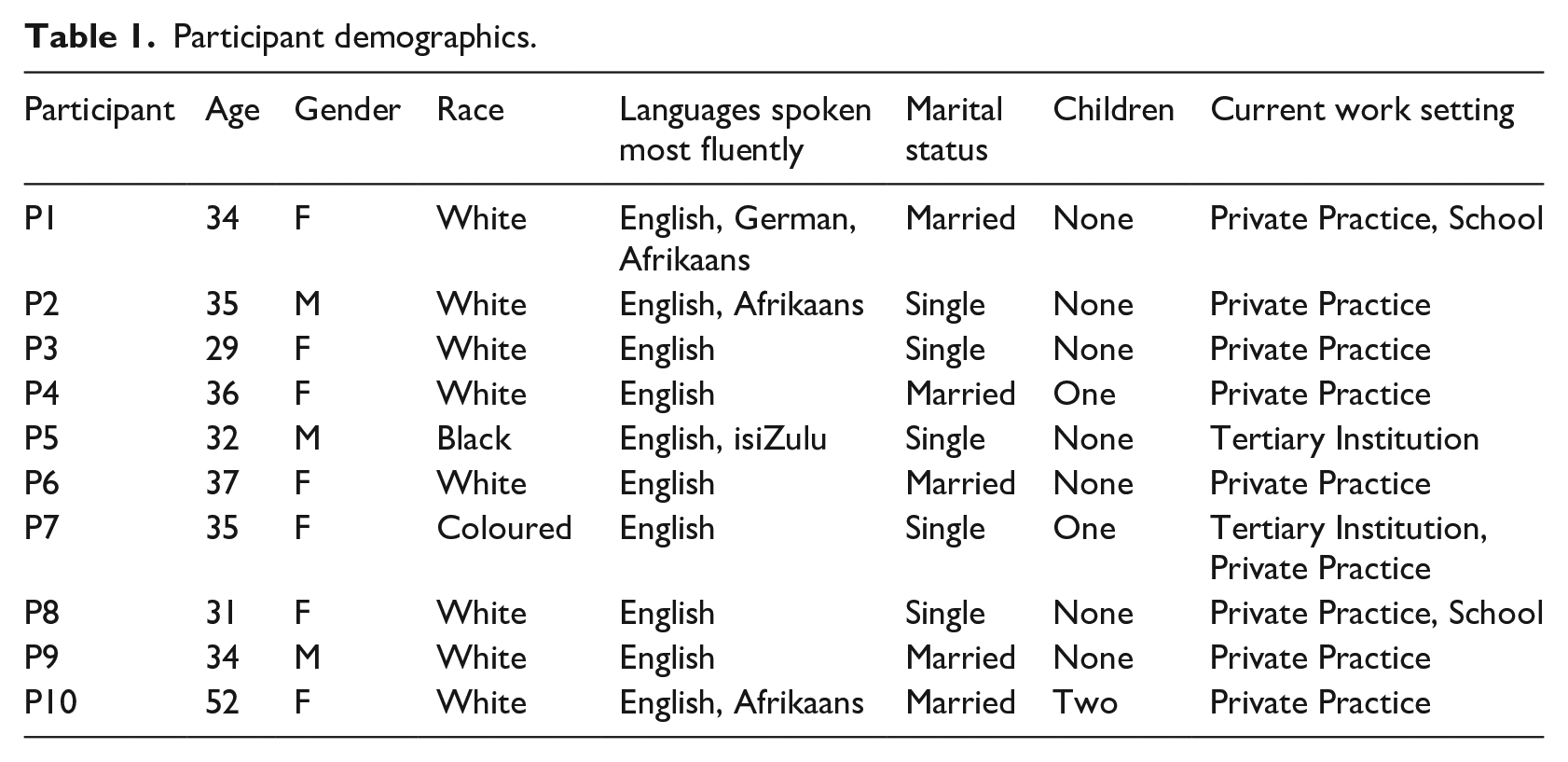
Ten early career counselling psychologists (see Table 1) who first registered with the Health Professions Council of South Africa (HPCSA) between the years 2010 and 2020 comprised the sample. The inclusion criterion of 1 to 10 years in service was chosen to align with the American Psychological Association’s (2013) definition of an early career psychologist, namely, a psychologist still within 10 years of graduation. Importantly, while the sample is overrepresented by White, female participants working within private practice settings, this aligns with the broader demographic of the counselling psychologist profession in South Africa (Young & Saville Young, 2019).
Participant demographics.
Data collection
The participants completed an online semi-structured interview on their professional experiences as early career counselling psychologists in South Africa. Interviews were conducted during March of 2022 and lasted approximately 45 to 90 min. A temporal structure was followed (Kvale & Brinkmann, 2015), beginning by exploring the participant’s path to becoming a counselling psychologist, then asking about aspects of their current work, and concluding by exploring their thoughts, assumptions, and feelings about their future as counselling psychologists in South Africa. Interviews were conducted in English, audio-recorded, transcribed verbatim, and stored electronically.
To ensure trustworthiness, we adhered to Nizza and colleagues’ (2021) criteria for high-quality interpretative phenomenological analytical research, which encompasses four key markers: (1) ensuring a dynamic, orderly and persuasive narrative; (2) purposely engaging with the experiential and existential significance of each participant’s narrative; (3) ensuring close analytic reading of participant’s words, and (4) attending to convergence and divergence of participants accounts.
Procedure
This research forms part of a larger PhD project (Haine, 2023), which employed a mixed-method sequential explanatory design (Creswell & Plano Clark, 2007) consisting of two phases, namely, a quantitative phase, followed by a qualitative phase. The quantitative phase (‘First Phase’) comprised an online survey questionnaire (n = 512) to investigate the workforce trends of counselling psychologists in South Africa. The qualitative phase (‘Second Phase’) followed, comprising online semi-structured interviews with 10 early career counselling psychologists.
All counselling psychologists registered with the Health Professions Council of South Africa (HPCSA) with functional email addresses (n = 1709) were invited to participate in the first, quantitative, phase of the study. Permission was obtained from the HPCSA to access the email address database for counselling psychologists. This ensured a comprehensive sampling pool. An email containing a URL link to the online survey was subsequently sent to the full list of counselling psychologist email addresses. An item at the end of the online survey asked participants to indicate their willingness to engage in a follow-up interview. The first 10 early career counselling psychologists who responded to the invitation to participate, and who indicated a date and time for the interview to be conducted, were recruited for the second, qualitative, phase of the study.
An interpretative phenomenological analysis (IPA) (Nizza et al., 2021) was conducted in the second, qualitative phase to investigate the lived professional experiences of early career counselling psychologists in South Africa. IPA was deemed suitable, given the fundamental aim to gain an in-depth understanding of the participants’ professional experiences.
Ethical considerations
Ethical clearance for the larger doctoral research project was applied for and granted by the Rhodes University Ethical Standards Committee (RUESC) (Review Reference: 2020-1574-362). Prior to their engagement, all individuals provided written informed consent to participate. Given that all participants were registered counselling psychologists, participants adeptly self-regulated during the interviews, eliminating the need for the interviewer (the first author) to intervene in instances of discomfort. Confidentiality and anonymity were maintained by substituting participant names with codes and omitting details that could potentially identify participants to the general reader. In addition, all data were securely stored on the interviewer’s password-protected laptop in documents with an additional layer of password protection.
Data analysis
IPA was used to analyse the data. IPA does not advocate for a specific data analysis method, but instead offers a framework of principles and recommendations to be adhered to (Smith & Nizza, 2022). Consequently, flexibility and creativity were essential in following the six-stage process proposed by Pietkiewicz and Smith (2014): (1) immersing oneself in the data by reading the interview transcripts multiple times; (2) drawing up margins on the left- and right-hand sides on the transcript and annotating initial observations in the left-hand margin; (3) transforming the annotations in the left-hand margin into preliminary personal experiential themes (PETs) and recording them in the right-hand margin; (4) grouping PETs based on conceptual similarities and assigning the clusters descriptive labels; (5) repeating the abovementioned processes for each participant’s interview transcript, and (6) identifying and recording patterns across cases, with recurring themes clustered together into group experiential themes (GETs). As indicated, to ensure the anonymity of the participants, names were removed and participants were allocated codes (see Table 1).
Findings
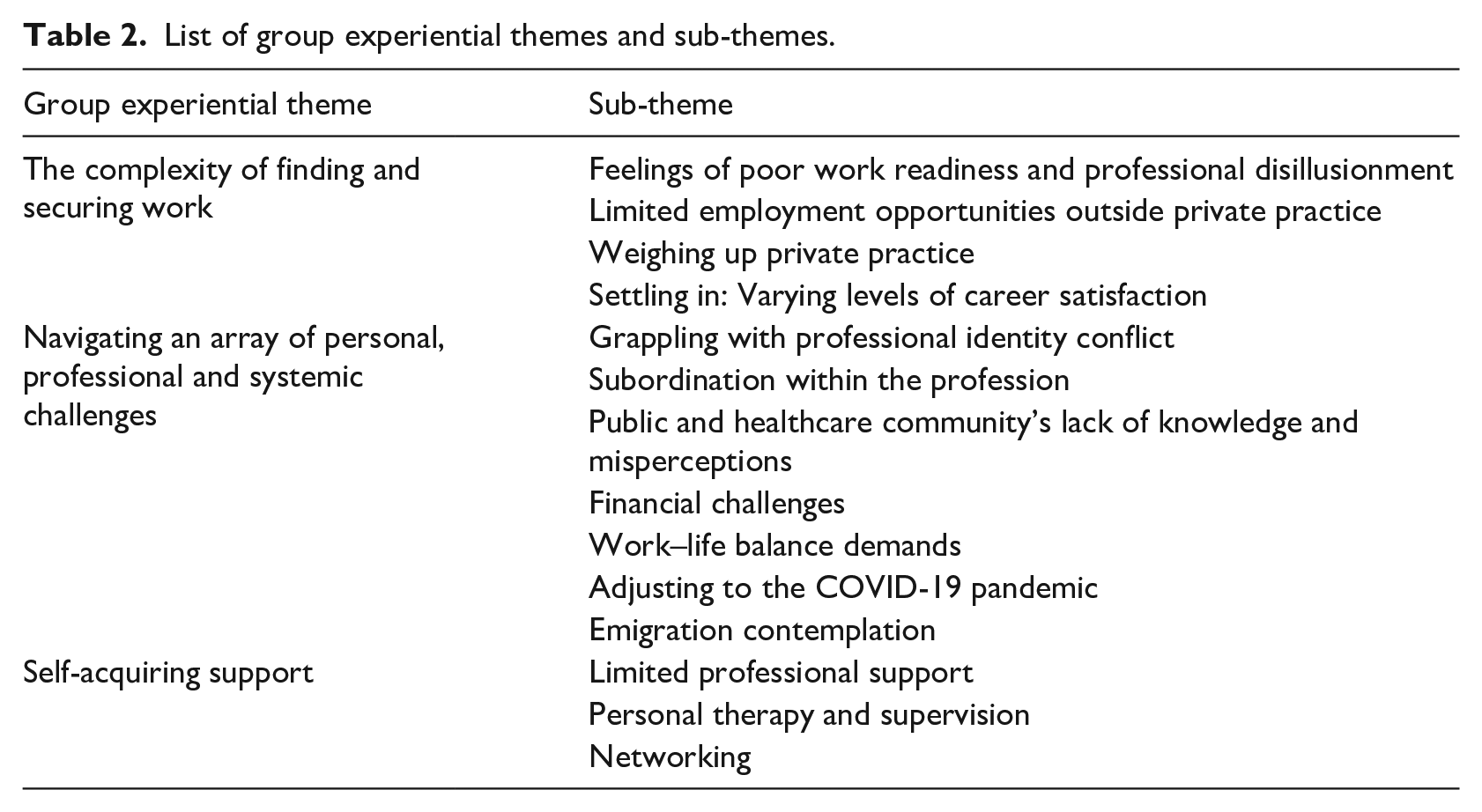
Several themes emerged from the data, which are presented as follows: (1) the complexity of finding and securing work; (2) navigating an array of personal, professional, and systemic challenges, and (3) self-acquiring support (see Table 2).
List of group experiential themes and sub-themes.
Theme 1: the complexity of finding and securing work
This first theme sets the scene for the themes which follow as it illustrates participants’ attempts to navigate the complexities of finding and securing work in South Africa. Participants were simply asked to describe their experience of acquiring employment and/or starting a practice in South Africa.
Feelings of poor work readiness and professional disillusionment
Eight participants expressed feeling ill-prepared upon entering the workforce. Specifically, participants indicated not graduating with the requisite knowledge and skills to successfully navigate the marketplace, establish and run a private practice, as well as to engage in licensure and medical aid credentialing procedures. International authors refer to this as poor work readiness (Kolar et al., 2017). Participant 1, for example, stated, I didn’t have the necessary skills to start the work. So I think to start the process, it was really tough. (P1)
For P2, feelings of poor work readiness came as a surprise, given expectations to be fully prepared upon entering the workforce: My expectation was that by the time my training was done that I’d be ready to face anything. So it’s a bit of a paradigm shift to realise that actually you’re not ready. (P2)
Seemingly exacerbated by feelings of poor work readiness, eight participants alluded to feelings of disillusionment on transitioning into the workforce. Participant 7, for example, stated, It’s so hard already to get into a Master’s programme and you feel like, you know, once you’ve accomplished that you’ve gotten over this huge hurdle and you’re finally at the top! But then you basically get crushed all over again. (P7)
Participant 7’s metaphorical depiction of feeling ‘crushed’ upon entering the workforce alludes to intense feelings of disappointment and discouragement about beginning her career as a counselling psychologist.
Limited employment opportunities outside of private practice
Eight participants revealed difficulty in finding and securing employment in South Africa. For example, P6 reflected, That was really, really, really hard. It was a real eye opener to see that there are not a lot of jobs. (P6)
Rhetorically, P6’s repeated use of the word ‘really’ emphasises the difficulty she experienced in securing employment. Nine participants attributed their decision to enter private practice to the limited employment opportunities available to them. For example, P1 reported, Although it was never my dream, I then decided to start a private practice because I really couldn’t find any employment. (P1)
Participant 1’s experience suggests a misalignment between inherent career interests and available work opportunities in South Africa. Expanding on this experience, P8 suggested posts were predominantly availed to psychologists in other registration categories: Counselling psychologists have to go into private practice because clinicals, hospitals want them, institutions want them, rehabs want them, educationals the schools want them.
Four participants, in turn, expressed frustration at a major misuse of practitioner resources within the country. The following viewpoint by P3 is illustrative: We keep saying ‘Oh, there’s such a shortage of practitioners’ . . . Like no! Well yes, there’s a shortage but there are so many of us that you could be using but you’re not! The resources are there, you just need to use them properly. (P3)
Weighing up private practice
All participants noted a major disadvantage of private practice to involve issues of accessibility. As such, four participants perceived offering pro bono and reduced rate services as a viable means to improve access to services. Participant 4, for example, reported, Where there is a need, I do offer some reduced fee services or some pro bono services. (P4)
Nine participants further reflected a major disadvantage of private practice to include financial unpredictability. Participant 3, for example, noted, Private practice is very unpredictable, which means that your income is unpredictable, and can be unstable. So that’s obviously challenging, and I think quite anxiety provoking. (P3)
For most participants, the advantages of private practice outweighed the disadvantages, with noted advantages including feelings of empowerment, the flexibility of work hours, the ability to manage burnout, and the potential of a lucrative income. For example, P3 observed, I’ve appreciated the flexibility around being in a private practice. I’ve appreciated that it’s, you know, it’s fairly lucrative. You earn quite well. And, I enjoy the therapy. I also enjoy not working for someone. (P3)
Settling in: varying levels of career satisfaction
Eventually finding and securing work, eight participants reflected on the process of ‘settling in’ to their careers, which required an accumulation of experience over time. Participant 6, for example, offered a metaphorical interpretation of her tumultuous journey to ‘settling in’: I really went through my stormy waters to navigate where I am now, which is really in a much calmer, more stable place. (P6)
Seven participants expressed high overall career satisfaction while simultaneously acknowledging the significant emotional labour required. For example, P4 reflected, I find the work very, very, very fulfilling. I do find it tiring. (P4)
Revealing feelings of overall career dissatisfaction, three participants expressed frustration with evolving regulatory restrictions and the subsequent impact on the practice lives of counselling psychologists. For P8, this career dissatisfaction resulted in discouraging future potential candidates from entering the profession: When I’ve got, you know, like younger friends or friends that are wanting to study psychology . . . I always say rather apply for clinical. (P8)
Theme 2: navigating an array of personal, professional and systemic challenges
In addition to challenges in finding and securing work, participants encountered an array of obstacles on entering the workforce, at personal, professional, and systemic levels.
Grappling with professional identity conflict
Participants were broadly asked to describe how they came to be a counselling psychologist in South Africa. All 10 participants described having pursued, or at least strongly considered, an alternative career path prior to pursuing a career as a counselling psychologist. For example, P4 noted, I wanted to pursue a career in medicine and was quite sort of focused on that. (P4)
Six participants described initial aspirations to pursue a career in clinical psychology. However, to improve the likelihood of being accepted into a professional psychology programme, participants reported applying to multiple universities in the categories of both clinical and counselling. Participant 3, for example, indicated, I really wanted to do clinical. But then I sort of reconciled in my mind. You know what, it’s pretty much the same, there isn’t much difference. Let me just see, you know . . . diversify my chances. So then I ticked the counselling box. (P3)
Interestingly, P3 reconciles counselling psychology as her second-rate career option by minimising the differences in professional identity between the clinical and counselling professions.
Subordination within the profession
All 10 participants revealed experiencing counselling psychologists’ subordination within the field. Four participants felt that despite equivalent training and mostly combined classes with clinical psychologists, an apparent hierarchical system was evident. For example, P10 argued, To really have power or to have or to hold any sway, it’s best to be clinical. . . So employment offers, medical aids. . . They are distinguished, even though our training is very much on a par. (P10)
Elaborating on their experience of subordination within the field, three participants spoke to ongoing remuneration challenges by medical aids. For example, P7 reflected, My own medical aid, I’ve got a benefit on it for psychological services, but I need to go to a clinical psychologist, because if I go to a counselling, they won’t pay for it. (P7)
Simultaneously, two participants noted overall improvements in payments by medical aids in recent years. Participant 8, for example, observed, I mean, I know it’s getting better with the scope of practice, scope of profession, that’s meant to be helping out a little bit. But you know, there’s still issues. (P8)
Public and health care community’s lack of knowledge and misperceptions
Nine participants reported a general lack of knowledge and misperception by the public and broader health community on the roles and responsibilities of counselling psychologists. Specifically, nine participants stated that the registration category system was mostly confusing and unhelpful to the public. P7, for example, argued, The public itself, they don’t really understand the different categories so they just see it as though you’re a psychologist. (P7)
To avoid confusion, four participants revealed identifying themselves simply as ‘psychologists’. For example, P2 highlighted, To avoid confusion, I usually just say I’m a psychologist. I wouldn’t elaborate on it because I think it gets confusing. (P2)
Participants’ self-identification as ‘psychologists’ contravenes counselling psychologists’ obligation to use the complete title, in turn perpetuating misunderstanding and misperceptions about the profession.
Financial challenges
Nine participants expressed facing significant financial challenges upon entering the workforce. For many participants, this elicited feelings of stress, anxiety, and frustration. For example, P1 noted, I remember getting paid like real peanuts. (P1)
From a different perspective, P2 stated, I had some contacts in some children’s homes but there’s not a lot of funding available. So a lot of that ended up being pro bono. And so, although I have a passion for the work, you also have to eat. (P2)
Although P2 describes an inherent interest in working with underserved and marginalised populations, he reports that significant financial constraints impede his ability to remain in such contexts. Reflecting on the impact of financial challenges in her early career years, P4 noted the challenge of affording adequate supervision: At the beginning, finances were tight. So supervision was tricky. (P4)
Work–life balance demands
Eight participants described facing challenges in balancing their personal and professional lives. Specifically, participants revealed difficulties in navigating their professional lives as a result of the intersection with their personal identities, for example: There were many sexist kinds of questions that I was asked in my interview . . . (P3) I have to deal with different kinds of conversations, right? Like I’m Black, therefore, I must be stupid. (P5)
Participants further indicated personal and familial factors as greatly impacting on their professional lives. For example, P4 reflected an overall reduction in work hours as a result of evolving familial factors: I’ve also got this little person, he’s three, so then I’ve still got to get home and make supper and all of those things. Whereas, before I was married, and before I had my little one, I was working until 20h00 at night. (P4)
In addition to work–family interactions, all 10 participants reported high workloads, resulting for five participants in poor mental health and/or burnout. For example, P9 indicated, I got severely depressed and I ended up on medication. (P9)
Six participants went on to report that temporarily leaving the profession allowed them to recover from burnout. Participant 7, for example, reflected, I actually did burn out and I had to take two months off almost just to recuperate. (P7)
Adjusting to the COVID-19 pandemic
Eight participants spoke of the COVID-19 pandemic and its impact on their professional lives. Notably, five participants reflected an overall increase in client numbers. For example, P4 observed, I think COVID has created a bit of a mental health pandemic. (P4)
Three participants acknowledged a transition from face-to-face to online therapy as a consequence of the pandemic. Participant 7, for example, indicated, We were doing online since the COVID pandemic hit but prior to that, it was all face-to-face. (P7)
Emigration contemplation
Participants were broadly asked to reveal how they felt about their futures in South Africa. Seven participants made reference to the prospect of emigration. Four participants, specifically, articulated a preference to remain in South Africa; nevertheless, participants were incentivised by improved counselling psychologist work opportunities and a reduced professional hierarchy elsewhere. For example, P3 noted, I was definitely attracted to going [to the UK] because of the opportunities and because there’s less distinction and there’s less of a hierarchy. (P3)
In contrast, two participants reflected that their contemplation over emigration was prompted by political and safety concerns. Participant 1, for example, reported, A decision around [emigration] would be determined either by experiencing something traumatic where there might be a knee jerk reaction of okay, what we’ve got to get out of here or if the political situation in South Africa changes. (P1)
Theme 3: self-acquiring support
Participants were asked to describe their experience of support upon entering the workforce. Participants revealed limited available professional support and consequently reported self-acquiring support though engagement in personal therapy, supervision, and networking.
Limited professional support
Eight participants reported insufficient professional support on entering the workforce. Consequently, participants expressed relying on self-initiated methods. For example, P3 described, I sort of feel like I figured it out on my own. Most of it, actually . . . I didn’t have too much guidance. (P3)
From a different perspective, two participants indicated gaining support through group practice settings. For example, P10 reflected, I received a lot of support in a lot of ways, because I was lucky enough to join this group practice, where two of the counselling psychologists have been practicing for over eight years. (P10)
Personal therapy and supervision
Nine participants revealed personal therapy and individual and peer supervision as significant forms of professional support in their early career years. Among these, four participants reported valuing personal therapy, while eight emphasised the importance of either individual or peer supervision. Participants, for example, revealed, So I was in therapy and I continued with that. That was very helpful and because my psychologist also provided guidance. (P1) I continued supervision with her and I’m still in supervision with her. I would say she’s given me a lot of support. (P3)
Interestingly, four participants revealed difficulties in acquiring individual or peer supervision. Participant 6, for example, described her experience of an inconsistent and mostly unavailable supervisor, resulting in feelings of frustration and professional isolation: For two years, I didn’t have a supervisor. I tried with a woman who promised me we would do it every month. I saw her I think three times, she wouldn’t answer my calls. (P6)
Networking
Eight participants identified networking as a means of professional support. For many participants, networking allowed them to secure employment and/or to successfully establish a private practice. For example, P8 indicated, A friend of mine, so I’d studied with her. She was the year ahead of me. She had a busy practice and she said, if you’re interested, why don’t you jump in. (P8)
Interestingly, four participants noted connections with clinical supervisors and/or training programme staff to have supported their transition into the workforce. Participant 6, for example, mentioned, My supervisor from my thesis had actually, had a business and . . . I can’t remember how it happened, but she offered me a job. (P6)
Discussion
The participants in this study faced numerous challenges in their transition into the workforce and felt they lacked adequate means of professional support, resulting in feelings of anxiety, frustration, and professional disillusionment. In line with much of the literature available on early career psychologists, participants described feeling overwhelmed and underprepared in their early career years (Kolar et al., 2017). According to Skovholt and Rønnestad (2003), this is both a common and dominant experience, as early career psychologists tend to be more idealistic about their professional lives and the potential impact of their efforts than is warranted. The phenomenological emphasis of this study revealed the extent to which the work opportunities available to counselling psychologists outside of private practice continues to be a problem (Haine & Booysen, 2020). Exacerbated by experiences of professional subordination as well as safety and political concerns, this prompted participants to contemplate emigration. While private practice in South Africa predominantly receives criticism because the majority cannot afford the high cost of the services, participants in this study reported offering pro bono and reduced rate options, proposing a potential means to fill an important health care gap (Goupil & Kinsinger, 2020). Even so, the authors question the weight of responsibility falling on individual practitioners to ensure countrywide economic redistribution. Arguably, this duty lies with the state and is achievable through the creation of posts or through the reimbursement of practitioners within the private sector. Participants’ experiences of private practice mostly align with global claims, suggesting that factors such as flexible work hours (Walfish & Walraven, 2005), enhanced autonomy, a greater sense of personal accomplishment, and reduced emotional exhaustion (Rupert & Kent, 2007) were major factors contributing to satisfaction in private practice. Conversely, the financial unpredictability of private practice was viewed as a deterrent (Walfish & Walraven, 2005). Overall, the fulfilling and altruistic nature of the work is particularly evident for participants, consistent with local findings (Haine & Booysen, 2020), while career dissatisfaction predominantly involves the emotional labour required as well as negative registration-category-related experiences. Specifically, participants described the registration category system as confusing and unhelpful to the public and the broader health care community, and further reported counselling psychologists’ general subordination within the field as a result. Perhaps not surprisingly, participants thus revealed grappling with their professional identity upon entering the workforce; with six initially aspiring to pursue a career in clinical psychology. We speculate that clinical psychology might merely be the less contentious career option given evolving regulatory restrictions and available work prospects for counselling psychologists. Despite the majority reporting negative registration-category-related experiences, including ongoing reimbursement issues from a handful of medical aids, participants did note a recent reduction in payment concerns from medical schemes. This likely comes as a result of regulatory efforts by the HPCSA’s Professional Board of Psychology, since medical aids rely on HPCSA documentation to make reimbursement decisions. It is noteworthy that a document outlining the ‘List of Professional Competencies’ has recently been introduced which, arguably, permits counselling psychologists a much greater degree of freedom in respect of practice. In line with existing literature, the participants noted significant financial constraints in their early career years which influenced their ability to gain supervision (Scalise et al., 2019) and work within marginalised and underserved communities. In addition, participants reflected the significant impact of the COVID-19 pandemic on their professional practice lives, inclusive of an increase in client numbers, as well as the transition to online therapy, echoing extant literature (Aafjes-van Doorn et al., 2022).
At the nexus of their personal and professional lives, participants spoke of challenges in managing a work–life balance. While psychologists are not immune to stress, burnout, and poor mental health (Volpe et al., 2014), the findings align with suggestions by Kolar et al. (2017) that early career psychologist stress and burnout may be mitigated by taking a break from the profession. That said, this suggestion may not be financially feasible for economically disadvantaged populations who are bound by heightened financial obligations and constraints. Such considerations are especially important considering the concept of intersectionality, defined as the complex effects which ensue when multiple aspects of an individual’s identity intersect within historically specific contexts (Crenshaw, 1989). In this study, issues of intersectionality were evident, where participants reported unique and negative experiences as a result of their overlapping personal and professional identities, inclusive of age, race, gender, culture, and language abilities, pointing to the need for tailored support of the new diverse cohort of counselling psychologist practitioners in South Africa (Haine, 2023). The current study suggests that unless participants commenced their professional careers within group practice settings, they reported experiencing limited available professional support. Rather, participants reported self-acquiring support through personal therapy, supervision, and networking. The findings mirror global data demonstrating that the fundamental means of support for early career psychologists involves supervision (Paterson et al., 2014), personal therapy (Grimmer & Tribe, 2001), and the utilisation of peer networks (Carmeli & Spreitzer, 2009). Nevertheless, similar challenges in obtaining willing and reliable supervisors on the part of early career psychologists have been noted in the literature (Kolar et al., 2017). This likely is a result of the scarcity of formal supervision opportunities following training due to time and resource constraints (i.e., in respect of the availability of senior psychologists), as well as the absence of structured supervision and mentorship programmes.
To optimise the professional experiences of early career counselling psychologists in South Africa, individual early career psychologists are urged to engage in critical self-reflection, seize employment and service opportunities, maintain a healthy work–life balance, and actively seek professional support. Furthermore, trainers are encouraged to recognise the early career stage as a vital extension of the training programme model to ensure trainees are adequately prepared for the workforce. In addition, professional organisations and regulatory boards are urged to collaborate in establishing formal mentoring or supervision programmes, provide centralised online early career psychologist resources, integrate early career psychologists into leadership structures, and offer reduced membership fees for the first 2 years. Moreover, a broader systemic approach requires workforce data to be routinely collected, analysed, and disseminated, to accurately and effectively guide policy, advocacy, utilisation, and distribution of counselling psychologists in the country. One possible limitation of this study is that the focus on the particular category of counselling psychology may obscure the extent to which the issues are shared across professional categories, including clinical psychology. However, while some issues are likely to apply to all early career psychologists, it is likely that there are some that are specific to early career counselling psychologists, as described by the participants above. Future studies should include an investigation into the possible similarities, differences, developmental needs and concerns, as well as professional training implications on the professional lives of early career psychologists in South Africa.
Conclusion
The pathway from student and intern psychologist to established practitioner is for some a ‘rite of passage’ fraught with many challenges. More needs to be done to prepare and support early career counselling psychologists as they make this transition, in the interests of their wellbeing and career satisfaction, and in the interests of the profession and the people it serves.
Footnotes
Declaration of conflicting interests
The author(s) declared no potential conflicts of interest with respect to the research, authorship, and/or publication of this article.
Funding
The author(s) disclosed receipt of the following financial support for the research, authorship, and/or publication of this article: The financial assistance of the Health and Welfare Sector Education and Training Authority (HWSETA) (Reference Number: G18H6216), and the National Institute for the Humanities and Social Sciences (NIHSS), in collaboration with the South African Humanities Dean Association (SAHUDA) (Reference Number: SDS20/1269) towards this research is hereby acknowledged. Opinions expressed and conclusions arrived at are those of the authors and are not necessarily to be attributed to the HWSETA, NIHSS, and SAHUDA.
