



Abstract
Gender is a fundamental element of social life but is premised on the notions of socially and culturally constructed differences which are almost always hierarchical in nature, imbued with power(lessness), and reinforced by binary thinking. Sport is one domain where gendered hierarchies, power struggles, and binaries have been most notable. CrossFit is a relatively new sport which is said to offer women a space for alternative gender performances. This article draws on autophotographical and photo-elicitation interview data generated with 13 women CrossFitters. Informed by feminist poststructuralism and using reflexive thematic analysis, the researchers generated two paradoxical themes which illustrate the ways in which women CrossFitters can transgress but also inadvertently reinforce gendered boundaries. We present and interrogate the themes of bodies, bruises, and blisters, and the struggle for/of the feminine/muscular body as paradoxical processes for women CrossFitters. These paradoxical processes permit women CrossFitters to experiment with performances of both femininity and masculinity that could be transformational and non-gendered and allow these women to transgress normative bodily ideals and gendered norms.
There is growing recognition and acceptance of the notion that gender and gender identity are a socially constructed series of performative and embodied acts which do not exist beyond their ‘doing’ (Butler, 1990, 1993). Because gender is socially constructed, the sociocultural and linguistic practices that are embedded in society create and reinforce the categorisation of the ways in which humans walk, talk, dress, and behave (i.e., embody gender) as either feminine or masculine, and position this embodiment at either end of a gender spectrum (Lorber, 1994). From a social constructionist perspective then, gender is a ‘structural category (the gender order of society)’ (Pfister, 2010, p. 235), created by broader societal and cultural structures, hierarchical in nature, and reinforced by socially and culturally constructed binary distinctions (Burr, 2015). Although gendered binaries and hierarchies play out in all domains of human activity, with these having adverse consequences for women’s subjectivities and rights, one domain where these binaries and hierarchies have been especially notable is in sport (Serra & Burnett, 2007).
CrossFit is a relatively new and postmodern sport where women and men train, perform, and compete together. This mixing of genders in the training and competitive CrossFit environment enables women CrossFitters opportunities to experiment with and participate in alternative forms of gender performance (Podmore & Ogle, 2018), this being especially relevant in a context where women’s achievements in sport have historically been devalued through sexualised and gendered media portrayals (Cooky et al., 2013; Serra & Burnett, 2007).
This article interrogates women CrossFitters’ construction and performance of gendered and non-gendered subjectivities through CrossFit. Here, we understand ‘non-gendered’ to mean no particular gender, and ‘subjectivities’, from a poststructuralist perspective, to refer to the essence of being a subject (e.g., Who am I? How am I formed?), but a subject that is only possible through and because of existing discursive structures (Howarth, 2013). This understanding of non-gendered subjectivity is grounded in Butler’s (1990) critique of the ‘radical splitting of the gendered subject’ (p. 6) and Wittig’s (1985) notion that the ultimate act of subjectivity (i.e., being a total subject) is that of being an ‘ungendered, universal, whole’ (p. 6).
Historically, women did not participate in certain kinds of ‘masculine’ sports such as biathlon, iron man, water polo, weightlifting, and bodybuilding (Pfister, 2010). However, in contemporary societies, Pfister (2010) explains how these kinds of sports have been ‘undergoing a “sex change”’ (p. 237), with women now actively participating and competing in historically male-dominated sports, including CrossFit. Originally established by former gymnast Greg Glassman in 2000 (Schrijnder et al., 2021), CrossFit is now understood to be ‘a strength and conditioning system built on constantly varied, if not randomised, functional movements executed at high intensity’ (Glassman, 2004, p. 1). The sport focuses on using a combination of high-intensity weightlifting and cardiovascular exercises to train a diverse range of physical skills in gyms, commonly referred to as CrossFit boxes. In addition to the technicalities of what CrossFit is, CrossFit participants typically form close-knit communities and regard the sport ‘not only as what they do, but also as who they are’ (Dawson, 2017, p. 370). In expanding on the sociological dynamics of CrossFit, Dawson (2017) argues that the sport can be understood as a reinventive institution, ‘a material, discursive or symbolic structure through which voluntary members actively seek to cultivate a new social identity, role or status’ (Scott, 2010, p. 226). In contrast to total institutions, such as an asylum or prison where members are ‘improved’ involuntarily, members of reinventive institutions like CrossFit seemingly use the institution ‘as a vehicle for [voluntary social] identity change’ (Scott, 2011, p. 234). Similar to the way in which Butler (1990, 1993) regards gender as a series of performative acts, members of reinventive institutions subject themselves and other members to powerful sets of performative regulation, where ‘members gaze at each other and monitor relative progress towards a shared goal’ (Scott, 2011, p. 49). From a social identity theory perspective then, CrossFit enables group and social identity in that an individual concurrently belongs to a CrossFit community (a group identity), and through comparison to others in that group positions herself according to several social identity markers (e.g., ability, age, gender performance, and race) (Beasley et al., 2021; Davis et al., 2019). Although all social identity markers are important, the focus of this article is on the varieties of gender performances made possible for women CrossFitters.
Women CrossFitters have been found to challenge gendered norms through their muscular bodies, outperforming men in workouts, and their competitive work ethic (Neufeld, 2019). Podmore and Ogle (2018) found that CrossFit influenced how women understood and viewed themselves as gendered beings who can and do challenge hegemonic ideals of submissiveness, and redefine themselves as active participants in life with choices. From an aesthetic and aspirational perspective, Knapp (2015) observed that in CrossFit, the body ideal of a woman can shift from the socially accepted goal of having a skinny and/or at most toned body, to having a powerful and strong body. For women, the focus of CrossFit training therefore can become more about physical performance and less about developing a stereotypically thin feminine appearance. Over time, CrossFit women may ascribe to the motto that ‘strong is the new sexy/skinny’ (Cohen & Colino, 2014; Dawson, 2017; Rinkunas, 2011).
Although CrossFit women can challenge gender normativity through the sport, CrossFit women and the contextual particularities of CrossFit can also reinforce gendered hierarchies from both biophysiological and sociocultural perspectives. Biophysiologically, men can generate more power during exercise because they possess more fast twitched muscle fibres (Dalleck & Smith, 2016), and as a result, can lift heavier weights, and lift these faster in workouts when compared to women. Generally, men also have larger skeletal frames, produce more testosterone, and hence, exhibit greater muscle gains in comparison to women (Monterio et al., 2016). Therefore, men do tend to outperform women in CrossFit, reinforcing their biophysical power over them. Socioculturally, women CrossFitters may experience and inadvertently engage in social acts which disempower and oppress them (Podmore & Ogle, 2018). For example, although women CrossFitters can and do develop and demonstrate stereotypically masculine traits (e.g., developing muscular bodies and being competitive), they can also perform or reproduce hyperfeminine norms through CrossFit by wearing minimal clothing when exercising (e.g., sports bra and booty shorts), thereby signalling hyperfeminine sexualities and gender performances. Related to these sociocultural practices and acts, CrossFit women may also experience and participate in a culturally produced glass ceiling effect where an attempt to progress (e.g., gain muscle) is stopped because of internalised and sociocultural messages that women’s bodies should be non-muscular (Dworkin, 2001; Robinson et al., 2017) and communicate a subordinated form of emphasised femininity (Connell, 1987). In close contiguity with hegemonic masculinity, emphasised femininity accommodates the ‘interests and desires of men’ (Connell, 1987, p. 183), whereas deviations from emphasised femininity (e.g., the development of muscular bodies) may lead to the othering and social isolation of these ‘deviant’ women. Overall, there is a paradox between gender and muscle development where on the one hand, women are taught that they cannot gain muscle mass like men by lifting weights because biologically this is not possible; however, when women do weight training, they do gain muscle (Dworkin, 2001). Grounded in the above literature review, the study reported in this article was based on the following research question: How do women CrossFitters construct and perform non-gendered subjectivities through CrossFit?
Methodology
The study was grounded in a feminist poststructuralist ontology and epistemology. Consequently, we prioritised a socially mediated understanding of the world where language, linguistic spaces, and texts are constitutive, and not reflective of reality (Burr, 2015; Jaspal, 2020). Moreover, from a poststructuralist perspective, we understand text as ‘any printed, visual, oral or auditory production that is available for reading, viewing or hearing’ (Denzin, 1995, p. 52).
Participants
The participants of the study included 13 South African women CrossFitters, aged between 20 and 50 years, who had been active in the sport for at least 6 months and were attending CrossFit classes three to four times a week. The first author is an active CrossFitter herself and obtained gatekeepers’ permissions from six South African CrossFit box managers to approach women CrossFitters who belonged to and trained at their CrossFit boxes. Based on her knowledge, experience, and relationships with other women CrossFitters, the first author used snowball sampling to recruit the participants after gatekeepers’ permissions and ethical clearance were granted for the study.
Instruments
The 13 women CrossFitters participated in individual autophotographical activities and photo-elicitation interviews with the first author. Similar to an autobiographical activity in research, an autophotographical activity involves research participants using photographs instead of written text to produce a narrative about an aspect of their lives (Harper, 2002; Noland, 2006). Given the poststructuralist foundations of the research, we understand photographs as valuable ‘texts’ and artefacts through which participants can (de)construct and constitute representations of gender. For the autophotographical activity, the first author prompted the participants to ‘take 10 photographs that represent how gender is expressed to/by me as a South African woman CrossFitter’. For the photo-elicitation interviews, the authors developed a semi-structured photo-elicitation interview schedule which was structured to encourage an open-ended discussion, and then a more focused sharing and explaining of how the photographs constituted participants’ non-gendered subjectivities through CrossFit.
Procedure
After a participant had been afforded a 2-week period to complete the autophotographical activity, she was invited to participate in an individual photo-elicitation interview with the first author. Most participants chose to meet in public spaces (e.g., CrossFit box, coffee shop); however, one chose to meet the first author online. Each photo-elicitation interview lasted between 60 and 90 min long, and the photographs from the autophotographical activity formed the basis for the photo-elicitation interviews. After welcoming the participant to the photo-elicitation interview and affirming ongoing consent to participate in the study, the first author then asked the participant to select, present, and discuss the photographs they took. The first author and the participants viewed the photographs on the participants’ cell phones, and then engaged in a conversation about the ways in which the participant and their photographs visually (re)presented performances of gender. All photo-elicitation interviews were audio recorded and transcribed. Participants also emailed copies of their photographs to the first author.
Ethical considerations
Ethical clearance for the study was granted by the Human and Social Sciences Research Ethics Committee (HSSREC/00003881/2022), a research ethics committee registered with the National Health Research Ethics Council in South Africa and based at the University of Kwa-Zulu-Natal. All participants provided written consent before data collection, and pseudonyms are used when presenting the findings. The participants were advised that they could withdraw from the research process at any time without the risk of adverse consequences. Moreover, because the study used photographs as part of the data production process, when research participants opted to take photographs of others where that person’s face or identity was recognisable from the photograph, they were required to obtain written consent from that person in the form of a consent, acknowledgement, and release form. When a participant wanted to take a photograph of a child, that child’s parent or guardian needed to provide consent (Wang & Redwood-Jones, 2001). The first author provided each research participant with consent, and acknowledgement, and release forms for the subjects of their photographs, and these forms included a description of how the photographs would be anonymised and used. Research participants were encouraged not to take photographs that specifically identified people, but where this was unavoidable, the subject of the photograph needed to consent, and photographic editing techniques such as facial obscuring through pixellation were used to anonymise the identity of the individuals in the photographs. Participants also needed to specifically consent to photographs being published for the purposes of disseminating research findings, such as through this article.
Data analysis
We made use of reflexive thematic analysis (Braun et al., 2018) to analyse the data. However, this analytic process was informed by feminist poststructuralism which prioritised an ‘analysis of the socially constructed nature of human behaviour, deconstruction of the assumptions within language and the processes of producing subjectivities’ (Gavey, 1989, p. 472). Our analytic process was akin to that used by Farvid and Braun (2006) in their feminist poststructuralist-inspired thematic analysis of text from popular ‘women’s’ magazines. In their analysis, and in ours, ‘data were interrogated for the assumptions they rely on and reproduce and the possibilities they offer for subjectivity and practice for women’ (p. 299). Although feminist poststructuralist research is highly compatible with discourse analysis, Braun and Clarke (2021a) argue that reflexive thematic analysis within a poststructuralist framework is indicated instead of discourse analysis when a study’s research question is not ‘solely . . . oriented to the effects of language’ (p. 44). Our research question was less concerned with the possible effects of the participants’ language use (i.e., what were they doing with their language), and more concerned with patterns that elaborate on ‘possibilities . . . for subjectivity and practice for women’ (Farvid & Braun, 2006, p. 299). The reflexive thematic analysis processes were informed by the growing body of work on the topic (Braun & Clarke, 2006, 2019, 2021a, 2021b, 2022; Braun et al., 2018) and involved first using the Jeffersonian Transcription System to transcribe the photo-elicitation interviews (Jefferson, 2004). The data collection and transcription processes contributed to the first author’s immersion in and familiarisation with the data, which then evolved into her undertaking an initial coding and theme construction process. The two authors then engaged in an extended iterative and reflexive process of theme revising and defining, and then co-constructed this article together. Given that the first author is herself an active CrossFitter, her own subjectivity, and specifically in relation to her own gender performativity through CrossFit would have influenced her analysis and interpretation of the data. For example, she may have been inclined to prioritise findings that resonated with her own constructions of gender performativity. Although we regard researcher subjectivity as an asset in qualitative data analysis (Braun & Clarke, 2021b), the co-constructed nature of the theme revision and development process engaged in between the two authors served as a mechanism to critique and check potential prioritisation of selected findings in this article. NVIVO 12 was used to manage the data.
Findings
We organise our findings into two themes which exemplify the ways in which women construct and perform alternative and non-gendered subjectivities through CrossFit. We named the first theme ‘bodies, bruises, and blisters’, and the second theme ‘the struggle for/of the feminine/muscular body’.
Theme 1: bodies, bruises, and blisters
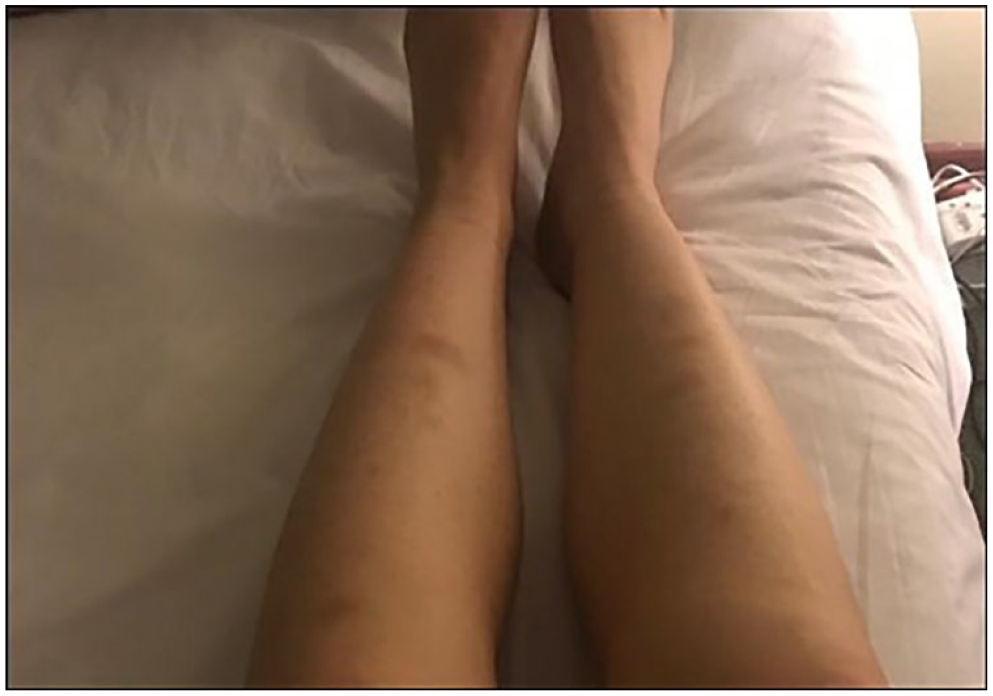
Through the process of theme refinement, we conceptualised the first theme as a process of first being reluctant to show the bruises and blisters on the body sustained from participating in CrossFit, and second, physically embracing and baring these bruises and blisters. Barbara showed Figure 1, which depicted an injury she sustained from doing a box jump, an exercise where a person jumps onto an elevated box, landing with both feet at the same time (Kyllman, 2021).
Initially being reluctant to show bruises on the body (Barbara).
Barbara said, ‘So you’ve got the bruising, from a box jump. The main reason I sent that photo was the reaction I got from friends. If you wear a dress, you going to have that showing’.
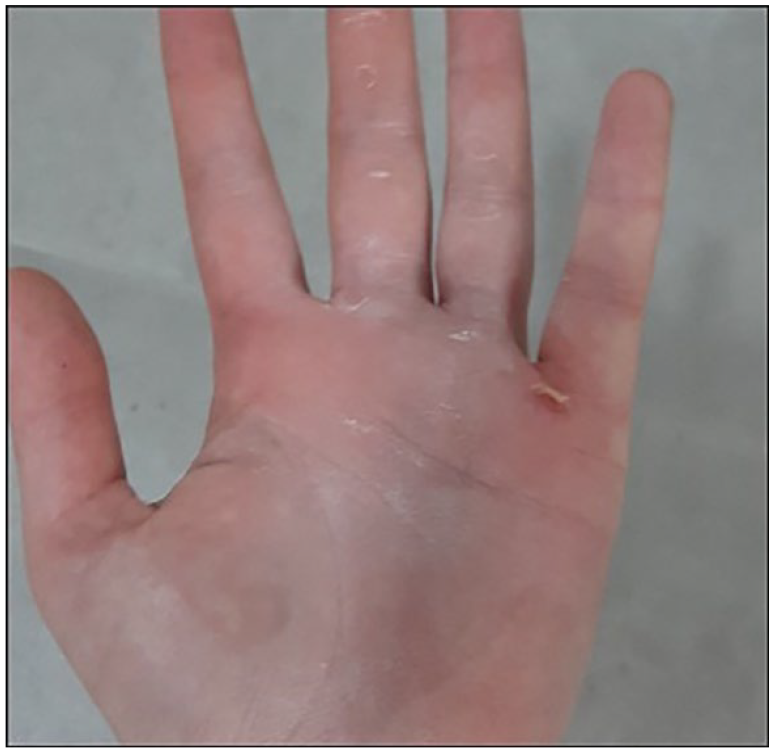
Similarly, Helen presented Figure 2, and explained, ‘Yeah, I got a blister’.
It was something that I really struggled with. I always felt like your hands are supposed to be soft as a female. When I saw it, I cried in the bathroom. This isn’t how I used to grow up, with my dad’s hands being blistered up from manual work.
Helen’s photograph and related talk suggest a struggle between what she regards as typical for a woman (‘your hands are supposed to be soft as a female’) and the evidence of ‘masculine’ blisters on her hands (‘my dad’s hands’). Theme 1 also pertains to the transitional process of physically embracing and baring bruises and blisters on bodies, with Helen noting that, ‘I just challenged the thoughts that I had . . . no one had ever said anything to me, but I kind of had this view in my head of what my hands should look like’. Barbara and Helen described the transitional process as gradual and internally oriented but also related to their increasing immersion in CrossFit. For example, Barbara explained how new members join a CrossFit gym, inevitably get injured, and ‘they are still trying to put fancy creams as opposed to, you know, wearing the scar a little bit’. However, over time this changes, with Barbara explaining that ‘it [the bruises or scar] was like a medal, you got your first box jump injury. So that touched the bone a little bit. You’re going to have that showing and it wasn’t really a thing anymore’.
Blisters on the hand (Helen).
Theme 2: the struggle for/of the feminine/muscular body
Although they produced varied constructions of what they thought a feminine body should be, the participants regarded the feminine body as being contradictory to the muscular body. We refined the theme of the struggle for/of the feminine/muscular body in two ways. First, through their photographs and explanations, the participants demonstrated the difficulties they had in dressing the muscular body with feminine clothes, and a gradual acceptance of their changing bodies and what physical purpose the changes facilitated in CrossFit. Second, the feminine/muscular body raised concerns pertaining to social comparison and sexual expression. In terms of the difficulties of dressing the feminine/muscular body, Cindy noted that because of her muscular body shape, . . . I don’t fit in 90% of the stuff that you buy in the shops. It’s either too small around the shoulders or too big around the waist. So, the way I dress, you kind of adapt to what you can get.
Elizabeth reported similar struggles, specifically highlighting how she ‘struggled a lot with like coming up with a wedding dress idea, because my body type is not exactly suitable for most styles of clothing’. Elizabeth described this gradual process of negotiating what she regarded as the ideal feminine body with the muscular body, and how to dress her changing body. She claimed to reframe her body in relation to its purpose for CrossFit, therefore focusing on her body’s performance in CrossFit rather than its growing non-adherence to a stereotypical feminine form. Elizabeth explained that she adapted her wedding dress (see Figure 3) to suit her body: That is what . . . I was going for with the dress. I wanted to highlight my body because I am proud of my body, and I also wanted to feel comfortable, which is why I had that poofy thing over the dress and
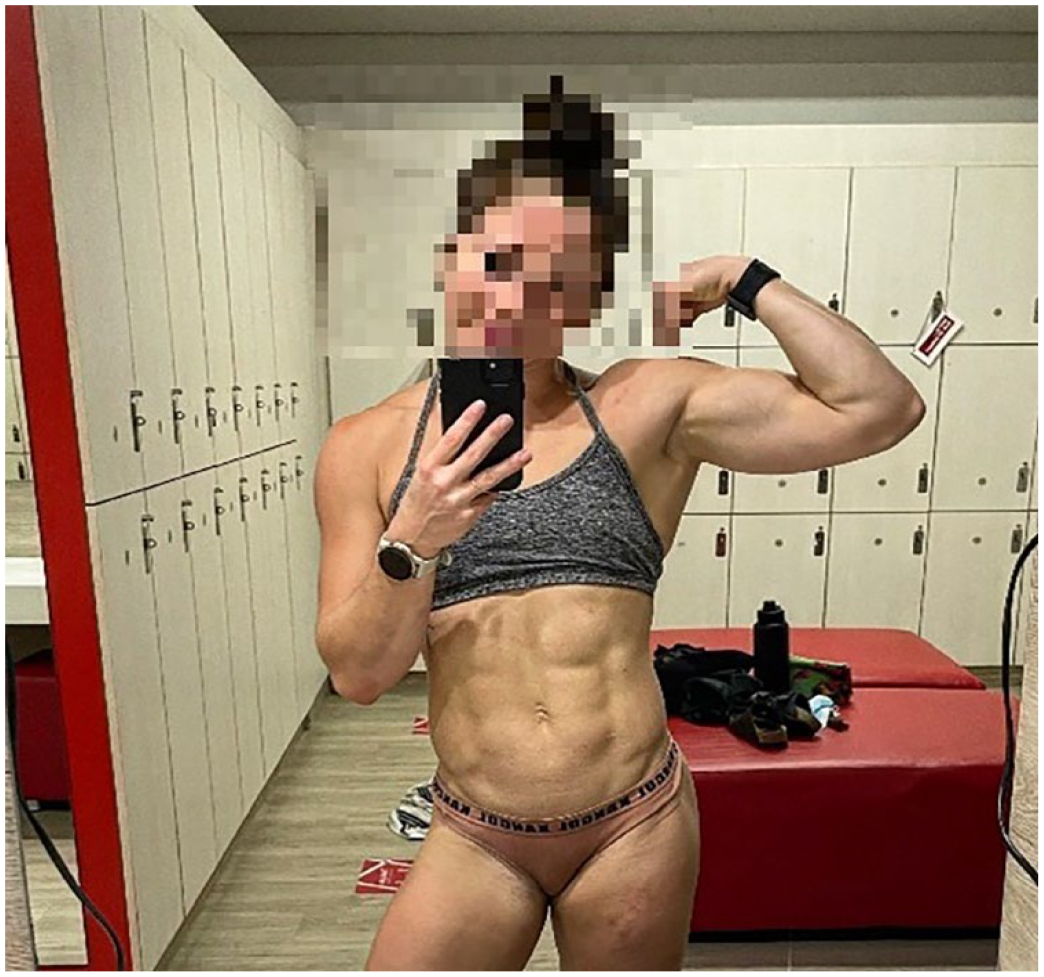
Both Elizabeth and Cindy explained that they initially thought the ideal female body shape was skinny, and that most clothes that were available in shops were designed for this particular conception of femininity. Participation in CrossFit seemed to push the participants’ body shapes further away from a socially and idealised norm of femininity. For example, Elizabeth also presented Figure 4, explaining that, When I first started CrossFit, the ideal body shape was skinny, big boobs, pretty, which I struggled with when I first started CrossFit because obviously, I didn’t want to be particularly different, as everyone does. I don’t have big boobs and they just got smaller and smaller (laugh) throughout CrossFit.
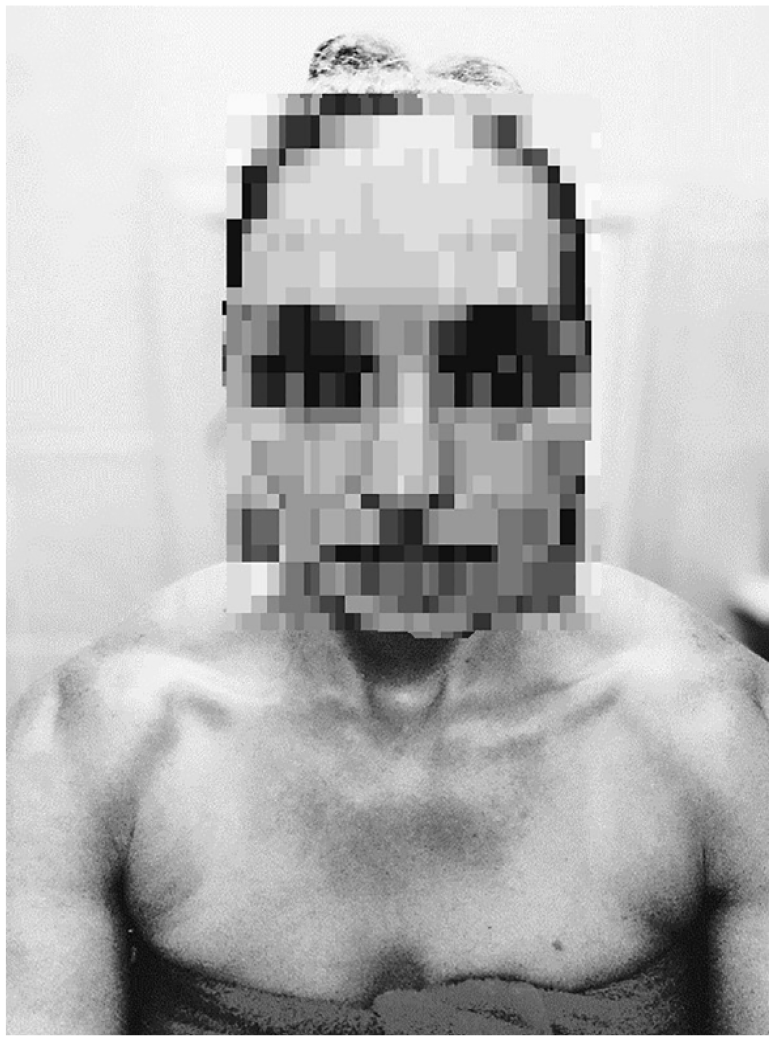
The theme of the struggle for/of the feminine/muscular body also included concerns around social comparison and body-sexuality expression. When they were outside the CrossFit setting, both Elizabeth and Cindy noted that their muscular body shape did not fit in. For example, Elizabeth claimed that, ‘I do sometimes feel, when around non-weightlifting [women], a bit chunky, which I don’t necessarily like, especially when I am around friends, because they are tiny. I do sometimes feel a bit self-conscious’. In explaining her ambivalent desire for a strong muscular body for CrossFit purposes, and whether her partner would still find her sexually attractive, Amanda said, . . . and little comments, like if my traps [trapezius muscles] are looking too big [see Figure 5], he is always checking and it’s funny, but it also makes me feel concerned. I don’t want to stop getting stronger. How is that going to affect our relationship, his attraction, how desirable he finds me, our sex life, our love life, everything? It worries me a lot.
Cindy spoke about wearing sport clothes and very short shorts that fit her muscular body shape. ‘So, I seem to wear sport clothes because that’s the clothes that fit (laugh). Let’s just be honest. Or, really short shorts because that’s the only shorts that fit over my thighs (laugh)’. However, in wearing these kinds of clothes, Cindy noted how her body was then sexualised by others, and she would be constructed as overly confident. ‘People would comment on stuff like that like, “oh, you trying to show off your legs!”’ Cindy went on to note, . . . and for me personally, I would love to have a little bit more curves when I wear certain dresses or shirts because you want to look a little more feminine every now and then. But I like the way I look. I wouldn’t want to change how I look.

Merging the female body with the muscular body (Elizabeth).
The CrossFit woman’s muscular body shape (Elizabeth).
The changing body and what it means for intimate relationships (Amanda).
Discussion: paradoxical themes and challenging women’s performance of the feminine/masculine binary through CrossFit
Our findings highlight two paradoxical themes for the women CrossFitters from the study. First, the initial reticence to bare bruises and blisters that women CrossFitters sustain from participating in CrossFit can be juxtaposed with a gradual process of being proud of and embracing those bruises and blisters. Second, a paradoxical relationship, of both initial rejection of, yet complementary desire for the seemingly contradictory feminine and muscular body is navigated. These two paradoxical themes point to the potential for women to use CrossFit as a platform to transgress and challenge gendered boundaries but also reinforce a socially constructed masculine/feminine binary.
Scott (2010) reminds us how, in reinventive institutions ‘power is most effective when it operates not through coercive domination but by securing the willing compliance of subjects’ (p. 221). Our findings are illustrative of willing CrossFit women regulating each other’s performances through ‘self and mutual surveillance’ (Dawson, 2017, p. 368). Under the guise of self-improvement and enhancing performance in CrossFit, the women in the study demonstrate the power that publicly performing a series of embodied and gendered acts (e.g., baring bruises, checking muscles, and adapting clothing) has on their own and others’ subjectivities. Although we prompted the study participants to produce autophotographical reflections and representations of gender, they chose to produce self-reflections in mirrors (i.e., performative regulations of self), explained the process of watching others ( ‘they are still trying to put fancy creams’–Barbara), and reflected on other’s checking on them ( ‘he is always checking [my traps] and it’s funny, but it also makes me feel concerned’ – Amanda; ‘Oh you’re trying to show your legs’–Cindy). Related to these examples of embodied performative regulation, our first theme demonstrates how a growing immersion in and alignment with the group identity of being a strong and powerful CrossFit woman enables a member to experiment with different identity performances (e.g., baring your bruises and blisters as a woman, even though you may construct these as falling within a masculine performance set). Whereas being slender and having soft skin and hands are typically associated with attractive and emphasised forms of femininity (Cahn, 2015; Connell, 1987), as the participants in this study immersed themselves in CrossFit through ‘self and mutual surveillance’ (Dawson, 2017, p. 368), the bruises and blisters on the body become a favourable social marker of the group and social identity. What becomes explicit here then is the paradoxical nature of this element of gender performance, where there is an initial reluctance to embody bruises and blisters, but through surveillance, approval is attained for this kind of ‘masculine’ embodiment.
Our findings also affirm CrossFit as an institution in which women can engage in gender undoing and non-binary gender performances. Paradoxically though, it is also an institution which can reinforce gender stereotyping. Specifically, the participants described a struggle for and of the feminine body and the muscular body, constructing these as seemingly paradoxical. Although women do not consistently aspire towards the thin ideal feminine form, the athletic and muscular body form still seems to be predominantly construed as belonging to the masculine performance repertoire (Dworkin, 2001; Robinson et al., 2017). However, in this study, the participants described a gradual but conflictual process in the integration of their feminine and muscular bodies. Once they acquired physical strength, visible muscular gains, and experienced the performance gains in CrossFit, their training became more about performance and less about appearance. Specifically, Elizabeth explained that she reframed her body in relation to its purpose and performance in CrossFit and moved away from seeking a stereotypical feminine form.
Even though the participants in our study embraced a muscular body ideal, demonstrated strength, power, and confidence (i.e., disrupting certain gender stereotypes) (Podmore & Ogle, 2018), they also reproduced gendered norms by wearing minimal clothing both inside and outside of CrossFit. Although Cindy and the other women in the study claimed to be proud of and confident of their muscular bodies, confidence is typically construed as a masculine trait (Newman et al., 2023), and demonstrates a complex and paradoxical mix of masculinity/femininity and non-gendered subjectivity in CrossFit women’s body-sexuality expression (Howarth, 2013). Cindy’s confident display of her masculine/feminine body reportedly yielded comments from others about ‘showing off’, whereas Amanda worries about whether her partner will continue to find her sexually attractive and desirable with large ‘masculine’ trapezoid muscles. Although the women in the study claim that ‘strong is the new sexy’ (Cohen & Colino, 2014; Dawson, 2017; Rinkunas, 2011), and report being proud of their muscular physiques and what they can achieve in CrossFit, they still struggle to dress the muscular female body in feminine ways, ‘want to look a little more feminine every now and then’ (Cindy), and have concerns that others may think they are overly confident with their muscular physiques or may no longer be sexually desirable. It is in these ways that CrossFit women are free to experiment with non-gendered subjectivities, but are also not free to do so without the regulatory gaze of others or self-doubts about what this might mean for how their dynamic bodies and sexualities may be accepted and/or rejected. In developing and demonstrating muscles (e.g., ‘he is always checking [my traps]’) CrossFit women risk rejection via deviating from the emphasised femininity that men may desire and demand (Connell, 1987).
Although we argue that the study offers innovative insights into paradoxical themes of gender performance in CrossFit and sport generally, we acknowledge two related study limitations. First, we note that as with most reinventive institutions, CrossFit can be regarded as an elite, costly, and exclusive institution for an individual to choose to belong to (Dawson, 2017). Our aim in the study was to identify the possible ways in which women can transgress oppressive gendered performances, this being especially relevant for contemporary (South African) society. However, women CrossFitters are not necessarily representative of the women in society who may be most vulnerable to oppressive patriarchal structures and systems. For example, all participants in the study were White women with the financial means to participate in CrossFit. Whereas CrossFit is not exclusively practised by White people in South Africa, the sport may not resonate as an option for alternative gender performances by the majority of South African women yet. Second, the study is limited by self-selection bias as we probably recruited women into the study who were predisposed and inclined to communicate alternative gendered performances through CrossFit.
Conclusion
The study reported in this article highlights the challenges associated with socially constructed feminine and masculine gender binaries within the sport of CrossFit. Specifically, the paradoxical relationship between acquiring, hiding, and then proudly baring bruises and blisters on the body, and the interplay between the sexualised feminine, yet powerful and confident muscular ‘masculine’ body are interrogated.
Transgressing gendered norms through participation in CrossFit is possible and allows women CrossFitters to experiment with a diverse range of gender performances in a context where this is supported, encouraged, and endorsed. However, instances of heteronormative discourses both within and outside the CrossFit setting, and in South African sport generally (Engh & Potgieter), can complicate the process of an unfettered gender performance. The findings from the study first suggest that future research focused on women in CrossFit could interrogate the extent to which alternative gender performances by women within CrossFit constrain participation in the sport by women who are not inclined to explore alternative gender performances in their lives, but still want to participate in CrossFit. In other words, are CrossFit women who only choose to endorse and maintain performances of emphasised femininity inadvertently excluded from the group and social identity associated with a non-gendered subjectivity? Second, the findings from the study suggest that future research focused on women in CrossFit could also interrogate the extent to which alternative gender performances within CrossFit transfer to other settings. Although there is some evidence of the transferability of alternative gender performances outside the CrossFit setting in the current study’s findings (e.g., adapting clothes to suit the changing body), it would be important to interrogate whether CrossFit women’s bodily and related clothing changes extend to more substantive intrapsychic, interpersonal, discursive, and socio-cultural changes.
Footnotes
Declaration of conflicting interests
The author(s) declared no potential conflicts of interest with respect to the research, authorship, and/or publication of this article.
Funding
The author(s) received no financial support for the research, authorship, and/or publication of this article.
