



Abstract
Students’ reasons for attending university are likely to impact their participation, academic engagement, and learning outcomes. This study aims to investigate undergraduate students’ motivations for attending a South African university and its association with specific socio-demographic factors. The study used a cross-sectional survey design. Participants were undergraduate students (N = 220) who completed a socio-demographic survey and the Student Motivations for Attending University Questionnaire-Revised scale. Descriptive statistics, correlations, and analysis of variance were used to determine associations between the study variables. The reasons for attending university were significantly related to racial identity, student generational status, parental educational status, and family characteristics. Students in their first and second years of study were motivated to attend university to prove their self-worth. Students who identified as Black as well as those coming from a single- or double-parent household and students whose parents had a school-level education were more likely to attend university to help their families. The findings suggest that students are motivated beyond the immediate benefits of employment and personal earnings and that the upliftment of their families is a central reason for attending university. For universities striving to connect with their students, understanding students’ motivational orientation can inform intervention efforts aimed at enhancing retention and throughput.
Keywords
Introduction
African universities operate in a burgeoning landscape characterised by increasing student demands and the need to contribute to the continent’s developing economies. Thriving in the knowledge economy has become synonymous with the development of high-level skills, human capital-focused, scientific, as well as innovative technological advancements (Cloete et al., 2018). According to a recent report commissioned by the Word Bank, many countries, especially those in Sub-Saharan Africa, are experiencing rapid enrolment increases alongside massive urbanisation and swelling workforces (Arnold & Bassett, 2021). These changing trends are poised as a window of opportunity for higher education institutions (HEIs) to contribute to economies, expand human capital, and yield more productive labour forces. Much like students on the continent, students in South Africa enter a mainly under-resourced higher education sector that has only recently begun to see the substantial enrolment of Black 1 students from poor and working-class families (Masutha, 2020). HEIs not only symbolise a means of economic drive but also a means of facilitating upward social mobility for those from previously excluded backgrounds.
In South Africa, higher education remains grossly underfunded, while the demand for access and funding for public tertiary education far exceeds its supply (Naidoo & McKay, 2018). While enrolment figures have continued to surge, student success and throughput have lagged behind (Van Zyl et al., 2020). Increasing the participation rates of students from historically marginalised groups has been prioritised by the South African higher education sector to develop human resource and skills shortages while redressing past inequalities in access (Essop, 2020). Widening participation has meant that HEIs have become more diverse in their student composition and, by extension, brought together students with differing motivations for attending university. The changing demographic landscape of universities, with all the challenges plaguing institutions of higher learning, means that little is known about students from previously marginalised groups, especially as it relates to their motives for attending university.
Several factors have been implicated in students’ motivation to attend university and how they achieve academic success. Among these are student engagement, motivational orientation, learning strategies, and non-academic external challenges (Abdulghani et al., 2014). More broadly, these factors can be grouped into learner characteristics, including motivation and cognitive aspects. Extrinsic factors include the current job market, family commitments and institutional factors relating to teaching quality, and engagement with peers and staff (Edgar et al., 2019). Motivation presents as a non-cognitive factor that exerts a bidirectional influence on learning and academic achievement (Liu & Hou, 2018). Given its impact on success, there has been an expanded focus on identifying the factors that can enhance student outcomes in higher education (Edgar et al., 2019). Bomia et al. (1997, p. 3), defined motivation as, ‘a student’s willingness, need, desire and compulsion to participate, and be successful in, the learning process’. Pather et al. (2017) note that, for South African students, non-academic pre-university factors, such as motivation and resilience, play a significant role in their institutional engagement and, ultimately their potential to succeed. The role of student motivation is not restricted to success while attending university but can serve as a pre-cursory component influencing the decision to attend an HEI.
Globally and in South Africa, universities are increasingly confronting significantly high dropout and low retention and completion rates in a much more diverse student landscape (European Union, 2019; Otu & Mkhize, 2018). In a review of student dropout and completion rates among 35 European countries, it was reported that, while these problems are pervasive and should constitute a focus of future policy development, research into student dropout and completion remains limited (European Commission et al., 2015, p. 7). South African universities and other HEIs are under continued pressure to graduate students to fulfil national targets, redress historical racial, gender, and ethnic inequalities for sustainable growth and development (Council on Higher Education, 2016; Flotman, 2021; Leibowitz, 2017; Marginson, 2016; Motala et al., 2018; Swartz et al., 2018). Moreover, student success in South African universities remains a matter of national debate and concern (Van Zyl et al., 2020). Understanding students’ motivational orientations can potentially assist in addressing the challenges of poor retention and low academic success rates.
Motivational orientation has been the subject of research for many decades but is understudied in South Africa. Several researchers (e.g., Guiffrida et al., 2013; Nowell, 2017) have reported that student motivation is directly related to academic success and student psychological well-being and life satisfaction. In their seminal work, Côte and Levine (1997), identified five categories of factors that motivate students to attend university. These include wanting to have a good job and financial success, self-development, helping others and improving their families or communities, meeting the expectations of others, and avoiding other less desirable options. Subsequent research (Moosa & Aloka, 2023; Mtshweni, 2022; Severiens & ten Dam, 2012; Van Zyl, 2016) has found that a range of factors influence motivational orientation including socio-economic status, parental education level and occupation, first-generation status, gender, and race. In one of the few large-scale studies on student motivation, Guiffrida et al. (2013) reported that, among low-income students, the primary motivation to attend HEIs was to improve their financial situation, whereas those from higher incomes were more likely to be motivated by the need for autonomy. In addition, the researchers concluded that race interacted with motivation in that students who identified as Black were more motivated to attend university to give back to their communities and families compared with students who identified with other racial groups (Guiffrida et al., 2013).
Differential motivation levels have also been observed among students at different levels of study. For example, Kennett et al. (2011) reported that first-year students were more likely to attribute their pursuit of higher education to wanting to prove their worth to significant others. Students who pursue higher education to develop friendships have been found to be less likely to succeed academically (Guiffrida et al., 2013), suggesting that an overemphasis on socialisation with peers may come at the expense of fulfilling academic requirements. Maintaining a strong relationship with the faculty and staff has been reported to influence student performance and academic persistence positively, while motivation for attending university has been linked to academic engagement and attendance/non-attendance of lectures (Massingham & Herrington, 2006). Few South African studies have investigated student motivations for attending university. This study aimed to address this gap by investigating students’ motivation in relation to specific socio-demographic factors.
Methods
Research design and participants
This cross-sectional study was undertaken at a historically disadvantaged institution (HDI) in the Western Cape province. The participants comprised a convenience sample of undergraduate students (N = 220). The majority were women (72.2%; SD = 0.43) and had a mean age of 21 years (SD = 4.64). More than a quarter of the sample (36.8%) were the first in their families to attend university.
Instruments
The participants completed a socio-demographic survey questionnaire and the Student Motivations for Attending University Questionnaire-Revised (SMAU-R: Côte & Levine, 1997; Phinney et al., 2006). The SMAU-R is a 33-item instrument comprising 7 subscales measuring the broad dimensions of motivation, namely, career/personal, humanitarian, default, expectation, prove worth, encouragement, and help family. Gaudier-Diaz et al. (2019) reported satisfactory internal consistency reliability for the SMAU-R (α = .75–.82).
Procedure
Following one of their regular lectures, students were provided with information regarding the study and invited to participate. Those that were interested completed the survey questionnaire. The survey took place across semesters in the period 2018–2019.
Data analysis
Data were analysed using the Statistical Package for the Social Sciences (SPSS: IBM SPSS 28). Descriptive statistics (means and standard deviations) and reliability (alpha) values were obtained. We examined whether data were normally distributed using indices of skewness and kurtosis. Prior to the statistical comparison of the subgroups, the assumption of homogeneity of variances was examined using Levene’s F-test. Where this assumption was violated, the non-parametric Mann–Whitney U-test (two groups) and the Kruskal–Wallis H-test (more than two groups) were used to compare groups. Dunn’s z-test was used for the post hoc comparisons in the Kruskal–Wallis test. Where the assumption of homogeneity of variance was not violated, the parametric t-test (two groups) and ANOVA (more than two groups) were used to compare groups. In addition, Scheffe’s post hoc analysis was used for contrasting subgroups in the case of ANOVA. In all instances, eta squared (η2) was used as the effect size statistic.
Ethics considerations
Ethics approval was obtained from the Institutional Review Board of the University (HS17/2/3). Participation was voluntary and anonymous. All the participants provided informed consent. No identifying information was captured.
Results
The descriptive statistics, indices of skewness and kurtosis, as well as reliabilities for the SMAU-R subscales are provided in Table 1.
Descriptive statistics and reliability.
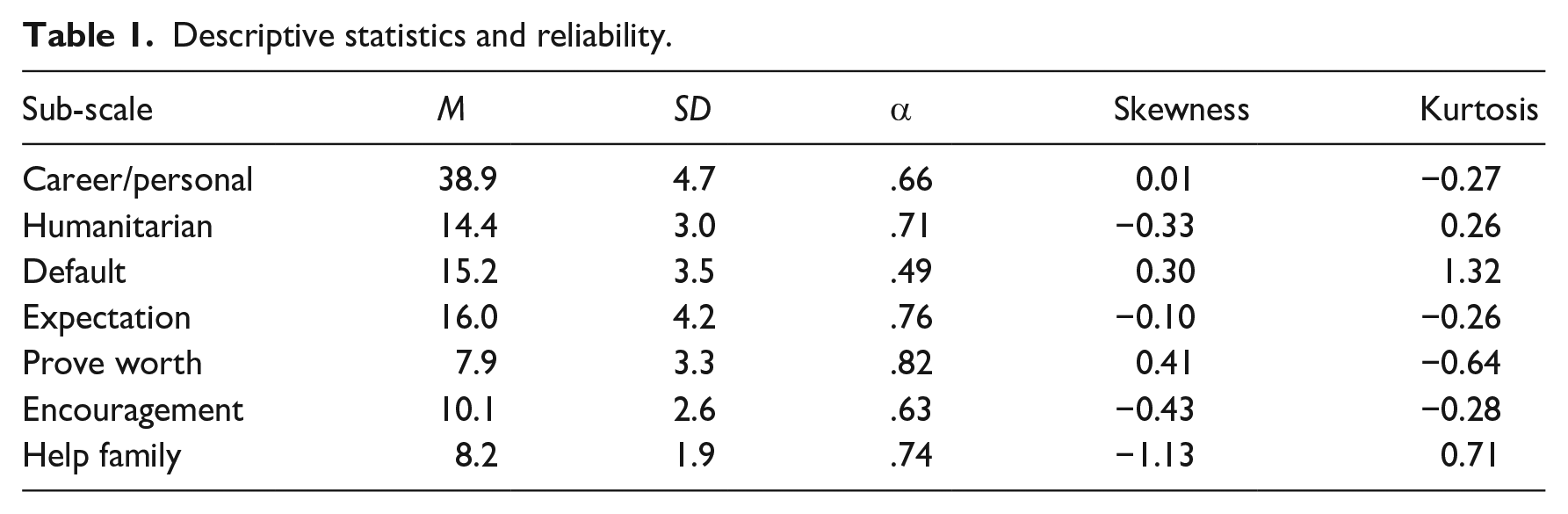
The indices of skewness (−1.13 to 0.41) and kurtosis (−0.64 to 1.32) were within the acceptable range of values (skewness: −2 to +2; kurtosis: −7 to +7; Hair et al., 2010), thus indicating that the data for all the scales were approximately normally distributed. All the subscales had satisfactory internal consistency > .70, except the ‘Career/Personal’ (α = .66) and ‘Encouragement’ (α = .63). However, these are not significantly below .70 and can be considered within the acceptable range (Hajjar, 2018; Raharjanti et al., 2022). The default subscale, however, had an unacceptable estimate of internal consistency and, hence, was not included for further analysis.
The description of the sample is provided in Table 2.
Description of sample.
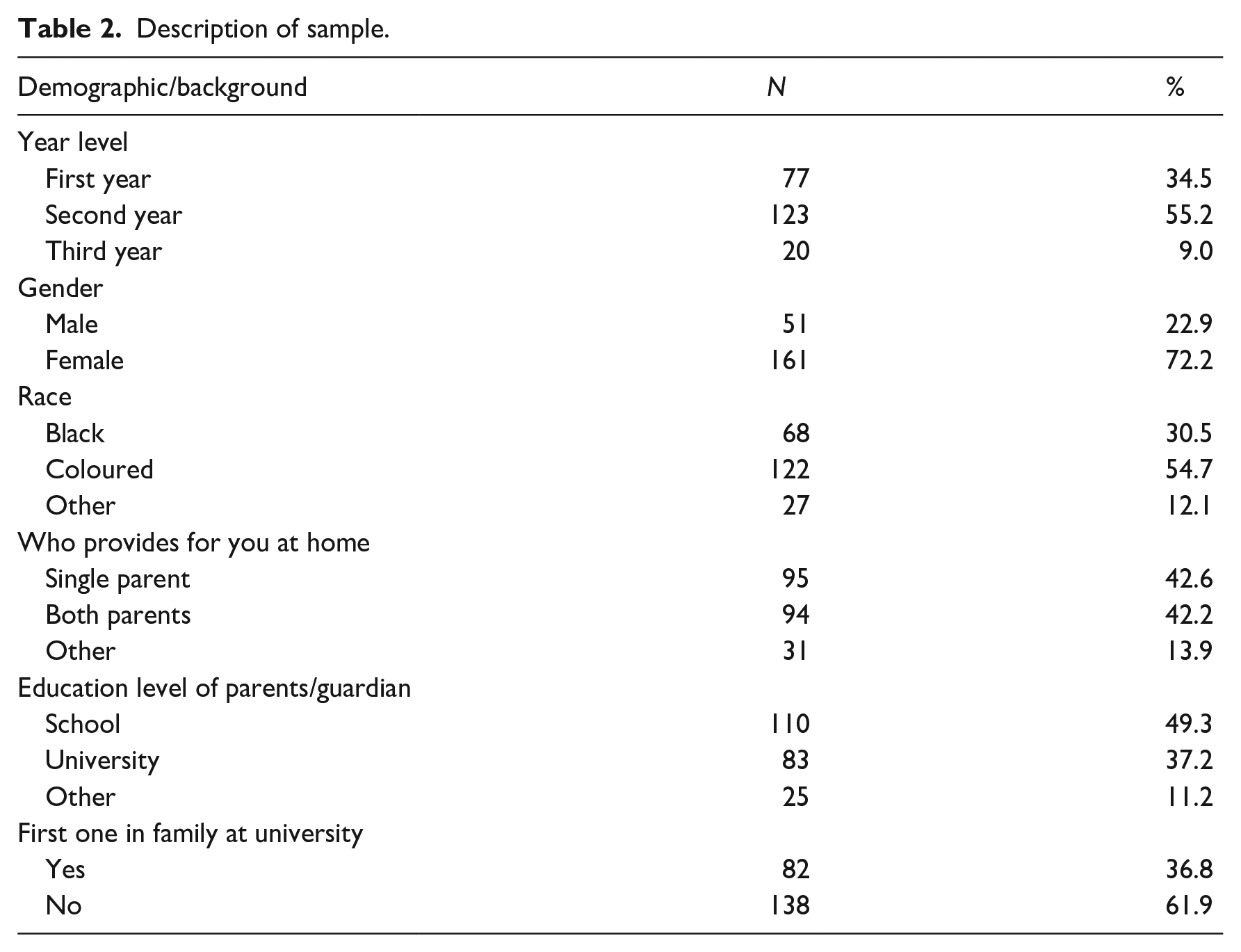
Table 2 indicates that the majority of participants were in their second year of studies (55.2%). More than half identified as Coloured (54.7%), followed by Black (30.5%). The participants were evenly distributed in terms of who provided for them at home (single parent: 42.6% and both parents: 42.2%). Most caregivers had a high school education (49.3%), and over a quarter of the participants were the first in their family to attend university (36.8%).
The comparison of various subgroups based on demographic and background variables in terms of the subscales of the SMAU is reported in Table 3.
Subgroup differences in terms of subscales.
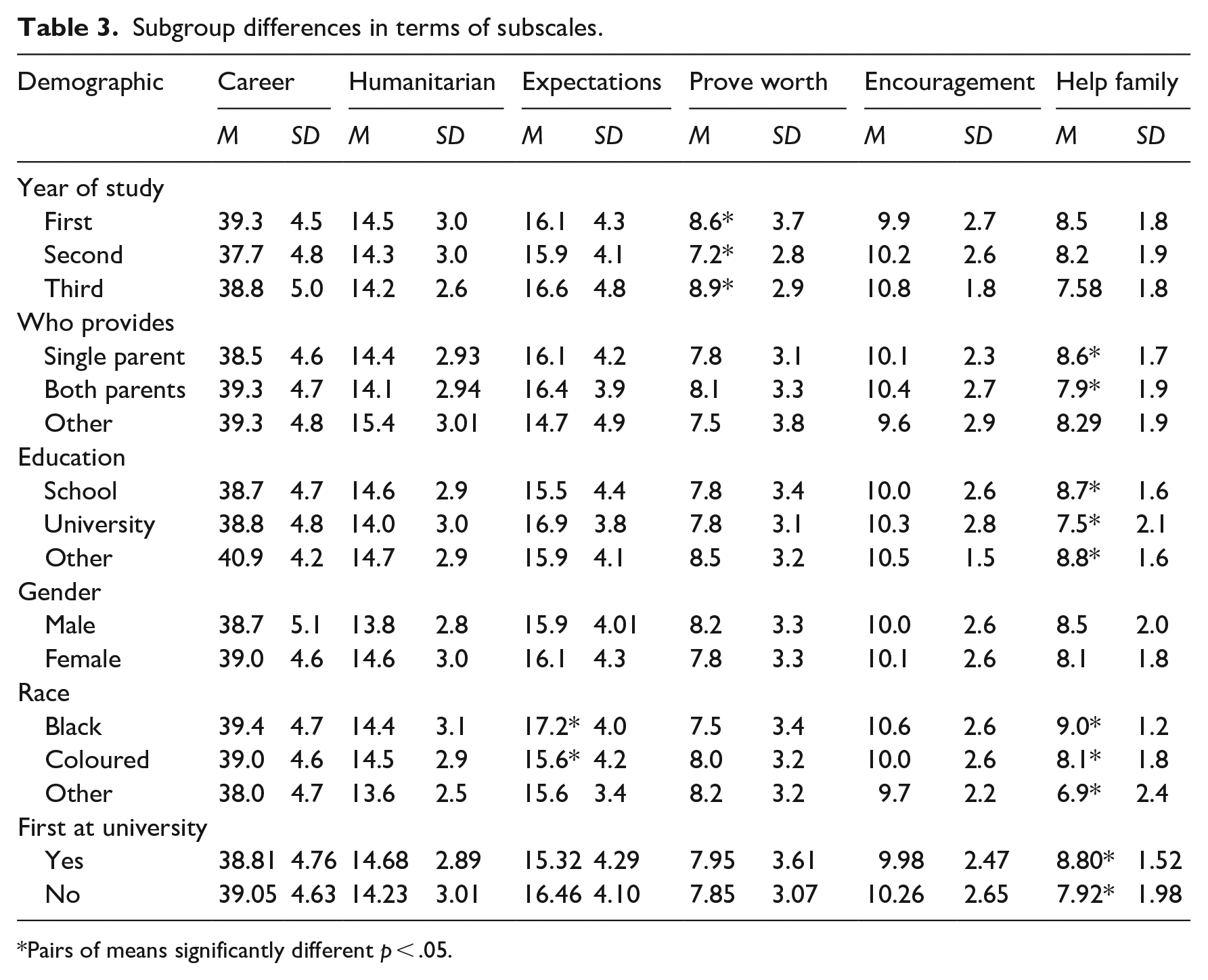
Pairs of means significantly different p < .05.
A test of the assumption of homogeneity of variance demonstrated that groups in the following demographic variables did not have equal variance: year of study (subscale ‘prove worth’: Levene’s F = 6.20, p = .002), education of parent/caretaker (subscale ‘help family’: Levene’s F = 6.30, p = .002), generational status (subscale ‘prove worth’: Levene’s F = 3.90, p = .049; subscale ‘help family’: Levene’s F = 6.77, p = .010), and race (subscale ‘help family’: Levene’s F = 13.89, p < .001). In these instances, the non-parametric alternatives were used (Mann–Whitney U and Kruskal–Wallis H).
Year of study
The H-test indicated a significant difference between the various levels of study in respect of the subscale, ‘prove worth’ (H = 10.96, p = .004, η2 = .04: between small and medium effects). Dunn’s z-test indicated that second-year students reported lower levels on the subscale, ‘prove worth’ in comparison with first-year students (z = 24.82, p = .020) and third-year students (z = 37.15, p = .040). There were no other significant differences in terms of subscales.
Who provides for students?
ANOVA indicated a significant difference between the subgroups of the demographic variable, ‘who provides’ in terms of the ‘help family’ subscale (F = 4.05, p = .019, η2 = .04: between small and medium effects). Scheffe’s post hoc comparison indicated that students who were supported by a single parent were more likely to report ‘helping family’ as their motivation to study than students who had both parents supporting them (mean difference = 0.78, p = .014). There were no other significant differences in terms of subscales.
Education of parent or caregiver
The H-test indicated significant differences between subgroups of the variable, ‘education of parent/caregiver’ in terms of the subscale ‘help family’ (H = 19.78, p < .001, η2 = .008: small effect). Dunn’s z-test demonstrated that students who indicated that their parent or caregiver had a university education were less likely to indicate ‘helping family’ as their motivation for studying than students whose parents had a school-level education (z = 37.27, p < .001) or students who indicated ‘other education’ (z = 40.31, p = .011). There were no other significant differences in terms of subscales.
Identify with which race group?
The H-test indicated significant overall differences between the various categories of race in terms of the subscale ‘help family’ (H = 22.86, p < .001, η2 = .10: between medium and strong effects). Dunn’s z-test indicated that students who identified as Black were more likely to identify ‘help family’ as their motivation for studying than students who identified as Coloured (z = 32.05, p = .002) or other (z = 61.28, p = .000).
ANOVA also indicated significant differences between the various categories of race in terms of the subscale ‘expectation’ (F = 3.43, p = .034, η2 = .032: between small and medium effects). Dunn’s z-test indicated that students who identified as Black were more likely to experience pressure from family or others (expectation) as their motivation for studying than students who identified as Coloured (mean difference = 1.64, p = .033).
Generational status
The Mann–Whitney U-test indicated that first-generation students were more likely to identify ‘helping family’ as their motivation for studying than students who were not the first in the family to attend university (U = 4009, p < .001, η2 = .05: medium effect). There were no other significant differences in terms of subscales. There were not any gender differences in terms of all the subscales of the SMAU-R either.
Discussion
In South Africa, higher education has been expected to reduce historical inequalities and facilitate the upward mobility of previously marginalised groups. The increasing numbers of students applying at universities across the country attest to the perceived benefits of tertiary education in promoting financial security and social mobility (Fongwa, 2019). It is against this background that this study investigated the motivational orientation of a sample of undergraduate students enrolled at an HDI and its association with specific socio-demographic variables. There were several important findings. First, students in their first and second year of study were strongly motivated to attend university to prove their self-worth. This may be attributed to establishing their self-regard and to formalise their transition from high school to university.
Second, students who identified as Black were motivated to a significant degree to attend university to meet the expectations of others and to help their families compared with other students. This is not surprising in that African cultures are typically collectivistic in nature. Moreover, when considering the legacy of the Apartheid order in which certain race groups were oppressed, there may be substantial pressure on Black and Coloured students to study further to help the collective family unit (Covarrubias et al., 2019; Montle, 2020; Slobodin et al., 2021). These findings correspond with those of Slobodin et al. (2021) among Ethiopian students. Parents and family members have a greater expectation of children to pursue higher education particularly when education is viewed as a means for upward social mobility (Slobodin et al., 2021). This is in contrast to the findings of an Australian study (Koshy et al., 2019) in which students from single, mother-led, lower socio-economic households were less motivated to attend university.
Third, students from single-parent households were more likely to attend university to help their families. This may be related to a greater understanding or appreciation of the sacrifices that single parents have made to facilitate their children attending university and these students may view academic attainment as a means of attaining upward social mobility (Won Kim et al., 2017). Furthermore, children from collectivist contexts may view academic achievement as a means of providing or giving back to their parents (Bernardo et al., 2008). The notion of students providing for their families financially has often been reported in samples from low-to-middle income groups (Covarrubias et al., 2019). First-generation students are typically expected to fulfil the role of an additional financial resource for their families while balancing the demands of higher education. This obligation is colloquially referred to in South Africa as Black Tax (Fongwa, 2019) and refers to the financial duty placed on Black students and graduates to provide for the needs of their families.
Fourth, for students whose parents had a school-level education, their motivation for attending university was to help their families. This finding differs from those of existing studies. For example, Karabchuk and Roshchina (2023) found that, among Russian students, parental family characteristics did not have a bearing on student engagement and motivation. The current findings may be linked to socio-economic status, as typically those with a tertiary level education tend to have a greater earning potential than those with only a school-level education, and therefore, academic attainment may serve as a precursor towards improving the family’s collective socio-economic standing (Morgan, 2011). This is supported by Gofen (2009) who determined that students who hoped to improve the socio-economic status of their families tend to be part of a collective family where education is regarded as a pathway to success. There were no significant gender differences in respect of motivational orientation. This corresponds to existing studies (for example, Bonneville-Roussy et al., 2017) where few gender differences have been identified in self-determined motivational measures.
The study had certain limitations. The cross-sectional research design inhibits robust inferences about causal relationships. The participants were mostly women and from one institution, which limits generalisability. Social desirability and selection bias can arise from the use of self-report measures. Consequently, future studies using more diverse methods of data collection are needed to confirm the results.
Conclusion
This study highlighted salient factors underlying student motivation for attending university. The reasons for attending university were significantly related to racial identity, student generational status, parental educational status, and coming from a single/double parent household. This study provides a foundation for further investigation into the factors that lead students to attend university and can form the basis of intervention efforts aimed at enhancing retention and throughput through a focus on motivational orientation.
Footnotes
Declaration of conflicting interests
The author(s) declared no potential conflicts of interest with respect to the research, authorship, and/or publication of this article.
Funding
The author(s) received no financial support for the research, authorship, and/or publication of this article.
