




Abstract
South Africa, as a developing country, is characterized by high levels of crime, partner violence, and other traumatic experiences. Exposure to these traumas may lead to the development of post-traumatic stress disorder or, conversely, post-traumatic growth. Citizens in developing African countries appear to be at risk for the development of insecure attachment styles due to the cumulative effects of socio-economic risk factors. The prevalence of many possible traumatic experiences along with the risk of more insecure attachments set the stage for investigating the impact of insecure attachment on post-traumatic growth. The aim of this study was thus to determine whether two insecure attachment styles, namely anxious and avoidant attachment, were significant predictors of post-traumatic growth. The sample consisted of 233 undergraduate students from a South African university who had experienced a traumatic event. Participants’ ages ranged from 18 to 33 years (M = 21 years) and were from various ethnic backgrounds (81.5% Black African, 7.7% White, 9% Coloured, and 3.9% Asian/Indian). Two self-report measures were administered via an online survey to assess attachment styles and post-traumatic growth. Results showed that an anxious attachment style was a significant negative predictor of post-traumatic growth. Furthermore, individuals with an avoidant attachment style were significantly less likely to experience post-traumatic growth through relating to others, than along the other domains of post-traumatic growth. The findings contribute by highlighting the importance of considering how insecure attachment styles may impact post-traumatic growth, as this could inform the treatment of trauma victims.
Attachment theory has become one of the major developmental theories of the last 50 years, influencing scientists and practitioners alike. According to Bowlby (1982), the attachment bond provides the infant with an attachment style, forming the basis for understanding itself and others, thereby serving as a working model for future social relationships. Attachment styles can also influence beliefs about the self, emotion regulation, and how an individual experiences a traumatic event and the aftermath thereof (Mikulincer & Shaver, 2019).
Traumatic/threatening experiences can disturb one’s beliefs about the self, others, and the world, as well as interfere with one’s coping strategies (Yumbul et al., 2010). Traumatic events can result in the development of post-traumatic symptoms, distress, and depression; it can also lead to a positive transformation, known as post-traumatic growth (PTG). PTG can be described as positive psychological change as a consequence of struggling with challenging life circumstances (such as trauma) (Tedeschi & Calhoun, 2004), and should not be confused with similar terms such as resilience or benefit-finding (Jayawickreme & Blackie, 2014).
Various aspects, such as positive disclosure (Taku et al., 2021; Tedeschi et al., 2018), social support (Calhoun et al., 2010), cognitive processing (Cann et al., 2011), personality factors (Rzeszutek et al., 2017), and attachment styles (Gleeson et al., 2021; Tedeschi et al., 2018), seem to have an impact on PTG and the way individuals manage traumatic events. Different attachment styles may influence individuals’ ability to cope with and adjust to a traumatic life event, as well as impact the intensity to which they experience posttraumatic emotional maladjustment (Lim et al., 2019). The aim of this study was thus to investigate to what extent attachment styles can predict PTG.
Attachment styles and PTG
An individual’s attachment style seems to influence his or her perception of a traumatic event and is thus related to the cognitive processing required for PTG to occur (Schmidt et al., 2012). A secure attachment style may lead individuals to believe that life’s challenges are manageable, thereby creating a constructive attitude towards stress, and a buffer for emotional distress. This attachment serves as a personal resource that assists with managing and coping with future stressful situations (Pascuzzo et al., 2015). Nelson et al. (2019) found that survivors of childhood sexual abuse with a secure attachment style experienced greater PTG than those with an insecure attachment style. In a study of adult survivors of cancer, secure attachment showed an association with PTG and was also linked to active coping, positive re-appraisals, and religious coping (Schmidt et al., 2012).
Insecure attachment styles may lead individuals to perceive life’s stresses to be threatening, irreparable, and overwhelming. When facing such stressful life events, insecurely attached individuals may struggle to react with the appropriate level of distress and feel overwhelmed, even after the threat is no longer present (Pascuzzo et al., 2015). Research findings pertaining to the relationship between the insecure attachment styles and PTG seem to be more varied. Some studies demonstrated positive relationships between the insecure anxious attachment style and PTG in non-clinical samples (Arikan & Karanci, 2012; R. Dekel, 2007), while other studies show a negative relationship (Arikan et al., 2016; Lim et al., 2019; Nelson et al., 2019). Positive relationships between the insecure avoidant attachment style and PTG have also been observed (S. Dekel et al., 2011), but more studies indicate a negative relationship here (Arikan et al., 2016; Cohen & Katz, 2015; Romeo et al., 2017; Turunen et al., 2014). On the whole, it would seem as if adults with an insecure attachment style seem to be more vulnerable to negative symptom development, such as anxiety, depression, and alcohol abuse, following a trauma (Lim et al., 2019).
More research on the relationships between insecure attachment styles and PTG can assist in clarifying these inconsistencies.
This study
The above-mentioned studies provide important information regarding the relationship between attachment styles and PTG, however, there are factors that need to be addressed. The existing research was predominantly conducted in developed countries (Arikan et al., 2016; Lim et al., 2019) or focused exclusively on a male sample (Salo et al., 2005). This study addresses the gap in the literature by focusing on a gender and culturally diverse sample in a developing country where exposure to violence and traumas are common. Voges et al. (2019) indicate that developing African countries pose as significant risks for insecure attachments due to the cumulative effect of socioeconomic risk factors (such as low income, unemployment, and low levels of education). Furthermore, South Africa, as a developing country, is characterized by high levels of poverty and adversity. Studies have found that South Africa has among the highest rates of murder, robbery, rape, and partner violence worldwide (Atwoli et al., 2013; StatsSA, 2019).
The prevalence of these traumatic experiences together with the risk of more insecure attachments in developing African countries provide the rationale for research investigating trauma and factors influencing the stress or growth thereafter. Evidence exists that psychotherapies aiming to modify internal working models may be more appropriate for enhancing PTG in individuals with insecure attachment styles (Levi-Belz & Lev-Ari, 2019). This type of research could assist with the treatment of trauma victims (Gleeson et al., 2021).
The overarching aim of this study was therefore to investigate the extent to which insecure attachment styles can predict PTG in a South African student sample.
Based on the literature, it is hypothesized that insecure (avoidant and anxious) attachment styles could predict poorer PTG.
Method
Participants
The sample consisted of 188 undergraduate psychology students who had indicated the experience of prior trauma. Women represented 72.9% (N = 137) and men represented 27.1% (N = 51) of the sample. Participants were between the age of 18 and 33 years, with a mean age of 21.14 (SD = 1.75). Participants were Black African (80.3%), White (7.4%), Coloured (8%), and Asian/Indian (4.3%). The majority (62.2%) of the participants was single, 34.6% were involved with a romantic partner, and 3.2% were engaged.
Instruments
A biographical questionnaire was used to gather demographic information. Participants were required to disclose their age, sex, ethnic affiliation, as well as information regarding recent and past traumatic experiences. Specifically, participants were asked the following questions, ‘Have you ever experienced an event that you considered to be traumatic?’; ‘If yes, when did this event occur (year and month)?’; ‘How old were you at the time of the trauma?’; ‘Please briefly describe this event’; ‘What was your biggest struggle immediately after this event?’; ‘What and/or who helped you during and after the event/period?’; ‘How long did it take you to get to a place where you felt you could handle what happened?’; ‘Is there anything else relating to the traumatic event that you would like to mention or explain?’
Two self-report measures were used to assess attachment styles and possible PTG.
The Experiences in Close Relationships-Revised (ECR-R) Questionnaire
The ECR-R assesses the quality of attachment in adult relationships on two subscales, namely anxiety and avoidance (Fraley et al., 2000). The ECR-R consists of 36 items and participants rate the extent to which each item describes their feelings in close relationships on a seven-point scale ranging from 1 (strongly disagree) to 7 (strongly agree). High scores on the anxiety and avoidance subscales indicate higher levels of attachment anxiety and avoidance, respectively. The ECR-R has strong psychometric properties, including high test–retest reliability and high construct validity (Wei et al., 2007). The present study found very good Cronbach’s α of 0.93 for the full scale, 0.91 for the anxiety subscale and 0.92 for the avoidance subscale.
The Post-Traumatic Growth Inventory
The Post-Traumatic Growth Inventory (PTGI) assesses whether the individual has experienced positive changes after trauma. It consists of 21 items answered on a six-point scale ranging from 0 = I did not experience this change as a result of trauma to 5 = I experienced this change to a very great extent. The PTGI consists of five subscales, namely Relating to Others (PTGI-1), New Possibilities (PTGI-2), Personal Strength (PTGI-3), Spiritual Change (PTGI-4), and Appreciation of Life (PTGI-5) (S. Dekel et al., 2011). The total score for the PTGI was used as a dependent variable, as well as each of the subscales’ scores. The PTGI has good internal consistency (Cronbach’s α = 0.9) and discriminant and convergent validity (Tedeschi & Calhoun, 1996). The PTGI has been used with South African samples and it has demonstrated good reliability with a Cronbach’s α of 0.89 for the total scale (Polatinsky & Esprey, 2000). This study found a very good alpha of 0.91 for the total scale and 0.83, 0.79, 0.77, 0.73, and 0.74 for PTGI-1, PTGI-2, PTGI-3, PTGI-4, and PTGI-5, respectively.
Procedure
During psychology lectures, second-year students were informed about the study and its purpose and invited to participate. Students were offered an incentive in the form of course credit. Those that did not wish to participate were provided with the option to complete an assignment to receive the course credit. Participants were asked to complete the questionnaires on the university’s online student portal, which is only accessible to registered students. Once logged in, participants were required to give informed consent before proceeding with the survey. The students had 1 month to complete the 20–30-min survey.
Ethical considerations
This study received ethics clearance from the Faculty of Humanities Research Ethics Committee at the University of Johannesburg. The nature of the study was explained to participants and they were reassured that their responses would be confidential. They were informed that participation was voluntary and that they could withdraw at any time without prejudice. Due to the sensitive nature of traumatic experiences, participants were given the contact details of the university’s counselling centre, should they require debriefing.
Data analysis
After confirming that the assumptions about the data, such as multicollinearity, singularity, and homoscedasticity, were met, a hierarchical multiple regression analysis was performed to examine whether attachment styles are predictors of PTG when sex and age are controlled for. Sex and age were controlled for, as studies have shown that women may experience PTG more than men (Tedeschi & Calhoun, 1996), and young adults may be more likely to experience PTG than older adults (Tedeschi et al., 2018). As a parsimonious model was hypothesized, no other variables were controlled for.
Results
The most frequently reported traumatic event was the death of a loved one (32.6%). The second and third most frequently experienced traumatic events were being robbed (22.3%), typically violently, and having a serious accident or health problem (15.9%). Participants identified their most supportive source of help following the trauma, with 35.2% listing family, 24.5% said no one, and 14.2% said a professional, that is, a psychologist or counsellor.
Zero-order correlations between the variables of interest are presented in Table 1. The total PTG score showed a small significant negative correlation with the anxious attachment style. Furthermore, Subscale 1 (Relating to Others) of the PTGI showed small significant negative correlations with both anxious and avoidant attachment styles. Subscale 3 (Personal Strength) of the PTGI also showed a small, significant negative correlation with the anxious attachment style.
Means, standard deviations, and inter-correlations between PTG and Anxious and Avoidant Attachment Styles.
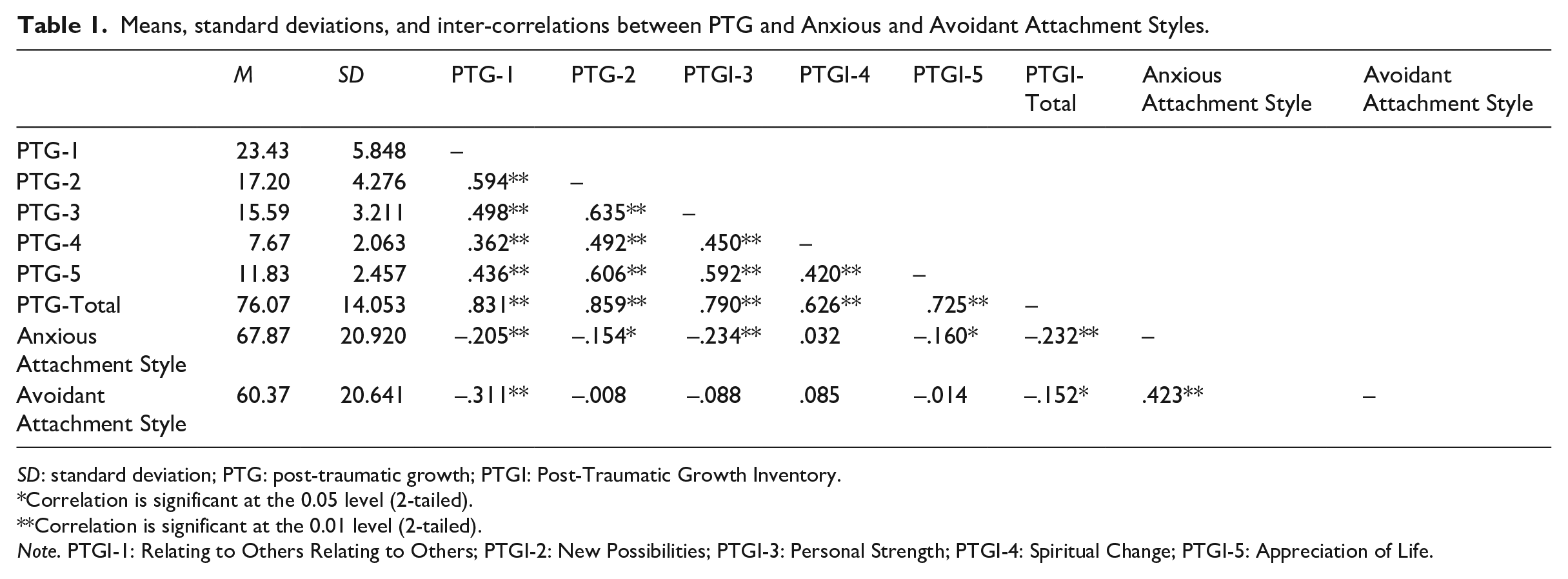
SD: standard deviation; PTG: post-traumatic growth; PTGI: Post-Traumatic Growth Inventory.
Correlation is significant at the 0.05 level (2-tailed).
Correlation is significant at the 0.01 level (2-tailed).
Note. PTGI-1: Relating to Others Relating to Others; PTGI-2: New Possibilities; PTGI-3: Personal Strength; PTGI-4: Spiritual Change; PTGI-5: Appreciation of Life.
Hierarchical multiple regression analyses were performed to assess whether anxious and avoidant attachment styles significantly predicted variance in PTG when age and sex were controlled for. Table 2 summarizes the analysis results where the total score and sub-scales of PTG served as the dependent variable. Results indicated that anxious attachment style was a significant, negative predictor (β = –.19, p < .05) of the total posttraumatic growth score, as well as for the Personal Strength subscale (β = –.24, p < .01) of the PTGI. Avoidant attachment style was a significant, negative predictor of the Relating to Others subscale (β = –.31, p < .01) of the PTGI. Hierarchical regression analyses with Subscale 2 (New Possibilities), Subscale 4 (Spiritual Change), and Subscale 5 (Appreciation of Life) as outcome variables were found to be not statistically significant.
Avoidant and Anxious Attachment Styles as predictors of PTG.
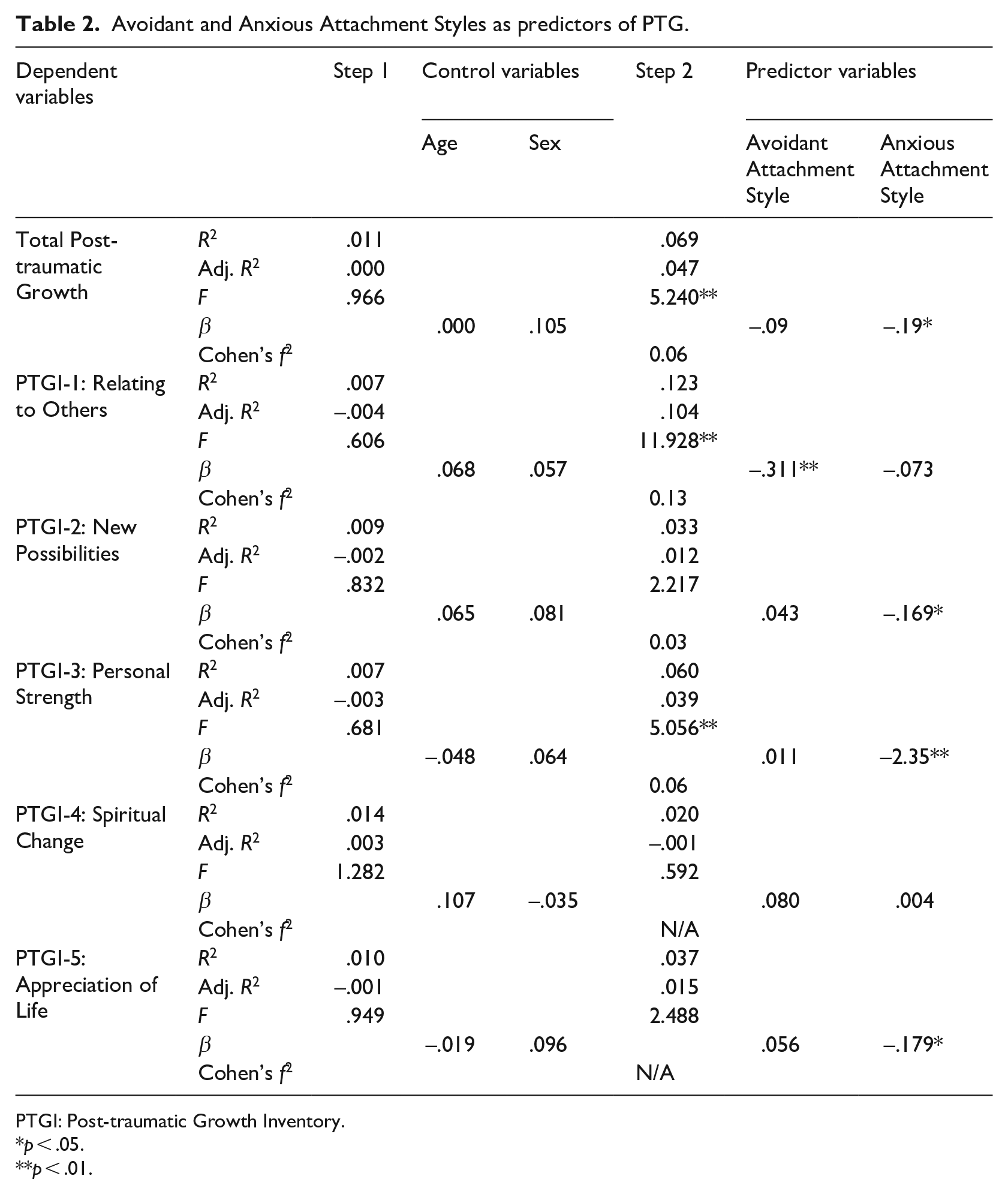
PTGI: Post-traumatic Growth Inventory.
p < .05.
p < .01.
Discussion
The aim of this study was to determine whether attachment styles, specifically the insecure attachment styles, could predict PTG among a sample of university students in South Africa. In general, the findings supported the hypothesis that the insecure attachment styles can predict some variance in PTG. The results indicated that an anxious attachment style was a negative predictor of PTG, thus suggesting that this attachment style may be negatively related to an individual’s likelihood of experiencing PTG following a traumatic event.
Previous trauma studies have indicated that anxiously attached individuals report more distress and difficulties than securely attached individuals (Berger, 2015; Mikulincer & Shaver, 2019; Ogle et al., 2016). This may negatively impact the potential development of PTG in anxiously attached individuals, which is in line with the results from this study. Anxiously attached individuals tend to have a negative view of the self, developing the self-perception of being vulnerable and the view that others cannot be relied upon to support them in times of distress (Pascuzzo et al., 2015). This may contribute to a sense of personal inadequacy and difficulty in reacting appropriately to distress.
Interestingly, the results of this study indicated that, of the different domains of PTG, anxiously attached individuals are least likely to experience PTG in terms of increased personal strength or a recognition of the potential for personal strength. Growth in this domain is associated with gaining an understanding that stress and difficulties may occur but that they are also manageable (Tedeschi et al., 2018). This suggests that, due to negative self-appraisal that is associated with an anxious attachment style, these individuals may struggle to view their self as capable of managing and overcoming a traumatic event.
The results further indicated that, of the five domains of PTG, individuals with an avoidant attachment style are least likely to experience PTG through relating to others. Studies have found that avoidantly attached adults are typically uncomfortable with intimacy and avoid closeness with others. Furthermore, they are less likely than securely attached adults to seek support in response to stress (Arikan & Karanci, 2012; Mikulincer & Shaver, 2019). These findings are in line with Voges et al.’s (2019) view of higher risk for insecure attachments in developing countries. This raises the concern that citizens in countries with a higher incidence of trauma might benefit less from PTG. Consequently, there is a need to follow the suggestion of Levi-Belz and Lev-Ari (2019) to make more extensive use of therapeutic interventions that focus on modifying internal working models to enhance PTG in individuals with insecure attachment styles.
Some limitations of this study should be noted. First, the sample consisted of students from one university in South Africa, therefore, it may not be possible to generalize the results to other populations. Second, the use of self-report questionnaires may lead to limited information gathered, thus a mixed methods approach may enrich the findings. Future studies may benefit from alternative or additional means of assessment, other than self-report measures. This could allow for more in-depth exploration of the different variables impacting PTG. This could also include obtaining qualitative data for a richer understanding of the different types of trauma experienced and the support that was provided. Furthermore, due to the limitations posed by the cross-sectional design of this study, it is suggested that the use of a longitudinal design would be beneficial from a developmental growth perspective.
Conclusion
The results suggest that early attachment experiences could be related to coping and growth later in life. More specifically, it seems that an insecure attachment style could limit a trauma survivor’s potential to benefit from the traumatic experience and experience meaningful posttraumatic growth. These findings can have significance for therapeutic interventions with survivors of traumatic experiences.
Footnotes
Declaration of conflicting interests
The author(s) declared no potential conflicts of interest with respect to the research, authorship, and/or publication of this article.
Funding
The author(s) received no financial support for the research, authorship, and/or publication of this article.
