




Abstract
Achievement goal researchers have primarily focused on mastery and performance goals, while goals concerning the social reasons for wanting to achieve academically have only been minimally explored. The aim of the current study was to extend previous research, by investigating the influence of social achievement goals on different types of academic engagement. Namibian primary school students (N = 117) answered questionnaires regarding their mastery, performance, and work avoidance achievement goals, their social achievement goals (i.e., affiliation, approval, concern, responsibility, status), and their academic engagement (i.e., behavioral, emotional, agentic). Hierarchical regression analyses, that controlled for the effects of mastery, performance, and work avoidance achievement goals, prior achievement, as well as grade-level, revealed that social achievement goals were able to account for a significant additional proportion of variance in engagement. Social status goals predicted behavioral engagement, while social concern goals predicted emotional and agentic engagement. Our findings indicate that social achievement goals are a distinct construct that can contribute to the current understanding of student motivation and academic engagement.
The primary aim of many educational stakeholders is to ensure the engagement and academic success of students, with motivation having been described as an essential factor. As school is a complex environment, in which the focus is not only on academic activities but also on the developing interpersonal relationships and daily social interactions, the importance of social motivation has been emphasized long ago. The notion of social motives (e.g., McClelland, 1985), the need for relatedness (e.g., Deci & Ryan, 1985), and the importance of social motivation in school (Juvonen & Wentzel, 1996) has driven many theoretical contemplations and empirical investigations. Yet despite the immense surge in research, the mechanisms by which social and academic factors are related are not well clarified (Anderman & Kaplan, 2008).
The current study draws upon achievement goal theory, as a conceptual framework to investigate students’ academic engagement and social motivation. This is a prominent framework within the field of educational psychology, which focuses on the goals that students pursue when engaging in academic tasks. It proposes that students possess stable goal orientations that reflect their individual desires and reasons for wanting to do well in school; a focus is placed on why students are trying to achieve. These goal orientations affect students’ cognitions, emotions, and behaviors, which in turn directly and indirectly influence their academic achievement. Thus far, research has predominantly focused on mastery and performance goal orientations. However, qualitative investigations have demonstrated that students name a plethora of goals when describing why they want to achieve, including social goals (i.e., multiple goal orientations; Dowson & McInerney, 2003; Mansfield, 2012). This highlights the need for both theoretical and empirical expansion of achievement goal theory, in which social goals are incorporated as distinctive parallel orientations.
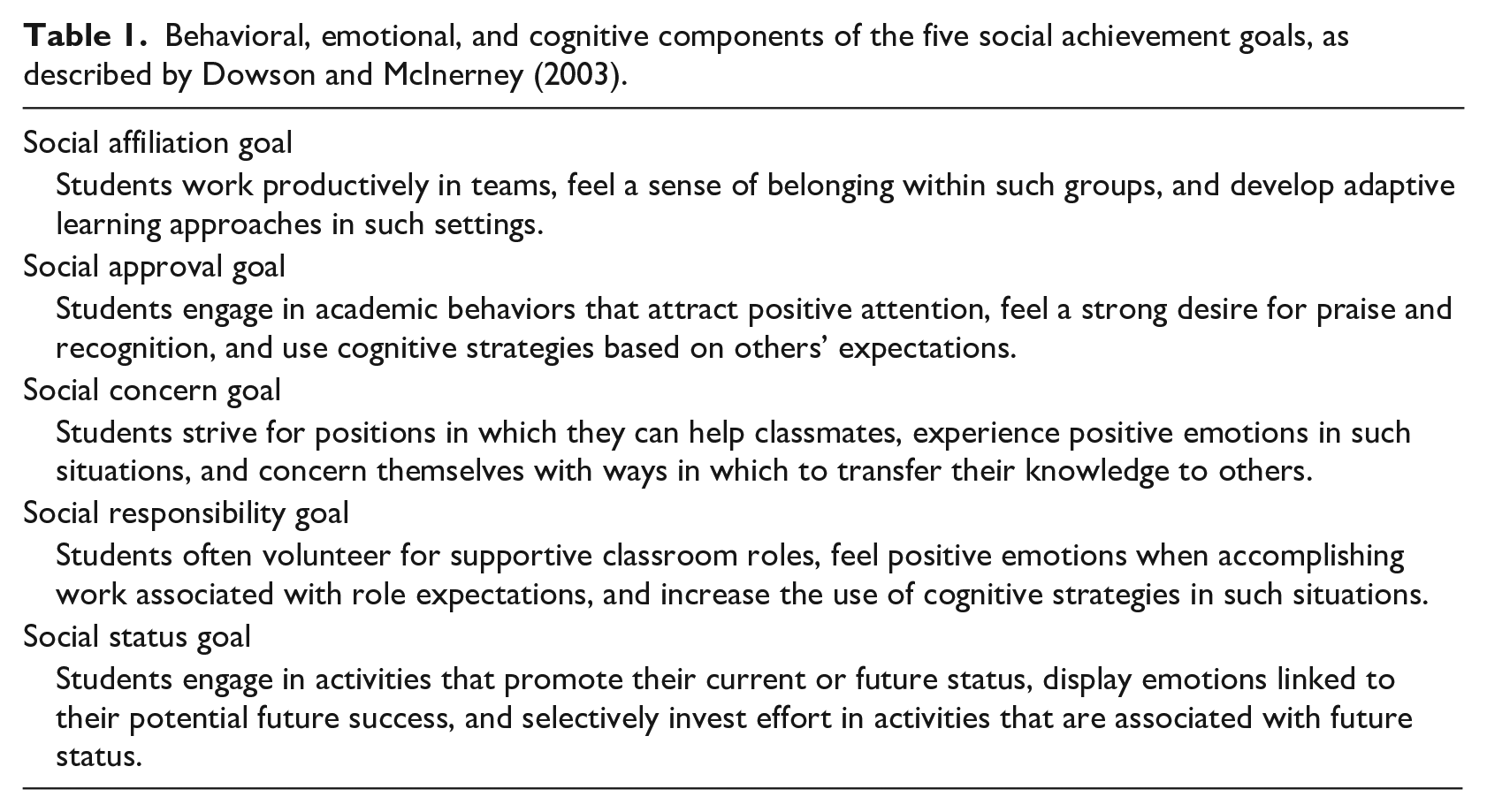
Researchers have indicated that social goals are important for students’ academic adjustment (Dawes, 2017) and have stated that there is a crucial need to untangle the different types of social goal constructs and their consequences for students’ behavior and achievement (Urdan & Maehr, 1995). Based on the work of Dowson and McInerney (2003, 2004), social achievement goals are defined as the social reasons for wanting to achieve in school. These include five types, namely social affiliation (i.e., wanting to build and/or maintain relationships), approval (i.e., wanting to gain praise and recognition from teachers and/or parents), concern (i.e., wanting to assist others with their schoolwork and academic development), responsibility (i.e., wanting to fulfill social obligations), and status goals (i.e., wanting to attain a high status within school or later in life). A description of the behavioral, emotional, and cognitive components of each social achievement goal is provided in Table 1.
Behavioral, emotional, and cognitive components of the five social achievement goals, as described by Dowson and McInerney (2003).
One way in which motivational factors are believed to influence academic achievement is through engagement (Goodman et al., 2011; Martin, 2012). Academic engagement refers to the degree of connection or involvement students have with their general schooling endeavor (Skinner et al., 2009) and is commonly considered a multi-faceted construct. Behavioral engagement is based on the concept of class participation, with key markers being (mental) effort exertion and persistence (Skinner et al., 2009). Emotional engagement encompasses energized emotional states, such as enthusiasm, interest, and enjoyment, that are felt within class (Skinner et al., 2009). Agentic engagement refers to students’ constructive contribution to the class, thereby proactively personalizing the content and didactive methods thereof (Reeve & Tseng, 2011).
Concerning achievement goal orientations, Anderman and Patrick (2012) report that the specific goal orientation held for a particular academic task will determine the quality of engagement with the task; engagement is adaptive for learning and hence assists the attainment of the espoused goal. In line with this theoretical notion, most research has demonstrated that mastery goals positively predict behavioral and emotional engagement (Datu & Park, 2019; Gonida et al., 2009). However, a clear pattern does not emerge with performance goals, as studies report negative, positive, and no associations with behavioral and emotional engagement (Duchesne et al., 2019). Furthermore, Datu and Park (2019) found that performance goals positively predict agentic engagement, while no association was found with mastery goals.
To the best of our knowledge, only two studies have investigated the association between social achievement goals and engagement. We do however only draw upon research which has conceptually defined social achievement goals as Dowson and McInerney (2003) have, to avoid confusion and unfounded conclusions (due to homonymous terms). In a study with university students, Ramshe et al. (2019) found that social achievement goals predicted a significant amount of variance in behavioral and emotional engagement; social status goals were identified as a specific predictor of emotional engagement. In a study with Filipino secondary school students, King et al. (2012) investigated which social achievement goals were related to behavioral and emotional engagement. Relying on a hierarchical regression analysis, the authors found that social achievement goals were able to explain a slight yet significant amount of variance in both forms of engagement, after controlling for mastery and performance goals, as well as demographic variables. Behavioral engagement was positively predicted by social concern, responsibility, and status goals, and negatively by affiliation goals. Emotional engagement was predicted by social concern and responsibility goals.
Current study
The aim of the current study was to investigate whether the social achievement goals endorsed by primary school students can concurrently predict their behavioral, emotional, and agentic engagement within the classroom. Our first intention was to investigate whether social achievement goals can explain a significant amount of variance in engagement, above and beyond the amount accounted for by academic achievement goals, prior achievement, and demographic factors. Our second intention was to investigate which specific social achievement goals predict engagement. As postulated by Anderman and Patrick (2012), the different forms of engagement could offer a form of strategy to assist students in attaining certain social achievement goals. Based on the behavioral, affectional, and cognitive components of each social achievement goal (see Table 1), and the findings reported by King et al. (2012), we hypothesized that (1) social concern, responsibility, and status goals would positively predict behavioral engagement; (2) social concern and responsibility goals would positively predict emotional engagement; and (3) social approval goals would negatively predict agentic engagement, and social concern goals would positively predict agentic engagement (see Figure 1(a)).
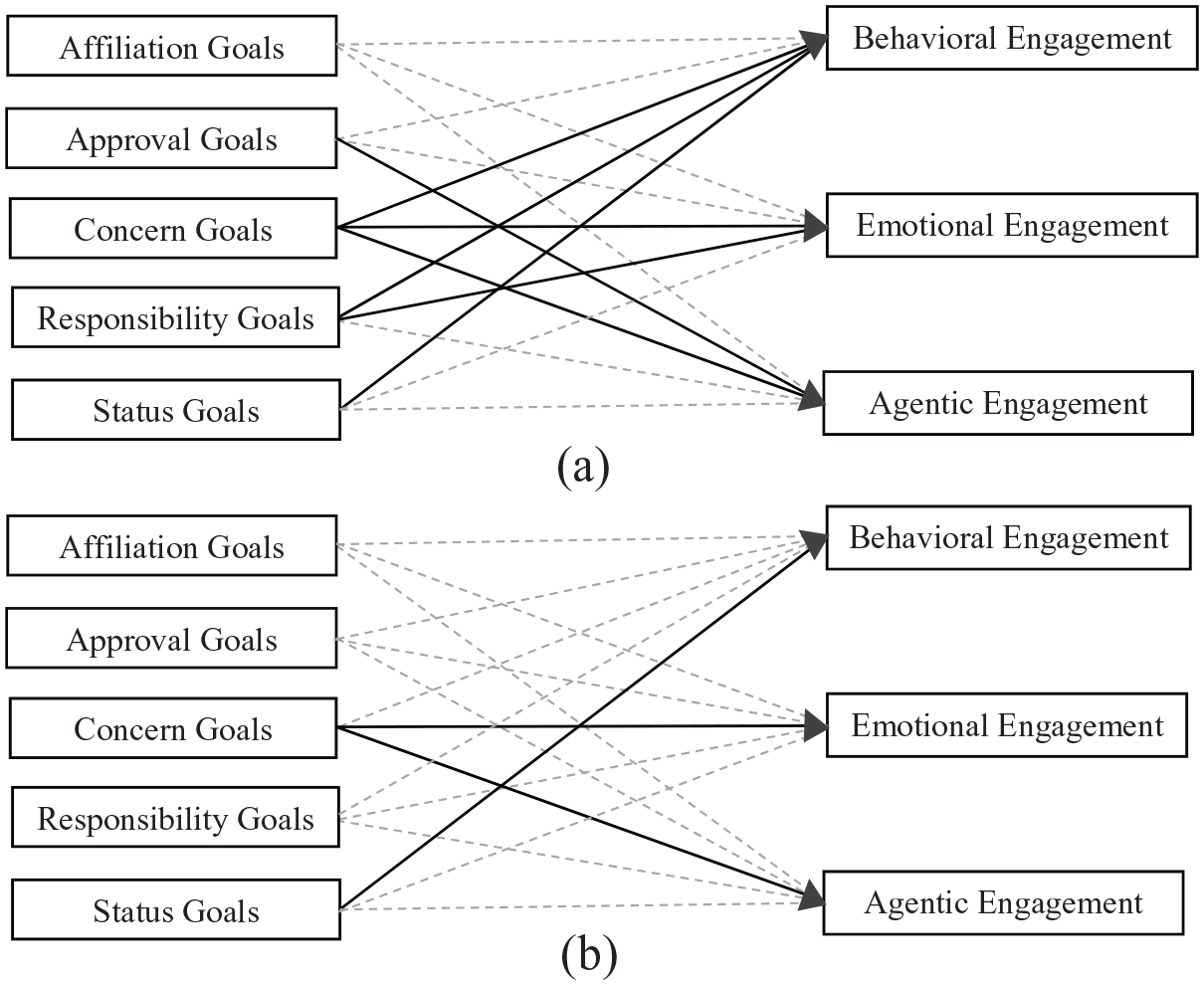
Associations between social achievement goals and academic engagement, as (a) initially hypothesized and as (b) indicated with the current empirical data. Dashed lines indicate no association, while solid lines indicate an association.
Methods
Participants
A total of 117 1 students attending sixth and seventh grades in a Namibian public primary school participated in the study. The sample included 74 females and 33 males (10 unreported), with ages ranging from 11 to 14 (M = 12.32, standard deviation [SD] = .94).
Instruments
To assess academic and social achievement goals, the Goal Orientation and Learning Strategies Survey (GOALS-S; Dowson & McInerney, 2004) was used. The GOALS-S has proven to be a valid measurement tool within Australia and the Philippines (Dowson & McInerney, 2004; King & Watkins, 2012). The mastery (e.g., “I want to do well at school to show that I can learn new things.”), performance (e.g., “I want to do well in school because being better than others is important to me.”), and work avoidance (e.g., “If schoolwork is too hard for me I just don’t do it.”) goal scales consisted of five items each. The social achievement goals consisted of four items each and included affiliation (e.g., “I want to do well at school so that I can feel close to my group of friends.”), approval (e.g., “I want to do well at school so that I can get praise from my teachers.”), concern (e.g., “I want to do well at school so that I can help other students with their work.”), responsibility (e.g., “I want to do well at school to show that I am being a responsible student.”), and status goals 2 (e.g., “I do good schoolwork so that I can get a good job in the future.”). Participants answered all items on a scale ranging from (1) strongly disagree to (5) strongly agree.
To assess behavioral and emotional engagement, we relied on the psychometrically validated self-report scales created by Skinner et al. (2009). Both scales consist of five items, measuring behavioral (e.g., “When I’m in class, I participate in class discussions.”) and emotional (e.g., “When I’m in class, I feel good.”) engagement. To assess agentic engagement, we relied on a self-report scale created and validated by Reeve and Tseng (2011), capturing unilateral contributions to the classroom instruction flow. The scale consists of five items (e.g., “During class, I express my preferences and opinions.”). Participants answered all items on a scale ranging from (1) strongly disagree to (5) strongly agree.
To control for the effect of prior achievement, we asked students to report their prior grades in English, Mathematics, and Science. We converted these into Grade Point Averages (GPA), which revealed an overall average of 2.59 (SD = .75).
Procedure
Data collection took place at a public primary school in Namibia in 2019. Each student received a questionnaire booklet, which entailed the above described questionnaires, as well additional questions that are not relevant to the current research question. Data collection took place in small group settings. Students were encouraged to ask questions if any of the items were unclear.
Ethical considerations
The study formed part of a larger longitudinal research endeavor focusing on the development of a reading culture in Namibian youth, which was endorsed by the Ministry of Education and approved by the local institutional ethics committee. In accordance with the school principal, data collection ensued at the school. Both students and their legal guardians were informed about the study and provided consent. Consent forms were given to nearly all students in sixth and seventh grades; this was repeated a few times to ensure that legal guardians received the forms. The study was anonymous and voluntary. Students received a small token of appreciation for their participation.
Data analysis
Data analyses were completed with the statistical package IBM SPSS and AMOS. An analysis of missing data patterns revealed that 7.6% of values are missing. Especially noteworthy is the large amounts of missing data for GPA (20.5% missing). This was already observed during data collection, as quite a few students asked stated that they did not remember their grades. The engagement scales revealed missing values in the range from 8.5% to 10.3%. During data entry we noticed that some students had left the middle section of the booklet empty (i.e., place of engagement items), which may be attributable to the amount of time allocated to completing the questionnaire. Little’s missing completely at random (MCAR) test was significant, χ2 = 357.79, degrees of freedom (df) = 288, p = .003, which prompted us to proceed with a multiple imputation. An imputation was carried out for all independent, dependent, and control variables. The imputation was carried out at scale-level, with variables additionally being used as predictor for the others. Auxiliary variables were not included in the imputation model. The model included 25 iterations and resulted in five imputations. We first conducted preliminary analyses, examining descriptive values, correlations, and gender and grade-level differences. Psychometric evaluations included calculating Cronbach’s alpha, and running confirmatory factor analyses (CFAs). For the CFAs, we used the original non-imputed data and relied on full information maximum likelihood estimation. Thereafter, we conducted multiple hierarchical regression analyses to test our hypotheses.
Results
Preliminary analyses
The means and standard deviations per variable, as well as the correlations between them are reported in Table 2. The Cronbach’s alpha values (α) and a summary of the goodness-of-fit statistics from the CFAs 3 is also included in Table 2. Exploring potential confounding variables that additionally influence engagement, we investigated gender and grade-level differences with a multivariate analysis of variance (MANOVA). We only found a significant effect of grade-level, with follow-up tests revealing that students in seventh grade reported higher behavioral (Msix = 4.05, Mseven = 4.25), emotional (Msix = 4.00, Mseven = 4.23), and agentic engagement (Msix = 3.58, Mseven = 3.97). Furthermore, GPA showed a significantly positive correlation with behavioral engagement (r = .46, p < .01) and emotional engagement (r = .44, p < .01).
Descriptive statistics of the included variables, as well as their internal consistency and model fit.
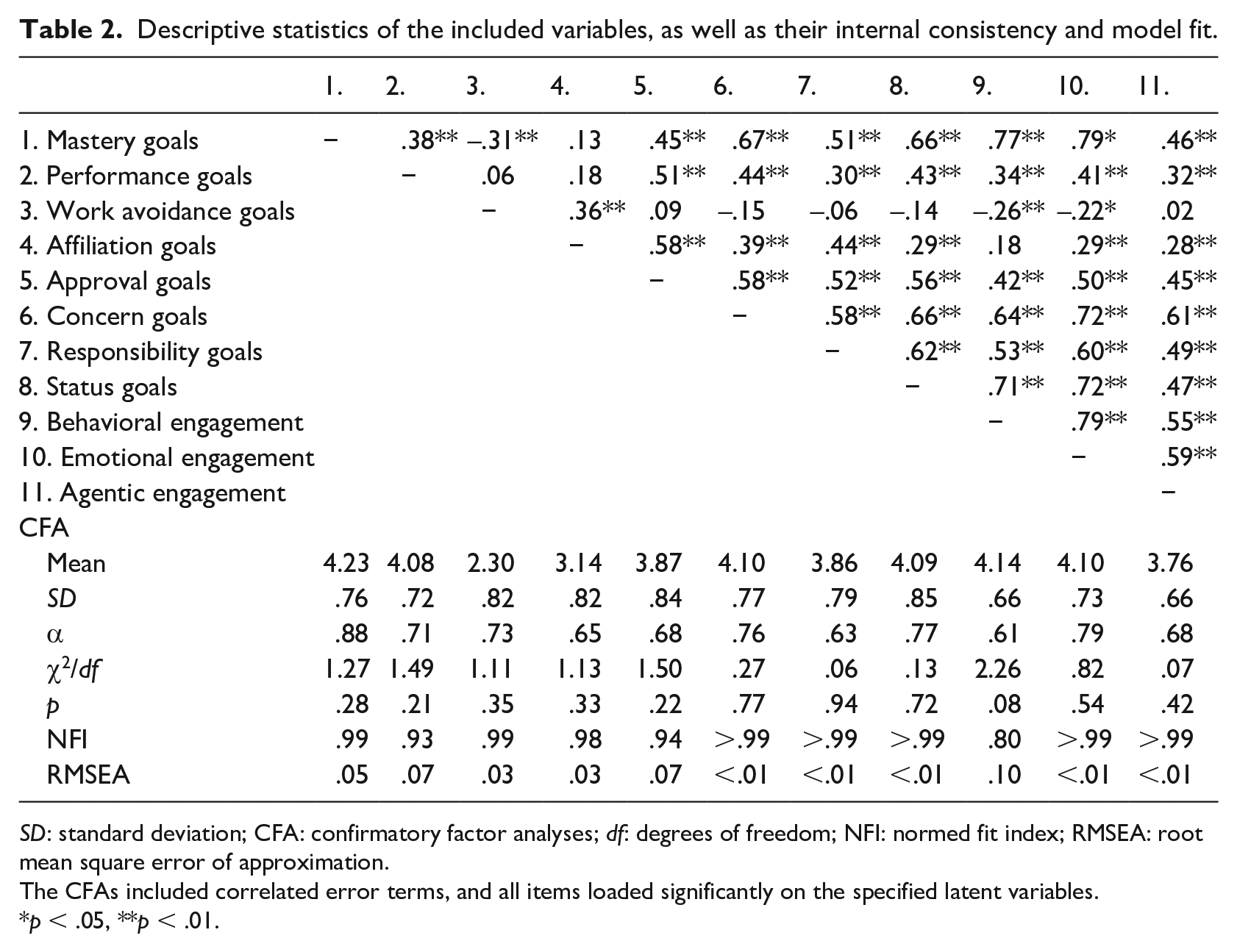
SD: standard deviation; CFA: confirmatory factor analyses; df: degrees of freedom; NFI: normed fit index; RMSEA: root mean square error of approximation.
The CFAs included correlated error terms, and all items loaded significantly on the specified latent variables.
p < .05, **p < .01.
Multiple hierarchical regression analyses
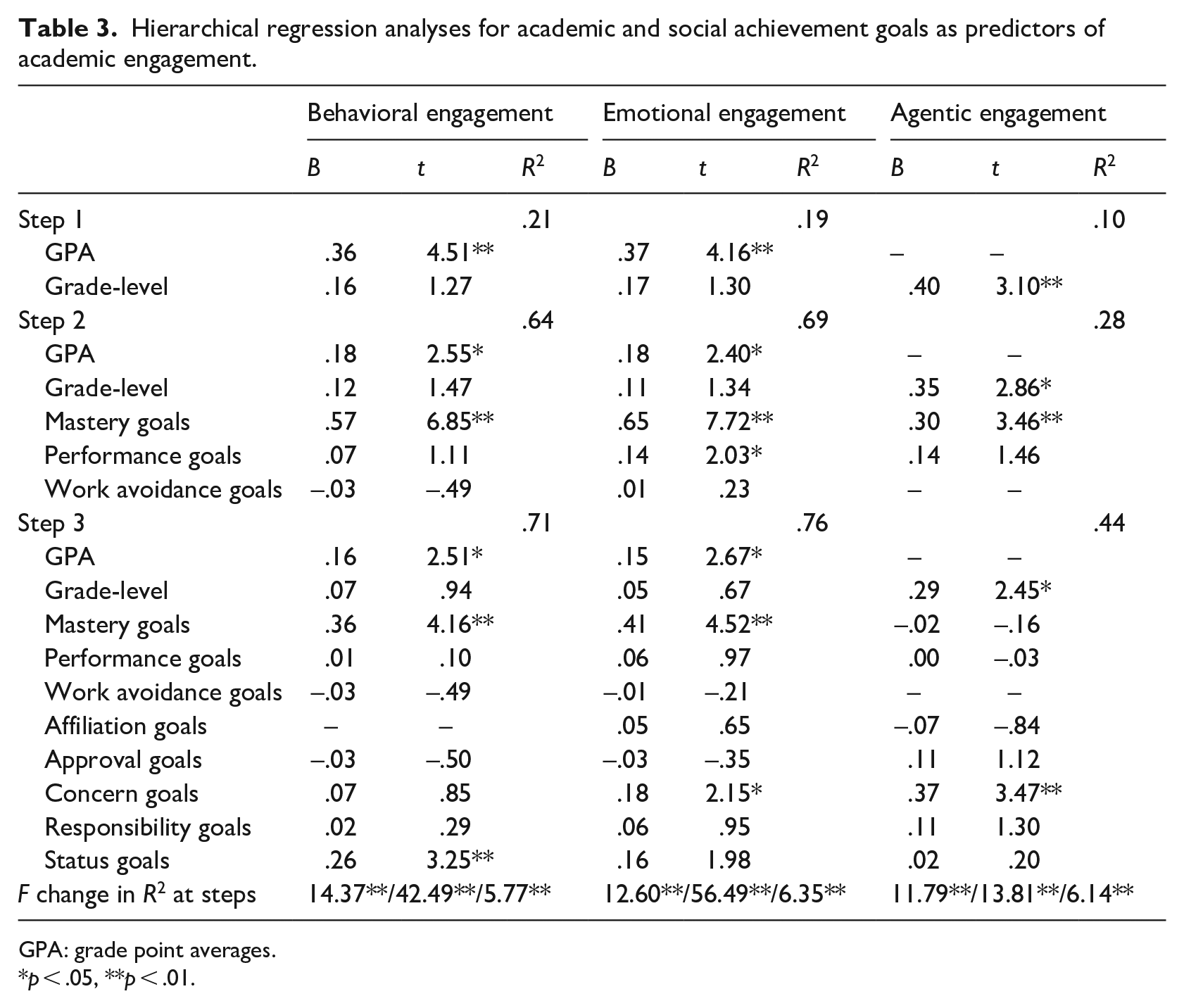
To determine the amount of variance explained by social achievement goals, as well as which specific social achievement goals predict behavioral, emotional, and agentic engagement, we conducted three multiple hierarchical regression analyses (Table 3). Prior to conducting the regression analyses, we confirmed that all assumptions were met. At Step 1, we entered GPA and grade-level as control variables. At Step 2, we entered mastery, performance, and work avoidance goals, and at step 3 the social achievement goals. As GPA and work avoidance goals showed no correlation with agentic engagement, and social affiliation goals showed no correlation with behavioral engagement, these variables were excluded from the respective analyses. Tests to see whether the data met the assumption of collinearity indicated that multicollinearity was not a concern (variance inflation factor [VIF] < 3).
Hierarchical regression analyses for academic and social achievement goals as predictors of academic engagement.
GPA: grade point averages.
p < .05, **p < .01.
Behavioral engagement
All three regression models were significant; Model 1 with F(2, 109) = 14.37, p < .001, R2 = .21; Model 2 with F(5, 106) = 37.68, p < .001, R2 = .64; and Model 3 with F(9, 102) = 27.27, p < .001, R2 = .71. GPA was a significant positive predictor of behavioral engagement, in all three models. Model 2 revealed that mastery goals were also significant positive predictors of behavioral engagement, accounting for a large amount of variance (ΔR2 = .43). Finally, Model 3 showed that social achievement goals explained a modest yet significant amount of variance (ΔR2 = .07). Only social status goals proved to be positive significant predictors of behavioral engagement.
Emotional engagement
All three regression models were also significant; Model 1 with F(2, 109) = 12.60, p < .001, R2 = .19; Model 2 with F(5, 106) = 46.46, p < .001, R2 = .69; and Model 3 with F(10, 101) = 32.25, p < .001, R2 = .76. GPA was a significant positive predictor of emotional engagement, in all three models. Model 2 revealed that mastery and performance goals were significant positive predictors of emotional engagement, accounting for a large amount of variance (ΔR2 = .50). Mastery goals remained a significant predictor in Model 3, while the effect of performance goals became non-significant. Model 3 showed that social achievement goals explained a modest yet significant amount of variance (ΔR2 = .08). Only social concern goals proved to be a positive significant predictor of emotional engagement. However, if considering a Bonferroni adjustment due to the amount of regression analyses conducted, the required significance level is not reached (α = .05/3 = .02).
Agentic engagement
All three regression models were significant; Model 1 with F(1, 110) = 11.80, p < .001, R2 = .10; Model 2 with F(3, 108) = 14.01, p < .001, R2 = .28; and Model 3 with F(8, 103) = 10.38, p < .001, R2 = .44. Grade-level was a significant positive predictor of agentic engagement, in all three models. Model 2 revealed that mastery goals were significant positive predictors of agentic engagement, accounting for a moderate amount of variance (ΔR2 = .18). Nonetheless, mastery goals were no longer a significant predictor in Model 3. Model 3 showed that social achievement goals explained a moderate amount of variance (ΔR2 = .16). Only social concern goals proved to be a positive significant predictor of agentic engagement. An explorative moderation analyses with non-imputed data revealed no interaction between grade-level and social concern goals, B = .02, t(96) = .12, p = .90.
Discussion
The aim of the current study was to demonstrate that social achievement goals can concurrently predict behavioral, emotional, and agentic engagement. Below we discuss our findings, which established that (1) social achievement goals are able to explain a significant amount of variance in all three types of engagement, above and beyond the amount accounted for by academic achievement goals, prior achievement, and grade-level, and that (2) social status and concern goals emerged as relevant social achievement goals for predicting engagement (see Figure 1(b)).
Behavioral engagement
Academic achievement goals, prior achievement, and grade-level accounted for 64% of the variation in behavioral engagement. Supporting our hypothesis, social achievement goals were able to account for a significant additional proportion of variance, accounting for 7% of the variation in behavioral engagement. This is slightly higher than the variance reported by King et al. (2012; 3%) and Ramshe et al. (2019; 5%). Conforming with previous research (Gonida et al., 2009), we found that mastery goals positively predicted behavioral engagement, while performance goals did not. Although previously regarded as maladaptive and negatively predicting behavioral engagement (King & McInerney, 2014), we found that in the current study work avoidance goals were not associated with behavioral engagement. Contradictory to our hypothesis, we found that social concern and responsibility goals did not predict behavioral engagement. In accordance with our hypotheses and the study by King et al. (2012), we did however find that social status goals were able to positively predict behavioral engagement. This is also in line with other research, which has demonstrated that educational aspirations predict behavioral engagement (Hill & Wang, 2015). Social status is usually achieved with high ranking educational credentials and occupations (Fallon, 1999); thus, students aiming for this will actively pursue strategies, such as demonstrating behavioral engagement (i.e., working hard and paying attention), to enhance their chances of achieving their goal.
Emotional engagement
Academic achievement goals, prior achievement, and grade-level accounted for 69% of the variation in emotional engagement. Supporting our hypothesis, social achievement goals were able to account for a significant additional proportion of variance, accounting for approximately 8% of the variation in emotional engagement. This is higher than the variance reported by King et al. (2012; 3%) and slightly lower than what was reported by Ramshe et al. (2019; 11%). In the second step of our regression model, we found that mastery and performance goals positively predicted emotional engagement. However, in our last model only mastery goals remained as a significant predictor. Again, this aligns with previous research, with mastery but not performance goals predicting emotional engagement (Gonida et al., 2009). Inconsistent with previous research (King & McInerney, 2014), our results demonstrated that work avoidance goals are not significant predictors of emotional engagement. In contradiction to our hypothesis and the findings by King et al. (2012), responsibility goals did not predict emotional engagement. We did however find that social concern goals were able to positively predict emotional engagement. Hence, students who desired to do well at school to assist their classmates by providing support and help, in turn, demonstrated higher emotional engagement in class. Thus far, research has predominately focused on the academic outcomes of students receiving peer-support, including an enhancement in emotional engagement (Fernandez-Lasarte et al., 2019). However, the current findings reveal that positive outcomes also emerge for the students who are invested in giving peer-support.
Agentic engagement
Academic achievement goals and grade-level accounted for 28% of the variation in agentic engagement. Supporting our hypothesis, social achievement goals were able to account for a significant additional proportion of variance, accounting for 16% of the variation in agentic engagement. When including only academic achievement goals within our regression model, we found that mastery goals positively predicted agentic engagement; yet, this effect disappeared when adding social achievement goals to the model. These findings somewhat correspond to those of Tas (2016), who found that mastery goals did not predict agentic engagement, while performance-approach goals did. In contradiction to our hypothesis, the endorsement of social approval goals did not negatively predict agentic engagement. However, social concern goals were a positive predictor of agentic engagement. Teachers often encourage students to provide feedback and ask questions by stating that it is likely that others have the same concerns. Hence, students may see their agentic engagement as an opportunity to support and help fellow classmates.
Contributions and implications
Although an association between achievement goals and academic engagement has often been assumed, research gaps between these inter-related constructs still exist (Anderman & Patrick, 2012; Duchesne et al., 2019). The current study offers not only a conceptual replication of previous findings, but also contributes toward a much-needed extension thereof.
The current study was conducted in a relatively underexplored cultural context. To determine whether motivational theories and educational practices based on research conducted in western societies are generalizable to southern Africa, it is important to undertake more local research. This is also true for research on social achievement goals, with Urdan and Maehr (1995) stating that their meaning and their associations with academic outcomes may vary across cultures. Although culture is often simplified in a dichotomous collectivistic-individualistic categorization, we propose that the focus should rather be on the unique educational contexts. In the past 30 years, the Namibian education system has seen several critical reform changes, including policy, curriculum, and syllabus amendments. While aiming for a learner-centered pedagogy, the shift has progressed slowly due to strong authoritarian traditions (Vavrus et al., 2011). Although continuously aiming for improvement, Namibia is country plagued by high dropout rates and mediocre academic achievements (Ministry of Education, Arts and Culture, n.d.). When examining these trends, the focus often lies on environmental, social, and familial factors, such as poverty, teenage pregnancy, and lack of school resources (Nekongo-Nielsen et al., 2015). Although these are all pressing matters, individual motivational factors, such as goal orientations, self-efficacy, and self-concept, as well as learning-related factors, such as engagement, learning strategies, and achievement-oriented emotions, should not be ignored. This notion aligns well with findings from other southern African counties. Interviewing street children in South Africa, Malindi and Machenjedze (2012) found that school engagement should be viewed as a resilience-promoting resource, which educators and practitioners should foster.
Duchesne et al. (2019) note that most studies investigating the association between achievement goals and engagement have focused on middle and high school, or university. Our findings demonstrate that even at the end stages of primary school, social achievement goals are already highly endorsed and are related to engagement. In line with a developmental perspective, implications for longitudinal learning processes can also be extracted. During early adolescence the nature of social relationships change, and a decline in achievement and academic motivation can occur (Eccles et al., 1993). An exploration of social achievement goals might offer a new approach, with which to counteract the declines in other motivational aspects and school disengagement. Instead of expecting students to be continuously and ubiquitously driven by mastery goal orientations, we suggest that educators provide students with sufficient opportunities and assistance to fulfill their espoused social achievement goals.
Finally, we included a relatively novel engagement type, that is, agentic engagement, thereby expanding on the empirical knowledge of this construct. As educators and policymakers are increasingly focusing on engagement to overcome low achievement, boredom, and high dropout rates (Fredricks et al., 2004), more research needs to be conducted to investigate potential influencing factors. Our findings demonstrated that social achievement goals accounted for a relatively high amount of variance in agentic engagement, compared with behavioral and emotional engagement. It is likely that social achievement goals are an important predictor because agentic engagement is characterized by social interactions.
As motivation and engagement are linked, quite a few school reforms are likely to be beneficial to both. For instance, Davis and McPartland (2012) note that immediate rewards for schoolwork, such as recognition and respect from teachers, are beneficial for both motivation and engagement; such an approach would also fit well for students pursuing social approval goals. Furthermore, developing a collaborative and supportive classroom climate among peers could be beneficial for those endorsing social concern goals; this might be accomplished by allocating set times in which students can tutor their classmates. Finally, demonstrating the functional relevance of the curriculum and increasing the utility value enhances both motivation and engagement (Davis & McPartland, 2012), which might be especially true for students endorsing social status goals. However, when considering practical classroom implications, it is important to actively involve educators and students, which can be accomplished with design-based and participatory action research (Kaplan et al., 2012).
Anderman and Kaplan (2008) state that there is a growing body of research into social processes and academic motivation, yet that these rely on a range of (competing) theoretical assumptions and principles. A major problem is that currently no model exists that incorporates social achievement goals, leading researchers to use different methodological approaches and rely on various definitions and operationalizations. For example, contrary to the definition used in the current study, Nelson and DeBacker (2008) conceptualized social approval goals as students not wanting to do as well as they could in school to gain approval from their classmates. Also, social status goals (according to Dowson & McInerney, 2003) encompasses the desire to attain a good job; however, this is a relative term and might not be equivalent to a high-paying job.
Early conceptualizations based within the achievement goal theory resulted in a dichotomous model, which over the years has evolved into a 3 × 2 achievement goal model (Elliot et al., 2011). It therefore seems plausible, and critical, that future model extensions should more holistically encompass the various goal orientations endorsed by students, including their social achievement goals. These model extensions also need to consider interactions with a range of individual and environmental factors (see Anderman & Patrick, 2012; Massey et al., 2008). As a preliminary step, we suggest that social achievement goals simply be considered additional constructs under a multiple goal perspective, that is, that students endorse various (simultaneous) goal orientations in school. However, considering that further goal orientations have and will be uncovered, a taxonomy of goal clusters will eventually be needed.
The current study has some limitations that need to be considered when interpreting the findings. As we relied on self-report measures, it is possible that students might have responded in a socially desirable manner. Furthermore, we operationalized engagement quite broadly (i.e., general engagement in class), which does not reflect how students’ engagement might vary as a function of contextual factors (i.e., in specific classes). When pooled results were not provided by SPSS, we averaged the values obtained from the imputations; the ignored variance may have led to less accurate estimates for some of the values (see van Ginkel, 2019). Also, the internal consistency is questionable for some of the scales, and the factor structure is not ideal. Finally, we acknowledge that students can endorse various goal orientations simultaneously, which might result in differential outcomes.
Conclusion
The current study makes an important contribution in the field of motivational and educational psychology, by demonstrating that social achievement goals influence behavioral, emotional, and agentic engagement in primary school students. Although our results call for us to be modest when stating the extent to which social achievement goals can predict academic engagement, the findings do indicate that they are a unique motivational construct that deserves further investigation.
Footnotes
Declaration of conflicting interests
The author(s) declared no potential conflicts of interest with respect to the research, authorship, and/or publication of this article.
Funding
The author(s) received no financial support for the research, authorship, and/or publication of this article.
