




Abstract
Hydraulic fracturing, or fracking, is an emerging and growing industry that is having considerable effects on environments and health. Yet fracking often lacks environmental regulations that might be understood as governmental forms of care. In some locations in the US, citizens have taken up environmental monitoring as a way to address this perceived absence of care, and to evidence harm in order to argue for new infrastructures of care. This article documents the practices of residents engaged in monitoring air pollution near fracking sites in the US, as well as the participatory and practice-based research undertaken by the Citizen Sense research project to develop monitoring kits for residents to use and test over a period of seven months. Citizen sensing practices for monitoring air pollution can constitute ways of expressing care about environments, communities and individual and public health. Yet practices for documenting and evidencing harm through the ongoing collection of air pollution data are also speculative attempts to make relevant these unrecognised and overlooked considerations of the need for care. Working with the concept of speculation, this article advances alternative notions of evidence, care and policy that attend to citizens’ experiences of living in the gas fields. How do citizen sensing practices work towards alternative ways of evidencing harm? In what ways does monitoring with environmental sensors facilitate this process? And what new speculative practices emerge to challenge the uses of environmental sensors, as well as to expand the types of data gathered, along with their political impact?
The rise of unconventional shale gas extraction, otherwise referred to as ‘fracking’, has raised multiple questions about how this mode of energy production impacts environments and health. Fracking involves extracting natural gas through first drilling vertically thousands of feet underground, then drilling laterally up to 1–1.5 miles beneath shale rock formations and injecting vast amounts of water, sand and chemicals to fracture shale deposits and release bubbles of gas trapped in the porous rock. Often considered to be cleaner than coal, in the US shale gas has been referred to as a ‘bridge’ technology that is promoted as an interim solution on the way to more renewable and sustainable energy sources, while also reducing dependence on imported energy sources.
The extensive infrastructures of fracking span across well development and drilling, well completion and production, on-site and off-site processing, distribution and storage of gas (see Figure 1). At every point in this infrastructure, pollution potentially occurs to both water and air. The wells drilled at initial points of extraction generate greenhouse gases primarily in the form of methane, and air pollutants including particulate matter (PM) emissions and volatile organic compounds (VOCs). The water and chemicals used to exert pressure to remove shale gas can contaminate drinking water and surface water through wastewater ponds of ‘flowback’ drilling fluid left to be trucked away or to evaporate into the air and settle into soil. The compressor sites where gas is pressurised, refined and pumped into pipelines generate additional methane, diesel and VOC emissions in the form of benzene, toluene, ethylbenzene and xylene (BTEX), some of which are known carcinogens at even minute levels of exposure (Moore, 2013). And the extensive truck traffic that hauls materials for initial well development to waste removal contributes to ultrafine particulate matter and diesel emissions that have been recognised as carcinogens by the World Health Organization (WHO) (International Agency for Research on Cancer [IARC], 2012).
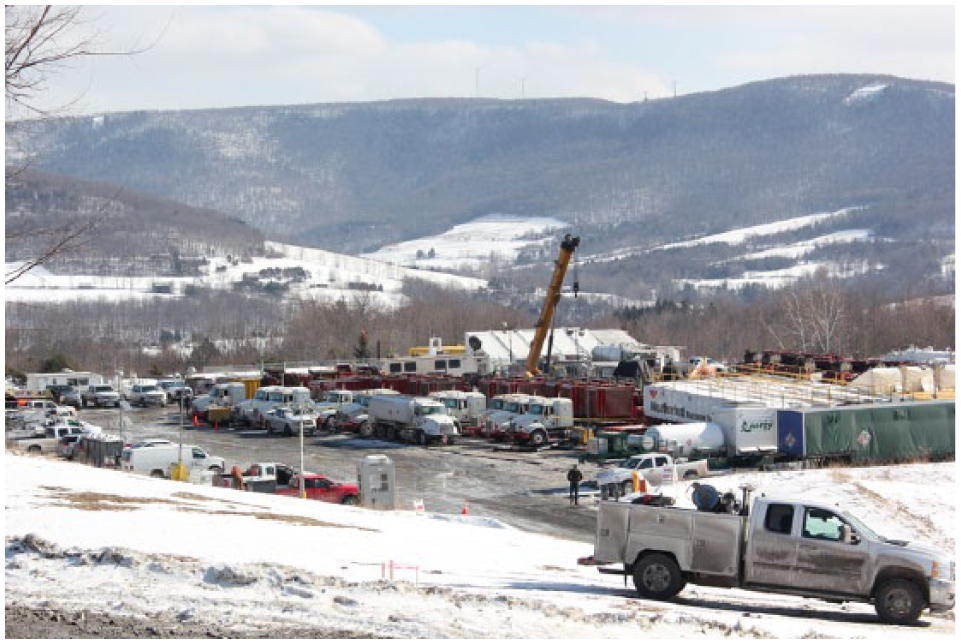
Fracking operation underway in northeastern Pennsylvania.
Across these infrastructures of energy extraction, established as well as new and even uncertain formations of pollution emerge that are yet to be studied both for their distribution and type, as well as for their possible effects and future accumulations. In this article, I address practices of citizen-based monitoring of air pollution near fracking sites as speculative attempts to evidence harm to environments and health. Citizen-led environmental monitoring can unfold through speculative registers because it at once seeks to generate forms of evidence that can be new or different to regulatory forms of evidence, and also because it seeks to articulate new forms of participation and political possibility for citizens concerned about environmental harm from fracking. While a certain amount of attention has been directed toward the monitoring of water quality in relation to fracking because of the rather spectacular if not alarming phenomenon of residents in fracking sites being able to light their water taps on fire from high levels of methane migrating from potentially faulty well casings (Ingraffea, Wells, Santoro, & Shonkoff, 2014; Osborn, Vengosh, Warner, & Jackson, 2011), 1 this research focuses on the relatively under-examined topic of air pollution at fracking sites. Whether in the form of ultrafine particles and particulate matter, nitrogen oxides, climate-change-accelerating methane, VOCs, ozone and more, an array of compounds generated and following on from fracking processes are known to be and suspected of accumulating in the air and affecting bodies and environments.
Air pollution is an environmental and health problem that is of increasing concern, and WHO (2014) has documented that air pollution is one the leading causes of disease and death worldwide. Air quality monitoring typically takes place through distributed infrastructures, from health research to policy guidelines to official monitoring stations and labs where data are analysed, which are oriented to protecting public health and lessening the effects of air pollution. These monitoring infrastructures are in turn meant to inform further corrective action, typically through additional policy measures, if levels of pollutants exceed guidelines. Air pollution monitoring could on one level be approached as a distributed expression of governmental care in relation to public and environmental health. Yet care can as likely turn to neglect and harm, since instantiations of care may be incomplete and even lead to forms of oversight and inertia. In rural environments where most fracking takes place, there is a relative absence of air quality monitoring networks, because air pollution is generally seen to be a problem of urban environments and higher population densities. At the same time, fracking as an industry is relatively exempt from federal-level clean air and water regulations (in the so-called ‘Halliburton loophole’ of the US Energy Policy Act of 2005), and so is not subject to the same national safeguards that might ensure the industry is not contributing to harmful air and water pollution levels, as these regulations are devolved to states. 2 In this sense, there are as many ways in which exposure to harm might not be monitored, whether through lack of policy or regulation regarding pollutants and industrial processes, or because individuals experience much different and situated exposures to pollution than the typically fixed and urban monitoring stations can possibly capture.
Detailing work from the Citizen Sense project, 3 this article considers one response to the at times incomplete and stationary official air pollution monitoring in the form of DIY and citizen-based air pollution monitoring. This practice-based research project investigates the use of DIY and low-tech monitoring kit used by citizens who seek to understand and act upon environmental problems. Discussing research into citizen-based and scientific monitoring practices taking place in the Marcellus Shale region, this contribution attends to the ways in which residents’ experiences of harm have led to practices of monitoring environments. As part of this documentation and review of citizen monitoring practices, this article further details participatory research into extending these practices by working with residents to develop and install monitoring kits throughout a three-county area in northeastern Pennsylvania.
DIY air pollution monitoring practices are often presented as a way to ‘care about your air’, 4 a seemingly simple strategy for protecting one’s individual health, and an attempt to facilitate the do-ability of mitigating one’s own exposure, since it is often difficult to reduce air pollution emissions through the usual political channels. Yet the invitation to care about one’s air in the absence or inaction of governmental air pollution infrastructures does not necessarily generate straightforward solutions to the problem of air pollution. Instead, caring about air becomes entangled with speculative practices of evidencing harm. Neither care, nor the subjects and actions that would constitute care, are so clearly identified, since the forms and forums needed for citizen data to have effect are in the making, and forms of harm are accumulating and often not fully known. The conditions in which these monitoring practices could gain a foothold and demonstrate environmental and bodily harm as felt, incurred, and yet to come are then potentially continually in process in relation to lived conditions.
Citizen sensing practices for monitoring air pollution are, on one level, ways of expressing care about environments, communities and individual and public health. Practices of documenting and evidencing harm through the ongoing collection of air pollution data are speculative attempts to make relevant these unrecognised and overlooked considerations of the need for care. Operating as they do outside of the more official infrastructures of care, citizen sensing practices indicate that more attention should be given to air pollution, while attempting to instigate corrective actions. Yet the exact contours of these political engagements can be somewhat open ended, and do not immediately translate into regulation, policy or even agreement about common environmental problems.
Recognising that there are multiple ways in which care could be considered to be ‘non-innocent’ (Murphy, 2015, p. 721), while also acknowledging that citizen monitoring of air pollution could be generative of forms of ‘cruel optimism’ (Berlant, 2011) in relation to how political hopes are attached to technologies and data, this article shifts the focus from making normative proposals for care to address instead the complex and speculative practices involved in evidencing harm, as precursors or entreaties to care. Such an approach might resonate with Puig de la Bellacasa’s (2011) suggestion that ‘engaging with care requires a speculative commitment to neglected things’ (p. 85). Such a speculative commitment, as I suggest here and drawing on Stengers, could also refer to practices for expanding potential within present political engagements, as well as practices for generating evidence and worlds where citizen data might come to have relevance.
While monitoring ostensibly focuses on gathering the ‘facts’ of pollution, what a
speculative approach to monitoring requires is that facts as well as a universe in which
thought takes hold must be co-constituted in order for speculative propositions to
realise their potential (Gabrys,
2016; Stengers,
2011; Whitehead, 1985
[1929]). Speculation describes not the adding up of evidence, but rather the
shifting of the conditions in which (here) monitoring as practice, habit, findings,
facts and concrescence, might come to make sense. As Stengers writes: It pertains to speculative propositions to ‘make us feel’ what is, in fact, a
generality that bears upon every proposition: it pertains to them to propose not
a fact, opinion, state of affairs, or even a vision of the world, but the
universe required by thought itself producing that proposition, a universe whose
general, systematic character is none other than the very experience of thought
as a ‘leap’, productive both of the thinker and of what is to be thought.
Speculative propositions do not designate a world that exists prior to them,
but, quite the contrary, they bring into existence what Deleuze and Guattari
call an ‘image of thought’, in the sense that such an image coincides with a
‘thought without images’, that is without a stopping point that makes words and
things communicate in a satisfactory way. No longer the thought of someone about
something, but thought experiencing itself as anonymous, as if produced not by
the thinker but by its very movement. (Stengers, 2011, p. 267; cf. Whitehead, 1985 [1929],
p. 11)
Speculative propositions do not articulate in advance the conditions in which they will have relevance, but rather through the leap of thought that they designate or instigate they bring into existence an image and movement of thought that takes hold as habit. In this way, the proposition that citizen monitoring puts forward is also the very process of making forms of sensation and facts, as well as worlds in which those sensations and facts can have relevance.
But if Stengers focuses on the movement of thought within propositions, at the same time Shaviro (2009, 2014) emphasises how these speculative capacities extend to things and more-than-humans, and are more than a habit of human – even if anonymous – mind. Experiences are distributed, and speculation is a practice undertaken collectively. Speculation can be distributed through things, which are propositions and potentialities for feelings and encounters: they lure us into ways of being. In this sense, any account of ‘the social’ would necessarily need to attend to the things that are continually drawing us into speculative encounters, feelings and occasions. These things, with respect to monitoring for pollution at fracking sites, include sensors and chemical compounds, data platforms and wellheads, truck traffic and meeting halls, bodily afflictions and noxious smells, as well as ancient rock and energy markets. For the purposes of this article, I will especially attend to the ways in which speculation through and with environmental sensors is part of this extended field in which collective experience takes hold.
Speculation can occur in yet another register, since rather than simply resolve or clearly evidence the probability and effects of pollution, monitoring practices also can at times amplify uncertainty, give rise to speculation, and cause residents to wonder if not worry about ongoing exposure to pollutants. Some of this uncertainty can actually proliferate through increased collection of evidence, where the documentation of extant pollutants may give rise to concerns and questions about effects of pollutants over time, how they will travel through environments and bodies, and whether individuals will find themselves with health issues that may or may not be linked to fracking-related pollutants. The modes of speculation that emerge in relation to pollution monitoring at once signal the potentiality as well as possible limits of speculative practices for evidencing harm. These practices could, on the one hand, be a way to direct attention to the potential new communities that increased monitoring can galvanise. On the other hand, speculative practices for evidencing harm could provoke conjecture about future environmental effects, as possible forms of harm-in-waiting that are difficult if not impossible to substantiate. Speculation, here, may be a cause for concern and even dread.
However, speculation neither signals a sort of ‘relativism’, nor does it form the basis for a mere dismissal of citizen data as irrelevant and speculative conjectures. Instead, and following Stengers and Whitehead, it does encompass the particular ways in which propositions for making particular worlds matter. To dismiss the experience of citizens living on the gas fields would be to also fix the environments, experiences and concerns of fracking as already settled and addressed. Yet as with any technology that unfolds in unpredictable ways in the world, new practices for making sense of and attending to this industrial process will also inevitably form new collective worlds. Indeed, speculation could be less about resolving uncertainties, and more about arranging new environments, worlds and conditions where evidence of harm can take hold.
By monitoring environments, citizens can then develop speculative modes of engagement that attempt to understand their lived environments. Yet how do citizen sensing practices work toward alternative ways of evidencing harm? In what ways does monitoring with environmental sensors facilitate – or limit – this process? And what new speculative practices emerge to expand the uses of environmental sensors, as well as the types of data gathered, along with their political impact? As I suggest here, environmental monitoring practices are not just ways of documenting the presence of pollutants, but also are techniques for tuning sensation and feeling environments through different experiential registers (Gabrys, 2012).
Through a discussion of a DIY air monitoring kit developed and used by participants in Pennsylvania, I consider how practices of evidencing harm involve speculative encounters with environments, pollutants, data, regulators, industry and communities. I address how these practices, on the one hand, could be seen to be oriented toward attempts to ‘empower’ citizens by shifting the infrastructures, technologies and practices of monitoring to less institutionalised arrangements. Yet on the other hand, I consider how these practices do not easily or readily mitigate harm by reworking the agents undertaking monitoring, but instead require new forms of collective attachment and individuation in order for political engagement and effect to be activated. These new ways in which citizen sensing unfolds to become relevant (or not) then unfold as speculative encounters and commitments to evidencing harm, and to instigating new relations that might be characterised through less normative – and even ‘complicated’ – forms of care (Clark & Giovanni, this issue). By focusing on the speculative dimensions of evidencing harm as a way to move toward infrastructures and policies of care, this article suggests that the processual and participatory aspects of establishing how best to care might be more fully taken into account. Such an approach then focuses on ways to generate forms of care and environmental policy that are more responsive to expanded accounts of the experience and evidence of the harm of air pollution, as captured through citizen sensing practices.
Environmental monitoring and fracking
While unconventional shale gas extraction in some cases is referred to (by proponents) as a long-standing technology that has been in use for nearly 60 years, others suggest that the particular high-intensity ways in which fracking are now being undertaken are relatively new, even less than 10–15 years old, and as such have unforeseen and understudied impacts (Howarth, Santoro, & Ingraffea, 2011). As with many technological ‘innovations’, fracking is unfolding as an experiment in the world (Gabrys & Yusoff, 2012; Latour, 2004; cf. Briggle, 2015), where earthquakes, untested and proprietary chemicals, groundwater contamination and air pollution are among the emerging material-political and environmental configurations and inhabitations that are generated through this mode of energy extraction. This emerging technology contributes to environmental effects that both at present and at some future point could impair living conditions for many within the catchments of fracking operations.
Residents who are feeling the effects of fracking often search for ways to register the effects of these newly lived conditions. Environmental monitoring can be one way to document and evidence environmental change and harm. At the same time, monitoring technologies might not necessarily capture those compounds, events, pollutants and effects that occupy more liminal, indeterminate or even unknown and future registers of harm. In other words, information gathering and the environmental awareness that it seems to promise can produce just as much uncertainty. For instance, while individual pollutants can be relatively well studied in some cases, the accumulation, amplification and interaction of pollutants are less well known and remain an ongoing concern. How might it be possible to monitor and evidence these indeterminate effects and processes, particularly if pollution monitoring may be oriented toward detecting an individual substance or limited substances, within a categorical present, and without attention to ongoing interactions of accumulations (cf. Chen, 2012; Schrader, 2010)? How might it also be possible to monitor environments and air if pollutants are not even known, and fall outside of the designated list of compounds to monitor and regulate? And how can citizen-based environmental monitoring make a contribution in the absence of and in comparison to governmental monitoring data?
This enquiry into speculative-based approaches to monitoring through DIY and citizen sensing technologies considers how these practices provide data that can be more accessible, and which can potentially challenge more ‘official’ monitoring infrastructures. As mentioned in the introduction to this article, while governmental air quality network monitoring sites might be sited at locations that are few and far between, and that give a somewhat limited picture of what an actual individual’s exposure to air pollution might be, portable DIY monitoring technologies are intended to provide a more specific and granulated picture of an individual’s exposure. Beyond mapping individual exposure, however, if communities are concerned about air pollution in their neighbourhoods, DIY technologies are meant to fill the gap where there might be an absence of official monitoring technologies, so that sensors can easily be set up to provide alternate datasets to address specific community concerns, such as a polluting roadway or industrial site, or the possible pollution of a proposed development. This is a much different way of mobilising public engagements with technology, moreover, since publics are not engaged in modes of reflexive deliberation with yet-to-be-introduced technologies (cf. Felt & Fochler, 2008) but instead are having to contend with and evidence the effects of uncertain and indeterminate technological operations as they happen in lived environments.
In research and fieldwork looking at both scientific and more citizen-based monitoring practices, particularly in relation to pollution sensing, it has been interesting to note the extent to which atmospheric scientists, for instance, express concerns about the possible ways in which citizen sensing technologies could be deployed in ways that generate inaccurate or unhelpful data (Cohen, n.d.). Their concern is one of numerical accuracy, of not compromising the data that would support possible actions that might need to be made in attempting to enforce air pollution policy (cf. Edwards, 2016). On the other hand, advocates of citizen sensing technologies have made the case that the absolute numerical accuracy of the data is of less concern, when the process of assembling communities of makers or environmentally engaged ‘citizens’ might be facilitated through the development and use of these kits. Still others have suggested that data can have increased relevance through the sheer quantity of monitoring underway, when distributed across multiple citizen monitoring sites; or that datasets might become relevant through detecting changes in the patterns of data, rather than precise numerical readings, and that a greater ability to work with ‘just good enough data’ could be developed so that situated engagements with environmental problems can be more easily generated (Gabrys, Pritchard, & Barratt, 2016; US Environmental Protection Agency [US EPA], 2013).
Environmental monitoring practices could then be engaged with not just as a project of collecting data or raising environmental awareness, but also as a more speculative undertaking that works through experience, feeling and attachments. A speculative approach to monitoring could transform the capacities and engagements, as well as concrete sites and concerns that emerge in relation to air pollution from fracking on the Marcellus Shale. In developing this sort of speculative approach to monitoring, it could be possible to consider how processes of evidencing harm could move beyond a primarily indexical or evidential tracing of pollutants, whether through high-tech or low-cost instrumentation, to engage also with addressing how facts or evidence ‘take hold’, as Stengers (2011, p. 518) has suggested, such that they mobilise relations, practices and forms of relevance (cf. Gabrys, 2016). Monitoring practices are not simply a question of what to sense and how to document pollutants, but also involve considering how particular sensing entities and arrangements concretise to inform the possible attachments of monitoring (Gabrys, 2012, 2016). A speculative approach to monitoring is not a ‘relativistic’ approach to generating environmental data, but rather is an expanded engagement with what citizen sensing puts in motion, as a practice of generating new forms of data as well as new forms of relevance. The possible attachments that arise through environmental monitoring further indicate how harm might be evidenced in such a way so as to generate practices of care that address or mitigate harm. It is these processual approaches to care and practices for evidencing harm that I discuss for the remainder of this discussion.
Sensing pollution on the Marcellus Shale
Citizen Sense fieldwork in the area of pollution sensing has spanned from conducting pilot studies on DIY air pollution monitoring technologies in London, to fieldwork and participatory research on the Marcellus Shale in Pennsylvania, USA. The particular focus of Citizen Sense research has been on the northeastern section of Pennsylvania, where there is a high concentration of drill sites. The Marcellus Shale is composed of a sedimentary rock formation that extends across the Appalachian Mountains and spans New York, Pennsylvania, West Virginia and Ohio. The formation is millions of years old, and contains gas created from decomposing organic material (State Impact, n.d.). One of the first shale plays to be drilled in the US, the Marcellus Shale has been in its most active stages of development since 2008. The Marcellus Shale in Pennsylvania is then a highly productive site of unconventional gas extraction, and as of late 2015 there were approximately 7800 active wells in operation in the state of Pennsylvania (Amico, DeBelius, Detrow, & Stiles, n.d.). The number of wells and sites related to fracking infrastructure continues to grow, with some estimates placing the anticipated total number of wells growing up to 100,000 over the next several decades in Pennsylvania alone (Griswold, 2011). To date, there have also been over 4000 recorded environmental violations at well sites, with fines totalling US$6.1 million. Violations include everything from failing to dispose of residual waste correctly to discharge of wastewater to poor construction of pits and tanks, to not adopting Pennsylvania Department of Environmental Protection (DEP) pollution prevention measures (Amico et al., n.d.).
Most fracking developments and the leasing of extraction rights are taking place in rural communities that may have previously had few sources of income. Shale gas presents a way for everyone from retirees to sustainable farmers to teachers and local governments to supplement their income, which on one level boosts local rural economies. Yet at the same time, the rural idyll that may have attracted people to settle in this area, or the long-standing relationships residents have experienced living in these environments, have frequently changed in relation to the latest wave of shale gas production, with its attendant environmental impacts. This is not to say that this is a pristine landscape, since Pennsylvania is well known for industry such as steel mills, as well as earlier forms of mining and energy production including coal extraction. But exactly because there is a prior history of extraction, new extraction economies and practices have brought with them concerns about what it means to commit now and in the future to these natural resource and energy economies.
While much focus is often placed on well pads where the gas is actually extracted, the landscape of fracking is not limited to one specific site, but consists of an extended infrastructure: horizontal, underground, as well as emerging at discrete points, interconnected by trucks hauling equipment and waste material, and contributing to airborne and waterborne impacts. Fracking is somewhat provisional not just as an emerging energy technology, but also because every site that is fracked has different geology and subsurface features. Fracking technology uses extensive horizontal drilling with a mix of hundreds of proprietary and often-untested chemicals. These chemicals –together with water, sand and lubricants – are injected into wells under high pressure as fracking fluid to blast out gas from shale layers, which in turn can release methane as well as radiation into the air. Fracking fluid can leach into groundwater, and contaminate drinking water (Llewellyn et al., 2015). The chemicals that return to above ground to be stored in impoundment ponds or trucked away to wastewater treatment facilities can also be different from site to site, and can include radionuclides including strontium and barium from underground radiation. 5
Environmental and health effects: Listing harm
It goes without saying that fracking is a contentious issue on many levels, something that can divide communities and generate differing understandings and experiences of pollution and harm, since the effects of fracking are typically unevenly distributed. Pollution can be differently felt by residents who live downwind rather than upwind of a compressor site, who live in an area with a contaminated water supply, or who live on a road with constant industry-related traffic. People living nearby these sites, including those who have leased their mineral rights, have begun to ask questions about the impact of these extraction techniques on environments and human health.
Reports have emerged of people living nearby fracking sites, compressor sites, waste pits, roads and more, experiencing multiple environmental disturbances and health effects, from noise and constant light, to smells from emissions, to a range of symptoms that are characteristic of VOC exposure, as well as asthma, cardiac and pulmonary diseases, and cancer. Residents nearby compressor sites notice odours and metallic tastes, which some have suggested are linked to the cleaning fluids used to flush compressors, or to the substances emanating from glycol dehydration processes. Across these multiple sites, residents report further experiences of chronic and acute nosebleeds, headaches, dizziness and a range of other symptoms that are difficult to tie into a cause-and-effect logic of how fracking may be impacting environments and bodies. Chronic illness can also take up to decades to manifest, so this raises another set of issues about how to capture the ongoing and accumulative health and environmental impacts and harms that could be related to fracking. The inconsistent occurrences of illness, chemical exposure, and evidence as provided through monitoring make this less a space of demonstrable proof and more an uncertain atmosphere of effects. For instance, tests of drinking water in households where residents complain of illness have at times shown an absence of any substances of concern, and in other instances arsenic, benzene and heavy metals are clearly evident at high levels (Griswold, 2011). Environmental monitoring does not simply reveal the ‘facts’ of pollution, but is entangled with complex environmental, chemical and bodily interactions. While monitoring might on one level be indicative of care, on another level care is always still to be realised since it requires engaging with the speculative aspects of how harm, evidence and care might yet unfold.
Indeed, even attempts to generate comprehensive lists of harm often indicate how environmental exposures are experiences lived within spaces of considerable uncertainty. The Pennsylvania Alliance for Clean Water and Air has established a ‘List of the harmed’, 6 which documents residents in locations across Pennsylvania and the wider US who have experienced harm from fracking. The ‘List’ documents the specific gas facility or facilities that residents live nearby, as well as expected or evidenced exposures, symptoms for humans and animals, and press or other coverage online, which can include videos and photographs of harm and damage experienced. Reaching nearly 17,000 records in length at the time of this writing, the ‘List’ records residents living next to a compressor station who experience ‘headaches, fatigue, dizziness, nausea, nosebleeds’ with one example ‘blood test show[ing] exposure to benzene and other chemicals’; as well as the death of goats, cows, chickens, cats and dogs in areas with contaminated water; and environmental nuisances including seismic testing, noise, dust, heavy machinery sounds and emissions, and ‘bright industrial lights’ throughout the night; and even some residents who have post-traumatic stress disorder from serving in Iraq having flashbacks triggered by the light of flaring gas wells. As a form of ‘evidence’, this ‘List’ might be considered to fit within multiple forms of citizen reporting that are often dismissed as ‘anecdotal’ in contrast to more ‘scientific’ methods for gathering evidence and documenting harm. However, not only is ‘the science incomplete’ (Olsen, 2011) when it comes to establishing links between fracking and harm, but also residents are often uniquely situated to record their lived experiences of exposure to shale gas production, and so to contribute new forms of citizen data. Care emerges here through indicating the harm experienced by individuals, which can further begin to inform additional ways of addressing the harm and potential harm experienced by communities.
Citizen sensing practices
Many questions emerge as to what may actually be monitored at present, by whom, and to what regulatory effect; and what remains unmonitored, unaccounted for, and yet may still create considerable harm. At the same time, the regulatory and enforcement infrastructure for monitoring pollution has not caught up with fracking technology and is often ill equipped to monitor and regulate the complex processes and impacts of this industry. It has been in these situations where citizens have then taken up multiple forms of monitoring and gathering evidence in order to record and make sense of their experiences, and to show their care and concern for their communities and environments.
A number of existing monitoring practices are currently taking place in fracking communities located in northeastern Pennsylvania. The practices include everything from the use of high-end instrumentation such as a Photovac 2020PRO Photoionization Detector that can be used for humidity-compensated VOC detection in air, water and soil (see Figure 2); to a FLIR Gas Finder that detects 17 gases at −20°C to +300°C through infrared thermal imaging, which some citizens use to try to understand the effects of compressor sites; to university- and NGO-loaned summa canisters for testing a range of air pollutants; and bucket brigade community monitoring, a long-standing analogue technique that can test for more than 70 VOCs and 20 sulphur compounds, but which requires that samples be sent off to laboratories for analysis. While bucket analysis and similar techniques have been used in environmental justice campaigns and fence-line monitoring at refinery sites, for instance, a concern has been raised that the buckets do not offer real-time monitoring capabilities, where someone monitoring their environment might have an immediate sense of environmental conditions.
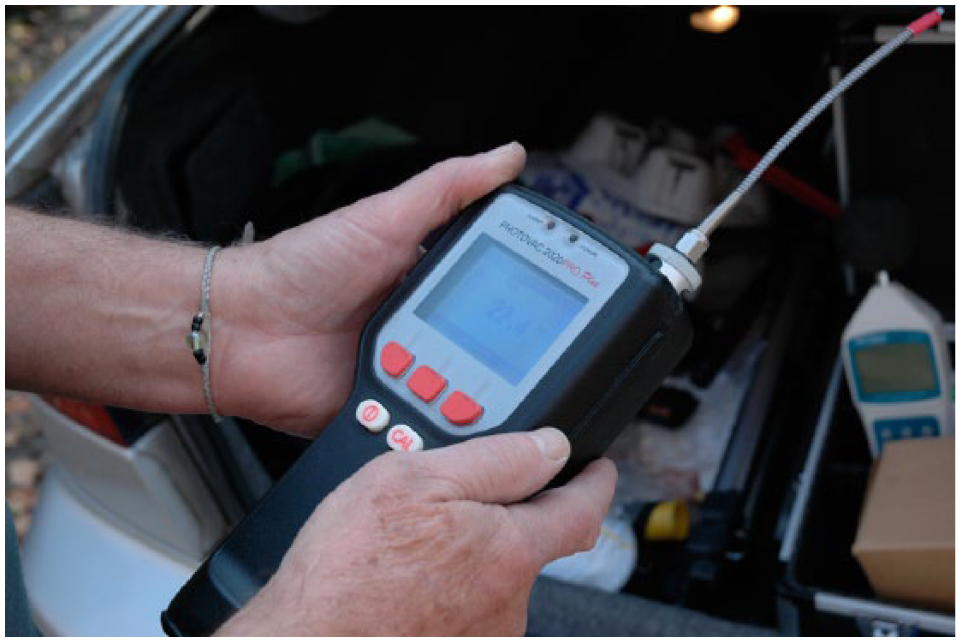
Citizen monitoring VOCs near compressor station in northeastern Pennsylvania.
Within this array of monitoring practices, some of which require citizens to collect samples for lab analysis, citizen sensing practices have also emerged where people are taking up more low-cost and DIY monitoring technologies in order to gain a more immediate sense of their environmental conditions. Yet this is not an instant tale of uncovering and collecting data in order to mobilise environmental action and change, since as it turns out, there is much more at stake than collecting data. Furthermore, the instruments used, whether DIY or professional instrumentation, raise questions about techniques and practices employed for undertaking monitoring, as well as how data are collected and managed.
The gathering of ‘evidence’ which monitoring technologies initially seem to enable, then, raises many more questions about how evidence is gathered and formed, comes to have relevance, and could potentially translate into political action, new policy, or further monitoring so as to mitigate and prevent harm. Within citizen monitoring techniques, the categories and procedures of evidence can also shift, so that not only nitrogen dioxide (NO2) data are collected, for instance, but also parallel ‘qualitative’ data such as noxious smells, noise and health effects are registered. These data may not easily match up to or be mobilized within a space of regulatory guidance. Moreover, these data may also be difficult to communicate within spaces of political change.
As Murphy (2006) has suggested in her comparison of toxicology tests to popular epidemiology practices, particularly in relation to indoor air pollution, these different evidentiary practices can make present or ‘perceptible’ different aspects of chemical exposure. Concentrations of an individual chemical linked to bodily effect, as toxicology tests tend to focus on, might not capture diffuse and multiple modes of exposure that are difficult to describe within causal dynamics. Popular epidemiology might make present a more situated and lived experience of chemical exposure, even if it does not generate data that are generally considered to be legally admissible. These ‘popular’ studies could, instead, ‘instigate’ other forms of political action (Murphy, 2006, pp. 81–110; cf. Irwin, 1995). What emerges from this discussion and comparison of different types of data and practices for monitoring chemical exposure and toxicity, is that the process of making pollution present and sensible could be differently approached as concentrations, experiences and lived encounters, which anticipate future potentialities – environmental, bodily and political. As Stengers notes in relation to Whitehead, this could be a way of indicating how ‘the future hesitates in the present’ (Stengers, 2011, p. 191). Speculation unfolds through the present as it makes future effects, without a prior model delineating a planned trajectory, but exactly as a process of instigation.
Participatory approaches to environmental monitoring
While reviewing existing monitoring practices already in use within this particular community where fracking is taking place, the Citizen Sense research project has also engaged in participatory and practice-based research to consider how environmental harm might register and be made relevant. This approach in part seeks to test the political and environmental capacities of sensor technologies, but it also attempts to understand how monitoring practices are situated within a range of other lived experiences, communities and complex relationships to the economies and environments of energy extraction.
In the course of undertaking this research, the Citizen Sense project then worked with residents to develop a monitoring kit that could be used in everyday settings in order to monitor exposure to air pollution. The kit was developed over a period of several months, and consisted of monitoring equipment that was sourced and created in response to resident concerns about particular contaminants. After several initial meetings and teleconferences with residents, we developed a logbook of monitoring practices, where residents could document their existing monitoring practices, note their particular observations and concerns about the changing landscape in relation to fracking, as well as indicate who should be monitoring and what should be monitored. We collected nearly 30 of these completed logbooks from residents, and used them as the basis for developing a monitoring kit that responded to their concerns.
After further discussion about the preferred composition of the monitoring kit, we then developed and assembled a kit of multiple parts, including a second logbook where observations could be recorded and which also provided instructions and references, an analogue BTEX badge that passively sampled air and monitored personal exposure, a Speck PM2.5 digital monitor that sensed, displayed and recorded particulate levels in real-time (see Figure 3), an online platform where particulate data were recorded and displayed so that individuals had access to their data and so that a community monitoring network was formed, and several custom-made Frackboxes that were placed next to compressor stations and monitored for nitrogen oxide (NO), nitrogen dioxide (NO2), ozone (O3), VOCs, as well as temperature, humidity and wind speed.
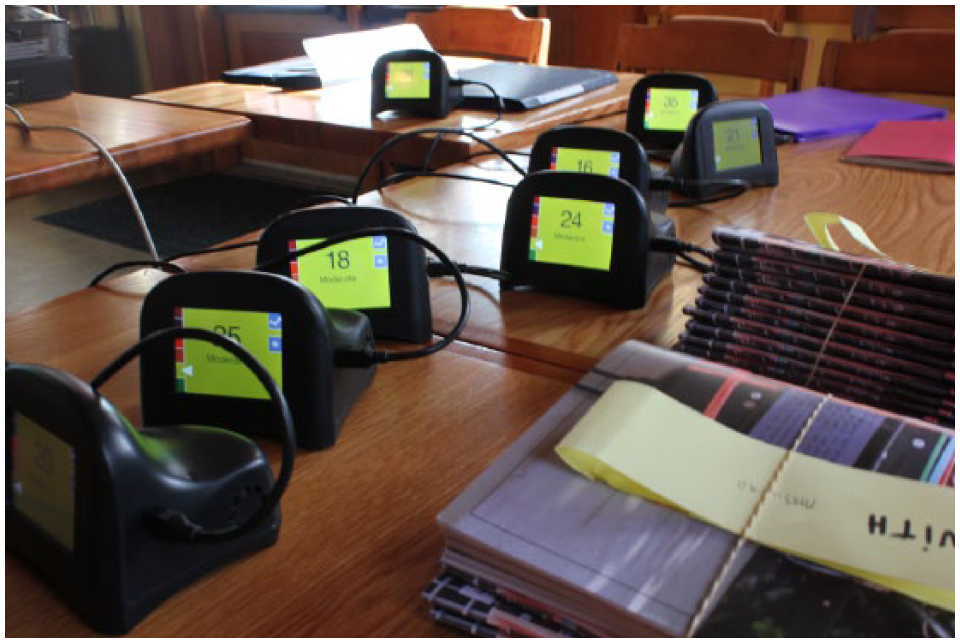
Citizen Sense monitoring kit, including Specks and logbooks, at community workshop in northeastern Pennsylvania.
The Citizen Sense group hosted a workshop in October 2014, where the kit was introduced, and speakers who had experience with monitoring, public health and fracking were invited to contribute. We took monitoring kits out on a walk to infrastructure sites in order to test monitoring practices and technologies, and to discuss issues related to fracking, as well as how best to monitor in particular settings. We also visited residents at their homes to help to set up the monitoring kits and connections to the platform, and to discuss issues around monitoring in the home. In all, nearly 30 kits were distributed to participants, which were taken up and used over a period of seven months, with some participants producing continuous datasets and records of experience, while others contributed for a few months or weeks. This participatory process unfolded a complex set of questions about how to monitor, what to do with the data once they were collected, and how to ensure regulators take data seriously. At various points, participants suggested the data were not indicating anything of significance, which often meant that their lived experiences of odour or nuisance or perceived emissions did not match up with real-time displays on the Speck or in the data collected and available on the platform. There was a sense that an immediate register of harm should be evident, or else the device was failing to perform as it should.
On other occasions, Speck monitors in particular would provide high readings, or ‘spikes’ in PM2.5 levels. There was often a process of troubleshooting to understand what could be causing the high readings: was it a device malfunction, or was there a pollution episode or some other atmospheric event underway? On one occasion, two participants, Chuck and Janis, called the Pennsylvania Department of Environmental Protection (DEP) in order to lodge a complaint in relation to a high PM2.5 reading on their Speck. Chuck and Janis found that when they were visited by the DEP, industry representatives also came to their home in order to find out what monitoring equipment was in use, and how the study was organised. The participants’ concern was that neither the DEP nor industry actually attended to the high readings they recorded, which were not due to a faulty device, and occurred over a period of several hours. Chuck and Janis subsequently took their story to the media, which documented how their citizen sensing activities were received by regulators and industry. 7 In the process of attempting to evidence harm, Chuck and Janis found that their data were of less interest than the act of citizen monitoring. The ‘evidence’ of harm then played out not through datasets on this occasion, but rather through the fact of having a monitor, and participating in a community study. Such an arrangement resonates with Murphy’s suggestion that monitoring can be as instigatory as it is evidentiary, since the DEP and industry were apparently more attentive to the ‘fact’ of community organising rather than the data they were collecting.
Yet this is by no means to discount the importance of data collected by citizens, since it has also been used to evidence harm. Other participants, Meryl and Rebecca, found the intense and rich datasets collected, which numbered over 5 million data points by the end of the monitoring period, could be mined for patterns to indicate that harmful levels of PM2.5 were being experienced at several monitoring sites across the community monitoring network. Meryl and Rebecca used these data to arrange a teleconference with the DEP, the Pennsylvania Department of Health (DOH) and the Agency for Toxic Substances and Disease Registry (ATSDR), along with Citizen Sense, to discuss their findings. While agencies and regulators were sceptical about devices used, their calibration and use, as well as the validity of the data, Meryl and Rebecca were able to use a combination of data and experience of lived exposure to make the case for follow-up monitoring to be undertaken by regulators at one of their homes.
A report from the ATSDR (2016) documenting their follow-up monitoring in relation to citizen monitoring efforts was subsequently released just after the Citizen Sense participant data were made public and sent to numerous regulatory agencies. The report documents how elevated PM2.5 levels were found at the test monitoring location, and were likely attributable to nearby infrastructure, which also led the ATSDR to recommend that the DEP develop more robust practices for mitigating emission sources, particularly from industry. Just after the ATSDR made its report public, the DEP (2016) announced it was undertaking an ‘unprecedented expansion’ of its PM2.5 monitoring network. The fracking operator whose particular infrastructure was nearby the ATSDR monitoring location responded that it was disappointed by the DEP’s decision to undertake additional air quality monitoring, and that it found the ATSDR’s report to be based on ‘speculative’ data (Hurdle, 2016). Commenting on this news, Rebecca indicated that a speculative approach was in fact not a bad thing, since waiting for harm to be done and then conducting ‘retrospective public health studies’ was less advisable than taking precautionary action before harm was done. In this sense, the process of evidencing harm drew on multiple forms of ‘data’ and evidence, some of which could be considered to be ‘speculative’ and to be generated through speculative practices, but which enabled residents and agencies to make the case for greater levels of governmental care in the form of monitoring and attending to exposure from fracking.
Conclusion: Speculative practices of evidencing harm
This discussion of participatory research focused on air pollution sensing points to the ways in which monitoring technologies and practices might link debates about care and environmental politics. As citizen sensing practices work toward alternative ways of generating evidence, new forms of care could emerge through these speculative approaches for evidencing harm. These practices are even necessary in order to indicate the ways in which harm could materialise outside of or in the absence of protocols and practices that are recognised by standard environmental regulation and policy. Speculative forms of citizen-led environmental sensing could facilitate the process of generating new approaches to what counts as evidence, and could also widen the scope of what counts as data to include registers of experience that might ordinarily be dismissed. By opening up care and policy to these expanded approaches to data and evidence, it could then be possible to incorporate speculative approaches to environmental monitoring not as the opposite to evidence and ‘proof’, but rather as an indication of how citizens are demonstrating what matters to them in their lived environments, and how they are attempting to bring their experiences into spaces of recognition and relevance.
On the one hand, sensor technologies often promise an ease of participation and contribution to environmental problems that could be tested and even critiqued. Yet on the other hand, sensing technologies can also give rise to other aspects of participation, democratised monitoring and new forms of environmental politics along with expanded approaches to capacity building that could be generated in the process of attending to and ‘taking into account’ environmental problems. At the same time, a scientific approach to encountering environmental issues – establishing a hypothesis, evidencing this with data, and bringing forward findings – does not necessarily fit so neatly with a potentially more distributed, community-driven, qualitative as well as data-based set of concerns about the environmental effects of fracking. If focus is placed exclusively on gathering data to evidence claims, other modes of organising might also be less foregrounded, but which could be key to developing collective capacities for addressing environmental problems.
The Citizen Sense project has been committed to investigating not just monitoring practices already underway, but through practice-based research has also engaged in rethinking and reworking what monitoring practices might become. Research into environmental monitoring could, in this way, attend to the ways in which diverse modes of evidencing experiences of harm are generative of collective engagements. In relation to social science research and practice, this collective speculative approach could generate distinct approaches to engaging with environmental communities, citizenship and participation – undertakings that are apparently political but often proceed from more epistemic and information-based starting points. In other words, what might it mean to begin an environmental monitoring project from the perspective of experience, and not just from information and awareness? Such a question, as I have discussed in relation to citizen sensing and citizen data, is concerned not simply with how facts take hold, but more centrally attends to how experience is a critical part of speculative propositions and their effects.
In this sense, I understand speculative practices for evidencing harm to offer up as much an opportunity as a dilemma, a challenge as a creative opening, since these sensing practices might generate more accounting-based ways of understanding environmental problems by trying to limit the space of speculation, and they could describe conditions of pollution without any clear indication of how to act. Alternatively, citizen-led monitoring could generate experimental practices and speculative configurations for addressing environmental concerns more readily, and in relation to situated concerns (cf. Lane et al., 2011; Waterton & Tsouvalis, 2016).
This discussion has considered how speculation in relation to environmental monitoring and fracking could draw out the potential and instigatory – rather than simply descriptive – registers of these speculative sensing practices. If on one level we take speculation to be a practice generative of possible futures, then a speculative approach to pollution sensing and evidencing harm at fracking sites could help to reinvent and reimagine the problem of fracking and its impacts, as well as realise practices for mitigating emissions and exposure. Such an approach to researching environmental monitoring practices at once seeks to engage with the more speculative aspects of monitoring as they are undertaken, while also reworking the potentialities of monitoring by adopting a more deliberately speculative approach to pollution sensing, and to evidencing harm.
Extending monitoring in a speculative register is a process that develops an account of the entities that are drawn together within pollution sensing to speculate about environmental events, politics and futures. A speculative and collective approach to pollution sensing might help to articulate environmental politics – and citizenship – differently. In other words, a speculative approach to environmental monitoring could recast or reformulate the ‘invention of the field in which the problem finds its solution’ (Stengers, 2011, p. 17). Monitoring, as a speculative proposition, could in this way be approached as an adventure in not just making things possible, but in making things matter in particular ways. Monitoring expresses a way of being for particular worlds, it presents a proposition and its effects that allow particular worlds to take hold, it articulates a ‘feeling for the datum’ that issues from particular ways of ‘possessing’ the world. As propositions are then generative of effects, Stengers reminds us to attend to the question of what is required for any particular foothold to persist, or in other words: ‘from what wager does your success proceed?’ (Stengers, 2011, p. 17). Such a question points to the ways in which particular commitments form worlds in which sensing practices, ways of life – and policies – are enabled and have relevance (Gabrys, 2014a, 2014b; cf. Gill, this issue).
From this discussion of air pollution monitoring, I suggest that we rethink care not simply as a prescriptive or normative relation, but rather as a speculative mode of encounter that is differently articulated in relation to the entities and collectives that are in-formed through monitoring practices that attempt to evidence experiences of harm. Such an approach could further point toward the importance of adopting a deliberately speculative engagement with citizen-based monitoring, since these experiences could have been overlooked, exposures could be undocumented, and harm could be still yet to be understood. If speculation, as Shaviro (2014) suggests, inevitably unfolds as much through registers of aesthetic and experiential engagement, then how could a speculative approach to evidencing harm also become a way of capturing the lived – and not just cognised or data-fied – experience of harm? We might approach monitoring not just as an exclusively epistemic evidentiary practice, but also as a formation of (distributed) feeling and experience. The ‘taking into account’ (Stengers, 2011, p. 147; Whitehead, 1967 [1925], p. 86) that monitoring puts into play is then more than a practice of producing a set of data on pollutant concentrations, since this practice involves attending to the multiple ways in which the speculative effects of fracking register, whether through data, bodies, sensors, environments, water, air or health. From this perspective, air pollution policy could further be reconsidered through this approach to the shifting sites of care both to address overall emission levels of criteria pollutants (as it currently does), as well as to consider the multiple ways in which exposure occurs, is experienced, and continues to be generative of new practices and entities – and harmful effects. Air pollution policy, in this respect, could become as atmospheric, speculative and responsive as the conditions it would regulate.
Footnotes
Acknowledgements
Thanks are due to participating residents in Pennsylvania, including Frank Finan, Rebecca Roter, Meryl Solar, Vera Scroggins, Chuck and Janis Winschuh, Paul Karpich, Barbara Clifford, John Hotvedt, Barbara Scott, Audrey Gozdiskowski and Alex Lotorto, along with anonymous participants, as well as previous Citizen Sense researchers, including Helen Pritchard, Nerea Calvillo, Tom Keene and Nick Shapiro, and consultants including Kelly Finan (illustration), Thiam Kok Lau (data analysis), Raphael Faeh (web design), Catherine Pancake (video documentation) and Dr Benjamin Barratt (atmospheric science), and to the Create Lab at Carnegie Mellon University for loaning Speck devices for use in this study. Thanks are also due to participants of the ‘Speculation and Speculative Research Workshop’ at Goldsmiths, University of London (2014), for comments on an earlier draft of this text.
Funding
The research leading to these results has received funding from the European Research Council under the European Union’s Seventh Framework Programme (FP/2007-2013) / ERC Grant Agreement No. 313347, ‘Citizen Sensing and Environmental Practice: Assessing Participatory Engagements with Environments through Sensor Technologies’.
Notes
Author biography
