




Abstract
This study tracks the use of familiarizer vocatives across the twentieth century in Ontario, Canada from a corpus comprising 11 million words of conversational interviews from individuals in eighteen communities, born between the 1880s and the 2000s. Vocatives are a richly variable grammatical category which are strongly tied to their sociolinguistic context. We focus here on the sub-category of familiarizers for birth years 1950-2004, which in these materials are almost entirely dominated by man, buddy, and dude. We extracted and coded several thousand vocative tokens, yielding 467 familiarizers. Random Forest modeling shows significant effects of birth year, gender, and community; but not education nor occupation. The dominant familiarizer man declines with the rise of buddy (outside Toronto) and dude (especially inside Toronto). Women use these incoming forms more than men do, perhaps as alternatives to the masculine-associated form man. The results show rapid change for familiarizers in patterns which parallel longstanding sociolinguistic principles.
Keywords
1. Introduction
Despite their salience and strong socially embedded meanings, vocatives in English have not been studied extensively based on general sociolinguistic patterns nor using quantitative methods. In fact, vocatives—the nominal terms used for addressing people directly—have been viewed for years as understudied across many areas of linguistics (Downing 1969; Levinson 1983; Davies 1986; Leech 1999; Shiina 2003; Schaden 2010; Hill 2013; Marcus 2018). Vocatives are a type of term of address which take the form of “a nominal constituent loosely integrated with the rest of the utterance” (Leech 1999:107). In English, vocatives comprise a grammatical category which includes a wide-ranging set of lexical items that are deployed for many pragmatic and social functions: from endearments (honey, dear) to honorifics (sir, ma’am), general plurals (everyone) to taboo words (asshole), among many others. This category has many features which make it an exciting opportunity for understanding linguistic change in a deeply social sphere. In the current study, we focus on a class of vocatives called familiarizers. Familiarizers form a semantic category of vocatives which “mark the relationship between speaker and addressee as a familiar one” (Leech 1999:112). They often involve masculine-derived nouns used among peers, such as man, dude, buddy, mate, brother, bro. Despite their derivation, these terms can be used flexibly across social categories such as gender and social standing: in example (1) buddy is directed toward a child, while in (2) dude is used by a woman addressing another woman. Note the coexistence of the addressing function of the familiarizer alongside possibly many pragmatic functions and social meanings: buddy highlights a close and perhaps protective relationship in (1), while dude frames a rebuttal between peers in (2).
(1) LW: What happened? SW: Tim fell off the bike. You alright, buddy? LW: He’ll be fine. (Sonya Willson,
1
26, W, Burnt River) (2) VF: She was like “Oh my god Bayview is so dirty. I rather go to A-mac.” VF: I’m like “Dude. It’s not true. It’s the about school program. It’s not really the actual school.” (Violet Fong, 13, W, Toronto)
In this paper we document social and geographic patterns of familiarizers in Ontario, Canada in a large body of spoken language materials with wide geographic and temporal coverage. We demonstrate that familiarizers offer a particularly promising area for research on language variation and change. Our principal research questions are:
What is the distribution of frequent familiarizer variants in Ontario?
How is this distribution changing for speakers born in the last decades of the twentieth century?
Do the patterns of familiarizer use correlate with social categories such as education, occupation, assumed binary gender 2 ?
How does familiarizer use pattern along an urban–rural continuum?
We find that a small number of familiarizers dominate, and new forms periodically rise to prominence in some generations. There are marked differences in familiarizer patterns in apparent time, with notable effects of gender and community (Toronto versus other Ontario communities).
In section 2, we review previous studies of vocatives (and specifically familiarizers) with particular attention to how the findings compare to earlier sociolinguistic study. In section 3, we describe the source, characteristics, and extent of the data used. In section 4, the preparation of the data and our choice of quantitative approaches are developed in detail. In section 5, we present the results of these analyses. In section 6, we offer in-depth interpretation of the results in the context of relevant theory, including the long-term, socially-embedded nature of vocative change, as well as the importance of grammatical change to the vocative category. Finally, we give a brief summation of the study and provide forward thinking for extension.
2. Background
The basic function of the vocative is to address another person or get their attention; however, vocatives encompass multiple non-address functions as well. In fact, the addressing and attention-calling functions can be less important than other functions for some vocative types. Zwicky (1974:796) observes that “there is virtually no affectively neutral vocative,” and we emphasize that the multiple meanings of a given vocative choice are sensitive to the social and cultural context. Vocatives are used for topic management, turn-taking, emphasis, interpersonal connection, identity presentation (e.g., as sociolinguistic markers), softening conflicts, framing negative responses, managing face, and so on. For simplicity, the major functions of English vocatives can be grouped into addressing/attention-calling, discourse functions, pragmatic functions, and social/cultural meanings. The functions of vocatives are by no means exclusive, so that a single instance of a vocative serves multiple functions simultaneously. Enacting diverse functions at the same time is a feature typical of layering—where emerging forms coexist with an already existing layer of functionally equivalent ones (Hopper & Traugott 1993:22). Layering can also be used as a mirror of the degrees of change attained by different forms in the ongoing developmental processes that underlie grammatical change (see Poplack & Tagliamonte 1996). We explore the trajectory of grammatical change in and out of vocative function in detail in section 6.
Vocatives show significant diversity across these functions, and the vocative in English comprises several subcategories: Leech (1999) differentiates endearments (darling), family terms (granny), first names in full (Paul), diminutive first names (Paulie), title and surname (Mr. Graham), honorifics (sir), familiarizers (dude), and others (everyone). We survey the diverse uses of vocatives in the rest of section 2, illustrating the non-address aspects using examples of familiarizers drawn from our data. Note that in this paper we treat similar wordforms that are not vocatives or referential nouns as discourse-pragmatic markers 3 ; in section 4, we further discuss the contrast between vocatives and non-vocative instances of the same wordforms, as well as our reasoning for using a categorical rather than a gradient approach in the current analyses.
2.1. Familiarizers in Sociolinguistic Research
In this study, the focus on familiarizers highlights the main social correlates of vocative usage and facilitates comparison with earlier sociolinguistic research (see section 2.4). Familiarizers show several characteristics of particular interest to sociolinguistic research. First, familiarizers are a highly versatile and flexible type of vocative. They may be used across many different relationships: for kin, peers, strangers, pets, etc. Familiarizers may be less constrained by formalized social structures (compare doctor versus mom) or conventionalized relationships (e.g., darling, cabbage); that is, dude can be used in a wider range of interpersonal contexts than darling. In addition, familiarizers are highly interchangeable: individuals alternate between dude with buddy or bro, while it is only sometimes possible to do this with other vocative categories as described above (e.g., possible for honey/darling/baby, not possible for mom/pop/gramps). While we do not claim each token has identical meaning (indeed, we do not believe they do), our data demonstrate intra-speaker variation such that a speaker can conceivably use any of man, buddy, dude, bro in most instances where one of them was used.
Second, familiarizers tend to be steeped in locally-grounded social meaning, in relative contrast to more neutral vocatives such as sir, miss, or someone; offering an impetus for sociolinguistic scrutiny (see section 2.4). Familiarizers also have practical methodological advantages: they are common enough for analysis, and because they are known to change, they are a good subject for studying change over time, especially among young people. Familiarizers have been shown in the literature to play a unique role in the encoding of complex relationships and identity between people, and their patterning regarding gender, age, and generation provides evidence of important overarching trends in usage. Taken together, this suggests that the choice of familiarizers in contemporary vernacular dialects of English in North America will provide important information about their nature and, by extension, new insights for language variation and change.
2.2. Discourse Functions
In an ongoing conversation between two people, there would seem to be little need to address or call attention; one effect of doing so is to emphasize the utterance. In (3) VF repeatedly punctuates her responses with dude across a sequence of turns in which she refutes the interviewer’s statements. A similar function is shown for man in (4): AE addresses the interviewer even though he already has the interviewer’s attention, to strengthen his response to the question.
(3) VF: I really hope we can actually go out in high school. But then the thing is I don’t know how to ask people. And dude he won’t even ask me because he doesn’t like me anymore. Interviewer: You never know. VF: Dude he doesn’t. Interviewer: In my experience it’s always been Valentine’s Day. VF: Valentine’s Day. Dude, no, no come on. (Violet Fong, 13, W, Toronto) (4) Interviewer: Who was your favourite that day? AE: It was nuts. Don’t even ask man. ACDC stole that whole place, stole it. Interviewer: I was going to say, you’ve got to see ACDC. (Andy Eaton, 18, M, Toronto)
The instance of dude in (5) is used for topic management (i.e., ER is attempting to end the discussion). Here, dude may also be used to soften ER’s effective refusal to answer the interviewer’s question, which could have negative social consequences).
(5) ER: I know. I already decided. I’m going to graphic design or media studies which is a course. Interviewer: Okay so yeah, why- why that then? ER: Because it’s what I’m into, dude. (Eliot Rousseau, 20, M, Kirkland Lake)
2.3. Pragmatic Functions
While vocatives are involved in discourse functions like turn and topic management, they can also serve to enact interpersonal relationships, depending on context (McCarthy & O’Keeffe 2003): compare Mother, what are you doing? to Mum, please help! They may claim or instantiate social relationships, intimacy, and distance. As we have seen in (1), buddy is used with a child to express concern and empathy. The same term activates a familiar friendly relationship in (6). Vocatives may also convey a speaker’s stance, tone, or framing, as in (7) and (8), where dude contributes to an authoritative and chastising tone, and (2), where the speaker uses dude to frame her response as a rebuttal.
(6) FF: I bumped into Milo at Jane and Bloor restaurant the other day. I went for breakfast with my buddy Andy. Then I turned around and he was sitting right behind me. I was like “Oh buddy, what’s up?” (Fred Flynn, 25, M, Toronto) (7) CF: That’s what I told him. And he has like anti bacterial wipes at home. I’m like “Dude, you’re going to get sick.” (Clara Felipe, 24, M, Toronto) (8) AS: [. . .] rather than dealing with the situation himself, he’s always like, “Go talk to the pool manager”, and I thought, “Dude, you could have done this yourself.” (Alyssa Sailner, 29, W, Toronto)
Examples (6-8) demonstrate that the vocatives rely on the interlocutors’ interpretation of the cultural and interpersonal context. Choosing a vocative for these pragmatic effects comes with a risk of failure in terms of inappropriateness, social miscommunication, or rejection of an attempt at use, and may have other ramifications. In an example of a rejected vocative use in Shakespeare’s Hamlet, Busse (2006:283) notes that Claudius attempts to enact a relationship by addressing his nephew Hamlet as “my son,” which Hamlet refuses with a pun: “No, I am too much in the sun.”
2.4. Sociolinguistic Meanings
Research on vocatives has shown that they are used in rich systems of social meaning, including stance, relationships, and social-indexical meaning. Because of their loose syntactic integration and strong sensitivity to social context, vocative terms are often reflective of gender, community, or other identities. These meanings may be complex and contingent: for example, the social meaning of the same vocative form can be interpreted differently by men versus women because of their different social experiences and positionality (Rendle-Short 2010; Alimoradian 2014) . Formentelli (2014) finds that vocative use is highly indexical, expressing social meaning and embodying relationship work; and that intended pragmatic meanings must always be interpreted in their context, to which they are intimately connected. We note that the identity of both the speaker and the addressee are critical aspects of these intricate social meanings (see e.g., Kiesling 2004). In parallel with their social embedding, vocatives exhibit extensive variation by region, ethnicity, and age, as well as cross-linguistically and over time.
Vocatives have also been shown to participate in both rapid language changes and long-term historical shifts (Shiina 2003). Much of recent sociolinguistic research on vocatives focuses on the familiarizer subcategory (Kiesling 2004; Rendle-Short 2010; Alimoradian 2014; Heyd 2014; Palacios Martínez 2018; Pastorino 2022; Flesch 2023), which often derive from historically masculine terms, such as dude, mate, man, buddy. While familiarizers in English reflect a robust history of masculine variants and usage by men, there is also evidence of a shift in these correlations (see Kiesling 2004; Rendle-Short 2010; Alimoradian 2014; Pastorino 2022).
Hill (1994) and Kiesling (2004) documented the development of the form dude from common American English usage in the late nineteenth and early twentieth centuries, into use by members of young and hip social groups during the twentieth century (e.g., pachucos, zoot-suiters, surfers, and others), and into more general use again. Over this time frame, dude ranges from a referential noun, a discourse-pragmatic marker, and a vocative. Across these functions, dude can carry various social meanings, including masculinity, ‘coolness’ and solidarity with other men (Kiesling 2004). Kiesling describes the stance of cool solidarity as “effortlessness (or laziness, depending on the perspective of the hearer),” which is linked to its embedding in the “surfer” and “druggie” subcultures where this type of stance is highly regarded (Kiesling 2004:282). The form and this social meaning then diffused to youth of the 1980s to express “dissatisfaction with careerism,” and in the 1990s to express “nihilism” (Kiesling 2004:21). Kiesling also describes how the predominantly masculine dude is also used by and to women, and that women and men can employ dude in a gradient pattern for quite different pragmatic uses. For example, while men are more likely to use dude in greetings, for example, Hey dude, how are you?, women are more likely use it when they are attempting to “ameliorate a confrontational and/or hierarchical stance” (Kiesling 2004:285). Kiesling’s example, “Dude, that’s just not cool” (286), is comparable to examples (2) and (8), both from women born in the 1980s. Similar gender-related patterns are shown for dude in British English by Pastorino (2022): dude is “now used by female and non-binary speakers as much as by male speakers” and “to address individuals of all genders equally” (27).
Rendle-Short’s (2010) analysis of mate in Australian English presents a variety of context-dependent social meanings: along with solidarity and familiarity, mate can carry meanings of masculinity versus gender-neutrality, and friendliness versus hostility. As with dude, there are contrasts here between the ways men and women use this familiarizer. The early uses signaling male solidarity have changed among younger women, who “interpret mate as being a fun, friendly term of address, almost like a term of endearment” (Rendle-Short 2010:1202). Such changes also implicate generational shifts and are diagnostic of linguistic change in progress. Further nuance is shown by Alimoradian’s (2014) study of mate in Australian English, which focuses on Australians of a non-English speaking background and reports similar patterns to Rendle-Short: mate is associated with men (and Anglo-Australian culture), but women are increasingly using the term, and with a wider variety of addressees; an effect of ethnic orientation is also reported.
Effects for familiarizers related to ethnicity/community, age, and gender appear to be common and separable, with similar developments being highlighted in Palacios Martínez’ (2018) study of London English (UK), which demonstrates a key effect of age group in familiarizer choices: adults use man and brother (including other variants such as bruv, blud), but teenagers also use other forms such as mate and boy. Urichuk and Loureiro-Rodríguez (2019) also find that bro is more common for younger speakers (especially men) in Manitoba, Canada; they further report that related variants like bruh and brah are also associated with younger speakers, particularly younger non-Caucasian speakers.
In summary, familiarizers are a proven site for rich sociolinguistic patterns, particularly with respect to gender and age. The extant research on familiarizers demonstrates all the hallmarks of change in progress. Based on the social trends reported in the literature on familiarizers—that is, dude (Kiesling 2004; Heyd 2014; Pastorino 2022; Flesch 2023), mate (Rendle-Short 2010; Alimoradian 2014), and others (Palacios Martínez 2018)—we can expect their distributions to be patterned by social factors. We may also expect change over time, either: (1) shifting types as the popularity of particular forms changes across generations, as evident in the metalinguistic commentaries in (16-20) and in the literature; or (2) a shift toward certain familiarizers as documented in the history of English from the Early Modern period into the present day (Shiina 2003); or (3) a pattern of geographic diffusion such that incoming forms are more frequent in urban centers like Toronto, while others may be more typical of outlying localities. Consistent with studies of other lexical categories in the ODP, such as adjectives (Tagliamonte & Pabst 2020) and certain swear words (Tagliamonte & Jankowski 2019), there may also be different rates of variants across time. Further, frequent variants with long-term presence in English may be fairly stable, for example, man, while those of recent vintage, for example, dude, may evidence short-lived popularity (Kiesling 2004; Tagliamonte & Brooke 2014).
3. Data
The data for this study come from the Ontario Dialects Project (ODP), a large compendium of synchronic and legacy conversational interviews from 1087 speakers across eighteen Ontario communities comprising approximately 11 million words at the time of data extraction (Tagliamonte 2003-2006 et seq.). The size and more than 100-year time span of birth dates in the corpus offer a unique perspective for investigating vocatives in contemporary English. We used this resource to explore the social and temporal patterns of familiarizer vocatives in Ontario, Canada. The current study focuses on speakers born between the 1950s and 2004, a group who vary with respect to education, occupation, gender identity, and place of birth/residence and who also use familiarizers with sufficient frequency to study quantitatively.
The data were coded for the following predictors: Year of birth is binned by decade when necessary for visualization and tabulation; based on experience with the ODP materials from earlier research, year of birth is treated as a continuous variable in analyses. Information on individual gender includes only assumed binary gender (men and women); ODP interviewees were not asked to provide detailed gender information. Occupation is treated as ternary: student, blue collar, or white collar. Education is treated as binary: no secondary education, or some secondary education. Community membership can be fine-grained in the ODP, but the sparsity of vocatives in the data made it necessary to pool the data, distinguishing Toronto, the largest urban center of the province and its political and economic capital, versus the smaller, outlying communities, 4 a contrast that has been previously demonstrated as a salient for the ODP (e.g., Jankowski & Tagliamonte 2019; Tagliamonte & Jankowski 2019).
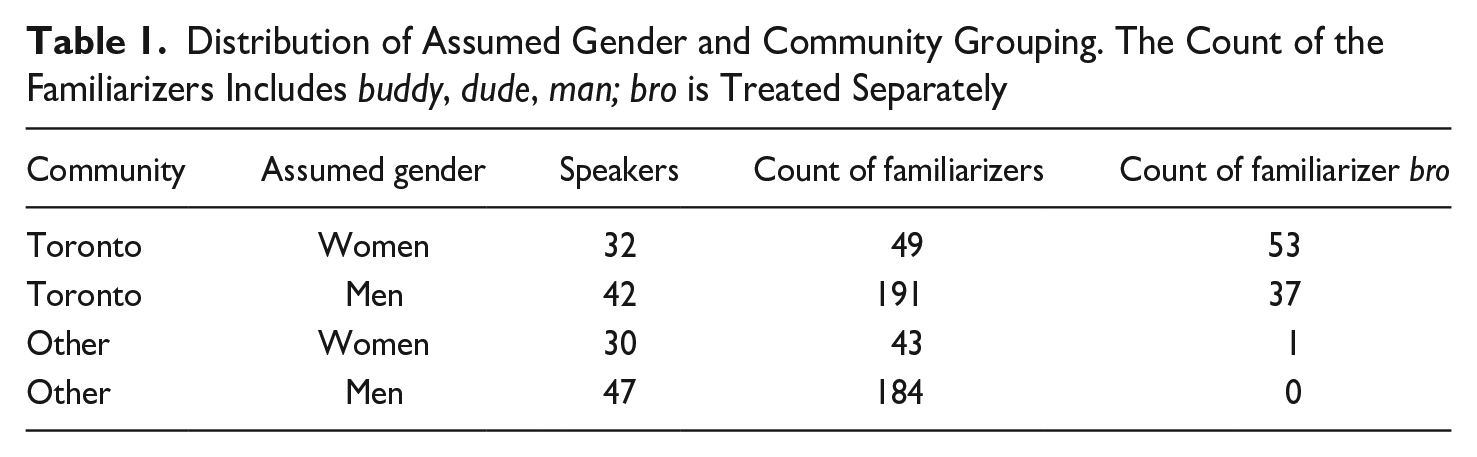
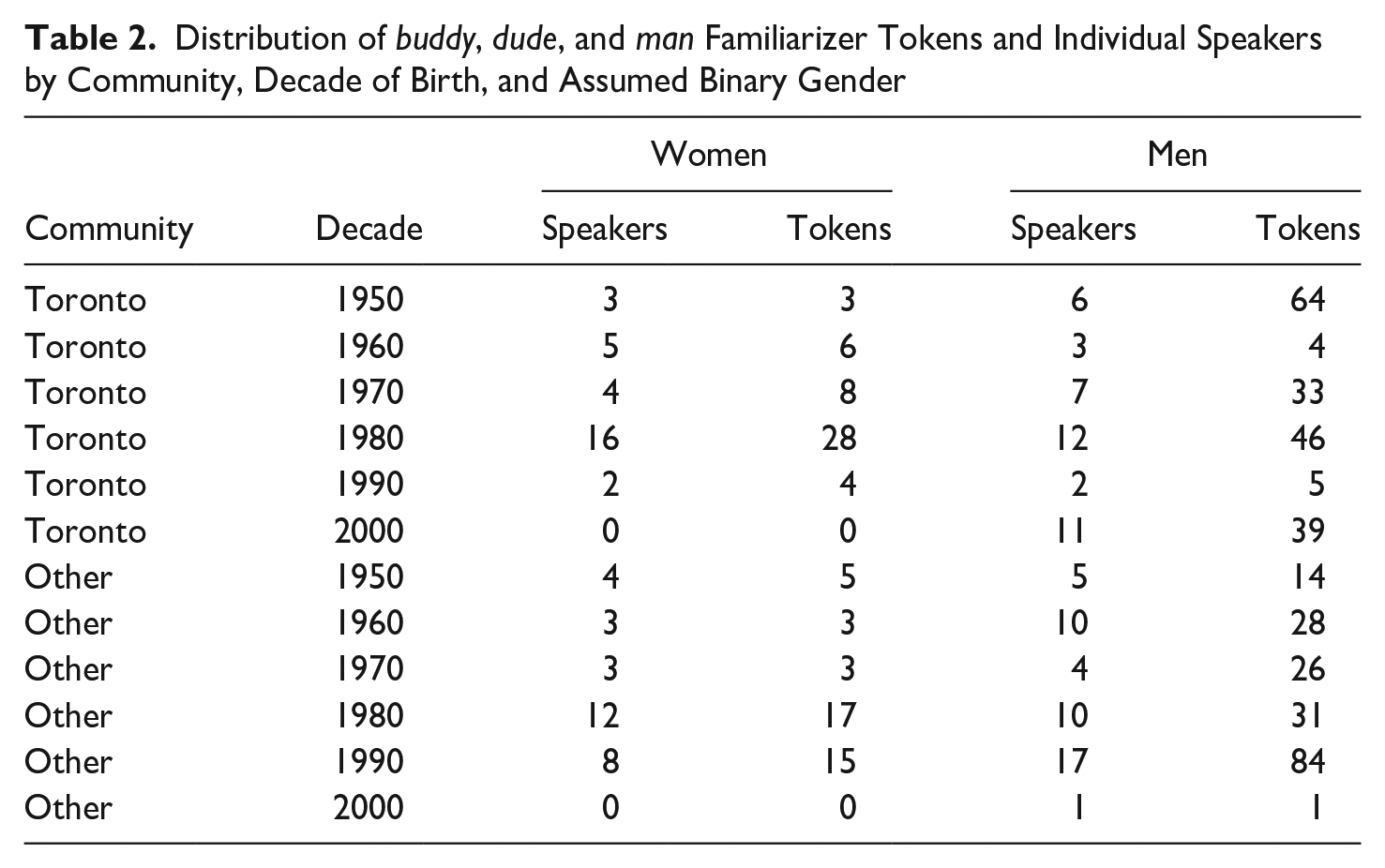
The distribution of tokens analyzed is shown in Table 1, showing a relatively balanced distribution of data by gender but more tokens from men. 5 Note that Table 1 reflects the 558 tokens examined after the data narrowing and coding processes described in section 4; tokens of bro are also separated. We also show that data sparsity makes per-speaker statistical analysis impossible, so the distributional and Random Forest patterns we describe in section 5 pool over speakers (for speaker counts across demographic groupings, see Table 2).
Distribution of Assumed Gender and Community Grouping. The Count of the Familiarizers Includes buddy, dude, man; bro is Treated Separately
Distribution of buddy, dude, and man Familiarizer Tokens and Individual Speakers by Community, Decade of Birth, and Assumed Binary Gender
4. Methods
Because vocative terms are a large, open-class category, it is difficult to know in advance which terms are present in a given dataset; in this case, the more than 11 million words of conversation represented in the ODP. To determine the relevant familiarizer terms and to situate them within the larger category of vocatives as a whole, we first searched the corpus for every instance of a potential vocative using a list of 231 terms assembled from the literature (Downing 1969; Davies 1986; Leech 1999; Schaden 2010; Wiktionary 2020). This produced 77,559 tokens of potential vocatives with 122 types, from which we excluded false starts. Then, we focused on a subset of the data from individuals born between 1950 and 2004 where most of the terms occurred, 6 comprising 44,953 tokens. By examining the most frequent types, we determined that a set including the terms man, bud, buddy, bro, dude, mate, and fella formed a coherent grouping of 2240 tokens with frequency and generality adequate to analyze. Note that these familiarizers are historically derived from male-referring nouns. However, as we shall see, they are used by men and women to address men and women: see examples (7) and (19) for women addressing men or women. Other terms such as friend are historically members of this set (see Shiina 2003), but do not occur in the data for birth years 1950-2004.
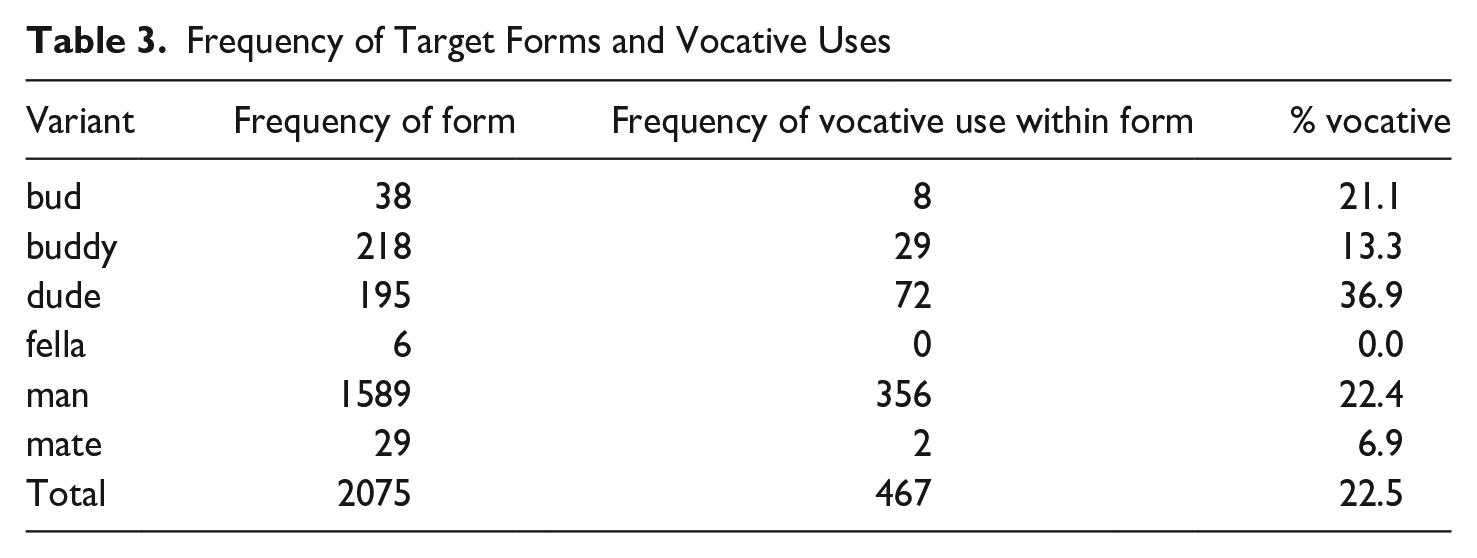
These 2240 tokens were coded for their primary function (vocative, referential noun, discourse-pragmatic marker) and for other exclusion criteria (metalinguistic commentary, reported speech); see section 4.1 for details regarding coding these categories. Tokens were excluded from analysis if their primary function was not vocative and left for future study (referential noun, N = 1158; discourse-pragmatic marker, N = 299). Metalinguistic speech or the reported speech of a third party (N = 160) were excluded. We also left aside tokens of bro (N = 100) from this study, because all of the tokens were used by Toronto speakers born in the 2000s. Nevertheless, the use of bro is important to mention with observations relevant in sections 5 and 6. Due to the low frequency of familiarizer uses of fella (fellow; N = 0) and mate (N = 2), we also excluded them from our analyses. Tokens of bud (N = 8) are treated together with tokens of buddy (N = 29). After coding for function, excluding tokens that were not vocatives and terms with very low frequency, we were left with 467 tokens of familiarizer terms for analysis.
4.1. Circumscribing the Variable Context
We refer to the baseline extraction of forms as ‘potential vocatives’ because they could be instances of other categories, such as referential nouns (I saw my sweetie.), discourse-pragmatic markers (Man, that’s hot!), etc. Consistent with the nature of layering described in section 1, not all tokens had any vocative function; and many tokens had unambiguous functions that were not primarily vocative. The data contain a vast array of these forms in their use as nouns or discourse-pragmatic markers. Indeed, the majority of uses of buddy, dude, and man—all used across Ontario—were referential nouns, as in (9-11).
(9) DD: ‘Cause my buddy has a fish shack there that he built. Put four-thousand-dollars into it. [. . .] And then sometimes my buddy Jason and I, him and I’ll take a hike into Algonquin-Park to go for some ah speckled-trout. (David Daniels, 57, M, North Bay) (10) SC: ‘Cause like, he gets so much stigma for being this redneck from the South, but he’s actually like this really really awesome dude [. . .]. (Sam Carr, 21, M, Parry Sound) (11) EA: The first schoolteacher was a man. And he was an old man. (Ethel Ashford, 90, W, Ottawa Valley)
Discourse-pragmatic uses of many of the same forms are also evident, for example, dude in (12) and man (13-15). The data were coded for these functional distinctions; that is, whether the instances of each form were primarily vocative uses (e.g., How are you, man?) or non-vocative, such as a referential noun (I saw a man.), a discourse-pragmatic marker (Man that’s good!). 7 To be included as a vocative, we required a token to unambiguously refer to an interlocutor or person in the immediate situation; for example, in (6) buddy is immediately followed by “What’s up?” In the absence of an obvious addressee, a non-referential-noun token is likely to be discourse-pragmatic; for example, in (14) “Man!” does not refer to an addressee, but expresses intensity or other affective nuance and is involved in the structure of the discourse. In cases of ambiguity, we erred on the side of rejecting the token.
(12) KM: Those were awesome. I saw those, I was like “Dude! That’s awesome!” Like I couldn’t believe someone actually wore that, because like it’s the Olympics. (Kaitlyn McAngus, 15, W, South Porcupine) (13) SW: My uncle always has ah- he always has like a fish-fry there in the summer. And he’ll go catch his pickerel, all that and he’ll deep-fry it and that’s just amazing, man. (Sam Wysocki, 17, M, Kapuskasing) (14) CF: He had like, soup to eat. Man! I didn’t know what to do. (Clara Felipe, 16, W, Toronto) (15) RN: I went to Waterloo instead of Toronto. Oh, man! I could have taken all my courses in Waterloo. I was stuck in Wycliffe, Hoskin Street, in the summer, in the basement. (Richard Northman, 67, M, Kapuskasing)
We also distinguished and excluded tokens of direct reported speech or metalinguistic commentary, as in (16-20). These tokens were excluded on the grounds that they are not in the same sense uses of the familiarizers but mentions. However, the many comments of this type highlight the degree of salience these forms hold in the population, as well as individuals’ awareness of their uses over different social groups (16, 18) and generations (17). In particular, the commentary in (19) describes the contextualized meanings of buddy, dude, and hun (‘honey’) across different social dyads.
(16) JC: I’ve been finding myself saying ‘bud’ or ‘buddy’ quite a bit. JC: I think that stems from my cousin too, like you see someone in the hall, “Hey buddy!” You know? And it’s a little less Canadian than the, (affected Northern accent) “Hey bud! How’s it going there, bud?” (John Courchaine, 18, M, Kapuskasing) (17) DS: I don’t really say that much but some of my friends say ‘dude’ a lot and ah, mom and dad don’t really say that. (Dwight Shooter, 14, M, Thunder Bay) (18) CM: [. . .] I think North Bay has a real like surfer kind of slang too. Like I say “dude” and like I used to say “gnarly” [. . .]. CM: [. . .] we say “like” and “dude” and you-know ‘cause it’s just really laid-back slang I guess, yeah. I don’t know. (Chloe McDougal, 23, W, North Bay) (19) BS: Queer people don’t use the word buddy. Buddy doesn’t exist. Or if it does, it’s like, you’re talking to a straight guy to prove that you don’t like him. BS: Um, within lesbians, dude is a big word because if you call- if you’re a dyke and you call your friend dude, that means you don’t like them, but you won’t call a femme dude, because it just doesn’t work like that. BS: [. . .] you can have like the dykiest person going, “Hey hun, come here.” But it won’t be to another dykey person. It’ll be to a femme. (Brigitte Santino, 20, W, Toronto) (20) NJ: We used to say dude all the time. Like, “Dude!” I still hear people say that and I laugh at them, but. “Oh dude, that was so lame. Yeah, dude.” (Neha Jairath, 27, W, Toronto)
4.2. Coding Information for Addressee Analysis
For the addressee analysis, age of the individual and assumed binary gender come from the metalinguistic information recorded at the time of interview. Addressee gender was derived from the corpus when the addressee was an interviewer or another interlocutor present in the interview, or estimated by the research team from close reading; addressee gender was labeled ‘indeterminate’ when no reasonable estimation was possible. For addressee analysis, we coded age group as ‘young’ (less than twenty-five years old) and ‘older’ (at least twenty-five years old). When the addressee is present in the interview (i.e., the interviewer or another interlocutor), age information comes from the field reports completed by the interviewers, in the same way that individual metadata was gathered. For non-present addressees (e.g., in a recounting of a conversation), age coding was based on close reading by the research team. We chose a binary scale with a threshold of twenty-five years old due to the difficulty of estimating non-present addressee age; using twenty-five years old corresponds to a distinct generational divide. This coarse approach is a necessary compromise between the limited data available and the importance of addressee in the literature. Addressee age group is coded ‘indeterminate’ when no reasonable estimation was possible.
4.3. Random Forest Modeling
In order to establish whether the trends in the data according to individual usage are statistically significant, we employ Random Forest modeling (see Tagliamonte & Baayen 2012). In keeping with the distributional trends shown in Figures 1 and 2, we include coarse-grained community (Toronto versus other communities) and assumed binary speaker gender (men and women), as well as occupation (student, blue collar, or white collar), education (some secondary education, or none), and year of birth (continuous). A random forest model is constructed out of a large number of randomized Conditional Inference Trees (CITs; Hothorn, Hornik & Zeileis 2006). In brief, CITs divide the data by recursive binary splits, each of which uses the single strongest predictor for that split, for parsimony. Each split is evaluated by significance testing and non-significant splits are not used. The tree stops growing when no significant splits exist, to avoid overfitting. This means that the contrasts presented in the analyses below are statistically significant when all the factors in the analysis are considered simultaneously.
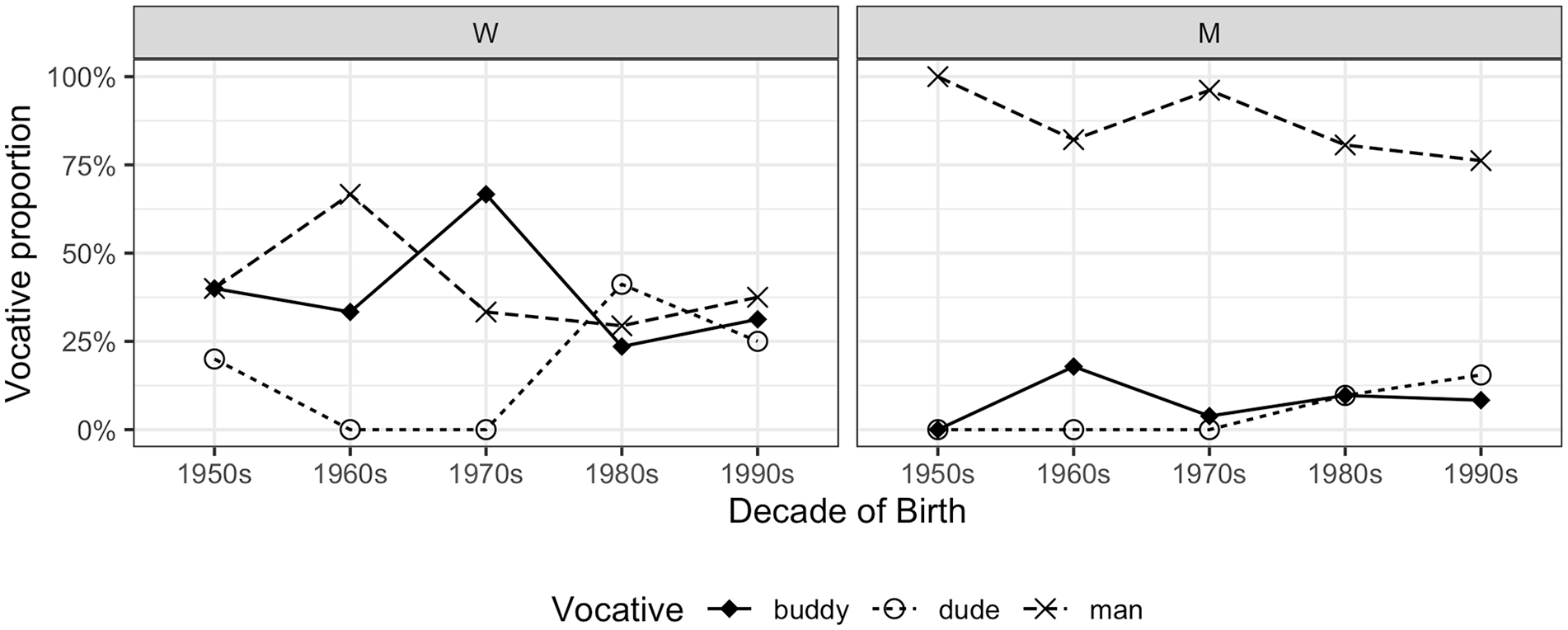
Proportion of Familiarizer Type by Decade of Birth 8 and Assumed Binary Gender, Outside of Toronto (W Denotes Women, M Denotes Men)
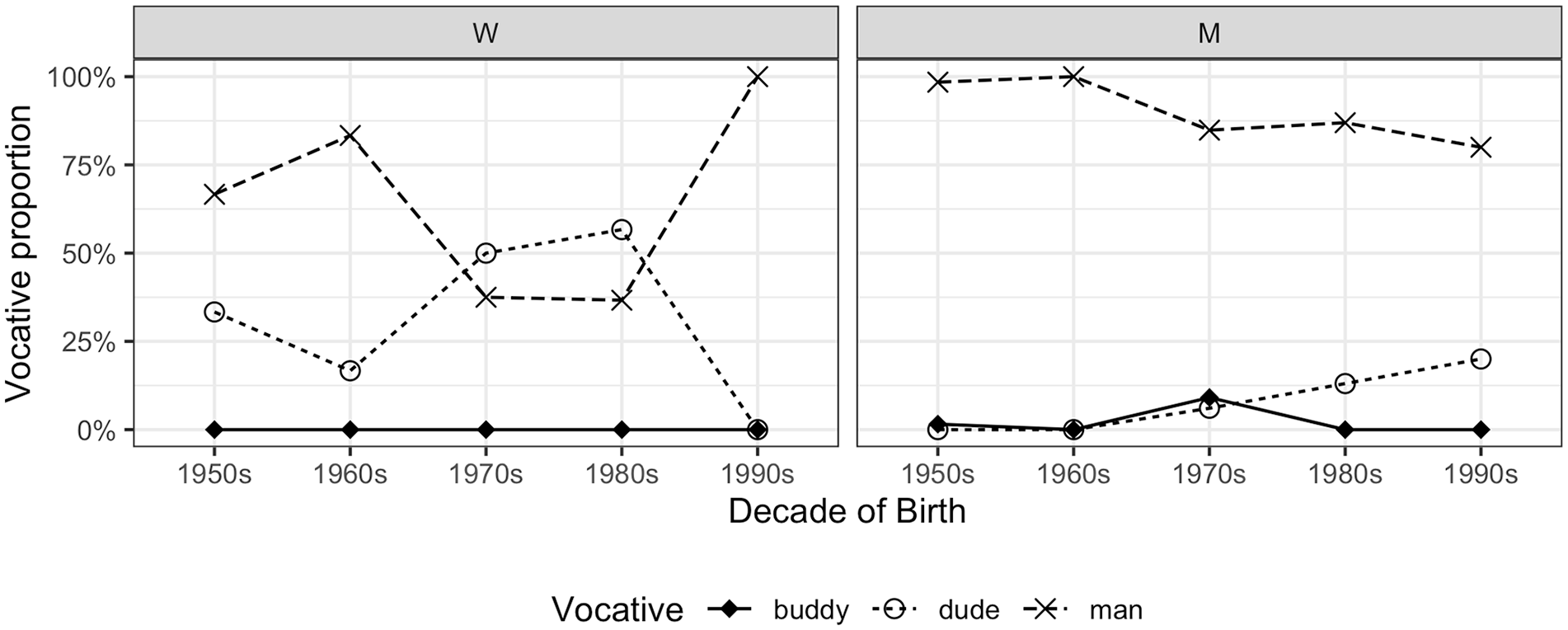
Proportion of Familiarizer Type by Decade of Birth and Assumed Binary Gender, in Toronto (W Denotes Women, M Denotes Men)
This modeling approach is better suited to these data than common alternatives such as mixed-effects regression for several reasons. First, instead of the binary nature of regression modeling, random forest modeling allows the analyst to construe the choice of familiarizer as a multinomial dependent variable: given an opportunity to use man, dude, or buddy, an individual may choose any one of these options, and these variants are not ranked relative to each other. Note that this model relies on the assumption that these three familiarizers are effectively interchangeable, which we believe holds for this application (see section 2.1); a comparable regression approach would require a similar assumption. Indeed, it is specifically the multiple-variant mixture of familiarizers within a given group (e.g., people born after 1980, Toronto women, men in non-urban communities, etc.) that bears sociolinguistic investigation given the literature, and confirmed in the addressee/speaker distributional analysis. Therefore, a binomial or ordinal regression could not straightforwardly address this question. We also consider random forest modeling to be well-suited deal with the data imbalances present in the ODP, which are typical of sociolinguistic corpora compared to experimental data (see Sarda-Espinosa, Subbiah & Bartz-Beielstein 2017). Finally, random forest models are flexible, readily interpretable, and considered robust against some kinds of data bias and overfitting.
5. Results
5.1. Distributional Analysis
The analyses that follow expose the general social and areal patterns in the data to characterize the nature of familiarizers in Ontario across the twentieth century from an overarching perspective. Table 3 shows the frequency of the target forms, the frequency of vocative use of each form, and the proportion of vocative use. The table reveals the extent to which the majority of uses for these forms are non-vocative and excluded: that is, referential nouns, discourse-pragmatic markers, reported speech, or metalinguistic commentary. Overall, only 22.5 percent of the data comprises a primarily vocative function. We note that the vocative share of tokens of the different lexical items shows wide variation: dude tokens are 36.9 percent vocatives, while the proportion of vocative uses for man and bud/buddy are lower (22.4 percent and 14.5 percent). It appears that the vocative share for a given term is most strongly influenced by the popularity of its non-vocative functions (e.g., noun, ‘a buddy of mine’), which varies widely between terms. This exhaustive procedure led us to establish that the main familiarizers in Ontario in the twentieth century are man, buddy, dude; in contrast, bud, fella, and mate are rare, and bro appears later. Notably, vocative uses of these forms are relatively rare in comparison to non-vocative uses, providing support for Cheshire, Adger, and Fox’s (2013) contention that vocatives arise from earlier nominal usage. This finding provides a foundation for understanding the trajectory of development of familiarizer vocatives in Ontario English, and may be used as a comparative base for studies in other corpora.
Frequency of Target Forms and Vocative Uses
5.2. Social Patterns
We begin our analysis of the Ontario familiarizers by considering the distribution of forms in time and space. As outlined in section 3, data sparsity does not allow us to compare each of the ODP communities individually; instead, we contrast the smaller communities of Ontario (Figure 1) and the large urban community of Toronto (Figure 2). Another key social factor is assumed binary gender, indicated by W (women) and M (men).
Figures 1 and 2 expose dramatic patterns across time and space for familiarizers, and between men and women in Ontario. In terms of apparent time, the familiarizer man—the dashed line—is both the most frequent and the most stable form across generations. However, there is evidence of a decline in its use over the course of the twentieth century. This decline is particularly visible among men (right panels). Another notable contrast by region is that buddy is a strong early variant outside of Toronto, consistent with the North American associations cited in the OED (OED Online 2021), but it is virtually non-existent in Toronto. In contrast, dude is more prevalent in Toronto, and appears earlier in the apparent time trajectory. Both women and men born after the 1960s use dude, but there is a surprising peak of usage among women born in the 1970s and 1980s; see related examples (2) and (17-19). In contrast, the use of dude among men shows an incremental rise and much lower frequency.
These comparative trajectories highlight the notable gender differences, generational changes, and community contrasts in familiarizer use. Women use more of the novel forms: in the city of Toronto they use dude, and in the smaller communities outside of Toronto, they use buddy. In contrast, men use more of the older and more conservative form man regardless of community. The differences across the twentieth century also reveal shifts over intervals of ten to twenty years, with individuals born in the 1970s ushering in the most marked adjustments. Notably, Toronto speakers adopt dude earlier than the other communities, which instead conserve buddy.
5.3. Addressee Effects for Age and Gender
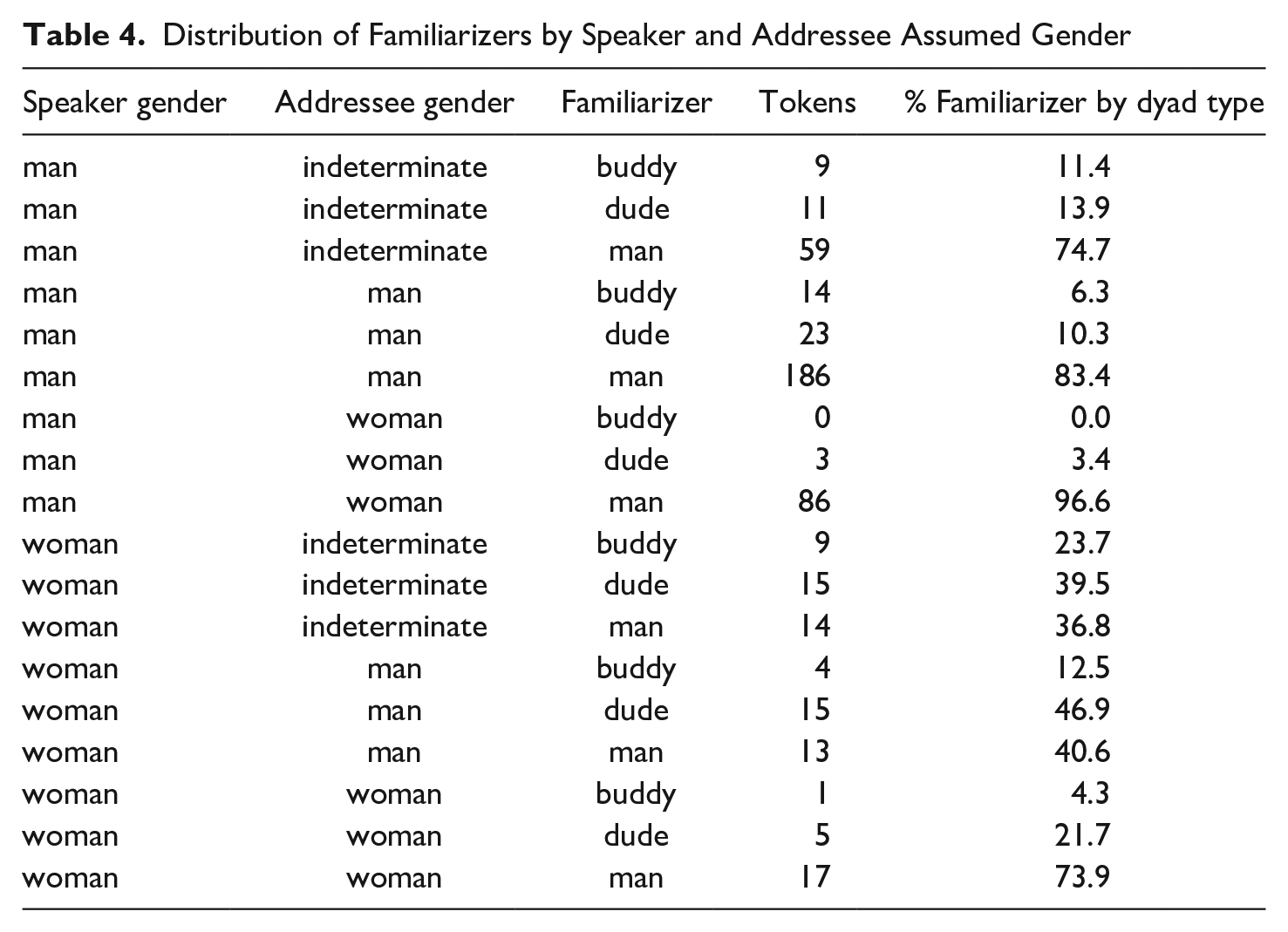
The literature notes that one of the strongest effects on vocative use is the addressee within social context. For example, Kiesling (2004) showed that women and men used dude at very similar rates when speaking to women, and that the relationship with the addressee could be more decisive than the influence of gender. In an effort to account for the effects of addressee, we coded all the familiarizers for the key attributes associated with familiarizer use—age group and gender of both speaker and addressee (see section 4.2 for coding details). The following section summarizes the results from a proportional analysis of these factors and their combination, focusing our discussion on each of the main forms. Although we cannot include these factors in our statistical modeling due to scarcity and exaggerated imbalances in the distribution of the data, we will discuss their relevance to the subsequent analysis. We refer to Table 4 (distributions by gender) and Table 5 (distributions by age group).
Distribution of Familiarizers by Speaker and Addressee Assumed Gender
Distribution of Familiarizers by Speaker and Addressee Age Group
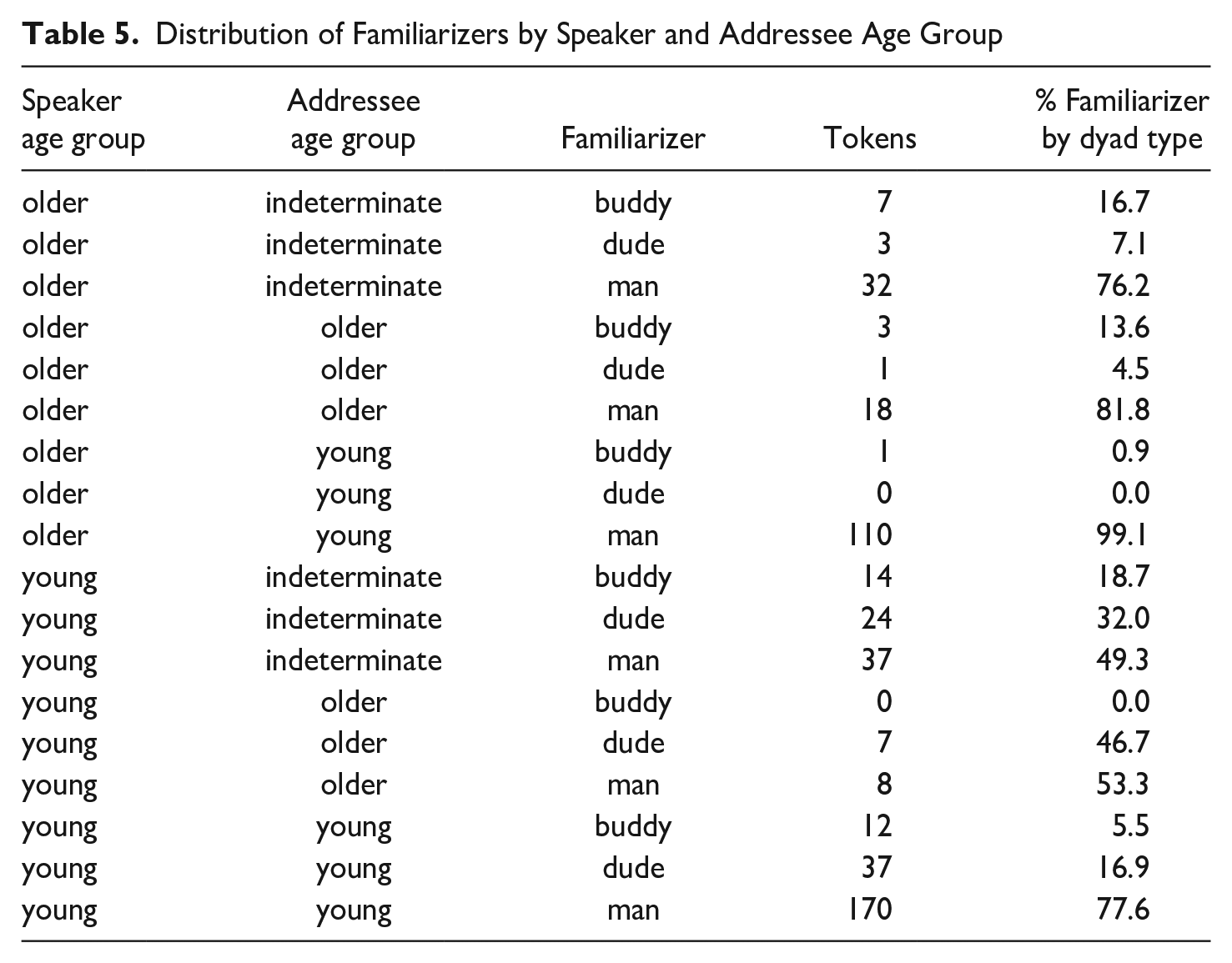
As reported earlier, man is the most frequent and diffused form. The distributional results show that is it overwhelmingly used when the speaker is a man, regardless of addressee gender (75-97 percent of familiarizers from men, depending on addressee gender; see Table 4). Women use man more rarely than men, and less than men in proportion to buddy or dude: 37 percent when addressee gender is indeterminate, 41 percent to men, and 74 percent to women. This distribution may suggest that speaker identity and not addressee gender drives some avoidance of man for women speakers. Additionally, man is dominant among older speakers, and largely directed at younger individuals: compare 99 percent usage for older-to-younger interactions versus 82 percent for older-to-older ones; and 78 percent for younger-to-younger versus 53 percent for younger-to-older (though, younger-to-older tokens are rare in the data). In summary, man is the dominant baseline familiarizer, especially for older speakers and for men. It is particularly common when men address younger men and when women address women.
The use of buddy is strongly directed at men, with almost no tokens for man-to-woman or woman-to-woman dyads. Many of the addressees for buddy are indeterminate for gender and especially for age group. Aside from these trends, buddy is largely used in younger-to-younger interactions (5 percent versus 0 percent for younger-to-older) and older-to-older interactions (13 percent versus 1 percent for older-to-younger). In sum, use of buddy is correlated with addressing men, and for age group peers.
The use of dude is also strongly directed at men, for both man-to-man and woman-to-man interactions, with many indeterminate addressees. For older speakers, dude is rarely used; but for younger speakers, it is more frequent outside of younger-to-younger dyads (32 percent younger-to-indeterminate, 47 percent younger-to-older, but 17 percent younger-to-younger). Overall, the use of dude is limited to younger speakers, is predominant among women, and largely man-directed; it is most frequently used with older addressees.
While bro is not included in the analysis, we note striking patterns in its use. As mentioned earlier, it is restricted to individuals born after 1999; the following proportions are calculated by including bro tokens with the study data. For these younger speakers, bro is used in 25 percent of cases for older addressees, and 26 percent for younger ones. It is used much more for same-gender dyads (9 percent versus 5 percent for man-to-man and man-to-woman; 67 percent versus 9 percent for woman-to-woman and woman-to-man). The relative dominance of bro for women speakers exceeds other familiarizers, including man.
In summary, there are pronounced distributional patterns associated with the use of familiarizers by addressee gender and age group. Man is diffused and generalized, with a bias toward younger addressees, but more neutral with respect to addressee gender. In contrast, buddy and dude pattern similarly with addressees that are men. Use of bro is innovative and is not strongly associated with a particular addressee gender. As we shall show, these results converge with and support the speaker-centric patterns we discuss in the next section.
5.4. Random Forest Modeling
We present the random forest model by variable importance analysis, which indicates the degree to which each predictor has explanatory power across the large number of randomized trees which comprise the model. Importance values are interpreted relative to each other, and values near zero indicate that a predictor is no more useful than noise (i.e., not significant). Figure 3 summarizes the random forest model by showing relative variable importance of factors, with the dashed gray line indicating the absolute magnitude of the least important predictor. This value is used as a rule of thumb threshold for considering the importance of variables in the model.
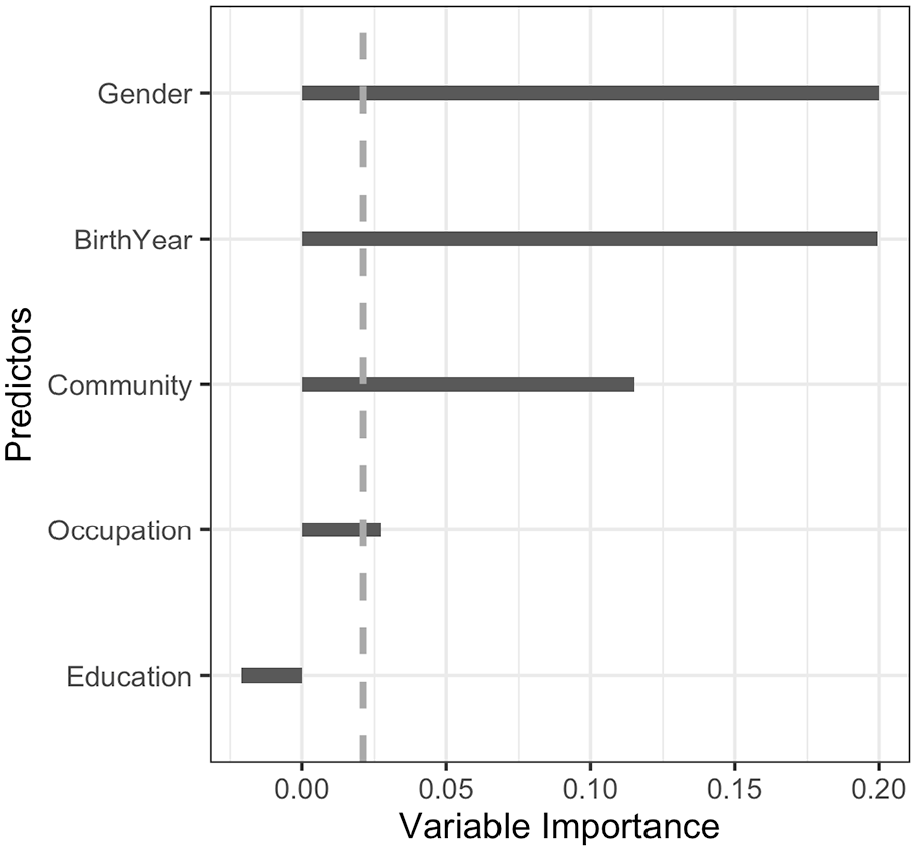
Random Forest Model Summary Showing Relative Variable Importance. Dashed Gray Line Indicates the Absolute Magnitude of the Least Important Predictor
The analysis confirms statistically significant effects on familiarizer use, which are Gender, BirthYear, and Community. Gender and BirthYear are the most important, each contributing a strong and comparable influence. The Community difference between Toronto and the non-urban communities is also significant. In contrast, the effects of occupation and education are not significant in this model. To illustrate the intersecting effects of Gender, BirthYear, and Community, we present a single conditional inference tree (Figure 4) that has been fitted on the same predictors as the random forest model.
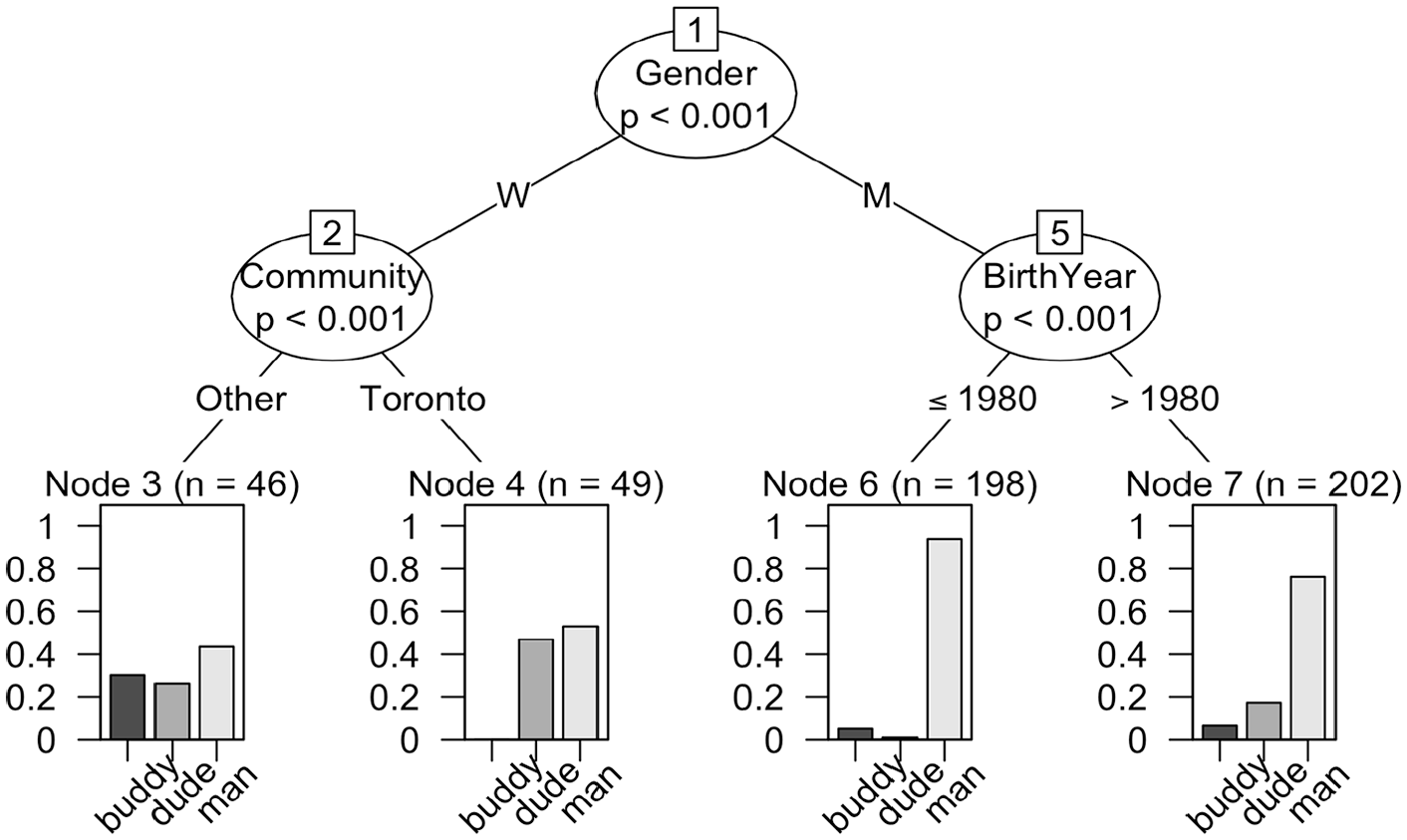
Conditional Inference Tree Showing Variable Structure. Gender, Community, and BirthYear Drive Significant Splits
Figure 4 shows that the main split (node 1) is Gender, with women (W) on the left and men (M) on the right. Men show more exclusive use of man than women (light gray bars). While women in the data also use man, they employ a wider range of familiarizers which includes buddy (dark bars) and dude (gray bars). The subsequent splits contrast the effects for men and women. For women (node 2), familiarizer use is further split by community: women outside of Toronto sometimes use buddy, but Toronto women do not (instead they use dude). For men (node 5), familiarizer use is split by year of birth in 1980: for men born after 1980, dude is more frequent. These patterns generally match those shown in Figures 1 and 2, though the difference in buddy use between men in Toronto and men in other communities is not significant in the tree model.
6. Discussion and Conclusions
6.1. Sociolinguistic Patterns of Ontario Familiarizers
The most popular familiarizers of the late twentieth century in Ontario, Canada, are man, buddy, and dude. Importantly, the system of familiarizers has been changing incrementally across generations, with statistically significant correlations related to the individual’s gender and the place they live. The dominant and longstanding form is man for individuals across the province. However, buddy is a persistent option for communities outside of Toronto, especially among women. The form dude becomes popular among individuals born after the 1960s, consistent with previous research on American English (Kiesling 2004; Flesch 2023). Interestingly, the earliest Ontario users of dude are women, notably in Toronto. The strong effect of an individual’s (binary) gender on familiarizer use is a recognizable pattern in sociolinguistics. Women are known to lead in linguistic innovation (Labov 1990 et seq.) and to be at the forefront in changes from above (Principle 2, Labov 2001:274) and below (Principle 3, Labov 2001:266). In this study, women are ahead of men in timing and extent of their use of dude or buddy. That women lead in the use of these familiarizers suggests familiarizers (and perhaps vocatives more generally) are yet another area of grammar for which women “perceive and react to prestige or stigma more strongly than men do, and when change begins, women are quicker and more forceful to employing the new social symbolism, whatever it might be” (Labov 2001:291).
In addition to the well-known sociolinguistic pattern of women leading what becomes a whole-community change, we suggest that the gender differences in familiarizer use in Ontario may indicate that men and women are exercising distinct strategies in social meaning for their familiarizers, and are using familiarizers in different contexts for different pragmatic functions. Kiesling (2004) notes that women use dude more when speaking to other women in the Dude Corpus of University of Pittsburgh college students in 2001 and 2002; and that in such cases, women used dude at a higher rate than men outside of simple greetings (i.e., in contexts of commiseration, confrontation, or directives). Following Kiesling (2004), Flesch (2023) finds that “the frequency of ‘dude’ more than doubles between 1995 and 2010” in the international TV Corpus (29), and that dude is used increasingly by women with a greater variety of addressees; and Pastorino (2022) concludes that the term is perceived and used as gender-neutral. This parallels Rendle-Short’s (2010:1202) observations on the familiarizer mate in Australian English: young women use mate gender-neutrally for fun and intimacy, rejecting the “traditional meaning of male solidarity, camaraderie and equality.” Rendle-Short notes that young women specifically reject the use of mate in some contexts, especially hostile ones. These possibilities of divergence in context and social meaning can be observed in example (19): a twenty-year-old Toronto woman describes strong and specialized usage of buddy and dude within her queer community, suggesting that a more fulsome study of gender fluidity and familiarizer use is warranted.
Given the gendered patterns we have observed, a possible explanation for the overarching result that women use man to a lesser extent than men do (in favor of buddy and dude) may be that women are avoiding the dominant variant man. Specifically, women may be avoiding the masculine meanings associated with man: Urichuk and Loureiro-Rodríguez (2019) conclude that “[man] indexes a higher degree of masculinity than dude in Canadian English.” Since man has the strongest statistical and semantic connections with masculinity, women may choose the other familiarizer options in order to avoid those associations. This retreat from a prevailing usage in relation to a gender contrast has been observed in earlier research; for example, Trudgill (1972) reported that men in Norwich, England align with local men’s norms by retreating from the prestige or prescriptive uses of women. Similarly gendered patterns have been noted by Kroch and Small (1978) and Labov (2001), as well as in studies by Laitinen (2008, 2018) and Nevalainen and Raumolin-Brunberg (2003); we expand on this concept and its connection to grammatical change in section 6.2. In an analogous pattern of disassociation, we suggest that Ontario women use buddy and dude as options less associated with men than man, depending on the norms of their localities: dude in Toronto; buddy in the non-urban communities.
The contrast of individuals in Toronto versus those in smaller, outlying communities, especially with respect to gender, raises additional questions. One of the strengths and goals of the ODP materials is the ability to compare language patterns across regions and—where possible—individual communities; however, due to the rarity of vocative tokens, the current study could not pursue finer contrasts either with respect to gender or community. These coarse-grained groupings undoubtedly miss minor variants and locally-situated uses that can be studied in future research. Nevertheless, we have uncovered a striking difference in use of buddy: Toronto women avoid buddy entirely, while it is a major choice for women outside of Toronto. Moreover, this pattern is a significant choice for women outside of Toronto within each community for which adequate tokens are available, particularly smaller communities where buddy is frequent in both men and women.
The gender pattern for buddy is distinct from the rise of dude for women inside and outside of Toronto. In the United States, dude is reported to be a relatively recent innovative form (Kiesling 2004). That it is also ‘cool’ and trendy is consistent with general sociolinguistic patterns in which women favor positively-regarded incoming forms. Women outside of Toronto do not pick up dude until the generation born in the 1980s, but even here their usage is split between buddy and dude. This pattern suggests that Toronto women had contact with dude decades earlier than individuals in the outlying communities: buddy was not used in Toronto, while women outside of Toronto already used buddy as an alternative to man. Outside of Toronto, the circumstances are reversed: both the lack of contact with dude and the prior presence of buddy are consistent with the delayed and reduced adoption of dude. A further possibility is that speakers from different communities maintain oppositional identities such that buddy has associations with being positively associated with outlying regions and dude has (or had) associations with being ‘urban’ or ‘southern’ (i.e., from Toronto). Further investigation of these possibilities would require more anthropological investigation on site in both Toronto and the other communities, as well as qualitative analysis of the contexts of use.
6.2. Systems of Familiarizer Change
Conversational speech data from individuals born from 1950 to 2004 in Ontario, Canada has provided insight into the rise and fall of familiarizers across the latter half of the twentieth century. We have documented a vigorous generational shift for these terms, with roughly twenty-year spacing between peaks for buddy and dude; illustrated in example (16). As discussed in section 2, buddy and dude are each innovations compared to the much older familiarizer man. Their advance is localized to this telescoped time frame, concordant with the idea that vocative forms are quicker to change than other grammatical systems. As Kiesling (2004:300) says, “What was cool in 1982 is not necessarily cool in 2002 but may become cool again in 2005.” This pattern of relatively rapid generational change can be corroborated by the familiarizer bro, a rising new form for Toronto teenagers. Unfortunately, we were not able to include bro in the statistical analyses because it occurs only in Toronto and among speakers born after 2000. However, the reason for its exclusion is precisely what makes bro relevant here: tokens of bro from teenagers in Toronto at the time of writing straightforwardly indicate a recent innovation. Moreover, bro is used by both young men and women, and with great frequency. In fact, these speakers overall use bro more than man or any other familiarizer. Consistent with the notion that familiarizers synchronize with prevailing social trends, this pattern converges with the significant rise in the same familiarizers, for example, bro, blud, bruv, reported by Palacios Martínez (2018:39), collected in London, England between the early 1990s and 2010 in the neighborhoods of Hackney and Havering (Cheshire, Kerswill, Fox & Torgersen 2011); a similar pattern of increasing bro is observed by Flesch (2023), and Urichuk and Loureiro-Rodríguez (2019). Study of these forms among individuals born in the early decades of the twenty-first century is critical to tap these incipient trends at a later phase in their development and into the future.
At the same time, we note that there are also indicators that individuals may change their familiarizer use over their lifetime: example (19) shows metalinguistic commentary by a twenty-seven-year-old Toronto woman who claims that she used to use dude, but now does not. However, because our data permit apparent-time analysis only, we are not able to disentangle age-grading patterns, another pathway for further investigation.
The literature for familiarizers describes their particular character as tightly bound in discourse context and group identity; accordingly, our study demonstrates that they are systematic and patterned at the broad social level, visible evidence comes from the importance of year of birth across generations in our results. We suggest that this reflects a tight association of familiarizers with generational identities and that, as with many linguistic changes, younger speakers drive the adoption of new forms which distinguish them from their elders, so that familiarizers shift in a tight temporally-spaced trajectory across these decades. Whether they recycle as has been found with intensifying adverbs is not apparent in the present study, but is something to keep in mind in future research.
A key characteristic of the full set of types with the category vocatives is that their use has been documented to change over time to accommodate changing social proprieties. Shiina (2003) reports a historical shift in vocative usage between Early Modern English (EME, c. 1640-1760) and Present Day British English (PBDE, c. 1999), which she argues reflects a change in social structures. The most prevalent forms in EME are honorifics and titles, for example, your ladyship, sir, etc. (see also Busse 2006:230). In PBDE, they are replaced by kinship terms (e.g., father, mother), first names, and familiarizers (Shiina 2003; see also Murray 2002).
We argued above that vocatives (and especially familiarizers) are of particular interest to sociolinguistic because they are so strongly embedded in social context and thereby may be among the most rapidly changing systems of grammar. This includes changes in types (e.g., the rise of dude and the fall of previous terms) and changes in vocative categories (e.g., the fall of honorifics and the rise of familiarizers as a whole). Vocative terms also play an important role in other large-scale grammatical changes, so an understanding of these interactions can in turn inform our sociolinguistic inquiries into familiarizers. Studies by Palacios Martínez (2018), Kleinknecht and Souza (2017), and Cheshire, Adger, and Fox (2013) describe a pathway of grammatical change for words such as man, which start out as referential nouns and then evolve into vocatives, pragmatic markers, and pronouns. Cheshire argues this process is crucially driven by the social needs of speakers, and states that “The sociolinguistic setting is all-important” (Cheshire, Adger & Fox 2013:627). Palacios Martínez notes, however, that the shifts in this pathway (i.e., noun > vocative > pragmatic marker > pronoun) may vary and “need not be regarded as necessarily sequential” (Palacios Martínez 2018:42). Further, Kiesling (2004:284) has suggested a similar dynamic for dude, which is developing into a discourse-pragmatic marker conveying a “cool solidarity” stance. The referential noun dude (‘a dandy, fashionable man’) became used as an in-group term of address (a familiarizer), and then a discourse-pragmatic marker, and then a pronoun; for example, John just arrived. Dude is hungry. Our results corroborate these trends.
The role of familiarizers in this process provides an insight into the gender patterns found for vocatives: masculine-derived familiarizers may not all retain the same masculine meaning of their source nouns, at least not for the time frame studied here. As terms shift from one grammatical function to another, their meanings also evolve and go in different directions. Cheshire, Adger, and Fox (2013) discuss the process underlying loss of meaning features, desemanticization, which occurs coincident with grammatical shifts. For example, the use of man as a discourse-pragmatic marker has lost the [+male] feature (keeping in mind that layering means that uses may not be categorical and may co-exist at different points in time). This again parallels discourse-pragmatic use of dude, which has carried forward a cool solidarity meaning and not the masculine feature of its referential source. We note that desemanticization steps may be divergent or incomplete, such that vocative man might be simultaneously used by and to women, yet also carry a measure of masculine meaning, as evident in the distributional results for familiarizers by speaker/addressee age group and gender. Historical sociolinguistic evidence shows that women avoided the use of masculine-associated pronouns in the past, which suggests incomplete desemanticization of that feature. As highlighted by Cheshire, Adger, and Fox (2013:624-625): Laitinen’s (2008) analysis of the development of he, they and those as indeterminate pronouns in Early and Late Modern English found that women strongly disfavoured the use of masculine he as an indeterminate pronoun, presumably, he suggests, because they were avoiding a form that for them indexed masculine gender. Similar gendered patterns are found in studies focusing on the loss of –man in indefinite pronouns. Nevalainen and Raumolin-Brunberg (2003) point out that gender is the only social factor that correlates with the reorganisation of the indefinites in Early Modern English; and Laitinen’s ([2018]) study of individuals who lag behind and polarise language change shows that male writers continue using the –man indefinites several generations after female writers.
We note that vocatives and their homophone terms have varying associations in the lexicon: for example, man frequently appears in adjectival collocations (I saw a tall man) while buddy does not (*I saw a tall buddy). These differences in usage, which are affected by syntactic, semantic, and social contexts, lead to variation in the frequency and flexibility of these terms in the lexicon. Cheshire, Adger, and Fox (2013) argue that this kind of variation affects the developmental trajectories of the terms as vocatives, pragmatic markers, and pronouns. Thus, despite their commonalities (e.g., as masculine-derived familiarizers), there is significant variation across forms in their developmental circumstances. Vocative man has had a continuous presence in English since the time of Old English (OED Online 2021) and is thought to be ubiquitous; buddy is attested much later, since the nineteenth century (OED Online 2021) and is reportedly limited to North America and the Caribbean. The familiarizer dude is most recent, accelerating in use in the US during the 1960s and afterward (Hill 1994; Kiesling 2004; OED Online 2021; Flesch 2023). Perhaps because of its long usage and diffusion, man has more general meanings (referential and social) than buddy and dude. Here too, further study of these factors and how they impact vocative change is ripe for future study.
To conclude: we have demonstrated that familiarizers are an exceptionally rich area of grammar for study, especially for the analysis of language variation and change. Their variety and availability for speaker choice, along with their close ties to generation, place, human relationship, and gender, give them high value for insight into the interface of external influences on language change and social change. In this study, we showed that familiarizers, while exhibiting strong associations by speaker/addressee age and gender, also reflect broad scale social patterns that are highly sensitive to Labov’s principles of linguistic change (Labov 1994, 2001) and follow known patterns of grammatical change, involving layering, desemanticization, and other linguistic correlates.
Further, our findings suggest that familiarizers are ripe for furthering the understanding of diachronic pathways of change (cf. Cheshire, Adger & Fox 2013). In the vocative system, lexical nouns are tapped for address functions while bringing along their prior associations and acquiring new ones. At the same time, we have every reason to think that adjustments within the inventory of familiarizers are taking place within in a long-and-ongoing move away from linguistically-marked formal social structures in different spheres of life—at work, at school, at home. To take a mundane example, historical norms of address with title and last-name, for example, Missus Donna Taylor, could continue to move toward increasingly familiar modes from abbreviated last names or first name only, to more intimate forms: for example, Missus T, Donna, lady, girl (Murray 2002; Shiina 2003). Further, while generational cycles of linguistic change do not necessarily require concomitant social or cultural shifts, the dramatic changes evident in certain familiarizer uses by birth year since the 1980s (Figure 4) suggests a shock point in time that is known to correlate with other innovations (see Tagliamonte 2016:256). Given the increasing gender fluidity in contemporary society and progressivism, we suggest that the next stage in the development of familiarizers may prove critical for understanding the interplay between language variation and cultural change.
Moreover, the evidence for changes in usage that transcend geography—that is, timing and uptake across North America in the rise of dude and between Canada and the UK for bro (compare Kiesling 2004; Palacios Martínez 2018; Flesch 2023)—means that this area of grammar may be a decisive test for ongoing global patterns of change (see Tagliamonte & Hudson 1999:168; Tagliamonte, D’Arcy & Rodríguez-Louro 2016). It will be of great interest to assess how the social, geographic, and generational patterns we have uncovered here compare to familiarizer use in other countries, regions, social groups and social networks, across ethnicity and other societal characteristics, and how these are embedded within a longer trajectory of change reaching back into the history of English and forward into the twenty-first century.
Footnotes
Declaration of Conflicting Interests
The author(s) declared no potential conflicts of interest with respect to the research, authorship, and/or publication of this article.
Funding
The author(s) disclosed receipt of the following financial support for the research, authorship, and/or publication of this article: Sali A. Tagliamonte has received research grant funding for this research and for the Ontario Dialects Project from the Social Sciences and Humanities Research Council of Canada (SSHRC):
Tagliamonte, S. A. (2018–2024). Language change and social change in the early 21st century: Canadian English 2002 to 2020. #435-2019-0053. Toronto, Canada: Social Sciences and Humanities Research Council of Canada.
Tagliamonte, S. A. (2013–2018). Social determinants of linguistic systems. Insight Grant, Social Sciences and Humanities Research Council of Canada (SSHRCC).
Tagliamonte, S. A. (2010–2013). Transmission and diffusion in Canadian English. Standard Research Grant #410-101-129. Social Sciences and Humanities Research Council of Canada. (SSHRCC).
Tagliamonte, S. A. (2007–2010). Directions of change in Canadian English. Research Grant. Social Sciences and Humanities Research Council of Canada. #410 070 048.
Tagliamonte, S. A. (2003–2006). Linguistic changes in Canada entering the 21st century. Research Grant. Social Sciences and Humanities Research Council of Canada (SSHRC). #410-2003-0005.
