



Abstract
In contrast to the common final rising pattern of Mainstream English yes/no questions, these questions may be produced with a final rising then falling intonation in parts of Central and Western Pennsylvania (PA). Researchers have suggested that this pattern is pragmatically conditioned, used either when a particular response is expected, or when the speaker wishes to communicate the answer is not-at-issue. While previous work on this regional final rise-fall pattern has been limited to observations of spontaneous speech, this paper presents the results of a pair of production and perception experiments aimed at obtaining a more detailed characterization of its acoustic correlates and testing hypotheses regarding its pragmatic conditioning. The results replicate and extend previous findings, illustrating highly variable fluctuations in fundamental frequency across yes/no question tokens that share a final rise-fall pattern, and a tendency toward using this pattern to imply that the speaker already has some idea of what the answer to the question will be. Comparison of the perceptions of speakers from Central PA with speakers from outside the Midland Dialect region suggests that pragmatic knowledge of this intonational variant may be region-specific. The results are discussed in the context of recent work in which intonation is shown to be a marker of social group or region, providing an example where regional intonational variation appears to be shaped at least in part by pragmatic meaning.
1. Introduction
Located toward the north end of the Appalachian Mountain range and overlapping with the Midland Dialect region, Central Pennsylvania is shaped by a unique set of factors contributing to the emergence of a diverse range of linguistic features. This paper investigates one such feature, which we call the Pennsylvania (PA) English Final Rise-Fall, marked by a final rising and falling tune in polar (yes/no) questions. The PA English Final Rise-Fall is a salient feature of the English in the region, occurring in variation with the more typical final rising pattern of yes/no questions in Mainstream English (O’Connor & Arnold 1973; Pierrehumbert & Hirschberg 1990; but see Geluykens 1988 for a broader view). 1 Huffines (1980, 1986) first documented the feature in Central PA, where English is in contact with “PA Dutch,” introduced to the region by seventeenth and eighteenth century German-speaking immigrants to Pennsylvania (Louden 2016). Huffines observed the feature in areas of extensive contact between English and PA Dutch, hypothesizing that it emerged as a contact feature (see also Maxfield 1931; Klees 1950) and calling it the “PA Dutch Question.” Fasold (1980) observed a similar pattern in the PA Dutch usage of speakers in Lancaster, PA, drawing an empirical link between the PA Dutch language and the “PA Dutch Question” in English.
Synchronically, the PA English Final Rise-Fall is present in the usage of English speakers who have had little or no contact with PA Dutch (Fasold 1980). For example, Kiesling (2017) observes that speakers from around the Western PA city of Pittsburgh may use the feature to index their regional identity. The feature thus appears to have been deeply integrated into Central and Western PA Englishes, thereby making it possible to study it as a bona fide feature of these varieties.
Thus far, research on the PA English Final Rise-Fall has been limited. In addition to the observations in Huffines (1980, 1986) about the feature’s melodic tune and Kiesling’s (2017) conclusion about its status as a marker of regional identity, hypotheses have been put forth about its pragmatic status, often drawn from familial or personal knowledge. On the basis of observations made on a visit with extended family members who used the feature, Fasold (1980) proposed that it is used to express a lack of concern on the speaker’s part regarding what the answer will be. 2 As an alternative hypothesis, Johnstone (2008) suggested that the pattern is used when the speaker already has some idea of what the answer will be.
Hypotheses about the pragmatic meaning of the PA English Final Rise-Fall point toward an interesting intersection between the study of prosody as a marker of pragmatic meaning (Pierrehumbert & Hirschberg 1990) and its use as a marker of regional or ethnolinguistic identity (Burdin, Holliday & Reed 2018, 2022; McLarty 2018; Holliday 2019; Reed 2020). Synthesizing previous observations and analyses, the PA English Final Rise-Fall appears to represent a pragmatically meaningful prosodic tune that indexes regional (Central and Western PA) identity (Fasold 1980; Huffines 1980, 1986; Johnstone 2008, 2013; Kiesling 2017). This is a unique intersection, particularly since English intonation is still relatively under-researched. Given the limited existing data, further investigation of the PA English Final Rise-Fall could amplify our understanding not just of the acoustic and pragmatic properties of the feature, but also of the relationship between English intonation and pragmatic meaning more generally. By focusing on this regional variant, we can contribute to a more nuanced understanding of the intersection between linguistic and social factors shaping intonation, where variation is the norm (Tyler 2015; Burdin, Holliday & Reed 2018, 2022; Holliday 2019; Reed 2020).
This paper aims to contribute toward our understanding of this intersection, reporting the results of a pair of experiments on the production and perception of the PA English Final Rise-Fall in polar questions. The following questions guide our research:
(i) Can we elicit sufficient tokens of the PA English Final Rise-Fall in a laboratory setting to submit to quantitative analysis?
(ii) If so, can we build on previous research to extract more specific and detailed information about the intonational characteristics of this regional prosodic tune?
(iii) Can we find experimental support for hypotheses about the pragmatic meaning of the PA English Final Rise-Fall (i.e., whether and to what extent it is used to express an “expected response” or a “not-at-issue” meaning)?
As a preview to our results, we can answer each of these questions in the affirmative, thereby illustrating a possible set of methods for observing regional intonational patterns in a laboratory setting (see also Lai & van Hell 2020). The production experiment reported in section 3 illustrates a tendency toward a particular shape and placement pattern for the rising and falling pitch movement characteristic of the PA English Final Rise-Fall, and the perception experiment in section 4 presents some support for Johnstone’s (2008) hypothesis about its pragmatic meaning. However, the picture is complex, as expected of any attempt to extract patterns from complex linguistic phenomena. In addition to reporting on the systematic patterns we observed, we also include information on the variability in our data, with the aim of contributing toward our understanding of English intonation, pragmatic meaning, and their intersection with regional variation. We begin with some background on prosody, pragmatics, and the PA English Final Rise-Fall.
2. Background
2.1. Prosody and Pragmatics
Prosody, understood as the melody and rhythm of speech, serves multiple functions in language. The way speakers utilize prosody to accomplish their communicative needs is highly language specific. In American English, prosody is used to parse the speech stream, distinguish utterance types (e.g., statements versus echo questions), convey pragmatic meanings, and encode focus or information structure (e.g., Pierrehumbert & Hirschberg 1990; Ladd 2008; Cole 2015).
Since the 1990s, researchers have been developing the Tones and Break Indices (ToBI) system for prosodic annotation in Mainstream American English (MAE; Beckman, Hirschberg & Shattuck-Hufnagel 2006). Key elements in this system are pitch accents, which are tonal movements associated with lexically stressed syllables, and boundary tones, which are pitch movements associated with the edge of a prosodic phrase. In seminal work on intonational contours and discourse-pragmatic interpretation, Pierrehumbert and Hirschberg (1990) used a final boundary tone (labeled as %) to describe certain tonal events (pitch movements). They argued that MAE declarative utterances and wh-questions often end with a low pitch at the right edge of an utterance (L%), whereas yes/no questions often end with a high pitch (H%). They also used H/L (high/low) annotation to label the tonal shape of pitch accents (*) and proposed a set of pragmatic meanings for different pitch accents in MAE. The high-toned pitch accent (H*) often occurs in declaratives, conveying that the accented item should be treated as new information in the discourse. The sharp rising pitch accent L+H* may be used to mark contrast or emphasis. They further delineate a rising L*+H pitch accent, where the peak corresponding with the high (H) component is in some sense “delayed” following the low (L*) target. This “delayed peak” pitch accent, which occurs after the associated stressed syllable, may suggest uncertainty or incredulity in MAE depending upon the context.
While the form and discourse-pragmatic mappings proposed in Pierrehumbert and Hirschberg (1990) are generally accepted, recent scholarship has revealed a richer landscape of prosodic variation in English, conditioned by factors such as region and ethnic or cultural identity. For example, Arvaniti and Garding (2007) show that speakers from Minnesota display greater use of a rising (L+H*) pitch contour than speakers outside of the region, and Reed (2016, 2020) reports similar findings for East Tennessee. In addition, African American and Jewish English speakers may use a higher proportion of rising (L+H*) pitch contours than speakers of Southern and Midland English (Burdin 2016; Holliday 2016; Burdin, Holliday & Reed 2018, 2022; see also McLarty 2018). Importantly, the production of these rising (L+H*) contours by African American, Appalachian, and Jewish speakers is shown to index regional or ethnolinguistic identity, serving a sociolinguistic function that extends beyond the linguistic functions identified by Pierrehumbert and Hirschberg (1990).
2.2. The Pennsylvania English Final Rise-Fall
As discussed above, the PA English Final Rise-Fall is understood to have emerged as a contact feature, but synchronically it is clearly a feature of Central and Western PA English (Fasold 1980; Johnstone 2008, 2013; Kiesling 2017; supported in our results below). With regard to the timing of its tonal events, Fasold (1980) and Huffines (1986) characterize the pattern as a rising intonation to the tonic syllable, followed by a final post tonic fall. On the basis of observations made in the Lancaster region of Central PA, Fasold (1980) further claims that the final fall characteristic of this pattern drops below the preceding minimum fundamental frequency (F0) of the utterance, and can be employed in utterances as long as a syntactically complete yes/no question and as short as a single mono-syllabic word (e.g., Done?, as in Are you done?). In a study of YouTube videos by individuals from Johnstown in Western PA, Kiesling (2017:255) observes that speakers use it to index their identity as “Yinzers,” that is, individuals from the Pittsburgh and Greater Pittsburgh region. He illustrates an example of what he takes to be the prototypical pattern, instantiated on the yes/no question “You hangry?” (i.e., Are you so hungry that you are getting angry?, Kiesling 2017:19). Kiesling illustrates a fall-rise-fall pattern stretching across the entire utterance, with the rise-fall component occuring across the final two syllables. Using the MAE-ToBI system, he codes the utterance as H* associated with you, followed by L*+H associated with hang- (the lexically stressed syllable of hangry), and a final L% boundary tone. This is similar to the rise-rise-fall and final rise-fall patterns observed in Huffines (1986), who further suggests that the final rise-fall typically begins on the penultimate syllable. This positioning is not categorical in her data, however, since she also finds cases where the final rise-fall is condensed onto the last syllable, which is consistent with Fasold’s (1980) observations as well. Synthesizing, these observations suggest that for a prosodic phrase where the final stressed syllable is in penultimate position, either a L*+H or L+H* pitch accent may be present, a possibility which is borne out in our data below (see section 3.5).
Fasold (1980) is the first to consider the idea that the PA English Final Rise-Fall contributes pragmatic meaning. He observes that speakers who use this pattern use it variably and in a particular set of discourse contexts, in particular, ones where there exists a possibility of the answer being problematic or “at issue” for the speaker. For example, when someone asks, “Is supper ready?,” the speaker could get upset if the answer is “no,” since they may be hungry or impatient about eating. A speaker can then use the intonation to communicate that, despite this possible expectation, they will not be upset if the answer is no. Fasold’s proposed not-at-issue pragmatic meaning is distinct from the one described in Johnstone (2008), who indicates that in addition to observing the pattern in her data from speakers in and around Pittsburgh, she has also used it in naturalistic conversation. For Johnstone, the pattern is used to communicate a particular type of bias, in which the speaker has a reasonable idea of what the answer will be. Although Johnstone does not make this connection, her hypothesis is related to Romero and Han’s (2004:610) notion of “epistemic bias,” or the belief on the part of the speaker about the particular state of affairs they are asking about, as instantiated in negated yes/no questions such as Isn’t it raining? Unlike the negated yes/no question, however, the form and meaning pairing associated with the PA English Final Rise-Fall appears to be tied to regional knowledge. Johnstone describes the PA English Final Rise-Fall expected response interpretation and use as arising from a strong level of familiarity within what she calls working class communities in the Pittsburgh region, among people who interact with each other daily and have a lot of knowledge about the contexts and events that occur in each other’s everyday lives.
While existing research points toward extensive variation in naturalistic use of the PA English Final Rise-Fall, some elements are consistent: It is characterized by a final fall immediately preceded by a rise, and building on Kiesling’s (2017) finding that the feature may be used to index region, it also appears to contribute pragmatic meaning. Though essential for understanding prosodic patterns, data from naturalistic speech are also somewhat limiting. For example, we cannot know if there is a predominant pattern for the location of the final rise-fall pattern unless we observe it across large numbers of utterances with similar structure and stress patterns. Applying a controlled experimental design, we can better understand finer grained acoustic aspects of this feature, such as which types of rising pitch accent (L+H*, L*+H, or H*) are most common before the final fall. In addition, a controlled experiment will allow us to draw more direct inferences regarding pragmatic meaning, which, as noted by Fasold (1980), is difficult to precisely characterize in naturally occurring conversation.
In order to augment the picture of the PA English Final Rise-Fall, we conducted a pair of controlled experiments on its production and perception. Our aim with the production experiment was to be able to make specific observations regarding the overall pattern and location of the final rise-fall, and to explore its pragmatic use(s). Our perception experiment further allowed us to probe pragmatic interpretation, and whether and how this is modulated by region. As a preview to our results, it is challenging but not impossible to elicit this regional intonational variant in a laboratory experiment. Although infrequent and highly variable, the data afforded by our production study nevertheless allow us to draw some generalizations regarding the specific intonational patterning of this feature, supporting and augmenting existing observations. In addition, our perception experiment provides the first quantitative support for Johnstone’s (2008) hypothesis regarding the pragmatic meaning of this regional intonation pattern. Extending beyond this specific regional pattern, by triangulating our methods in obtaining information from both production and perception, we provide a possible model for obtaining generalizable data on socially conditioned intonational variants in the context of a laboratory experiment. Such methods can be used to complement data obtained in more naturalistic settings, and as we show in subsequent sections, in our case they contribute toward a more complete picture of the very interesting PA English Final Rise-Fall intonation pattern.
3. The Production Experiment
One of the biggest challenges in a laboratory setting is encouraging speakers to produce a particular target prosodic tune, which lies below the level of consciousness (Johnstone 2013) and is typically produced in much more naturalistic environments. Moreover, Labov’s (1972) “observer’s paradox” is at play whenever speakers are aware that they are being observed, making capturing linguistic forms exactly as they occur in unobserved conversation virtually impossible in a laboratory context. Despite these limitations, as we will show in this section, we had sufficient success in our production experiment to be able to offer some new information on both the acoustic correlates as well as tendencies in how the PA English Final Rise-Fall is used to express pragmatic meaning.
3.1. Production Experiment Participants
Participants in the production experiment were recruited from communities within and around a university community in Central Pennsylvania. Recruitment focused primarily on members of the administrative and facilities staff, since these groups tend to have stronger connections to the surrounding rural areas where regional vernacular features are more likely to be found (Seale & Mallinson 2018). All participants recruited for the study were raised in Central PA and had lived most of their lives in the same region.
A total of forty-three participants from Central PA completed the production experiment. However, it was necessary to exclude some from the analyses either because their response patterns suggested they did not complete the task as instructed (see section 3.2 below), or because the quality of the audio files was not adequate for acoustic analysis. After these exclusions, a final sample composed of productions from thirty-six individuals was included in our analyses. Participants’ ages ranged between eighteen and seventy-three years (mean = 42, SD = 17). The sample was relatively well balanced for gender, since nineteen of these participants self-identified as female and seventeen as male. Unfortunately, we did not collect information regarding participants’ racial and ethnic identities. However, we can observe that the communities they are from are predominantly white, and our casual observations suggest that most if not all of our participants would identify as White or Caucasian. These observations are supported by U.S. Census data, since the population of Pennsylvania is reported as 80 percent White, while populations of counties in Central PA are upwards of 88 percent White (U.S. Census Bureau 2023). We acknowledge that the lack of specific information regarding racial or ethnic identity and the apparent lack of diversity in our group are limitations of our study, since information on these groups is essential to our understanding of linguistic variation in Central PA (Bloomquist 2009) and beyond. Nevertheless, we were able to recruit a sample of speakers that represent the demographic that, based on previous research and our own observations, tends to use the PA English Final Rise-Fall in their everyday speech.
Since the PA English Final Rise-Fall likely emerged as a result of language contact, we collected information on participants’ contact with PA Dutch-speaking communities. We asked participants to indicate their amount of interaction with PA Dutch speakers at home, at school, in their neighborhoods, in their communities, and at church. 3 For each of these social contexts, participants selected from four options: “daily/weekly,” “monthly,” “1-3 times yearly,” or “never.” Following the methods in Reed (2016), 4 each response was assigned a score between 0 (“never”) and 3 (“daily/weekly”) with half point increments between the levels. We then added these numbers to construct a PA Dutch contact score for each participant. The maximum possible score was 12, with 0 representing no contact whatsoever with PA Dutch communities. Overall, our participants had limited contact with PA Dutch communities: The highest score was 6 and the lowest was 0, while the median, representing thirty-one of our forty-three participants, was 1, reflecting overall very infrequent interaction with the language. As a preview to our results, while eighteen of our participants produced final falling intonation during the experiment, the production of this feature was not systematically related to greater amounts of interaction with PA Dutch speakers.
3.2. Production Experiment Materials and Design
The production experiment presented participants with a set of contexts, each followed by a yes/no question which they were asked to say out loud. The critical stimuli were the yes/no questions, controlled for syntactic structure: each contained the auxiliary did followed by a two-syllable proper name, then a transitive verb and three syllable direct object with a determiner-noun structure. Each stimulus item had seven syllables, and all but one had primary stress on the penultimate syllable. 5 The stimuli were therefore relatively well-controlled for both syllable structure and stress placement. Table 1 provides examples.
Production Experiment Example Stimuli

The contexts were intended to prime one of four possible pragmatic intentions on the part of the speaker (i.e., the participant). Contexts that were genuine were meant to evoke the sentiment that the speaker was asking a straightforward yes/no question, with no particular idea about what the response might be. Contexts that were expected response, on the other hand, were intended to evoke the notion that the speaker already had some idea of what the answer would be. Contexts that were at issue were intended to evoke the sentiment that the speaker may take issue with the response, possibly getting upset if it was not what they wanted to hear. Contexts that were not-at-issue, on the other hand, were intended to evoke the sentiment that, despite any controversy that could be associated with the question, the speaker did not have a stake and would not get upset or take issue with whatever response they received. The four context types are therefore reflective of the existing hypotheses regarding the pragmatic meaning of the PA English Final Rise-Fall (Fasold 1980; Johnstone 2008).
Participants were encouraged to imagine themselves in the contexts and then read the question in a way that reflects how they would feel. After reading each question out loud, participants responded to a True-False verification statement to ascertain whether their pragmatic interpretation matched the meaning that the context was intended to elicit. Table 1 contains examples of each context type and question pair, and the associated verification statements.
As Table 1 shows, the same questions were employed in the genuine and expected response conditions, and in the at-issue and not-at-issue conditions. Stimuli were divided across two lists, and upon beginning the experiment, participants were randomly assigned to one of the lists (see Table 2 below). A total of twelve questions appeared in either a genuine or expected response context, and twelve appeared in either an at-issue or a not-at-issue context. However, only six items appeared in each condition on a given list. For example, participants who were assigned to List A would be asked to produce Did Gerald like the meatballs? in a genuine context, while participants assigned to List B would be asked to produce the same question in an expected response context. This design was intended to allow for direct comparisons of acoustic properties of a given stimulus item across pragmatic conditions.
Blocked Design and Counterbalancing in the Production Experiment
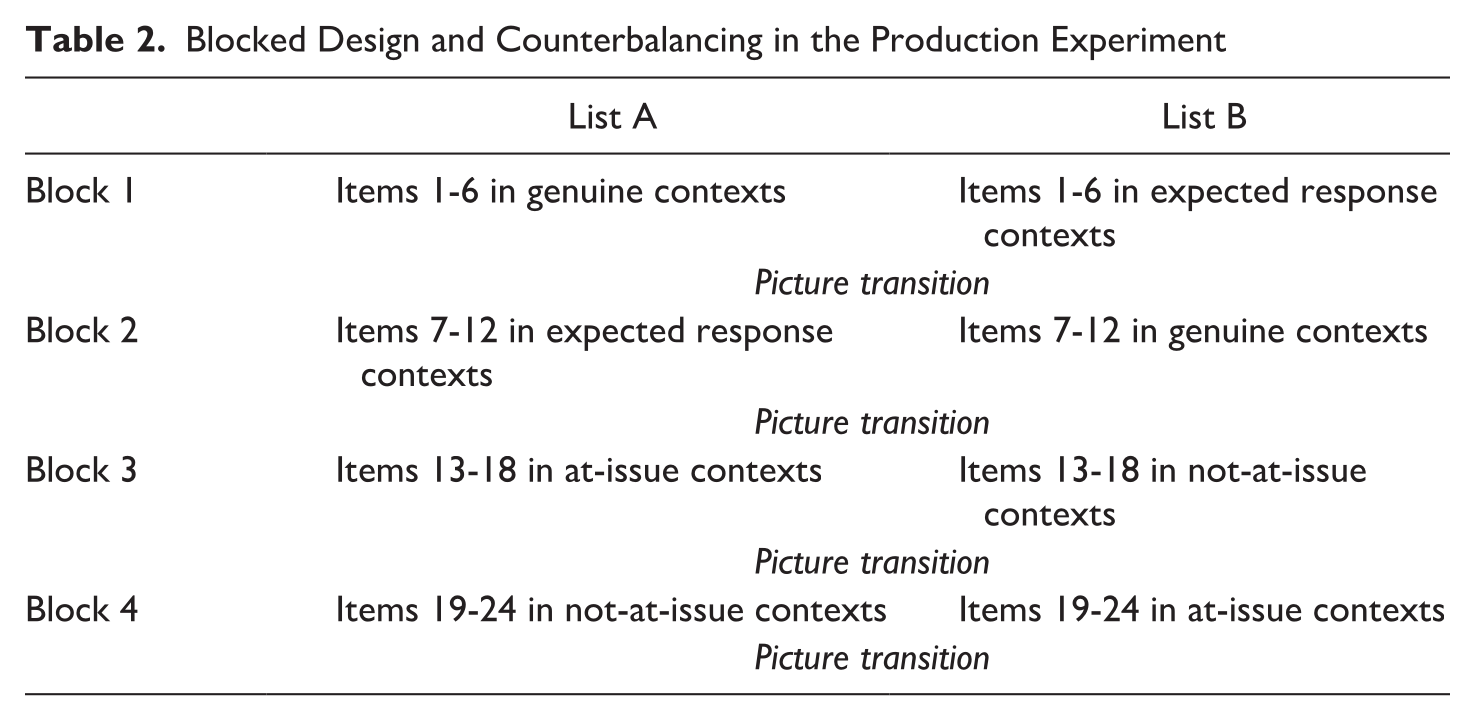
Stimuli were presented in blocks according to pragmatic condition. This is because, instead of trying to obscure the pragmatic meaning we were eliciting through full randomization, we wanted to increase the chances that participants would interpret the items as intended. Items were fully randomized within blocks, to avoid ordering effects. We further included a transition between each block, in which participants identified an item in a picture. We used pictures that have lexical variants specific to Central PA, to further encourage participants to tap into their regional variety. For example, one of the picture transitions included an outdoor extension cord, often called a drag cord in the region. Table 2 illustrates the blocked design and locations of the picture transitions.
3.3. Production Experiment Procedure
Participants met an experimenter in a laboratory booth on campus or in a quiet room close to their home. After consenting to participate, the experimenter helped participants fasten a Shure BLX188/CVL wireless lavalier microphone close to the neckline and began recording their voices with a Shure Dual Channel system and a Marantz PMD660 recorder. The experimenter then instructed participants to sit in front of a laptop and launched the experiment, programmed in PsychoPy (Pierce et al. 2019). All instructions and written components of the experiment were pre-recorded by a speaker native to Central PA. These recordings were time-aligned with the experiment, such that participants were reading and listening simultaneously. Having a Central PA English speaker pre-record the instructions and stimuli was intended to increase the likelihood that participants would use features of their local variety, and it further helped mitigate any differences in participants’ comfort level with written instructions and text.
After the instructions, participants were guided through several practice trials. These were designed to encourage participants to use the tone of their voice to express emotion elicited by the context. For example, one practice context asked participants to imagine their friend has just told them she ate a scorpion for breakfast. They were then prompted to say: “What did you eat for breakfast?,” and feedback was provided about how they may have used their voices to express surprise, since people do not normally eat scorpions for breakfast. As in the experiment, each practice trial was also followed by a verification question to ensure participants obtained the intended meaning (in the example case, that they were surprised to hear their friend ate a scorpion for breakfast). The experimenter remained in the room until the practice trials were completed, leaving once the participant was ready to begin.
During the task, participants read and listened to each context, said each polar question out loud, then responded to the verification statement that followed. Participants advanced through the trials at their own pace using the space bar. After participants completed the experiment, the experimenter came in and debriefed them, then conducted a sociolinguistic interview while continuing to record the participant’s voice.
3.4. Production Experiment Analyses
Acoustic analyses were conducted using Praat (Boersma & Weenink 2016). Of the 621 analyzable tokens obtained, initial impressionistic coding identified sixty-nine with the final falling intonation characteristic of the PA English Final Rise-Fall. Thus, only 9 percent of the tokens in which participants’ response matched the intended pragmatic interpretation displayed the regional intonational pattern. This is perhaps unsurprising since this is a regional feature elicited in a laboratory setting, and even in naturalistic settings socially salient prosodic features may be produced infrequently (Podesva 2011). Nevertheless, with sixty-nine tokens we had sufficient information to analyze quantitatively.
We used the ProsodyPro script (Xu 2013) to extract ten equidistant F0 values from each syllable within each final falling token and did the same for a parallel set of sixty-nine tokens ending in a final rise. 6 These F0 values were z-score transformed by participant and fitted to a smoothing spline (SS) ANOVA (Gu 2014). In the SS ANOVA, the data are fitted to splines within each condition (e.g., final fall versus final rise), and Bayesian confidence intervals are plotted for visual comparison. A lack of overlap between confidence intervals is interpreted as a statistically significant difference (see Figure 1 below).
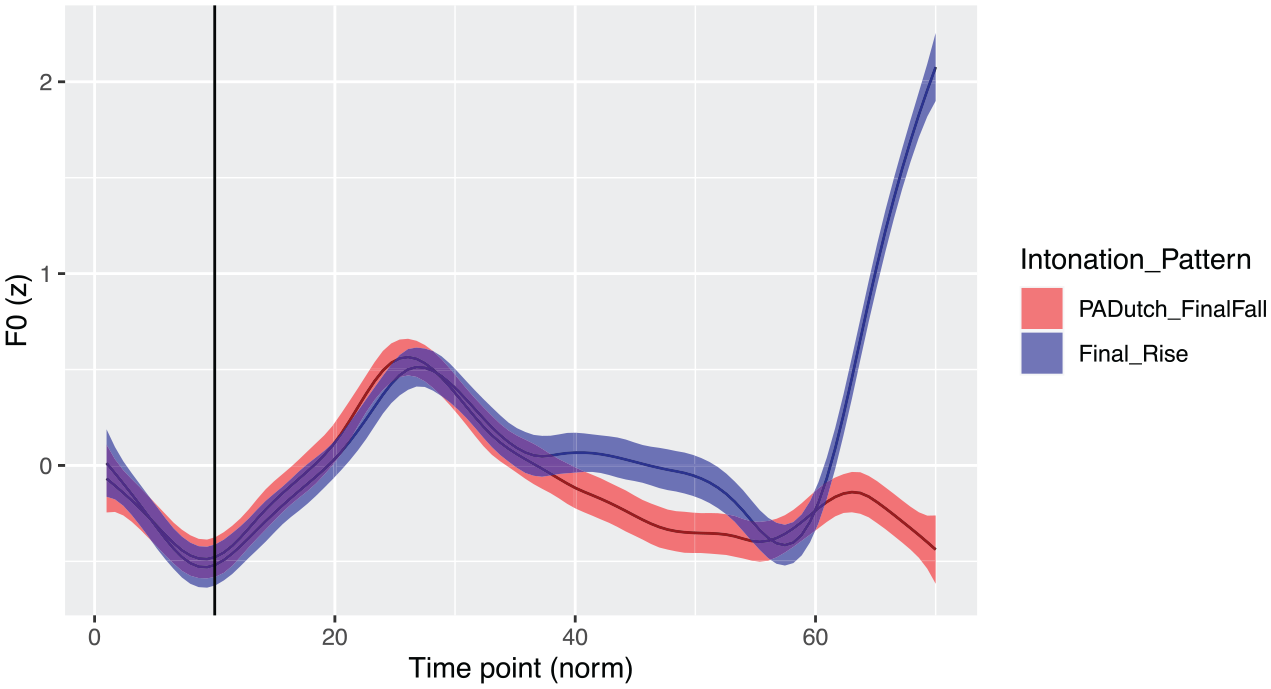
SS ANOVA Comparing F0 Curves of Final Falling Tokens and Tokens Ending in a Final Rise. The Vertical Line at Point 10 on the x-Axis Marks the End of the First and the Beginning of the Second Syllable
In addition to the SS ANOVA, the sixty-nine final falling tokens also underwent impressionistic coding using the ToBI system (Beckman, Hirschberg & Shattuck-Hufnagel 2006), to identify pitch accents and final boundary tones. Each token was coded by two coders, and a third coder made the final determination on any tokens for which there was disagreement. We used the same ToBI coding procedure for the forty-eight tokens ending in a final rise used for the perception experiment (see section 4 below), for comparison with the final falling tokens.
3.5. Production Experiment Results
Tokens with final falling intonation were produced by eighteen different participants, two of whom produced final falling tokens only once. Thus, the majority of our PA English Final Rise-Fall tokens were produced by sixteen speakers, or 37 percent of the group. Contact with PA Dutch-speaking communities did not appear to be a predictor of PA English Final Rise-Fall use, since the participants who produced the largest numbers of tokens (10-11) reported low levels of contact (scoring either a 0 or a 1 on our connectedness metric), while the few participants who scored higher on our PA Dutch community connectedness metric produced fewer or no tokens. To better understand what social factors predicted the use of the PA English Final Rise-Fall, we grouped participants into three age bands: 18-37 (n = 14), 38-57 (13), and 58-75 (9), then tabulated the number of PA English Final Rise-Fall tokens produced by each group. The largest number—thirty-six in total, representing more than half of the data set—was produced by the fifty-eight to seventy-five year olds, while the eighteen to thirty-seven group produced 20 and the thirty-eight to fifty-seven group produced 11. This suggests that older generations may be more likely to produce this feature than younger ones, and in line with Holliday’s (2019) findings for regional intonation patterns in African American language, may even suggest that the feature is on the decline. However, given the relative sparsity of our data in this regard, we note it here as a possible avenue for future research, but are reluctant to draw any strong conclusions regarding the influence of age on the use of the PA English Final Rise-Fall.
Turning to our analyses, Table 3 illustrates the distribution of the sixty-nine tokens with final falling intonation across the different pragmatic conditions. The largest proportion of these tokens (49 percent) was produced in expected response contexts, presenting some support for the hypothesis that the PA English Final Rise-Fall is often used to express that the speaker has an idea of what the response will be. Not-at-issue contexts also elicited a smaller but perhaps non-trivial proportion (23 percent) of final falling tokens in comparison with genuine (16 percent) and at-issue (12 percent) contexts, suggesting that this pattern may also be employed to express when something is not at issue. However, given the relatively small number of tokens produced in our sample, we interpret these production results with caution, and consider the perception experiment results below to be stronger indicators of the pragmatic status of the PA English Final Rise-Fall.
Distribution of Tokens with Final Falling Intonation Elicited in the Production Experiment

To better understand the acoustic features of the PA English Final Rise-Fall, we conducted an SS ANOVA comparing the average F0 curves of our sixty-nine PA final falling tokens to a set of sixty-nine tokens produced by our participants ending in a final rise. We selected seventeen final rise tokens produced in the expected response, genuine, and not-at-issue conditions and eighteen from the at-issue condition, resulting in thirty-five different context-sentence pairs. These final rise tokens were produced by speakers who also produced final falling intonation (n = 38) as well as speakers who did not (n = 31), resulting in a broadly representative sample with regard to item and speaker. Figure 1 illustrates the results.
As Figure 1 shows, both the final rising and falling patterns contain a rise in F0 in the first half of the sentence, occurring on average within the third syllable (between points 20 and 30 on the x-axis). The curves begin to diverge at the onset of the fourth syllable, coming together again at the end of syllable 5 before diverging into their final rise and fall patterns in the seventh syllable. The prototypical final rise curve displays a clear unidirectional rise in the final syllable. The PA English final fall curve, on the other hand, displays an initial rise in the first part of the final syllable followed by a final fall to end the sentence. This is the rising-falling tone that has been previously observed as characteristic of the PA English Final Rise-Fall (Huffines 1986). Observing the graph, we see that the PA English Final Rise-Fall pattern on these seven syllable stimuli reflects on average a rising and falling pattern in the initial part of the sentence and another one in the final part of the sentence.
Figure 1 also shows that, on average, the rising-falling sequence of the final boundary tone for the PA English Final Rise-Fall tokens occurs entirely within the final syllable. 7 However, observation of individual tokens illustrate that this is not categorical, and as observed across previous literature (Fasold 1980; Huffines 1986; Kiesling 2017), there are a range of possibilities for placement of the signature rise-fall. Figures 2 and 3 illustrate sample tokens of PA English Final Rise-Fall intonation. The token in Figure 2 is consistent with the SS ANOVA results, with the final rise-fall occurring mostly within the final syllable (the second syllable of the word schedule). Figure 3, however, illustrates a different pattern, in which the final rising falling pitch contour stretches across the last four syllables (corresponding to the noun phrase the meatballs).
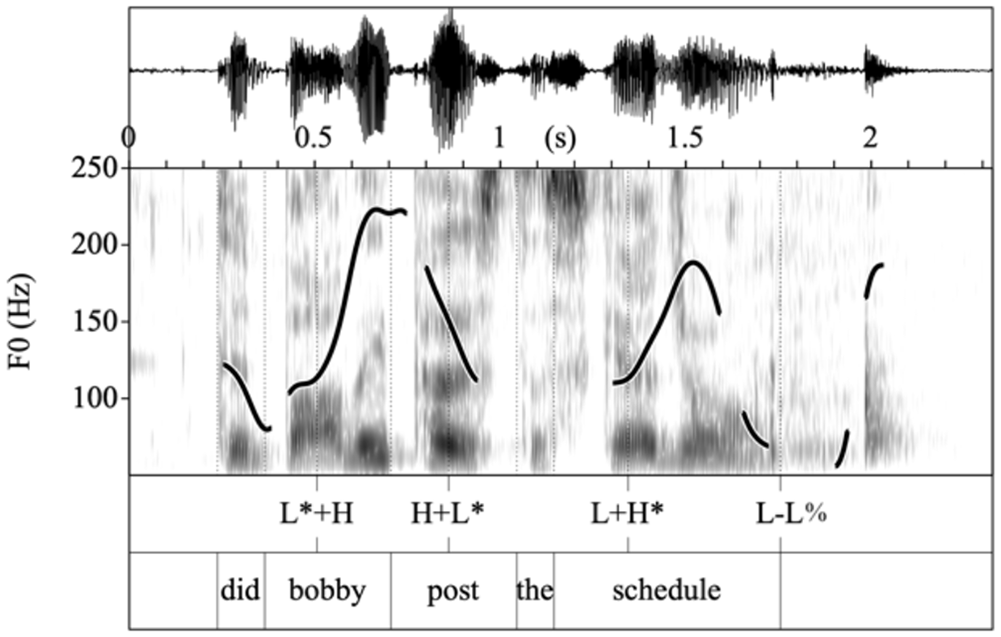
Sample Token of a Final Rising and Falling Sequence Mostly in the Final Syllable
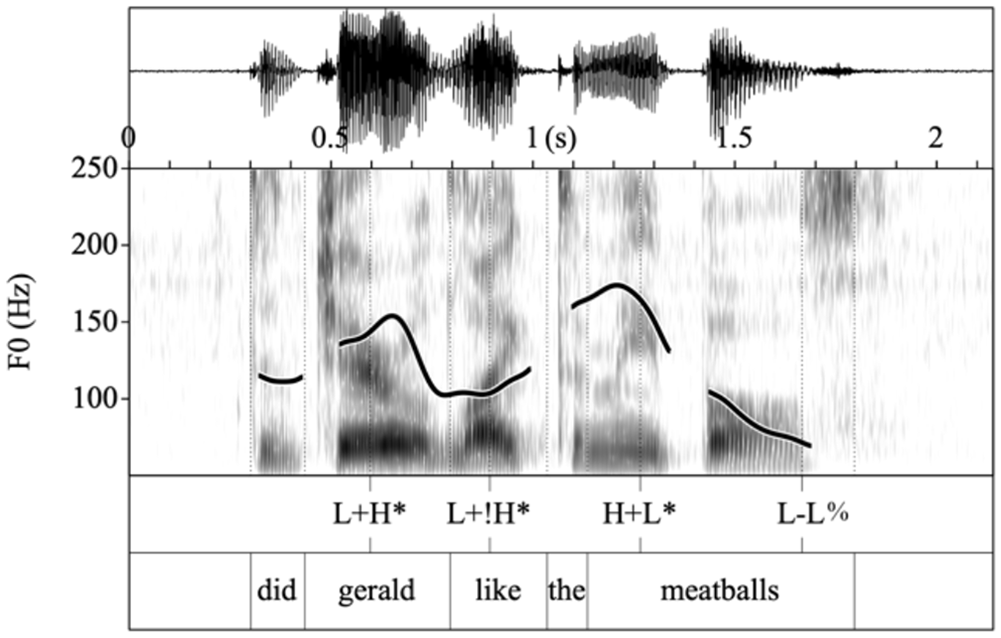
Sample Token of a Final Rising Falling Tone Across Multiple Syllables
Notably, both tokens in Figures 2 and 3 were produced by the same speaker. Given that the syllable structure and stress placement of our stimuli were controlled for comparison, this intra-speaker variation suggests that speakers do not restrict themselves to a specific pitch accent type to create the rise part of the PA English Final Rise-Fall, but instead use a variety of pitch accents (L*+H, L+H*, H*+L, etc.). Furthermore, unlike in the averaged curve in Figure 1, the final fall in these tokens drops below the preceding minimum F0 of the utterance, a point which was also observed by Fasold (1980).
In addition to comparing F0 across final rising and final falling tokens, we also explored the individual contours of the sixty-nine tokens produced with final falling intonation. Figure 4 contains results of our ToBI coding. 8 The figure includes all the patterns that occurred more than once. As the figure shows, we found six distinct patterns occurring more than once. The most frequent was a sharp rising L+H* followed by a high (H*) then another L+H* pitch accent, ending in the final low boundary tone (L-L%) shared by all of the attested patterns. The two L+H* pitch accents in this most frequent pattern, together with the final falling boundary tone, appear related to the two rising and falling sequences we saw in the averaged curves in Figure 1 above. The second most frequent pattern, H* H* L+H* L-L%, has only one of these, occurring as the third pitch accent in the utterance in conjunction with the final falling boundary tone. Both these patterns occurred most frequently in the expected response condition, though the number of tokens in this condition—six with two rise-falls and five with a single one—is too small to allow for any strong conclusions. It is interesting that the most frequent pattern with two rising and falling pitch accents did not occur at all in the not at issue condition, though again given the small number of tokens overall we are hesitant to draw any conclusions from this. 9
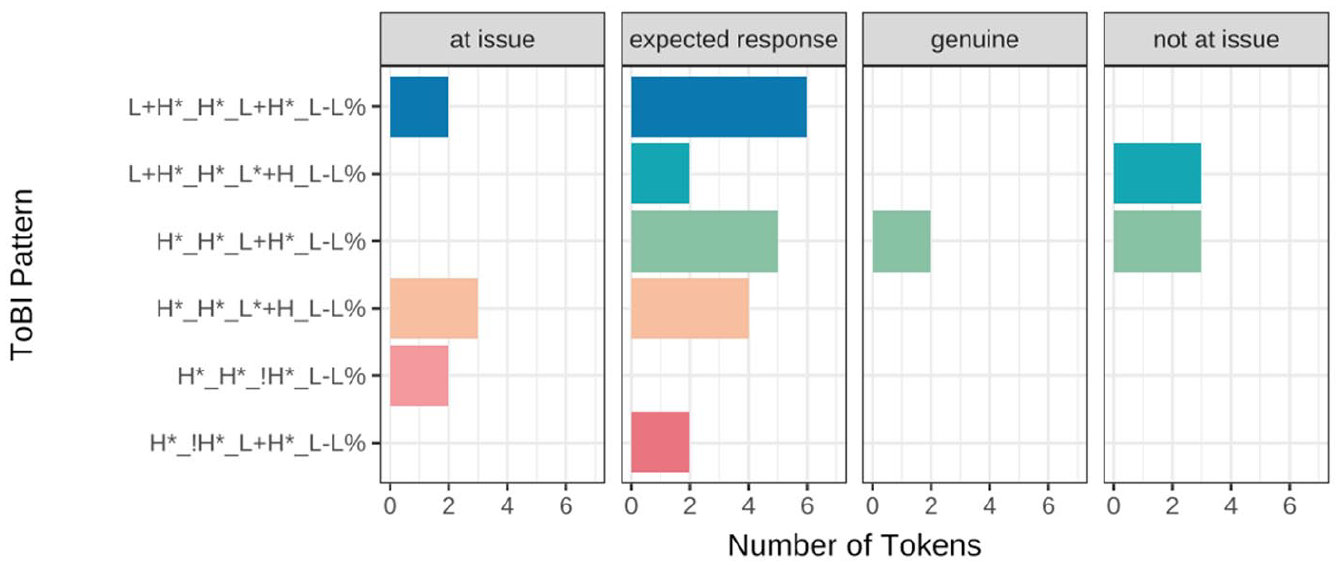
Final Falling ToBI Patterns from the Production Experiment, by Pragmatic Condition
To extract more information about the tonal patterns associated with final falling intonation in our data set, we also observed which pitch accents tended to occur in particular positions. Since most tokens had four tones, we compared which types tended to occur in the first, second, and third positions preceding either a final rising or falling boundary tone. Since the data were highly variable, to extract any patterns that existed we included only those types that accounted for more than 1 percent of the data when occurring in a particular position. Figure 5 illustrates the results.
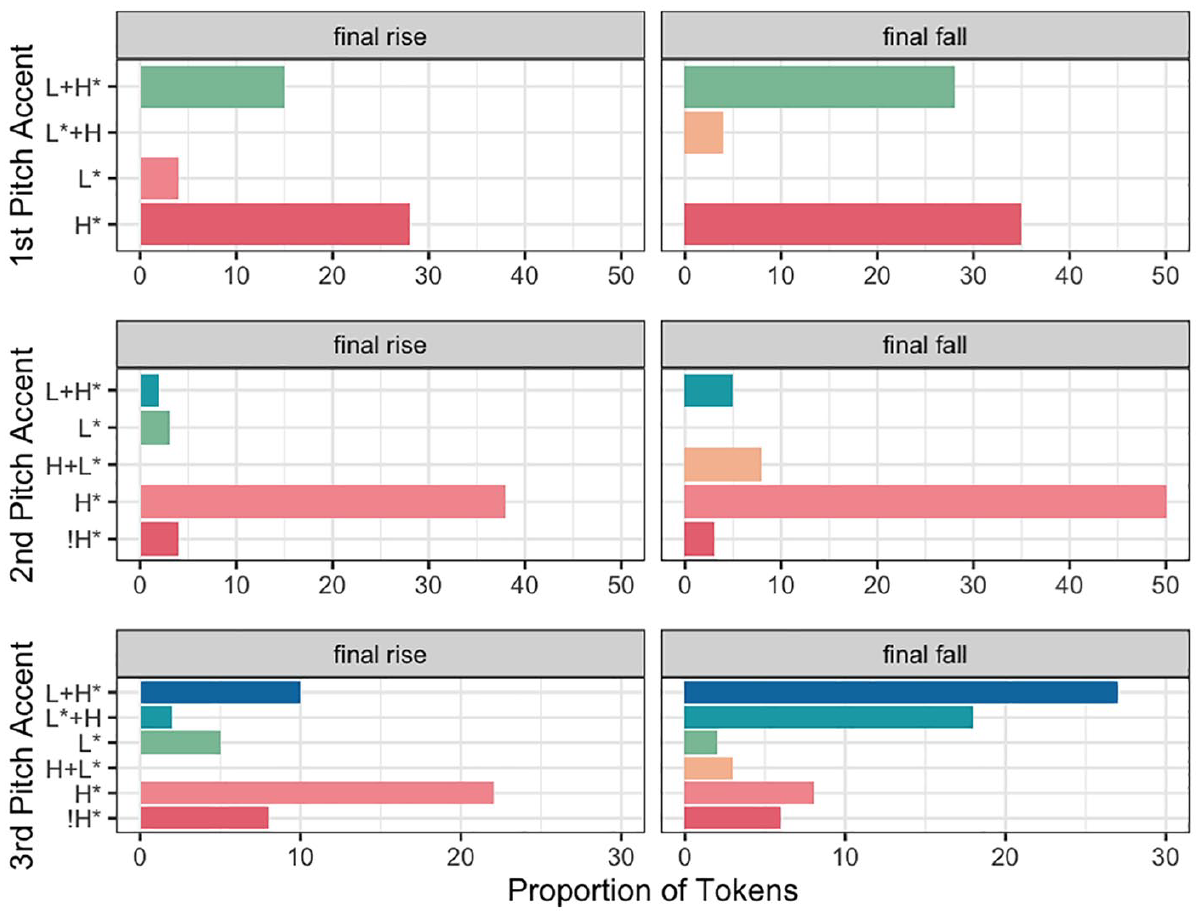
Proportions of First, Second, and Third Pitch Accents for Tokens with Final Rise versus Fall
As Figure 5 shows, the clearest differences between final rising and falling tokens emerged in the third position, which for the tokens represented in the graph (and for nearly all our data) was always the pitch accent preceding the final boundary tone. In this third (i.e., nuclear) position, while L+H* accounts for only 10 percent of the final rise tokens, it is the predominant pattern in the final falling tokens, accounting for 27 percent. The “delayed peak” L*+H pitch accent also appeared infrequently in the position prior to the final boundary tone in the final rise tokens (2 percent) but accounted for 17 percent of tokens ending in a final fall. In contrast, in the final rise tokens, rising H* appeared to be the predominant pattern preceding the final boundary tone. Interestingly, as Figure 5 shows, pitch accent patterning in the first and second positions was more similar across final rising and falling tokens. Taken together, these observations suggest that, in addition to being distinguishable by their final boundary tone, the intonational contour immediately preceding the final boundary tone also plays a role in defining the PA English Final Rise-Fall. More specifically, our data suggest that penultimate (or nuclear) L*+H and L+H* may also be characteristic of the PA English Final Rise-Fall. We return to this, and its relation to the pragmatic associations previously established within the MAE-ToBI framework, in the discussion section.
3.6. Production Experiment Summary and Interim Discussion
The results of the production experiment demonstrate that it is possible to elicit the PA English Final Rise-Fall in the context of an experiment, yielding sufficient tokens for quantitative analysis. Averaging across tokens with a final fall, we saw that the final rise-fall tended to occur most frequently within the final syllable of each seven-syllable utterance (Figure 1). This is significant, since our stimuli were controlled for syllable structure and stress placement, suggesting that placement of the final rise-fall within the final syllable may be a frequent characteristic of the PA English Final Rise-Fall. 10
Positioning of the final rise-fall within the final syllable was not categorical in our data, however, and impressionistic coding revealed that speakers varied in their placement. Our impressionistic coding further revealed two predominant complex pitch accents immediately preceding the final boundary tone: the “delayed peak” L*+H, and the sharp rising L+H*. Comparing our impressionistic coding of the falling tokens with those ending in a final rise, these complex L*+H and L+H* pitch accents immediately preceding the final boundary tone also appear to be a feature distinguishing the PA English Final Rise-Fall from the more mainstream final rising pattern.
With regard to its pragmatic meaning, we found the highest number of final falling tokens produced in the expected response condition, providing some support for the hypothesis that the pattern is used when the speaker has an idea of what the response will be. However, given the relatively small number of tokens elicited, further investigation is needed. To that end, we used the production experiment tokens to design a perception experiment that probed listeners’ understanding of its pragmatic meaning. The next section describes this experiment.
4. The Perception Experiment
While the use of pragmatic contexts in the production experiment provided some information about the pragmatic uses of the PA English Final Rise-Fall, the tokens were too few to draw any strong generalizations. In designing a perception experiment with these tokens, we were able to directly question larger numbers of participants on their pragmatic interpretation. In addition, by questioning listeners from Central PA and listeners from outside the Midland Dialect region, we were able to gain information on the extent to which pragmatic interpretation of the PA English Final Rise-Fall is region-specific.
4.1. Perception Experiment Materials and Design
The perception experiment was designed in a Latin square format with four separate lists. Each list consisted of twenty tokens from the production experiment coded as having final falling intonation, and forty-eight control tokens coded as having “neutral” (level) or rising intonation on the final syllable. The lists were counterbalanced such that each of the twenty-four questions from the production experiment occurred at least once but no more than twice on each list.
Since the stimuli were produced by different speakers, we also had to ensure that speaker identity and gender were counterbalanced across lists. For the critical items, there were seventeen different speakers who produced a total of sixty-six usable final falling tokens with no pauses or external noise. However, over half of those tokens (38/66) were produced by only four speakers (one male, three female). To limit the number of items produced by a single speaker included on a given list, only 47/66 tokens (at least one from each of the seventeen speakers) were used as stimuli. We also ensured that participants listened to an equal number of tokens from male and female speakers. To achieve this balance, some speakers had to appear multiple times on each list, though the extent of speaker repetition was also balanced across lists. With these controls, each participant listened to sixty-eight audio files by thirty-four different speakers (seventeen male, seventeen female) uttering twenty-four different questions. 11 Items were presented in pseudo-randomized order with no two critical items, no two speakers, and no two questions occurring sequentially.
Participants listened to the sixty-eight audio files absent of any context and answered one of two questions after each: Do you think the speaker knows what the response will be? (the “expected response” pragmatic condition) or Do you think the speaker will take issue with the response? (the “not-at-issue” pragmatic condition). Twelve of the final falling tokens were followed by the expected response question, and eight were followed by the not at issue question, a proportion which mirrors the results of the production experiment. The remainder of the tokens with neutral and rising intonation were divided equally between the two questions.
4.2. Perception Experiment Participants
We recruited two groups of participants for the perception experiment. One group consisted of individuals from communities within and around a university community in Central Pennsylvania, again focusing primarily on members of the administrative and facilities staff (excluding participants and close contacts of participants in the production experiment). The second group was recruited through the Amazon Mechanical Turk platform, where it was stipulated that individuals from states associated with the Midland Dialect region were not qualified to participate. Although the feature under study is not a widespread Midland feature, because we were interested in comparing individuals with regional knowledge against those who had not been exposed, we cast a wide exclusionary net in order to help ensure that our assumptions about exposure were met.
A total of fifty-five participants from Central Pennsylvania and forty-nine from Mechanical Turk (henceforth the non-Midland group) completed the perception experiment. Two participants from the non-Midland group were excluded from analyses because they did not meet our inclusion criteria, one who was not a native speaker of American English and had spent no time living in the US, and one who reported to having spent substantial portions of their life living within the Midland dialect region. This left forty-seven participants from the non-Midland group whose data were included in analyses.
Participants from the Central PA group had ages ranging between 19 and 71 (mean = 38, SD = 12). All participants confirmed that they were native speakers of American English from the Central PA region. Thirty-nine of these fifty-five participants were female, twelve were male, and four chose not to identify their gender. 12 One participant from the Central PA group identified as African American, Hispanic, and White, one identified as Asian, one as Asian-Indian, one as Asian American, forty-six as White or Caucasian, one as White and Asian, one as White Hispanic, one as White and Eastern European, one as White and Korean, and one chose not to identify their race or ethnicity.
The non-Midland group contained adult native speakers of American English with ages ranging from 24 to 67 (mean = 41, SD = 11). Twenty-two were female, twenty-five were male, and one was non-binary. The PA group is therefore more heavily skewed toward female participants, while the non-Midland group is more balanced. Regarding their racial and ethnic identities, two of the forty-seven included participants in the non-Midland group identified as Asian, one as Asian American, two as Black, two as Chinese, one as Hispanic, thirty-seven as White or Caucasian, one as White and American Indian, and one as White and Hispanic. They were from a wide range of non-Midland states including California (11), Florida (4), Georgia (1), Illinois (2), Massachusetts (1), Michigan (4), New York (10), 13 North Carolina (5), Oregon (1), Tennessee (1), Virginia (2), Washington (1), and West Virginia (1). With respect to regional identity, non-Midland participants were therefore relatively diverse but crucially did not come from and had not lived in areas where they were likely to have had exposure to the PA English Final Rise-Fall.
4.3. Perception Experiment Procedure
The perception experiment was programmed in PsychoPy and administered online through the Pavlovia platform (Pierce et al. 2019; Morys-Carter 2021). Pennsylvania participants were recruited through networks at a university in Central PA with a particular focus on staff, who tend to have longstanding ties to the area. Once it was established that a participant met the study criteria of being an adult native speaker of American English who had lived all or most of their life Central PA, they received an email directing them to a survey link. Non-Midland participants were recruited through Mechanical Turk and received the link through the Amazon module. Upon clicking the link participants confirmed they met the criteria for inclusion, then read and acknowledged an informed consent statement and proceeded to the experiment. 14
The experiment was preceded by several practice trials with feedback, to familiarize participants with the task. It was followed by a debriefing and language history questionnaire. Upon completion, PA participants were given a code to email to an experimenter to receive their payment, while non-Midland participants recruited through Mechanical Turk were paid through Amazon’s online platform.
4.4. Perception Experiment Analyses
Since the response variable for the perception experiment was binary (‘yes’ versus ‘no’), response patterns were analyzed using mixed effects logistic regression models with the package lme4 version 1.1-34 (Bates, Maechler, Bolker & Walker 2015) and a priori contrasts for hypothesis testing (Schad, Vashishth, Hohenstein & Kliegl 2020). The use of a mixed effects model allows us to account for random effects not related to the experimental manipulation. Elements that may generate random effects in this experiment include the lexical content of each individual question, the individual speaker uttering the token, and the individual participants/listeners, who may introduce their own biases to the task. All analyses were conducted using R version 2023.06.1+524 (R Core Team 2023).
4.5. Perception Experiment Results
Figure 6 summarizes the results, with points representing individual participants’ proportion of ‘yes’ responses and boxplots to illustrate the distribution. Observing the left panel, which includes only the data from the expected response condition (i.e., the data that represent participants’ responses to the question Do you think the speaker knows the answer?), we see that while the groups pattern somewhat similarly in the neutral and final rising conditions, the PA participants (in red) gave more ‘yes’ responses than the non-Midland participants (in blue) in the final falling condition. Since a ‘yes’ response means that the participant thinks the speaker asking the question has some knowledge of the answer, this pattern is in the direction predicted by the hypothesis that the PA English Final Rise-Fall may be used to express epistemic bias.
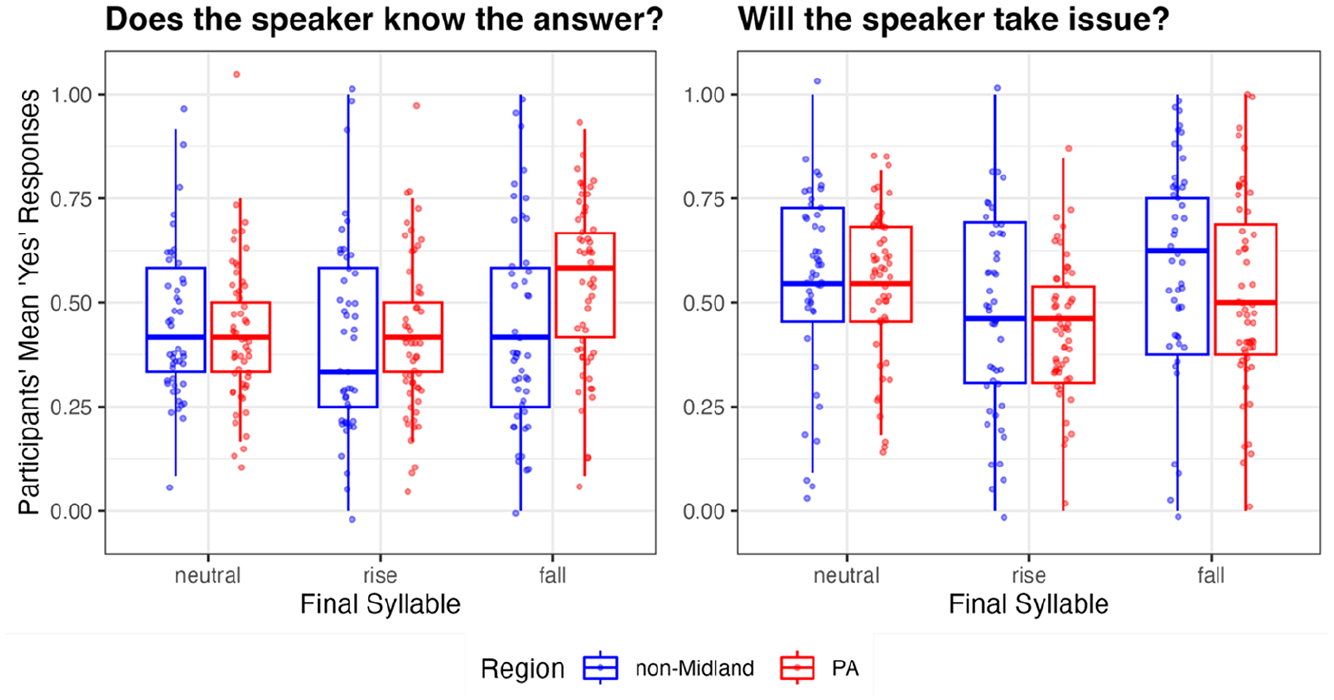
Participants’ Proportion of ‘Yes’ Responses in the Perception Experiment
Turning to the not-at-issue condition (in which participants responded ‘yes’ or ‘no’ to the question Do you think the speaker will take issue with the response?), note first that with regard to the final fall condition, the hypothesis that the PA English Final Rise-Fall is used to express that the speaker will not take issue with the response predicts a response pattern in the opposite direction from the expected response condition. This is because in the not-at-issue condition, a ‘no’ answer reflects an interpretation in which the listener does not think the speaker will take issue with the response. Figure 6 shows that while on average the groups gave similar responses to the final neutral and rise tokens, the PA group does appear to have given more ‘no’ responses for the final fall tokens. Moreover, the non-Midland speakers appear to have given more ‘yes’ responses for these tokens than for the neutral and rising ones. The final falling condition thus appears to represent a point of regional variation here as well. The distributions are variable and at least partially overlapping, though, so it will help to use more fine-grained measures to determine whether any meaningful differences can be detected.
To better understand the patterns in Figure 6, two separate mixed effects logistic regression models were fitted to the data to explore how responses within each pragmatic condition were influenced by the shape of the final syllable (neutral, rise, or fall) and region (PA or non-Midland). Each model also included an interaction term to explore whether participants responded differently to the different final syllable shapes depending on which region they were from.
We first present the results of the model for the expected response condition. A pair of Helmert contrasts were used to first compare rising with neutral intonation (neutral −1, rise 1, fall 0), then combine rising and neutral to compare them with final falling intonation (neutral −1, rise −1, fall 2). Our reason for using these contrasts is that final neutral and rising intonation are expected to have equivalent status with regard to the question do you think the speaker knows what the answer will be?, while based on regional knowledge responses to the final fall condition are expected to be different from both neutral and final rise. Repeated or sliding difference contrasts were used for the Region variable (non-Midland −0.5, PA 0.5). This model also included random intercepts for speaker, participant, and question, as well as a random slope for final syllable by participant.
The results of the expected response model are shown in Table 4. They reflect a main effect of syllable in the comparison between neutral and rising (p < .01), such that listeners overall tended to give fewer ‘yes’ responses when the token ended in rising as opposed to neutral intonation. This might be because final rising intonation is a stronger marker of interrogative interpretation than neutral intonation (Pierrehumbert & Hirschberg 1990). Overall participants did not distinguish between final falling intonation and the other two final syllable shapes (p = .28), and there were no differences between regions when their responses to all three final syllable shapes were grouped together (p = .32). However, while the groups behaved similarly in the extent to which they distinguished between neutral and rising intonation (p = .43), this was not the case for falling intonation as compared with the combination of neutral and rising intonation (p < .01). Final falling intonation thus represents a regional difference with regard to the extent to which listeners interpret it as communicating bias toward a particular answer.
Mixed Effects Logistic Regression Model Results for the Expected Response Portion of the Perception Experiment

To better understand the interaction in the main model, we performed several follow up simple comparisons. One model explored the extent to which PA participants’ responses alone were predicted by the shape of the final syllable. This employed the same Helmert contrasts for final syllable shape as in the main model, and included random intercepts for speaker, participant, and question. This revealed that PA participants gave reliably fewer ‘yes’ responses for rising than for neutral final intonation (b = −0.22, SE = 0.11, z = 1.97, Pr(>|z|) < .05), and reliably more ‘yes’ responses for falling intonation than for neutral and rising intonation combined (b = 0.05, SE = 0.11, z = 2.34, Pr(>|z|) < .05). A model of the same structure was also fitted to explore just the non-Midland responses. This revealed that, like the PA participants, non-Midland participants gave reliably fewer ‘yes’ responses for rising than for neutral final intonation (b = −0.27, SE = 0.11, z = −2.42, Pr(>|z|) < .05). However, unlike the PA participants, non-Midland participants did not reliably distinguish between falling intonation as compared with neutral and rising combined (b = −0.08, SE = 0.05, z = −0.16, Pr(>|z|) = .87). This difference between groups points toward a regional distinction in support of the hypothesis that epistemic bias forms part of Central PA speakers’ knowledge of the PA English Final Rise-Fall.
In addition to exploring the effects of final syllable shape within each region in the expected response condition, we also fitted three simple models to explore the role of region on participants responses for each individual final syllable shape. These models included the same contrasts for region as in the main model, and random intercepts for speaker, participant, and question. These revealed no reliable difference in ‘yes’ responses for neutral (b = −0.22, SE = 0.19, z = −0.62, Pr(>|z|) = .54) or rising (b = 0.06, SE = 0.21, z = 0.30, Pr(>|z|) = .77) intonation between regions, but a reliable difference between regions when the final syllable was falling (b = 0.54, SE = 0.22, z = 2.46, Pr(>|z|) < .05). PA participants thus gave reliably more ‘yes’ responses to do you think the speaker knows the answer to the question? than non-Midland participants, but only when final falling intonation was used—a reflection of their in-group knowledge of this regional feature.
A similar set of models was fitted to participants’ responses under the not-at-issue condition. One difference is that, instead of using Helmert contrasts to group neutral and rising intonation together to compare them with final falling intonation, we instead used repeated contrasts to compare adjacent levels of the final syllable variable, first comparing neutral to rise, then comparing rise to fall (neutral versus rise comparison: neutral −0.67, rise 0.33, fall 0.33; rise versus fall comparison: neutral −0.33, rise −0.33, fall 0.67). 15 Our reasoning was that, with regard to the question do you think that the speaker will take issue with the response?, the neutral or flattened intonation pattern could reflect some level of anger or dissatisfaction (e.g., Crystal 1969), which would distinguish it from both rising and falling intonation. Comparing the three prosodic conditions side by side in this way thus allowed us to observe any differences in response patterns related to the specific question being asked. 16 Region contrasts for the not-at-issue models were set in the same way as in the expected response model, and we also included random intercepts for speaker, participant, and question.
Table 5 contains the results of the main model fitted to the not-at-issue responses. It reflects a main effect of final syllable shape for each of the comparisons: fewer ‘yes’ responses overall for final rising than for neutral intonation (p < .05), and more ‘yes’ responses for final falling as compared with final rising intonation (p < .001). Overall, the groups did not behave differently when all final syllable shapes were grouped together, and there were no interactions between region and the two final syllable comparisons made (all p values >.05). Thus, while Figure 6 suggests that PA participants gave numerically more ‘no’ responses than non-Midland participants to final falling intonation in the not-at-issue condition—a result predicted by the hypothesis that the PA English Final Rise-Fall is used to express the idea that the speaker will not take issue with the response—on the basis of our main model results this does not appear to be a meaningful difference. 17
Mixed Effects Logistic Model Results for the Not-At-Issue Portion of the Perception Experiment

4.6. Summary and Discussion of the Perception Experiment Results
The results of the perception experiment revealed regional differences in the pragmatic interpretation of the PA English Final Rise-Fall, as produced by a range of different English speakers from Central PA. Differences were clearest when listeners were asked whether they thought the speaker knew the answer to the question. Since listeners from PA tended to answer ‘yes’ to this question in cases of final falling intonation, and since their behaviors were distinct from their non-Midland counterparts in this regard, it seems we have found some evidence for a pragmatically conditioned regional intonational variant. Given the limitations discussed above regarding drawing inferences about speaker intent from spontaneous speech, we believe the perception experiment paradigm presented here suggests a promising additional avenue for investigating the relationship between prosody, pragmatics, and regional variation. In particular, in conjunction with observations from naturalistic speech, we can utilize the more controlled environment of a perception experiment to uncover new information on how regional identity interacts with prosody and pragmatics.
5. Discussion and Conclusion
This paper set out to augment our knowledge of the interesting but somewhat elusive PA English Final Rise-Fall, in terms of both its acoustic properties and its pragmatic meaning. One insight that emerged is that it is possible to elicit this pattern in the context of a laboratory experiment, generating tokens that can be analyzed quantitatively and employed to draw inferences about regional knowledge of its pragmatic use. The methods outlined in this paper therefore suggest a possible avenue for exploring socially conditioned intonational patterns in the context of a laboratory experiment, as an essential complement to more naturalistic data.
We found that the acoustic correlates of the PA English Final Rise-Fall are indeed as varied as previous work suggests (Fasold 1980; Huffines 1986; Kiesling 2017), but also, that certain characteristic properties emerge. Confirming and extending previous results, one systematic property that emerged is that while the final rise-fall may stretch across multiple syllables, its most frequent occurrence appeared to be within the final (usually unstressed) syllable. This was reflected both in our averaging over final falling tokens in the SS ANOVA as well as in our ToBI coding. This is in contrast with the final rising tokens, which on average had only one rise-fall toward the beginning of the utterance. Given that the PA English Final Rise-Fall displayed two rising and falling movements as opposed to the single one in the final rising tokens, we can further conclude that this regional variant is characterized by greater pitch movement than more mainstream yes-no question utterances.18,19 Interestingly, Burdin, Holliday, and Reed (2022:14) found greater pitch accents per intonational phrase in their Appalachian and African American English data as compared with data from Jewish English speakers (see also McLarty 2018). Our results therefore point toward a possible similarity between the regional English intonation patterns found in Central PA and the patterns found in Appalachian and African American varieties. Looking beyond the current study, it may be that Central PA English is characterized by greater pitch movement more generally, a possibility which could merit further investigation.
Our impressionistic ToBI coding also revealed interesting differences between Central PA Speakers’ productions of yes/no questions with final rising as compared with falling intonation. While all tokens showed similar patterning toward the beginning, there were substantial differences in the shape of the pitch accent preceding the boundary tone in the final falling tokens, where we observed large proportions of complex L*+H and L+H*. As mentioned in Section 2, these pitch accents have been tied to contrastive stress and incredulity respectively. However, as we have shown here, the PA English Final Rise-Fall is tied to an expected response meaning and, perhaps less strongly, a not-at-issue reading. This represents a point of departure from the more mainstream pragmatic uses of these complex pitch accents. Our results complement the findings in Reed (2020), where similarly high proportions of complex pitch accent use in Southern Appalachia is not tied to the pragmatic meanings that would be expected in the MAE-ToBI framework. At this point it is worth noting that Central PA is in the northern part of the Appalachian region. It is possible that the similar patterning found in these distinct regions of Appalachia are related, though further research would be needed to determine this. At this stage it suffices to say that observing intonational patterning in non-mainstream varieties may lead to different conclusions regarding the relationship between pitch accents and pragmatic meaning than those established within the MAE-ToBI framework.
With regard to hypotheses about the pragmatic meaning of the PA English Final Rise-Fall, while it was difficult to draw any strong inferences on the basis of our production experiment, our perception experiment provided some important new clues. In particular, we found support for Johnstone’s (2008) hypothesis that speakers use this pattern to express their insider knowledge of their interlocutor’s mind state with regard to the question. Fasold’s (1980) hypothesis that the pattern is used to express a not-at-issue meaning found less support in our data, but we do not wish to suggest that this is because this use is not available. Fasold’s observations were made in a location that is geographically closer to where we conducted our experiments, so we would expect our participants’ intuitions to be closer to those of his speakers than the Pittsburghese observations in Johnstone (2008, 2013). If the not-at-issue interpretation is still available and widely used in this region—and some casual observations suggest that it may be at least for some speakers—then it may be that we need a slightly different set of experimental tools or design to detect it, a matter we leave for future research.
In addition to other possible pragmatic uses of the PA English Final Rise-Fall, there are many additional remaining questions. For example, we did not systematically probe the extent to which people use the feature as a marker of identity with Central PA, as Kiesling (2017) suggests for his “YouTube Yinzers.” At this point it is worth noting that, based on casual observations, it is relatively common to hear the PA English Final Rise-Fall employed with utterances that are both syntactically and semantically declarative. Interestingly, the use of final rising and falling intonation on declaratives stands in contrast to the more common high rising final intonation (i.e., “uptalk”) found in many parts of the United States (see Warren 2016 for a review). As noted by an anonymous reviewer, these contrasting patterns on declaratives provide further support for the idea that the PA English Final Rise-Fall is used to index region in Central and Western PA English, a hypothesis that merits further exploration.
Another important point is that, in cases where the PA English Final Rise-Fall is used on declaratives, one cannot propose that its meaning pertains to the speaker’s bias toward a particular answer, since no answer is being solicited. From a pragmatic perspective, it is possible that the pattern is nevertheless used on declaratives to mark a particular epistemic stance the speaker holds (thanks to an anonymous reviewer for this suggestion), a possibility which could be worth investigating using methods similar to those outlined here.
Despite the many remaining questions, the study presented here represents a step forward in our understanding of the PA English Final Rise-Fall, and of patterns of regional intonational variation more generally, suggesting a possible path for how these might be studied in a laboratory setting. Our experimental methods allowed us to fill in some of the acoustic picture of this interesting feature, and provided the first quantitative ties between this regional intonational contour and the pragmatic meaning of an “expected response.” Since the pitch accents we identified as characteristic of the PA English Final Rise-Fall also occur in MAE, the fact that they appear to contribute distinct pragmatic meanings illustrates an interesting point of variation. In particular, it appears that some varieties have established links between specific pitch contours and pragmatic meanings that are distinct or in addition to those found in MAE. In the context of existing research on the relationship between intonational variation and social factors, our findings support the existence of a much richer landscape of intonational meaning in English than can be captured by observing only mainstream varieties, stretching far beyond the regional boundaries of Central PA.
Supplemental Material
sj-csv-1-eng-10.1177_00754242241311619 – Supplemental material for The Pennsylvania English Final Rise-Fall: Intonation, Pragmatics, and Regional Variation
Supplemental material, sj-csv-1-eng-10.1177_00754242241311619 for The Pennsylvania English Final Rise-Fall: Intonation, Pragmatics, and Regional Variation by Frances Blanchette, Johan Alberto De La Rosa Yacomelo, Amanda Eads, Li-Fang Lai, Amanda Harman and Leah Hunt in Journal of English Linguistics
Footnotes
Declaration of Conflicting Interests
The author(s) declared no potential conflicts of interest with respect to the research, authorship, and/or publication of this article.
Funding
The author(s) disclosed receipt of the following financial support for the research, authorship, and/or publication of this article: This research was supported by Penn State’s Eberly College of Science and Center for Language Science.

Notes
Author Biographies
References
Supplementary Material
Please find the following supplemental material available below.
For Open Access articles published under a Creative Commons License, all supplemental material carries the same license as the article it is associated with.
For non-Open Access articles published, all supplemental material carries a non-exclusive license, and permission requests for re-use of supplemental material or any part of supplemental material shall be sent directly to the copyright owner as specified in the copyright notice associated with the article.
