




Abstract
Despite the well attested finding that orientation to place can exhibit correlations with sociolinguistic usage, the role of place identity in sociolinguistic variation and change has been long disputed. The disputes often center around two key points. Firstly, a contested point is whether observed identity effects are independent statistically meaningful effects or whether they are corollaries of effects relating to other socio-demographic features such as age or socioeconomic class. Secondly, when place identity effects are found in sociolinguistic usage, few studies have explored the extent to which these effects can be attributed to acts of identity or to common interactions that can be influenced by attitudinal factors such as local orientation. To delve into these issues, I analyze lexical data from Cornwall and highlight the complexity involved in interpreting the role of place identity in sociolinguistic usage. I advocate, to varying extents, for both the act of identity and interlocutor frequency interpretations for different data sets.
1. Introduction
Place identity is the extent to which one’s geographical provenance is central to one’s conceptualization of self and the extent to which one feels or expresses pride in one’s locale. The role of place identity in processes of sociolinguistic variation and change is a controversial topic in variationist sociolinguistics (e.g., Moore 2011). In Labov’s (1963) Martha’s Vineyard study, orientation to the island exhibited the “sharpest example of stratification” (Labov 1972:39) in the centralization of the diphthongs (ay) and (aw). This “orientation” to Martha’s Vineyard, that is, whether participants had largely positive or negative feelings toward the island, has often been interpreted as “identity” (e.g., Bailey, Wikle, Tillery & Sand 1991; Ito & Preston 1998; Dyer 2002; Hazen 2002). Yet, as Underwood (1988:420) notes, Labov himself did not use “identity” (although he does refer to “local identity” when discussing Martha’s Vineyard in Labov [2010:185]). Indeed, Labov (e.g., Labov 1979, 2001) has been somewhat skeptical of the role of identity in the context of sociolinguistic variation and change (see also Trudgill 2008; Baranowski 2017). For example, Labov (2001:228) states that “the evidence for the association of [variant use and identity] is largely the linguistic distributions themselves.” This highlights the difficulties of interpreting sociolinguistic patterns which purport to show a relationship between place identity and linguistic usage.
While the stories of sociolinguistic variation and change have mostly been told through the lenses of age, gender, socioeconomic class, and, to a lesser extent, ethnicity, studies have also identified a relationship between place identity and language variation. Early examples include Frazer (1983) and Underwood (1988), but more recent work has likewise considered the role of place identity in the sociolinguistic system (e.g., Haddican, Foulkes, Hughes & Richards 2013; Reed 2016; Roberts 2016; Sandow & Robinson 2018; Dann 2019; Sandow 2020; Beaman 2021). In addition to demonstrating a quantitative link between local orientation and linguistic usage, the role of local dialect in performing identities of place through the styling of dialect words, phrases, and pronunciations has also been highlighted (e.g., Schilling-Estes 1998; Hall 2019). However, the meaning of these patterns is largely undertheorized (see Coupland 2008:268). For example, it seems intuitive that those with a strong local identity orient toward local dialect norms and this trend has largely been borne out in the sociolinguistic literature. But precisely what motivates this quantitative relationship has seldom been critically examined.
Nonetheless, competing interpretations exist which must be considered before it is possible to make, or even to understand, claims such as that speakers with stronger local identities use higher frequencies of local dialect variants. Statistical relationships between identities of place and sociolinguistic variation can broadly be read in one of two ways. On the one hand, the higher use of local variants by those with a strong local identity can be interpreted through a social constructionist lens as “acts of identity” (Le Page & Tabouret-Keller 1985). That is, features of a local dialect can be used to construct an identity associated with that dialect region. On the other hand, as Labov (2001:191) argues, these quantitative patterns may in fact be an indirect consequence of local orientation, emerging through the more direct consequence of social network structures or “interlocutor frequencies.”
In this article I outline these two positions in more detail and draw on lexical evidence from Cornwall, United Kingdom, to try to better understand the relationship between language variation and place identity. I use three pieces of evidence from Sandow (2021): (i) social and stylistic lexical variation (onomasiology), (ii) social semantic variation (semasiology), and (iii) social variation in the recognition of Anglo-Cornish dialect words.
The paper is structured as follows. Section 2 provides a background to the research, focusing on place-based identity research in sociolinguistics and how such findings have been interpreted. Section 3 is concerned with the methodology of my study. The results are presented in section 4, beginning with onomasiology, followed by semasiology, and, finally, lexical recognition. Using the frames of “acts of identity” and “interlocutor frequencies” these results are evaluated in section 5, before section 6 summarizes the study and calls for further research on place-based identity effects in the study of sociolinguistic variation and change. In concluding, I highlight the efficacy of both interpretations of identity effects: the onomasiological data primarily support the acts of identity interpretation; and the lexical recognition data and, to some extent the semasiological data primarily support the interlocutor frequency interpretation.
2. Background
The third wave of sociolinguistics has seen an increased focus on the social meaning of language variation (see Eckert 2012). Concomitant to this third wave is the speaker design interpretation of style (see Schilling-Estes 2002), which suggests that speakers can use language, and other semiotic channels, to communicate social information about themselves that they perceive to be desirable at any particular time, such as being educated, being cool, or being from a particular place. These identities can be styled through the use of language. That is, for example, a speaker can make use of linguistic features enregistered as part of a dialect in order to index their provenance from that area (see Johnstone, Andrus & Danielson 2006). However, the current research is best situated in the body of scholarship that has demonstrated quantitative links between place identity and linguistic variation. Such identity effects have been observed at the levels of segmental (e.g., Dann 2019) and supra-segmental (Reed 2016) phonetics, phonology (e.g., Knee & Van Herk 2013), and lexis (Sandow & Robinson 2018; Sandow 2020).
A key issue with interpreting purported identity effects in studies of sociolinguistic variation and change is that strength of local identity is not likely to be evenly distributed throughout a community in the same way that we can broadly expect age, gender, and, to a lesser extent, socioeconomic class, to be. For example, it may well be the case that local identity is stronger within particular age, gender, or socioeconomic groups. When a relationship between the strength of local identity and linguistic usage is observed, it is first necessary to determine whether or not there is a clear identity effect that is independent of other vectors of social variation- or at least to account for the intersection of identity with other social categories.
Without also controlling for other socio-demographic dimensions, the claims that can be made about place identity effects are limited. It is thus important to reflect on the interactions that identity has with other social categories. However, this remains an underexplored area. In her Teesside study, Llamas (2001) found young men to have the strongest local identities and young females to have the weakest. Burbano-Elizondo (2008:123) found that men and middle-aged speakers typically had the strongest Sunderland (Mackem) identities. Neither Llamas (2001) nor Burbano-Elizondo (2008) considered the role of social class on strength of local identity, as both communities were judged to be broadly working-class (see also Roberts 2016). Haddican, Foulkes, Hughes, and Richards (2013) acknowledge that the observed relationship between attitudinal data and usage of local dialect forms in their study may be an artefact of social class, which they did not include in the statistical modeling of their usage data (also Reed 2016). Baranowski (2017:328) suggests that the effect of attitudinal factors, such as place identity, on linguistic usage has broadly been overestimated and “may in fact be a secondary effect due to social class differences.” These studies serve to highlight the need for precise descriptions of interactions between language variation, strength of local identity, and other social categories. However, even if it has been satisfactorily demonstrated that any observed identity effects are statistically independent of other dimensions of sociolinguistic variation, it is not immediately clear how these effects should be interpreted.
There are two possible interpretations of data of this kind. The first, the “acts of identity” (Le Page & Tabouret-Keller 1985; see also Sturtevant 1947) interpretation, holds that speakers with a strong sense of local identity use more local forms in order to signal their affiliation to their locale. This interpretation has been applied to the observed relationship between the strength of place identity and sociolinguistic variation (e.g., Underwood 1988; see also Auer & Hinskens’ [2005] identity-projection model). This reading of identity effects in sociolinguistic variation suggests that speakers with a strong sense of local identity are more likely to perform this identity through the use of linguistic forms enregistered as being associated with that place. Speakers can shift toward or away from linguistic features in order to construct a contextually desirable identity. For example, Underwood (1988:418) accounts for the quantitative relationship between a Texan variant of /ai/ and scores on an “Index of Texan Identification” by interpreting this sociolinguistic pattern as an act of identity.
While the act of identity interpretation may be intuitive, an alternative possibility must also be considered. The second interpretation, the “interlocutor frequency” (Labov 2001) reading, holds that ostensible identity effects are a corollary of the tendency for those with strong local identities to have more locally-oriented social networks, with fewer regular interactions with non-local interlocutors. Labov (2001:505) argues that “[a]s always, it is good practice to consider first the simpler and more mechanical view that social structure affects linguistic output through changes in the frequency of interaction.” (see also Kristiansen 2010; Sharma & Dodsworth 2020). Building on Bloomfield’s (1933) “principle of density,” Labov (2001) raises the possibility that the observed effects of local orientation on sociolinguistic usage could in fact be a result of who our interlocutors are, rather than any explanation rooted in ideology, attitude, or orientation. As opposed to subjective factors such as local orientation, Labov suggests that “language change may simply reflect changes in interlocutor frequencies which are in turn the result of changes in social preferences and attitudes” (Labov 2001:191). That is to say, our strength of local identity may influence our social network structure (we gravitate toward those who think and act similarly to ourselves), which results in observable patterns of sociolinguistic usage. Thus, this interpretation suggests that patterns of sociolinguistic variation are better accounted for by who one’s interlocutors are as opposed to some performative act.
The present article considers the merits of these interpretations of sociolinguistic identity effects by presenting data from a study of lexical variation and change in Cornwall. However, it is not necessarily prudent to conceptualize the acts of identity and interlocutor frequency interpretations as mutually exclusive or as polar opposites. It is possible for acts of identity to emerge from contexts with highly localized social networks. As highlighted by Tabouret-Keller (1997:323), “[o]ne can only behave according to the behavioral patterns of groups one finds it desirable to identity with to the extent that [. . .] one has both adequate access to the groups and ability to analyze their behavior patterns.” Thus, to advocate for an acts of identity interpretation is not to diminish the role of interlocutor frequencies. This paper seeks to shed light on the extent to which the observed local identity effects can be attributed to agentive, performative acts (of identity) or something less directly ideological, that is interlocutor frequencies.
The research reported on in this article comes from a larger study of variation, change, and social meaning of local dialect lexis in the Anglo-Cornish dialect, that is, the variety of English spoken in Cornwall, United Kingdom (Sandow 2021). 1 I have detailed key facets of this research elsewhere. For example, I focus specifically on the performance of Cornish identities through stylistic variation in Sandow (2022), and in Sandow (2023) I analyze patterns of lexical leveling using the word maid as a case-study.
Cornwall is rooted in its history as a Celtic nation and its history of industrial prowess, particularly relating to the mining of tin and copper, and its people have a famously strong identity. To many Cornish people, this is a national and not merely a regional identity, citing Cornwall’s Celtic roots as the basis of a separateness from England. However, to many other Cornish people, their pride is centered around the lifestyle associated with Cornwall, which is perceived to be “relaxed” and “cool,” and the landscapes and seascapes which combine to give Cornwall an iconic aesthetic. Those who orient toward the latter identity are more likely to consider Cornwall to be a county of England, albeit one with a distinctive cultural flavor (see Sandow forthcoming).
The research discussed in this article was conducted in the mid-West Cornish towns of Camborne and Redruth and surrounding villages (henceforth Camborne-Redruth). This area was at the vanguard of Cornwall’s industrial successes in the eighteenth and early nineteenth centuries, and the remains of mines continue to scatter the landscape. While Cornwall is famous for a range of extractive industries, including fishing and farming, Camborne-Redruth was, historically, mining country. Cornwall has also developed into a tourist destination, with the tourism and hospitality sector contributing a higher percentage of Cornwall’s total economic output than any other comparable region in the UK (Office for National Statistics 2016). Despite this general trend, the Camborne-Redruth area is not one which is typically frequented by tourists.
In my pilot study of lexical usage in Cornwall, I found a strong link between Cornish identity and the usage of Anglo-Cornish dialect words (Sandow & Robinson 2018; Sandow 2020). Similarly, Dann (2019) found a slight identity effect in her sociophonetic study of adolescents in West Cornwall. Despite widespread stigmatization of the Anglo-Cornish dialect (see Dann 2019; Beal 2021), many Cornish people report a great deal of pride in the Anglo-Cornish dialect, which is often perceived as an important point of difference between Cornwall and (the rest of) England. Building on these studies, I use this paper to put sociolinguistic identity effects under the microscope and evaluate the possible explanations for the observed patterns of variation.
3. Material and Method
In this study, I consider a range of data types including onomasiological and semasiological variation in lexical usage, recognition of local dialect words, and speakers’ meta-linguistic commentaries. An onomasiological approach entails taking a concept (or onomasiological variable) and studying the words (or onomasiological variants) that are used to lexicalize it. The four onomasiological variables that I investigate here are
I also consider maid and emmet as semasiological variables. A semasiological perspective considers a word form (or the semasiological variable) and investigates variation in meaning of that word form (so-called semasiological variants). Emmet is polysemous in Cornwall; ‘ant’ is an archaic English sense which remains in use in Cornwall. Since the 1970s, through metaphorical extension, emmet can also mean ‘tourist’ (OED, s.v. emmet). Thus, ‘ant’ and ‘tourist’ are the two semasiological variants of emmet. Maid has the supra-local sense ‘female servant or attendant’ or, in many regional dialects of English, including Anglo-Cornish, ‘woman.’ Thus, ‘female servant or attendant’ and ‘woman’ are the two semasiological variants of maid. Maid and emmet are the only two semasiological variables with Anglo-Cornish variables for which data were collected in this study. These variables were selected as I hypothesized that they were undergoing semantic change. In addition to the study on onomasiological and semasiological usage, I investigated the extent to which participants can identify words as being Anglo-Cornish.
The primary data analysis in this article come from eighty interviews conducted with individuals from Camborne-Redruth. The interviews were framed as part of a study of the Anglo-Cornish dialect and Cornish identity, which was made clear on the information sheet and consent form that participants read and signed. These interviews were complemented by a year-long ethnographic participant-observation in the community (Sandow 2021). I acted as the interviewer, and I am Cornish (specifically, from Redruth); the participants knew my background. Thus, I can be considered to be a member of a Cornish in-group. All participants interviewed self-identified as Cornish and lived and/or worked in the Camborne-Redruth area. The eighty participants in this study were all white (Camborne-Redruth has a 98.4 percent white British population) and were numerically balanced according to binary categorizations of socioeconomic class (working-class and middle-class), gender (man and woman), and age (<30 and >40). 2 For example, there were ten older middle-class women, ten older middle-class men, ten older working-class women etc. Socioeconomic class was determined from three key indicators, namely, education, occupation, and various conditions in the participants’ place-of-domicile using the “Index of Multiple Deprivation” (2015). Based on the 2011 census, the Index of Multiple Deprivation is a composite measure of deprivation of postcode areas (Lower-layer Super Output Areas) in England that consists of seven (plus two supplementary) measures including “income deprivation,” “employment deprivation,” and “barriers to services and housing” (see Sandow 2021). For each postcode area, the index provides a percentile for the deprivation experienced within that locale.
My ethnographic observation for Sandow (2021) and initial quantitative sociolinguistic results from Sandow and Robinson (2018) suggested that rootedness in Cornwall and orientation to local community norms form a dimension along which linguistic variation is interactionally and socially meaningful. I therefore developed a metric to compare speakers’ Cornish identities. Building on Llamas (1999, 2001), Burbano-Elizondo (2008), and specifically adapted from Sandow and Robinson (2018), I used an Identity Questionnaire (henceforth IdQ; see Appendix) to quantify the strength of speakers’ local identity. Participants were asked to rate the extent to which they agreed with statements, such as “Cornwall is a Celtic nation first, a county of England second,” between 1 and 5, with 5 indicating strong agreement and 1 representing strong disagreement. That is, strong agreement with each statement would indicate a prototypical Cornish identity. Based on my knowledge of Cornish identity, I selected the ten statements that I felt best characterized Cornish identity. The responses to each of the ten statements were relatively consistent, as evidenced by the Cronbach’s alpha score of .858. 3 This suggests that all ten statements measure the same concept, that is, the strength of Cornish identity.
While many sociolinguistic studies focus on interactionally-constructed and practice-based identities (e.g., Eckert 2000), as the focus of this article is on patterns of variation and change at the community level, a slightly more blunt instrument is used to measure identity, that of a questionnaire. This method may homogenize Cornish identity, and it does not necessarily capture the dynamic nature of identities and identity construction. It is, nonetheless, a useful tool to explore quantitative patterns at the community level. The quantification of local identity through the IdQ enables me to consider strength of local identity as a social parameter, analogous to socioeconomic class, gender, and age. The participants’ responses (between 1 and 5) for each of the ten statements were added together to form an individual aggregate IdQ value. Two participants scored the maximum possible total of fifty. The lowest possible total was ten, but the lowest realized total was twenty-three. Thus, the range of IdQ totals was 23-50. The mean average total was 38.36 (41.4 for the older participants and 35.33 for younger participants) with a standard deviation of 6.9 (5.95 for the older participants and 6.39 for younger participants). As with the categories of age, gender, and socioeconomic class, I employ a binary categorization of identity. I classify those with an IdQ total of ≥40 as having a “strong” sense of local identity and those with an IdQ total of <40 as having a “weaker” sense of local identity, which I label “high” and “low” scores, respectively. I selected the value of forty as the IdQ total boundary primarily because, if participants, on average, “agreed” with each of the ten questions on the IdQ, they would have an aggregate total of forty. This separates those with an ambivalence to Cornwall from those with an overall positive orientation. There were forty-five participants with IdQ totals of forty or above, while thirty-five participants’ totals were below forty.
The sample of participants used in this study was numerically balanced for age, gender, and socioeconomic class. However, the sample was not balanced for strength of identity because place identity is not evenly spread throughout the population of Camborne-Redruth. It is therefore important to understand how local identity interacts with other social categories. That is, are high IdQ scores more likely among particular demographic groups? Another independent variable investigated was the number of Cornish grandparents (CGP) that each participant had, in order to explore the extent to which familial links to Cornwall are relevant to the usage and recognition of Anglo-Cornish lexis.
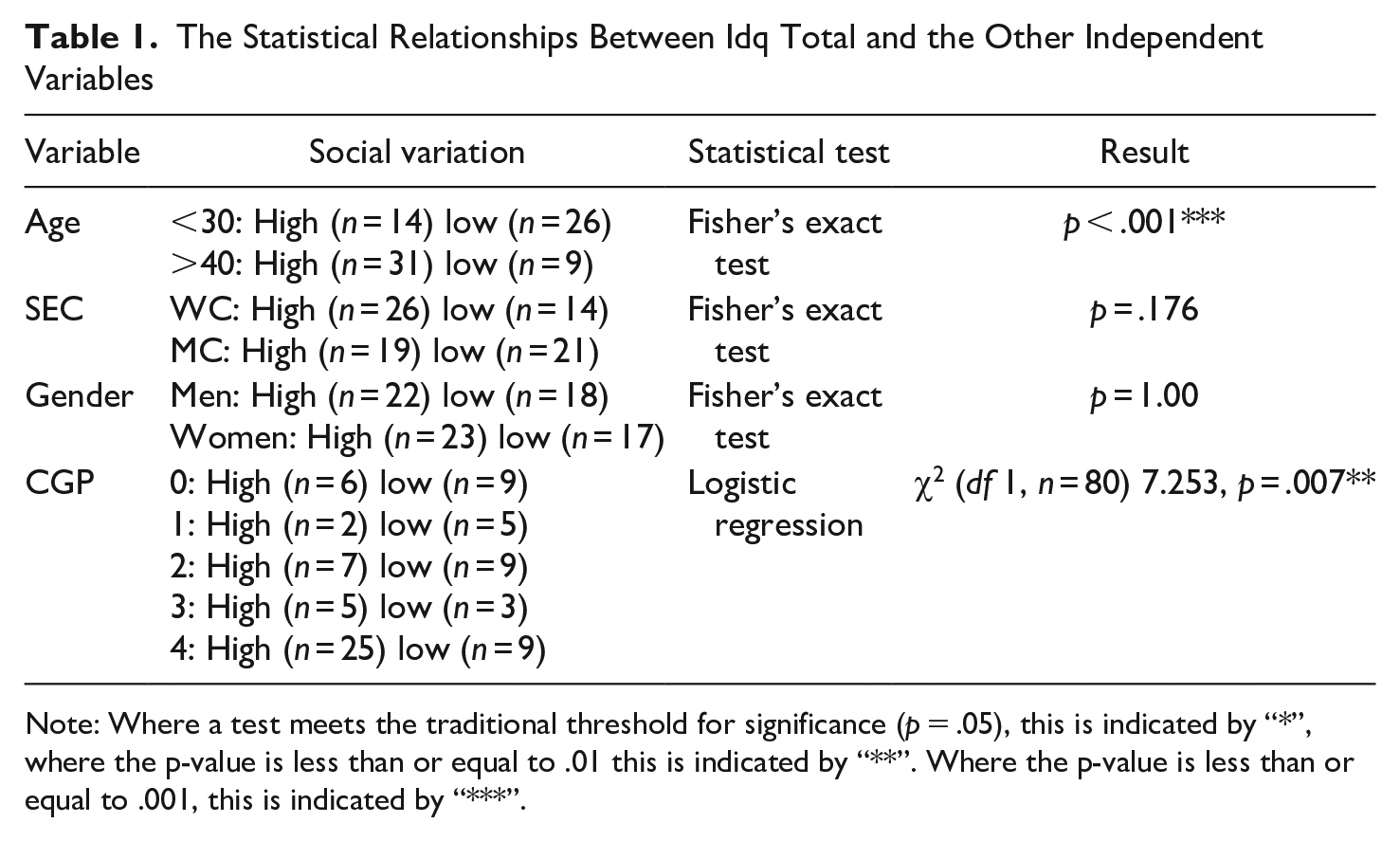
The relationships between IdQ and the other independent variables are displayed in Table 1. Specifically, Table 1 shows the number of participants with high and low IdQ scores across each of the other social variables; for example, twenty-two men received a high IdQ total while eighteen received a low IdQ total.
The Statistical Relationships Between Idq Total and the Other Independent Variables
Note: Where a test meets the traditional threshold for significance (p = .05), this is indicated by “*”, where the p-value is less than or equal to .01 this is indicated by “**”. Where the p-value is less than or equal to .001, this is indicated by “***”.
Table 1 shows that there is a statistically significant association between IdQ total and age. Specifically, older speakers are more likely to have high totals on the IdQ. There is also a statistically significant relationship between CGP and IdQ score, with those with higher numbers of CGP being more likely to have high IdQ totals. These interactions will be discussed further in the study.
The three approaches I detailed earlier (the onomasiological, the semasiological, and the lexical recognition) require distinct methodologies. To study onomasiological usage, I used two elicitation techniques. I used a task-oriented procedure to elicit onomasiological usage in a casual speech style. This approach involved spot-the-difference tasks, where, in order to complete the task, participants were required to identify differences between two near-identical frames. By “spotting the differences” participants used lexical items to refer to the concept that they identified as being non-identical between the frames, for example, “the tourists/emmets are facing different directions.” The participants were told that the purpose of the task was to explore their problem-solving abilities, and they were timed in order to ensure that the primary cognitive load was on task-completion, not lexical usage.
In contrast, to elicit onomasiological usage from a relatively careful speech style, naming-tasks were used. Participants were simply asked to complete the sentence on the screen, such as “this is a . . .,” by naming the image on the screen, such as a lunch box. In this task, participants were told that their use of words was being studied. This means that, unlike in the spot-the-difference task, their attention to word usage was elevated. As the attention paid to speech (see Labov 1972) differs between the spot-the-difference and naming tasks, a comparison of the data elicited in these tasks can be considered to be an analysis of style (see Sandow & Robinson 2018; Sandow 2020, 2022, 2023).
In order to elicit semasiological variants, following Robinson (2010), I used a who/what question-answer schema. I used a slightly adapted version due to the focus on nominal semasiological variables in this study, as opposed to Robinson’s (2010) focus on polysemous adjectives. Robinson’s (2010) who/what elicitation technique typically proceeds in the following manner, where “X” is the investigated polysemous word, “Y” is the referent, and “Z” is the sense:
Who/what is X
Y
Why is Y, X
Because it is Z
However, the second question-answer pair is not always necessary when the investigated variable is a polysemous noun. This is because the participant’s first response, Y, is often simultaneously a referent and a sense. For example, when asked “who/what is an emmet?,” if a participant responded with “a tourist,” the second adjacency pair becomes redundant. However, when the response to the first adjacency pair was unclear, the second question was employed in order to disambiguate the sense being used from potential alternatives. The who/what questions were repeated twice for each variable, so each participant provided two responses. The responses were coded for whether they were elicited in the first or second round of elicitation prompts.
In order to investigate their ability to recognize local dialect lexis, participants were asked to identify the Anglo-Cornish words from a table of words of mixed provenance. The 4 × 8 table contained thirty-two words, thirteen of which are Anglo-Cornish or have distinctly Anglo-Cornish senses (see Table 2, in which the Anglo-Cornish words have been underlined). The other words in the table were from a range of different languages and dialects, including Welsh (Cymraeg), Pittsburghese, and Australian English, as well as some nonce words from Carroll’s (1872) Jabberwocky. Participants were told that they would be asked questions about the words that they correctly identified as being Anglo-Cornish. These questions led into meta-linguistic discussions of particular lexical items as well as the Anglo-Cornish dialect more broadly.
The Anglo-Cornish Dialect Lexical Recognition Task
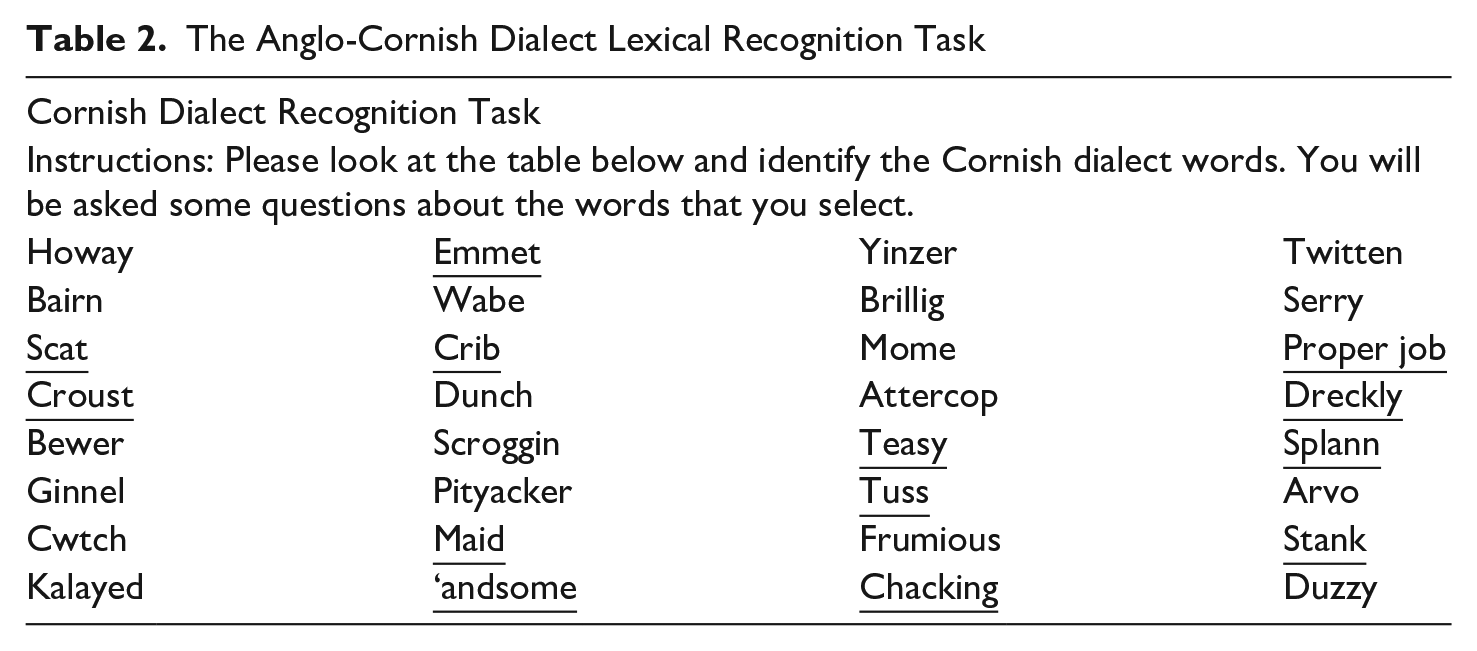
Specifically, the Anglo-Cornish words in the Table 2 are scat (‘knock/hit’), croust (‘snack/lunch’), emmet (‘ant’ or ‘tourist’), crib (‘snack/lunch’), maid (‘woman’), ‘andsome (‘good/lovely’), teasy (‘bad tempered’), tuss (‘idiot’), chacking (‘thirsty’ or ‘desperate’), proper job (‘very good’), dreckly (‘soon/in the future’), splann (‘brilliant’), and stank (‘walk/hike’). These lexical items were selected for this task as they represent a broad range of Anglo-Cornish dialect words, including words from the Cornish language, for example, stank and splann, words with a specific locally-meaningful sense, for example, maid and ‘andsome, as well as words which I perceived to be widely recognizable, for example, proper job and dreckly, and those which I perceived to be less widely recognizable, for example, splann and croust.
4. Results
4.1. Onomasiology
In this article, I treat the four onomasiological variables as a collective, or a “compound variable” (see Sandow 2021). This is done in order to display aggregate patterns, as opposed to the particulars of a single variable. In coding the onomasiological data for an analysis of inter-speaker variation, I simply recorded whether or not a participant used an Anglo-Cornish variant of each of the four variables in either of the elicitation tasks. Thus, if speakers used at least one token of the Anglo-Cornish variants of all four of the onomasiological variables in either of the onomasiological elicitation tasks, they were given a score of four.
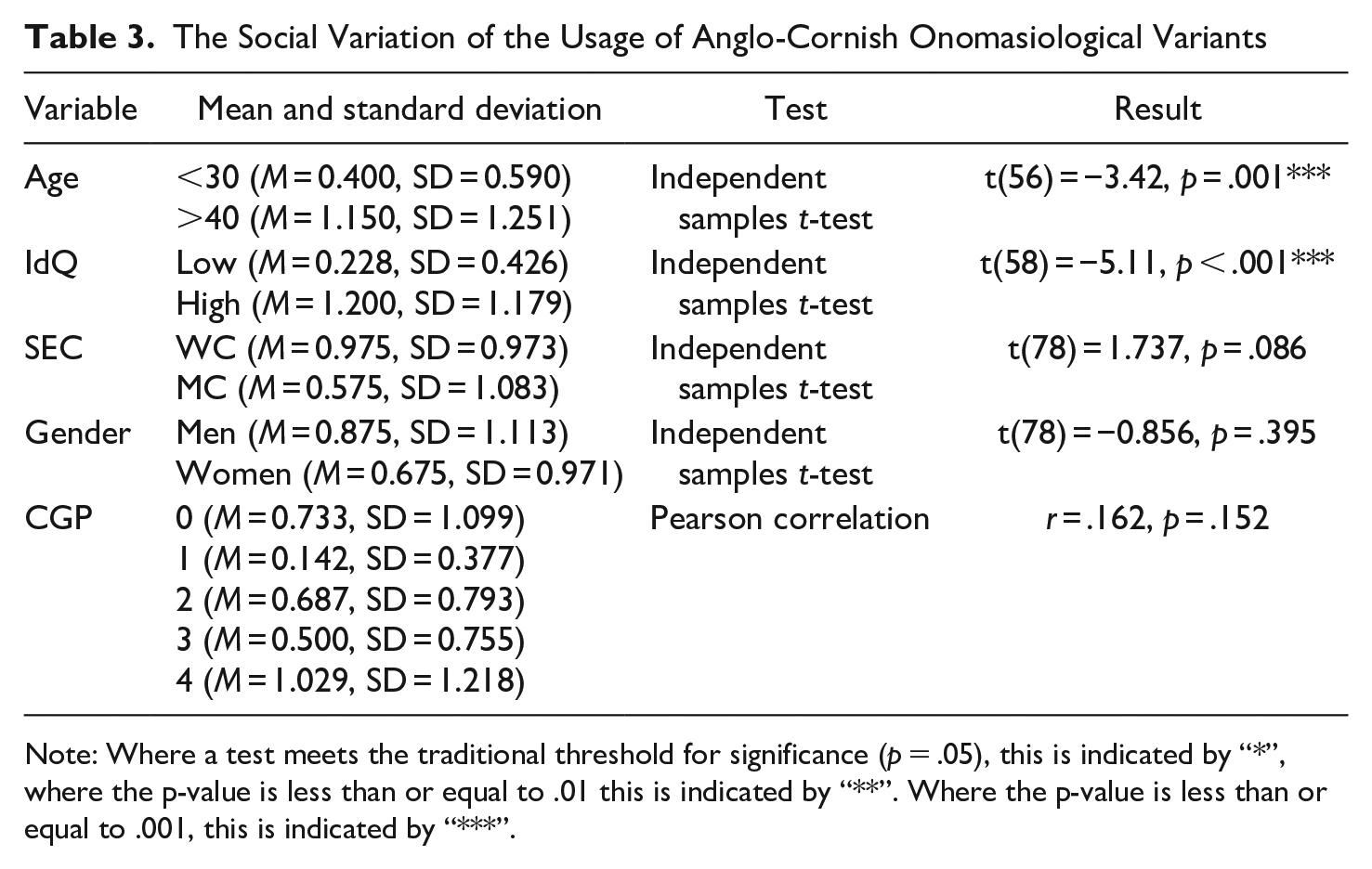
Table 3 shows the group mean values for the number of Anglo-Cornish onomasiological variants used. Older speakers and those with high IdQ scores use a higher frequency of the investigated Anglo-Cornish dialect words. No other social variable exhibits a statistically significant result.
The Social Variation of the Usage of Anglo-Cornish Onomasiological Variants
Note: Where a test meets the traditional threshold for significance (p = .05), this is indicated by “*”, where the p-value is less than or equal to .01 this is indicated by “**”. Where the p-value is less than or equal to .001, this is indicated by “***”.
It is not immediately clear how to interpret this data as there is both a statistical relationship between age and IdQ total (see Table 1), and both categories exhibit a statistically significant association with Anglo-Cornish onomasiological usage (see Table 3). Various interpretations could be suggested, including attributing sociolinguistic variation to age, to identity, or some combination thereof. Clarity can be provided by multivariate analysis, which can be used in order to provide quantitative evidence of the interaction between the independent variables of age and local identity. For this purpose, I use Chi-square Automatic Interaction Detection (CHAID; see Van Diepen & Franses 2006; Robinson 2014). CHAID identifies interactions between independent variables and visualizes the results in the form of a tree diagram. In relation to multiple linear regression, CHAID has the advantage that it can compute independent variables which exhibit multicollinearity (see Rodríguez-Sabiote, Álvarez-Rodríguez, Álvarez-Ferrandiz & Zurita-Ortega 2021). This approach is thus appropriate for the data set used in this study, where IdQ score exhibits statistical relationships with age and CGP.
Figure 1 shows that there is a statistical relationship between age and Anglo-Cornish onomasiological usage, with older speakers being more likely to use local words. The CHAID tree continues to split, revealing that within the younger and older populations, there are statistically significant identity effects, such that younger and older speakers with high IdQ totals use a higher frequency of Anglo-Cornish words than their counterparts with lower IdQ totals.
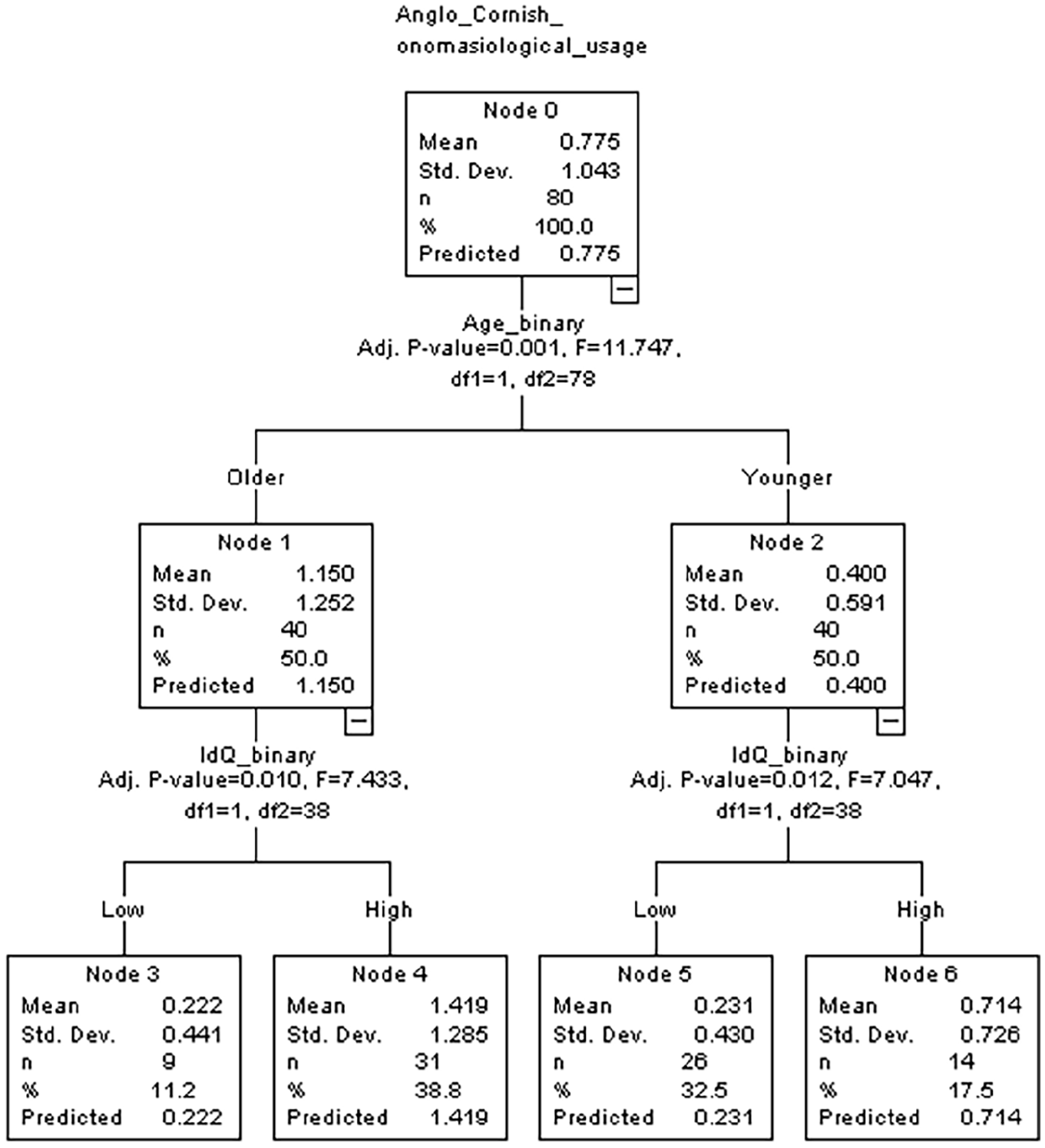
A CHAID Decision Tree Displaying the Social Variation of Anglo-Cornish Onomasiological Usage
While the decision-tree presented in Figure 1 is not the strongest model for the observed data, it was “forced” to split first in relation to age. This was done not to suggest that this is the best way to account for the patterns of variation, but to demonstrate that the identity effect on Anglo-Cornish onomasiological usage is independent of the age effect. That is, one effect is not a mere corollary of the other. This interaction displayed at the aggregate level in Figure 1 also holds for the individual variables
It is not possible to advocate for either an act of identity or interlocutor frequencies based on the socially-distributed usage displayed in Figure 1. However, stylistic evidence can serve to differentiate the two potential readings of the identity effect in the data. In terms of stylistic variation, it is important to outline what sort of data may support each interpretation. I propose that a lack of style shifting or a shift toward the standard form in careful speech would be supportive of an interlocutor frequency interpretation. Conversely, an act of identity interpretation would be supported by the purposeful use of local dialect forms when attention to speech, and, more broadly, attention-to-self (see Sandow 2022), is elevated. That is, I propose that a shift toward the local forms in careful speech (here, the naming task), through the styling of a local identity, would be supportive of an acts of identity interpretation.
The stylistic data in fact support the latter prediction (see Figure 2). That is, a higher rate of Anglo-Cornish forms is used in the relatively careful speech style. When comparing stylistic variation, I coded the elicitation task in which each Anglo-Cornish variant was used, that is, casual or careful. The mean rate of usage of Anglo-Cornish words in the casual style is 0.0625 (N = 80, SD = 0.290) and 0.775 (N = 80, SD = 1.04) in the careful style. The difference between the speech styles is statistically significant (two sided paired samples test, t(79) = −6.240, p = <.001). All speakers who exhibited style shifting did so in this “inverted” direction (cf., e.g., Labov 1972:113). In Sandow (2022) I consider the motivation for this inverted style pattern with recourse to the linguistic marketplace in Cornwall. That is, while Anglo-Cornish dialect words are stigmatized on the standard language market, which can lead to a lack of local words in “vernacular” speech, when conditions are right, such as in an interview with a Cornish interlocutor, that local dialect words can assert status on a locally meaningful market, which results in styled usage of such words in careful speech.
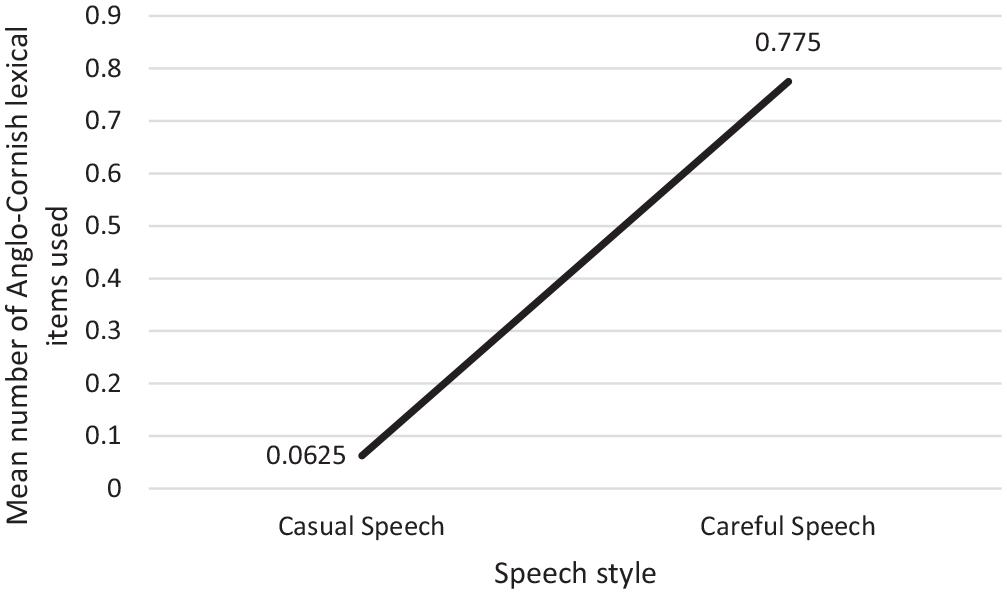
The Stylistic Variation of Anglo-Cornish Onomasiological Usage
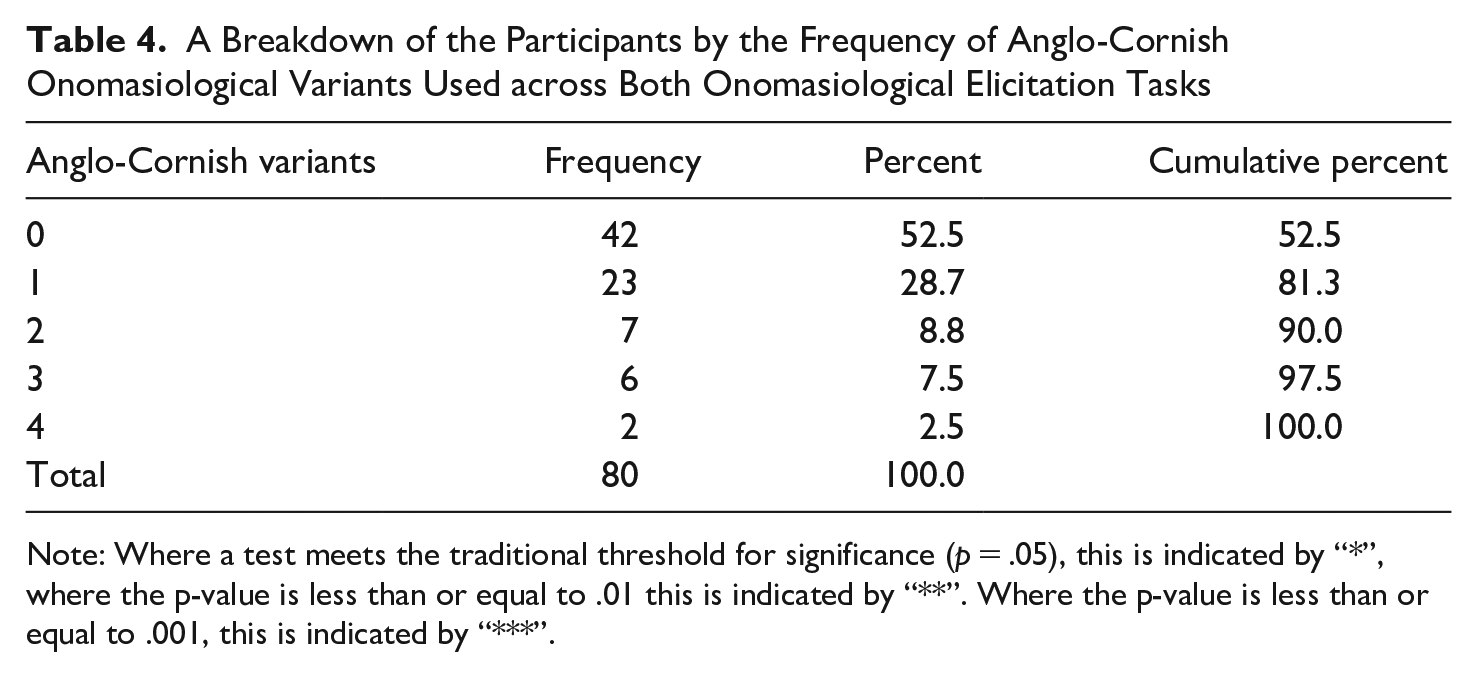
In the casual style, five Anglo-Cornish variants were used by four different speakers, whereas thirty-eight speakers used sixty-two Anglo-Cornish variants in the careful style. As shown in Table 4, forty-two speakers did not use any Anglo-Cornish variants in any style. Twenty-three used a single Anglo-Cornish variant, seven speakers used two local variants, six speakers used three local variants, and two used all four local variants.
A Breakdown of the Participants by the Frequency of Anglo-Cornish Onomasiological Variants Used across Both Onomasiological Elicitation Tasks
Note: Where a test meets the traditional threshold for significance (p = .05), this is indicated by “*”, where the p-value is less than or equal to .01 this is indicated by “**”. Where the p-value is less than or equal to .001, this is indicated by “***”.
While elicited data provide only a partial picture of the sociolinguistic ecology of a community, the style pattern observed in Figure 2 is strongly supported by participants’ meta-linguistic commentaries regarding the performative use of the Anglo-Cornish dialect, particularly its lexis. Such comments include, for example, “[the Anglo-Cornish dialect] is reflective of a Cornish identity. It is an identity statement” (Sandow 2022:685) and “[the Anglo-Cornish dialect] is a performance, a deliberate performance” (Sandow 2020:81). Such comments demonstrate that members of the Camborne-Redruth community recognize the stylistic function of Anglo-Cornish lexis and the ways in which it can function to construct, or to communicate, Cornish identities.
4.2. Semasiology
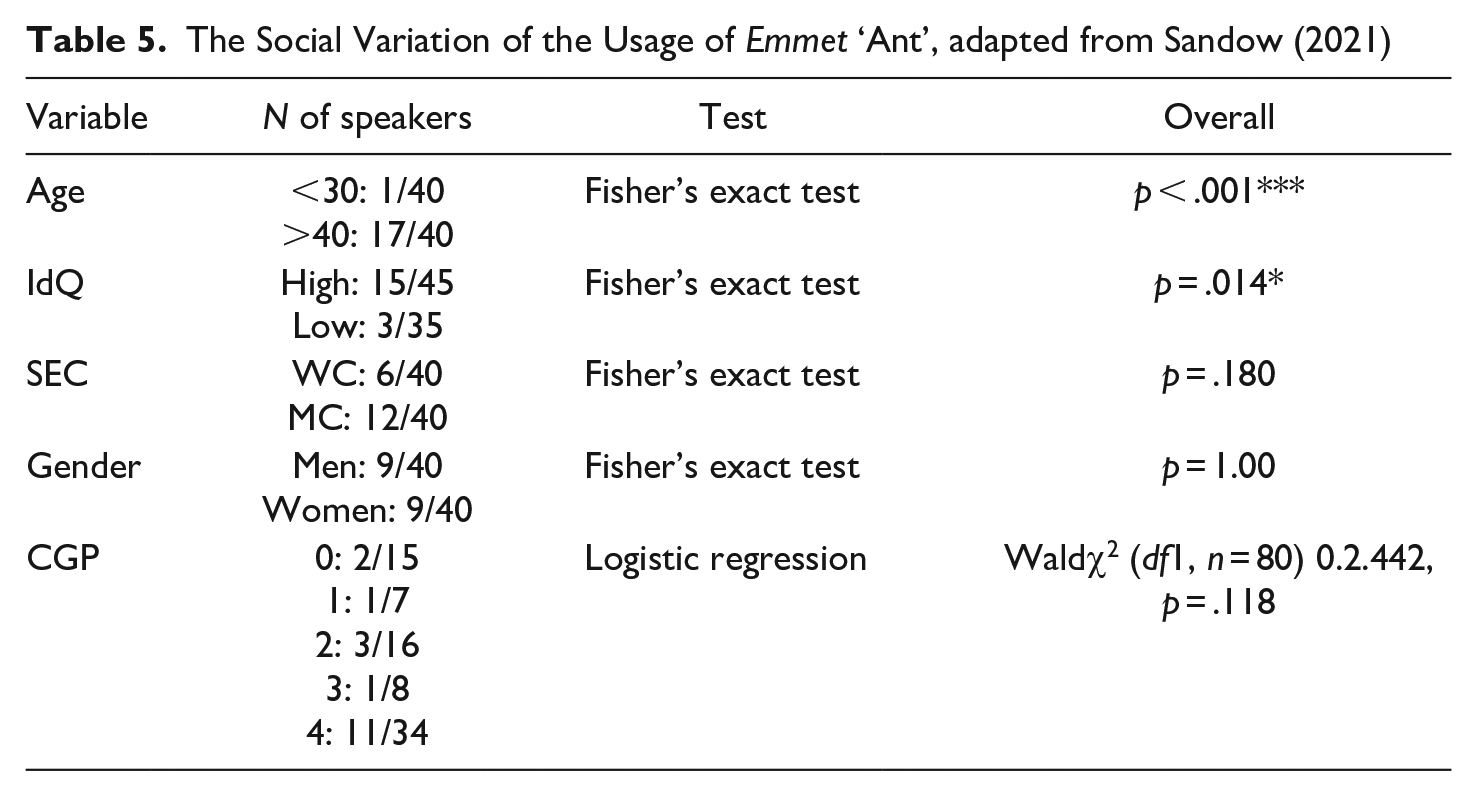
In the statistical analysis of the semasiological variation of emmet, I explore only variation in the use of emmet ‘ant,’ as seventy-eight of eighty speakers used emmet ‘tourist.’ The near-ceiling effect in the use of emmet ‘tourist’ makes it unsuitable for statistical analysis, but it does highlight the near ubiquity of this more recent innovation. Emmet ‘ant’ exhibits a great deal of social variation, including an identity effect, whereby speakers with high IdQ totals are more likely to use the recessive variant. However, it is also the case that older speakers are more likely to use emmet ‘ant’ than their younger counterparts (see Table 5). The interactions between (independent) social variables are displayed in Figure 3.
The Social Variation of the Usage of Emmet ‘Ant’, adapted from Sandow (2021)
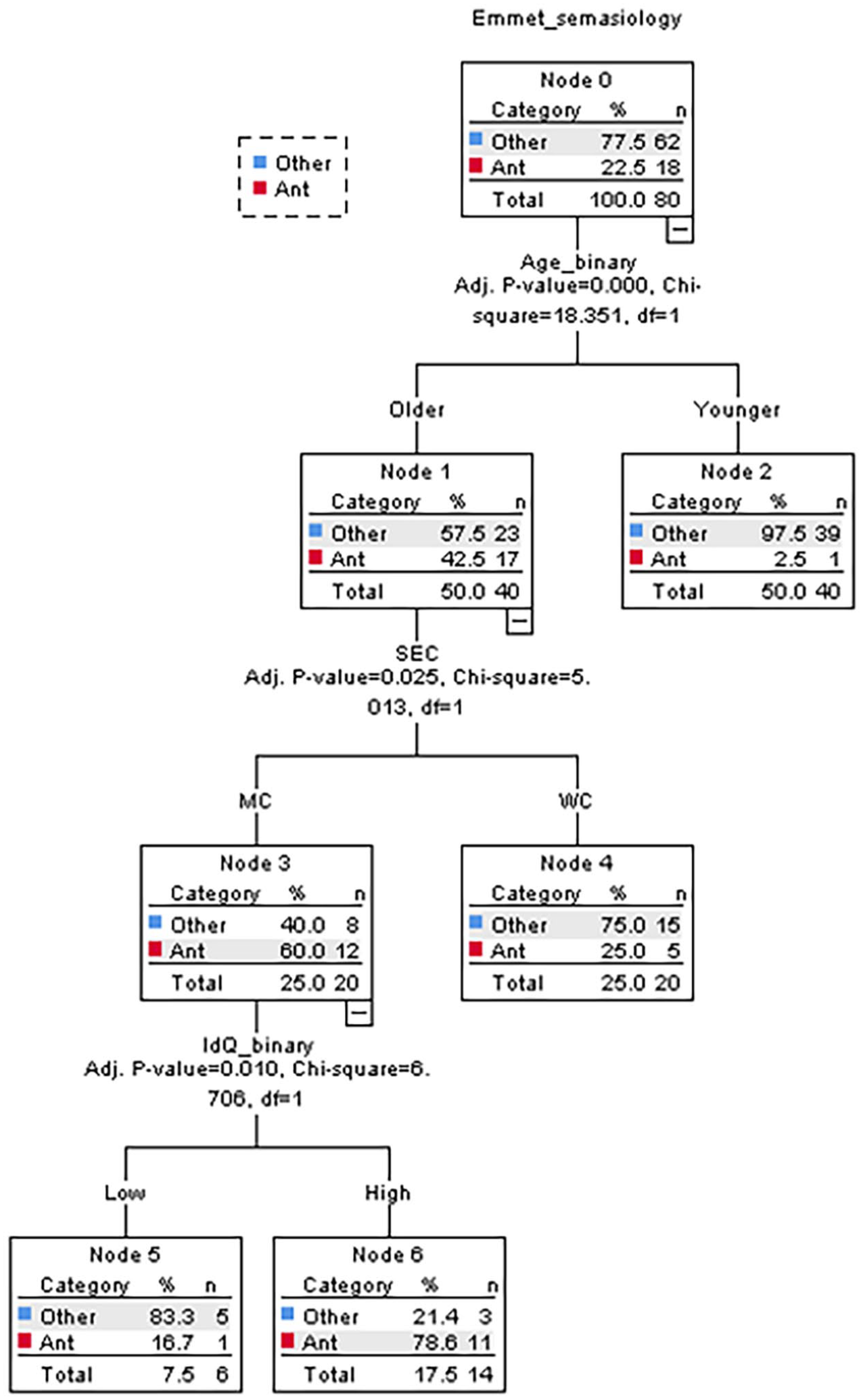
A CHAID Decision Tree Displaying the Semasiological Variation of Emmet, from Sandow (2021)
Figure 3 shows that age is the strongest predictor of the usage of the semasiological variant emmet ‘ant.’ For the older speakers, the next strongest effect is that of socioeconomic class with middle-class speakers being more likely to retain the recessive variant than their working-class counterparts. The final split displayed in the decision-tree in Figure 3 is that, among those speakers who are older and middle-class, those with high IdQ totals are most likely to use emmet ‘ant.’ This highlights the role of identity, alongside other factors, in the mediation of this change in progress.
The Anglo-Cornish sense of maid ‘woman’ does not exhibit an overall identity effect, or, for that matter, any overall social variation. However, it does exhibit an identity effect when one considers the responses to the first iteration of the who/what elicitation prompt task only, as shown in Table 6. This result is suggestive of a change to the word’s primary sense as prototypical senses are typically given before more peripheral senses in lists or elicitation tasks (see Sandow 2023). Maid ‘woman’ also exhibits an age effect in the first elicitation task, as seen in Table 6. Thus, while there is no overall variation in the semasiological usage of maid and both senses are widely attested, there is such variation when one considers the core sense, that is the first elicited sense, only.
The Social Variation of Maid ‘Woman’, adapted from Sandow (2021)
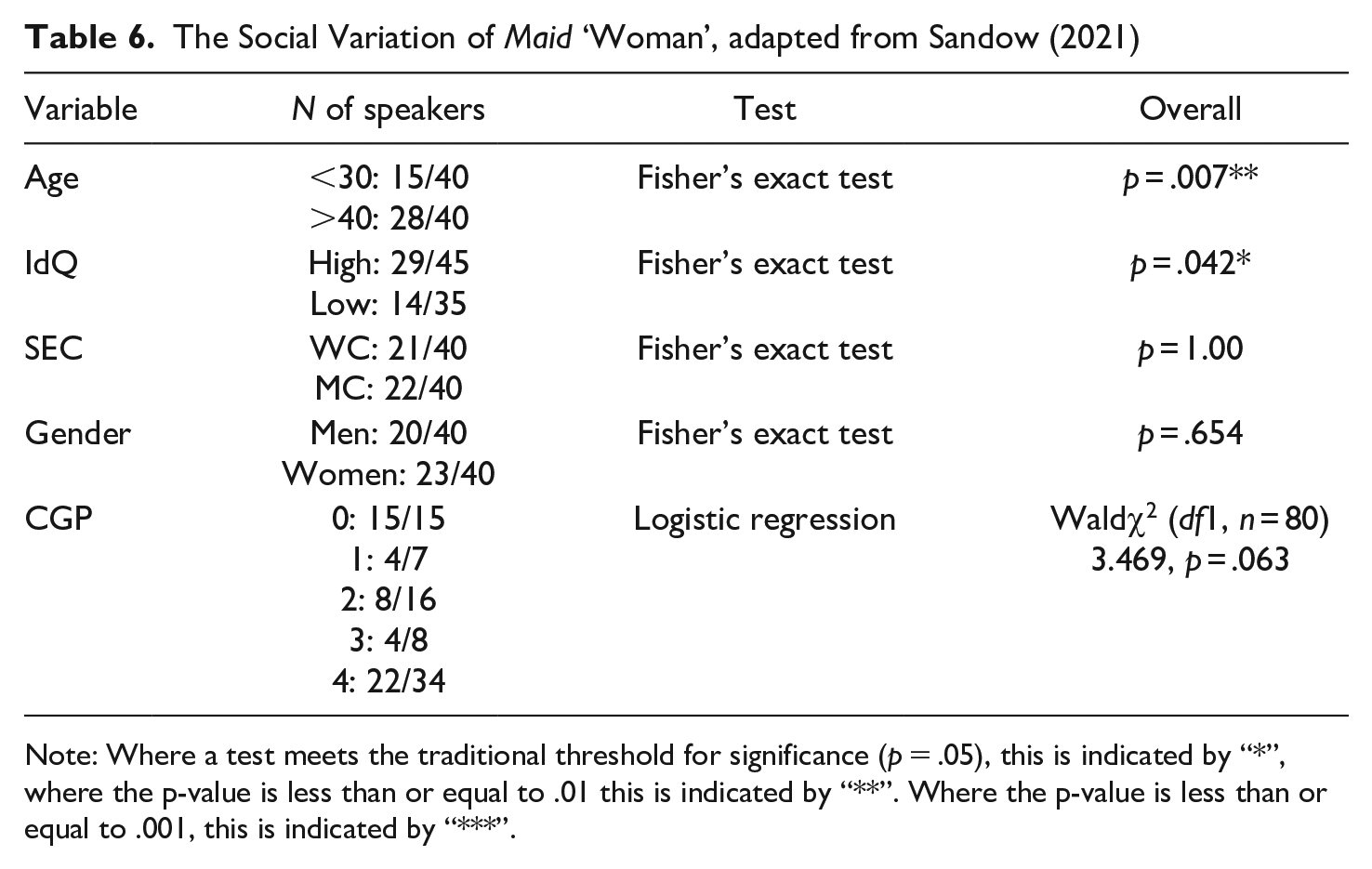
Note: Where a test meets the traditional threshold for significance (p = .05), this is indicated by “*”, where the p-value is less than or equal to .01 this is indicated by “**”. Where the p-value is less than or equal to .001, this is indicated by “***”.
Specifically, the change in the prototypical sense maid from ‘woman’ to maid ‘female servant or attendant’ is most advanced among younger speakers with low IdQ totals (see Figure 4). That is, the supra-local sense is used the most by younger speakers with a less strong local orientation. This highlights the role of identity in the trajectory of a semantic change in progress.
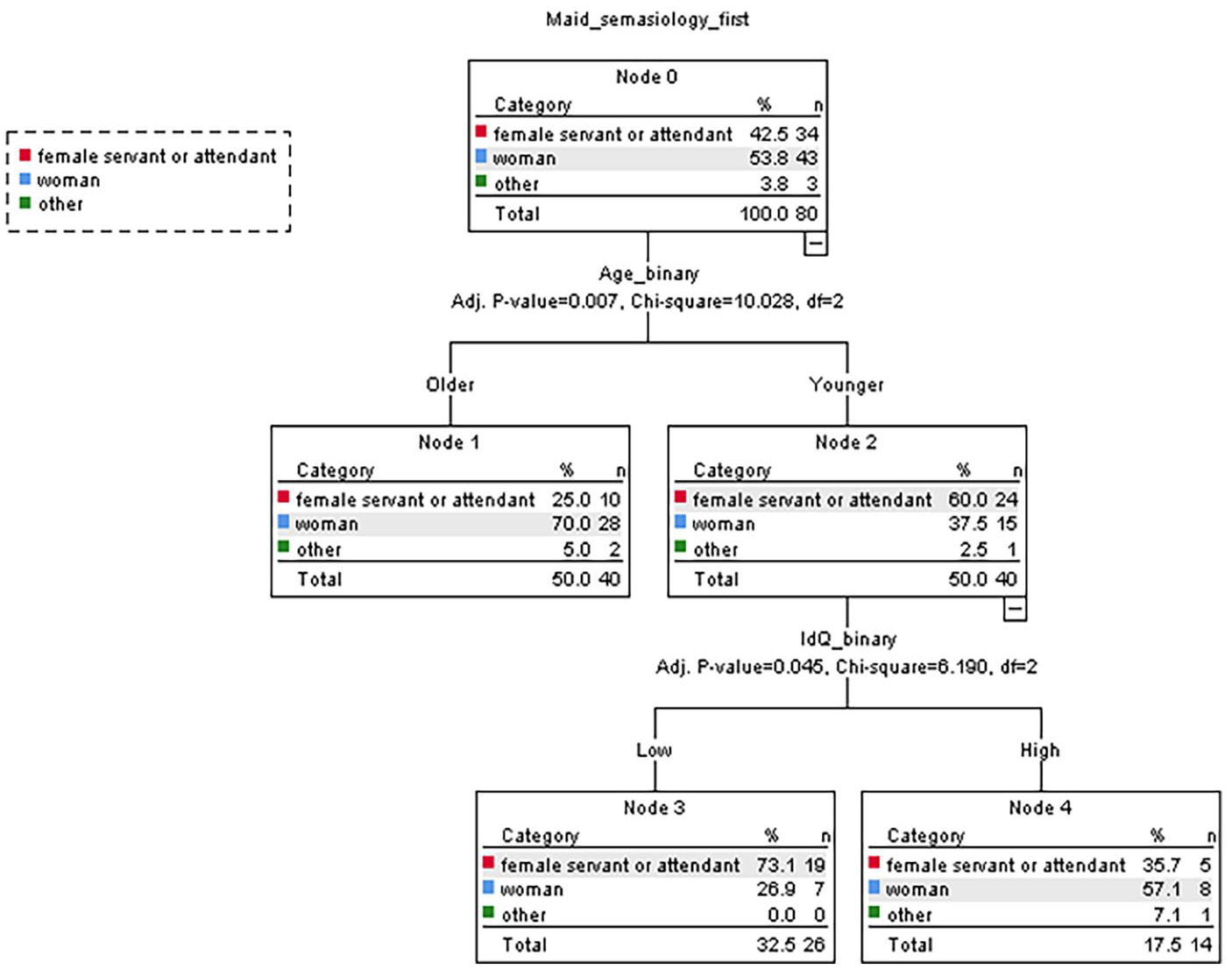
A CHAID Decision Tree Displaying the Social Variation of the Usage of Maid in the First Semasiological Elicitation Task
The semantic changes of both emmet and maid exhibit an identity effect. Figures 3 and 4 highlight the independence of an identity effect, but the quantitative social distributions themselves do not provide any indication as to whether the semasiological data support the act of identity or interlocutor frequency interpretation.
4.3. Lexical Recognition
The lexical recognition task also reveals an identity effect: those with higher IdQ totals were more likely to recognize a greater number of Anglo-Cornish words than their counterparts with lower IdQ totals. Table 7 shows that in addition to the identify effect, the social categories of age and CGP, which both interact with IdQ totals (see Table 1), also exhibit statistical associations with Anglo-Cornish lexical recognition. The grouped mean values in Table 7 refer to the average number of Anglo-Cornish words recognized by participants in that particular group. For example, working-class participants recognized on average 8.88 Anglo-Cornish words in the lexical recognition task while their middle-class counterparts recognized an average of 8.83 Anglo-Cornish dialect words.
The Social Variation of the Recognition of Anglo-Cornish Dialect Words, adapted from Sandow (2021)
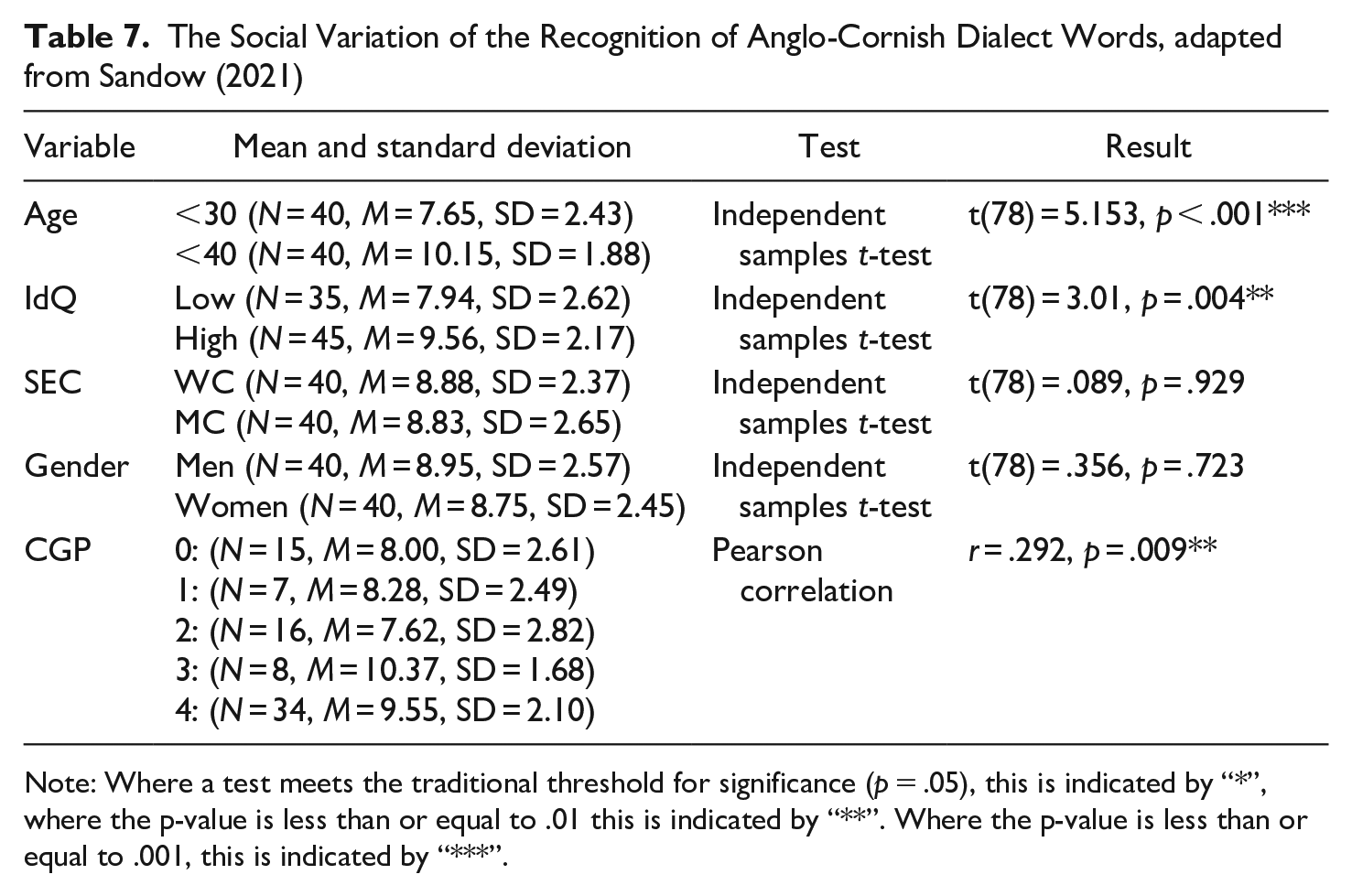
Note: Where a test meets the traditional threshold for significance (p = .05), this is indicated by “*”, where the p-value is less than or equal to .01 this is indicated by “**”. Where the p-value is less than or equal to .001, this is indicated by “***”.
Figure 5 displays an interaction between IdQ total, age, and lexical recognition, with older participants with high IdQ scores recognizing the greatest total of Anglo-Cornish words (mean average 10.61, standard deviation 1.75) and younger speakers with low IdQ totals recognizing the fewest (mean average 7.27, standard deviation 2.39). This decision tree was “forced” to split first on the basis of IdQ total, in order to highlight the interaction with age. Thus, while this is not the decision tree with the strongest statistical foundation, it does serve to highlight the independence of the age and IdQ effects on this data set.
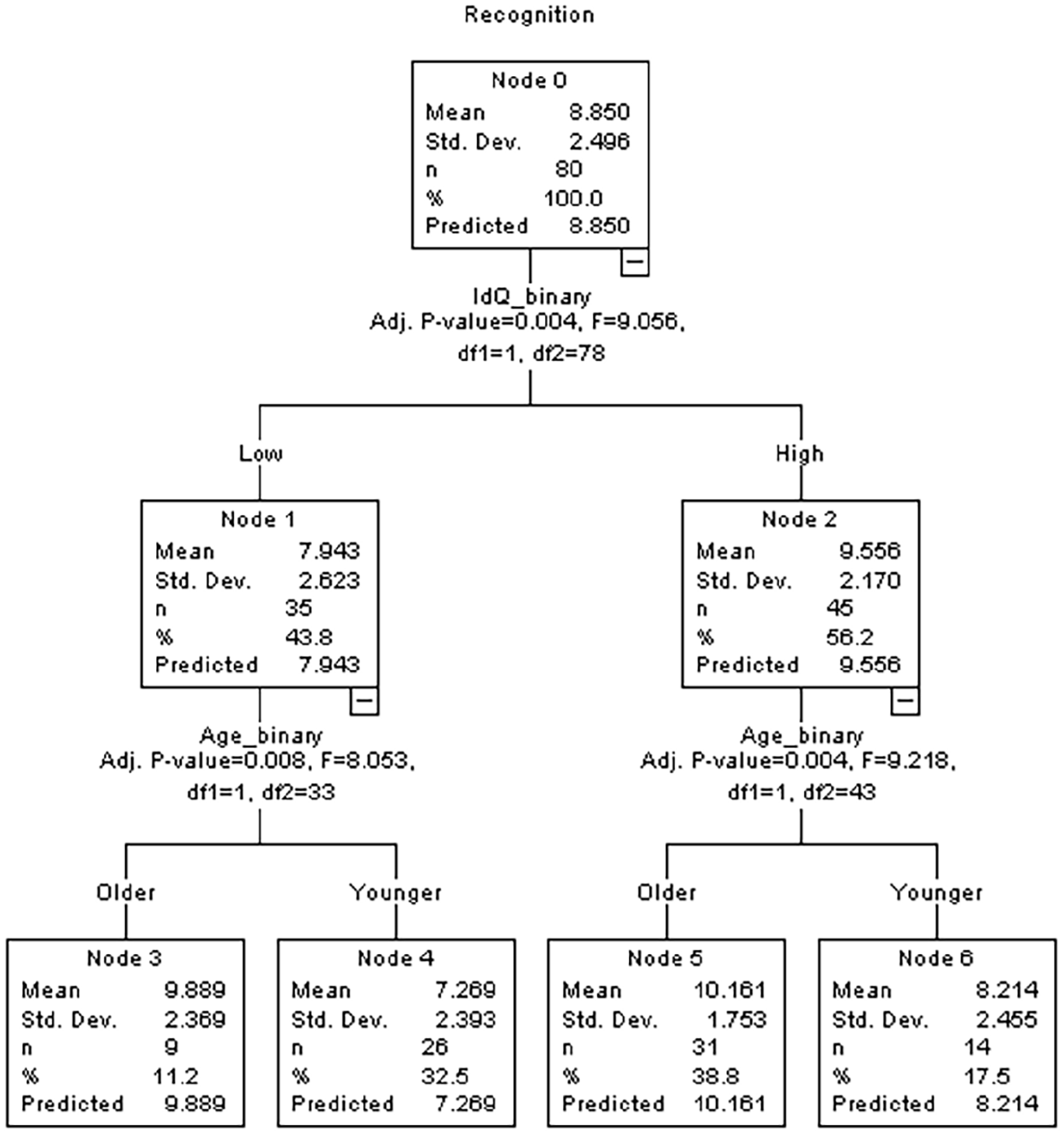
A CHAID Decision Tree Displaying the Social Variation of Anglo-Cornish Lexical Recognition Scores, in Which the First Split in the Tree Was “Forced” in Relation to Idq Total (adapted from Sandow 2021)
Figure 5 demonstrates an interaction between IdQ total and age. Within the groups with high and low scores, older participants recognized significantly more Anglo-Cornish words than their younger counterparts. This demonstrates that the local identity effect on the lexical recognition scores is not a corollary of an age effect.
Table 7 also shows that lexical recognition scores are conditioned by CGP, with those with a higher number of CGP being more likely to recognize a greater number of Anglo-Cornish words from a table of mixed provenance. In light of this finding, it is also important to demonstrate independence of the identity effect from the CGP effect. Figure 6 shows that, when considering CGP and identity only, the group who, on average, recognize the fewest Anglo-Cornish words are those with two or fewer CGP and a low IdQ total. The decision tree in Figure 6 was also “forced” to split first on the basis of CGP, in order to highlight the interaction with IdQ total.
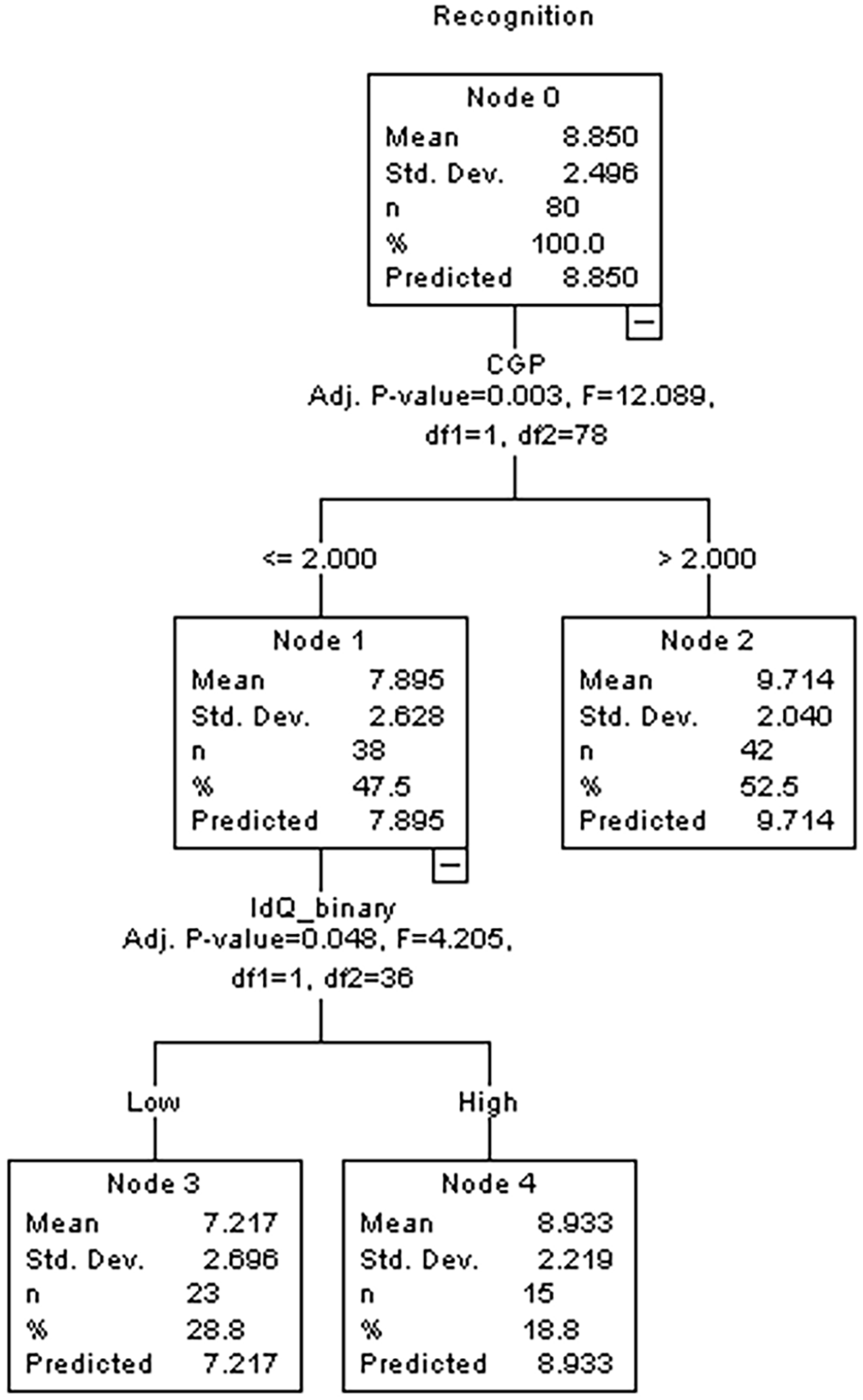
A CHAID Decision Tree Displaying the Social Variation of Anglo-Cornish Lexical Recognition Scores, in Which the First Split in the Tree Was ‘Forced’ in Relation to CGP
5. Discussion
I propose that the place identity effect in the onomasiological usage data in this article should be read as an act of identity. In this reading, the shift toward Anglo-Cornish words in careful speech by those with high IdQ totals is an act of Cornish identity. This interpretation is supported by participants’ meta-linguistic discussions regarding the performative use of Anglo-Cornish words. In contrast, the interlocutor frequency interpretation (Labov 2001:191) is not a satisfactory account of why IdQ total is a good predictor of the onomasiological usage. Interlocutor frequency may have been a sufficient explanation of Anglo-Cornish onomasiological usage had the local variants occurred mainly in casual speech styles or lacked clear stylistic variation. However, it does not account for why those with strong local identities were more likely to use local forms to style their Cornish identities, using lexical items which broadly index Cornishness, in careful speech. This is not an example of linguistic output (the words one uses) simply mirroring linguistic input (the words one hears). Instead, speakers with a strong sense of local identity use Anglo-Cornish dialect lexis to perform a locally meaningful identity. Hence, I interpret the use of Anglo-Cornish variants in careful speech styles as an example of acts of identity. This is not to suggest that interlocutor frequencies are irrelevant here, just that this cannot be the sole explanation for the observed patterns of onomasiological usage.
There is no analogous evidence to support an act of identity interpretation of the semasiological usage data. As a result, I interpret the relationship between IdQ totals and the semasiological variation of emmet and maid as connected to interlocutor frequency, especially in light of Labov’s (2001) suggestion that the interlocutor frequency should be the default interpretation. The change from maid ‘woman’ to maid ‘female servant or attendant’ is led by younger speakers with low IdQ totals. If we apply Labov’s (2001) interlocutor frequency interpretation to this data, those who are least likely to use the local variant maid ‘woman’ have the least frequent engagement in locally-oriented social networks and social practices. However, in the case of emmet, both senses are Anglo-Cornish and can index a Cornish identity, with ‘ant’ being the more conservative sense and ‘tourist’ being the more innovative. I propose that alignment to traditional social practices and engagement in social networks comprising like-minded individuals (see “value homophily”; McPherson, Smith-Lovin & Cook 2001; see also discussion in Sharma & Dodsworth 2020:354) to some extent shields against innovation, even when that innovation is endogenous to the community. As Labov (2001:191) suggests, social preferences can influence social network structure, which can, in turn, influence linguistic variation (see also Sharma & Dodsworth 2020). This accounts for why those with high IdQ totals are more likely to use the conservative variant emmet ‘ant’ in addition to the more innovative variant emmet ‘tourist.’ Again, this result highlights the role of identity in the mediation of semantic change in progress.
Recognition of dialect words is of course not an act of identity. There is no performative component involved in identifying Anglo-Cornish words from a table of words of mixed provenance. Instead, the local identity effect exhibited in relation to lexical recognition should be interpreted as a consequence of interlocutor frequencies. That is, participants’ knowledge of Anglo-Cornish words can be attributed to the interlocutors with whom they tend to engage. These interlocutors influence not only the participants’ active repertoire of vocabulary, as with the semasiological usage data, but also their awareness of local dialect words.
The interlocutor frequency interpretation is a sufficient explanation for the observed relationship in these data between IdQ totals and semasiological usage and lexical recognition scores. This is because there is no evidence to suggest that the semasiological variation is used to “do” Cornishness. Nor do participants “do” Cornishness by recognizing a large number of Anglo-Cornish words. But the semasiological and recognition data provide evidence that identity effects are attested even in the absence of the styling of local identities. Increased exposure to local linguistic forms through a higher frequency of interactions with (particularly socially and linguistically conservative) Cornish interlocutors can account for the observed statistical relationship between IdQ total and semasiological variation and lexical recognition scores.
6. Conclusion
The two main focuses of this article have been (a) potential interaction effects between strength of local identity and other social categories and (b) the interlocutor frequencies (Labov 2001) and acts of identity (Le Page & Tabouret-Keller 1985) interpretations of statistical relationships between strength of identity and sociolinguistic variation.
With respect to (a), this article has demonstrated the existence of place identity effects which are not corollaries of other dimensions of social variation. Multivariate analyses demonstrated that the effect of identity of lexical usage and recognition is not (at least in this study) an artefact of the relationship between, for example, place identity and age or between age and sociolinguistic variation. Even when age is controlled for, it is those with a higher IdQ totals who are most likely to use, and recognize, Anglo-Cornish words and meanings. This means that it is possible to claim the presence of a place identity effect on sociolinguistic variation which is not a mere corollary of other social categories such as age or socioeconomic class (cf. Haddican, Foulkes, Hughes & Richards 2013; Baranowski 2017).
With respect to issue (b), I have advocated for both interpretations throughout this article. Some of the lexical data in this article support the interlocutor frequency interpretation while other data support the act of identity interpretation. The observed semasiological variation and lexical recognition data are best accounted for by interlocutor frequency. This follows Labov’s (2001) position whereby the interlocutor frequency interpretation is the default reading of place identity effects; there was no evidence in support of acts of identity. However, this interpretation is not a satisfactory reading of the onomasiological usage data. The shift toward Anglo-Cornish variants in careful speech by those with a strong Cornish identity is a clear example of an “act of identity.”
One limitation of this study is that there was no explicit measure of interlocutor frequencies, as IdQ score functioned as a proxy. While I have adopted Labov’s (2001) position of attributing identity effects to interlocutor frequencies in the absence of alternative evidence, I suggest that future research should seek to develop tools which can serve to identify and quantify the role of interlocutor frequencies more affirmatively. Thus, I join Beaman (2020) in calling for the development of tools to unpack this distinction between strength of local identity and social network structure further. By considering both (regional) identity and interlocutor frequencies as distinct, though possibly related, factors in sociolinguistic variation, future research will more readily serve to provide more specific analyzes of patterns of sociolinguistic variation such as the ones discussed in this article. Moreover, while the variables investigated here are relatively few in the context of the broader lexicon, they serve to illustrate identity effects and how sociolinguists can use our methodological and analytical toolkits to tease apart distinct interpretations of such data.
Footnotes
Appendix: The Identity Questionnaire Used to Quantify Participants’ Strength of Local Identity
Acknowledgements
This article is developed from my doctoral thesis ( ). I would like to thank my supervisor, Justyna Robinson, as well as my two examiners, M. Lynne Murphy and Natalie Braber, for their input into the development of this work. I would also like to thank Paul Foulkes, two anonymous reviewers, and the journal editors, Alexandra D’Arcy and Peter Grund, for comments on previous versions of this article as well as audiences at Language Variation and Change in the South of England and the University of York Linguistics Society. Any remaining errors are my own.
Declaration of Conflicting Interests
The author declared no potential conflicts of interest with respect to the research, authorship, and/or publication of this article.
Funding
The author received no financial support for the research, authorship, and/or publication of this article.