




Abstract
This article examines the historical development of the VVingOBL construction, as exemplified by “Jane came whistling down the street” or “She went walking up the field path,” where an intransitive motion verb is followed by a present participle and an oblique complement. The analysis looks at the precursors of the construction since Old English and argues that the sharp rise in productivity of the VVingOBL construction, especially from the second half of the nineteenth century, is interrelated with changes affecting English motion vocabulary in Early and Late Modern English and also the increase in frequency of the
1. Introduction
The aim of this article is to examine the origins and historical development of the construction exemplified in (1) and (2) (henceforth, the VVingOBL construction).
(1) [. . .] the merry little group went laughing up the stairs. (BNC, 1991, Sunley, Fields in the sun)
(2) he [. . .] came running forward. (CLMET3.01, 1726, Chetwood, The voyages [. . .] of Captain Robert Boyle)
In terms of form, these structures involve an intransitive motion verb (V), such as
(3) Troops of bright-eyed girls [. . .] went, tripping beneath the trees, towards the cottage of Widow Gostillon. (CLMET3.03, 1852, Chamber’s Edinburgh journal)
(4) Cecil Graham comes towards him laughing. (CLMET3.03, 1892, Wilde, Lady Windermere’s fan)
The past thirty years have seen extensive research on the development of various kinds of sequences involving -ing forms. Most notably, attention has been paid to those constructions where the -ing form is gerundial in origin, that is, it goes back to an abstract action noun in -ing (as in 5).
(5) Forbeare the eting of Swynis flesche. (1552 J. Hamilton, Catech. I.i.f.6; OED, s.v. forbear v. 5)
From Late Middle English (LME) onwards, this noun developed verbal properties and became formally indistinguishable from the present participle. This development led to the emergence of the -ing clausal patterns that now complement verbs like
The article is organized as follows. Section 2 reviews the existing literature on the VVingOBL construction and offers a brief preliminary characterization. Section 3 summarizes the theoretical model—Talmy’s typology of complex event integration (1972, 2000:II, 21-288)—which will be employed in order to organize and interpret the results from the corpus data. Section 4 is concerned with the two grammatical developments noted above, that is, the obligatorification and extended range of uses of the progressive over the Modern period, plus changes in the English motion vocabulary. Section 5 describes the data sources and the procedure for data collection of the VVingOBL construction from LME to the present day. Sections 6 and 7 provide, respectively, an overview of the construction’s precursors in Old and Middle English and the results of the detailed quantitative analysis of the corpus materials. Section 8 discusses the VVingOBL construction in relation to grammaticalization and serialization, and in particular the extent to which the morphosyntactic and semantic properties of the construction support analyzing it as a serial verb construction (Aikhenvald & Dixon 2006; Haspelmath 2016). This hypothesis has been raised in work by Goldberg (2006:52), “despite the fact that English does not allow serial verbs in general.” Finally, section 9 offers some concluding remarks.
2. Research on the VVingOBL Construction
Brief references to the use of the VVingOBL construction in Present-Day English (PDE) can be found in Spears (1982:852-853), Bolinger (1983:158), and Salkie (2010:177-179), all of whom essentially agree that both verbs name simultaneous or overlapping actions. In a more comprehensive treatment, Matsumoto (2016) examines a vast collection of English “multi-verb sequences,” namely -ing complement clauses in object function (“I don’t like talking in public”), aspectuals (“It’s time to start thinking about the next year”), so-called expeditionary go (“Let’s go swimming”; for the label, see Salkie 2010), modality
This view is also found in Goldberg’s (2006) work. It is set within the framework of Construction Grammar (CxG) and its conception of the language system as made up of an inventory of constructions, that is, correspondences of form and meaning that are part of speakers’ linguistic knowledge. Goldberg (2006:50) argues that the VVingOBL construction illustrates “the type of partially idiosyncratic and partially general knowledge that language learners retain.” She adds that the construction bears progressive semantics, “such that the activity described must be construed as obtaining over a period of time or as being iterative” (Goldberg 2006:51). She provides a formal representation of the construction, reproduced here as Figure 1.

The VVingOBL Construction (from Goldberg 2006:52)
The representation in Figure 1 employs notation that is characteristic of the CxG model, which pairs a semantic side (“Sem”) with a formal side (“Syn”); the semantic side specifies an overall event meaning (‘move in a [certain] manner along a path’). The formal side specifies a particular configuration of constituents: a V belonging to a very restricted set of possible motion verbs (according to Goldberg, only
(6) Sylvie screamed. Screamed and screamed again. An attendant came running. (BNC, 1992, Appignanesi, Memory and desire)
Goldberg’s (2006) representation of the VVingOBL construction can serve as a useful point of departure for the discussion that follows; it will be refined in later sections in light of the evidence retrieved from the various corpora employed in the analysis.
3. Talmy’s Typology of Event Integration
The expression of motion events across languages has been a topic of lively debate since the publication, over forty years ago, of Talmy’s influential work (1972, 2000) on the classification of the world’s languages into “satellite-framed” and “verb-framed.” A motion event, according to Talmy (2000:II, 25-26), consists of four components: a) a figure moving with respect to another entity, b) the reference entity, or ground, with respect to which the figure moves, c) the path followed by the figure with respect to the ground, and d) the motion itself. Thus, in (7), the rock functions as the figure, the hill as the ground, down expresses path, and moved motion.
(7) The rock moved down the hill.
Figure Motion Path Ground
Motion events can differ in terms of their degree of structural complexity: they can be simple, as in (7), which indicates only one dimension of the motion (in this case, information on the path, i.e., down), or they can be macro-events (i.e., complex) as in (8)-(10). A macro-event represents as unitary by means of “a single clause” an event that “under a more analytic conceptualization would be understood as complex and represented by a multiclause syntactic structure” (Talmy 2000:II, 215-216). A consequence of such unitary conceptualization is that macro-events encode or “conflate” (Talmy 1972:257) an additional co-event or support relation of motion. The co-event is very often “manner,” with other possible co-events, according to Talmy’s categorization (2000:II, 28, 42-47, 137, 220-221), being “precursion,” “enablement,” “reverse enablement,” “cause,” “concomitance,” “concurrent result,” and “subsequence.”
(8) Rudolf opened the door and walked in. (CLMET3.03, 1898, Hope, Rupert of Hentzau)
(9) the rain was pattering down, and the people as they clinked by in pattens, left long reflections on the shining stone [. . .] (CLMET3.02, 1843, Thackeray, Vanity fair)
(10) The rhinoceros [. . .] still abounds, and I [. . .] once disturbed one feeding, which went crashing away through the jungle [. . .] (CLMET3.03, 1869, Wallace, The Malay archipelago)
Of the various co-events identified by Talmy (2000), three are directly relevant to the present study: manner, concurrent result, and concomitance. A manner, in addition to a motion, is expressed by walked in (8). In (9) and (10) the forms clinked and crashing express a concurrent result: the people make a clinking sound as a result of, and concurrently with, their motion, and the rhinoceros produces a crashing sound while moving through the jungle.
Finally, (11) and (12), quoted from Talmy (2000:II, 46), express concomitance: “an activity that the Figure of the Motion event additionally exhibits [. . .], but does not in itself pertain to the concurrent Motion [. . .] and could just as readily take place by itself.”
(11) She wore a green dress to the party.
(12) ?I whistled past the graveyard [i.e., ‘I went past the graveyard whistling’].
Crucially, as Talmy (2000:II, 46) also notes, the concomitance relation “is not robustly represented in English.” This explains why example (12) is judged unacceptable by most speakers of standard English, as Talmy (2000) acknowledges. In other words, English cannot conflate in an “Intransitive Motion construction” (Goldberg 1995:3) activities such as whistling, laughing (*She laughed into the room), singing (*She sang into the room), and the like (see also section 4.1).
This formulation of the typology of co-events enabled Talmy (2000:II, 117, 222-223) to establish a fundamental cross-linguistic distinction between satellite-framed and verb-framed languages based on how the various components of a motion event are realized in the surface expression. Very briefly, satellite-framed languages such as English or Russian characteristically encode manner or another co-event in the main verb and path in a satellite; that is, in adverbs such as by and away in (9) and (10), or in prepositional phrases such as to the party and past the graveyard in (11) and (12). By contrast, verb-framed languages such as Spanish, French, and Turkish characteristically express path in the verb by means of predicates containing a specification of the direction of motion, such as Spanish salir ‘to exit’ in (13). In these languages, the expression of manner or other co-events is thus left to an independent—usually adverbial or participial—constituent.
(13) La botella salió de la cueva (flotando).
the bottle exited from the cave (floating)
‘The bottle floated out of the cave.’
Discussing events of motion in verb-framed languages, Talmy (2000:II, 224) makes the interesting observation that a Spanish example such as (13) is really “a complex sentence composed of two clauses and could therefore not represent a macro-event.” He goes on to point out, however, that Spanish also has structures such as in (14), in which the constituent referring to the co-event of manner “is in direct construction with the main verb. With this syntactic pattern, the whole sentence now can be interpreted as a single clause, and hence as representing a macro-event” (Talmy 2000:II, 224).
(14) La botella salió flotando de la cueva.
the bottle exited floating from the cave
‘The bottle floated out of the cave.’
As can be seen, the Spanish clause in (14) is exactly analogous to the VVingOBL pattern. Compare, for example, (14) and “He came running into the room”: in both clauses path is marked in the verbs (salió ‘exited’ and came) and in the prepositions (de ‘from’ and into). In addition, both Spanish and English specify the manner of the motion by means of a non-finite verb (flotando ‘floating’ and running) placed adjacent to the matrix verb. Like the Spanish clause in (14), therefore, the English VVingOBL construction is interpreted here as a macro-event of motion that takes the form of a verb-framed pattern; it is used in English for special discourse purposes, as will be discussed in the remainder of this article. This does not challenge the categorization of English as satellite-framed. As Talmy (2017:4) has always recognized, “every language may exhibit a certain variety” of patterns for motion expression, though only one of these (i.e., He ran into the room, in the case of English) will be found to occur pervasively across a range of text types, both oral and written. 1
4. Lexical and Grammatical Developments in EModE and LModE
4.1. Changes in English Motion Expressions and Motion Vocabulary
The study of how languages represent motion has been a prolific area of research for several decades, particularly with regard to synchronic differences across languages and language families (see, e.g., Ibarretxe-Antuñano 2017). Diachronic studies are far less numerous, but those published on English (Fanego 2012, 2017, 2019; Huber 2017; Perek 2018) have revealed a number of important facts about the dramatic increase in what Slobin (2017:440) describes as “verb descriptivity.” This development, which is directly connected to cognitive factors relating to the typological status of English as a satellite-framed language, has been discussed at length elsewhere (Fanego 2012, 2017:55-64). The enormous expansion of the inventory of English descriptive verbs is relevant to the discussion here, since it pertains to kinds of predicates that figure prominently in the VVingOBL construction, namely verbs of manner of motion (
Starting with verbs of manner, Fanego (2012, 2017:41) showed that the English domain of manner of motion has constantly been on the increase, with impressively large additions of new verbs in each historical period, especially since 1500. Though Old English (OE) was already rich in such verbs, with some seventy-two manner of motion verbs attested before 1100, 181 new verbs were added to the lexicon in Middle English (ME), another 205 in EModE, and about 250 more between 1700 and 1900. This explains why English ranks as one of the top languages for lexical diversity in this domain of experience (see, e.g., Slobin 2017:426-428).
As regards sound emission verbs, these also constitute an area of the English lexicon that has undergone important changes (Fanego 2017). With sound emission verbs (henceforth,
(15) the regiment retired swiftly into the zeriba, while the shells from the gunboats screamed overhead. (CLMET3.03, 1899, Churchill, The river war; cf. OED, s.v. scream v. 1.c. ‘of an inanimate thing: to travel swiftly with a screaming noise’)
As happened with manner of motion verbs, the inventory of
Turning finally to verbs denoting sounds emitted via the vocal tract, such as
This greatly enlarged inventory of verbs describing manners of motion in particular, and manners of action in general, provided the raw material for use in English motion constructions; there are essentially three of these: “the Intransitive Motion construction” (IMC; Goldberg 1995:3, 78; Fanego 2017), as in (16), “the Way construction” (Goldberg 1995:199-218; Fanego 2019), as in (17), and “the VVingOBL construction” as in (18).
(16) I drove [. . .] my sword full into the big man’s breast. His bullet whizzed past my ear [. . .] (CLMET3.03, 1894, Hope, The prisoner of Zenda) [co-event: concurrent result]
(17) I have now been something like five hours on the tramp, plodding my way through a deep glen in a pine forest [. . .] (CLMET3.03, 1890, Punch, 16 August) [co-event: manner of motion]
(18) [. . .] silence sank upon the whole troop, and they went splashing on through the deep lanes, in mud and mire [. . .] (CLMET3.03, 1870, Yonge, The caged lion) [co-event: concurrent result]
Both the IMC and the Way construction underwent profound quantitative and qualitative changes over the EModE and LModE periods as a result of the need to integrate into the grammar the many new verbs designating various manners of action (Fanego 2017, 2019). The Way construction, for instance, has come to be employed quite frequently from the late nineteenth century onwards to code a relation of concomitance (see especially Perek 2018:82, 86-87; Fanego 2019:693-695). As already pointed out in section 3, this relationship is incompatible with the IMC. In other words, verbs of the
(19) A favourite animal, white as snow, brought by one of the visitors, purred its way gracefully among the wine-cups [. . .] (CLMET3.03, 1885, Pater, Marius the Epicurean)
(20) [. . .] these grand forests were almost silent, except when a huge animal something like a gigantic newt or frog went croaking through the marsh, (CLMET3.03, 1879, Buckley, The fairy-land of science)
In view of the above observations, the hypothesis is put forward here that the VVingOBL construction will also reflect, to a greater or lesser extent, the changes that have taken place in the English lexicon of manners of action, and that its frequency of use will increase over time, as has happened, quite prominently, with the Way construction and with some subtypes of the IMC (Fanego 2017, 2019).
4.2. Developments in the be Progressive
Instances that appear to prefigure the modern
(21) [S]he was abruptly interrupted by our carriage suddenly coming to a full stop. The moon was still high in the heavens, [. . .] as we were creaking and jolting up the very steep main street of a place whose name I have forgotten [. . .] (CLMET3.03, 1885, Blind, Tarantella)
(22) [. . .] when I went creaking up the winding back staircase to the two attics and looked in through their respective doors [. . .] I did not go right in (BNC, 1991, Beechey, The reluctant Samaritan) [Co-event: concurrent result]
Using data from the ARCHER corpus, Kranich (2010:95) shows that the frequency of the progressive rose steeply from the seventeenth century onwards, the most noticeable increase found in the second half of the nineteenth century (Kranich 2010:95, 242, 251). She also reports frequency differences in terms of text type, with fiction and drama in particular favoring the use of the progressive (Kranich 2010:101, 251). In this respect, too, the
Overall, it can thus be said that the
(23) two of his cosyns leid them in an enbusshement fast by the castel of tyntagyl in armes / and as by fortune there came rydynge Kynge Marke and foure of his neuewes (EEBO, 1485, Malory, Le morte d’Arthur)
(24) And while he was resting, over the hill came flying the dark Swift, screaming as he went, “News! News!” (BNC, 1987, Adams, Watership down)
Though not very important quantitatively,
2
in this particular functional niche, the VVingOBL construction is thus complementary to the
5. Data Sources and Methods
As in my earlier research on the development of various motion patterns in the history of English (Fanego 2012, 2017, 2019), the analysis of the VVingOBL construction and its precursors since OE draws on data gathered from a variety of sources. For usage in Old and Early Middle English, I relied chiefly on Ogura (2002) and Visser (1963-1973:III/1 1391-1400, III/2 1906-1912). These sources were supplemented with the following reference works: the Dictionary of Old English (DOE), the Middle English Dictionary (MED), and the Oxford English Dictionary (OED).
The quantitative data were retrieved from several large electronic corpora of British English. 3 For LME and EModE, I use EEBO BYU (Davies 2017), focusing on decades 1470s-1490s (6,411,570 words), decades 1550s and 1570s considered together (34,146,652 words), and the 1640s (47,129,000 words). As the main source on usage in LModE, I have employed the Corpus of Late Modern English Texts, version 3.0 (CLMET3.0; De Smet, Diller & Tyrkkö 2013). CLMET3.0 is a collection of texts comprising six major genres, as indicated in Table 1. In total, the corpus contains thirty-four million words of running text, of which 15,784,689 words are from narrative fiction. Because of its size and composition, CLMET3.0 provides a solid basis for research on motion events, especially given the intimate connection between fiction and frequency of motion descriptions (cf. Slobin 2004, 2017:423).
Contents of CLMET3.0, per Subperiod
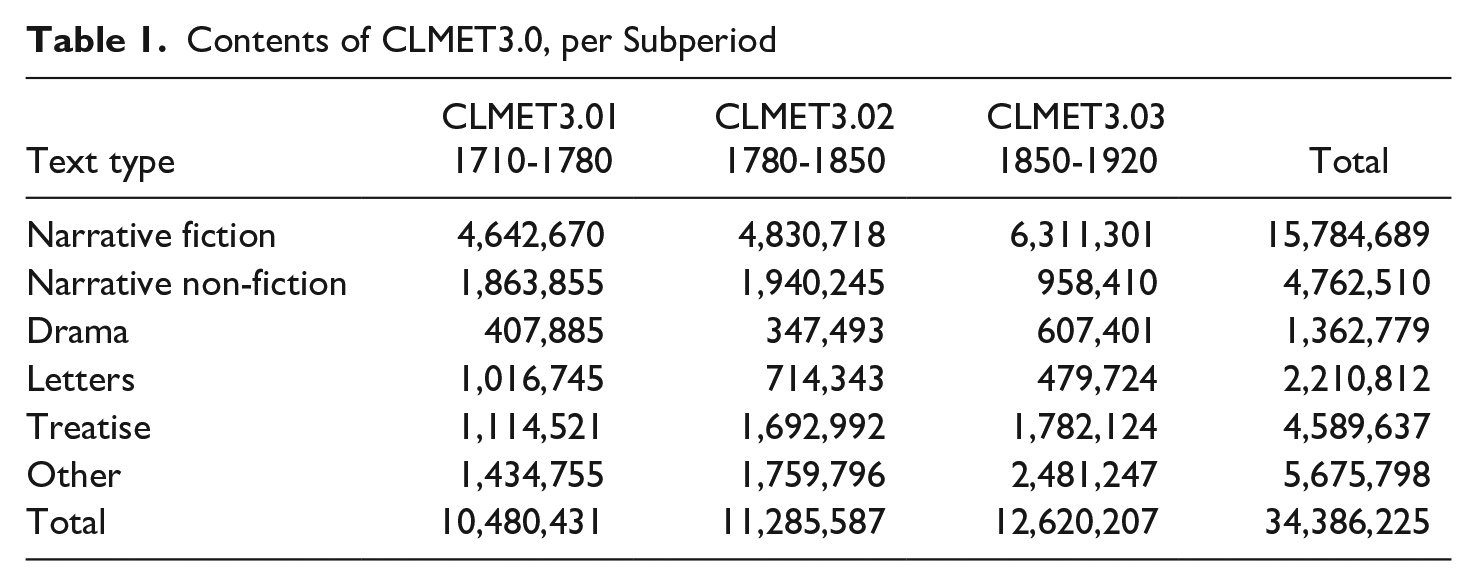
Finally, the BNC BYU (100 million words; Davies 2004-), which covers the years 1980-1993, was selected to represent late twentieth century usage. Like CLMET3.0, the BNC consists of several text categories, namely Fiction_prose, Fiction_poetry, Fiction_drama, Magazine, Newspaper, Non-Academic, Academic, and Miscellaneous; its text category Fiction_prose (15,644,928 words) can be roughly equated with the category Narrative Fiction (15,784,689 words) in CLMET3.0, and is practically identical in size, so it offers a good basis for comparison.
In order to identify the verbs occurring most frequently in the VVingOBL construction in both earlier and contemporary English, I conducted searches in EEBO and the BNC, using the string _vv* _v?g* _i*, which retrieves any verb followed by Ving and a preposition. The search options were set to 1000 hits, grouped by lemmas; this very high figure (100 hits is the option selected for automatic searches in many corpus-based studies) ensured the retrieval of a large number of relevant strings, in their various forms (e.g., come running, comes running, came running, go wand(e)ring, goes wand(e)ring, goeth wandring, went wand(e)ring, etc.).
In this way, the search in EEBO (1470s-1690s; 755,078,402 words) yielded a total of 8229 occurrences. After discarding purpose clauses (e.g., come seeking for), expeditionary
In the case of CLMET3.0, the combination of V with Ving was searched by means of WordSmith Tools 6.0 (Scott 2012) within a context window of one word to the right (i.e., *ing 0L 1R). Total hits recorded for the search string in question came to 1344, of which 558 had to be discarded, as they corresponded to purpose clauses (e.g., come looking for him) and various other constructions not relevant to the study; this is based, therefore, on 786 tokens of the construction. In the case of the BNC, the search strings were the same employed for EEBO, as detailed in section 7.1, namely COME _v?g*, GO _v?g*, and RUN _v?g*. Total hits recorded came to 1501; after manual sorting, 872 of these were found to be instances of the VVingOBL construction.
6. The VVingOBL Construction and Its Precursors
The VVingOBL construction can be traced to two different, though related, OE constructions which express an action taking place simultaneously with that of the matrix verb. One contains a present participle (inflected in -ende in OE) and a superordinate verb of motion, as in (25). The other is a verb of motion and an uninflected infinitive, as in (26).
(25) [. . .] him com ða ridende to sum arwurðe ridda sittende on snáwhwitum horse.
‘then a venerable rider came riding to him, sitting on a snow-white horse’
(ÆC Hom II, 10 82.31; quoted from Ogura 2002:83)
(26) [. . .] þa com þær gan in to me heofencund Wisdom [. . .]
‘then there came walking in toward me heavenly Philosophy’
(Bo 3.8.15; quoted from Ogura 2002:82)
The first type—VVende sequences denoting event simultaneity—is examined at length by Visser (1963-1973:III/2 1906-1912) and Ogura (2002:80-88). They document its use with the verbs
(27) þæt hit brastliende sah to ðam halgan were. hetelice swiðe.
‘so that it [the tree] fell crashing towards the holy man, very violently’ (ÆCHom II, 39.1 293.170; DOE, s.v. brastlian v. 3. ‘to make a crashing sound’)
(28) [. . .] he arn forhtigende to Maure þam munuce.
‘he ran trembling with fear to the monk Maure’
(GD 2 (C) 6.114.3; DOE, s.v. forhtian)
As will be seen, the verbs attested in OE correspond quite closely to those most commonly found, according to Goldberg (2006), in the modern VVingOBL construction (
The OE VVende pattern therefore appears to exhibit most of the features of the modern VVingOBL construction (see, e.g., examples 1, 2, 10, 18, 20, and 22). The one (crucial) feature which cannot be determined is whether the higher verb and the participle already formed a unit of some kind in OE, as I will argue they do today (see section 8), or whether the participle should rather be taken as an adjunct clause of “accompanying circumstance, or exemplification/specification,” a possibility put forward by Ringe and Taylor (2014:494). The positional mobility of participles and participial phrases in OE was very great, as has often been noted in the literature (Mitchell 1985:§§1561-1564; Ringe & Taylor 2014:492), and as is illustrated in the above examples. On the other hand, the important cue of punctuation is generally lacking in the OE material, so that it is not possible to exclude, for instance, a reading of (28) above as two separate intonation units, with forhtigende representing an adjunct clause, i.e., ‘he ran, trembling with fear, to the monk Maure.’
As noted above, the second type of OE precursor to the VVingOBL construction is
(29) þa com þær færlice yrnan an þearle wod cu.
then came there suddenly run one very mad cow
‘then there suddenly came running a very mad cow.’
(ÆLS (Martin) 1039; DOE, s.v. cuman F.1)
Los (2015:22) draws attention to examples like this and argues that they constituted “one of the ways in which imperfective aspect and ongoing-ness” could be expressed in English before the rise of a grammaticalized progressive. The implication seems to be that in such uses the bare infinitive was “not an adjunct but an argument of the verb of motion” (Los 2005:35; see also Mitchell 1985:§1543), and that the verb (
For reasons that fall beyond the scope of this paper, the type
(30) the hunters [. . .] hereth hym come russhyng in the greues,
‘the hunters [. . .] hear him [i.e., a lion] come rushing into the woods’
(c1385 Chaucer CT.Kn.(Manly-Rickert)A.1641; cf. MED, s.v. in prep. 8a(b) ‘into (a town, forest, etc.)’)
7. The Development of the VVingOBL Construction from 1470 Onwards
7.1. 1470s-1640s
As discussed in section 5, the results from EEBO are based on the lemmatized search strings COME _v?g*, GO _v?g*, and RUN _v?g*. This kind of search retrieves both instances where the oblique complement is explicit (e.g., came running into the room) and those where it is latent (e.g., came running), since it was thought that having information at hand on the latter subtype might prove useful. One disadvantage of this procedure was that a considerable amount of manual sorting was needed in order to quantify the number of actual VVingOBL examples attested in the six decades in EEBO (1470s, 1480s, 1490s, 1550s, 1570s, 1640s; see section 5) that were selected for analysis.
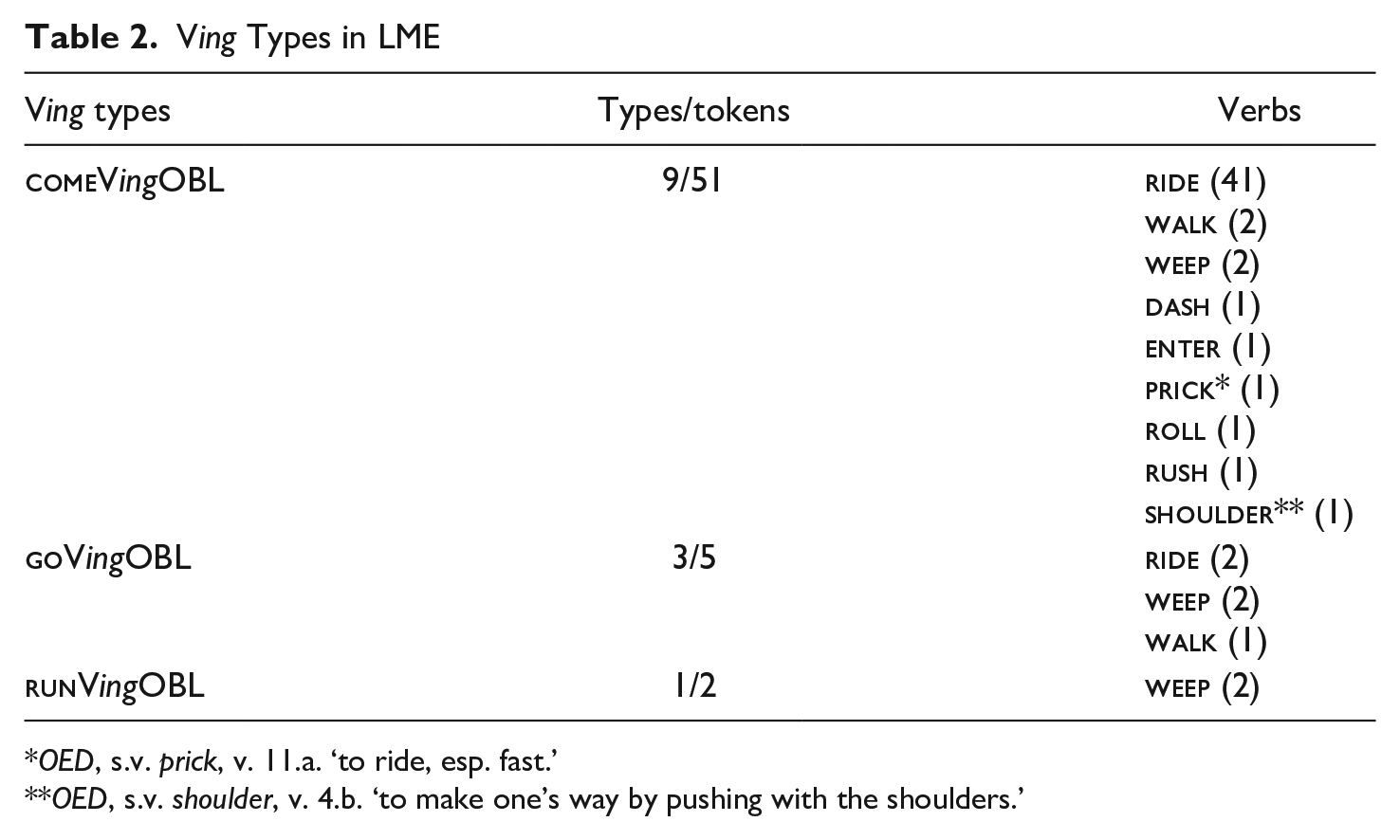
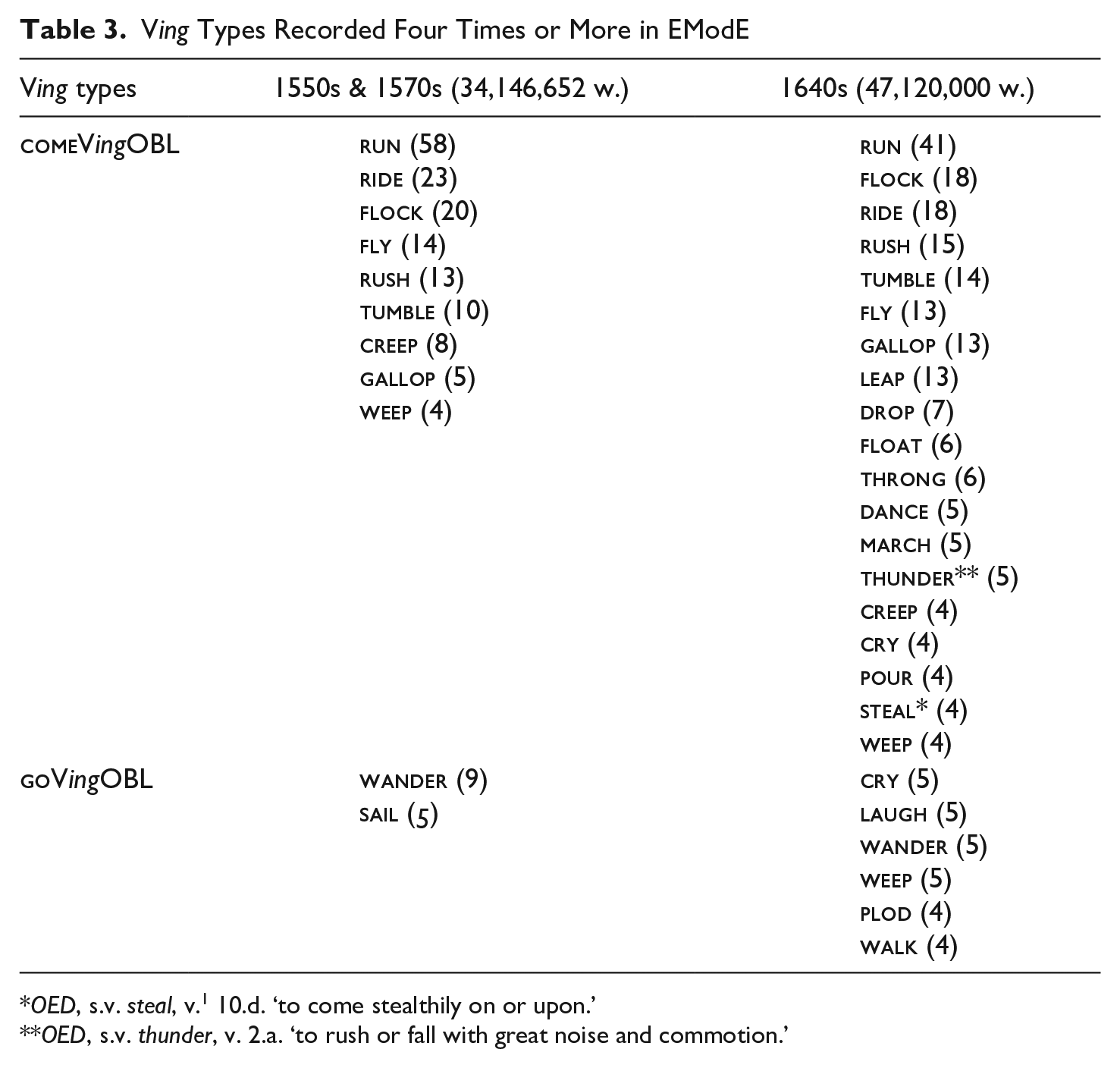
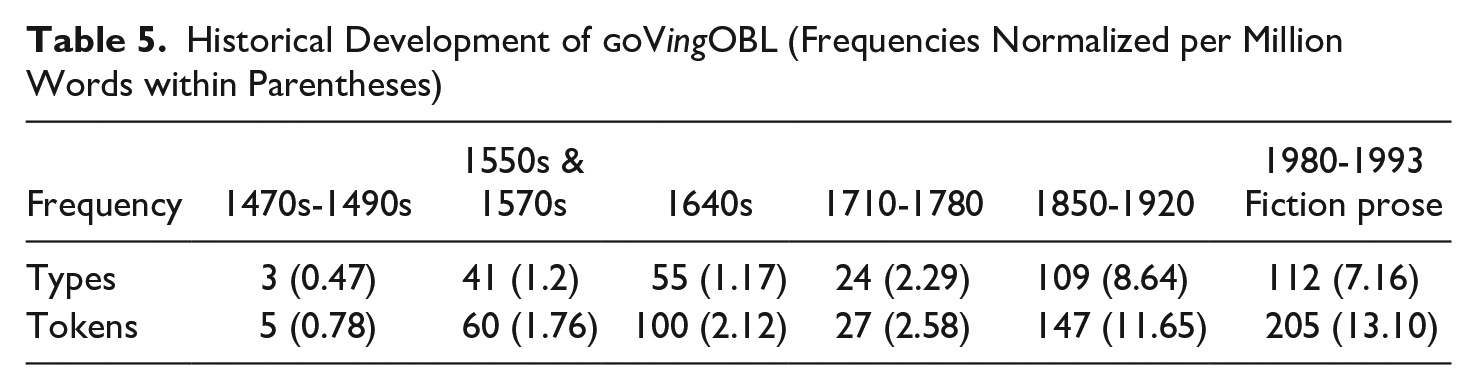
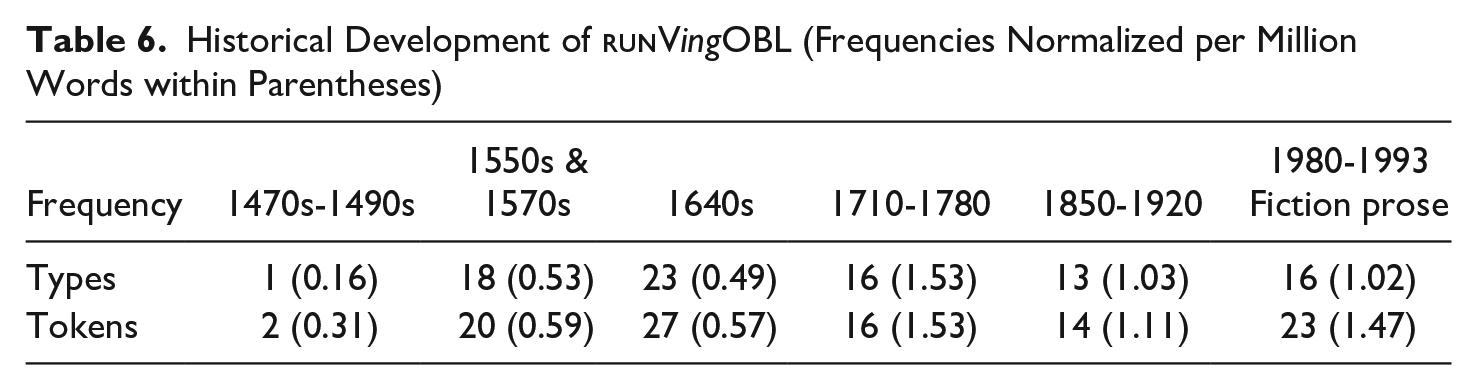
As can be seen from Tables 2-6, despite the considerable size (87,687,222 words altogether) of the sample examined for LME and EModE, the number of occurrences of the construction is very low, with token frequencies per million words ranging, in the 1640s, from 6.09 for
Ving Types in LME
OED, s.v. prick, v. 11.a. ‘to ride, esp. fast.’
OED, s.v. shoulder, v. 4.b. ‘to make one’s way by pushing with the shoulders.’
Ving Types Recorded Four Times or More in EModE
OED, s.v. steal, v.1 10.d. ‘to come stealthily on or upon.’
OED, s.v. thunder, v. 2.a. ‘to rush or fall with great noise and commotion.’
Historical Development of
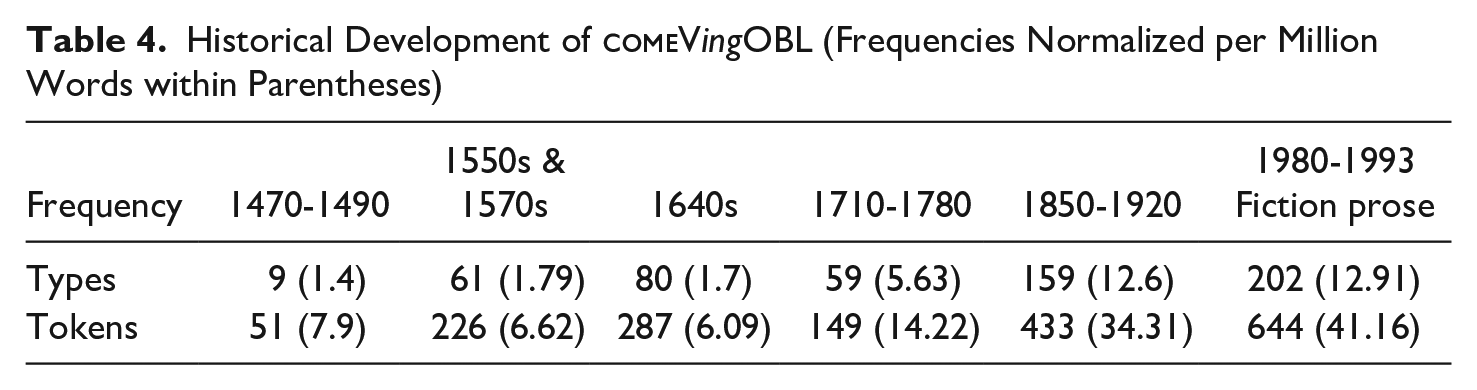
Historical Development of
Historical Development of
(31) [. . .] and thenne the moder of the chylde came wepyng to the dore of pastor [. . .] (EEBO, 1483, de Voragine/Caxton, Legenda aurea sanctorum) [Concomitance]
(32) [. . .] the prince of morocco, re-collecting all his force and all the opinion of his courage, came thundring on polexander, and broke his lance with a great deale of strength [. . .] (EEBO, 1647, Le Roy/Browne, The history of Polexander; OED, s.v. thunder, v. 2.a. ‘to rush or fall with great noise and commotion’) [Concurrent result]
(33) [. . .] when we goe groping up and downe in the darke, [. . .] truth affoords us direction and consolation, (EEBO, 1642, Hill, The trade of truth advanced; OED, s.v. grope, v. 2.a. ‘to feel about in order to find one’s way’) [Manner of motion]
(34) [. . .] this capitaine stoute, went flaunting too and fro, till loe (ill lucke) [. . .], he espyes, my gallant port, (EEBO, 1576, Whetstone, The rocke of regard; OED, s.v. flaunt, v. 2.a. ‘to walk or move about so as to display one’s finery’) [Manner of motion]
(35) [. . .] certainly jesus christ will never deny maintainance to his spouse, it’s a dishonour for a husband to have the wife go whining up-and down; (EEBO, 1649, Burroughs, The rare jewel of Christian contentment) [Concomitance]
7.1.1. Ving’s Attested and Prefabs
The set of predicates occurring in the Ving slot in decades 1470s-1490s is very small, yet it is indicative to some extent of the Ving’s found in later periods. The set comprises the items displayed in Table 2; several of them are among those recorded most frequently (four times or more) in the following two centuries, as summarized in Table 3 relating to the 1550s-1570s and the 1640s. 7
Aspects that deserve comment regarding the information in Tables 2 and 3 are, first, the fact that a majority (41 out of 51) of the instances of
In addition to riding, a few other Ving’s occur with considerable frequency in combination with
Tracing in detail the extension of VVingOBL from
7.1.2. Zooming in on the Semantics of go VingOBL
The
(36) Wommen may go [i.e., ‘walk’] saufly vp and doun. (c1395 Chaucer CT.WB. (Manly-Rickert).D.878; MED, s.v. gon 1.a)
(37) Ʒoure aduersarie [. . .] as a roryng lyoun goith aboute, sekinge whom he shal deuoure. (c1384 WBible(1) (Roy 1.B.6)1 Pet.5.8; MED, s.v. gon 2.a)
These kinds of usages help to explain, first, why the Ving’s most frequently occurring in the goVingOBL pattern (see Table 3) are verbs which in themselves often refer to relatively aimless motion, such as sail and wander (on sail see Levin 1993:268, who notes that “no specific direction of motion is implied unless there is an explicit directional phrase present”); second, why in my EModE data
(38) [. . .] the corsegnans went wandring towardes the army, in so much as not only the region of calabria was left in daunger, but also it was feared least the victors would aduaunce [. . .] (EEBO, 1579, Guicciardini / Fenton, The historie of Guicciardin conteining the warres of Italie and other partes)
(39) [. . .] they procured him besides, the ill will and displeasure of all the friendes and confederates of the athenians, for that he went sayling still to and fro alongest the Iles, exacting money of the inhabitants of the same [. . .] (EEBO, 1579, Plutarch / North, The lives of the noble Grecians and Romanes)
Other examples of the extended trajectory category include about all the countrey (1572), euery where (1579), fro Prouince to Prouince (1579), from common welth to common welth (1575), here and thare (1553), through places and Countryes (1647), to and fro (passim), up and down (passim) (see also 33-35 above). Overall, in the decades 1550s-1570s, 26 (43.3 percent) out of the 60 tokens of
Aimless, non-oriented motion is apt to be colored with negative overtones. This can be observed quite consistently, for instance, in the Spanish progressive periphrasis formed with
(40) [. . .] make wicked and ungodly men affraid of you: let not drunkards dare to goe reeling and staggering in the streets; [. . .] nor children &; others dare to be playing up &; down the streets on the lords day: (EEBO, 1645, Blackwell, A caveat for magistrates) [Co-event: manner of motion]
(41) [. . .] what have I to expect, but, after a deal of flimsy preparation with a bishop’s licence, [. . .], to go simpering up to the Altar; (CLMET3.01, 1775, Sheridan, The rivals) [Co-event: concomitance]
(42) [. . .] she had never worn a strapless dress before, and [. . .] she couldn’t rid herself of the fear that the dress would go slithering to the floor at some critical moment, leaving her almost naked, like in a bad dream. (BNC, 1993, Darcy, A private arrangement) [Co-event: manner of motion]
7.2. LModE (1710-1920) and PDE (1980-1993)
Tables 4-6 present the data obtained for
Tables 4-5 reveal considerable increases in the frequency of the VVingOBL construction over time in the case of
7.2.1. Productivity
This section complements the preceding information on type and token frequency by looking at productivity, “the likelihood that a construction will apply to a new item” (Bybee 2010:94). Productivity has been studied in the morphological domain more than any other (Baayen & Lieber 1991; Baayen 1992), and increasingly with regard to morphosyntactic constructions as well, in order to assess their degree of “entrenchment” (Langacker 1987:59-60) or of grammaticalization (see, e.g., Coussé, Andersson & Olofsson 2018).
I have followed the method for measuring syntactic productivity employed by Petré (2012) in the study of the English
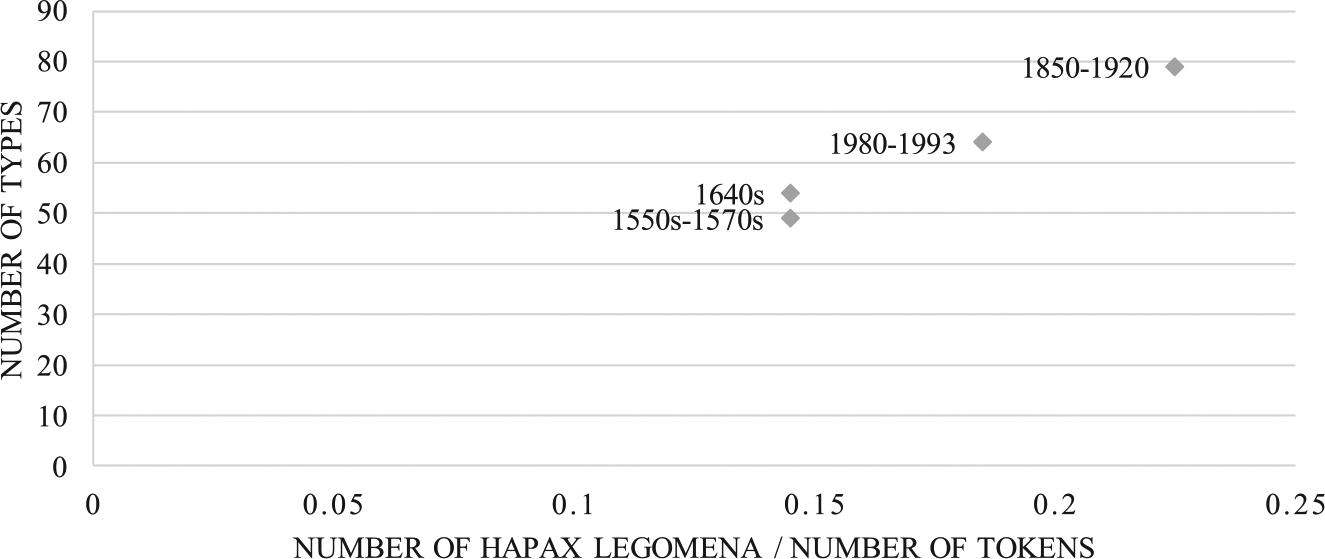
Global Productivity for
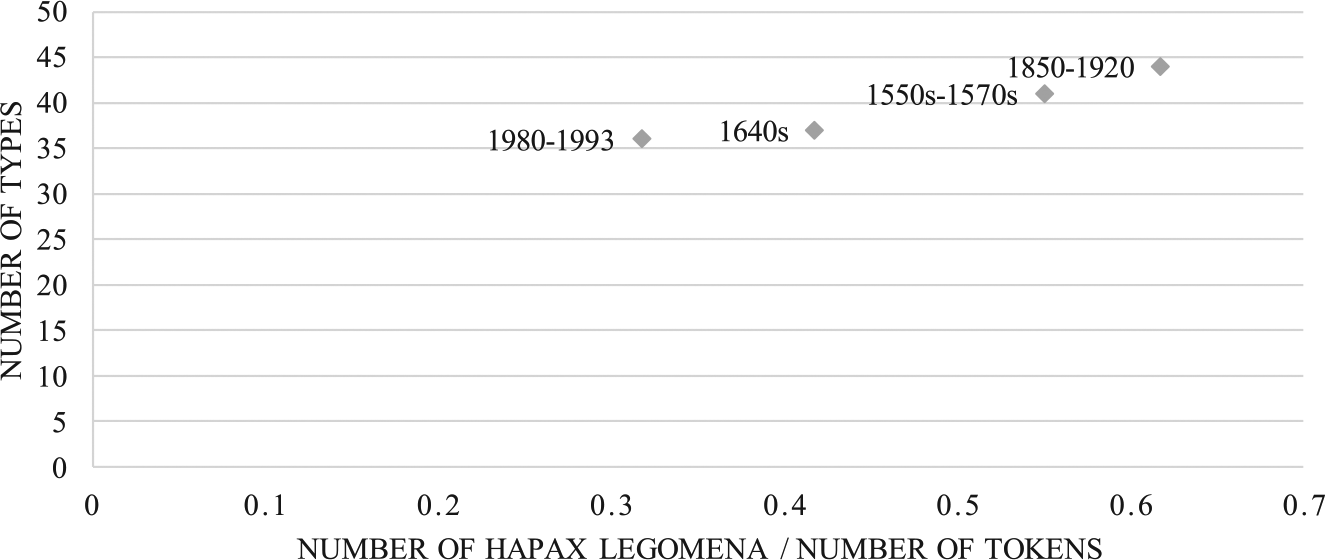
Global Productivity for
As can be observed, for both subpatterns of the construction the peak in global productivity (i.e., the combination of type productivity plus productivity rate) coincides with LModE (1850-1920), a finding which is in agreement with the frequencies displayed in Tables 4 and 5. In 1980-1993 the productivity rate for
7.2.2. Interaction with Co-Event Type
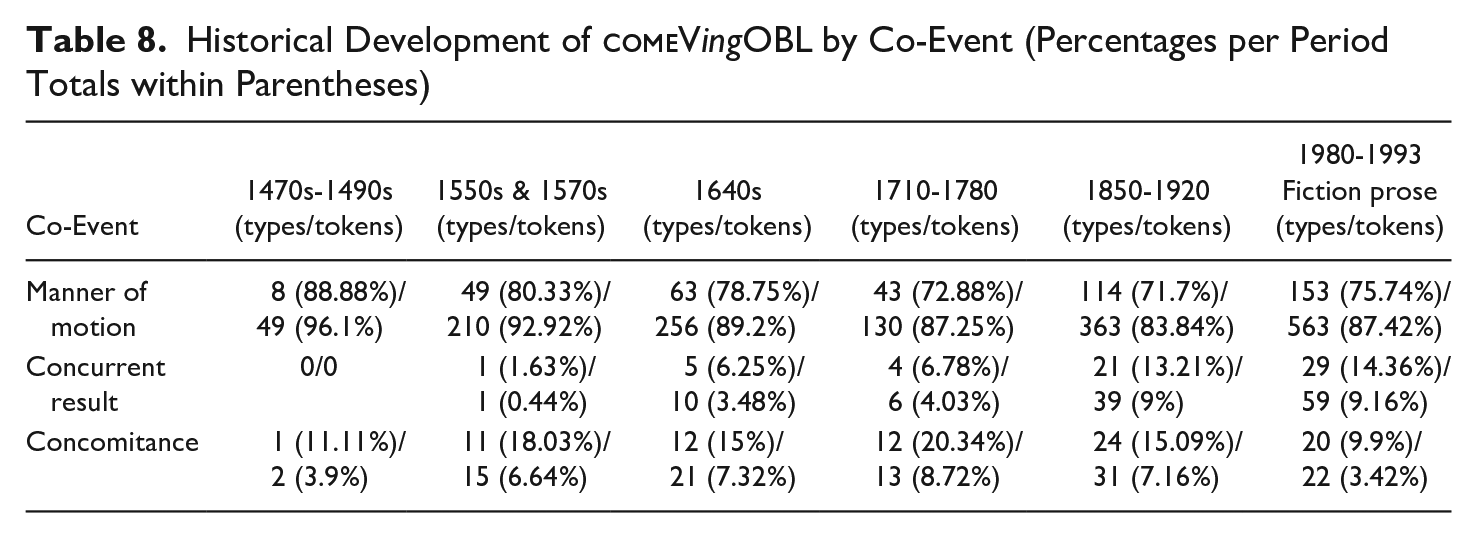
This section is concerned with the correlation between the VVingOBL construction and the type of co-event it encodes. In a recent analysis of various kinds of VVing sequences in PDE based on COCA (Corpus of Contemporary American English), Broccias and Torre (2018:89-90) suggest that
Historical Development of
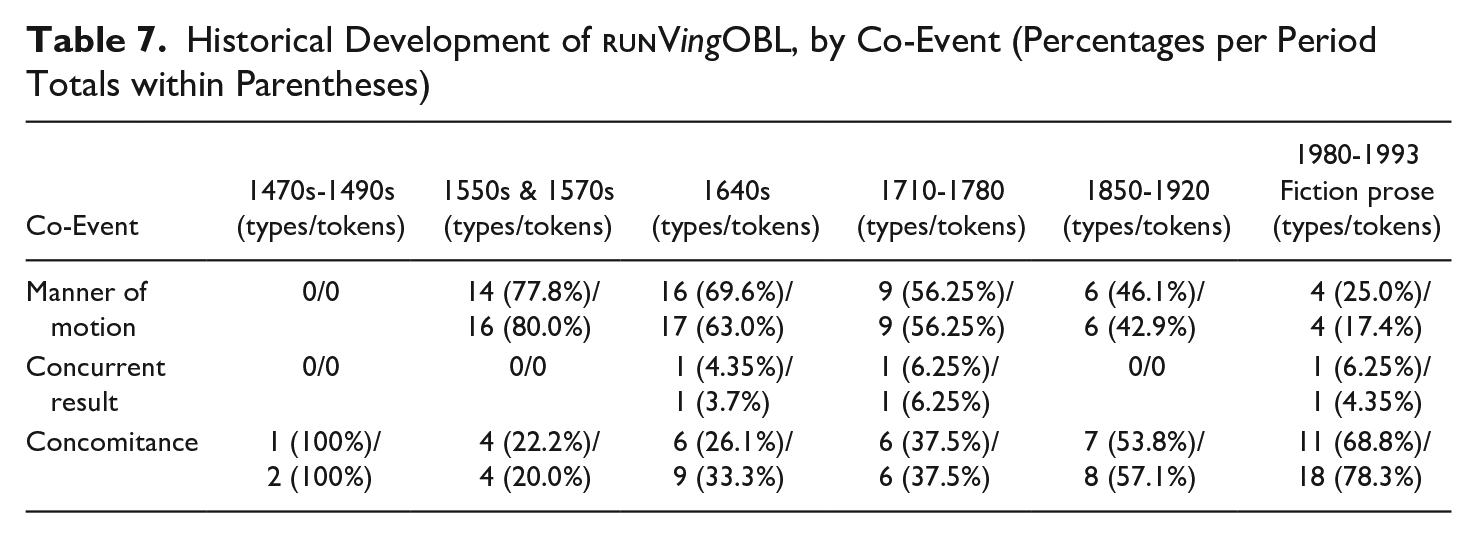
(43) The sunward sides of the tree-stems took a glow, and the dew that ran dripping down their mossy sides trickled blood-red to earth. (CLMET3.03, 1905, Arnold, Gulliver of Mars)
As regards
Historical Development of
Historical Development of
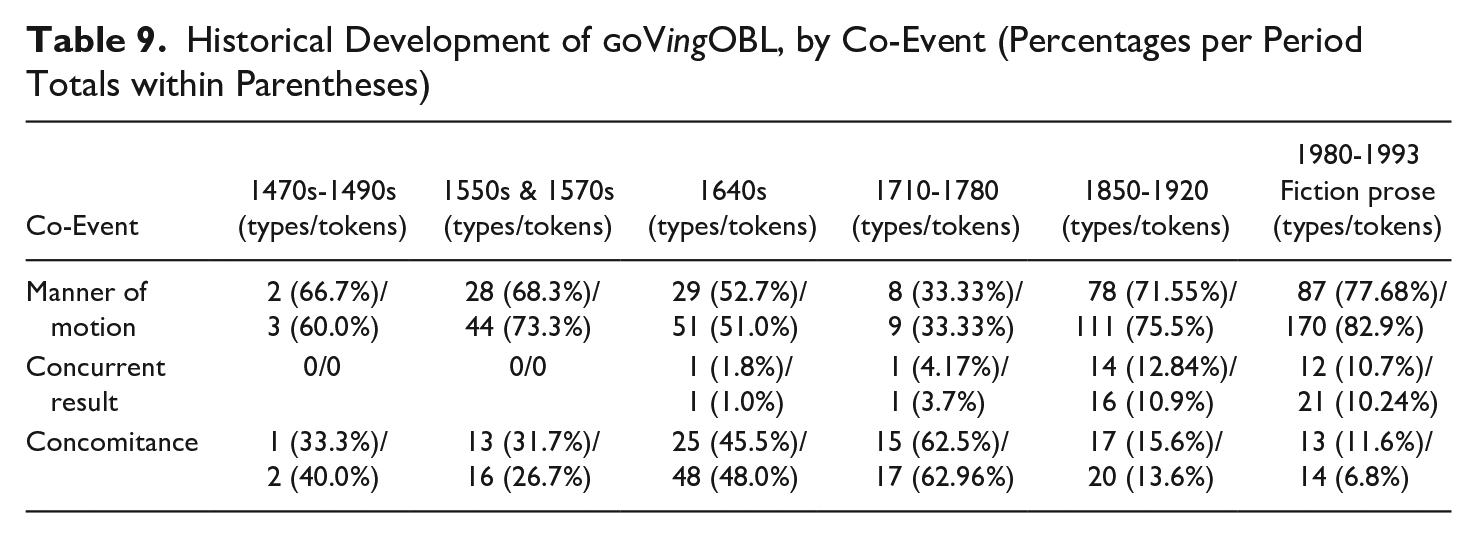
I will conclude this overview of co-event types with a few comments on the relation of concomitance. As a co-event not causally related to the motion, concomitance is quite flexible; in other words, the range of possible concomitant activities that can be performed while moving is virtually open-ended. Yet the great majority of cases of concomitance coding by Ving in my data denote fairly concrete physical activities that can accompany motion, such as the emission of sounds via the vocal tract (e.g., bawl, bellow, cluck), gestures and other forms of nonverbal expression (e.g., smile, sob, stare), and bodily processes and body-internal states of existence (e.g., blush, shiver, shudder; for these verb classes, see Levin 1993:223). Occasionally, however, more abstract activities can also be found, as in (44).
(44) Boldwood went meditating down the slopes with his eyes on his boots, (CLMET3.03, 1874, Hardy, Far from the madding crowd)
7.2.3. Interaction with Text Type
EEBO BYU lacks codification for text type and so cannot be used to examine the effect of this variable. By contrast, both CLMET3.0 and the BNC are organized into different text categories, enabling me to check whether the growth in frequency of VVingOBL applies to all of them or rather correlates with one or more. As motion clauses in general are known to occur often in fiction and narrative (e.g., Slobin 2004), I compare the category Fiction_prose (15,644,928 words) in the BNC to the corresponding text category, Narrative Fiction, in subperiods 1 (4,642,670 words) and 3 (6,311,301 words) of CLMET3.0. The results are displayed in Tables 10 and 11. When compared with the data in Tables 4 and 5, they confirm that the frequency of the VVingOBL construction in LModE is considerably higher when Fiction is considered separately than when all six text types represented in CLMET3.0 are considered together. In this respect, therefore, the construction once more has affinities with the
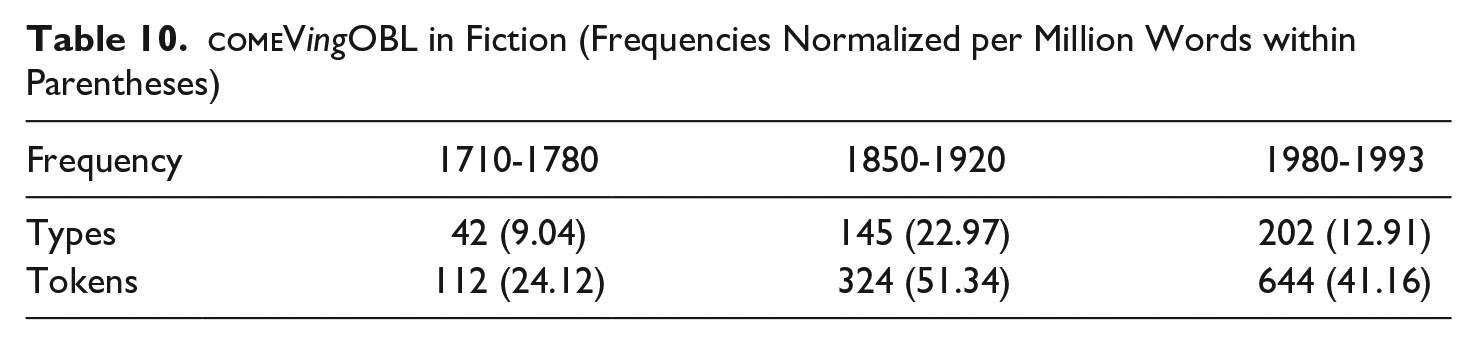
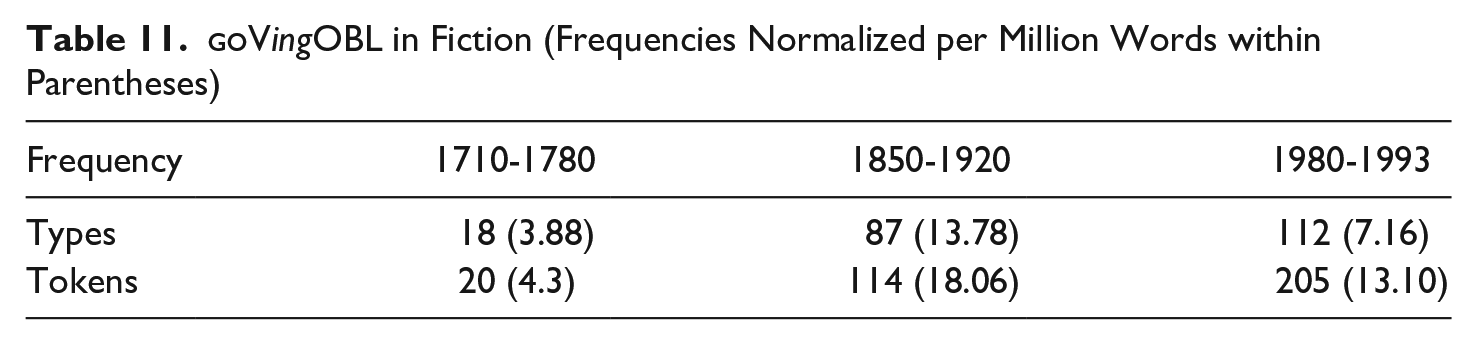
Tables 10 and 11 reveal as well that from subperiod 3 (1850-1920) of CLMET3.0 to the late twentieth century as represented in the BNC, the VVingOBL construction decreased in Fiction rather than increased. The frequencies for both
8. The VVingOBL Construction in Relation to Grammaticalization and Serialization
As discussed in section 2, Goldberg (2006:52) argues that the VVingOBL pattern is a construction in the sense of CxG, that is, a form-meaning pairing whose overall event meaning can be glossed as ‘move in a manner along a path.’ The corpus-based study presented here enables us to refine this characterization and propose that the construction codes ‘deictic motion along a path, which takes place simultaneously with a manner of action involving manner of motion proper, concurrent result, or concomitance.’
The question to be examined in 8.1 is whether this particular form-meaning pairing exhibits any of the features commonly associated with grammaticalization. Grammaticalization is closely intertwined with serialization. The discussion in 8.1 serves as a point of departure for the analysis of the VVingOBL construction from the perspective of serialization which follows in section 8.2.
8.1. Grammaticalization
Over the past ten or fifteen years, efforts have been made to integrate insights from work on grammaticalization (Lehmann 1995; Hopper & Traugott 2003) and (diachronic) construction grammar (Traugott & Trousdale 2013; Barðdal, Smirnova, Sommerer & Gildea 2015; Coussé, Andersson & Olofsson 2018), in order to advance our understanding of constructional change. Based on previous research, I review the features that characterize the VVingOBL construction in terms of grammaticalization.
An increase in frequency has long been recognized as a concomitant of grammaticalization (Hopper & Traugott 2003:126-127; Kranich 2010:250), since the kinds of changes that are most characteristic of grammaticalization, as discussed below, “are inseparable from the absolute frequency of the forms and the frequency with which they cooccur with other forms” (Hopper & Traugott 2003:127). Frequency is intertwined with productivity, in that as constructions grammaticalize they tend to become more productive. As seen in section 7, both increases in frequency and in productivity can be observed in the development of the VVingOBL construction since LME.
The parameter of desemanticization (Lehmann 1995:127-128), also often termed semantic bleaching, can be seen at work in processes of auxiliation (i.e., the development of lexical verbs into auxiliaries), and relates to the degree in which one of the verb forms involved is bleached of lexical meaning. It applies very clearly, for instance, to the VVing sequence discussed in section 2 as modality
A third well-known parameter is paradigmaticization (Lehmann 1995:132-137), that is, grammaticalizing elements tend to become part of a closed paradigm whose members are linked to each other by “paradigmatic relations, especially opposition and complementarity” (Lehmann 1995:132). Paradigmaticization has often been invoked in the analysis of so-called pseudo-coordination (V1 and V2; e.g., try and do, go and get, etc.), the assumption being that a small number of possible V1s is an indicator of paradigmatic restriction and hence of grammaticalization (Kinn 2018). This measure is evidenced by the VVingOBL construction: its direct precursor in OE, the VVende pattern (see section 6), allowed at least nine different verbs in the V1 slot; by LME they had been reduced to three (
The parameter of decategorialization (Hopper 1991:30-31), whereby grammaticalizing units lose some of their markers of categoriality, including their morphosyntactic trappings, also applies to the VVingOBL construction. Goldberg (2006:51; see also section 8.2) aptly notes that the Ving form cannot appear with its own arguments (as illustrated in 45), unlike the related paraphrase involving a subordinate clause (i.e., “Bill went down the street whistling a tune”).
(45) *Bill went whistling a tune down the street.
In (45),
Lastly, the parameter of bondedness or adjacency (Lehmann 1995:147-157) relates to the degree of syntagmatic cohesion “with which [a sign] is connected with another sign to which it bears a syntagmatic relation” (Lehmann 1995:147). In its most extreme form, bondedness leads to univerbation (e.g., German keines Wegs ‘of no way’ > keineswegs ‘by no means’). At the constructional level, bondedness has often been employed to examine the degree of grammaticalization and constructionalization of verbal periphrases of various kinds, for instance, the progressive periphrases of Spanish (Bybee & Torres Cacoullos 2009:201-204) and pseudocoordination in Norwegian (V1 og V2) (Kinn 2018). Grammaticalization correlates with a decrease in the presence of intervening material between V1 and V2, which strengthens auxiliation and a single-event reading of the construction in question.
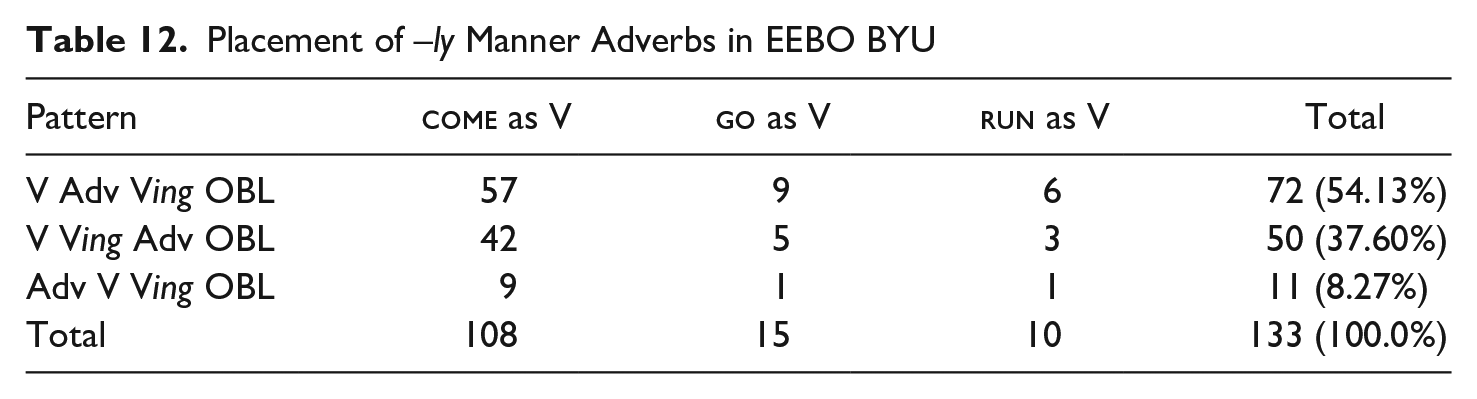
For the VVingOBL construction, the degree of adjacency between V and Ving has been measured in this study by looking at the position of -ly manner adverbs (e.g., carefully, as in “John carefully shifted the nitroglycerine”) relative to V and Ving. The decision to make use of this particular manifestation of adjacency was a principled one: on the one hand, -ly adverbs can be retrieved computationally from big corpora such as EEBO and the BNC. On the other, manner adverbs are core-internal modifiers, that is, they modify internally the part of the clause consisting of the predicate and its arguments (Foley & Olson 1985:33-37; Van Valin & LaPolla 1997:162-171). They are thus subject to positional preferences different from those applying to aspectual adverbs (completely, continuously), which are modifiers of the clause nucleus or predicate (cf. “Leslie completely immersed herself in the new language”), and to temporal (early, subsequently), evidential (evidently), and epistemic (probably) adverbs, which take the core of the clause in their scope and thus have much greater positional mobility (e.g., “Probably, Sam will bake a cake tomorrow”; “Robin saw Pat earlier”; see also Jackendoff 1972:47-107; Huddleston & Pullum 2002:574-580).
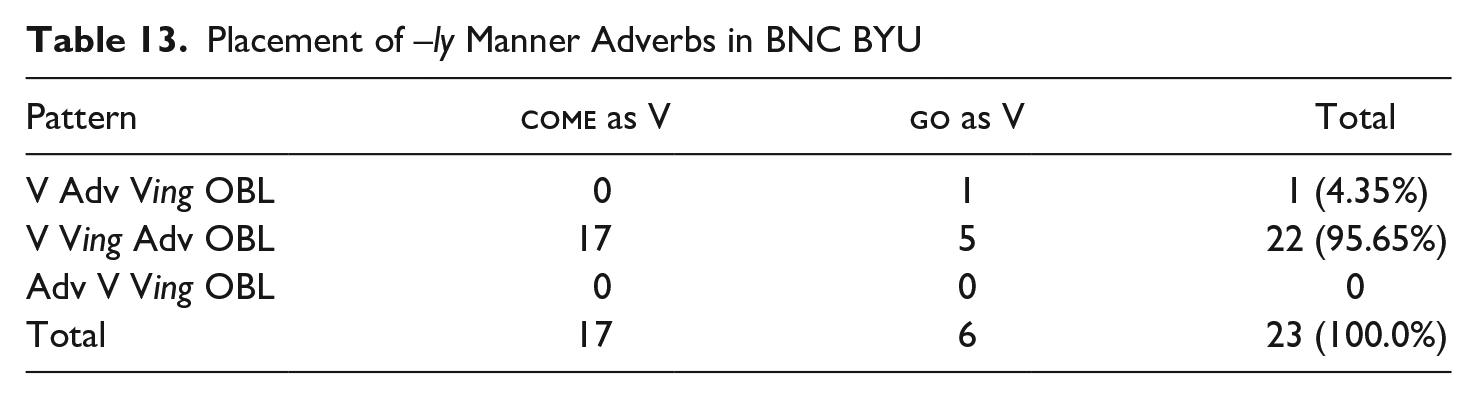
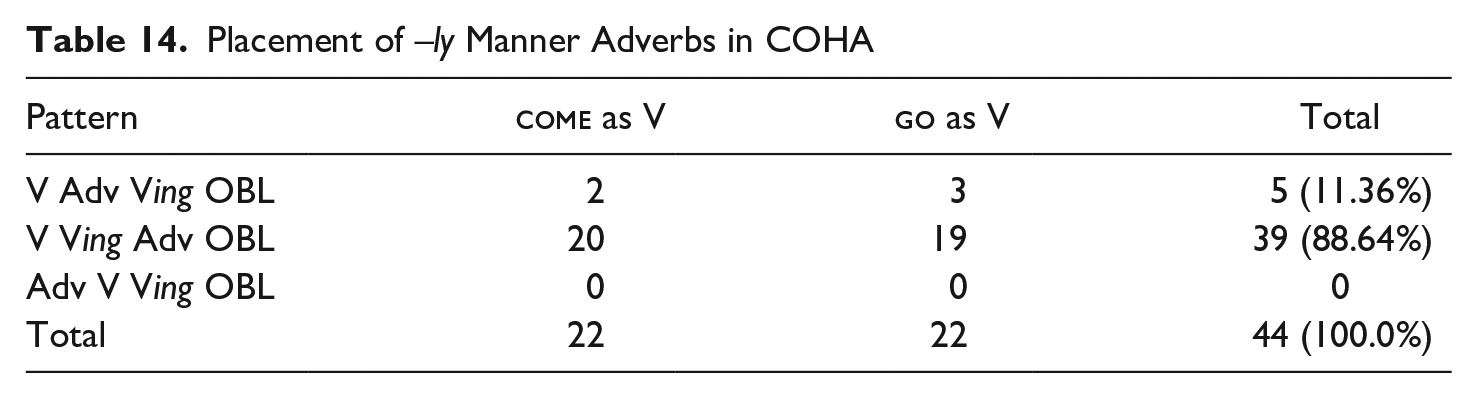
Tables 12-15 show the position of -ly manner adverbs relative to the VVing sequence. In order to obtain sufficient results, I searched the complete EEBO BYU and BNC BYU, as well as decades 1970s-2000s in COHA (Corpus of Historical American English; Davies 2010-). Three different search strings were employed, which allowed the extraction of all sequences consisting of either V
Placement of –ly Manner Adverbs in EEBO BYU
Placement of –ly Manner Adverbs in BNC BYU
Placement of –ly Manner Adverbs in COHA
Placement of –ly Manner Adverbs in CLMET3.01 (1710-1780) and CLMET3.03 (1850-1920)
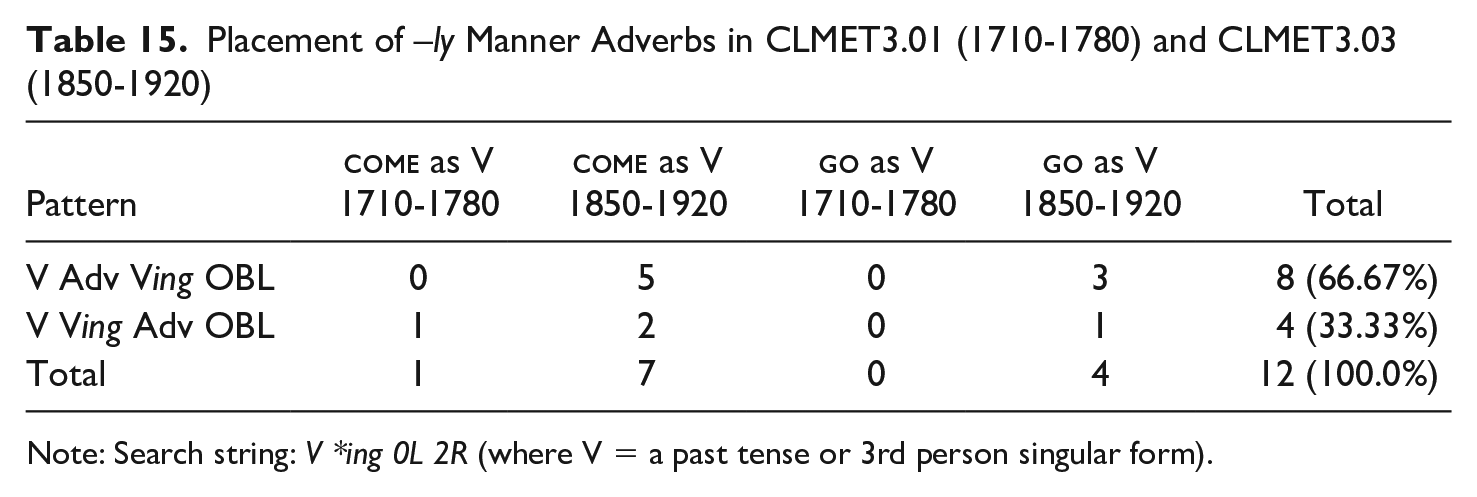
Note: Search string: V *ing 0L 2R (where V = a past tense or 3rd person singular form).
COME *ly_r _v?g or GO *ly_r _v?g or RUN *ly_r _v?g:
(46) Three horses, with a man leading the foremost, came slowly clattering down a steep incline from their stable. (CLMET3.03, 1885, Blind, Tarantella) [Co-event: concurrent result]
(47) But the elephants went gaily dancing and trumpeting away over the mountains, through Roumania and Georgia, through Turkey, Iran, and Afghanistan, until they came to their native land. (BNC, 1989, Aiken, The kingdom under the sea) [Co-events: manner of motion + concomitance]
COME _v?g *ly_r or GO _v?g *ly_r or RUN _v?g *ly_r:
(48) [. . .] whan his fader knewe it he went wepyng tenderly to Saynt marcyal / and prayed hym to reyse his sone fro dethe to lyf. (EEBO, 1483, de Voragine/Caxton, Legenda aurea sanctorum) [Co-event: concomitance]
(49) She looked across the road, saw Meredith, smiled and came striding athletically towards her. (BNC, 1991, Granger, A season for murder) [Co-event: manner of motion]
*ly_r COME _v?g or *ly_r GO _v?g or *ly_r RUN _v?g:
(50) [. . .] at length her Vncle numitorius and [. . .] icilius, these hastily come crowding through the presse, and call vpon fell appius for redresse: (EEBO 1617 Barksted, Iuuenals tenth satyre; cf. OED, s.v. press, n.¹ 5.a. ‘a crowd, a multitude’) [Co-event: manner of motion]
Tables 12-15 show a clear diachronic increase in adjacency, to the extent that by the end of the twentieth century occurrences of VVingOBL with an intervening manner adverb have virtually disappeared, especially in British English. These results suggest that VVing has become automated as a single processing unit through frequent collocation, a development which can lead, ultimately, to the formerly separate units (V + Ving) losing their individual meanings, as has already happened, for instance, with the construction involving modality
Summing up, the joint evidence of indicators such as frequency and productivity, paradigmaticization, decategorialization, and adjacency has allowed us to uncover the ongoing grammaticalization of the VVingOBL construction. The next section addresses serialization, which cross-linguistically is a frequent source of grammaticalized markers of tense, aspect, mood, and direction (Aikhenvald 2006:30-37).
8.2. Serialization
Goldberg (2006:50-52) suggests that the VVingOBL construction might qualify as a “serial verb construction” (SVC), despite the fact that English “generally allows only one verb per clause” (Goldberg 2019:48), unlike many other languages which can routinely combine verbs to express a single clause, as in (51), from Cantonese.
(51) lei5
you take
‘bring some clothes’ (from Aikhenvald 2006:21)
Goldberg (2006) bases her suggestion on the existence of a number of “constraints” that limit the meaning and form of the VVingOBL construction, discussed already in sections 2 and 8.1, namely: (a) the progressive or iterative interpretation of the construction; (b) the low productivity of the verb (V) slot, which according to Goldberg is restricted to four intransitive verbs (
Support for Goldberg’s claim depends largely on the features that one considers criterial for SVCs, since the notion of a SVC has itself not been delimited clearly in the literature. Based on the typological surveys in Foley and Olson (1985), Aikhenvald and Dixon (2006), Bisang (2009), and Shibatani (2009), and on recent work by Cleary-Kemp (2015) and Haspelmath (2016), it is possible to isolate a few basic properties of SVCs which recur and seem to have a direct bearing on the analysis of the VVingOBL construction:
(a) each verb is an independent verb (e.g., Aikhenvald 2006:1, 5; Cleary-Kemp 2015:97; Haspelmath 2016:302-304);
(b) the construction is monoclausal and “has the intonational properties of a monoverbal clause” (Aikhenvald 2006:7); grammatical categories such as tense, aspect, mood, and negation have the whole SVC as their scope; similarly, “a manner adverb will have scope over a complete SVC” (Dixon 2006:339);
(c) the construction “is conceived of as describing a single action” (Dixon 2006:339) or “multiple sub-events that form a single macro-event” (Cleary-Kemp 2015:120);
(d) the verbs share one or more arguments (e.g., Aikhenvald 2006:12; Haspelmath 2016:309);
(e) two basic categories of SVCs can be distinguished: asymmetrical and symmetrical (Aikhenvald 2006:3; see below);
(f) there exists a hierarchy of serializability of verbs (Foley & Olson 1985:41-48; Aikhenvald 2006:48), with the types of verbs on the left more easily serialized than those on the right: motion verbs (‘come,’ ‘go’) < other intransitive verbs (‘wander,’ ‘crawl’) and postural verbs (‘sit,’ ‘stand,’ ‘lie’) < stative intransitive verbs (‘be dead,’ ‘ache’) < transitive verbs.
Property (a) is the most controversial, since the requirement for each verb to be an “independent verb” (Haspelmath 2016:303) has been variously interpreted. According to Aikhenvald (2006:5), each verb must have the ability “to function on its own,” and must not be “a dependent or a nominalized form” (Aikhenvald 2006:5; see also Cleary-Kemp 2015:102, 152). Haspelmath (2016:303), for his part, explains that the independent-verb criterion is intended to exclude auxiliaries, which are “not able to occur on their own without another verb,” except in an elliptical utterance. Therefore, a sequence such as will go “is not a serial verb construction in English” (Haspelmath 2016:303), but imperative sequences such as “Go get the milk” and “Come eat with me” “count as an SVC” (Haspelmath 2016:298; cf. Pullum 1990) since both verbs can occur in isolation. Yet a third interpretation of the independent-verb criterion is represented by Shibatani (2009:262). He draws attention to the fact that in Formosan languages “only one verb in the series has the potential of displaying the full range of formal finiteness features”; the others are severely restricted in contrast to autonomous verbs, for instance by their inability to choose focus marking or host a pronominal clitic. They may, however, show some finiteness features such as tense marking and verb agreement.
In view of the above, if property (a) is applied rigorously (i.e., Aikhenvald 2006; Cleary-Kemp 2015), the VVingOBL construction is disqualified from consideration as a SVC, since the Ving form is non-finite and cannot form a clause on its own. The same could be said of the
Property (b) (“the construction is monoclausal”), by contrast, is uncontroversial, as VVingOBL clearly complies with it, also with regard to the scope of manner adverbs, which extends over the core of the clause, i.e., the predicate and its arguments (see section 8.1). Consider in this respect, for instance, the cleft version of “She came striding athletically towards her” (cited in 49): “It was athletically [that she came striding towards her].” This can be compared with the ungrammatical “*It was striding athletically towards her that she came,” which shows, in addition, that V and Ving cannot be partitioned, a point also made by Goldberg (2006:51-52) in her discussion of the construction.
Property (c) (“the construction describes a single event”) is also uncontroversial. As was discussed in section 3 in connection with Talmy’s (2000) typology of event integration, VVingOBL constitutes a complex event that is conceptualized as unitary (and hence represented as a single clause). Property (d) (“the verbs share one or more arguments”) also seems to apply, since V and Ving behave as a single unit, as described in section 8.1, and thus share both the subject and the oblique complement.
Properties (e) (“two categories of SVCs can be distinguished: asymmetrical and symmetrical”) and (f) (“there exists a hierarchy of serializability of verbs”) can be considered together. Symmetrical SVCs “consist of two or more verbs each chosen from a semantically and grammatically unrestricted class” (Aikhenvald 2006:3). Asymmetrical SVCs, by contrast, consist of “one verb from a relatively large, open, or unrestricted class, and another from a semantically or grammatically restricted (or closed) class” (Aikhenvald 2006:21). The verb from a closed class “provides a modificational specification: it is often a motion or posture verb expressing direction, or imparting a tense-aspect meaning to the whole construction” (Aikhenvald 2006:21). In agreement with the hierarchy of serializability shown in (f), asymmetrical deictic SVCs, as in the Cantonese example quoted as (51), are the most frequent and widespread cross-linguistically (Aikhenvald 2006:22, 48); in non-serializing languages or languages with limited serialization, serialization with deictic verbs of motion is the only type allowed (Foley & Olson 1985:48; Aikhenvald 2006:48).
As is evident, if we leave aside property (a), it can be said that the VVingOBL construction has numerous affinities with serial verb constructions, as Goldberg (2006) rightly suggested. Beyond this issue, reviewing the features that apply to SVCs cross-linguistically has also shed light on an aspect of the development of the VVingOBL construction which I pointed out in section 7.2, namely the fact that the sharp rise in productivity over the LModE period of the subtypes of the construction containing
9. Conclusions
It was shown in the preceding sections that the VVingOBL construction originates in two motion constructions that have existed in the language since the OE period. The grammaticalization of the
An important issue which could not be addressed in detail here relates to the pragmatics of the construction. The utility of this construction to convey vivid descriptions of motion events which are conceptualized as having duration is evident in many of the examples adduced along these pages (e.g., 20, 22, 43-50, etc.). However, the VVingOBL pattern can clearly serve other purposes as well, including the expression of negative attitudes towards the situation, which was discussed in section 7.1.2 in connection with examples (40)-(42). Questions pertaining to constructional networking should also be explored in the future: how do the two subtypes of the construction, one venitive (
Footnotes
Appendix
Acknowledgements
For generous financial support I am grateful to the Spanish Ministry of Science and Innovation (grant FFI2017-86884-P). Thanks are also due to the editors and anonymous reviewers of JEngL for their most valuable suggestions on an earlier version, and to Laurel J. Brinton and Mark Davies.
Declaration of Conflicting Interests
The author declared no potential conflicts of interest with respect to the research, authorship, and/or publication of this article.
Funding
The author(s) disclosed receipt of the following financial support for the research, authorship, and/or publication of this article: The author received financial support for OA publication of this article from the Vicerrectorate for Research and Innovation of the University of Santiago de Compostela.
