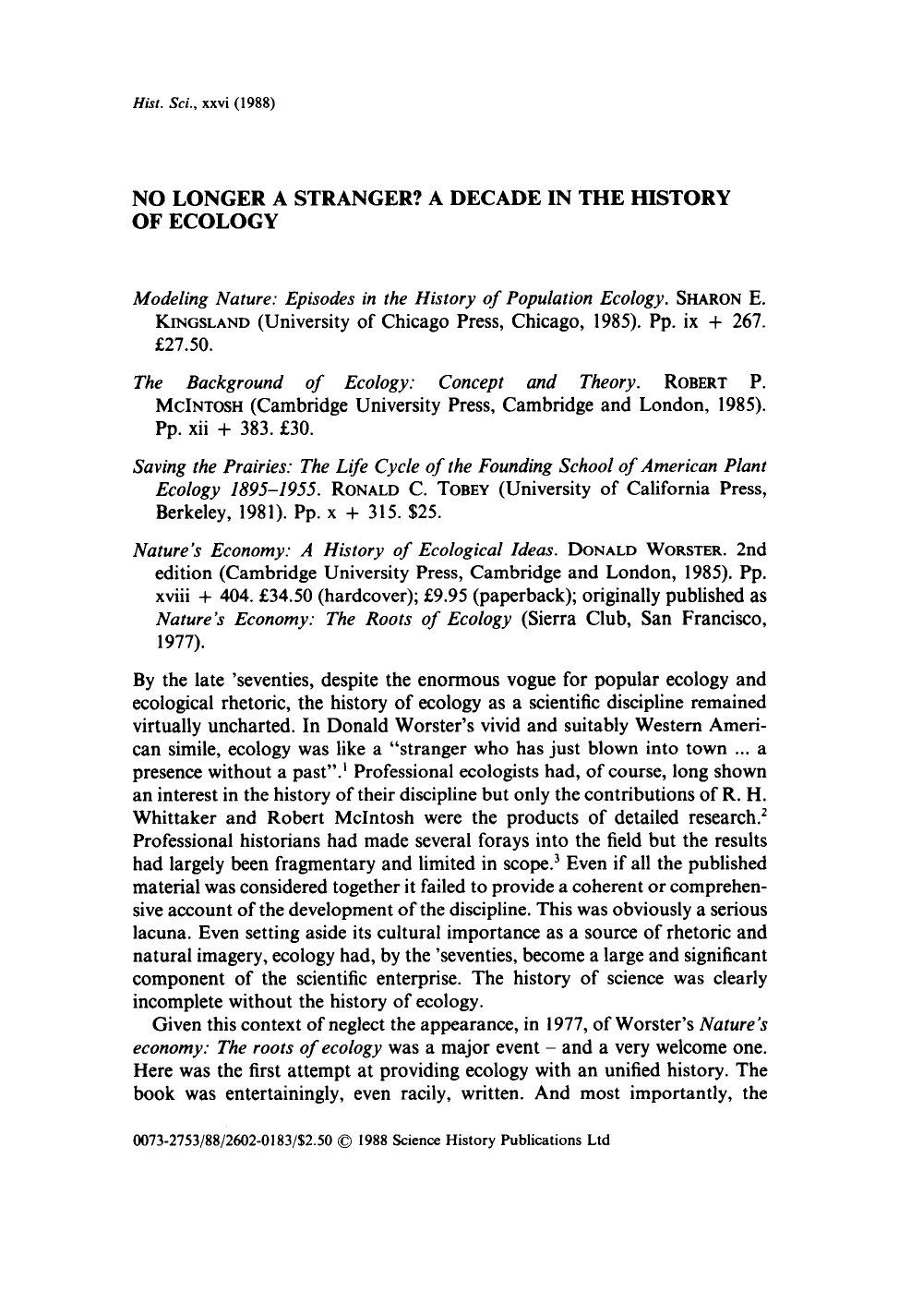
Essay Review: No Longer a Stranger? a Decade in the History of Ecology: Modeling Nature: Episodes in the History of Population Ecology,the Background of Ecology: Concept and Theory,Saving the Prairies: The Life Cycle of the Founding School of American Plant Ecology 1895–1955,Nature's Economy: A History of Ecological Ideas,Nature's Economy: The Roots of Ecology
Restricted accessBook reviewFirst published online June, 1988
Essay Review: No Longer a Stranger? a Decade in the History of Ecology: Modeling Nature: Episodes in the History of Population Ecology,the Background of Ecology: Concept and Theory,Saving the Prairies: The Life Cycle of the Founding School of American Plant Ecology 1895–1955,Nature's Economy: A History of Ecological Ideas,Nature's Economy: The Roots of Ecology
WhittakerR. H., “Classification of natural communities”, Botanical gazette, xxviii (1962), 1–239; McIntoshR. P., “Plant ecology, 1947–1972”, Annals of the Missouri Botanical Garden, lxi (1974), 132–65; idem, “Henry Allan Gleason – individualistic ecologist 1882–1975”, Bulletin of the Torrey Botanical Club, cii (1975), 253–73; idem, “Ecology since 1900”, in TaylorB. J. and WhiteT. J. (eds), Issues and ideas in America (Norman, Oklahoma, 1976), 353–72; see also BurgessP. L., “The Ecological Society of America – historical data and some preliminary analyses”, in EgertonF. N. (ed.), History of American ecology (New York, 1977).
3.
For example, EgertonF. N., “Changing concepts of the balance of nature”, Quarterly review of biology, xlvii (1973), 322–50; idem, “Ecological studies and observations before 1900”, in TaylorB. J. and WhiteT. J. (eds), Issues and ideas in America (Norman, Oklahoma, 1976), 311–51; LoweP. D., “Amateurs and professionals: The institutional emergence of British plant ecology”, Journal of the Society for the Bibliography of Natural History, vii (1976), 517–35; StaufferR., “Ecology in the long manuscript version of Darwin's Origin of species and Linnaeus' Oeconomy of Nature”, Proceedings of the American Philosophical Society, civ (1960), 235–41.
4.
CittadinoE., “Plant adaption and natural selection after Darwin; Physiological plant ecology 1880–1900” (Ph.D. thesis, University of Wisconsin, Madison, 1981); CoxD. L., “Charles Elton and the emergence of modern ecology” (Ph.D. thesis, Washington University, 1979); DuffA., “The institutionalisation of ecology in Britain and the United States 1890–1918” (Ph.D. thesis, University of Manchester, 1980); NicolsonM., “The development of plant ecology, 1790–1960” (Ph.D. thesis, University of Edinburgh, 1984); WeinerD. R., “The history of the conservation movement in Russia and the Soviet Union from its origins to the Stalin period” (Ph.D. thesis, Columbia University, 1983).
5.
“Conceptual issues in ecology”, Synthèse, xlii, no. 1 (1980); “Reflections on ecology and evolution”, Journal of the history of biology, xix, no. 2 (1986).
6.
EgertonF. N., “The history of ecology: Achievements and opportunities, I”, Journal of the history of biology, xvi (1983), 259–316; see also idem, “A bibliographical guide to the history of general ecology and population ecology”, History of science, xv (1977), 189–21.
7.
Worster, op. cit. (ref. 1), 2.
8.
ibid., 58.
9.
ibid., p. ix.
10.
AlleeW. B.EmersonA.ParkT.ParkO., and SchmidtK., Principles of animal ecology (Philadelphia, 1949), 1–59.
11.
Worster, op. cit. (ref. 1), 135.
12.
ibid., 338.
13.
ibid., 163–9.
14.
ibid., 249.
15.
McIntoshR. P., The background of ecology, 26.
16.
CittadinoE., rev. of Robert P. McIntosh, The background of ecology: Concept and theory, Journal of the history of biology, xix (1986), 314–16.
17.
KingslandS., Modeling nature, 210.
18.
See PickeringA. R., “Against putting the phenomena first: The discovery of the weak neutral current”, Studies in the history and philosophy of science, xv (1984), 85–117. For criticisms of the correspondence realism which underlies much positivist historiography, see idem, “Against correspondence: A constructivist view of experiment and the real”, in FineA. and MacahamerP. (eds), PSA 1986: Proceedings of the biennial meeting of the Philosophy of Science Association, ii (East Lansing, forthcoming) and NicolsonM. and McLaughlinC., “Social constructionism and medical sociology: A study of the vascular theory of multiple sclerosis”, Sociology of health and illness, forthcoming.
19.
It seems significant that, although she discusses the work of several biometricians, she does not draw upon Donald MacKenzie's careful study of the political interests which were embodied in biometric theory, MacKenzieD., Statistics in Britain 1865–1930: The social construction of scientific knowledge (Edinburgh, 1981). Nor, despite the fact that many of the disputes she documents were between personnel trained as biologists and personnel trained as physicists, does she refer to the now considerable number of case-studies which elucidate the constitutive role which professional vested interests, such as specific technical skills, have played in scientific controversy, see ShapinS., “History of science and its sociological reconstructions”, History of science, xx (1982), 157–211, and for an outstanding example, DeanJ., “Controversy over classification: A case-study from the history of botany”, in BarnesB. and ShapinS. (eds), Natural order: Historical studies of scientific culture (London, 1979).
20.
Kingsland, op. cit. (ref. 17), 185.
21.
For examples of explanations of the technical content of science along these lines see PickeringA. R., “The role of interests in high-energy physics: The choice between charm and colour”, in KnorrK. D.KrohnR. and WhitleyR. (eds), The social process of scientific investigation (Dordrecht, 1980) and Dean, op. cit. (ref. 19). For an ecological example, see Nicolson, op. cit. (ref. 4), chap. 3. I have prepared a version of this chapter (which concerns the career of GleasonH. A.) for publication, copies of which are obtainable from the author.
22.
Tobey, Saving the prairies, 6.
23.
ibid., 114–18.
24.
ibid., 204.
25.
See Burgess, op. cit. (ref. 2).
26.
There is also a logical problem with Tobey's contention that the Nebraska school was victorious in a competitive struggle with the Chicago group. He argues that the Nebraska school founded the distinctive specialty of ‘grassland ecology’. If this is true, then in order to be competitors to Nebraska, the Chicagoans would also have to be members of the grassland specialty. But most of the Chicago ecologists worked on forest vegetation and its development. In what sense, then, were they members of the grassland specialty? In other words, Tobey attempts to make two incompatible arguments simultaneously. Either both groups belonged to the same specialty and competed – in which case there could not have been a truly separate “grassland” specialty – or they belonged to different specialties and therefore could not have competed for supremacy within grassland ecology. My own view, contained in Nicolson, op. cit. (ref. 4) is that there was not a distinctive specialty of grassland ecology with its own specific paradigm. It should be noted that the text Tobey regards as paradigmatic for the specialty, Clements'sF. E.Plant succession (Washington, 1916), contains much discussion of vegetations other than grassland. The principles it sets out were clearly intended to apply to all forms of vegetation and were responded as such by other American ecologists. Therefore the Nebraska school is best regarded as a very important and influential, but never wholly dominant, group with American plant ecology as a whole.
27.
Tobey, op. cit. (ref. 22), 68–69.
28.
NicolsonM., “National styles, divergent classifications: A comparative case-study from the history of French and American plant ecology”, Knowledge and society, forthcoming; see also Nicolson, op. cit. (ref. 4).
29.
Tobey, op. cit. (ref. 22), 69.
30.
WeaverJ. E. and ClementsF. E., Plant ecology, 2nd edn (New York, 1938), 89.
31.
This point is discussed in detail in Nicolson, op. cit. (ref. 4), 74–78 and chap. 3. For an eloquent actors' testimony on this point, see AlleeW. B., op. cit. (ref 10).
32.
Tobey, op. cit. (ref. 22), 7.
33.
ibid., 170–1.
34.
For a full discussion of Gleason's views on vegetation and their development, see Nicolson, op. cit. (ref. 4), chap. 3; see also McIntosh, “Henry Allan Gleason” (ref. 2), and ref. 21 above.
35.
For an account of the revival of the individualistic hypothesis, see Nicolson, ibid., chap. 4.
36.
GleasonH. A., “The fundamental principles in the classification of vegetation”, Proceedings of the Fifth International Botanical Congress (Cambridge, 1930), 77–78, p. 78.
37.
Compare the views on the theory of classification expressed in GleasonH. A., ibid., and idem, “The individualistic concept of the plant association”, Bulletin of the Torrey Botanical Club, liii (1926), 7–26 with Whittaker, op. cit. (ref. 2), 123 and BloorD., “Durkheim and Mauss revisited: Classification and the sociology of knowledge”, Studies in the history and philosophy of science, xii (1982), 267–97.
38.
ColemanW., in his essay review of EgertonF. N. (ed.), History of American ecology, Isis, lxxi (1980), 150–2.