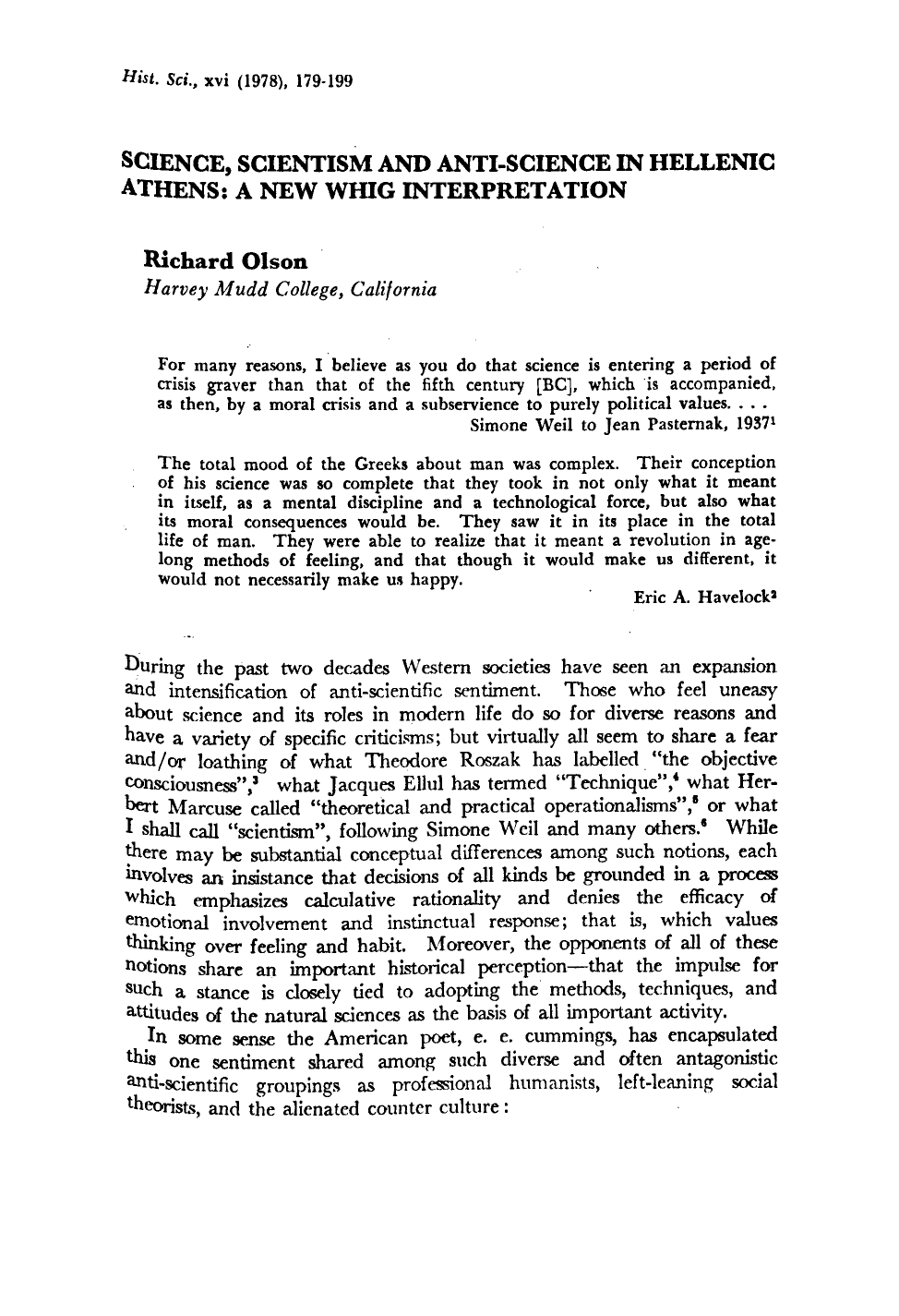
HavelockEric A., The crucifixion of intellectual man (Boston, 1951), 33.
3.
See RoszakTheodore, The making of a counter culture (Garden City, 1969), esp. ch. 7, “The myth of objective consciousness”, 203–38.
4.
EllulJacques, The technological society (New York, 1964, from French original, 1954), 3–22.
5.
MarcuseHerbert, One dimensional man (Boston, 1964), 158–9.
6.
See WeilSimone, “Scientism—A review”, in On science, necessity and the love of God (London, 1968), 65–70.
7.
e.e. cummings to HesseEva, in DupeeF. W.StadeG., eds, Selected letters of e. e, cummings (New York, 1969), 265.
8.
RousseauJean Jacques, The first and second discourses, ed. by MastersRoger D. (New York, 1964), 50.
9.
NietzscheFriedrich, The birth of tragdy and The genealogy of morals, trans. GolffinsFrancis (Garden City, 1956), 108.
10.
Rousseau, op. cit. (ref. 8), 44.
11.
NietzscheFriedrich, op. cit. (ref. 9), 94.
12.
Ibid., 82–83.
13.
There are two conspicuous, though not very successful, exceptions to this generalization if we interpret historians of science very closely. Kahn'sA. D.“Every art possessed by man comes from Prometheus': The Greek tragedians and science and technology”, Technology and culture, ii (1970), 133–62, develops the parallels between the impact of the Vietnam War on modern anti-scientific altitudes and the impact of the Peloponnesian War on Greek attitudes toward science and technology. In his “The Frankenstein syndrome: Man's ambivalent attitude toward knowledge and power”, Perspectives in biology and medicine, x (1967), 419–43, Mark Graubard also focuses on the Prometheus myth as one example of what he claims to be a universal human attitude toward knowledge and its application.
14.
See LloydG. E. R., Early Greek science: Thales to Aristotle (New York, 1970), Preface, p. 7.
15.
See especially FarringtonBenjamin, Greek science (revised edn, Baltimore, 1961), ch. 6, 79–89.
16.
See HavelockEric, The crucifixion of intellectual man (Boston, 1950), passim.
17.
That even those who have been most concerned to emphasize the differences between Pre-Socratic thought and that of Plato and Aristotle generally impute to the Pre-Socratics a search for pure knowledge for its own sake is best seen in Cornford'sF. M.Before and after Socrates (Cambridge, 1932), 29, where he characterizes the greatest achievement of Ionian natural science as the disengagement of thought from the interests of action.
18.
See Farrington, op. cit. (ref. 15).
19.
See, for example, LloydG. E. R., “Experiment in early Greek philosophy and medicine”, Proceedings of the Cambridge Philological Society, cxc (1964), 50–72, and “Popper versus Kirk: A controversy in the interpretation of Greek science”. The British journal for the philosophy of science, xviii (1967), 21–38.
20.
FränkelHermann, Early Greek poetry and philosophy (Oxford, 1975), 255–6.
21.
PoincaréHenri, The value of science (New York, 1958, from the 1913 original), 8.
22.
DeweyJohn, The quest for certainty (New York, 1960 edn), 79.
23.
HabermasJurgen, Toward a rational society: Student protest, science, and politics (Boston, 1970), 52.
24.
See HavelockEric, The liberal temper in Greek politics (London, 1957), esp. ch. 3, “History as progress”.
25.
The rapidity of technological and social change in Hellenic Athens is emphasized by Kahn. See ref. 13 above.
26.
The whole of Finley'sM.I., The ancient economy (Berkeley, 1973) is devoted to an analysis of this issue.
27.
See especially JaegerWerner, The theology of the early Greek philosophers: The Gifford Lectures of 1936 (Oxford, 1947), and GuthrieW. K. C., The Greeks and their gods (Boston, 1950).
28.
For a good summary of the integration of religious, civic, and cosmological thought in Hellenic culture see DickinsonLowes, The Greek view of life (Ann Arbor, 1958).
29.
This point is particularly well made by DavidJoseph Ben, The scientist's role in society: A comparative study (Englewood Curl's, New Jersey, 1971). See ch. 3, “The sociology of Greek science”. Ben-David wants to use the lack of specialization for much different purposes from myself.
30.
See RobinLeon, Greek thought and the origins of the scientific spirit (New York, 1969, from the 1928 French original) for an expression of this point of view.
31.
Malinowski's essay appeared in NeedhamJames, ed., Science, religion and reality (New York, 1925).
32.
See the “Essays on philosophical subjects—1795”, in The early writings of Adam Smith, ed. by LindgrenJ. Ralph (New York, 1967), 29–135. FoleyVernard, in his The social physics of Adam Smith (West Lafayette, Indiana, 1976), has in some sense gone one better than Smith by claiming that Smith's own scientistic approach to political economy was derived more directly from Hellenic scientism than from eighteenth century sources. Though far from totally convincing, Foley's arguments may have some merit.
33.
See RavenJ. E., Plato's thought in the making: A study of the development of his metaphysics (Cambridge, 1965), esp. 87–96, for this interpretation of the central argument of the Phaedo.
34.
Philological Monographs published by the American Philological Association, number xxv (Cleveland, 1967).
35.
London, 1969; published separately as The Sophists in 1971.
36.
ClagettMarshall, Greek science in Antiquity (New York, 1955).
37.
LloydG. E. R., Early Greek science: From Thales to Aristotle (New York, 1970), 66.
38.
Plutarch, Nicias, 23. The most extensive discussions of the ties between science and charges of impiety in Athens is DerenneE., Les procès d'impieté intentes aux philosophes à Athens au Vme et IVme siècles avant J.-C. (Paris, 1930).
39.
See UntersteinerMario, The Sophists (Oxford, 1954), 4.
40.
See GuthrieW. K. C., The Sophists (London, 1971), 231.
See RoszakTheodore, “The monster and the titan: Science, knowledge, and gnosis”, Daedalus (Summer, 1974), 17–32.
48.
Rousseau, op. cit. (ref. 8), 50, 59.
49.
Ibid., 44–45.
50.
The Rambler#24 (9 June, 1750).
51.
Plato, Apology, 19c.
52.
Plato, Phaedo, 96.
53.
Ibid., 98b–99b.
54.
Ibid., 99b–c.
55.
Aristophanes, Clouds, in The complete plays of Aristophanes, ed. HadasMoses (New York, 1962), 141.
56.
Lactantius, The divine institutes, III, iii.
57.
NietzscheFriedrich, op. cit. (ref. 9), 72. Aristophanes's criticisms of what I am calling scientism are concentrated in Clouds and Frogs. In the latter, Euripides personifies the pernicious character of the new learning; but in the final chorus, his views are identified with those of Socrates.
58.
Aristophanes, Frogs, final chorus.
59.
See Guthrie, The Sophists, 226–49.
60.
MurrayGilbert, Aristophanes (Oxford, 1983), 125–6 and WhitmanCedric, Aristophanes and the comic hero (Cambridge, Mass., 1964), 124–6.
McDermotJohn, “Technology, the opiate of the intellectuals”, New York review of books, 31 July, 1969.
63.
Kahn, see ref. 13, has developed this particular parallel. The frequent correlation between anti-scientific outbursts and unpopular wars—e.g., the French Revolution, the Franco-Prussian War, etc.—invites analysis.