



Abstract
This article develops a historical anthropology of craftspeople in the sciences through the story of the family Wunder, who for three generations (from 1771 to 1832) ran a prolific trade in rare plants and large mammal fossils from their workshop in the mountains of Upper Franconia. Studies of scientific homes and families have had an extraordinary impact on the history of science, showing how experiments and museums were so housed as to model highly exclusive scientific publics, and how projects of inquiry were shared among spouses, children, and servants. But this literature has rarely stepped outside of elite, urban homes and country estates. Doing so demonstrates how material flows conventionally oriented around metropolitan institutions could hinge on the spatial logistics of post roads, highland footpaths, inns and taverns – and the families who minded them. Viewed from the village, new university and museum institutions rose in reciprocal action with rural projects, otherwise excluded from the story of a liberal-bourgeois public sphere and the emergence of the modern natural sciences (Naturwissenschaften). I argue further for a thick description of science among craftspeople and peasants, suggesting nature’s keepers as a useful social category for actors involved in the everyday production of the economies and spatial logistics of natural inquiry. Across Central and Alpine Europe, inns, workshops, and country lanes composed a substructure of scientific life that materially shaped natural history and its theoretical horizons in “deep time,” directing the movements of earthly objects and educated travelers.
A wainwright’s tale
Anna Elisabeth Wunder (1766–1832) saw it all. From the village of Muggendorf, folded into the mountains of Upper Franconia, she was witness to perhaps the era’s most prolific trade in Pleistocene fossils, all run from a wagon-making and leather-tanning workshop. Well-to-do lowlanders came and went with the seasons, taking all manner of naturalia with them – cheaply-bought bones of exotic beasts, marine fossils from Muggendorf’s limestone, and dried plants from its high tablelands. All the while, three generations of Wunders maintained an obscure scientific dynasty on Muggendorf’s market square (Figure 1). Born in 1766, Anna’s earliest memories might have been the “Years of Hunger” brought on by the extreme cold of 1770–2. That is when her parents, Johann Georg Wunder and Catharina Mühlhäußer, turned to natural history as a new source of income. Together with her brother Ludwig, born amid crisis in 1771, Anna came of age in the craft of inquiry, with fossils and flowers strewn among the lumber, turning wheels, planers, and tree-bark required of the family trades. Ludwig inherited their father’s title, “Cave and Naturalia Inspector,” passing it on to his son, Daniel. But it was Anna, unmarried, who saw the trade from its first to final days.
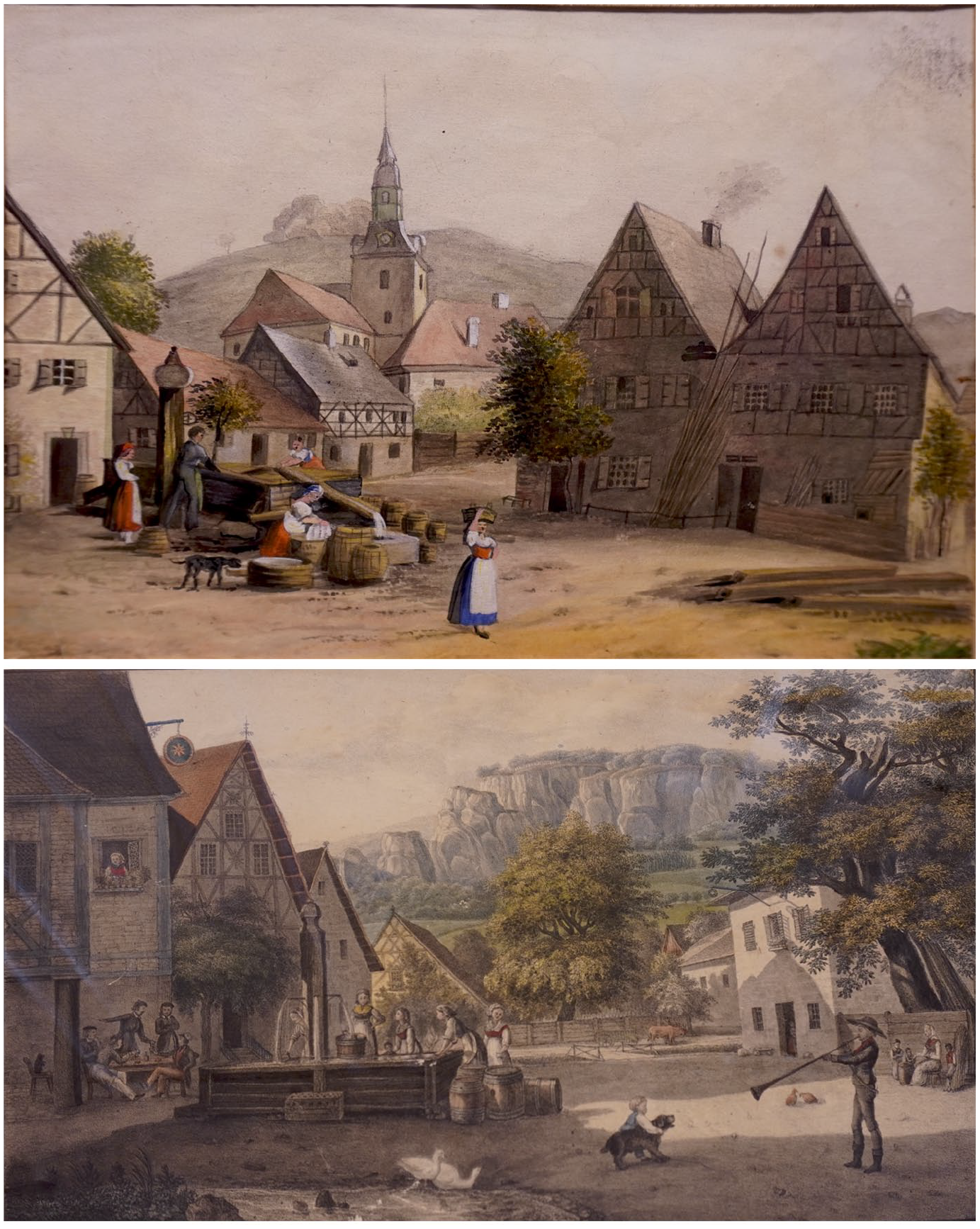
The market square in Muggendorf, featuring (above) lumber stockpiled before a barn-style house and (below) a lively inn with a prospect of the cliffs near Rosenmüller’s Cave, early nineteenth century.
Like the Wunder workshop, this article stands at the crossroads of material flows, rural economy, and working families in the history of science. Studies of scientific homes and families have had an extraordinary impact on the field as a whole. They have shown how experiments and museums were so housed as to create and model highly exclusive scientific publics, with projects of inquiry shared among spouses, children, and servants who were themselves subject to gendered divisions of labor and selective visibility. 1 And yet this literature has rarely stepped outside of elite, urban homes, occasionally venturing to country estates and into the “affective geographies” of fieldwork. 2 Meanwhile, studies of philosophical Swiss farmers and botany in British pubs suggest a historical anthropology of peasant and craft spaces excluded from the “learned world” of bourgeois science. 3
This article invokes Laurel Thatcher Ulrich’s classic A Midwife’s Tale, based on a common diary from Maine, as much as it is engages historical and anthropological studies of village life, working identities, and upland communities. 4 As Ulrich wrote of her “trivial” hinterland source: “[b]y restoring a lost substructure of eighteenth-century life it transforms the nature of the evidence upon which much of the history of the period has been written.” 5 In the main, the natural sciences of this period are characterized by Latinate taxonomic schemes, the trained eye of European travelers (ever dependent on local expertise), and a dramatic increase in the number and kind of specimens that circulated to universities, societies, and new museum sites. 6 To that account the Wunders restore a substructure of scientific work that materially shaped natural history and its theoretical horizons in “deep time,” particularly through the traffic of large mammal fossils. 7 Moreover, the wainwright’s tale upends received histories by showing how material flows conventionally oriented around metropolitan institutions could hinge on the spatial logistics of post roads, highland footpaths, inns and taverns – and the families who minded them. 8 In this world, the remit of wagonmakers and innkeepers, it is not the artisan but the naturalist who appears transient, even marginal.
Concepts of friction and maintenance are as helpful here as they have proven useful in the study of global and imperial processes far from Franconia. Friction draws attention to the multiple mobilities at play in the sciences, as when colonial naturalists in Asia or the Americas intersected with subaltern communities subjected to coerced migrations. 9 “Friction reminds us that heterogenous and unequal encounters can lead to new arrangements of culture and power,” Anna Tsing writes, gesturing to creolized knowledges and the key role of informants and intermediaries in imperial models of science. 10 So, too, unequal encounters shaped distinct arrangements of knowledge and power in Upper Franconia. Learned men both idealized the Wunders’ “rickety hut” and exploited their food insecurity to bargain for bones. 11 In the first instance, however, the trade in naturalia caused conflict within the village, revealing how social inequality shaped scientific practice at multiple levels.
Friction can also be taken more literally along rugged country lanes, for the Wunders figure in a wider history of transportation and breakdown that turns attention to the practices of maintenance and repair that underpin circulation and observation. 12 This perspective puts ships, roads, and wagons – and the actors who maintain them – on equal footing with those whose travels they facilitated: the Alexander von Humboldts, Ernst Moritz Arndts, W. H. Wackenroders, and Ludwig Tiecks of German travel writing, for example, all of whom passed through Muggendorf in the 1790s. A decade before Humboldt attempted to summit Mt. Chimborazo in the Andes, he arrived in Muggendorf with two servants in tow, sore from riding horseback in the “grim cold” of the highlands. 13 Arndt and Wackenroder likewise complained about country roads turned to rivers by rain; still others came by foot, seeking a wainwright to repair their broken axles. 14
What emerges at the crossroads is a new social category for the history of science: the titular keepers of nature. Akin to lighthouse-keepers, bee-keepers, or the “castellans” who kept watch over castles and the surrounding country, the Wunders’ sort were variously identified as wardens, inspectors, and cave-keepers (Höhlenwirth, from the word for innkeeper). 15 Seldom recognized as naturalists in their own right, the Wunders nonetheless belong to a heterogeneous group of tradespeople who maintained the information orders and material economies that structured natural history, down to the domestic manufacture of smocks, lanterns, and rope for cave-going clients. They did so over the six decades that straddled 1800, just as the natural sciences, or Naturwissenschaften, took their modern form and meaning in the German lands. 16 Viewed from Muggendorf’s market square, self-consciously modern university and museum institutions in Bayreuth and Erlangen rose in reciprocal action with rural projects, otherwise excluded from the story of a liberal-bourgeois public sphere. In the spirit of redress, this article builds a case for keepers as a critical category for understanding the Handwerk that set objects and people in motion. The resulting friction produced a distinct set of scientific attitudes, motivations, and identities among craftspeople.
Ways of knowing
You wish to travel overland Best have a wainwright near to hand. . . Merchant’s wares beyond tally, I’ll manage o’er mountain and valley. Wainwright’s song
17
. . .we can be certain that many more men than writers have looked with intense interest at all the features and movements of the natural world: hills, rivers, trees, skies, and stars. Raymond Williams, The Country and the City
18
The conceit of lowland writers was that Muggendorf was off the beaten path and therefore needed to be discovered. Beginning in the 1790s, writers from cities near and far invented Upper Franconia as a hinterland at the heart of Germany, a quintessentially Romantic landscape they called the Franconian Alps. 19 It’s been said that “a working country is hardly ever a landscape.” 20 However, Muggendorf’s prospects were the product of much labor. Centuries of sheep grazing kept vegetation low on the tablelands, save for juniper among the crags and woods of beech and fir that fell into the valley of the Wiesent River (see Figure 2). This gave travelers the sense that they wandered through a land of much greater elevation. Botanists reinforced the notion with accounts of “Alpine plants,” like yellow whitlow-grass, known to grow in the Pyrenees and Carpathians. 21 But those who claimed to discover an Alpine hinterland traveled, in fact, along well-established highways.
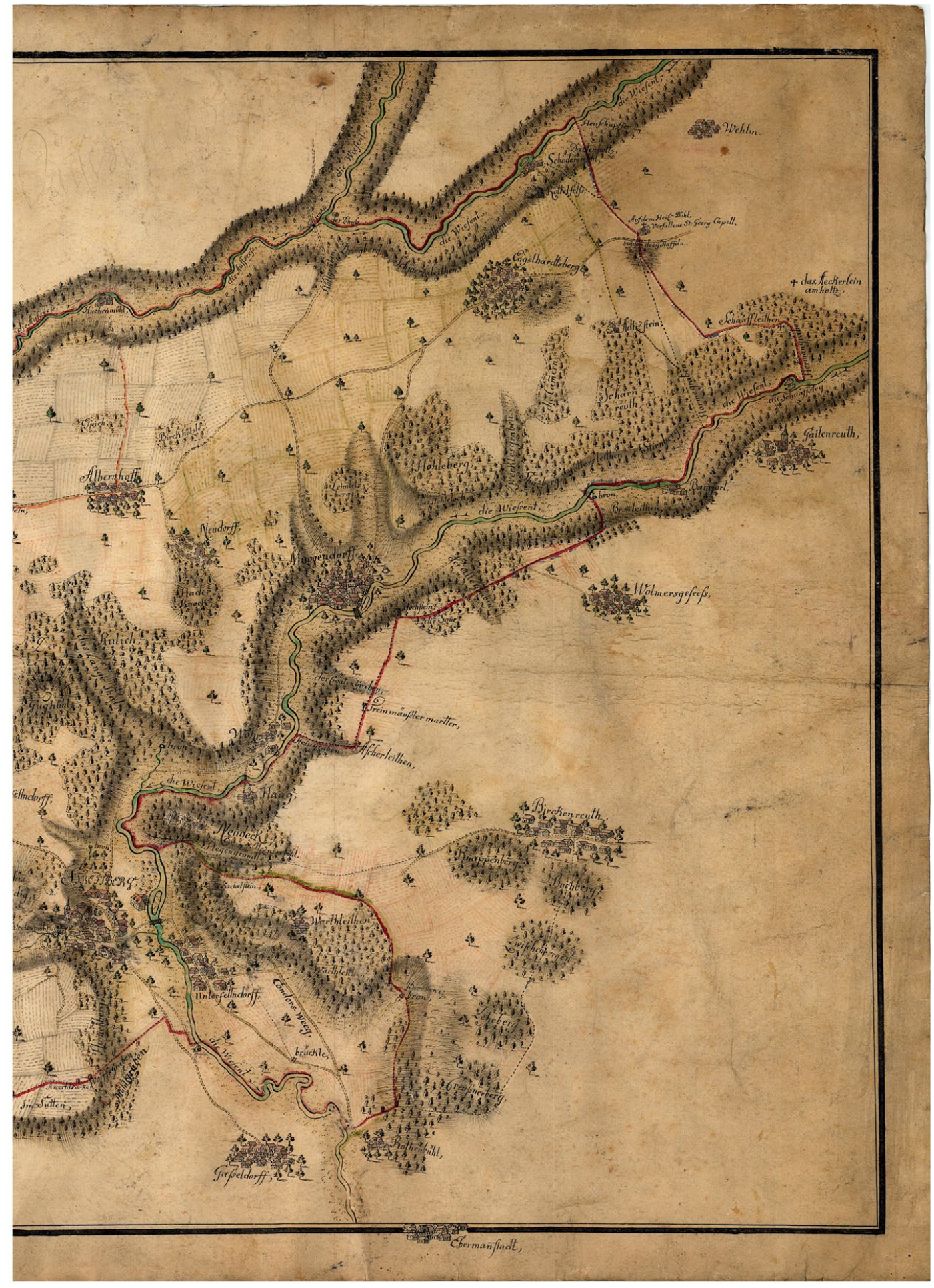
Detail from east-oriented map of the cultivated, pastoral tablelands above Streitberg, Muggendorf, and Gailenreuth in the Wiesent Valley (1750).
Muggendorf and its neighbor Streitberg were customary waystations between the courts of the principalities of Bayreuth and Ansbach, a day’s ride in either direction. Significantly for Protestant travelers, roadmaps show the district as a Lutheran enclave in the lands of the Archbishopric of Bamberg (Figure 3). Muggendorf was not an obscure mountain village at all, then, but a regular thoroughfare for postmen and courtly pages, which could connect Prussia and Saxony in the north to the cities of the south, Nuremberg and Augsburg. 22 Regular traffic meant inns – of which Muggendorf had twelve among just fifty-three houses – and inns, of course, meant beer. 23 With brewing licenses liberally granted in Upper Franconia, hops lined the Wiesent Valley. Before plants and fossils, beer and brandy were Muggendorf’s major exports, carted eight hours each way along the old post road. Cattle they drove further still, as far as Nuremberg some fifty kilometers south. 24 The well-worn paths of postmen, carters, and herders thus underlay the circuits of later naturalists, who first appeared in the 1770s. In other words, an existing infrastructure of roads and inns framed the conditions of possibility for an influx of naturalists and a commerce in natural objects. Several of Muggendorf’s limestone caves were already well-known to villagers, even drawn on mid-century maps; but they were not yet commodified. 25
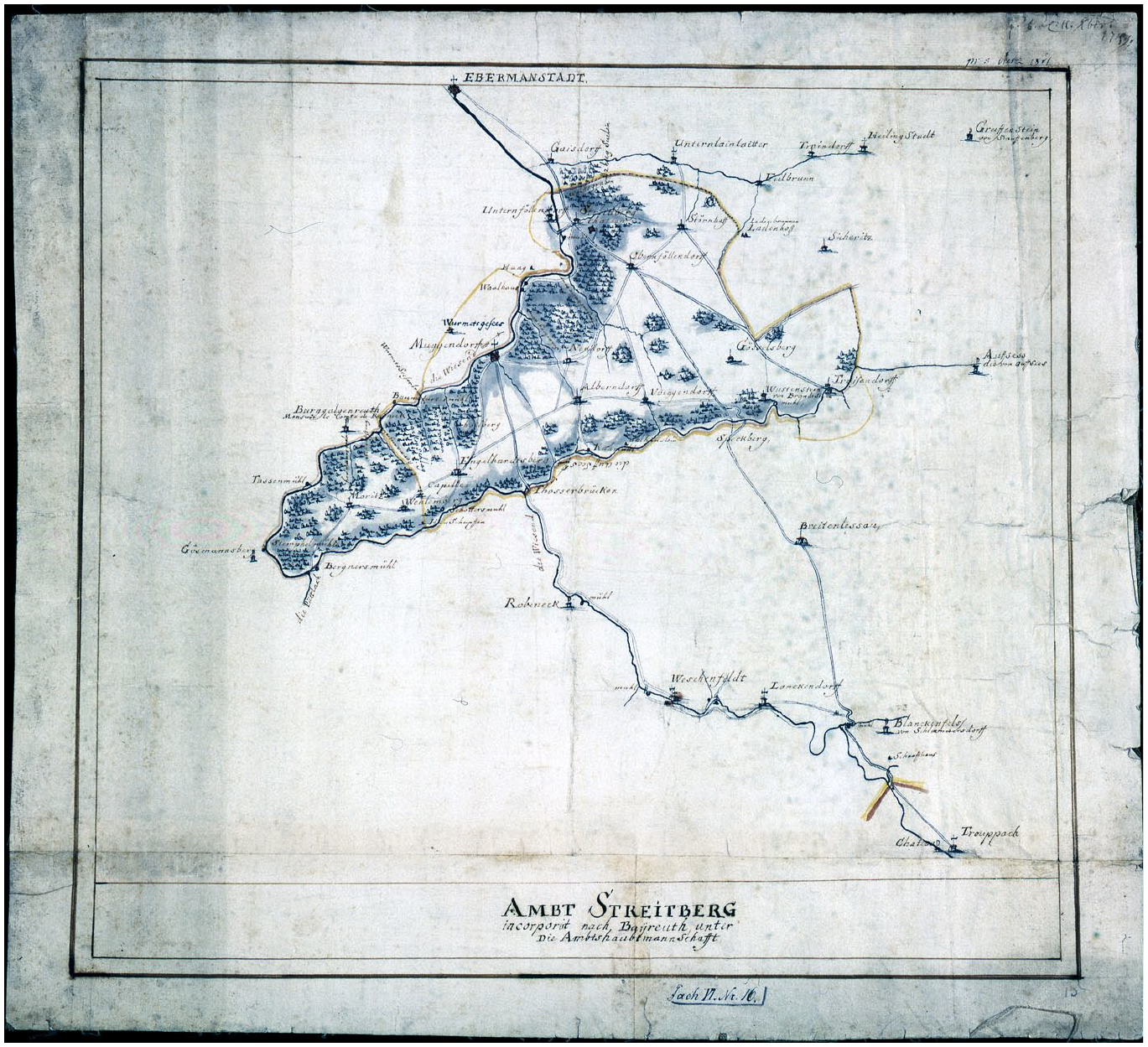
South-oriented roadmap of Streitberg District showing the route between Bayreuth and Ansbach, branching off to Muggendorf and Streitberg (1722).
This changed during the Years of Hunger in 1770–2. 26 A spate of hard winters gripped the region, causing crop failures, high corn prices, and a typhus epidemic, dramatically visible in Muggendorf’s parish records (Figure 4). Muggendorf buried seventy villagers in 1772, probably about a quarter of the whole parish, including Johann Georg Wunder the elder. Johann the younger and his wife Catharina had faced twelve winters together, but none so hard as this, and now had to feed three young children (Figure 5). Contemporaries wrote of artisans selling their tools for food. 27 Johann and Catharina turned to the trade in earthly objects.
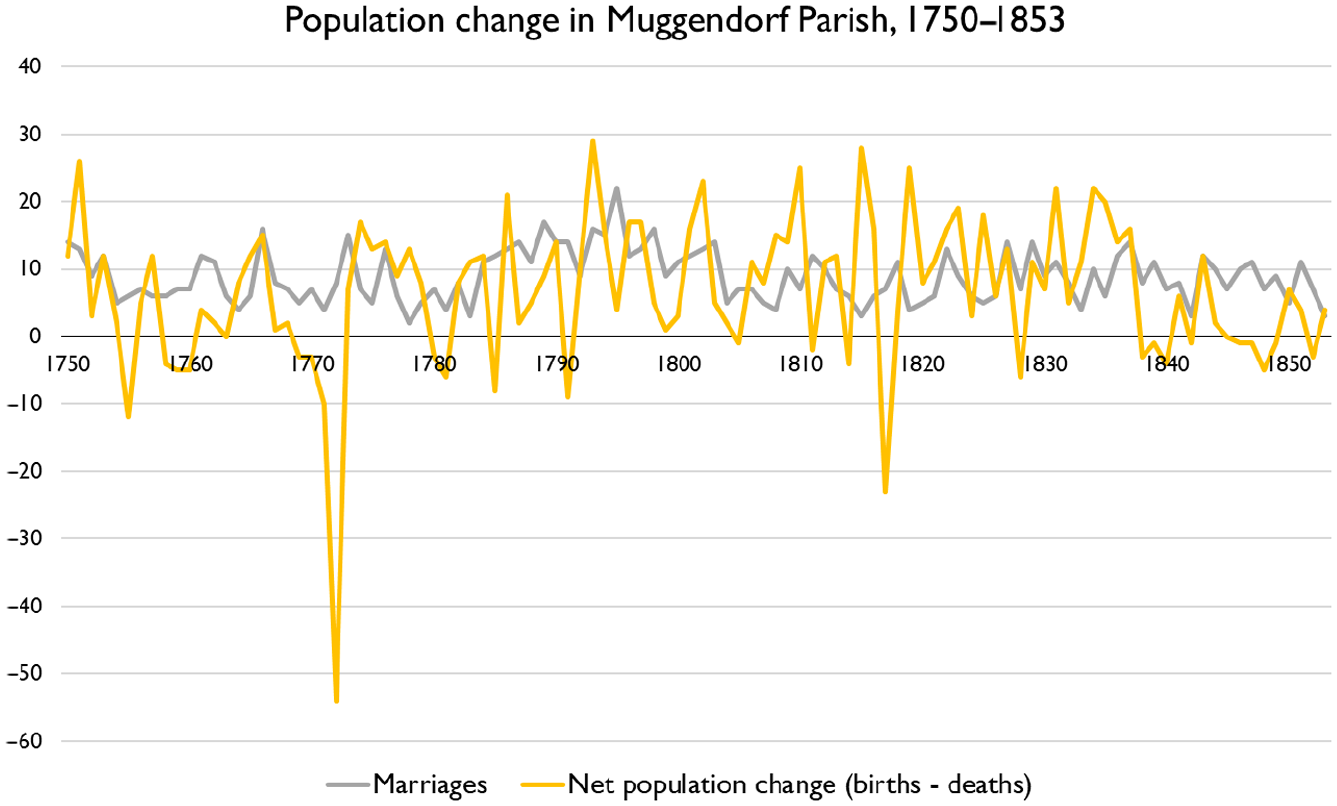
The Years of Hunger (1770–2) starkly visible in the net population change in Muggendorf Parish.
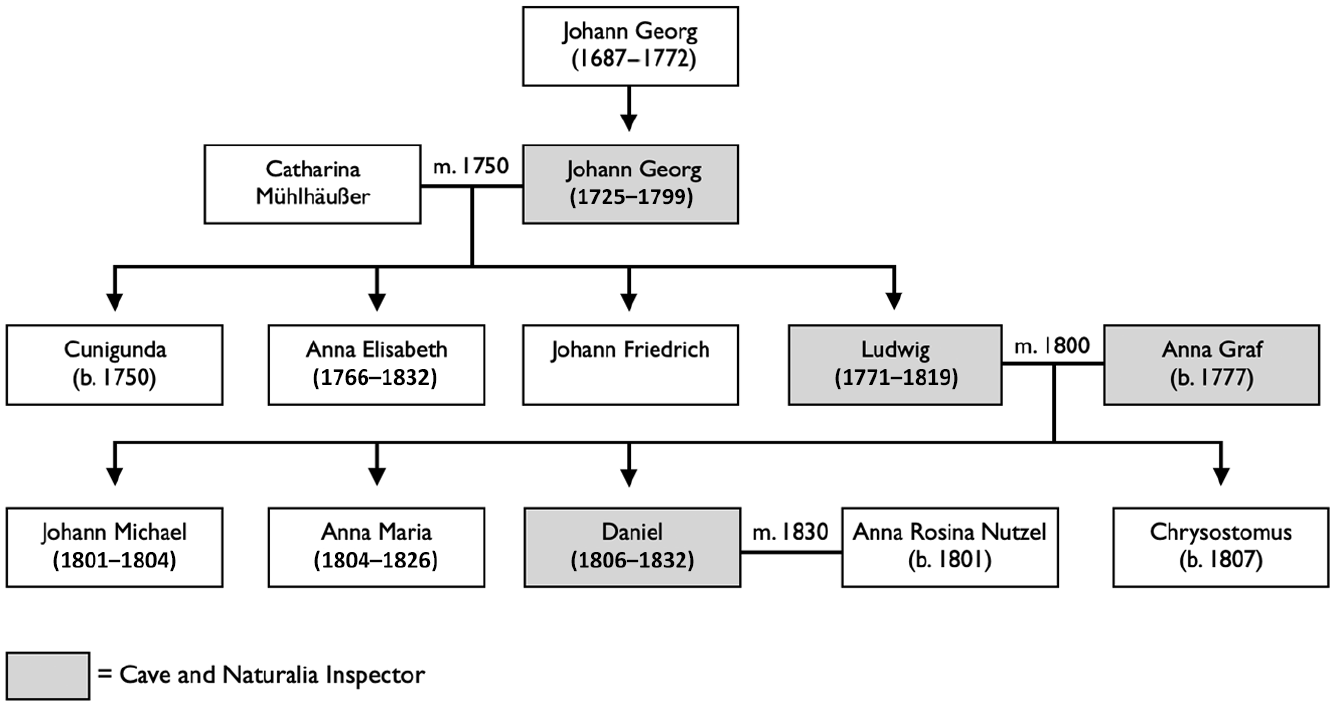
Wunder family tree and three generations of Cave Inspectors. Based on records of the LAELKB, Dekanat Forchheim, Muggendorf (Bestattungen, Taufen, Trauungen).
It was at this moment that hints of fossil-filled caverns reached Johann Friedrich Esper (1732–81), a pastor and naturalist who lived near Erlangen, a university town to the south. 28 Upon arriving in Muggendorf, Esper “heard a great deal about new discoveries,” including the newly named Wunder’s Cave. 29 He proceeded to publish sensational accounts of fossilized “polar bears” and other strange beasts thought to have been swept into Franconia by a primordial deluge. Esper never mentioned the Wunders by name, but later naturalists describe the period as one of intensive collaboration between the Muggendorf artisans and a circle of Erlangen naturalists that included the apothecary Frischmann and the professor Johann Christian Schreber (1739–1810), director of the university’s cabinet and botanical garden. Several of those accounts came from students who said their professors had the Wunders “to thank for many plants and other naturalia once thought indigenous only to the most remote lands and to the far North.” 30 In turn, Erlangen professors were supposed to have awakened in the Wunders a latent “aptitude for natural history,” even schooling them in Linnaean taxonomy. 31
The Wunders also practiced natural history on their own artisanal terms by licensing a country craft. In 1775, not long after Esper’s first publication on the “zoolite caves,” the Margrave of Bayreuth “acquiesced” to appoint Johann Georg Wunder as warden of “the natural history of the Fatherland,” coining the distinct title of Cave and Naturalia Inspector. 32 The Cave Inspector was not merely a warden and keeper of caves, but also a provisioner of natural objects (fossils, minerals, and plants) to the royal cabinet in Bayreuth. He, and later she, was therefore charged with identifying naturalia of worth and curiosity, typically an act of learned scrutiny. In an age of hunger, these services would be paid in kind with rations of corn and grain from the state.
Still, necessity is too narrow an explanation for an enterprise that posted fossils as far as Paris and London. Artisan autobiographies from the period show scenic tours and “thirst for knowledge” as markers of “honor” among craftspeople, as much as ownership over means of production signaled distinction from the lower orders of corporate society. 33 The Wunders’ biographies were mostly mediated by travel writers and sometimes through correspondence with territorial authorities. One botanist said “Old Wunder” exhibited the common globe daisy under the Latinate genus of Sesleria, and even “beheld it as the crest of Muggendorf.” 34 Such stories set the craftsman’s sense of honor in the language of learned inquiry. Botanical skill was a particular point of pride for the Wunders. Both Johann and Ludwig claimed to discover new caves while searching the hills and clefts for “rare plants,” asserting the priority of their botanical interests over the fossil-hunters who came after. 35 In this way, Ludwig had discovered his own cave, Ludwigshöhle, in 1788, at age seventeen, while “on his wanderings [auf seinen Wanderungen] for plants and petrifactions,” an Erlangen man wrote. 36 Reference to Ludwig’s “wanderings” hints at the artisanal nature of their science, invoking a journeyman year (Wanderjahre or Wanderungen) en route to mastery.
Follow the Wunders far enough along the post roads and footpaths of Upper Franconia and natural history takes on a country character of its own. Rural wagonmakers knew the woods particularly well, associated as they were with a thorough knowledge of trees – elm for the hobs, oak for the spokes, birch for the tow shaft, and so on. 37 Thus, one lowland visitor purchased a “Collection of Muggendorf Wood Species in 60 Pieces” along with boxes full of rare herbs and fossils. 38 If bear skulls and marine invertebrates struck visitors as oddities, the Wunders’ array of dried plants and petrified woods was not out of place in a workshop stocked with lumber and barks and resins for tanning. The associated skills were also critical to the family enterprise, since caves required considerable woodwork (bespoke steps, doors, ladders, and lighting systems) to be made navigable. 39 Indeed, a sturdy wagon was perhaps the most essential technology to the country craft of natural history, required for the transport of skeletons and stalagmites over tough mountain roads. 40
Roads also help to explain why a family of wainwrights, of all people, were at the center of this economy. The region’s roads were as notorious as they were well-trafficked, making maintenance a particularly salient category for country science.
41
To be waylaid at the mercy of locals was something of a trope in the sixty or so published narratives of Muggendorf. Traveling by covered chaise in the summer of 1792, the Erlangen writer Köppel had an axle replaced en route to Muggendorf only to find the “narrow, mountainous” roads by Streitberg nearly impassable in a sudden thunderstorm.
42
Similar scenes echoed in the verse of visitors like Tieck, who came to Muggendorf “over swamp, or upon snow” the following summer. Of travels further afield he later reminisced: From the path erred, By storm beset, From rain soaked, I seek shelter here In this country dwelling.
43
Rutty lanes presented a twofold opportunity for the Wunders, who were by trade already indispensable to travel. The organization of transport was a customary source of income for upland communities, involving muleteers, carters, and wainwrights alike. 44 Historians have even noted how rural communities sometimes neglected roads, since broken axles brought work. 45 The Erlangen anatomist Johann Christian Rosenmüller (1771–1820) called Muggendorfers “mischievous gnomes” for this very reason, though he conceded that paving the roads would starve those who “feed themselves by harnessing and leading others’ horses.” 46 Only toward the end of the Wunders’ enterprise, around 1830, did the road to Bayreuth appear on maps as a paved chaussée, as maps themselves made locals redundant. 47
The Wunders used the region’s roads to marvelous effect, steering geological imaginaries just as fossils became witness to mass extinction events in the reconstruction of earth history. 48 The same fossil-rich limestone that accounted for Muggendorf’s many caverns also made for sandy thoroughfares, subject to flooding. Melting snows and summer rains turned roads into a “sea floor,” as the phrase went among travelers (see Figure 6). 49 The Wunders cultivated this imaginary by leading visitors on a route replete with mollusks and crustaceans (Figure 7), some of them found on footpaths over the tablelands. 50 The effect combined well with “antediluvian” mammal skeletons, which most said were swept in from afar. Others, like Rosenmüller, thought these megafauna might have lived on the Franconian shores of a primordial ocean. 51 Either way, scenes of real-time inundation allowed visitors to virtually witness events that shaped the surface of the Earth, leaving exotic carcasses and marine fossils in their wake. Diluvial theories that sprang from Esper’s speculations were taken up by later generations of naturalists like August Goldfuß (1782–1848), who succeeded Schreber in Erlangen, and William Buckland (1784–1856), who described how Muggendorf’s valleys were “excavated by the diluvian waters” in his Reliquiæ diluvianæ (1823). 52 Both dealt extensively with the Wunders, led down theory-laden paths and back to the market square.
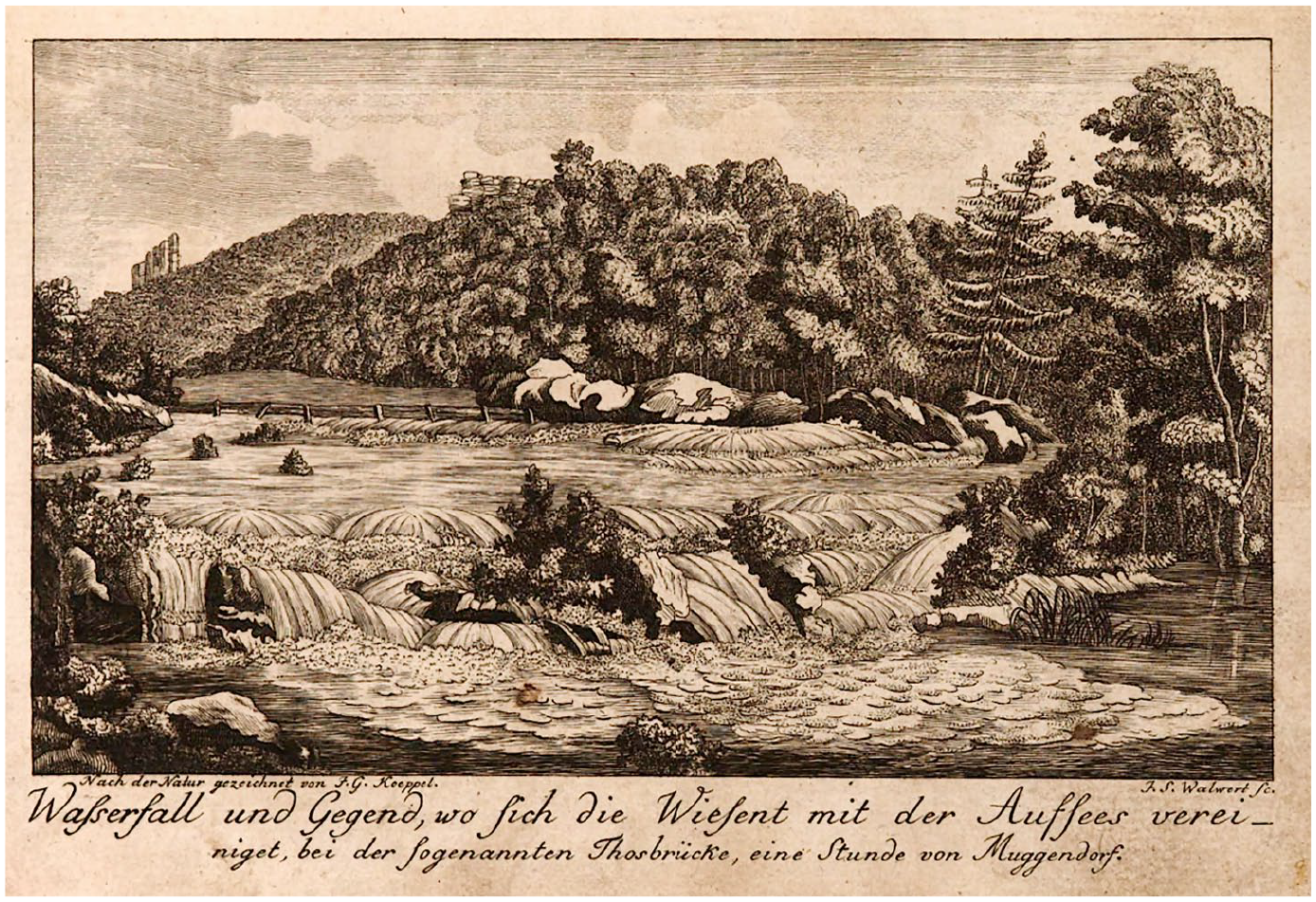
The Wiesent River washing out a fence on the road to Muggendorf.
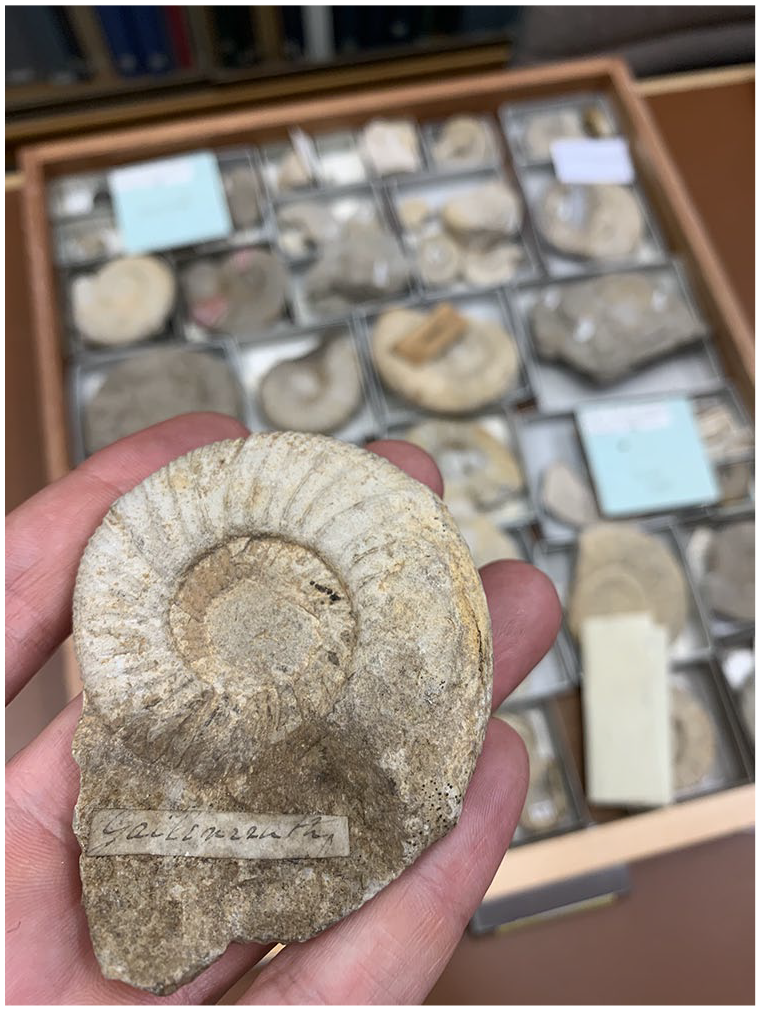
Cephalopoda from Gaillenreuth in the Wiesent Valley, collected by William Buckland while on a tour with Anna Graf in July 1816.
The upland exchange
To follow the Wunders is not to turn away from conventional sites of science entirely. It is to see the university, cabinet, and museum as part of an information order that included the keepers of caves, inns, and workshops. The reciprocal action of these spaces produced a new whole, a system of upland exchange in which Muggendorf’s market square is only as marginal as a university cabinet, depending on one’s position. However novel the Franconian Alps appeared to lowland writers, the relation between the two followed a long-standing intercourse between the highlands and the plains, which is documented across the Continent. High, geographically remote valleys are often associated with isolation and stasis, generically portrayed as “closed” subsistence economies and intellectual backwaters besides. Yet the very marginality of high valleys spurred communities to “open” their economies through seasonal emigration. 53 Muggendorf’s upland exchange similarly demands an anthropology of sliding scale, alive to modes of economic sociability within and beyond the village.
If the Wunders appear subordinate, even servile, in learned accounts, local sources show them as village notables, jealous of land and resources. What outsiders described as a “rickety hut on the market” was, in fact, prime real estate. It marked the Wunders’ centrality in the concentric order of village life. While peasants and day-laborers lived on the outskirts of German villages, “citizens” dwelt in close proximity to the twin pillars of rural society: church and tavern, both visible from the Wunder home (see Figure 1). 54 What is more, parish records reveal the elder Johann Georg Wunder as a member of the district court (Gerichtsverwandter), the same court in Streitberg that became the family’s primary conduit to natural history cabinets in Erlangen, Bayreuth, and beyond. 55 Where learned categories like “guide” and “assistant” present the Wunders as mere laborers, titles like Gerichtsverwandter and Cave Inspector invite a thicker description of status and meaning, both locally and among the artisans’ interlocutors at provincial courts.
Understanding science as artisanry means appreciating Handwerk not merely as a working process but “a set of norms governing exchange,” in Mack Walker’s words. 56 The Wunders practiced science as artisanry in a sense specific to the Holy Roman Empire, a patchwork of 300-plus territorial units from principalities and kingdoms down to autonomous “home towns.” The legal status of Handwerk in the countryside framed unique conditions of possibility. It meant, firstly, that the Wunders were not beholden to the guilds that controlled labor and markets in towns and cities. 57 Indeed, natural history provided an alternative to “going on the tramp” for journeymen likely to face hostility from the guilds (as when a Muggendorf carpenter was denied work even in a nearby town). 58 But exclusion could convey a rare degree of autonomy for country artisans who were therefore able to practice several trades – wagon-making, leather-tanning, and cave-inspecting, say – all at once. Moreover, they did so at the discretion of the territorial ruler, explaining the remarkable fact of the Wunders’ line of communication with princely authorities in Bayreuth. 59 Even more remarkable, the Wunders’ official ties endured regime change time and again: first when Prussia annexed the Principalities of Ansbach and Bayreuth in 1792, then again when Franconia fell under the Kingdom of Bavaria in 1810, after years of French occupation. 60
These exchanges produced an archive that emphasizes the primacy of the Wunders’ stately relations, even before their workshop became a regular site of “pilgrimage” among students and sightseers. 61 As Anne Secord wrote of artisan botanists in Britain, “the scientific élite were communally regarded as just another link (albeit a very useful one) in their own networks.” 62 Likewise, the key node in the Wunder network was the district court in Streitberg, where Johann Georg gave notice of “perfectly whole, monstrous skulls of completely unknown species” and, in turn, received orders to send “the most magnificent” of them in a crate with “Coachman Ott” to Bayreuth, for example. 63 Receipts of “rare plants” sent to Bayreuth or the botanical garden in Erlangen are mixed with shipments of “Zoolites” bound for Berlin, Paris, and London. 64 Another directive from Bayreuth shows how men of laboring and learned worlds were commonly enrolled in princely science: when the Cave Inspector was compensated for a shipment of “calcified AnimalBones [sic]” in 1777, the naturalist Esper was commissioned to write a book about them. 65
This was not an epistolary network, then, as among artisan botanists in Britain, but a scribal economy of nature embedded in the workings of the German states. The Wunders dictated their finds to a representative of the Margrave (and later of Prussian and Bavarian monarchs), and in at least one case dispatched their own first-person reports. All were stamped and filed among affairs of state, in a dossier titled “Police: Natural Rarities.” The Cave and Naturalia Inspector was himself a delegate of the royal cabinet, a corresponding agent to the Inspector of Naturalia Collections in Bayreuth, who was coincidently named Friedrich Wilhelm Wunder (1742–1828). 66 Already by about 1780, then, the Wunders had supply chains of naturalia running both ways along the old post road, to Bayreuth and Erlangen, some thirty-five kilometers in either direction.
Muggendorf’s upland exchange was also characterized by considerable conflict and inequality. On one level, travel narratives performed a great deal of “boundary-work” in positioning the Cave Inspector outside the learned pursuit of natural history. 67 As a rule, writers restricted the Wunders to a state of potentiality, ever striving toward “cultivation” (Bildung). Johann Georg was possessed of “all the makings of a naturalist” without ever becoming an equal member of the learned world. 68 It was probably Rosenmüller, writing anonymously in 1804, who described “old Wunder” as a “half-learned” man “hurling Latin stones about, comically enough,” in his attempt at Linnaean taxonomy. 69 But social histories of science should beware the bourgeois assumption that craftspeople and keepers wanted to become “men of science” after their own image. After all, Bildung was the invention of the same Romantic generation that claimed to discover the Franconian Alps. The Wunders were preoccupied with boundary-work of their own, laying exclusive claim to local resources.
Decades before the subdivision of Muggendorf’s commons, the Wunders petitioned authorities in Bayreuth for the “Enclosure of Caves Near Muggendorf.” 70 This was the title of a set of exchanges in 1777–8 in which Johann Georg raised the specter of villagers ransacking fossil-filled caverns, their contents “broken, chipped, and destroyed.” 71 He specifically targeted Muggendorf’s poorest class of tenants (Inwohner), who lacked real estate and civic rights, implying they were to blame for the “foreign sale” of Muggendorf’s “rare and remarkable zoolites, entire skulls, and bones.” 72 Only, some of the caves in question were not actually in Muggendorf, territorially speaking, nor even in the Margraviate. The richest caves lay in the wooded hills behind Burg Gaillenreuth, upstream and clear across the valley, in the lands of the Archbishopric of Bamberg. Bayreuth’s response not only made the Wunders sole wardens of Muggendorf’s “Cabinet-pieces” but also expanded their remit beyond territorial bounds, with exclusive license to cart fossils across territorial lines (vividly red-lined in Figure 2). 73 Further orders were given to keep the caves under lock and key as authorities imposed an embargo on earthly objects. All commerce in “attention-worthy naturalia” was formally restricted to official channels with royal cabinets and gardens. 74
But the Wunder enterprise fast outgrew its stately confines, responsive to a growing market of educated travelers and, no doubt, to meager pay in irregular rations of corn and grain. One writer’s lament that the family must “occasionally starve” echoes through the Wunders’ own pleas to state authorities for adequate remuneration. 75 Little wonder, then, that within a decade of the official embargo, the Wunder home became a center of illicit commerce. Writers of the 1790s only slightly exaggerated when they said the Wunders furnished “nearly all the natural history cabinets in and outside of Germany with the petrified bones of strange beasts,” bear skulls being Muggendorf’s most famous export. 76
The Wunder trade was enmeshed in a complex web of social and legal relations, within and beyond the village. Their home should be understood in these capacious terms, as an “open house” in Joachim Eibach’s conception of the interhousehold sociability that characterized early modern economic life. 77 Arguably more important than transient naturalists were alliances and kinship ties within the village, beginning with Johann Georg’s marriage to Catharina Mühlhäußer. 78 The Mühlhäußers owned one of Muggendorf’s two mills as well as an inn, and so ranked above the Wunders in the village economy of social capital. 79 Alliances also with innkeepers Leicht and Zöbelein were advantageous in establishing a private trade outside of official channels. 80
In a village where one in every five buildings was an inn, tavern scenes were soon written into natural history.
81
A dish of trout from the Wiesent and pints of “high repute” became part of the spectacle of country science as first narrated in the 1780s.
82
The same writers could be said to have invented the figure of “old Wunder,” albeit in ways that reflected the family’s commercial attitudes. “He reads and traverses mountains in search of herbs,” wrote an Erlangen man traveling with his sons: Woefully he complained to us, what a shame it would be if he could not see the entirety of these mountains. But he lacks sufficient pay and legitimacy to lay aside his wagon-work and devote himself entirely to the discovery of important treasures. Still, he hopes his complaints will be heard, and his wish to draw the entire land within the scope of his activity will be granted.
83
Others recalled Wunder sharing breakfast at the tavern before a day’s tour or returning them to their lodgings in what became an increasingly sentimental journey to Muggendorf in the 1790s. By the time of his death, in 1799, the wainwright of Muggendorf was a vessel for early Romantic notions of a Lebensart, or way of life, characterized by “sylvan solitude” and depth of feeling. 84 Cave, meadow, mountain, and inn all had a place in this drama. A somewhat more sober reading recognizes the social functions of rural taverns, as scenes of everyday business and encounter with outsiders – a fitting arrangement for the Wunder trade. 85 Their home on the market square, remote and “rickety” though it seemed, was shrewdly positioned among taverns and caverns.
The opening of Rosenmüller’s Cave in 1792 shows the whole complex of upland exchange in a single episode, all the more revealing for the tension between its learned namesake and its local discoverer. As in Esper’s case two decades earlier, hints of an unexplored cave filtered down the Wiesent to Erlangen, where Rosenmüller was a twenty-one-year-old medical student. Upon arriving in Muggendorf, Rosenmüller found the local infrastructure of natural inquiry already in place. Indeed, by his own account, it was the Cave Inspector and his son Ludwig (also twenty-one) who “had the design to assemble a company of nature-admirers” to rappel into the cave from a cleft in its ceiling. 86 Hardly a half-hour’s walk into the heights above Muggendorf, the cave’s bold rockface was visible from the market square, and very likely from the Wunders’ doorstep (Figure 1). The “company of nature-admirers” was also near at hand, reflecting the household’s links to key village institutions. Ludwig and his older brother, Johann Friedrich, led the operation to descend into the cave by rope and erect a system of ladders for further exploration. They were joined by Rosenmüller’s innkeeper, Zöbelein, and a church elder. As the company proceeded to blast and hew a new entrance from the cliffside, Zöbelein’s relative, a mason, joined the Wunders in the requisite stone- and woodwork. 87 Rosenmüller’s work was neither manual nor managerial. He operated rather like a Streitberg scribe, or a courier to Bayreuth, presenting a “report in the name of the Cave Inspector” to the Prussian minister who took charge of Bayreuth and Ansbach that year. 88
Rosenmüller’s report was to secure royal funds to open the cave to an educated public. Crucially, it was also an opportunity for the lowlander to register the cave under his name. Ludwig contested Rosenmüller’s stake in a remarkable document of his own making, quite possibly the only surviving source written (or at least dictated) by a Wunder. With the passing of his father in 1799, Ludwig addressed Prussian authorities to claim his patrilineal right to the title of Cave Inspector.
89
His bid for mastery included a register of the seven caves in the Wunders’ keeping, with Rosenmüller’s name dramatically struck from the record. “The Rosenmüller’s Cave,” said Ludwig, whose beauty and abundance of various stalagmites exceeds all other caves found in the region, terminates the valley from Streitberg to Muggendorf on the midnightly [north] side, the so-called Kupfe, and was discovered by Herr Prosector Rosenmüller and me while prospecting for herbs [Figure 8].
90
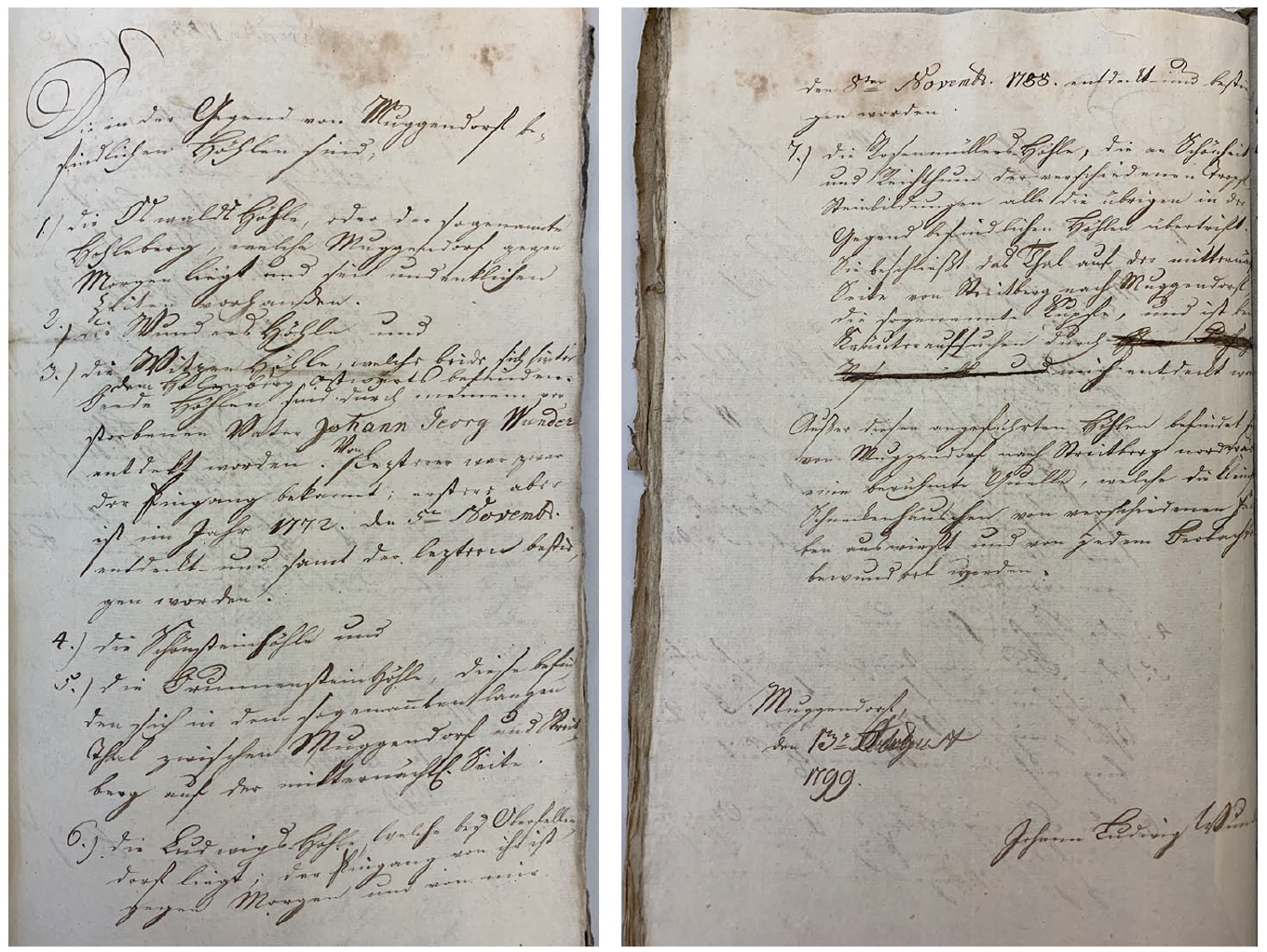
Perhaps the only extant writings of the Wunders, a register of Muggendorf caves signed by Johann Ludwig Wunder, August 13, 1799. StABa, Kastenamt Streitberg, Nr. 3.
The striking from the record of one of Muggendorf’s principal publicists suggests considerable friction in the upland exchange, as the Wunders endured meager remuneration and unfair bargaining. 91 The episode also captures a changing economy of nature in Muggendorf around the turn of the nineteenth century, as the Wunder trade was progressively commercialized and their collections ultimately sold in their entirety. The family’s fate allows us to revisit the making of the modern Naturwissenschaften as a commodity history, one in which metropolitan museums rose in proportion to the plunder of countryside cabinets.
Wagons full of fossils
Prussian annexation in 1792 coincided with a new era of renown and enterprise for the Wunders, though it was also one of precarity. Ludwig’s ascension to Cave Inspector in 1799 was followed, crucially, by his marriage to Anna Graf (b. 1777), who became his partner in the business of natural history. While regime change spurred an influx of travelers from north Germany, generational change in the south brought Ludwig and Anna into sustained contact with their contemporaries at the University of Erlangen, notably Rosenmüller and Goldfuß. Published accounts provide a peek in the window of the workshop: an apparently “decrepit, dark building,” where one Berliner “purchased a heathen urn, a fossilized terebratula, and a pair of red stalagmites.”
92
Others suggest the cabinet’s relocation into a dedicated room in their home, “a small room where Wunder’s treasures are spread about, fossils, teeth, jawbones, whole heads of unknown beasts and other petrified objects.”
93
The cabinet’s separation from the workshop reflected the distribution of trades among the Wunders: wagon-making to Johann Friedrich, cave-keeping to Ludwig, and leather-tanning taken up by another line.
94
In time, the Wunder cabinet became the stuff of verse: A great many stalagmites, Spar, crystal, sea urchin, Pectinates and fungates All brought to light. Echinates, ammonites, and the like, Polar bear skulls, jaws, teeth, And more –ates and –ites besides All here to see in great quantity.
95
The poet also recognized the cabinet as capital of a kind, calling it the “Wunder-inheritance.” With four children, born between 1801 and 1807 (Figure 5), Anna and Ludwig show natural science as a strategy of economic survival across generations. 96
Behind these cornucopian verses was an extraordinary labor of extraction, with “wagons full of fossils” carted from Muggendorf since the early 1780s. 97 In 1810, Goldfuß reported that Ludwig excavated 150 bear skulls from the Gaillenreuth Cave in just three years. Decades of excavation stocked cabinets in Bayreuth and Erlangen. 98 An 1840 catalogue shows that one in every five fossils in Bayreuth’s natural history collection came from Muggendorf, 1,451 specimens in all. 99 The private sale of plants and fossils is far more difficult to gauge, though travelers’ accounts suggest a considerable uptick after Prussian annexation. This is consistent with a Prussian policy that fused liberal commercial principles with aggressive control over natural resources in Franconia. 100 Some records suggest the state both officiated and curtailed the Wunders’ trade, imposing price restrictions. 101 Another believed the Wunders too easily bargained on objects that could otherwise be “expensively sold.” 102 Receipts are rare but revealing. “We bought a fine bears head for . . . £2 — teeth for 5 Creuz[er] a piece,” wrote the geologist Greenough, traveling with Buckland in 1816; “—our whole lot cost about £7.” 103 Today, the “lot” of Buckland’s collections in Oxford include 229 specimens from Muggendorf, including two fine bear skulls (Figure 9). 104
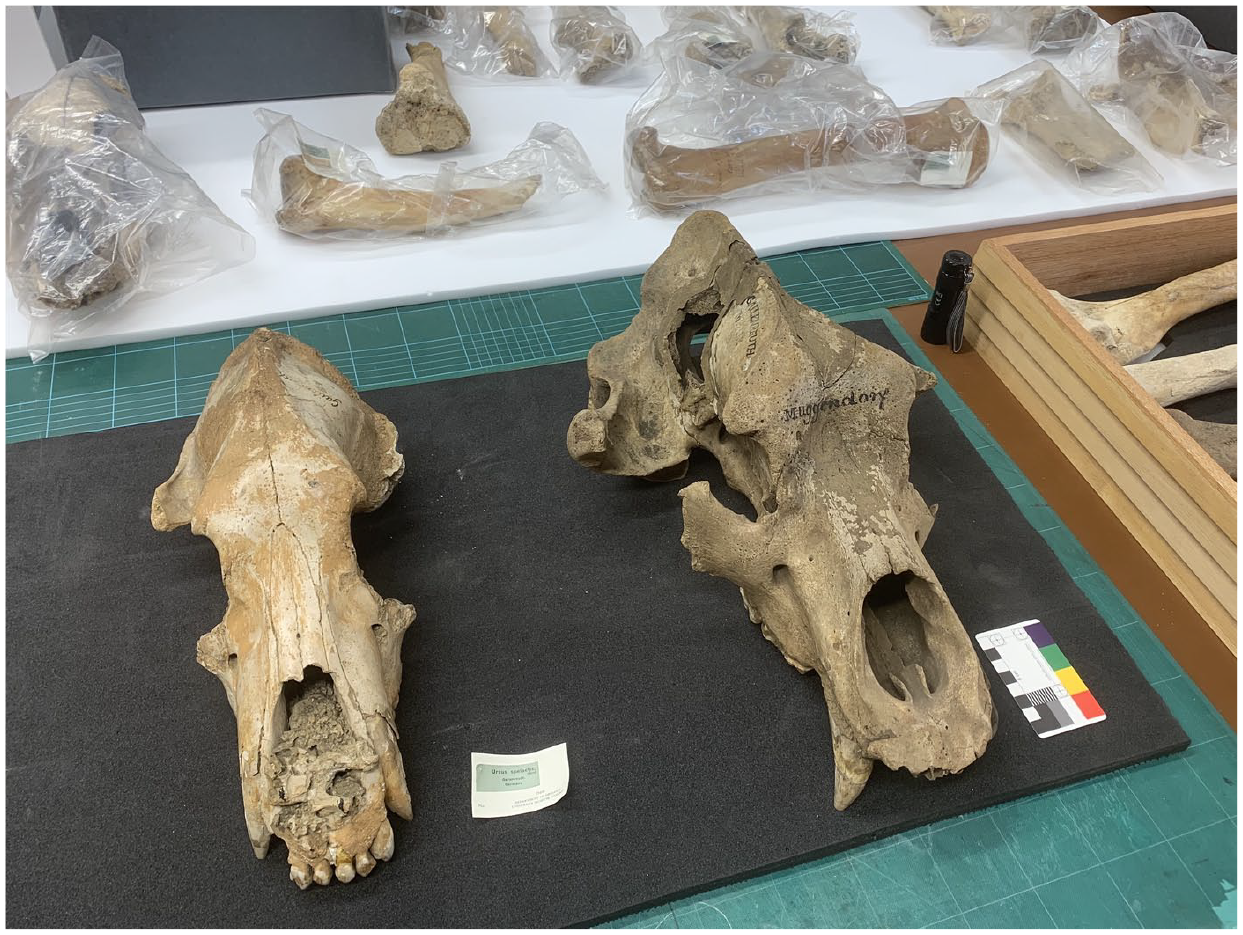
Cave bear skulls in William Buckland’s collections, likely labeled “Muggendorf” and “Gailenreuth” by Mary Moreland.
These objects of the Wunder trade show their hand in the making of scientific careers and curating of natural history museums. Rosenmüller’s rise to prominence as an anatomist hinged on his three-week trip to Muggendorf and subsequent dissertation on the cave bear, which he classified as Ursus spelaeus Rosenmüller. 105 A decade of publications on Muggendorf’s caves and fossils led to his appointment as prosector of the Leipzig Anatomical Theater, and to Continental renown as a theorist of earth history. Muggendorf was a regular training ground for the Erlangen medical program, a sort of scientific Wanderjahr that sent students on the tramp to Muggendorf’s master cave-keepers. They followed in the footsteps of Professors Frischmann, Schreber, and Eugen Esper (brother of Johann Friedrich Esper), who made their own careers in Muggendorf. The most prolific of Erlangen students was the paleontologist Goldfuß, who spent his Wanderjahr of 1809 among the “as yet inexhaustible stock” of Muggendorf’s large mammal fossils. 106 Goldfuß’s handbook of 1810 classified lions among bears as the denizens of a vast cave-network, which he mapped across the region. 107 It also positioned him to take over vacancies in natural history and zoology at Erlangen, following the deaths of Schreber and Esper in 1810. Under Goldfuß’s management, the university’s cabinet accrued the private collections of the Erlangen trio (Schreber, Frischmann, and Esper), who owed much to Muggendorf. The founding of Erlangen’s first natural history museum in 1813 was thus an act of re-assemblage that displaced the mountains and meadows of Muggendorf into the plains.
Museology shows how learned collections were dissociated from rural keepers. In this process, the commodity status of a natural object is overwritten by curatorial acts of indexing and display. But this was rarely done without a trace of a keeper’s hand. At the Oxford University Natural History Museum, several drawers of Buckland’s collections open to molars, vertebrae, ribs, ulnas, and metacarpals – all labeled “M” or perhaps “W” (Figure 10), likely by the Wunders themselves.
108
After Buckland and Greenough visited the “Wunder dealer in Bear bones,” they posted a box of fossils to England.
109
Upon arrival, Mary Morland Buckland (1797–1857) was known to organize and label specimens for her husband. Yet the fossils in Figure 10 already bore the mark of
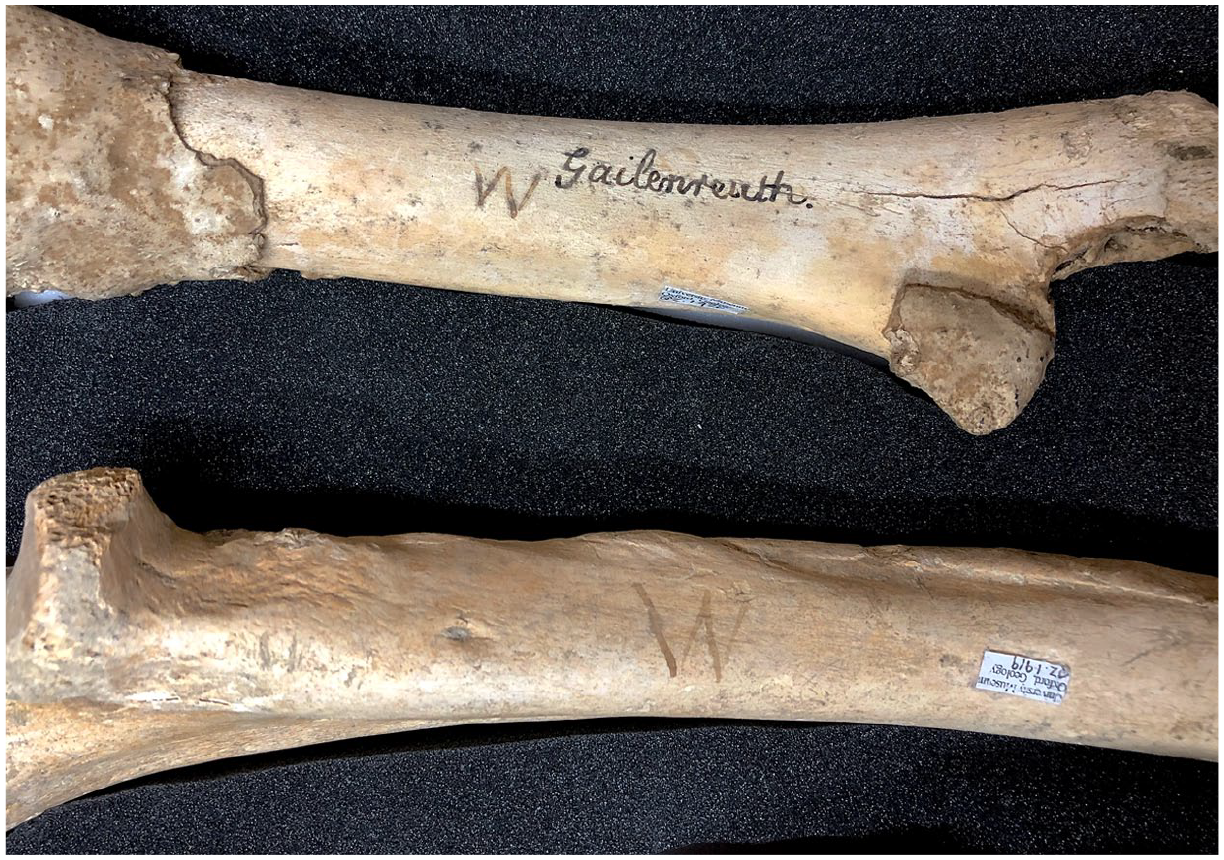
Cave bear ulnas in Buckland’s collection, labeled “M” or “W” in one hand and “Gailenreuth” in another.
Anna Graf, of mining heritage, became the face of Muggendorf’s trade in the time of Buckland’s two tours, in 1816 and 1822. 111 She appears unnamed in Buckland’s illustration of the Gaillenreuth “Bear Cave,” drawn up for lectures on geology. 112 Distinguished from the gentlemen by her dress and slight figure, Anna eyes a great heap of skeletons at the base of a vertical shaft as Greenough scampers down to her level, unable to evade the “flaming pitch” that rained down from Buckland’s torch. Greenough described it in his diary as a dangerous and suffocating affair, and a foreboding one in light of Ludwig’s pulmonary illness. Ludwig died of a lung infection (Auszehrung) in February 1819 and spent the last years of his life in ill health. 113 He was not there that rainy day in July 1816 – the so-called Year without Summer – when Buckland reached his companions in the depths. “[I]n a short time the smoke became so oppressive that Buckland returned,” said Greenough.
[T]he delay of a minute also almost rendered the light of the flambeau invisible & stopped respiration – it was with great difficulty that the woman who was our guide & myself could command sufficient strength to return up the chasm into a freer atmosphere.
114
A feeble flame was an ill omen for miners and cave-keepers alike, a clear sign of irrespirable air. But Anna, then thirty-nine, was a capable guide. From a family of local quarry workers, she was well-placed to take the torch in Ludwig’s absence.
In doing so, Anna Graf describes the vital role artisanal women played in maintaining the continuity of family trades, in the crafts as in the sciences. 115 Her son Daniel, in line to be the third Cave Inspector, was only ten years old when Buckland’s company arrived in 1816. But even when Ludwig was im good health, the Wunder trade functioned as a family enterprise. Official instructions all but outlined the two-supporter model of the premodern household in mandating that a “suitable person” be present at all times on the market square, ready to ply the trade in the Inspector’s absence. 116 Ludwig’s death saw Anna assume the role of Inspector (feminized as Höhl-Inspektorin), supported by her children Daniel, thirteen, and Anna Maria, fifteen. 117 The title was given to her by a new handbook of 1820, though it was not the official view of the new territorial ruler, the Kingdom of Bavaria. Ludwig’s death coincided with the sale of the family cabinet to the Bavarian state, suggesting both precarity and adaptation.
The sale of the cabinet underscores the inherent multiplicity of natural objects: evidence of geohistorical change to some, fossils were strategic assets for Anna Graf as she steered the family through illness, death, and uncertainty. Turning her zoolites over to rented rooms for display, Anna maintained control over the cabinet in the 1820s as she headed guiding services and took up beer brewing besides.
118
She soon become as much a spectacle as “old Wunder” had been. As the 1820 handbook counseled: Best way is to call upon, The blissful Wunder-wife, Bold, she slips into every chasm, And all’s reveal’d precise.
119
Some sources obscured Anna’s centrality to Franconian earth science, in keeping with geology’s patriarchy. By 1823, a new figure appeared in Buckland’s illustration of the Gaillenreuth Cave, as “refined” for publication in Reliquiæ diluvianæ. 120 Yet Anna headed the Wunder family trade for a full decade, until Daniel assumed the title in 1829. Like his parents, Daniel shared the trade with his wife, Anna Rosina Nutzel (b. 1801), from an innkeeping family. Both died young, however. “Cave Inspector here. Widower. Consumption,” reads the record of Daniel’s death in 1832, aged “26 years 2 months 27 days.” 121
The last wagons full of fossils were wheeled away to Bayreuth that year, 1832, as cave-guiding was distributed among the villagers. A new site for Bayreuth’s Provincial Naturalia Cabinet came with orders to appropriate Muggendorf’s collections, still plentiful in the skulls of caves bears and wolves and the feet of lions. 122 And yet this is not only a story of the artisans’ alienation from their fossil means of production. Daniel had in fact seen lowland cabinets with his own eyes in his early twenties, in training to take up the Inspectorate. Inverting the travels of Rosenmüller and Goldfuß, he descended to Erlangen to study natural history at the university. Daniel’s studies passed through the university garden, sown with Muggendorf plants, and a museum stocked full of Gaillenreuth fossils. It must have looked something like his childhood home. However briefly, this third-generation cave-keeper represented a new and remarkable incarnation of country science: Daniel was a tradesman of university learning, schooled in Linnaean taxonomy first in the workshop, then the museum.
The road from Franconia: toward a history of keepers
Only the enormous condescension of their elite interlocutors made the Wunders seem a quaint and singular story, a “wonder” of their low station and rural setting. The same condescension romanticized the Wunders in self-serving narratives about bourgeois cultivation: the villagers’ potential set against the fulfillment of the Bildungsbürgertum (educated bourgeoisie), their “comely cabinet” and “corrupt Latin” a debasement of well-ordered Linnaean gardens and ostensibly public museums. 123 The displacement of nature from one cabinet to another was an argument about the social difference between rural keepers and learned collectors: bones deemed oddities in the Wunder workshop were “eloquently staged” in collections in Bayreuth and Erlangen, or Paris and London, as geohistorical facts. 124
These tales warrant a thick description of science among people who worked for a living, often in places deemed high, wild, remote, or unseemly and subject, therefore, to alien invention and “discovery.” This is to write toward a historical anthropology of (rural) poverty and Handwerk in the sciences, which joins a wide spectrum of the intersectional and colonial inequalities that shaped natural knowledge on a global scale.
The category of keeper is especially apt for this study, being both relational (within local and regional economies of nature) and constitutive of working identities. The keeping of nature can be counted among “constitutive tasks,” where work is understood as a social performance that may attest to one’s status and credibility in a community. 125 In the Wunders’ only known testimony (Figure 8), their trade comprises acts of discovery (entdecken), ascent (besteigen), and prospecting (aufsuchen). These verbs are a far cry from their usual reduction as guides and suppliers of naturalists, echoed in Fernand Braudel’s description of mountains as a “reservoir of men for other people’s use.” 126 The category of keeper does not take the purposes of the scientific elite as its measuring stick. Instead, the everyday production of the economies and spatial logistics of natural inquiry takes precedence over the question of a keeper’s “contribution” to a particular theory or body of knowledge. More important in Muggendorf were the terms the Wunders negotiated with state authorities, constitutive tasks of warding, inspecting, and keeping nature.
Theirs is a remarkable story but a more likely one than might be assumed. Numerous variations of the Wunder family trade appeared in uplands across Central and Alpine Europe around the turn of the nineteenth century, suggesting as many new keeper-histories. The Wiesent watershed alone saw related enterprises emerge among innkeepers in Ebermannstadt (downstream) and Waischenfeld (upstream) of Muggendorf. Eighteen kilometers upstream, the Förster family was said to keep a cabinet that rivaled the Wunders’, with bear skulls displayed in a glass case. 127 “Forster’s inn tolerable,” noted Greenough; “very bad at Muggendorf.” 128 That Greenough’s fare included “books purchased” broadens the picture of the Förster cabinet to include a library alongside bear skulls and stuffed owls. The innkeeper even hired a miner to make the “Förster Cave” navigable for visitors. 129 He also alleged that the Wunders came by night to rob their caves of lucrative fossils and stalagmites. 130 Competition among keepers is a reminder that the country craft of science was not only shaped by asymmetrical exchanges with university men and elite naturalists. It was also shaped by the country’s own forcefield of hostilities and reciprocities, from kinship ties to rival claims on resources. 131
Beyond Waischenfeld, Bayreuth linked to all points north, including caves of still greater renown in the Harz Mountains. They also had their keepers. The “Brocken-keeper” (Brockenwirth) kept meteorological records atop the Harz’s highest point, while the Becker family had warded the region’s caves since the seventeenth century. 132 The opening of a new cave near the village of Rübeland in the mid-1780s closely resembled the Wunder enterprise. 133 A marble quarryman, Christian Friedrich Becker, was well-tooled for blasting and boring. He did so with the help of his two daughters, who appear in sources much as Anna Graf – unnamed and yet at the fore of travels in vertical nature. 134 Here, too, cave-keeping was a country craft: the Becker family was licensed by ducal authorities to guard naturalia from the “rabble” and keep a logbook of cave-goers. 135 Over a thousand visitors signed in the first seven years, drawn to the inn at the center of Rübeland, just opposite the Becker home. 136
Traveling south of Muggendorf, the road to Nuremberg could carry one on to noted naturalia-dealers in Regensburg or Munich, as advertised among merchants of the period. 137 Beyond them, other roads led to Alpine villages where travelers found cabinets kept “for sale” at inns. One writer’s quip about a “mineralia cabinet” ensconced in the stone walls of his lodgings hinted at the ubiquity of natural inquiry in high Europe. 138 In elevated valleys from Savoy to Slovenia, natural history took the forms of pastoral and wild game economies, entering into an existing intercourse between the highlands and the plains. A Ljubljana naturalist, for example, embedded himself in a family of chamois hunters in the Julian Alps, just as the cabinet in Bayreuth sourced minerals from a Franconian Jägermeister. 139 When the hunters came to sell meat in the plains, Franc Hohenwart (1771–1844) went with them to track down minerals and fossils, even lodging in their highland “farmhouse.” 140 Hohenwart returned from such hunts to stock Ljubljana’s first natural history museum as its founding president.
Upland exchanges were also conditioned by patterns of seasonal emigration, as highlanders descended to help with the harvest in lower pastures or work as notaries and schoolmasters in the plains. Their migrations help to explain why literacy levels rose with altitude, higher in the Alpine villages of Savoy and Piedmont than the surrounding valleys. 141 Such was the transhumant and literate world of the Savoyard peasant communities who mobilized a new Alpine physics in the later eighteenth century, just as the Wunders and Beckers led natural history into the depths. 142 Those who guided Genevan savants – local hunters like Jacques Balmat (1762–1834) and Jean-Marie Coutet – entered print culture as making a “craft, indeed an art” of guiding around the turn of the century. 143
As Franconian wagonmakers proved well-placed for natural history, so Alpine guiding grew from the customary by-employment of highlanders, as porters and muleteers who moved people and goods over mountain passes. In the Swiss Alps, transportation turned to grand tourism in the later eighteenth century. In the Bernese Oberland, artisans of Interlaken even formed a “sort of guild” by 1816. 144 The guild was reportedly designed to manage competition among rival outfits and distinguish “practiced” and “industrious” pathfinders (Wegweiser) from mere porters (Packträger). Here, as in Franconia and the Harz, tradespeople jealously guarded their mountain-going crafts from the itinerant and propertyless. 145
Handbooks ranked the brothers Michel chief among Bernese guides, with Jakob Michel (b. 1761) at the head of yet another family enterprise of upland travel. 146 Jakob was distinguished by his ability to speak Italian and French as well as the local German dialect, as passed on to his son Jonathan (b. 1782). “He is the Nestor of his kind,” reads one handbook, after the orator and voyager of Homeric legend. 147 The moniker suited Jakob’s customary craft of cobbling, known for producing “shoemaker intellectuals” and “village politicians.” These proverbs stem from the high turnover rate faced by journeymen cobblers, compelling them to wander further and longer than other artisans – certainly as far as French- and Italian-speaking lands from Interlaken. 148 This gave cobblers an uncommonly rich experience of people, books, and news, especially in roadside inns. 149 (Cobblers were also associated with taverns and drink.) A cobbler was thus as likely as a wainwright to have an ear to the ground as travel accelerated among the educated classes. 150 At this junction, the inns of Interlaken, Rübeland, and Muggendorf became houses of call for highland science and travel. 151
Inns, workshops, and country lanes composed a substructure of scientific life that shaped the movements of earthly objects and educated travelers. That structure was not so much hidden or erased from the learned world as re-presented to it in “eloquent things”: in the staging of museum objects and in the discursive figure of the guide and keeper. 152 “Old Wunder” reappeared at the heart of Romanticism after Berlin writers Wackenroder and Tieck met the man “engaged in the searching and selling of fossils and botanical herbs.” 153 Four years later, Tieck described a fictional Franconian, Walther, in the same terms: an aged man who wanders as far as the Harz “to collect herbs and stones, and is engaged with their order and classification.” 154 But Walther is revealed as an apparition and shape-shifter, a fancy of “sylvan solitude,” or Waldeinsamkeit. He is but a woodland spirit that haunts and deceives, conjuring chimera of “subterranean treasures.” 155
As upland exchanges displaced and rearranged those treasures, keepers themselves were isolated and staged – or shot dead in Tieck’s telling. Yet Tieck’s fictions also gesture toward the social history of sylvan solitude; they hint at that curious pairing of artists and artisans that took place in the mountains and caves. 156 This article has juxtaposed the two – artist and artisan, collector and keeper, museum and workshop – reading the tramp against the traveler, or Wanderer in Romantic parlance. Artists of Tieck’s time appropriated the artisanal lifecycle for a literature on bourgeois self-cultivation, depicting the Lehr- and Wanderjahre of middle-class men. 157 The same terms describe the career paths of Erlangen students for whom the Wunder workshop led to anatomical theaters and spectacles of museology. Historians can start down the same roads to understand the scientific worlds shaped by working families and highlanders, and they can take them many miles from Muggendorf.
Footnotes
Acknowledgements
I thank Jens Kraus at the Fränkische Schweiz-Museum Tüchersfeld and Eliza Howlett, Hilary Ketchum, Susan Newell, and Danielle Czerkaszyn at the Oxford University Museum of Natural History for supporting this project. It benefited enormously from exchanges at the Science Studies Colloquium, ETH Zürich (organized by Niki Rhyner), the Cabinet of Natural History at the University of Cambridge HPS (organized by Olin Moctezuma-Burns), the Historisches Institut der Universität Bern (organized by Moritz von Brescius), and the 2022 German Studies Association panel on “Mapping Village Spaces” (co-organized with Govind Sreenivasan). Finally, I thank Lissa Roberts, the peer reviewers, and guest editors Brooke Penaloza-Patzak and Tamara Fernando for the opportunity to tell this story in History of Science. I dedicate the article to David Blackbourn, scholar, supervisor, and friend.
Abbreviations
LAELKB Landeskirchliche Archiv der Evangelisch-Lutherischen Kirche Bavaria
OUMNK Oxford University Museum of Natural History
StABa Bayerisches Staatsarchiv Bamberg
UCL University College London Special Collections
Declaration of conflicting interests
The author declared no potential conflicts of interest with respect to the research, authorship, and/or publication of this article.
Funding
The author disclosed receipt of the following financial support for the research, authorship, and/or publication of this article: Irish Research Council Postdoctoral Fellowship (GOIPD/2023/1098), DAAD German Academic Exchange Service PRIME Fellowship.

1.
Steven Shapin, “The House of Experiment in Seventeenth-Century England,” Isis 79, no. 3 (1988): 373–404; Paula Findlen, Possessing Nature: Museums, Collecting, and Scientific Culture in Early Modern Italy (Berkeley, CA: University of California Press, 1996); Alix Cooper, “Homes and Households,” in Katherine Park and Lorraine Daston (eds.), The Cambridge History of Science, Vol. 3 (Cambridge, UK: Cambridge University Press, 2006), pp.224–237; Alix Cooper, “Picturing Nature: Gender and the Politics of Natural-Historical Description in Eighteenth-Century Gdańsk/Danzig,” Journal for Eighteenth-Century Studies 36, no. 4 (2013): 519–29; Mary Terrall, “Masculine Knowledge, the Public Good, and the Scientific Household of Réaumur,” Osiris 30 (2015): 182–201; Meghan K. Roberts, Sentimental Savants: Philosophical Families in Enlightenment France (Chicago, IL: University of Chicago Press, 2016); Anita Guerrini, “The Ghastly Kitchen,” History of Science 54, no. 1 (2016): 71–97; Elaine Leong, Recipes and Everyday Knowledge: Medicine, Science, and the Household in Early Modern England (Chicago, IL: University of Chicago Press, 2018); Dunja Bulinsky, Nahbeziehungen eines europäischen Gelehrten: Johann Jakob Scheuchzer (1672–1733) und sein soziales Umfeld (Zürich: Chronos Verlag, 2020); Deborah R. Coen, “The Experimental Multispecies Household,” Historical Studies in the Natural Sciences 51, no. 3 (2021): 330–78.
2.
Country estates were socially constructed as though outside of the political, as a suitable “retreat” for place-less science or, alternatively, an ideal of scientific sociability: Simon Schaffer, “Physics Laboratories and the Victorian Country House,” in Crosbie Smith and Jon Agar (eds.), Making Space for Science: Territorial Themes in the Shaping of Knowledge (London: MacMillan Press, 1998), pp.149–180; Deborah R. Coen, Vienna in the Age of Uncertainty: Science, Liberalism, and Private Life (Chicago, IL: University of Chicago Press, 2007), pp.18–20, 26–7, 95–106, 255–7. On family and fieldwork, see Alix Cooper, “Natural History as a Family Enterprise: Kinship and Inheritance in Eighteenth-Century Science,” Berichte zur Wissenschaftsgeschichte 44, no. 2 (2021): 211–27, and Dena Goodman, “Affective Geographies: Family and Friendship in the Production of Scientific Knowledge,” History of Science 61, no. 2 (2023): 236–65.
3.
Anne Secord, “Science in the Pub: Artisan Botanists in Early Nineteenth-Century Lancashire,” History of Science 32, no. 3 (1994): 269–315; Denise Phillips, “Socrates on the Farm: Agricultural Improvement and Rural Knowledge in Eighteenth-Century Germany and Switzerland,” Berichte zur Wissenschaftsgeschichte 44, no. 2 (2021): 159–79. On the so-called learned world (Gelehrtenwelt), see Denise Phillips, Acolytes of Nature: Defining Natural Science in Germany, 1770–1850 (Chicago, IL: University of Chicago Press, 2012), pp.14–22, 30, 61–3. Related studies of rural, peasant, and laboring actors in natural history are Linda Andersson Burnett, “An Eighteenth-Century Ecology of Knowledge: Patronage and Natural History,” Culture Unbound: Journal of Current Cultural Research 6 (2014): 1275–97, and Lydia Barnett, “Showing and Hiding: The Flickering Visibility of Earth Workers in the Archives of Earth Science,” History of Science 58, no. 3 (2019): 245–74.
4.
Laurel Thatcher Ulrich, A Midwife’s Tale: The Life of Martha Ballard, Based on Her Diary, 1785-1812 (New York: Vintage Books, 1991), p.27; Pier Paolo Viazzo, Upland Communities: Environment, Population and Social Structure in the Alps since the Sixteenth Century (Cambridge, UK: Cambridge University Press, 1989); Govind P. Sreenivasan, “Beyond the Village: Recent Approaches to the Social History of the Early Modern German Peasantry,” History Compass 11, no. 1 (2013): 47–64; Maria Ågren (ed.), Making a Living, Making a Difference: Gender and Work in Early Modern European Society (Oxford, UK: Oxford University Press, 2017).
5.
Ulrich, A Midwife’s Tale, p.27 (note 4).
6.
These themes are ambitiously explored on a global scale in recent volumes like Patrick Manning and Daniel Rood (eds.), Global Scientific Practice in an Age of Revolutions, 1750–1850 (Pittsburgh, PA: University of Pittsburgh Press, 2016) and Helen Anne Curry, Nicholas Jardine, James A. Secord, and Emma C. Spary (eds.), Worlds of Natural History (Cambridge, UK: Cambridge University Press, 2018).
7.
Muggendorf’s caves and “antediluvian” fossils profoundly impacted the construction of earth history, as described in Martin J. S. Rudwick, Bursting the Limits of Time: The Reconstruction of Geohistory in the Age of Revolution (Chicago, IL: University of Chicago Press, 2005), pp.271–8, 351–2, 364–5, 604–9, 632–4, and Patrick Anthony, “Making Historicity: Paleontology and the Proximity of the Past, 1775–1825,” Journal of the History of Ideas 82, no. 2 (2021): 231–56, esp. 246–50.
8.
This can be compared, for example, to the “spatial infrastructures and logistics of expedition-making” in Felix Driver, “Intermediaries and the Archive of Exploration,” in Shino Konishi, Maria Nugent, and Tiffany Shellam (eds.), Indigenous Intermediaries: New Perspectives on Exploration Archives (Canberra: Australian National University Press, 2015), pp.11–30.
9.
Linda Andersson Burnett, “Collecting Humanity in the Age of Enlightenment: The Hudson’s Bay Company and Edinburgh University’s Natural History Museum,” Global Intellectual History 8, no. 4 (2023): 387–408, on 402. Moreover, as argued in this issue, the accumulation of plants and artefacts in Global North museums violates existing connections between people and place, as objects displaced from their native contexts are exhibited in “curious” displays of human difference. See Raphael Uchôa, “Amazonian Artifacts, Plant-Human Relations, and Amerindian Perspectives on the Colonial Condition of Museums,” History of Science, under review; Brooke Penaloza-Patzak and Tamara Fernando, “Archiving Mollusks, Articulating Difference: Mollusks as Scientific objects in Studies of Human Difference,” in this issue, History of Science, under review.
10.
Anna Lowenhaupt Tsing, Friction: An Ethnography of Global Connection (Princeton, NJ: Princeton University Press, 2005), p.5. On intermediaries in global scientific processes, Simon Schaffer, Lissa Roberts, Kapil Raj, and James Delbourgo (eds.), The Brokered World: Go-Betweens and Global Intelligence 1770–1820 (Sagamore Beach, MA: Watson Publishing International, 2009).
11.
The Wunder home entered literature as a Hütte in Johann Michael Füssel, Unser Tagebuch, oder Erfahrungen und Bemerkungen eines Hofmeisters, Vol. 2 (Erlangen: Palm, 1788), p.152; Johann Gottfried Köppel, Briefe über die beiden fränkischen Fürstenthümer Bayreuth und Ansbach: Auf einer Sommerreise in den Jahren 1792 und 1793 geschrieben, Vol. 1 (Walther, 1794), pp.35–6, 67–8.
12.
Simon Schaffer, “Easily Cracked: Scientific Instruments in States of Disrepair,” Isis 102 (2011): 706–17; Dániel Margócsy and Mary Augusta Brazelton, “Techniques of Repair, the Circulation of Knowledge, and Environmental Transformation: Towards a New History of Transportation,” History of Science 61, no. 1 (2021): 3–18.
13.
Alexander von Humboldt to Carl Freiesleben, October 24, 1793, Die Jugendbriefe Alexander von Humboldts, 1787–1799, eds. Ilse Jahn and Fritz G. Lange (Berlin: Akademie, 1973), p.281.
14.
Ernst Moritz Arndt, Reisen durch einen Theil Teutschlands, Italiens und Frankreichs in den Jahren 1798 und 1799, Pt. 1 (Gräff, 1801), pp.8, 10, 31; Wilhelm Heinrich Wackenroder, Reisebriefe, ed. Heinrich Höhn (Berlin, 1938), p.25. Humboldt “frequently” visited the caves of Muggendorf and nearby Gaillenreuth and was described by Arndt as a “good acquaintance” of Johann Georg Wunder (Humboldt to Georg August Ebell, December 2, 1793, Staatsbibliothek Bamberg, Signatur: OFS.Autogr. H 2).
15.
E.g., Friedrich Karl Gottlob Hirschung, Nachrichten von sehenswürdigen Gemälde- und Kupferstichsammlungen, Münz- Gemmen- Kunst- und Naturalienkabitneten . . . in Teutschland, Vol. 3 (Erlangen: Palm, 1789), pp.145–6; Arndt, Reisen, p.8 (note 14); Johann Christian Rosenmüller, Die Merkwürdigkeiten der Gegend um Muggendorf (Berlin: Unger, 1804), p.10; Anonymous, Szenen aus einer Reise von Erlangen nach Muggendorf und der Rosenmüllershöhle (Leipzig: Schäfer, 1804), p.60; Johann Christian Rosenmüller and Wilhelm Gottlieb Tilesius (eds.), Beschreibung merkwürdiger Höhlen: Ein Beitrag zur physikalischen Geschichte der Erde, Vol. 2 (Leipzig: Breitkopf und Härtel, 1805), pp.347–8; and on a Harz Mountain Höhlenwirth, Samuel Christian Wagener, Reise durch den Harz (Braunschweig: Schul-buchhandlung, 1797), p.79. On castellans as castle-wardens, Emanuel Le Roy Laduria, The Beggar and the Professor: A Sixteenth-Century Family Saga, trans. Arthur Goldhammer (Chicago, IL: Chicago University Press, 1997), p.353, nt. 3.
16.
Phillips, Acolytes of Nature (note 3).
17.
“Für Wagner,” in Benedikt Pillwein (ed.), Praktische Blicke in das Leben der Künstler und Handwerker (Vienna: Linz, 1824), pp.68–9.
18.
Raymond Williams, The Country and the City (Oxford, UK: Oxford University press, 1975), p.120.
19.
Ludwig Tieck and Wilhelm Heinrich Wackenroder, Die Pfingstreise von 1793 durch die Fränkische Schweiz, den Frankenwald und das Fichtelgebirge von Ludwig Tieck und Wilhelm Heinrich Wackenroder, ed. Christoph Schaller (Antiquariat Kaufmann, 2010); Günter Dippold, Kleine Geschichte Oberfrankens (Regensburg: Verlag Friedrich Pustet, 2020), p.97. Fränkische Schweiz was probably coined by an Erlangen student turned professor, Johann Christian Fick, Historisch-topographisch-statistische Beschreibung von Erlangen und dessen Gegend mit Anweisungen und Regeln für Studierende (Erlgangen: Palm, 1812), p.109; Jakob Reiselsberger, Die kleine Schweiz oder Einladung zur Reise nach Streitberg, Muggendorf, Weischenfeld etc. und deren Umgebung (Weischenfeld: Selbst-Verlage des Verfassers, 1820).
20.
Williams, The Country and the City, p.120 (note 18).
21.
Rhode, “Botanische Bemerkungen auf einer Reise nach dem südlichen Deutschland,” Neues Journal für die Botanik 2, no. 2 (1807): 1–39, on 11. Hirschung, Nachrichten, p.143 (note 15).
22.
E.g., Ch. L. Eber, Geographisches Reise- Post- und Zeitungs-Lexicon (Jena: Schulzens, 1756), pp.19–20.
23.
The number of houses is consistently reported as being between fifty-two and fifty-four from the 1790s through the mid-nineteenth century. Inns rise from twelve to seventeen in that period, as the population apparently grew from about 300 to 421. For statistical accounts, see Köppel, Briefe, p.106 (note 11); August Goldfuß, Die Umgebung von Muggendorf: Ein Taschenbuch für Freunde der Natur und Altherthumskunde (Erlangen: Palm, 1810), p.8; Joseph Heller, Muggendorf und seine Umgebungen, oder die fränkische Schweiz (Bamberg: Dresch, 1829), pp.115–16; Pleickhard Stumpf, Bayern. Ein geographisch-statistisch-historisches Handbuch des Königreichs, Pt. 2 (Munich: Verlags-Expedition des “geographisch-statistisch-historischen Handbuches,” 1853), p.580.
24.
Köppel, Briefe, pp.54, 64–5 (note 11).
25.
Johann Friedrich Weiß, “Das Hochfüstl. Brandenburg-Culmbachische Amt Streitberg,” in StABa, A 240, Nr. R 768. Caves are also noted in mid-century geographies, e.g., Anton Friedrich Büsching, D. Anton Friedrich Büschungs Neuer Erdbeschreibung, Pt. 3, Vol. 2 (Bohn, 1761), p.1718; Carl Gottlob Dietmann, Neue Europäische Staats- und Reisegeographie, Bd. 5 (Leipzig: Richter und Compagnie, 1755), p.1713.
26.
Britta Schneider, “Wo der getreidt-Mangel Tag für Tag großer, und bedenklicher werden will: Die Teuerung der Jahre 1770 bis 1772 im Hochstift Bamberg,” in Mark Häberlein, Kerstin Kech, and Johannes Staudenmaier (eds.), Bamberg in der Frühen Neuzeit. Neue Beiträge zur Geschichte von Stadt und Hochstift (Bamberg: University of Bamberg Press, 2008), pp.261–292; Rudolf Brádzil, Hubert Valášek, Jürg Luterbacher, and Jarmila Macková, “Die Hungerjahre 1770-1772 in den böhmischen Ländern: Verlauf, meteorologische Ursachen und Auswirken,” Österreichische Zeitschrift für Geschichtswissenschaften 12, no. 2 (2021): 44–78.
27.
Hermann Lungwitz, “Die Hungersnot im sächsischen Erzgebirge in den Jahren 1771 und 1772,” in Sächsischen Pestalozzi-vereine (ed.), Bunte Bilder aus dem Sachsenlande für Jugend und Volk, Vol. 1 (Leipzig: Klinkhardt, 1898), pp.340–344.
28.
Gottlieb Zimmermann, Das Juragebirg in Franken und Oberpfalz, vornehmlich Muggendorf und seine Umgebungen (Erlangen: Palm, 1843), p.3. Another account suggests a medical physician, Heumann (b. 1711) from Muggendorf, wrote to Esper and Frischmann about the caves as early as 1766, though they came first in 1771 (Lorenz Krausshold and G. Brock, Geschichte der fränkischen Schweiz, oder Muggendorfs und seiner Umgebung [Nuremberg: Riegel und Weißner, 1837], p.147); “Heumann,” in Georg Andreas Will (ed.), Nürnbergisches Gelehrten-Lexicon (Nuremberg: Schüpfel, 1756), p.112.
29.
Johann Friedrich Esper, “Reise zu den Gailenreuther Osteolithen-Höhlen,” Schriften der Berlinischen Gesellschaft Naturforschender Freunde 4 (1784): 56–106, on 63. His first publication notes only his companions Heumann and Frischmann: Johann Friedrich Esper, Ausführliche Nachricht von neuentdeckten Zoolithen unbekannter vierfüsiger Thiere, und denen sie enthaltenden, so wie verschiedenen andern denkwürdigen Grüften der Obergebürgischen Lande des Markgrafthums Bayreuth (Nuremberg: Knorr, 1774), p.2.
30.
Hirschung, Nachrichten, pp.142–3, nt (note 15); see also Köppel, Briefe, p.67 (note 11); Ernst Wilhelm Martius, Wanderungen durch einen Theil Franken und Thüringen (Erlangen: Waltherschen Buchhandlung, 1795), pp.162, 165; David Heinrich Hoppe, “Nachricht von einigen seltenen Pflanzen, welche in der Gegend um Muggendorf wachsen,” in David Heinrich Hoppe (ed.), Botanisches Taschenbuch für Anfänger dieser Wissenschaft und Apothekerkunst auf das Jahr 1795 (Regensburg: Weißischen Buchhandlung, 1795), pp.126–147; Arndt, Reisen, pp.7–8 (note 14); Füssel, Unser Tagebuch, pp.152–5 (note 11); Rosenmüller and Tilesius, Beschreibung, pp.347–8 (note 15); Rhode, “Botanische Bemerkungen,” 1–38, on 11 (note 21).
31.
Köppel, Briefe, pp.67–8 (note 11); Hoppe, “Nachricht” (note 30).
32.
July 22, 1775, “Wir haben dem unter das CastenAmt Streitberg gehörigen Unterthan zu Muggendorf, Joh: Georg Wunder,” in “Acta. Die Bestallung der Aufseher der Höhle zu Muggendorf betrf. 1775-1789,” StABa, Markgraftum Brandenburg-Bayreuth, Geheime Landesregierung Nr. 5163/1.
33.
Andreas Grießinger, Das symbolische Kapital der Ehre: Streikbewegungen und kollektives Bewusstsein deutscher Handwerksgesellen im 18. Jahrhundert (Berlin: Ullstein Materialien, 1985), pp.68–71. On the significance of “honorable” work in the village setting, Richard van Dülmen, Kultur und Alltag in der Frühen Neuzeit: Dorf und Stadt (Frankfurt am Main: C.H. Beck, 2005), pp.27–9.
34.
Hoppe, “Nachricht,” (note 30).
35.
Köppel, Briefe, p.84 (note 11); Rosenmüller and Tilesius, Beschreibung, p.348 (note 15); Goldfuß, Umgebung, pp.50–1 (note 23).
36.
Köppel, Briefe, p.84 (note 11); Klement Alois Baader, Reisen durch verschiedene Gegenden Deutschlands in Briefen (Augsburg: Lotter und Kompagnie, 1797), pp.137–8.
37.
For this reason, wainwrights were said to be in close contact with foresters and hunters; see “Der Wagner,” in Johann Peter Voit (ed.), Unterhaltungen für junge Leute aus der Naturgeschichte, dem bürgerlichen Leben und der Kunst, Pt. 2 (Nuremberg: Weigel and Schneider, 1791).
38.
Füssel, Unser Tagebuch, p.172 (note 11); Arndt, Reisen, p.27 (note 14).
39.
On the woodwork of cave-keeping, see orders for the construction and repair of doors and entryways in December 25, 1788, Christian Friedrich Carl Alexander, “Bittschrift des Muggendorfer Höhlen-Inspectors, Wunder,” in “Acta. Die Einzäunung der bey Muggendorf in dem Casten-Amt Streitberg, gelegene Höhle, das Hohe Loch genannt, betref. 1776–1777,” in StABa, Markgraftum Brandenburg-Bayreuth, Geheime Landesregierung Nr. 5166 (6 B III Nr. 4); “Acta, Die zu Unterhaltung und bequemeren und sichern Eingänge bey den – ohnweit Muggendorf gelegenen merckwürdigen Höhlen veranstalteten Bauten und Reparaturen betr. 1776, 1777, 1789, 1791, 1793, 1794,” in StABa, Markgraftum Brandenburg-Bayreuth, C9VI Kriegs- und Domänen-Kammer Hofkammer Bayreuth, Nr. 10964 (985/1); Köppel, Briefe, pp.68, 84 (note 11); Anonymous, Szenen aus einer Reise, pp.68–71 (note 15).
40.
On other terrain, canal access similarly proved critical to the circulation of fossils from field to museum. See Susan Margaret Newell, “Museum Collections, Academic Teaching and the Making of Geology in the Nineteenth-Century University: The Case of William Buckland and the University of Oxford, 1813–1849” (PhD Dissertation, The University of Leeds, 2023), pp.132, 146.
41.
On the vagaries of travel, roads, and banditry in the period, see David Blackbourn, History of Germany, 1780–1918: The Long Nineteenth Century, 2nd ed. (Oxford, UK: Blackwell Publishing, 2003), pp.7–8.
42.
Köppel, Briefe, pp.14, 29–30, 32, 98 (note 11). Writers routinely remarked on the dangerous state of the unpaved roads, e.g., Rosenmüller, Merkwürdigkeiten, pp.14, 79 (note 15); Martius, Wanderungen, p.169 (note 30); Heller, Muggendorf, p.17 (note 22).
43.
Wackenroder, Reisebriefe, p.61 (note 14); Ludwig Tieck, “Auf der Reise,” in Yomb May (ed.), Gedichten der Deutschen Romantik (Wiesbaden: Marix Verlag, 2013), pp.131–132.
44.
Peter Kriedte, “Trade,” in Sheilagh Ogilvie (ed.), Germany: A New Social and Economic History: 1630–1800, Vol. 2, trans. Sheilagh Ogilvie (London: Arnold, 1996), pp.130–133, on 102–105; Viazzo, Upland Communities, p.36 (note 4).
45.
Kriedte, “Trade” (note 44); Eckart Schremmer, Die Wirtschaft Bayerns. Vom hohen Mittelalter bis zur Industrialisierung. Bergbau, Gewerbe, Handel (Frankfurt am Main: C.H. Beck, 1970), p.547.
46.
Rosenmüller, Merkwürdigkeiten, p.14 (note 15); Wackenroder, Reisebriefe, pp.25, 61 (note 14).
47.
The foldout map in Heller’s Muggendorf (1829) distinguishes both chaussées and “improved highways.”
48.
Martin Rudwick, The Meaning of Fossils: Episodes in the History of Paleontology (Amsterdam: Elsevier, 1972), pp.94, 101–11; John H. Zammito, The Gestation of German Biology: Philosophy and Physiology from Stahl to Schelling (Chicago, IL: University of Chicago Press, 2018), pp.216–24.
49.
Köppel, Briefe, p.60 (note 11); Rosenmüller, Merkwürdigkeiten, p.14 (note 15); Wackenroder, Reisebriefe, p.25 (note 14).
50.
Martius, Wanderungen, p.160 (note 30); Köppel, Briefe, pp.67–70 (note 11).
51.
See the primordial shore hypothesis of Deluc and Rosenmüller in Anthony, “Making Historicity,” 248–50 (note 7), and in the theories of Georges Cuvier as re-circulated in the German press, e.g., Jakob Nöggerath, Cuvier’s Ansichten von der Urwelt, Vol. 2 (Bonn: Weber, 1826), pp.70–4.
52.
William Buckland, Reliquiæ diluvianæ; or, Observations on the Organic Remains Contained in Caves, Fissures, and Diluvial Gravel, and on Other Geological Phenomena, Attesting the Actions of an Universal Deluge (London: Murray, 1824), pp.73–4, 125, 237–8. Plates 18 and 19 show, respectively, the gorge of the Esbach River and its caves, just north of the Wiesent, and a full map of the district’s “caves and valleys of denudation.”
53.
Viazzo, Upland Communities, pp.36, 142 (note 4); J. Andie Speed, “On Sunlit Fields: The Swabian Children, Legal Personhood, and the Tyrolean Statthalterei’s Edict of 1867,” German Studies Review 47, no. 1 (2024): 125–43.
54.
van Dülmen, Kultur und Alltag, pp.12–13, 28 (note 33). The Wunders’ Bürger-status is consistently observed throughout the parish records.
55.
“7. Muggendorf,” Bestattungen 1717–1789, LAELKB, Dekanat Forchheim, Muggendorf, Bild 166.
56.
Mack Walker, German Home Towns: Community, State, and General Estate, 1648–1871 (Ithaca, NY: Cornell University Press, 1971), p.121.
57.
Ibid., pp.76–8, 99.
58.
Ruth Kilian, “Schreinerhandwerk in Franken: Studien zu Bamberg, Coburg und Kitzingen,” Bayerische Blätter für Volkskunde 31 (1988): 1–272, on 69.
59.
Walker, German Home Towns, p.114 (note 56).
60.
On the region’s variegated transition to Bavarian rule after French occupation, see Dippold, Kleine Geschichte, pp.78–86 (note 19).
61.
Köppel, Briefe, pp.35–6 (note 11); Fick, Beschreibung, p.7 (note 19). The trope of pilgrimage was applied to Erlangen students, though it also referred to the deeper history of Catholic pilgrimage to caves and grottos in Gößweinstein, not far from Gaillrenreuth, in the territory of the Archbishopric of Bamberg.
62.
Anne Secord, “Corresponding Interests: Artisans and Gentlemen in Nineteenth-Century Natural History,” The British Journal for the History of Science 27, no. 4 (1994): 383–408, on 407.
63.
“Da der bekannte Wunder, zu Muggendorff,” December 4, 1777, in StABa, Kastenamt Streitberg, Nr. 3; April 22, 1777, “Wohin der CammerRegistrator und Naturalien Kammer Inspector Wunder,” in “Die Sammlung und Anherlieferung der vorzüglichsten Stücke der in den Muggendorfer Höhle gefunden werdenden calcinirten Thierknochen an das Naturalien-Cabinet betrf. Anno 1777,” StABa, Markgraftum Brandenburg-Bayreuth, Hofkammer Nr. 10220.
64.
September 27, 1784, “Jussu Serenissimi wird Vorzeiger dieses Johann Georg Wunderer,” in StABa, Kastenamt Streitberg, Nr. 3; December 20, 1777, “Stück nach Paris zu senden,” in StABa, Kastenamt Streitberg, Nr. 3; Instructions following Ludwig’s appointment as Inspector on August 15, 1799, specifically order the delivery of “rare plants to the botanical garden of the academy in Erlangen” (“Instruction für den Höhlen- und Naturalien-Inspector Johann Ludwig Wunder zu Muggendorf [September 2, 1799],” in StABa, Kastenamt Streitberg, Nr. 3); May 18, 1803, “Die Kosten für die aus der Muggendorfer Höhle an das Berliner Naturalienkabinett abgelieferten Versteinerung,” in StABa, preußisches Fürstentum Bayreuth, Kriegs- und Domänenkammer Nr. 7024. See reports on fossils sent on to the Royal Society in Letter September 7, 1792, “‘Account of Some Remarkable Caves [. . .]’ from Thomas Wildman, on Behalf of the Margrave of Ansbach to the Royal Society,” The Royal Society, L&P/10/87; “XXII. Account of Some Remarkable Caves in the Principality of Bayreuth, and of the Fossil Bones Found Therein. Extracted from a Paper Sent, with Specimens of the Bones, as a Present to the Royal Society, by his Most Serene Highness the Margrave of Anspach, &c. Read January 10 1793,” Philosophical Transactions of the Royal Society 84 (1794): 402–7; John Hunter, “XXIII. Observations on the Fossil Bones Presented to the Royal Society by His Most Serene Highness the Margrave of Anspach, &c. By the late John Hunter, Esq. F. R. S., Read May 8, 1794,” Philosophical Transactions of the Royal Society 84 (1794): 407–17.
65.
This is arranged on the back of April 22, 1777, “Acta. Die Sammlung und Anherlieferung der vorzüglichsten Stücke,” in StABa, Markgraftum Brandenburg-Bayreuth, Hofkammer Nr. 10220, but signed May 6, 1777, by the Cabinet Inspector Friedrich Wilhelm Wunder in Bayreuth.
66.
Hirschung, Nachrichten, pp.386–7 (note 15). Friedrich Wilhelm made direct requests for “animal bones” from the Muggendorf Wunders in April 22, 1777, StABa, Markgraftum Brandenburg-Bayreuth, Hofkammer Nr. 10220.
67.
Thomas Gieryn, Cultural Boundaries of Science: Credibility on the Line (Chicago, IL: University of Chicago Press, 1999).
68.
Rosenmüller and Tilesius, Beschreibung, p.348 (note 15).
69.
Anonymous, Szenen aus einer Reise, pp.61–2 (note 15). Rosenmüller is the only other writer to use both Kastellan and Lebensart in describing the elder Johann Georg Wunder.
70.
“Die Einzäunung der bei Muggendorf gelegenen Höhle (1776-1777),” in StABa, Markgraftum Brandenburg-Bayreuth, Geheime Landesregierung Nr. 5166 (6 B III Nr. 4).
71.
“Da der bekannte Wunder, zu Muggendorff,” December 4, 1777, in StABa, Kastenamt Streitberg, Nr. 3.
72.
February 19, 1778, “Nach einer von dem Aufseher der Höle zu Muggendorf,” in StABa, Kastenamt Streitberg, Nr. 3.
73.
Crossing confessional lines could be a dangerous business, as when armed conflict broke out between Brandenburg- and Bamberg-backed factions of the Wiesent Valley in 1786, as chronicled in Krausshold and Brock, Geschichte, pp.142–5 (note 28).
74.
“Da der bekannte Wunder, zu Muggendorff,” December 4, 1777, in StABa, Kastenamt Streitberg, Nr. 3; February 19, 1778, “Nach einer von dem Aufseher der Höle zu Muggendorf,” in StABa, Kastenamt Streitberg, Nr. 3.
75.
Baader, Reisen, p.133 (note 36); Renate Illmann, “Die Geschichte der Rosenmüllershöhle – nach historischen Dokumenten,” Jahresmitteilungen, Naturhistorische Gesellschaft Nürnberg, “Natur und Mensch” 2010 (2010): 129–46, on 137.
76.
Köppel, Breife, pp.67–8 (note 11); Baader, Reisen, p.133 (note 36); Reiselsberger, Die kleine Schweiz, p.23 (note 19).
77.
Joachim Eibach, “DAS OFFENE HAUS: Kommunikative Praxis im sozialen Nahraum der europäischen Frühen Neuzeit,” Zeitschrift für Historische Forschung 38, no. 4 (2011): 621–64.
78.
Relevant to this approach are studies of the village space as pervaded by kinship relations, social coalitions, and competition over resources, most formidably in David Warren Sabean, Property, Production, and Family in Neckarhausen, 1700–1870 (Cambridge, UK: Cambridge University Press, 1984), and David Warren Sabean, Kinship in Neckarhausen, 1700–1870 (Cambridge, UK: Cambridge University Press, 1998).
79.
The Mühlhäußers’ own involvement in the enclosure of commons testifies to their local stature: “Landgericht Ebermannstadt Acta. Die Verteilung der Gemeindegründe von Muggendorf, 1817,” in StABa Landgericht ä.O. Ebermannstadt (K 8) Nr. 2462.
80.
Several texts led travelers to innkeepers Leicht and Zöbelein in particular, being coordinated with the Wunders (Rosenmüller, Merkwürdigkeiten, pp.15–16, 30 [note 15]; Goldfuß, Umgebung, p.8 [note 23]; Fick, Beschreibung, p.111 [note 19]).
81.
These scenes were characterized by bourgeois condescension yet contrast with the ideology of middle-class botanists in Britain, who excluded (rather than romanticized) pubs from their accounts of natural history (Secord, “Science in the Pub,” pp.270–4, 294–7 [note 3]). Guidebooks to the Swiss Alps even coached travelers on how to dine with local guides at inns to secure their loyalty (e.g., Johann Gottfried Ebel, The Traveller’s Guide Through Switzerland: In Four Parts [London: Leigh, 1820], pp.32–3).
82.
Köppel, Briefe, p.64 (note 11); Fick, Beschreibung, p.111 (note 19).
83.
Füssel, Unser Tagebuch, p.154 (note 11).
84.
The concept of sylvan solitude, or Waldeinsamkeit, was developed by Ludwig Tieck after touring Muggendorf with Johann Georg Wunder in 1793. See Ludwig Tieck, Der blonde Eckbert, Der Runenberg, ed. Uwe Jansen (Ditzingen: Reclam, 2018), pp.5, 10, 17.
85.
On inns as information vectors in the German lands, see B. Ann Tlusty, Bacchus and Civic Order: The Culture of Drink in the Early Modern German City (Charlottesville, VA: University of Virginia Press, 2001), pp.162–63; van Dülmen, Kultur und Alltag, pp.65, 131–2 (note 33); James M. Brophy, Popular Culture and the Public Sphere in the Rhineland, 1800–1850 (Cambridge, UK: Cambridge University Press, 2007), pp.155–70.
86.
Rosenmüller, Merkwürdigkeiten, pp.26–30 (note 15).
87.
Illmann, “Die Geschichte der Rosenmüllershöhle,” 130–1 (note 75).
88.
Rosenmüller, Merkwürdigkeiten, p.30 (note 15); Johann Christian Rosenmüller, “Am 18 October 1792 ließ ich mich zuerst mit Beyhulfe einiger Leute aus dem Dorfe an einem Seil hinab. . .,” Intelligenzblatt der Jenaischen Allg. Literaturzeitung 72 (1793): 576.
89.
Artisan rights in the region favored the patrilineal inheritance of a trade, as noted in Johann Andreas Ortloff, Das Recht der Handwerker (Erlangen: Schubart, 1803), p.192.
90.
Johann Ludwig Wunder, August 13, 1799, “Die in der Gegend von Muggendorf befindlichen Höhlen,” in “Acta der Königl. Kammer Amter Streitberg. Die in der Gegend von Muggendorf befindlichen Höhlen und andere NaturMarkwürdigkeiten betreffend. 1774[–1804],” StABa, Kastenamt Streitberg, Nr. 3.
91.
Köppel, Briefe, pp.67–8 (note 11); Illmann, “Die Geschichte der Rosenmüllershöhle,”137 (note 75).
92.
Füssel, Unser Tagebuch, pp.152–3 (note 11); Wackenroder, Reisebriefe, pp.67–8 (note 14).
93.
Köppel, Briefe, p.67 (note 11).
94.
Leather-tanning was taken up by a Johann Georg Chrysostomous Wunder (1775–1819), called Meister Rothgerber, who I am unable to definitively place in the family tree (LAELKB, Dekanat Forchheim, Muggendorf, Taufen 1799–1820, Bild 148).
95.
Reiselsberger, Die kleine Schweiz, p.21 (note 19).
96.
On inheritance and kinship in family-based sciences, see Cooper, “Homes and Households” (note 1); Cooper, “Natural History as a Family Enterprise,” 218–24 (note 2).
97.
Füssel, Unser Tagebuch, p.168 (note 11).
98.
Goldfuß, Umgebung, p.277 (note 23).
99.
Karl Friedrich Braun, Verzeichniss der in der Kreis-Naturalien-Sammlung zu Bayreuth befindlichen Petrefacten (Leipzig: Voss, 1840). Muggendorf’s share of the cabinet was mostly in marine invertebrates (labeled zoophyta, radiaria, annulate, mollusca, and crustacea) but also included thirty-eight large mammal specimens from Gaillenreuth. My count includes nearby Streitberg and Gaillenreuth, well within the scope of the Wunder family enterprise.
100.
Rudolf Endres, “Die preußische Ära in Franken,” in Peter Baumgart (ed.), Expansion und Integration: Zur Eingliederung neugewonnener Gebiete in den preußischen Staat (Vienna and Cologne: Böhlau, 1984); Patrick Anthony, “Labour, Folklore, and Environmental Politics in German Mining around 1800,” The Historical Journal 64, no. 3 (2021): 583–605.
101.
“Instruction [02.09.1799],” StABa, Kastenamt Streitberg, Nr. 3 (note 63). Miners were also forbidden from engaging in the commerce of minerals, while naturalists apparently required a signed certificate to geologize in the Prussian territories (Johann Theodor Benjamin Helfrecht, Versuch einer orographisch-mineralogischen Beschreibung der Landeshauptmannschaft Hof, oder des combinirten Bergamtes Lichtenberg-Lauenstein [Hof: Grau, 1797], p.35, nt. 19).
102.
Köppel, Briefe, pp.67–8 (note 11).
103.
Greenough travel diary, July 2–3, 1816, UCL, GREENOUGH/B/2/1/2.
104.
The William Buckland Collection at the OUMNH contains 167 catalogues of vertebrates and invertebrates, 51 uncatalogued vertebrates, and 11 rocks whose provenance is Muggendorf or Gaillenreuth, including the “Zahnloch” and “Kuhloch” caves in the Wunder’s remit.
105.
On the scientific career of Rosenmüller, bound up in the celebrity and circulation of Muggendorf’s cave bear, see Anthony, “Making Historicity,” 238–9, 246–50 (note 7).
106.
Goldfuß, Umgebung, p.277 (note 23).
107.
108.
These are kept in OUMNH PAL.QZ drawers 442, 446, and 447 (PAL.QZ.01990, 01920, 01919, 01874, 01861, 01845-01852). As most came from the same species, Ursus spelaeus Rosenmüller, it’s possible the fossils belong to a single specimen whose label corresponds to a part of the Gaillenreuth Cave that Buckland labeled “M” in Buckland’s Reliquiæ diluvianæ, p.134, Plate 17 (note 52).
109.
Greenough travel document, July 6, 1816, UCL, GREENOUGH/B/2/1/3.
110.
I thank Eliza Howlett for showing me this example, OUMNH, J.23739, Phragmoteuthis montefiorei (J. Buckman, 1880). Hugh Torrens, “(Presidential Address) Mary Anning (1799–1847) of Lyme; ‘The Greatest Fossilist the World Ever Knew’,” British Journal for the History of Science 28 (1995): 257–84.
111.
Rudwick, Bursting, pp.604–8, 633–4 (note 7); Hugh S. Torrens, “Geology in Peace Time: An English Visit to Study German Mineralogy and Geology (and Visit Goethe, Werner and Raumer) in 1816),” in Bernhard Fritscher and Fergus Henderson (eds.), Towards a History of Mineralogy, Petrology, and Geochemistry (Proc. International Symposium on the History of Mineralogy, Petrology, and Geochemistry, Munich, March 8–9, 1996) (Institut für Geschichte der Naturwissenschaften, 1998).
112.
William Buckland, “Section of a bear’s cave,” OUMNH, L.m.c. (2), dr. 6. D – 338*. On the life of the section as a teaching illustration, see Rudwick, Bursting, p.607, nt. 73 (note 7); Newell, “Museum Collections,” pp.231–2 (note 40).
113.
“Herr Johann Ludwig Wunder,” in LAELKB, Dekanat Forchheim, Muggendorf, Trauungen; Bestattungen 1786–1838, Bild 316; Illmann, “Die Geschichte der Rosenmüllershöhle,” 137 (note 75). Parish records show six deaths by Auszehrung that year.
114.
As quoted in Torrens, “Geology in Peace Time” (note 111). I thank Peter Lincoln for scans of the original account, which I was unable to locate in the UCL Special Collections as cited in Torrens.
115.
Walker, German Home Towns, pp.87–8 (note 56).
116.
“Instruction [02.09.1799],” StABa, Kastenamt Streitberg, Nr. 3 (note 63).
117.
Reiselsberger, Die kleine Schweiz, p.111 (note 19).
118.
Illmann, “Die Geschichte der Rosenmüllershöhle,” 137–8 (note 75); September 7, 1824, “Anna Wunderin zu Muggendorf,” in Schankerlaubnis von Anna Wunder, Muggendorf, StABa, Landgericht ä.O. Ebermannstadt (K 8) Nr. 11036.
119.
Reiselsberger, Die kleine Schweiz, p.12 (note 19).
120.
Newell, “Museum Collections,” p.231 (note 40).
121.
“Muggendorf Nr. 18,” LAELKB, Dekanat Forchheim, Muggendorf, Trauungen; Bestattungen 1786–1838, Bild 121; Taufen; Trauungen; Bestattungen 1808–1844, Bild 229.
122.
Illmann, “Die Geschichte der Rosenmüllershöhle,” 137–8 (note 75).
123.
Köppel, Briefe, p.67 (note 11).
124.
Simon Schaffer, Mutability, Mobility and Meteorites: On Some Material Cultures of the Sciences, 1st STS Haldane Lecture, November 20, 2014 (Department of Science and Technology Studies, UCL, 2014), p.14; and on the staging of facts amid crisis, Simon Schaffer, “Late Enlightenment Crises of Facts: Mesmerism and Meteorites,” Configurations 26 (2018): 119–48.
125.
Karin Hassan Jansson, Rosemarie Fiebranz, and Ann-Catrin Östman, “Constitutive Tasks: Performances of Hierarchy and Identity,” in Maria Ågren (ed.), Making a Living, Making a Difference: Gender and Work in Early Modern European Society (Oxford, UK: Oxford University Press, 2017).
126.
Fernand Braudel, The Mediterranean and the Mediterranean World in the Age of Phillip II (Berkeley, CA: University of California Press, 1995), pp.51–2.
127.
Reiselsberger, Die kleine Schweiz, p.41 (note 19); Goldfuß, Umgebung, p.270 (note 23).
128.
Greenough travel diary, July 3, 1816, UCL, GREENOUGH/B/2/1/2.
129.
Jakob Reiselsberger, “Naturgeschichte. Meine Gedanken über die Försters-Höhle bei Weischenfeld,” Allgemeine Kameral-Korrespondent 56 (1809): 241–3; Anselm Andreas Caspar Cammerer, Naturwunder, Orts- und Länder-Merkwürdigkeiten (Kempten: Kosel, 1832), p.52.
130.
Arndt, Reisen, p.25 (note 14).
131.
The classic work on these themes in Germany is David Warren Sabean, Power in the Blood: Popular Culture and Village Discourse in Early Modern Germany (Cambridge, UK: Cambridge University Press, 1984).
132.
The Brockenwirth appears, for example, in Christian Friedrich Schröder to Friedrich Nicolai, February 9, 1784, Staatsbibliothek zu Berlin – Preußischer Kulturbesitz, Signatur: Nachl. Friedrich Nicolai/I/69/Mappe 16/Bl. 403-05; Humboldt to Freiesleben, October 24, 1793, Jugendbriefe, p.281 (note 13); and, in his own words, as the editor of C. E. Nehse (ed.), Brocken-Stammbuch mit Scherz und Ernst, Witz und Laune, Weisheit und Einfalt in Gedichten und Prosa vom Mai 1753 bis Mai 1850 nebst einigen komischen Brockengedichten aus einem alten Werke des D. Johannes Praetorii vom Jahr 1669 (Sondershausen: Friedrich August Eupel, 1850), p.7. The first to guide the Baumann’s Cave with ducal authority was Hans-Jürgen Becker, beginning in 1667.
133.
Biel’s Cave is shown in cross-section as Plate 16 of Buckland, Reliquiæ diluvianæ (note 52).
134.
Christian Friedrich Schröder, Naturgeschichte und Beschreibung der Baumanns und besonders der Bielshöhle, wie auch der Gegend des Unterharzes; nebst den Jahrbüchern der Bielshöhle von 1788 bis 1796, (Berlin: Vieweg, 1796), pp.57–9; December 28, 1792, in Die Jahrbücher der Bielshöhle oder Verzeichniß derer, welche die Bekkerbielsteinhöhle befahren haben. Erster Theil vom Jahr 1788 bis 1795. Besorgt von Christian Friedrich Bekker, Steiger auf den Marmorbrüchen und Entdecker der obbenannten Höhle (Rübeland, an dem Tage, da die Höhle zuerst fahrbar gemacht ist, im Monat August 1787), in Schröder, Naturgeschichte, p.182; Patrick Anthony, “Mines, Mountains, and the Making of a Vertical Consciousness in Germany ca. 1800,” Centaurus 62, no. 4 (2020): 612–30, esp. 622–4.
135.
Schröder, Naturgeschichte, p.59 (note 134).
136.
Map (Ortslage) of Rübeland in the Harz, by Bielshöhle and Baumannshöhle (1819), Niedersächsisches Landesarchiv, Abt. Wolfenbüttel K 4 Fb. 2 A 15/A 15. Visitors were directed to Schiennemann’s in public advertisements, e.g., “Die Bielshöhle,” Neues Hannöversches Magazin Pt. 22 (1807): 341–44l; Anonymous, “Für Reisende,” Der Anzeiger. Ein Tagblatt zum Behuf der Justiz, der Polizey und aller bürgerlichen Gewerbe (Gotha: Kaiserl. Reichs-Post-Amt, 1792), pp.1017–18.
137.
On commercial naturalists and scientific merchants, see Bernhard Fritscher, “Making Objects Move: On Minerals and Their Dealers in 19th-Century Germany,” HOST 5 (2012): 84–105; Dániel Margócsy, Commercial Visions: Science, Trade, and Visual Culture in the Dutch Golden Age (Chicago, IL: University of Chicago Press, 2014).
138.
Maximilian Löwenthal, Skizzen aus dem Tagebuch einer Reise durch Frankreich, Großbritannien und Deutschland (Wallsihausser, 1825), p.225; J. A. Schultes, Riese auf den Glockner, Pt. 3 (Degen, 1804), p.100.
139.
November 17, 1802, “Abgabe von Mineralien durch den Landjägermeister Frh. v. Hardenberg an das Naturalienkabinett Bayreuth,” StABa, preußisches Fürstentum Bayreuth, Kriegs- und Domänenkammer Nr. 7020.
140.
Franz Grafen von Hohenwart, Beiträge zur Naturgeschichte, Landwirtschaft und Topographie des Herzogthums Krain, Vol. 1 (Blasnik, 1838), pp.33–7; Ibid., pp.55–68.
141.
Viazzo, Upland Communities, pp.137–41 (note 4).
142.
Ion Mihailescu, Simon Dumas Primbault, and Jérôme Baudry, “Science on the Summit: Exploring Scientific Tourism through the Lens of Eighteenth-Century Mountain Ascents,” Journal of Alpine Research 110, no. 1 (2022): 1–18.
143.
Johann Rudolph Wyß, Reise in das Berner Oberland (Burgdorfer, 1816), pp.111–12.
144.
Ibid., pp.111–13.
145.
Wyß is careful to note they these guides are geographically fixed, with a Standquartier, and not itinerant (ibid., p.109).
146.
Ibid., pp.113–14; Friedrich Meisner, Alpenreise mit seinen Zöglingen. Für die Jugend beschrieben (Haller, 1801), pp.55–66, 93, 131, 137, 160–4, 171, 208–9; Ebel, The Traveller’s Guide, pp.245, 284, 485 (note 81); Franz Niklaus König, Reise in die Alpen. Begleitet mit naturhistorischen Beyträgen (Bei dem Verfasser, 1814), pp.8, 53.
147.
Wyß, Reise, p.113 (note 143).
148.
Eric Hobsbawm and Joan Scott, “Political Shoemakers,” in Eric Hobsbawm (ed.), Worlds of Labour. Further Studies in the History of Labour (London: Phoenix, 1984), pp.103–130, on 106–111.
149.
Journeyman rituals of legitimation and labor organization at inns is described in Grießinger, Das symbolische Kapital, pp.101–5 (note 33).
150.
Blackbourn, History of Germany, pp.8, 27 (note 41); Jörn Sieglerschmidt, “Social and Economic Landscapes,” in Sheilagh Ogilvie (ed.), Germany: A New Social and Economic History: 1630–1800, Vol. 2 (London: Arnold, 1996), pp.1–38, on 30–32.
151.
One handbook suggests guides in Interlaken could be arranged at specific inns as far as Zurich, suggesting an extraordinary degree of coordination in the industry (Heinrich Reichard, Der Passagier auf der Reise in Deutschland und einigen angränzenden Ländern. . . [Berlin: Gädicke, 1806], p.459).
152.
Schaffer, Mutability, Mobility and Meteorites, pp.14, 17–18 (note 124).
153.
Wackenroder, Reisebriefe, pp.66–7 (note 14).
154.
Tieck, Der blonde Eckbert, p.3 (note 84).
155.
Ibid., pp.5, 10, 17.
156.
See Tieck’s artisan-ideal in the 1836 novel Der junge Tischlermeister (the young master joiner), as discussed in Sven Dierig, Wissenschaft in der Maschinenstadt Emil du Bois-Raymond und seine Laboratorien in Berlin (Göttingen: Wallstein Verlag, 2006), pp.36–40, and Patrick Eiden-Offe, Die Poesie der Klasse: Romantischer Antikapitalismus und die Erfindung des Proletariats (Berlin: Matthes & Seitz, 2020), pp.41–9. Tieck finished an initial draft of Der junge Tischlermeister in early 1795, following his tour of Muggendorf with Wackenroder in 1793.
157.
Most notable here is Johann Wolfgang von Goethe’s Wilhelm Meisters Lehrjahr (1795–6) and Wilhelm Meisters Wanderjahre (1821). Also in this genre, see Karl Preuster’s Sophien-Dukaten oder des Tischlers Gustav Walther’s Lehrjahre (1845), as discussed in Phillips, Acolytes of Nature, p.223 (note 3). The figure of the cave-keeper also appears in literature for the bourgeois upbringing of children, with emphasis on studying the wonder and order of nature: Samuel Bredetzsky, “Der Pächter Ehrenfels und seine Familie,” in Samuel Bredetzsky (ed.), Monathliche Unterhaltungen für die Jugend (Vienna: Peter Rehm’s Witwe, 1804), pp.23–51.