




Abstract
There existed a tradition of mimetic experimentation in the late nineteenth century, whereby morphologists sought to scale down sublime natural phenomena to tabletop devices in the laboratory. Experimenters constructed analogs of the aurora, attempting to replicate the colors and forms of the phenomenon with discharge tube experiments and electrical displays, which became popular spectacles at London’s public galleries. This paper analyses a closely allied but different kind of imitation. Between 1872 and 1884, Professor Karl Selim Lemström (1838–1904) attempted to reproduce the aurora borealis in all of its complexity atop four mountains in northern Finland. Crucially, his “artificial aurora” was to materialize at the same scale as the original phenomenon and in its natural habitat in the polar atmosphere. With his experiment Lemström hoped to uncover the workings of the aurora and the electrical currents that he believed were always present within the atmosphere; his epistemological framework was one of learning by making. This paper sheds light on the broader problem of what it meant to authentically replicate a phenomenon that remained largely enigmatic, and, most importantly, how this replication could be verified. This prompts a discussion as to whether model experiments needed only to appear visually similar to the objects they purported to imitate, were required to preserve their form, or needed to be materially identical in order to the original to be identified as legitimate “reproductions” in the late nineteenth century.
Introduction
There has existed a long tradition of mimetic experimentation that sought to scale down sublime phenomena in the laboratory. 1 Alexander Rueger argues that the imitation of such occurrences as water spouts, lightning, and rain clouds appealed to eighteenth century aesthetic sensibilities, though he questions their empirical utility. 2 Furthermore, as Peter Galison and Alexi Assmus have identified, the methodology whereby objects or processes were understood through analog devices flourished among morphological scientists in the late nineteenth century. 3 John Tyndall (1820–93) employed a yard-long glass tube, different gas mixtures, a light source, and a Nicol’s prism to simulate the blue color of the sky. 4 Sir Oliver Lodge (1851–1940) mimicked lightning using various arrangements of two Leyden jars, each charged via a Voss machine and connected by a very low resistance copper wire and an adjustable spark gap. 5 Charles Thomas Rees Wilson (1869–1959) was inspired by his time at the Ben Nevis Observatory in 1894 to reproduce coronas, glories, and clouds, resulting in his invention of the cloud chamber for which he was awarded the Nobel prize in physics in 1927. 6 In tune with other morphologists of the era, Wilson “wanted to mimic the wonders of nature.” 7 In his analysis of the Victorian category of “experiment,” Simon Schaffer explores Norman Lockyer’s (1836–1920) tabletop simulations of the motion of solar matter in sunspots and Charles William Siemens’ (1823–83) modeling of the Sun using his knowledge of industrial regenerative furnaces. 8
In the eighteenth century analogs were often judged to be successful if they could replicate the visual experience of witnessing a phenomenon in nature. 9 Willem Hackmann argues that the main problem of this epistemology was that the experiments “were interpreted in terms of macroscopic observable behaviour and not synthesised to idealised behaviour between microscopic particles.” 10 Galison emphasizes that for an analog experiment to be considered “mimetic” it must do more than just resemble a phenomenon; it needs to “preserve the form of things as they occur in the world.” 11 Cloud chamber images fulfill this criterion because they represent the tracks of charged particles, making visible a natural process in all of its complexity. 12 This prompts a discussion as to whether model experiments needed only to appear similar to the objects they purported to replicate, were required to preserve their form, or needed to have the same atomic-level material components in order to be useful. What, exactly, was being replicated and, more importantly, how could this imitation be verified? To answer these questions, it will be useful to distinguish between analogs and reproductions, both of which are models that lie on a continuum contingent on judgments of sufficient similarity. An analog mimics some of the features of a phenomenon or system, but is understood to be fundamentally different. Dumb holes are a modern analog for black holes, involving sound perturbations that cannot escape a horizon created by a fluid moving faster than the local speed of sound. 13 A reproduction implies a closer connection between the original and the replica; it refers to an artificial copy of a natural phenomenon.
Considerations of scale, moving between scales, making objects “to scale,” creating acceptable standards of proportionality, and calibrating inaccessible phenomena against known measures are critical for discussions of models. As Deborah Coen contends, “a methodological problem of scale” was embedded within the nineteenth-century project to connect planetary models of the atmosphere with local conditions. 14 Coen argues persuasively for histories of scaling, meaning studies “of the work that goes into mediating between different ways of measuring the world.” 15 Analog devices have been assumed by historians and philosophers to collapse distance, creating “a virtually immediate, sensual connection through the analogy or resemblance of a laboratory set-up (small-scale) and a natural phenomenon (large scale).” 16 The assumption embedded within statements such as this is that analogs are necessarily miniature imitations of their large-scale target counterparts. They often are, as some of the previously described canonical examples demonstrate.
Yet, analogs can also be produced at the same scale as the original object, often with helpful functional consequences. For example, in the 1770s, Henry Cavendish (1731–1810) endeavored to create an artificial torpedo fish to test whether the shocks they produced were of electrical origin, even though they did not produce a spark or light. 17 He used a wooden board cut into the size and shape of a torpedo, a glass tube, wires soldered to a thin piece of pewter, an electrical device composed of forty-nine Leyden jars of extremely thin glass coated with tinfoil and a sheepskin leather to act as the outer layer of the fish. Cavendish kept the model in water until it was thoroughly soaked before testing the electric shocks by touching the positive side of the “fish.” He was careful to ensure the size of the instrument and salinity of the water were accurate so as to get a realistic sense of the strength of the shock produced. Like Cavendish’s fish, the analogs discussed in this paper can be considered tools of scaling, bringing intangible and inaccessible phenomena such as the aurora into familiar contexts.
This paper treats as its subjects both analogs of the aurora borealis put on display at such venues as London’s South Kensington Museum and Professor Karl Selim Lemström’s (1838–1904) attempts to reproduce the aurora atop four mountains in northern Finland between 1872 and 1884. Lemström worked under physicist Erik Edlund (1819–88) on electromagnetic induction in 1867 and became professor of physics at the Imperial Alexander University (now Helsinki University) in 1878. Lemström was an advocate for Swedish language and culture in Finland, publishing his works in Swedish. He became fascinated by the aurora while taking part in the fourth Swedish expedition to Spitzbergen, led by Adolf Erik Nordenskiöld (1832–1901) in 1868. 18 Lemström’s little studied research furnishes us with an unusual and productive case study because it involved reproduction rather than analog models and because he sought to produce an aurora to scale in its natural habitat in the polar atmosphere, against the grain of traditional mimetic experimentation. From Lemström’s experiment we stand to learn much about the process of judging the veracity of replication.
I investigate reproduction as a twofold process, involving both the reconstruction of the aurora in a material form as well as the subsequent representation of the artifice to an audience, via public gallery exhibits, watercolor paintings, and the written word. “The venerable problem of mimesis,” Barbara Stafford tells us, “can be restated as just the tension between first-person experience . . . and coming to know another through a double process of internalisation: by intuitive copying and willed repetition.” 19 The third section of this paper explores the reception of Lemström’s experiments by a small network of auroral researchers and enthusiasts located mostly in Britain. Primarily anglophone source material underpins discussions of the critiques charged against his work. Crucially, Lemström’s experiments took place at a time when there was no consensus as to the mechanism or constitution of the phenomenon. The material content of the aurora had not been established.
Edmund Halley (1656–1741) pointed out the close relationship between the Earth’s magnetic field and appearances of the aurora after witnessing the auroral display of 1716. 20 The connection between electrical discharges and the aurora was widely accepted by the late nineteenth century, though a complete consensus had not been reached. Johann Georg Zehfuss (1901–38) and Hendrik Jan Herman Groneman (1840–1908) favored a meteoritic dust hypothesis, which involved ferruginous material drawn to the Earth’s magnetic field lines and igniting due to friction within the atmosphere. 21 Lemström aimed to prove, with direct reference to Groneman, that the aurora was of electrical origin. 22 Theorizers who supported an electrical cause, however, faced other uncertainties. As Helge Kragh argues, “for one thing, there was no theory of how electrically excited atoms emitted light.” 23 Secondly, the atoms or molecules involved in the interaction proved elusive. In 1868 Anders Jonas Ångström (1814–74) found that the green light of the aurora produced an almost monochromatic spectroscopic line, which was later identified as having the wavelength 5577Å. 24 The line, however, did not correspond with any known elements.
Though it was a distinctly unusual way of approaching the study of the phenomenon, Lemström was neither the first nor only experimenter to attempt to replicate the aurora. 25 Samuel Triewald (1688–1743), a Swedish poet and statesman, described his own attempt in a publication in 1744. 26 His experiment involved a ray of light entering a dark room through a hole the size of a pea and striking a prism before passing over a cup filled with common grain spirit, and then hitting a screen, as shown in Figure 1. As Triewald asserted, with this apparatus “one sees all the phenomena that the natural northern lights display and as changeable as the same.” 27 Moreover, Kristian Birkeland (1867–1917), a Norwegian auroral scientist and polar explorer, undertook terrella (Latin for ‘little earth’) experiments between 1900 and 1913, mostly involving a metallic sphere painted with a phosphorescent substance inside a discharge tube. The sphere, shown in Figure 2, simulated the Earth while cathode rays directed at the sphere represented the auroral “current.” 28 That the rays were attracted to the poles of the terrella provided an explanation for the aurora’s position surrounding the Earth’s magnetic poles. His terrella experiments also demonstrated the existence of the Earth’s radiation belts. Birkeland currents was the name posthumously given to a set of electrical currents that flow along geomagnetic lines connecting the magnetosphere and ionosphere, as predicted by Birkeland.
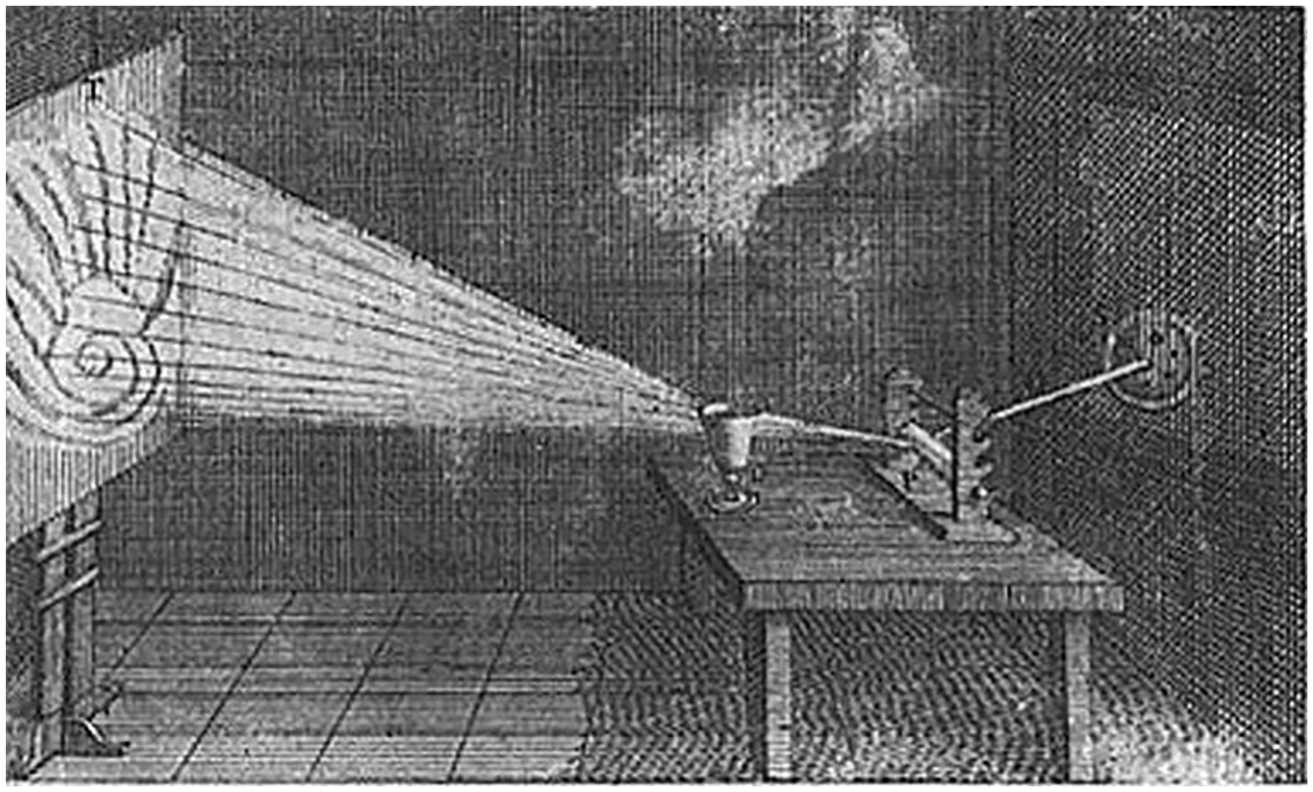
Samuel Triewald, “Experimentum aurorae borealis artificialis,” Kungl. Vetenskapsakademiens Handlingar (1744), plate III.
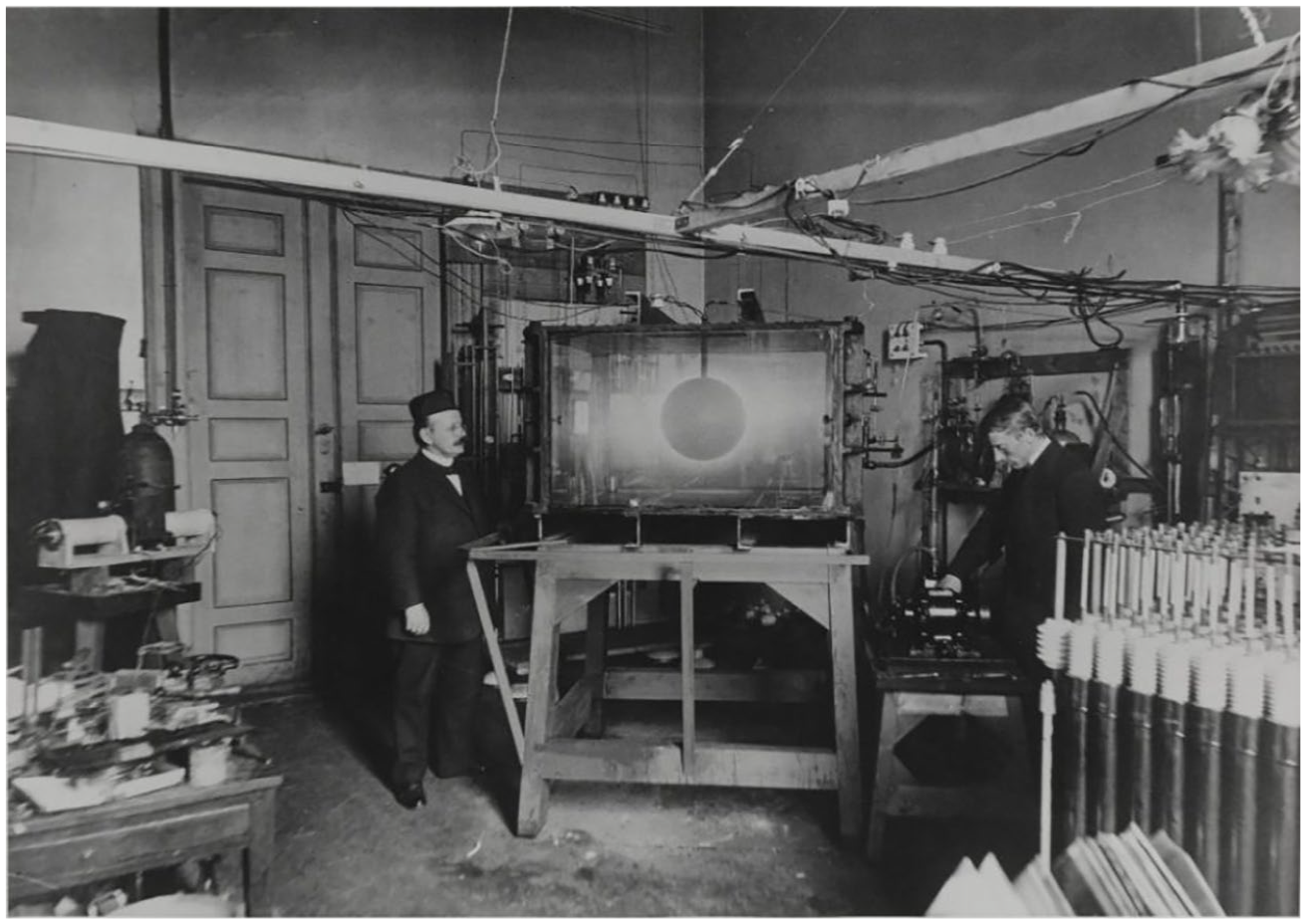
“Kristian Birkeland experiments with the northern lights in a vacuum vessel, 1912,” Oslo Nasjonalbiblioteket.
The history of auroral science has received attention from scholars interested in the role of particular societies and institutions in the development of the field and discrete “chapters” of historical auroral research. 29 Helge Kragh’s excellent work on the auroral green line debate brings together developments in spectroscopy, detailing the spectroscopic work of Lars Vegard alongside John McLennan and Gordon Shrum. 30 Issues of Acta Borealia, a multi-disciplinary journal publishing cultural research on northern societies, have explored histories of interaction with the Arctic landscape and particular periods of auroral research in Scandinavia. 31 Moreover, Robert Marc Friedman’s research and his project, “Making Sense of the Aurora,” which began in 2012 at the University of Tromsø, provided an impetus for greater attention to be paid to the cultural significance and meanings of the aurora in northern histories. 32 Some auroral scientists have written histories of the northern lights themselves. For example, Robert Eather published Majestic Lights: The Aurora in Science, History and the Arts in 1980. 33 Lemström, by contrast, has largely been overlooked as a figure in the history of auroral research, though a biographical study and description of the content of his most significant works has been provided by Päivi Maria Pihlaja. 34
Auroral analogs in public galleries
To gain legitimacy and notoriety, experiments were staged or represented in ways that were tailored to particular audiences and the spaces in which they were performed. 35 An unusual mode of visuality dictated the viewing experience of such shows: audiences were willing to suspend their disbelief but were simultaneously interested in “seeing behind the curtain” and understanding how particular tricks or spectacles were performed. 36 In a similar vein, as a visual technology popular in the 1850s and 1860s, magic lantern shows transported their viewers to different locations, testing the limits of visual knowledge and probing the relationship between artifice and reality. 37 The aurora was a popular subject of both magic lantern shows and electrical exhibitions. Indeed, as Aileen Fyfe and Bernard Lightman contend, popular optical tricks like the aurora borealis were so familiar that they could be used to establish the reputations of new instruments brought into public galleries. 38 A successful show could legitimate equipment in a way that an experiment could not – experiments rely on trusted instruments.
Several hand-painted magic lantern slides depicting the aurora (Figures 3–5) were projected at the Royal Polytechnic Institution in the years around 1860 before they were auctioned off in 1882 following the 1881 closure of the institution. 39 The Royal Polytechnic housed particularly well-functioning equipment for the performance of these shows, with a large screen, a hidden lantern box, and tracks to transfer the slides smoothly. 40 The slides, consisting of a glass plate placed within a wooden frame, were intricately painted with translucent pinks, yellows, blues, and purples so that, when magnified, they appeared as large arrays of individual rays in contrast to the dark silhouettes of the mountainous foreground landscapes. Figure 5 depicts the back of a lantern slide that produced changing colors when the handle was turned. Viewers of these magic lantern shows were engulfed in a display of color, movement, and light that reflected the sensations and emotions of observing an atmospheric aurora.
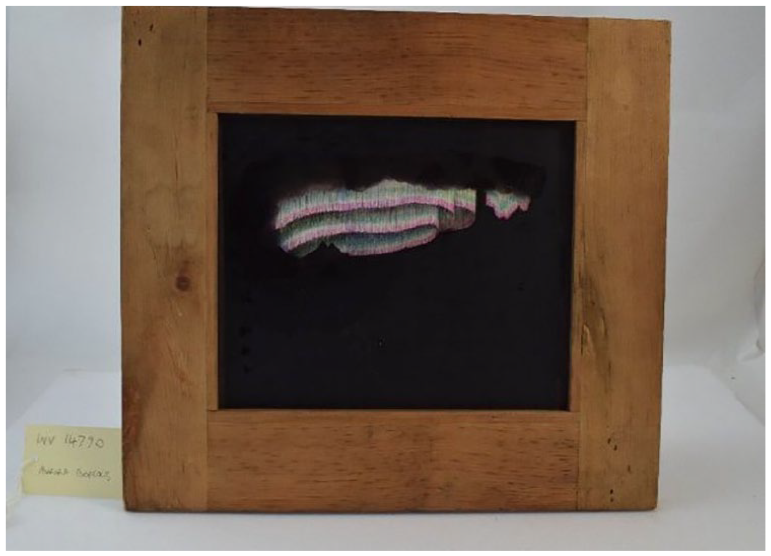
“Magic lantern slide depicting the aurora, made for projection at the Royal Polytechnic,” History of Science Museum. Oxford, inv.14790.
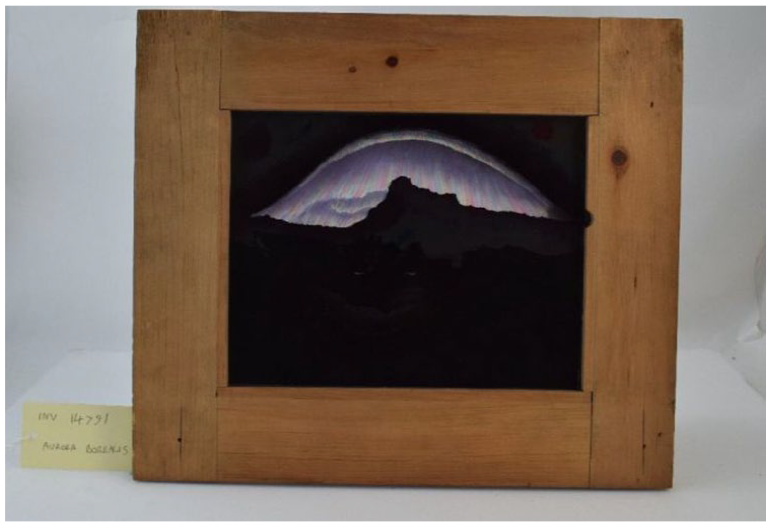
“Magic lantern slide depicting the aurora, made for projection at the Royal Polytechnic,” History of Science Museum. Oxford, inv.14791.
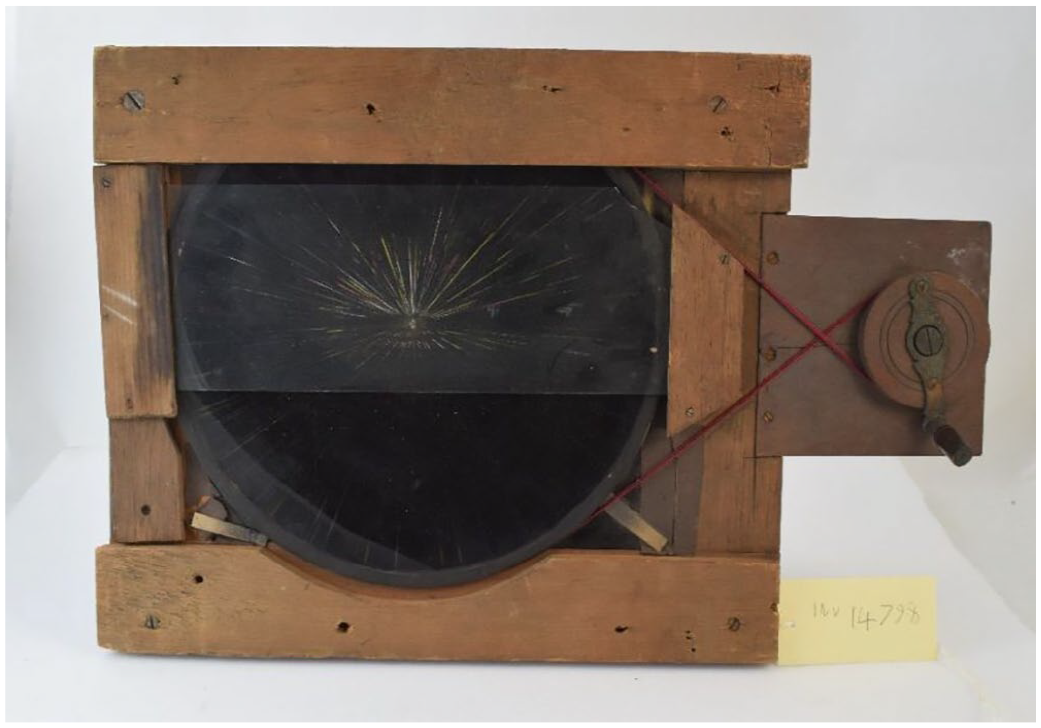
“Magic lantern slide depicting the aurora, made for projection at the Royal Polytechnic,” History of Science Museum. Oxford, inv.14798.
John Rand Capron (1829–88), a gentlemanly amateur scientist with a great interest in the aurora and spectroscopy, stated in his 1879 treatise that, “with many of us (at least it was so in my own case) our first viewed auroræ have been artificial ones, devised by electricians and having their locus at the Royal Polytechnic in Regent Street or in some scientific lecture-room.” 41 This reminds us that audiences of these electric shows would most likely never see a true atmospheric aurora, and therefore their understanding of the phenomenon was predicated on cultural portrayals and these experiments themselves, the likeness of which they judged against an imagined “real” aurora. The hydroelectric machine, invented by William Armstrong (1810–1900) and installed at the Royal Polytechnic in 1843, “produced static electricity from friction produced by steam escaping a boiler through a series of nozzles.” 42 Among its many electrical tricks, the simulation of a violet aurora was a firm favorite. After witnessing the effect, a reporter for the Morning Chronicle wrote in September 1843 that “the passage of the electricity over the tinfoil on the tubes was far more brilliant, and the aurora borealis exceeded in intensity and beauty anything we had ever witnessed.” 43 This statement begs the question as to which characteristics were considered most important for the identification of the artificial “aurora borealis.” It appears that the more spectacular the show, the more successful the reproduction in the eyes of its viewers.
After experimenting with the hydroelectric machine in 1858, Auguste de la Rive (1801–73), a Swiss physicist, began using a Ruhmkorff’s induction coil to generate a current in order to produce his electrical effects. 44 To imitate the aurora, de la Rive had an apparatus constructed composed of a wooden sphere of 30–35 cm in diameter with a metallic equatorial band running around its circumference, which represented the Earth, as can be seen in Figure 6. On each side of the sphere a cylinder of soft iron was fixed, which was then surrounded by an evacuated glass tube. 45 These soft-iron cylinders were connected to one another via strong screws and also connected to the sphere’s equatorial band by saline-soaked blotting paper. 46 The soft-iron cylinders could be magnetized by placing the two vertical supports onto two poles of an electro-magnet or by surrounding them with a coil traversed by a strong current. 47 A metal ring was set around the ends of each of the cylinders, which represented the atmosphere. The soft iron would be negatively charged by connecting the Ruhmkorff’s induction coil to the equatorial band, while the metal ring was positively charged. If the air was too rare, a few droplets of water would be introduced into the glass tubes. Once the water droplets had evaporated, a discharge would appear, which de la Rive described as a “jet” of violet light. As he wrote, “at the moment the soft iron is magnetised the jet commences to rotate and to throw off a multitude of brilliant jets issuing from the luminous ring.” 48 These jets, de la Rive argued, were “a perfectly faithful representation of what takes place in the aurorae boreales when the auroral arcs send out luminous jets into the high regions of the atmosphere.” 49 The jets could only be observed when the current was directed from the metal ring to the circumference of the sphere.
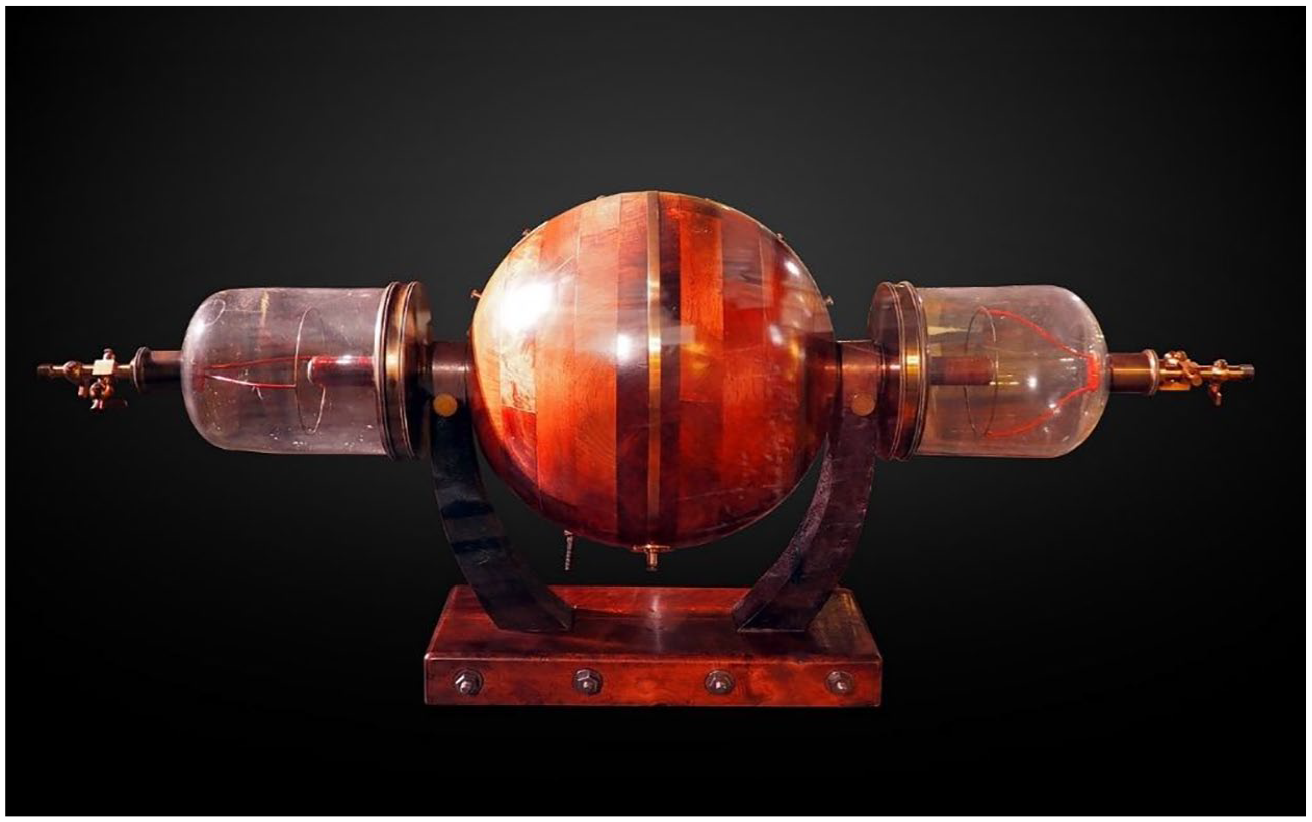
Auguste de la Rive, “Aurora-simulating machine,” Musée d’histoire des sciences de la Ville de Genève, MHS 501 (circa 1860).
De la Rive’s apparatus was exhibited at the South Kensington Museum in 1877 on loan from Geneva, four years after his death in 1873. 50 Edouard Sarasin (1843–1917), a Swiss physicist who worked with de la Rive, provided a commentary at the accompanying conference. 51 He contended that the experiments conducted with this device constituted “important evidence in support of the electrical theory of the aurora borealis.” 52 De la Rive’s own conclusions from his experiments were published in his earlier 1858 treatise. 53 In it, he argued that the aurora is a consequence of the positive electricity of the atmosphere and the negative electricity of the terrestrial globe, which he claimed to have demonstrated with his apparatus. 54 More specifically, he asserted that the aurora results from icy particles suspended in the air at great heights, forming very light clouds. 55
Capron and Lemström both visited de la Rive’s apparatus at the South Kensington Museum, with Lemström attending the 1877 conference there to exhibit his own apparatus (to which we will return later). Lemström had clearly at least read of de la Rive’s device before the South Kensington Museum conference, because it was the subject of a talk he presented to the US Congress in 1875. 56 As part of the talk, Lemström stated that de la Rive’s experiments “have demonstrated the influence of magnetism upon electric light, under circumstances almost identical with those presented by polar light.” 57 He also noted de la Rive’s apparatus presented a dark band near the negative electrode, providing evidence for the contention that the dark band observed under atmospheric aurorae was an objective phenomenon, and not an optical illusion. 58 Thus, de la Rive’s analog presented some interesting and contentious aspects of the aurora that corresponded with outdoor observations in northern territories. The problem of scaling, however, was a challenge intrinsic to such model experiments. For analog devices to provide a sense of the particle interactions involved in the production of aurorae, they would need to replicate the speed of particles traveling through space and the atmosphere. Furthermore, the magnetic field of the Earth would need to be accurately remapped onto a terrella for the experiment to be meaningful. Problems such as these threatened to undermine the legitimacy of analog models demonstrating planetary scale interactions.
Discharge tube experiments were first conducted in the early eighteenth century. Francis Hauksbee (1660–1713) produced static electrical charges in evacuated glass tubes by rubbing the outside of the tube, in turn generating visible discharges inside the tubes. The association between the light produced and the assumed optical effects of the aurora borealis was so strong that a series of glass tubes became known as “aurora tubes” and “aurora flasks” (Figures 7 and 8). 59 Victorian experimenters such as William Spottiswoode (1825–83), Warren De la Rue (1815–89), Hugo Müller (1835–1915), and John Fletcher Moulton (1844–1921) investigated stratified discharge in vacuum tubes in the 1880s, demonstrating their electrical effects at the Royal Institution and the British Association for the Advancement of Science. As Chitra Ramalingam argues, they stabilized the strata visually within the laboratory. 60 “The artificiality and manipulability of the phenomenon liberated experimenters from constraints that limited the gathering of observations from an astronomical event.” 61 Most importantly, the strata “were also literally materialised,” within an epistemological framework whereby knowledge was created by the very visual making of a phenomenon. 62
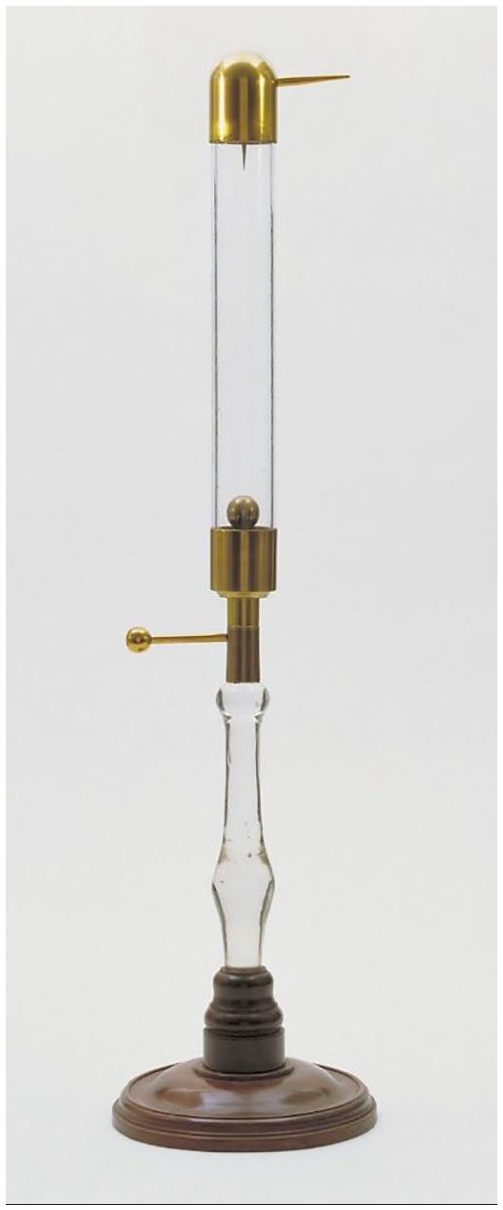
“Aurora Tube,” Lorraine Collections, Museo Galileo: Instituto e Museo di Storia Della Scienza, inv. 1203.
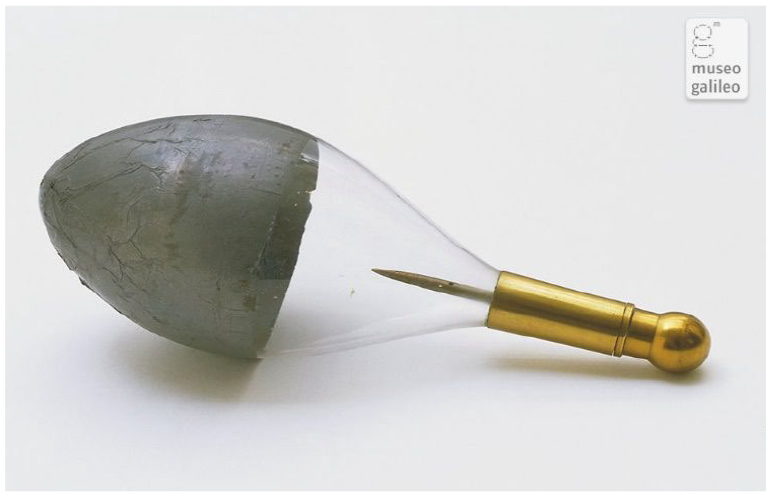
“Aurora Flask,” Lorraine Collections, Museo Galileo: Instituto e Museo di Storia Della Scienza, inv. 423.
In April 1883 an article in Symons’s Monthly Meteorological Magazine alluded to the ubiquity of glass discharge tube experiments resembling auroral glows, stating that “probably most of our readers have somewhere or other at the defunct polytechnic, if nowhere else, seen the beautiful imitation of aurora produced by an electric discharge through an exhausted tube.” 63 Capron conducted several experiments in the 1870s and 1880s examining the spectra of discharges produced by different gas mixtures with a Browning’s larger direct-vision spectroscope, then comparing these spectra with the “green line” discovered by Ångström in 1868. 64 Capron also examined the spectra produced by an aurora flask, which he found to be “of a rosy red colour; and the long flickering stream from pole to pole certainly much reminded me optically of an auroral streamer.” 65 In addition, Lemström spent the Christmas period of 1874 working on experiments with Geissler tubes, noting that the “light phenomena are strikingly similar both in production and appearance to the electric light of the aurora borealis.” 66 Capron, Ångström, Robert Scott (1833–1916), Warren De la Rue, Hugo Müller, Lemström, and others undertook these experiments to deduce the element(s) responsible for the auroral green line, but they were judged by audiences and scientists alike by their visual similarity to the atmospheric phenomenon. 67
Until the spectroscope came to be widely used, Capron tells us, discharges in vacuum chambers were understood to be “true representations of auroral discharge.” 68 Afterwards, the spectroscope became the “only true test of the identity of the matter” or “the true touchstone,” indicating that the artifice and real phenomena did indeed need to be substantially similar for a legitimate connection to be established between them. 69 This criterion disqualified the Royal Polytechnic vacuum experiments in Capron’s eyes. By 1883, the spectroscope, he argued, “has now pronounced that all laboratory artificial aurorae, however much they look like the northern lights, cannot by any persuasion of treatment be induced to yield the prominent and principal lines of the auroral spectrum.” 70 He continued that we may conclude therefore that they “are not of the same physical character,” undermining the scientific merit of the publicly displayed analog devices. 71 Though discharge tube glows were visually similar, they could not usefully contribute to solving the problem of the aurora’s material composition.
Lemström’s outdoor aurora
In 1858 a French professor of chemistry, Louis Figuier (1819–94), imagined what it would look like if all the gas lights of Paris were united at a single point 2,500 m above the city. 72 He mused that they would light the whole region around the Seine at night as if it were a cloudy day. 73 Thirteen years later, Professor Lemström led a Finnish Society of Science expedition to Lapland to investigate whether a luminous jet could really be generated by harnessing the power of atmospheric electricity. He intended “to ascertain if such a phenomenon could not be called forth or in any event magnified by mere mechanical appliances.” 74 Lemström wanted to prove that not only do momentary electric discharges occur in the atmosphere as lightning, but constant streams of electric currents also exist, giving rise to the aurora borealis. 75 Lemström’s project was, from the outset, patterned by its location at altitude in the wild outdoor realm of the field, happening “in the very lap of nature by aiding the action of her own forces.” 76 Indeed, the situation and scale of his experiment was part of the performance of his theories. The same techniques of analysis and the same sense of awe could be applied to a light phenomenon of the same order of magnitude as a real aurora. The chosen location for Lemström’s experiments also reflected the commonly held view, accepted by many auroral researchers, that aurorae could descend to the surface of the Earth. 77 The question of the altitude of the aurora remained unresolved in the period. 78
During the expedition, Lemström constructed a device consisting of 2 m2 of copper wire, 2 mm in diameter, in the shape of a wreath attached to the top of several poles, approximately 2 m tall, atop Luosmavaara, a mountain rising 158 m above Lake Enare in northern Finland. 79 Soldered onto the wreath were several vertical metal spikes at intervals of 0.5 m. From the center of the device an insulated conductor ran down the mountain to a disc of platina buried in the ground, earthing the device in the adjacent valley, approximately 4 km from the summit. 80 A galvanometer was also placed in a vicarage in the valley and connected to the circuit. The purpose of the galvanometer was to measure the current between the “coronet,” or the wreath of wires, and the Earth at the vicarage in the valley. Significantly, if the galvanometer was placed at the same altitude as the coronet it indicated a small current flowing from the ground toward the atmosphere, but when the vertical distance was increased beyond a few meters, the galvanometer consistently showed a positive current flowing from the coronet to the Earth. It was monitored for deflexions, particularly at times when an apparent aurora was visible. 81 When the circuit was first closed, for example, Lemström noted that the galvanometer gave a slight deflexion. 82
According to Lemström, the first signs of an artificial aurora appeared the day after the apparatus had been constructed on November 22, 1871, beginning with a column of light apparently directly above Luosmavaara. 83 Lemström admitted, however, that it was impossible to tell whether the column was on or behind the mountain from his vantage point. 84 The light phenomenon gave the common green auroral line in the spectroscope, but the green line was also returned from nearly every object the spectroscope was pointed at, including the “ice of a pond, the roof of a shed and even, faintly, from the snow in the immediate vicinity of the observatory.” 85 These results led Lemström to believe that he was standing within a sphere of electrical discharge, though other scientists explained the strange readings as reflections from a natural aurora or the zodiacal light. 86 From this set of experiments Lemström concluded that a current emanating from the pole of an electric apparatus will produce no light when traversing air of ordinary density, but can produce a luminous phenomenon when it encounters a thin layer of air (for example, air at high altitude). 87
Lemström suggested continuing his research into artificial aurorae by leading an expedition to Sodankylä as part of the International Polar Year (IPY) at the preparatory conference held in 1881 in St. Petersburg. 88 The First IPY was to take place with twelve participating nations between September 1, 1882, and August 31, 1883. It was the first of four large-scale events posed to further investigations of the polar regions. In each program expeditions were sent to the Arctic and Antarctic to carry out co-ordinated, year-long studies in such disciplines as oceanography, geology, glaciology, and terrestrial magnetism. Lemström’s proposal was accepted and the work to be undertaken was chiefly confined to investigations of aurorae, galvanic currents, and atmospheric electricity. 89 Of the fourteen expeditions sent to the Arctic, twelve stations carried out auroral observations, but only the Finnish expedition attempted to recreate the phenomenon. Lemström chose Orantunturi, 20 km from the Sodankylä observatory, on which to place his newly entitled utströmnings device, which will be referred to hereafter as the discharging device. 90
The apparatus, positioned on the highest peak of Orantunturi on December 5, 1882, consisted of long strings of bare copper wire, arranged in square spiral coils, with each row approximately 1.5 m from the next, and attached to the top of several supporting poles standing 2.5 m directly upwards. 91 As before, tin points or nibs protruded from this wire spiral at distances of 0.5 m apart. From the device, an insulated wire ran down to the foot of the mountain to a galvanometer set up in a rice hut and connected to a zinc plate that had been buried in the ground. The entire device covered a surface area of 900 m2. As Ernst Biese (1856–1926), the director of the Sodankylä base and one of Lemström’s companions on the expedition, stated in his description of the device, “if there were any electrical discharges to the Earth from the atmosphere it would be facilitated by the device and its wiring.” 92
The winter of 1882–3 was not favorable for auroral observations in Sodankylä as there was much precipitation and cloud cover. 93 Yet, Lemström claimed “from the first day the apparatus was finished . . . there appeared almost every night a yellow-white luminosity around the summit of the mountain.” 94 He described the phenomenon as “very variable in intensity, and in constant oscillation as those of liquid fire.” 95 The light was tested three times with a Wrede spectroscope from a distance of 4 km and although the line at 5577Å was not present, a nearby line at 5569Å was recorded. Extended observations of the luminosity were not possible, however, because the wires frequently collapsed under the weight of the hoar-frost, thus breaking the electrical circuit. 96 On December 29, 1882, a great column of light rising 134 m into the atmosphere was observed, similar to that seen in 1871. A spectrum, however, was not taken on the night because the Finnish expedition members prioritized determining the plane of the luminosity with respect to the apparatus, and the spectroscope was difficult to handle at −35°C. 97 In addition, readings from the galvanometer were only recorded for short intervals before the observers needed to warm their hands over a fire. 98 Without these measurements, the burden of relaying details of the man-made aurora fell to Lemström’s descriptions and images.
The most striking and controversial image produced as part of the First IPY was undoubtedly Lemström’s drawing of the “aurora” appearing on December 29, 1882, published in his French account of the expedition in 1886 and shown in Figure 9. 99 Yet, interestingly, Lemström later commented that his reproduction only “gives a faint idea of” the phenomenon because the four observers present, including himself, fell into “dumb admiration” at the sight. 100 Indeed, Uno Brynolf Roos (1862–1923), one of the observers on the Finnish IPY expedition, spoke of auroral observation more generally as if he were “unconsciously . . . pulled away into the world of fantasies.” 101 Fieldwork, John-David Dewsbury and Simon Naylor argue, “involves an encounter that confronts, engulfs and even overwhelms us.” 102 It is one of the functions of fieldwork that one feels enveloped within an environment, and it is in recognizing that one’s senses are overwhelmed that the aesthetic sublime is experienced. Considerations of the imaginative potency and of the beam of light chime with Bruno Latour’s discussion of the establishment of facts and artifacts. He asserted that “scientists themselves constantly raise questions as to whether a particular statement actually relates to something ‘out there’ or whether it is a mere figment of the imagination, or an artefact of the procedures employed.” 103
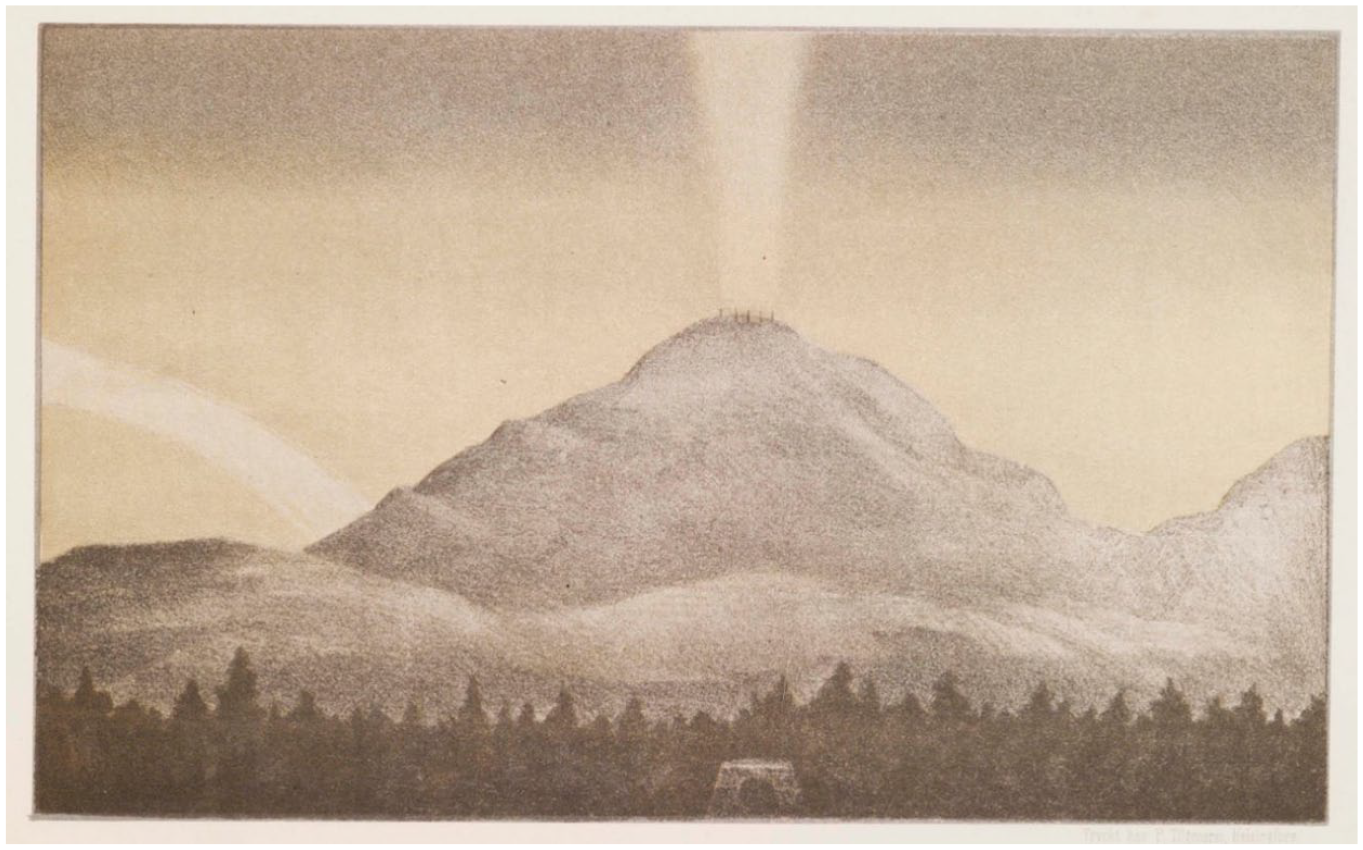
Karl Selim Lemström, “L’aurore boréale. Étude générale des phénomènes produits par les courants électriques de l’atmosphère” [With coloured plates.] (Paris: Gauthier-Villars, 1886), p. 139.
The great column of light was portrayed as a muted yellow-ish glow directly above the pinnacle of Orantunturi, with the luminosity dispersing with altitude. The second yellow band of light on the left-hand side of the image represents a “faint aurora in the sky at the back of the mountain,” which Lemström claimed may have negatively influenced spectroscopic readings had he been able to take any. 104 The inclusion of this natural aurora within the image was no accident; it was part of the artifice. Lemström established the mode in which authentic aurorae would be represented and drew a strong visual parallel between the natural and man-made aurorae. The visual rhetoric of the piece brought experiment and nature together in the mind of the beholder. Just as the gallery shows of London required audiences to suspend their disbelief while revealing the inner workings of a spectacle, Lemström drew attention to the fact that his light phenomena appeared as an aurora, while also underlining its man-made nature. The drawing therefore functioned as a piece of evidence that would outlast the fleeting luminous glow. As Louis Marin argued, “the art of painting repeats nature’s production of artifice in turn, but by surmounting its defining particular deficiency, which is essentially temporal.” 105
Two additional smaller discharging devices were installed on the summit of Pietarintunturi, a mountain near Kultala in northern Finland, in late 1882 during the IPY expedition. 106 To place and subsequently check the apparatus, a member of the expedition team had to climb 300 m and then walk a further 3.2 km. A Holtz machine was introduced to the circuit and the standing poles were insulated with sulphuric acid to avoid the creeping of electricity over their surfaces. 107 Lemström noted that a Holtz machine can “reinforce the phenomenon if it already exists and can even provoke it if circumstances are favourable.” 108 The purpose of the Holtz machine was thus to amplify the reaction in the atmosphere by adding greater voltage to the circuit. Given the fragility of the machine, it was transported to the region with considerable difficulty on the back of a reindeer. Fortunately, it arrived in one piece.
Lemström’s wife, Alma Lemström, assisted with the observational work at Kultala station but it was Roos, Karl Granit (1857–94), and Biese who were involved in observing the light phenomenon above the discharging device on February 27 and March 2, 1883. 109 Lemström admitted that there may have been some doubt surrounding the first observation but the second, in his opinion, was certain, which begs the question as to how visual certainty was achieved. 110 According to Roos, the ray seen on February 27 was vertical, of a constant width, and had a pale yellow color. He saw it from a distance of 1.56 km for approximately one minute, whereas Granit, connected via a telephone wire, could not identify the ray from a position 5 km removed from Pietarintunturi. Overall, Lemström concluded that “the experiments at Luosmavaara in 1871 and at Orantunturi and Pietarintunturi in 1882, clearly and undeniably prove that the aurora borealis is an electrical phenomenon.” 111 Electrical currents, he asserted, are always present within the atmosphere, caused by the “evaporation which is going on all over the Earth,” with the water vapor, brought by southern winds, increasing the conductivity of polar air. 112 He also argued that terrestrial magnetism played a minor secondary role in the formation of aurorae, contributing only to give the rays a certain direction, a sentiment with which de la Rive agreed. 113
So compelling were Lemström’s artificial aurora experiments that the Swedish Riksdag and the Finnish government provided funding for an additional year of work during the winter of 1883–4, directly after the Polar Year. 114 This was exceptional given the resources needed to maintain a polar station and the desire for co-ordination within the confines of the IPY program. As Lemström lamented to his friend, Adolf Erik Nordenskiöld, no other stations except for those operated by Russian research teams would remain in the winter of 1883–4. 115 In this additional year, Lemström erected his discharging device atop the Kommattivaara mountain, 6 km east of the Sodankylä base. The wires of this new apparatus were made from iron to avoid the constant breakages associated with the copper wires. Lemström was once again disappointed by the lack of ordinary and artificial aurorae. He mused that while in the laboratory one could “get their hands on the phenomenon,” processes and interactions happening in nature required much more “patience and humility.” 116 Nevertheless, on nights such as November 12, 1883, Lemström claimed to have witnessed a luminous phenomenon above the apparatus constructed atop Kommattivaara as well as a reaction on the spectroscope, indicating that the light was of auroral character. 117 The glow was reportedly particularly bright, “appearing as a moving knot along the entire apparatus,” observed for fifteen minutes at a distance of 1 km. 118 Lemström created a watercolor of this later artificial aurora, presented in Figure 10. 119 This image shares many characteristics with that published in 1886, although the glow surrounding the discharging apparatus is markedly smaller. The luminous jet can be seen to be reflected in the lake, implying that the light display was an objective phenomenon, influencing the environment, rather than an optical illusion. Yet, this watercolor painting remained unpublished; it was eventually donated to the Finnish Heritage Society as part of a testamentary bequest made by Mrs Cely Mechelin (1866–1950), a relation of Lemström’s by marriage.
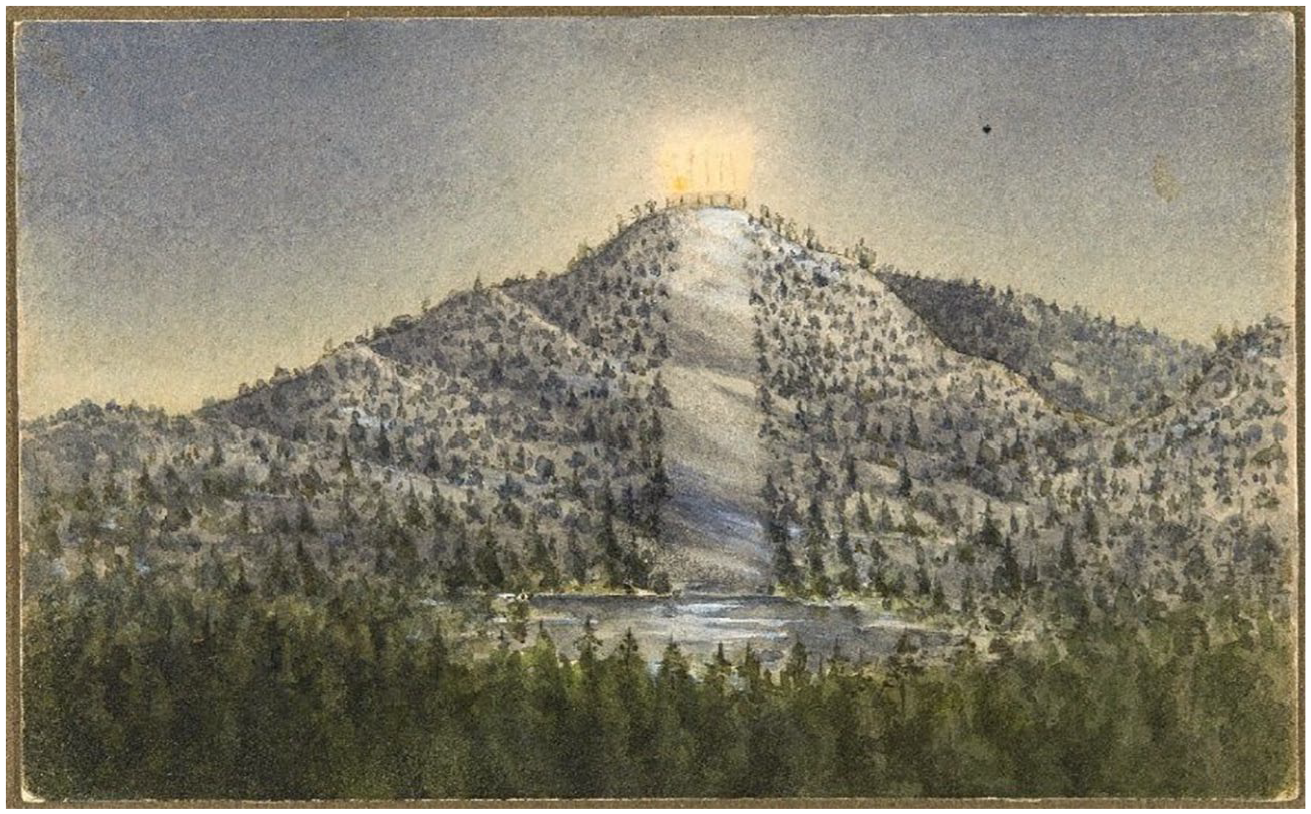
Karl Selim Lemström, “12th November 1883 aurora atop Kommattivaara, Sodankylä,” watercolor, Finnish Heritage Agency, inventory ID: HK19501007:575.
Lemström claimed that the light phenomena generated above his discharging devices over the course of more than a decade “prove that the aurora borealis may be produced in nature by a simple contrivance assisting the electric current flowing from the atmosphere to the Earth.” 120 Importantly, Lemström contended that his man-made “light phenomena” were “of the same nature as the auroras.” 121 The luminosities did not just look the part but also returned some of the spectroscopic lines associated with atmospheric aurorae, albeit with some uncertain readings. Lemström believed he had reproduced the aurora atop four mountains in northern Finland in all of its complexity. 122 Through making the phenomenon, Lemström demonstrated his understanding of the atmosphere; his aurorae were a spectacular substantiation of his theories. Lemström produced one final watercolor of his 1871 “artificial aurora,” which was published in 1899 and is shown in Figure 11. 123 Almost three decades after the event, it had become important to produce a persuasive visual rendering of the phenomenon to bolster his claims, which were coming under growing scrutiny at the turn of the twentieth century. 124 Lemström made no further artificial aurora experiments after 1884, citing the difficulties of numbed hands and the vulnerability of the wires to the cold as reasons for abandoning his project. He later became interested in the effects of atmospheric electricity on the yields of agricultural produce, publishing a treatise on the topic in the year of his death in 1904. 125
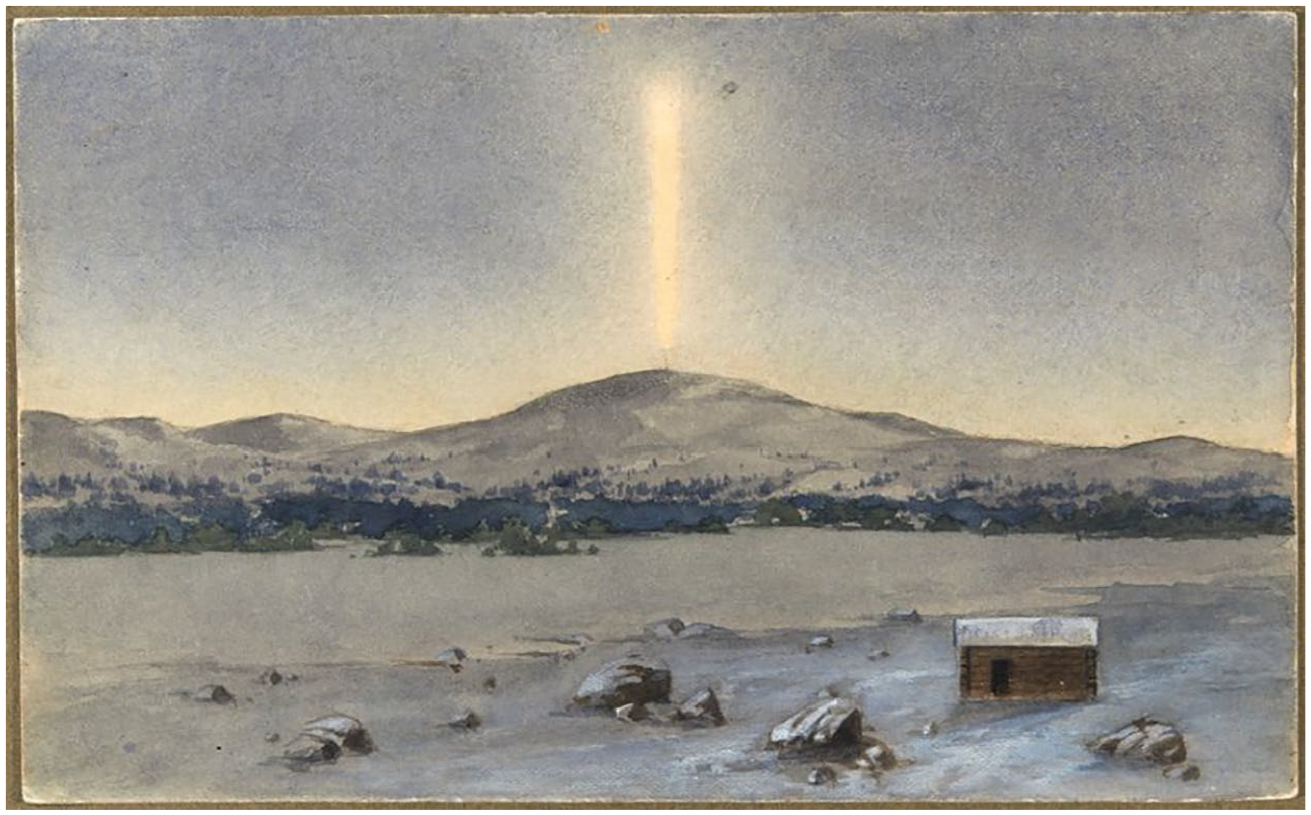
Karl Selim Lemström, “1871 artificial aurora,” in Några resultat af den Finska Polarstationens arbeten i Sondankylä och Kultala åren 1882–84 berörande närmast Jordströmmarna och den elektriska strömmen från atmosferen och deras samband med Jordmagnetismen (Helsingfors: J. C. Frenckell & Son, 1899), p. 32.
Discussion of Lemström’s experiments
Lemström’s artificial aurora experiments generated energetic discussions and critiques in the late nineteenth century from experimenters including Capron, Tromholt, and Célestin-Xavier Vaussenat (1831–91). Interested parties learned of his work via telegrams and through viewing a miniature version of his apparatus at the 1875 Congrès International de Géographie in Paris and the 1877 South Kensington Museum conference. Lemström constructed a tabletop discharging device, as illustrated in Figure 12, after his initial outdoor experiments at Luosmavaara in 1871 but before his more affirmative Polar Year research. The smaller apparatus consisted of a brass sphere fixed to a 0.6 m length of Indian rubber fastened to a board and connected to a Holtz machine, accompanied by an arm on which sixteen Geissler tubes were attached, containing air at a pressure of 0.5 mm. 126 The lower ends of the tubes were pierced with platinum wires and directed toward the sphere, while the upper ends were connected and earthed via a copper wire. The Geissler tubes represented the upper atmosphere. When the machine was put into action, the brass sphere became negatively charged and a reddish-lilac glow could be seen throughout the tubes. 127
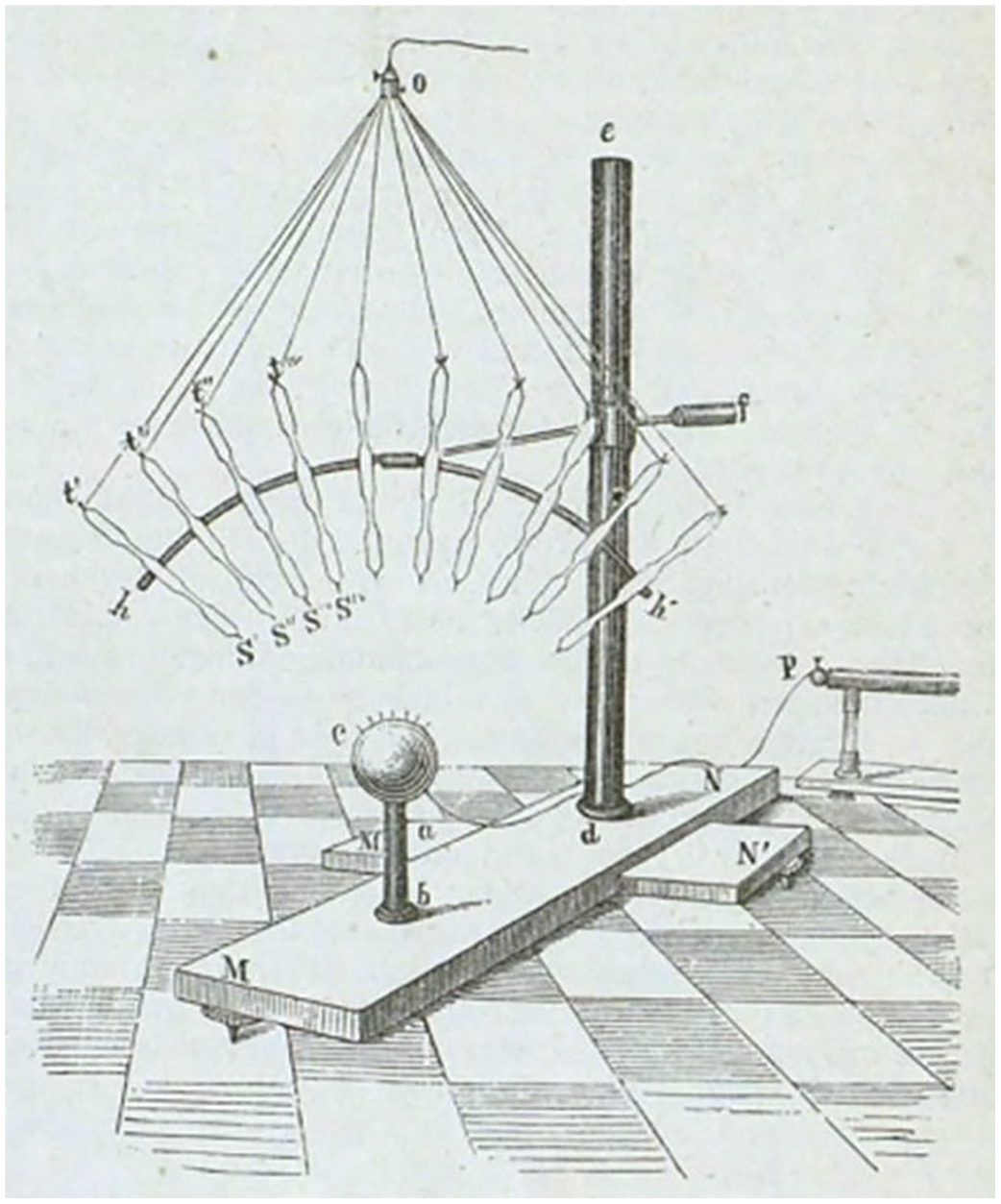
Karl Selim Lemström, “utströmnings apparatus,” in Om Polarljuset Eller Norrskenet af Selim Lemström Professor I Fysik vid Helsingfors Universitet (Stockholm: Adolf Bonnier, 1886), p. 100.
Baron Oscar Dickson (1823–97), a Swedish magnate, funded the construction of the apparatus for the 1875 Paris exhibition, where it was awarded a first-class medal. 128 Lemström himself could not attend the Congrès International de Géographie but Robert Rubenson (1829–1902), director of the Central Institute of Meteorology in Stockholm, spoke on his behalf, emphasizing that the device provided experimental proof of Lemström’s auroral and atmospheric theories. For the South Kensington Museum exhibition of 1877, a new machine was designed by Ferdinand Carré (1824–1900) in Paris. 129 This time Lemström attended to provide an accompanying speech. As he made clear, “the polar-light apparatus now exhibited shows that an electric current passing from an insulated body does not produce any light in air of normal pressure, but as soon as it rises to the rarefied air of the Geissler tubes, there is directly produced a phenomenon very like the real polar light.” 130 Capron attended the exhibition to view the devices displayed by de la Rive and Lemström in London and was impressed. He emphasized that “if Professor Lemström’s experiments established a permanent aurora, our chances of discovering its true nature will increase with its duration.” 131
A telegram sent on December 11, 1882, was the first communication to Britain regarding Lemström’s experiments conducted on Orantunturi. 132 Lemström relayed the message that he had erected his discharging device on the mountain and witnessed a “halo yellow-white in colour, which faintly but perfectly yields the spectrum of the aurora borealis.” 133 A subsequent telegram sent on January 5 from the Finnish Academy of Sciences, published in Nature and Symons’s Monthly Meteorological Magazine, acquainted interested parties with the investigations on Pietarintunturi. 134 The Daily Telegraph then printed some extra particulars on March 2, 1883. 135 Indeed, The Daily Telegraph’s Berlin correspondent remarked that “since Franklin’s famous experiment, by which he proved that a flash of lightning is only a long electric spark darting from the battery of the clouds, nothing has been done to test the nature of atmospheric electricity so praiseworthy or so interesting as the investigation by Professor Lemstrom.” 136
Capron was deeply interested in the possibilities Lemström’s experiments presented and wrote in favor of funding being directed toward his continued research after the Polar Year. 137 Capron also presented a talk at the British Association for the Advancement of Science’s Annual Conference at Southport on September 25, 1883, devoted entirely to Lemström’s work, titled “On Some Points in Lemström’s Recent Auroral Experiments in Lapland” (reprinted in Symons’s Monthly Meteorological Magazine). 138 The terminology Capron used within his speech is worth analyzing. He stated that Lemström was actively engaged in “collecting” rather than making an aurora. 139 The inference here is that if Lemström succeeded, he would command a “real” aurora. Moreover, Capron contended in an 1883 Observatory article that Lemström’s phenomenon had been “curiously miscalled an artificial aurora.” 140 In Capron’s view, it was, for all intents and purposes a natural atmospheric aurora, exactly the same as the original, that Lemström sought to conjure.
However, Capron was also cautious in his endorsement of Lemström’s research, pointing out the uncertainties surrounding his spectroscopic readings. Capron lamented that lines other than the auroral green line associated with the aurora were not found, Lemström’s four-prism spectroscope failed to give the green line when the two-prism spectroscope did so, several observations recorded the green line when no aurora was visible, and that the yellow-white hazy phosphorescence may have been a different phenomenon altogether. 141 He stated that “one cannot help feeling something of regret that if, only for further assurance, the wavelength of the one line seen was not absolutely determined, on some occasions at least, and that the observations appear to rest only on a small instrument presumably without scale.” 142 Despite his misgivings, and somewhat curiously, Capron accepted that Lemström had indeed produced an auroral glow, stating that “the apparatus on these occasions so ingeniously applied did really collect and make apparent to the eye a true auroral glow, its spectroscopic character being at the same time tested and defined by experienced observers.” 143 He was reassured by the fact that Lemström’s light display seemed to return the green auroral line and a faint yellow-green continuous spectrum, just as the true aurora of November 17, 1882, had done. 144
While drawing significant attention to Lemström’s experiments at the British Association for the Advancement of Science’s Annual Conference of 1884, Capron also urged that they “can hardly be accepted in their present state as conclusive.” 145 First, in congruence with his earlier remarks (if not his conclusions), he pointed out that no measurement of the aurora line at 5577Å had been reliably recorded. 146 Moreover, in an 1883 article for the London, Edinburgh, and Dublin Philosophical Magazine and Journal of Science, Capron gently presented the possibility that Lemström may have measured the auroral green line erroneously, given that “even scientists of such calibre as Ångström and Respighi were on occasions deceived by the presence of a concealed aurora.” 147 Second, and more importantly for Capron, Lemström had brought the scientific community no closer to identifying the “real nature of auroral discharge.” 148 He contended, “the nature of this electricity and of the other agencies involved in the matter seems left . . . as mysterious as ever.” 149 In fact, as Capron’s responses demonstrate, he opened the debate, making it more leaky and uncertain. Lemström’s luminous jets did not resolve the vexed question as to what an aurora actually was and therefore the experiments could not purport to replicate a phenomenon that itself was still obscure. Capron’s vacillating opinions on Lemström’s experiments reflect the fact that these kinds of model experiments had the tendency to generate extreme ambiguity.
Another critique of the artificial aurora experiments came from Lemström’s fellow explorer and personal friend, Adolf Erik Nordenskiöld. On the Vega expedition of 1878–9, Nordenskiöld had conducted his own observations of aurorae. Having read Nordenskiöld’s manuscript account of the trip in late 1882, Lemström requested that one remark be suppressed for fear “it is your intention to discredit my observations by pointing out that I could confuse the light band 585Å with the yellow line 5569Å.” 150 In other words, Nordenskiöld implied that Lemström had mistaken the well-documented glow occasionally seen around mountaintops for an auroral discharge in his observations at Orantunturi. In a subsequent letter dated February 7, 1883, Nordenskiöld asked, “are you sure the light phenomenon you saw was the northern lights? It sometimes happens that whole mountaintops shine through electric discharge.” 151 He continued in a letter dated February 25, 1883, “isn’t the phenomenon you saw identical to the light that you see on the tops of the Alps, in the Sahara etc, discharged from pointed objects, alpine poles, camels ears!” 152 Nordenskiöld pressed on the point of reliable observation, asking if Lemström had previously seen this glowing phenomenon himself and could therefore distinguish it from an aurora. 153 Lemström felt it necessary to defend himself in direct response to Nordenskiöld’s critique, arguing in an article published in Nature that “the two lines are, in fact, of such a different character that they cannot be confused for a moment by anyone who has had an opportunity of comparing them simultaneously.” 154 This exchange highlights the significance of first-hand witnessing and the authority of an observer in establishing the particular nature of unusual, deceptive phenomena, while also casting doubt on Lemström’s spectroscopic verification of his artificial aurora.
In the face of these critiques, Lemström’s experiment would have gained considerable legitimacy had it been replicated by other experimenters. Tromholt was a Danish teacher and aurora researcher who conducted surveys of Norwegian vicarages and ship’s captains for auroral observational accounts, collected records from Danish meteorological stations, observed aurorae from Bergen and calculated relatively accurately the height of aurorae (before the introduction of the auroral camera). 155 He took part in the First IPY, manning a station alone at Kautokeino in northern Norway, but visited the Finnish Polar Year station during the program to learn about Lemström’s research. 156 In his account of the Polar Year, Under the Rays of the Aurora Borealis: In the Land of the Lapps and Kvæns, Sophus Tromholt recorded that he detected some discrepancies between what he was told by the scientists at Sodankylä and Lemström’s later official account. 157 He noted that he had personal “misgiving about considering it beyond all doubt that the light phenomena produced by Lemström can be easily identified with the northern lights.” 158 Furthermore, Tromholt asserted that the experiments were too provisional in nature and required repetition “in places where there are fewer natural obstacles against their execution than in the forest-clad rigid wilderness of Finnish Lapland.” 159 Interestingly, Tromholt implied that Finnish mountains were too wild a setting for reliable outdoor experiments. What counted as remote here most likely had more to do with geopolitical boundaries than it did with judgments of the environment. Indeed, to Tromholt’s mind, northern Finland, a space that was under Russian autonomy, seemed much more remote than northern Norway and Iceland, where he worked, which traditionally had much closer ties to Denmark.
Tromholt then attempted to reproduce Lemström’s artificial aurora results atop Mount Esja in Iceland, just northeast of Reykjavik, directly after the Polar Year in the winter of 1883–4. 160 He erected his own discharging apparatus on February 25, 1884, once the weather conditions allowed safe passage to the summit. His device consisted of 250 m of bare wire in a spiral shape at the top of the mountain, 2,000 needle points and a 1,000 m wire insulated with gutta percha laid from the summit to the base of the mountain. 161 It took twenty-one men to carry the equipment up the mountain and four hours to set up the device. 162 He noted that no current could be traced between the upstanding points and the buried plate. 163 Tromholt waited patiently to observe any signs of aurorae on the mountaintop. 164 Nevertheless, he wrote in an 1884 Nature article that the device showed “no signs of life whatsoever.” 165 Tromholt conceded that the lack of aurorae may have been due to the apparently low intensity of electrical forces on the island at the time. Yet, a year later in his account of the Polar Year program, he was bolder in his assertions, arguing that it was impossible for Lemström to have created an aurora. 166 Instead, he insisted that Lemström must have witnessed an example of the electrical phenomenon known as St. Elmo’s fire on both his 1871 and IPY expeditions. 167 Tromholt argued that Lemström’s “spectroscopic analysis . . . proves very little,” given that St. Elmo’s fire had never before been analyzed spectroscopically and thus might have compared favorably to the spectrographs produced from Lemström’s light phenomenon. 168 Lemström, for his part, blamed the unusually “adverse winter, heavy snowfall and great moisture” that Tromholt experienced for his lack of success in recreating the artificial aurora. 169
A second attempt to recreate Lemström’s experiment was commissioned by the French Académie des sciences and took place under the direction of Vaussenat, a civil engineer, professional mountaineer, and founder of Pic du Midi Observatory, located 2,877 m above sea level atop Pic du Midi de Bigorre in the French Pyrénées. Mountain observatories, such as Pic du Midi, were increasingly popular institutions for carrying out scientific enterprises, resolving, to some extent, the tensions between the laboratory and the field. Vaussenat’s apparatus, erected in 1885, consisted of copper wires covering 3,700 m and 200 vertical posts set out as portrayed in Figure 13, even larger than Lemström’s discharging device. 170 In the ten months that the apparatus stood on Pic du Midi, there was neither any sign of natural auroral phenomena nor any instance of St. Elmo’s fire. 171 In fact, the device was more a safety hazard than a useful piece of equipment. On August 11, 1885, Vaussenat received a dangerous electric shock, singing his eyebrows and eyelashes, scorching his face, and burning a spring in the chronometer he was carrying. In the following days another observer, Gilbert Étienne Defforges (1852–1915), was also struck by sparks originating from the apparatus. 172 These circumstances, Vaussenat concluded, were due to the insufficiency of the conductors in dealing with a large accumulation of atmospheric electricity. 173 Furthermore, Vaussenat stated that “from these experiences we are left with the certainty that, if luminous sheaves have been seen on points at the top of a mountain, they cannot be of an origin and of a nature different from St. Elmo’s fire, who decorates our good lightning conductors in stormy weather.” 174 Alfred Angot (1848–1924), a French meteorologist, physicist, and climatologist, agreed that Lemström had likely created St. Elmo’s fire and suggested his experiments only demonstrated that the atmosphere contained static potential and not, as Lemström argued, electric currents. 175 Ultimately, Lemström’s luminous glow could neither be repeated in a different location by a different experimenter, nor could it be said to convincingly replicate the spectroscopic or visual properties of a natural aurora. He had failed to convincingly represent evidence of his supposed replication to a broader audience of specialists.
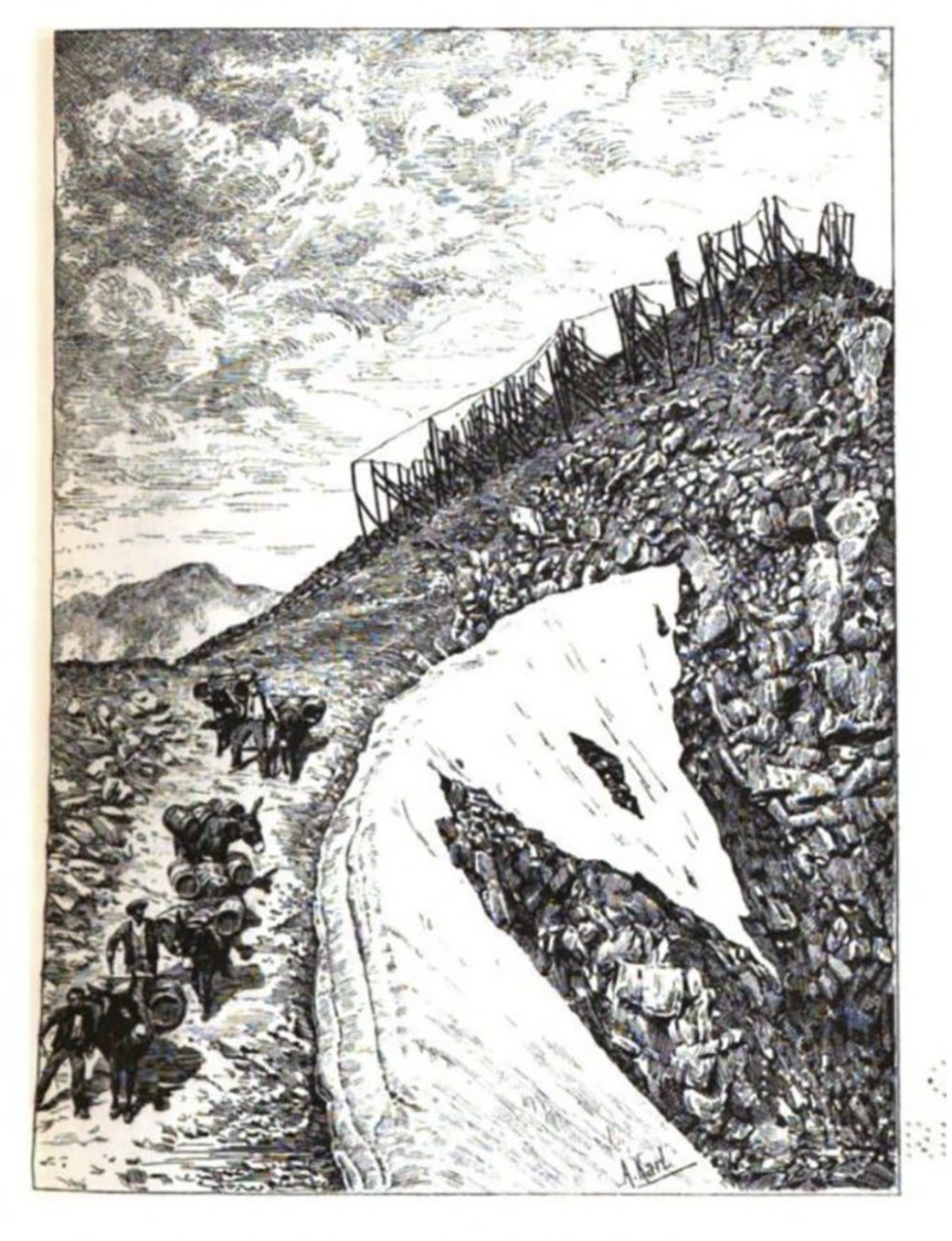
Célestin-Xavier Vaussenat, “Installation au Pic du Midi d’un réseau de 14000 pointes, pour vérifier l’expérience Lemström,” in “Observatoire du Pic du Midi,” Annuaire de la Société météorologique de France, vol. 4 (1886), p. 119.
Conclusion
“If mankind possessed an electro-static sense, and could perceive electricity as they can light,” The Daily Telegraph’s 1883 article posed, “then we should see this now mysterious agency everywhere diffused in the world, from all the edged and sharp points of rocks and hills and church spires, and even the tips of the leaves of plants and trees, we should observe unceasingly at work day and night electric streamers keeping up the balance of nature.” 176 Lemström’s ambitious artificial aurora experiments aimed to make these apparitional electric streamers visible by means of spectacular displays of luminous jets above four mountains in northern Finland. In doing so, he hoped to prove his theory of ever-present electrical currents in the atmosphere, akin to the way the cloud chamber would later make visible the tracks of subatomic charged particles. 177 Drawing on a substantial late nineteenth-century tradition of morphological experimentation, involving the shrinking of immense phenomena to the size of tabletop devices, Lemström attempted something different. He ventured to construct a man-made artificial aurora of a similar magnitude and made of the same constituent parts as the phenomenon as it appeared in nature, reproducing the aurora entirely and perfectly. He thus intended to surpass the multiple problems of scaling inherent in analog experimentation (though reconciling the local and universal scales remained problematic).
Consequentially, this case study demonstrates that model experiments need not be confined in our thinking to miniaturized versions of larger-scale phenomena. Indeed, a model could gain credibility from its proportionality to a natural object, with its macro- and microlevel features scaled accordingly. The vast, wild and unruly space of the outdoors became a productive environment lending a “realness” to Lemström’s project. While the laboratory had become the exemplary site for the production of knowledge within the physical sciences, his experiment demonstrated the utility of working within nature. Proximity to the atmosphere and the position of the scientist-observer within the environment contributed to a full and constructive sense of experimentation uninhibited by the sanitized and constrained parameters of indoor laboratories and exhibition galleries.
Even with the added legitimacy of the outdoors, the issue of credibility arose in the context of Lemström’s artificial aurora, reflecting a wider history of contested ownership and authority over the northern lights. 178 Indeed, the aurora’s ability to capture the imaginations of publics, amateurs, and professionals alike meant that the stakes for the right to make claims about the phenomenon were high and sharply felt. During a period in which the aurora was a popular touchstone for magic lantern shows, and patrons of London’s public galleries were familiar with the optical effects produced by aurora flasks and the hydroelectric machine, Lemström’s artificial aurora experiments chimed with a fascination for the imagined aesthetic experience of watching the lights. Nevertheless, for Lemström’s luminous jets to be identified as an aurora, they had to do more than just resemble the colors of the naturally occurring phenomenon visually. The light phenomenon needed to reproduce the atomic-level properties of an aurora; it needed to perform microscopic mimesis. This we can interpret as a broader condition of formal replication in the period.
The problem was that there was no consensus as to the microscopic make-up of an aurora, aside from its little understood association with the auroral green line at 5577Å. Even so, spectroscopic analyses held sway in authenticating the light phenomenon, though lines other than that at 5577Å were observed and considered. 179 The most significant challenge to Lemström’s assertions, however, resulted from the failure of both Tromholt and Vaussenat to replicate his luminous jets (or any comparable spectroscopic result) under similar conditions. It is through the critiques of Lemström’s artificial aurora that we learn about the conditions required for the reproduction of unruly, slippery phenomena in the late nineteenth century. Verification hinged most heavily upon repetition by trusted observers. It also relied upon an admixture of visual confirmation, authority within a scientific community, standardized systems of calibration, and instrumental analyses of key internal structures. The claim to have reproduced an intangible, unpredictable, and still somewhat mysterious phenomenon was subject to further, more stringent criteria and skepticism than the replication of broadly known objects. Lemström’s luminous jets were ultimately considered closer to an analog than a reproduction on the continuum of model experiments.
The critiques highlight the paradox of constructing an imitation to understand an original object. What could it be calibrated against? Lemström’s epistemological framework was one of learning by making, a principle that was simultaneously employed in the realm of 1880s chemical synthesis. 180 Indeed, it was a way of knowing which was having its moment at exactly this time. However, with Lemström’s experiment, we see the model of learning-by-making break down because it presupposed that an object was already delimited and understood in some meaningful way. Replication, or mimesis, emerged from the resulting discussions of Lemström’s experiments, as an unproductive source of theoretical insight. This case study is just one example of the ways in which model experiments were grappled with as possible routes to knowledge in the late nineteenth century. Though much excellent scholarly work has analyzed the use of analog devices to investigate weather, geological, and light phenomena, future studies in this area would benefit from a reinvigorated consideration of the problems arising from establishing a connection between analog and the original phenomenon, and, most significantly, the assumptions involved in verifying that an object had indeed been completely and authentically reproduced.
Footnotes
Acknowledgements
I would like to thank Professor Hasok Chang for discussing some of the central issues of this paper at a formative stage in the research process and Professor Richard Staley for his advice on initial work from which this paper developed. My sincere gratitude is owed to Professor Simon Schaffer for his generous and insightful comments on multiple drafts of this paper. My thanks are also owed to two anonymous reviewers, to whom I’m most grateful.
Funding
The author received no financial support for the research, authorship, and/or publication of this article.
Conflict of interest
The author declared no potential conflicts of interest with respect to the research, authorship, and/or publication of this article.

1.
Peter Galison and Alexi Assmus defined “mimetic experimentation, a term that will designate the attempt to reproduce natural physical phenomena, with all their complexity, in the laboratory”; Peter Galison and Alexi Assmus, “Artificial Clouds, Real Particles,” in David Gooding, Trevor Pinch, and Simon Schaffer (eds.), The Uses of Experiment: Studies in Natural Sciences (Cambridge: Cambridge University Press, 1989), pp.225–74, 227.
2.
Priestley described an arrangement whereby Giambatista Beccaria “imitated the appeance of clouds that bring rain by insulating himself between the rubber and conductor of his electrical machine”; Joseph Priestley, History and Present State of Electricity, Vol. 2 (London: J. Johnson, 1775), p.429; Alexander Rueger, “Aesthetic Appreciation of Experiments: The Case of Eighteenth Century Mimetic Experiments,” International Studies in the Philosophy of Science 16, no. 1 (2002): 49–59, 52.
3.
The morphological sciences were defined by James Clerk Maxwell and Johann Wolfgang von Goethe as an approach akin to natural history in opposition to “an abstract law-seeking, often mechanical reductionist approach to the physical world,” Galison and Assmus, “Artificial Clouds, Real Particles,” pp.227, 231 (note 1).
4.
John Tyndall, “On the Blue Colour of the Sky, the Polarisation of Skylight, and on the Polarisation of Light by Cloudy Matter Generally,” Proceedings of the Royal Society of London 17 (1869): 223–33, 224.
5.
Oliver Lodge, Lightning Conductors and Lightning Guards: A Treatise on the Protection of Buildings, of Telegraph Instruments and Submarine Cables, and of Electric Installations Generally, from Damage by Atmospheric Discharges (London: Whittaker and Co., 1892), p.33.
6.
Richard Staley also finds CTR Wilson’s motivations in a pre-established meteorological tradition within the Cavendish Laboratory; see Richard Staley, “Fog, Dust and Rising Air: Understanding Cloud Formation, Cloud Chambers and the Role of Meteorology in Cambridge Physics in the Late 19th Century,” in James Fleming, Vladimir Jankovic, and Deborah R. Coen (eds.), Intimate Universality: Local and Global Themes in the History of Weather and Climate ((Sagamore Beach: Science History Publications/USA, 2006), pp.93–113; CTR Wilson, “On the Cloud Method of Making Visible Ions and Tracks of Ionising Particles,” in Nobel Lectures: Physics 1922–1941, vol. 2 (Amsterdam: Elsevier, 1965), pp. 194–215.
7.
Galison and Assmus, “Artificial Clouds, Real Particles,” pp.237–9 (note 1) (emphasis in original).
8.
Simon Schaffer, “Where Experiments End: Tabletop Trials in Victorian Astronomy,” in Jed Z. Buchwald (ed.), Scientific Practice: Theories and Stories of Doing Physics (Chicago, IL: University of Chicago Press, 1995), pp.257–99, 298.
9.
Willem Hackmann, “The Lightning Rod: A Case Study of Eighteenth Century Model Experiments,” Transactions of the American Philosophical Society 99, no. 5 (2009): 209–29, 221.
10.
Ibid., 222.
11.
Peter Galison, Image and Logic: A Material Culture of Microphysics (Chicago, IL: University of Chicago Press, 1997), p.19.
12.
Ibid.
13.
Karen Crowther, Niels S. Linnemann, and Christian Wüthrich, “What We Cannot Learn from Analogue Experiments,” Synthesis 198 (2021): 3701–26, 3705; Paul Bartha, “Analogy and Analogical Reasoning,” in E. N. Zalta (ed.), The Stanford Encylopedia of Philosophy (Stanford, CA: Stanford University Press, 2016); W. G. Unruh, “Experiments with Black Hole Evaporation?” Physical Review Letters 46 (1981): 1351–3.
14.
Deborah Coen, Climate in Motion: Science, Empire, and the Problem of Scale (Chicago, IL: University of Chicago Press, 2018), p.6.
15.
Deborah Coen, “Big is a Thing of the Past: Climate Change and Methodology,” Journal of the History of Ideas 77, no. 2 (2016): 305–21, 312.
16.
Rueger, “Aesthetic Appreciation of Experiments” 52(note 2).
17.
Henry Cavendish, “An Account of Some Attempts to Imitiate the Effects of the Torpedo by Electricity,” Philosophical Transactions of the Royal Society of London Series A – Mathematical and Physical Science 66 (1776): 194–215, 201.
18.
For more information about the friendship and correspondence between Lemström and Nordenskiöld, see Peter Holmberg, “Efter Nordenskiölds expedition till Spetsbergen 1868. Något om den fortsatta kontakten mellan Adolf Erik Nordenskiöld och Selim Lemström,” Nordenskiold-Samfundets Tidskrift 54 (1994): 3–20. For an account of Nordenskiöld as a national hero and patriotic role model in Finland and Sweden, see Urban Wråkberg, “A. E. Nordenskiöld in Swedish Memory: The Origin and Uses of Arctic Heroism,” Acta Borealia 36 (2019): 166–82.
19.
Barbara Stafford, Echo Objects: The Cognitive Work of Images (Chicago, IL: Chicago University Press, 2007), p.76; David Summers argues that the artistic and representational category of naturalism is a kind of imitation “in which the artificial analogue is a virtual relationship of light, dark and colour”; David Summers, The Judgment of Sense: Renaissance Naturalism and the Rise of Aesthetics (Cambridge: Cambridge University Press, 1990), p.3.
20.
Willem Hackmann, “Instrument and Reality: The Case of Terrestrial Magnetism and the Northern Lights (Aurora Borealis),” Royal Institute of Philosophy Supplement 38 (1995): 29–51, 41.
21.
John Rand Capron, Aurorae: Their Characters and Spectra (London: E. & F. N. Spon, 1879), p.64.
22.
Karl Selim Lemström, “The Aurora Borealis 2,” Nature 28 (1883): 107–9, 109.
23.
Helge Kragh, “The Green Line: A Chapter in the History of Auroral Physics,” Astronomy and Geophysics 50, no. 5 (2009): 525–8, 525.
24.
Klaus Hentschel, Mapping the Spectrum: Techniques of Visual Representation in Research and Teaching (Oxford: Oxford University Press, 2002), p.58.
25.
Lemström was unusual in attempting to replicate the phenomenon but the aurora had been studied in Finland for decades. For information see Peter Holmberg, “From Dogmatic Discussions to Observations and Planned Experiments: Some Examples from Early Aurora Borealis Research in Finland,” Science & Education 5 (1996): 267–76.
26.
Samuel Triewald, “Experimentum aurorae borealis artificialis,” Kungl. Vetenskapsakademiens Handlingar (Proceedings of the Royal Swedish Academy of Sciences) 7 (1744): 115–17; Svante Lindqvist, “The Spectacle of Science: An Experiment in 1744 Concerning the Aurora Borealis,” Configurations 1, no. 1 (1993): 57–93.
27.
Triewald, “Experimentum aurorae borealis artificialis,” p. 116 (note 26).
28.
K. Rypdal and T. Brundtland, “The Birkeland Terrella Experiments and their Importance for the Modern Synergy of Laboratory and Space Plasma Physics,” Journal de Physique IV (Proceedings) 7 (1997): 113–31, 117.
29.
Per Pippin Aspaas, “The Role of the Societas Meteorologica Palatine (1781–1791) in the History of Auroral Research,” Acta Borealia 29, no. 2 (2012): 157–76; H. Nevanlinna, “On the Early History of the Finnish Meteorological Institute,” History of Geo- and Space Sciences 5 (2014): 75–80; Heikki Nevanlinna, “Auroral Observations in Finland. Visual Sightings during the 18th and 19th Centuries,” Journal of Geomagnetism and Geoelectricity 47, no. 10 (1995): 953–60.
30.
Kragh, “The Green Line” (note 23).
31.
Ulrike Spring, “Between Spectacle and Science: The Aurora in Central Europe, 1870s–1880s,” Acta Borealia: A Nordic Journal of Circumpolar Societies 29, no. 2 (2012): 197–215; Sven Widmalm, “Auroral Research and the Character of Astronomy in Enlightenment Sweden,” Acta Borealia 29, no. 2 (2012): 137–56; Päivi Maria Pihlaja, “Northern Laboratories of Nature and the Quest for Scientific Honour in Early Modern Sweden,” Acta Borealia 29, no. 2 (2012): 119–36.
32.
Robert Marc Friedman, “Making the Aurora Norwegian: Science and Image in the Making of Tradition,” Interdisciplinary Science Reviews 35, no. 1 (2010): 51–68; Robert Marc Friedman, “Making Sense of the Aurora: A Research Project,” Nordlit 16, no. 1 (2012): 59–68.
33.
Robert Eather, Majestic Lights: The Aurora in Science, History and the Arts, Vol. 18 (Washington, DC: American Geophysical Union: Special Publications Series, 1980).
34.
Päivi Maria Pihlaja, “Selim Lemström (1838–1904),” in Per Pippin Aspaas (ed.), Aurorae Borealis Studia Classica, Vol. 3 (University of Tromsø: Septentrio Academic Publishing, 2016).
35.
Iwan Rhys Morus, “Worlds of Wonder: Sensation and the Victorian Scientific Performance,” Isis 101, no. 4 (2010): 806–16, 810.
36.
Viewers of such shows were seduced by the spectacle but they also understood that they were being beguiled. Iwan Rhys Morus, “Seeing and Believing Science,” Isis 97, no. 1 (2006): 101–10, 104; Fiona Amery, “‘An Attempt to Trace Illusions to Their Physical Causes’: Atmospheric Mirages and the Performance of Their Demystification in the 1820s and 1830s,” The British Journal for the History of Science 53, no. 4 (2020): 443–67, 447.
37.
Iwan Rhys Morus, “Illuminating Illusions, or, the Victorian Art of Seeing Things,” Early Popular Visual Culture 10 (2012): 37–50, 46.
38.
Aileen Fyfe and Bernard Lightman, Science in the Marketplace: Nineteenth-Century Sites and Experiences (Chicago, IL: University of Chicago Press, 2007).
39.
“Hand-painted wooden framed lantern slide depicting the aurora borealis, from the Royal Polytechnic Institution” (c. 1860), History of Science Museum, Oxford, inv. 14791-8.
40.
Morus, “Illuminating Illusions,” p. 47 (note 37).
41.
Capron, Aurorae, p. 83 (note 21).
42.
Fyfe and Lightman, Science in the Marketplace, p.351 (note 38).
43.
“Royal Polytechnic Institution,” Morning Chronicle, September 16, 1843.
44.
Auguste de la Rive, “LVIII. On the Rotation of the Electric Light Round the Pole of an Electro-Magnet, to Dr. Faraday,” The London, Edinburgh and Dublin Philosophical Magazine and Journal of Science 15, no. 102 (1858): 463–6, 549.
45.
Auguste de la Rive, “LXXV. Further Researches on the Aurora Borealis, and the Phenomena Which Attend Them,” The London, Edinburgh and Dublin Philosophical Magazine and Journal of Science 23, no. 157 (1862): 546–53, 549.
46.
This apparatus was constructed by Professor Thury, under the direction of M. Eugene Schwerd, a skilful German artist; Auguste de la Rive, “Aurora-simulating machine” (circa 1860), Musée d’histoire des sciences de la Ville de Genève, MHS 501.
47.
de La Rive, “Further Researches on the Aurora Borealis,” p.549 (note 45).
48.
Ibid., 551.
49.
Ibid.
50.
South Kensington Museum, Catalogue of the Special Loan Collection of Scientific Apparatus at the South Kensington Museum, Vol. MDCCCLXXVI (London: G. E. Eyre and W. Spottiswoode, 1877), p.385.
51.
South Kensington Museum, Conferences Held in Connection with the Special Loan Collection of Scientific Apparatus (London: Published for the Lords of the Committee of Council on Education by Chapman and Hall, 1877), p.157.
52.
Ibid., p.158.
53.
Auguste de la Rive, A Treatise on Electricity in Theory and Practice, Vol. 3 (London: Longman, Brown, Green and Longmans, 1858).
54.
Ibid., p.302.
55.
Ibid., p.238.
56.
Congressional Committee, The Miscellaneous Documents Printed by order of the House of Representatives during the second session of the Forty-Third Congress 1874–75, Vol. 2 (Washington, DC: Government Printing Office, 1875).
57.
Ibid., p.234.
58.
Ibid., p.236; Alexander Stewart Herschel also argued that “the spectrum of the aurora is no doubt in the main the same as that of the pale blue light round the negative pole in an air or nitrogen vacuum tube, with the spark induction passing through it”; Alexander Stewart Herschel, “On the Spectrum of the Aurora,” The Philosophical Magazine: A Journal of Theoretical, Experimental and Applied Physics 49 (1875): 65–71.
59.
“Aurora Tube,” Lorraine Collections, Firenze: Museo Galileo: Istituto e Museo di Storia Della Scienza, p.1203; “Aurora Flask,” Lorraine Collections, Firenze: Museo Galileo: Istituto e Museo di Storia Della Scienza, inv. 423.
60.
Chitra Ramalingam, “Natural History in the Dark: Seriality and the Electric Discharge in Victorian Physics,” History of Science 48 (2010): 371–98, 390.
61.
Ibid., 389.
62.
Ibid., 391.
63.
G. I. Symons, “Artificial Aurorae,” Symons’s Monthly Meteorological Magazine XVII (1883): 33.
64.
John R. Capron, “On the Comparison of Some Tube and Other Spectra with the Spectrum of the Aurora,” The Philosophical Magazine: A Journal of Theoretical, Experimental and Applied Physics 49 (1875): 249–60; Paul Fuller, “The Life and Times of John Rand Capron (1829–1888),” Antiquarian Astronomer 8 (2014): 21–45, 40.
65.
Capron, “On the Comparison of Some Tube and Other Spectra with the Spectrum of the Aurora,” pp.252–62 (note 64).
66.
Karl Selim Lemström to H. Gyldén, February 10, 1875, Royal Academy of Sciences, Stockholm.
67.
Discharge tube experiments were relevant to debates about the altitude at which aurorae appear, see Warren De la Rue and Hugo W. Müller, “Experimental Researches on the Electric Discharge with the Chloride of Silver Battery,” Philosophical Transactions of the Royal Society of London Series A – Mathematical and Physical Science 171 (1880): 65–116; Robert Scott, “The Aurora Borealis 1,” Nature 22 (1880): 33–34.
68.
John R. Capron, “Professor Lemström’s Auroral Experiments in Lapland,” The Observatory 6 (1883): 259–66, 263.
69.
Ibid.
70.
John R. Capron, “To the Editor of the Meteorological Magazine,” Symons’s Monthly Meteorological Magazine XVII (1883): 55.
71.
Ibid.
72.
L. Figuier, “Eclairage au gaz dans la ville de Paris,” L’année scientifique et industrielle 17 (1858): 134.
73.
Ibid.
74.
Karl Selim Lemström, “The Aurora Borealis,” Nature 28 (1883): 60–3, 60.
75.
Selim Lemström, L’aurore boréale. Étude générale des phénomènes produits par les courants électriques de l’atmosphère [With coloured plates] (Paris: Gauthier-Villars, 1886), p.138.
76.
Lemström, “The Aurora Borealis,” p.61 (note 74); Robert E. Kohler and J. Vetter, “The Field,” in B. Lightman (ed.), A Companion to the History of Science (Oxford: Wiley, 2016), pp.282–95, 285.
77.
Friedman, “Making the Aurora Norwegian,” p.60 (note 32).
78.
The program of parallax photography initiated by Carl Størmer is considered the definitive resolution of the question of auroral altitude. For a description of this investigation during the Second International Polar Year see Fiona Amery, “Capturing the Northern Lights: Standardising the Practice of Auroral Photography During the Second International Polar Year, 1932–1933,” Historical Studies in the Natural Sciences 52, no. 2 (2022): 147–89, 176.
79.
Lemström, “The Aurora Borealis” (note 74).
80.
Lemström, L’aurore boréale, p.139 (note 75).
81.
G. J. Symons, “Artificial Aurorae,” Symons’s Monthly Meteorological Magazine XVII (1883): 33–5, 52.
82.
Lemström, “The Aurora Borealis,” p.60 (note 74).
83.
Ibid.; Selim Lemström, “Auroral experiments in Finland,” Nature 27 (1883): 389.
84.
Lemström, “The Aurora Borealis,” p.60 (note 74).
85.
Ibid.
86.
John Rand Capron, “The Auroral Beam of November 17, 1882,” Philosophical Magazine Series 5 15, no. 95 (1883): 318–39, 339; Gaston Tissandier “Les Aurores Boréales Travaux de m. Lemström,” La Natur 15 (1887): 104–6, 106; Lemström, “The Aurora Borealis,” p. 60 (note 74).
87.
Lemström, “The Aurora Borealis,” p.61 (note 74).
88.
Mäklin and Lindelöf wrote persuasively to His Imperial Majesty in favor of the expedition on behalf of the Finnish Science Society. W. Mäklin and L. Lindelöf to His Imperial Majesty, “on behalf of the Finnish Science Society,” December 19, 1881, Finnish International Polar Year Expedition members, Om den Finska Polarexpeditionen till Sodankylä och Kutula åren 1882–83 och 1883–84 jämte Skildringar från Lapplan af Expeditionens medlemmar (Helsingfors: Finska Litteratur-sällskapets tryckeri, 1885), p.22; His Imperial Majesty granted 63,000 marks for the Finnish Polar Year expedition, followed by 37,000 marks to fund the additional year of the expedition; see Adolf Edvard Arppe, Finska vetenskaps-societeten 1838–1888, dess organisation och verksamhet (Helsingfors: J. Simelii arfv. boktryckeri aktiebolag, 1888).
89.
Karl Selim Lemström, “The Results of the Scientific Expedition to Sodankylä,” Nature 31 (1885): 372–76, 372.
90.
“Utströmnings device” roughly translates to “discharging device.”
91.
Lemström, “The Aurora Borealis,” p.61 (note 74).
92.
Ernst Biese, “Retkikunnan edistyminen ja tärkeimmät tulokset,” in Finnish International Polar Year Expedition members (ed.), Om den Finska Polarexpeditionen till Sodankylä och Kutula åren 1882–83 och 1883–84 jämte Skildringar från Lapplan af Expeditionens medlemmar (Helsingfors: Litteratur-sällskapets tryckeri, 1885), pp.46–73, 59.
93.
Selim Lemström, “Sur les principaux résultats de l’expédition polaire finlandaise, 1883–84, note de M. Selim Lemström, présentée par M. Tresca,” Comptes rendus hebdomadaires des séances de l’Académie des sciences 99 (1884): 91–5, 94.
94.
Lemström, “The Aurora Borealis,” p.61 (note 74).
95.
Ibid.
96.
Ibid.
97.
Ibid., 62.
98.
Biese, “Retkikunnan edistyminen ja tärkeimmät tulokset,” p.54 (note 92).
99.
Lemström, L’aurore boréale, p.139 (note 75).
100.
Karl Selim Lemström, Några resultat af den Finska Polarstationens arbeten i Sondankylä och Kultala åren 1882–84 berörande närmast Jordströmmarna och den elektriska strömmen från atmosferen och deras samband med Jordmagnetismen (Helsingfors: J. C. Frenckell & Son, 1899), p.33.
101.
U. B. Roos, “Muistoja ja Vaikutelmia Oleskelusta Kultala,” in Finnish International Polar Year Expedition members (ed.), Om den Finska Polarexpeditionen till Sodankylä och Kutula åren 1882–83 och 1883–84 jämte Skildringar från Lapplan af Expeditionens medlemmar (Helsingfors: Litteratur-sällskapets tryckeri, 1885), pp.137–52, 146.
102.
J. D. Dewsbury and Simon Naylor, “Practising Geographical Knowledge: Fields, Bodies and Dissemination,” Area 34, no. 3 (2002): 254–60, 256.
103.
Bruno Latour, Pandora’s Hope: Essays on the Reality of Science Studies (Cambridge, MA: Havard University Press, 1999), p.186.
104.
Lemström, “The Aurora Borealis,” p.62 (note 74).
105.
Louis Marin, On Representation (Redwood City, CA: Stanford University Press, 2001), p.253.
106.
Biese, “Retkikunnan edistyminen ja tärkeimmät tulokset,” p.54 (note 92).
107.
F. Zurcher, “Expedition Lemström en Finlande,” La Nature 14 (1886): 38–9, 39.
108.
Lemström, “Sur les principaux résultats de l’expédition polaire finlandaise,” p.94 (note 93).
109.
Lemström, L’aurore boréale, p.148 (note 75).
110.
Lemström, “Sur les principaux résultats de l’expédition polaire finlandaise,” p.95 (note 93).
111.
Lemström, “The Aurora Borealis 2,” p.109 (note 22).
112.
Karl Selim Lemström, Electricity in Agriculture and Horticulture (London: “The Electrician” Printing & Publishing Co. Ltd, 1904), p.6.
113.
The miscellaneous documents printed by order of the House of Representatives, p.237 (note 56); Capron, Aurorae, p.88 (note 21); Karl Selim Lemström, “On the Relations Between the Variations in the Earth Currents, the Electric Currents from the Atmosphere and the Magnetic Perturbations,” Terrestrial Magnetism and Atmospheric Electricity 3, no. 3 (1898): 128–9, 129.
114.
William Barr, “Geographical Aspects of the First International Polar Year, 1932–1933,” Annals of the Association of American Geographers 73, no.4 (1983): 463–84, 446; Capron, “Professor Lemström’s Auroral Experiments in Lapland,” p.266 (note 68).
115.
Karl Selim Lemström to A. E. Nordenskiöld January 27, 1883, Royal Academy of Sciences, Stockholm.
116.
Biese, “Retkikunnan edistyminen ja tärkeimmät tulokset,” p.66 (note 92).
117.
Selim Lemström, Om Polarljuset Eller Norrskenet af Selim Lemstrom Professor I Fysik vid Helsingfors Universitet (Stockholm: Adolf Bonnier, 1886), p.115.
118.
Ibid., p.15.
119.
Karl Selim Lemström, “Aurora atop Kommattivaara, Sodankylä,” watercolor (November 12, 1883), Finnish Heritage Agency, inventory ID: HK19501007:575.
120.
Lemström, “The Aurora Borealis 2,” p.109 (note 22).
121.
Lemström, Electricity in Agriculture and Horticulture, p.7 (note 112).
122.
Lemström, “The Aurora Borealis 2,” p.109 (note 22).
123.
Karl Selim Lemström, “Aurora Borealis test atop Luosmaavaara,” watercolor (November 16, 1871), kuvakokoelma collection, Finnish Heritage Agency, HK19501007:574.
124.
Arthur Rindell, “Prof. Karl Selim Lemström,” Nature 17 (1904): 129.
125.
Lemström, Electricity in Agriculture and Horticulture (note 112); Génie Civil, “La Culture Électrique,” La Science Illustree 14 (1894): 49–51.
126.
127.
Ibid.
128.
Congrès international de géographie, Congrès international de sciences géographiques, Tenu a Paris du 1st Aug 11 au août 1875, Vol. 2 (Paris: Compte Rendu des Seances, 1875), p.34.
129.
Anonymous, “The International Geographical Congress,” Nature 10 (1874): 267.
130.
South Kensington Museum, Conferences Held in Connection with the Special Loan Collection of Scientific Apparatus, p.162 (note 51).
131.
Capron, “To the Editor of the Meteorological Magazine,” p. 55 (note 70).
132.
John Rand Capron, “On Some Points in Lemstrom’s Recent Auroral Experiments in Lapland,” Report of the Fifty-Third Meeting of the British Association for the Advancement of Science (London: John Murray, 1884), pp.439–40, 259; Ibid.: Capron, “Professor Lemström’s Auroral Experiments in Lapland” (note 68).
133.
Public Opinion, “An Artificial Aurora,” Symons’s Monthly Meteorological Magazine XVII (1883): 33.
134.
Selim Lemström, “Notes,” Nature 27 (1883): 322–4, 322; Public Opinion, “An Artificial Aurora” (note 133).
135.
The Daily Telegraph, “An Artificial Aurora,” Symons’s Monthly Meteorological Magazine, March 5, 1883; The Daily Telegraph, “Scientific Experiments in High Latitudes,” Symons’s Monthly Meteorological Magazine, March 2, 1883.
136.
The Daily Telegraph, “An Artificial Aurora” (note 135).
137.
Capron, “Professor Lemström’s Auroral Experiments in Lapland,” p. 266 (note 68).
138.
John Rand Capron, “On Some Points in Prof. Lemström’s Experiments in Lapland,” Symons’s Monthly Meteorological Magazine 17 (1882): 147–8; Capron, “On Some Points in Lemstrom’s Recent Auroral Experiments in Lapland” (note 132).
139.
Capron, “On Some Points in Prof. Lemström’s Experiments in Lapland,” p. 148 (note 138).
140.
Capron, “Professor Lemström’s Auroral Experiments in Lapland” (note 68).
141.
Ibid., 262.
142.
Ibid., 263.
143.
Ibid., 262.
144.
Capron, “The Auroral Beam of November 17, 1882,” p. 320 (note 86).
145.
Capron, “On Some Points in Lemstrom’s Recent Auroral Experiments in Lapland” (note 132).
146.
Ibid., 440.
147.
Capron, “The Auroral Beam of November 17, 1882,” p. 339 (note 86).
148.
Capron, “On Some Points in Lemstrom’s Recent Auroral Experiments in Lapland,” p. 440 (note 132).
149.
Capron, “Professor Lemström’s Auroral Experiments in Lapland,” p.263 (note 68).
150.
Karl Selim Lemström to A. E. Nordenskiöld, December 23, 1882, Royal Academy of Sciences, Stockholm.
151.
A. E. Nordenskiöld to Karl Selim Lemström, February 25, 1883, Royal Academy of Sciences, Stockholm
152.
Ibid.
153.
Ibid.
154.
Lemström, “The Aurora Borealis,” p. 60 (note 74).
155.
P. Stauning, “Danish Auroral Science History,” History of Geo and Space Sciences 2 (2011): 1–28, 7–8.
156.
Alfred Petrelius, “Suomen naparetkikunnan elämää ja vuorovaikutusta ihmisten kanssa 1882–3,” in Finnish International Polar Year Expedition Members, Om den Finska Polarexpeditionen till Sodankylä och Kutula åren 1882-83 och 1883-84 jämte Skildringar från Lapplan af Expeditionens medlemmar (Helsingfors: Finska Litteratur-sällskapets tryckeri, 1885), pp.74–105, 100.
157.
Sophus Tromholt, Under the Rays of the Aurora Borealis: In the Land of the Lapps and Kvæns, trans. Carl Siewers, Vol. 2 (London: Sampson Low, Maston, Searle, and Rivington, 1885), p.170.
158.
Sophus Tromholt, Breve fra Ultima Thile: Indtryk fra et Ophold paa Island (København: Cilius Gravenhorts Forlag, 1885), p.74.
159.
Tromholt, Under the Rays of the Aurora Borealis (2), p.172 (note 157).
160.
An account of Tromholt’s experiment is given in: K. Moss, “Sophus Peter Tromholt: An Outstanding Pioneer in Auroral Research,” History of Geo and Space Sciences 3 (2012): 53–72, 65.
161.
Tromholt, Breve fra Ultima Thile: Indtryk fra et Ophold paa Island, pp.74, 91 (note 158).
162.
Ibid.
163.
Ibid., p.77.
164.
Sophus Tromholt, “Auroral Researches in Iceland,” Nature 30 (1884): 80–1, 81.
165.
Ibid.
166.
Sophus Tromholt, Under the Rays of the Aurora Borealis: In the Land of the Lapps and Kvæns, trans. Carl Siewers, Vol. 1 (Boston, MA: Houghton Mifflin Harcourt, 1885), p.81.
167.
Ibid.
168.
Tromholt, Under the Rays of the Aurora Borealis (2), p.171 (note 157).
169.
Anonymous, “Notes,” Nature 30 (1884): 252.
170.
Jean-Christophe Sanchez, Pic du midi de bigorre et son obseatoire (Pau: Cairn Publishing, 1999), p.118.
171.
M. C.-X. Vaussenat, “Observatoire du Pic du Midi,” Annuaire de la Société météorologique de France 4 (1886): 104–20, 119.
172.
Ibid.
173.
Ibid.
174.
Ibid.
175.
Alfred Angot, The Aurora Borealis (New York, NY: D. Appleton and Company, 1897), p.119.
176.
The article was reprinted in Symons’s Monthy Meteorological Magazine; The Daily Telegraph, “An Artificial Aurora,” p. 34 (note 135).
177.
After its initial invention to mimic the formation of clouds.
178.
Friedman, “Making the Aurora Norwegian” (note 32).
179.
For an in-depth account of how spectrographs were produced and interpreted, and how they provided a standardised and universal methodology, see Hentschel, Mapping the Spectrum (note 24).
180.
Catherine Jackson, Molecular World: Making Modern Chemistry (Cambridge, MA: MIT Press, 2023), p.274.