



Abstract
This article presents a new perspective on the intersection of technology, biology, and politics in modern Germany by examining the history of biotechnics, a nonanthropocentric concept of technology that was developed in German-speaking Europe from the 1870s to the 1930s. Biotechnics challenged the traditional view of technology as exclusively a human creation, arguing that nature itself could also be a source of technical innovations. Our study focuses on the contributions of Ernst Kapp, Raoul Heinrich Francé, and Alf Giessler, highlighting the gradual shift in political perspectives that influenced the merging of nature and technology in their respective visions of biotechnics. From Kapp’s liberal radicalism to Francé’s social organicism and ultimately to Giessler’s totalitarian fascism, their writings increasingly vitalized technology by portraying it as a natural force independent from human influence. The history of biotechnics sheds light on previously unexplored aspects of debates surrounding the sciences and philosophy of technology in Germany, while also foreshadowing contemporary discussions on technocultural hybridity. As a genealogy of the idea of nonhuman technology, the article raises perturbing questions about the political implications of conflating nature and culture.
Introduction
This paper aims to open a new perspective on the intertwining of technology, biology, and politics in the German-speaking world from the 1870s to the 1930s. It centers on the scientific and political genealogy of a nonanthropocentric, naturalistic concept of technology called biotechnics (Biotechnik), which applied biological knowledge of the functioning of organic systems to engineering problems and the invention of new technical forms. In this view, nonhuman nature did not merely figure as a model for technics, but as an inventor in its own right. Biotechnics treated technology not as an exclusively human product based on human skills, but rather as a phenomenon common to both human and nonhuman nature. In fact, many practitioners of biotechnics argued that engineers should study nature so as to understand how it has invented technological solutions in the course of the struggle for existence. The field’s interweaving of nature, society, and technics exploded the binary of organicism and mechanism in ways that proved philosophically quite productive. At the same time, it raises perturbing questions about the political stakes of such conceptual fusions of nature and culture, both in the twentieth century and in the present.
Although the history and philosophy of nonhuman technology has recently attracted considerable interest, its political background has been largely ignored, especially as regards twentieth-century biotechnics. This omission is particularly significant because, as many authors have noted, different political agendas strongly encouraged or inhibited different biological approaches in the first half of the twentieth century. One of the best-known examples of such interwoven trajectories is the alliance of organicism and National Socialism during the 1930s and 1940s. 1 Scholarship on twentieth-century German-speaking science has meticulously demonstrated how politics became a resource for science. 2 In these works, technology has been construed as a fairly broad category, ranging from the practices and tools used in eugenics, to the technologies used to classify and investigate humans, to the practices used in museums and paleogeological disciplines to rewrite and represent the geological and human past. 3 Yet in spite of this disciplinary variety, a common denominator is discernible: the intersection between technology, biology, and politics has been read and historicized according to a specifically anthropocentric notion of technology, that is, as a product of human practices in order to solve human problems. 4
By focusing on the entanglements of biology, engineering, and philosophy, we aim to unravel the shifting political dimensions of biotechnics from its late nineteenth-century beginnings into the Nazi period. In the story we present, we witness a definitive transition from a progressive politics of biotechnical form to one that is distinctly reactionary and fascist-adjacent. 5 This political turn from left to right is elucidated through our case studies of three paradigmatic figures in the history of biotechnics who exercised the greatest influence over that field. The German philosopher Ernst Kapp, according to whom all technology is grounded on an anthropomorphic mechanism of organic projection, infused his philosophy of technology with his progressive notion of society and change. The liberal political framework informing Kapp’s work slowly crumbled until it was overturned altogether, with the founding of biotechnics by the botanist Raoul Heinrich Francé and its incorporation into National Socialist ideology by the hydrobiologist Alf Giessler. However, the fact that the history of biotechnics is interwoven with that of reactionary politics does not mean that its postwar successor disciplines of bionics and biomimetics today share that politics. 6 On the contrary, it will be argued that technology cannot be classified as inherently optimized, human-needs-centered, and liberal, nor can it be deemed incompatible with a “nature romantic” perspective that values and mythicizes the past. When we scrutinize the history of nonhuman technology, it becomes evident that these two viewpoints were never contradictory, and technology has always been a non-neutral concept with political and philosophical implications. Indeed, as biotechnics shifted from a ‘liberal’ approach to one that was authoritarian and oriented toward Nazism, its supporters identified themselves emphatically as technocrats.
Hence, by outlining the key theorists and practitioners in the history of biotechnics, this paper aims to present a much more complete picture of technobiological research in German-speaking science in the twentieth century. In particular, it will provide valuable insights into the broader history of the intersection of technology, philosophy, and the natural sciences in the twentieth century and adumbrate the political rifts and persistent ambiguities in the modern opposition between nature and technology.
Ernst Kapp: From organ projection to the state
In his 1877 book Elements of a Philosophy of Technology, the German philosopher Ernst Kapp (1808–96) defended the strong thesis that technology was based on a process he called organ projection, whereby the shape and function of a given human organ was translated into and materialized as a technical device. 7 But well before he formulated his philosophy of technology, Kapp had sought to develop a philosophy of history that fused together politics, nature, and the development of technology. Born in Ludwigsstadt, Germany, Kapp completed his doctoral studies in history and taught this subject together with geography at various secondary schools. In fact, one of Kapp’s major interests was precisely the combination of geography and history. Yet he understood these issues in a rather peculiar way, that is, according to the post-Kantian categories employed at that time by the left-wing Hegelians. In his 1845 book Philosophical or Comparative General Geography as a Scientific Account of the Conditions of the Earth and Human Life, he asserted that “history in its highest conception is philosophical history or politics in a broader sense. The philosophy of geography can therefore also be called a preschool of politics.” 8
Kapp was a committed and convinced liberal. Following the failed revolutions of 1848, he fled Germany to the United States, along with thousands of other German-speaking political refugees. He settled in Texas in the “Latin” community, where well-educated Germans (Lateiner) had established themselves. Between 1849 and 1865, Kapp devoted himself to practical work in Sisterdale, Kendall County, where he worked as a farmer, carpenter, and builder, but also as a teacher in the Latin community. 9 In this way, he had the opportunity to put into practice one of the principles developed in his Philosophical or Comparative General Geography: the dialectical transfiguration of nature and labor. The earth itself, he averred, was a “prophecy of the spirit coming to appear in the human being,” which “has a determining effect on the development of spirit, and in turn is determined and changed by the spirit.” 10
While his political and philosophical ideas were being materialized in his practical work in Texas, Kapp was very engaged in American social and political life as well. In 1853 he was elected president of the Freier Verein, a progressive organization that produced a number of suggestions for political, social, and religious change, including the abolition of slavery. After returning to Germany in 1865, Kapp gradually withdrew from active involvement in party politics and, like many radicals of his generation, devoted himself to science and scholarship as an alternative means of promoting political liberalism. While teaching as a Privatdozent in Düsseldorf, Kapp synthesized his political and geographical insights with the practical knowledge he had acquired in Texas to conduct a philosophical exploration of the significance and underpinnings of technology, culminating ultimately in his Elements of a Philosophy of Technology.
Scientists have long drawn parallels between natural organisms and technical inventions: already in the seventeenth century, “anatomists routinely identified structures in plants and animals and interpreted them and their operations by analogy with artificial devices, from comparing the eye to the camera obscura to Hooke’s microscopic syringes and stinging nettle.” 11 In his 1790 Critique of Judgment, Immanuel Kant divided technics into “such as is designed (technica intentionalis) and such as is undesigned (technica naturalis),” indicating that nature itself employed technical means to achieve its ends. 12 The distinction between designed and undesigned technics prepared the epistemic foundations for Kapp’s concept of organ projection.
With Kant, Kapp shared the belief that humans only come to know the world through the things they create.
13
He was furthermore aware how mechanical models generated new knowledge of the human body: from William Harvey’s investigations of the circulatory system after the example of the air-pump, to Helmholtz’s studies of the transmission of nervous signals by analogy with telegraphic relays. In an 1851 lecture, the physiologist Emil DuBois-Reymond marveled at how the wonder of our time, electrical telegraphy, was long ago modeled in the animal machine. But the similarity between the two apparatus, the nervous system and the electric telegraph, has a much deeper foundation. It is more than similarity; it is a kinship between the two, an agreement not merely of the effects, but also perhaps of the causes.
14
Kapp went further than his predecessors, however, in arguing that every mechanical invention is an “unconscious” projection of human organs. Take, for instance, the anonymously crafted, yet perfectly proportioned American axe, whose curved handle evolved to correspond to the sinews of the human arm. In the course of organ projection, the mechanical labors of the human body become exteriorized into tools and machines that only retrospectively reveal the workings on their “organic prototypical image.” 15 Tools and machines thus replicate the organs of living beings, while organisms are transformed (at least potentially) into technical systems. As human technology develops, Kapp suggests, machines and bodies become ever more entangled in a dense web of mimetic entanglements, whereby an anthropomorphized nature leads gradually to human self-realization.
To illustrate how the unconscious process of organ projection works, Kapp compares two very different types of technical “prosthesis”: a hand hammer and an iron hand. Whereas the hammer has been “projected” through the hand’s own working movements, the iron hand of the knight Götz of Berlichingen (Figure 1) represents a deliberate, and failed, attempt to “remake” a human organ. “The hand hammer,” Kapp writes, “is a hand metamorphosed, while the iron hand is merely its frame. Someone has to manufacture the latter; the former itself helps to forge new hammers, erect entire hammer mills, and make world history.” While the iron hand, as a painstaking and “conscious reconstruction of the organic structure” is barren of effective utility, the hammer – an unconscious concretization of manual labor – possessed even the power to reproduce itself. 16 For this reason Kapp calls the hammer “organic,” exhibiting that same “self-propagating formative power” that Kant had ascribed to nature. 17
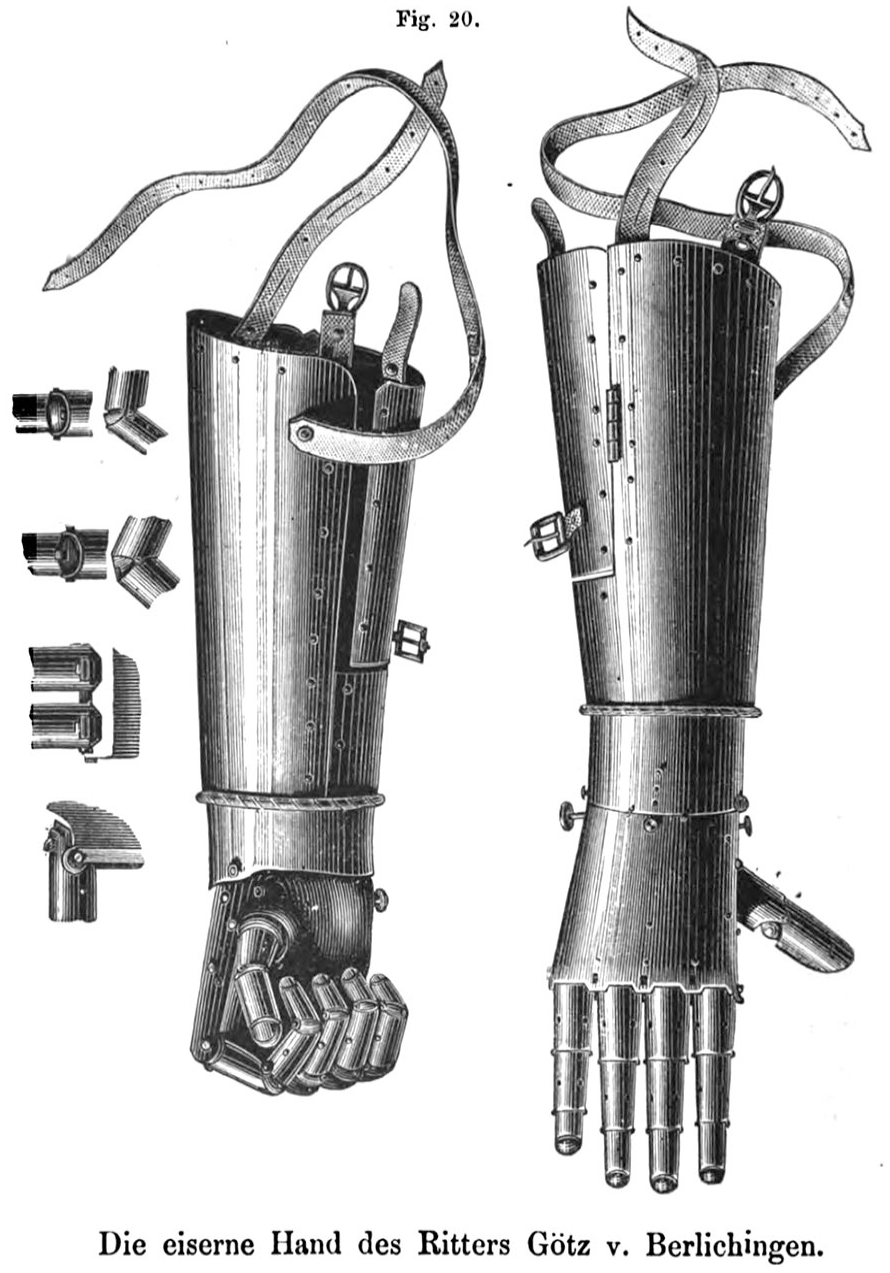
Ernst Kapp, Grundlinien einer Philosophie der Technik; zur Entstehungsgeschichte der Cultur aus neuen Gesichtspunkten (Braunschweig: G. Westermann, 1877), p.102.
This transition from organic to technical forms is what Kapp called organ projection. As historian Jeffrey Herf notes, Kapp was interested precisely in overcoming the “dualism that placed technology in the realm of mind and rationality as opposed to that of organic nature.” 18 It is above all his concept of the unconscious – one much closer to the philosopher Eduard von Hartmann than to Freud – that guarantees this presumed unity of technics and life, and which situates the process of organ projection beyond the control of the autonomous, rational human subject. 19 Kapp’s philosophy reversed the direction of agency from knowledge to action: by contending that organ projection proceeded organically and unconsciously from the human body, Kapp asserted “the absolute chronological and biological anteriority of the construction of machines to the knowledge of physics,” in the words of the French philosopher of science Georges Canguilhem. 20 This inversion of the relationship between knowledge and technical production also directly informed his method of explication in Elements of a Philosophy of Technology. Reversing the typical Kantian approach, Kapp begins by questioning the conditions of possibility of a given technical device in order to trace it back to its “organic” origin: the unconsciously teleological technica naturalis thus becomes the model for human technica intentionalis.
Following the idea that organ projection was responsible for every technological and mechanical device, from the camera obscura to the suspension bridge, Kapp proceeded to analyze the origin of the machinery of the state. Kapp’s state is the ultimate “organ projection”: in the “state body,” explains the good Hegelian, the “antithesis that persists in the individual artifacts, the antithesis of mechanism and organism [. . .] is sublated [aufgehoben].” 21 Understood as an organic whole, the state is based on the principle of the unity of the parts, which is proper to the human body. “Therefore,” he adds, “the state too is an evolving organism – it evolves, in other words, from the res interna of human nature and its total projection outward to become the res externa, the res publica.” 22 Extending this line of thought, Kapp then proceeds to announce the end of the classic dichotomy between nature and mechanical artifact: “the machine has given way to another product of human labor – namely, the state. Suddenly we see the machine mechanism and the state organism moving ‘hand in hand’ with the desire that science will disclose proof of their common origin.” 23
In summary, Kapp held the view that technology, nature, and political organization cannot be separated. Technology is a part of nature and shares the same basic principles with it – as he had already pointed out in his philosophy of geography. 24 Moreover, Kapp’s philosophy of technology shows that technical forms do not arise through an act of genius. Rather, they are based on natural forms and, as such, are inherent in all human beings.
Along with his theory of organ projection, Kapp’s typological notion of form would become decisive for subsequent theorists of organic and technological form. In describing the transition from simpler objects, such as the hammer, to more complex instruments like the axe, Kapp observed how the basic form transformed itself into various technical devices and artifacts. And he continued: “This basic form of the hammer [. . .] has been preserved unmodified in, among others, blacksmithing and mining hammers and is recognizable still in the giant industrial steam hammer.” 25 Hence, according to Kapp, there are basic organic forms or basic types that make technology possible. Of course, as Canguilhem noted, Kapp’s theory of organ projection “encounters notable obstacles in explaining inventions like fire or the wheel, which are so characteristic of human technique” – to say nothing of the state form itself. 26 Later theoreticians of nonhuman technology did not hesitate to jettison Kapp’s anthropomorphism. It was in early twentieth-century Germany that a genuinely posthuman conception of technology would take root: it is to this conception, called biotechnics, that we now turn.
The dialectical opposite of invention: Raoul Francé’s biotechnics
The Austro-Hungarian botanist, microbiologist, and writer Raoul Heinrich Francé (1874–1943) was the pioneer and prophet of interwar biotechnics in Germany. Born in Vienna and raised in Budapest, Francé studied natural sciences with a focus on marine microorganisms. After rejecting an academic career, he moved to Munich in 1902 and achieved prodigious success as a writer and science popularizer, not least through the Kosmos publication series that he cofounded with Wilhelm Bölsche in 1904. 27 Three years later he cofounded the German Micrological Society, and shortly thereafter became director of the state-subsidized Biological Institute in Munich, which he led until 1919. 28 Prior to, but specially after, the First World War, Francé’s writing was gravitating toward a homespun natural philosophy that preached the ‘organic’ values of harmony, integration, and equilibrium in nature and society alike. His books, bearing titles like The Love Lives of Plants and The Laws of Life, bear witness to that welter of monist, vitalist, holist, and organicist thought in the early twentieth century that has been collectively named “biocentrism.” 29 By reorienting humanist culture around a scientific understanding of Life, the biocentrists aimed to restore stability and values to a seemingly soulless and ‘mechanistic’ modern society. 30 In this respect it is not surprising that Francé’s writings comprised perhaps the single most important influence of the life sciences on the twentieth-century artistic avant-gardes. 31
In his books The Technical Achievements of Plants (1919) and Plants as Inventors (1920) Francé outlined the theory of what he called biotechnics (Biotechnik), a program for the deliberate imitation of nature’s own ‘technical forms’. 32 For Francé, all natural forms are technical to the degree that they fulfill a function; likewise, “no technical form exists which cannot be traced to the forms of nature.” 33 Long before human beings walked the earth, he suggests, plants had already anticipated human tools, machines, and architectures. In our own humble constructions, we unwittingly imitate the forms that plants unerringly engineered in ways at once more rational, sustainable, and aesthetically pleasing than our own. In Francé’s books, underwater algae are compared to torpedoes, the pollen of pine trees to hot air balloons, tree roots to plumbing pipes, and liverwort to a Taylorist factory. “The plant unfolds as a real industrial village if it is carefully studied,” the botanist exults. “There are elevators, coolers, condensers, stuffing-boxes, filter and hydraulic presses, electrolytical apparatuses, and evacuating pumps. The more of an expert you are, the more technical forms you will find.” 34
Rather than rejecting the perceived omnipotence of the ‘Machine’, as was so common to the cultural criticism of the time, Francé’s hallucinatory panorama of biotechnical inventions instead domesticates nature in the image of modern industry whose products he treats as “merely a special application of a general biological law, [. . .] the special case of a biotechnics.” 35 . In this way, he anticipates the ontological hybridity that characterizes much contemporary thinking about “natureculture” – to say nothing of disciplines like synthetic biology, genetic engineering, and earth system science. 36 By the same token, Francé’s tomes can be seen as precocious precursors to a kind of posthumanism, insisting as they do that humanity has fatally overestimated its own uniqueness, intelligence, and ingenuity. Just as he decenters the anthropocentric worldview, he simultaneously gives machines themselves a new lease on life, inhabiting the same ontological plane as living organisms.
The kernel of Francé’s theory of plant invention, with its ambivalent dialectic of anticipation and imitation, is based upon the very same theory of “organ projection” that Kapp outlined in 1877. It is of course somewhat ironic that Francé should have adopted the theory of organ projection, given the “radical anthropocentrism” inherent to its “theory of a unique model.” 37 If organ projection nonetheless serves Francé (in his words) “as a general explanatory principle of organ design [Organgestaltung],” that is because he makes the plant, and not the human body, his ideal mechanical system and mimetic reservoir of forms. 38 As such he can declare a sugar filter press to be the “projection” of a microscopic plant fiber, and manmade projectiles to be “unconscious imitations” of flagellate algae (Figure 2). 39 These unconscious imitations and projections unfold not according to the dictates of reason, but to those of life itself. In this they correspond precisely to that “vegetative principle of life” which Walter Benjamin called the “dialectical opposite of invention.” 40
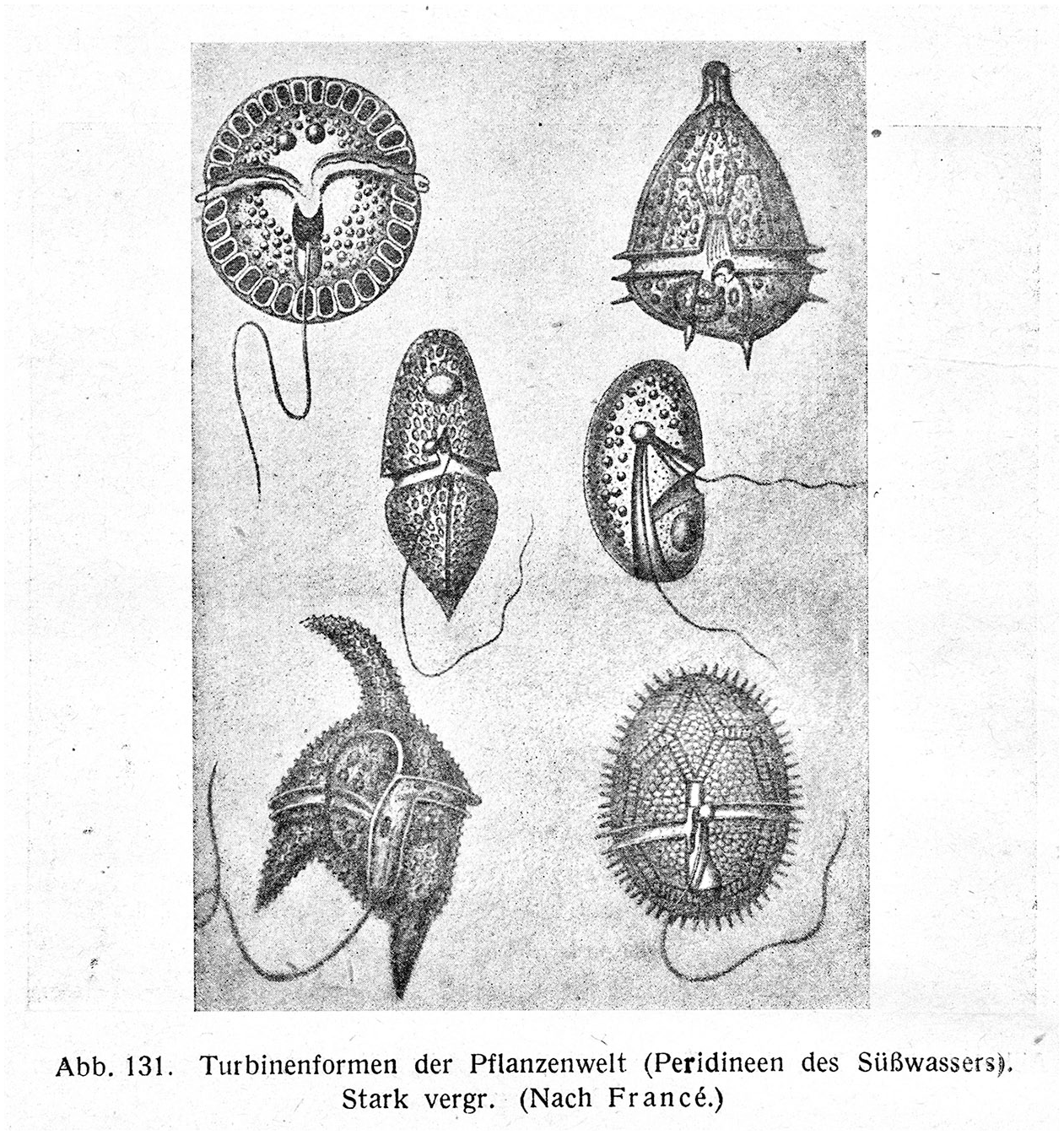
“Turbine forms of the plant world.” Raoul H. Francé, Die technischen Leistungen der Pflanze (Leipzig, Veit & Co., 1919), p.228.
Francé’s inheritance from Kapp is complex and contested, not least by himself. On the one hand, he criticized the concept of organ projection as a metaphysical legacy that hindered the serious technical investigation of organic forms. 41 In his 1921 work Bios, for instance, the botanist censures Kapp for “leading biotechnics down the dead end of the metaphysical concept of ‘organ projection.’” 42 On the other hand, Kapp’s schema of organ projection can be found reproduced numerous times in the very same volume: Francé describes stringed instruments, for instance, as “unconscious biotechnical copies of the ear” in which “the human spirit of invention has repeated the human body” – an example actually taken directly from Kapp’s 1877 text. 43 In his The Technical Achievements of Plants, Francé repeatedly champions the “law of organ projection . . . as a universal law [Universalgesetz].” 44
For Francé, following Kapp, technical forms are not so much “created” as “discovered.” 45 Although both thinkers took an unknown, unconscious instinct as the ultimate source of technical innovation, Francé’s biotechnical theories were nevertheless meant to make that instinctual process conscious, and so to accelerate the merger of human industry with the natural order. It was this motive that lent his writing its prophetic élan. Yet his books seldom studied nature in order to invent new technical forms; on the contrary, Francé’s first aim seems to have been to retroactively confirm that nature had preempted all preexisting human constructions. The prophecy was self-fulfilling: if plants invent in theory, in practice it is machines that dictate which technical forms in nature can be discerned at all. 46
Francé’s ostensibly “mechanistic” conception of the vegetal world works entirely in the service of a bona fide vitalism. In place of Darwin’s controversial theory, he appealed to Jean-Baptiste Lamarck’s idea of an “inner life force” that drives organisms to adapt their habits to the demands of their environment, changes that are then passed on to the next generation via the inheritance of acquired traits. It was in this sense that the plant was, in Francé’s eyes, already the ideal model of the inductive scientist-engineer.
This vitalistic outlook already permeates Francé’s first major success, the multivolume Life of Plants (Das Leben der Pflanze, 1906–13), which became known as the “Pflanzenbrehm” in homage to Alfred Brehm’s beloved Life of Animals (Thierleben). And just like its illustrious precursor, Francé’s Life of Plants was unabashedly anthropomorphic in its descriptions of the vegetal kingdom – a fact that likely contributed to its popular success. In 1912, the industrialist-cum-social philosopher Walther Rathenau exclaimed that “since years no recent book has so moved and fulfilled” him like Francé’s Life of Plants: Plants had gained life; and not just this: they gave themselves forms and laws, they adapted themselves, protected and defended themselves, wandered, fought with pursuers and competitors, forged alliances with friends and foes, invited guests and friends of the house, entered into business and trade relations. But even more: the whole organic world with its species and formations merged into a unity that, from external and internal laws, standardized [normierte] an exalted, all-powerful balance.
47
It was less the anthropomorphic characterization of the vegetal world that captured the imagination of Francé’s audience, than the biocentric image of that “all-powerful balance” that united nature and culture under its laws.
To many German readers in the immediate postwar period, Francé’s new science of biotechnics seemed to marshal the very forces of nature in the service of national regeneration. In the conclusion to The Technical Achievements of Plants, the botanist heralds “a new world of work, possibilities and knowledge” that awaits the brave souls who would seize it. “In an age full of deep destruction of pasts,” he exhorts, humanity now had to “use native [heimische] nature and the cosmic forces [Weltkräfte] in general quite differently than before, in the new construction of the culture of the twentieth century.” Biotechnics would be Francé’s contribution to “the great struggle for the ideals of being, precisely in the great years of the renewal of our people.” 48 But as more than one critic complained, Francé also believed that one could impose the norms of technical design directly onto society itself. 49 In one sense, the real impact of biotechnics was less practical than ideological, answering to a desire for a natural order that, today, seems far more fragile and contingent than anyone could have imagined at the time.
Vitalized technics
Francé’s call for industry and architecture to imitate algae and vegetables was simultaneously a plea for the reshaping of society itself: for generating a new, harmonious, and balanced sense of community with its roots in nature. Yet his plan to heal a fractured society by reorganizing it in nature’s image was equally as authoritarian as it was utopian. In 1924, the völkisch philosopher Paul Krannhals published an homage to Francé in which he extolled his gospel of hierarchy, harmony, and rootedness in the soil of the homeland [Heimat] as the best weapons against the influx of “foreign ideas” he believed were threatening Germany. 50 In 1932, five years after he had joined the NSDAP (Nationalsozialistische Deutsche Arbeiterpartei), Krannhals published a book on The Universal Meaning of Technics in which he again extolled Francé’s biotechnical theories. When natural models are applied to human constructions, “even without conscious intention,” the resulting products give expression to a “universal lawfulness [Weltgesetzlichkeit]” that embraces both nature and culture. 51 Krannhals’s view of technics as a force or instinct preformed within organic life goes back ultimately to Kapp’s conception of technics as unconscious projection. 52 While such a perspective would reasonably appear to denigrate their conscious activities of human technicians and inventors, certain German engineers nevertheless enthusiastically took it up. In 1931, the Dresden engineering professor Enno Heidebroek described technology as the unconscious expression of an inhuman “creative power” (Gestaltungskraft), a “natural force” (Naturkraft) that simply “uses the creative organ of the human brain for its development [. . .] as a servomotor, as it uses other auxiliaries in other branches of organic life.” 53
The deterministic strain in Francé’s own thought seems at times less posthuman than antihuman. The literary scholar Gerd Mattenklott recognized this tendency in Plants as Inventors, referring to the ferocity of its “passionate subordination” and “masochistic participation in dominating violence.” 54 And it is notable how absent human beings and their uses of technics are from these considerations: instead humanity becomes, if anything, a mere vessel for what Francé names the “dark instinct [Trieb] for inventing” that supposedly inhabits all forms of life. 55 “It is not the plant, nor ‘we’ who invent, but rather the law of technical forms is consummated in the icy dark night of necessity.” 56
We, ourselves, did not invent the screw, the gimlet, and the propeller; nor did the bacteria, the scourging infusoria, or the plants; nor yet the wind which moves most rapidly in spiral windings. The natural law – deeply embedded in the structure of the world – stands behind all these occurrences: spiral movement occurs with less expenditure of energy than movement in a straight line.
57
If humans and plants constructed and designed in the same way, it was only because both were ruled over equally by Necessity – as Francé calls it, “the true god.” 58 As a result, human labor and agency appear as though transmuted into a single, dark Darwinian law that no longer represents the precondition for action, but rather its cause.
Francé’s unique strain of technovitalism demonstrates vividly how the rationalization of nature goes hand in hand with the vitalization of technics. In a 1946 lecture, Georges Canguilhem delivered a lucid account of this problem: “By considering technics to be a universal biological phenomenon and no longer only an intellectual operation of man,” he explained, one is led, first, to affirm the creative autonomy of arts and crafts [arts et métiers] from any knowledge capable of appropriating them so as to apply itself to them. [. . .] Second, in consequence, one is led to inscribe the mechanical within the organic.
59
Francé’s biotechnics fulfills both of these conditions, investing technics with an inner life force that is outside of reason, at the same time as it casts plants as rationally optimized machines. Surprisingly, Canguilhem’s insight that “every technique essentially and positively includes a vital originality irreducible to rationalization” draws directly on the biocentric thought of Weimar Germany: his reference is none other than Krannhals’s Universal Meaning of Technics, the same book in which the Nazi philosopher declared technics an unconscious instinct, with Francé as his supporting witness. 60
Francé’s sinister yet mystical vitalization of technology could be described as a quietistic counterpart to the fascist technophilia of his contemporary Ernst Jünger, the bard of modern militarism who gleefully describes soldiers as swarms of bees and explosions as storms, and who pined to unite human industry with the telluric forces of the earth. Perhaps the consummate conservative modernist, Jünger cultivated an “amoral aestheticism of technological form” that bespoke a fundamental pessimism about human life. 61 His protofascist technovitalism reveled in the destructive potentials of a technology run amok (“the machines are not only directed against nature,” he swoons, “but against us as well”). 62 At first glance, Francé’s writing with its idealization of harmony and order stands at odds with Jünger’s orgiastic celebration of androcentric mechanized aggression; yet they shared a common vision of the human as an abject and deracinated creature made increasingly obsolete both by the powers unleashed by his (it was an emphatically male subject) own creations. If traditional humanism had represented reason, freedom, and mastery over nature, Francé’s biocentric outlook instead privileged blind instinct, biological determinism, and absolute subjection to the greater good.
For Francé, biotechnics was integral to a larger social and political agenda, one which diverges in key ways from his predecessor and model Ernst Kapp. As we have seen, Kapp’s philosophy of technics had culminated with the state, which the philosopher calls the “totality of individuals in a social-organic unity.” 63 For Francé the state was a genuinely “biotechnical product.” 64 His vision of the “truly organic life” resembled nothing so much as the mechanization and rationalization of labor that characterized the radical productivism of planned economies in the twentieth century. The plant, he wrote, represents the “ideal embodiment of Taylorism without its downsides” – and by extension, the ideal model for mercantile, technical, as well as political planning and organization. 65 Vegetal technics demonstrated how the efficiency characteristic of “practical business operations” could become “‘biologized,’ that is, transformed into an organism for which the laws of the organic are also valid.” 66 Thus, “in an ideal manner, every increased output of the individual operation in the plant benefits the whole – that is, the state.” 67 Through its energy-efficiency and equitable division of labor, the vegetable seems to practice a kind of organic Taylorism, a relentless optimization, that Francé presents as the model for a harmonious future society. 68
The organization of nature was thus also a question of politics. As a young man Francé had been inclined toward a Kropotkinian anarchist philosophy of mutual aid, which hardly excluded a belief in natural hierarchies. In his prewar writings on the forest ecosystem, he painted an “idealized portrait of the sylvan community,” which corresponded, in Jeffrey Wilson’s words, “with a radical nationalist vision of society, where the subterranean proletariat, meek bourgeoisie, feckless aristocrats, and social parasites would be dominated by an ‘oligarchy’ of heroes (Nietzschean or otherwise).” 69 This socially conservative perspective on forest ecology foreshadows the biologist’s turn after 1919 to völkisch nationalism, which he shared with his admirers on the far right, like Krannhals and Hanns Fischer. 70 He eventually joined the Nazis in 1935. The reasons for his doing so remain ambiguous, and some have argued they had more to do with career opportunism than with any specifically anti-Semitic sentiment (which is indeed absent from his published writings). 71 From this perspective, it seems hardly inevitable that Francé, who at the height of his popularity was read widely on the left and the right, should have aligned himself with National Socialism. Even so, it did not require great feats of adaptation to make his vision of a harmonious, biologically governed society congruent with key aspects of Nazi ideology.
Francé’s writings from the 1920s vividly illustrate how fluid the divisions already were then between ecological neo-Romanticism on the one hand, and totalitarian biopolitics on the other. In Bios, for instance, the botanist names not plants but insect societies as the closest approximation of the “optimum of the life of the state,” in which “the state does not tolerate any intruder foreign to the race” and where “racial hygiene and the preservation of the racial purity are preconditions [for the creation of the state] which are strictly observed.” 72 In a work of speculative science fiction from 1927 entitled Phoebus: A Look Back at Prosperous Germany in 1980, he depicted a utopian Central Europe where overpopulation and pollution had given way to garden cities and wildlife reserves. Unlike America, which had declined due to “racial mixture,” Germany circa 1980 is described as a genuine eugenic paradise in which the “plasmatic qualities” of each citizen determined his or her integration into a certain class (a selection process that Francé mystifyingly calls “meritocracy”). 73 General suffrage had been overthrown along with the “ancient mistake of the ‘equality of humanity,’” and society had been reordered into an “organic” framework of castes and guilds that recall the social order of the Middle Ages. Any defects in this natural order are resolved by the “eradication of life unworthy of living [Ausmerzung des lebensunwerten Lebens].” 74
Biotechnics was the means by which this organic state would be realized. In Phoebus, Francé narrates how the “victory of biotechnics,” founded on “the so-called production in the cold way [auf kaltem Wege] in the manner of plants,” led to the disappearance of traditional factories and to a more rational distribution of industrial energy that catapulted Germany’s economic strength “ahead of all other nations.” 75 Such nationalistic fantasies make it easier to understand how, in 1939, the engineer Alf Giessler could repackage Francé’s biotechnics as Nazi science. 76
Biotechnical research under Nazism: Alf Giessler
In the 1930s, a number of National Socialist thinkers and technicians radicalized the ‘irrational’ origin of technology as a kind of biological instinct exclusive to the Aryan race. They thus proposed a holistic relationship between race and nature: the ‘Aryan’ alone was able to master this relationship by producing technical artifacts based on the structures of nature. One of the most important proponents of this doctrine was Alfred Giessler, born in 1903 in Halle an der Saale. Details about his biography are sparse, and the exact year of his death is unknown. 77 He studied natural sciences at the Martin Luther University of Halle, where he completed his PhD in hydrology in 1927. 78 Following an assistantship at the Engineering Bureau for Hydrogeology in Braunschweig from 1931–4, Giessler worked independently for five years. It was during this time that he penned his popular reflections on the role and origin of technics, culminating in his 1939 publication, simply titled Biotechnics: An Introduction.
In his characterization of biotechnics, Giessler adopted the same perspective as Francé and others biotechnicians: the scientist encounters optimal and optimized forms, as it were, “readymade” in nature. These, he argued, were the result of lengthy evolutionary processes. Accordingly, human technology must reorient itself and explore nature to find optimal solutions to existing problems. To explain his methodology, Giessler also offered the example of the human hand as a perfect tool “given to us by nature.” Inspired by Aristotle and Kapp, Giessler showed how the shape of the hand was an imprint of its function. The process of an organ’s technical functioning results in optimal, that is, functionally optimized, forms. 79 Nature, according to Giessler, has thus given humankind tools “that can usually perform at least one to several functions of the human hand or of the technical hand tools that have evolved from it.” 80 By merging with nature, human technologies could be adapted to solving ever-increasing new functional problems (Figures 3 and 4).
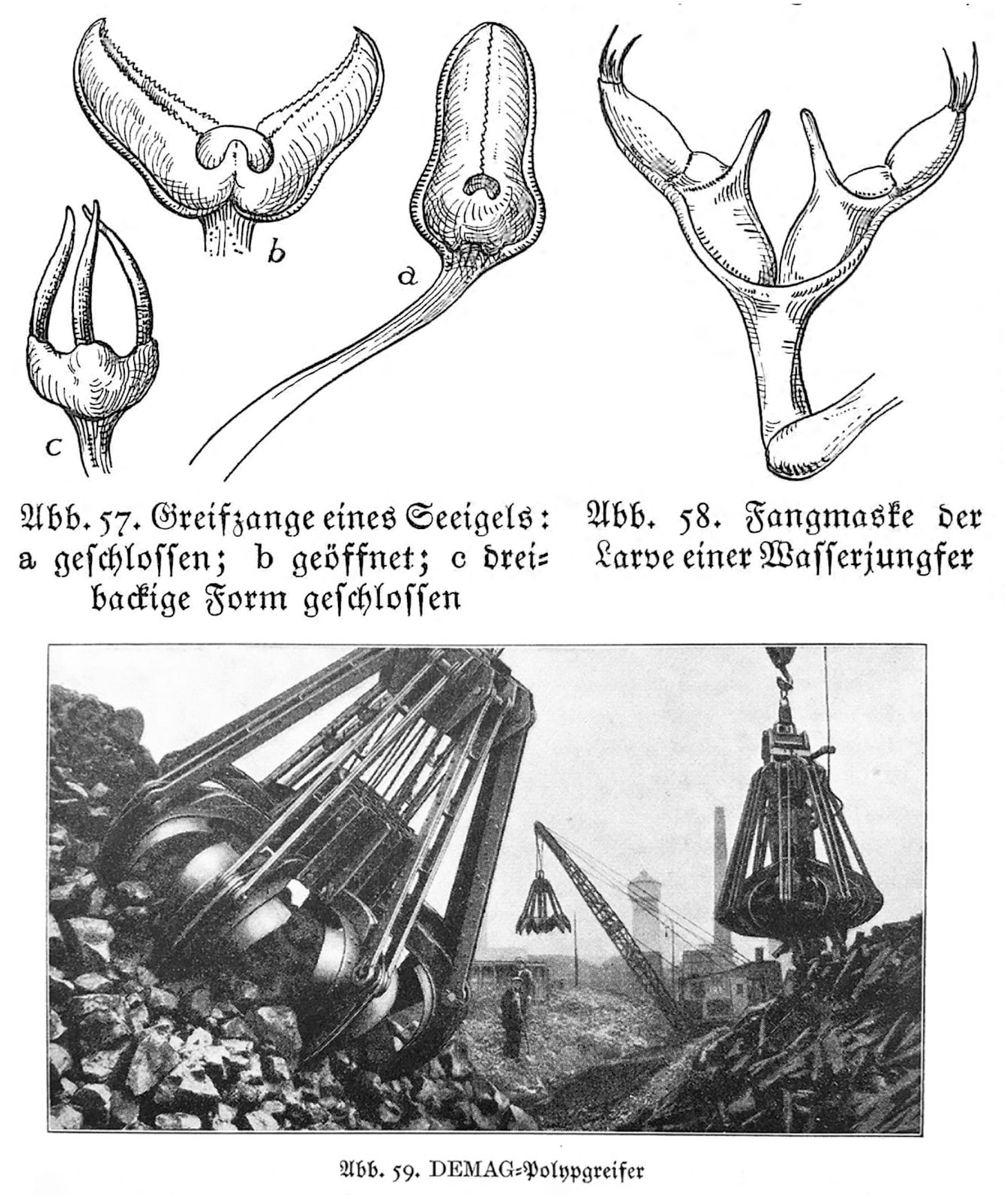
Alf Giessler, Biotechnik. Eine Einführung (Leipzig: Quelle & Meyer, 1939), p.74. The gripping pincers of a sea urchin (upper left) and the mandible of a damselfly larva (upper right) are presented as prototypes of the ‘polyp grappler’ produced by the Deutsche Maschinenbau-Aktiengesellschaft (Figure 4).
Echoing Krannhals, Giessler emphasized that human-made technology was merely “a translation and continuation [of] nature-conditioned [technology], which at the same time signifies the prerequisite and foundation of all life.” 81 And just as Francé exhorted engineers to study botany, Giessler therefore stated that “technology must consciously become biotechnics, and the technician has to go through the school of nature.” 82 Reckoning with the priorities of the new wartime economy in 1939, Giessler pronounced the urgent task facing engineers in the Nazi state: “to re-establish the synthesis between nature and technology, to consciously orient German technology in a biological sense, i.e., to put it on a biotechnological basis.” 83
An NSDAP member since 1933, Giessler based his conception of biotechnics not only on the synthetic unity of nature and technology, but also on fascist theories that saw a deep continuity between nature, technology, culture, and race. For example, he wrote that “technical work must be in the service of higher human development and elevate the cultural nation,” adding further: “Technology is the formative tool of culture [. . .] it is thus one of the salient features of the cultural achievement of a race.” 84 Thus he argued that the entire history of culture could be rewritten through the relationship between the concept of race and technology. Indeed, Giessler noted that “of the three major, historically tangible racial and ethnic groups of Mongols, Semites, and Indo-Europeans or Aryans [. . .] only one group [has] emerged in the course of world history as technical pioneers and cultural creators” (he meant the Aryans, naturally). 85 For Giessler, it is only the “close-to-nature Nordic man” who is capable of grasping nature’s “technical principle” through his instinct and “intuitive gaze.” 86 Only he could realize the true potential of biotechnics, because only he was able to understand the technical problems of nature, to use them, and finally to build a culture on them.
Giessler’s book and his idea of a strong synthesis between nature and technology on a political and anthropological basis were very well-received by the National Socialist establishment. The Nationalsozialistische Monatshefte, one of the main political and cultural journals of the Nazi Party, positively reviewed the book, which was also included in the NS bibliography. 87 The review’s author glorified Giessler’s attempt to bring together and synthetize the biological with the technical, in effect guiding and optimizing organic development by means of technology. In addition, Giessler’s book itself included a preface by Joachim Albrecht Leo Eggeling (1884–1945), Nazi Gauleiter of Halle-Merseburg and High President of the Province of Halle-Merseburg. In a page full of National Socialist idioms, Eggeling provided an ideological justification for biotechnics as a key means for achieving the necessary synthesis between the divided fields of scientific and technical research. This would have led to a new educational foundation in which the abilities of Nordic man, nature, technology, and society would eventually merge. Eggeling also commissioned Giessler to establish the first German research center for biotechnics, which evidently did not fulfill its promises to maximize material efficiency and resource self-sufficiency in wartime, and led a very short existence. 88
Conclusion
In this paper, we have explored the concept of biotechnics in early twentieth-century German-speaking philosophy, biology, and engineering, and considered how it challenged the traditional binary of organicism and mechanism. We showed how biotechnics underwent a significant shift from a progressive politics of biotechnical form to a reactionary and fascist-adjacent one. In fact, Kapp’s liberal political framework gradually declined until it was completely overturned with the establishment of biotechnics by the botanist Raoul Heinrich Francé and its incorporation into National Socialist ideology. One of the clearest lessons of the history of nonhuman technology we have sketched out above is the political ambivalence of technocratic images of nature. “Technology,” Walter Benjamin wrote in the wake of the First World War, “is the mastery of not nature but of the relation between nature and man.” 89 The destructive potentials of the war had proved that this relation was anything but harmonious, yet Benjamin also recognized in the mass mobilization of European society “an attempt at new and unprecedented commingling with the cosmic powers.” 90 Technology itself had become one such power.
Biotechnik was the privileged expression of this existential ambivalence, which confounds easy oppositions between reactionary politics and technological rationalization. In his influential and controversial account of Weimar German conservative philosophies of technology, Jeffrey Herf exposes the ideological threads linking authors like Ernst Jünger and Hans Freyer to the engineers who would embrace Nazism and lend the party their skilled support. Yet the assumption that “reactionary modernism” is somehow a contradiction in terms fundamentally misapprehends the very lability of Nazi ideology, which did not maintain consistent positions on either (nonhuman) nature or technology. There is no basis for assuming, as Herf does, that technophilia is per se rational and liberal, or somehow incompatible with backward-looking “nature romanticism.” 91 The genealogy of nonhuman technology reveals that these were never alternatives to one another, and that technology was never a politically neutral category.
There is, of course, a politically progressive tradition of theorizing the relationship of biology and technology, which connects Kapp’s thinking with that of his contemporary, and fellow left Hegelian, Karl Marx. Just as Kapp’s concept of organ projection derives from Hegel’s idea of the realization of spirit as self-externalization, Marx likewise articulated the origins of tools, and eventually even machines, as extensions of the human body. For Marx, “primitive tools and machines are copies of human bodily organs,” and even as more advanced tools “de-organize themselves” and take on new nonmimetic forms, they still “remain bodily organs of man, “ which” even if artificial, [are] as necessary to civilized life as hand and arm are to primitive life.” 92 However, in stark contrast with Francé’s and Giessler’s adaptations of biotechnics, Marx insisted upon the role of labor as a transformative force that dialectically shapes humankind, technology, and nature alike. 93
Indeed, if Kapp’s theory of organ projection hypostasized the human body as the origin of technical forms, Francé’s account of nonhuman technology by contrast resembles a sort of negative anthropology, with its relentless denial of social relations and conflicts. Though it may have escaped many of his left-leaning modernist readers, his books on biotechnics open an unsettling space between vanguard ecological posthumanism and a rearguard totalitarian antihumanism. Like the interwar “cult of technics” that he had helped foment, Francé reduced “real progress to the progress of technics, and the rational constitution of society to the rationality of machine production. By excluding the relations of production, [the] forces [of technics] were ontologized.” 94 And just as the omission of human social dynamics from Francé’s analysis helped naturalize technics as an autonomous, vital force, this same ontologized force permitted him to elevate technics to an ostensibly “natural” model for social and political organization.
Today, when the differences between nature and technology seem to become increasingly and irrevocably blurred, this political history of biotechnics requires closer attention. Already in his geographical writings, Kapp made human history an integral part of natural history, one which culminates in the history of technology. Some philosophers of science today, departing from the growing awareness of the planetary condition of climate change and the (so-called) Anthropocene, have espoused the suspension of any distinctions between nature and culture: most prominently among them the late Bruno Latour, who postulated a “postnatural” condition in which technics and organic nature are equal actors in agential networks. 95 Yet as philosopher Fréderic Neyrat warns, the idea of post-nature is “most certainly not post-technological”; on the contrary “the end of the division between nature/culture was effectuated for the benefit of culture, technologies, and human colonization.” 96 In light of present-day geoengineering projects and other large-scale technological interventions into atmospheres and ecosystems, Neyrat contends, “showing that everything is connected is the best way for affirming the idea that the entirety of nature has been anthropized.” 97 Of course, not as Kapp imagined it, as a harmony of geography and politics, but rather as the ruthless domestication of nonhuman nature into commodifiable resources serving purely human ends. 98 In other words, the contemporary postnatural worldview reinforces, and indeed ‘naturalizes’ the logic of contemporary of capitalism. Although for different reasons today, to place technology and nature on the same ontological plane appears as dangerous as it did one century ago.
Hence at the same time as “nature” itself appears to be running out of control, upending the once-imagined stable order of climate and geology, so too is technology imagined to be escaping human control. Not only supported by several scientists, this externalist conception of technology’s supposedly overwhelming autonomy and power over its human makers has demonstrated its continuing popularity in international bestsellers such as Yuval Harari’s Homo Deus: A Brief History of Tomorrow (2016). 99 This ‘new’ technovitalism has deep links with the old technovitalism elucidated here. 100 The history of biotechnics exposes how our incipient postnatural condition had already been formulated in 1877, 1919, and 1938 – enmeshed at each point in politically charged visions of the future, even as it was designed to naturalize, and so to depoliticize, the form of social relations.
Footnotes
Acknowledgements
We would like to thank the two anonymous referees for their insightful and constructive feedback.
Conflict of interest
The authors declared no potential conflicts of interest with respect to the research, authorship, and/or publication of this article.
Funding
The authors disclosed receipt of the following financial support for the research, authorship, and/or publication of this article: Marco Tamborini coauthored this article as part of the DFG project “Hybride Systeme, Bionik und die Zirkulation von morphologischem Wissen in der zweiten Hälfte des 20. und im frühen 21. Jahrhundert” (DFG project number 491776489).
