



Abstract
While interest in early modern herbaria has so far mainly concentrated on the dried plants stored in them, this paper addresses another of their qualities – their role as manuscripts. In the 1670s, the German botanist Paul Hermann (1646–95) spent several years in Ceylon (today Sri Lanka) as a medical officer in the service of the Dutch East India Company. During his stay he put together four herbaria, two of which contain a wealth of handwritten notes by himself and several later owners. First, it will be shown that these notes provide information on the linguistic skills and interests of those who collected plants in an overseas trading settlement. Hermann’s botanical practice demanded and, at the same time, generated knowledge of Sinhalese (an Indo-Aryan language that is spoken by the largest ethnic group on the island) and its script. In his herbarium, observations on the semantics, morphology, and pronunciation of Sinhalese are inextricably intertwined with those of botanical nature. Second, on the basis of these voluminous notes, the character of early modern herbaria as manuscripts will be highlighted. And third, Hermann’s herbaria will be integrated into an investigation of scribal practices and publication strategies of eighteenth-century botany. Along with field notes, letters, manuscripts, illustrations, and printed books, herbaria were knots in the textual–visual mesh of early modern botany.
Introduction
Herbaria were, and still are, one of the central repositories for botanical practice. While present-day botanists primarily focus on whether historical herbaria contain type specimens, for early modern botanists they were indispensable tools of their daily scholarly work. Many of them possessed herbaria, as evidenced by the correspondence that accompanied the international exchange of plants and seeds. 1 Some of them developed specific methods for their use, such as, notably, the Swedish botanist Carolus Linnaeus (1707–78), who devised a technique of successively comparing plants as well as specimens from herbaria in order to create his “natural characters.” In one of the few existing studies on the role of herbaria in the taxonomic practice of early modern botany, Staffan Müller-Wille shows how Linnaeus went about this. 2 With some studies dedicated to the history of individual herbaria and, further afield, to the ethics and aesthetics of using them, interest so far has mainly concentrated on the dried plants contained in them. 3
In recent years, ethnobotanists have developed new perspectives on historical herbaria, although their main interest in the use of local plants by Indigenous communities is focused on the present. How many of the plants in a herbarium identified as plants of economic relevance can still be found in a region today? How many of them are still used there for the same purpose? And are the Indigenous names listed in historical herbaria still in use? 4 Tinde van Andel and her collaborators have looked at these questions in relation to several herbaria, including one out of a total of four that were put together by the German botanist Paul Hermann (1646–95) during his stay in Ceylon (today Sri Lanka) in the 1670s. 5 Two other Hermann herbaria will be the focus of attention here, but from a different perspective.
The origins of ethnobotany go back to the observations made by early modern missionaries, merchants, traveling scholars, botanists, and others on their journeys, whether in the context of expeditions financed and organized by the state, on private, individual journeys, or on travels in the service of trading companies such as the Dutch East India Company (VOC), the British East India Company (EIC), and others. 6 With Paul Hermann, the emphasis here will be on a member of the third group, whose presence in Asia was based on the global infrastructure of a trading company, in this case the VOC. 7 They traveled on the VOC’s ships, lived in its settlements, and were employed as merchants, preachers, medical doctors, or administrative staff. During their long periods of service abroad, some of them not only collected plants but also amassed ethnobotanical and linguistic information about their uses and names. This often went far beyond what they were expected to provide to their employers in order to facilitate the exploitation of biological resources in the context of a competitive plant capitalism. 8 Their herbaria document comprehensive ethnobotanical and linguistic investigations, as well as the language skills required for both. Here these herbaria will be investigated as a medium that was used to register, organize, and update this information for use in later publications.
To do so, I draw inspiration from recent approaches developed by historians of technology that conceptualize historical objects as remnants of the practices, gestures, and skills required to produce and use them. This framework allows for the use of an object’s material properties as sources for an inquiry into the social, cultural, economic, artisanal, or scholarly practices of which the object had originally been a part. Gianenrico Bernasconi developed this approach into what he called an archaeology of practices (archéologie des pratiques) and investigated, among other objects, a watch with a second hand from the late eighteenth century to gain insights into its original use. 9 I will apply some of these tools to two of Hermann’s herbaria that were annotated further by several botanists throughout the first half of the eighteenth century. 10
First, this article will show that herbaria and the handwritten notes they contain provide a wealth of information on the linguistic skills and interests of those who collected plants and information about their uses in an overseas trading settlement (in this case Sri Lanka). Hermann’s botanical practice demanded and, at the same time, generated knowledge of Sinhalese (an Indo-Aryan language that is spoken by the largest ethnic group on the island) and its script. His handwritten notes not only reveal his basic understanding of this language but also a philological interest going beyond the purely utilitarian. His herbarium documents a wealth of information on the semantics, morphology, and pronunciation of Sinhalese that is intertwined with his botanical observations. Second, on the basis of the voluminous notes in the two herbaria, the character of early modern herbaria as manuscripts will be emphasized. This is an essential quality that has so far been largely overshadowed by interest in the dried plants they contain. And third, Hermann’s herbaria will be integrated into an investigation of scribal practices and publication methods of eighteenth-century botany. 11 Along with field notes, letters, manuscripts, illustrations, and printed books, herbaria were knots in the textual–visual mesh of early modern botany.
Foreign language skills, multilingualism, and field linguistics in the herbarium
Paul Hermann was born in Halle an der Saale (Saxony-Anhalt) in 1646. He studied medicine in Leipzig and Padua, where he gained a degree in 1670. 12 In 1671, he continued his studies in Leiden, attending the botany lectures given there by Arnold Syen, director of the Botanical Gardens. Via Syen, Hermann made the acquaintance of Hieronymus van Beverningh (or Beverningk), a Dutch diplomat and plant lover, through whose good offices he was employed as a doctor in Ceylon (today Sri Lanka) by the VOC. 13 From 1672 to 1680, Hermann headed the Dutch hospital in Colombo. When Syen died in 1678, Hermann was appointed his successor and returned to Leiden in 1680. Hermann died in 1695 at the age of forty-eight. At this point, his Ceylon material had not yet been published. 14
We know of four herbaria that Hermann created during his stay in Sri Lanka: the largest comprises five volumes – four with dried plants, and one with drawings – that is today held by the Natural History Museum in London (hereafter London Herbarium, LH). For a long time its whereabouts were a mystery until, by chance, it fell into Linnaeus’s hands. He identified it as Hermann’s personal herbarium and published his Flora Zeylanica (1747) based on it. 15 The second – a single volume containing only dried plants and no illustrations – is today held by the library of the Institut de France in Paris (hereafter Paris Herbarium, PH). It had been in the possession of the Dutch botanist Johannes Burman (1706–79) and provided the basis of his Thesaurus Zeylanicus (1737). 16 A third herbarium, in two volumes, is held by the Naturalis Biodiversity Center in Leiden (Netherlands). 17 Hermann had given it as a present to Hieronymus Beverningh, who had facilitated his stay in Ceylon. A fourth herbarium was in the papers left by the Breyne family of botanists from Danzig and is today held by the Forschunghsbibliothek Gotha (Thuringia). 18
Not all early modern herbaria were annotated. Some have only sparse comments, while others – including the two that will occupy center stage here – were densely annotated. What is immediately obvious on leafing through the Paris Herbarium is how many handwritten notes there are per folio. 19 Hermann placed his notes in close proximity to the affixed plants, either right next to or directly below them. It is also obvious that some folios contain notes written in up to three different hands. I shall turn first to the successive layers of this cross-generational, multilingual annotation process and to the authors involved.
Hermann’s meticulous, formal handwriting stands out from the annotations that were made by the later owners of his herbaria. 20 His notes, largely in Latin, contain information about the name of the plant and, where known, references to its use, in particular as fodder, food, a poison, or as a pigment for dyeing textiles. In some cases, there are also references to authors who had already described a particular plant before him. If one looks at the large, handwritten text block on the right lower half of folio 5 of the Paris Herbarium, lines four to seven are in Hermann’s handwriting, framed above and below by Latin notes in a second hand, which will be discussed in the section “The herbarium as a record of botanical writing and reading practices.” Hermann’s entry consists of a long, descriptive name for the affixed plant, “Balsamina seu Noli me tangere Zeylanicum flore rubente fructu hirudinis facie,” followed by Kudalukola, the Sinhalese name of the plant, noted in a Latin transcription as well as in the Sinhalese script. 21 Numerous examples of this sort can be found on other folios of this herbarium. 22 Sometimes, Hermann also noted the pronunciation of the Sinhalese name, for example, in the entry on a plant which he calls the Ceylonese Ratabala (Ratabala Ceylonensium): “Ratabala is pronounced . . . Ratámbala.” 23 This is followed by a brief explanation of the morphology and meaning of the name: “Ratabala . . . means red bala.” 24 Similar information is also found in Hermann’s London Herbarium, where for almost every plant its Sinhalese name is noted. Even more frequently than in his Paris Herbarium, Hermann’s entries in the London Herbarium contain a commentary on the morphology and semantics of the names. For one plant, for example, he explains that its name derives from the fact that its flower resembles an elephant’s trunk; 25 the name of another plant is traced back to a local insect. 26 Hermann clearly had a basic knowledge of the Sinhalese language. 27
How did he acquire it? Plant names in various Asian as well as South and Central American languages are found in a number of botanical publications from the seventeenth and eighteenth centuries. The most spectacular is the Hortus Malabaricus (Amsterdam, 1678–93), an illustrated work in twelve volumes on the flora of the west Indian coast along the Western Ghats, compiled by local scholars, commissioned by the governor of Dutch Malabar, Hendrik Adriaan van Rheede (also Reede) tot Drakenstein (1636–91). 28 The illustrations in the Hortus Malabaricus are labeled with the names of the plants in up to four languages in the relevant scripts – in Malayalam, Konkani, “Arabic,” and Latin. 29 People who were knowledgeable about local plants had written down their names and detailed information about their mostly medicinal use in their own mother tongues. These were subsequently translated into Portuguese and, finally, into Latin. 30
While the multilingualism of the Hortus Malabaricus did not result from the Dutchman Rheede’s mastery of South Indian languages, the Dutch missionary and travel writer Philips Balde (also Baelde or Baldaeus; 1632–71), by contrast, is known to have prepared himself in Leiden for a mission to South-East Asia by learning Malay. As this language was spoken in the regions of South-East Asia where the spices traded by the VOC originated, its employees had compiled linguistic information over time that Balde may have used. 31 Unexpectedly, however, Balde was sent not to South-East Asia, but to Ceylon, where he found himself having to learn other languages. His description, Wahrhaftige ausführliche Beschreibung der berühmten ost-indischen Kusten Malabar und Coromandel, als auch der Insel Zeylon (Truthful, Detailed Description of the Famous East Indian Coasts of Malabar and Coromandel As Well As of the Island Ceylon; published first in Dutch then in German, 1672), contains an extensive chapter on language. 32 In it, Balde outlined the grammar and script of the Tamil language and reported how he communicated on the spot and learned the language. 33 For his missionary activity, Balde first worked with an interpreter whose mother tongue was Tamil, and with whom he communicated in Portuguese. 34 At the same time, he started learning the Tamil script along with the local children. 35 The records of the Swedish botanist Daniel Rolander (1723/1725–93), who traveled in Suriname between 1755 and 1756 and collected plants there, suggest that within a few months he had learned the basics of Sranan Tongo, a local creole language. On his collecting expeditions, he was able to make himself understood, to ask for plant names and write them down, and inquire how the locals used them. 36
However Hermann acquired the language – studying handwritten vocabulary lists and grammars put together by Portuguese and Dutch missionaries for their own purposes is another possibility – the entries in his herbaria document that during his stay in Ceylon he was able to understand the Sinhalese language and use the Sinhalese script at an elementary level. 37 Some of the plants listed in the Leiden Herbarium, many plants in the Paris and Gotha herbaria, and practically all of those in the London Herbarium are accompanied by his entries with names in Sinhalese script. As both the shade of the ink and the thickness of the pen strokes are identical in all of his entries, it can be assumed that it was not a secretary or assistant who wrote them, but Hermann himself. These notes in Hermann’s herbaria indicate that while gathering information about local languages was not his main aim, it was an important and integral part of his botanical and medical activities in Ceylon. He and other botanists in comparable situations practiced what, in a different context, Romain Bertrand called “on-the-spot-philology.” 38 Hermann’s basic knowledge of the language allowed him to collect information about the use of plants, to record local plant names in Sinhalese script, and to transliterate them and translate the parts of which these names were composed into Latin, which required a basic understanding of morphology. He also recorded emphasis and pronunciation. In addition, he put together a list of the Sinhalese alphabet (Alphabetum Cingalensium) and compiled a small book of vocabulary (Vocabularium Selanense seu Insulae Ceylon in India Orientali).
After his return to Leiden, Hermann sent the handwritten alphabet and vocabulary book to Thomas Hyde (1636–1703), Professor of Oriental Languages at the University of Oxford. Hyde, an eminent authority on Arabic, Persian, and Hebrew, had also translated the Bible into Malay, compiled a Malay–English dictionary, and collected information on other languages. 39 He regarded the botanist Hermann as an especially reliable informant on the Sinhalese language because of his knowledge of the script. 40 Hermann’s botanical-philological explorations thus produced not only information about the plants of Ceylon and their uses, but also material for a philology of South Asian languages, which had been used and put into a provisional order by a botanist on the spot before it reached specialists in European learned institutions. The herbarium thus fulfilled a previously unnoticed function: it was the place where botanical and philological information – not yet separated, so ultimately it was botanical-philological information – was noted and stored for the preparation of, and use in, later publications. 41
In addition to Sinhalese plant names, Portuguese names frequently appear in Hermann’s entries. On the Ratabala, which has already been mentioned above, we read, for example: “the Portuguese describe its fruits, which are about the size of a cherry, as Pavoninos, because peacocks (in Portuguese: pavão) fed on it.” 42 To record information about the flora of Ceylon, therefore, Hermann not only had to learn Sinhalese, but also needed a grasp of Portuguese, which had spread in the region earlier. At the time of Dutch dominance, it was still used as the medium of communication between the Dutch – administrators, VOC factors, missionaries, and scholars – and the local population. 43 Botanical practice in the region was multilingual and required a knowledge not only of South Asian languages but also several European ones.
The updating of the herbaria by the second generation of owners
Hermann died in 1695 without publishing a major work on the flora of Ceylon, as he himself and the botanical community had hoped. One of his herbaria had come into the possession of the Dutch botanist Johannes Burman, who edited a posthumous publication of Hermann’s material under the title of Thesaurus Zeylanicus (1737) based on it. Some time later, a second, considerably larger herbarium fell by chance into the hands of Linnaeus. Burman and Linnaeus each produced a publication on the flora of Ceylon on the basis of the herbarium in their possession, in the course of which they annotated it further. The handwritten notes on the individual pages of the herbaria thus began to expand, and to deviate from each other.
Hermann originally sent the first of the two herbaria today held by the library of the Institut de France (Paris) from Ceylon to the Amsterdam botanist Jan Commelin (1629–92), who bequeathed it to his nephew Caspar Commelin. Via Commelin, the herbarium came into the possession of Johannes Burman, Professor of Botany at the University of Amsterdam. 44 Burman often wrote his annotations directly above or below Hermann’s entries – sometimes his notes framed Hermann’s – thus creating long text blocks containing two different hands on many folios. His annotations mainly comprised references to those publications that had listed the respective plants under various names after Hermann’s death.
On the folio of Balsamina mentioned in the first section of this paper (see also Figure 1), for example, Burman noted, directly above Hermann’s entry, “Balsamina latifolia floris . . . longissimo,
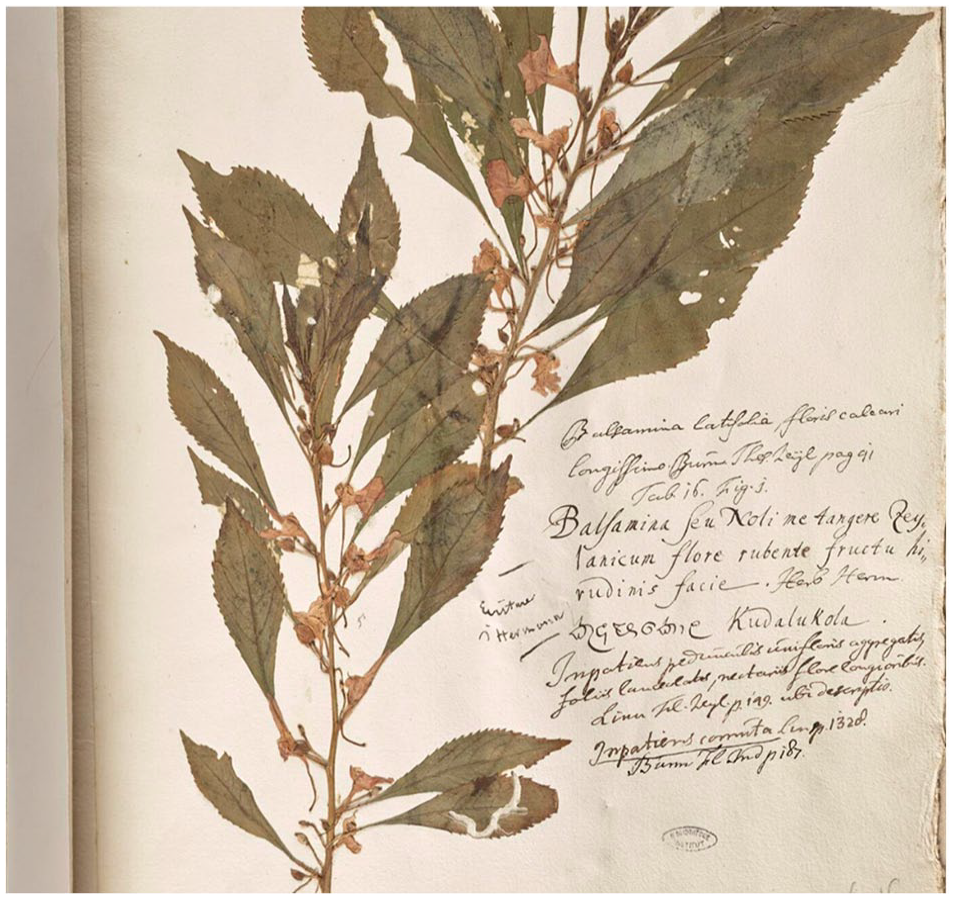
Folio 5 of the Paris Herbarium, “Balsamina seu Noli me tangere Zeylanicum.” 47
In his annotations on the entry for a plant named Kamarangha, Burman also refers to relevant publications: Linnaeus’ Flora Zeylanica, “where there is a description”; Burman’s Thesaurus Zeylanicus, “where the rest can be looked up” (presumably referring to synonyms, that is, the names that other authors had given to the plant); Linnaeus’ Species plantarum; and N. L. Burman’s Flora Indica. 46 Burman used the individual folios of Hermann’s herbarium as a folios of Hermann’s herbarium as datasets on which he entered all the information on a plant available to him. He kept it up to date over the years, adding references to new, relevant works as they were published.
There are many instances of entries written by a third person in the Paris Herbarium, possibly by Jan Commelin or Arnold Syen, in a hand that is similar in style to Hermann’s. 48 A commentary on Kamarangha, for example, describes in detail the powers ascribed to the wood of the plant and the use that was made of it. It was said that if the wood was worn on the body or kept in the bedroom, it could protect against poisoning and sorcery. The entry states that the name was made up of Ka, which meant “something poisoned that had already been swallowed,” and marangha, which meant “to destroy.” 49 Philological and ethnobotanical information were intertwined, and both were recorded on the herbarium folio.
The location of the second herbarium, which is today in the holdings of the Natural History Museum in London, was unknown until 1744, when five anonymous volumes containing South Indian plants came into the possession of a Copenhagen apothecary by the name of August Günther. He sent them on to Linnaeus with a request to name the plants they contained. 50 Linnaeus identified the material as Hermann’s personal herbarium and, on this basis, he published – ten years after Burman’s Thesaurus Zeylanicus (1737) – a further posthumous edition under the title Flora Zeylanica. Like Burman, Linnaeus also added further information to the herbarium that had come into his possession. As he only had it on loan, sending it back to Günther afterwards, his annotations were sparser than those by Burman, but also refer to botanical publications in which a particular plant had been described and named since Hermann’s death. The most frequent references are to Burman’s Thesaurus Zeylanicus and to Linnaeus’ own Hortus Cliffortianus, published one year later in 1738. As a rule, Linnaeus only added a single title in which information about the plant in question could be looked up. Moreover, he added numbers to the individual plants in the herbarium, which corresponded to the numbering in his Flora Zeylanica. A typical page from the London Herbarium can be seen in Figure 2.
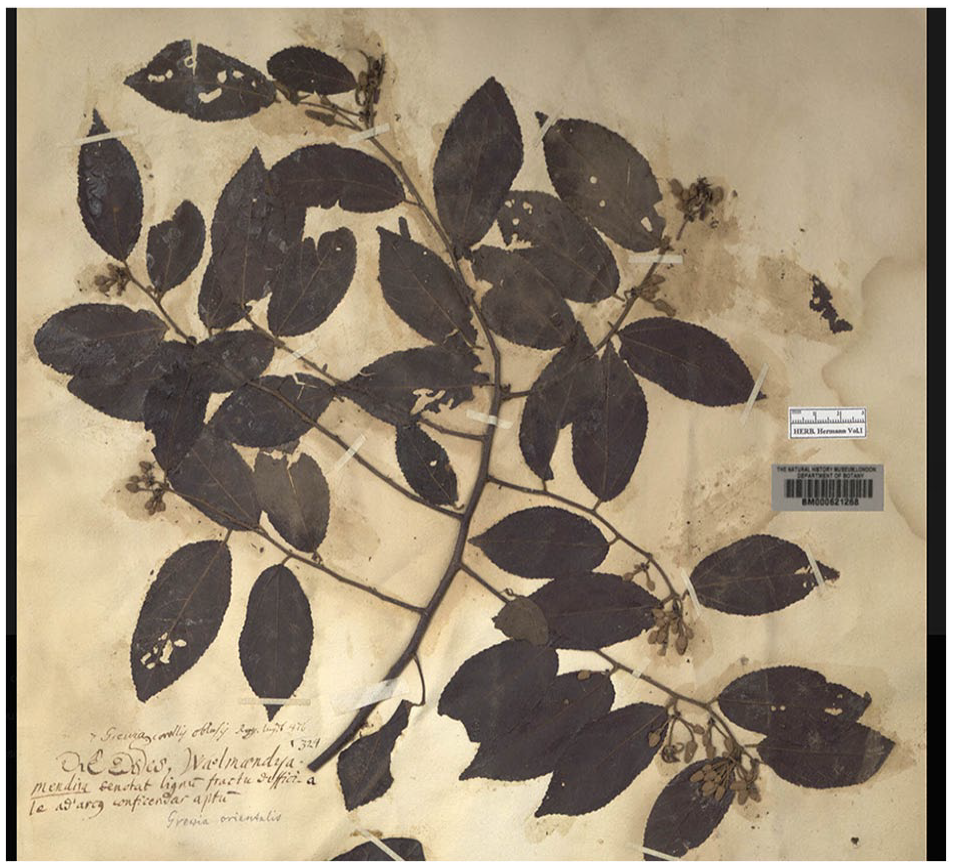
Folio 47 from the London Herbarium. 51
Hermann’s original entry starts with the name of the plant in Sinhalese script, followed by the transcription Waelmaendija. He then explains how this plant name is composed: mendija is the name of a type of wood that is hard to break and was used for making bows. Above this, we read in Linnaeus’ small hand: “Grewia corollis obtusis, Roy. Lugd. 476 (Adriaan van Royen, Florae Leydensis prodromus, 1740)”; below it, the number 324. 52 This one reference to Adriaan van Royen’s overview of the plants in Leiden’s Botanical Gardens, the most recent relevant publication at that time, indicated where to look up what was already known about this plant. The number 324 refers to the corresponding entry in Linnaeus’ Flora Zeylanica, which lists the plant under a different name (Grewia foliis sublanceolatis) and contains a list of synonyms with van Royen’s Grewia corollis obtusis in first place, followed by further references to van Royen and Linnaeus’ Hortus Cliffortianus (1738). 53 Assigning numbers to the plants allowed Linnaeus to correlate the published description of Grewia with the specimen in the herbarium. 54
It has become clear that Hermann’s herbaria should be seen not only as collections of dried plants, but also as botanical manuscripts. In a next step, these annotated herbaria will be integrated into the networked processes of writing, reading, and publishing in early modern botany. Herbaria were inextricably linked with printed botanical literature, not only as a place to keep the plants that were illustrated, described, and identified in a publication, but also as a place to file the information about plants that the owner, or a series of owners, had extracted from the published literature over time. The folios of a herbarium were datasets that – regularly updated and corrected – contained references to the most recent, relevant publications and to the various names under which a plant appeared in them. This meant that working with a herbarium was not limited to considering and examining the plants it contained. Dried plants had to be compared with descriptions and illustrations in the published literature. References to botanical works noted by hand in a herbarium were followed up by those using it. The use of a herbarium, like the study of botanical publications, was a multimedia, comparative practice.
Herbaria were, therefore, often kept in the library of a scholar. Francis Boott’s well-known drawing of Banks’ herbarium in his house in Soho Square, London, show an interior that was specifically designed for this practice. Two of the walls are covered in bookshelves from floor to ceiling, while a third contains timber panels, presumably doors leading to individual sections of a cabinet covering the whole wall. Parallel to the longer of the two walls covered with bookshelves are two much lower shelves – about table height – for large-format folios and folders. One of these has a padded surface on which several large-format books could be opened at the same time, while also leaving space for individual herbarium folios or a bound herbarium to be laid out next to them (see Figure 3).
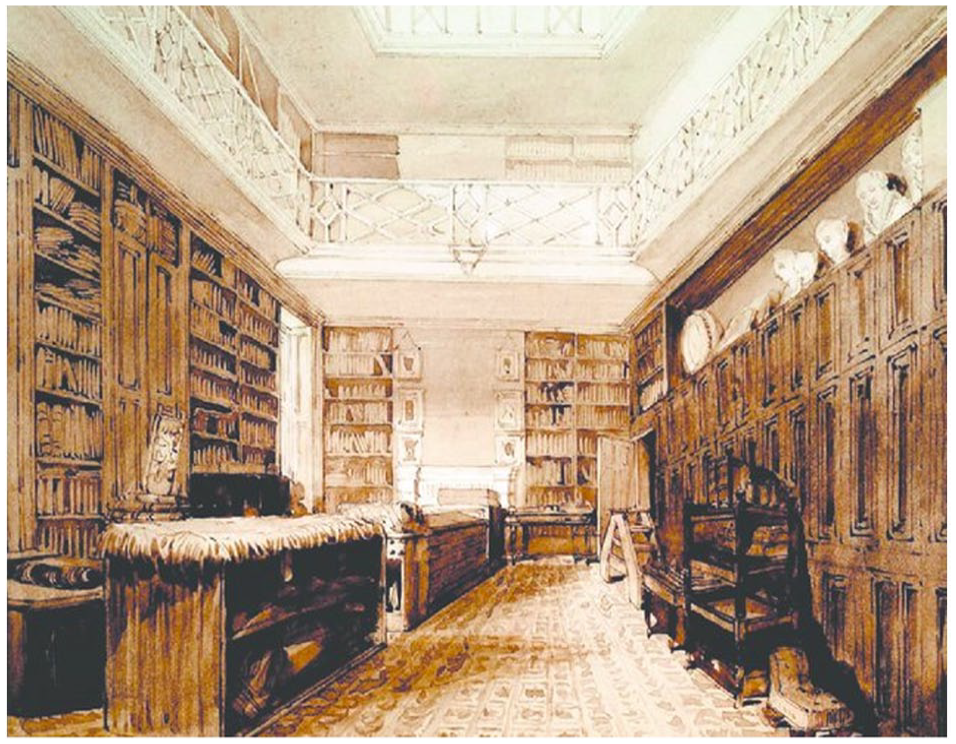
Sepia drawing from 1820, commonly attributed to the American physician and botanist Francis Boott, of the herbarium and library belonging to Joseph Banks at his house at Soho Square, London. I am grateful to Jonathan Goodman for letting me know that, based on information obtained from the Natural History Museum London, he now attributes the drawing to the British painter Ralph Lucas.
The herbarium as a record of botanical writing and reading practices
An annotated herbarium was not only viewed but also “read.” The handwritten entries informed the user of where in the botanical literature information on any particular plant could be found. Anyone who followed up some or all of these references – where his own library permitted – could gather together the available knowledge about any particular plant from what was scattered throughout the literature and linked by cross-references. The reader was prompted to compare against each other the descriptions and illustrations, Latin synonyms, Indigenous plant names, information about medicinal and other forms of use, and the linguistic information provided by various authors. Only repeated cycles of this comparative practice made it possible for a botanist to reach their own conclusions about the quality of the illustrations and descriptions, the correctness of the synonyms identified by different authors, and the reliability of the information on pharmaceutical efficacy. Over time, further relevant information was woven into the increasingly dense web of textual and visual information by other members of the botanical community. This process is documented in Hermann’s annotated herbaria.
The handwritten apparatus on the first folio shown in Figure 4 presents the following picture: the first entry, not in Hermann’s hand, but in the not clearly identifiable one mentioned in the section on language skills, contains a descriptive Latin name as well as the corresponding Sinhalese name – transcribed as Nijaghala (which, it is said, was pronounced Nijenghala) – and the information that the root was deadly even in the smallest doses. A note in Burman’s hand, in the bottom lower half of the page, adds a reference to his own Thesaurus Zeylanicus (1737), which lists the same plant under a different name: “Methonica gloriosa foliis capreolatis floribus fimbriatis reflexis, Thes. Zeyl. (Thesaurus Zeylanicus), p. 158, see the rest there [emphasis added].).” 55 What is “the rest”? If one follows Burman’s instructions, and opens the Thesaurus Zeylanicus at the specified place, one finds, under the name Methonica gloriosa, a lengthy entry containing about fifteen references to botanical works that list the same plant under different names, and in some cases contain additional information. 56 The first reference, for example, points to an illustration and a description of this plant in Paul Hermann’s Hortus Academicus Lugduno-Batavus (Leiden, 1687). 57 Anyone who follows this reference will find that Hermann does indeed provide a full-page illustration of the Methonica gloriosa.
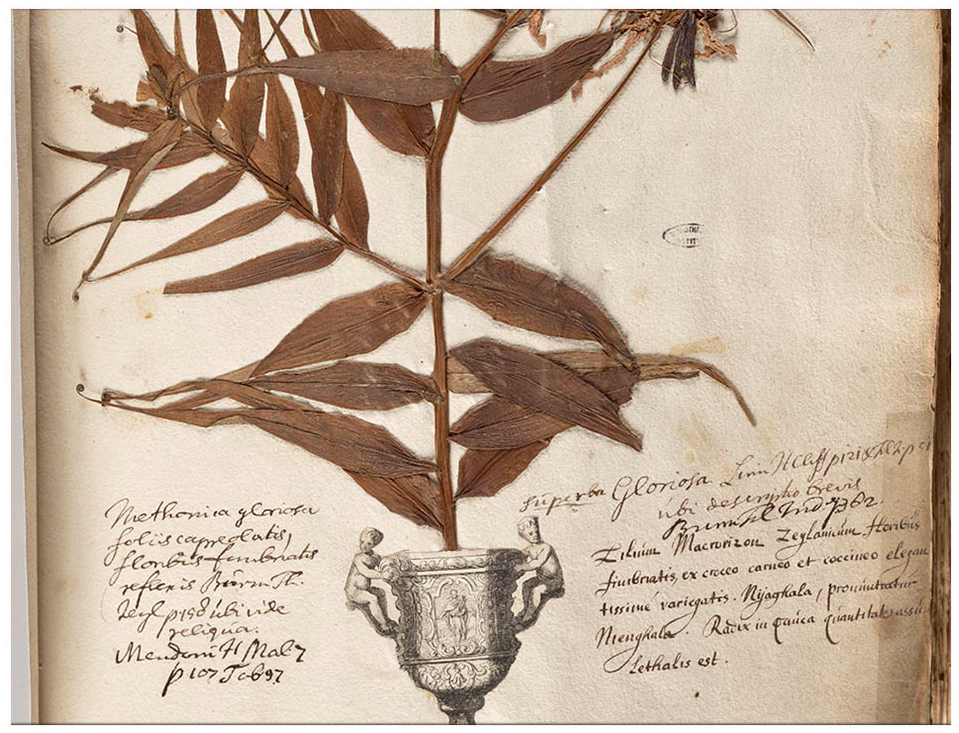
Folio 1 of the Paris Herbarium.
In 1738, one year after the publication of the Thesaurus Zeylanicus, Linnaeus’ Hortus Cliffortianus appeared. His Flora Zeylanica followed in 1747. Burman either owned both books or at least had the opportunity to use them, as on the herbarium folio there is another note in his handwriting, which refers to the relevant entries in both works: “Superba Gloriosa Linn. H Cliff (Hortus Cliffortianus, B.D.) p 121 & Fl Z (Flora Zeylanica, B.D.) p 51 ubi descriptio brevis (where a brief description can be found [emphasis added]).” 58 Thus Burman had compared Linnaeus’ works, after their publication, with Hermann’s herbarium, and noted references there. This meant that he and others who used the herbarium after him (such as his son Niklaas Laurens Burman) could be directed from the herbarium folio that features a particular plant both to the relevant pre-Linnaean literature and to Linnaeus’ publications, which assigned the plant a place in his taxonomy. On the other hand, botanists who studied Linnaeus’ Hortus Cliffortianus without any knowledge of the herbarium found a list of synonyms of the Gloriosa there, the first one of which was that in Burman’s Thesaurus Zeylanicus. 59 Anyone who then looked up the Thesaurus was referred from there to the web of information and publications on this plant, going back to Hermann’s herbarium.
After his son’s Flora Indica (Leiden / Amsterdam 1768) was published twenty years later, Burman once again checked Hermann’s herbarium against a relevant new publication. The references that he added to the herbarium are written in darker ink and stand out clearly from the rest of the handwritten documentation, indicating that they were added later. 60 If one follows up the reference on the herbarium folio of Methonica gloriosa and looks up the relevant place in the Flora Indica, one finds there, going beyond the titles already noted in Linnaeus’ Flora Zeylanica, a reference to Linnaeus’ Species plantarum (1753), which had since been published, and, in addition to Hermann’s name Nienghala, a further Indigenous name (Junghlang). At the end of the entry, ethnobotanical information from Hermann’s herbarium reappears, namely, that the root of the plant was deadly, even in the smallest doses. 61
Based on Hermann’s herbarium, which had fallen into his possession (the LH), Linnaeus wove similar nets of information that integrated Hermann’s plants into his own taxonomy, while also connecting them with the major publications of pre-Linnaean botany. If we start with the herbarium folio on Alcea Indica, Linnaeus’ handwritten notes lead us to two of his own works: to the Hortus Cliffortianus (1737), where the Alcea Indica is listed under the name Sida foliis cordatis oblongis ferratis, capsulis quinis biscupatis and synonyms are provided; and to the Flora Zeylanica, where the plant is discussed under a slightly modified name, and is briefly described at the end of the entry. 62 Linnaeus added: “The history of the plant provided by the very famous Dillenius, is sufficient.” 63 If we follow up the reference to the Hortus Elthamensis (1732), the German botanist Johann Jakob Dillenius’ opus magnum, we find a treatment one and a half pages long. Thus, to avoid repeating what had already been said elsewhere and prevent his own book from becoming excessively lengthy, Linnaeus used cross-references to a detailed and reliable illustration, or to the description of a plant by another botanist whose accuracy he trusted.
Conclusion
More than fifty years after Hermann’s death, David van Royen (1727–99), a nephew of the better-known botanist Adriaan van Royen (1704–79) and his successor as director of the Botanical Gardens in Leiden, set up a number of handwritten indices entitled Indices in Pauli Hermanni Herbaria ceylanica quae sunt in Biblioth. Acad. Lugd. Bat. (Indices to Paul Hermann’s Ceylon herbaria, which are held by the library of Leiden University). Like Burman and Linnaeus before him, he had compared the plants in Hermann’s herbarium with the relevant literature that had been published since. But instead of noting his finds directly on the herbarium folios, he set up separate documents for this purpose. 64 The first index correlates the number given to a plant in Hermann’s herbarium with the corresponding number of a plant in Linnaeus’ Flora Zeylanica and with the corresponding name in Linnaeus’ Species plantarum. 65 The second index is structured in the same way, but has been supplemented with detailed observations on a plant’s flowers and fruit that van Royen had made in the Leiden Botanical Gardens. 66 Thus he not only updated Hermann’s herbarium by references to new botanical literature, but, by comparing the hortus siccus (dried garden, as a herbarium was called then) with a botanical garden, he enriched it with observations on living plants.
Plant names are the subject of two more of van Royen’s indices: the first alphabetically lists the Sinhalese plant names given by Hermann; the second contains the corresponding Latin names. 67 The last document in van Royen’s volume is the only one that is dated, to 1757. It is a directory of the words, listed alphabetically with Latin translations, of which Hermann’s Singhalese plant names are composed. 68 Added page numbers indicate where the words can be found in Burman’s Thesaurus Zeylanicus; a prefixed letter H indicates that the word is also to be found in the Musaeum Zeylanicum. 69
Almost sixty years after Hermann’s death, therefore, botanists were still studying and updating his herbaria and the information they contained. The process of excerpting, annotating, and indexing took place in cycles, and began over and over again, either after the publication of a new, relevant work, such as Johannes Burman’s Thesaurus Zeylanicus, Linnaeus’ Flora Zeylanica and Species plantarum, and Niklaas Laurens Burman’s Flora Indica, or when a botanist had obtained new information from another source, such as David van Royen comparing the dried specimens in Hermann’s herbarium with the living plants in Leiden’s Botanical Gardens. As a rule, these additions were noted on the relevant folio of the herbarium, which gradually filled up with information on a particular plant, or the updating and annotating took place in a separate document, as in the case of van Royen’s Indices. Through these iterative-comparative practices of writing and reading, the botanical community wove descriptions, illustrations, synonyms, Indigenous plant names, and ethnobotanical and linguistic observations from printed books, manuscripts, and herbaria – especially annotated ones – into an ever-growing mesh of textual–visual information.
The mesh of cross-references grew with each new reading of the items it comprised, as this generated additional connections or undid already existing ones by adding further comments. Here, it was shown which role herbaria played as annotated manuscripts in these networked practices of reading, writing, and publishing in eighteenth-century botany. In the process, it also became clear to what extent herbaria could serve as repositories of ethnobotanical and linguistic information about the plants they contained. As in the case of Hermann’s notes on the Sinhalese language, these were often inseparably linked to botanical observations, forming what should be called linguistic–botanical material.
Regarding the interplay between early modern botany and the philology of non-European languages, it is instructive to see that not only Hermann’s botanical observations but also the Sinhalese plant names he compiled, as well as the accompanying notes on the semantics and morphology of the Sinhalese language, were gradually integrated into the fabric of botanical information described in this paper. In 1717, most of the Sinhalese plant names from his herbaria were published in the Musaeum Zeylanicum, and many others appeared in Burman’s Thesaurus Zeylanicus in 1737. References to Hermann’s philological-botanical observations can also be found in contemporaries’ botanical manuscripts, such as the handwritten annotations of the botanist Johann Philipp Breyne (1680–1764) in a copy of the Exoticarum aliarumque minus cognitarum plantarum centuria prima (Gdansk, 1678) of his father Jakob Breyne (1637–97) for a planned but unrealized new edition. Regarding a tree referred to as Arbor Kauki Indorum, Johann Philipp Breyne noted that it was called “Manamal by the Ceylonese, which means eye-flower, dedicated to the eyes according to Hermann’s testimony.” 70 How this material was used by those who studied South Asian languages remains to be explored.
Footnotes
Declaration of conflicting interests
The author declared no potential conflicts of interest with respect to the research, authorship, and/or publication of this article.
Funding
The author(s) disclosed receipt of the following financial support for the research, authorship, and/or publication of this article: Funded by the Deutsche Forschungsgemeinschaft (DFG, German Research Foundation) - project number 508886028.
1.
On scholarly correspondence in the early modern period and the paradigm of circulation (a selection): Anne Goldgar, Impolite Learning: Conduct and Community in the Republic of Letters, 1680–1750 (New Haven, CT: Yale University Press, 1995); Pierre-Yves Beaurepaire (ed.), La plume et la toile: Pouvoirs et résaux de correspondance dans l’Europe des Lumières (Arras: Artois Presse Université, 2002); Regina Dauser et al. (eds.), Wissen im Netz: Botanik und Pflanzentransfer in europäischen Korrespondenznetzen des 18. Jahrhunderts (Berlin, Germany: Akademie Verlag, 2008); Bettina Dietz, “Contribution and Co-production: The Collaborative Culture of Linnaean Botany,” Annals of Science 69 (2012): 551–69; in addition, see the edited correspondences of early modern botanists. To name only a few of the largest projects: Uppsala University, “Carl Linnaeus’ Correspondence,” <https://ub.uu.se/finding-your-way-in-the-collections/selections-of-special-items-and-collections/linnaeus-collections/linnaean-correspondence> (April 20, 2022); Urs Boschung and Barbara Braun-Bucher (eds.), Repertorium zu Albrecht von Hallers Korrespondenz, 1724–1777, 2 vols. (Basel, Switzerland: Schwabe, 2002); <https://hallernet.org/data/letters> (April 20, 2022); Neil Chambers (ed.), The Scientific Correspondence of Sir Joseph Banks, 6 vols. (London: Pickering & Chatto, 2007); The Sloane Letters Project, < > (April 20, 2022); on circulation see Sujit Sivasundaram, “Sciences and the Global: On Methods, Questions, and Theory,” Isis 101 (2010): 146–58; Kapil Raj and Mary Terrall (guest editors), “Circulation and Locality in Early Modern Science,” special issue, The British Journal for the History of Science 43 (2010): 513–606; Kapil Raj, “Postcolonialism . . . and Postpositivism: Circulation and the Global History of Science,” Isis 104 (2013): 337–47; Hanna Hodacs, Kenneth Nyberg, and Stéphane van Damme (eds.), Linnaeus, Natural History and the Circulation of Knowledge (Oxford: Oxford University Press, 2018); Nick Hopwood, Staffan Müller-Wille, and Janet Browne, “Cycles and Circulation: A Theme in the History of Biology and Medicine,” History and Philosophy of the Life Sciences 43 (2021): article 89.
2.
Unlike the so-called sexual method, which concentrated exclusively on the reproductive features of the flower for the purposes of taxonomic identification, natural characters were descriptions that provided a more comprehensive picture of a genus. See Staffan Müller-Wille, “Linnaeus’ Herbarium Cabinet: A Piece of Furniture and Its Function,” Endeavour 30 (2006): 60–4; see also Alette Fleischer, “Leaves on the Loose: The Changing Nature of Archiving Plants and Botanical Knowledge,” Journal of Early Modern Studies 6 (2017): 117–35; Alette Fleischer, “Gardening Nature, Gardening Knowledge: The Parallel Activities of Stabilizing Knowledge and Gardens in the Early Modern Period,” in Hubertus Fischer, Volker R. Remmert, and Joachim Wolschke-Bulmahn (eds.), Gardens, Knowledge and the Sciences in the Early Modern Period (Basel, Switzerland: Birkhäuser, 2016), pp.289–304; for the role of the herbarium in the iterative process of rewriting, editing, and re-editing of botanical publications, see Bettina Dietz, “Iterative Books: Posthumous Publishing in Eighteenth-Century Botany,” History of Science 60 (2022): 166–82.
3.
A selection: Santa Pulvirenti et al., “Study of a Pre-Linnaean Herbarium Attributed to Francesco Cupani (1657–1710),” Candollea 70 (2015): 67–96; Alix Cooper, “Placing Plants on Paper: Lists, Herbaria, and Tables as Experiments with Territorial Inventory at the Mid-Seventeenth-Century Gotha Court,” History of Science 56 (2018): 257–77; Charles E. Jarvis, “‘The Most Common Grass, Rush, Moss, Fern, Thistles, Thorns or Vilest Weeds you Can Find’: James Petiver’s Plants,” Notes and Records. The Royal Society Journal of the History of Science 74 (2020): 303–28; Mark Carine and Robert Huxley, The Collectors: Creating Hans Sloane’s Extraordinary Herbarium (London: Natural History Museum, 2020); on Hermnann’s herbaria see notes 5 and 10; on herbaria and the visual representation of plants, see Floriana Giallombardo and Tinde van Andel, “Paolo Boccone and the Visual Communication of Pre-Linnean Botany: A Comparison between his Leiden Herbarium, Paris Autoprint and Published Icones (1674),” Studies in History and Philosophy of Biological and Biomedical Sciences 74 (2019): 15–26; on the aesthetic and pedagogical dimension of herbaria, see Alexandra Cook, Jean-Jacques Rousseau and Botany: The Salutary Science (Oxford: Voltaire Foundation, 2012); Célia Abele, “Rousseau’s Herbaria: Leaves of Self, Books of Nature,” Eighteenth-Century Studies 54 (2021): 401–25.
4.
See, e.g., Mark Nesbitt, “Use of Herbarium Specimens in Ethnobotany,” in Jan Salick, Katie Konchar, and Mark Nesbitt (eds.), Curating Biocultural Collections: A Handbook (Richmond, Surrey: Royal Botanic Gardens, Kew, 2014), pp.313–28; Estevão N. Fernandes de Souza and Julie A. Hawkins, “Comparison of Herbarium Label Data and Published Medicinal Use: Herbaria as an Underutilized Source of Ethnobotanical Information,” Economic Botany 71 (2017): 1–12.
5.
See Tinde van Andel et al., “The Forgotten Hermann Herbarium: A 17th Century Collection of Useful Plants from Suriname,” Taxon 61 (2012): 1296–304; Tinde van Andel and Nadine Barth, “Paul Hermann’s Ceylon Herbarium (1672–1679) at Leiden, the Netherlands,” Taxon 67 (2018): 977–88; Tinde van Andel, Jaideep Mazumdar, and Jan-Frits Veldkamp, “Rumphius Specimens Detected in Paul Hermann’s Ceylon Herbarium (1672–1679) in Leiden, the Netherlands,” Blumea 63 (2018): 11–19; a recently published article by the working group around van Andel covers a somewhat wider historical horizon. See Tilman Walter, Abdelbasset Ghorbani, and Tinde van Andel, “The Emperor’s Herbarium: The German Physician Leonhard Rauwolf (1535?–96) and His Botanical Field Studies in the Middle East,” History of Science 60 (2022): 130–51.
6.
See Caroline Cornish and Mark Nesbitt, “Historical Perspectives on Western Ethnobotanical Collections,” in Jan Salick, Katie Konchar, and Mark Nesbitt (eds.), Curating Biocultural Collections (Kew: Kew Publishing, 2014), pp.271–93, 271.
7.
In general, see William A. Pettigrew and David Weevers (eds.), The Corporation as a Protagonist in Global History, c. 1550–1750 (Leiden, Netherlands and Boston, MA: Brill, 2019); on the VOC see Harold Cook, Matters of Exchange: Commerce, Medicine, and Science in the Dutch Golden Age (New Haven, CT: Yale University Press, 2007); Leonard Blussé and Ilonka Ooms (eds.), Kennis en compagnie. De Verenigde Oost-Indische Compagnie en de moderne wetenschap (Amsterdam, Netherlands: Balans, 2002); Siegfried Huigen, Jan L. de Jong, and Elmar Kolfin (eds.), The Dutch Trading Companies as Knowledge Networks (Leiden, Netherlands and Boston, MA: Brill, 2011); Peter Boomgaard (ed.), Empire and Science in the Making: Dutch Colonial Scholarship in Comparative Perspective, 1760–1830 (New York, NY: Palgrave Macmillan, 2013); Sven Dupré and Christoph Lüthy (eds.), Silent Messengers: The Circulation of Objects of Knowledge in the Early Modern Low Countries (Münster, Germany: LIT Verlag, 2014); Daniel Margócsy, Commercial Visions: Science, Trade and Visual Culture in the Dutch Golden Age (Chicago, IL: University of Chicago Press, 2014); on the EIC, see Vinita Damodaran, Anna Winterbottom, and Alan Lester (eds.), The East India Company and the Natural World (Basingstoke: Palgrave Macmillan, 2014); Anna Winterbottom, Hybrid Knowledge in the Early East India Company World (Basingstoke: Palgrave Macmillan, 2015).
8.
On this see the essays in Damodaran, Winterbottom, and Lester, East India Company (note 7), especially Deepak Kumar, “Botanical Explorations and the East India Company: Revisiting ‘Plant Colonialism’,” pp.16–34; Jeyamalar Kathirithambu-Wells, “Unlikely Partners: Malay-Indonesian Medicine and European Plant Science,” in Vinita Damodaran, Anna Winterbottom, and Alan Lester (eds.), The East India Company and the Natural World (London: Palgrave Macmillan, 2014), pp.193–218.
9.
For an overview of relevant recent literature on the history of technology, see Gianenrico Bernasconi, “L’objet comme document: Culture matérielle et cultures techniques,” Artefact. Techniques, histoire et sciences humaines 4 (206): 31–47; see also Gianenrico Bernasconi, “Pour une archéologie des pratiques: Mesure du temps, corps et prestation (XVIIIe-XXe siècle),” Socio-anthropologie 40 (2019): 247–62; Gianenrico Bernasconi, Objets portatifs au Siècle des lumières (Paris, France: Éditions du Comité des Travaux Historiques et Scientifiques, 2015). On the history and sociology of practices, see Theodore R. Schatzki and Karin Knorr Cetina (eds.), The Practice Turn in Contemporary Theory (London and New York, NY: Routledge, 2001); Lucas Haasis and Constantin Rieske (eds.), Historische Praxeologie: Dimensionen vergangenen Handelns (Paderborn, Germany: Schöningh, 2015); on the practice turn in the history of science, see, among others, Bruno Latour, Science in Action: How to Follow Scientists and Engineers through Society (Cambridge, MA: Harvard University Press, 1987); Andrew Pickering, The Mangle of Practice: Time, Agency and Science (Chicago, IL: University of Chicago Press, 1995); Karin Knorr-Cetina, Epistemic Cultures: How the Sciences Make Knowledge (Cambridge, MA: Harvard University Press, 1999); Léna Soler et al. (eds.), Science after the Practice Turn in the Philosophy, History, and Social Studies of Science (New York, NY: Routledge, 2014).
10.
On Hermann’s herbaria, see especially Henry Trimen, “Hermann’s Ceylon Herbarium and Linnaeus’ Flora Zeylanica,” Journal of the Linnaean Society (Botany) 24 (1887): 129–55; van Andel and Barth, “Paul Hermann’s Ceylon Herbarium” (note 5); van Andel, Mazumdar, and Veldkamp, “Rumphius Specimens” (note 5); in addition, S. J. van Ooststroom, “Hermann’s Collection of Ceylon Plants in the Rijksherbarium (National Herbarium) at Leyden,” Blumea 29 (1937): 193–209; J. Ardagh, “Paul Hermann’s Ceylon Herbarium and Icones,” Journal of Botany 69 (1931): 137–138.
11.
On paper and scribal technologies, see Helmut Zedelmaier and Martin Mulsow (eds.), Die Praktiken der Gelehrsamkeit in der Frühen Neuzeit (Tübingen, Germany: Niemeyer, 2001); Martin Krajewski, Zettelwirtschaft: Die Geburt der Kartei aus dem Geist der Bibliothek (Berlin, Germany: Kadmos, 2002); Anke te Heesen, “The Notebook: A Paper-Technology,” in Bruno Latour and Peter Weibel (eds.), Making Things Public: Atmospheres of Democracy (Cambridge, MA: The MIT Press, 2005), pp.582–9; Volker Hess and J. Andrew Mendelsohn, “Case and Series: Medical Knowledge and Paper Technology, 1600–1900,” History of Science 48 (2010): 287–314; Volker Hess and J. Andrew Mendelsohn (guest-editors), “Paper Technology in der Frühen Neuzeit,” special issue, NTM. Zeitschrift für Geschichte der Wissenschaften, Technik und Medizin 21 (2013): 1–106; Ann Blair and Richard Yeo (guest-editors), “Note-Taking in Early Modern Europe,” special issue, Intellectual History Review 20 (2010): 301–432; Richard Yeo, Notebooks, English Virtuosi, and Early Modern Science (Chicago, IL: University of Chicago Press, 2014); Staffan Müller-Wille and Isabelle Charmantier (guest editors), “Worlds of Paper,” special issue, Early Science and Medicine 19 (2014): 379–503; Elizabeth Yale, Sociable Knowledge: Natural History and the Nation in Early Modern Britain (Philadelphia, PA: University of Pennsylvania Press, 2016); Carla Bittel, Elaine Leong, and Christine von Oerzen (eds.), Working with Paper: Gendered Practices in the History of Knowledge (Pittsburgh, PA: University of Pittsburgh Press, 2019).
12.
On Hermann’s biography, see Stephan Rauschert, “Das Herbarium von Paul Hermann (1646–1695) in der Forschungsbibliothek Gotha,” Hercynia 7 (1970): 301–28, 304–5; Sarina Veldman, “Prins der botanici: De reizen, verzamelingen en studies van Paul Hermann,” in Esther van Gelder (ed.), Bloeiende Botanie. Groene ontdekkingen in de gouden eeuw (Hilversum: Verloren, 2012), pp.146–57.
13.
On Sri Lanka’s colonial past, see Leonard Blussé and Kees Zandvliet (eds.), The Dutch Encounter with Asia, 1600–1950 (Zwolle, Netherlands: Waanders, 2004); Sujit Sivasundaram, Islanded: Britain, Sri Lanka, and the Bounds of an Indian Ocean Colony (Chicago, IL: The University of Chicago Press, 2013); Alicia Shrikker, Dutch and British Colonial Intervention in Sri Lanka, 1780-1815: Expansion and Reform (Leiden, Netherlands and Boston, MA: Brill, 2017).
14.
On the sequence of posthumous publications that appeared during the eighteenth century on the basis of Hermann’s material, see Dietz, “Iterative Books,” (note 2).
15.
On this see below, pp. 12–13.
16.
On this see below, pp. 13–15.
17.
On this, see Trimen, “Hermann’s Ceylon Herbarium and Linnaeus’ Flora Zeylanica” (note 10); van Oostroom, “Hermann’s Collection of Ceylon Plants” (note 10); van Andel and Barth, “Paul Hermann’s Ceylon Herbarium” (note 5); van Andel, Mazumdar, and Veldkamp, “Rumphius Specimens” (note 5).
18.
See van Andel and Barth, “Paul Hermann’s Ceylon Herbarium,” 978 (note 5). A list of the plants in the Gotha Herbarium can be found in Rauschert, “Herbarium,” 310–25 (note 12).
19.
Collectio plantarum Zeylanensium quas olim peritissimus botanicus Paulus Hermannus in ipsa Zeylona observavit atque collegit, dein vero ad has pluresque alias Thesaurum meum zeylanicum conscripsi et edidi. Johannes Burmannus (Bibliothèque de l’Institut de France, Paris; Collection Benjamin Delessert, Ms 3912 Réserve).
20.
On fo. 10 of the PH, the text block in Hermann’s handwriting is marked with two lines. Next to them, in a different hand, is noted in French: “Ecriture d’Hermann” (Hermann’s writing).
21.
Ibid., fo. 5. 5 is marked in pencil on the top right of the folio. This corresponds to page 10 in the digitized version held by the library of the Institut de France. (Translations from the Latin original here and in the following are mine, unless indicated otherwise.)
22.
See also e.g. fos. 7, 11, 15, 23, 29 (ibid.).
23.
Ibid., 10. Another example of an indication about pronunciation can be found on fo. 2 (“Nijaghala, is pronounced Nienghala”).
24.
Ibid. Here, Hermann seems to have erred (according to Himesh Jayasinghe; see note 27). See also the lengthy entries on fo. 20, where Hermann decodes the components of the Sinhalese name Kamarangha as Ka (something poisoned) and marangha (to destroy).
26.
See LH, 40 (ibid., April 21, 2022).
27.
I am grateful to Himesh Dilruwan Jayasinghe and Alex McKinley for their linguistic assessment of Hermann’s notes on plant names and their morphology and meaning in Sinhala. According to them both, Hermann had a fundamental grasp of these names. His transliterations are often at least partly correct. Sometimes he erred when trying to break down a name into the elements it is composed of, but even some of his errors reveal a basic understanding of the language. Hermann’s handwriting in Sinhala script is fluent and his letters are mostly correctly formed with only occasional mistakes. In this context, it is also significant that Sri Lanka had a long tradition of compiling the names of local plants – especially medicinal ones – in Sinhala, to which Hermann presumably had access. On this, see L. H. Cramer, “The Nomenclatural History of Plants of Early Sri Lankan Botany,” Ceylon Journal of Science (Biological Sciences) 28 (2001): 21–33. See also the Appendix of botanical names in Charles Carter, A Sinhalese-English Dictionary (Colombo, Sri Lanka: The “Ceylon Observer” Printing Works; London: Probsthain & Co, 1924). A searchable version of this dictionary can be found at <> (August 18, 2022).
28.
See J. Henniger, Hendrik Adriaan van Reede tot Drakenstein (1636–1691) and Hortus Malabaricus: A Contribution to the History of Dutch Colonial Botany (Rotterdam, Netherlands/Boston, MA: A. A. Balkema, 1986), pp.97–176; Richard Grove, “Indigenous Knowledge and the Significance of South-West India for Portuguese and Dutch Constructions of Tropical Nature,” Modern Asian Studies 30 (1996): 121–43; see also Palmira Fontes da Costa, “Geographical Expansion and the Reconfiguration of Medical Authority: Garcia de Orta’s Colloquies on the Simples and Drugs of India (1563),” Studies in History and Philosophy of Science 43 (2012): 74–81.
29.
Although the illustrations are labeled “Arabice” (in Arabic), they appear to be Malayalam plant names written in Arabic script. On this see Henniger, Hortus Malabaricus, p.149 (note 28).
30.
Cf. Henniger, Hortus Malabaricus, vol. 1 (1678), unpaginated (note 28); Henniger, Hortus Malabaricus, p.148–9 (note 28).
31.
On this see Anna Pytlowany and Toon van Hal, “Merchants, Scholars, and Languages: The Circulation of Linguistic Knowledge in the Context of the Dutch East India Company (VOC),” Histoire, Epistémologie, Langage 38 (2016): 19–38, 23. On the further spread of Malayan languages skills among VOC factors in South East Asia in the seventeenth century, see Romain Bertrand, “The Making of a Malay Text: Peter Floris, Espenius, and Textual Transmission in and out the Malay World at the Turn of the 17th Century,” Quaderni Storici 48 (2013): 141–65; see also Winterbottom, Hybrid Knowledge, ch.2 (“Linguistic Landscapes: Early English Studies of Malay and the EIC in Maritime Southeast Asia”), pp.54–81 (note 7).
32.
Phillips Balde (also known as Philippus Baldaeus), Wahrhaftige ausführliche Beschreibung der berühmten Ost-Indischen Kusten Malabar und Coromandel, als auch der Insel Zeylon; samt dero angräntzenden und untergehörigen Reichen . . . ; durchgehends verzieret mit neuen Landkarten und Abbildungen . . . ; benebst einer Umständlichen und Gründlichen Entdeckung der Abgötterey der Ost-Indischen Heyden, Malabaren, Benjanen, Gentiven, Bramines etc. . . .; anitzo aber aus dem Niederländischen ins Hochteutsche mit Fleiß übergesetzt . . . (Amsterdam: Johannes Janssonius van Waesberge und Johannes Someren, 1672).
33.
“Kurze Anleitung zur Malabarischen Sprachkunst,” ibid., pp.186–92. The trading company’s ships also offered opportunities to learn the language.
34.
Ibid., p.187.
35.
Ibid., p.188.
36.
On this see Tinde van Andel, Paul Maas, and James Dobreff, “Ethnobotanical Notes from Daniel Rolander’s Diarium Surinamicum (1754–56): Are These Plants Still in Use in Suriname Today?” Taxon 61 (2012): 852–63.
37.
On handwritten lexicographical and grammatical material relating to South Indian languages, see Pytlowany and van Hal, “Merchants,” 23–27 (note 31); Cristina Muru, “Early Descriptors and Descriptions of South Asian Languages from the 16th Century Onwards,” Journal of Portuguese Linguistics 17 (2018): 1–29, 6. Shortly after Hermann’s departure from Ceylon, the Dutch missionary Joannes Ruëll (c.1660–1701) arrived there. He produced a grammar of the Sinhalese language, which was published in Amsterdan in 1708 (Grammatica, of Singaleesche taal-kunst, zynde een korte methode om de voornaamste fondamenten van de Singaleesche spraak te leeren). Simon Cat, also a Dutch missionary in Ceylon, compiled a Dutch–Sinhalese dictionary in the 1690s. See K. D. Paranavitana, The Dutch Sinhala Dictionary by Simon Cat (Colombo, Sri Lanka: Department of National Archives of Sri Lanka, 2013).
38.
Bertrand, “Making,” 146 (note 31).
39.
On this in brief, see Anna Winterbottom, “Producing and Using the Historical Relation of Ceylon: Robert Knox, the East India Company and the Royal Society,” The British Journal for the History of Science 42 (2009): 515–38, 527f; Winterbottom, Hybrid Knowledge, ch.2 (note 7); similarly briefly on Dutch scholars and their philological informants from the environs of the VOC, see Pytlowany and Van Hal, “Merchants,” 29–33 (note 31).
40.
Thomas Hyde considered Hermann’s philological information on the Sinhalese language to be especially reliable as he knew the script (Thomas Hyde to Thomas Bowrey, February 7, 1700; quoted from Anna Winterbottom, Company culture: information, scholarship, and the East India Company settlements 1660–1720, 321) Company culture: information, scholarship, and the East India Company settlements 1660–1720s <> (June 10, 2023).
41.
On the different framework for the relationship between philology and natural history in the Renaissance, see Antony Grafton and Nancy Siraisi (eds.), Natural Particulars: Nature and the Disciplines in Renaissance Europe (Cambridge, MA/London: The MIT Press, 1999).
42.
Hermann, PH, fo. 10.
43.
On this see Muru, “Descriptors and Descriptions,” 9–12 (note 37); Maria Johanna Schouten, “Malay and Portuguese as Contact Languages in the Southeast Asian Archipelago, 16th–18th Centuries,” in Mark Häberlein and Alexander Keese (eds.), Sprachgrenzen, Sprachkontakte, Kulturelle Vermittler: Kommunikation zwischen Europäern und Aussereuropäern, 16.–20. Jahrhundert (Stuttgart, Germany: Franz Steiner Verlag, 2010), pp.345–54.
44.
On this see Rauschert, “Herbarium,” 309 (note 12).
45.
Hermann, PH, 5. Here and in what follows, I have put in brackets what the abbreviations stand for.
46.
Ibid.
47.
Ibid., 19
48.
I have consulted the manuscript departments of several Dutch libraries, but it has not yet been possible to identify the handwriting with any certainty.
49.
See Hermann, PH, 20.
50.
On this see Rauschert, “Herbarium,” 309 (note 12).
51.
Ibid., 25.
52.
LH, 47.
53.
See Carl von Linné, Flora Zeylanica (Stockholm, Sweden: Laurentius Salvius, 1747), p.154.
54.
On the use of numbers in the management of botanical information in the eighteenth century, see Dietz, “Contribution and Co-production,” 554–6 (note 1); Staffan Müller-Wille, “Names and Numbers: ‘Data’ in Classical Natural History, 1758–1859,” Osiris 32 (2017): 109–28.
55.
Hermann, PH, 2.
56.
Burman, Thesaurus Ceylanicus (Amsterdam: Janssonius van Waesberghe and Salomon Schouten: 1737).
57.
“H.L.B. app. pag. 688 ubi icon & descr.” (Hortus Lugduno-Batavus, Appendix, p. 688, which contains an illustration and a description); ibid., p.158.
58.
PH, 2.
59.
Carl von Linné, Hortus Cliffortianus plantas exhibens quas in hortis tam vivis tam siccis, Hartecampi in Hollandia, coluit vir nobilissimus & generosissimus Georgius Clifford (Amsterdam, Netherlands, 1737).
60.
Cf. PH, 2; similarly also e.g. PH 7; PH 8.
61.
Niklaas Laurens Burman, Flora Indica cui accedit series zoophytorum Indicorum nec non Prodromus Florae Capensis (Leiden, Netherlands: Cornelius Haek, 1768), p.82.
62.
See LH, 17.
63.
Ibid.
64.
The manuscript is in the collection of the Naturalis Biodiversity Center in Leiden (no call mark yet assigned).
65.
Indices in Pauli Hermanni Herbaria Ceylanica quae sunt in Biblioth. Acad. Lugd. Bat., ibid., pp.1–7.
66.
Index Stirpium Herbarium Zeylanicum constituentium qui in Biblioth. publ. Acad. Lugd. Batav. servatur, ibid., pp.9–24 (the spellings “Ceylon” and “Zeylon” are both used).
67.
Index Nominum Barbarorum quibus designantur plantae Zeylanicae in Hermannii Herbar. Zeyl., 25–30; Index Nominum Botanicorum Plantarum quibus constat Paul. Hermanni Herbarius Zeylanicus, ibid., pp.31–6.
68.
Nonnullorum vocabulorum Ceylonensium e quibus nomina plantarum indigenarum componuntur, interpretatio Latina, ibid., pp.37–49.
69.
See ibid., “Notanda,” p.38.
70.
See Jacob Breyne, Exoticarum aliarumque minus cognitarum plantarum centuria prima (Gdansk, Poland, 1678), with handwritten annotations by the author and his son, Johann Philipp Breyne (A Chart. 786/2, fol. 22r, Forschungsbibliothek Gotha. The manuscript comprises two separate documents – A Chart. 786 [1], which contains notes by Jacob Breyne, and A Chart. 786 [2], annotated by Johann Philipp Breyne).