



Abstract
Insect white wax is a type of biological wax, mainly produced in Jiading Fu (now Leshan, Sichuan province) in southern Sichuan province, also known as Sichuan wax. It is a special export product in China and an important source of income for local wax farmers. From the seventeenth century onward, Westerners who traveled deep into southwestern China studied the wax, including its geographical distribution, biological experiments, and production techniques. They assessed its commercial prospects and strove to introduce it to Europe and the areas it controlled. Based on the reports of the European scholars’ expeditions, travelogues, conference proceedings, and correspondence, this paper examines the history of Western research on the insect white wax and aims to investigate the underlying motivations for the exploration activities, proposes the concept of “object colonialism,” and discusses the impact of adopting objects from their countries of origin on the world’s political and economic landscape.
Introduction
Insect white wax, also known as Sichuan wax, is secreted by a male white wax scale insect that inhabits host plants such as Chinese glossy privet and ash trees and is mainly used as wax for candle making. 1 The history of wax farming in China dates back to as late as the Song and Yuan dynasties. 2 By the Qing dynasty, there was a mature industry, mainly in the Jiading Fu of southern Sichuan (now Leshan, Sichuan), where it was produced on a large scale. 3 The insect white wax was very profitable, even comparable to sericulture. The price of white wax was often several times higher than that of yellow wax. 4 It was said at the time that “white wax was the most important, the rich and the poor were the ones who relied on it for their livelihoods.” 5 Until first half of the 20th century, insect white wax remained the main source of income for wax farmers and a symbol of family wealth.
As early as the seventeenth century, foreign missionaries had discovered the insect wax of China and introduced this “perhaps the most interesting article of all” to Europe. 6 In the eighteenth and nineteenth centuries, insect wax became a primary commodity in the world market, distinguished by its high-quality properties and as a key material used for lighting at the time. 7 How did this product from a corner of Southwest China attract the attention of Westerners? Why did it take until the mid-eighteenth century for insect wax to enter the global market? And how did Westerners transform this locally sourced product “susceptibles de devenir les contre-valeurs de nos envois” into a profitable commodity? 8
This article reconstructs how Westerners explored Chinese insect wax from the seventeenth to nineteenth centuries and argues that this journey had a significant impact on local economic activities, further interpreting our core concept of “object colonialism.” Firstly, it is based on economic entomology and economic botany. The transplantation of the insect wax industry requires not only specific plants but the domestication of a particular insect, which harshly affects the breeding environments. Given the high economic risk and uncertainty of its value, why did Westerners persist in their attempts for three centuries?
Secondly, we discuss “object colonialism,” the theft of species by Westerners from the seventeenth to the nineteenth century in non-Western and non-Western-controlled areas, relying on modern science and technology. There are significant differences between the imperial claims of the colonialists in the colonies and in the specific circumstances of China. In the face of a vast empire with a highly developed agricultural civilization, colonizing it by force would have been costly for the Western powers, so economic aggression was the best option. The opium trade and the dumping of goods by the West in modern times did not give them an absolute advantage over Chinese goods. In semi-colonial countries, the West had competitive advantages such as taxation and low purchase prices compared to colonial countries. The endemic species were not developed and exploited by a colonial plantation economy, but by Westerners, mainly scientists, under the guise of “scientific expeditions,” and were introduced into the home country and the areas under its control for industrialization.
Thirdly, we consider the connections between science in non-Western regions, the allocation of world resources, and Western centrism. From the perspective of the world market, the fundamental cause of the cost of competition was the resource endowment – the natural allocation of world resources – that gave Chinese goods such as tea, silk, and porcelain a monopoly in the world market. Therefore, breaking China’s resource endowment or coveting China’s endemic species became an unconscious Western initiative. 9 The exploration of non-Western regions was critical in shaping the world economic landscape of the eighteenth and nineteenth centuries and the “Western-centric” logic of the world economy.
Scholars have not ignored the links among imperialism, economic botany, and economic entomology. Western academics have concentrated their efforts on the colonies, frequently utilizing terminologies like “scientific imperialism,” “green imperialism,” and “colonial agro-industrialism” to elucidate the modern Western investigation of plant or insect products of economic value to the empire around the world, arguing that a significant part was played by the exploitation of plant and animal species in the development of modern scientific frameworks. 10 They see the symbiotic association between science and imperialism within the Western colonial movement as a natural outcome of the political and economic demands of imperial colonialism. These studies recognize the fact of the power differential between the West and the rest of the world, but accentuate the role of the West, eventually returning to a narrow view of history centered on the West. By examining the interaction between the local people and the visiting naturalists, Fa-ti Fan emphasizes the important role of the Chinese in the formation of scientific practice. 11 However, he downplays the negative effects this behavior had on the global economy during that time, and validates the rationality of the economic objectives suggested by Western centrism. 12 Furthermore, Western scholars inadequately explore non-colonial areas. In contrast to the colonies, the Qing government maintained its independence despite internal and external challenges. As a result of this anomaly, colonial powers had to resort to alternative methods to exert economic control in this region.
Chinese scholars have argued that Westerners’ species investigation activities in China were motivated by commercial and political interests, driven by “resource plunder,” and that the outflow of cash crops ultimately served to benefit capitalist countries, resulting in the impoverishment of Chinese peasants and indirectly supporting imperialist aggression. 13 The issue of insect white wax has been an area of academic interest since the 1950s. The available results focus on the biological characteristics of the wax insect; the production, trade, and living conditions of ethnic minorities in the southwest; and the development of the insect wax industry. 14 The majority of these studies examine biological characteristics, including production uses, rearing methods, wax tree cultivation, and pest and disease control. Human history studies focus on the impact of the wax on the economic patterns and production methods of traditional Chinese societies and regions. In contrast to previous research on the wax insect industry, which relied on ancient Chinese historical texts, local archives, and local chronicles, this paper employs new historical sources and attempts to examine the insect white wax industry within the context of the global market.
Our study of the insect white wax industry is based on fifty-six documents, including reports on expeditions, travelogues, conference records, and correspondence authored by fifty scholars from seven countries, including Great Britain, France, the United States, Japan, Germany, Italy, and Portugal, from the seventeenth to the nineteenth centuries. This paper presents an overview of the Western exploration of the industry in three stages: geographical distribution, scientific experiments, and research on production techniques. This analysis provides insight into the formation and influence of the Western concept of the rationality of the world’s resources.
Geographical distribution survey
Chinese insect white wax was introduced to the West by European missionaries in the early seventeenth century and soon attracted attention. Initial investigations were dominated by French, Italian, and Portuguese missionaries to China who, out of curiosity about Chinese commodities, recorded what they saw in China, including the distribution of insect white wax production areas and the wax worm trade, etc. In the mid- to late nineteenth century, the volume and value of exports of insect white wax as a commodity on the world market increased, and organized expeditions on a large scale began to emerge. As with the theft of Chinese tea production technology for introduction and industrialization in India, Great Britain used its international political position to investigate the climatic and topographical conditions and industrial characteristics of wax tree cultivation in almost all of China to find suitable conditions for introducing it to the Western world.
In 1615, the French missionary Nicolas Trigault’s book sent a message to Europe: “Besides the wax taken from bees, they in China have a better wax, more transparent, less sticky, and with a brighter flame. This wax is obtained from a small worm raised on a special tree,” which became the beginning of European interest in insect white wax. 15 From 1643 onward, the Italian missionary Martino Martini sailed three times between Central Europe and China, spending a total of eleven years in China, during which time he discovered the production of wax in Dean (Te-gan), Huguang province, and Pingle (Ping-lo), Guangxi province. 16 The Portuguese missionary Gabriel de Magalhāes, who spent thirty-seven years in China from 1640 onward, wrote A New History of the Empire of China, in which he gives a more detailed account of social conditions in China in the late Ming and early Qing dynasties, mentioning that people in Shandong transported wax insects in large empty bamboo tubes to Huguang to sell them, and that the inhabitants there then waited for the insect to produce wax before selling them. They then collected the insect wax and made it into wax cakes for the whole country. “The insect white wax from Huguang is the richest, whitest, and most beautiful [. . .]. The insect white wax from Shandong is the most expensive.” 17 The Italian adventurer Gemelli Careri wrote the same about these two sources of wax when he traveled through China in 1696. 18 In addition, the French priest Chanseaume Jean-Gaspard wrote a treatise on “tree wax” in 1752 by observing the growth of wax trees and wax insects, and in 1785 Abbe Grosier, the priest of the church of St. Louis in the Louvre, wrote that the Chinese General Dictionary considers wax to be endemic to China. 19 In 1871, Frederick Porter Smith, a British medical missionary, wrote the entry for “insect white wax” in the Contributions towards the Materia Medica & Natural History of China, detailing that the wax was supplied on a large scale in Luzhou Fu in Anhui, Jiaxing Fu in Zhejiang, Xinghua Fu in Fujian, Liping Fu and Xingyi Fu in Guizhou, Changde Fu, Qianzhou Ting, Jing Zhou, Yongshun Fu, Hengzhou Fu, Guiyang Zhou, and other places in Hunan, along with several districts in Yunnan and Sichuan. 20 In 1877, the British explorer William John Gill, on an expedition to Sichuan, spoke of the trees needed to produce the wax growing mainly near Ningyuan Fu and Jiading (Kia-Ting) Fu. 21
During this period, non-researchers, mainly Jesuits, were the forerunners and mainstays of the introduction of insect white wax to Europe. They lived in China for a long time, had close contact with the local people, and had a great knowledge of the richness of Chinese products. These fragmentary accounts of Chinese insect white wax laid the foundation for later specialized research.
With the expanding demand for insect white wax in the world market and the advantage established by the Western powers in their diplomacy with China using the threat of force, Great Britain became interested in the possibility of introducing wax trees for transplanting insect white wax. In 1884, the Royal Botanic Gardens at Kew suggested to the Ministry of Foreign Affairs that matters relating to the insect white wax industry should be investigated by Queen Victoria’s Consul in China, and received a positive response. 22 The British Foreign Office then sent letters to more than twenty consulates in China to conduct an extensive nationwide investigation, blatantly engaging in economic espionage. 23 The purpose of this investigation was threefold.
One purpose was to find out which areas of China had wax worm growth and insect white wax production and marketing. The results of the survey showed that in addition to the main production areas of Yunnan and Sichuan, other provinces in China also had wax worm and wax production areas. 24 In February 1884, after receiving a letter from Her Majesty’s Minister, Consul William M. Cooper in Ningbo conducted a field survey of insect white wax in Zhejiang province and found that there were artificially grown wax trees in Feng-hua, that people collected wild wax from maidenhair trees at temples near Tiantai (Tien-tai) Mountain, that commercial wax sold in Jinhua (Kiu-hua) was shipped from Yongkang (Yung-kang), Dongyang (Tung-yang), and Wu-i, and that wax insects were imported from the neighboring province of Fujian (Fuh-kien). 25 In the spring of the same year, Alexander Hosie, the British Consul in Chongqing, conducted a thorough investigation of the insect white wax industry, noting that Sichuan province had long been recognized as the main breeding area for wax insects, in Guizhou, Hunan, Fujian, Zhejiang, and Anhui. From Zhili in northern China to Hainan Island in the south, there were small quantities of wax. 26 In addition, the British Consul in Wuhu, Benjamin Charles George Scott, found that Bozhou (Pochou) in Anhui province was an important trading center for wax, mainly to northern markets and by water to Shanghai. 27
Secondly, the climatic and topographical conditions were suitable for the growth of wax insects and the production of adult wax. In the survey of the distribution of production areas, the British found that between Jiading (Chia-ting), Jianchang (Chien-chang), and Huili Zhou (Why-li-tzow), a great transport of wax insects was staged every year, that is, the growth of wax insects and the production of adult wax were done in different areas. 28 The prevailing view as to why this was the case was that it was influenced by climatic and topographical conditions, similar to what has been stated in the Ming dynasty’s Complete Book of Agriculture: “perhaps flowers by nature prefer warmth and insect species prefer cold.” 29 Alexander Hosie, then British Consul in Chongqing, investigated the geographical location and topography of Chien-chang, a wax insect-producing area in Sichuan, between 29°11′N and 27°11′N, at an altitude of about 5,000 feet, and collected wax insect specimens for study at Kew Gardens. 30 Before this, the German geologist Ferdinand Freiherr von Richthofen, 1872, and E. Colborne Baber, the former consul of Alexander Hosie, 1877, made separate surveys of the local temperature and concluded that the temperature of the Jiading (Chia-ting) Plain was between that of the Chengdu Plain and the Chien-chang Gorge (the site of Ningyuan, now Xichang, Sichuan), and for every 3,000 additional feet of elevation (1 foot=30.48cm or 914.4m), the temperature dropped by 12–15°F (equivalent to a change of 6.66–10°C). 31
However, Baber rejects the idea that the transport of the insect eggs to Jiading Fu was due to climatic reasons. He gives the example of Qianwei county (Chien-wei-Hsien) and Fuling (Fu-lin) valley, which have similar climates and soils as well as topography to the Jiading wax area, where both good quality wax insects are produced and white wax is made. He argues, therefore, that the reason why wax insects do not produce wax (secrete wax flowers) in Jiading is simply because the eggs are transported to other areas. The absence of wax insects in the wax-producing Jiading area is because the branches of the host trees (for wax harvesting) were cut down and boiled. 32 Therefore, if the insects are bred, the wax cannot be produced; if the wax is harvested, the insects cannot be bred: the two cannot be combined. This is similar to the view of Wu Qiyun of the Qing dynasty: “Probably something that produces wax flowers and eggs together, if you want to harvest eggs, you shouldn’t harvest them early, the wax flowers are gone.” 33 The British Consul in Wuhu, Benjamin Charles George Scott, also believed that this situation was the result of the division of labor due to the expansion of the commercial market, the need to increase the production of wax, and the speed of harvesting. 34
Thirdly, the British Foreign Office wanted to know the reason for the high cost of production of white wax insects. In a correspondence addressed to Her Majesty the Queen on June 20, 1884, the then British Consul in Ningbo, William M. Cooper, enclosed a letter produced by the customs authorities of various countries to estimate the value of insect white wax for customs purposes. The letter also included a detailed account of the price of insect white wax collected and distributed in Ningbo from 1878 to 1884, which varied between 49 and 68 Hai-kwan taels per picul. The mean value of this range was 53.45 Hai-kwan taels per picul or approximately 59.54 taels per picul, as reported in the letter. 35 Regarding the underlying causes for the aforementioned price, Baber’s study on the production costs of insect white wax from 1877 (published in The Kew Bulletin in 1893) reveals that in 1876, the trade of wax insects between Jianchang and Jiading resulted in a loss of about one-third of the weight of the exported Jianchang wax eggs. This loss was caused by wax larvae crawling out of their bales after hatching during transportation. According to the study, the production ratio of wax from one packet of wax insects (weighing 18 taels) was estimated to be 1:3.5, that is, 4kg of wax was produced from one packet of wax insects, resulting in a rough estimate of 76,800 piculs of wax production. Considering the cost of wax insects at approximately 0.467 taels per catty, as well as the cost of transport and insect loss at about 0.151 taels per catty, the selling price of wax in the wax area was 1.038 taels per catty. The price of wax in Jiading was calculated at 40 taels per picul (100 catties), resulting in a profit margin of commodity wax as high as 37%. 36 This represents only the profit from the source region; the price of Sichuan wax in Ningbo and other places was even higher.
It is easy to see that the purpose of this research, initiated by the Royal Botanic Gardens, was to clarify the growth pattern of the wax worm and to lay the foundations for the introduction to the Western world of the wax tree wax worm by examining the distribution of wax-producing areas, the natural environment, and the costs incurred in the production chain, given the price of the insect white wax on the world market. William Cooper concluded his letter to the Queen with an excited statement: “The specimens asked for I am sending direct to Kew Gardens, such of them, that is, as I have been able to collect as yet. I hope in the autumn to obtain twigs coated with the wax and seeds to complete the collection.” 37 Indeed, such an act had already begun in the mid-nineteenth century to provide material for further biological experiments in Europe.
Experimental biological research
In 1886, two years after the massive British research into Chinese insect white wax, the same British Consul at Ningbo, William M. Cooper, sent William Turner Thiselton-Dyer, the Director of Kew Gardens, an entire box of insect white wax specimens. It is clear that both Cooper and Kew took this shipment very seriously, not only because of “fears for the candles if the box is put near the engines and [they] considered labelling it as ‘explosives,’” but also because they “thought a timorous officer might see it and throw it overboard.” 38 The caution revealed by this official behavior cannot, I fear, be fully explained by mere scientific research. By the second half of the nineteenth century, Europe had entered an era dominated by electricity and the chemical industries. New lighting materials and tools, such as paraffin, kerosene, and even electric lamps, had emerged and were gradually being promoted. In this context, the research interest in insect white wax, a relatively single-use Chinese commodity, lay more in exploring whether it had any popular applications beyond candle making and in exploring whether introducing it was necessary or feasible.
After the discovery of insect white wax by French missionaries in 1615 and the transmission of the information to Europe, the task of learning about the wax insect, wax trees, and insect white wax fell to the missionaries and adventurers who were able to live in China for some time. Limited by their range of knowledge, the missionaries could only give a brief descriptive account of what they saw, and most of their explanations attributed this bounty to a gift from God. The French missionary Nicolas Trigault, who first brought the information about the insect white wax to Europe, called the wax tree a special tree. 39 In 1668, the Portuguese missionary Gabriel de Magalhāes described the wax insect as “a small worm no bigger than a silkworm,” adding that “wax, does not ooze out of the tree, but is produced by a special natural process [. . .] God has given them a special function [. . .] to become wax as white as snow.” 40 In 1704, the Italian adventurer Gemelli referred to the wax insect as “a worm that eats the pith of the wood,” and the French priest Chanseaume Jean-Gaspard called the insect white wax “tree wax” because he had learned that people collected coarse wax from trees. 41 Not content with this, some missionaries began translating Chinese accounts and introducing them to the West. However, traditional Chinese agricultural science and technology were based on intuitive experience, and because there were no uniform standards of observation or experimental tools, Chinese descriptions of the wax tree were also very simple, making it difficult to observe the morphology and habits of the wax insects and easy to misunderstand the production of wax. 42 The descriptions of the wax tree and the wax insect vary from observer to observer, and in Li Shizhen’s Compendium of Materia Medica of the Ming dynasty it is stated that “people in eastern China called Nvzhen (privet) Dongqing (Tong-tsing, meaning evergreen) because of the lushness of Nvzhen. People use the same name as Dongqing (holly) for two different trees (privet and holly).” 43 So when one sees “Dongqing” in the histories, the translator does not know exactly which tree is being referred to. The loose and uncertain knowledge of botanical or entomological names in Chinese classics brings confusion to the translators themselves, even for those who are well-versed in Chinese, as they are prone to being misled. 44
From the seventeenth century to the mid-nineteenth century, the only study that can be considered of any scientific value was the inclusion of the insects of China in 1789 in the British naturalist Edward Donovan’s An Epitome of the Natural History of the Insects of China, based on Linnaeus’ taxonomy. 45 “The wax-insect of China,” published in Chambers’ Edinburgh Journal in 1853, critiqued a summary of previous research on the wax insects by stating that “This account is by no means clear, and has been drawn up by persons little accustomed to precise entomological investigations.” 46 As a result, the vast majority of scientifically literate Westerners were only able to learn about this endemic Chinese species through the vague and confusing accounts of missionaries and adventurers. In terms of the quantity of insect white wax available on the world market, it is clear that the demand for insect white wax in the West was not as urgent as for Chinese silk, porcelain, and tea. It was not until the mid-nineteenth century that the desire arose in the West for the opportunity for European entomologists to examine this Chinese insect in its place of origin and thus provide more satisfactory information. 47 To satisfy this desire, Western botanists, entomologists, and chemists, among others, began a more systematic scientific study of wax trees, wax insects, and wax with the help of samples transported from China.
Studies on the botanical classification of wax trees
The method of using samples shipped from China as subjects for study caused problems for European botanists. The host plants for wax insects are a dozen trees such as wax trees, small wax trees, and maidenhair trees. Chinese wax farmers refer to any tree that can support insects and hang wax as a wax tree and do not make any distinction among them. 48 The samples of wax trees obtained by botanists vary due to the different places where they are collected and the trees from which they are collected. Even different wax trees from the same area have different genera of species. This has therefore caused controversy for some time.
A sample of the wax tree known locally as the Chong (Chung) shu, Dongqing (Tung-Qing) shu, Evergreen Tree, or Pao-ge-zao shu was taken from Jianchang, Ningyuan Fu, Sichuan. 49 In 1873, the British botanist Henry Fletcher Hance suggested that it belongs to the same species as the Ligustrum japonicum, Thunberg. 50 In 1884, the British botanist obtained from J. D. Hooker, the former Director of Kew Gardens, a specimen of the tree provided by Hosie, the consul in Chongqing, and identified it as Ligustrum lucidum (Ait). 51 Not all of the wax tree specimens provided by Hosie were privet trees, but the specimens seen by M. Franchet were of another species of Chinese wax tree, Fraxinus rhyncophylla (Hance), the large-leaved wax tree. In 1886, botanist William Botting Hemsley referred to the various Fraxinus species collectively as F. Chinensis (Fraxinus Chinensis, Roxb), the Chinese wax tree, in the Index Florae Sinensis. 52 In contrast, Chinese wax trees mainly comprise two genera of species in the family Oleaceae, Ligustrum Linn and Fraxinus Linn. Efforts to combine the results of geographical distribution surveys and studies of plant species in attempts to cultivate Chinese wax trees were already underway at the Royal Botanic Gardens by 1886. 53
Study of the biological characteristics of waxworms
Research on the biological characteristics of wax insects progressed relatively well, from the late 1840s, in roughly two stages. In 1848, the French sinologist Edouard Chavannes gave the species name Coccus pe-la to the wax insect. 54 In 1853, the British entomologist John Obadiah Westwood reported on a specimen sent by William Lockhart, a British medical missionary living in Shanghai. Lockhart reported on a specimen of the wax insect sent to him, suggesting the name of the new insect as Coccus Sinensis. 55 In the same year, British histologist John Thomas Quekett observed the microstructure of the wax insect using sophisticated instruments (Figure 1). 56 Compared to the woodcut of the Materia Medica (Figure 2), Quekett was able to obtain a higher degree of detail of the larval features of the wax insect by partially magnifying the specimen and carefully depicting each part of the larva, which provided important support for in vivo studies.
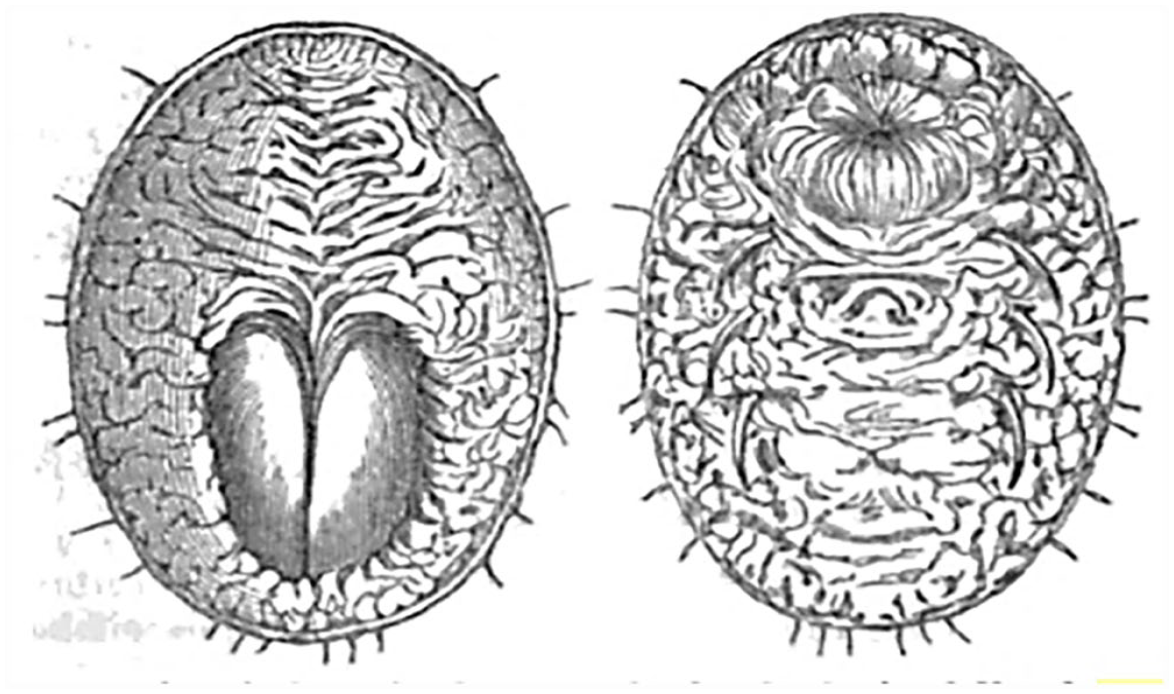
Microscopic features of the dorsal and ventral surfaces of insect wax larvae.
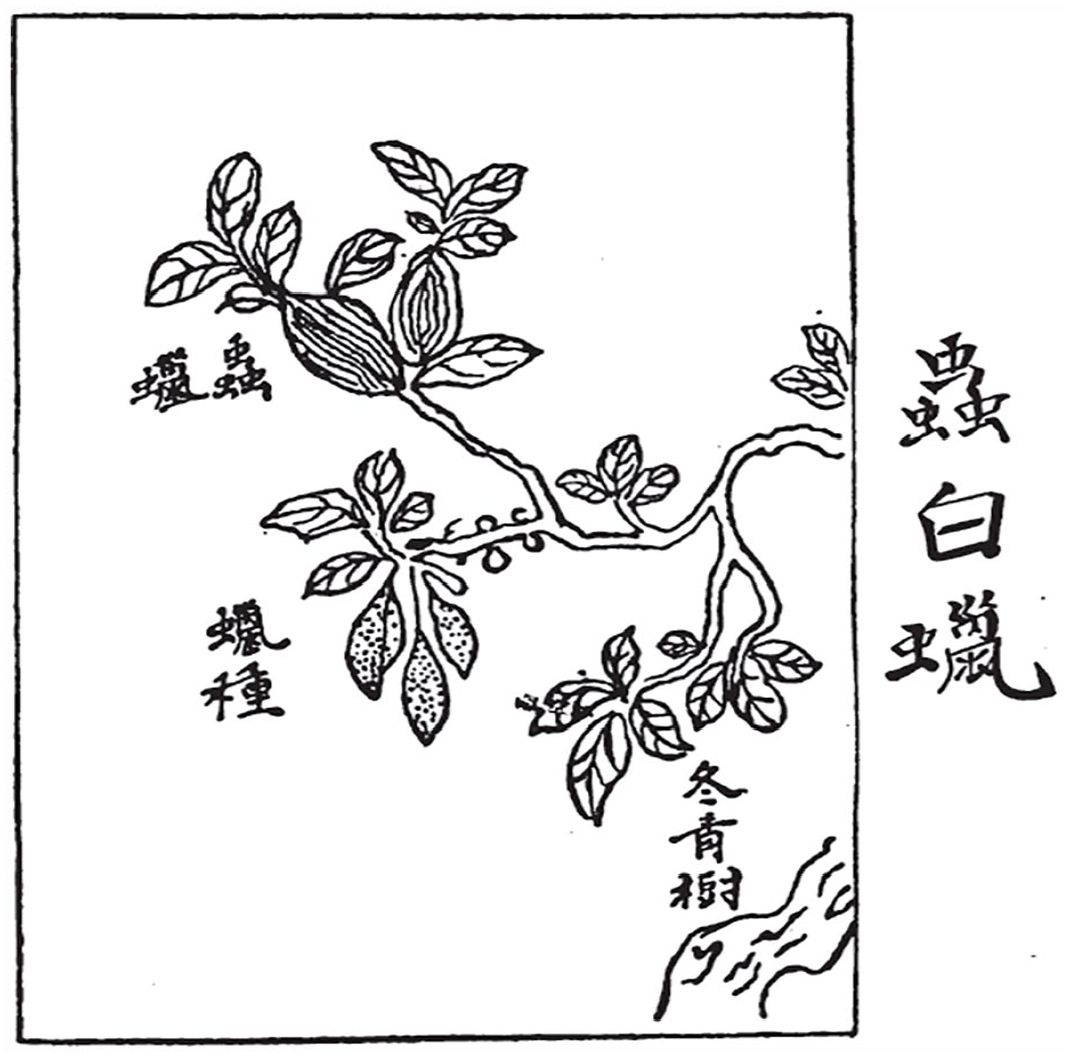
Wax trees and wax insect.
Secondly, European scientists not only classified and named these new insect-based specimens collected by Westerners in China, but also kept the wax insect for close observation in the laboratory and outdoors. In 1880, the French Jesuit Charles Rathouis, who had received special medical training, completed a professional report in an entomological sense by following the morphological characteristics of wax larvae throughout their growth process to the laying of eggs by adults. Rathouis also made an anatomical drawing of the wax insect at each stage of development (Figure 3). 57
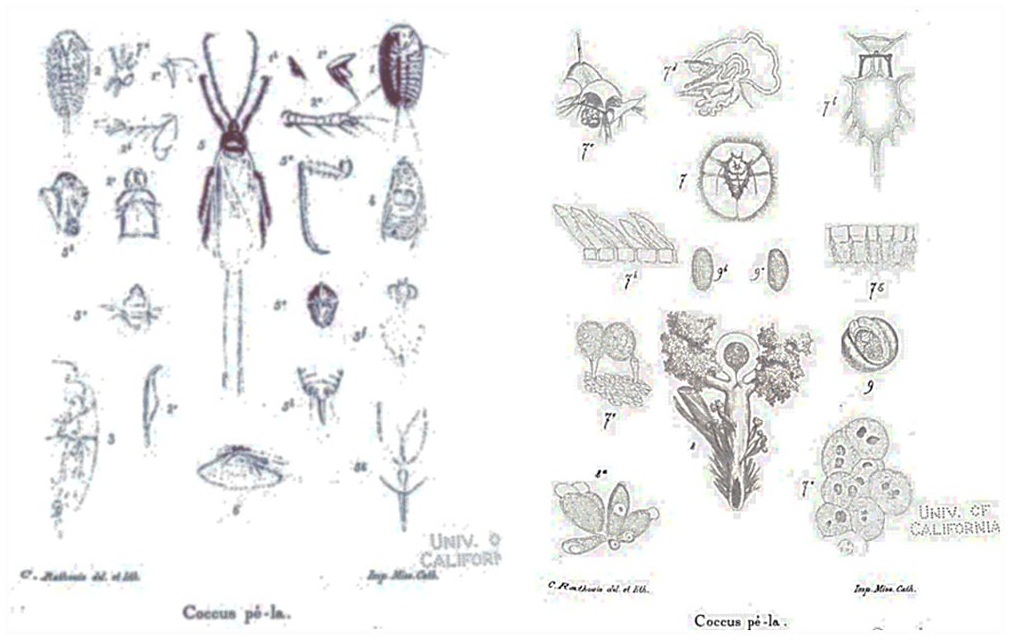
Anatomy of a wax insect.
However, the question of how to cause wax insects to produce wax has always troubled Westerners. While many European scholars agreed with the Chinese belief that the wax was actually “insect dung” or “saliva” “insect dung” and “saliva,” others opposed this view and believed that the insects themselves became wax. In 1850, Jerome Daniel Macgowan, an American Baptist medical missionary and vice-consul in Ningbo, speculated that the wax insect might have undergone a process known as “waxing,” in which the whole body was saturated with wax. 58 In 1880, Rathouis revealed the truth through careful dissection of the insect wax and found that the wax filaments were secreted by wax glands located under the worm’s abdomen. 59
Studies on the physical and chemical properties of insect wax
In the 1840s and 1850s, Western research on the physical and chemical properties of waxes focused on the scientific characterization and definition of the differences and connections between waxes and other wax species. Qualitative studies were carried out by saponification, chlorination, oxidation, and distillation to determine the melting point, specific gravity, chemical formula, and practical uses of various waxes. In 1846, Andrew Ure, a Scottish chemist, determined that the lustrous white crystals resembled spermaceti wax in appearance, were hard, and had a melting point of 91°C. In 1848, Brodie Benjamin Collins, a British chemist, determined the melting point of purified wax as 82°C. 60 In 1853, the British botanist Daniel Hanbury tested the melting point of different samples of insect wax and found that the melting point of wax varied with the number of impurities in the wax. Commercial wax samples had a melting point of 82.2°C, while coarse wax specimens sent by the English missionary William Lockhart melted at 83.75°C. 61 Macgowan’s 1850 article “Uses of the Stillingia sebifera, or Tallow Tree, with a notice of the Pe-la, an insect-wax of China” mentions that worm wax melts at 38°C, which Hanbury believed to be a typographical error. 62
The use of insect white wax was explored through studies of its chemical formula and other physicochemical properties of insect white wax and decomposition products (see Table 1). In 1846, Ure measured the specific gravity of insect white wax to be 0.965, higher than the value of stearic acid prepared from animal and vegetable fats and oils by the English merchant William Bolts in 1799, and found that it was insoluble in ethanol, suggesting that it could make good candle wax. 63 In 1848, the British chemist Brodie Benjamin Collins determined the chemical formula of C108H108O4 by analyzing the decomposition products of experiments such as the saponification reaction of insect wax and wrote two sets of chemical equations for the saponification reaction and thermal decomposition of insect wax: 64

Selected Western research results on the physicochemical properties of insect white wax in the 1840s and 1850s.
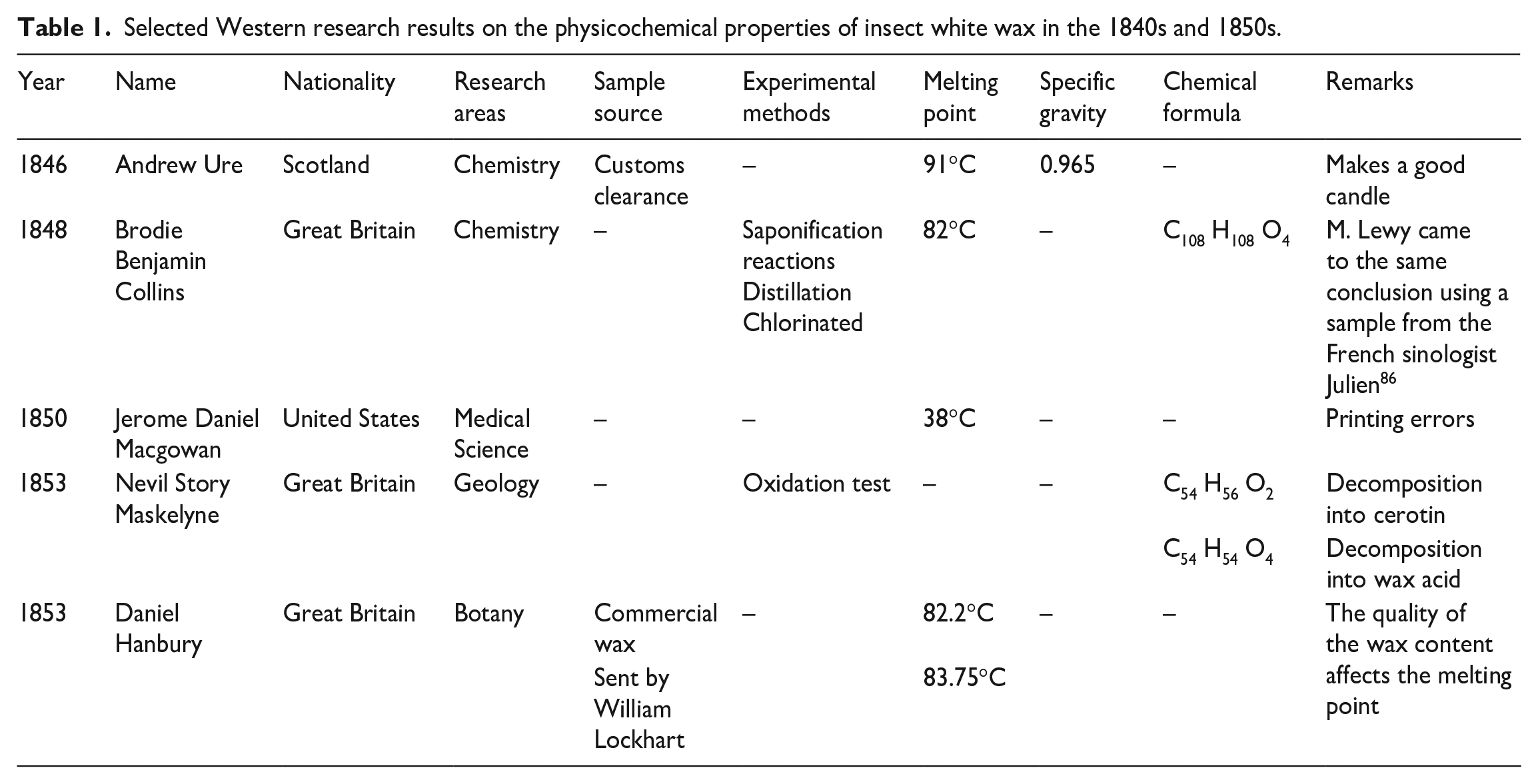
In 1853, the British geologist Nevil Story Maskelyne discovered that insect white wax could be decomposed into cerotin C54H56O2 and cerotin acid C54H54O4 by saponification experiments with the addition of solid alkali, and then oxidation experiments in which the cerotin were all oxidized to cerotin acid by the oxidizing action of the potash-lime. This discovery simplifies the tedious method of procuring cerotin acid barium salts by oxidation, for the washing out of the baryta-salt, formed in the treatment of the Chinese wax, or of the lead-salt of cerotic acid from common beeswax, which is a very tedious operation. 65
From the 1840s to the 1890s, while exploring research on the introduction of wax trees and wax bugs, European researchers in countries such as Bangladesh, India, Great Britain, the United States, and Japan began to search for species similar to the wax insect (Homoptera, Coccoidae, Ericerus), involving at least five species from different families of Homoptera and different families of Hemiptera, comparing the secretions of wax bugs with these species, the quality of the insect wax produced, etc. 67 The physical and chemical properties were compared. Even though it was mainly used for candle making, the Europeans seem to have been anxious to find alternatives that could match the properties of the insect white wax and to find ways to increase the profitability at a lower cost than by introducing the species, due to its obvious advantages over other waxes of the time.
In 1792, George Staunton, the deputy envoy of the Macartney mission to China, in his An Historical Account of the Embassy of the British to the Emperor of China, illustrated a description of the wax insect. 68 In 1843, Captain Thomas Hutton, serving in Bengal, identified the secretions of the wax insect and Flata Limbata (Hemiptera, Fulgoroidea). He found that the secretions of the Flata Limbata were soluble in water, insoluble in oil, and when burned became a hard, baked substance, unlike the secretions of the wax insect: the two were completely different insects. 69 The British histologist Quekett worked to find species with secretions similar to those of the white wax bug. In 1853, he looked microscopically at Dactylopius Coccus (Hemiptera, Dactylopius), wrapped in white wax powder, and the white wax bug and found significant differences in the microstructure of the secretions of the two insects (Figure 4). 70
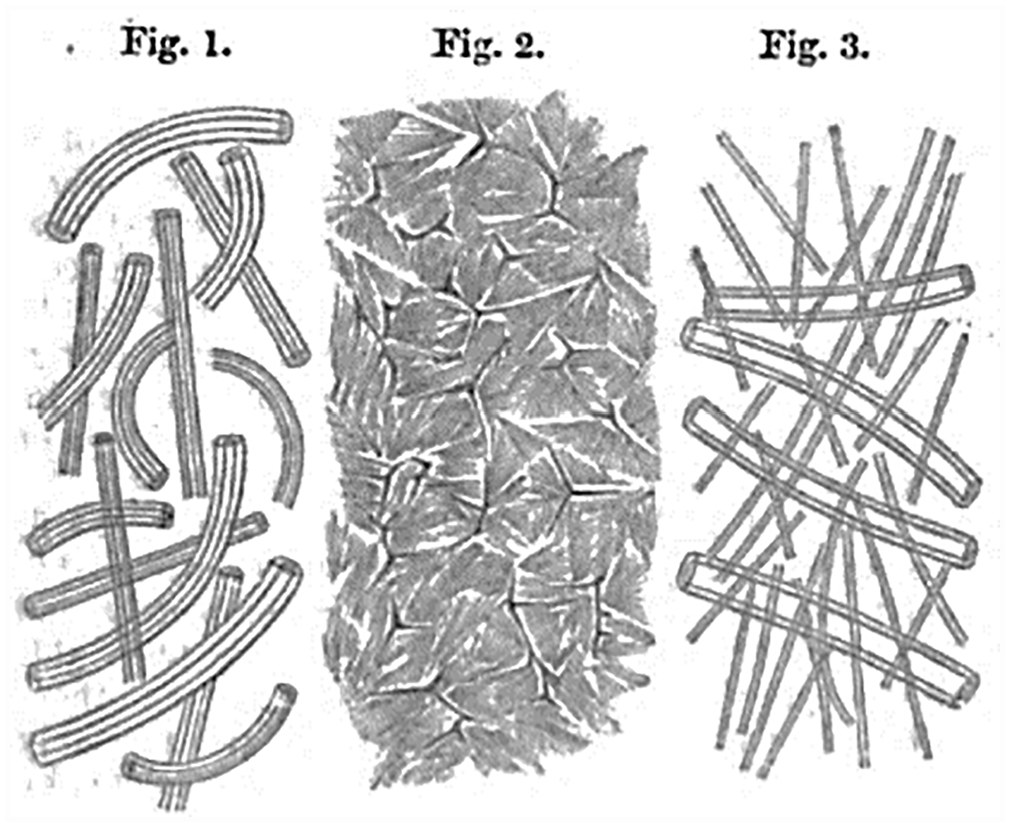
Microscopic features of insect wax.
In 1858 he also compared the Vine coccus (Hemiptera, Mealybugidae), which secretes a cottony white sticky substance, with the wax insect, and even the American blight, which produces a white flocculent substance. 71 The British botanist Hanbury also referred in 1853 to the findings of the British chemist Dr. George Pearson on the physicochemical properties of the secretion of Lacciferlacca (Homoptera, Mealybugidae). 72 Hanbury stated that it was translucent and friable, with a specific gravity greater than that of water when purified and a melting point of 63°C. 73 In 1891, Everard Charles Cotes, a British entomologist working in the Indian Museum, studied another similar species, Ceroplastes ceriferus (Homoptera, Mealybugidae). He showed that this wax bug produces so little wax that it is of little use, and that it burns with a smoky, dim light and gives off a resinous smell, making it unsuitable for commercial candle making in its own right. 74
As Quekett states, “my attention has been directed on all the insect productions I could meet with that, as far as external appearances were concerned, at all resembled the insect wax.” But frustratingly, “the cocoons of insects, and the white flocculent substance known as American blight, has been examined, but none of these presented the same character as the wax in question.” 75 Other researchers likewise failed to conclude much that was encouraging to Westerners. Nevertheless, in the search for similarities or substitutes in the West, the special value of insect wax came to the fore, attracting a great deal of attention and coveting.
Research on seed introduction and production techniques
The Western interest in Chinese insect white wax since the seventeenth century confirms the words of Engels in his “Dialectics of Nature” that geographical discoveries were made purely for profit and therefore ultimately for production. 76 In 1840, the desire for insect wax in the West was fully exposed by a statement made with conviction by Stanislas Julien, the French sinologist, who said: “Je m’engage à les compléter plus tard si l’on reussit a obtenir de Chine l’insecte a cire et a l’acclimater en France.” 77 In 1851, at the First Great Exhibition of the Works of Industry of All Nations in London, China used insect wax. This technique for wrapping candles, which had been used in China for a long time and had only recently been introduced in Europe, drew even more attention to insect white wax in Europe. In 1871, Benjamin Silliman, Professor of Chemistry at Yale University, read Thomas Thornville Cooper’s book Travels of a Pioneer of Commerce in Pigtail and Petticoats: Or, An Overland Journey from China Towards India, and directly stated the idea of industrialization: “Mr. Cooper supplies us with the first definite statement we have seen of what proves to be extensive, and to us novel, industry.” 78 The ultimate aim of that study is therefore how to introduce the process of raw wax production, wax making, and wax products into the West and other countries under Western control.
Study of the production technology of raw wax
European knowledge of the production of virgin wax came to encompass both the cultivation of wax trees and the release of wax. From the late eighteenth to the mid-nineteenth century, European knowledge of wax cultivation techniques came mainly from the visual records of the growth of wax trees by missionaries in China. Wax trees are easily propagated and spread, are cold and heat resistant, and can survive even in the most barren lands without tillage. 79 After 1840, more European researchers witnessed the miraculous wax with its dazzling whiteness, and they urged the French sinologist, Julien, to start collecting and translating information on the insect white wax from Chinese books such as Song’s Miscellaneous Works, the Compendium of Materia Medica, and The Complete Book of Agricultural Administration. The translation of the information is on wax trees, wax insects, and the production of insect white wax, and the cultivation of wax trees included the breeding method of impregnating clear rice and water, pounding it away for ten days, then planting it; it also included the method of raising the wax for one year, stopping it for another year, and cutting the wood before harvesting it so that it did not grow old and dry. 80 In the 1850s, Macgowan, Hanbury, and others examined in detail wax tree planting methods, including the spacing of wax trees, planted in rows about 12 feet apart, and the specifics of both seeding and cutting methods of wax tree propagation, as well as tree pruning, frequency of tilling, prevention of pests and diseases, etc. 81 The area where the wax trees are planted is tilled every six months to ensure that no weeds grow, and the ground is left completely bare to prevent the wax insect from crawling away and also to prevent ants from devouring the wax insect. 82 In 1886, when the Royal Botanic Gardens at Kew were planting Chinese wax trees on a trial basis, the British Consul in China, Cooper, also wrote a letter reminding them that the cultivation of Chinese plants had to mimic the Chinese climate and humidity; the humidity of the air is 30–40% during the five months of winter and 80–90% in summer. 83 In the late nineteenth century, Europe became interested in methods to promote rapid growth. The British botanist Wilson considered cuttings to be superior to sowing: selecting strong branches, cutting off part of the bark and trunk, filling the area around the cut with soil and straw, separating the branches from the parent plant after the roots have grown in the ball of mud, and planting them at the edge of the field for rapid growth into a complete plant, enhancing the rapid growth of wax trees. 84
Along with the study of wax tree cultivation methods, Europeans made observations regarding wax worm placement. These observations were much the same, with differences in the content of the concerns. In 1785, the French scholar Grosier expressed concern over the method used for suspending the insects, which typically involved placing wax insects on the lateral branches of annual or perennial plants. The density of insect packs was adjusted in accordance with the length and size of the bush. For instance, if the bush was five feet high, one or two egg nests were placed on each branch and stem, and so forth. Insect white wax was typically sent to the court in China and was used as tribute wax for the benefit of emperors, princes, and officials of the highest rank. 85 In 1871, the British medical missionary Frederick Porter Smith focused on the process of insect cultivation for the purpose of wax extraction. The process began with the harvesting of cocoons in early May and then wrapping them in Ruo leaves. Subsequently, the wax insects, which completed hatching by mid-June, were allowed to produce wax on the trees’ branches. Toward the end of August, this wax was carefully stripped from the trees, melted in boiling water, strained while hot, and poured into cold water. Subsequently, it condensed into a white, opaque, crystalline substance that was comparable to the finest spermaceti wax. 86 In 1893, Stephen Wootton Bushell, a biologist at the University of London, introduced the method of hanging wax in Lengthy Compilation of Plants with Illustrations (The Chih wu ming shih t’ou k’ao), written by Wu Qijun of the Qing dynasty. 87 Noteworthy is the discovery by the British Consul in Chongqing, Hosie, in 1884 that the surface of cocoons left on uncollected maidenhair trees had round holes where other beetle larvae poked through the shell from the inner wall, and that wax insects used this hole to escape, affecting the amount of wax released. 88
Other European scholars at the time suggested that the transport of eggs to Chia-ting to produce more wax was due to changes in survival conditions that caused the wax insect to become morbid and secrete white wax in large quantities. 89 This is the closest view to the available research. The study by Chen et al. shows that wax secretion by a wax insect is a protective response and ecological countermeasure of the insect to adapt to the environment, a defensive response to adverse conditions, rather than a marker of the insect’s fitness for the ecological environment. 90 The transfer of wax borers to lower mountain areas (e.g. Jiading) to take advantage of the high humidity and low light conditions stimulates an increase in wax production, thus creating a two-site production pattern of high mountain insect production and low mountain wax production. 91
Exploration of the value of finished wax
Apart from candle making, Europeans also discovered other uses for insect white wax. In the 18th century, they focused on the medicinal value of insect white wax. It can be used to treat a variety of diseases, to help wounds grow quickly, to stop bleeding, to prevent heart palpitations, and to “appaife les douleurs; elle rétablit les forces; elle unit les nerfs, &rejoint les os; prife en poudre dont on forme des pillules, elle fait mourir les vers qui caufent la phtifie.” 92 From the nineteenth century onward, other uses and refinements of insect white wax were discovered. In 1871, the British medical missionary Smith learned that insect white wax was the component of the ink, and that a mixture of purifying wax, egg yolk, and sugar was used to treat diarrhea, dysentery, and uterine hemorrhage. 93 It was also used as a polish for paper, cotton, silk, pictures, wooden furniture, walls, and even stone ornaments, as well as a hair fixative and a coating for tablets. 94
In 1848, the French industrialist Isidore Hedde, in his book Étude pratique du commerce d'exportation de la Chine, stated that the collection of practical information that could be imitated was the first task of the government representatives sent to China. 95 The unique Chinese product of insect wax has naturally attracted high attention from the West. Whether it was the translation of ancient Chinese texts or fieldwork on the production of raw wax, wax making, and wax products, the Westerners had key knowledge of the insect white wax industry and seemed to be completing the job they had been sent to do. These efforts only came to an end with the subsequent changes in the world market for lighting materials, since there were so many alternatives for the various uses of wax.
Concluding remarks
The Chinese wax insect was introduced to Algeria by the French a few years after the French sinologist Julien claimed to be able to domesticate the wax insect. 96 The wax tree had been introduced from China to the Botanical Gardens at Calcutta, India, long before 1793. The seeds of two plants, wax tree (little k’u-li) and great k’uli (Fraxinus bungeana DC.), were sent to Paris by the Russian sinologist Bretschneider, where they were planted in the Jardin des Plantes. 97 There is no subsequent record of successful Western cultivation of insect wax in the literature. Until now, only China has produced wax on a large scale. 98
Why has insect white wax not become a major commodity on the world market? 99 It is not explicitly mentioned in Western studies. Based on our findings, there are three main reasons. Firstly, the climatic environment from higher to lower temperatures required for wax worm release is not available in the United Kingdom, France, India, or Algeria. Secondly, wax worm movement and wax hanging need to be done manually and cannot be standardized or machine-produced, resulting in unstable yields and quality, making it difficult to achieve mass production and price advantages. Thirdly, there is little demand for insect white wax for uses other than wax production, and there are many alternatives. In 1891, Charles Denby, the American minister to China, said in his report that “Kerosene lamps afford a cheaper light than tallow candles, and the constantly increasing use of oil diminishes the demand for wax.” 100 Despite this, huge human and material resources were invested in the West, starting in the seventeenth century and reaching a peak in the mid- to late nineteenth century. Missionaries, explorers, diplomats, sinologists, botanists, entomologists, geologists, chemists, and other professionals from Great Britain, France, the United States, Russia, and Japan took it for granted that “a use for this wax may be found abroad to reestablish this interesting and once flourishing industry,” and worked tirelessly to break the “monopoly” of commodities formed by the natural environment in China. 101
This appropriation of non-Western species by relying on modern science and technology is inverse to the armed occupation, overseas migration, and capital export of colonialism, and is “mild” compared to pirate plunder and the slave trade, which we will call “object colonialism.” It is precisely this seemingly “mild” “object colonialism” that has had a more profound impact on the world’s economic and political landscape. While colonialism is explicit and naked, “object colonialism” is implicit. The consequences of this “crossing the borderline of science” were even more frightening: on the one hand it fundamentally destroyed the pattern of resource endowments of the world’s countries, which had been shaped by their natural environment, and shook the economic foundations on which the countries that had been forced to integrate into the world market had been based. This was an intrinsic motivation for the formation of the world economic landscape in the eighteenth and nineteenth centuries. On the other hand, object colonialism had an impact on the Western perception that only those with advanced science and technology could make the most of the uses that nature had given to species from all over the world, and that therefore these species are “rightfully” possessed by Westerners. This is the West-centered theory logic of the world economy, which is the starting point of a Western-centric model of world resource allocation and laid the groundwork for the current political and economic landscape of the world. However, we prefer to regard this “object colonialism” wrapped in scientific terminology as an objective result of subjective intentions, which represents another significant attribute of imperialism.
Footnotes
Acknowledgements
We would like to thank Professor Wei Wang, the member of the Institute of Biotechnology, Shanxi University; Professor Junsheng Hao, the member of the School of Chemistry and Chemical Engineering, Shanxi University; Professor Lissa Roberts, the editor; and the two anonymous reviewers for their selfless and helpful guidance.
Declaration of conflicting interests
The authors declared no potential conflicts of interest with respect to the research, authorship, and/or publication of this article.
Funding
The authors disclosed receipt of the following financial support for the research, authorship, and/or publication of this article: This work was supported by the National Social Science Fund of China (grant number 19BJL001).

1.
At the end of the Southern Song Dynasty, Zhou Mi wrote in the Miscellaneous Knowledge of Guixin, “It is peeled and taken in the middle of August, and decocted in boiling broth, and it becomes wax.” According to the Compendium of Materia Medica, “The insect white wax is different from the beeswax, which is made by small insects. In autumn, it is scraped, boiled and dissolved in water, and strained into cold water, then coalesced into a block. When it is broken, the texture is as clear as white plaster, and people use it to pour oil on candles, and it is much better than beeswax.” See Zhou Mi, Miscellaneous Knowledge of Guixin (Beijing, China: Zhonghua Book Company, 1988), p.214; Li Shizhen, Compendium of Materia Medica, Vol. 39 (Jiangxi, China: Zhang Dingsi and Xia Liangxin, collected by National Library of China, 1603), pp.21–2.
2.
There are varying opinions on the origin of the use of insect white wax. Li Shizhen claimed that it had been known since the Yuan Dynasty. However, during the Ming Dynasty, Shen Maoguan challenged this statement, arguing that the Materia Medica had confused insect white wax with beeswax. Zou Shuwen used this as evidence and corrected Li’s statement by adding records of white wax in documents such as the Materia Medica Tujing, Ximan Congxiao, and Taiping Stories. Zou argued that the “white wax” mentioned in Mingyi Bielu was insect white wax, which could be traced back to the Wei and Jin dynasties. Zhang Changhai and Liu Huaqin supported this claim. However, Cen Zhongmian pointed out, through the records of Yuanhe Junxian Zhi, that the wax was used as a tribute in the Tang Dynasty. Wang Xingguang and Chai Guosheng also believed that the wax was a good lighting material in the Tang and Song dynasties. Yang Kai examined the use of wax in ancient texts such as the Herbal Lection by Shennong, Mingyi Bielu, Naturalis Historia, and Tongdian. Kai found that the evidence for Zou’s theory was insufficient and sided with the traditional “Song and Yuan dynasty theory.” Scholars have debated the origins of wax farming in China and proposed that it existed before the Song and Yuan dynasties. Therefore, it appears that the Chinese started to raise insects for wax only as late as the Song and Yuan dynasties. This passage adopts the terminology used in the text. See, respectively, Li, Materia Medica, p.21 (note 1); Shen Mao Guan, Chinese Flowers, Trees, Birds and Animals Wankao (collected by Tianjin Library, 1581), pp.66–7; Zou Shuwen, “The Origin of the Use of Insect White Wax,” in The Chinese Agricultural Heritage Research Office, Nanjing Agricultural College, and Chinese Academy of Agricultural Sciences (eds.), Collected Studies on the History of Agriculture (Beijing, China: Science Press, 1959), pp.83–92; Zhang Changhai and Liu Huaqin, Chinese Insect, and White Wax Production Technology (Beijing, China: China Forestry Publishing House, 1997), p.1; Cen Zhongmeng, History of Sui and Tang (Beijing, China: The Commercial Press, 2017), p.510; Wang Xingguang and Chai Guosheng, “On the Types and Utilization of Biomass Energy in Ancient China,” Studies in the History of Natural Sciences 29 (2010): 421–36; Yang Kai, “Reanalysis of the Origin of Cera Chinensis Utilization in China,” Studies in the History of Natural Sciences 39 (2020): 152–62.
3.
The word “fu” refers to the name of the administrative division of the Qing dynasty, which is equivalent to the prefecture level in China; As most of the world’s commercial insect white wax is only produced in China, it is known as “Chinese wax.” Historically, insect white wax was produced in the southern provinces of China, “in Sichuan, Huguang, Yunnan, Minling and the southeastern counties of Wu Yue, with those produced in Sichuan, Yunnan, Heng and Yong being the best.” It is also known as “Chuan wax” and makes up around 90% of all wax production in the nation. It was mostly “made in select sections of Sichuan Province, which is remote from the world commerce.” See Li, Materia Medica, p.21 (note 1); Wilhelm Wagner, The Book of Chinese Agriculture, Vol. 2, trans. into Chinese by Wang Jianxin (Nanjing, China: Zhongshan Culture and Education Museum, 1936); Wang Fu, The Breeding and Utilization of the Wax Insect (Chengdu, China: Sichuan People’s Publishing House, 1978), p.1.
4.
Zhou, Miscellaneous Knowledge, p.214 (note 1).
5.
Xi Shaobao and Xie Mingqian, Qianlong Chenzhou Fuzhi, Vol. 16 (Changsha, China: Yuelu Press, 2010), p.32.
6.
Charles Denby, “White Wax in China,” in Bureau of Foreign Commerce (ed.), Reports from the Consuls of the United States, No. 132-5 (Washington, DC: U.S. Government Printing Office, 1891), pp.201–3.
7.
Firstly, it was more physically and chemically stable than mineral waxes (e.g. paraffin wax) and secondly, it had a higher melting point than animal waxes or solid fat waxes and was odorless and tasteless. The high melting point of insect white wax increased the durability and stability of candles. It was attractive to Great Britain and the United States, which also used candles as a lighting tool and had a demand for high-quality wax sources in industrialized goods. In the early to mid-eighteenth century, insect white wax began to enter the world market. According to customs reports, the quantity re-exported from the port of Yichang to Great Britain and the United States in 1887 was about 11,409 piculs, or 1,140,900 catties, valued at 571,044 Hai-kwan taels. In 1888, the export volume of wax was 15,410 piculs, about 1,541,000 catties, and the export value of wax in 1889 was more than 400,000 taels, or about US$460,000 in gold. See Xia Zhengnong, Dictionary of Engineering and Technology, Cihai, 2nd ed. (Shanghai, China: Shanghai Dictionary Press, 1987), pp.1129–30; Isidore Hedde, Étude pratique du commerce d’exportation de la Chine (Paris, France: Renard, 1848), p.59; William Chambers and Robert Chambers, “Wax,” in William Chambers and Robert Chambers (eds.), Chambers’ Encyclopadia: A Dictionary of Universal Knowledge for the People, with Maps and Numerous Wood Engravings, Vol. 8 (New York, NY: Collier, 1887), p.221–2; Bank of China, Chongqing (ed.), Mountain Products of Sichuan Province (Chongqing, China: Economic Research Office of the General Administration of the Bank of China, 1934), p.5; data from The Inspectorate General of Customs (ed.), Returns of Trade at the Treaty Ports and Trade Reports for the Year 1887, Part II (Shanghai, China: The Statistical Department of the Inspectorate General of Customs, 1888), p.72; “Chinese White Wax,” in Royal Botanic Gardens (ed.), Bulletin of Miscellaneous Information (Royal Botanic Gardens, Kew), No. 76/77 (London: Springer, 1893), pp.84–111; Denby, “White Wax in China,” pp.201–3 (note 7); Animal wax materials at the time included beeswax, insect wax, and spermaceti wax, while among vegetable waxes Japanese wax predominated. According to the 1823 edition of The Encyclopædia Britannica, candles were made from sheep fat and beef fat, while pig fat candles burned badly and with black smoke. See “Wax” in The Home Encyclopædia: Compiled and Revised to Date from the Leading Encyclopædias, Vol. 19 (Chicago, IL: Educational Publishing Company, 1895), p.6303; “Candle,” Vol. 5 of Encyclopaedia Britannica; Or A Dictionary of Arts, Sciences, and Miscellaneous Literature, 6th ed. (Edinburgh: Archibald Constable, 1823), pp.124–5.
8.
This sentence means “likely to become the counterparts of our exports.” See Hedde, Étude pratique du commerce d’exportation de la Chine, p.1 (note 8).
9.
In the late twentieth century, the British garden historian Toby Musgrave and others expressed the British mentality toward Chinese species at the time in their book The Plant Hunters in this way: “In the 18th and early 19th centuries, some Chinese plants, such as hydrangeas, peonies and chrysanthemums, settled in the British Isles and excited the British. . . who generally believed that there were more Chinese treasures still to be discovered” and they “went to great lengths to clear every possible obstacle to be able to send a plant hunter to China to collect plants.” See Toby Musgrave, Chris Gardner, and Will Musgrave, The Plant Hunters, trans. into Chinese by Yang Chunli and Yuan Yu (Taiyuan, China: Hope Press, 2005), p.101.
10.
James W. Frey, “Prickly Pears and Pagodas: The East India Company’s Failure to Establish a Cochineal Industry in Early Colonial India,” The Historian 74 (2012): 241–66; William Eamon, “Corn, Cochineal, and Quina: The ‘Zilsel Thesis’ in a Colonial Iberian Setting,” Centaurus 60, no. 3 (2018): 141–58; Amy Butler Greenfield, A Perfect Red: Empire, Espionage and the Quest for the Colour of Desire (New York, NY: Harper Collins, 2005); The term “scientific imperialism” was coined by the American historian of science Lewis Pyenson in Cultural Imperialism and Exact Sciences: German Expansion Overseas, 1900-1930 (New York, NY: Lang, 1985). For more information on scientific imperialism see Roy MacLeod, “On Visiting the ‘Moving Metropolis’: Reflections on the Architecture of Imperial Science,” in Nathan Reingold and Marc Rothenberg (eds.), Scientific Colonialism: A Cross-Cultural Comparison (Washington, DC: Smithsonian Institution Press, 1987), pp.217–19; Paolo Palladino and Michael Worboys, “Science and Imperialism,” Isis 84 (1993): 91–102; Richard Drayton, “Science and the European Empires,” Journal of Imperial and Commonwealth History 23 (1996): 503–10; William Storey (ed.), Scientific Aspects of European Expansion (Brookfield, VT: Variorum, 1996); Richard Grove and Richard H. Grove, Green Imperialism: Colonial Expansion, Tropical Island Edens and the Origins of Environmentalism, 1600–1860 (Cambridge: Cambridge University Press, 1995); Lucile Brockway, Science and Colonial Expansion: The Role of the British Royal Botanical Gardens (New York, NY: Academic Press, 1979); Donal P. McCracken, Gardens of Empire: Botanical Institutions of the Victorian British Royal British Empire (London: Leicester University Press, 1997); Arjo Roersch van der Hoogte and T. Pieters, “Science in the Service of Colonial Agro-Industrialism: The Case of Cinchona Cultivation in the Dutch and British East Indies, 1852–1900,” Studies in the History and Philosophy of Biological and Biomedical Sciences 47 (2014): 12–22.
11.
Fa-ti Fan, British Naturalists in Qing China: Science, Empire, and Cultural Encounters, trans. into Chinese by Yuan Jian (Beijing, China: China Renmin University Press, 2011).
12.
That is, with the dominant position of the West in the allocation of world resources.
13.
Zhao Tieqiao, “Biological Resources of Foreigners in China in Modern Times,” Bulletin of Biology 26, no. 7 (1991): 33–4, 28; Luo Guihuan, “Botanical Expeditions and Collections Made by Westerners in China Since the Qing Dynasty,” The Chinese Journal for the History of Science and Technology 15, no. 2 (1994): 17–31; Luo Guihuan, “Biological Exploration in Wuyi Mountain by Modern Westerners,” The Chinese Journal for the History of Science and Technology 23, no. 1 (2002): 31–7; Luo Guihuan, History of Western Botanical and Zoological Studies in China (Jinan, China: Shandong Education Press, 2005); Gao Ju, “Modern Westerners’ Exploration and Travel in the Chinese Areas of Sichuan, Yunnan, Tibet” (Master’s Thesis, China University of Geosciences, Beijing, China, 2010); Yang Mei, “Modern Western Exploration and Writings in Yunnan” (PhD Thesis, Yunnan University, China, 2011).
14.
For example, books edited by Xu Shigeng, Wu Cibin, Zhang Changhai, Liu Huaqin, and the Shaanxi Provincial Biological Resources Expedition provide detailed discussions on the useful applications of wax, techniques for rearing wax insects, cultivation methods of wax trees, and pest control. Wang Xujun et al. conducted comparative experiments on wax production by seed insects, focusing on wax and the cultivation aspect of wax as a biological resource. Lv Pin and Wang Xueqing et al. used high-throughput sequencing technology to sequence and annotate the wax insect symbiotic bacteria and wax flower symbiotic bacteria. Ma Jinju et al. solved the problem of limited application due to the insolubility of the advanced alkanol of insect white wax in water by preparing an emulsion; Wang Zhandi et al. explored the role of insect white wax in promoting hair growth from the perspective of its medicinal value. See Xu Shigeng, White Wax (Beijing, China: China Forestry Publishing House, 1959); Wu Cibin, White Wax Insect and White Wax Production (Beijing, China: China Forestry Publishing House, 1989); Zhang and Liu, Chinese Insect (note 2); Shaanxi Provincial Biological Resources Expedition, White Wax Insect and White Wax Production (Xian, China: Shanxi Renmin Publishing Company, 1974); Wang Xujun et al., “Study on the Wax-Secreting Capacity of the Breeding Insect of Ericerus pela (Chavannes),” Hunan Forestry Science & Technology 47, no. 1 (2020): 77–80; Lv Pin, “Diversity and Dynamic Changes of Symbiotic Bacteria in the Development of Ericerus pela” (Master’s Thesis, Chinese Academy of Forestry, Beijing, China, 2019); Wang Xueqing et al., “Analysis of the Diversity of Microorganisms in the Wax Secreted by the Chinese White Wax Scale Insect, Ericerus pela (Chavannes) (Hemiptera: Coccidae),” Acta Entomologica Sinica 59, no. 10 (2016): 1086–92; Ma Jinju et al., “Preparation of Microemulsion with Policosanol Derived from Insect Wax and Its Application in Functional Beverage,” Food Science 40, no. 12 (2019): 78–84; Wang Zhandi et al., “Mechanism of White Wax on Treating Seborrheic Alopecia,” Chinese Journal of Ethnomedicine and Ethnopharmacy 28, no. 10 (2019): 17–21; Such studies include: Long Cunni, “The Culturing of Ericerus pela (Chavannes) in China and the Transmission of Chinese Wax into Europe,” Chinese Agricultural History 24, no. 4 (2004): 19–24; Mou Xuping, “A Study on the Evolution of Ericerus pela Trade in Ningshu, Sichuan Province,” Journal of Chinese Culture 157, no. 5 (2019): 56–62, 156–7; Gong Zhen and Wang Jiange, “From Raising Chinese White Wax Insects to Cultivating Opium: The Social Reconstruction of the Yi People in Liangshan in Modern Times from the Perspective of Agricultural Economic History,” Chinese Agricultural History 40, no. 2 (2021): 70–7. Such studies include Lai Xianguang and Chen Xiaoze, “A Brief Discussion on the Potential of Developing Insect White Wax Production in China,” Journal of West China Forestry Science 2 (1987): 31–4, 30; Wang Fu, “The Evolution of China’s Wax Insect Industry and Its Revitalization Strategy,” Resources Science 2 (1992): 37–43, 56; Fu Shanshan, “Archival Record: The White Wax Branch in Xinzhenba, South County, Qing Dynasty,” Sichuan Archives 1 (2015): 51–2; Fu Shanshan, “A Study of ‘White Wax’ as a Product of Sichuan Province in the Qing Dynasty as Seen in the South Archives,” Journal of Mudanjiang Normal University (Social Sciences Edition) 3 (2015): 84–7; Yun Chuanjie, “Research on Sichuan Wax Industry Economy during the Republic of China” (Master’s Thesis, Southwest University, Chongqing, China, 2019).
15.
In 1934, when Wang Jianxin translated The Book of Chinese Agriculture by Wagner, a German who had been a lecturer in agriculture at a higher school in Qingdao, China, he transliterated Jinnige as Nicolas Trigault, and wrote that the earliest record of insect wax being brought to Europe was documented by the British Jesuit missionary, Terry Gault, in 1651, who described the collection of wax from the southeastern coastal provinces of China. After that, news of China breeding wax-producing insects spread to Europe. See Wagner, Chinese Agriculture, p.514 (note 4); Matteo Ricci and Nicolas Trigault, Ricci’s Chinese Journal, trans. into Chinese by He Gaoji, Wang Zunzhong, and Li Shen (Beijing, China: China Travel Publishing House and The Commercial Press, 2017), p.54.
16.
Martino Martini, Novus Atlas Sinensis (Amsterdam, Netherlands: Blaeu, 1655), pp.76, 145.
17.
Gabriel de Magalhāes, A New History of the Empire of China, trans. into Chinese by He Gaoji and Li Shen (Zhengzhou, China: Elephant Press, 2004), p.87.
18.
Giovanni Francesco Gemelli Careri, “A Voyage round the World,” in Awnsham Churchill and John Churchill (eds.), A Collection of Voyages and Travels, Vol. 4 (London: Awnsham and John Churchill, 1704), p.383.
19.
The Europeans were not yet familiar with wax, and called it “tree wax” because people collected it from trees. See Jean-Baptiste Du Halde, The Jesuits in China: Memoirs of China 4, trans. into Chinese by Geng Sheng (Zhengzhou, China: Elephant Press, 2005), pp.367–70; Jean Baptiste Gabriel Alexandre Grosier, Description générale de la Chine, trans. into Chinese by Zhang Dantong and Zhang Fang (Zhengzhou, China: Elephant Press, 2019), pp.207–8.
20.
The place names here use the Hanyu Pinyin system and the passage reads in the original: “Lu-chan fu in Nganhwui, Kia-hing fu in Cheh kiang, Hing-hwa in Fuhkien, Li-ping fu and Hing-i fu in Kweichau, Chang-teh fu, Kwang-chau ting, Tsing chau, Yung-shun fu, Hang-chau fu, Kwei-yang chau, and other places in Hunan, with several districts in Yunnan and Sechuen.” See Frederick Porter Smith, Contributions towards the Materia Medica & Natural History of China (Shanghai, China: American Presbyterian Mission Press, 1871), p.119.
21.
William John Gill, The River of Golden Sand: Being the Narrative of a Journey though China and Eastern Tibet to Burma, Vol. 2 (London: John Murray, 1880), p.61.
22.
“Chinese White Wax,” pp.84–111 (note 8); Kew’s request for assistance from the Ministry of Foreign Affairs and the consul’s reply are included in Kew: Miscellaneous Reports, including Letter from William M. Cooper to Sir William Thiselton-Dyer, from HM Consulate, Ning-po [Ningbo, China] (July 4, 1884), Ref No: DC/150/135; Letter from William M. Cooper to [Sir William Thiselton-Dyer], from Ning-po [Ningbo, China] (February 19, 1886), Ref No: DC/150/139; Letter from Augustine Henry to Sir William Thiselton-Dyer, from Ichang [Yichang], China (March 9, 1886), Ref No: DC/151/584; Letter from Augustine Henry to the Royal Botanic, Kew, from Ichang [Yichang], China (April 4, 1887), Ref No: DC/151/601; China: Economic Products: Insect White Wax (1853–April 15, 1897), Ref No: MCR/4/2/4.
23.
Patrick Devereux Coates, The China Consuls: British Consular Officers, 1843–1943 (Hong Kong, China: Oxford University Press, 1988), pp.489–90.
24.
British Association for the Advancement of Science (ed.), Report of the Fifty-Fifth Meeting (London: John Murray, 1886), p.1064.
25.
William M. Cooper, “Letter from William M. Cooper to Her Majesty,” Kew Bulletin 76/77 (1893): 86–90.
26.
Alexander Hosie, Three Years in Western China: A Narrative of Three Journeys in Ssй-ch′uan, Kuei-chow, and Yun-nan, trans. into Chinese by Han Hua (Beijing, China: Zhonghua Book Company, 2019), p.149.
27.
E. Colborne Baber, “Report on the Production of White Wax in Ssй-ch′uan,” Kew Bulletin 76/77 (1893): 90–7.
28.
Ibid., 94; Thomas Thornville Cooper, Travels of a Pioneer of Commerce in Pigtail and Petticoats: Or, An Overland Journey from China towards India (London: John Murray, 1871), p.429; Breeding wax insects and hanging packs of wax insects are two very different processes. As the adult females attached to the branches become impregnated, their bodies expand and form a hard mother shell, the larvae inside the shell cannot come out on their own and need to be manually stripped of their pellets and then placed on the wax tree, i.e. “hanging wax.”
29.
E. H. Wilson, China, Mother of Gardens, trans. into Chinese by Bao Zhiyi (Beijing, China: China Youth Publishing Group, 2017), pp.515–17; Xu Guangqi, The Complete Book of Agriculture, Vol. 2 (Shanghai, China: Shanghai Ancient Books Publishing House, 2020), p.818.
30.
Hosie, Three Years in Western China, p.149 (note 36).
31.
Ferdinand Freiherr von Richthofen, Letters to the Shanghai General Chamber of Commerce (Shanghai, China: The Ching-foong Printing Office, 1872), pp.52–3; Baber, “Report on the Production of White Wax in Ssй-ch′uan,” 92 (note 37). This report is a summary of the 1877 Bedloe survey.
32.
Ibid., 92.
33.
Wu Qijun, Lengthy Compilation of Plants with Illustrations, Vol. 22 (Beijing, China: The Commercial Press, 1959), p.1061.
34.
Benjam Charles George Scott, “Report on the Production of Insect or White Wax in the Province of Anhui,” Kew Bulletin 76/77 (1893): 108–11.
35.
Date Source: Prices of the Imported Insect Wax at Ningpo during the Years 1878 to 1884, in Cooper, “Letter to Her Majesty,” 89 (note 35). “Hai-kwan tael” refers to a unit of accountable currency used by customs in the mid to late Qing dynasty. “Picul” and “catty” is the unit of weight used in China. 1 picul = 100 catties ≈ 133.3 pounds.
36.
Based on Baber, “Report on the Production of White Wax in Ssй-ch′uan,” 96 (note 37), converted from 1 Hai-kwan tael=2 shillings and 8 pence=1.114 taels. See Yao Xianhao (ed.), Materials on the History of Modern Chinese Foreign Trade (1840–1895), Vol. 3 (Beijing, China: Zhonghua Book Company, 2016), p.1671.
37.
Cooper, “Letter to Her Majesty,” 86–90 (note 35).
38.
Letter from Cooper, February 19, 1886 (note 32).
39.
Ricci and Trigault, Ricci’s Chinese Journal, p.54 (note 23).
40.
de Magalhāes, A New History of the Empire of China, p.87 (note 25).
41.
Careri, “A Voyage Round the World,” p.383 (note 26); Du Halde, The Jesuits in China, p.367 (note 27).
42.
Liang Jiamian (ed.), Draft History of Chinese Agricultural Science and Technology (Beijing, China: Agricultural Press, 1989), p.588; In the article “Ancient Records on the Breeding of the White Wax Insect in China,” Wang Fu said that it was a mistake to state in the Compendium of Materia Medica that “Tianzhu trees can also hang wax.” The ancient people used the terms “midge,” “louse,” and “nymph” to describe white wax larvae, but the biological characteristics of male and female wax insects were not understood; instead, they were mistaken as “Spitting wax when young and when it is old, it becomes wax insect species.” Also, the white wax was wrongly understood as “white dung,” “insect dung,” or “saliva.” See Wang Fu, “Ancient Records on the Breeding of the White Wax Insect in China,” Chinese Journal of Applied Entomology 3 (1965): 178–180, 185.
43.
Li, Materia Medica Vol. 36, p.44 (note 1).
44.
Robert Fortune, “The White Wax Insect of China,” The Gardeners’ Chronicle and Agricultural Gazette 12, no. 34 (1852): 532; Du Halde, The Jesuits in China, p.367 (note 27).
45.
Edward Donovan, An Epitome of The Natural History of the Insects of China (London: Bensley, 1798), pp.47–51.
46.
William Chambers and Robert Chambers, “The Wax-Insect of China,” Chambers’ Edinburgh Journal 19–20, no. 521 (1853): 414–15.
47.
Ibid., 414–15.
48.
Baber, “Report on the Production of White Wax in Ssй-ch′uan,” 95 (note 37).
49.
Originally written as “Pao-ke-ts’ao,” it was so called because the glossy privet crackles and pops like a firecracker when it burns; Hosie, Three Years in Western China, p.150 (note 36).
50.
Henry Fletcher Hance, “Notes on Some Plants from Northern China,” The Journal of the Linnean Society 13 (1873): 74–94.
51.
Even today, the scientific name “Ligustrun lucidum (Ait)” is used.
52.
“Chinese White Wax,” pp.84–111 (note 8).
53.
Letter from Cooper, February 19, 1886 (note 32).
54.
Long, “The Culturing of Ericerus pela,” 19–24 (note 21).
55.
Wilson, China, p.515 (note 41); John Obadiah Westwood, “Entomological,” The Athenaeum 1321 (1853): 229.
56.
John Thomas Quekett, “On the Microscopical Characters of the Insect-White-Wax of China,” Pharmaceutical Journal and Transactions 12, no. 10 (1853): 482–4.
57.
Charles Rathouis, “Étude sur le Coccus pé-la,” in Pierre Marie Heude (ed.), Pères de la Compagnie de Jésus, Mémoires concernant L’histoire naturelle de L’empire chinois (Shanghai, China: La Mission catholique, 1880), pp.43–55.
58.
Jerome Daniel Macgowan, “Uses of the Stillingia Sebifera, or Tallow Tree, with a Notice of the Pe-la, an Insect-Wax of China,” Annals and Magazine of Natural History 10, no. 56 (1852): 152–7.
59.
Rathouis, “Étude sur le Coccus pé-la,” pp.43–55 (note 76).
60.
Brodie Benjamin Collins, “An Investigation on the Chemical Nature of Wax,” Philosophical Transactions of the Royal Society 138 (1848): 159–70.
61.
Daniel Hanbury, “On the Insect-White-Wax of China,” in Joseph Ince (ed.), Science Papers: Chiefly Pharmacological and Botanical (London: Macmillan and Co., 1876), pp.60–73.
62.
Macgowan, “Uses of the Stillingia sebifera,” 152–7 (note 77).
63.
Commissioners for the Exhibition of 1851 (ed.), Reports by the Juries on the Subjects in the Thirty Classes into Which the Exhibition was Divided (London: William Clowes & Sons, 1852), p.617; Stearic acid is a solid fatty acid obtained from animal and vegetable fats and oils and is used in candle making. The Scottish chemist Andrew Ure mentions in his article that stearic acid has a melting point of 59°C–60°C and a specific gravity of 0.943, Andrew Ure, “Chinese Vegetable Wax,” The Pharmaceutical Journal and Transactions 6, no. 2 (1846): 69.
64.
Collins, “An Investigation on the Chemical Nature of Wax,” 159–70 (note 79).
65.
Nevil Story Maskelyne, “On the Oxidation of Chinese Wax,” Quarterly Journal of the Chemical Society of London 5, no. 1 (1853): 24–6.
66.
Collins, “An Investigation on the Chemical Nature of Wax,” 159–70 (note 79).
67.
Probably since the early East–West white wax trade was transshipped through Japan, Europeans at the time considered Japan to be a white wax producer as well. The Japanese researcher Sasaki had gathered wax insect specimens in the prefectures of Fukushima, Tottori, Nagano, and Kochi but was unable to put them to productive use. William Turner Thiselton-Dyer, the director of Kew Gardens in England, wrote an article on the difference between Chinese wax and Japanese wax. He claimed that the former is an animal wax while the latter is a vegetable wax, which is frequently exported from Japan but is inferior to beeswax and far less valuable than insect wax. See Long, “The Culturing of Ericerus pela,” 19–24 (note 21); 佐々木忠二郎,「いぼたろう(虫白蠟)ニ就キテ」,『動物學雜誌』10, no. 114 (1898): 111–16; Smith, Contributions towards the Materia Medica, p.228 (note 29).
68.
George Staunton, An Historical Account of the Embassy to the Emperor of China (London: John Stockdale, 1797), pp.179–80.
69.
Thomas Hutton, “Note on the Flata Limbata and the White Wax of China,” The Journal of the Asiatic Society of Bengal 12, no. 142 (1843): 898–903.
70.
Quekett, “On the Microscopical Characters of the Insect-White-Wax of China,” 482–4 (note 75).
71.
John Thomas Quekett, “Note on a Filamentious Substance Surrounding Coccus Vitis, or Mealy Bug of the Vine, and Resembling the Crude Insect White Wax of China,” The Pharmaceutical Journal: A Weekly Record of Pharmacy and Allied Sciences 17 (1858): 323–4.
72.
George Pearson, “Observations and Experiments on a Wax-Like Substance, Resembling the Pe-la of the Chinese, Collected at Madras,” The Philosophical Transactions of the Royal Society of London 17 (1794): 383.
73.
Hanbury, “On the Insect-White-Wax of China,” pp.60–73 (note 80).
74.
Everard Charles Cotes, “White Insect Wax in India,” India Museum Notes 2, no. 3 (1891): 91–7.
75.
Quekett, “Note on a Filamentious Substance Surrounding Coccus Vitis,” 323–4 (note 91).
76.
Friedrich Engels, “Dialectics of Nature,” in Karl Marx and Friedrich Engels, The Complete Works of Marx and Engels, Vol. 20, trans. into Chinese by Central Compilation and Translation Bureau (Beijing, China: People’s Publishing House, 1971), p.524.
77.
This sentence means “I undertake to complete them later if we succeed in obtaining the wax insect from China and acclimatizing it in France.” See M. Stanislas Julien, “Nouveaux renseignements sur la cire d’arbres et sur les insectes qui la produisent, etc. Extraits des auteurs chinois,” Comptes Rendus de L’académie des Sciences 10, no.1 (1840): 618–25.
78.
Commissioners for the Exhibition of 1851, Reports, p.1389 (note 82); Cooper, Travels of a Pioneer of Commerce in Pigtail and Petticoats, p.429 (note 39); B. Silliman, “The Chinese White Wax Insect,” The American Naturalist 5, no. 11 (1871): 683–5.
79.
Grosier, Description générale de la Chine, p.207 (note 28).
80.
Julien, “Nouveaux renseignements sur la cire d’arbres et sur les insectes qui la produisent, etc. Extraits des auteurs chinois,” 618–25 (note 97).
81.
“If the former (seeds), they are soaked in water in which unhusked rice has been washed, and their shells pounded off: when propagated by cuttings, branches an inch in diameter are recommended as of the most suitable size.” See Macgowan, “Uses of the Stillingia sebifera,” p.155 (note 77).
82.
Ibid., 152–7; Hanbury, “On the Insect-White-Wax of China,” pp.60–73 (note 80).
83.
Letter from Cooper, February 19, 1886 (note 32).
84.
Wilson, China, p.516 (note 41).
85.
Grosier, Description générale de la Chine, p.208 (note 28).
86.
Smith, Contributions towards the Materia Medica, p.118–19 (note 29).
87.
Stephen Wootton Bushell, “Notes on the Production of Insect White Wax in China,” Kew Bulletin 76/77 (1893): 101–7.
88.
Hosie, Three Years in Western China, p.152 (note 36).
89.
Baber, “Report on the Production of White Wax in Ssй-ch′uan,” 90–7 (note 37).
90.
Chen Xiaoming, “Research on the Ecology of Natural Populations of White Wax Insect and Its Application” (PhD Thesis, China Academy of Forestry Science, Yunnan, 1997).
91.
Chen Xiaoming et al., “The Impact of Environmental Factors on the Wax Excretion by Chinese White Wax Scale (Ericerus pela Chavannes),” Acta Ecologica Sinica 1 (2007): 103–12.
92.
Du Halde, The Jesuits in China, pp.367–70 (note 27); This French phrase describes the medicinal properties of insect white wax that can be used to alleviate pain, restore strength, and treat phthisis. In 1735, the translation of the theory of the medicinal properties of the Materia Medica and the sixteen medicines in the Complete History of the Chinese Empire, edited by the French priest Du Halde, was based on a manuscript by the French missionary Claude Visdelou. See Jean Baptiste Du Halde (ed.), Description géographique, historique, chronologique, politique et physique de l’Empire dela Chine et de la Tartarie Chinoise, Vol. 3 (Paris, France: P. G. Le Mercier, 1735), pp.495–6.
93.
Smith, Contributions towards the Materia Medica, pp.118–19 (note 29).
94.
Cooper, “Letter to Her Majesty,” 86–90 (note 35); Scott, “Report on the Production of Insect or White Wax in the Province of Anhui,” 108–11 (note 48); Denby, “White Wax in China,” pp.201–3 (note 7).
95.
Hedde, Étude pratique du commerce d’exportation de la Chine, p.1 (note 8).
96.
Chambers and Chambers, “Wax,” p.222 (note 8).
97.
Bushell, “Notes on the Production of Insect White Wax in China,” 101–7 (note 110).
98.
The academic community holds divergent opinions regarding the nations that produce insect wax. In 1959, Xu Shigeng wrote that “the distribution of wax is recorded in China, Japan, and India.” Ke Zhiguo believed that the distribution of insect wax also includes other countries in Asia, such as the Soviet Union. In 1992, Wang Fu, based on Varshney’s article, stated that there are 630 species of scale insects in India, but did not mention the wax-producing insects. In 2003, Lu Wenxi adopted Xu’s statement and asserted that “only India, Japan, and China produce insect wax in the world. The former Soviet Union introduced it to the Far East but did not develop it successfully.” See Shigeng, White Wax, p.1 (note 20); Ke Zhiguo, “Analysis of the Distribution and Ecological Factors of the White Wax Insect,” Chinese Journal of Applied Entomology 18, no. 6 (1981): 257–9; Wang, “The Evolution of China’s Wax Insect Industry and Its Revitalization Strategy,” 37–43, 56 (note 22); R. K. Varshney, “A Review of Indian Coccids (Homoptera: Coccoidea),” Oriental Insects 19, no. 1 (1985): 1–101; Lu Wenxi, “Regional Division of Labour in Historical Sichuan Insect White Wax Production,” Journal of Southwest Minzu University (Humanities and Social Science) 25, no. 12 (2003): 202–5.
99.
According to the Chambers Encyclopaedia, although wax was supposed to be an excellent material for candles, manufacturers found it difficult to make candles from it. Perhaps because of its high price, it never became a commercially important commodity in Europe. “Wax,” in William Chambers and Robert Chambers (eds.), Chambers’ Encyclopædia: A Dictionary of Universal Knowledge for the People, with Maps and Numerous Wood Engravings, Vol. 10 (New York, NY: W. & R. Chambers, 1892), p.584.
100.
Denby, “White Wax in China,” pp.201–3 (note 7).
101.
Ibid., pp.201–3.