



Abstract
This article delves into Captain Samuel Alfred Warner’s dogged campaign to sell two inventions – his submersible mine and “long range” missile – to the British government in the 1840s and 1850s. Departing from a historiography that dismisses Warner as a fraudster, it clarifies how he managed to generate widespread interest in his weapons technologies for nearly twenty years. I therefore analyze three key elements of his self-promotion: his personal branding, his pitch, and his simultaneous embrace and rejection of publicity. Neither elite nor highly educated, Warner ran up against a culture of “polite science” that distinguished disinterested practitioners from profit-minded schemers. To establish his credentials, he emphasized his practical maritime experience and represented himself as a martyr willing to bear the scorn of a disbelieving establishment. In pitching his devices, Warner capitalized on alarmism over border security and the integrity of the empire; he declared that they could hobble France’s modernizing navy and quickly end colonial conflicts. When skeptics began to fret over the proliferation of his destructive weapons, Warner flipped the script and lauded the threat of mutual annihilation as a deterrent to needless warfare. The issue of publicity, however, would ultimately be Warner’s professional undoing. Despite successful demonstrations, his clashes with official investigators and his refusal to disclose his chemical secrets led critics to dispute the originality of his discoveries. An examination of Warner’s self-promotional strategies, his fraught interactions with the British state, and the ambivalent public reaction to his contraptions provides insight into how scientific authority was acquired and lost in this period.
Standing before the Court of Bankruptcy in November 1850, Captain Samuel Alfred Warner (1793–1853) was ordered to provide a £500 assurance that he would not flee Britain in debt. Warner assented, though he insisted that “those gentlemen who oppose me know as well as I do that I have no intentions whatever of leaving the country.” 1 Who were these shadowy figures circumscribing Warner’s movements? To his mind, they might have been agents of the Admiralty who had long obstructed the deployment of his “invisible shells,” or submersible mines. Likely composed of wood, the shells may have housed a lever-activated “exploding bolt” that contained a glass bulb filled with sulfuric acid and combustible chemical compounds. 2 The parties who sought to extend Warner’s detention might also have denounced his “long range” missile, an ordnance-bearing, “ponderous machine” attached to a hot-air balloon that supposedly could destroy a target at a distance of five miles. One naval official went so far as to denounce this contraption as the “greatest imposition ever practised upon public credulity and gullibility.” 3 But while Warner contended with skeptics and scorn throughout his checkered career, he was not without allies. Henry Chetwynd-Talbot, also known as Viscount Ingestre and Earl Talbot, was a former naval commander and long-serving Conservative MP who doggedly defended Warner’s reputation throughout the 1840s and 1850s. He observed that Warner’s persecution was very much the norm for inventors of his social standing; those who made “a great discovery” were typically obliged “to go through an ordeal, whilst others reaped the benefit.” 4 Warner’s plight was not so different from that of “the man who introduced gas” or the “projector of a scheme to light London’s streets,” both of whom died indebted and in prison.
Although Warner’s exploits were the topic of sustained discussion in Parliament and the press, they have attracted scant historical interest. The scholarship that does exist tends to label him as a charlatan who simply deceived his Tory supporters. Richard Altick, who mentions Warner in passing in his capacious study of Punch, refers to him as a “monomaniacal self-styled ‘Captain’. . . who adamantly refused to reveal his background.” 5 Meanwhile, Anita McConnell’s entry on Warner in the Oxford Dictionary of National Biography speaks to his roguish origins, as both he and his father gained a reputation for smuggling. While McConnell accepted contemporary accusations of Warner’s fraudulence, she also noted that “few such imposters have . . . succeeded in playing successive governments on such a slender line for more than twenty years.” 6 It is this question of self-promotion, more than the ‘truth’ of Warner’s alleged deceptions, that animates the following article. How was Warner able to hold the government’s attention for so long, often communicating directly with prime ministers and first lords of the Admiralty? How did he stimulate sufficient public interest in his work to elevate his profile as a pseudocelebrity and a potential “benefactor to mankind”? 7 And more generally, how did aspiring inventors and engineers gain – and lose – credibility in the early Victorian period?
In broaching these questions, this article contributes to a growing corpus on the cultural history of technological innovation. As Ben Marsden and Crosbie Smith reminded us in Engineering Empires, “whether or not a technology succeeds, or fails, is as much to do with the social as it is to do with any supposed inherent material worth.” 8 Their study therefore probed inventors’ efforts to publicize their devices; Matthew Boulton facilitated “technological tourism” by configuring his factory as a “show-space” for potential investors, while I. K. Brunel stage-managed grand reveals such as the launch of the Great Eastern steamer and helped turn his father’s beleaguered Thames Tunnel into a public attraction. 9 Extending this framework, other scholars have turned their attentions from the promotion of inventions to the self-fashioning of the inventors themselves. David Philip Miller, for instance, has interrogated I. K. Brunel’s creation of a bombastic “inventive persona,” which led him to exercise “supreme authority” over his systems and co-opt others’ patented devices for his own grander purposes. 10 But Brunel’s cultivation of his maverick image also earned him his fair share of detractors who bristled at his arrogance and tendency to play fast and loose with investors’ money. While these studies have rightfully highlighted the social factors and historical contingencies that can contribute to an invention’s take-up or rejection, they have largely centered upon the same luminous pantheon of engineers and men of science. In contrast, this article offers a case study of one of the “smaller men” of invention – to borrow Brunel’s term – who existed at the fringes of respectable scientific circles but nonetheless developed his own techniques to assert his authority, attain credibility, and attract public attention.
The following sections will analyze three elements of Captain Warner’s self-promotion: his personal branding, his messaging (or pitch), and his simultaneous embrace and rejection of publicity. Warner ran up against an established culture of “polite science” that continued to distinguish elite, disinterested practitioners from tawdry, profit-minded mechanics. To establish his credentials as an authority on military science and justify his demands for a hefty £400,000 payment for his two inventions, Warner emphasized his practical maritime experience and represented himself as a martyr who was willing to bear the scorn of disbelievers (like many illustrious minds before him). I further argue that Warner, in pitching his inventions, capitalized on alarmism over border security and the integrity of the empire. As a series of invasion panics gripped Britain, he declared that his devices could hobble France’s modernizing, steam-driven navy. He further insisted that the deployment of his “long range” missile would put a quick end to the recurrent frontier wars in Cape Colony. When skeptics began to fret over the inevitable proliferation of his destructive weapons, Warner flipped the script and lauded the threat of mutual annihilation as a prophylactic against needless war-making.
The issue of publicity, however, ultimately would be Warner’s professional undoing. Contributing to a burgeoning culture of demonstration, he repeatedly showcased his inventions in public and private trials. At first, his successful “implosion” of the John O’ Gaunt vessel off the coast of Brighton in 1844 seemed to confirm the efficacy of his invisible shells. Yet some spectators approached the exhibition as a kind of trick or mirage that one would typically witness in popular venues such as the Adelaide Gallery, where viewers readily gleaned the principles behind the “scientific showmanship.” 11 Warner’s refusal to reveal his secrets prompted a series of speculative opinion-pieces that attempted to expose his process or dispute the novelty of the invention. At the same time, he received some free – albeit partisan – publicity in the columns of the satirical papers that mercilessly mocked Whig naysayers such as MP Henry Brougham who had attended the Brighton event.
The inherent difficulty of publicizing an invention while safeguarding its chemical secrets also waylaid Warner’s negotiations with the British government. Although he repeatedly called for the administration to fund trials of his devices, he was rarely content with the composition of the tribunals or else feared that the military men involved would steal his secrets. When exasperated officials suspended the trials or conducted them in a summary fashion, Warner alleged the existence of an endemic conspiracy within the Admiralty to prevent the innovation of new weapons technologies that would render their ships and crews obsolete. An examination of Warner’s self-promotional strategies, his fraught interactions with the British state, and the ambivalent public reaction to his devices further demonstrates that the very concept of ‘invention’ was hotly contested in this period.
Suffering for science
The nebulous position of the scientific practitioner in nineteenth-century British society has preoccupied historians for over a generation. As Alison Winter aptly put it, “early Victorian science was volatile and underdetermined” to the extent that “immense uncertainty surrounded the communication of scientific claims.” 12 Luminaries such as mathematician Charles Babbage feared that official bodies like the Admiralty were ignorant of recent scientific developments and were being hoodwinked by charlatans who fabricated the results of their experiments. By shaming the Royal Society for its financial irregularities and demanding that commentators sign their published articles, he effectively staged an “attack on corruption in English science.” 13 Such transparency, Babbage hoped, would render science a “completely open enterprise, comprehensible not just to adepts and experts” but to laypeople as well.
Gauging the honesty and respectability of self-anointed scientific authorities remained an issue throughout the century. In her comprehensive study of representational practices, Ruth Barton demonstrates that figures within the natural sciences continued to favor descriptors that emphasized their “self-sacrifice” for the advancement of knowledge. So-called men of science who staged these investigations in their leisure time worked “not for themselves but for mankind.” 14 An emphasis on “truth for truth’s sake” stigmatized those who were guided by financial motivations or whose perceptions were constrained by religious preconceptions. Indeed, science was deemed a suitable topic of conversation in polite society in the 1850s precisely because it was seemingly disconnected from trade. 15 Yet these gentlemanly theoreticians increasingly clashed with the up-and-coming practical mechanics and struggled to assert the significance of their more abstract knowledge. Members of the academic establishment such as natural philosophy professor John Tyndall even called upon the government to subsidize the work of scholars who advanced national interests but could not rely on recompense within the “industrial marketplace.” 16
These professional tussles were a form of what Thomas Gieryn has termed “boundary work,” or the ways in which “science gets stretched and pulled, pinched and tucked, as its epistemic authority is reproduced time and again in a diverse array of settings.” 17 Rather than essentializing science as a transcendent, fixed phenomenon, Gieryn suggests that “cultural cartographers” strategically produce varying “maps of science” that reflect disparate understandings of “natural reality” and must be historicized. As the consequent discourse over methods and facts rages, “the spaces in and around the edges of science” remain “perpetually contested terrain.” 18 This jostling was particularly evident in the 1830s and 1840s, a period in which the debates over the utility of steam versus sailing power were increasingly couched in scientific terms. Vying parties took to the new professional journals, the university classroom, and the public lecture circuit to advance their views. 19 Reacting to this shift, the British Association for the Advancement of Science (BAAS) established Section G for the engineering community in 1836. Although this body was considered the “poor relation” of Section A – the bastion of astronomy and physics – Section G’s speeches and demonstrations proved especially popular when the BAAS held its annual meetings in Britain’s industrial centers. 20
Relatedly, Christine MacLeod has accounted for the public veneration of “practical mechanic” James Watt, who was lauded as both a “projector” and a man of science on account of his steam-engine designs. 21 Despite the fact that some engineers resented Watt for his rigorous patent enforcement, antimilitarist Whigs posthumously elevated him as a harbinger of peace whose innovations had ushered in a pacific era of global commerce and free trade. 22 Yet the “Watt effect,” as MacLeod terms it, did not completely dispel the British public’s “fear of visionary schemers.” 23 Those who advocated for the abolition of the patent system claimed that it promoted a “gambling mentality” among reckless, lower-class speculators who were eager for a quick windfall. 24
Epistemic contests over the elements of “proper” science were also evident in the debates over ship construction that riveted the Admiralty in the 1830s. Adopting Gieryn’s framework, Don Leggett’s “actor-driven history of technology” recreates the clash between the ship designers affiliated with the School of Naval Architecture (SNA) and self-trained Surveyor William Symonds. 25 Whereas the graduates of the SNA sought to bring the science of physics to bear on ship construction, Symonds contended that the Royal Navy’s builders were ignorant of how their vessels actually operated under real-world conditions. 26 Prioritizing maneuverability – a particular hobbyhorse of the influential Royal Yacht Club – ahead of stability, he hoped to generate support for his controversial appointment outside of official circles. While Symonds’ defenders characterized him as a well-rounded “sailor-designer” who melded abstract thinking with practical insights, his detractors defamed him as an amateur who was out of his depth. Incidentally, Chetwynd-Talbot took issue with Symonds’ “unscientific” approach and demanded that the Admiralty establish a “committee of scientific advisors” to prevent the adoption of unsound plans. 27 This stance was somewhat ironic, given that Chetwynd-Talbot later endorsed Warner despite his lack of formal training and his insistence on immense compensation.
How, then, did Warner exploit the contested, occasionally permeable, boundary between engineering and scientific cultures to brand himself as a practical authority on military technology?
In an article published shortly after an underwhelming demonstration of the “long range” in 1846, the Satirist wryly observed that his knowledge of nautical matters was acquired . . . not in the regular but the irregular way. A privateer, there is no doubt, is a capital school for seeing service of a peculiar kind, and a little smuggling gives a zest to the ordinary routine of a sailor’s life.
28
In contrast to engineers like Watt and railway doyen George Stephenson, who carefully cultivated a gentlemanly image, 29 Warner transformed his atypical, swashbuckling background into a core component of his personal branding. He declared that his immersion in the maritime world since childhood had enabled him to acquire “that practical knowledge of which [his] more polished but theoretical opponents are for the most part destitute.” 30 These experiences taught him “sincerity, if not courtly manners” and established his position as an antiestablishment firebrand willing to speak (technological) truth to power. And for a time, commentators in the press excused his uncouth debating style and his pernicious temperament because they believed that he was “more accustomed to manage a ship than to take part in a negotiation.” 31 Yet Warner also emphasized the unprecedented nature of his designs; in so doing, he preyed upon fears that the Admiralty was pathologically averse to innovation and was jeopardizing national security. By situating himself amidst the martyrs of science who had suffered the establishment’s scorn, Warner defensively fashioned himself as a patriotic disruptor whose inventions could not be ignored.
Likely embellished, Warner’s autobiographical narrative foregrounded the intergenerational transfer of chemical secrets, his application of new technologies in the field of battle, and the early accolades he received from admirals and the King of England alike. Warner repeatedly claimed that he had covertly assisted the British government during the waning days of the Napoleonic Wars, when Secretary of State Castlereagh tasked him with landing spies on French soil; Chetwynd-Talbot later affirmed that he had performed this “dangerous and difficult duty exceedingly well.” 32 Around this time, Warner also supposedly sank two privateers off the coast of Folkestone by employing his devices. The design of this invisible shell, which “put an extinguisher on all naval tactics,” was very much a Warner family affair; his grandfather had spent forty years on its composition, which his father gradually perfected. 33 Aware that the Warners had devoted themselves to “the prosecution of chemical, mechanical, and scientific pursuits” for some time, an operative at the War Office brought their inventions to the attention of naval enthusiast William IV in the early 1830s.
If we are to believe Warner, this introduction resulted in seventeen interviews with the king, who set up an investigatory commission helmed by Admiral Thomas Hardy and Admiral Richard Keats. After eighteen months, they conceded that Warner’s shells could safely “be used with the greatest precision and rapidity.” 34 In numerous tracts, Warner also insisted that William had dissuaded him from soliciting the attentions of Muhammad Ali, the modernizing governor of Egypt, and implied that the British state would compensate him for his secrets. While this account may appear somewhat fantastical, it does accurately reflect William’s geopolitical priorities at the time. By 1835, he had repeatedly pressed upon his “government the importance of strengthening materially the naval force in the Mediterranean and in the archipelago and he urged this . . . more earnestly when he learnt the rapid strides of Mehmet Ali and the alarm they had excited at Constantinople.” 35 Indeed, the king regretted that his navy had not dispatched a force to Alexandria, as the sight of it “would have effectually checked the designs and the progress of Mehmet Ali and relieved the Sultan from the necessity of making a very unwilling appeal to the dangerous protection of his powerful and ambitious neighbour” – Russia.
In 1831, Warner offered his services to constitutionalist Dom Pedro, who was attempting to wrest power from Dom Miguel, his brother and rival claimant to the Portuguese throne. While Warner earned Pedro’s favor and the designation of ‘captain,’ he once more heeded William’s instructions not to deploy his inventions in combat, lest his secrets be revealed. But when Warner returned to England in the late 1830s, he found that his erstwhile allies – Hardy, Keats, and the king – had died and the prospects for the sale of his weapons had dimmed accordingly. The Admiralty, which had come under the control of the prominent Whig Lord Melbourne, was rather more skeptical of Warner’s schemes and tasked a Lieutenant William Webster with completing a second analysis. In an effusive report, Webster confirmed that the invisible shells could be laid throughout the empire “in riverways, and against stockades, as in India.” 36 He also recommended that “the inventions should lie dormant until a case of emergency, and that the secret should be confined to the projector, the Crown, and [Melbourne’s] own breast.” Doubting the feasibility of these conditions, Melbourne forwarded the matter to Hussey Vivian, the Master-General of Ordnance, who ridiculed Warner’s scheme despite his own admission that he was “altogether unscientific, and wholly incompetent to [form] any judgment.”
This summary dismissal proved controversial. F. P. Walesby, a barrister who penned an entire pamphlet on the matter, claimed that “Sir Hussey Vivian’s mind was evidently prepossessed with a notion that Mr. Warner was a visionary enthusiast, one of the thousand-and-one projectors of the day, who vex men in office with their crude and impracticable schemes.” 37 Walesby found it unfortunate “that there is no competent tribunal to which any inventor may submit his discoveries without his incurring the hazard of losing the reward of his own labours.” The Times also faulted the indecorous Vivian for receiving Warner with “gentlemanly jocularity, as one about to display for his morning’s amusement some toy, such as astonishes juvenile visitors to the Adelaide Gallery, or other places where science is made easy.” 38 Warner’s treatment even became a matter of parliamentary debate in June 1841, when MP Thomas Wakley (the founder of The Lancet) upbraided the Admiralty for failing to appear before the House of Commons to justify its conduct. In recounting Chetwynd-Talbot’s annoyance on this head, the conservative John Bull paper warned the Whig naval authorities that “the country will yet call you to a severe account for such culpable remissness.” 39
Warner’s supposed mistreatment reignited a simmering dispute over the Admiralty’s technological prowess that had become politicized following the Whig ascendance in the 1830s. Even revisionist historians who reject portrayals of the Admiralty as “hidebound and resistant to innovation” recognize that the Royal Navy economized and “left much of the initial research and development to Britain’s thriving private sector.” 40 Subsidies for emergent inventions were few and far between. One notable exception was the administration’s allocation of £15,000 for the refinement of Robert Fulton’s “torpedo,” a clockwork-timed, anchored submersible mine that somewhat anticipated Warner’s model. Having pitched these devices to the British government at the start of the Napoleonic Wars, Fulton conducted a partially successful demonstration and sank the Dorothea in the waters near Walmer Castle. However, Britain’s triumph at the Battle of Trafalgar soothed the Navy’s anxieties and funding for the project evaporated as a result. 41
The Admiralty and the naval community more generally remained wary of new technologies well into the 1830s. Early advocates of steam power were ridiculed as “gentlemen going to sea in a tea-kettle”; committed to preserving its traditions, the Royal Yacht Club threatened to expel any members who used steam propulsion on their vessels. 42 Even John Ericsson, the inventor of the paradigm-changing screw propeller, failed to impress the Surveyor with his designs despite having received positive press for his 1837 trial in The Times and the professional engineering magazines. 43 Given this habitual hesitance, it is hardly surprising that parliamentarians were rejecting the Admiralty’s cautions and placing their faith in battle-tested witnesses such as Lieutenant Webster, who had “fought in seventeen engagements, and had been selected for his great skill and experience.” 44 Warner, too, joined in this pile on and pointed to the “imbecility of the Admiralty” in continuing to prefer the use of wood over iron in the construction of future vessels. 45
It should be noted that this aversion to innovation was not a peculiarly British shortcoming. As Michael Schiffer explains, “American military men were notoriously slow to promote technological change and especially reluctant to consider the offerings of outsiders.” 46 After the Army Ordnance Office refused to purchase his patented revolver, Samuel Colt leap-frogged over the military altogether in soliciting governmental support for his submersible mines (which were detonated by manipulating a galvanic battery housed in a distant tower). In 1842, he approached the acting vice president and implied that he would take his designs to the Russians if he yet again received the cold shoulder. Although Colt won $6,000 for continued tests, his strategy ultimately backfired. Testifying before a congressional inquiry, the military authorities whom Colt had edged out protested their exclusion by disputing the novelty of his invention and questioning the susceptibility of the tower to enemy attack. These critiques – issued without any actual inspection of the technology itself – dampened the government’s enthusiasm for the mines and stymied their further development. 47
For his part, Warner fully embraced the persona of the wronged inventor contending with institutionalized prejudice. He therefore counted himself among visionaries such as Fulton, whose friends had “remonstrated with him as a dreamer about to expose himself to derision” for promoting steam navigation. 48 In the early 1850s, Warner expressed his disbelief that he was opposed by Lord Rosse, the President of the Royal Society, whose “own reading must have told him the incredulity with which the discoveries of Galileo, Columbus, De Caus, Fulton, Winsor, and numberless others were received when first announced.” 49 Certainly, Warner was not attempting to gain admittance into elite scientific circles with this jeremiad; rather, he was building upon an established tradition of “hard-luck stories” that positioned the “inventor as victim or martyr” in order to obtain “grants, pensions [and] subscriptions.” 50 This branding technique also drew on literary conventions. According to one critical review of David Brewster’s Martyrs of Science (1841), it had become quite “the fashion with poets and rhetoricians, and consequently with the popular mind, to quote Galileo as the martyr of science, and to illustrate the folly of ignorance and the cruelty of fanatical prejudice by his name.” 51
Sectors of the press and certain politicians embraced Warner’s narrative. The Morning Post recalled that Constantinople – which had repelled invasions for centuries by means of its “Greek fire” – had fallen after its complacent generals underestimated the destructive power of gunpowder.
52
Even professional journals such as the Naval & Military Gazette reiterated Warner’s observation that the perseverance, the patience under ridicule and rebuffs, the elasticity under reiterated disappointments and the unconquerable hopefulness of inventors have become proverbial, and may be amply illustrated from the lives of Columbus, Fulton, and of every inventor whose discoveries have enriched or benefitted mankind.
53
Following Warner’s failed “long range” demonstration, parliamentarians continued to allege that his opponents had insufficiently acquainted themselves with the scientific principles behind his discovery. How many skeptics, MP Henry Aglionby wondered, had visited Warner’s workshop on Arlington Street “where they might have seen models and plans, and everything, indeed, with the exception of the secret, as to how it was to be used in war?” Without this due diligence, accusations of “deception and delusion” were entirely premature. 54 Whether Warner would have welcomed this technological tourism is anyone’s guess. As for the Admiralty’s fear that it would be overrun with aspiring inventors if it facilitated Warner’s research, Chetwynd-Talbot dismissed this objection as a “false delicacy.” 55 The threat of foreign governments beating the British state to the punch and deciphering Warner’s secrets was simply too great to keep up such a pretense.
Pitching to the panic-stricken
By the 1820s, the rampant development of new technologies in Europe had produced great expectations and even greater anxieties. Public intellectuals such as Thomas Carlyle were convinced that a watershed change had occurred; Britons were now living in an “age of machinery” in which instinctive, artisanal knowledge had been superseded “by rule and calculated contrivance.” 56 Ruminating on Warner’s inventions, the Satirist echoed the Byronic line that Europe had entered “the patent age of new inventions for killing bodies, and for saving souls. All propagated with the best intentions.” 57 The Morning Post further reasoned that “the development of scientific powers in the present age justifies careful and candid men in believing that, in the event of another European war, forces will be brought to play such as will render all the armaments of the last age utterly useless.” 58 This concern over technological obsolescence exacerbated fears over imperial insecurity and made the scenario of a French invasion appear ever more likely. Warner, I suggest, shrewdly capitalized on geopolitical tensions to market his deadly devices while paradoxically representing them as instruments of universal peace.
Despite a veneer of equanimity, Anglo-French relations in the 1830s and 1840s were still unsettled. The two countries took opposite sides in the internal conflict between Muhammad Ali and the Ottoman Porte; they also continued to tussle over aggrandizement in the Pacific. 59 The French authorities’ campaign to modernize their navy through the widespread application of steam power therefore riled up the British Admiralty to the point of panic. 60 Free-trader and Radical politician Richard Cobden later referred to this period as a “great and sudden derangement” when the naval forces of both countries appeared evenly matched. 61 In a famous speech that is often misattributed to the Duke of Wellington, Foreign Secretary Palmerston lamented that the “Channel is no longer a barrier. Steam navigation has rendered that which was before impassable by a military force nothing more than a river passable by a steam bridge.” The circulation of a pamphlet drawn up by Prince de Joinville, King Louis Philippe’s “sailor-son,” further enflamed tensions. Although this tract was filled “throughout with complaints of the inferiority of the French navy, and offer[ed] not a few probably unmerited compliments to the superior management of England,” Joinville’s strident advocacy of steam power perplexed British authorities who interpreted it as an official policy statement. In a private letter that was soon leaked, Wellington countenanced the notion of a steam-driven French invasion and recommended the establishment of a 150,000-strong militia to surveil the coast. 62 Although The Times doubted that a French force could “land unhurt on our coasts, to march unimpeded to London, to exact and pocket a fitting ransom,” Wellington’s scaremongering produced a full-blown panic in 1848 that reverberated throughout British society. 63 As Cobden reported, “even the peerage, that body which views all other agitations with so much serenity, partook of the excitement” lest its members be accused of being insufficiently patriotic. 64
The panic that Joinville and Wellington triggered was followed by a second period of alarmism that coincided with Napoleon III’s coup in 1851. This disorder was rather inexplicable, given that the ratio of French to British naval forces was the lowest it had been in years. Radical skeptics like MP Joseph Hume chalked up the frenzy “to our having too many clubs about London, containing so many half-pay officers, who had nothing to do but to look about for themselves and their friends.” 65 And yet, Palmerston continued to prognosticate the nightly landing of 50,000 French troops, while Prime Minister John Russell promoted a militia bill. Naval authority Sir Howard Douglas – Warner’s bête noire and the author of a new publication on naval gunnery – further proclaimed that the “defenceless state of England is a matter of continued contemplation, openly and public discussed, not only in France but elsewhere.” 66 Officials’ confirmation of this clear and present danger led commentators to call for large-scale militarization. Any suggestion that the threat of an invasion was born out of panic, or a groundless fear, was tantamount to a personal attack on Wellington himself. One pamphleteer predicted that neither treaties nor the agitation of Cobden’s Peace Congress would pacify Britain’s contumacious adversary across the Channel. Future naval victories, moreover, would be decided “on principles in which the science of gunnery will have a much larger share than seamanship, and human courage and muscle.” 67
Panics – especially those of a financial nature – could dampen the public’s faith in emergent technologies, but they could also provide a promotional opportunity. 68 Adroitly reading the political climate, Warner propounded the necessity of governmental support for his own game-changing inventions. Once more touting his naval experience, he found himself “peculiarly qualified to form an accurate opinion of the extraordinary power which the introduction of Steam must give to France.” 69 With this enhanced mobility, Britain’s nemesis could readily land 100,000 troops in Ireland or on the western coast of England. Yet Warner maligned the admirals who had erroneously stoked “the fears of the people” and awakened “a foreign power to our own imagined inferiority.” 70 Whereas Wellington and his supporters demanded a mass armament and fortification of Britain’s coastline, Warner doubted that the Exchequer could bankroll such a costly project. What Britain instead required was “a defensive power which can quickly move around our island” – namely steam vessels equipped with both the “long range” and invisible shells. 71 Chetwynd-Talbot was confident that “the largest ships may be instantaneously, certainly, and cheaply destroyed” by means of Warner’s inventions. John Harvey, a commander in the Royal Navy, confirmed that Warner’s shells were not only of use in barricading harbors; agile steam vessels operating under the cover of darkness could also tow the bombs into contact with enemy ships and produce a “cobweb of destruction.” 72 According to Harvey, a revolution in the field of military technology had occurred, for there was “too much already known of Warner engineering to presume that it can be extinguished.”
Warner’s harangues on the futility of conventional fleets and land-based militias were compelling. Even Punch, which had begun to doubt the veracity of Warner’s claims by 1852, nevertheless defended him against the “civilians, stock-brokers, lawyers, and other such harmless, peaceful bodies, all smelling of powder – all demanding rifle practice.” 73 Militia enthusiasts who put their faith in the “pea-shooters of the duck-legged squad” and “despise[d] the avowed thunderbolts of a Captain Jupiter” did so at their own risk. Even after the “long range” underperformed, fiscally minded commentators continued to regard Warner’s inventions as a cost-cutting alternative to traditional mobilization. The Sun, for instance, anticipated that his devices would naturally appeal to the members of Cobden’s Peace Society, as their deployment would “completely set aside the invasion panic, and reduce all the expenses for our national defences within the narrowest limits.” 74 Even parliamentarians such as naval officer Sir George Pechell, who personally thought there was a “great deal of humbug” attached to Warner’s “long range,” was willing to subject it to additional trials in the hopes of preventing the passage of the exorbitant militia bill. 75
Warner not only capitalized upon a domestic invasion panic to hawk his wares, but also exploited fears concerning the integrity of the British Empire. Gravely in debt by the early 1850s, he published a series of promotional tracts that reiterated his earlier proposals to “cement Colonial peace and prosperity.” 76 Warner surmised that the Americans were becoming ever more capable of seizing Britain’s West Indian possessions; enlisting his shells and “long range,” however, would hinder their efforts to establish regional hegemony. Shifting his gaze southwards, Warner also offered to bring an end to the recurrent Anglo-Xhosa wars. Settlers on the frontier had suffered in the most recent conflict, having lost an estimated 20,000 merino sheep and 3,000 head of cattle. In the fall of 1851, The Times was reporting that the British public had begun to tire of “the lingering and indecisive contest in Southern Africa which is wasting the blood of our soldiers and the treasures of our taxpayers in a struggle as profitless and ignominious as ever drained the resources and tarnished the credit of a civilized nation.” 77 Warner therefore accused the Colonial Office of having squandered millions on waging wars of attrition when a one-time payment for his secrets would have brought the conflict to a speedy end. The “long range” could clear the hostile brush “without the necessity of a single man entering them, to encounter a hidden and unseen enemy.” 78 Warner claimed that he had even volunteered to go out to Cape Colony and personally consult with Sir Harry Smith, who was leading the war effort. However, it seems that Colonial Secretary Earl Grey declined the offer.
Warner also locked horns with critics in the military who attacked his weapons as a cowardly mode of warfare. Noting that similar critiques had been levied against the use of revolvers in frontier conflicts, he referenced an article in The Times that insisted the “Government should not fear to deviate from what may be established as military science in civilized war.” 79 Properly armed with three to four guns apiece, 1,000 Britons could repel 20,000 Xhosa and “from the celerity of their movements, carry terror through their land.” A show of strength of this magnitude would deter further violence for at least a generation. Mortality rates from recent colonial clashes also indicated that “in proportion as the weapons of war have been deadly and scientifically handled, have the horrors of war been abridged.” 80 The Naval & Military Gazette observed that the use of artillery during the Battle of Gujrat in the Second Anglo-Sikh War mitigated the wanton loss of life that usually resulted from hand-to-hand fighting. And while the employment of Britain’s “fearful Ordnance . . . against the Mud Forts of the miserable Chinamen” in the First Opium War was hardly in conformity with the “rules of extinct Chivalry,” it did “put an end to a conflict which . . . might have been prolonged for years.” 81 Based on these findings, Warner reasoned that “science could not be carried too far in increasing the destructiveness of war weapons.” 82 While he admitted that his chemical secrets would inevitably leak to rival nations, he did not consider this outcome to be wholly unwelcome. Instead, he believed that the threat of mutual annihilation would render Europe peaceable for the foreseeable future.
Warner’s endorsement of advanced weaponry as instruments of long-term pacification was hardly a novel promotional tactic. In his earlier attempts to sell his torpedo technology to the French and Americans, Fulton had signaled his intent to disrupt Britain’s oppressive maritime hegemony. When he first approached the French Directory, he had even suggested that its usage could facilitate an invasion of Britain and yield the installation of a republican government. 83 Barring this outcome, his mines would still hobble the Royal Navy to such an extent that it could no longer protect the British commercial vessels that were monopolizing international trade. In an 1810 pamphlet addressed to James Madison, Fulton once more declared that science could “point out a means by which the application of the violent explosive force of gun-powder shall destroy ships of war, and give to the seas the liberty which shall secure perpetual peace between nations.” 84 In his view, “military marines” were “the remains of ancient warlike habits, and an existing political disease.” 85 Rather than attempting to out-build the Royal Navy, the American government could simply deploy Fulton’s submersible missiles and allocate the money saved to internal improvements like canals. Anticipating the argument that it would be “barbarous to blow up a ship with all her crew,” Fulton contended that it was just as savage to bombard cities from afar and decimate the civilian population: “if Torpedoes should prevent such acts of violence, the invention must be humane.” 86
As invasion panics and fears of imperial decline preoccupied metropolitan society, Warner was doggedly attempting to “convince the world of the utter uselessness or impotency of war, or for any power to stand against [his] new mode of warfare . . . unless either party aspires to total annihilation.” 87 Speaking to the innate humaneness of Warner’s inventions, Chetwynd-Talbot suspected that “Providence, perhaps, mercifully designs, by its very horrors, to lessen the frequency and miseries of war.” 88 Alfred Savage, a mechanist residing in central London, also hazarded that Warner’s inventions could “put an end to, or rather prevent the commencement of wars entirely”; he therefore sought to anoint their designer “Universal Constable or Keeper of Peace to all Nations.” 89 This messaging resonated with certain papers. Following the Brighton demonstration of 1844, The Times concluded that Warner’s “marvelous engine of destruction . . . may be taken as a harbinger of universal peace. A war carried on with such agency would be a war of extermination and therefore useless.” 90 Punch, which featured an accompanying illustration, anticipated “a terrible decline in the world’s market of all gunpowder heroes” as a result of Warner’s devices (Figure 1). 91 Given the success of the Brighton trial, it was advisable “that all the cannon from Deptford – all the shot – all swords and bayonets – in a word, all the metal cast and hammered by VULCAN for the sport of war” should be “put up for auction; mere waste iron, to be turned into railways and steam-engines.”
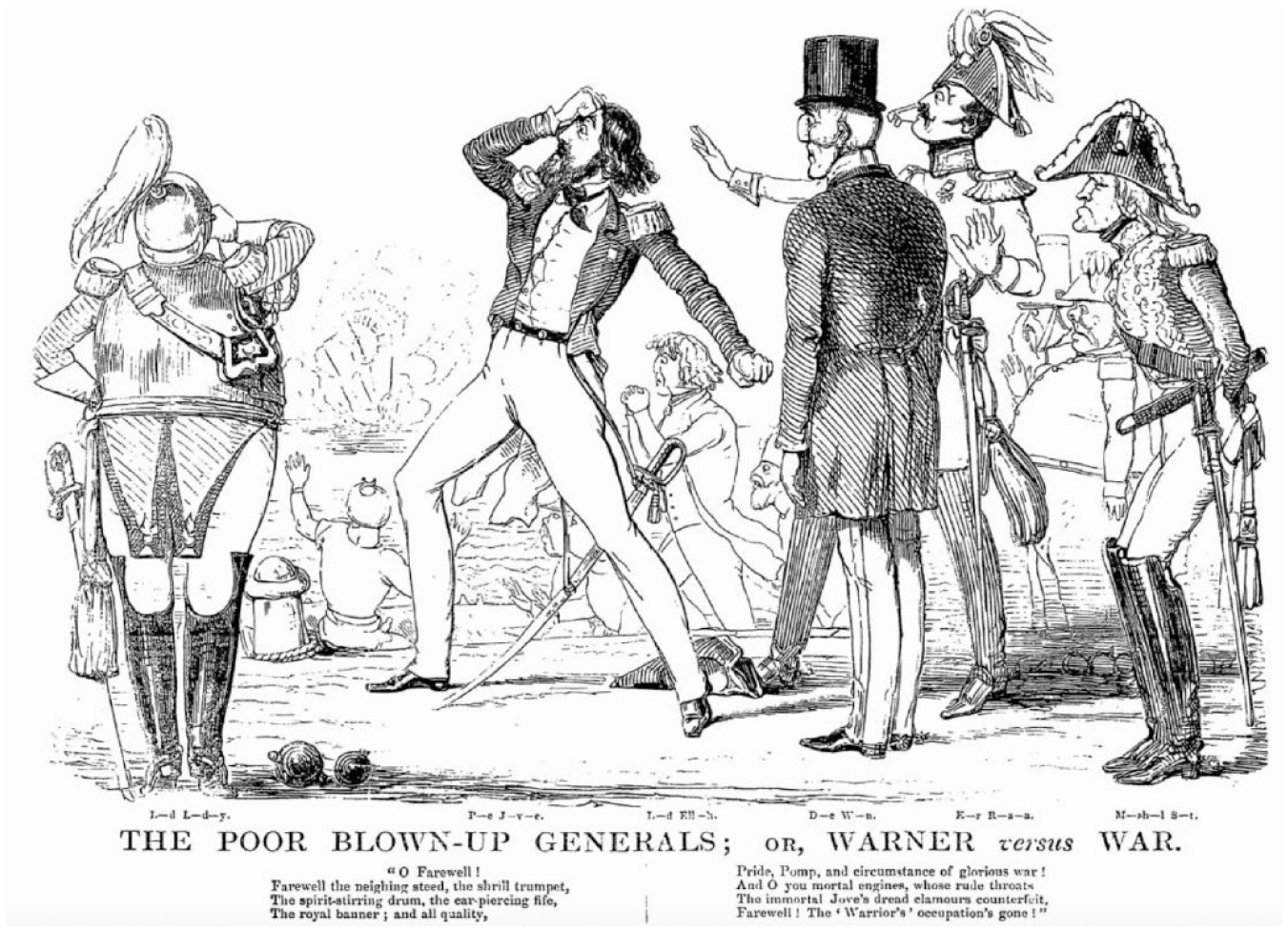
The POOR BLOWN-UP GENERALS; or, WARNER versus WAR, Punch, 3 August 1844, 59.
Commentators across the board did not necessarily regard the fear of mutual annihilation as an effective constraint on warfare, nor did they sanction Britain’s unilateral deployment of such weapons. The United Service Magazine (USM), for instance, differentiated Warner from past inventors of “useful” devices who were ridiculed on account of the novelty of their designs. Critiques of Warner did not stem from professional animosity or ignorance, but rather vocalized deep ethical concerns. In particular, the USM dreaded the moral implications of forgoing a fair fight: to introduce such an engine of warfare would outrage humanity, and be an everlasting disgrace to a civilized nation. Brave men would scorn and blush to be the sole employers, without fear of retaliation, of an engine by whose uneven agency hundreds or thousands of unsuspecting and unprepared fellow creatures . . . might be instantaneously destroyed, without power of resistance or chance of escape.
92
It was possible that the “rest of the civilized world” would unite against a “delinquent nation” that wielded such an advantage; thereafter, Britain would be “cut off from all friendly communication, and thrown entirely upon its own resources and products.” These concerns were echoed before Parliament. MP Joseph Brotherton did not balk at the price tag for Warner’s secrets, but rather could not “find it in his conscience to vote one shilling for the encouragement of inventors of such an infernal machine.” 93 If the government subsidized such ventures, they would have them “by the dozen; and men, to produce them, would leave all useful and peaceful employment.” Even Punch, which had previously applauded Warner’s Brighton demonstration, altered its tone several months later upon learning that “some scientific folks have got into an establishment at Fulham, from which they issued a prospectus, undertaking to blow up schooners on moderate terms, and annihilate fortresses at the very shortest notice.” 94 This opportunistic imitation prompted Mr. Punch to question the utility of destroying “life wholesale, for the purpose of saving it in detail.”
Showcasing secrets
In clarifying how Warner garnered the attentions of the British government and public alike over the course of two decades, I have delved into his modes of self-promotion, namely, his personal branding and his pitch. Offering a rich narrative of his practical experience, Warner claimed to be a martyr for science who had suffered at the hands of the backward Admiralty. Meanwhile, he played upon invasion panics and fears of intractable colonial conflicts. In the short term, his weapons would usher in a “scientific” era of warfare by reducing mortality rates and discouraging reprisals; even if foreign governments replicated his devices, a shared fear of total annihilation would deter armed combat. This representation of Warner’s devices as instruments of universal peace received some favorable coverage, but it also ostracized military commentators who feared the ethical implications of their application. However, it was Warner’s recurrent attempts to publicize his inventions while safeguarding his secrets that tarnished his reputation and resulted in his professional demise.
In this section, I suggest that Warner struggled to negotiate a popular culture in which spectators interpreted scientific demonstrations as manipulations of natural phenomena. Uncovering the mechanics behind apparent feats was part of the entertainment and in keeping with “the ethos of rational recreation that was such a key element of bourgeois civic culture.” 95 Following the successful implosion of the John O’ Gaunt, numerous observers and armchair chemists wrote to the papers to speculate upon the composition of Warner’s closely guarded secrets and dispute their originality. Warner also ran into difficulties in negotiating the terms under which he would perform trials of his inventions for potential military sponsors. While he was keen to demonstrate the use of devices, he feared that his antagonists in the Admiralty and Board of Ordnance would steal his secrets for an easy payday. These concerns, which had some foundation, resulted in years of squabbling. Some high-ranking officials believed that his micromanagement of the trials was a delaying tactic; they suspected that Warner was really intending to mulct the government out of a fortune by implicating them in intellectual property theft. After an unsuccessful trial of the “long range” resulted in ridicule, Warner’s backers cast him as the victim of a conspiracy orchestrated by “a powerful clique of those interested in the maintenance of the present order of things.” 96 Fearing that his inventions would render conventional weapons obsolete and reduce their well-padded establishment, military authorities had prioritized their salaries over the welfare of the nation.
In publicizing his inventions, Warner was operating in an environment where the boundaries between proper scientific experimentation and popular entertainment were ill-defined. This fluidity was the source of much tension, as differing audiences could interpret the same spectacle in wildly varying ways. 97 Ship designers, for instance, routinely staged “experimental” cruises of their prototypes in order to solicit funding from the Admiralty. But these demonstrations were also social events; Queen Victoria and Prince Albert even attended one exhibition in 1845. Some critical voices in the Navy dismissed these cruises as glorified sailing matches, as crews unscientifically altered features of their vessels in real time to enhance their performance. 98 Much like the ship designers, inventors of weaponry approached their demonstrations as spectacles and stage-managed the proceedings accordingly. Colt was compelled to escalate the drama in successive trials performed before American officials and civilians alike. Rather than simply exploding a target boat from a nearby vessel (as Warner had done), Colt performed the feat while positioned five miles south of the scene of action. This accomplishment won him the admiration of 8,000 onlookers and even earned him a bouquet of flowers from the president’s daughter. 99 Their appetite for destruction satiated, it seems that nobody enquired into the actual workings of Colt’s device.
While inventors attempted to win over the public through grand performances, they sometimes struggled to conform to the conventions of a demonstrative culture of popular science. Commercial ventures like London’s Adelaide Gallery revealed “nature’s wonders” through the use of cutting-edge technologies such as the oxyhydrogen microscope and the hydroelectric machine that replicated the aurora borealis. Historian Iwan Morus posits that audiences were often aware of the basic scientific principles behind these displays of natural phenomena. Their interest lay in the improvements wrought to the machines themselves that enhanced their capacity to produce the expected outcome. As Morus puts it, the “routine’s very familiarity simply served to emphasize the unfamiliarity of the result.” 100 Spectacles that incorporated an element of visual deceit not only evidenced the scientific showman’s epidictic acumen, but also served to train the audience’s eyes so that they might better detect frauds and expose imposters. It was this “educational intent” that “differentiated modern illusions from those of their natural magical predecessors.” 101
But if these enthusiasts were enthralled by gradual advances in scientific equipment, they were disinclined to accept new inventions that seemingly broke with established precedent altogether. A passage in Robert Chambers’ best-selling Vestiges of the Natural History of Creation – which Warner often cited – spoke to this ambivalence: the reception of novelties in science must ever be regulated very much by the amount of kindred or relative phenomena which the public mind already possesses and acknowledges, to which the new can be assimilated. A novelty, however true, if there be no received truths with which it can be shown in harmonious relation, has little chance of a favourable hearing.
102
This rumination lends credence to Benoît Godin’s claim that the term “innovation” was anathema for most of the nineteenth century and typically associated with heresy or subterfuge. In the French context, establishment figures expressed a “loathing and distrust of all types of novelties” and rejected new designs that seemed to be at variance with scientific conventions. 103 According to Graeme Gooday, late-Victorian electrical experts overcame this hostility by affirming a kind of “social contract” that constrained their actions. 104 The lay community recognized these experts’ status in exchange for receiving useful and practical knowledge; to retain their authority, practitioners were obliged to exercise “prudence and restraint.” The press could quickly turn on men of science when they appeared to be indulging in abstract conjecture or making grandiose and possibly untestable claims.
In his quest for publicity, Warner managed to violate this implicit contract by tenaciously guarding his secrets. His trials, moreover, blurred the distinction between proper “experiments” that generated uncertain results and “demonstrations,” which Harry Collins has described as a “‘post-closure’ phenomenon” that required “technical virtuosity.” 105 Much to the frustration of the spectators who had assembled at Brighton, the implosion of the “invisible shells” did not reveal the inner workings of nature, nor did it sufficiently showcase Warner’s epidictic talents as a public-facing performer. Rather, it defied explanation and (uncomfortably) appeared to contradict known physics. This ambiguity set the demonstration apart from earlier “scientific trials” conducted at sea like the transatlantic crossing of I. K. Brunel’s steam-powered Great Western, where the act of completion offered sufficient proof of the technology’s viability. 106 With few clues, contributors to the scientific journals and popular press began to wildly speculate about the composition of Warner’s shells and question the novelty of the devices. This was arguably an instance of what Collins terms “pathological science,” in which “inexperienced and untrained outsiders assume, and are widely granted, the right to comment authoritatively on scientific matters.” 107 The apparent failure of the “long range” trial, in contrast, led Warner and Chetwynd-Talbot to portray it as an initial ‘experiment’ that could only have been performed with the government’s backing and resources. This gambit failed to convince Warner’s longtime detractors in the Navy who believed they had secured definitive proof of his charlatanism.
On the afternoon of 20 July 1844, the bulk of Brighton’s population flocked to the pier and cliffs to witness the destruction of the John O’ Gaunt. Hosting an expectant crowd of around 40,000, which included numerous East India Company directors and politicians, the seaside town “never could have made a gayer appearance.” 108 There was a delay in bringing the boat into the harbor, which led to some handwringing from anxious onlookers such as the Whig MP and jack-of-all-trades Henry Brougham. Around 6 o’clock, the audience detected “a low, dull sound, immediately succeeded by a column of white smoke, which appeared to rise from beneath the vessel.” 109 Ruptured internally, it sank in under two minutes. This successful performance seemed to conclusively demonstrate that Warner was “in possession of the secret of an instrument of destruction” that he could deploy with precision and activate at the distance of several hundred yards. 110 But it also baffled witnesses: the “expression on the countenances of the multitude generally seemed to say – What was it? An illusion? A dream? A magical trick?” The Age and Argus reported that viewers could “scarcely believe their senses.” 111 The Times likened the spectacle to “an awful mystery,” noting that “there were none of the ordinary circumstances that accompany similar catastrophes.” The public therefore experienced a kind of “melancholy feeling, for it was impossible to prevent the imagination depicting the terrific effects of such an explosion upon a peopled ship, thus silently and suddenly perishing.”
Neither sufficiently bombastic nor educational, Warner’s demonstration left some of his viewers in an agitated state. Disturbed commentators began to doubt that a scientific feat defying all known explanation had even occurred. It was more likely a hoax, the mechanics of which could be untangled by the average mind upon serious reflection. To be sure, some papers thought this leap to judgment premature. John Bull recognized that “the invention may be open to many serious objections when it comes to be duly examined by scientific and practical men: but it is absurd to imagine that it is exposed at the very outset to such a condemnation as this.” 112 These cautions, however, did not prevent a flurry of speculation in the press on the topic of Warner’s secrets. One writer for the Mechanics’ Magazine disputed the originality of the shells’ chemical composition. He had recently observed an experiment “at that grand toy-shop, the Polytechnic Institution,” in which the controlled explosion of half an ounce of fulminating powder “shook the whole building.” 113 If Warner did not employ a fulminate, he might have used various chlorides or iodides that were “practically impossible to be handled as warlike agents at all.” Experts from further afield also contributed to this debate. Identifying mercury fulminate as a likely explosive compound, a “M. Jobbard of Brussels” believed that the shell itself was attached to a Congreve rocket and shot out of a ship’s porthole. 114 Other “scientific individuals” postulated that the shells were either propelled by means of an air gun, triggered through “galvanic communications” that Warner had initiated, or were fashioned out of magnetic steel with cork supports for buoyancy. 115 For these skeptics, Warner’s invention was simply a scaled-up application of known technologies that utilized hazardous materials. Ruing this cultural intolerance for disruption, Chetwynd-Talbot lamented “how incredulous the English nation is of every thing which is not subjected barely to their eyes – which is not handled and turned inside out.” 116
While Warner’s publicity campaign somewhat backfired, one of his principal doubters – Henry Brougham – was himself taken to task for putting on scientific airs. A vocal advocate of liberal causes including abolitionism, franchise extension, Catholic Emancipation, and education for the working-classes, Brougham was also known for his stinging tongue, which was “the most active in the nation and the bitterest.” 117 As a result, the satirical press featured him in hundreds of illustrations that lampooned his apparent Francophilia, his blatant careerism, and his dilettantism. 118 It was this latter tendency that Brougham exhibited during the Brighton trial. The Age and Argus ridiculed him for giving “seamanlike orders to the crew of the John O’ Gaunt to expedite its arrival” and mockingly paraphrased his instructions to “to reef the keel – haul in the maintop mizen bowsprit – and then bring her seven points.” 119 Accusing him of impersonating a man of science, Punch went so far as to print a fictitious letter from Brougham that prematurely dismissed Warner’s demonstration as a “mere trick” and “a semi-optical delusion.” 120
A month after the Brighton event, Punch’s writers were still mining the Warner–Brougham conflict for humorous content. Noting that the demonstration had inspired “all the small maritime geniuses” to approach the Treasury with offers to “shiver ships to atoms at reduced prices,” Mr. Punch did “not see why he should not have his chance”; he therefore proposed “to blow-up that crazy old funny – Brougham, – for any sum that the achievement may be thought entitled to.” 121 The satirical papers simply could not resist explosive wordplay in their political commentaries. Fearful of fraying Anglo-Irish relations and Daniel O’Connell’s efforts to repeal the Act of Union, the Satirist poetically predicted that “WARNER’s shell shall settle, / And overthrow friend DANIEL’s brass / With much more heavy metal.” 122 Humorists thereby enlisted Warner as a reliable foil whom they could pit against the usual targets of ridicule – Brougham, the French, and the Irish. In so doing, they brought him a degree of positive publicity that he had been unable to generate through his trials alone.
Aside from contending with the public’s dismissive reactions to his demonstration, Warner also struggled to negotiate terms for government-sponsored trials that would have ensured the safeguarding of his chemical secrets. In the absence of an institutionalized system for verifying new inventions, he was reliant upon the goodwill of prominent statesmen. Following the demise of his prospective patrons in the late 1830s, Warner had been shuffled between the Admiralty and Board of Ordnance. Finding this bureaucratic sidelining to be “unexpedient and injurious to the national interest,” he drafted an explanatory letter that Chetwynd-Talbot forwarded to Prime Minister Robert Peel in September 1841. 123 Peel proceeded to establish a new investigatory committee, though he advised Sir George Murray of the Board of Ordnance to attempt his own parallel experiment “by putting silver nitrate in a shell” and comparing the effect to that of Warner’s mines. 124 Historian Marshall Bastable observes that this chicanery was par for the course; the War Office and Admiralty routinely rejected inventors’ designs, only to fashion their own “mix-and-match versions” at the Royal Gun Factories. 125 This threat of covert replication would haunt Warner throughout the decade.
Sir Howard Douglas, who sat on the investigatory committee, later insisted that this body had taken pains to ensure “that no attempt should be made to obtain any part of Mr. Warner’s secret” and “that he should be forbidden to answer any question that might in the slightest degree tend, if answered, to disclose his alleged discoveries.” 126 This decision was a strategic one, for the government apparently wanted to “disarm Mr. Warner of any pretext for saying that his secret had been drawn from him, and on that ground to claim compensation for having been deprived of what he would still have regarded as a market-able property.” 127 Yet Warner’s account of the committee’s activities differed markedly. He recalled that Douglas had casually joked with his peers that he could co-opt Warner’s secrets and claim the £400,000 award himself. 128 Warner also had it on good authority that the famed Admiral George Cockburn had secretly consulted a “very distinguished chemist and experimental philosopher . . . on the subject pending the negotiations between [him] and the commissioners.” More problematically, Warner’s complaints over potential leaks had earned him a reputation as a dodgy dealer who was delaying the trials indefinitely in the hope of swindling the government on a technicality. Before any trial was even performed, naval authorities such as Cockburn and Admiral Charles Napier had convinced Peel that the “long range” was a “hocus pocus trick” and the invisible shells merely a type of “catamaran.” 129
Much to the surprise of Warner and Chetwynd-Talbot, the arguably successful demonstration at Brighton did not convince the administration of the functionality and desirability of his invisible shells. The reason for this was that the government had never been terribly interested in submersible mines in the first place; it was mainly humoring Warner to get access to his “long range.” Authorities, however, were divided on the question of a Treasury-subsidized trial. Peel, who along with Douglas had doubted Warner’s sincerity from the outset, was willing to sponsor an exhibition of the “long range” mainly to “expose his charlatanism.”
130
His “confidential prophecy” – which turned out to be somewhat accurate – was that the “boasted long range will be found to be nothing more than the conveyance of a shell to the distance of five miles by means of an air balloon.”
131
Peel was therefore insistent that Warner be barred from proposing members for a new committee of inquiry lest he select gullible officials who had shown him favor in the past.
132
Moreover, additional delays due to the ill-health of elderly investigators would only “throw ridicule on the proceeding.” Yet Lord Ellenborough, the First Lord of the Admiralty who took charge of the trial, did not find it “prudent to assume that anything is impossible to Science.”
133
Having been recalled from his post as governor-general of India for embroiling the East India Company in annexationist campaigns, he was perhaps more eager than Peel to cement Britain’s imperial dominance through military innovation. Giving the subject ample thought, Ellenborough recognized that alterations and improvements in the manufacture of guns have already greatly increased their range beyond what would have been thought possible 40 years ago, and we cannot reasonably reject as impossible a further increase of the range even without having recourse to a new explosive composition of greater strength than that now used.
A private trial of the “long range” performed in September 1846 at Cannock Chase resulted in a poor showing and provided Warner’s antagonists with ample fodder. Despite having obtained a £1,300 grant for materials from the government – which he vowed to return if the experiment was unsatisfactory – Warner acquired a balloon on credit from famed manufacturer Charles Green. 134 The committee of inquiry had requested that Warner’s apparatus carry thirty explosives and deposit these dummy munitions at designated mile markings by means of a timed fuse. Due to delays in preparation, the trial did not commence until the early evening, at which point it was difficult to view the airborne “missile.” Eager to return to London, the handful of attendees did not bother to determine where the ordnance had landed; after some searching, a groundskeeper recovered eighteen shells lodged deep in the soil and scattered over a distance of three miles. 135 Based on this sole demonstration, the committee concluded that the technology’s “principle of action” would be given away after its first usage and doubted whether the “long range” could be guided with sufficient accuracy. 136 This hasty determination irked Chetwynd-Talbot, who thought it “unprecedented that any invention should be condemned on a single trial.” 137 The Naval & Military Gazette also affirmed its unflagging support of Warner and faulted critics for circulating misinformation. The shells deposited by the “long range” did not ‘fail’ to explode, for they were never loaded with powder in the first place. 138 But for Douglas, the trial provided the evidence he had long sought to unmask Warner as an agent of deception. “By a specious use of terms of scientific import,” Warner had “led many who were unlearned in these matters, and even those who had a smattering of science, to believe in the discovery of some new and tremendous kind of projectile force.” 139 Asserting his expertise in naval gunnery and his mastery of physics, Douglas asserted that he had always known better.
Amidst escalating tensions with France, Warner staged a last-ditch effort to subject his devices to additional trials and managed to solicit the attention of the Earl of Derby in March 1852. Now claiming to be an expert in “aerostation,” Warner insisted that none of his detractors were “scientific men” and therefore were simply mocking technology they did not properly understand. 140 Moreover, the description of the “long range” that Howard Douglas had presented before the House of Commons was not only “ridiculous, as well as savage and brutal,” but also “diametrically opposite” to the actual invention. But the “long range,” Warner acknowledged, was ultimately an auxiliary weapon designed for occasional usage; its significance paled in comparison to that of his invisible shells. To justify his calls for renewed demonstrations, Warner announced that he was no longer seeking immediate recompense for his secrets, but rather was attempting to salvage his reputation. 141 He also enclosed an original copy of the favorable report on the shells with signed attestations from admirals Hardy and Keats. In a separate letter, Chetwynd-Talbot confirmed that these signatures were the genuine article based on his consultations with the chief clerk of the Admiralty. 142 These maneuvers proved effective. Despite the skepticism of Earl Grey, who believed that Warner was simply trying to bring his scheme under governmental consideration to “obtain loans from sanguine persons out of doors,” Derby sought to revisit the shells and garnered sufficient votes to order the formation of a new investigatory committee. 143
But once again, Warner was dissatisfied with both the composition of this body and its agenda. Although he had offered to prove the efficacy and chemical stability of the shells – whether through models or full-scale trials – committee member Michael Faraday demanded to know the details of their combustive properties from the get-go. 144 And while Warner initially welcomed the appointment of leading scientific men such as the Earl of Rosse, he regretted that the only naval authority in the group was none other than Captain Chads, who had witnessed the trial at Cannock Chase and wrote a “false report” on the “long range.” 145 “A mere tool in the hands of others,” Chads supposedly regarded Warner as a thorn in the side of the British naval establishment and wished that his “brains had been blown out twenty years ago.” Warner was perhaps most disappointed with committee chair Lord Henry Hardinge, who had previously handled the shells and privately marveled at how “everything is so well made and scientifically arranged.” At that time, Hardinge had warned the inventor to persist with his campaign in the face of “professional prejudice.” And yet, he was now accepting the conclusions of those who feared that the successful deployment of Warner’s shells would result in massive slashes to the Navy’s budget.
In numerous pamphlets, speeches, and editorials, Warner’s defenders had long argued that the British military was selfishly clinging to archaic traditions to preserve its patronage networks. Shortly after the Brighton demonstration, Alfred Savage had written to the Mechanics’ Magazine to question why the government had not yet sanctioned a trial of Warner’s “long range”; he speculated that they were disinclined to test a “power which might render our present expensive naval and military establishments unnecessary.” 146 Harvey also anticipated that there would always be resistance to innovations that threatened to disturb “existing interests or establishments, on which depend patronage of the higher orders, and extensive employment for the more humble classes.” 147 The contemporary Admiralty was not all that different from “the valiant knights and warriors of old” who attempted to “suppress modes of warfare that arose from the discovery of gunpowder!” Walesby similarly compared the naval lords to the English “stage coach establishment,” a once-thriving sector that had “been reduced by railroads to beggary.” 148 Chetwynd-Talbot posited that this illogical resistance to change had led governmental authorities to regard Warner as an imposter from the very beginning. He therefore reminded the House of Lords that “patriotism may sometimes burn as ardently in the humble breast as in that bedizened with stars and decorations.” 149
Facing personal financial ruin in the 1850s, Warner revived this line of attack and heaped opprobrium upon numerous high-ranking military and government officials. In private conversations, Wellington had reportedly acknowledged the functionality of Warner’s inventions but rejected them on the grounds that they would lead to reductions in both the army and navy. “Any officer,” he declared, “must be mad to advocate a measure for the ruin of his profession.” 150 Indeed, Warner confirmed that the application of his devices would yield a public saving so large that it would “rid the country of those useless excrescences, the Boards of Ordnance and Admiralty.” 151 Fully investing in this conspiratorial narrative, Warner charged Peel with obstructing his trials lest they “displace the numerous relatives and friends he ha[d] in the Service.” 152 He even claimed that the Marquess of Anglesey (who permitted the use of his estate for the “long range” trial) had admitted that Warner’s inventions would never be adopted in Britain, for they would “render all the ships of the line useless, and dispense with the greater part of us.” 153 Eventually conceding that this institutionalized opposition to his devices would be insurmountable, Warner informed Derby in June 1852 that his inventions were “to go abroad” and disclaimed all responsibility for the inevitable “ruin of the Country.” 154
This scenario did not come to pass, as Warner died suddenly the following year and left a legal wife, a mistress, and seven children in poverty. 155 Had he lived to witness the Crimean War, he might have gotten some satisfaction out of the ignominious downfall of his longtime adversary, Admiral Charles Napier. Tasked with storming the Russian forts at Kronstadt and Sveaborg that guarded the approach to St. Petersburg, Napier encountered an obstacle that he had been warned of, but which he had blithely ignored. A network of Immanuel Nobel’s submersible mines – each with a chemical fuse consisting “of a pencil-sized glass tube filled with sulfuric acid and suspended over a combination of potassium and sugar” – awaited his fleet. 156 Unable to breach these defenses, Napier retreated and was relieved of his command.
Conclusion: “Invention” under fire
Given all the obstacles Warner encountered in arranging these trials, one might question why he did not simply obtain a patent in the first place. Charlatanism could account for this inaction, but Warner may also have contended with the outmoded and extremely costly nature of an unreformed patent system that had changed little in 200 years. This process consisted of at least ten steps and could cost the inventor the hefty sum of £350; even if a patent was granted, defending one’s intellectual property in court could be prohibitively expensive. 157 Warner’s London-based booster, Alfred Savage, was particularly peeved that the state continued to rake in revenue from this indirect “tax” that barred poorer technicians from the field of fair competition even after it had reduced the duty on newspapers and adopted penny postage. Meanwhile, the “state of moral feeling” on the issue of intellectual property theft remained very low. Savage lamented that “rival manufacturers seem hardly aware, that when they pirate each other’s designs . . . they commit a theft as dishonourable and cowardly as stealing any other property with certain impunity.” 158
Warner was thus operating within a culture in which the very concept of ‘invention’ was being contested on a deep epistemological level. Concurrent disputes over the legitimacy of patents suggest there was very little consensus as to how – or even if – technological innovations should be protected. The passage of the Patent Law Amendment Act of 1852 addressed some of Savage’s issues by establishing a centralized Patent Office and reducing costs, but it also incensed a rival faction of “abolitionists” who denounced patents in their entirety as a form of monopolism akin to the Corn Laws. Critics such as William Armstrong – the wealthy inventor of a hydraulic crane who turned his attentions to artillery design during the Crimean War – argued that patents enabled the rise of a class of litigious parasites who cribbed their basic research from uncompensated parties. 159 He therefore adopted the mentality that no technology was entirely novel, but was instead the result of prior accretions of knowledge. Varying devices that resembled each other likely arose from a common societal need and could be attributed to “simultaneous invention.”
These heady debates over the legitimacy of patents and the very notion of technical originality contributed to a paradoxical intellectual culture of fervent aspiration and profound disbelief. Commentators in the British press and members of the government fully expected ‘legitimate’ inventions to yield a significant paradigm shift, yet they instinctively derided emergent technologies as thefts or facile derivations. For instance, one contributor to the Mechanics’ Magazine compared Warner’s “humbugging” to that of Robert Fulton, who allegedly based the design for his famed steamship on William Symington’s Charlotte Dundas. 160 While Fulton made a fortune from his venture in America, Symington died in debt; his widow continued to plead with the British government “for some token of public gratitude for the incalculable services rendered by her departed husband to steam navigation.” Similarly, Robert Wilson of the Bridgewater Foundry claimed that it was he – and not Ericsson nor rival claimant Francis Pettit Smith – who first invented the screw propeller, though he had failed to convince the lords of the Admiralty to sanction a trial in 1833. 161 Warner, too, was accused of imitation in 1844 when the American Weekly Sun rejected his submersible mine experiments as “a feeble effort to equal those made by our distinguished fellow countryman, Samuel Colt.” 162 For John Bull, this case of near-simultaneous invention suggested that Warner’s secret was “very likely to be discovered by half a dozen other people” and was therefore not worth the cost. Ironically, Colt was himself accused of appropriating the techniques of Robert Hare, who had used galvanic electricity to ignite gunpowder in the early 1830s. 163 The fact that Colt altered the process by using Samuel Morse’s cutting-edge submarine cable was seemingly immaterial.
Performing its own boundary work, the Polytechnic Review faulted Warner for effectively prejudicing the government against future, more worthwhile technologies. Assuring readers that Warner’s expectations for the “long range” were a “physical impossibility in the present state of chemical science,” one writer regretted “that scientific characters are debarred from the ground these enthusiasts claim as their own. Every application for experiment is now refused at Woolwich, because ninety-eight out of a hundred applicants prove to be ignorant adventurers.” 164 In 1847, the Mechanics’ Magazine bemoaned Captain John Powell Reed’s unsuccessful attempts to promote his “comet,” which was composed of several rockets attached together to minimize wind resistance. The editor acknowledged that Reed had every right to be disappointed. “After the prodigious stir made about the Warner ‘long range’ – after the large sums thrown away upon it, and after its most ludicrous failure,” it was hardly surprising that “the government should fight shy for a time of everything of the ‘long range’ genus.” 165 Such commentary not only speaks to the contemporary significance of the Warner affair, but also to the fractious nature of the informal relationship between the military establishment and the private sector in this period.
For fringe figures like Warner who were neither genteel nor disinterested, the acquisition of scientific authority was a hardscrabble affair that necessitated complex navigations of political channels and maneuvers in the public sphere. Those who developed weapons technologies were in an even more precarious position, as their fortunes were often contingent on the goodwill shown by high-ranking ministers or lords of the Admiralty. Through strategic branding and narrativization, Warner established himself as an antiestablishment disruptor with vaunted practical experience in military science. He further exploited imperial and domestic panics to pitch his inventions as an economical alternative to conventional warfare. But Warner’s self-aggrandizement was undercut by his unwillingness to reveal his secrets; his inability to manage his audience’s expectations frustrated spectators and incensed officials who accused him of malign intent. In the absence of any surviving schematics, the exact specifications of Warner’s weaponry and the composition of his chemical compound will remain topics of speculation. An investigation of his trials and tribulations, however, illuminates the fraught entanglements between private-sector innovators and the state in the early Victorian period. Regardless of whether these individuals were earnest inventors, committed fraudsters, or something in-between, historians ought to consider self-fashioning, marketing, and public engagement as core elements in the production of scientific credibility.
Footnotes
Acknowledgements
The author would like to thank Eric Gurevitch, Fredrik Albritton Jonsson, and the participants of the University of Chicago’s Empires Forum for their valuable feedback on earlier versions of this article.
Funding
The author received no financial support for the research, authorship, and/or publication of this article.
Declaration of conflicting interests
The author declared no potential conflicts of interest with respect to the research, authorship, and/or publication of this article.

1.
“The Warner Bankruptcy,” Lady’s Newspaper, 9 November 1850, 257.
2.
John Harvey, Brief Exposition of the Nature of Capt. Warner’s Invention, the “Invisible Shell” (Sandwich: Hayward, n. d.), pp.3–6.
3.
“Warner’s Long Range,” in J. C. Robertson (ed.), Mechanics’ Magazine, Vol. 46 (London: Robertson and Co., 1847), p.503.
4.
Henry Chetwynd-Talbot, Viscount Ingestre, Speech to House of Commons, 13 July 1846, Parliamentary Debates, Commons, 3rd ser., Vol. 87 (1846), col. 1074; Morning Post, 6 February 1845, 4.
5.
Richard D. Altick, Punch: The Lively Youth of a British Institution, 1841-1851 (Columbus, OH: Ohio State University Press, 1997), p.418.
6.
Anita McConnell, “Samuel Alfred Warner,” Oxford Dictionary of National Biography, 23 September 2004.
7.
Samuel Alfred Warner, The Position and Prospects of the British Dominions Considered (London: Piper Brothers & Co., 1851), p.13.
8.
Ben Marsden and Crosbie Smith, Engineering Empires: A Cultural History of Technology in Nineteenth-Century Britain (New York, NY: Palgrave, 2005), p.6.
9.
Ibid., pp.227–9. See also Barbara Hahn, Technology in the Industrial Revolution (Cambridge: Cambridge University Press, 2020), p.83.
10.
David Philip Miller, “Principle, Practice and Persona in Isambard Kingdom Brunel’s Patent Abolitionism,” British Journal for the History of Science 41 (2008): 43–72, 50.
11.
Iwan Rhys Morus, “‘More the Aspect of Magic than Anything Natural’: The Philosophy of Demonstration,” in Aileen Fyfe and Bernard Lightman (eds.), Science in the Marketplace: Nineteenth-Century Sites and Experiences (Chicago, IL: University of Chicago Press, 2007), pp.336–70, 350.
12.
Alison Winter, “The Construction of Orthodoxies and Heterodoxies in the Early Victorian Life Sciences,” in Bernard Lightman (ed.), Victorian Science in Context (Chicago, IL: University of Chicago Press, 1997), pp.24–50, 24, 32.
13.
James A. Secord, Visions of Science: Books and Readers at the Dawn of the Victorian Age (Chicago, IL: University of Chicago Press, 2015), pp.62, 70.
14.
Ruth Barton, “‘Men of Science’: Language, Identity and Professionalization in the mid-Victorian Scientific Community,” History of Science 41 (2003): 73–119, 87–8.
15.
James A. Secord, “How Scientific Conversation Became Shop-Talk,” in Aileen Fyfe and Bernard Lightman (eds.), Science in the Marketplace: Nineteenth-Century Sites and Experiences (Chicago, IL: University of Chicago Press, 2007), pp.23–59, 40.
16.
Thomas F. Gieryn, Cultural Boundaries of Science: Credibility on the Line (Chicago, IL: University of Chicago Press, 1999), p.60.
17.
Ibid., pp.xi, 4.
18.
Ibid., p.15.
19.
For an account of the contest between Junius Smith, a proponent of steam-powered transatlantic travel, and his antagonist, Dionysius Lardner, see Crosbie Smith, Coal, Steam and Ships: Engineering, Enterprise and Empire on the Nineteenth-Century Seas (Cambridge: Cambridge University Press, 2018), pp.60–84.
20.
Marsden and Smith, Engineering Empires, p.102 (note 8). The establishment of the Institution of Civil Engineers (1818) and the rival Institution of Mechanical Engineers (1847), which catered to the railway community, also facilitated this “professional self-fashioning.” See Henry Atmore, “Railway Interests and the ‘Rope of Air,’ 1840–8,” British Journal for the History of Science 37 (2004): 245–79, 253–4.
21.
Christine MacLeod, Heroes of Invention: Technology, Liberalism and British Identity, 1750–1914 (Cambridge: Cambridge University Press, 2007), p.101.
22.
Ibid., pp.93, 107.
23.
Ibid., p.191.
24.
Adrian Johns, Piracy: The Intellectual Property Wars from Gutenberg to Gates (Chicago, IL: University of Chicago Press, 2010), p.272.
25.
Don Leggett, Shaping the Royal Navy: Technology, Authority and Naval Architecture, c. 1830–1906 (Manchester: Manchester University Press, 2015), p.5.
26.
Ibid., p.33.
27.
Ibid., p.77. A similar conflict played out over the issue of compass misreading on iron-hulled ships. Whereas mathematician George Airy of the Royal Greenwich Observatory sought to circumscribe the role of the ship’s captain by means of his correctional device, whaler-turned-Anglican Evangelical William Scoresby argued that Airy’s calculations failed to account for conditions at sea. Altering the magnetism of iron in demonstrations at the Liverpool shipyards, Scoresby gained the confidence of captains, merchants, and underwriters. However, his individualistic zeal limited his appeal within the established scientific institutions. See Alison Winter, “‘Compasses All Awry’: The Iron Ship and the Ambiguities of Cultural Authority in Victorian Britain,” Victorian Studies 38 (1994): 69–98, 75, 83, 87.
28.
“The ‘Long Range’ Captain and His Discovery,” Satirist, 31 January 1847, 34.
29.
Marsden and Smith, Engineering Empires, pp.8, 61–2, 243 (note 8).
30.
Samuel Alfred Warner, Facts and Documents Relating to our National Defences, with Remarks, Addressed to the People for Their Consideration (London: W. & T. Piper, 1853), p.9.
31.
“Captain Warner’s Explosive Force,” The Artizan, 2 July 1844, 161.
32.
Chetwynd-Talbot, Viscount Ingestre (note 4).
33.
Samuel Alfred Warner, Fair Play’s a Jewel: A Narrative of Circumstances Connected with my Mode of National Defence Against the Whole World (London: J. & W. Robins, 1849), pp.5, 11.
34.
Ibid., p.10.
35.
William IV, Memorandum for Sir Robert Peel and his Cabinet, 14 January 1835, Royal Collection Trust, GEO/MAIN/35927-35948, f. 75.
36.
Warner, Fair Play’s a Jewel, pp.19–24 (note 33).
37.
F. P. Walesby, New and Extraordinary Implements of War. Is England’s Safety or Admiralty Interest to be Considered? 3rd ed. (London: William Edward Painter, 1841), pp.19–20.
38.
The Times, 8 September 1840, 4.
39.
John Bull, 26 June 1841, 308.
40.
Rebecca Berens Matzke, Deterrence through Strength: British Naval Power and Foreign Policy Under Pax Britannica (Lincoln, NE: University of Nebraska Press, 2011), p.37.
41.
Stephen H. Cutcliffe and Kimberly Fabbri, “Robert Fulton’s Torpedoes,” Technology and Culture 51 (2010): 879–88, 885.
42.
Leggett, Shaping the Royal Navy, pp.69–70 (note 25).
43.
Surveyor Symonds believed that the attachment of the screw propeller to the rear of the ship would make it impossible to steer. The Admiralty soon reversed its position, retrofitting HMS Rattler with a screw propeller in 1842. By that time, a disenchanted Ericsson had relocated to America and was designing ship engines for merchants eager to tap the newly opened Chinese markets. See William Conant Church, The Life of John Ericsson, Vol. 1 (New York, NY: Charles Scribner’s Sons, 1906), pp.89–90, 158.
44.
Thomas Wakley, Speech to House of Commons, 21 June 1841, Parliamentary Debates, Commons, 3rd ser., Vol. 58 (1841), col. 1587.
45.
Warner, The Position and Prospects, p.15 (note 7).
46.
Michael B. Schiffer, Power Struggles: Scientific Authority and the Creation of Practical Electricity Before Edison (Cambridge, MA: MIT Press, 2008), p.121.
47.
Ibid., 126–7.
48.
Warner, Fair Play’s a Jewel, p.iii (note 33).
49.
Warner, Facts and Documents, p.51 (note 30).
50.
MacLeod, Heroes of Invention, p.189 (note 21).
51.
This reviewer did not believe that Galileo deserved the title of martyr, as he had recklessly provoked the Catholic Church through his “rash and uncalled for conduct.” See “Brewster’s Martyrs of Science,” in The Monthly Review, from January to April Inclusive, Vol. 1 (London: G. Henderson, 1841), pp.428–9.
52.
Morning Post, 6 February 1845, 4.
53.
Warner, Facts and Documents, p.8 (note 30).
54.
Henry Aglionby, Speech to House of Commons, 25 June 1847, Parliamentary Debates, Commons, 3rd ser., Vol. 93 (1847), col. 940.
55.
Warner, Fair Play’s a Jewel, p.103 (note 33).
56.
Marsden and Smith, Engineering Empires, p.84 (note 8).
57.
“Captain Warner’s Glorious Invention,” Satirist, 4 August 1844, 245.
58.
Morning Post, 6 February 1845, 4.
59.
Charles Iain Hamilton, Anglo-French Naval Rivalry, 1840–1870 (Oxford: Clarendon Press, 1993), pp.11–17.
60.
Although the Royal Navy boasted 257 ships of varying sizes in 1842, the Whigs had introduced an economizing policy of “undermanning” and could not rely on a standing reserve of seamen. See Matzke, Deterrence through Strength, p.55 (note 40).
61.
Richard Cobden, The Three Panics: An Historical Episode (London: Ward & Co., 1862), pp.5–8.
62.
“The National Defences. The Duke of Wellington’s Letters,” The Times, 5 January 1848, 5.
63.
The Times, 5 January 1848, 4.
64.
Cobden, The Three Panics, p.10 (note 61).
65.
Ibid., p.25.
66.
“An Englishman and Civilian,” The Invasion of England (London: J. Ridgway, 1852), p.4.
67.
Ibid., p.11.
68.
After the Panic of 1847 dissipated Britain’s railway mania, investors turned against speculative pursuits like the schemes for “atmospheric traction” that had failed to perform well under real-world conditions. See Atmore, “Railway Interests,” pp.276–9 (note 20).
69.
Warner, The Position and Prospects, p.9 (note 7).
70.
Warner, Fair Play’s a Jewel, p.147 (note 33).
71.
Henry Chetwynd-Talbot, Earl Talbot, “To the Editor of The Times,” The Times, 30 January 1852, 3.
72.
Harvey, Brief Exposition, p.7 (note 2).
73.
“The Warner Range,” Punch, 7 February 1852, 56.
74.
Warner, Facts and Documents, p.34 (note 30).
75.
George Pechell, Speech to House of Commons, 17 May 1852, Parliamentary Debates, Commons, 3rd ser., Vol. 121 (1852), col. 692.
76.
Warner, The Position and Prospects, p.5 (note 7).
77.
The Times, 11 September 1851, 4.
78.
Warner, Facts and Documents, p.65 (note 30).
79.
A. P., “The Caffre War,” The Times, 28 March 1851, 6.
80.
Quoted in Warner, Fair Play’s a Jewel, p.150 (note 33). This was a classic ethical defense of arms-manufacturing. In 1795, gun magnate Samuel Galton Jr. protested his looming expulsion from the Quaker community by insisting that his weapons made war “less sanguinary, and less ferocious.” See Priya Satia, Empire of Guns: The Violent Making of the Industrial Revolution (New York, NY: Penguin Press, 2018), p.320.
81.
Naval & Military Gazette, 19 April 1845, 249.
82.
Warner, The Position and Prospects, p.12 (note 7).
83.
Joseph Dorfman, “Fulton and the Economics of Invention,” Political Science Quarterly 59 (1944): 578–593, 581–2.
84.
Robert Fulton, Torpedo War and Submarine Explosions (New York, NY: William Abbatt, 1914), p.31.
85.
Ibid., p.42.
86.
Ibid., p.41.
87.
Warner, Facts and Documents, p.46 (note 30).
88.
Warner, Fair Play’s a Jewel, p.149 (note 33).
89.
Alfred Savage, “The Arts of War, Arts of Peace — Case of Captain Warner,” in J. C. Robertson (ed.), Mechanics’ Magazine, Vol. 43 (London: Robertson and Co., 1845), p.18.
90.
Warner, Facts and Documents, p.29 (note 30).
91.
“Poor Blown-up Generals,” Punch, 3 August 1844, 58.
92.
“A Glance at the Approaching Session, with References to the Army and Navy,” Colburn’s United Service Magazine 46 (1844): 489–90.
93.
Joseph Brotherton, Speech to House of Commons, 13 July 1846, Debates, Commons, 3rd ser., Vol. 87 (1846), col. 1096.
94.
“The Noble Science of Warfare,” Punch, 2 November 1844, 195.
95.
John Plunkett and Jill A. Sullivan, “Fetes, Bazaars and Conversaziones: Science, Entertainment and Local Civic Elites,” in Joe Kember, John Plunkett, and Jill A. Sullivan (eds.), Popular Exhibitions, Science and Showmanship, 1840–1910 (Pittsburgh, PA: University of Pittsburgh Press, 2012), pp.41–60, 48–9.
96.
Warner, Fair Play’s a Jewel, p.86 (note 33).
97.
Doherty also speaks to “the coexistence of the spectacular and the scientific” in the field of aerial navigation (or ballooning). Whereas aspiring “man of science” John Jeffries solicited the attentions of the Royal Society, emphasized the precision of his measurements, and expressed his disinterestedness, the romanticist Vincenzo Lunardi sought accolades from Scottish viewers across classes and funded his flights through public subscription. See Caitlín Róisín Doherty, “‘Transporting Thought’: Cultures of Balloon Flight in Britain, 1784–1785,” British Journal for the History of Science 50, no. 2 (2017): 229–47, 247.
98.
Leggett, Shaping the Royal Navy, pp.53–6 (note 25).
99.
Schiffer, Power Struggles, p.124 (note 46).
100.
Morus, “‘More the Aspect of Magic,’” p.359 (note 11).
101.
Iwan Rhys Morus, “Seeing and Believing Science,” Isis 97 (2006): 101–10, 103–4.
102.
Robert Chambers, Vestiges of the Natural History of Creation, 9th ed. (London: John Churchill, 1851), p.114.
103.
Benoît Godin, “Technological Innovation: On the Origins and Development of an Inclusive Concept,” Technology and Culture 57 (2016): 527–56, 535.
104.
Graeme Gooday, “Liars, Experts and Authorities,” History of Science 46 (2008): 431–56, 445–7.
105.
Harry M. Collins, “Public Experiments and Displays of Virtuosity: The Core-Set Revisited,” Social Studies of Science 18 (1988): 725–48, 728–30.
106.
Smith, Coal, Steam and Ships, p.74 (note 19).
107.
Collins, “Public Experiments,” 741 (note 105).
108.
“The New Ship Destroying Experiment by Capt. Warner Off Brighton,” Age and Argus, 27 July 1844, 2.
109.
“Captain Warner’s New Destructive Power. Grand-Experiment Off Brighton this Day,” John Bull, 20 July 1844, 460.
110.
“Captain Warner’s Secret Destroyer,” in J. C. Robertson (ed.), Mechanics’ Magazine, Vol. 41 (London: James Bounsall, 1844), pp.58–60.
111.
“The New Ship Destroying Experiment by Capt. Warner Off Brighton,” Age and Argus, 27 July 1844, 2.
112.
John Bull, 27 July 1844, 469.
113.
R. M., “Captain Warner’s Invention,” in J. C. Robertson (ed.), Mechanics’ Magazine, Vol. 41 (London: James Bounsall, 1844), pp.88–91, 89.
114.
“Gleanings in the Field of Science,” Penny Satirist, 28 September 1844, 2.
115.
Warner, Fair Play’s a Jewel, p.117 (note 33).
116.
Chetwynd-Talbot, “To the Editor of The Times,” 3 (note 71).
117.
Landor Praed, Life of the Celebrated Lord Brougham (London: F. Farrah, 1868), p.13.
118.
Altick, Punch, p.316 (note 5). Even a sympathetic biographer acknowledged that “Brougham had so many parcels to bear that he got unsteady with the weight.” Ibid., p.13.
119.
Age and Argus, 3 August 1844, 9.
120.
“Captain Warner’s Discovery,” Punch, 27 July 1844, 53. The Satirist also partook in this mockery of Brougham. See “On the Uses of Captain Warner’s Bomb,” Satirist, 28 July 1844, 237.
121.
“The Warner Invention,” Punch, 24 August 1844, 78.
122.
“Captain Warner’s Glorious Invention,” Satirist, 4 August 1844, 245.
123.
Samuel Alfred Warner to Robert Peel, 29 September 1841, British Library (BL), Add. MS 40490, f. 181.
124.
Robert Peel to George Murray, 5 October 1841, BL, Add. MS 40490, f. 193.
125.
Marshall J. Bastable, Arms and the State: Sir William Armstrong and the Remaking of British Naval Power, 1854–1914 (Burlington, VT: Ashgate, 2004), p.37.
126.
Speech of Lieut.-General Sir Howard Douglas, Bart. M.P. on Lord Ingestre’s Motion, for an Address to the Crown, to Issue Another Commission for the Investigation and Trial of Mr. Warner’s Alleged Discoveries (London: T. & W. Boone, 1846), p.8.
127.
Ibid., p.18.
128.
Samuel Alfred Warner to George Murray, 6 July 1842, BL, Add. MS 40511, ff. 303–4.
129.
Samuel Alfred Warner to Robert Peel, 30 July 1842, BL, Add. MS 40511, f. 309. Warner’s advocates in the press reminded Charles Napier that “ridicule is not the best test of truth, though it often turns the weak and wavering away from the truth.” See Naval & Military Gazette, 23 November 1844, 747.
130.
Robert Peel to Edward Law, Lord Ellenborough, 28 March 1846, BL, Add. MS 40473, f. 214.
131.
Robert Peel to Edward Law, Lord Ellenborough, 31 March 1846, BL, Add. MS 40473, f. 234.
132.
Robert Peel to Edward Law, Lord Ellenborough, 5 April 1846, BL, Add. MS 40473, ff. 244–9.
133.
Edward Law, Lord Ellenborough to Robert Peel, n. d., BL, Add. MS 40473, f. 224.
134.
Mr. Warner’s Invention. 1847. An Account “of Public Money placed at the disposal of the Officers appointed by Her Majesty’s Government to Report upon the Trials to be made of Mr. Warner’s Invention” [H.C. 302], 2.
135.
Mr. Warner’s Invention. 1847. A Copy “of the Journal of the Proceedings of the Officers so appointed by the Board of Ordnance to Conduct the Examination” [H.C. 250], 7.
136.
Mr. Warner’s Invention. 1847. A Copy “of Report of Officers appointed to make a Trial of Mr. Warner’s Long Range” [H.C. 165].
137.
Henry Chetwynd-Talbot, Viscount Ingestre, Speech to House of Commons, 25 June 1847, Parliamentary Debates, Commons, 3rd ser., Vol. 93 (1847), col. 928.
138.
Naval & Military Gazette, 12 December 1846, 793.
139.
Howard Douglas, Speech to House of Commons, 25 June 1847, Parliamentary Debates, Commons, 3rd ser., Vol. 93 (1847), col. 942.
140.
Samuel Alfred Warner to Edward Smith-Stanley, Earl of Derby, 8 March 1852, Liverpool Records Office, 920 DER 14/156/1.
141.
Samuel Alfred Warner to Edward Smith-Stanley, Earl of Derby, 1 May 1852, Liverpool Records Office, 920 DER 14/156/1.
142.
Henry Chetwynd-Talbot, Earl Talbot, to Edward Smith-Stanley, Earl of Derby, 7 May 1852. Liverpool Records Office, 920 DER 14/156/1.
143.
Henry Grey, Earl Grey, Speech to House of Lords, 21 May 1852, Parliamentary Debates, Lords, 3rd ser., Vol. 121 (1852), col. 868.
144.
While Warner lauded Faraday’s self-elevation from a “journeyman mechanic” to a leading figure in the Royal Institution, he did not think him the sort of man that one could trust with the nation’s military secrets.
145.
Samuel Alfred Warner to Lord Henry Hardinge, 25 June 1852, Liverpool Records Office, 920 DER 14/156/1.
146.
Savage, “The Arts of War,” p.18 (note 89).
147.
Warner, Fair Play’s a Jewel, p.140–1 (note 33).
148.
Walesby, New and Extraordinary Implements, p.28 (note 37). For a similar analysis, see Naval & Military Gazette, 29 November 1845, 762.
149.
Chetwynd-Talbot, Viscount Ingestre, col. 932 (note 137).
150.
Warner, The Position and Prospects, p.14 (note 7).
151.
Warner, Facts and Documents, p.46 (note 30).
152.
Ibid., p.99.
153.
Warner, Fair Play’s a Jewel, p.125 (note 33).
154.
Samuel Alfred Warner to Edward Smith-Stanley, Earl of Derby, 26 June 1852, Liverpool Records Office, 920 DER 14/156/1.
155.
McConnell, “Samuel Alfred Warner” (note 6). Claiming to be a relative, William Warner Marsh alleged that Captain Warner’s death was a “gross fabrication” and discounted the existence of his wife and children. See William Warner Marsh, “To the Editor of The Times,” The Times, 21 December 1853, 8.
156.
Norman Youngblood, The Development of Mine Warfare: A Most Murderous and Barbarous Conduct (Westport, CT: Praeger Security International, 2006), p.28–9.
157.
Johns, Piracy, p.251 (note 24).
158.
Alfred Savage, “Costs of Patents,” Iron 41 (1844): 277.
159.
MacLeod, Heroes of Invention, p.268 (note 21). Ironically, the scientific journals charged Armstrong himself with “appropriating the ideas of others right and left.” See Johns, Piracy, p.279 (note 24).
160.
Scotus, “Fulton–Symington,” in J. C. Robertson (ed.), Mechanics’ Magazine, Vol. 41 (London: James Bounsall, 1844), p.91.
161.
Robert Wilson, The Screw Propeller: Who Invented It? (Glasgow: Thomas Murray and Son, 1860), p.35.
162.
John Bull, 21 September 1844, 597.
163.
Schiffer, Power Struggles, p.126 (note 46).
164.
“Captain Warner’s Experiment at Brighton,” John Bull, 7 September 1844, 569.
165.
“Reed’s ‘Comet,’ or Long Range,” in J. C. Robertson (ed.), Mechanics’ Magazine, Vol. 46 (London: Robertson and Co., 1847), p.446.