




Abstract
Between 1893 and 1908, at least six private consortia and the municipality of Baghdad were denied permission to operate steamships on the Tigris and Euphrates on the grounds that a navigation concession had already been granted to the Privy Purse (hazine-i hassa). The Privy Purse justified its insistence on monopoly with reference to the emerging ideology of development (nafia), though its ideas about the role of steam technology in nafia stood in contrast to those of private investors and other Ottoman bureaucrats. Working from the hazine-i hassa’s planning memos and contracts, I show that the private treasury envisioned a primarily agrarian future for Iraq, with steamships serving agricultural aims. As such, it focused on envisioning future steamships rather than managing its existing fleet, while still acquiring dominance over land and transport in the region. However, private companies and officials contested this vision, emphasizing the materiality of existing steamships, their roles in trade, and the potential for commercial competition as a means of resisting British imperial encroachment. After the Committee of Union and Progress came to power in 1908, the Privy Purse was disestablished and its properties reverted to the Finance Ministry, opening a brief window during which steamship companies were encouraged to proliferate. Quickly, however, new comprehensive schemes were proposed, though with railways replacing steamships as the corollary to Iraq’s imagined riches. Engaging questions about the futurity of both infrastructure and capital, as well as those posed by the technology-in-use paradigm, this article suggests that the hazine-i hassa is a rich starting point for analysis because the scalar and ontological tensions it embodied highlight how different kinds of futures interact in development planning to affect the present.
Introduction
Between 1893 and 1908 at least six private consortia and the Baghdad municipality were denied permission to operate steamships on the Tigris and Euphrates on the grounds that the hazine-i hassa already held a navigation concession covering the rivers from their junction at Qurnah to Meskeneh on the Euphrates and Mosul on the Tigris. The hazine-i hassa – the “private treasury” that administered the properties belonging personally to the sultan – reached its height under Abdülhamid II (r. 1876–1909), who wielded it to acquire territory and concessions across the empire. Supposedly, Abdülhamid’s buying sprees were intended to protect Ottoman wealth and develop the land while preventing its alienation to foreigners. The sultan reportedly believed that in the event of an invasion, his private holdings would be legally protected, stymieing would-be occupiers. Regardless of whether this was realistic, it buoyed an extensive Ottoman developmental program centered on the hazine-i hassa. 1
While the concept of “development” arose only in the twentieth century, many nineteenth-century polities were ideologically and financially invested in similar ideas. 2 This article argues that Ottoman administration in Iraq was directed toward achieving nafia, a kind of economic development that sought to “revive” (ihya) the land to produce public benefit, especially through technology. It approaches nafia by asking how different groups used steam technology – literally and discursively – on the Ottoman Tigris. David Edgerton has argued that studying use can help scholars ask historical questions about technology, rather than focusing on its transhistorical “nature.” 3 Taking up Edgerton’s call, David Arnold and Mikiya Koyagi have highlighted “everyday” technologies, with Koyagi arguing that the “everyday” can incorporate experiences “from actually using technology and learning about it to narrating one’s life stories and dreams around it.” 4
In addition to the actual steamships that navigated the Tigris from 1836 onwards, Ottoman reformers and local notables used steamships to imagine and narrate plans for the future. Bureaucrats of the hazine-i hassa, which controlled the Tigris navigation concession from 1886, envisioned an improved fleet of steamships, under their control, as critical to the future agrarian wealth of Iraq, and by extension the entire Ottoman realm. Bypassing the steamships they actually operated in favor of these projections, Privy Purse officials justified their refusal to countenance other steamship operators in the name of reform. For the Baghdadi merchants and landowners who sought to operate their own ships, in contrast, the most important steamships were the existing ones, which did not meet the requirements of local trade. They saw their current use of steamships as requiring more urgent attention than the imagined future uses of the Privy Purse. Ultimately, in arguing about whose steamship use mattered most, they were arguing about what nafia should, and could, look like in Iraq.
To understand nafia, I highlight the tangible and discursive entanglements between steamship use and land, especially for the hazine-i hassa. Both under the private treasury and under the Finance Ministry administration that succeeded it, ideas about steamship use depended on the perceived link between transport and agriculture. In highlighting these relationships, the article builds on work by İlhan Ekinci and Burcu Kurt. Both focus on the politics of the Tigris fleet, and especially on how it mattered for British–Ottoman competition. 5 By showing how steamship use was bound up in the administration of land, I argue that steamships mattered as part of a broader vision of nafia rather than primarily as objects of geopolitical rivalry.
In addition, by foregrounding the status of the hazine-i hassa as simultaneously internal and external to the state, the article uses it to complicate traditional conceptions of “state” actors. While scholars have undertaken valuable work describing the operations of the private treasury, they have not dealt with the historical and theoretical implications of the treasury’s simultaneous private/public status. 6 I argue that this combination led the hazine-i hassa to develop a particular orientation toward nafia, technology, and the Ottoman future, with an outsize impact on agriculture and infrastructure in Iraq. Because the hazine-i hassa was both a treasury and a semi-autonomous territorial administration, it was invested in a broad vision of gradual progress while also needing to generate immediate profits. It saw steamships as a public service that promised changes for all Iraq, while expecting them to generate private profits, at least partly to fund the sultan’s other programs. 7 This blend of public and private, and near- and far-futures, drove the Privy Purse’s vision of steamships as primarily a tool of agrarian Iraq. Moreover, it encouraged the private treasury’s monopolistic approach, as hazine-i hassa bureaucrats squashed competitors to bolster profits, which they needed to invest (literally) in their sociotechnical and environmental imaginary, in Iraq and across the empire. 8
Infrastructures, according to anthropologists, are “always fantastic as much as technical objects, (Larkin, p. 16) calling into being future worlds made up of longing and hope as much as planning. 9 Shaping the present through a politics of anticipation, infrastructures are haunted by multiple temporalities and open futures. 10 While these analyses focus on states, historians of capitalism argue in similar terms that the essence of capital is time, in that its value always concerns the future. The causal relation extends from future to present, and “the history of capitalism contains many futures past.” 11 The hazine-i hassa’s ideological and economic investments in steamships as a tool of a future nafia linked the temporalities of capital and infrastructure, shaping the uses of both existing and imaginary steamships on the Tigris.
Imagining “beneficial” futures
For many nineteenth-century imperial states, technology, and particularly large infrastructure projects, provided legitimacy for states as uniquely able to bring about human progress. 12 They were also crucial for administration. In the Ottoman lands, Michael Christopher Low has shown how the imperial project in the Hijaz relied on modern engineering and technology to manage the people of the Hijaz and the resources needed to sustain them. 13 Eugene Rogan and Mostafa Minawi, looking at the “infrastructural state” on the Ottoman margins, have shown how infrastructural power was deployed and how it began to be translated into discourses of government. 14
Projects like these relied on and developed the idea of nafia, building on earlier concepts. Darina Martykánová has noted that nafia often occurred in a cluster of concepts like ıslah/maslahat (reform) and ‘imar (prosperity/built-ness), which all referred to actions taken by authority to put into order, improve, and promote the wealth of the realm. Because of their flexibility and long use, these concepts created the appearance of continuity despite radical changes in practice. 15 On the other hand, İlhan Tekeli and Selim İlkin argue that nafia emerged during the late tanzimat period by displacing the “classical” Ottoman concept of ‘umr. Crucially, the Arabic root n-f-‘ connotes “benefit,” indicating a shift in focus from reviving the land to reviving land and people together. 16 While Tekeli and İlkin perhaps overstate the extent to which nafia displaced existing ideas – Ottomans certainly did not speak exclusively in terms of nafia or abandon existing discourses about progress – reform policies and ideologies increasingly became inflected with concerns around “benefit” and “profit.”
Despite its significance for justifying changes to the built environment, nafia has largely been left out of genealogies of Ottoman reform, which more commonly center concepts like ‘umran (prosperity/civilization), medeniyet (civilization), and terakki (progress). Scholars have debated whether these discourses of improvement constituted an Ottoman colonialism or civilizing mission, particularly in the Arab provinces. 17 But nafia outlines a different geography of reform: nafia was a good that applied to the whole empire, and was pursued everywhere, including Istanbul. 18 In their overview of the 1908 imperial plan for “matters of nafia,” İlkin and Tekeli discuss projects from the irrigation of Iraq to improved port infrastructure in six cities across Anatolia and the Levant to a 10,000-kilometer extension to railways empire-wide. 19 The breadth of the plan shows not only that nafia was a kind of reform that belonged to every part of the empire, but that it was conceived of as affecting the empire as a whole.
After decades during which nafia programs bounced around between ministries, a Nafia Ministry – usually translated by the Ottomans as “Public Works” – was founded in 1870 and given responsibility for roads and bridges, railways, mines, posts and telegraphs, and the creation of a civil engineering school. 20 While it managed some projects directly, the ministry also pursued nafia by issuing concessions. Concessions were a huge business in the nineteenth-century Ottoman Empire, and investors avidly sought large infrastructure contracts, looking for guaranteed paydays and favorable terms. 21 Though foreign concessions were more notorious, many concessions were distributed to Ottoman investors, including the hazine-i hassa. However, hazine-i hassa officials often disagreed with Nafia Ministry bureaucrats over development visions and priorities, especially around technology. Still, because of the legal framework of concessions, and the semi-sovereign status of the private treasury, it was able to pursue its own agenda in Iraq, where it acquired a large amount of territory and multiple port, mineral, and infrastructure concessions.
Strategic disagreements notwithstanding, most Ottoman observers of Iraq agreed about its potential. Ali Sa‘ad, an Ottoman inspector who traveled to Baghdad and Basra in 1909, envisioned a future Iraq blessed by idara, which he defined as “the highest public morals which will influence even the spirits in order to produce the path of promotion and order for these blessed regions through the provision of agriculture and trade through economic and social ideas.” He lamented that the “legendary fertility of the soil” was spoiled by the deprivation of the population, adding that “this imagination has affected me like Chinese opium.” 22 Ottoman and foreign observers of Iraq invoked physical and textual evidence of its past fertility to justify dreams of nafia. 23 They shared a belief that, with irrigation and attention to cultivation, Iraq could surpass Egypt in fertility and profitability. 24
The Ottoman faith in Iraq’s potential underlay several decades of reform planning in the region. Many Ottoman officials, including locals and appointees from elsewhere, suggested programs to transform Iraq into a profit-generating Garden of Eden. Officials agreed on three priorities: irrigation and marshland drainage; rail and river communications; and tribal settlement. 25 In 1908, the Nafia Ministry issued an imperial plan, with the goal of increasing imperial agricultural production and ensuring that products could reach domestic and international markets. One of the program’s six action items was “reviv[ing] Mesopotamia.” Echoing earlier reformers, the plan’s authors suggested that if Iraq achieved its “former level of civilization and fame,” it could supply grain to the whole world. 26
Ottoman administrators implemented several programs during this time to address ecological and infrastructural components of the proposals. With regard to land, most officials agreed that before any steps could be taken toward irrigation or marshland drainage, the large quantities of state-owned (miri) land in the region should be distributed to the people. 27 Midhat Paşa, the famous reformist governor of Baghdad, tried to use the 1858 Land Code to replace the system by which shaykhs controlled most of the “tribal” land in Iraq with one of smallholders. The policy was abandoned, however, and in 1881 Abdülhamid II returned substantial quantities of Iraqi land to state control and prohibited the registration of land deeds in the region. 28 It is unclear how long the policy persisted, although it seems to have been relaxed in the 1890s. Throughout, however, one person was allowed to accumulate land: Abdülhamid II. By the end of his reign in 1909, the hazine-i hassa owned 11.11 percent of the land in Baghdad and 5.08 percent of land in Basra, more than in any province but Mosul. In the ‘Amara district, the hazine-i hassa reportedly obtained two-thirds of formerly miri lands. This policy was not entirely selfish: After the 1877–8 war with Russia, the private treasury focused purchases on places that were “strategic” and “far away and hard to govern.” 29 The sultan was worried about British aims in Iraq, and his attempts to consolidate landholdings in the region should be understood in the context of interimperial competition in the Gulf. 30
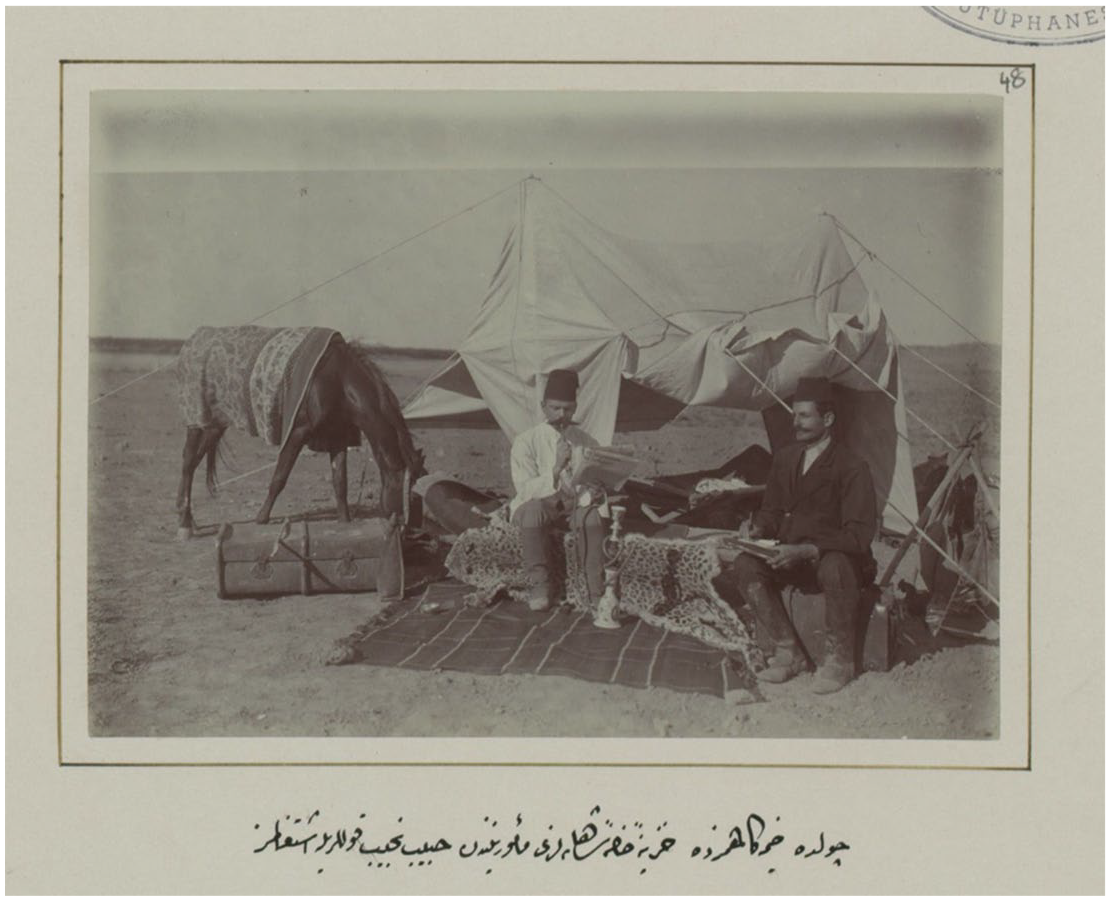
Hazine-i hassa land inspectors in the desert outside Baghdad.
By the 1880s, the hazine-i hassa likewise tightened its grip on steamshipping infrastructure on the Tigris. The first steamships in Iraq were actually British. Under the command of Colonel Francis Chesney, two ships, supported jointly by the Ottoman and British governments, traversed the length of the Tigris and Euphrates in 1836. Although one sank, the other remained in Iraq. 31 Governors (valis) Namık Paşa and Reşid Paşa brought several more steamships to the region in the late 1850s. By 1860, both Ottoman and British steamships were regularly plying the Tigris between Basra and Baghdad. When Midhat Paşa came to power, he consolidated the Ottoman steamships in the Oman-Ottoman administration, which was intended to combat British influence and to better link Baghdad and Basra with the Red Sea and Eastern Mediterranean. Ottoman officials worried throughout the latter half of the nineteenth century about British encroachment, particularly by the Euphrates and Tigris Steam Navigation company (ETSN), which had taken over the Chesney ships in 1860. The competing Oman-Ottoman steamship service received mixed reviews, partly because the navy used the same ships for commerce, passenger shipping, and military campaigns, regularly halting “normal” operations to transport soldiers. However, existing Ottoman plans for the Tigris were set aside in 1886, when the hazine-i hassa won the concession for the navigation of the Tigris and Euphrates. 32
With that, the private treasury acquired the means to transform the two things seen as most necessary to achieve nafia in Iraq: agriculture and infrastructure. The private treasury’s embrace of those policy areas, and its focus on Iraq, were congruent with existing Ottoman hopes. However, by pursuing the tight coordination of technology and agriculture, the hazine-i hassa changed how steamships were used in Iraq. Insisting on control over steam technology, the private treasury prioritized the uses of its projected steamships rather than the uses, and users, of the steamships that continued to navigate the same Baghdad–Basra route under the same Oman-Ottoman officials.
“Benefits without number or dimension”
In Baghdad and Basra, Abdülhamid’s private treasury approached nafia as a project of domestic development and international security. 33 The imperial properties functioned as a single whole, with income from agricultural estates (emlak-ı seniye or arazi-i seniye) used to defray expenses ranging from the construction and upkeep of schools and mosques on seniye lands to an orchestra in Istanbul. Between 1887 and 1903, the private treasury borrowed nearly ninety million kuruş from the seniye land revenues, spending just three million on salaries and public works in Baghdad and Basra. 34 Because annual revenues from tax-farm auctions on the ‘Amara seniye lands alone topped four million, they were mostly distributed to Privy Purse establishments elsewhere in the empire. 35 Between 1903 and 1908, several bankers in Basra, ‘Amara, and Baghdad loaned money to the hazine-i hassa – including for expenses that “cannot be delayed one more minute” – through an arrangement with the ‘Amara commission. 36 By paying, and sometimes prepaying, the ‘Amara revenues via telegraph to the Istanbul-based Zarifi bank, these men enabled the circulation of monies within an imperial geography defined by the private treasury. 37 By effectively allowing the hazine-i hassa to borrow against the ‘Amara revenues to fund infrastructural and cultural projects elsewhere, this process helped the private treasury use its agricultural properties to manifest its civilizational vision for the empire as a whole.
Despite claims to the contrary, revenues from hazine-i hassa lands in Iraq were rarely reinvested in local agriculture. 38 Rather, standard tax-farm contracts for seniye estates included provisions assuming responsibility for improvements and finance. 39 In fact, an 1881 hazine-i hassa memo noted that direct administration of lands was unjustifiably expensive, recommending that seniye lands be tax-farmed and tax farmers held responsible for infrastructural and other improvements. 40 Despite the administration’s resistance to direct investment, the seniye estates were meant to serve as an example of nafia to the rest of the region. In an 1888 report, a seniye land inspector divided the Dujayla estate into “built” and “ruined” sections, recommending employing peasants already settled in the “built” sections to help revive the ruined areas and suggesting that this would “tame” the peasants and tribes who would be attracted to the region. 41
In Iraq, the hazine-i hassa was tasked with making cultivation on its estates more efficient and productive – an example for the region – while generating a surplus that could be deployed in service of infrastructure and civilization around the empire. The seniye estates were called upon to embody the future, both as avatars of the modernized agriculture that would bring Iraq prosperity and civilization, and as the capital basis for investments in culture and infrastructure that embodied a kind of modernity more suitable, in the eyes of the private treasury, for somewhere like Istanbul. But the estates did not only pay for infrastructure elsewhere. Beginning in 1886, they helped fund the Tigris steamships.
Between 1887 and 1905, the treasury framed its plans for operating the navigation concession in terms of Iraq’s agricultural prospects and especially the seniye estates. In 1887, a memo about the concession stated that “in accordance with the wishes of the sultan [and] to achieve the long-awaited civilization [. . .] it is necessary to make it easier to gather and transport the crops that exist.” The memo noted that much of the land between the Tigris and Euphrates belonged to the sultan, and that once the “means of facilitation” (steamships) were brought to the region, the region would become prosperous and inhabited. Moreover, it asserted that because the hazine-i hassa was the body “most concerned” with this transformation, it, in partnership with local capitalists, would operate steamships. Looking ahead, the private treasury predicted that once steamships increased the civilization and cultivation of the seniye lands, people would see that the sultan had brought them a way to transport their crops, increasing state revenues and public respect for the sultan while protecting Ottoman interests against foreign encroachment. 42
The memo articulates how the hazine-i hassa envisioned steamships as tools of agricultural transformation, and how it saw itself as both agent and grounds for that transformation. The relationship between the private treasury and imperial sovereignty was tricky: hazine-i hassa lands were removed from state control, but nonetheless embodied imperial sovereignty. For the sultan’s private treasury, acquisitions of land and steamships were aimed at recouping investments and ensuring development, but were also about political sovereignty. The sheer quantity of seniye land in southern Iraq offered an opportunity to invest in development that was technological and agrarian but also explicitly imperial. At the same time, the memo articulates the private treasury’s stance on the uses and users of steam technology. Monopoly notwithstanding, the Privy Purse suggested that others would benefit economically from its steamships. More importantly, though, the hazine-i hassa argued that its monopoly would increase the number of Ottomans benefiting from the less immediate political and cultural “uses” of steam, from the “civilization” of people and land to imperial strengthening.
The next year, the Interior Ministry elaborated on the plan to implement the “material of nafia” in Iraq. Having acquired the navigation concession, the hazine-i hassa, together with local capitalists, would replace the Oman-Ottoman administration with a new “Hamidiye” company. In addition to operating the Baghdad–Basra route, the Hamidiye would extend service north to Diyarbekir on the Tigris and to Meskeneh on the Euphrates, and open coastal routes in Najd as well as land transport routes from Hit to Damascus and Meskeneh to Aleppo. To fill these ships, the ministry proposed bringing steam machines for dredging the rivers and preparing fields to grow cash crops including opium, cotton, hemp, and jute. It also advocated new modes of land auction and tax incentives to cultivate more and different crops, expand military forces, and induce tribal settlement. 43 Though wildly out of step with the capacity of Ottoman institutions in Baghdad and Basra, the proposal illustrates how the private treasury envisioned industrial technologies as useful primarily for agriculture.
The hazine-i hassa’s efforts to expand steam infrastructure were molded by the commercial and legal framework imposed by the concession contract. Generally, when a concession was awarded, the concessionaire signed a preliminary contract, paid a deposit, and pledged to form a company to operate the concession within a specified period of time. While the sultan was not an ordinary property-holder, the hazine-i hassa was also not an ordinary government bureaucracy. So, in 1887 and again in 1892, the hazine-i hassa, together with local capitalists, attempted to form a company to operate the navigation concession. 44 The 1892 draft contract, signed by the hazine-i hassa and seventeen Baghdadi capitalists, noted that the company’s purpose included large agricultural and navigational works. It also stipulated the employment of expert engineers to conduct survey missions during the low water season. 45 In both 1887 and 1892, local seniye land officials participated in the commissions formed to work out the details of the proposed companies. Land and agriculture were foundational to these attempts to establish steam infrastructure, both institutionally and in terms of mission.
However, both attempts were plagued by suspicions on the part of the treasury about foreign influence over local shareholders, and shareholder discomfort with sultanic hegemony. Ultimately, they were unable to reach a working agreement, and in 1894 orders were issued for a new river administration, to be run solely by the hazine-i hassa. While its outlook was somewhat reduced, the new Hamidiye administration was tasked with ameliorating (ıslah) the rivers, and renewing and repairing steamships, pools, barges, factories, and other plant, all in order to get the increasing seniye-lands’ agricultural products to market. Over the next six years, as seniye land officials and foreign engineers conducted more feasibility studies, the Oman-Ottoman administration continued to operate the same ships on the same Baghdad–Basra route. The hazine-i hassa purchased two new ships in 1900, officially disbanding the old administration with the founding of the “Hamidiye” administration in 1904. 46
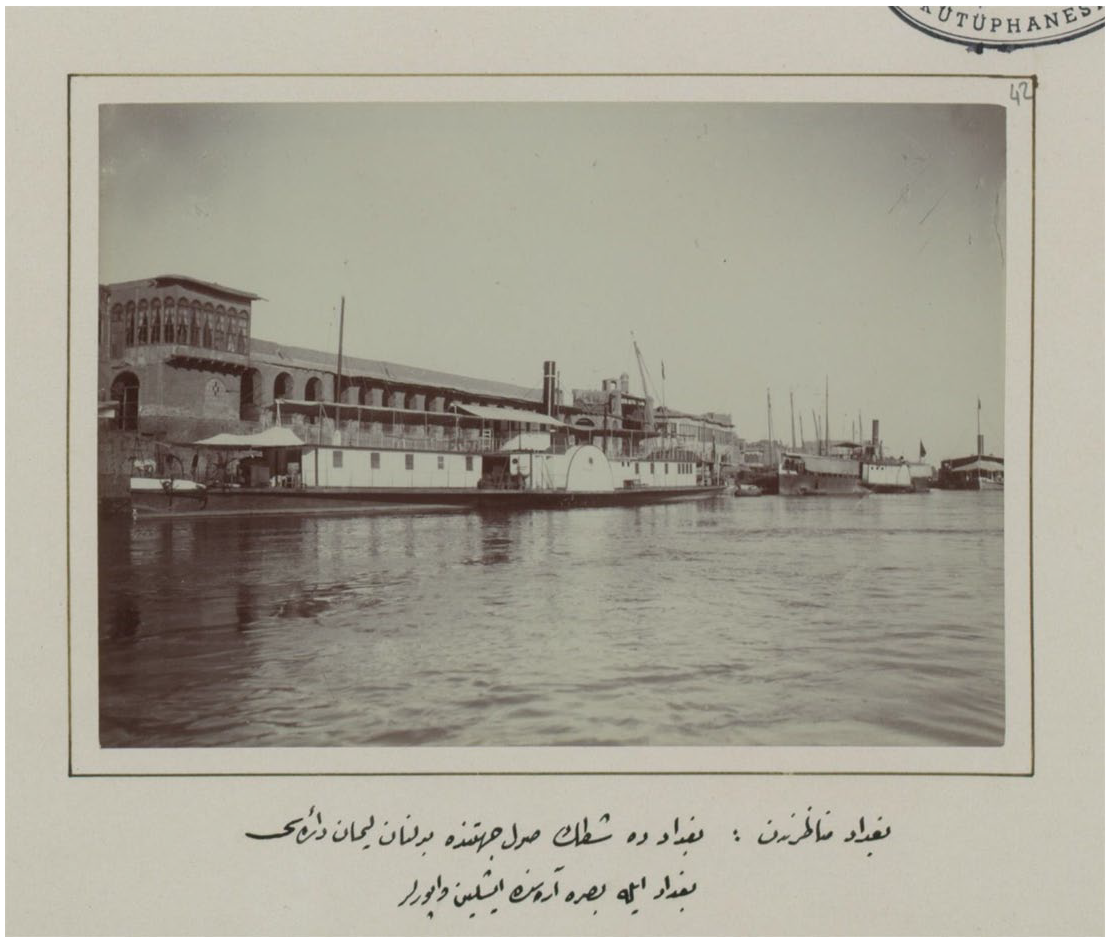
Steamships outside the Baghdad port authority.
In 1905, the land administration of the private treasury (emlak-ı hümayun) formed a commission that again linked Hamidiye steamship operations to the seniye estates. Based on new surveys, the commission projected that steamship routes could expand north to Mosul on the Tigris and Meskeneh on the Euphrates. It made the Hamidiye administration responsible for dredging and widening the rivers, and for employing an expert European engineer to work alongside the head of survey operations for the Baghdad seniye land administration to complete construction on the Hindiye barrage on the Euphrates. Crucially, all of this was to be funded out of the revenues of the sultan’s properties in Baghdad, ‘Amara, and Mosul. 47 The memo ended with the prediction: “and thus, the connections between the lands of Iraq and the Mediterranean, which contain the natural significance of all the world’s grain storehouses, will be made much easier. Now and in the future, this must bring tangible and intangible (maddi ve manevi) benefits without number or dimension.” 48
But efforts to implement this plan stumbled on the unresolved question of the relationship between regional and imperial scales of development. Just eighteen months after the emlak-ı hümayun commission directed that the Hamidiye administration be funded out of the revenues of the local seniye estates, the ‘Amara seniye land commission was already complaining about the financial burdens imposed on its agricultural estates. Enumerating its other expenses, the commission refused to pay its 6,000-lira tranche to the Hamidiye administration. In some ways, this funding scheme made sense. Privy Purse administrators envisioned development within the general region of Iraq, understood as an agricultural and infrastructural unit. Steam technology would enable this regional rebirth while unifying the region. However, the hazine-i hassa was an imperial institution, and revenues from the seniye estates in Baghdad and Basra circulated widely. The ‘Amara seniye lands commission complained about the 6,000-lira charge partly because it had already sent 13,000 lira that year to Istanbul, out of an average annual revenue of 80,000 lira. 49 Similarly, the hazine-i hassa’s efforts to form a consortium with local capitalists had foundered on the question of scale. It looked for local capitalists because this was conceived as a local project that would specifically enrich Iraq. But locals were suspicious of the imperial scale of the private treasury’s motivations. On the whole, the operations of the hazine-i hassa were plagued by inconsistencies. It was public, but also private; operated for the empire, but also the sultan; and pursued development that was local, but also imperial. In Iraq, these paradoxes led to the continual deferral of agrarian rejuvenation, while local wealth was deployed for imperial development through the institutional framework of the hazine-i hassa.
“The needs of the country”
From 1886, the hazine-i hassa zealously protected its monopoly over steamshipping on the Tigris, insisting that a greatly expanded fleet plying more extensive routes would bring agricultural prosperity to Iraq – but only under its control. These imaginary steamships were far more useful to the private treasury in promoting its ideas about nafia than the four steamships the Oman-Ottoman administration ran between Baghdad and Basra. All four had been operating since the 1870s, and by 1900 had deteriorated substantially. They burned more coal than the competing ETSN ships, while traveling more slowly. In order to pay for the coal they had to tow barges, but some of the steamships no longer had sufficient horsepower to pull the barges, which had begun to rot. 50 Although many merchants abandoned the Ottoman ships in favor of the ETSN, that service was also limited, and disliked for its excessive freight charges. The local merchants and landowners who were some of the most important users of both fleets were unwilling to wait for the hazine-i hassa to realize its vision for the Tigris steamships. This was not because they were less invested in expanding steamship service; on the contrary, many had pledged to purchase shares and helped draft contracts for the abortive 1887 and 1892 companies. 51 But where the private treasury prioritized agriculture, local merchants focused on commercial uses of the steamships. As such, between 1887 and 1908 multiple local consortia requested permission to operate steamships on the Tigris and Euphrates. In their applications, several of which were supported by the Nafia Ministry and local and municipal authorities, the merchants appealed to a different set of ideas about progress and what was necessary to achieve it.
This section focuses on the steamships operated by Menahım Salih, Yakub İsai, and Paçacızade Abdurrahman. 52 Their case began in 1881 and was resolved in 1911, spanning the pre-Hamidiye period and the entirety of the time the hazine-i hassa held the navigation monopoly, and ending after the private treasury and navigation concession were absorbed into the Finance Ministry. In their petitions, the partners argued that steamships were most important for trade, and that the most important steamships were those actually operating – and failing – on the Tigris.
In 1881, Menahım Salih petitioned the Nafia Ministry for permission to operate steamships on the Tigris. The ministry recommended the application favorably to the Porte, which granted it on the condition that he and his partners conform to Ottoman laws and act “for the benefit” of Ottoman subjects. The government further stipulated that the permission (ruhsat) could not be considered a concession or monopoly (imtiyaz ve inhisar), that the ship operate under an Ottoman flag, and that the company be headed by an Ottoman subject. 53 The fact that such rules existed suggests that it was relatively routine for Ottoman subjects to operate steamships on internal waters without concessions. The content of the rules, however, suggests that the authorities were trying to prevent a repeat of their experience with the ETSN. The ETSN, which was the transport branch of an English trading company, operated two – and later three – steamships on the Basra–Baghdad route. It was a major irritant for the Ottomans, and often a destabilizing force in the Ottoman–British relationship. It also operated its ships under a ruhsat rather than a concession, but used diplomatic pressure to maintain its operations, which met none of the conditions laid out for Menahım Salih. 54 When he applied for this permission in 1881, the hazine-i hassa had not yet won the navigation concession, and the government was primarily concerned with supporting development while avoiding the problems associated with the ETSN and competing with the English company. 55
Subsequent petitions from the partners highlighted trade as the most important use of the Tigris fleet, and the best means of developing the region. In 1897, Paçacızade Abdurrahman informed the Council of State that the Oman-Ottoman administration had prevented the partners from operating their ships. Paçacızade agreed that “it is not appropriate to compete with the Oman-Ottoman steamships which navigate the Tigris. In order to serve the goal of increasing local trade, though, necessary steps must be taken in accordance with the needs of the country.” Paçacızade went on to outline the current situation on the river, emphasizing that the ETSN’s larger and faster steamships allowed them to dominate the market, charging exorbitant freight fees (fahiş nevl) that “ke[pt] the local merchants and people hostage” and caused extraordinary losses to merchants and farmers as well as the Finance Ministry and the Privy Purse. Avowing that he had no intention of harming Oman-Ottoman profits, but rather wanted to compete with the ETSN to push cargo prices down, he repeated the request for “the operation of several steamships on the Tigris, without a concession.” He asked that his previous permission be “strengthened” and that orders be sent to Baghdad, Basra, and the navy about it. 56
While Paçacızade validated the private treasury’s geopolitical concerns by invoking the possibility that competition from his steamships would mitigate British encroachment, he also revealed quite a different view of the “needs of the country and the local situation.” In contrast to the agrarian focus of the hazine-i hassa, Paçacızade repeatedly mentioned how exorbitant freight fees harmed local merchants. For the private treasury, trade – the question of how increased cultivation and transport would produce wealth – remained implicit. For Abdurrahman, son of a prominent merchant family, the problem of trade was an immediate one with repercussions for how nafia was experienced. 57 The lower freight charge by the Hamidiye ships was irrelevant given the ability of the ETSN ships to bring products to market more quickly and reliably.
The partners also differed from the hazine-i hassa in their concern for the ships as material objects, and so for the practicalities of steamship operation in the present. In 1898, Menahım Salih requested that some tools that the partners planned to import for repairs be exempt from customs duties. Pointedly, he blamed the insufficiency of the existing Ottoman steamships for “many problems and delays in transport” of the tools. While the province recommended that his operations be encouraged in the interests of development, the hazine-i hassa refused, informing the Nafia Ministry that the partners should consider their navigation permission null and void. 58
Other applications generated similar responses. In 1898, Şehbenderzade Mehmed Salih Efendi applied for a navigation permission for his steamboat “Osmanlı,” which he said would ameliorate the harms local merchants suffered because of the insufficiency of river transport. He argued that this was necessary because the hazine-i hassa was not actually operating its concession. The Baghdad provincial administration agreed, noting that as “still no steamships have been sent [by the hazine-i hassa]” it would be harmless to the private treasury and beneficial to the country if Şehbenderzade were allowed to run his ship. 59 Other would-be steamship operators tried to solicit approval by avoiding direct competition with the Privy Purse. In 1908, Esterabadi Mehmed Salih and his partners, who had started running a steamship between Baghdad and Samarra, were informed that the line was already covered by the hazine-i hassa concession. However, given that Hamidiye ships did not regularly travel to Samarra, Esterabadi proposed that he be allowed to operate this portion of the route, in exchange for giving the hazine-i hassa a fixed amount of the pure profits in recognition of their concessionary rights. 60 The private treasury did not agree, despite the support of the Nafia Ministry and the municipality. 61 As with Şehbenderzade, both applicants and officials argued that because the proposed new ships would extend or close a gap in service, they would not meaningfully encroach on the hazine-i hassa concession. 62
Why did so many people ignore the concession in seeking navigation permissions for the Tigris? It is important to note that there was extensive steam traffic on the river throughout this period. While most studies refer just to the six Hamidiye and three ETSN ships that generated most diplomatic correspondence on steam, they were far from alone. All nine pulled steam-powered barges up and down the Tigris, and multiple steam-barges were kept in Basra and Baghdad to unload goods from ship to jetty. 63 At any given moment, up to seven seagoing commercial steamships were present in Basra and the lower Shatt al-‘Arab, in addition, after 1889, to British steamships navigating from Basra up the Karun to Ahvaz. 64 In 1910 the Basra port administration conducted a ship census, which found 193 steam-powered vessels of various sizes and nationalities operating in and around Basra. 65 Because navigation on the Shatt al-‘Arab was open, some Basra-based firms ran small steamships carrying passengers and cargo between Basra and the Gulf. 66 In addition, the British Residency boat “Comet” and several Ottoman gunboats regularly navigated both the Tigris and Euphrates. 67 Some wealthy people in Baghdad and Basra also maintained steam launches for personal use, which they sometimes used to carry their own agricultural products. 68 While steam traffic was dwarfed by the number of sailing ships, and many people in the region had little access to steam, the wealthy merchants and landowners who sought to run commercial ships on the Tigris likely had substantial experience with both commercial and private steamships. 69 For them, the abundance of steam technology in use on the Tigris must have seemed at odds with the failures of commercial shipping.
But for the hazine-i hassa, any competition threatened its ability to build the fleet that it viewed as necessary for the future agricultural riches of the country. In 1906, it even applied for a concession to run automobiles from Mosul and Meskeneh at the (proposed) ends of the steamship line, up to Damascus, to protect the steamships’ profits. 70 The private treasury’s protectiveness of its imagined profits on lines it had no immediate plans to operate clarifies how it understood the role of steamships. In order for Iraq to produce the kind of agricultural revenues the hazine-i hassa wanted, the steamship administration needed more and better ships and a greater operational range. But the private treasury feared that any competition would prevent expansion, hindering agrarian progress and potentially justifying ETSN expansion. 71 So, its steamship use depended on blocking other users.
The hazine-i hassa focused on monopolizing the transport networks of the future, which it imagined as connected to the deep agrarian past but not to the agriculture or infrastructure of the present. In contrast, steamship entrepreneurs focused on the materiality and practical implications of steamship operation in the present. In 1906, Yakub İsai, the third partner of Menahım Salih and Paçacızade Abdurrahman, detailed their operations since 1897. After Paçacızade’s letter, the Nafia Ministry communicated a further imperial navigation permission to the province of Baghdad. Encouraged, the partners formed a joint-stock company, bought a steamship, and began operating it on the Tigris above Baghdad. Whether the private treasury’s 1898 injunction was never communicated to them, or they simply ignored it, the consortium likely braved the more dangerous waters of the upper Tigris to avoid open competition with the hazine-i hassa. Still, according to Yakub İsai, at some point the hazine-i hassa realized what they were doing, and “for illegitimate reasons had the vilayet prevent me from continuing to operate my ship.” The ship was tied up in Baghdad, exposing it to “rain and sun and heat,” which damaged the machinery. After repeated petitions to no avail, the partners decided to sell. The ETSN made an offer, but claiming to be thinking of “serving the sultan” despite having “received more help and protection from foreigners,” the partners refused. Yakub İsai ended by noting that in preventing him from helping to build his country, the hazine-i hassa had left navigation privileges in Iraq limited to the English. 72
Emphasizing commercial competition as a mode of anti-British resistance and an aspect of development, Yakub İsai presented steamships as beneficial in themselves. As such, he emphasized the materiality of steamshipping infrastructure. Although the hazine-i hassa ran steamships on the Tigris, its constant displacement of nafia into the future meant it avoided confronting the ships’ physical existence. While the Hamidiye’s ships slowed down and required extensive repairs, the fact that they were seen as infrastructure of the past meant their operational problems could be overlooked in planning the future of steam. 73 For Yakub İsai and his partners, however, the immediate demands of commerce made the tangible aspects of shipping impossible to ignore.
The hazine-i hassa rejected Yakub İsai’s proposal, stating that, because of the hazine-i hassa concession, his navigation rights were terminated. 74 Responding to his complaint that the concession had not stopped the ETSN, the private treasury asserted that its permission was likewise “without authority,” clarifying that the question of the ETSN was one of geopolitics rather than right. 75 The partners made one last attempt to dispose of their steamship, offering to sell it to the Hamidiye for 8,000 lira. The hazine-i hassa sent an inspector but determined that the ship had design flaws and had been damaged by repeated beaching. This is unsurprising, considering how often ships navigating the lower Tigris went aground and the more difficult conditions on the upper river. 76 And so the case ended with the partners’ somewhat decrepit steamship tied up in Baghdad, and the hazine-i hassa having squashed any opposition to its navigation monopoly.
In some ways, we can see the private treasury’s efforts to restrict steamship use as simply protecting its ships from competition. Although the ships were subsidized, partly by the seniye land administrations, they were intended to generate profit. And because the hazine-i hassa managed agriculture and steamships as part of a comprehensive developmental vision within one institutional framework, shipping profits mattered not only for themselves but also for the future they were to build. For the private consortia, the provincial administration, and the Nafia Ministry, in contrast, increased trade and commercial competition constituted a mode of anti-British nafia. While the hazine-i hassa was committed to preserving Ottoman sovereignty, its vision of future sovereignty and development weighed on its practice of administration in the – increasingly inevitable – present. 77
Navigation revolution?
In July 1908, the Committee of Union and Progress (CUP) took power in Istanbul. After quashing a counter-revolution in April 1909, the authorities removed the majority of seniye properties from the hazine-i hassa, giving them to a new “returned lands” (emlak-ı mudevvere) division of the Finance Ministry. 78 After the Tigris–Euphrates steamship concession reverted to the Finance Ministry, responsibility for the ships was returned to the navy, which renamed the line the “river administration” (idare-i nehriye). 79 While the new administration endorsed the basic goals of extending steam navigation north to Mosul and Meskeneh, and doing whatever was necessary to make the rivers “acceptable for navigation,” its outlook on nafia, especially in relation to imperial geopolitics, was radically different from the hazine-i hassa. At first, the Nafia Ministry and the Porte considered offering a new concession, calling for tenders for the formation of an Ottoman joint-stock company. 80 But, as the Nafia Ministry pointed out to grand vizier Hüseyin Hilmi Paşa, if the new concession prevented the ETSN from navigating, they would inevitably cause problems for the new government. If allowed to continue operating, they would compete with the new company. Both eventualities being undesirable, the ministry suggested uniting British and Ottoman ships under a single administration. 81
While taking stock of the commercial and geopolitical ramifications of its decisions around shipping, CUP officials remained committed to an agrarian Iraq. When the combined administration was mooted, the attaché of the Ottoman embassy in Paris wrote that “this kind of monopoly could produce wealth on the scale of the Nile in Egypt, and the individual who owns this right, in the future, could increase the wealth of our country by millions, or would also be free to control the lack of increase.” 82 After intense opposition, led in Iraq by many of the same merchants who had applied, and would apply again, for navigation permissions, the reconvened Ottoman parliament and the Council of Ministers decided not to award any kind of monopoly or concession. Observing that the idare-i nehriye did not compete effectively with the ETSN, they endorsed a policy of increasing the number of Ottoman commercial ships on the river, effectively acquiescing to the arguments of Menahım Salih and Paçacızade Abdurrahman that competition was the best antidote to British encroachment. 83
Between 1909 and 1913, steam navigation permits were granted to at least six local partnerships, including those led by Esterabadi Mehmed Salih and Yakub İsai. 84 Tellingly, I found just one application that was refused, from Baghdad merchant ‘Abd al-‘Ala, a British Indian subject. The Interior Ministry argued that granting his permission would open the door for other foreign companies – namely, the ETSN – to grow their fleets, suggesting that ‘Abd al-‘Ala sell his boats to an Ottoman subject, who might run them under the Ottoman flag. 85 In the correspondence around granting these permissions, the government revived the pre-Hamidiye vocabulary for regulating navigation. It stipulated that permits not pass to foreigners; that no kind of monopoly or concession be possessed; and that owners be Ottoman subjects and fly the Ottoman flag. The government added two novel conditions: that the companies pay an appropriate yearly sum – some permissions specified 10 percent of profits – to the Baghdad municipality; and that if another Ottoman subject requested a navigation permission, that they “would not interfere with it.” 86 This last can be read as an attempt to prevent the formation of illicit monopolies, and to ensure that the new Ottoman companies concentrated on competing with the English rather than with each other.
Discussing the petitions, the Nafia Ministry and Interior Ministries echoed the kind of development language favored by the merchants, noting that steamships on the Euphrates would “bring numerous benefits,” including cheaper cargo rates. 87 In granting permission to one Aga Cafer, the Nafia Ministry wrote, “considering that the development of trade and security and the easing of industry depend on the increase in means of transportation, the granting of the aforementioned permit is agreed.” 88 While the ministry cited several reasons to increase the number of steamships on the Tigris and Euphrates, agricultural increase was not one. That is not to say that agriculture no longer figured in Ottoman developmental visions; in fact, the CUP proposed an ambitious suite of irrigation and land redistribution schemes. 89 Rather, while the new shipowners and the officials who oversaw them understood steamships as tools of improvement, they did not insist that development be only agricultural.
This openness did not last long. William Willcocks, the irrigation engineer hired by the Nafia Ministry in 1908 to “revive Mesopotamia,” left in frustration after two years, while the ministry slashed his comprehensive plan down to just the Hindiye barrage. 90 Land redistribution plans encountered opposition from military officials and foundered on increased violence in the middle Tigris and Euphrates. 91 Continuing to face stiff competition from the ETSN, and with British worries about German influence heating up, the Ottoman government signed a new agreement with the British and Germans in 1914, creating a unified plan for navigation, irrigation, and railways in Iraq. 92 The plan dissolved the ETSN and idare-i nehriye, turning over responsibility for navigation to Lord Inchcape of the British India Steam Navigation company. 93
The negotiations were fraught with the assumption that Iraq did not have enough water for both navigation and irrigation. This idea, originating in an earlier dispute between Willcocks and the ETSN, suggested that shipping could have no role in ensuring agricultural prosperity. 94 Ottoman officials and European diplomats dealt with this problem by reimagining the Baghdad Railway – which in 1914 was nowhere near Baghdad – as a substitute for shipping. Seemingly more neatly divorced from the landscape and the problems it posed, the Baghdad Railway held out the prospect of using more of Iraq’s waters for irrigation, while providing a backstop against British encroachment. Moreover, in a shift away from the regional emphasis of the early CUP period, the Railway’s transregional scope recentered the imperial scale of nafia.
Technology in the agrarian future
Throughout their history, the Tigris steamships were caught between competing assessments of the present and imaginations of the future. While the hazine-i hassa controlled the use of commercial steam technology on the Tigris and Euphrates, it focused on imagined future steamships rather than the ships it actually operated. Its emphasis on this potential transport network helped justify how it used its ships, and its refusal to grant any other navigation permissions, because it did not see those ships as part of that future network. In contrast, local merchants and landowners who regularly used the Oman-Ottoman, and later Hamidiye, ships were spurred by their experiences to import and operate their own steamships. Rather than focus on possible agricultural prosperity, they wanted to use steamships for the immediate purposes of securing affordable trade and competing with the British. By considering the language used by the hazine-i hassa, the merchants, and other parties, this article suggests that we can move beyond institutional or political histories of steamshipping to consider how and why Ottomans used steamships.
David Edgerton has argued that concentrating on use allows historians of technology to overcome the biases of more traditional histories of innovation and adoption. In part, he suggests that histories of innovation are biased by a systematic orientation toward the future. 95 Here, I argue that ideas about the future also significantly shaped steamship use in late Ottoman Iraq. The Ottoman steamships – commercial, military, and private – that were in use on the Tigris failed to generate the wealth and order that local, imperial, and foreign observers predicted for the region. The contrast between prediction and reality generated what Brian Larkin has described as a “complicated set of emotional investments” for customers and officials. 96 Divergent assessments of how steamships could and should be used in the future affected how both the hazine-i hassa and its competitors used steamships in the present.
The Tigris steamships, both real and imagined, were products of their political context. The concept of nafia, which introduced a concern with public and private “benefit” to existing Ottoman ideas about the built environment, was an easy match for the sultan’s private treasury. In Iraq, with its storied past and presumably gloriously wealthy future, the hazine-i hassa sought to create a self-sustaining system of agriculture and steamships that would produce peace as well as profits. While it pursued an agrarian future in Iraq, however, the private treasury was engaged in a wider variety of “beneficial” projects elsewhere, creating a mismatch between a (proposed) regional ecology and economy, and the drain of agricultural revenues to circulate through financial networks and nafia projects around the empire. This mismatch displaced the future in space rather than time.
Under the CUP, the river administration continued to be plagued by conflicting regional and imperial aims, and a lack of clarity about what was being developed, where, and for whom. And while the CUP administration at first seemed to embrace a broader vision of what steamships could do for Iraq, by the outbreak of World War I Ottoman officials seemed more fixated than ever on an agrarian future. After the British occupation, moreover, a similar vision of reviving Iraq’s bountiful agrarian past through technology formed the basis of what Priya Satia calls the “modern notion of colonial development.” 97 Throughout, the identification of the future with a deep past divorced expectations of development further and further from the technology and ecology of the present.
Footnotes
Acknowledgements
Many thanks to Darina Martykánová, Nurçin İleri, and the participants in the 2017 SHOT workshop “History of Technology in Ottoman and Post-Ottoman Cities at the Turn of the Twentieth Century” for their support of and feedback on an early draft of this essay. Thanks also to Isacar Bolaños, Sam Dolbee, Taylor Rose, and the members of the Yale Environmental History workshop for their generous feedback on subsequent drafts of the article.
Declaration of conflicting interests
The author declared no potential conflicts of interest with respect to the research, authorship, and/or publication of this article.
Funding
The author(s) disclosed receipt of the following financial support for the research, authorship, and/or publication of this article: The author would like to acknowledge the support of Koç University’s ANAMED Research Center for Anatolian Civilizations for making this research possible.
