



Abstract
Against the common association of voyages of exploration with discovery and the arrival of modernity, this essay argues that maintenance and repair were essential to the success of such voyages and that maintenance and innovation are best seen as fundamentally integrated. Using the Russian circumnavigatory voyage of Adam von Krusenstern and Urey Lisianskii in 1803–7 as a case study, the essay explores the diverse forms and roles of infrastructure and repair work in enabling a voyage of exploration, and reveals the tensions and debates that considerations of maintenance evoked among ships’ officers, crews, and the peoples they encountered.
Introduction
In August 1803 two Russian ships, Nadezhda and Neva, commanded by the Baltic German officer Adam von Krusenstern and the Russian Urey Lisianskii, departed from St. Petersburg to begin the first Russian circumnavigation of the world. Over the next three years they visited the Marquesas, Hawai’i, Japan, China, and Kamchatka. In June 1804, en route to Kamchatka, the fourth lieutenant, Hermann Ludwig von Löwenstern, made an observation about the ship’s naturalist, Tilesius.
Tilesius thinks that if he has told a sailor this has to be fastened down, preserved, or put away, that he has done his part and does not need to concern himself with the matter any further. Who is . . . going to look after and be responsible for his specimens in bottles, glasses, etc., filled with spiritus? Since this counselor himself in no way looks after these things, they are noticeably rotting, spoiling, and breaking. Soon, he will wake up from his dream.
1
One might say that Löwenstern thought Tilesius was focusing too much on discovery and not enough on maintenance. If no one looked after his specimens, they would rot, no matter how interesting they were to science.
Like Löwenstern, historians of technology are paying increasing attention to maintenance. As David Edgerton has written, “maintenance and repair are the most widespread forms of technical expertise.” 2 Looking at technology in use, not just at moments of discovery and invention, reveals diverse epistemic, political, and social dimensions of technological practice. This is not to say that discovery and maintenance are distinct and easily identifiable categories. As Löwenstern recognized, they were intimately entwined features of voyages such as his, integrating people and things in activities that repaired what already existed and in so doing revealed things unknown. 3
Separating discovery and maintenance has often been done in the name of identifying a certain kind of modernity. Histories of exploration have traditionally focused on geographical discoveries and technoscientific innovations. This approach has a long pedigree. Seventeenth-century scholars identified science, discovery, and inventions like the compass as distinguishing “moderns” from “ancients.” 4 Through discovery, knowledge and power combined, Francis Bacon famously insisting that, “the opening of the world by navigation and commerce and the further discovery of knowledge should meet in one time and place.” 5 Since then historians have often viewed the “Age of Exploration” as ushering in the modern world. The half-century after Cook’s voyages is now taken to mark the transition from the “early modern” to the “modern,” while discovery of the unknown, attaining power over nature, and the development of useful knowledge, all rooted in exploration, appear as seminal modern values. 6 Even proponents of Actor–Network Theory, who have “never been modern,” take maritime exploration as a model for explaining modern science. But “cycles of accumulation” could not happen without maintenance. 7
Exploration, then, is a vital arena for making sense of values and narratives associated with modernity. But, as Löwenstern recognized, one cannot disentangle maintenance and discovery in practice. Innovation is underwritten by continuities of context, practice, and material culture that endure over time, just as forms and processes of continuity are enabled by innovation. Infrastructure provides the often unnoticed technological background that makes more visible innovations possible. Infrastructure will be the focus of this essay. Paul Edwards and others have drawn our attention to infrastructure as a critical element of modernity, revealing how innovation depends on mundane things like transport facilities, water or fuel supply, and information services. 8 Infrastructure is “modern” because it regulates the environment, controlling nature to make things easy and predictable. But Edwards equally emphasizes the tensions and contradictions in associations of infrastructure with modernity by approaching them at different scales. If large-scale modern infrastructures are rigid technological systems overpowering “Nature,” the individual, smaller-scale infrastructures may operate more fluidly, in dialogue with and dependent upon their local environments, designers, and users. Modernity, then, cannot be understood as a single condition but exists on multiple scales whose consideration reveals inherent contradictions.
This essay complicates the equation of exploration and modernity by looking at maritime maintenance. My argument is that we should pay more attention to the importance of maintenance and infrastructure in the history of voyages normally associated with discovery and innovation. Shipyards, docks, ports, and harbors were some of the principal forms of global maritime infrastructure around 1800. British imperial dominance and scientific innovation has been linked to unequaled networks of secure naval institutions across the world. 9 As Erika Jones has shown, Britain’s Challenger expedition of the 1870s, which pioneered the science of oceanography, relied on regular interactions with a diverse range of naval bases, coaling stations, rail and postal networks, administration, and museums in order to succeed. Even if they sailed alone much of the time, ships maintained their progress by remaining tied to the land and its invaluable resources. 10
Krusenstern and Lisianskii’s circumnavigation of 1803–6 offers a useful case for examining the nature of naval maintenance and infrastructure and their consequences for notions of technology and modernity at a critical moment in history. A close examination of the voyage shows how important maintenance was to ‘voyages of discovery’, with implications for how we think about science, technology, and empire, and the relationship of maintenance to modernity. This and subsequent Russian voyages altered the nature of Russian imperialism in the nineteenth century, from a land-based empire to one with ambitions of overseas domination. 11 The expedition contributed to the opening of Japan to European trade, and revealed through meticulous records a variety of North American and Asian cultures to European eyes. 12 This essay will argue first that practices of maintenance were critical to the voyage and took place at a diversity of scales: in ports and docks belonging to the Russian empire, on board the ship, and in foreign harbors around the globe. Second, in different ways at different scales, these practices were inseparably integrated with practices of discovery: keeping things “shipshape” was creative and innovative. Third, these practices were not unique to Western, European explorers. Maintenance and infrastructure were hybrids of international and cross-cultural expertise and resources. The Russians themselves occupied an uneasy position as insiders or outsiders to a ‘civilized’ Europe. Pacific peoples they encountered on the voyage also managed substantial infrastructures and extensive programs of maintenance.
Background to the Krusenstern–Lisianskii expedition
The Krusenstern–Lisianskii expedition began as an effort to maintain the empire, a voyage to provision distant Russian trading outposts in Alaska. Through the eighteenth century the Russian government and private fur traders (promyshlenniki) extended east to Siberia, Kamchatka, the Aleutians and ultimately Alaska in search of opportunities for trade and profit. As the historical geographer James Gibson argued in Feeding the Russian Fur Trade (1969), the great distance of these enterprises from urban Russia meant that the maintenance of an extensive network of outposts to provision and supply hunters and traders was a fundamental concern. 13 The government sponsored exploration of the region, with a view to cultivating agriculture and identifying resources, while traders consolidated to form the “Russian American Company.” Such efforts were bound up for the government with desires to demonstrate Russia’s place among ‘civilized’ European nations, demonstrated through support of science and exploration. 14 Russia adapted foreign skills to enable these enterprises, beginning with the Dane Vitus Bering, who explored the eastern seas for Peter I. By the late eighteenth century, in the case of the Imperial Russian Navy, the government looked to British expertise. 15 Catherine II drafted in naval experts such as Samuel Bentham, Samuel Grieg, and Charles Knowles to reform the Imperial Navy, and sent young Russian officers to England to train with the Royal Navy. 16 Krusenstern and Lisianskii were among them, and when they returned to Russia as ardent anglophiles around 1800 they brought with them plans to extend Russia’s influence on the model of Britain’s overseas empire, while offering a novel solution to the problem of eastern provisioning. Already in 1785, impressed with Captain James Cook’s voyages, Catherine commissioned Cook’s former astronomer’s assistant, Joseph Billings, to investigate the trade in sea otter furs in the east. 17 Billings, like previous Russian explorers and trappers, traveled overland to Kamchatka before building vessels to carry him across the Bering Sea toward America. But Krusenstern, in 1799, proposed a different plan. Instead of crossing Eurasia, a long and arduous journey, ships might pass from St. Petersburg to London then around Cape Horn into the Pacific, traveling up the west coast of North America to Alaska. Here they could provision the outposts of the Russian American Company and then pass to China to sell furs and pick up goods to be sold in Russia. Along the way, the Russians would explore islands in the Pacific and the northwest coast. The Russian government approved the plans and in 1803 Krusenstern, in Nadezhda, and Lisianskii, in Neva, set off from the port of Kronstadt for London. 18 They carried with them a Russian ambassador, Nikolai Petrovich Rezanov, charged with negotiating a trade deal in Japan, which the Russians believed the Japanese had promised (they had not). Although no deal was forthcoming, the voyage proved highly influential and some thirty further Russian circumnavigations to Alaska followed until the sale of the region to the United States in 1867. 19
These voyages were significant in asserting Russian modernity. The Krusenstern–Lisianskii expedition was quite consciously modeled on a medley of European voyages, including those of Captain Cook in the Pacific and Earl Macartney’s embassy to China of 1793. 20 They formed part of Russian efforts to present the empire as European and civilized. Foreign observers appreciated the message. British Arctic explorer Sir John Ross identified Krusenstern’s voyage as part of a “series of rapid changes which distinguished the dark period of Russia from that in which she has begun to run the race of civilization with other European nations.” 21 But for many it was far from obvious that voyages of exploration made the Russians “modern”. Visitors disparaged the Russian empire as backward, even as Russian explorers from St. Petersburg applied the same criticisms to ethnic peoples of the empire. 22 When the French traveler abbé Chappe d’Auteroche visited Russia in the 1760s he dismissed Russians as naive and superstitious. 23 The same contradictions marked Krusenstern’s and Lisianskii’s voyages, filled with debates over who was barbarous and who was ‘civilized’. Rezanov was scornful of the Japanese, expecting them to cower before displays of European scientific instruments. Krusenstern urged respect for the Japanese as equals. The Japanese considered the Russians “northern barbarians.” 24 As Löwenstern’s private journals recorded, competing parties of Russians and Baltic Germans on the ships had a dim view of one another. Löwenstern accused members of Rezanov’s party of “stupid boldness and coarseness . . . Schemelin does not deserve to be counted among civilized men.” Rezanov, he wrote, was a “donkey in a lion’s skin.” 25
Regional maintenance: Russia’s naval infrastructure
The dividing lines between discovery and maintenance, civility and barbarism, Russia’s past and future, tradition and modernity, thus remained highly fraught in the era of the Krusenstern–Lisianskii voyage and on the voyage itself. The same was true of the infrastructure that supported it. At the turn of the nineteenth century voyages of exploration were ‘big science’ and depended on diverse infrastructures to succeed, relying upon substantial military–fiscal state enterprises and global establishments of ports, colonies, harbors, and shipyards to move from place to place. 26 Russian infrastructure took in a dispersed collection of shipyards and ports across Eurasia, and a variety of small towns, colonies, and harbors where ships could stop for repairs and provisioning. Given the great scale of the Russian empire at this time, such infrastructures were focused in particular regions and suffered from the difficulties of distance. This was one reason the Russian government approved Krusenstern’s plan to take a sea route to Alaska, replacing laborious travel overland. 27
At the time of the Krusenstern–Lisianskii expedition, several large shipyards existed in the Russian empire, overseen by a group of leading constructors who managed shipbuilding and ship repairs. 28 The system was far from coordinated or unified however. Shipyards in Sevastopol, Kherson, and Nikolayev served the Black Sea Fleet, while the Solombala shipyards in Archangel’sk built ships for the Baltic. Shipyards simultaneously defended ships from the environment and relied upon and transformed environmental features into resources and artifacts. In the northwest, Archangel’sk had access to extensive larch and pine timber forests and iron ore from the Ural Mountains for manufacturing ordnance. The shipyard exported tar, a critical material used to extend the life of ships by waterproofing timbers. 29 Quality hemp, used to make sailcloth, was widely available in the Baltic region, with the best coming from Novgorod. 30
The same resources served shipyards at the Admiralty on the River Neva in St. Petersburg, and at Kronstadt on Kotlin Island nineteen miles west of the city. Kronstadt, taken from the Swedes in 1703, was the main Russian shipyard in the empire. The island was a natural defense supported by built fortifications, and contained a marine hospital, an academy for officers, and two ports for military and merchant ships respectively. 31 Kronstadt linked to networks supplying natural resources across Eurasia. Shipbuilders used oak timbers transported from Kazan to repair ships in a dry dock, with the water drained then readmitted drained from and then readmitted to the dock to float the ship out of the harbor. 32 Although some shipbuilding occurred there, Kronstadt was primarily used for maintenance and repairs (Krusenstern used the term pochinka korablia – “repair of a ship” – for what I shall translate as maintenance), a role it retains to this day. 33 Indeed, Nadezhda and Neva were not built in Russia, but were adapted British ships purchased by Lisianskii in London and sailed to Kronstadt in May 1803 to be repaired and refitted. 34 The Russians chose British ships in part out of admiration for Cook’s voyages and on account of Britain’s reputation for fine shipbuilding: a lucrative deal for Lisianskii may also have helped motivate the decision. 35 Kronstadt’s focus on maintenance did not preclude innovation, bringing together knowledge and skills. Through experiments and commissioned prize essays, the Admiralty struggled to overcome ship deterioration caused by poor timber seasoning and the cold and low salinity of the Baltic Sea. 36
The best method of avoiding damage was to anticipate it and much innovative thinking went into the design of ships to secure them from the need for repairs. Nadezhda and Neva were experimental vessels, having copper sheathing added to the hull as a form of protection from weeds, worms, and barnacles. Copper sheathing integrated maintenance and innovation, with a history that stretched back at least to the early seventeenth century. 37 The practice was adopted by Britain’s Royal Navy in the 1760s and subsequently picked up in Russia. Initially frustrated by the galvanic action that occurred between the copper and iron nails in a wooden hull, corroding the iron, a series of British experiments with zinc alloy bolts and paint concluded with the use of hardened copper bolts for joinery below the water line. By the 1790s, French naval ships and British merchant ships were being fitted with copper sheathing. 38 When the Russians fought the Turkish fleet on the Black Sea in 1790, the Turks were already experimenting with copper sheathing. 39 Nadezhda and Neva were among the first Russian ships to be protected in this way, having been fitted with copper sheets in Britain before being sailed out to Kronstadt. 40
Krusenstern and Lisianskii departed from Kronstadt in July 1803, completing the first part of the voyage in the Pacific before landing at the town of Petropavlovsk in Avacha Bay on the east coast of Kamchatka in July 1804. The ships would return again twice during the voyage, making use of the bay as a location for restoring the crews and ships. While Kronstadt offered substantial resources for shipping, outposts further afield were much more limited. The small town of Petropavlovsk had been founded in 1740 by Vitus Bering, being named after the two ships constructed for him at Okhotsk for his second expedition to the region (the town was referred to in English as “St. Peter and St. Paul”). 41 Petropavlovsk’s location was owing to the natural protection afforded by a bay at the mouth of the river Avacha, making it useful as a safe site for conducting repairs. There was minimal infrastructure however. Although a small community of officers, soldiers, priests, and merchants led by a governor resided there, Krusenstern was dismayed by an absence of people and ships that indicated how “the nautical concerns of this colony are still in a state of infancy.” 42 Infrastructure needed maintenance too, and Petropavlovsk had declined in recent years. Löwenstern noted how the abandoned boat of Joseph Billings lay upturned in the harbor, a scene recorded in Krusenstern’s journal (Figure 1). Nevertheless, a garrison was stationed in the town, together with a small hospital and surgeon, though medicines were scarce. Many Kamchadals (the native people of Kamchatka) contributed to the operation of the harbor, providing security and serving as guides, porters, hunters, and pilots. 43 Despite its shortcomings Petropavlovsk enabled remarkable exchanges of goods and intelligence. In 1779, for example, it was visited by Captain Charles Clerke, who passed on news of James Cook’s death in Hawai’i before handing over the ship’s journal and Pacific artifacts to the governor of Kamchatka in nearby Bol’sheretsk to be returned to England. 44
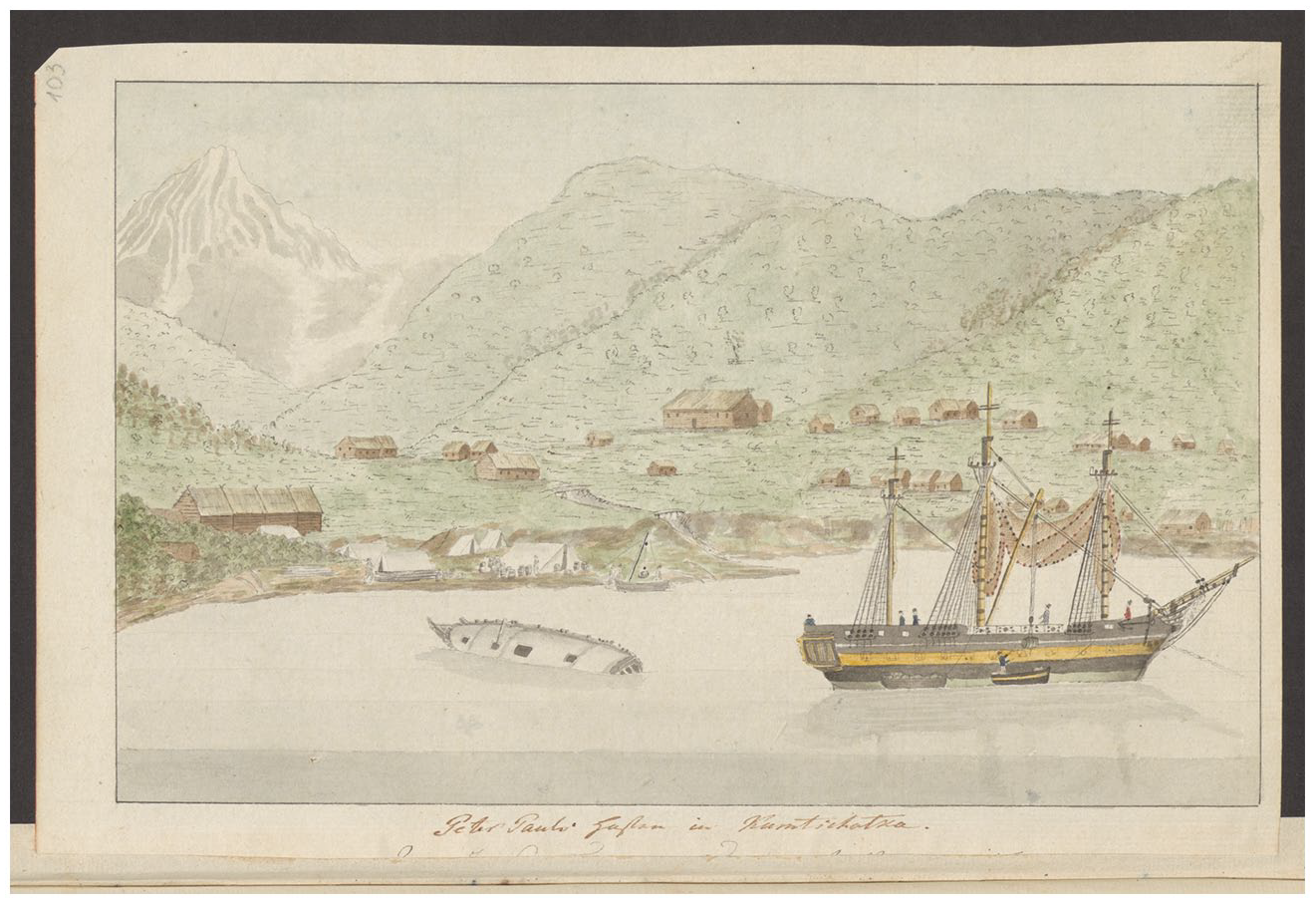
The Bay of Petropavlovsk, from Adam Johann von Krusenstern, Materjalid elu ja tegevuse kohta; 02.1789–1831, Reisipäevik; EAA.1414.3.3; 1803-1805, p. 89. Rahvusarhiiv, Tartu.
Krusenstern played up the current “infancy” of Petropavlovsk partly because he wanted to encourage its potential as naval infrastructure on the model, in this case, of the British colony at Port Jackson. In his published account of the voyage he advocated the town’s development. He reckoned cabbages, carrots, and potatoes could be grown in the vicinity, the weather was better than some imagined, and with more discipline the local people could flourish. 45 Certainly during the summer of 1804 the harbor provided critical resources for maintenance. 46 When Nadezhda arrived, mail was sent and received. Fresh water and ballast were collected. Maintenance applied to both people and vessels. Krusenstern recalled, “we had but one invalid, and in a week he became perfectly well.” 47 Social niceties were observed in the process. When the local governor was unavailable, the commandant Major Krupskoi, “did every thing in his power to assist and be of service to us.” 48 “The ship was immediately unrigged, and every thing sent on shore, the landing place not being fifty fathoms distant; and after so long a voyage all the sails and rigging required either a thorough repair, or to be replaced with new.” 49 When it mattered, the disparate sociomaterial resources of Petropavlovsk could be mustered effectively. For their assistance the crew rewarded the governor and officers of the town with dinner on the ship before they left. 50
The Russians’ repairs followed a typical pattern of the time. When European ships docked, officers sought to clean and repair as much as was practicable given constraints of time, ambient conditions, local support, and available supplies. Locales might be transformed due to the demands for labor and materials serving maintenance. 51 The work mixed tried and tested methods with ingenious improvisation and relied mostly on traditional muscle power. A full overhaul might be undertaken by the whole crew and involved the removal of cargo, stores, guns, and rigging, followed by cleaning of the interior and exterior of the ship, the latter often encrusted with barnacles. 52 Ships were turned on their sides to enable caulking (konopatit’), which entailed driving cotton or oakum (hemp fibers soaked in tar) into the seams between joints in the wooden boards of the ship’s hull with a mallet and covering them with putty or pitch to make them watertight. Harbors provided shelter from the extremes of the elements, but crews had to keep the weather in mind, delaying or hurrying repairs to avoid bad weather. Repairs carried their particular temporalities. At Petropavlovsk in August 1804 Krusenstern determined to set off for Japan “before the north-east monsoon should set in,” leading him to “hasten every thing as much as possible.” 53
Networked into the resources of the land, harbors also provided food and livestock, and physicians to attend to the health of the crew. Hungry crews attended their work eagerly. “Like hamsters, we are dragging fresh provisions from land,” as Löwenstern noted. 54 At Petropavlovsk, the officers Romberg and Bellingshausen reviewed the Nadezhda’s and Neva’s provisions and arranged new supplies. Kamchadals caught salmon, and caravans brought food from Okhotsk, Siberia’s main seaport on the Pacific and four weeks’ journey from Kamchatka. 55 Gin, sugar, tobacco, salt, soap, and candles were easily had, but rum, coffee, vinegar, and mustard were impossible to get. 56 Foods that made it onto the ships were dried and salted to preserve them (the Russian officers ate salted reindeer and goose). A stock of wild garlic used as an antiscorbutic was provided in barrels of water. 57 The long passage from Okhotsk meant that food spoiled, prompting ingenious improvisation. Krusenstern found butter supplied from Okhotsk was “so bad . . . we could not eat it, and I was compelled to use it on board instead of grease.” 58 Putrid meat was thrown overboard. 59
Kronsdtadt and Petropavlovsk thus served as critical locations for maintaining the ships and crews. As infrastructure they might be viewed as indicators of Russia’s modernization, but cannot be characterized so simply. Russian shipyards and harbors were sites where experiment, improvisation, and innovation were generated by, and served, the needs of maintenance. Officers sought power over nature to protect ships and relied on nature to repair them. Innovative material techniques, like copper sheathing, preserved ships, but old-fashioned muscle power remained critical for manipulating hulls or loading and offloading vessels. Maintenance was applied to the social as much as the technological, demanding care for the sick as much as repairs to hardware. Shipyards and harbors signaled discovery and expansion, but also the limits of an extended empire, displaying failures from the past and opportunities for the future.
Shipboard maintenance on Nadezhda and Neva
A similar picture emerges if we turn to the place where ships spent most of their time: at sea. At sea, ships had no refuge from the environment. Harnessing the properties of water and wind afforded rapid travel, but errors in navigation could lead a ship to be grounded on reefs or rocks, or worse, be shipwrecked. 60 Winds and storms battered vessels, causing more or less extensive damage, and long periods with inadequate provisions led to scurvy, sickness, and death. This demanded very different practices of experiment, improvisation, and maintenance than the kind afforded by shipyards and harbors, often urgent, temporary, and entailing a high level of risk. On Nadezhda and Neva, an assortment of skilled artisans and medical personnel dealt with human and material injuries as they occurred. Officers deployed ingenious techniques to ensure ships continued to operate despite damage. These practices involved distinct temporalities, opportunities, and constraints compared to those characteristic of Kronstadt or Petropavlovsk.
If good design precluded damage that needed care in shipyards, expertise and training in navigation secured ships at sea. Krusenstern and Lisianskii’s voyage was part of continuous Russian efforts to improve navigation. Academics on land and naval officers at sea used innovations in mathematics, astronomy, and new instruments such as the marine chronometer to perfect a discipline intended to make the crew and ship’s path as predictable and manageable as possible. Writing was a critical technique of maintenance, enabling officers to secure fleeting observations and measures in as permanent a form as possible. 61 On the 1803 expedition, the officers took endless measurements to track their path safely and experimented with Cook’s techniques of navigation. 62
Maintenance was thus a significant motive for innovation. It was also responsive, as crews struggled with the environment to keep their vessel running. The weather was an overriding concern. While haste could forestall bad weather in a harbor, at sea ships had to contend with whatever confronted them. Nadezhda and Neva suffered in repeated storms. Extremes of heat and cold, damp, ice, wind, and waves all threatened oblivion. Anticipation and prompt expediency resolved some of this. Ships carried spare parts, and crews improvised in the moment with substitutions if a part was not available. Acts of substitution prompted creativity and ingenuity. 63 Krusenstern explained that he kept off using new sails until he reached the waters between Taiwan and the Philippines, where “violent storms prevail in all seasons.” He evidently had three sets, of differing quality, and since “the loss of any Principal sail is attended with danger, I only used our second and third set of sails; but as these split and tore in every gale, I was at last obliged to have recourse to the best, keeping, however, the sail-maker constantly at work, in spite of the continued rains, which proved a great hindrance to him.” 64
Ships could rely on diverse skills and personnel in a harbor, but at sea they had to make do with just a few. More than ten percent of the crew on Nadezhda and Neva were “maintainers” or people skilled in repairs. 65 On Nadezhda, for example, there was a sailmaker, Pavel Semenov, two carpenters, Taras Gledianov and Kiril Shchekin, a cooper, Petr Iakovlev, a caulker, Evsevii Pautov, and a locksmith, Mikhail Svägin. This was in addition to medical personnel and the cooks, Neumann, Charitonov, and Kharitonov. The artisans saved the voyage on many occasions. In May 1806 Krusenstern feared the ships were lost.
Our rigging was grown so bad as to stand in need of almost daily repairs, and even the shrouds of the lower as well as the upper masts were frequently breaking asunder. . . . By the assistance and skill of our carpenter we were enabled, in some degree, to remedy the evil; but it was still only with the greatest precaution that we could venture to carry sail on our main-mast.
66
Social and material judgments on these occasions went hand-in-hand, assessing and asserting rank, class, and power. Maintenance was “sociomaterial,” both moral and technical. The officers’ private journals recorded the unruliness of the artisans and the need to keep them “in check like all common people.” 67 The sailmaker Semenov was flogged after insulting the mate, and the locksmith Svägin was described by Löwenstern as “a skilled, industrious man, unfortunately too much inclined to guzzling.” 68 In May 1804, shortly before arriving in Nuku Hiva in the Marquesas, Krusenstern took advantage of good weather to order the sailmakers to repair the sails and the carpenters to repair the boats. Maintenance and preparation for anticipated exchanges and encounters went hand-in-hand. The lock smith, Svägin, “erected his forge to make several articles that were required for the ship, but also knives and hatchets to barter with the islanders of this ocean.” 69 Acts of repair and intercultural interactions unfolded together. Once they arrived on the island, Löwenstern recorded how the “king” of Nuku Hiva, the haka’iki Kiatonui, would observe Svägin working “for hours, especially when he has brought an old hatchet to be repaired.” 70 Pacific Islanders thus assessed the Russians for prospective maintenance work as much as the other way around, making judgments of rank and status along the way.
Indeed, Pacific peoples were much occupied with the maintenance and repair of their own seaborne vessels. While European ships were weighed with ballast to counteract the wind pressure in their sails, Polynesian double voyaging canoes achieved stability by the breadth of their twin hulls. A leaking European ship would sink from the weight of ballast. Polynesian canoes could leak or be swamped with water during a storm. They would not sink, but in a storm might need to be bailed out and repaired. Polynesian mythologies recorded how voyagers were forced to land to repair damaged vessels. 71 An irreparable canoe might be abandoned and “remain drifting until so ravaged by teredo worms that it fell apart, or might be thrown up onto some shore to rot or be scavenged there.” 72
Cleaning was of course another major preoccupation of shipboard life, serving as a means to maintain the ship, to occupy the crew in long periods of sailing, and to discipline and keep the men fit. The temporality of cleaning centered on routine. Besides washing the decks and quarters regularly, Russian sailors washed their clothes in casks of fresh water provided by the officers. 73 The ships were given a fresh coat of paint several times during the voyage, using yellow and black oil paint to waterproof the timbers. 74 Such actions gave structure to life at sea: “we occupied ourselves with putting the deck in order.” 75 Cleanliness was also linked to health, and the provision of good health to the crew was intimately connected to material practices, though officers varied greatly in their efforts to achieve it. A typical range of medical personnel attended to the sick on the Russian voyage. Nadezhda’s principal physician was the Baltic German Karl Espenberg, a medical graduate of Jena, Halle, and Erlangen, and Krusenstern’s family doctor in Estonia. On the Neva, Moses Laband, a Silesian graduate of Halle University, served as physician. They were accompanied by two otherwise unknown surgeons. 76
The officers also saw themselves as maintaining the health of the crew and viewed this maintenance as highly innovative. Krusenstern, perhaps with the model of Cook in mind, was keen to present himself as enlightened and experimented with the latest methods of shipboard ventilation. In a prolonged period of darkness and wet weather, he lit fires in the hold to dry the air, covered the deck with an awning, fed the men “citrons, potatoes, and pumpkins” to ward off scurvy, and had them drink a punch made with lemon juice. 77 In a period when the purity of the atmosphere and ventilation was of much interest, the officers made great efforts to manage bad air and smells. 78 Lisianskii refused to allow the decks to be washed in cold, wet weather in case they were “productive of disease” by holding in damp. Instead the sailors had to scrape the decks, while fumigating the interior of the ship with charcoal smoke and spraying vinegar on areas “where the air had not a free circulation.” 79 At Copenhagen on the outward voyage, Lisianskii was given a recipe by the Danish astronomer Thomas Bugge, “for purifying the air of any confined place by fumigation; which consisted of magnesia nigra and common salt, in equal quantities, with a proportional mixture of oil of vitriol [sulfuric acid].” 80 Lisianskii was much taken with this method. In November 1805, en route between Sitka and Canton, he noticed an obnoxious odor in the ship caused by a putrefying stock of furs in the hold. An ingenious bricolage solved the problem. As sailors went down to examine each fur (“A most unpleasant business”), “to render the air as pure as possible, chafing-dishes with burning coals were hung in different parts of the ship, and a fumigator with vitriol was suspended over the place where the men were to work.” 81 Lisianskii felt sure these methods succeeded in clearing the air.
Certainly it could be argued that these innovative medical and chemical techniques for maintaining health were successful, since no crewmember died on the voyage. 82 They were not simply medical acts though, but evoked chemistry in the name of governance, marking the education of the officers over the crew. “Krusenstern has extensive knowledge, which brings respect, which has given him influence over us.” 83 Repairs were opportunities to enact power. Care of bodies through science complemented the more traditional theater of power enacted through floggings and corporal punishment. 84 At sea these efforts took in different possibilities and constraints to those on land. As in the shipyards, labors at sea mixed innovation and maintenance, in the use of new navigational techniques to protect the ships or ventilation systems to protect the crew. As in the shipyards, these activities were sociomaterial, transforming human and material bodies in integrated acts of maintenance, improvisation, and innovation. But at sea the temporality of such efforts was quite different, as crews battled urgent threats and rushed to find expedient measures. In calmer periods, cleaning and maintenance punctuated the slowly passing time and, when the ships landed, they provided occasions for discovery and engagement with Pacific Islanders. Just as they did at Nagasaki, crews were unsure whether these efforts at sea were marks of civility or backwardness. While Krusenstern appeared to his men as an enlightened benefactor, Löwenstern and the priest Gideon felt Lisianskii was a “tyrant” who confined his men too often, dismissed religion, and treated his men like animals. 85 The Russians complained that the Baltic Germans looked down upon them. Furthermore, not all repair and maintenance work could resolve the issues that arose at sea. When this happened, and the ships were too far from any Russian harbor to find help, they relied on foreign support.
Foreign support: The Russians in Japan
While Russia’s imperial infrastructure and the ships themselves offered means to facilitate pochinka korablia, on many occasions Nadezhda and Neva had to seek out opportunities for repairs elsewhere. This was in part a goal of the voyage, as navigators routinely sought new harbors where infrastructure might be established to effect repairs and maintenance and so extend their nation’s imperial reach. As Lisianksii wrote in the Marquesas in May 1804, “The bay of Jegawé is a very safe place for anchoring; it forms a small basin, defended from all the winds, and ships may lie quite close to the shore, especially on the south side, which renders it an admirable place for such as may be in want of thorough repair.” 86
Ships might also be forced to seek refuge and repairs in any harbor or port where such opportunities could be had. “Exploration” was then as much about keeping in mind the locations of familiar and known places, about scouting locations that provided venues for maintenance and sources of sustenance, as it was about entering unknown regions. Damage, whether gradually accumulated or sudden, prompted return visits. In February 1778 Cook famously returned to Hawai’i, and his death, to repair the mast of Resolution after a storm.
87
In his account of the Russian voyage, Lisianskii recommended that more ships could enter the Pacific around Cape Horn safely, “The only serious objection to the passage” being, the desolate nature of the shores of this Cape, where if a ship should be in want of masts, or repairs, no assistance can be obtained. It is true, there are harbours in the neighbourhood of Terra del Fuego; but we are not yet well enough acquainted with their true situation, for a damaged vessel to go in search of them.
88
When foreign ships arrived in a harbor in need of repairs and provisions, local officials might permit it and provide assistance as long as no military threat could be surmised. When Captain Clerke landed in Petropavlovsk in 1779 the Russians feared a hostile attack but proceeded to supply livestock and support on the basis that they would trust the foreign ship in the first instance. 89 When the Russians reached Nuku Hiva in 1803 they sought provisions, with little luck, but the Nuku Hivans collected fresh water for them, a scene that Löwenstern thought worthy of recording in a painting (Figure 2).
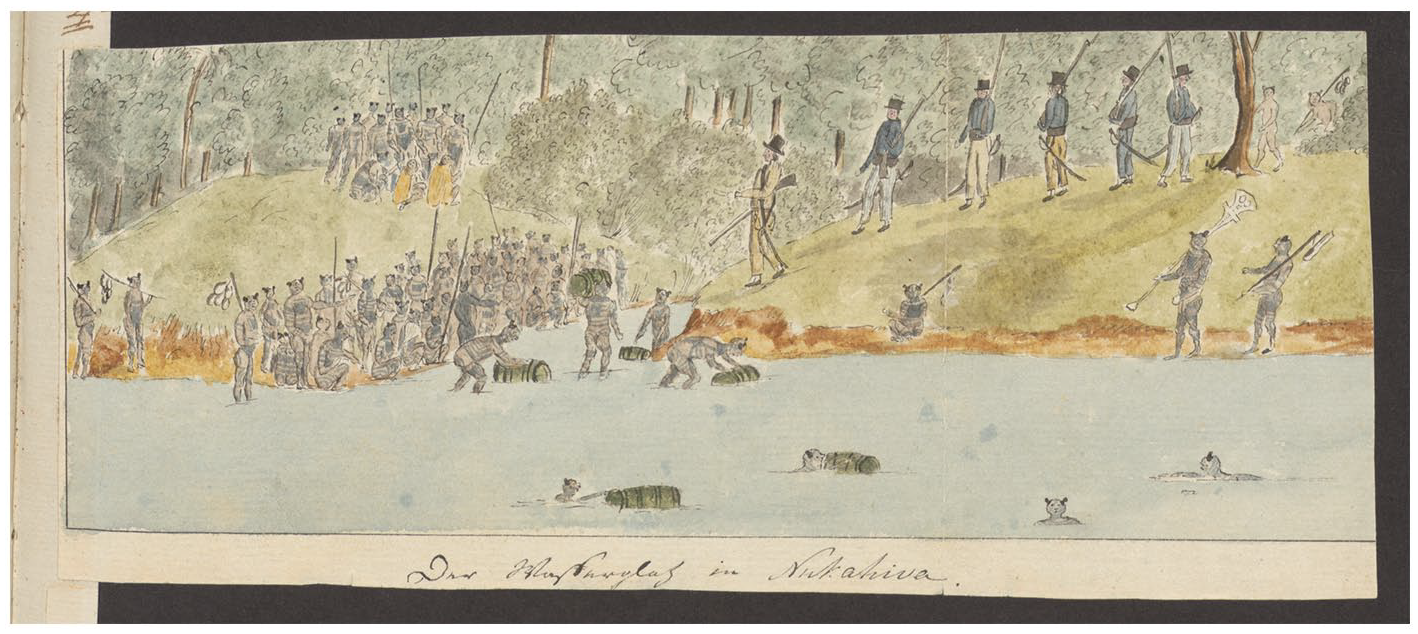
Nuku Hivans collecting water for Russian sailors, from Adam Johann von Krusenstern, Materjalid elu ja tegevuse kohta; 02.1789–1831, Reisipäevik; EAA.1414.3.3; 1803-1805, p. 112. Rahvusarhiiv, Tartu.
Visits to foreign harbors thus mixed the anticipatory and improvisatory character of maintenance at sea and in home ports. They also prompted rich exchanges of goods and materials. When Neva docked in the harbor of Sitka, Lisianskii recorded how two ships belonging to the United States of America arrived for repairs. One was “greatly damaged” after colliding with a vessel and the other offloaded cargo, aware that the Russians in the area always wanted flour, brandy, and wool. 90 Shifting alliances between nations could always revise the reception and support offered to foreign ships, but even hostile or indifferent nations could offer to repair ships in need of help. In some cases, maintenance came to serve as a diplomatic weapon, used to usher unwanted visitors back to the seas. Such was the case when Krusenstern visited Japan in the autumn of 1804, carrying the ambassador Rezanov who sought a trade agreement for his Russian American Company. While the Japanese rejected his proposals, they did provide critical maintenance for Krusenstern’s ship and crew, using it to accelerate the Russians’ departure.
The episode began in September 1804, when, during a storm en route between Kamchatka and Japan, Nadezhda sprang a leak in its hold beneath its copper sheathing. 91 Krusenstern did not yet know where the leak was located and as he sailed toward Japan, incessant rain led to the ship taking on ten to twelve inches of water per hour, pumped out continuously. 92 Muscle power and chain pumps served this end. Chain pumps were an old but critical tool of maintenance on ships. Used since the seventeenth century in Europe and known earlier in China, they consisted of a chain carrying “valves” or sealed disks that passed through two wooden tubes located between the lower and upper decks of the ship. Sailors turning a windlass on the upper deck rotated the chain, which brought water up from below to be deposited overboard. The work combined muscle power and technology, sailors taking shifts until exhausted to keep the windlass turning and the pumps in continuous action. 93
Krusenstern was not overly bothered by the leak, perhaps because the pumps were effective, traversing several island coasts as he approached Japan, but the damage continued to mount. In late September, a violent gale prompted heroic maintenance, rising “to such a height as to prevent our taking in the topsails and courses without the greatest difficulty and danger, the tackle, though almost all new, giving way; but our men were animated by an undaunted courage and a noble contempt of danger, and would not yield, so that not a single seam in any one sail was split.” 94 Krusenstern had never seen such a storm, but recorded that as long as the masts remained standing the ship would survive. 95 Although the storm abated, the rigging suffered and a great wave destroyed the larboard quarter gallery, carrying off all of Krusenstern’s books and charts in the process. 96
In early October the Russians passed through Satsuma Bay to meet the Japanese at Nagasaki, the only city in the empire where trade and exchange with foreigners was allowed following the policy of seclusion (sakoku). 97 At this time only the Chinese and Dutch were permitted contact with the Japanese, and the latter met the Russians with caution. The Russians were allowed to land and set up in a camp at nearby Megasaky while local officials debated how to receive them. Krusenstern expressed much frustration with the “barbarous” way the Japanese approached the Russians with mistrust. But he was impressed with their willingness to assist in repairs. “I cannot deny . . . that all my requests for such materials as were wanted for the repairs of the ship were punctually acceded to.” 98 Evidently the Japanese were willing to help a ship in distress. They certainly had the means. Nagasaki had long been a substantial port city with a diverse infrastructure of harbors and shipyards, and administrative centers connected the city to sites across East Asia and Europe. While the Japanese did not sail out to the ocean, they conducted a busy coastal traffic of bezaisen wooden vessels, hybrids of Asian and European design, shipping rice, seaweed, salmon, and sake between the north and south of the islands. Dutch ships visited the port at Dejima, an artificial island and settlement constructed off the mainland of Nagasaki and connected to it by a stone bridge. Cargos could be rapidly unloaded into flat-bottomed boats and then into warehouses, speed being critical as ballast then replaced the cargos to keep the ships stable. 99
The Russians succeeded in repairing Nadezhda with the aid of Dutch traders, Japanese administrators, and an assortment of sailors, shipbuilders, and interpreters. Krusenstern had the masts and yards dismantled for repair, and “On the 22d [sic] December the ambassador [Rezanov] was informed that a courier had arrived from Jeddo [Edo – modern-day Tokyo] with the order for the Nadezhda to be carried into the inner harbour that she might be repaired.” 100 Two banjos (magistrates) led a flotilla that towed the ship into this harbor on December 23, and repairs began on December 25.
Repairs continued for several months, while the Russians waited for a response from the Japanese shogun to their petitions to establish trade. In January 1805 Nadezhda’s leak was found and the copper sheathing of the hull replaced. The ship was “put . . . on her left side in order to caulk her and repair ruined copper plates.” 101 Japanese skills contributed greatly to this process. The local “governor had received orders from Jeddo to furnish every thing that was required towards the repairs of the ship” and he provided 500 sheets of thin copper to sheath the Russians’ barges and long boat, ordering more from Miaco to sheath the ship itself. 102 Now repairs served the diplomatic interests of the Japanese. The shogun, Tokugawa Ienari, decided that no trade would be permitted with the Russians and communicated that they should leave, “It is our Government’s will not to open this place. Do not come again in vain. Sail home quickly.” 103 To help this along, the Japanese government took on the expense of assisting repairs. The Russians were permitted to go to Kibatsch (Rat Island) where Japanese craftsmen fixed the yards and mast. 104 In February, Japanese officials inquired how long the Russians would need to complete repairs to rigging on land and caulking, prompting a nice negotiation that settled on a period of twenty days. 105 On February 17, “The Japanese brought us our new topmast which Krusenstern had ordered.” It was an exact replica of the old mast, a technical feat that surprised the Russians. “Every nail that had accidentally been driven in, every little piece of wood patched in, had been put in the new one the same way as in the old one.” 106 Judgments of what was necessary and what contingent in acts of repair thus varied between the Japanese and Russians. Repairs also had politics. 107 Ultimately, “it was declared [by the Japanese], that the repairs of the ship and the supply of provisions, were taken into the imperial account; that [the ship] should be provided with every thing for two months.” The shogun offered generous provisions of 200 sacks of salt and 100 sacks of rice as long as the Russians departed promptly. 108 At first the Russian ambassador, Rezanov, refused this offer, aware they were intended to hurry the Russians away, but “If he failed to take the gifts, it was explained, the local governor and numerous subordinate officials would be forced to meet that insult by an act of disembowelment en masse.” 109 Rezanov reconsidered his position and the Russians left in April.
They sailed to Petropavlovsk before Nadezhda set out to complete a survey of Sakhalin Island in the summer of 1805. They returned to Petropavlovsk for a third time in September, when the ship was once again in need of repairs. By now the crews were keen to go home and their emotions motivated the work. “The ship was . . . immediately unrigged, all hands set to work, and the various tasks performed with the greatest alacrity and zeal. The moment was now come when we were to commence our voyage back to Russia . . . and no greater stimulus than this could be required.” 110 The ships finally arrived back in Kronstadt in August 1806.
A great variety of ingenious, improvised, and innovative acts of maintenance had succeeded in getting the ships home. These varied across the different sites of Russian shipyards, the open ocean, and foreign ports. In Kronstadt or Petropavlovsk, shipbuilders used design and experiment to minimize risks of damage, enlisting rich networks of labor and natural resources to enable their work. A more urgent and improvised form of maintenance was needed at sea, where crews confronted potential catastrophe with limited means. Acts of repair were entangled with diverse meanings, emotions, and politics. Maintenance was heroic, tragic, nostalgic, and exhausting. Acts of repair occasioned social order and interaction. Everywhere, the social and material were bound up and mutually transformative. Different parties read these activities very differently, in conflicting assessments of civility and modernity.
Indeed, reading was a final activity where the conflicted status of these voyages was played out. Both Lisianskii and Krusenstern published accounts of the voyages on their return, translated into several languages. 111 Their accounts echoed the matter-of-fact style that Cook had introduced into published journals, and they erased most of the daily bickering and disagreement that was captured in private journals like that of Löwenstern. But they frequently discussed acts of maintenance, enmeshed in their narratives of discovery. Certainly the particular details of the work were not included, but stories of damage and repairs added drama to the accounts and played up the heroism of the crew and officers in an era that much celebrated the martial, masculine persona. 112 In his private journals, Löwenstern routinely recorded acts of maintenance, no doubt because they were a routine part of the shipboard life he was trying to record. Only Tilesius, the ship’s naturalist whom Löwenstern had criticized for dismissing the value of maintenance on the ship, overlooked it again in his publications. If Tilesius was an expert, enlightened observer of nature, this depended on labor and maintenance practices. But in accounts of the discoveries of new species he eliminated any mention of processes of transportation, preservation, and care, reducing specimens to contextless images and abstract descriptions. 113 While Krusenstern emphasized the human here and now of maintenance, Tilesius erased it to make apparently timeless facts. This is just what Löwenstern was complaining about.
Conclusion
Bruno Latour might say that the division of “nature” from “society,” which a split between timeless knowledge and the gritty mundanity of maintenance suggests, is exactly indicative of the modern. But as Edwards indicated, maintenance cuts across categories and scales, doing as much to bring nature and society together as to keep them apart. Before Lisianskii, the previous survey of Sakhalin Island had been made by the French explorer the Comte de Lapérouse. The French diplomat Barthélemy de Lesseps was charged with taking Lapérouse’s journals back to France and began his journey at Petropavlovsk.
114
In Science in Action, Latour famously took this trip to be part of a “cycle of accumulation” that could serve as a model for how modern science works. But Latour paid little attention to maintenance.
115
In fact, throughout his journey across Kamchatka and Siberia on the way to France, de Lesseps had need of pochinka and found the lack of infrastructure debilitating. Outside Okhotsk, he recorded the trouble of fixing a boat to take his party upriver, On examining it, I found that it must be caulked, tarred, and have an additional plank at the head. With two boards, and some nails from an old boat, one of the soldiers, who understood a little the trade of a carpenter, effected the latter part of the business, but we wanted every material for the other repairs. We ransacked the magazines to no purpose, and during the whole night I ceased not to puzzle my brain in order to invent some expedient.
116
As Löwenstern would later complain of Tilesius with his rotten specimens, knowledge simply could not accumulate without maintenance. Voyages of exploration depended on a great variety of sociomaterial maintenance and infrastructure to succeed. Maintenance and innovation, nature and society, unfolded together. Maintenance and infrastructure made ships a usable technology that in turn aided and enabled discovery and innovation. Social order and empire emerged out of these integrated efforts. Maintenance happened at different scales, and these were by no means compatible or consistent, with different temporalities, opportunities, and vulnerabilities. Maintenance required a great and international set of skills and people. The Russians depended on Japanese woodworkers, Kamchadal sailors, and Nuku Hivan navigators, not to mention a multiplicity of expertise from the Baltic states, Russia, and the German lands. This transnational character of maintenance is indicative of the ways imperialism was in practice rarely the province of a single state. 117 Concentrating on acts of maintenance thus complicates simple accounts of the geography and temporality of exploration, making it harder to represent voyages of “discovery” as convenient metaphors of modernity.
Footnotes
Acknowledgements
I am grateful to Lissa Roberts and Amy Slaton for their comments on this paper, and to comments from all the participants in two workshops on “Technologies in Use” held in Berlin and Oxford. My thanks also to Christine von Oertzen, Lorraine Daston, and the Max Planck Institute for the History of Science for support when I was writing this paper.
Funding
The author received no financial support for the research, authorship, and/or publication of this article.
Conflict of interest
The author declared no potential conflicts of interest with respect to the research, authorship, and/or publication of this article.
Open Access
I will be seeking Green Open Access for this article via UCL (The author applied for gold open access via a transformative agreement between Sage and UCL on November 9, 2021).

Author Biography
Simon Werrett is Professor of the History of Science in the Department of Science and Technology Studies at University College London. He is the author of Thrifty Science: Making the Most of Materials in the History of Experiment (Chicago, 2019) and editor, with Lissa Roberts, of Compound Histories: Materials, Production, and Governance, 1760-1840 (Brill, 2017).