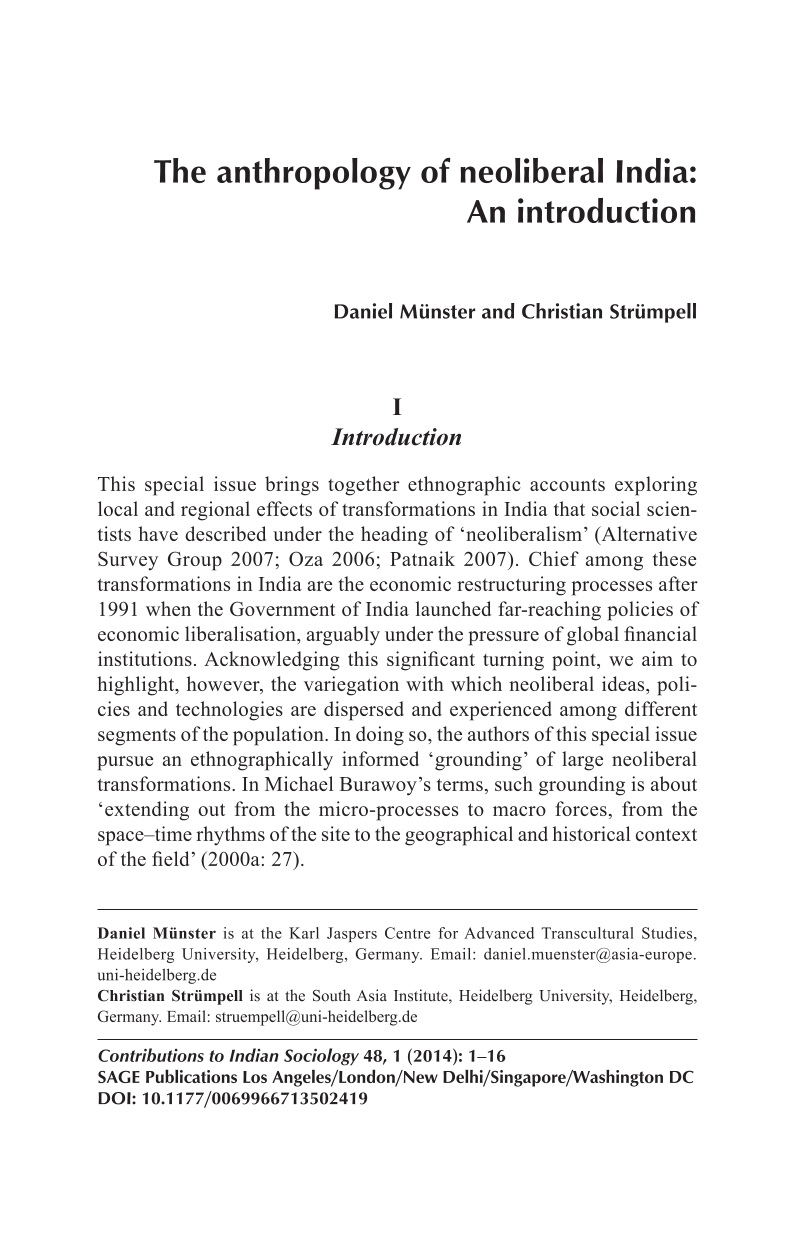
Alternative Survey Group, ed. 2007. Alternative Economic Survey, India 2006–07: Pampering Corporates, Pauperizing Masses. Delhi: Daanish Books.
2.
ArrighiGiovanni. 1994. The Long Twentieth Century: Money, Power, and the Origins of Our Time. London: Verso.
3.
BacaGeorge. 2004. ‘Legends of Fordism: Between Myth, History, and Foregone Conclusions.’ Social Analysis: The International Journal of Social and Cultural Practice48 (3): 169–78.
4.
BalachandranG.SubrahmanianSanjay. 2005. ‘On the History of Globalization and India: Concepts, Measures and Debates.’ In Globalizing India: Perspectives from Below, edited by AssayagJackieFullerChris J.17–46. London: Anthem Press.
5.
BardhanPranab. 1984. The Political Economy of Development in India. Oxford: Blackwell.
6.
BaviskarAmitaSundarNandini. 2008. ‘Democracy versus Economic Transformation?’ Economic and Political Weekly43 (46): 87–89.
7.
BaylySusan. 1999. Caste, Society and Politics in India from the Eighteenth Century to the Modern Age. Cambridge: Cambridge University Press.
8.
Benda-BeckmannFranz vonBenda-BeckmannKeebet vonEckertJulia. 2009. ‘Rules of Law and Laws of Ruling: Law and Governance between Past and Future.’ In Rules of Law and Laws of Ruling: On the Governance of Law, edited by Benda-BeckmannFranz vonBenda-BeckmannKeebet vonEckertJulia, 1–30. Farnham: Ashgate.
9.
BurawoyMichael. 2000a. ‘Introduction: Reaching for the Global.’ In Global Ethnography: Forces, Connections, and Imaginations in a Postmodern World, edited by BurawoyMichaelBlumJoseph A.GeorgeShebaGilleZsuzsaGowanTeresaHaneyLynneKlawiterMarenLopezSteven H.RiainSeán ÓThayerMillie, 1–40. Berkeley: University of California Press.
10.
BurawoyMichael. 2000b. ‘Grounding Globalization.’ In Global Ethnography. Forces, Connections, and Imaginations in a Postmodern World, edited by BurawoyMichaelBlumJoseph A.GeorgeShebaGilleZsuzsaGowanTeresaHaneyLynneKlawiterMarenLopezSteven H.RiainSeán ÓThayerMillie, 337–50. Berkeley: University of California Press.
11.
BurchellGraham. 1996. ‘Liberal Government and the Techniques of the Self.’ In Foucault and Political Reason: Liberalism, Neo-liberalism and Rationalities of Government, edited by BarryAndrewOsborneThomasRoseNikolas, 19–36. Chicago: The University of Chicago Press.
12.
ChariSharad. 2004. Fraternal Capital: Peasant–Workers, Self-made Men, and Globalization in Provincial India. New Delhi: Permanent Black.
13.
ChatterjeePartha. 2004. The Politics of the Governed: Reflections on Popular Politics in Most of the World. New York: Columbia University Press.
14.
ChatterjeePartha. 2008. ‘Democracy and Economic Transformation in India.’ Economic and Political Weekly43 (16): 53–62.
15.
CollierStephen J.OngAihwa, eds. 2005. Global Assemblages: Technology, Politics, and Ethics as Anthropological Problems. Malden: Blackwell Publishing.
16.
ComaroffJeanComaroffJohn L. eds. 2001. Millennial Capitalism and the Culture of Neoliberalism. Durham: Duke University Press.
17.
CorbridgeStuartHarrissJohn. 2003. Reinventing India: Liberalization, Hindu Nationalism and Popular Democracy. New Delhi: Oxford University Press.
18.
CorbridgeStuartWilliamsGlynSrivastavaManojVéronRené. 2005. Seeing the State: Governance and Governmentality in India. Cambridge: Cambridge University Press.
19.
CrossJamie. 2010. ‘Neoliberalism as Unexceptional: Economic Zones and the Everyday Precariousness of Working Life in South India.’ Critique of Anthropology30 (4): 355–73.
20.
De NeveGeert. 2005. The Everyday Politics of Labour: Working Lives in India’s Informal Economy. Delhi: Social Science Press.
21.
De NeveGeert. 2006. ‘Economic Liberalization, Class Restructuring and Social Space in Provincial South India.’ In The Meaning of the Local. Politics and Place in Urban India, edited by De NeveGeertDonnerHenrike, 21–43. London: Routledge.
22.
DeanMitchell. 1999. Governmentality: Power and Rule in Modern Society. London: SAGE Publications.
23.
EckertJulia. 2006. ‘From Subjects to Citizens: Legalism from Below and the Homogenisation of the Legal Sphere.’ Journal of Legal Pluralism53–54: 45–75.
24.
EckertJuliaBinerZerrin ÖzlemDonahoeBrianStrümpellChristian. 2012. ‘Introduction: Law’s Travels and Transformations.’ In Law against the State: Ethnographic Forays into Law’s Transformations, edited by EckertJuliaDonahoeBrianStrümpellChristianBinerZerrin Özlem, 1–22. Cambridge: Cambridge University Press.
25.
EnglundHarriLeachHarri. 2000. ‘Ethnography and the Meta-narratives of Modernity.’ Current Anthropology41 (2): 225–48.
26.
Gibson-GrahamJ.K.2006. A Postcapitalist Politics. Minneapolis: University of Minnesota Press.
27.
GoldmanMichael. 2006. Imperial Nature: The World Bank and Struggles for Social Justice in the Age of Globalization. New Haven: Yale University Press.
28.
GuhaRamachandra. 2007. India after Gandhi: The History of the World’s Largest Democracy. New York: HarperCollins.
29.
GuptaAkhilSharmaAradhana. 2006. ‘Globalization and Postcolonial States.’ Current Anthropology47 (2): 277–307.
30.
HannChrisHartKeith. 2009. ‘Introduction: Learning from Polanyi.’ In Market and Society: The Great Transformation Today, edited by HannChrisHartKeith, 1–16. Cambridge: Cambridge University Press.
31.
HarrissJohn. 2011. ‘How Far have India’s Economic Reforms been “Guided by Compassion and Justice”? Social Policy in the Neoliberal Era.’ In Understanding India’s New Political Economy: A Great Transformation?, edited by RupareliaSanjayReddySanjayHarrissJohnCorbridgeStuart, 127–40. London: Routledge.
32.
Harriss-WhiteBarbara. 2003. India Working: Essays on Society and Economy. Cambridge: Cambridge University Press.
33.
HarveyDavid. 2005. A Brief History of Neoliberalism. Oxford: Oxford University Press.
34.
HeldDavidMcGrewAnthony G.2003. The Global Transformations Reader: An Introduction to the Globalization Debate. Cambridge: Polity Press.
35.
KavirajSudipta. 1989. ‘A Critique of the Passive Revolution.’ Economic and Political Weekly23 (45–47): 2429–44.
36.
KingfisherCatherineMaskovskyJeff. 2008. ‘Introduction: The Limits of Neoliberalism.’ Critique of Anthropology28 (2): 115–26.
37.
KipnisAndrew. 2007. ‘Neoliberalism Reified: Suzhi Discourse and Tropes of Neoliberalism in the People’s Republic of China.’ Journal of the Royal Anthropological Institute (N.S.)13 (2): 383–400.
38.
LiTania Murray. 2007. The Will to Improve: Governmentality, Development, and the Practice of Politics. Durham: Duke University Press.
39.
LuddenDavid. 1992. ‘India’s Development Regime.’ In Colonialism and Culture, edited by DirksNicholas B.247–88. Ann Arbor: University of Michigan Press.
40.
MankekarPurnima. 2011. ‘Becoming Entrepreneurial Subjects: Neoliberalism and the Media.’ In The State in India after Liberalization: Interdisciplinary Perspectives, edited by GuptaAkhilSivaramakrishnanK.213–31. London: Routledge.
41.
MünsterDaniel. 2012. ‘Farmers’ Suicides and the State in India: Conceptual and Ethnographic Notes from Wayanad, Kerala.’ Contributions to Indian Sociology46 (1–2): 181–208.
42.
MünsterDanielMünsterUrsula. 2012. ‘Consuming the Forest in an Environment of Crisis: Nature Tourism, Forest Conservation and Neoliberal Agriculture in South India.’ Development and Change43 (1): 205–27.
43.
OngAihwa. 2006. Neoliberalism as Exception: Mutations in Citizenship and Sovereignty. Durham: Duke University Press.
44.
OngAihwa. 2007. ‘Neoliberalism as a Mobile Technology.’ Transactions of the Institute of British Geographers32 (1): 3–8.
45.
OzaRupal. 2006. The Making of Neoliberal India: Nationalism, Gender, and the Paradoxes of Globalization. New York: Routledge.
46.
PadelFelixDasSamarendra. 2010. Out of This Earth. East India Adivasis and the Aluminium Cartel. New Delhi: Orient BlackSwan.
47.
PatnaikUtsa. 2007. ‘Neoliberalism and Rural Poverty in India.’ Economic and Political Weekly42 (32): 3132–50.
48.
PhilipKavita. 2009. ‘Indian Informational Capitalism: Revisiting Environment and Development Studies.’ Capitalism, Nature, Socialism20 (4): 73–81.
49.
PolanyiKarl. 2001 (1944). The Great Transformation: The Political and Economic Origins of Our Time. Boston: Beacon Press.
50.
RanderiaShalini. 2007. ‘The State of Globalization: Legal Plurality, Overlapping Sovereignties and Ambiguous Alliances between Civil Society and Cunning State in India.’ Theory, Culture & Society24 (1): 1–33.
51.
RoseNikolas. 1999. Powers of Freedom: Reframing Political Thought. Cambridge: Cambridge University Press.
52.
RoseNikolas. 2006. ‘Governing “Advanced” Liberal Democracies.’ In Foucault and Political Reason: Liberalism, Neo-liberalism and Rationalities of Government, edited by BarryAndrewOsborneThomasRoseNikolas, 37–64. Chicago: University of Chicago Press.
ShahMihir. 2008. ‘Structures of Power in Indian Society: A Response.’ Economic and Political Weekly43 (46): 78–83.
55.
ShaniOrnit. 2007. Communalism, Caste and Hindu Nationalism: The Violence in Gujarat. Cambridge: Cambridge University Press.
56.
SharmaAradhana. 2008. Logics of Empowerment: Development, Gender, and Governance in Neoliberal India. Minneapolis: University of Minnesota Press.
57.
SharmaAradhana. 2011. ‘States of Empowerment.’ In The State in India after Liberalization: Interdisciplinary Perspectives, edited by GuptaAkhilSivaramakrishnanK.71–90. London: Routledge.
58.
SpringerSimon. 2012. ‘Neoliberalism as Discourse: Between Foucauldian Political Economy and Marxian Poststructuralism.’ Critical Discourse Studies9 (2): 133–47.
59.
SridharDevi Lalita. 2008. Anthropologists inside Organisations: South Asian Case Studies. New Delhi and Thousand Oaks: SAGE Publications.
60.
StiglitzJoseph E.2002. Globalization and its Discontents. New York: W.W. Norton.
61.
ThompsonEdward P.1966. The Making of the English Working Class. New York: Vintage Books.