




Abstract
This article addresses Hindi crime-porn magazines that are mostly distributed in makeshift stalls in cities and railway stations in Central and Northern India. This scene involves formal and informal layers, actors and writing styles, creating a series of disparities within and between literal and visual planes, and forming an apparatus within which, above all, state agents and signifiers are employed: policemen, the courts, legislation and political movements. Through a strategy that combines seduction and pedagogy, crime-porn magazines turn the reader/citizen into a demeaned subject. Moreover, the visual plane displays unstable and fragmented objects, in contrast to images of the state, which are emblazoned as a single signifier of authority and stability. Through a qualitative approach that combines ethnography and textual analysis addressing dominant narrative models, I analyse the aspiration to constitute ‘moral pornography’ and identify the pivots that shape and negotiate a regulated subjectivity under the authority of state signifiers.
I Preface
A dusty plastic sheet laden with wares was placed on the pavement of one of the alleys leading off Chandni Chowk, the main street of Old Delhi; a peddler, in his 70s, sat at one end of the plastic sheet. At the other end lay an elderly woman, covered with a blanket, who seemed quite accustomed to sleeping through the hustle and bustle of the city. This was the scene at a makeshift newsstand (see Figure 1) selling daily newspapers, mainly in Hindi, Hindu calendars, a bundle of miswak (branches used for brushing teeth) 1 and a number of Hindi pulp magazines, including Nari Shobha (Women’s Glory) and, on this occasion, Madhur Kathaein (Sweet Tales), a soft porn magazine. 2 This study examines volumes of Madhur Kathaein as well as other soft porn magazines I purchased from makeshift stands (befitting Sanjay Srivastava’s [2004, 2006, 2013] term, ‘footpath pornography’) in cities in Central and Northern India over the last decade and a half.
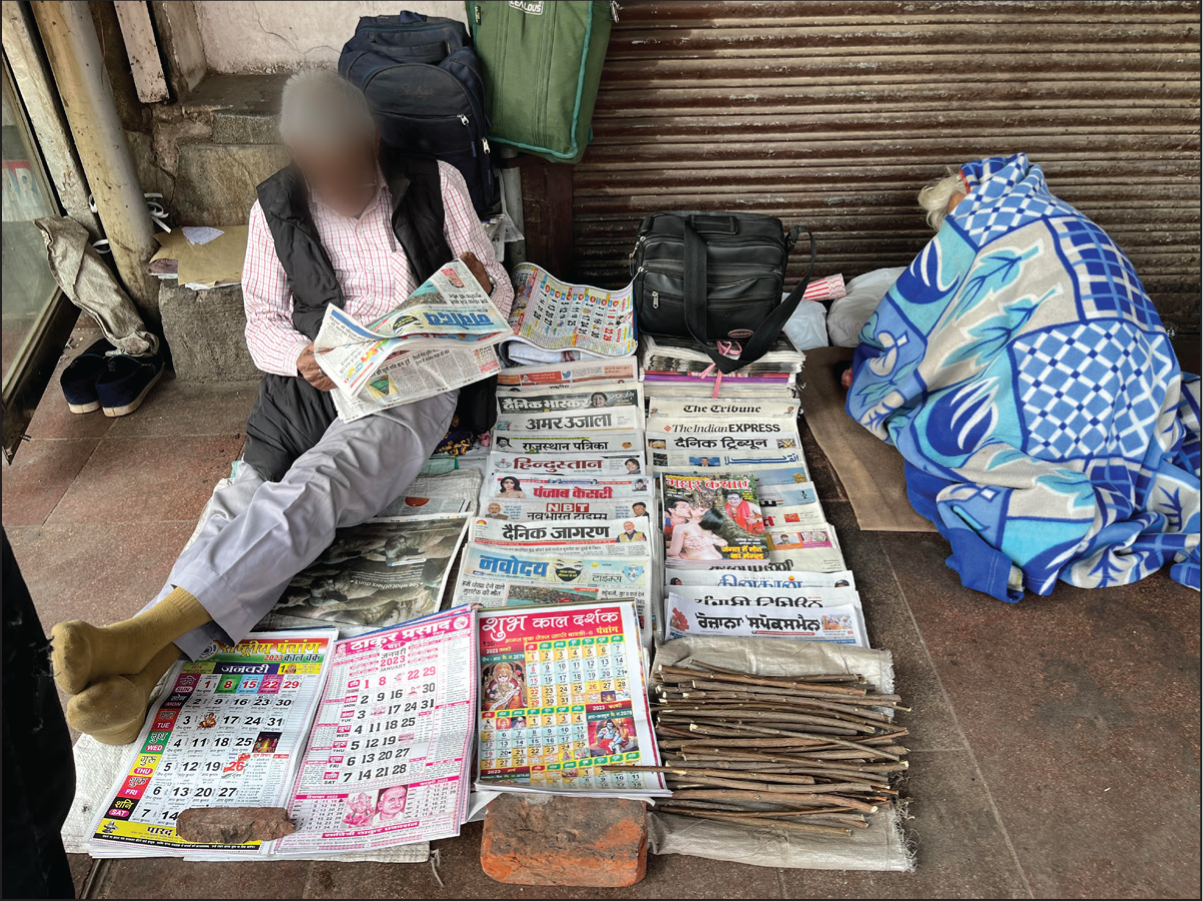
I had not found copies of Madhur Kathaein since the COVID-19 crisis. The date on the issue of the magazine—February 2023—was current. 3 Its shiny chromo cover presented a photograph of a fair-skinned, half-naked woman, her head tilted back in submission, while her bare back faced the camera. A young, clothed man encircled her authoritatively in his arms. A thick tree trunk separated the couple from the figure of a religious leader adorned with a rudrākṣa necklace (prayer beads usually associated with Śaivism and its derivatives, at times with esoteric sects such as Tantra—a disputed stream sometimes associated with sexual practices; Urban 2003: 8; White 2003: xii–xiii), his body wrapped in saffron cloth as he peeped at the two with an expression of sensational anticipation that generated an immediate feeling of unease for the viewer.
‘I haven’t seen this magazine for a long time’, I whispered in Hindi, a little apprehensive of the reaction my interest would elicit. This was not the first time I had been hesitant about purchasing this magazine publicly, given the seeming contradiction between ideas of respectability and women consuming porn (Chowkhani 2016: 445). However, the commercial opportunity and my Western look that may have matched the image of uninhibited femininity (Srivastava 2013: 229) helped dispel any potential qualms on the seller’s part. It prompted him to offer additional soft porn material, some of which was not on display; this was not the first time something like this had happened.
Upon expressing interest, a man sitting near the stand stood up and introduced himself as one of the magazine’s staff reporters. Ramesh (pseudonym) was a crime reporter who had a valid Indian Newspaper Society (INS) press card. Since that initial encounter, I learned that he would sit by the stand most of the day. Despite his being an experienced writer who had worked for decades at Madhur Kathaein as well as other magazines reporting scandalous/sensational tales and sports with no pornographic overtones, he found himself out of work. He could not afford to pay for access to the internet or WhatsApp on his mobile phone, both of which were crucial to his work. I offered to charge his mobile at a nearby Airtel booth. We entered the mazed alleys of the walled city, where he agreed to be interviewed about his work, how the materials reached him, their further processing and the purposes of publication.
Hindi soft porn magazines are part of the diverse landscape of pulp (cheap newsprint on which documents are printed at low cost and quality) culture, whether elitist ‘little magazines’ 4 (Nag 1997), or books, booklets or tracts on a variety of subjects, printed on cheap (pulp) paper with chromo covers, characterised by content oscillating between the legitimate and grey, controversial or informal zones of writing, publishing and distribution. 5 This shift between the domains of the legitimate and the formal and what subsists beyond them constitutes an inherent part of pulp culture. The pulp magazine shelf offers material on a wide spectrum of themes—sensational stories, thrillers, crimes, instructional material, self-improvement and sex. Soft pornography magazines toy with notions of legitimacy by conveying the message that any desire is impossible, disastrous, shameful and, moreover, policed and framed through criminal law, legal systems, police bodies, the state and right-wing movements. Hindi crime-porn magazines are modelled on ‘sensational tale’ magazines such as Manohar Kahaniyan (Alluring Tales; originally published by Allahabad’s Mitra Prakashan, now published by Delhi Press) without the explicit sexually arousing material. From another perspective, they draw on women’s interest magazines such as Nari Shobha (Nai Sadi Prakashan, Delhi) which was on sale, like Madhur Kathaein, at the Old Delhi impromptu stall and shared the same publisher. Nari Shobha is intended for middle-class urban women and takes after the upper-middle-class English magazine Femina (The Times Group), which has been extensively discussed in relation to canons of normative femininity in the contexts of modernity and globalisation (Chirmuley 2015; Reddy 2006; Thapan 2004). For example, Nari Shobha’s February 2023 issue had articles on how to celebrate Valentine’s Day, 6 businesswomen’s success stories, fashion, nutrition, cosmetics, relationships, psychology, motherhood and self-improvement, 7 all of which are gender-oriented themes that are not necessarily sexual.
However, the distinction between sensational tales, crime stories, women’s interest magazines and soft porn is not unequivocal and constitutes a fluid arena characterised by movement (Srivastava 2013: 229, 231). Thus, magazines classified as ‘women’s interest’, such as Grhashobha (The House’s Glory, Delhi Press), Grhalaxmi (The House’s Abundance, Mathrubhumi Group, Kozhikode) and Meri Saheli (My Girlfriend, Pioneer Book Company Private Limited, Mumbai) incorporate sexually titillating innuendos in texts containing detailed instructions on hygiene, female health issues and intimate relations. Certain pulp magazines such as Kamgyan (The Knowledge of Desire, Nai Dunya Prakashan, Delhi) mainly contain intimate/pornographic texts framed as articles on anatomy, health and lifestyle. Others, such as Saras Salil (Fresh Water, Delhi Press Patra Prakashan) offer an eclectic mix of stories relating to politics, lifestyle and sex.
Scholarly research on pornography in India tends to centre on a few key issues. Srivastava’s studies of ‘Footpath Pornography’ (2004, 2006, 2013) analysed pornography in the light of modernity, urbanism and consumerism. Chatterjee (2017) examined the connections to globalisation and celebrity studies. Others discuss issues related to the jurisprudence of pornography and technology (Chandra and Ramachandran 2011; Malhotra 2011) and, in particular, digital technologies such as mobile phones (Baishya 2017) alongside audience research, in particular, on female readership (Chowkhani 2016).
This article utilises an ethnographic perspective to address the use of materials related to criminal investigations, as well as state agents and signifiers employed extensively in crime-porn magazines. By ‘state agents and signifiers’, I refer to that which is indicative of the state and state power—bodies such as the police and the courts, photographs of police officers and officials, detailed references to the Indian Penal Code (IPC) and the judiciary as well as political parties such as the Shiv Sena. All of these are fodder for crime-porn textual discourse. Over and above this, I apply textual analysis to better understand the genre and its use of writing styles and visual signifiers. Borrowing from the concept of ‘moral consumption’—consumption practices used to enhance patriotic/nationalist ideology—coined by Sanjay Srivastava (2017), I show that crime-porn magazines aspire to produce a ‘moral pornography’ laden with conservative moral values, while at the same time constituting the reader/consumer who is enticed into reading as a demeaned subject/citizen.
I centre on Hindi magazines that combine soft pornography with crime reporting, such as Madhur Kathaein (Nai Sadi Prakashan, New Delhi), Madhur Aadayen (Sweet Recompensing; G. S. Chawhan, Rahwar Printers, Delhi), Madhur Romantic (Sweet Romantic; Mamta Prakashan, Delhi), Romantic Kahaniyan (Romantic Tales, O.K. Magazines, New Delhi) and Sachchi Dunya Kamsutr (True World Kamasutr; Roshanpura, Delhi). 8 Crime-porn magazines deserve analytical attention since they refer directly to, one, state apparatuses as well as social power structures, family, religious and socioeconomic hierarchies and, two, issues related to informal religious authorities and welfare mechanisms that attract underprivileged populations—the readership of these magazines. I analyse magazines and not pulp fiction, since unlike books, which tend to present a visual image only on their covers, magazines have rich visual layers. I also limit myself to soft porn magazines because hard porn can more easily be considered illegal (which does not mean that soft porn is not a disputed category). Although hard porn is easily accessible on internet websites and cell phones and, in some ways, has rendered printed porn obsolete, the hard porn genre would face hurdles in maintaining relations with state agents, institutions and state signifiers or juggling formal components and issues of legitimacy.
II Between formal and informal zones: The working and context of crime-porn magazines
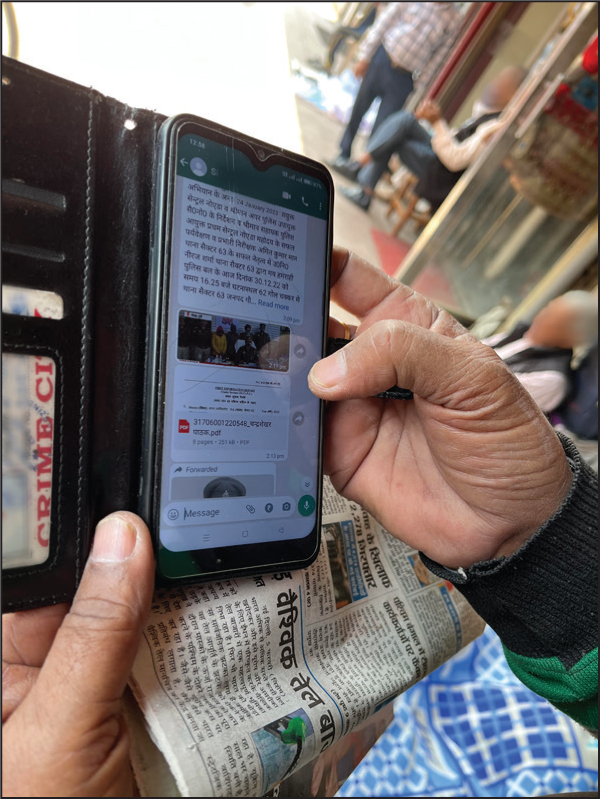
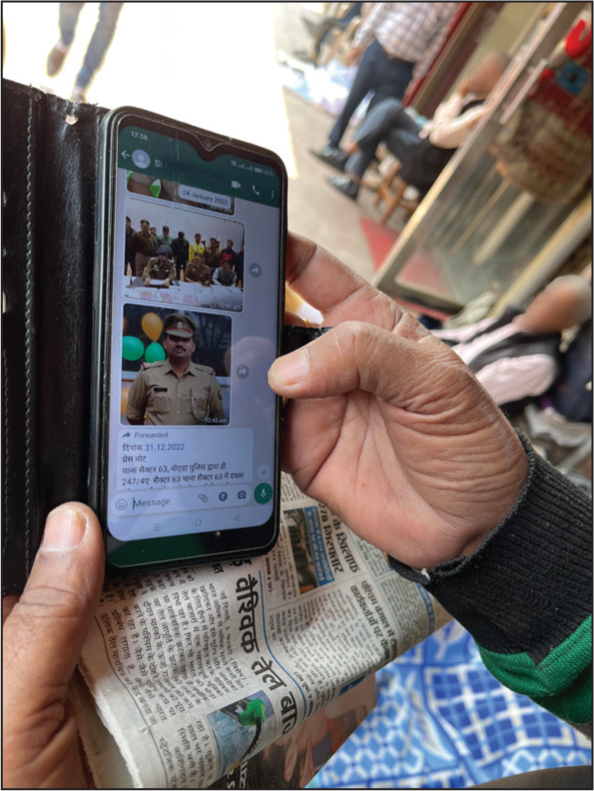
A significant part of the stories in crime-porn magazines is based on crime reports and news material. These kinds of materials dropped into Ramesh’s mobile phone inbox one after the other. They were sent to his WhatsApp account by identified officials (at the rank of sub-inspector or Station House Officer, i.e., positions in the Indian police force that are non-gazetted) based at police stations in Delhi. Dozens of such officials on his contact list supplied him with press releases, invitations to press conferences, formal First Information Report (FIR) documents in PDF format, photographs of police officers and officials and national holiday greetings (see Figures 2 and 3).
In addition to materials from police sources, some of the stories written by Ramesh and his colleagues were based on events reported in the Indian press. These also require analytical consideration. Through qualitative methods—ethnographic work and textual analysis addressing three dominant narrative models—I analyse the dynamic oscillation between formal and conservative etiquette and controversial sexual conduct while identifying several dominant narratives that shape and negotiate a regulated subjectivity under the authority of state signifiers.
Ambiguous spaces
The definition of the magazines I labelled as pornographic draws upon the habitual understanding of pornography as sexually explicit material (whether verbal or pictorial), designed primarily to produce sexual arousal (Chandra and Ramachandran 2011: 325). The magazines analysed in this article have explicit sexual images on their chromo covers and, to a considerable extent, in their internal pages as well. Taking into consideration the fact that they refrain from displaying visible genitals and stick to partial nudity, one may wonder whether these magazines can be classified as ‘erotic’ instead. Although some scholars consider that ‘pornography’ and ‘eroticism’ overlap (Juiffer 1998: 3), others ascribe such terminological distinctions to class differentiation and ideological bias (Ziv 2015: 14). I chose to use the term ‘soft pornography’ since the central images overtly convey a purpose of creating sexual arousal, despite the lack of visible genitals. Legally, this photographic tactic places the magazines in a grey area. According to Chandra and Ramachandran (2011: 22), Indian law mainly refers to the concept of obscenity:
Though there is no specific provision in any statute that directly deals with pornography, it has been brought within the purview of §29213 dealing with obscenity in the Indian Penal Code, 1860 … that imposes criminal liability for sale, distribution etc. of obscene material. This section was introduced by the Obscene Publications Act, 1925, to give effect to Art … [while the] … test of obscenity has been given in §292(1) of IPC19 … [defining a] matter charged as obscenity [in case it is designed] to deprave and corrupt those whose minds are open to such immoral influences … [and load them with] thoughts of a most impure and libidinous character.
While the law is framed around the concept of obscenity, and numerous pieces of legislation have been enacted to prohibit it, 9 its (the law’s) interpretation is fuzzy and pulp magazines occupy a contested arena that cannot be easily classified as illegal. The oscillation between the legal and the illicit can also be seen through the reporters’ cooperation with police sources and the authority granted to state bodies, as well as at the level of the visual images, writing styles and narratives of the stories analysed in the section entitled: ‘Moral Pornography: Reflections on Impossible Desires’.
Formally speaking, the publishing houses are registered companies. The magazines, too, are registered, and the numbers assigned to them by the Registrar of Newspapers for India (RNI) appeared clearly on both the magazines and the journalists’ cards. The publishing houses’ office addresses also appeared on the content page. Stories were published mostly under the reporters’ real names, and many of them were based on ongoing cooperation with the police.
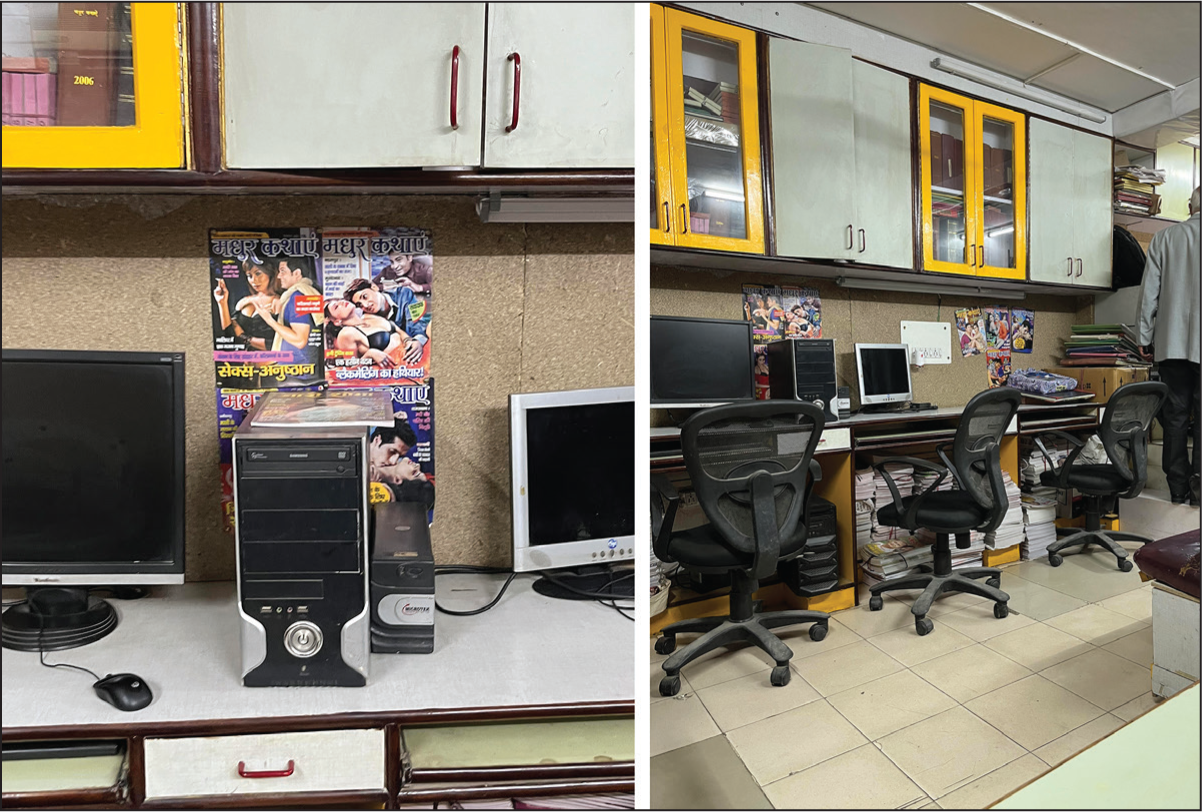
Despite these legal trappings that endow crime-porn magazines with an aura of legitimacy, fieldwork in ambiguous spaces ranging from the legitimate to the less so is not straightforward. My visits to the editorial offices in Ramesh’s company illustrated the ambiguity associated with soft porn. All the editorial offices and publishing houses I visited printed magazines in a variety of fields. The editors were informed of my specific interest in crime-porn, and their cooperation was polite, although hesitant. In one such editorial office, I was only given minimal information, while in another, the editor made sure not to talk to me about porn magazines but about current politics and magazines devoted to military and security issues, which he assumed I would be interested in as an academic.
The sharing of information retrieved from formal police sources appeared to constitute a routine part of the spokespersons’ and public relations activities directed towards the multiple crime reporters in Delhi-NCR. The messages that landed in Ramesh’s inbox were not sent in response to any questions he sent, nor did representatives approach him personally. From time to time, there were text messages in English such as ‘tomorrow provide photos’, for example. But Ramesh, originally from Uttar Pradesh, did not read English. The daily reports and FIR forms that landed on his device were mostly written in Hindi.
The soft crime porn readership comprises the urban poor and work migrants with limited means (Srivastava 2013: 228–29). The writers were relatively older men belonging to medium-low socioeconomic strata and educated in Hindi-medium institutions. Both were groups that were left behind by the ‘Digital Divide’ (gaps in digital literacy, as well as affordability and accessibility of internet sources [Ragnedda and Ruiu 2020: 14; Segev 2010: 7]) or those who have less of what Ragnedda and Ruiu (2020: 14) termed, following Bourdieu, ‘digital capital’.
The materials obtained from the police, Ramesh confirmed, were the basis for the stories he embellished with sexual and other layers as a function of his creative imagination. A few dozen reporters were employed in crime-porn magazines and worked in a similar way. Some of the stories concluded with the statement that they were freely based on police sources (katha police sutron par adhaarit tathyon ka naddy roopantran) but that the protagonists’ names, as well as other personal details regarding the case, were not altered or masked with pseudonyms. ‘Everything is real! These are real stories, real people, real names’, Ramesh stressed, suggesting that relying on the truth, in this case, police sources, conferred legitimacy and validation and contributed to seeing his work as moral.
This desire to endow the work with morality clashes with the branding of the magazines as soft porn, first and foremost through the images that appear on their bright chromo covers. A formulaic cover presents a barely clothed or lingerie-clad woman at the centre of the page, her breasts partly exposed, and sometimes, her thighs. Her eyes are at times closed and her head tilted back in submissive passion. Alternatively, she may direct a frontal, seductive gaze towards the camera, that is, towards the consumer/reader, in a way that befits Darshana Sreedhar Mini’s (2016: 127) description of the madakarani as ‘a sexualised figure who is unabashed about her sexuality and uses her charms to her advantage, while the dominant use of the term madakarani implies a sense of fleeting sexual pleasure and voyeuristic male consumption…’ in soft porn Malayali cinema (see also, Srivastava 2006: 229).
This seductive woman is often accompanied by a man, usually clothed, often looming over or behind her, sometimes also waving a stack of banknotes at her. The situations on the covers are thus suggestive of sexual intercourse and prostitution. When I asked Ramesh who the women actors were, and whether there was any connection to prostitution, he defined them as models. According to Himanshi Dhawan’s report in The Times of India in 2018, they were often models or actors who earned a fairly low amount (₹3,000–₹7,000), hoping that the exposure would translate into a much-desired Bollywood break or access to the entertainment industry, TV crime shows, Bhojpuri films or advertisements. 10 Representing the object of arousal as female reflects a heteronormative/patriarchal stance. Similarly, hiding men behind the female models and their protective representation as clothed reflects the habitual hierarchical and gendered power system.
There is a clear hierarchy generated by the constitution of the reader-consumer as a male subject and its indecent object as female, corresponding to the patriarchal point of view of masculinity as dominant, firm and as an embodiment of moral supremacy. These gendered constructions grew notably stronger with the powerful demarcations prompted by modernity (Krishnaswamy 1998: 15) as well as by the homogenising aspirations advanced by nationalist thought that permeated India during colonial rule. However, the diversified landscapes of gender are neither uncontested nor monolithic.
Srivastava (2004) pointed to the contrasting models of masculinity embodied, for example, in the apparently frail figure of Mahatma Gandhi as compared to the solid, powerful physicality of leaders such as Narendra Modi. This kind of contrast can be interpreted symbolically through a historical prism that juxtaposes the subjected colonial body with the sovereign one. In this logic, the fragile masculine body can be seen as the effeminate colonised body. 11 By contrast, firm physicality can be seen as embodying the notion of sovereignty and the wave of ardent, muscular nationalism that has swept India in recent decades (Banerjee 2005, 2012).
Where is the imagined masculinity of both crime-porn writers and their readership situated? Broadly speaking, it lies in a twilight zone delineating the patriarchal promise of male supremacy—at least in terms of social power and morality—and its failure. Both writers and readers are characterised as mostly consisting of the urban poor with limited means (Srivastava 2013: 228–29). All are trapped in forbidden, denounced passions that make them demeaned subjects with respect to a repertoire of motifs representing the state and its institutions.
This ambiguous dynamic is captured from the start in these magazines’ formulaic covers. The convention within which a woman is depicted as seductive, accompanied by a clothed, wealthy man clearly reinforces the patriarchal underpinnings of the magazines. However, other details on the front pages typically employ a repertoire of markers locating the situation as requiring condemnation. On some covers, the models hold industrial/Western cigarettes (not the local beedis) or a glass of wine, all of which negatively connote ‘Westernisation’ and sexual promiscuity in mainstream popular culture, including in Hindi cinema (Delaney-Bhattacharya 2019: 319–20). The use of these mainstream signifiers is indicative of an attempt to situate these magazines—together with their readers—in a liminal space between mainstream spheres and reprehensible ones.
III Moral pornography: Reflections on impossible desires
Me: ‘What is the purpose of the stories?’
Ramesh: ‘That people will understand what is forbidden’.
This section presents three case studies of stories (not visual photo stories) published in Hindi crime-porn magazines. My textual analysis focuses on three dominant models or formulas that underpin the discourse shaped by these magazines. The first deals with taboo-breaking passions within the domestic space, where crime-porn oscillates between seduction and pedagogy and constitutes the reader as a demeaned subject/citizen. The second model exploits the trope of the ‘libidinous baba’, interpreted in terms of the socio-economic and religious context of the ‘economy of despair’, that is, the milieu of low and lower-middle classes who are attracted to the informal authorities of hyperlocal saints who act as non-state welfare systems (Parciack 2022: 42; 2023). The third model unfolds a story of interfaith love between a Hindu woman and a Muslim man while introducing the gendered notion of the Hindu state into the context of crime-porn magazines.
Within domestic spaces
The story ‘Kami Sasur Bahu se Vaasna Mange’ (The lewd father-in-law demands [fulfilment of] his lust from his daughter-in-law) was written by Ajay Kumar Das and Vinod Prasad and published in the December 2007 issue of Madhur Kathaein. 12 Its subtitle frames it as an ‘adultery story’ (vyabhichaar) since its plot focuses on the breaking of a social taboo, namely voyeurism and the sexual assault and rape of a young bride by her father-in-law, while her husband, the perpetrator’s son, a marginal figure lacking agency in the story, works at a nearby factory. When the husband discovers the scandal occurring in the domestic space, he suggests disbanding the joint family and moving to a separate flat. Before this somewhat liberal plan is fulfilled, his wife, described alternately as an ideal daughter-in-law, as a suffering victim and/or an object of sexual arousal, threatens her father-in-law with public disclosure, which would lead to incurable social disgrace. The story is spread over three double pages and ends with the father-in-law murdering his daughter-in-law by setting her alight. The son also receives severe burns and is hospitalised as the tale ends. The father-in-law is sent to jail, based on sections 120, 302 and 376 of the IPC dealing with intent to commit an offence punishable by imprisonment, along with murder and rape—all of which are part of the story. The story ends with a statement that the tale was based on police sources: ‘Katha police sutron par adhaarit’. 13
This narrative of domestic violence and its violation of criminal law subjects the domestic space to the state in terms of legislation and the judicial process. However, as Newbigin noted, the family is the key site of gender relations, and as such is integral to the constitution of the state–society framework (2019: 2). It is the primary institution that provides the basis for an authoritative state to reproduce and strengthen itself (Nigam 2022: 6). In other words, the domestic space serves as a microcosm for the power of larger social and state mechanisms manifested in the private, domestic spheres. Such power relations are eventually extended to the reader, who is called upon to shift between arousal and condemnation. This manipulation does not constitute the reader as a sovereign subject who opts to take pleasure in illicit desires in a protected, sublimed way, but as a subject caught up in corruption, as shown in the excerpts translated below. The exposition presents the bride as an ideal traditional daughter-in-law:
14
After bathing, Pooja got dressed, and then hummed a song from the movies: ‘I must adorn myself, for my beloved…’ while humming, she went out of the bathroom, and was shocked to see Shiv Narayan sitting there. Pooja covered her head with her saree… ‘Babuji, shall I bring you some water? … or at least eat something … shall I serve you the thali?’ ‘Arre, did you prepare the food that early?’
The description of the exemplary daughter-in-law swiftly shifts into a sexual assault by the father-in-law. While detailing the occurrences, the text oscillates between incitement and denunciation. Denunciation takes the form of utterances by an all-knowing anonymous and authoritative voice detailing Pooja’s reluctance and rebuke. Incitements are made through descriptions that invite the reader to visualise the situation and enter a state of sexual arousal, such as details about her body and underwear that prompt a visualisation process that symbolically puts the reader at par with the lustful father-in-law:
Shiv Narayan kissed her hand, and the tip of his tongue left a trail of pleasure on her hand. It seemed to Pooja as though a snake or a worm was crawling down her hand. She quickly withdrew her hand. ‘Babuji, what are you doing?’ ‘Listen, Pooja. The sari blouse you wore is brown. But your underwear do not match… [he goes on to describe other intimate details regarding her body, lingerie, menstrual cycle and sexual intercourse routine with her husband—his son].’ Pooja felt as if she had been stung by a scorpion. The events of the last time passed like a movie before her eyes. When she took off her clothes in the shower, she was afraid that there was someone around … when she was making love to her husband, it seemed to her … that there was someone … who was secretly watching her naked … a pair of eyes that looked at her lustfully. She looked over the open roof [of the bathroom] … noticed a cat and relaxed … she undressed and applied cream below her navel. She washed herself with fragrant soap and put on underwear, exactly as Shiv Narayan had described. Shiv Narayan’s smile darkened. ‘If you want, I can also tell you what size bra you’re wearing’. ‘Babuji, come to your senses’, she uttered. ‘I am your daughter- in-law!’ ‘First of all, you are a beautiful young woman, then you are my daughter-in-law’. … ‘Pooja, my lips are tired of calling you “my daughter-in-law”. Now, I would like to call you Pooja Rani [my queen/beloved]. Pooja Rani, let me also worship [Hindi: offer a pooja] your body for a little while’. Shiv Narayan was 55 years old and still powerful. He forcefully picked up Pooja and threw her down. Pooja started crying, begging for mercy … but Shiv Narayan was like a devil.
15
Although the text is replete with statements denouncing the father-in-law, the act of visualisation it promotes functions as a double-edged sword, inviting the reader to take pleasure and play a semi-active role in the narration. Paul Willemen’s (1994) discussion on pornography and film studies through a Lacanian perspective is illustrative in this regard. In the analysis of a short film entitled Girl—a one-shot short movie of a naked girl in a bathtub (directed by Stephen Dwoskin in 1975)—Willemen argues, as time passes, that the viewer begins to notice her discomfort in the small gestures she uses to try to cover herself. As the shooting continues, the spectator’s gaze transforms from an apparently innocent one to a gaze that is fully aware of the discomfort it is causing—a gaze that might be classified as sadistic.
This transformation is interpreted through Lacan’s notion of the ‘fourth gaze’: an invisible gaze, the gaze imagined by the subject as pertaining to the field of the Other—a gaze that is structured in relation to the Other (Lacan 1977: 84). In the context of Girl, this gaze is none other than the one delivered by the medium of cinema, and by and large any visual medium—the gaze through which it observes its audience. This was the gaze, Willemen (1994: 107) concluded, that surprised the viewer who imagined himself as invisible and exposed him as a voyeur, bothered him and instilled within him a sense of guilt. Dixon (1995) made similar arguments, also challenging the perception of the media (specifically cinema, but in fact any medium) as closed or ‘blind’ and laid a theoretical foundation for gazes directed from spaces that allegedly cannot see—in this case, the media looking at its spectators. Dixon went on to suggest that such a gaze corresponded to a policing image of prisoners and their guards (1995: 7, 17).
In the context of Madhur Kathaein, the practice of guided visualisation allows a close comparison between the soft porn magazine reader and the spectator in Willemen’s (1994) and Dixon’s (1995) works. Although the magazine does not contain any photos that illustrate the physical descriptions, the reader is enticed to imagine Pooja’s body, undergarments and rape in detail, all of which may lead to sexual arousal. At the same time, the description can tint the reader’s pleasure with guilt—forcing the reader to confront the agents of the state, since the laws and jail sentence detailed at the end of each story make him also a potential defendant—a citizen whose passions are ignited while simultaneously being denounced, shattered, exposed and eventually position him as a demeaned subject. These are the workings of ‘moral pornography’—pornography that, along with arousal, promotes a kind of shaming, emphasising the taboo and guilt associated with pleasure and is marked by the ubiquitous presence of the authoritative figures of policemen, the authority of the state, the IPC and the courts.
From a visual perspective, ‘moral pornography’ can also be strengthened by the large number of images of police officers in crime-porn magazines, at times exceeding the number of pictures of the protagonists, especially since the latter are only captured as incoherent, fragmented objects. In the above story, for example, the first double page depicts Pooja and Sanu’s wedding. The image appears to be a makeshift collage consisting of two separate photos: a side view of a bride with her eyes lowered and a frontal long/medium shot of a slim man looking at the camera. The bride and groom are portrayed differently in terms of size and camera angles. They are also not located in the same space and do not turn towards each other or indicate any rapport. The second double page consists of a staged image illustrating the sexual situation between the father and daughter-in-law. The people in the first and second double are different. 16 While the narration follows linear and realistic lines that may lead to expectations of coherence, the photos themselves have no continuity or coherence on the visual plane. This visual incoherence is largely apparent in crime-porn magazine stories that primarily constitute objects that are fragmented or broken, thereby destabilising the potential objects of desire.
In contrast to the unstable, incoherent objects representing the protagonists, images of policemen who investigate the cases fill most of the internal pages, thus dominating the crime-porn visual plane. These images stress the supremacy of policing agents over both the reading subject and the fragmented object. Furthermore, the images reflect Catharine MacKinnon’s and Andrea Dworkin’s reading of pornography as an act and not as a representation. MacKinnon (1989) defined pornography as a ‘sphere of social power’ (205) and as ‘a practice of sexual politics’ (197; see also Dworkin and Mackinnon [1989: 25–26]). Such an exercise of power is not only reflected through the display of stable and unstable images; it also extends to the regulation of the relationship between the reader, state institutions and its agents.
The economy of despair and the trope of the ‘libidinous baba’
The second model of stories often found in crime-porn magazines draws on the ‘libidinous baba’ trope, which relates to the socio-economic and religious context of the ‘economy of despair’ (Parciack 2022, 2023). This economy of despair derives from a combination of low socio-economic status and unfavourable life circumstances characteristic of populations devoid of concrete and symbolic capital in a non-welfare state. Lacking agency, reluctant to seek medical help from physicians, unable to approach financial institutions and alienated from the state, many seek to cure their health problems and life crises through informal authorities and hyperlocal saints that are believed to have intercessory powers and act as non-state welfare systems.
The spaces of the economy of despair also correspond to the social milieu and habitus of the crime-porn magazines’ readership. The worship of hyperlocal saints resonates with the way the crime-porn scene engages with the question of authority and mediates it for readers. The ‘libidinous baba’ trope accommodates and confronts two conflicting authorities: The first is the suspicious, spellbinding authority of a baba—a religious leader of unclear context who mostly exists outside formal hierarchies, disconnected from established transmission lineages or reputed religious institutions. The second is the authority of the state, represented through policing agents, laws and courts. The ideological line underpinning the stories undermines the authority of the babas in presenting them as sexually perverted, greedy and fatal figures who bring calamities on their followers. Simultaneously, the authority of the state is established as stable and unshakeable.
The cover story ‘Tantra evam Dong Katha: Baba, Vaasna Tatha Feviquick se Chipte Badan’ (A tantra and hypocrisy tale: Baba, lust and superglue-pasted bodies) was written by Arun Mathur and Navin Chandra Pokhriyal and published in the February 2023 issue of Madhur Kathaein. 17 The story is based on a sensational event reported in the Indian press that can also be seen in news clips uploaded on YouTube. 18 The main narrative line, the photos from the crime-scene and police officers involved in the case were the same in the press sources and in Madhur Kathaein. Some staged photo illustrations depicting sexual situations were added to the story, using the motif of the ‘fragmented object’ in the sense that the staged photographs had models who looked quite different from those in the press reports.
The story depicts the tense married life of two teachers (both employed in government or sarkaari jobs and enjoying financial stability). The stress is anchored in the wife’s economic power, which reflects the growth of the middle class in post-globalisation India, and its bringing about of what is imagined as Westernised gender roles and familial hierarchies; ‘Shweta had an ego: “I am also a sarkaari, I earn the same [salary] as my husband; why should I be subordinate to him or serve him like a maid?”’. 19 The concerned father-in-law sends the troubled/modernised couple to a signifier of the non-modern world—a ‘tantrik baba’ (spiritual master), whom he follows. It is noteworthy that the distance from modernity also means that this signifier does not belong to the state, which may stand for another powerful signifier of modernity. The tantric baba is described as endowed with miraculous powers that have the potential to solve any problem through amulets, magic or the chanting of ‘tantra-mantra’. 20 Above all, the text states, he was most famous for the ‘sweetening’ of conjugal life. This description probably corresponds to the widespread popular, sometimes new-age association between tantra and sex (Urban 2003: 8; White 2003: xii–xiii) and to what Khanna termed ‘bazaari tantra’ (Khanna n.d.: 5, cited in Dinnel 2017: 6) or what Lutgendorf termed a ‘quick fix’ for worldly problems (2001: 289) that arise in a hectic, market-driven world (2007: 388). These practices are popular not only in ‘tantric’ spaces but are also proposed by a myriad of hyperlocal Hindus, Muslims and other saints who thrive in the desolate spaces associated with the economy of despair.
In the tantrik’s ashram (spiritual hermitage), the husband encountered a young woman who was separated from her husband, and the two engaged in an extra-marital affair. The plot thickened, so the narration goes, as a result of the allusive preaching of the baba: ‘After listening to Babaji’s speech today [the woman confessed], I realised that the source of all of our problems is an unsatisfied body’. 21 This opened the door to extra-marital sex.
Let’s go to the forest! It was not difficult for the woman to understand why he was asking her to go there. She cast her eyes down timidly and whispered: ‘Let’s go’ … the man took off his scarf and spread it on the ground … they both had the same wish … their breath became fragrant, and the body became the servant of desire. The burning fire was only extinguished when the act had been consummated. 22
As the plot proceeds, the tantric baba takes on the double role of the actor encouraging the illegitimate sex as well as of the punishing agent, corresponding to the moral yet sensational turn at the end of the narrative. He persuades the couple to have sex in front of him in the forest under the pretext that while they perform the act, he would chant a mantra that would help them overcome any difficulty. The sexual act, that takes place at a certain distance from the tantric baba, is depicted on the magazine’s cover—designed to elicit arousal and discomfort through the baba’s peeping Tom expression, which extends to the reader, thereby activating the dual dynamics of seduction and pedagogy. The description of the sexual act is written to arouse the reader, but this is rapidly extinguished when the baba comes out of hiding, pours a large amount of Feviquick (a brand of superglue) on the couple, murders them and mutilates their genitals. His character description thus delegitimises the ‘baba culture’ (practices aiming to cure life crises through informal authorities and hyperlocal saints who are believed to have intercessory powers), while at the same time assigning him the agency of punishing the deviation from monogamy—a role that meshes with the proclaimed moral aspirations of crime-porn magazine culture.
Although in some ways, the tantric baba may be interpreted as an agent, albeit distorted, of ‘moral pornography’, there is a different authority above him: This is the state. Although the baba is by no means a state agent, state agents are widely depicted through photographs and mentions of police officers as well as references to Indian penal law. These agents constitute an unquestioned authority, identified with social order, the law and the state. Beyond the visual plane, the state and its agents are represented through the writing style of journalistic reportage—different from the impressionistic style characterising the sex scenes:
On November 18 around 10 a.m. a call was received on Chetar Singh’s [the man’s father’s] mobile. The caller introduced himself as Constable Nandikishor Gurjar who asked: ‘is anyone from your family missing?’ ‘Yes, my 30-year-old son has been missing for three days…’ ‘We found two bodies on Ubeshwar Road, in the forest near Majwad village. A mobile phone [and later also an Aadhaar card] was lying next to the body. I called you after I found your home phone number’. The police solved the case in just 72 hours … The accused was arrested on November 20 and by the next day, on November 21, after the bodies were sent for a postmortem, he was brought before the court and sent to prison … [with the assistance of the police] the family members filed complaints based on sections 201, 302 of the IPC (murder and suppression of evidence).
23
The libidinous baba model thus targets the readership of the magazine, as well as the popular practice of saint worship that is prevalent in underprivileged spaces, and channels them to the double arena of seduction and pedagogy, within which they are invited to experience pleasure and simultaneously to realise the unavoidable shattering of this pleasure. State agents and their signifiers are instrumental in shattering this desire and constitute the only stable authority in the turbulent web of personalities, informal religious authorities and welfare systems. However, the threat does not remain within the boundaries of informal institutions and authorities alone; it also extends to secular and liberal aspects of citizenship discourses.
Interfaith spaces and the liberal/secular threat
The third model I analyse depicts interfaith love stories. ‘Jab Pyaar ke beech Khadi hui Mazhab ka Deewaar’ (When the wall of religion blocks love) by Nilosh was published in the November 2007 issue of Madhur Adayen magazine 24 —years before the 2014, 2019 and 2024 landslide victories of the Bharatiya Janata Party (BJP)-led National Democratic Alliance (NDA) in the general elections and the intensification of the ‘Love Jihad’ campaign or conspiracy theory, according to which ‘Muslim men conspire to lure Hindu women for marriage to alter India’s religious demography as part of a political takeover strategy’ (Frøystad 2021: 1–2), and years before senior members of the BJP, including Union Home Minister Amit Shah, called for a nationwide anti-conversion law (Ahmad 2018: 1; US Commission on International Religious Freedom 2016). 25
This formulaic story focuses on a Muslim man and a Hindu woman, who fall in love despite their families’ opposition. In a somewhat exceptional way, this story contains no descriptions that seek to sexually arouse the reader. Rather, the relationship between the two is described in innocent, naïve ways: ‘Lata’s beautiful face was always [present] before Mustafa’s eyes … Lata’s peace of mind and slumber were taken away from her’.
26
Both of these are formulaic descriptions found in legitimate and highly valued literary genres such as the Bhakti or Ghazal—mystical Hindu and Muslim poetic traditions that emerged from the medieval era and stressed the intense emotional state of the loving devotee in the absence or elusiveness of the ultimate beloved: God. However, the element of criminality is woven into the story from its very beginning, despite the author’s explicit awareness of the fact that the situation in itself does not belong to the criminal realm:
For days Lata felt that while she was going and coming back from school, two eyes were staring at her … Although Lata was not happy about it, and even got angry, the person observing [her] did not do anything that could lead to an investigation.
27
The basic situation alludes to the core tension (Anand 2005, 2008; Shani 2010) between two conflicting discourses of citizenry. One is the discourse of Hindu nationalism, through which the Hindu woman, interpreted as a metonym for the body of the Hindu nation (Ramaswamy 2002: 154–56; 2010: 1), is threatened with penetration and pollution by the Muslim. The other discourse is that of the liberal citizenry, which stresses individual rights and social equity. This tension is explicitly present throughout the narration:
When Lata’s father discovered her whereabouts … he explained [the problematics] to her with much love: ‘Look, my daughter. Today you are close to Mustafa, but it would be better if you withdrew, since we will not be able to show our faces in our society’. ‘What society are you talking about, father? What is the connection between me and society? Mustafa and I love each other’… ‘My daughter, we are Hindus and he is a Muslim. There is no compatibility between us’… ‘Father, aren’t Muslims human beings? Is the blood flowing in their veins not red but white? This is a hypocrisy that exists in every society, which I do not accept. We fell in love with each other and not with any religion’.
28
In response to Lata’s family’s opposition and in an attempt to follow a liberal path, the two run away twice. State institutions and acts (police, court orders), as well as political parties such as the Shiv Sena take part in locating, policing and punishing the couple. The situations involve a complaint pretexting abduction, a counterclaim submitted to the police by Mustafa who claims she is his wife and the issue of religious conversion. This is how the first escape is narrated:
Until noon, Satpaal [Lata’s father] … tried to locate the address where Lata and Mustafa were staying. Since he found no clues, Satpaal went to the police station, where he claimed that Mustafa had abducted Lata … Through the efforts of the police, the two were located, and Mustafa revealed that he had married Lata in a Muslim ceremony in a mosque … he informed the police that Lata had converted [to Islam] and that her new name was Latifan. The court did not recognise the marriage and the name Latifan. Mustafa objected and filed a petition to the High Court, which was not only rejected, but also imposed a fine of ₹7,000 on him…
29
Religious conversion is a legal issue in contemporary India. During the Nehruvian nation-building years, laws were passed (or maintained, since some harked back to the British administration) to ensure religious freedom for all religious communities. The acknowledgement of the Indian nation as a multi-religious was institutionalised in Articles 25–28 of the Indian Constitution, which states that Indian citizens have the right to practise, profess and propagate their faith as long as these do not interfere with wellbeing, law and order. 30
However, religious conversion, and conversions from Hinduism to Islam in particular, have become extremely loaded in 21st-century India. Tariq Ahmad (2018) notes that quite a few Indian states including Arunachal Pradesh, Odisha, Madhya Pradesh, Chhattisgarh, Gujarat, Himachal Pradesh, Jharkhand and Uttarakhand have legislated ‘anti-conversion’ laws which state that no person can be made to convert by ‘forcible’ or ‘fraudulent’ means, or by ‘allurement’ or ‘inducement’. These laws consider forced conversion to be a recognised offence (Ahmad 2018: 1).
Although these pieces of legislation were voted on several years after the Madhur Adayen issue was published, the ideology underpinning it is clearly evident in the narrative. During their second escape, the two try to formalise their marriage in a civil ceremony, which is permissible under the Special Marriage Act, 1954. This act regularises inter-faith marriage and thus bypasses the issue and procedure of conversion. 31 This time, however, Hindu nationalist parties—the text mentions the Shiv Sena and some of its leaders—join forces with the police who issue court orders leading to the imprisonment of the couple.
The police feared riots [by] the organizations [in case they discovered] that Lata had formally married Mustafa, so [the police] charged [Mustafa] the next day with violating public order, and he was sent to prison … Lata [appeared] before the district judge … she refused to join her relatives and expressed the fear that they would kill her… the district judge issued an order to send her to the prison in Nariniketan. 32
The woman’s imprisonment is presented as a preventative measure, but its practical effect is the result of what the story frames as a ‘violation of public order’, that is, a violation of gendered and religious hierarchies, as well as the enactment of the liberal option.
In terms of style, this story corresponds to the genre of sensational stories, since it does not include any sexual descriptions. This atypical feature can be explained as the inability to express the indescribable—the unbearable threat, from the perspective of political Hinduism, of penetration. However, drawing on Dibyesh Anand (2008), the implied menace may be enough to trigger what he termed ‘porno-nationalism’, a repertoire of images denoting the Muslim as hypersexual and ‘porno-sexual’—‘While the public aspect of Hindutva (Hindu nationalism) discourse is consciously asexualised, “the Muslim” as a stereotyped imaginary … has a conspicuous dimension of porno-sexuality for the ordinary young Hindu male activists’ (2008: 164).
In the context of crime-porn conventions, the sexual situation does not need to be overtly articulated; it is present in any case because it is anchored in the basic narrative formula. At the same time, it is also silenced. This silence may well be linked to the fact that crime-porn magazines oscillate between contrasting depictions of sexuality. On the one hand, they emphasise that certain depictions of sexuality are not seen as legitimate in a highly conservative society. In this mode, they convey the message that any desire is impossible, disastrous, shameful and moreover, policed and framed through criminal law, legal systems, police bodies, the state and right-wing movements. On the other hand, they simultaneously incite their readers through seductive tales and images designed to ignite sexual arousal.
The disparities between the legitimate and the illegitimate are also reflected in the writing styles and the shifts between free or impressionistic writing (associated with the writing of a sexual nature) and the quasi-journalistic reportage style composed of dry language, dates, the naming of police stakeholders, stations and courts, all of which anchor the events in clear contexts of space and time, situating them within a reality suffused with criminal acts. These are overall and ultimately reflected, through the three models I discussed, in the constitution of the object of desire as fragmented and unstable and the transformation of the reader into a demeaned subject/citizen, who is called upon to submit to regulated subjectivity imposed by State signifiers and see the latter as the sole signifier of authority and stability.
Footnotes
Acknowledgements
I would like to express my deep gratitude to Michal Alter and Ofir Mizrahi for their help in the early stages of this essay. My gratitude is extended to the anonymous reviewers whose invaluable remarks helped shape and reshape this essay.
Declaration of Conflicting Interests
The author declared no potential conflicts of interest with respect to the research, authorship and/or publication of this article.
Funding
The author received no financial support for the research, authorship and/or publication of this article.