




Abstract
This note focuses on the value of looking into the visual culture embodied in India’s epic manuscripts during the medieval period—which combined Persian, Mughal and Rājput styles—for a sociology of India. It demonstrates how illustrations and text were blended in the case of the Vālmīki Rāmāyaṇa, commissioned by the ruler of Orchā and Datia, Bīr Singh Bundela, borrowing from the earliest extant illustrated manuscripts of the Persian translation of the Rāmāyaṇa commissioned by the Mughal Emperor Akbar in the 1580s as well as Bīr Singh’s own Vaisnava leanings.
Keywords
This article is a comment on a set of illustrations of the Rāma story, which is accompanied on the versos of the paintings, by continuous passages of text from the Vālmīki Rāmāyaṇa. I begin by providing some background in part by recapitulating my earlier note on this illustrated Rāmāyaṇa (Brockington 2019). Further evidence has become available since my earlier note that allows a more nuanced assessment of this Rāmāyaṇa. 1 The Bīr Singh to whose patronage it is generally—and no doubt correctly—ascribed is Bīr Singh Dev (Vīrasiṃhadeva), the ruler of Orchā and Datia in Bundelkhand and a major Mughal courtier in Jahāngīr’s reign (r. 1605–27).
The concept of this set of paintings is clearly dependent on the group of illustrated manuscripts of the Persian translation of the Rāmāyaṇa commissioned by the Mughal emperor Akbar—the earliest extant illustrated manuscripts of a Rāmāyaṇa text. 2 It is the first illustrated set of paintings to incorporate text from the Vālmīki Rāmāyaṇa which includes a number of folios assignable on artistic grounds to artists formerly employed in the imperial Mughal atelier (Jagajīvana, Makara, Lohanka, Khemana and Bhora, as indicated in Seyller 2001: 62–63), though with influences also from Rājput painting styles. This, together with its assignment to Bīr Singh’s patronage (see further below), indicates its dating to 1605–10. Although it follows the vertical format of Mughal paintings, in contrast to the horizontal pothī format of most Hindu, Buddhist and Jain manuscripts, 3 the paintings occupy the whole of one side of the folios, which were kept as separate leaves rather than bound into a volume in the Islamic style. The depiction of background architecture is also based on the Mughal style, though handled in a very different manner (see Seyller 2001: 62–63), but there is none of the interest in flora and fauna seen in much Mughal painting. However, there is a major departure from its Mughal models, which follow the standard practice derived from Persian painting traditions of including text emboxed within the painting. The Bīr Singh Rāmāyaṇa reverts to Indian models of keeping painting and text strictly separate—normally on the recto and verso of the folio. 4 All the folios were damaged at an early date (it is sometimes, therefore, called the ‘burnt’ Rāmāyaṇa), on which more below.
Bīr Singh was a younger son of Madhukar Shāh of Orchā (r. 1554–92) and holder of the jāgīr of Baroni. He rebelled against Akbar’s appointment of his older brother Rāmcandra Shāh as ruler of Orchā in 1592
There are several points which indicate that Bīr Singh Bundela was indeed the individual who commissioned this series of paintings, none of them conclusive on their own, but cumulatively making it almost certain. The most obvious, but least secure, is that several of the folios have on the verso a stamp in purple ink of the Datia Palace Library (tasvīr khānā datiyā sṭeṭ) and sometimes a number (cf. Figures 1 and 2).
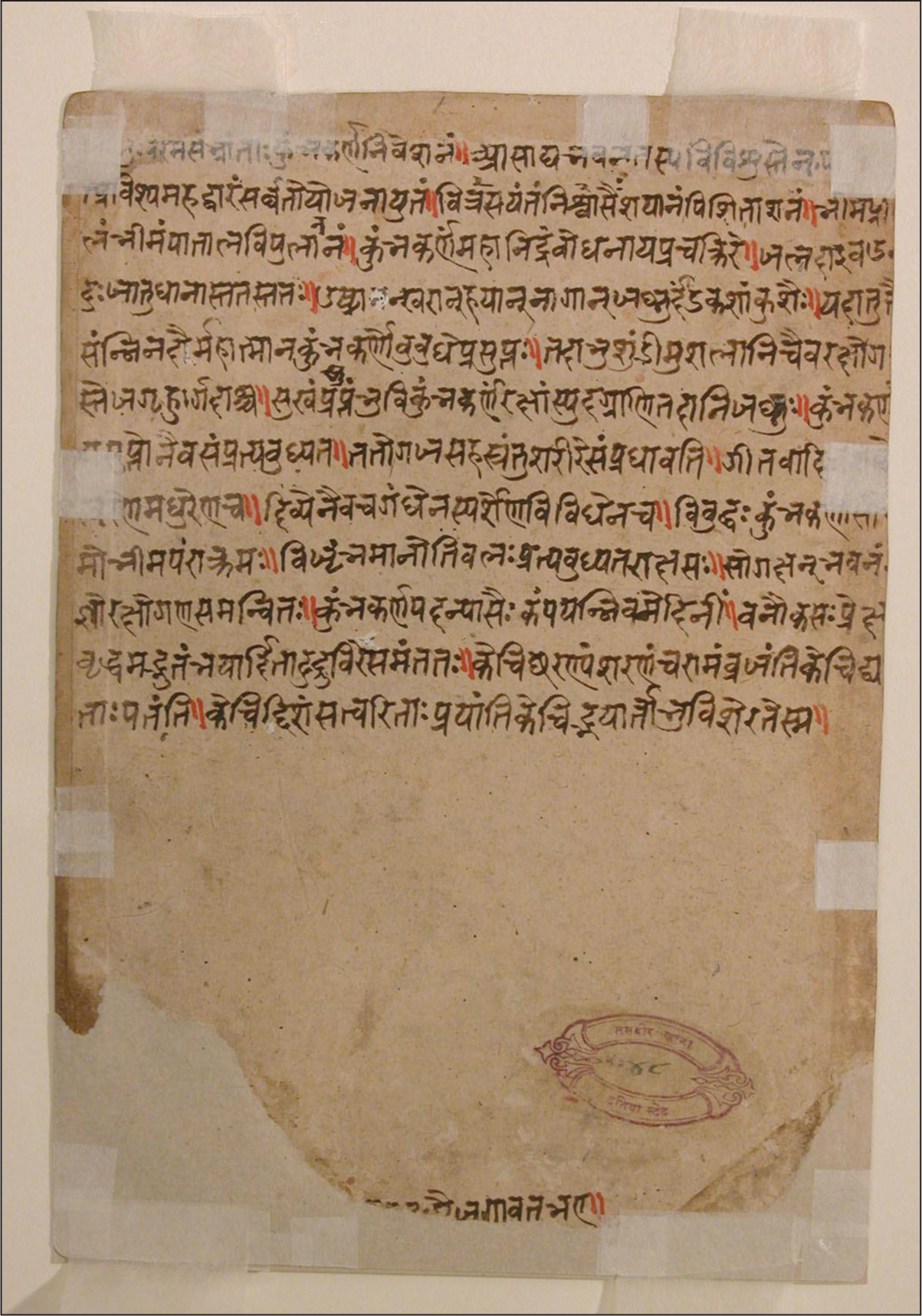
However, these numbers bear no relation to the obvious sequence of the narrative, which may be a sign that the set was in disarray by the time the stamps were added. 6 These stamps evidently date from the colonial period and so it is possible, though not very likely, that the folios could have entered the collection at a later date than when they were made. Closer in date to the paintings themselves are the frequent Bundeli captions in Devanāgarī, added below the Sanskrit text (Sardar 2016: 68; Seyller 2001: 62–63). 7 But most nearly decisive is the use of artists formerly in the imperial atelier. This would only have been feasible for a major Hindu courtier such as Bīr Singh from the beginning of Jahāngīr’s reign (though not, of course, earlier while he was in rebellion against Akbar). This was also the point at which several artists were released from the imperial atelier as a result of Jahāngīr’s different interests in painting and greater interest in elegant architecture, much of it in marble and incorporating Hindu motifs.
The choice of the Rāmāyaṇa as the subject for this set of paintings was no doubt influenced by the precedent set by Akbar, but it was not inevitable. 8 However, it would also have coincided with Bīr Singh’s own Vaiṣṇava leanings. As with his highly visible construction of temples, prestige was no doubt the motivation for its production, as is suggested not only by the style of the paintings and the painters employed but also by the choice of the Sanskrit Vālmīki Rāmāyaṇa as the text to be written on the versos. Though clearly not intended for public viewing, its existence and the employment of former Mughal artists on it would undoubtedly have become widely known. It is likely that it would have been displayed to courtiers and neighbouring rulers (both those subordinate to Orchā and independent Rājput chiefs) in order to impress them. 9
It has been suggested in the past that the text was added later, in the 18th century (Losty in Poovaya-Smith et al. 1989: 28). However, on all but one of the folios examined, the written text has suffered the same losses as the paintings. It is generally thought that the fire damage occurred quite soon after the series was completed. This was first suggested by Terence McInerney (1982: 26) on the basis that ‘the restored areas, filling the irregular edges of some of them, are fairly close in style to the original work’. So, if it is not contemporary with the paintings, the written text cannot be much later.
It is not known how many folios constituted the set originally. 10 The completeness of the written text on the illustrated manuscripts of the Persian translation which it is emulating, indicates that it could well have been on a similarly large scale. The spread of known folios does indeed indicate that it was an extensive set, but whether it was intended to include all significant episodes is unclear. The nature of the Vālmīki Rāmāyaṇa text written on the versos provides the main clue to this, as well as being of interest in other respects. The illustrated Vālmīki Rāmāyaṇa text, next in date (1649–53) to the Bīr Singh Rāmāyaṇa—the set commissioned by Jagat Singh of Mewar—still comprises over 400 paintings distributed across around 700 folios containing a substantial proportion of what must once have been the complete text. 11 In the case of the Bīr Singh Rāmāyaṇa, there is no trace of any text-only folios and no means of knowing whether any were ever produced. In the past, such text-only folios have often been discarded by art dealers and collectors, in favour of the paintings. 12 For the Bīr Singh Rāmāyaṇa, it is all the more likely that text-only folios would be discarded, if they were as damaged as the extant folios are. The number of paintings known is only about one-sixth of that of the Mewar Rāmāyaṇa. It has been deduced from this, that this set was not intended to be as comprehensive and that the text on its versos was only intended as an extended caption. This assumption clearly underlies such descriptions of it as ‘an extensive unbound series of upright individual leaves with selected verses written on the reverse’ (Seyller 2001: 62), which have been widely echoed. However, the reality is considerably more complex, and the evidence conflicting.
In my previous note I was able to examine in detail, transcribe and identify the text on the versos of 13 folios (Brockington 2019). 13 Since its publication, 15 versos with text from the collection of the National Museum, New Delhi, have become available on the internet and also one in an auctioneer’s sales catalogue. 14 These more than double the total number available for study, bringing it up to well over a third of the identified folios (29 out of 67) and making it appropriate to undertake an updated assessment, which now follows. 15
Contrary to the general assumption that the Sanskrit text consists of selections, the passages examined appear in the majority of cases to be broadly continuous, except that the damage to all the folios has meant the loss of two to three akṣaras at the beginning and end of each line and sometimes of part lines at the top and bottom of the sheet. The text was written by several—probably four—different hands, which implies that the project was at least envisaged as being larger than is apparent from the number of extant folios, since more often a single scribe would have been responsible for a considerable amount of text. At what is probably the opposite extreme, just one scribe, Mahātmā Hīrāṇanda, copied the entire text of the Mewar Rāmāyaṇa (between 1649 and 1653). On the other hand, there is a total absence of the colophons at the end of sargas (chapters) that might be expected in a complete manuscript; this is the case with the first two versos that I transcribed originally. 16 But in the remaining instances, the text comes from within a single sarga and so a colophon would not be expected. In some instances the Vālmīki Rāmāyaṇa text fills the entire verso but is only brief on others. 17
The scribe of one group followed a text with readings allied to the Northeastern (NE) recension and wrote versos in all the kāṇḍas, except the unrepresented Sundarakāṇḍa. The writing style has a somewhat uneven top line and some characteristic letter forms, such as an angular ta. The letter forms of a second group are mostly similar to those in the first group, except that there is little trace of the wavy top line, and the text followed is Northern (N) but not clearly either NE or Northwestern (NW). The scribe of a third group followed a text with readings allied to the NW recension; the writing is neat, with a strong thick/thin contrast and a tendency to a serif at the lower end of the vertical line. The writing style of a fourth group again shows a strong thick/thin contrast but characteristically uses a small circle for the dots in anusvāra and visarga (ṃ and ḥ); instances come only from the Yuddhakāṇḍa so far. 18 It is puzzling that these groupings do not correlate at all with the obvious sequence of the folios shown in both the paintings and the related text. 19
In the majority of cases examined, the painting on the recto and the written text on the verso correlate closely, although three partial exceptions were identified and examined in detail in my previous note (Brockington 2019). In all other instances in this series, the text was written on the verso of the painting to which it refers, as is standardly the case then in subsequent illustrated manuscripts. Whereas typically in continuous manuscripts, the text on any individual folio breaks at the beginning and end of each folio without regard for pāda (quarter verse) or even word division (as well as filling all the space within its margins), the Sanskrit text on the versos of this Rāmāyaṇa often begins at the start of a śloka and finishes at the end of another (often before the end of the line). However, this is the earliest illustrated Vālmīki Rāmāyaṇa, and so the only precedent for it to follow is that set by the three illustrated copies of the Persian translation made for Akbar, in which the blocks of prose text in several instances end at the end of a sentence or clause, since several have blank space at the end of their last line.
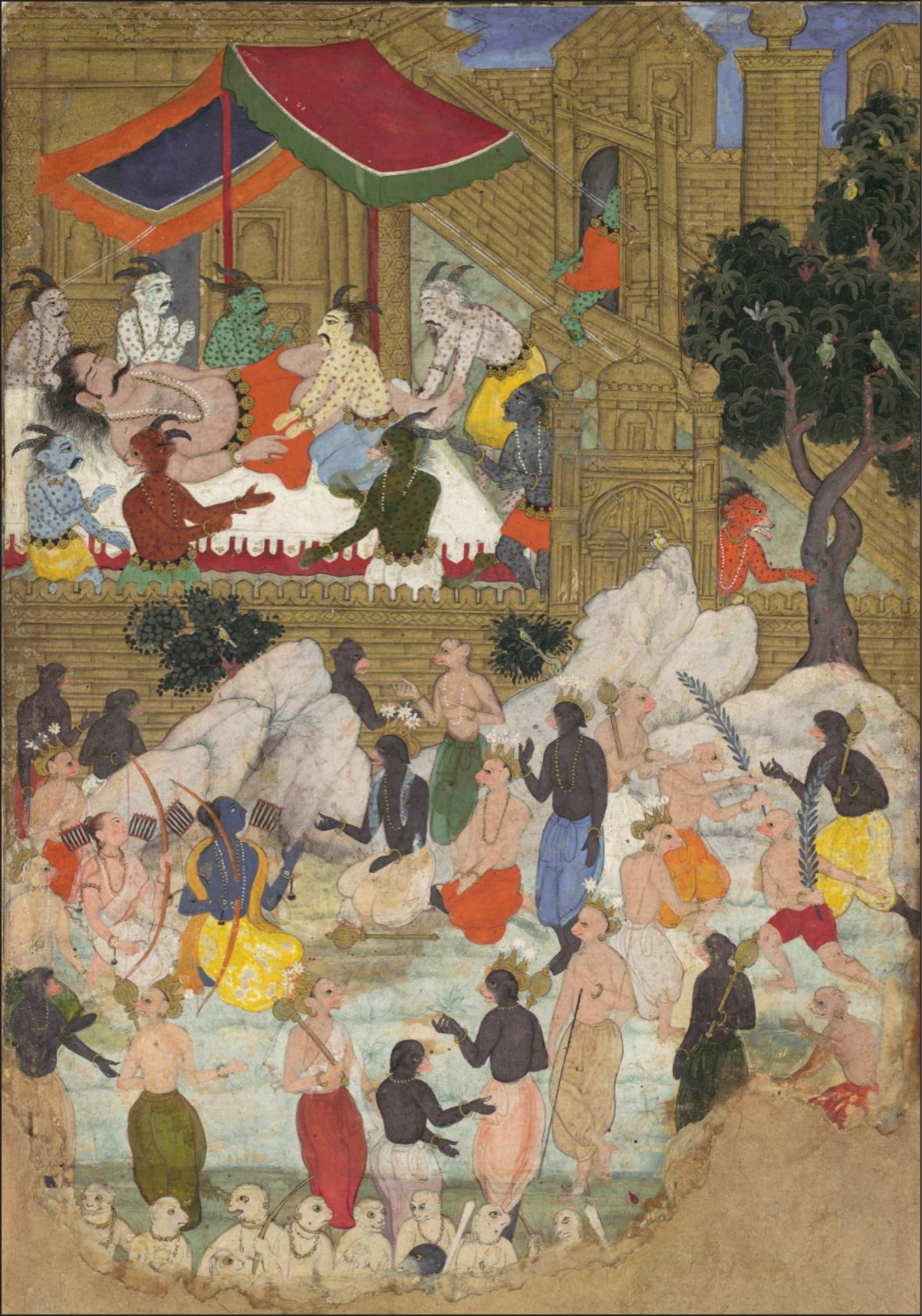
Moreover, there is an instance of consecutive text across two versos, indeed, of a slight overlap. 20 However, these two versos are written by distinctively different hands, which may suggest that the text was added independently to each verso and so, quite possibly, at separate dates. The painting on the recto of the first of these shows Rāvaṇa being informed of Prahasta’s death by assorted rākṣasas and that on the second shows Mandodarī with a female attendant approaching Rāvaṇa while Rāma and Lakṣmaṇa confer with the vānara (literally ‘forest people’, but interpreted as monkeys, cf. Hindi baṃdar) leaders outside the walls of Laṅkā, so the match between painting and written text is good. In addition, the text on two other versos from the Yuddhakāṇḍa comes from consecutive sargas and, exceptionally, both include * passages read by all Southern (S) manuscripts, as well as being written by the same scribe (the writer of the second group), whereas the text on the great majority of other versos is aligned with the N recension, often with either the NE or the NW recension. 21 The painting on the recto of the first of these shows rākṣasas informing Rāvaṇa of Kumbhakarṇa’s death, 22 while the second shows the continuing battle, with Rāvaṇa enthroned inside his palace at the top right.
It is not surprising that these examples are all from the Yuddhakāṇḍa, since by far the largest number of known folios come from that book, reflecting the interest in war both in the Mughal court and among its Rājput courtiers. Another instance of this interest is the title of the already mentioned Mahābhārata translation for Akbar: the Razmnāma (The Book of War). Apart from the degree of emphasis on war scenes, the extant paintings show no particular predilection for particular characters being closely tied to the verbal narrative. For example, Hanumān is little emphasised in contrast to his prominence in so much of the later tradition. 23 Only a few are known from the Bāla and the Uttara kāṇḍas, but this could well be because the damage to the set affected them most, although the subject of the first known folio from the Bālakāṇḍa is as early as the episode when Sumantra mentions Ṛṣyaśṛṅga to Daśaratha. 24 However, the absence of any known illustrations to the Sundarakāṇḍa is puzzling.
It is no doubt only a coincidence that there are so few paintings remaining of the incomplete Sundarakāṇḍa of the Mewar Rāmāyaṇa (as noted in footnote 10), but surprisingly, its Yuddhakāṇḍa has fewer paintings in proportion to its length than would be expected by comparison with the other complete kāṇḍas. For the many other subsequent sets of paintings and the much smaller number of illustrated manuscripts, the Bīr Singh Rāmāyaṇa has broadly set the pattern followed. The sets of paintings include the one made for Hīrā Rāṇī (cf. footnote 2), another Orchā series of 99 folios in the middle of the 17th century, two so-called ‘Malwa’ series from c. 1650 and c. 1690, one in Mewar folk style from the 17th century, one in a mixed Bikaner-Deccani style from around 1734, a 17th-century one from Datia and another from Mewar from the second half of the 18th century, to name only the most significant (Brockington 2018b). The illustrated manuscripts comprise the Mewar or Jagat Singh Rāmāyaṇa, the Bālakāṇḍa dated 1712, the group comprising the ‘small Guler’ and Mankoṭ Rāmāyaṇas along with Mānaku’s ‘Siege of Laṅkā’ from the first quarter of the 18th century (Brockington and Brockington 2013) and the Uniara Rāmāyaṇa, painted for Rao Rajendra Singh by Mira Bagas and dating from around 1760–80, on which I am currently working. There are also a number of series of paintings (many with captions either on recto or verso) and a few illustrated manuscripts based on the Rāmcaritmānas of Tulsīdās and other vernacular versions, as well as of the Sanskrit Adhyātma Rāmāyaṇa and the Kuśalavopākhyāna of the Jaiminīyāśvamedhikaparvan (Brockington 2018b).
To sum up, this set’s obvious dependence conceptually on the illustrated manuscripts of the Persian translation of the Rāmāyaṇa done for Akbar shows that it is the first set to incorporate text from the Vālmīki Rāmāyaṇa. Such dependence also tends to confirm its dating to the period 1605–1610 and its patron as the notable Mughal courtier, Bīr Singh Bundela, who in Jahāngīr’s reign (r. 1605–27) enjoyed the position needed to commission dismissed imperial artists. The vertical format of Mughal paintings is followed but the Bīr Singh Rāmāyaṇa reverts to Indian models of keeping painting and text strictly separate. In addition, the folios were kept as separate leaves rather than bound into a volume in the Islamic style (and may well have become disordered by the time Datia Palace Library stamp was added). With three limited exceptions, the painting on the recto and the text on the verso correlate closely. On all but one of the folios examined the text has suffered the same losses as the paintings (and that one exception is a later replacement). Since it is generally accepted that the fire damage occurred quite soon after the series was completed, the written text, even if not contemporary with the paintings, was added not much later. That much is clear, but the evidence for other aspects is less clear and even conflicting.
The spread of episodes illustrated across all known folios suggests that this was once an extensive set, but this falls short of proof. The text fills several versos in the way that is characteristic of complete manuscripts while others contain as few as four lines of the Vālmīki Rāmāyaṇa text. The passages examined are broadly continuous and were written by several different hands. The number of different scribes identified indicates both plans for a large-scale enterprise and the resources for achieving it. It also ties in with the varied alignment of the text being copied, usually either the NE and NW recensions (the alignment cannot always be determined exactly) but occasionally also the S. All this implies that the project was at least envisaged as being much larger than is apparent from the number of extant folios. There is no trace of any text-only folios, but this is easily explicable as a by-product of the damage suffered.
Bīr Singh’s Rāmāyaṇa was very obviously a prestige project, undertaken in emulation of Mughal models, as is clear not only from the style of the paintings and the identity of the painters employed but also from the choice of the Sanskrit Vālmīki Rāmāyaṇa as the text to be written on the versos. Although that choice was no doubt influenced by the precedent set by Akbar, it also coincided with Bīr Singh’s own Vaiṣṇava leanings, as well as with ideas of Rāma as the ideal king. This would have been useful in bolstering his position for a ruler whose position was none too stable. In its turn, it has set a precedent for subsequent illustrated manuscripts of the Vālmīki Rāmāyaṇa, similarly produced for reasons of prestige, from Jagat Singh’s monumental Mewar Rāmāyaṇa nearly half a century later (produced in part, at any rate, to stress the position of the Śiśodiyas as the most prominent dynasty within the solar line, which claims Rama as an ancestor) to the Uniara Rāmāyaṇa produced for Rao Raja Rajendra Singh (r. 1740–77) around a century and a half later. That Rājput rulers set such store on cultural production as an intended marker of status is in itself significant.
Footnotes
Declaration of Conflicting Interests
The author declared no potential conflicts of interest with respect to the research, authorship and/or publication of this article.
Funding
The author received no financial support for the research, authorship and/or publication of this article.