




Abstract
The digitalisation of the state in India and elsewhere has produced a range of effects and critical responses. Arguably, digital processes intervene in the functioning of paper processes, the lynchpin of bureaucratic states with a colonial legacy. Digitalisation must be understood as the emergence of data and technologies splintered across many different locations and functions of the state rather than as a singular form. This article argues that this splintering digitality generates a perspectival stance on the (re)significance of paper by agents of the state that embody its ‘textual habitus’, namely Village Accountants (VAs). Memorialised as writers, VAs have historically been responsible for recording the ever-changing social. Faced with the computerisation of records and their removal from participation in key inscriptional events, they generate a critique of writing and point to non-textual forms of information that congeal outside written records. In doing so, they provide a view into the encounter between digitalisation and bureaucratic knowledge.
I
Introduction
One afternoon in November 2018, in a town—outside Bengaluru, in southern India—I call Data Nagar, sitting in the ‘computer room’ of a taluk 1 office, Meena, a computer operator, casually pointed out that Village Accountants (VA)—a group of lower- or street-level bureaucrats (Lipsky 2010) responsible for all forms of record-keeping pertaining to agricultural land—are not required any longer to digitally authorise the Record of Rights, Tenancy and Crops or the Mutation Record. 2 By law, the Bhoomi project (Prakash 2008) in Karnataka, which started in 2001, digitised records held in registers at the level of the village, transferred them onto a single database and made any future changes to land records dependent on the digital system. Before Bhoomi, VAs were the sole custodians of both documents. Even after Bhoomi, VAs—who travel between the ‘field’ and the taluk office—continued to go to office every day to provide biometric thumb approvals before changes in land records could be formalised until they were finally removed from the process that November. Meena’s casual remark underplayed the significance of this moment.
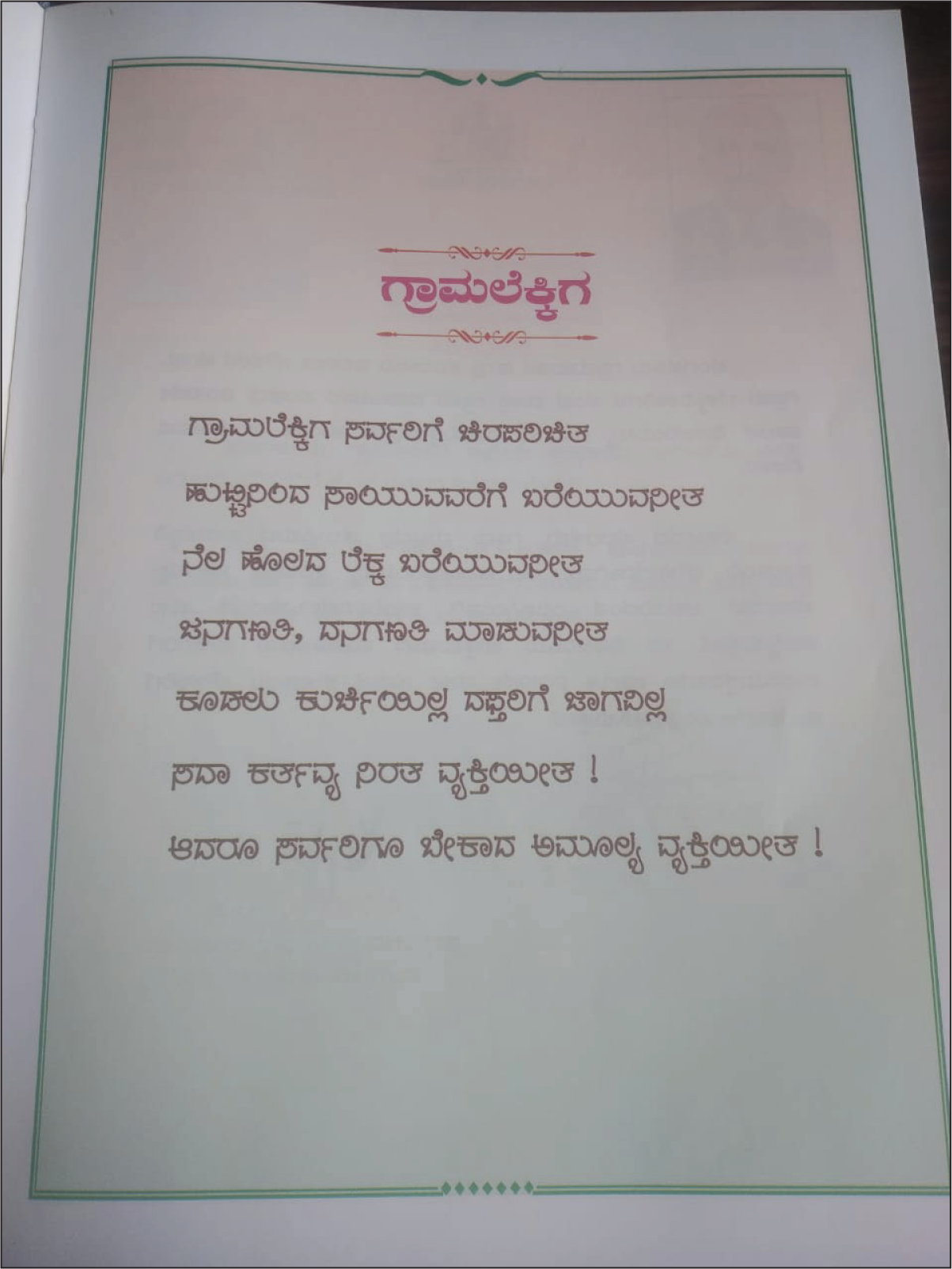
The VA is a historical, precolonial figure, who ‘stationed at the bottom rungs…kept the records that formed the linchpin of the entire revenue apparatus’ of the colonial empire (Raman 2012: 38). They are memorialised not only by employees of the revenue department but also in numerous scholarly and non-scholarly accounts of government revenue management (Galanter 1984; Potter 1964), including a poem celebrating their skills as ‘writers’ inscribed in a diary published by the department each year (Figure 1).
When it appeared in the 1990s, Bhoomi was a unique configuration of an entrepreneurial spirit emergent within the post-liberalised Indian state, and a techno-optimism about sorting out a persisting unevenness between the higher level, urban-bred civil services and the lower-level, ‘subaltern’ bureaucracy. Bhoomi’s critique came from scholars who saw technology as a façade to create a neoliberal market in land, and digitisation as a means to make legible property ownership and, thereby, the possibility of enabling ‘land developers’ to use one-sided deals to dispossess poor people of their land (Benjamin et al. 2007).
As part of India’s move towards electronic forms of governance, the computerisation of land records sought to centralise the maintenance of records, citing nefarious practices among the lower bureaucracy, particularly VAs (Chawla 2005). This might be seen as the latest attempt at reform in a long line of interventions that since the colonial period have been premised on the ‘corruption’ of lower officials (Taylor 1920). Elaborate procedures of accountability, in the form of the very same records that are now being digitised, were introduced in the 19th century (Raman 2012). Continuing that trend more recently in the 1960s, changes in the recruitment of VAs aimed to control the gamut of documents under their control. Yet, all these prior reforms aimed to rein in VAs, while the computerisation of land records pertains to doing away with them altogether from the record-making process, an ambition incrementally laid out. Meena’s remark pointed to the last nail in the coffin. 3
In the post-colonial period, as the state took on development functions, the purpose of the Record of Rights, Tenancy and Crops began shifting from being a record of tax and revenue liabilities to becoming an identity document for farmers to access various development goods (Shivanna 2006) and VAs became the conduit for development policies (Khera 1964). In all these roles, VAs held inscriptional authority over the documents under their custody through the authority of signatures at different stages of record production and on the copies of records farmers needed to participate in a larger ecosystem of document-led entitlements.
II
The Proliferation of Digitality
In the three decades of Bhoomi’s development, projects of the digitisation of governance proliferated across several sectors, spurring inquiry into the effects of digitisation from many angles. Scholars have aimed to study the political conditions within which digitisation of government services improves people’s lives (Bussell 2012). With the rise of biometrics in the past two decades, scholars have been paying attention to how a change in the material forms of governance impacts access to entitlements, across a range of governmental services (Abraham and Rajadhyaksha 2015; Chambers 2020; Dandurand 2019; Mudliar 2021; Rao 2013; Sriraman 2018). Tracking the proliferation of digital technologies, another set of scholars have attempted to account for bureaucratic states as they are constituted by a coexistence of forms of paperwork and new forms of digitally mediated processes (Breckenridge 2014; Datta 2023; Hull 2022; Hasan 2022).
Yet, despite the proliferation of interest in studying the processes of digitisation, less attention seems to have been paid to how lower-level bureaucrats—often the subjects of technology-mediated reforms—come to experience digitisation. When studies of digitisation of governance in South Asia bring in the voices of lower-level officials, even VAs, it is usually to show the persistence of older forms of knowledge in relation to the newer ones attributed to digitisation. For instance, Cowan’s (2023) detailed account of patwaris (VA) in Gurgaon highlights the relevance of VAs’ ability to dig through paper records in the face of digitisation. In contrast, in researching digitisation, I encountered VAs articulating their experiences of the digital in relation to their identities as custodians of paper records. The digitisation of records is a moment of re-fashioned aesthetics of paper and the document (Manovich 2001).
If, as Riles (1998) suggests, bureaucratic documents are not texts and, therefore, their meaning-making involves interpretive work, this article asks how document-makers view the business of reading and writing documents with a change in medium—and how their attempts at understanding the social, arguably constructed in relation to their textual practices—are affected by the appearance of digital systems. Providing a portraiture of village officials at the interstices of old and new media contributes to a long history and contemporary scholarly interest in a sociology of the state, that is, in the making of bureaucratic persons and the writing, translating and meaning-making processes they engage with.
Historians studying the development of scribes and scribal activity related to state power in South Asia focus on the social and material aspects of records and their keepers (Alam and Subrahmanyam 2004; Bellenoit 2014; Green 2010; O’Hanlon 2010; Raman 2012). More recent social-scientific accounts of documents and bureaucracy also study document-makers and the worlds they mediate. For instance, Mathur (2016) documents how a national policy to guarantee work is experienced as an onerous task of sorting out various categories of paper by the lower-level staff of a development bureaucracy; Pati (2019: 261) describes how partial knowledge of bureaucratic documents, yet complete authority over their production and use, allows lower-level bureaucrats to collude with upper-caste landlords to enhance property accumulation; and Ghosh (2019) shows how typists and notarists, as agents of the everyday state, mediate a shift from a legalistic understanding of documents to one experienced through a corporeal viewing of the aesthetics of documents (ibid.: 36).
This article draws its inspiration not only from the established fact that the realisation of policy depends on a vast army of state and para-state agents—which warrants a deeper understanding of their personhood—but also that the voices of these agents contribute to an archive of the effects of technological change, from post-industrialisation (Bell 1976) to the computerisation of factory work (Zuboff 1988) and now to the digitisation of the state (Datta 2023). To be sure, India, as other countries, has invested materially and technologically in the charisma of new media (Mazzarella 2010), suturing a nationalist, developmentalist project to the travails of technology. This has produced many outcomes, including excessive ones (Shah et al. 2022), all warranting an account of the many histories and the many ‘internets’ that a singular vision of technology-led development has generated. Providing an account of an emerging network bureaucracy from the point of view of its foundational human layers, whose scribal practices were central to the establishment of the modern state in India, contributes to an understanding of a moment in the long telos of modernity, that of a splintering vision of technological modernity.
Going back to the opening vignette, office talk about the waning of VAs’ participation in inscriptional work and of their social identification as record writers linked it to the loss of their ‘power’, explained sometimes as gaurava (honour) and sammaana (respect), pointing to its social forms (Mann 2012) and at other times as jawabdaari (responsibility), pointing to its personal, authoritative forms.
Yet, the VAs with whom I had been engaging with regularly were not as dismayed; it did not seem to matter much to them that other staff in the hierarchy or private computer operators moved in to do inscriptional work on the land records under their former control. Rather, they pointed to a different reading of records, one not visible in the claims of senior bureaucrats who devised computerisation policies.
First, VAs point to a diminished quality of records in the electronic form as compared to the handwritten documents they controlled. By challenging the very materiality of digital records, they use multiple aspects of writing and documentation not tied to the function of writing only as a form of representation, to negotiate their social position within bureaucracy.
Second, they argue that records are no longer a storage device that congeals knowledge about land, as information about the rapidly changing sociality around parcels of land is dissipated across a range of public and private actors.
And, third, VAs point to their continued work in generating and disseminating information higher up the bureaucratic chain, through digital artefacts other than written documents. This is the production of information in the realm of splintered digitality.
The remainder of the article explicates on these three broad responses that VAs had to computerised records, which together constitute an ethnographic view of the encounter between forms of work. In the conclusion, I bring these ethnographic observations together to reflect on the domination of a ‘textual habitus’ (Raman 2012) in the scholarship on South Asian bureaucracies, and I argue that the encounter of a subaltern bureaucracy with elements of digitisation calls for an analysis of bureaucracy through its burgeoning non-literal forms.
Even as the critical history of the bureaucratic record is one of an ineluctable gap between evidentiary claims and the social that it aims to account for (Hull 2008; Smith 1985), the record remains a stable device in scholarly descriptions of bureaucracy. My analysis shows that digitisation might be splintering this stable notion of the record, a phenomenon I capture through the phrase ‘mutating records’, in turn calling for a multimedia account of how bureaucratic knowledge is constituted. Further, if digitisation is indeed causing a breakdown of the record as we know it, the article also aims to meditate on the construction of bureaucratic power and knowledge in the age of digitisation.
As part of my ethnography of the digitisation of public bureaucracy, conducted in what an informant termed ‘the mother of all bureaucracies’, a sub-district revenue office in a site I call Data Nagar, outside Bangalore, I observed, between September 2018 and May 2019, the work that VAs did in their offices, in the sub-district offices and in other public locations, as they interacted with a diverse set of people. In the course of my field study, I interviewed VAs spanning three generations—those holding office in the 1970s who retired in the early 2000s; those holding office in the 1990s and due to retire in the next decade; and those hired in the 2010s, a decade after the digitisation of two revenue records.
III
‘Writing’ on the Computer
The transformation currently underway in the material elements of the revenue bureaucracy is significant. This is reflected in the medium of writing (computers and mobile phones over physical books), the type of writing (preprinted formats over more subjective statements), the quality of writing (ticking yes/no boxes over writing longer descriptive statements) and the physicality of the office itself (kiosks manned by private staff and online services located in remotely held servers, over more informal workspaces). These material transformations cannot all be reduced to a digital transformation emanating in the policies of liberalisation of the early 1990s. My own perusal of a large number of documentary records from over the last 50 years point to evident material changes in the production of the record. The aim here is not to look for a date when things changed permanently but to point to the flux that defines the work that VAs do and its multiple sources, including digital transformations, that is evident from observing the day-to-day life of bureaucracy.
This material flux provides an opportunity to understand how VAs view the act of writing and recording in the present. VAs do not write the Record of Rights, Tenancy and Crops or the Mutation Record on the computer, a task they performed manually before 2001, when a new set of ‘Bhoomi Operators’ were hired for the job. Knowing the production process is said to be crucial to their social survival, however, as farmers depend on them (and others) to negotiate the system. Yet, VAs do not seem concerned over gaps in their knowledge of the repeated (and mostly unexplained) changes to the software system by bureaucrats and their staff in Bangalore, leaving the charge to ‘computer operators’ hired for the job. An anecdote helps to explain this point.
One day, while having a discussion on errors within digital records, I asked how these errors appear in the first place. While many errors were produced during the original digitisation of the records in 2001, apparently by the under-skilled, overworked data entry operators in stuffy rooms in Bangalore, errors also crept in during present ‘mutations’ to the already existing digitised records—‘Bhoomi Operators’ like Meena made ‘human errors’. Manjula, a VA, claimed that in the past the software was such that it allowed for an error of this kind, if identified, to be rectified within the production process itself (by a re-entry of the data point) but the current version did not. Even if an error is identified mid-process, the mutation must proceed, only to become a disputed case when a higher-level officer rejects it. Another VA, sitting next to Manjula, said that she was under the impression that errors could be corrected mid-process even now and was mildly surprised to hear about this change. She clearly did not know about this change to the software but did not seem very concerned about her lack of knowledge. Both VAs went on to complain about rapid changes to the software and say they were not interested in keeping up.
Instead, VAs spoke of writing in terms of rigidity, limitation and the lack of ability to manoeuvre the script. With the computer appearing in these parts as the legal way of writing land records, higher officials—and not VAs—began to have more control on the writing. This is an effect of the ‘rigidity’ of the computer, as one VA puts it. Writing on the computer—on screens driven by software, writing that is concealed from the producer or the location of production—is a frustrating activity. Writing on the computer is akin to not having space for authorial impact and to being tied down by the software that is always beyond one’s control. It means the use of strategies beyond the writing to get by, like having to call multiple people in Bangalore to have things corrected. Writing is rigid also because it can be done only on specific computers assigned to people, through ‘login’ credentials that require prior approvals.
An example is the Mutation Record, which captures—or at least is meant to capture—historical ownership and transactional information about a parcel of land. The record should tell the owner how through time the land became theirs. Older VAs claim that the precursor of the present-day Mutation Record was the Record of Rights, during the late colonial and early postcolonial periods (1900–50), and in turn its precursor was the Preliminary Record during the reign of the Marathas (1780–99) and of Tipu Sultan. 4 The function of the Record of Rights and the Mutation Record is the same but the form is different; a Record of Rights is a large document, folded in to fit the standard A4 5 file (Figure 2).
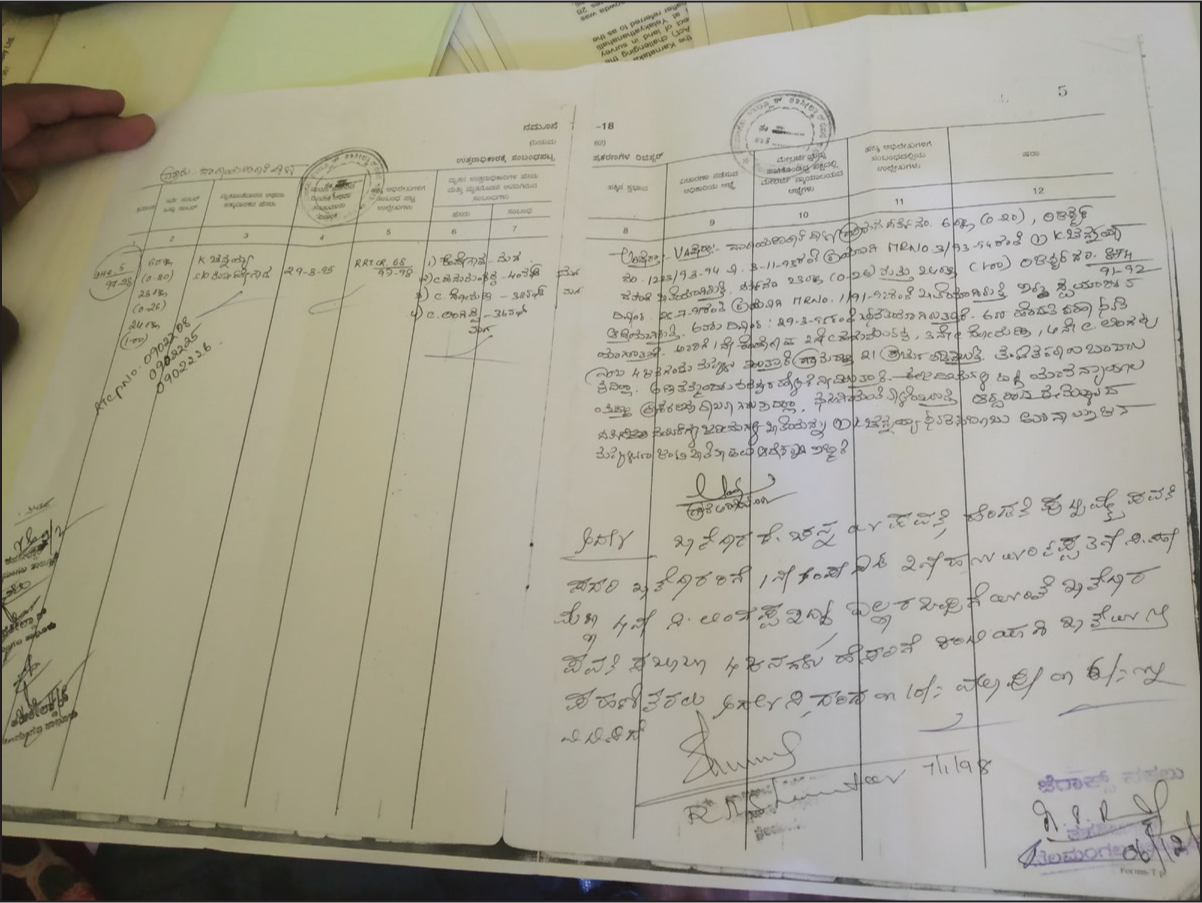
A Record of Rights has a number of columns; the last column is the Shara (statements, a space for comments by the VA and the tahsildar). The Record of Rights (Figure 2) was handwritten in the revenue year 1997–98, the last year before records were digitised. The VA’s descriptive statements appear in the top right-hand corner of the document, as recreated below with my translation and explanation in square brackets:
The village of Narayana Rao Palya, survey number 6(0-20), Reg. no. 1223/93-94, Date 3-11-93. Through Kraya [purchase], MR no. 3/93-94, Khata [ownership] has been made in the name of one K. Channayya. Survey number 23(0-26) and 24(100) reg no. 874/91-92, date 25-7-91. Through Kraya, MR No. 1/ 91-92 Khata has been made in the name of K. Channayya. These are Swaardita land parcels [bought by K. Channayya himself] On date: 29-03-95, Pavathi [inheritance] has been made in the name of his wife, Puttamma [after his death the land was transferred to his wife through an ‘inheritance mutation of the record’] Now, there are four sons, first Kempegowda, second Hanumanrthappa, third Somanna and fourth Lingappa. Notice served in the village through Form 21. No dispute has arisen hence no dispute case is registered. All four have given their statements. No court case has been registered in the court. This is a matching with the Pahani [RTC], hence the following order is requested—for the above survey number lands Khata should be made in the joint account of the four children of K Channaya.
These statements provide genealogical information pertaining to how the present owner, Puttamma, became the owner of these lands through an inheritance from her husband and how her husband had got these lands through a former purchase. Based on the genealogical information, the last sentence makes a request to the Tahsildar to make an order to allow Puttamma’s four sons to inherit these lands from her.
Ravi, a VA I had spent considerable time with, read out these lines to me with an intonation that is hard to capture in text. At the end, he looked at me and said, ‘All this is gone’. He meant that since the Mutation Record began to be generated by computer, in the early 2000s, this narrative genre of inscribing genealogical information has been lost. Ravi flipped a file and held a computer-printed Mutation Record (Figure 3) open for me to look at: it had no space for statements by the VA—or anyone else, for that matter.
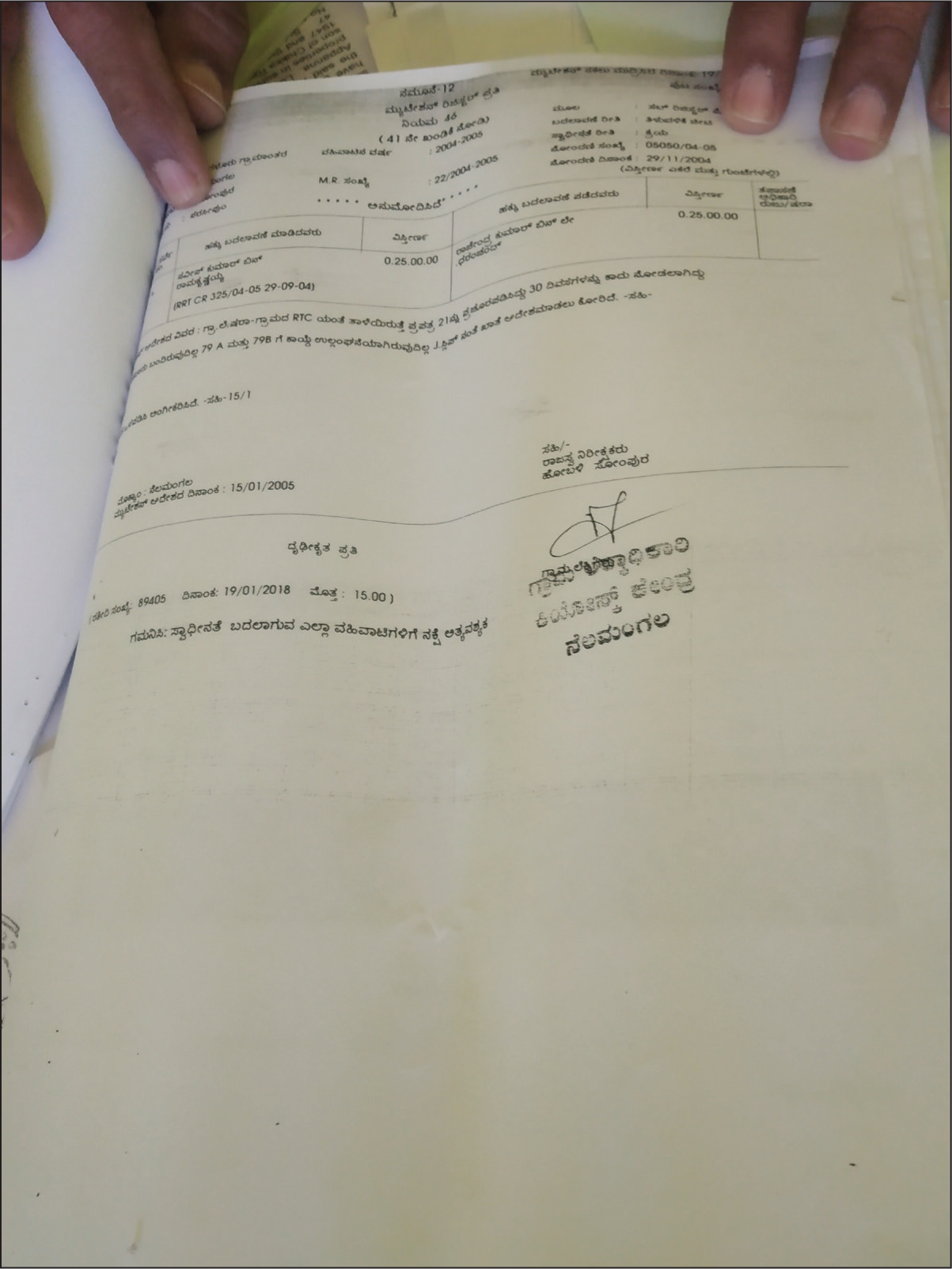
The information in the table at the top of the page is sparse. While the Record of Rights carried genealogical information about past transactions, the Mutation Record documents only the current transaction. The statements below the table are conclusive. The first says that the information here matches that in the Record of Rights, Tenancy and Crops, and that notice was served for 21 days, and no dispute was received. The historical information in the first one is missing in the second, Ravi pointed out.
Yet, Ravi was not saying that information is lost in the Mutation Record, or that it inaccurately represents changes in land ownership; he was acutely aware of how this document worked—even though it does not carry genealogical information in the way the Record of Rights did, it adds up to the same information when linked to a network of Mutation Records, as is clear from the multiple Mutation Records he had attached in the same file which he flipped through as we spoke.
Over the past few years technologists and senior bureaucrats have been attempting to apply managerial principles of process re-engineering to the management of land records. One of the principles is to ‘streamline’ processes, to enable supervision and control, and to prevent discretion in record-writing. Another was to cut down what they saw as superfluous information that slowed down processes and took up more storage space on the database servers. As having servers approved by the government department was a time-consuming and unpredictable process, optimisation of storage space was seen as a prudent solution. A ‘technical consultant’ working on the digitisation of records explained to me that the digital Mutation Record was based on the principle that information should not be repeated. The consultant said that the Karnataka Land Revenue Act, 1961, required a Mutation Record for every mutation; therefore, a Mutation Record did not need to carry information on past transactions.
Yet, to VAs, the appearance of the same data in multiple documents is a key to a kind of documentary ethics; to them, multiple lines of description make a document ‘good’ and ‘robust’. A sparse document like the Mutation Record does not carry the symbolic weight of a government document. For them, repetition of data is also a kind of diagnostic tool to cross-verify one document against another as it was an impediment against arbitrarily changing data across documents. They hastened to add that these accountability mechanisms were embedded in the production of the document itself and do not need to be introduced through computerisation.
To explicate on this point, a retired VA, Rajanna, pointed out that the Barah Nammune Lekha (Twelve Types of Documents), written since the time of Tipu Sultan, constituted a kind of documentary network of various facets of the village, and it had multiple data points repeated across documents. The Khetwar Patrike, a kind of ‘mother ledger’, consolidated information on all types of government, private and common land as well as all types of lakes, stormwater drains, forested patches, government trees and grazing areas. For all private lands, the extent of tax to be collected was listed next to the survey number. But other documents—like the Amrai Takhte, listing all the government-owned fruit-bearing trees, or the Banjar Takhte, describing the extent of government land—carried subsets of the information already in the main document.
VAs also spoke about the document format and the quality of the paper that the documents are printed on. When documents were handwritten, the rows and columns in the formatted sheets of paper—pre-approved by the government—were blue in colour, and the text, in black ink, showed the VA’s work. Now, they complained, pre-formatted computer templates can be printed on any white sheet, and there was no difference between the colours of the format and the printed information. Older documents, they claimed, were printed on ‘special’ sized and quality paper, while now computer printouts could be taken on any mamooly (common) A4-size paper. This, they felt, devalued the document.
My interest lies in thinking about these claims as a response to the onslaught of computerisation. What appears through these invocations of a rich documentary past is that truncated forms of writing devalue writing for VAs even though the information in the digital documents has not changed much. VAs claim that more writing is good writing, pointing to the same kind of need of ‘visuality’ that Cody’s (2009) interlocutors looked for in their performance of signatures. Herein lies one explanation for VAs’ nonchalance towards the loss of participation in inscriptional events. Writing on the computer does not carry the weight (even if the message remained the same) of a government record, a point they repeatedly make by comparing the ‘thin’ Mutation Record to the ‘thick’ Record of Rights.
IV
Empty Records and the Risk of Non-Writing
The VAs’ office had grey cabinets full of ‘registers’, or records of different aspects of land—such as the extent and condition of government-owned land in the villages under the VAs’ supervision—the list of old age pension beneficiaries and amount of welfare emoluments and tax collection. Most of these registers were in pristine condition, with just a few marks of inscription, as opposed to the chronologically older records stored in the taluk office’s ‘record room’. Some seemed incomplete, the writing disappearing after a couple of entries. An occasional sign and stamp of a higher official was seen across the pages but just flipping through the records, as I did multiple times, showed a general absence of regular writing. They were also not on standardised government books, a specific format and colour of stationery found sometimes in the offices, though pre-formatted texts on plain A4 size paper were in use for most work. In the way the VAs spread these records out on the table for me to see, putting it back again after I was done, showed me that these were not documents of daily use; rather, sheets of pre-formatted paper—which they called ‘verification reports’—along with other files being worked on during the day took up much of the space on the table. But, they did not hesitate to show these empty records to me; that they allowed me repeated viewings and questions is suggestive of their attitude towards them.
The absence of writing in these records was in direct contrast with the belief and assurance of bureaucrats higher up the chain in the robustness of these documents. Higher-level bureaucrats pointed out several times that the knowledge of land that had congealed in these records had made the VAs too powerful and their discretionary power needed to be contained. One way was to digitise land records, starting with the Record of Rights, Tenancy and Crops and the Mutation Record. When I pointed out that I had not seen VAs write detailed records, these officials would point to a seven-volume Handbooks of Village Accountants (Government of Karnataka 2010) and insist that these records should be maintained. This is not surprising, considering Smith’s (1985: 181) description of the office manual as the central technology through which the writing of village records was controlled from a distance. The office manual came to replace the need for the micro-supervision of record-keeping, making senior bureaucrats believe that records are maintained because it says so in the handbook.
In the next section, I discuss why these records remained empty. For now, the absence of writing records was often contrasted with another situation emerging in relation to knowledge about land. I heard multiple stories from VAs and other people, including brokers, about land-grabbing and fraudulent attempts at claiming ownership of land. VAs, in particular, claimed that they were caught in a difficult situation. They claimed that because the need to maintain registers around different aspects of land was not relevant anymore—owing to other channels of communication with the higher bureaucracy (as I describe below)—their knowledge of land transactions was limited. They went on to claim that it was not just them, but officials at large who had lost track of the various divisions of land and ownership. In their view, ‘imposters’, land grabbers and brokers had up-to-date knowledge of land transactions and were using it to evade any form of monitoring or overview. It was hard to validate the claim. But, a higher bureaucrat in Bangalore from the same department echoed this view when he said that a village survey would reveal the extent of government-owned land to be very different from the information in Bhoomi, the land records database. VAs also believed that part of the reason they knew less about land than in the past was because they had less to do with the maintenance of records. They did not anymore have the means to detect fraudulent activities; yet, they were held accountable for activities beyond their purview. They felt exposed to complaints, inquiries and actions against them and it was easy for people to dupe them. At an employee association meeting, Gaythri, a VA, recounted a recent incident in her village: she found a building being constructed on a parcel of agricultural land; since that is a violation of the revenue law, she summoned the people involved. But, they laughed at her for not knowing that the higher-up bureaucracy had approved the conversion for that parcel of land. And, she was not aware because the people involved had bypassed her, approached a higher-up bureaucrat and won the approval.
VAs experience their waning position as record-keepers also in changes in their social relations with clients. Gayathri revealed to me a court case she was embroiled in. A year earlier, someone—she still did not know who—had filed a case against her and her supervisor, a revenue inspector, for signing on papers that led to a transaction on what he claimed was his plot of land. The complainant charged Gayathri with approving a fake transaction in return for a bribe. Because it was a case related to employee corruption, it was lodged at the state’s Lokayukta (anti- corruption ombudsman) in Bangalore. In the intervening year, Gayathri had made several visits to Bangalore to appear before the Lokayukta and had spent over ₹100,000 (about US$1,400) in hiring advocates to represent her. In describing her predicament to me, Gayathri did not claim that she was honest, or the charge was false, but rather that the absence of regular record-keeping had significantly reduced face-to-face contact with farmers in the villages under her jurisdiction. As a result, it was difficult for her to distinguish between fake and genuine clients only on the basis of the documents they brought because she had less opportunity to gain the social knowledge that was built through the work of recording myriad aspects of land and the rights that people had on them. She said she acted on the documents given to her by the ‘computer section’ of Data Nagar’s taluk office without having the means to check for herself the authenticity of the transaction. Gayathri said she was ‘under pressure’ from senior officials in the office to sign on files and she feared contradicting them. Whether Gayathri took a bribe to make that change is not the moot point here; what I am interested in is her description of this case to show the tenuous relations between VAs and their relations with people owing to a devitalised documentary system of writing records.
VAs, thus, also encountered computer records as risk. Writing records in their registers, a dwindling exercise, constituted some form of insurance against contradictory claims. In the absence of this writing, acting on the direction of author-less computer records, they experienced the burden of risk of authenticating changes in the records that they longer controlled through their signatures. If a mutation of a land parcel turned out to be ‘fake’ or disputed for any reason in a court of law, the revenue law continued to hold VAs responsible. Even as digitisation had removed VAs from the record-making process, they continued to experience risk that had been previously curtailed within the contours of their inscriptional powers. This experience of risk further invalidated the sanctity of the digital record.
V
Information through Splintered Digitality
Conversations that surrounded my perusal of empty records provided important insights into what VAs thought about records as documents. One of the first points to emerge was that VAs thought of their records in relation to other kinds of communicative work they were engaged in and the digital technologies through which that work was undertaken. If the previous sections have detailed VAs’ response to one kind of digitality, which materialised through the database, this section points to the many other forms of the digital that pervaded the work lives of VAs and splinters our understanding of stable records. I refer to a range of technologies—Microsoft Word, PDFs, WhatsApp, Aadhaar and so on—as digital data to describe the proliferation of digital forms in the lives of VAs.
A weekly audio conference call carried out through a mobile application with the District Commissioner was referred to several times in these discussions. A single call was made by the commissioner to his staff, including all VAs under his jurisdiction. The calls that I attended lasted anywhere between five and 20 minutes per week. VAs were often the subject of the Commissioner’s attention and sometimes the subject of his wrath. The Commissioner would focus on tasks that he expected VAs to complete before the next call or ask them for status updates on the previous week’s tasks. Many times, the Commissioner asked VAs to prepare data sheets pertaining to different aspects of the village. One time he asked them to go out into specific villages and identify land for a specific purpose:
For all graveyards and solid waste disposal, through WhatsApp groups I will send you a list of villages in which this should happen…your Tahsildar will forward it to you. By next Saturday, you all should send a proposal to reserve land for graveyards and solid waste disposal, under KLR, Section 71.
Another time he asked for VAs to prepare a ‘list’ of all beneficiaries for an ongoing old age pension scheme by visiting households and verifying how many of those pensioners were still alive. The commissioner claimed that during a review meeting with the revenue minister, the question of whether funds were adequately used had come up, for which the minister recommended an investigation by VAs. He asked VAs to fill out this information in a specified template, a ‘format’:
I will send out the format on WhatsApp. According to that, enter names of all the people who are not alive but are getting pensions in instalments. Find out their serial number in the voter IDs and their serial number in ration card and put it down in the format. Fill out all this information…we should not reject beneficiaries by mistake.
In the following week’s call, a lively and complicated discussion ensued. A problem several VAs noted was that the number on the pension certificate given to a beneficiary did not match with any of the other identity cards (such as ration or voter ID) that were available with them, making it hard for them to verify who the real pensioner was. They complained, that the Aadhaar number, a unique number given to Indian residents in return for their biometric data, had not been completely ‘seeded’ to the pensions database. One VA offered a solution—part of the pension number did match with some part of the voter ID number, so it could be used to identify beneficiaries—that the Commissioner seconded.
The VAs reminded me of these audio calls in the presence of their incomplete records to point to the communicative processes through which ‘data’ was always in motion, even when it did not congeal in the records. They referred to this information that was supposed to be in the record but was now flowing through more immediate channels such as the weekly audio call and on WhatsApp, as data. Particularly, they spoke of the immediacy with which data about the villages under their administration was required to be produced and circulated through oral exchanges, Excel sheets or as Microsoft Word or PDF attachments through WhatsApp messages. They showed me how rapidly and urgently data was demanded and sent on the WhatsApp groups they were part of. They said all this not to suggest that the registers sitting in their grey cabinets were inadequate storage devices for this information but rather to point to the expanded social worlds and expanding actors and interests for which this information was necessary.
The VAs downplayed the significance of information in computer records or in the registers in their cupboards to point to the methods of production and the patterns of circulations. In other words, records were insignificant not because they did not contain much information but because their form and accompanying limitations prevented them from participating in a broader universe of exchange. The VAs used this dissonance between the medium and channels of circulation to critique a straightforward relation between the maintenance of records and the holding of social power, as made out by their office staff, such as the computer operator Meena, in the anecdote with which I started out this article.
The VAs held—as do some anthropologists studying the effects of documents outside their function of representation—that their position in the bureaucracy was determined by where the information associated with the records travelled and through what mediums, and who saw and accessed them; it was not that the information (or its absence) in the registers that undermined their significance as social beings in the office. The VAs’ talk of, and around, records opens up an opportunity to think about the interplay between form and content in documents and the social meaning they give to their producers.
The diminishing significance of the documentary regime, a context within which production of texts on the computer is not considered significant, is also evident in the vestiges of ceremonial work around the authentication of records. Revenue records have historically been legitimised in an annual settlement process called the Jamabandi, an annual event, vividly described in Tipu Sultan’s Mysore Regulations (Greville 1795: 175), which included a ceremonial function of signing the registers that documented taxes collected by an office during the revenue year. This practice continues but—as I describe below—has little to do with the records themselves. I was part of the 2019 event, a day in February, where staff in the office in Data Nagar was in an upbeat mood, looking forward to lunch at the signing ceremony that was organised at a resort 10 miles away from the office. Kumar, a caseworker, 6 one of my interlocutors in the office, offered to take me in a car that his brother was driving, but that he insisted was his own.
Earlier, in the office a discussion about what Jamabandi was had ensued. VAs write three books of accounts throughout the year. The Khathe has the names of previous and current owners of a parcel of agricultural land and the tax due from the current owner. At the end of the document is a total for the village. The Keerdi has an entry of the receipt numbers given to landowners on collection of tax from them. The Recidi Patta is the actual receipt book through which tax is paid. These books, first signed by the serishtedar or office manager, are presented to either the Assistant Commissioner or the Deputy Commissioner on the day of the signing, also called Huzur Jamabandi.
But, Kumar clarified that this is how it should be done, not necessarily how it was being done. VAs do not any more go to villages to collect these taxes. Changing land tax rules and the depleting productivity of agricultural land have resulted in marginal taxes. Kumar quipped that a one-acre parcel of land that he owned attracts a tax of only five rupees (approximately 10 cents). In such a scenario, he claimed, VAs do not spend time or money going to villages to collect these small amounts; instead, they make these payments out of pocket. Since the whole documentary system of the Jamabandi documents is based on a collection, balance and recovery model, the document produced in the absence of this is a pretence.
Yet, VAs do not necessarily see it in that way. Irrespective of the content of the Jamabandi registers, they point to how these documents engender a transaction between them and their managers as well as the sociality of the event of signing. Several VAs told me that their office manager charged them ₹5,000 (approximately $72) each to sign the documents before the day of the ceremonial event. This was presented not so much as a complaint but as a practical strategy to meet the demands of the event, without having to spend too much time on it. The VAs said if the manager, well respected in the office for his knowledge about land matters, actually checked their books, he would find many errors. And, so it was easier for them to pay this money and get the signature rather than correct the records. Many VAs do not even write these records themselves, rather depending on older retired VAs or their support staff; so, having to make corrections would require payments to these people. A one-time payment to a single officer, a transaction that would strengthen their relationship with him, was preferable for many of the VAs I spoke to.
Rather than worrying about the content of the Jamabandi books, VAs were interested in talking about the ceremony of the Huzur Jamabandi, which in February 2019 was being presided over by the Assistant Commissioner. Driving to the event, Kumar asked me if I would eat non-vegetarian food on that day. Apparently, given the large number of vegetarians in the office, separate arrangements, a cordoned space, were made for meat eaters. Kumar advised me to stay close to him if I wanted any of the chicken curry as he knew exactly where it was going to be served and how much. The VAs collect a significant amount of money from among themselves to put together this event. It also involves negotiating with a host of people, starting with the owner of the resort, to the caterers and the cleaners to get the event going.
The driveway from the gate of the resort to the hall where the event was taking place was lined with cars of all shapes and sizes. At the end of the row was the Assistant Commissioner’s car. Before I entered, a VA who I knew but had not spent much time with welcomed me to the event as a mark of respect but also as a way to show that he was in charge. As I went into the hall, I saw officials sitting in a row on a raised platform in front of the audience. At the centre was the Assistant Commissioner, two Tahsildars and a few of his subordinates. No VAs were on the raised platform. The office manager who had signed the books of accounts the previous day in return for money was strolling outside the hall, chatting with the Bhoomi technical consultant who had been invited for the event from Bangalore.
Prior to the signing, the Assistant Commissioner’s office Tahsildar made a few comments in which he pointed to the historical roots of the Jamabandi and the need for VAs to maintain accurate records given the confusion around how much land the government owned. A queue of VAs lined up on the right-hand side of the platform and one by one presented their Jamabandi books to the AC for his signature. Books were being signed in quick succession and VAs moved out to make space for other people. Everyone from the office was there but after a few minutes most people drifted to the dining rooms and sat at tables waiting to be served. The VAs took on the role of hosts. They made sure everyone was seated and had a banana leaf to eat off, and they came several times to serve the food.
Manjula beamed in a silk sari with a golden border, something I had never seen her in before. She had just ushered in people into the dining room, and I chatted briefly with her. ‘The event is going well’, she said. It was particularly important to her to have everything in place since she was the cultural secretary of the VA association of the district. She showed me pictures she had taken of the event with herself next to the Assistant Commissioner that she had already sent via WhatsApp to several groups. Manjula was distracted, and in a few minutes went back to waiting on the Assistant Commissioner, who was now sitting in the non-vegetarian part of the dining hall.
What I aimed to show in this section is that circulation of information about land and other revenue matters outside the contours of the record, through myriad digital channels, constitutes the lived experience of VAs and their perception towards bureaucratic writing and the social power associated with inscriptional activities. In the concluding section, I summarise the argument about the diminished quality of bureaucratic writing in relation to scholarship on how states and their agents come to know in the age of digitalisation.
VI
Mutating Records: Bureaucratic Knowledge in the Age of Digitalisation
In writing about the digitalisation of the state as constituting a form of urbanisation, Ayona Datta (2023: 144) contends that the emerging digital infrastructure of the state is up against the vast swath of information that remains in the mode of paper. This she sees as both a contradiction in the claims of a technocratic sovereign power as well as a telos. By the very logic of its existence, the digitalising state will attempt to retrieve more and more of governmental work from the hold of paper into the realm of the digital. In the age of state digitalisation, the partial digitisation of land records and the response it has elicited—and the contrasting culture of splintered digitality and the diminishing concept of the record as a fixed entity that this digitisation enlivens—calls for a rethinking of the relationship between paper and the digital.
The processes I have aimed to describe in this article may be less about the teleological takeover of paper by the digital and more about the fading of a documentary culture organised around paper. Bhoomi does not aim to translate all the several written records around agricultural land into its database. In the 25 years of its existence, only two records have been digitised, a fact that has irked scholars (Prakash 2008); yet, even the partial digitisation of records and the introduction of a range of digital communication technologies has elicited responses that point to what media theorists David Bolter and Richard Grusin (1999) call ‘remediation’. As old media, and paper, reassert itself (Bolter and Grusin 1999), it does so in ‘new’ ways; that is, paper itself seems to be undergoing some material and perspectival change as it encounters, articulates, effaces or is effaced by digital technologies.
It is important to pay attention to the diminishing significance of paper in the age of the digital to adequately update scholarly interest in how the postcolonial state in India comes to know the social that it aims to dominate. The tradition of studying the material practices through which the state acquires information and knowledge is long. That tradition begins, in many ways, with Bernard Cohn’s work on the census in colonial India (1984). The more recent studies of state bureaucracies which—inspired by Foucault (2007)—insist that power emanates from acts of inscription (Das and Poole 2004; Gupta 2012). All invest heavily in the ‘textual habitus’ (Raman 2012) of bureaucrats and their ways of knowing. The digitalisation of the state and the responses it elicits might be pointing away from this investment in literacy and inscription as a form of knowing to other multimedia forms that increasingly comprise the working day of bureaucrats in the business of acquiring information about the social.
When VAs describe computerised records as a form of non-writing, they are indicating the reduced relevance of a text-based framing of their work. Here, Francis Cody’s (2009) work on practices of literacy in southern India is instructive. Cody finds that neo-literate women in the Dalit village of Katrampatti are not content with inscribing their newly learnt ‘unsteady’ signatures on a letter to a commissioner, an act unparalleled in the history of the village; they seek a form of ‘performativity’ in which they physically hand the letter to the Commissioner, as a significant component of their newly established agency as literate citizens. Cody takes this situation to show:
There is nothing natural about an interpretive framework that would presume an isomorphism between written subject and social agent…the magical conflation of subject and agent that is supposed to inhere to the act of signing is thrown into question even further if we take into account the signers’ own interpretation of events—interpretations that were shaped by logics of deference and visuality that escape dominant ideologies of the written sign. (Cody 2009: 371)
Applying Cody’s analysis to document makers, we find that in similar ways VAs denounce writing on computers because it lacks the material qualities that writing was supposed to have. Because it lacked these qualities, it did not symbolise for VAs the power they associated with the authority of writing. The absence of the familiar material qualities of paper and writing is not experienced in isolation but aggravated by a diminished documentary culture in which recording information about land is no longer confined to the records but congeals in a wide variety of technological forms, which I have called digital data. In a sense, bureaucratic knowledge has historically been constituted in a situation of ‘paradoxical authority and vulnerability’, as Andrew Mathews (2011: 19) documents in the context of the Mexican Forest bureaucracy. Even when officials speak authoritatively, they are haunted by the vulnerability of being proven wrong. By splintering the record as a stable storage mechanism for bureaucratic information, and by introducing multiple mediations in the form of digital data, digitisation might be complicating this relationship and widening the gap between the social and the bureaucratically knowable.
Footnotes
Acknowledgements
I wish to thank Professor Rita Brara, Editor of CIS for inviting me to contribute to this special issue and the anonymous CIS reviewer for their very helpful suggestions to improve the article. I am truly grateful to all the VAs in Data Nagar that I spent time with, particularly Manjula, Ravi and Gayathri, who gave me a lot of their precious time. I am indebted to Dr. Narayana A at Azim Premji University for introducing me to the ‘problems’ of digitisation that plague the revenue department in Karnataka, as well as for taking the time to introduce me to key people, which eventually led to finding an ethnographic site. Thanks to Professor Smriti Srinivas and Dr. Hemangini Gupta for organising the BRN-NAGARA workshop in August 2019 in Bengaluru, where the first draft of this article was discussed. The broader research from which this article draws insights was supported by the International Dissertation Research Fellowship from the Social Science Research Council.
Notes
Declaration of Conflicting Interests
The author declared no potential conflicts of interest with respect to the research, authorship and/or publication of this article.
Funding
The author received no financial support for the research, authorship and/or publication of this article.