



Abstract
Australia appears to be following the trend in mainly Western countries of recognising animal sentience in the law. This article sets out a typology of animal sentience recognition provisions that have been enacted, or have been proposed, in Australian jurisdictions to date. These include provisions or proposed provisions located in statutory objects, statutory principles, statutory definitions and a treaty. Depending on legislative context, these provisions, and proposed provisions (if enacted), may have different legal consequences. The trend towards legally recognising animal sentience may also signal further positive legal reforms for animals in the future.
I Introduction
Knowing others is a difficult thing. It is relatively straightforward to know ourselves: we know that we have thoughts, we have feelings, we can respond to and interact with a tangible world that exists outside of us. We also have good evidence that other humans have similar subjective experiences because they tell us, in a language that we understand, that this is the case. When it comes to non-human animals, however, it is less straightforward because humans do not share a spoken language with other animals. 1 Instead, we need to rely on other evidence, including animal vocalisation, physical movement and hormonal changes. Fortunately, scientists have now gathered sufficient evidence to conclude that many animals have similar subjective experiences to humans. 2 Like humans, these animals have the capacity for negative feelings like fear, anxiety and suffering, as well as positive emotions, like happiness and joy. 3 In other words, many animals are sentient. While the term sentience lacks ‘a clear and incontrovertible definition at present’, 4 David J Mellor’s definition is particularly helpful. Mellor asserts that ‘[s]entience is a capacity of animals to consciously perceive by the senses; to consciously feel or experience subjectively. In animals that manifest different states of welfare, these experiences can be negative, that is, potentially welfare compromising, or positive, that is, potentially welfare enhancing’. 5 In this respect, animal welfare scientists have established that all vertebrates are sentient, 6 and that cephalopods (including octopods, squids and cuttlefish) and decapod crustaceans (including crabs, lobsters and crayfish) are probably also sentient. 7
In tandem with these scientific developments, public concern for animals has grown in Australia and other developed countries. Our increased understanding of animals’ inner lives, as well as better understanding of the ways in which humans impact other animals has led to public concern that legal protections for animals are inadequate. This concern is most evident in relation to farmed animals, as they are generally provided with much lower levels of legal protection when compared with other animals. For example, a 2018 report commissioned by the federal Department of Agriculture and Water Resources found that ‘the Australian public’s view on how farm animals should be treated has advanced to the point where they expect to see more effective regulation’, and that the public consider that animals should have rights and freedoms. 8 These findings are remarkable as they are the product of reliable and extensive research showing that current animal welfare laws are out of step with Australian values.
Human society has been engaged with issues concerning the treatment of animals for a long time. These recent scientific developments and public concerns, however, are beginning to be reflected in law and policy in many national legal systems, particularly in developed countries. While animal welfare laws have been around for a long time and implicitly recognise that animals are sentient by referencing negative states like pain and suffering, 9 in more recent times, laws have been introduced and amended to expressly recognise animal sentience. For example, the European Union recognised animals as sentient in a protocol to the Treaty of Amsterdam by referring to them as ‘sentient beings’. 10 More recently, California introduced a bill of rights for cats and dogs which states that ‘[d]ogs and cats have the right to be respected as sentient beings that experience complex feelings that are common among living animals while being unique to each individual animal’. 11 A number of Australian jurisdictions appear to be following this trend by passing or proposing laws and policies that expressly recognise that animals are sentient. 12 Express recognition of sentience is a significant development because it is explicit, because — in contrast with traditional animal welfare legislation — the concept of animal sentience encapsulates both positive and negative states, and because legislation can often have unforeseen consequences. Moreover, in a context where animals have historically been generally categorised as property, recognition of animal sentience may signal a fundamental change in the way humans regulate their relationships with animals.
This context gives rise to many different conversations. For example, is sentience recognition a positive development for animals? 13 Is it appropriate for people to own another sentient being? 14 Should sentient animals have legal rights? 15 Should governments encourage people not to eat sentient animals? 16 While the context gives rise to varied ethical discussions, this article focuses on the legal similarities and differences between the animal sentience recognition statements that have been enacted or proposed in Australian law. It sets out a typology of Australian animal sentience recognition statements, with a view to better understanding the differences between them and the consequences that may eventuate if enacted, depending on the provision or proposed provision in question. In this respect, it identifies several ‘types’ of provision and analyses the context of each type of provision and proposes some possible consequences of each provision based on these factors.
The next part of the article sets out the background to sentience recognition provisions. This includes discussion of where sentience recognition sits in the animal rights/welfare debate, public concern for animal welfare, the international and possible domestic trend towards enacting sentience provisions, and the purpose of Australian legal provisions and proposed provisions that recognise animal sentience. Following this, the article sets out the typology of animal sentience recognition provisions and proposed provisions, located in legislative objects, legislative principles, legislative definitions and a treaty. While these legal provisions and proposed provisions can be readily recognised as part of a trend and have been discussed in the literature accordingly, they differ in form and (if enacted) likely effect based on their wording and placement in legislation and policy. This article will also provide some concluding thoughts in relation to sentience provisions and what they may herald for the future of animal welfare in Australia.
II Background
A Place on the Ideological Spectrum
Animal advocacy has increased over the last 50 years, bolstered by seminal texts like Peter Singer’s Animal Liberation, 17 Tom Regan’s The Case for Animal Rights18 and Gary Francione’s writings. 19 Over time, the differing philosophical positions presented in these texts have been reflected in noticeable differences in ideology among animal advocates. The chief difference concerns animal advocates that seek advances in animal welfare, in contrast with those that work towards recognition of animal rights. In this respect, animal welfare supporters aim to improve the living conditions of animals, while allowing that ‘humans use animals for their own ends’. 20 For example, animal welfare supporters might argue in favour of banning battery cages for hens, but not challenge the right of humans to raise hens for their eggs in the first place. In contrast, people that argue for animal rights oppose the human use of animals and argue that animals are entitled to fundamental rights. 21 Gary Francione, for example, has claimed that animals should be accorded ‘the right not to be treated as the property of humans’. 22 Thus, animal rights ideology views animal interests in living a happy and healthy life as more important than human interests in consuming or otherwise exploiting animals. Animal welfare ideology, on the other hand, seeks to balance these conflicting interests.
Legal recognition of animal sentience does not fit neatly into either of these ideological positions. On the one hand, recognising animal sentience will not change the categorisation of animals by law as property and will not prevent humans from using animals in different ways. On the other hand, recognising animal sentience does not demand specific improvements to animal welfare. Legal recognition of animal sentience may, however, help to realise other objectives. For example, animal sentience recognition statements may provide a scientific basis for animal welfare legislation and better reflect public opinion regarding the ethical treatment of animals. They may lead to better awareness of animals’ ability to experience pain and suffering. They might also reduce human exploitation of animals and potentially improve legal protections for animals. 23
B Animals’ Legal Vulnerability
Western legal systems have traditionally constructed and treated things as persons or objects. 24 Under this orthodox binary classification, humans are persons, meaning they have legal rights, bear legal duties or have the ‘legal capacity’ to have legal rights and duties. 25 Companies are also treated as persons, 26 and more recently other ‘entities’ have been recognised to have certain legal rights, including, for example, the Whanganui river in New Zealand. 27 Historically, animals have been categorised in Western legal systems as things, or property. 28 Property also includes ‘real’ property such as land and fixtures and structures upon land, 29 as well as ‘personal’ property including chattels or goods. 30 It also includes intangible property, created by law, such as copyright and other intellectual property rights 31 and corporate shares. 32 In the past, some people now considered legal persons were categorised as property. For example, enslaved Africans were categorised as property in the United States. 33
Unlike all other forms of property, however, many animals are sentient. 34 This means animals experience the world subjectively and feel negative states like pain and suffering, as well as positive emotions such as happiness and pleasure. 35 Moreover, it is clear many animals can feel physical and psychological pain in a similar way to humans. 36 Categorisation of sentient animals as property makes them vulnerable to human abuse and cruelty, in that humans as legal persons are generally entitled to deal with their ‘property’ as they see fit, subject to animal welfare laws. 37
Legislatures have sought to address the inherent vulnerability of animals by enacting animal welfare laws. In this respect, most jurisdictions in developed countries, including all states and territories in Australia, have passed animal welfare legislation seeking to prohibit human cruelty towards some animals and to promote animal welfare. 38 The first animal protection legislation in the United Kingdom (‘UK’) was passed in 1822 and was later reproduced in the Australian colonies. 39 Existing Australian animal welfare legislation has, however, become inadequate. Instead of a consistent national approach to animal welfare, 40 states and territories have their own legislative approaches which have been described as ‘fragmented, complex, contradictory, [and] inconsistent’. 41 Rochelle Morton et al argue that the weaknesses in Australian animal welfare laws lie in the ‘lack of a consistent definition of “animal” and reliance on forms of legal punishment to promote animal welfare which have questionable effectiveness’. 42 Certainly, the philosophy underpinning animal welfare laws means that ‘significant harm is inflicted on [animals], quite legally’. 43 However the weaknesses are framed, there appears to be a general consensus that Australian animal welfare laws are outdated, which is indicated by the recent efforts by most jurisdictions to review and amend animal welfare legislation. 44
C Public Concern for Animal Welfare
In recent decades, media and other coverage of animal abuses has intensified, assisted by new technologies. Popular documentaries including Earthlings (2005) 45 and Dominion (2018) 46 have depicted how humans use animals for economic purposes, including in modern animal agriculture. Such coverage has highlighted ways in which animal use can become abuse or cruel treatment. In Australia, the ABC Four Corners program has exposed the cruel treatment of Australian cattle exported to slaughterhouses in Indonesia 47 and live baiting in the greyhound racing industry. 48 Also in Australia, the Farm Transparency Project Repository operates as a public database for videos, photos and documents of animal cruelty and exploitation to increase the transparency of animal use industries. 49
These circumstances have led to significant public concern for animal welfare, which has become a driving force behind the proposal and adoption of animal sentience recognition provisions internationally and in Australia. In relation to concern for farmed animal welfare in developed countries, 50 Amelia Cornish, David Raubenheimer and Paul McGreevy recently surveyed the literature relating to concern for the welfare of farmed animals amongst veterinarians, farmers and members of the public. 51 They noted that ‘[t]he past two decades have seen public concern for animal welfare continue to rise’ 52 and identified ‘high levels of public concern for animal welfare across many developed countries’. 53 In particular, they identified a number of studies revealing significant concern for farmed animal welfare in particular countries. This included an Australian study pursuant to which 71 per cent of respondents agreed that ‘farm animal welfare is an important consideration’ 54 ; a Scottish study in which 68 per cent of respondents were either ‘concerned’ or ‘strongly concerned’ about farmed animal welfare 55 ; and a Dutch study which recorded 86 per cent of respondents as either ‘somewhat concerned’ or ‘very concerned’ about farmed animal welfare. 56 Similarly, surveys undertaken in New Zealand indicate that the New Zealander population is concerned about farmed animal welfare and that this concern is growing, particularly in relation to common practices such as the use of farrowing crates for gestating pigs. 57 In the United States, the Animal Welfare Institute’s Report Consumer Perceptions of Farm Animal Welfare states that ‘American consumers are increasingly aware of, and concerned about, how animals raised for food are treated’. 58
There is also evidence of public concern for animals more broadly. The European Commission’s Report Attitudes of Europeans Towards Animal Welfare reveals high levels of public concern for the welfare of animals. 59 It reports that ‘[m]ore than nine in ten EU citizens believe it is important to protect the welfare of farmed animals (94%)’ and that ‘Europeans believe the welfare of farmed animals should be better protected than it is now (82%) and similarly for companion animals (74%)’. 60 In public surveys taken in 2006 and 2016, nine countries showed more than a 5 percentage point increase in the share of respondents that feel that farmed animals need better protection. 61 Similarly, in relation to an increase in respondents agreeing that animal protection should ‘probably’ be better, to those agreeing that it should ‘certainly’ be better, 14 countries showed an increase of greater than 5 percentage points. 62 In relation to both questions, increases in concern for animals were most marked in Finland and Ireland. 63
Similar concerns for animal welfare are echoed by the Australian public. A recent report commissioned by the former federal Department of Agriculture and Water Resources has found that ‘the Australian public’s view on how farm animals should be treated has advanced to the point where they expect to see more effective regulation’, 64 and that the community believe that animals should have rights and freedoms. 65 These findings are significant because they are drawn from dependable and broad research and demonstrate that the law does not reflect contemporary Australian values. Similarly, research published in the UNSW Law Journal found that ‘the property status of at least some animals may not be consistent with contemporary attitudes’. 66
D International Context
The UK made headlines last year when it announced that it would officially recognise animals as sentient beings in law. 67 As noted above, the UK’s announcement follows an international trend, spanning a few decades, towards expressly recognising animal sentience in the law. Following the Treaty of Amsterdam, the European Union recognised animal sentience in Article 13 of the Treaty on the Functioning of the European Union (‘TFEU’) in 2008. 68 This provision both recognises animals as ‘sentient beings’ and requires Member States to ‘pay full regard to the welfare requirements of animals’ when formulating and implementing related European Union policies. In the same year, Tanzania adopted the Animal Welfare Act 2008, which recognises that ‘an animal is a sentient being’ and defines sentient as meaning the ‘capability of an animal to be aware of sensations, emotions, feeling pain, suffering and enjoying their species specific needs’. 69
Since then, several other jurisdictions, of both civil law and common law backgrounds, have enacted similar provisions. In 2011, the Netherlands drew on existing legislation to formulate the Animals Act 2011. Article 1.3 paragraph 2 of the Act recognises that animals are ‘sentient beings’ and have intrinsic value. 70 Oregon, in the United States, enacted legislation acknowledging that ‘animals are sentient beings capable of experiencing pain, stress and fear’ in 2013. 71 Similarly, in France in 2015, the French National Assembly amended the Civil Law to recognise animals as ‘living beings gifted with sentience’. 72 The French amendments helped inspire the government of Quebec to enact legislation in 2015 providing that ‘animals are not things. They are sentient beings and have biological needs’. 73 In the same year, legislators in New Zealand amended the long title of the Animal Welfare Act 1999 to include recognition of animal sentience as a purpose of the legislation. 74 Similar provisions have been enacted in Colombia in 2016, 75 Sweden in 2018, 76 Brussels in 2018, 77 and Denmark and Spain in 2021. 78
E Domestic Context
Australia appears to be following this international trend. In 2019, the Australian Capital Territory (‘ACT’) became the first Australian jurisdiction to expressly recognise animal sentience in law when it amended the Animal Welfare Act 1992. 79 Section 4A(1)(a) of that Act now provides that the main objects of the Act include recognition that ‘animals are sentient beings that are able to subjectively feel and perceive the world around them’. 80 Moreover, section 4A(1)(b) provides that ‘animals have intrinsic value and deserve to be treated with compassion and have a quality of life that reflects their intrinsic value’. 81 The amendment bill was introduced by the governing ACT Labor Party whose Animal Welfare and Management Strategy 2017-2022 also recognises animal sentience. 82 The Victorian Government has also committed to legally recognising animal sentience in its replacement of the Prevention of Cruelty to Animals Act 1986. 83 The Victorian State Government’s ‘Animal Welfare Action Plan’ affirms that ‘[s]entience is the primary reason that animal welfare is so important’. 84 The Directions Paper for consultation in relation to the new Victorian Animal Welfare Act sets out three ways in which sentience might be recognised in the new legislation: in the objects of the Act, as a principle of the Act or as part of the definition of animals covered by the Act. 85 While these recognition statements are interesting in the context of the recent international trend towards animal sentience recognition, it is also noteworthy that appreciation of animal sentience in Victoria extends back as far as 2007. In that year, the Victorian Department of Primary Industries’ publication ‘Animal Welfare for Livestock Producers’ identified sentience as a reason to be concerned about animal welfare and asserted that ‘[f]ailure to recognise sentience in livestock species could result in production losses, market access loss and breaches of [the Prevention of Cruelty to Animals Act 1986]’. 86
Western Australia (‘WA’) is also committed to recognising animal sentience. The WA Government established an independent panel to review the state welfare legislation, which recommended that ‘section 3 of the Animal Welfare Act 2002 be amended to expressly recognise that animals are living beings, able to perceive, feel, and have positive and negative experiences’. 87 The WA Government responded favourably to the Panel Report, stating that ‘[a]nimals are living beings and science tells us that they experience some of the same feelings that humans do’ and supporting the Panel’s recommendation. 88 New South Wales (‘NSW’) is also reviewing its Animal Welfare Act. While its draft Animal Welfare Bill 2022 89 does not mention sentience, the Select Committee on Animal Cruelty Laws in New South Wales recommended in 2020 that ‘the NSW Government ensure that the Prevention of Cruelty to Animals Act 1979 and the animal welfare framework that supports it are overhauled to better meet growing community understanding of animal sentience and expectations about animal welfare’. 90 In spite of this, the NSW Government did not include sentience as an issue in its Discussion Paper on animal welfare reform. 91 While sentience was a key issue raised during consultation, the Government is unlikely to expressly recognise sentience, responding to the issue by stating that ‘[t]he draft Bill acknowledges the concept of animal sentience through reference to protecting animals from harm, which is defined as including distress, pain, and physical and psychological suffering’. 92 Similarly in Queensland, despite the omission of animal sentience from the Discussion Paper regarding Review of the Animal Care and Protection Act 2001, 93 nearly half of respondents that provided written submissions argued that animal sentience should be expressly recognised in the Act. 94 In spite of this public support, the Government’s Animal Care and Protection Amendment Act 2022 makes no reference to animal sentience. 95
The Northern Territory (‘NT’) has also rejected calls to legally recognise animal sentience. In this respect, the NT Department of Primary Industry and Resources asserted that ‘the content of the [Animal Protection] Bill [2018] and intention would remain the same with or without that recognition [of sentience]’ and that ‘the adding of sentience as a specific statement did not add to the intent of the legislation or enhance compliance with the legislation’. 96 Similarly, the Report of the Parliamentary Inquiry into the Animal Protection Bill 2018 states that the Social Policy Scrutiny Committee was ‘of the view that recognition [of sentience] is implicit in the Bill and does not need to be explicitly stated in the Objects of the Bill’. 97 In Tasmania, a draft Animal Welfare Act Amendment Bill 2022 was recently released for public consultation. While it does not include a sentience recognition statement, the Government has indicated it will include the concept in its animal welfare guidelines. 98 In South Australia, the Government has announced a review of the Animal Welfare Act 1985 (SA) and as at the time of writing is seeking feedback in relation to the Act. 99
While the federal Australian government lacks express constitutional power to make laws regarding animals, it does have an indirect impact based on other heads of constitutional power, particularly the external affairs, interstate trade or commerce powers 100 and corporations power. 101 Pursuant to the external affairs power, the previous Government recently entered into a free trade agreement with the UK, the Australia-United Kingdom Free Trade Agreement (‘A-UKFTA’), which states that ‘[t]he Parties recognise that animals are sentient beings’. 102 This provision was the result of UK influence and is placed within a dedicated animal welfare chapter. This agreement is significant as the first trade agreement involving Australia that has a chapter devoted to animal welfare. 103 The federal Department of Agriculture, Water and the Environment’s now defunded ‘Australian Animal Welfare Strategy (AAWS) and National Implementation Plan 2010-2014’ also recognised animal sentience. Part 1 of the AAWS states that ‘[s]entience, which implies a level of conscious awareness, is the reason that welfare matters’. 104 The defunding of the Strategy, 105 non-renewal of its Implementation Plan, 106 disbanding of its Advisory Committee 107 and omission of sentience in subsequent federal Standards and Guidelines, 108 however, suggests that animal welfare was not a priority of former Prime Minister Scott Morrison’s government. The new federal government’s animal welfare-related commitments suggest that it may be more amenable to legal recognition of animal sentience. 109
F Purpose of Australian Animal Sentience Provisions
The purposes of enacting provisions recognising animal sentience emerge from the documentation surrounding enacted and proposed provisions in Australia. They can be grouped into five broad categories. There are no discernible differences in purpose based on the type of sentience provision. The first purpose, as would be expected, is that such provisions represent an attempt by legislatures to benefit animals. This purpose is most obvious in the documentation surrounding the ACT sentience recognition provision. For example, the Territory’s ‘Animal Welfare and Management Strategy 2017-2022’ states that the Strategy has been ‘developed to ensure the ACT Government delivers a consistent and consolidated approach to promoting improved outcomes for animal welfare and management’. 110 Further, in his speech introducing the bill to amend the Animal Welfare Act 1992, Chris Steel, the ACT Minister for City Services, Australian Labor Party, stated that ‘[t]his bill will improve the quality of life for animals in the ACT’ and ‘will protect and promote the welfare of animals, prevent and deter cruelty to animals and respond appropriately to animal welfare abuses’. 111 During its passage through Parliament, Nicole Lawder (Liberal) proposed amendments to the bill, including recognition that ‘responsible and humane — (a) food production practices; and (b) environmental management; and (c) scientific research; and (d) cultural and recreation activities’ would not be restricted by recognition of animal sentience in the Act. 112 These proposals were rejected by Parliament, possibly suggesting that Parliament was focused on more on improving the welfare of animals than on safeguarding the position of humans in their interactions with animals. The focus on improving animal welfare is also apparent from the ‘Report of the Independent Review of the Animal Welfare Act 2002’ of WA. The Panel states that ‘[i]t is important for the AW Act to reflect contemporary practices with respect to animal welfare regulation. An outdated AW Act may lead to poor outcomes for animals’. 113
In connection with the objective of improving animal welfare, the second reason that Parliaments have passed, or committed to pass, animal sentience recognition provisions is to shift the focus of animal welfare legislation to better reflect contemporary animal welfare science. Traditional animal welfare legislation is generally focused on the prevention of cruelty to animals. Contemporary animal welfare science, in contrast, emphasises that many animals have the capacity to experience both negative and positive feelings. Legal recognition of animal sentience is considered to legally embed this contemporary understanding of animal cognition and may be complemented by the imposition of positive duties in relation to animals. 114 The objective of shifting the focus of legislation is seen clearly in the documentation surrounding the Victorian animal sentience recognition proposals. The Victorian Directions Paper ‘A New Animal Welfare Act for Victoria’ states that ‘[t]he proposals below represent a shift away from the focus on cruelty in Victoria’s current POCTA Act’ and that recognising animal sentience ‘provides clarity that policy development and regulatory decisions should be based on preserving animal welfare (rather than just responding to animal cruelty)’. 115 Further, recognising animal sentience is also expected to ‘provide clarity about the purpose of the legislation and support greater consistency in the interpretation and application of animal welfare law’. 116 Similarly, in Western Australia the Independent Panel charged with reviewing the Animal Welfare Act 2002 identified ‘the need for the [Animal Welfare Act 2002] … to evolve from a law that is primarily intended to prohibit cruelty to one that promotes the welfare of animals, while continuing to appropriately define and proscribe cruelty’. 117 In the Australian Capital Territory, the legislation also sought to incorporate contemporary animal welfare science, with the government media release stating that, ‘[f]or the first time under law we are recognising the science, that animals are sentient, and they feel emotion and pain’. 118
The third reason that Parliaments have passed, or committed to pass, animal sentience recognition provisions is to respond to community expectations. As discussed, public concern for the situation of animals has been growing over the last few decades, which is partly a consequence of the recent developments in animal welfare science. The need to respond to public concern is evident in the ACT ‘Animal Welfare and Management Strategy 2017-2022’, which asserts that ‘[i]n the absence of a targeted strategy, animal welfare and management practices are less likely to evolve to meet the changing expectations of the ACT community’. 119 The community expectations in the ACT are evident from consultation in relation to the Animal Welfare and Management Strategy and the Animal Welfare Legislation Amendment Bill 2019. One of the key themes that emerged during consultation in relation to the Strategy was that ‘animals should be recognised as sentient in the legislation’. 120 Similarly, consultation in relation to the Bill revealed a ‘very high degree of support for ‘[r]ecognising animals as sentient beings that deserve a quality of life’. 121 Related concerns are apparent in Victoria. The Victorian ‘Animal Welfare Action Plan’ identifies that ‘[c]ommunity expectations about how animals are treated are increasing’. 122 Community support for recognition of animal sentience is demonstrated in Engagement Summary Report relating to the proposed new Animal Welfare Act. The Report details that 60 per cent of survey respondents supported explicitly recognising animal sentience in new legislation. 123
Fourth, and clearly in connection with attempts to address public concern for animals, governments have political reasons to introduce legal provisions that recognise animal sentience. This is perhaps most evident from the A-UKFTA. The UK’s exit from the European Union gave rise to significant concern that animal welfare standards may fall in the UK. 124 The UK Government has sought to assure the public that this will not occur. As part of its Manifesto of 2019, the Government promised to raise standards in animal welfare and legally recognise animal sentience. 125 In this respect, in 2021, the Government introduced legislation that recognises animal sentience and establishes an Animal Sentience Committee responsible for reviewing government policy in relation to its impact on animals. 126
In terms of trade agreements specifically, the UK Government’s Manifesto states that ‘[i]n all of our trade negotiations, we will not compromise on our high … animal welfare … standards’. 127 Regarding the A-UKFTA, the Government’s strategy document asserts that ‘[w]e remain committed to upholding our high … animal welfare standards in our trade agreement with Australia’. 128 Accountability mechanisms exist in relation to this commitment. Under section 42 of the Agriculture Act 2020 the Government is required to report to Parliament in relation to whether the A-UKFTA is consistent with UK levels of statutory protection for animal welfare and the Government has confirmed that it will comply with this requirement. 129 When preparing this report, the Secretary of State is required to seek the Trade and Agriculture Commission’s (‘TAC’) advice as to the consistency of the Agreement with UK animal welfare standards. 130 The TAC’s advice must also be laid before Parliament. 131 While it is debatable whether the A-UKFTA meets the objective of not undermining UK animal welfare standards, 132 this context indicates that the Government faces significant political pressure to ensure that the Agreement does not do so. This political pressure was likely one of the key reasons for the inclusion of an animal sentience provision in the A-UKFTA. Political concerns are also evident in the documentation underpinning the ACT recognition of animal sentience. During the introduction of the relevant bill into Parliament, Chris Steel stated that the bill would ‘deliver … on a key commitment in the animal welfare and management strategy 2017-22’. 133 Statements like these highlight the influence that political pressure has on decisions to legally recognise animal sentience.
Finally, legal recognition of animal sentience may be expected to improve economic outcomes for humans. While recognising animal sentience is not the same as improving animal welfare practices, it may signal a government’s commitment to animal welfare. Governments see good animal welfare practices as being linked to economic outcomes. This expectation is evident from the documentation surrounding Victoria’s proposals to recognise animal sentience. For example, Victoria’s ‘Animal Welfare Action Plan’ states that ‘[t]he way animals are treated reflects on Victoria’s national and international reputation, including market access, consumer confidence and the ability to create and sustain jobs’ and that ‘[g]ood animal welfare practices … return significant social, economic and environmental benefits’. 134 The draft Action Plan put this more bluntly in stating that ‘good animal welfare makes good commercial sense’. 135 Similar views can be found in the documentation from Western Australia. During parliamentary debate, Alannah MacTiernan, Minister for Agriculture and Food, Australian Labor Party, stated that ‘[o]ur farmers also understand the importance of having a credible animal welfare regime to maintain our market reputation’. 136 Thus, legal recognition of animal sentience may also be driven in part by a desire to improve human economies.
The purposes for enacting animal sentience recognition provisions are unlikely to have a significant impact on the extent to which those provisions increase protections for animals. When courts interpret such provisions, however, they will consider the legislative text as well as its context and purpose. 137 It is possible, then, that the purposes for enacting such provisions will have some impact on the extent that they are able to protect animals. For example, it may have some impact on the interpretation of an animal sentience recognition provision if sentience is recognised to protect animals as opposed to the provision being the result of political pressure.
III Taxonomy of Australian Provisions
A Introduction
Australian Animal Sentience Recognition Provisions — Enacted and Proposed.
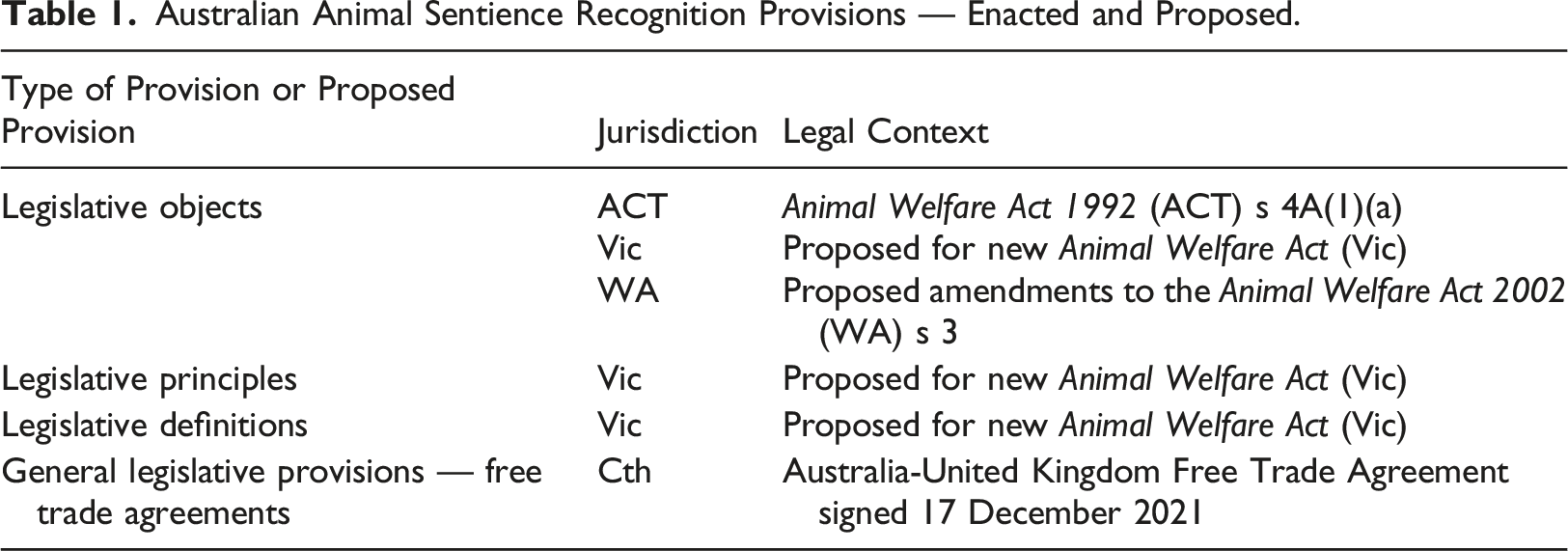
This part of the paper will look at each of these ‘types’ in turn. It will consider the context of each type of provision and propose some possible interpretive consequences.
B Legislative Objects
The most common means of recognising, or planning to recognise, animal sentience in law in Australia is to include a statement to that effect in the objects section of the relevant jurisdiction’s animal welfare legislation. In general, animal welfare legislation operates to promote animal welfare and criminalise human conduct towards animals.
138
An example of this type of sentience recognition provision can be seen in the ACT, in s 4A(1) of the Animal Welfare Act 1992 (ACT). Titled ‘Objects of Act’, the section includes the following statement: (1) The main objects of this Act are to recognise that — (a) animals are sentient beings that are able to subjectively feel and perceive the world around them.
While Victoria has not yet released a draft of its proposed legislation, it is likely to include a similar provision. This has been foreshadowed in Victoria’s New Animal Care and Protection Laws Plan, 139 and the Engagement Summary Report which indicated that 60 per cent of survey respondents supported recognition of animal sentience in the new Act. 140 Of these respondents, 18 per cent supported recognition via a combination of statements in the objects, principles and definitions of the legislation, while 13 per cent supported recognition in the objects, 12 per cent of supported recognition in the principles and 17 per cent favoured recognition in the definitions. 141 The Northern Territory also recently reviewed its animal welfare legislation. 142 While they were ultimately unsuccessful, multiple submissions were made in favour of legally recognising animal sentience in the objects of the legislation. 143
Objects sections are commonly, and increasingly, found in Australian legislation. 144 Since 1985, they have been included as the first section of each Victorian Act. 145 They are also common in other Australian jurisdictions. 146 An objects section sets out the objects or purposes that the legislation is designed to achieve. 147 Objects sections are an important part of legislation because they are used by judges, lawyers, decision-makers and other people who need to deal with the law in some way to interpret the meaning of legislative provisions. This function is particularly important where legislative provisions are unclear or where they have more than one potential meaning.
When establishing the meaning of a legislative provision, the court will consider the wording of the provision, as well as its context and purpose. This is explained in more detail by Kiefel CJ, Nettle and Gordon JJ as follows: The starting point for the ascertainment of the meaning of a statutory provision is the text of the statute whilst, at the same time, regard is had to its context and purpose. Context should be regarded at this first stage and not at some later stage and it should be regarded in its widest sense. This is not to deny the importance of the natural and ordinary meaning of a word, namely how it is ordinarily understood in discourse, to the process of construction. Considerations of context and purpose simply recognise that, understood in its statutory, historical or other context, some other meaning of a word may be suggested, and so too, if its ordinary meaning is not consistent with the statutory purpose, that meaning must be rejected.
148
Thus, a court will look at the language in its context. If the meaning of the language is clear and is congruent with the purpose of the legislation, then the statement of purpose is not likely to play a significant role in interpretation. However, if there is some uncertainty or ambiguity in the meaning of the provision, the court may have regard to an objects clause to determine the meaning. 149 This may be the case where imprecise words like ‘reasonable’ or ‘satisfactory’ are used. 150
Placing a statement recognising animal sentience in an objects provision will likely have implications for how various provisions in the legislation are interpreted. Animal welfare legislation often includes a general, arguably vague, prohibition on cruelty to animals. For example, s 6A of the Animal Welfare Act 1992 (ACT) defines cruelty. Pursuant to this section, cruelty includes ‘doing, or not doing, something to an animal that causes, or is likely to cause, injury, pain, stress or death to the animal that is unjustifiable, unnecessary or unreasonable in the circumstances’. 151 Similarly, the Prevention of Cruelty to Animals Act 1986 (Vic) uses the tests of reasonableness and necessity to determine whether particular acts in relation to animals are cruel. 152 The Animal Welfare Act 2002 (WA) also uses tests of unnecessary harm to define cruelty to animals. 153 What constitutes justifiable, necessary or reasonable harm to an animal is unclear. A court seeking to interpret such a provision would likely refer to the objects of the legislation, including any recognition of animal sentience.
C Legislative Principles
Another way that animal sentience may be recognised in Australian law is as a principle underpinning animal welfare legislation. The Victorian Directions Paper included a proposal to acknowledge animal sentience in the Principles of the Act, 154 although its Animal Care and Protection Laws Plan indicates that sentience will underpin the principles. 155 As noted above, the Engagement Summary Report related broad support for recognition of animal sentience in the new Act, including in the principles.
Some legislation, particularly more contemporary legislation, includes a section containing principles. These principles are intended to indicate to decision-makers the standards that should be considered when understanding or implementing the legislation. 156 For example, s 4 of the Prevention of Family Violence Act 2018 (Vic) contains ‘guiding principles’ and states that ‘[i]t is the intention of Parliament that a function, duty or program under this Act be carried out in a way that is consistent with the following principles’. 157 These provisions form part of the Act and will be interpreted in accordance with the general rules of statutory interpretation. In particular, ‘a construction that would promote the purpose or object underlying the Act … shall be preferred to a construction that would not promote that purpose or object’. 158
Interestingly, the Victorian Prevention of Cruelty to Animals Act 1986 does not currently contain a set of guiding principles. If one was included in a new Victorian Animal Welfare Act, its primary impact would be on decision-makers that carry out the functions and duties under the Act. This is likely to include members of the Royal Society for the Protection and Care of Animals (‘RSPCA’) (Victoria), 159 veterinary practitioners, 160 police officers, 161 employees of the Victorian Department of Environment and Primary Industries, 162 courts, 163 the relevant Minister 164 and the Governor in Council. 165
D Legislative Definitions
The Victorian Directions paper also foreshadowed the possibility of recognising animal sentience as part of the definition of animals covered by the legislation. 166 While the wording of such a provision was not identified, examples may be drawn from international jurisdictions. For example, the Swiss Animal Welfare Act 2005 defines animals as vertebrates and empowers the Federal Council to expand this definition. 167 When considering possible expansion, the Federal Council ‘is guided by scientific knowledge on the sensitivity of invertebrate animals’. 168 Sensitivity here may be read as a proxy for sentience. 169 In terms of the Victorian proposal, as noted above, the Engagement Summary Report indicated strong support for recognition of sentience in this manner.
The Definitions section in legislation assists people to understand what legislative provisions mean. 170 It is generally located as the first or second article or section in the statute. 171 Somewhat like Objects provisions, Definitions provisions operate as a device to help people understand the meaning of potentially ambiguous or uncertain legislative terms. 172 Unlike Objects provisions, however, Definitions provisions are not influential but rather determinative in legislative interpretation. 173 Definitions provisions are also helpful for Parliaments, in that they obviate the need to draft lengthy legislation. 174 In drafting Definitions, legislators seek to use clear language in order to avoid any ambiguity. 175
Defining the animals covered by animal welfare legislation by reference to the concept of sentience expressly makes sentience a prerequisite to legislative protection. In other words, to be legally protected, animals must be sentient. This will raise some questions in terms of what level of scientific certainty is required for an animal to be considered sentient, who gets the ultimate say in this respect, and whether a precautionary principle should be adopted in relation to animals whose sentience is unclear.
E General Legislative Provisions — Free Trade Agreements
The A-UKFTA was signed on 17 December 2021 and was tabled in the Australian Parliament on 8 February 2022. The Agreement will be considered by the Joint Standing Committee on Treaties, which will consult with the public in relation to the Treaty content. 176 It is expected that the A-UKFTA will come into force during 2022. 177 The Agreement is structured by way of a Preamble and Chapters. Chapter 25 is titled ‘Animal Welfare and Antimicrobial Resistance’. Article 25.1 provides that, ‘[t]he Parties recognise that animals are sentient beings. They also recognise the connection between improved welfare of farmed animals and sustainable food production systems’. 178
Articles within free trade agreements set out the substantive content to which the parties have agreed. In this sense, a free trade agreement is somewhat analogous to a private contract. However, unlike a private contract, a free trade agreement is a type of international treaty, and thus, international law interpretive principles will apply. These principles are found in Articles 31 and 32 of the Vienna Convention on the Law of Treaties (1969). 179 In general, this requires that the treaty be ‘interpreted in good faith in accordance with the ordinary meaning to be given to the terms of the treaty in their context and in the light of its object and purpose’. 180
It is unclear what, if any, impact this provision might have in Australia. This is the first time that a free trade agreement involving Australia has included such a provision and the first time one has included a Chapter on animal welfare. The most likely impact will be in political terms, in that the federal government may come under pressure from the UK government to improve its animal welfare standards.
IV Reflection on Australian Animal Sentience Recognition Provisions
A Using Sentience as a ‘Gateway’ to Legal Protections for Animals
The most common place in which animal sentience is recognised is in animal welfare legislation. In this respect, sentience is often asserted to be the reason that animal welfare matters. 181 Indeed, if animals did not enjoy their own subjective experiences, it is difficult to imagine humans arguing for prohibitions against cruelty. Nevertheless, it is worthwhile considering the implications of using animal sentience as a ‘gateway’ to animal welfare protection. 182 A key benefit of using animal sentience in this way is that it provides an objective baseline from which to judge the responsibilities that humans have towards animals. Using animal sentience as a criterion reduces the arbitrariness and inconsistency that would result from using no criteria or from using less satisfactory criteria such as looks, utility or emotional closeness to humans. 183 Further, recognising animal sentience may imply that animals should be protected because they have intrinsic value, rather than because of their perceived value to humans. This is often stated expressly in legislation. For example, the ACT Animal Welfare Act 1992 recognises that animals have ‘intrinsic value’. 184
While animal sentience provides a useful criterion to judge which animals require legal protection, it is not beyond criticism. First, although legislation might recognise animals as sentient, it does not always follow that all sentient animals are protected by law. Rather, many sentient animals are frequently excluded from protection. 185 Second, while sentience is the foundation for granting legal protection, protections are not generally commensurate to the level of animal sentience. 186 For example, while calf-roping is legal in all states except the ACT, 187 if the same actions were performed in relation to a dog, it would constitute animal cruelty under animal welfare legislation. This is despite animal welfare science indicating that both dogs and cows are sentient and able to experience negative emotions like stress, anxiety and pain. 188 Third, scientists that produce the science that animal sentience categorisation relies on may suffer from biases against animals that undermine their research. 189 Further, legislators need to make decisions about whether to grant legal protections to animals where there has been insufficient research undertaken in relation to sentience. In this respect, the recently published ‘Review of the Evidence of Sentience in Cephalopod Molluscs and Decapod Crustaceans’ found that where animals did not satisfy particular criteria for sentience, it was ‘invariably because of a lack of positive evidence, rather than because of clear evidence that the animals fail the criterion’. 190
B Exclusion of Sentient Animals from Legal Protection
Animal sentience recognition provisions recognise that animals are sentient; that they have their own subjective experiences of the world and can have both positive and negative feelings and experiences. A glaring inconsistency in Australian animal welfare legislation that recognises (or will recognise) animal sentience is that most sentient animals are excluded from the protections afforded by the relevant legislation. For example, the ACT Animal Welfare Act 1992 recognises that ‘animals are sentient beings that are able to subjectively feel and perceive the world around them; and … have intrinsic value and deserve to be treated with compassion and have a quality of life that reflects their intrinsic value’. 191 However, where conduct towards an animal that might be considered cruel accords with a code of practice, most of the anti-cruelty provisions in the Act do not apply. 192
Codes of practice in all Australian jurisdictions address the use of animals in common contexts including intensive animal farming, scientific research involving animals and control and culling of animals. 193 The standards set out in codes of practice, however, are not necessarily protective of animal welfare. 194 For example, the ‘Model Code of Practice for the Welfare of Animals — The Sheep’, which was adopted as a code of practice by the ACT, 195 permits the mulesing of sheep less than 6 months old without pain relief. 196 Similarly, the Australian Animal Welfare Standards and Guidelines for Sheep, which will be implemented in the ACT as a code of practice under the Animal Welfare Act 1992, 197 permits the mulesing of sheep, which may be done without pain relief where the sheep is less than 6 months old. 198 Mulesing involves the surgical removal of skin from the tail area of the sheep, in order to reduce the risk of flystrike and causes pain and stress to sheep. 199 Even when conducted with pain relief, mulesing is not painless and still involves suffering and stress for the sheep. 200 The RSPCA recommends that pain relief should be mandatory for sheep undergoing mulesing and that the wool industry should transition to breeds of sheep that are less prone to flystrike. 201 It could therefore be argued that mulesing sheep without pain relief is cruel, or that continuing to breed and mules sheep that are more susceptible to flystrike is cruel. Even though mulesing might be considered unjustifiable, unnecessary or unreasonable and thus cruel, 202 however, it will not breach the anticruelty provision set out in section 7 if undertaken in accordance with the relevant ACT Code.
Codes of practice are intended to assist people that work with animals to understand what practices are legally acceptable. 203 While this objective is understandable, codes of practice are developed by representatives of state and territory government departments and industry bodies. 204 Government departments that are charged with responsibility for animal welfare are also responsible for growing the agricultural sector, creating an inherent conflict of interest for them. 205 Further, representatives of industry bodies profit from the commercial use of farmed animals and hence are also subject to a conflict of interest. While the development of the Australian Animal Welfare Standards and Guidelines has involved consultation with animal welfare representatives and members of the public, 206 it is unclear the extent to which animal welfare concerns are able to override human interests in efficient and profitable animal farming. In this respect, a Productivity Commission report asserted that ‘the standard setting process does not adequately value the benefits of animal welfare to the community’ and that ‘[t]here is scope for … science and (soundly elicited) community values to play a more prominent role’ in the process. 207 As it stands, the codes of practice essentially legalise ‘institutionalised cruelty to millions of animals’ each year in Australia. 208
V Conclusion
Australian jurisdictions appear to be following the international legal trend of recognising animal sentience in the law. This may be perceived as a positive development for Australian animal welfare law because it clarifies the purpose of animal welfare legislation, which should assist stakeholders in carrying out their obligations under the legislation and courts in interpreting legislative provisions. 209 This article has presented a typology of animal sentience recognition statements that have been passed or proposed in Australian law. This provides a detailed understanding of the various ways that animal sentience has been, or will be, recognised in Australian law, with a view to appreciating the differing purposes, contexts and consequences of various provisions.
In Australia, four different types of animal sentience recognition statements have been identified. While the impact of such statements will depend on the way that they are framed, some broad conclusions can be drawn. First and most commonly, animal sentience is recognised in the objects of animal welfare legislation. This will provide helpful guidance for those seeking to interpret animal welfare legislation. Second, animal sentience is proposed to be recognised as a principle of animal welfare legislation. This would influence the actions of stakeholders undertaking obligations under the legislation. Third, animal sentience is proposed to be recognised as part of the definition of animals covered by animal welfare legislation. This would expressly make sentience the gateway for animals to receive legal protection. Finally, animal sentience is recognised in the A-UKFTA, the consequences of which are likely to be largely political.
Perhaps the most interesting aspect of animal sentience recognition is what it may herald for the future regulation of human-animal relationships. If we recognise that animals have their own subjective experiences of the world that matter to them, will we continue to categorise animals as legal property, or might the law find or develop a more appropriate legal category? Animals as sentient beings clearly have interests, so does that mean that the law will develop to allow animals to have legal standing to protect their interests? Could animal sentience provisions be construed in the future to imply that states should encourage people not to eat animals? How might sentience recognition provisions be used to create further changes in public values and culture, to benefit both animals and combat climate change, to which animal agriculture is a significant contributor? Many similar questions arise. Animal sentience recognition alone may bring positive benefits for animals; it may also signal further positive legal developments for animals in the future.
ORCID iD
Jane Kotzmann https://orcid.org/0000-0003-1834-5480