



Abstract
Installing reliable, affordable electricity in a Malawian hospital, through overhauling its solar and overall electrical system in response to extremely poor grid electricity, has resulted in reduced bills and reduced damage to electrical equipment, and saved money for patient care. In 2024, we reported results of this upgraded system after a year of operation from July 2022 to July 2023. In January 2024, we installed 17 more 100Ah lithium-ion batteries, and results from February 2024 to February 2025 showed significant savings. We make recommendations for other hospitals.
Update
Mulanje Mission Hospital in Malawi operates in an environment of extremely poor grid electricity, generally poor electrical workmanship and poor availability of electrical parts. By 2021, its solar power system was not delivering the operational effectiveness that it should, resulting in detrimental impacts on patient care, caused by high expenditure on electricity and diesel bills (the latter for a back-up generator), frequent power cuts and damage to electrical equipment.
Through overhauling the hospital's solar and overall electrical system from January to June 2022, and installing more reliable solar power for good quality, affordable electricity, we sought to improve patient care, reduce damage to electrical equipment and reduce electricity bills, thereby leaving more scarce hospital funds for patient care.
We reported on a year's results between July 2022 and July 2023 1 that electricity bills fell 61%, saving US$1585/month; use of diesel for the generator was minimal; electrical equipment was rarely damaged; water pumped from the borehole was in continuous supply; the hospital had night battery-powered solar power; and the system is easily operated by a phone app.
In January 2024, with electricity prices having risen again, and the Malawian kwacha in turmoil, we added 17 s100Ah lithium-ion batteries, at a cost of US$24,232 (plus labour and project management). Having used these batteries for over a year, we see yet more savings, namely annual savings of US$24,369, because consumption of grid electricity was 17% of that of the previous 3 years.
In this third year analysed, since the installation of 17 extra batteries, hospital electricity bills reduced against baseline by almost US$24,400, assuming baseline consumption would have continued at the current cost of electricity. This is over US$2000 saved per month – a significant saving.
Table 1 shows savings in 12 months from February 2024 to February 2025. The cost of electricity in Malawi kwacha had increased by 70% compared to between July 2022 and July 2023, but had decreased slightly in US$ due to the continuing devaluation of the Malawi Kwacha against the US$.
Updated grid electricity consumption and cost savings over two years at Mulanje Mission Hospital.
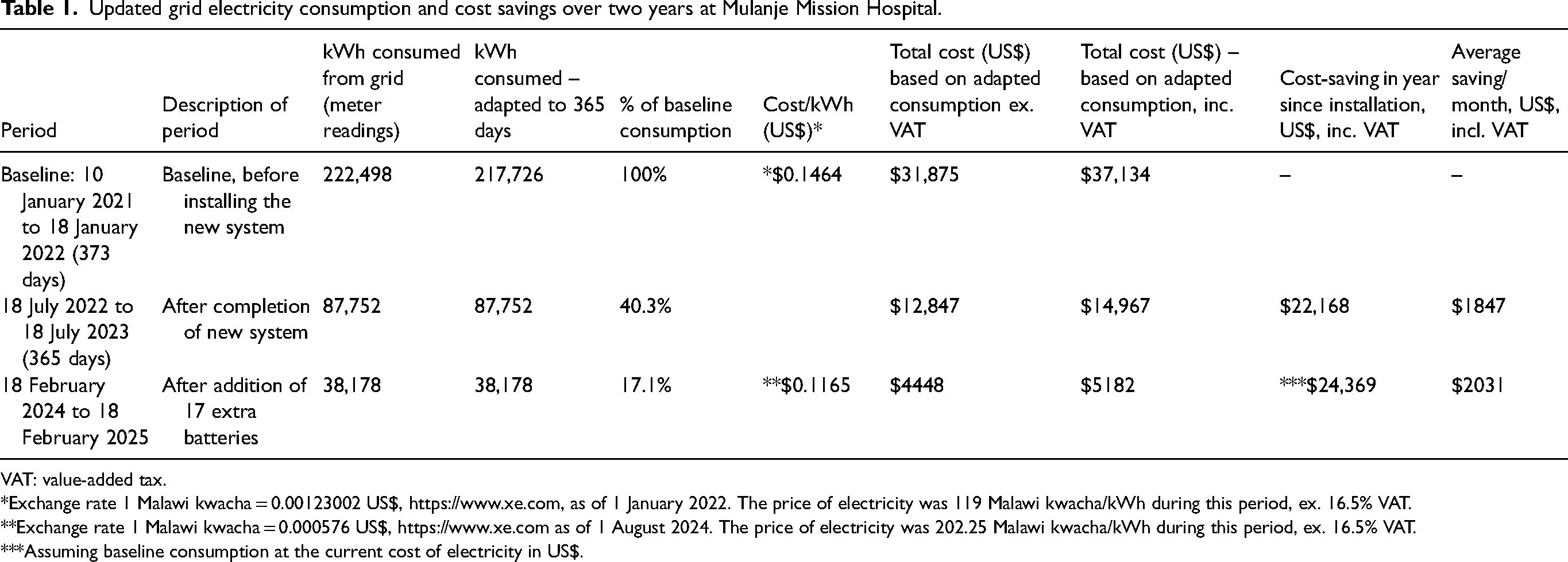
VAT: value-added tax.
*Exchange rate 1 Malawi kwacha = 0.00123002 US$, https://www.xe.com, as of 1 January 2022. The price of electricity was 119 Malawi kwacha/kWh during this period, ex. 16.5% VAT.
**Exchange rate 1 Malawi kwacha = 0.000576 US$, https://www.xe.com as of 1 August 2024. The price of electricity was 202.25 Malawi kwacha/kWh during this period, ex. 16.5% VAT.
***Assuming baseline consumption at the current cost of electricity in US$.
Discussion
Some foreign donors wish to fund solar power to mitigate climate change, but many hospital managers want solar power to reduce grid electricity and diesel bills, reduce damage to electrical equipment, and so increase or maintain funds available for patient care. Meanwhile, hospital clinicians are most concerned to ensure a constant sufficient electrical supply for patient care. In addition, all parties see the value of solar power for its contribution to the resilience of a hospital during increasingly frequent severe weather events caused by climate change. Indeed, Mulanje Mission Hospital experienced this relative independence from the grid during Storm Freddy in 2023, when the hospital kept operating fully, on its upgraded solar power system, until grid power was restored.
While Mulanje Mission Hospital management and its overseas partners had assumed that the solar power system installed previously must be delivering sufficient benefits, by 2021, expert advice was that they needed to assess and redesign the hospital's electrical system, which had been added piecemeal over the years, resulting in a somewhat incoherent and possibly unsafe electrical system.
The decision taken to assess and upgrade the system was vindicated by the savings outlined, and the inclusion of the 17 100Ah lithium-ion batteries proved their worth. This supports the design chosen, in which the entire hospital electrical system is integrated with the solar power supply, rather than adding solar power for emergency back-up, which is a common choice but is unlikely to lead to significant savings.
Conclusion
A phenomenal reduction of usage of an increasingly unreliable and expensive electrical grid, from upgrading an inefficient solar power system, results in significant financial savings.
Our resounding recommendation is that, particularly in an environment of volatile electricity prices and increasing grid unreliability, hospitals should examine their solar power systems, incorporate appropriate batteries into the solar power design from the start, and fundraise or invest accordingly.
This two-stage upgrade cost US$300,000 for a 250-bed hospital in Malawi, which would pay for itself in 12 years on electricity bill savings alone, and would pay for itself in fewer years if reduced costs of repair and replacement of electrical equipment are included.
While the addition of batteries was only 12% of the overall cost, the batteries reduced grid electricity usage from 40% to 17% of pre-improvement usage. All financial savings have the potential to improve patient care.
Footnotes
Declaration of conflicting interests
The authors declared no potential conflicts of interest with respect to the research, authorship, and/or publication of this article.
Funding
The authors received no financial support for the research, authorship, and/or publication of this article.
