




Abstract

Introduction: A skin rash in a pre-term baby may just be a heat rash!
A preterm neonate developed a skin rash while on prolonged kangaroo care during the third week of admission. This female infant was born by normal vaginal delivery at 34 weeks and weighed 1.4 kg (< third centile; small for dates) and was fed by breast milk. Her initial stay in neonatal intensive care was uneventful, as she had consistent weight gain. She was therefore followed up on the ward, where a practice of prolonged kangaroo care was encouraged. On the fourth day there, she developed a pyrexia of 37.8 °C. A polymorphic rash was noted with widespread maculopapular eruption over the neck, chest and upper abdomen, and a few vesicles over the chest containing clear fluid, with erythematous macules also found on the back and acral parts (Fig. 1 and Supplemental Figures).
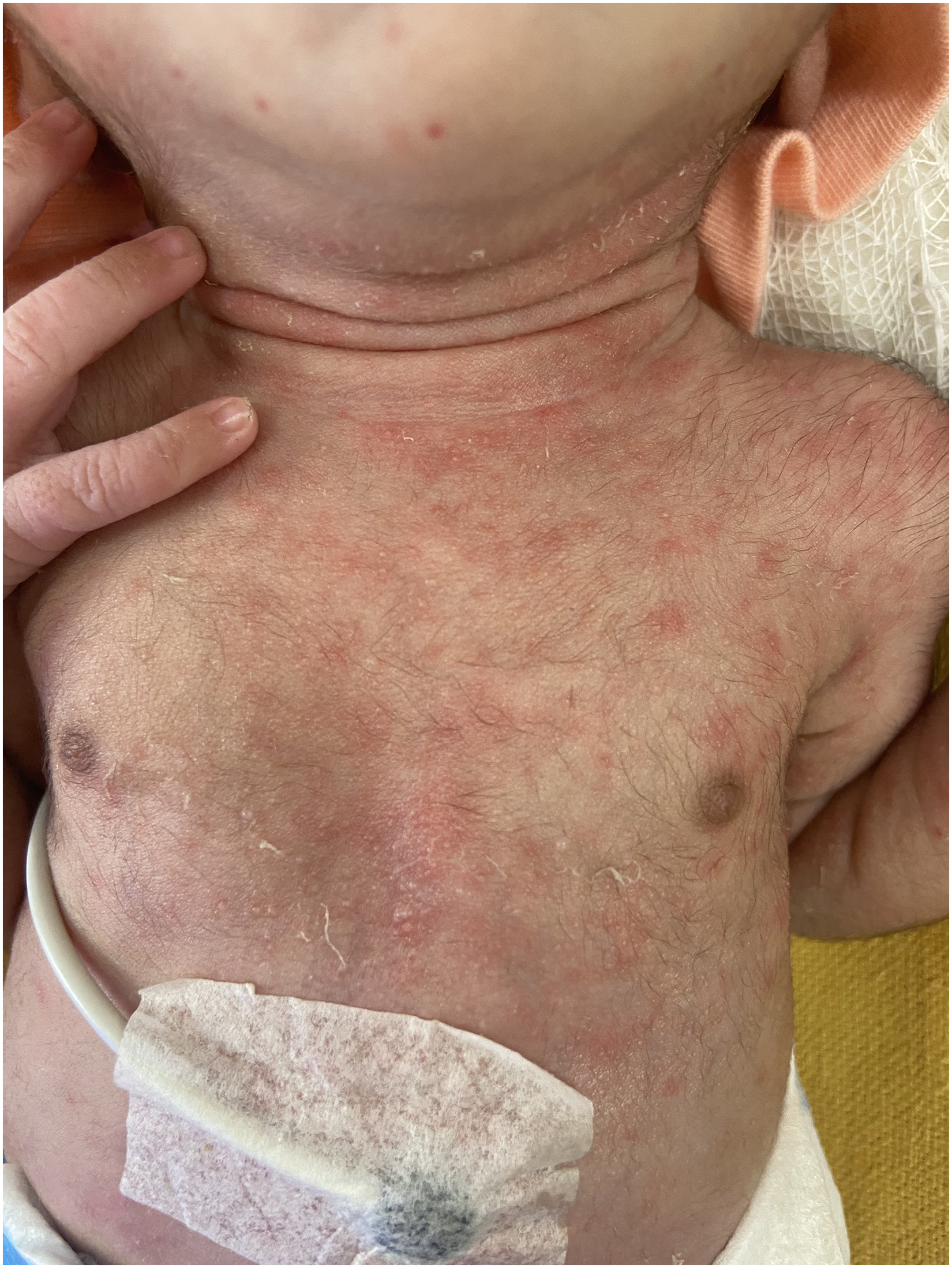
Illustrates polymorphic rashes in the preterm infant, including erythematous macules, papules and occasional vesicles in a preterm infant. Erythema is inconsistently present around the papular eruptions.
The papules were small, grain-sized. Such eruptions in excessively warm environs are typical of miliaria rubra or heat rash with a concomitant presence of miliaria crystallina. 1 The lesions resolved promptly and spontaneously.
A punch biopsy showed epidermal vesicles in communication with eccrine ducts and epidermal inflammatory changes, thus excluding erythema toxicum, a common dermatological eruption in neonates. Other differential diagnoses considered to be considered are cutaneous candida, varicella zoster, neonatal acne, folliculitis or febrile eruptions; however, these differ in appearance and course. Miliaria rubra is a clinical diagnosis, and no further work-up is required; a biopsy is not usually required if there are no ominous signs of infection or other underlying illness.2,3
Prolonged kangaroo care in a preterm infant rarely results in hyperthermia. However, the additional warmth of tropical heat in the summer months might have led to excessive warmth in the infant. The visual appearance of the rashes may be alarming to an inexperienced paediatrician.
Supplemental Material
sj-docx-1-tdo-10.1177_00494755231201194 - Supplemental material for Erythematous papules in a preterm infant
Supplemental material, sj-docx-1-tdo-10.1177_00494755231201194 for Erythematous papules in a preterm infant by Chetan Khare and Deepika Rustogi in Tropical Doctor
Footnotes
Declaration of conflicting interests
The author(s) declared no potential conflicts of interest with respect to the research, authorship, and/or publication of this article.
Funding
The author(s) received no financial support for the research, authorship, and/or publication of this article.
Informed consent
Written informed consent for publication of the image and clinical details was obtained from the parents.

Supplemental material
Supplemental material for this article is available online.
References
Supplementary Material
Please find the following supplemental material available below.
For Open Access articles published under a Creative Commons License, all supplemental material carries the same license as the article it is associated with.
For non-Open Access articles published, all supplemental material carries a non-exclusive license, and permission requests for re-use of supplemental material or any part of supplemental material shall be sent directly to the copyright owner as specified in the copyright notice associated with the article.
