



Abstract
Extant work has identified two discursive forms of racism: overt and covert. While both forms have received attention in scholarly work, research on covert racism has been limited. Its subtle and context-specific nature has made it difficult to systematically identify covert racism in text, especially in large corpora. In this article, we first propose a theoretically driven and generalizable process to identify and classify covert and overt racism in text. This process allows researchers to construct coding schemes and build labeled datasets. We use the resulting dataset to train XLM-RoBERTa, a cross-lingual large language model (LLM) for supervised classification with a cutting-edge contextual understanding of text. We show that XLM-R and XLM-R-Racismo, our pretrained model, outperform other state-of-the-art approaches in classifying racism in large corpora. We illustrate our approach using a corpus of tweets relating to the Ecuadorian indígena community between 2018 and 2021.
Introduction
Scholars theorizing about the different discursive forms taken by racism have identified two clear patterns: overt and covert racism (Bonilla-Silva 2006; Coates 2011; Van Dijk 2005). While overt racism refers to direct attacks using language openly acknowledged as derogatory (e.g., slurs), covert racism can be described as “subtle, and subversive institutional or societal practices, policies, and norms utilized to mask the structural racial apparatus” (Coates 2008: 212). As its name suggests, covert racism has a hidden nature that has brought scholars to focus on the social practices that embody it rather than on its discursive forms (Chin 2015; Coates 2008, 2011; Hampton 2010; Holdaway and O’neill 2007; Levchak 2018; Marom 2019; Walsh 2004).
Researchers have emphasized the performative nature of covert racism, highlighting the importance of context to identify these practices. Covert racism is a style of discrimination that is hard to detect and even harder to label. It entails the use of language, rhetorical strategies, and “semantic moves” aimed at avoiding explicit racial conversations and racist language (Bobo et al. 1997; Bonilla-Silva 2015; Essed 1991). Thus, to understand these practices as racist, as well as their discursive manifestations, we need an understanding of the historical and sociological processes underpinning the racist ideology embedded into the social structures of the place of study. Given the complexity of identifying covert racism in general, most scholars focus on racist practices rather than on racist discourse. Extant research on covert racism addresses mainly anecdotal observations of these practices (Holdaway and O’neill 2007; Levchak 2018) or interviews (Bonilla-Silva 2002; Marom 2019; Shoshana 2016), rather than on other sources of abundant information, such as large corpora.
In this article, we address two gaps in this literature. First is the paucity of research on covert racism in discourse. Second is the limitations found in current computational tools to systematically identify overt and covert racist content in text, especially in large corpora. To address the first gap, we propose a generalizable step-by-step process to identify and classify covert and overt racist discourse. The process explicitly integrates contextual knowledge into the development of lexical rules to categorize speech acts. Taking the Ecuadorian case as an example, we first identify covert and overt racist practices based on existing literature. We then transform the narrative of these practices into lexical rules to classify discourse. Covert racist discourse is pervasive but requires an understanding of the context in which it is produced and reproduced. In particular, it is necessary to include an understanding of the historical constructions of hierarchies produced by racist ideologies and the forms of domination that are manifested in social settings (including language). Constructing rules to identify racist discourse using this context allowed us to detect in the text the (covertly) racist practices described by scholars. We use these rules to manually label a dataset to train a supervised machine learning model.
Second, work on hate speech detection has highlighted how models trained to detect hate speech, including implicit hate speech, fail to generalize to other corpora (Kim et al. 2022, 2023), as well as the lack of clear definitions for concepts like “implicit and explicit hate speech” (Ocampo et al. 2023). We address this limitation from the computational approaches, not by proposing a generalizable model, but rather by proposing a generalizable approach, that acknowledges the context-dependent nature of racist language, and how to take this into account when constructing the training sets and further pre-training Transformer-based models. To this end, we apply a natural language processing (NLP) technique for contextual understanding of text to classify covert and overt racism. While conventional NLP techniques are unable to fully understand contextual cues from text, 1 Transformer-based large language models (e.g., RoBERTa) have greatly improved contextual understanding of text (see Timoneda and Vallejo Vera 2025a). In this article, we further pretrain and fine-tune a Transformer-based cross-lingual large language model (LLM), XLM-RoBERTa (XLM-R), to detect overt and covert racism in Spanish. We place special emphasis on building a theoretically grounded training set and further pre-training the XLM-R model with 1.7 million tweets that include racist language specific to the Ecuadorian context. We then compare XLM-R performance with three sets of widely used machine learning and deep learning approaches. First are traditional machine learning models such as Support Vector Machines (SVM) and logistic regression. Second are two neural networks, one convolutional (CNN) and one recurrent (Bi-LSTM), which we pair with two sets of word embeddings. Third, we test the performance of two generative LLMs, OpenAI’s GPT-4o and Meta’s Llama-3.3-70B, using few-shot learning. We find that our models significantly outperform these alternative approaches in our annotation task.
The remainder of the article is organized as follows. In Section “Covert and Overt Racism,” we give an overview of the literature focusing on overt and covert racism. We concentrate on research that studies the discursive manifestation of overt and covert racism. In the following section, we introduce our step-by-step process and detail the steps taken to define the coding rules for the training data (using Ecuador as an example). In Section “Training an XLM-R Model to Detect Overt and Covert Racism,” we discuss the limitations of non-contextual machine learning approaches to classifying racist content, and how these can be solved by context-rich models such as RoBERTa. We then apply our lexical rules to label a training set (of tweets), and train a RoBERTa-based LLM model to categorize a large corpus (2M+ tweets). In Section “Covert and Overt Racism in Ecuadorian Twitter,” we show the prevalence and activation of covert and overt racism in the Ecuadorian Twitter network during the 2019 indígena protests. We conclude this research by addressing the limitations of our approach and possible extensions.
Covert and Overt Racism
Although we are particularly interested in discursive manifestations of racism, doing so requires first engaging, though briefly, with a general understanding of racism writ large, as well as non-discursive manifestations of racism. Scholars have conceptualized and understood racism differently, often as a complex and evolving notion. Common to many authors is the idea of racism as a system of racial domination sustained by racial domination projects (Bonilla-Silva 2001; Van Dijk 2009). These projects create races out of people who were not so before: European peoples becoming White (Painter 2010), African peoples becoming Black (Wright 2004), and peoples of the Americas becoming Indios (Bonfil Batalla 1977). Racism is a combination of practices and behaviors that produce and reproduce racial structures and define social relations among newly created races leading to economic, political, and, overall, material consequences (Bonilla-Silva 2015).
Racism is manifested in different forms: marginalization, discrimination, exclusion, and violence, among other social practices that go beyond discourse. These practices are the product of domination—power of one group over another—and result in distinct social inequalities (Van Dijk 2009). The structural and systemic dimension of racism means that its manifestations are at the individual (Henry and Sears 2002; Kinder and Sears 1981) and institutional level (Bridges 2019). For the former, through discriminatory practices and individual expression; for the latter, through institutions—for example, public policy, laws, and access to political spaces (Ahmed 2012). Broadly, racist discourse reflects how people communicate these practices and how they view “power relations, normative frameworks, and the combination of symbolic and material reality” (Herzog and Lance Porfillio 2022); racist discourse is directly involved in the reproduction of the racist social structure (see Van Dijk 1993, 2005).
Covert racism operates through a process of socialization that creates distance between the dominant and the dominated group in a social structure. Covert racism creates boundaries that are assumed “natural, legitimate, and normal” (Coates 2008: 111), while perpetuating and reinforcing the racial order. It embodies a series of social practices, at the individual level—for example, shunning (Xu 2025)—and group level—for example, redlining (Lynch et al. 2021)—, informal—for example, racial profiling (Glover 2009)—and formal—for example, benign neglect (Elias 2024).
As racist practices can be both overt—for example, Jim Crow in the United States or Apartheid in South Africa—and covert—for example, racialized minorities targeted by police officers (Pierson et al. 2020)—so can racist discourse. Overt racism consists of direct attacks using language openly acknowledged as derogatory (e.g., slurs), taking an “open and blatant nature” (Coates 2011). Covert racist language, by contrast, is “hidden, secret, private, covered, disguised, insidious, or concealed” (Coates 2011), understood as a set of linguistic practices that advance racialized differentiations and stratification that rely on unspoken assumptions and expectations about the racist structure (Kroskrity 2021).
Studying the discursive forms of covert racism, as well as any form of racism, requires deep knowledge of the context in which this discourse is employed. The discursive manifestations of covert racism are largely context dependent. Racial stereotypes change from context to context as there are “differential expectations for different racial groups” (Coates 2008: 213). The importance of context lies in the fact that covert racism perpetuates a particular racist social order. 2 Its discursive form thus reflects this specific social order, which may need to be more evident to untrained (de-contextualized) eyes. 3
Still, within the contextual nature of covert racism, scholars have identified certain generalizable characteristics of this discourse. First, it reproduces racial stereotypes with slightly sanitized terms (Shoshana 2016). For example, the representations of Asian-Americans as “nerds” within the United States. The terms are innocent enough to make racial elites able to participate in such practices (Coates 2008: 222). Second, covert racism relies on racial codes, that is, “words, phrases and/or ideas that may camouflage its true racist intent or purpose” (Chin 2015; Coates 2011; Hill 1995). These codes are often presented (and represented) by local authority figures that use the language to perpetuate the practices of domination (Bonilla-Silva 2002; Coates 2011; Levchak 2018). Third, covert racism is presented under a political correctness and “politeness” façade (Bonilla-Silva 2002; Coates 2011). As Bonilla-Silva (2002) argues, this form of covert racism (defined by the author as “color-blind racism”) is presented in a slippery and ambivalent form. In some cases, speakers preface racist statements with different forms of disclosure of non-racism (“I am not a racist…,” “I have [racial identity] friends…”) or clarify that the topic pertains to anything but race. Alternatively, speakers take both sides (the non-racist and racist sides), or aim to soften racist statements with diminutives (Bonilla-Silva 2002). The discursive ambivalence, and the semantic moves employed, can take different shapes under different contexts.
Fourth, covert racism discourse often takes the form of light talk—a hybrid between private sphere and public sphere statements (Hill 1995). These discursive forms presented as light talk hide racist content behind a veneer of playfulness (Levchak 2018). For example, the use of Spanish words in English language statements with ambivalent meanings, for example, “adios” or “hasta la vista,” which could mean a formal farewell or a form of expulsion (Hill 1995). Finally, covert racism can take the form of “microinvalidations.” In this case, statements negate experiences or negate race entirely. Individuals are told not to be “too sensitive” or the speaker declares herself as “not able to see race” (Bonilla-Silva 2002; Levchak 2018; Shoshana 2016; Walsh 2004).
It is important to note that this is not an exhaustive list of generalizable characteristics, but rather some characteristics regularly mentioned across cases. Beyond the five enumerated above, there are many characteristics of covert linguistic racism that are common in some contexts but not in others. For example, ventriloquism (which we explain in detail below), is a covert trait found in some countries in Central Africa (Murrey and Jackson 2020) and the Andes (Martínez Novo 2018), but not mentioned in other cases. Additionally, there are other types of behavior that can be used to hide the meaning of a message, among them racist messages, though not exclusively. Dog whistling, for example, is the use of coded language with the objective to signal group membership or support for an issue without having to do it openly (Albertson 2015). As covert racism, the use of dog whistling allows the speaker to present their ideas at a lower risk. Yet, while it can be associated with racist intent, it can also be used to signal support for conspiracy theories, which do not include racial content (Blackington and Cayton 2025), signal socio-economic discrimination (Kruk et al. 2024a), or use religious appeals (Albertson 2015). 4 As we stress throughout the article, contextual knowledge is paramount when developing an understanding of the (covertly) racist discourse of the case(s) analyzed.
Covert and Overt Racism in Ecuador
Ecuador serves as an interesting example of a racial structure that emerged from mestizaje and Spanish colonialism, similar to the rest of Latin America. Through this case, we exemplify how to contextualize racism to a place and time, and how we can apply our categories of interest (e.g., covert and overt racism), to this context. In their own work, researchers need to determine their target context of study—place and time—and adapt this and the next steps accordingly.
The racial structure in Ecuador is a product of the Spanish colonial domination project. The material and political inequalities began with the hacienda or huasipungo system in the late 16th century, where Indians were expected to pay tribute to the landowners in exchange for the right to use a parcel of land in the hacienda’s territory (Oberem 1985). After independence in 1822, the hacienda system, as well as the indio tribute, continued as large landholdings expanded. Only during the 1960s, with the land reform, oil boom, early industrialization, and expansion of the urban center did the hacienda system wither away (Pallares 2002). Nevertheless, the racial structure remained. Thus, the indígena population started to organize and mobilize politically. This organization took the shape of the indígena uprisings of the nineties, massive mobilizations throughout the 21st century, and the foundation and institutionalization of a political party. The indigenous population demanded and eventually conquered important political and social victories (see Pallares 2002). 5 Yet, rejection of their demands from the mestizo and blanco-mestizo population has been constant, as have racist attacks and material inequalities. 6
The state structures in Ecuador have perpetuated unequal systems dominated by a blanco-mestizo dominant ideology (Roitman and Oviedo 2017). Research on race and ethnicity in Ecuador shows that mestizaje has created a “whitening” process. Mestizaje, and also most people who identify as mestizos, downplays discrimination toward indígenas and other marginal communities while still engaging in covert racist practices (Beck et al. 2011). Unsurprisingly, covertly racist language is normalized while having different forms. Individuals and society at large cover the racist elements of their actions and discourses through rhetorical means (Traverso-Yépez 2005), which leads to variation in the manifestations of racist discourse.
Racism in Ecuador, deeply rooted in European colonialism, manifests as a “system of ethnic-racial dominance” (Van Dijk 2009), primarily impacting the indigenous population. Despite their political activism and historical gains, indigenous communities continue facing marginalization due to a state that offers minimal support and unequal political access (De la Torre 1996). In Ecuador, all institutions, classes, and contexts perpetuate a subtle yet pervasive blanco-mestizo racist ideology, often dismissed by its users as non-racist (Roitman and Oviedo 2017). This makes covert racism pervasive, which provides an ideal opportunity to test our method.
Discursive Manifestations of Racism in Ecuador
We now turn to the task of identifying covert and overt forms of racist discourse considering their historical, social, and political context in Ecuador. To do this, we surveyed the extant literature on racist practices and discursive forms specific to our case. We started by asking how racial structure manifests itself in modern-day Ecuador. As discussed above, researchers have recently focused on the indigenous population’s organization. Hence, this article builds on prior research on the social and political standing of the indigenous population in Ecuador. These works highlight that (a) diverse forms of racism, racial stereotyping, and racial discrimination are entrenched in Ecuadorian society (Beck et al. 2011), and (b) that the intersection of ethnicity, race, and class has created spaces where race is used both as a mobilizer and as a social marker (Whitten Jr 2003). Additionally, we make use of more recent work focusing solely on racist practices and discourse to ensure we cover the breadth and depth of research on the topic. Our work was to systematize and bring together their insights, applying our definitions of covert and overt racism.
For our case, we define overtly racist language as any discourse that falls within one of the following categories: (a) discourse that explicitly includes derogatory terms or phrases that have been historically used to characterize the indígena population (either as individuals or as a community) as the lesser and dominated group in Ecuadorian society; (b) insults directed toward members of the indígena community that explicitly include their identity; (c) aggressive or denigratory language that includes the word “indio”; (d) racialized phrases or idioms; and (e) violence or incitement to violence toward members of the indígena community. Additionally, we define covert racist language as any discourse that describes the actions or character of the indígena population (either as individuals or as a community) by reproducing the idea of them as the lesser and dominated group in Ecuadorian society through masked, sanitized, or de-racialized language. The codebook used is available in Appendix C in the online supplement, where we provide details and examples of each category.
Some sources referenced did not use our terminology (i.e., covert and overt racism) to describe the manifestations of racism. Nonetheless, we parsed the manifestations of racism studied by these scholars following our definitions of covert and overt racism. Overall, we identify five general manifestations of covert racism: (a) no-difference racism (Bonilla-Silva 2006) or negation of identity (Canessa 2007); (b) attacks on the capabilities of the indigenous population (Roitman and Oviedo 2017); (c) infantilization of the indígena population; (d) hygienic racism or deeming the indígena population unclean (metaphorically or literally) (Colloredo-Mansfeld 1998); and (e) ventriloquism (Guerrero 1997). 7 We provide extended descriptions for each manifestation in Appendix B in the online supplement. Since we are not interested in independently coding these different manifestations but in identifying covert racist language more broadly, we are not concerned with slight overlaps in the definitions. 8 In Appendix B in the online supplement, we also include examples of covert and overt racist language from our corpus.
Data
To build our training set, we use Twitter data covering indígena-related discourse in Ecuador. The main corpus of tweets was collected during the indigenous protests in Ecuador between October 1st and October 30th, 2019. 9 The corpus includes 2,020,487 posts (168,933 unique posts) by 91,458 unique Twitter users. A second corpus of tweets includes posts mentioning the indígena community in Ecuador between 2018 and 2021. 10 The corpus includes 1,497,369 posts (154,630 unique posts) by 66,574 unique Twitter users. This second corpus allows us to test generalizability and control for intertemporal losses in accuracy.
We used 3,724 tweets to create the training set. We sampled the corpus using three different approaches to have a more balanced training set. The first third of the training set was randomly produced from the entirety of the corpus. Another third of the training set was randomly produced from tweets that included the word “indígena” or “indio.” 11 The final third of the training set was randomly produced from tweets that contained linguistic markers (i.e., words or phrases) that are commonly associated with the indígena community, including those that directly pertain to the indigenous identity (see Table B.1). In Table 1, we provide examples from the data for each form of racist discourse previously described.
Examples of Racism in Ecuadorian Twitter.
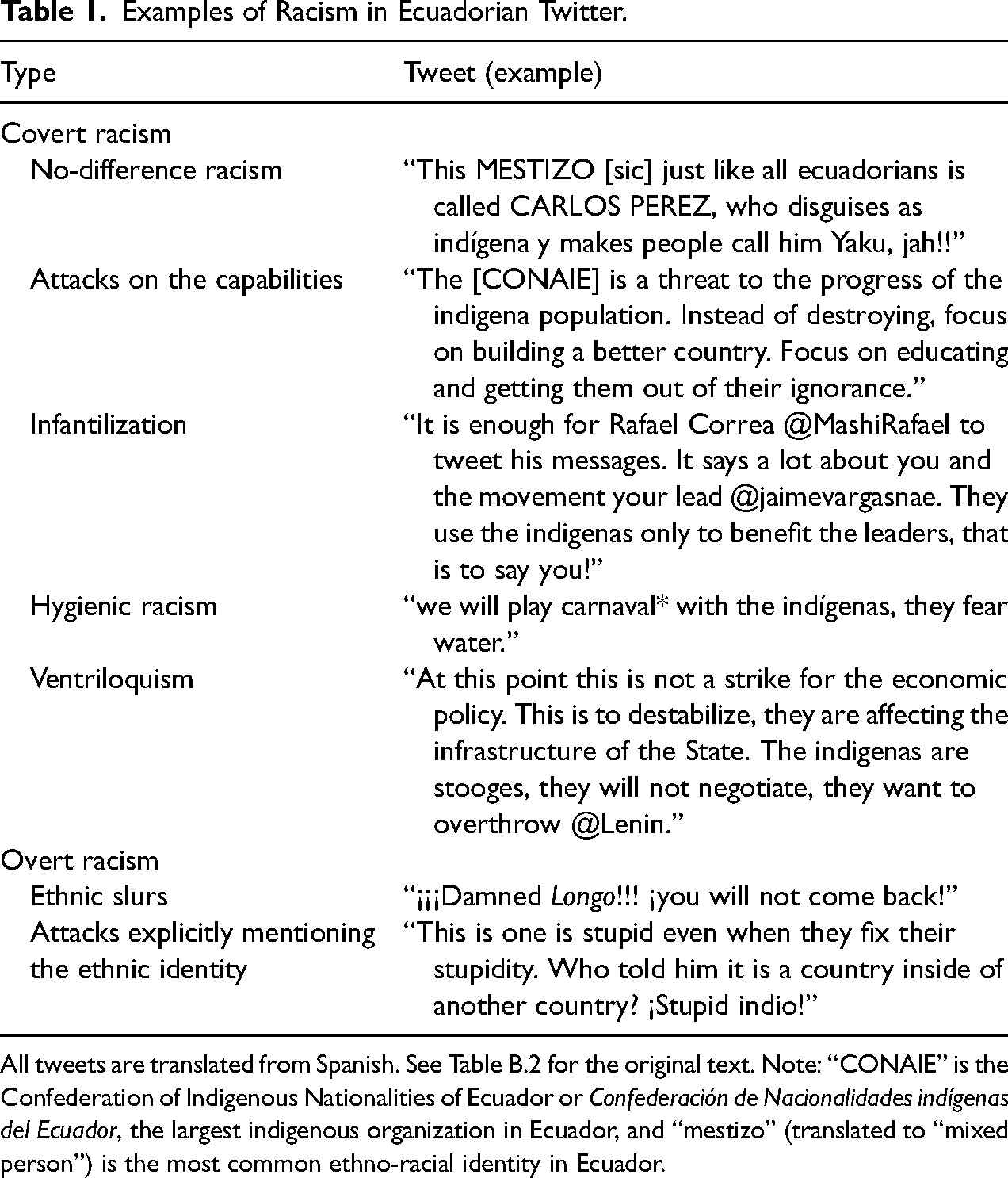
All tweets are translated from Spanish. See Table B.2 for the original text. Note: “CONAIE” is the Confederation of Indigenous Nationalities of Ecuador or Confederación de Nacionalidades indígenas del Ecuador, the largest indigenous organization in Ecuador, and “mestizo” (translated to “mixed person”) is the most common ethno-racial identity in Ecuador.
Codebook, Labeling, and Inter-Coder Reliability
The complete codebook from our example used to train coders is available in Appendix C in the online supplement. The codebook structure took the following form: (a) a general definition of covert and overt racism, (b) rules, explanation of rules, and examples of overt racism, (c) rules, explanation of rules, and examples of covert racism, (d) advice for coders to handle unclear/ambiguous text. To generalize this codebook, we encourage researchers and practitioners to maintain a similar structure: a general definition of the different forms of racism to be coded, followed by the various manifestations of those forms that coders might encounter in the training set, and advice on how to handle unclear or ambiguous text. The codebook structure allows researchers to label different forms of racist discourse while providing important details of each category that help coders have a more homogeneous understanding of each element. The final form of our codebook resulted from numerous training and discussion sessions with coders. One of the greatest difficulties we found in this process was labeling discourse that is, by nature, covert (e.g., covert racism, symbolic racism, laissez-faire racism, etc.). Thus, in Appendix C in the online supplement, we add details on training coders, lessons learned, and suggestions on tackling drawbacks found in the process.
For this particular exercise, we followed Schreier (2012) in the coding process. We trained two hired coders across three review rounds to ensure consistency and performance. The initial review round (500 tweets) allowed us to explain discrepancies and identify cases we did not initially consider. After a second review round (500 tweets), coders independently coded 2750 tweets (Cohen's kappa
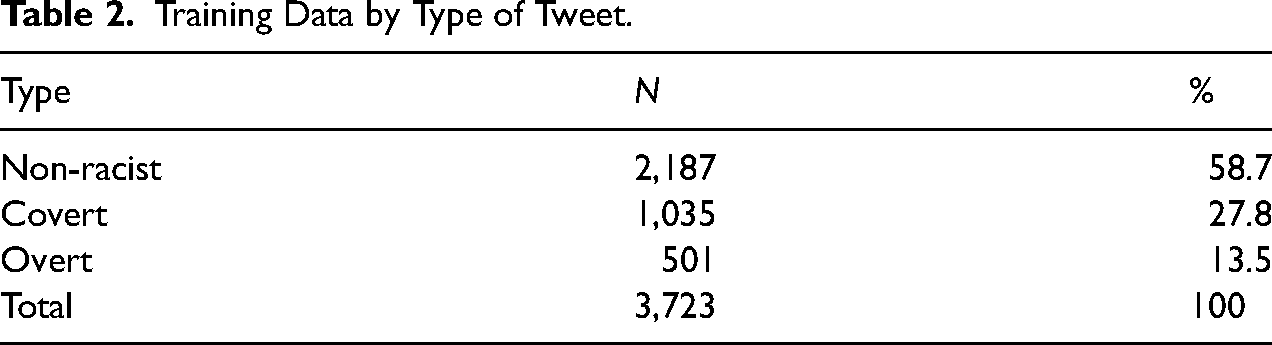
To harmonize our training set when encountering coding discrepancies, we coded tweets as covertly racist or overtly racist if both coders agreed. In Table 2, we present the distribution of categories in our training data. Notice that the data are skewed in favor of non-racist tweets, which is expected. Racism, while not uncommon, is not the main lexical form found in social media, as it is, we argue, a costly social behavior that can have real-life consequences. It is also monitored, flagged, and eliminated from most social media platforms. 12
Training Data by Type of Tweet.
An NLP Approach to Detecting Overt and Covert Racism
Once we have a theoretically-driven training set, we turn to our NLP approach to classifying overt and covert racist discourse and apply it to the Twitter corpus.
There is an expansive literature advancing the detection of explicit hate speech and racism in language (see Gambäck and Sikdar 2017; Ousidhoum et al. 2019; Schmidt and Wiegand 2017; Yoder et al. 2022). Extant work on NLP approaches for detecting implicit hate speech in large corpora have highlighted the challenges of the task, pointing to the linguistic nuances and diversity of the implicit hate class (ElSherief et al. 2021), their failure to generalize to other corpora (Kim et al. 2022, 2023), as well as the lack of clear definitions for concepts like “implicit and explicit hate speech” (Ocampo et al. 2023).
Some of the computational work to detect covert racist language in large corpora focuses primarily on improving the performance of models by modifying the models (e.g., different fine-tuning strategies, pre-training approaches) without engaging with the source data (e.g, training set) or how the model can adapt to characteristics of the concepts analyzed. For example, Gao et al. (2017) use an explicit slur-term learner and a neural net classifier (i.e., LSTM) to capture explicit and implicit hate speech. Kim et al. (2023) use machine-generated data and contrastive learning to improve the performance of a pre-trained model to detect implicit hate speech, an approach that is complemented by Ahn et al. (2024) who leverage the shared semantics among the data.
The approach that more closely resembles ours is proposed by ElSherief et al. (2021). They develop a taxonomy of implicit hate speech that includes elements such as incitement to violence, irony, and inferiority language. 13 They then test their dataset to train several variations of SVM and BERT models (e.g., SVM + TF-IDF, BERT + ConceptNet). In addition to providing a complete workflow (i.e., from the theoretical foundations to create a training set to the model choice), we explicitly link the characteristics of racist discourse with the mechanics of machine-learning models, mainly Transformers-based models, to obtain improved performance.
In the following section, we describe Transformers, a deep learning architecture used for text classification developed by Google in 2017 (Vaswani et al. 2017). We also explain how to exploit the full functionality of XLM-RoBERTa, the Transformer-based LLM we train to detect racism in text. 14 We briefly introduce the most common NLP approaches in the social sciences, which we use as baselines to compare to our main model. We then describe our process for further pre-training and fine-tuning the XLM-R model to detect overt and covert racism specifically in the Ecuadorian context. Throughout this section, we use the Twitter data corpus from Ecuador described in the previous section.
Pretrained Contextual and Non-Contextual Embeddings
Previous work in the social sciences has shown the benefits of word embeddings in identifying the meaning of words in context. Word embeddings represented a major leap forward in NLP and have advanced many substantive debates through novel and sophisticated analyses of text. For example, Rheault and Cochrane (2020) combine word embeddings with political metadata to train large-scale text from global Parliaments and produce scaling models for ideological placement. Likewise, Rodriguez and Spirling (2022) propose a method, based on Khodak et al. (2018), that utilizes a small sample of tokens of interest to estimate new embeddings that are able to capture changes over time, like partisan identity, or some other document-level covariates. We extend the intuition behind both approaches in our application of Transformer-based models. Using the theoretical insights from Steps 1 to 3, we create custom embeddings for highly informative words that are not included in the pre-trained model (e.g., slang) and further train our model using data from the target context, before fine-tuning the model for our specific task. In other words, we take a pre-trained model that in its base form outperforms traditional word-embedding models, and adapt it to our specific context to maximize performance.
Our model of choice is XLM-RoBERTa, or XLM-R, the cross-lingual version of RoBERTa (Conneau et al. 2019; Liu et al. 2019). 15 . The model is based on the Transformers architecture, as are other well-known models such as BERT and DeBERTa. 16 Transformers are large neural networks that produce representations (i.e., embeddings) of text input through the self-attention mechanism (Vaswani et al. 2017). Self-attention relates each word to all other words in the sentence, which makes BERT and similar models bidirectional in nature. Unlike other sequential and unidirectional methods such as Word2Vec, Transformers-based models can process tokens in a sentence all at once, which makes the embeddings inherently dynamic across contexts. This adaptability gives Transformers models unparalleled performance in supervised classification with highly nuanced and complex text.
XLM-R is trained on large amounts of pre-existing text. The creators of XLM-R used 2.5 terabytes of filtered data from Common Crawl and it contains 250,002 unique vocabulary elements (Tunstall et al. 2022). 17 For words that do not directly match a token, XLM-R adds different word chunks (tokens) together and extracts a combined representation. For instance, the word “training” would be tokenized as “train, ##ing,” with the double hashtag indicating that “ing” is a subword token that follows the token “train.” Subword tokenization strategies, or out-of-vocabulary strategies, have proven quite accurate at handling unknown words. However, if a word is important enough to a researcher’s specific application, XLM-R can be further trained to understand this word in context. In this article, we detail how this process to further train a Transformers model works and leverage the flexibility of XLM-RoBERTa to improve its recognition of racist text in Spanish (Timoneda and Vallejo Vera 2025a).
Training an XLM-R Model to Detect Overt and Covert Racism
In all supervised machine learning models, there are three important parts to consider: the input text or training data, the model to train or fine-tune, and the testing and validation of the results. We place emphasis on all three steps, showing the importance of (1) building a theoretically grounded and rigorous training set, (2) pre-training and fine-tuning an XLM-R model built specifically to detect racism in Ecuador, and (3) applying 10-fold cross-validation and reporting accurate out-of-sample performance averages for model testing. In the previous sections, we describe the first step. Below, we go over steps 2 and 3 in detail and present the main results of the article.
Pretraining the XLM-R for the Ecuadorian Context
Timoneda and Vallejo Vera (2025a) show that further training a Transformers model such as XLM-R can yield significant increases in performance. There are four steps to further train an XLM-R model. First, we add new tokens to the original XLM-R tokenizer that reflect different expressions of racism in Ecuador. Second, we assign the mean representation of similar words to the newly added tokens. Third, we feed a new large text corpus containing the new tokens and train it again to improve the representations for those tokens. 18 Fourth, we save the new model and apply it to our classification task through fine-tuning in the same way we would apply the original.
We followed these four steps to build our own XLM-R classifier, “XLM-R-Racismo.” We first add 20 tokens to the XLM-R tokenizer, increasing the number of tokens in the vocabulary (tokenizer) to 250,022. We produced the list of 20 tokens based on our knowledge of the Ecuadorian context and what we learned while labeling our training data. Specifically, we found a series of terms that strongly signaled overt and covert forms of racism and shorthand expressions used, in part, to avoid being flagged as inappropriate content by Twitter (e.g., instead of “hijo de p*ta,” users would write “hdp”). These words were either not in the pre-trained vocabulary or appeared in an unrelated context (e.g., “longo” is a derogatory term in Ecuador, yet it only appears in the pre-trained data as the Portuguese word for “long”). The subword tokenization technique that XLM-R uses by default would also not help understand the meaning of “hdp” in context. Thus, we added tokens such as hdp, longo, guangudo, poncho dorado, and cholo, among others, to the tokenizer. 19
Tokens added to the vocabulary are given the mean embedding for similar preexisting derogatory terms. 20 Doing this imbues these tokens with initial substantive meaning, which helps the model recognize their contextual relationship to other tokens during training.
Afterwards, we use a new unlabeled set of over 1.7 million tweets to pretrain the model on new text. 21 The new corpus contains the added tokens and allows the model to see how and where these words are used in context. The unlabeled Twitter corpus also provides additional information on the unique linguistic construction of tweets. During this process of further training, the embeddings for the new tokens will change, making them a more accurate representation of their actual meaning. Furthermore, the embeddings of tokens that rarely appear in the original data but that are used often in the new unlabeled corpus will also change and improve. Therefore, both adding new tokens and further training the model on new unsupervised text combine to maximize model performance for highly specific tasks. Through further training, we embed the newly added tokens with unique meaning based on the contextual characteristics of the relevant corpus.
Once further training is complete, the resulting new model is saved and applied to text in the same way as the original XLM-R model. Importantly, this process can be extrapolated to other research questions, especially those in a very specialized field for which the original XLM-R model does not have a strong set of pretraining text. XLM-R-Racismo, whose full technical model name is “xlm-r-racismo-es-v2,” is available for public use at huggingface.co. This is the model we apply below and the one to which we compare the performance of all models, including the original XLM-R.
Fine-Tuning Our Models
We fine-tune two variants of our main XLM-R model: (a) the original XLM-R model 22 and (b) our own XLM-R model pretrained specifically to detect racist text with Twitter data from Ecuador. 23 To evaluate model performance, we use 10-times repeated cross-validation and report the usual metrics for NLP tasks, including accuracy, recall, precision, and F1-scores for each model. We are particularly interested in understanding how our model is misidentifying covertly and overtly racist language. 24
We also train six separate models to serve as baselines, all of which are widely used in the social sciences and have been considered state-of-the-art at some point or another in the past decade (Grimmer et al. 2022). First are non-contextual word-embedding models such as GloVe and Word2Vec, which are usually applied via convolutional neural network or recurrent neural network (CNN or RNN) architectures. For this exercise, we use a CNN with Word2Vec and a long short-term memory RNN with GloVe embeddings. Bidirectional long-short term memory (Bi-LSTM) networks are a type of RNN that have proven particularly effective with NLP tasks due to their capacity to retain some contextual information from previous word sequences in the text. We are thus especially interested in comparing XLM-R’s performance with that of a Bi-LSTM neural network using GloVe embeddings in the context of covert racism in Ecuador.
Additionally, we use two generative models to provide a performance comparison between them and our main RoBERTa models. Recent research has explored the use of generative models to detect hate-speech, focusing on the potential benefits as an annotator, rather than a trained model to classify text at scale (Huang et al. 2023; Kruk et al. 2024b). For this test, we use both OpenAI’s GPT-4o and Meta’s Llama 3.3-70B as annotators, following Timoneda and Vallejo Vera (2025b). 25 . For both models, we follow a few-shot approach with chain-of-thought (CoT) reasoning to maximize performance (see Gilardi et al. 2023). 26 Lastly, we also train two traditional machine-learning models to provide two non-neural network baselines: Support Vector Machine (SVM) and Logistic Regression (LR). For these two models, we tokenize the words using NLTK’s Spanish word tokenizer and use a TF-IDF vectorizer. We then train and test the models, and use 10-fold cross-validation to evaluate model performance and results (Loper and Bird 2002).
Results and Validation
The performance gains from the XLM-R models are considerable compared to the traditional machine learning models and CNN and Bi-LSTM using GloVe and Word2Vec embeddings. These results are in Table 3. This is especially true with covert racism, which is much more difficult to detect without deep contextual understanding of text. Both the logistic regression and SVM models score below 50%. The CNN and Bi-LSTM models improve the classification for covert racism, as expected, given the more advanced word embeddings used and their greater capacity to understand context. The Bi-LSTM model correctly detects covert racism more than 50% of the time. However, the two XLM-R models in Table 3 significantly outperform the rest of the models. The original XLM-R model identifies covert racism correctly 73.3% (0.733) of the time in unseen data. Even more striking are the results of the XLM-R-Racismo model further pretrained on 1.7 million tweets from Ecuador (last row in Table 3). The model shows strong improvement in covert racism with an F1 score of 0.805. This represents a 9.56% improvement in performance when compared to the original XLM-R model and 41.5% when compared to the Bi-LSTM model. As for the generative models, their performance is significantly below XLM-R, especially in terms of covert and overt racism. GPT-4o with few-shot CoT produces F1 scores of 0.624 for covert and 0.483 for overt racism, while Llama’s scores are lower at 0.445 and 0.416, respectively. This suggests that while these models are trained on even greater amounts of data than XLM-R, they do not perform as well in highly specific cross-lingual tasks.
Performance Statistics for Racist Discourse Classifiers (10-Fold CV Averages).
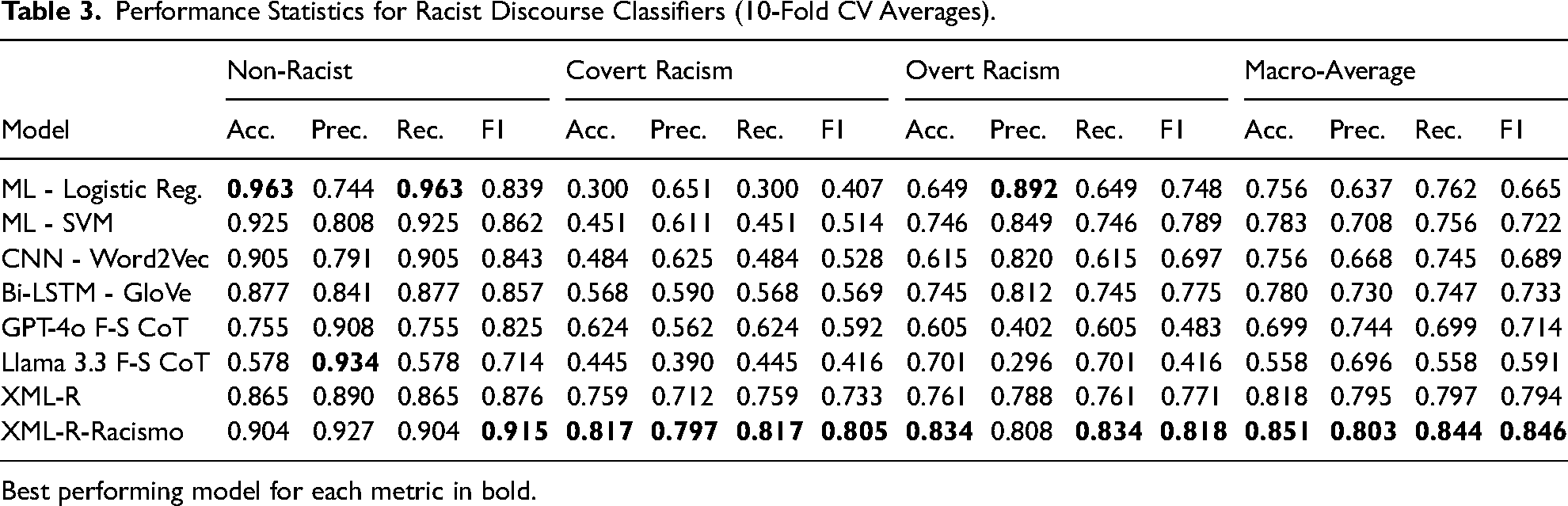
Best performing model for each metric in bold.
The results are less pronounced, as expected, with overt and non-racist text. SVM and Logistic Regression models perform fairly well in identifying overtly racist and non-racist discourse, with accuracy scores over 90% for the latter and over 60 and 70%, respectively, for the former. Bi-LSTM performs well with overt racism and non-racist discourse, with an accuracy of 77.5% and 85.7%, respectively. Original XLM-R, for its part, identifies overt racism correctly 77.1% (F1 score) of the time and non-racist discourse in 87.6% of instances. XLM-R-Racismo still improves on these figures, with an accuracy of 91.5% for non-racist discourse and 81.8% for overtly racist discourse. These numbers represent a 5% average gain over XLM-R and 6% over Bi-LSTM in these two categories. Taken together, this is a substantial improvement in detecting covert and overt racism (especially covert), considering we only used a relatively small corpus of 1.7 million tweets for pretraining, which pales compared to the 2.5 TB of data used to pretrain the original XLM-R model. It is reasonable to think that larger amounts of task-specific pretraining data would further improve model performance during fine-tuning.
While it is expected for Transformer-based models to outperform other machine-learning approaches, the results are particularly noteworthy given that similar work on detecting hate speech in Spanish text has achieved F1 scores for the hate-speech category of 72.7% (Gertner 2019) and 75.5% (Plaza-del Arco et al. 2021), compared to our 81.8% F1 score for the overt racism category. Both of these works used similar Transformers-based architectures based on Google AI’s original models—specifically, they used mBERT (multilingual BERT) and BETO, a refined BERT model pretrained specifically with large amounts of text in Spanish. The performance gains of the XLM-R-Racismo are substantial compared to these two works (12.52% and 8.34%, respectively). There is no comparable extant study of covert racism, so our figures showing F1 scores over 0.8 in this category show the true potential of our approach to identify highly nuanced categories in text.
Beyond the performance of our models, we are interested in conducting error analysis to identify the weaknesses of our best-performing set-ups. For the XLM-R-Racismo model, we check each mislabeled instance and compare instances that were commonly misclassified. Since we have a multi-class classification model, it is not sufficient to analyze the false positive (FP) or false negative (FN) rate, as it is not the same to mistakenly label a non-racist text as covertly racist and to label an overtly racist text as covertly racist. Thus, not only are we interested in identifying the FP and FN rate for each category, but more importantly, we are interested in identifying toward which category is the error skewing.
Table 4 shows the confusion matrix for the XLM-R-Racismo model. Our model is accurate at predicting overtly racist and non-racist text. In the model, text that is misidentified as overtly racist is more likely to be covertly racist (8.8%) rather than non-racist (3.8%). This is a positive result, as covertly and overtly racist text are, above all, racist text (just different manifestations of the phenomenon). As is evident from all models, covert racism is more difficult to identify. XLM-R-Racismo is more likely to misidentify covertly racist text as non-racist (26.2%) than overtly racist (10.7%), which is consistent with our expectations. More important, however, is the relatively low FP rate for non-racist text. The XLM-R-Racismo model misidentifies (15.3%) of non-racist text was classified as either covertly or overtly racist.
Confusion Matrix for the Pretrained XLM-R Model.
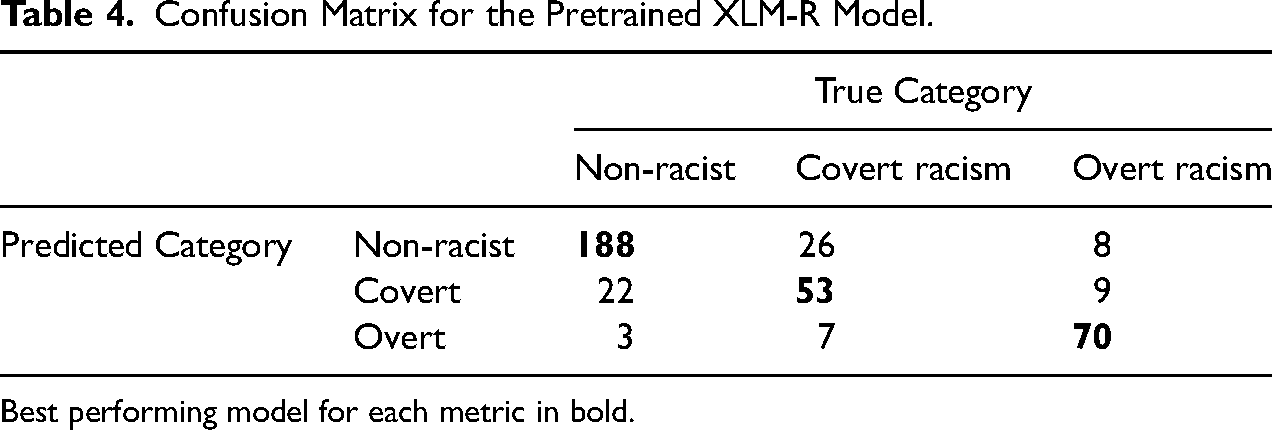
Best performing model for each metric in bold.
Having shown the advantages and limitations of our approach, we use our trained model to predict racist discourse in a corpus of 168,933 unique tweets. Following the same rules used to label our training dataset, we manually code a sample from the predicted data. We are interested in the extent to which our model is able to scale up to new text. We present the performance statistics in Table 5. Compared to the results from Table 3, this out-of-sample performance is similar to the ones obtained with the training data.
Confusion Matrix for XLM-R-Racismo Predictions and Hand-Coded Out-of-Sample Data.
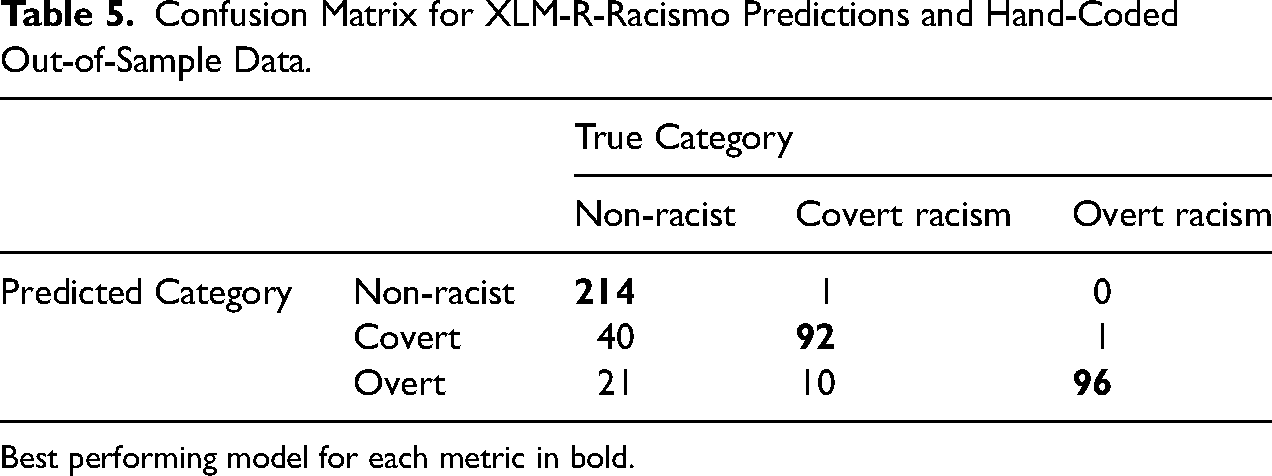
Best performing model for each metric in bold.
Covert and Overt Racism in Ecuadorian Twitter
To showcase the usefulness of our method, we apply our trained model to predict racist discourse on the full Twitter dataset. We explore the prevalence of covert and overt racism in the time covered by the data, and the characteristics of the users that are more likely to engage with the different forms of racist discourse. We analyze the relationship between the use of racist language and the importance of the user within the network, as well as their likely position toward the indígena protest. In addition to the abundance of text, this corpus includes information (i.e., tweets) from public figures and less-prominent users during the political turmoil that highlighted the historical confrontation between the indígena and the blanco-mestizo community (Vallejo Vera 2023). As previously mentioned, we use our trained model to predict racist discourse on the two corpora described in the Data section: Twitter data during the 2019 indígena protest in Ecuador (Protest Data), and Twitter data mentioning the indígena community between 2018 and 2021 (Indígena Data). In Table 6, we show the distribution of non-racist, covertly racist, and overtly racist tweets in both corpora.
Prevalence of Different Forms of Racist Tweets.

Social media users tend to cluster around like-minded peers, leading to homogeneous communities—clusters of nodes where the same information (tweets) is shared—that are consistent across time (Calvo and Aruguete 2020). On Twitter, communities formed around political events and cleavages often have at their center political leaders or users strongly aligned with the leadership. In Ecuador, this roughly translates into pro-government users mostly interacting (retweeting) with other pro-government users or pro-indígena users interacting primarily with other pro-indígena users (Vallejo Vera 2023). We identify communities in our Twitter data via a random-walk community detection algorithm (Pons and Latapy 2005),where each user is a node that creates a connection (edge) when they retweet another user (node). 27 The random-walk community detection algorithm identified the same primary communities in both datasets: a pro-government network, which includes 41,493 nodes in the Protest Data and 26,036 nodes in the Indígena Data; and an indígena community network of 30,244 nodes in the Protest Data and 26,110 in the Indígena Data. The community detection is, in essence, an unsupervised learning problem based on the characteristics of a network. To determine which type of users are part of each community, we look at highly influential users (i.e., users with high in-degree) in each cluster: the pro-government community had at its center then President @lenin, then vice-President @ottosonnenh, and then interior minister @mariapaularomo; in the center of the pro-indígena community was the institutional account of the @CONAIE_Ecuador, and its then president, @jaimevargasnae. 28
A correlational analysis of our data aligns with the theoretical expectations from our review of covert and overt racism. For example, Bonilla-Silva (2015) suggests that covert racism has replaced the overt manifestations of the racist ideology, partly as an answer to demands to dismantle the racial structure without actually changing it. Furthermore, unlike covert racism, overt racism is socially punished (i.e., a socially costly behavior). We find, for example, that covert racism is more prevalent than overt racism in both corpora. Given the socially costly nature of overt racism, we also find that verified accounts—political figures and media accounts—do not produce or reproduce overtly racist content. The stakes for public figures in engaging with racist content, in terms of exposure and repercussions, far outweigh those for less public users. Verified users predominantly include news agencies and government officials, who face greater risks in publicly endorsing overt racist discourse.
To more formally show this relationship, we regress a multinomial logistical model with a categorical dependent variable for whether the tweet is non-racist, covertly racist, or overtly racist, against the (log) in-degree of the user tweeting, as well as the community to where they belong (i.e., pro-indígena community or pro-government community). While users at the center of the network topography are less likely than less prominent users to tweet covertly racist content, they do so at a higher rate than overtly racist content. The lower cost of these discursive forms allows more prominent and more public users—users whose reputation would suffer from engaging with overtly racist content—to produce and reproduce it. This includes members of the media (e.g., online political magazine @4pelagatos), politicians (e.g., former president @mashirafael and then president @lenin), and political commentators (e.g., pro-government journalist @CarlosVeraReal). For example, a common characterization of the indígena community during the protests was as “terrorists” or “criminals” (one of the characteristics of “hygienic racism”). Then President Lenin Moreno tweeted: “The indígena leadership, supportive of Democracy and the Rule of Law for all Ecuadorians, must stir away from these false leaders, akin to indigenous terrorism and paramilitarism.”
The opposite is also true: less influential users (i.e., users with low in-degree) and users in the periphery of the network topography produce most of the overtly racist content. We plot the predicted probabilities in Figure 1 for ease of interpretation. The results suggest that, as in-degree increases, the probability of tweeting racist content decreases. For example, going from the first quartile of the in-degree distribution to the third quartile reduced the probability of producing racist content by half. Furthermore, research has shown how bots—social media accounts controlled by software—amplify hate speech to sow discord and perpetuate harm (see, e.g., Uyheng et al. 2022). To explore how bots engage with racist content, we follow Yang et al. (2020) and estimate the likelihood a user is a bot. The method proposed by Yang et al. (2020) yields a score between 0 and 1, where 0 is behavior akin to human users and 1 is more bot-like behavior.
29
We find that, as suggested, a higher bot-like behavior is positively associated with the likelihood of reproducing covert and overt racism. Going from no bot-like behavior to a high bot-like behavior (
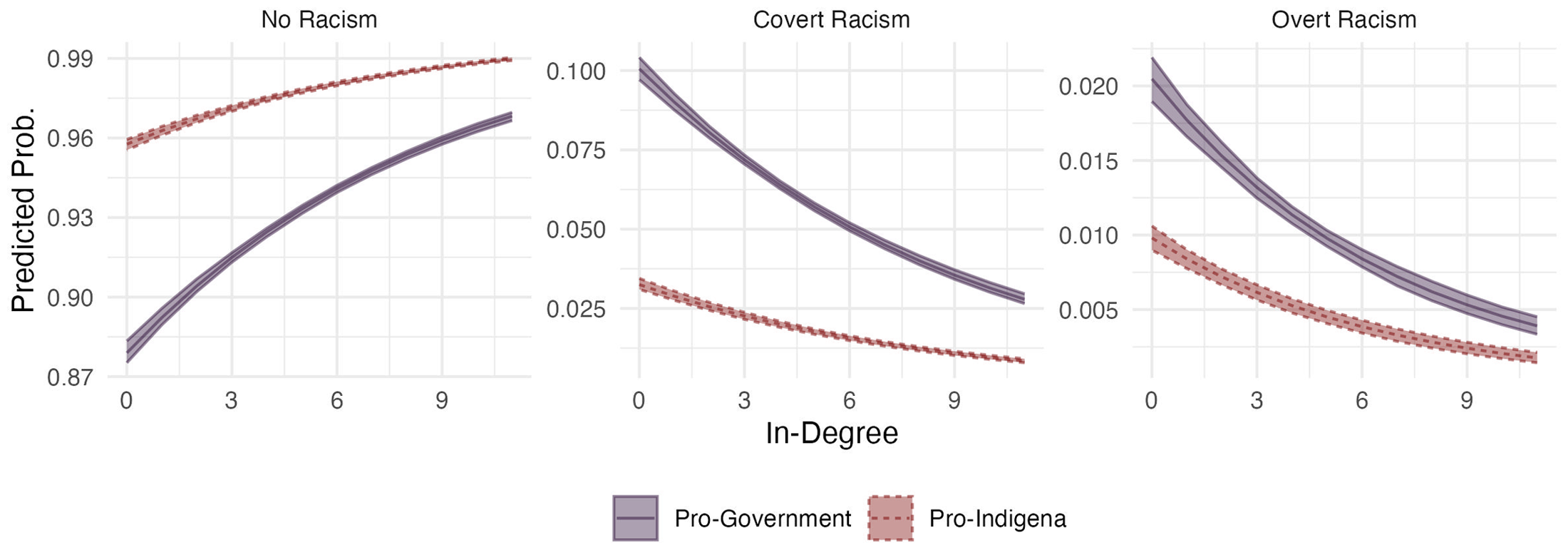
Predicted probabilities of tweeting covertly, overtly, or none racist content during the Ecuadorian protests (2019). We find a similar result using the data from the network mentioning the indígena community (2018--2022).
The difference in the prevalence of covertly and overtly racist content between pro-government and pro-indígena communities speaks to the literature on racism and on social media. For the former, the presence of covertly racist content across both communities points to the normalized nature of covertly racist language in Ecuador. Users from the pro-government community retweeted 77.2% of all covertly racist content (37,025 retweets), while users from the indígena community retweeted 18.8% (9,076 retweets). Even though it is impossible to individually know the racial identity of each user, the participation of mestizos in social media platforms corresponds to their distribution in the population (LAPOP Lab 2019). Research has shown that for mestizos in Ecuador (Beck et al. 2011; Traverso-Yépez 2005), as for whites in the U.S. (Bonilla-Silva 2013) and Europe (Coates 2008), socializing in and benefiting from the racist social order can lead them to reproduce covertly racist language to rationalize racial inequalities, hierarchies, and behaviors. Furthermore, some covert forms of racism are embedded in apparently benign intentions (see Section 4). Covert forms of racism from supporters of the indígena community often perpetuate the idea of indígenas as a cursed race, a people in need of protection (i.e., infantilization), accused indígena leaders that did not support the strike of not being “real” indígenas (i.e., denying their identity), or questioned whether those leaders involved in the strike were “real” indígenas. For example, a user supporting the strike tweets: “Yaku Pérez [an indígena leader] is a fake indígena, trying to [take advantage of the situation]. CONAIE cannot allow for this treason.”
The distribution of overtly racist content across both communities, on the other hand, speaks to behavior of users in social media. Of all overtly racist content in the Protest Data (6,446 retweets), users from the pro-government retweeted 75.4% (n
Limitations
While our proposed Transformer-based approach to classifying racist text improves upon the performance of other supervised machine-learning models, it is not without its limitations. First, while not uncommon, overt and covert racist discourse is not the main lexical form found in “naturally-occurring” corpora, as producing racist text is socially costly. This can lead to highly unbalanced samples (or require large samples for labeling). Unbalanced training datasets produce less accurate results than balanced datasets, particularly when using small samples to train models. Research has shown that the Transformer architecture used in this article outperforms other supervised-learning approaches (e.g., CNNs and RNNs) with small samples. Yet, it does not guarantee a baseline level of accuracy that researchers might be comfortable with. Researchers might use dictionary-based techniques to select the training set to address this limitation. Certain words might signal a higher likelihood of observing the phenomenon of interest—in our case, racist discourse.
Second, as social scientists, we are usually comfortable with error, as long as it does not overestimate our predictions (type-I error). When examining the performance of our model classifying overt and covert racism, it more often mislabeled racist discourse as non-racist than non-racist discourse as racist. That is, the model produced more false negatives than false positives. This is generally preferable over type-I error, and we can argue in our analyses that we are underestimating the effect size rather than inducing positive bias. However, this might not be the case for practitioners in other fields. For example, when applying our method to flagging potentially harmful content in social media comment sections, researchers might want to favor an over-cautious algorithm that is more likely to flag non-racist content as racist to have a human later decide on the accuracy of the prediction.
Third, to identify certain instances of racist discourse, specific knowledge of the case is required. For example, following our codebook, this tweet should be classified as covertly racist: “I will stop being polite to this deceitful mestizo, Carlos Perez you are an accomplice to the damage done to my Ecuador.” 31 However, to recognize the racist nature of the tweet (i.e., denying the identity of Perez), the coder must know that Carlos Perez identifies as indígena and that he changed his first name to Yaku, a Quechua word. It is even more complicated for the machine-learning algorithm to make these connections solely from the information provided (i.e., the training set).
Fourth, for corpora covering more extended periods, researchers might also need to evaluate the robustness of the process to drift in discourse over time. While the different forms of racism are slow to change, their linguistic manifestations might not be. Furthermore, different sources of the text can also include different expressions. For example, the language used in social media will differ from that used in campaign ads or parliamentary speeches. If researchers find significant shifts in time and context, they must account for these in their training sets and validate their model across time and context.
Finally, our approach relies heavily on computational power. In Appendix H in the online supplement, we include a detailed explanation of the resources and platforms we used to run our models, together with a summary of their time and cost. We understand that not all researchers have access to the required computational power or the computational skills to implement a Transformer-based machine learning approach. This perpetuates and accentuates the existing inequalities within the field, and that it should not be an entry barrier to using state-of-the-art techniques. While we have tried to be as clear and comprehensible as possible, many elements of our process may be difficult to implement. Our future work also aims to provide a simple and efficient library that makes using a Transformers infrastructure accessible to everybody and applicable to various types of text.
Conclusion
Systematically identifying racist discourse in large corpora has been a complex task (Van Dijk 2005). Racism takes different forms, such as overt and covert racism, which are largely dependent on context. This article provides a methodological approach to classify different forms of racist discourse in text that combines a theoretical understanding of the context with learning approaches. Given the contextual nature of racism, we highlight the importance of creating coding rules that consider the origin and manifestations of racism in the place and time of study. Having theoretically grounded rules to categorize different forms of discursive racism is the first step to identifying them in large corpora. To this end, we provide a step-by-step approach to building a coding scheme to label different forms of racist discourse.
The second part uses a Transformers-based deep-learning approach to text classification. The Transformers architecture has revolutionized NLP tasks, partly for its ability to better understand context compared to other deep learning approaches, like CNN and RNN models. Transformers-based LLMs such as XLM-RoBERTa can be further pre-trained with specialized text that improves classification performance. Adequately trained models can accurately classify text that requires a nuanced understanding of context, such as racist discourse. We apply this process to identify covert and overt racism in a corpus of 2M+ tweets relating to the indígena community in Ecuador between 2018 and 2021. Our main model, XLM-R-Racismo, an XLM-RoBERTa model further pre-trained using 1.7 million tweets, outperforms other machine-learning models in detecting overt and covert racism in text.
The results from our analysis highlight not only the usefulness of our method but also the implications on how we understand the role of racist content in modern settings. We found the expected patterns of overtly racist content in social media: more central nodes (i.e., more important users) are less likely than more peripheral nodes to tweet racist messages. The effect was weaker on covertly racist tweets. The consequences of the characteristics of racist language in current-day Ecuador (i.e., language that is socially punished) are replicated in social media.
Finally, while the primary goal of this article is to provide a step-by-step approach to classifying racist discourse in large corpora, we believe our contribution can be extended to other areas that require identifying coded language. Our approach focuses on a socially constructed notion such as race, and provides a nuanced identification of its various manifestations. There are other social constructions that can be identified following a similar process as the one described in this article (e.g., benevolent vs. hostile sexism). Furthermore, it can be applied to other cases that employ coded language to communicate positions (and lower the costs of doing so). Dog-whistling, which has been employed to hide racist meaning—albeit not exclusively—also requires contextual understanding and knowledge to be identified: the use of “dog-whistling” has been reported in the United States (López 2013), Sweden (Åkerlund 2022), and Brazil (de Oliveira and Figuereo-Benítex 2022), but is not yet salient in Ecuador.
The ability of Transformer-based approaches to understanding language in context makes them an ideal tool to classify text that requires a contextual understanding. Indeed, their effectiveness in annotation tasks, the larger tokenizer, and the potential for further training make these models especially well-suited for hate speech detection when compared to available alternatives. The identification of covert and overt racism in a highly specialized task serves as an example of the possibilities. Researchers can exploit the approach presented here to answer other substantive questions in the discipline, using the vast corpora available in new and creative ways.
Supplemental Material
sj-pdf-1-smr-10.1177_00491241251412360 - Supplemental material for Machines Do See Color: Using LLMs to Classify Overt and Covert Racism in Text
Supplemental material, sj-pdf-1-smr-10.1177_00491241251412360 for Machines Do See Color: Using LLMs to Classify Overt and Covert Racism in Text by Diana Dávila Gordillo, Joan C. Timoneda and Sebastián Vallejo Vera in Sociological Methods & Research
Footnotes
Acknowledgments
The authors would like to thank Indira Vega, Yana Lucila Lema, and Mateo Villaquirán for their assistance during the labeling process. The authors would also like to thank the editor and reviewers for their comments; the participants at 2024 MapleMeth Conference; and the audience at the Oxford LLMs workshop for their suggestions. This work was completed with computing resources provided by Purdue University and the Research Computing Data Core at the University of Houston.
Declaration of Conflicting Interests
The authors declare no potential conflicts of interest with respect to the research, authorship, and publication of this article.
Funding
The authors received no financial support for the research, authorship, and/or publication of this article.
Pre-Registration Statement
This study was not preregistered.
Data Availability Statement
The training data produced and the datasets analyzed during this study are available in the Harvard Dataverse repository, https://doi.org/10.7910/DVN/3G6YXY. The code used to pre-train and fine-tune the models are available here: https://github.com/svallejovera/smr_racism or https://zenodo.org/records/17634511. The final fine-tuned model (xlm-r-racismo) is available here:  .
.