




Abstract
We examine variations in pay gap estimates and inferences associated with distinct conceptualizations of jobs and employment contexts under legal and comparable worth theories of pay bias. We find that job titles produce smaller estimates of within job pay gaps than job groups, but the inferential importance of job concepts differs across organizational, workplace, and job groups within workplace units of observation. Moving from more to less job concept detail, we find almost no inference differences when pay gaps are estimated at the organizational level. Tradeoffs at the workplace and job groups within workplace levels are more common, comprising around 10 percent to 20 percent of observations. A legal theoretical framework leads to fewer empirical estimates of significant pay disparities, while comparable worth estimates suggest higher levels of gender and racial bias at the job and workplace levels. This research has implications for future analyses of linked employer-employee data and for both scientific research and regulatory enforcement of equal opportunity law.
Introduction
We have 40 years of calls in sociology (Baron and Bielby 1980; Kmec 2003; Stainback, Tomaskovic-Devey, and Skaggs 2010), and more recently in economics and management (Cobb 2016; Card et al. 2018), for a focus on the workplace generation of inequalities. Past progress was stalled by the limited availability of workplace-level data, but increasingly social scientists have been able to access government and firm generated administrative data and observe workplace-level earnings dynamics (e.g., Castilla 2008; Song et al. 2019; Avent-Holt et al. 2020).
Linked employer-employee data (LEED) are attractive for their measurement qualities. LEED produce less error and non-response in earnings and other measures than surveys, often includes whole populations rather than samples, and includes the actual workplace context in which wages are set, negotiated, and paid. While sociologists have long aspired to “bring the firm back in” (Baron and Bielby 1980), this is increasingly possible (e.g., Avent-Holt et al. 2020; Schneider and Harknett 2022; Smith-Doerr et al. 2019).
One can easily see the power of LEED for answering fundamental stratification questions. For example, Song et al. (2019) find that most of the steep rise in U.S. earnings inequalities is a between-firm phenomenon, a pattern also found in multiple countries with similar data (Tomaskovic-Devey et al. 2020). Others have shown that between-firm inequalities in many countries are more powerful drivers of earnings distributions than detailed occupations (see Spletzer and Handwerker 2014 for the United States and Avent-Holt et al. 2019 for multiple countries). There is also emerging research exploring workplace variation in gender (Card, Cardoso, and Kline 2016; Petersen, Penner, and Høgsnes 2014; Smith-Doerr et al. 2019) and immigrant-native pay gaps (Melzer et al. 2018; Tomaskovic-Devey, Hällsten, Avent-Holt 2015).
Yet, we know relatively little about what level of job concept precision is appropriate to capture underlying workplace inequality-generating mechanisms. Some administrative data, such as that collected by the U.S. Equal Employment Opportunity Commission (EEOC), use a nine-category “big-class” job concept. Many use national occupational classifications that vary from 92 to 174 occupational codes (Avent-Holt et al. 2020). More rarely researchers have had access to actual job titles (e.g., Petersen and Morgan 1995; Smith-Doerr et al. 2019), as we do here. Job titles presumably map more closely onto a firm's internal divisions of labor.
A preference for more detailed job titles, however, need not be superior to less occupational detail if actual earnings distinctions are primarily between similarly skilled occupational groups or when workplaces make few internal job distinctions. In these cases, it is possible that less precision may be sufficient to map the levels of inequality and segregation processes, a possibility we explore here.
There is also a theoretical choice to be made, as job groups within the same workplace may better capture equivalently skilled workers, who may be further segregated by closure mechanisms into detailed job titles (Bielby and Baron 1986). In the policy realm, this job title segregation process has been described as the problem of comparable worth for equivalently skilled workers in the same organization (England 1992) and parsed into three distinct employer bias processes–allocative, valuative, and direct discrimination (Petersen and Saporta 2004). A contrasting theoretical choice is to define interesting pay disparities as occurring only within narrowly defined job titles within workplaces, which is the dominant legal model in the United States following the 1963 Equal Pay Act. This legal model has a narrower set of potential mechanisms around disparate treatment for employees in the same job.
In this article, we cross classify these two theoretical models of earnings inequalities by three employment contexts that imply different assumptions about the causal context in which pay inequalities are generated: organizations, workplaces, and job groups within workplaces. We take this as an exercise in precisely defining theoretical and empirical estimands, linking them to our estimation strategy, and then compare the differences in inference associated with explicit theoretical models of the pay setting process.
There are also policy implications of our analyses. Administrative data varies in occupational detail, varying from the “big class” job concept used by the U.S. EEOC, to intermediate detail in existing LEED data collections in multiple countries, and actual job titles in workplace's internal human resource systems. In the legal framework estimates of pay disparities using aggregated job groups might be interpreted as producing errors in estimates. Conversely, job title estimates may be underestimating gender and racial bias under a comparable worth theoretical model. To the extent that various levels of aggregation are used to inform equal opportunity regulatory policy or a firm's internal analyses of pay equity, precision in the measurement of job concepts (National Academies of Sciences 2022) as well as the agents responsible for pay decisions (Smith-Doerr et al. 2019) may be crucial to the interpretation of empirical estimates. We argue that theoretical clarity, often absent in past research, is required in order to choose appropriate empirical estimands, estimation strategies, and evaluation of model limitations regardless of the data at hand.
Using personnel records for U.S. federal government agencies, we examine pay disparities at the intersection of gender and race, two of the most important earnings inequalities focused on in prior research and equal opportunity regulatory activity. In these personnel records, the data collection process is well-defined and accurate, and includes a great deal of workplace and job variation in the magnitude of observed inequalities. The comprehensive coverage of organizations, workplaces, multiple job concepts and earnings makes the population of federal agencies a good starting point to examine the utility and limitations associated with different levels of job and employment granularity. There are, of course, limitations to these data, the two most notable is they are U.S. centric and within the United States they focus on the relatively low inequality federal sector.
Background
The 1963 U.S. Equal Pay Act defined pay discrimination as women and men in the same job in the same workplace receiving different levels of pay that cannot be justified with productivity relevant gender differences, such as in tenure or job performance. This act has since been the dominant guide to pay equity analyses in firms and courtrooms, defining legal liability under that law. Going forward we label this approach to establishing pay inequalities the “legal model.” Its core causal argument is that only disparate treatment of employees in the same job in a shared workplace constitutes discrimination.
This legal model of pay inequalities was challenged in the courts with an alternative theoretical model of comparable worth (England 1992). Title VII of the 1964 Civil Rights Act further prohibited discrimination and segregation, potentially expanding legal liability to include job segregation within firms. This led to the development of the comparable worth framework, under which pay disparities reflect both the discriminatory sorting of equivalent skilled men and women into jobs with different pay levels, the devaluation of jobs that became associated with female or non-white labor, as well as disparate pay within the same job. The sociological and labor economics literatures have developed with this broader notion of pay inequalities, focusing on segregation, devaluation, and direct discrimination as causal mechanisms (e.g., Blau and Kahn 2017; Levanon, England, and Allison 2009; Petersen and Saporta 2004).
Interestingly, the Civil Rights Act of 1964 defined discrimination in terms of both segregation and disparate treatment, but the legal interpretation of prohibited pay disparities has primarily followed the more narrowly defined 1963 Equal Pay Act. Comparable worth considers the full treatment of categories of individuals relative to each other, which entails a consideration of all mechanisms that might lead categories of individuals to have average differences in outcomes for the same employer. Comparable worth remains a powerful perspective for understanding why it feels rather unjust to consider only disparate individualized wage-setting within the same job titles.
Past research is clear that occupation and job segregation are major drivers of race and gender earnings inequalities (e.g., Blau and Kahn 2017; Semyonov and Mandel 2014, 2016; Tomaskovic-Devey 1993), while being less clear as to whether within-job disparities are large (Bayard et al. 2003; Carrington and Troske 1998a, 1998b; King et al. 2023) or small (Groshen 1991; Petersen and Morgan 1995). In general, research has concluded that more occupational detail better captures segregation processes, since much gender segregation occurs within more aggregate occupational groups (e.g., Avent-Holt et al. 2020; Jerby, Semyonov, and Lewin-Epstein 2005; Smith-Doerr et al. 2019).
Robinson et al. (2005) showed that the nine occupational groups used by the U.S. EEOC when nested within workplaces produce national gender and race segregation estimates comparably high to very detailed occupational estimates which lack information on workplace context. They demonstrated that much segregation captured by detailed occupations is actually between workplace segregation.
The detailed categorical approach using LEED has been most thoroughly applied in multiple countries to gender inequality in the work of Trond Petersen and colleagues (e.g., Meyersson, Petersen, and Snartland 2001; Petersen, Penner, and Høgsnes 2014; Penner et al. 2022). This work has the advantage of combining ISCO occupational codes with establishment location to produce estimates of the relative role of workplace, occupation, and jobs to gender earnings gaps. While the relative impact of occupations and workplaces vary across their studies, in all cases it is job segregation that explains much more of the gender earnings gaps than the traditional focus in sociology on occupation alone. A recent study by Avent-Holt et al. (2020) reproduces this result for earnings more generally for multiple countries over multiple decades. In that paper, workplaces actually had a stronger impact on earnings than detailed occupations in five of six countries, but jobs were the decisive driver of earnings everywhere.
Work on organizational inequalities stresses the importance of recognizing variability in organizational inequality levels (Acker 2006; Schneider and Harknett 2022; Tomaskovic-Devey and Avent-Holt 2019). For example, using personnel data from six federal science agencies, Smith-Doerr et al. (2019) find that the relative impact of differences in human capital at the hiring stage, job title segregation within agencies, and within-job pay gaps vary across organizations. The EEOC and courts have taken workplace variation as a given, asking in particular cases if a particular organization displays pay disparities that might signal discrimination. The shift to workplace inequality analyses in sociology represents a convergence with the approach to discrimination in the courts.
The Current Study
We follow the methodological framework outlined by Lundberg et al. (2021). They advise researchers to (1) Choose a theoretical estimand and defend its relationship to a general theory. This is likely to require specificity about the hypothetical intervention (if causal) and the target population (in all cases). (2) Choose an empirical estimand that can be linked to the theoretical estimand by a set of identification assumptions. (3) Choose an estimation strategy to learn the empirical estimand from data.
Our theoretical estimand is the differences in earnings between similarly qualified women and men or whites and people of color employed in the same job. We ask if employers pay men and women in the same job differently. The causal intervention that generates these pay disparities is employer pay practices.
We are interested in this estimand for six different populations defined in terms of distinct conceptual definitions of same job and employment (2 Pay Disparity Models * 3 Employment Contexts). First, as outlined above, there are two quite distinct theoretical approaches to defining disparity or bias in gender or race-linked earnings. The first is the “legal model,” which defines the same job narrowly as the same job title in a shared workplace, with adjustments for individual differences in productivity-linked attributes. The second is the “comparable worth model,” which defines the same job more broadly in terms of similarly skilled individuals in similarly skilled job groups in the same workplace. In this second approach, the notion of gender bias includes allocative and valuative job sorting as well as within job title pay disparities for women and men with similar human capital attributes. We will operationalize the comparable worth theoretical notion as EEOC job groups, defined as 1 digit ISCO occupations within employment contexts. The legal theory will be operationalized as federal job titles within employment contexts.
We also distinguish theoretically between three distinct employment contexts: organizations, workplaces, and job groups within workplaces. These refer to distinct arenas of interest in the literature, which we discuss below. All assign causal priority to employers, but distinguish conceptually between the level of employer decision making at which pay inequalities are generated.
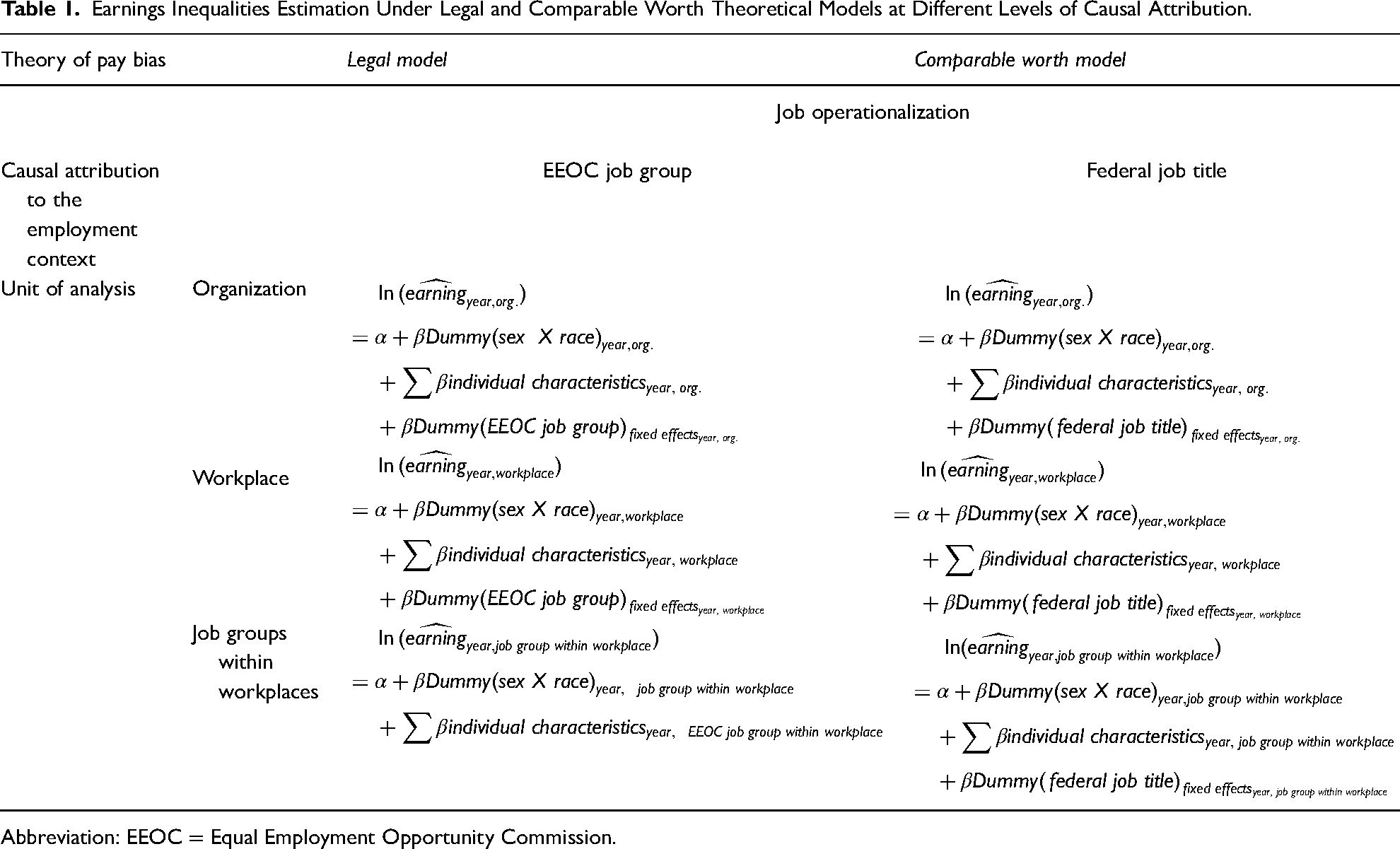
Our empirical estimands are the descriptive earnings gaps between employed women and men, whites and people of color, conditional on individual covariates in the six population contexts defined by the cross-classification of the same job concept and employment context. Table 1 illustrates the six empirical estimands we are interested in. Each reflects a distinct theoretical context produced at the cross-classification of the “legal” and “comparable worth” theories of inequality and the preferred employment context—organization, workplace, and job group within workplaces—for evaluating where employee pay setting practices should be evaluated.
Earnings Inequalities Estimation Under Legal and Comparable Worth Theoretical Models at Different Levels of Causal Attribution.
Abbreviation: EEOC = Equal Employment Opportunity Commission.
Our estimation strategy to learn our empirical estimand is the OLS fixed effect framework proposed by Petersen and Morgan (1995), estimated separately for these six theoretically defined populations. As we do not observe the actual pay setting mechanisms employers are using we see these estimates as descriptive of the outcomes of a causal process, rather than estimates of causal mechanisms. We follow the conventional approach in earnings models of estimating pay disparities in logged earnings units. These produce estimates of group differences in the logarithm of earnings, and are interpreted as relative differences in the arithmetic mean of earnings, but which strictly correspond to relative differences in the geometric mean of earnings (Petersen 2017). For large differences in the logarithm of earnings, the coefficients need first to be exponentiated.
An obvious research question asks if pay gap estimates and inferences of disparity are sensitive to job concept detail. The expectation is that more detailed job concepts when nested within workplaces will produce larger estimates of segregation's contribution to pay gaps and smaller estimated within-job pay disparities. Consistently, Penner et al. (2022) using the cross-classification of occupation and workplaces find for multiple countries that a nine occupational group within workplaces coding produces within-job gender wage gap averaging 30 percent larger than estimates using detailed occupational codes.
A more useful question for both science and regulatory practice we suggest, is how often does the use of less job concept detail lead to errors in inference under the legal theory of pay bias? Conversely, how much disparity is obscured from a comparable worth point of view if we employ job titles? Should we conceptualize consequential disparities to exist only when they are within jobs or are organization-wide pay patterns of scientific or legal interest as well? Finally, for regulators operating under the legal theory, can we use LEED with confidence if it only contains more aggregate job concept measures?
We analyze personnel data on U.S. government agencies for 1994 and 2008. These data are attractive in that they include many workplaces (distinct government agencies in different geographical locations), and are drawn directly from federal personnel records for the population of federal workers. Within this population there is no unit non-response, little item non-response, and very little measurement error. Because these are personnel records, they have highly accurate measures of earnings and job titles as well as individual-level education and age, which we treat as individual-level control variables. Compared to survey data they are of very high quality. Even compared to government administrative data for taxation or social security purposes they are high quality.
Data were obtained from the U.S. Federal Office of Personnel Management (OPM) in the form of raw, de-identified data. The dataset includes variables for yearly earnings, job title, and individual education and age. These data include all non-elected federal employees outside of the Department of Defense, although individuals whose characteristics are unique enough to allow them to be identified are also excluded. Job incumbents who were employed for multiple years have records for each year, but we cannot identify the same individual across years.
Almost all federal employees are full-time, full-year, and are limited to 40-hour work weeks. We restrict our analyses to these full-time employees. We begin with a focus on 1994 pay gaps. In 1994 gender and racial pay gaps in the federal government were on average of comparable magnitude to their current levels in the country more generally, and so might be seen as a proxy for a contemporary workplace analysis. By 2008 federal pay gaps were considerably smaller and we use these data to examine estimates and inferences in relatively low inequality contexts.
Our analyses examine the consequences for estimates of pay gaps when moving from less to more detailed job concepts at the organizational, workplace, and job group within workplace levels. We are also interested in inference and magnitude shifts produced by moving from detailed federal job titles, to Census intermediate 30 job group coding, and finally to EEOC style nine job groups. EEOC occupations (see Appendix Table 1 of the Supplemental Material) are quite similar to ISCO one-digit occupation codes. In the remainder of this article, we primarily focus on the more policy-relevant EEOC style coding, as we find only small differences between those nine EEOC job group models and the Census intermediate 30 job group coding scheme.
Inference shifts refer to reaching a different conclusion as to the presence of gender or racial earnings inequalities as we move from federal job titles to EEOC job groups (varying by job concept) or from EEOC job group to workplace to organizational units of analysis (varying by employment contexts). Magnitude shifts refer to the estimated size of gender and racial pay gaps given federal job titles versus EEOC job group conceptualizations. We find larger pay gaps when using EEOC job group concepts and measures than when we use federal job titles. Job group aggregation underestimates segregation mechanisms and over-estimates within-job inequalities. Under the legal theory of discrimination, these would be signals of measurement error. Under a comparable worth theory, however, in which the normative expectation is equivalent wages for equivalent skill levels, the interpretation of the larger within-job inequalities in job group models reflects a series of bias processes including job title segregation of comparable skilled individuals, devaluation of gender or race typed jobs, as well as any within-job title bias processes.
Units of Analysis
We focus on three units of analysis: organizations comprised of multiple workplaces, workplaces within larger organizations, and EEOC job groups within workplaces. Sociologists studying organizational inequality have most often been interested in understanding organizational-level inequalities and the mechanisms that produce them (e.g., Castilla 2008; Schneider and Harknett 2022; Smith-Doerr et al. 2019). Other analyses focus on workplaces as the relevant employment unit (e.g., Penner et al. 2022; Stainback and Tomaskovic-Devey 2012). Pay equity under the law and in most human resource applications is defined in terms of people doing the same work in the same workplace, favoring a job group within the workplace unit of observation.
In Lundberg et al.'s (2021) framework, estimand choice involves being explicit about both causality and population. From a causal point of view, both the legal and comparable worth frameworks identify the employer's hiring and pay decisions as the causal agent. The legal framework normatively centers within job pay decisions as the core context for these decisions. The comparable worth framework also focuses on job-related decisions, but admits to a wider realm of decision-making including segregating similarly skilled people into differently remunerated jobs as well as within job disparities. Neither is explicit as to the precise causal actors culpable for decision making. From one point of view, it could be corporate leadership and so the proper level of analysis is organizational. From another, it is the direct decision maker, so managers in workplaces, or perhaps even supervisors of particular jobs might be the proper context in which to produce empirical estimates. In practice, the legal framework with its focus on within job inequalities erases attention to small but systematic disparities that take place across all or most jobs. Thus, it will often be much more conservative in attributing substantive disparities than a leadership or decision-maker notion of the relevant causal actors.
The federal government includes cabinet-level and independent executive branch agencies. Most of these organizations have sub-agencies, mimicking the multi-establishment firm structure of large private sector firms. We define an organization as a cabinet-level or independent agency. In 1994, we observed 17 cabinet-level agencies and 43 independent executive branch agencies; in 2008, we had 17 cabinet-level agencies and 46 independent executive branch agencies.
The U.S. EEOC collects employment data on establishments at a specific address, and this has been the normal operationalization of “workplace” in the courts. For the Federal government, this is less appropriate since it is common for people from multiple agencies and sub-agencies to work in the same building. We follow a conception of the workplace as people with a shared product or service, division of labor, and authority structure. In the courts shared decision-making authority has been used to define the scope of potential discrimination (Tomaskovic-Devey 2011).
The federal pay plan recognizes local cost of living variation and adjusts pay through the General Schedule Locality Pay Tables. The Office of Personnel Management uses a duty station location system compatible with the pay tables. We use the 9-digit duty station code from the location system to define separate workplaces within sub-agencies. Thus, we define workplaces as sub-agencies within duty stations. We eliminate any workplace with less than 50 employees. There were 7,248 distinct job titles within 2,270 workplaces in 1994 and 6,215 job titles within 2,101 workplaces in 2008. Because of the linkage to locality pay tables our operationalization of workplaces and jobs adjusts for geographic differences in the cost of living by design.
In order to compare the impact of job concept measures on pays gap estimates we make comparisons of pay gap generating mechanisms estimated with EEOC nine category job groups, an intermediate 30 occupation Census classification, and detailed federal job title information, all nested within workplaces. We primarily focus on the nine-category EEOC job group—federal job title comparisons, as results from the intermediate 30-category job group analyses were almost identical to the nine-category EEOC job groupings.
Measures
Pay. Pay is the 12-month annual salary in constant 2021 dollars. This includes base salary and contractual supplements to base pay. It does not include overtime or bonuses, both of which are in any case quite rare in the federal government. In regression models, we take the natural log of annual salary.
Most prior research relies on self-reported earnings. Self-reports tend to underreport high and low earnings and the patterns of error in reporting are complexly related to education, race, and occupation (ChangHwan and Tamborini 2014). This is also true at the level of gender gap wage regressions, where errors in earnings measurement can have substantive impacts on estimates (Uhrig and Watson 2020). Earnings measured directly from personnel records are a clear advantage of administrative data of all types.
Gender/Race. In this study, gender is coded as male and female. Race is coded as white, people of color, and missing. We retain missing values as a distinctive group since some federal agency personnel systems did not report full information about race. This is the only source of item missingness in our analysis. We exclude those agencies that have over 90 percent missing on race, most of which occurred in 2008. This led the final analytic sample to include 16 cabinet-level agencies and 39 independent executive branch agencies in 2008. We recognize that further racial detail is possible and for some applications desirable, but to reduce what is already substantial complexity in our methodological application, we focus on the white/people of color comparison.
Federal Job Titles and EEOC Job Groups. The U.S. government has a standardized set of detailed federal job titles and responsibilities that apply across agencies. The titles are narrow in their scope and describe specific task bundles (e.g., Park Ranger, Electrician, Tax Law Specialist, and Museum Curator). We operationalize the legal theory conceptualization of jobs as federal job titles within employment contexts. We label these going forward federal job titles.
For the comparable worth theoretical framework, we use the EEOC's nine-category occupational codes (i.e., Managers, Professionals, Technicians, Sales Workers, Administrative Support Workers, Craft Workers, Operatives, Laborers and Helpers, and Service Workers, see Appendix Table A1 of the Supplemental Material) within employment contexts as our operational definition of job groups. We label these EEOC job groups. For intermediate job group codes, we use the 2010 EEO occupational codes (n = 30) created by the U.S. Census Bureau to group similar technically skilled roles (e.g., Business and Financial Operations, Architecture and Engineering, Life, Physical, and Social Science, Community and Social Service, see Appendix Table A2 of the Supplemental Material) nested within workplace contexts.
Individual-Level Variables. Following the theoretical distinction in both the legal and comparable worth models of similarly skilled individuals we control for workers’ education and age. Education is coded as “Less Than High School,” “High School,” “BA,” “Graduate or Professional, Doctorate,” and “Post-Doctorate.” OPM provided age data in three-year intervals to protect individual identity; we assign workers indicator variables for their reported age-year range. We use age as a proxy for pre-Federal employment experience in regression models. We would have preferred to use a measure of government tenure, but it was not available in the data. Age is a proxy for labor market experience, but it is tenure that is typically treated in legal proceedings as a justifiable basis for pay disparities. Brummond (2022), also investigating federal personnel data, reports that women tend to have 1.6 years longer tenure with the federal government than men, thus not adjusting for tenure will underestimate the magnitude of gender earnings disparities net of individual characteristics. We do not know of a similar comparison for white-people of color tenure.
Initial Analyses of Large and Small Inequality Agencies
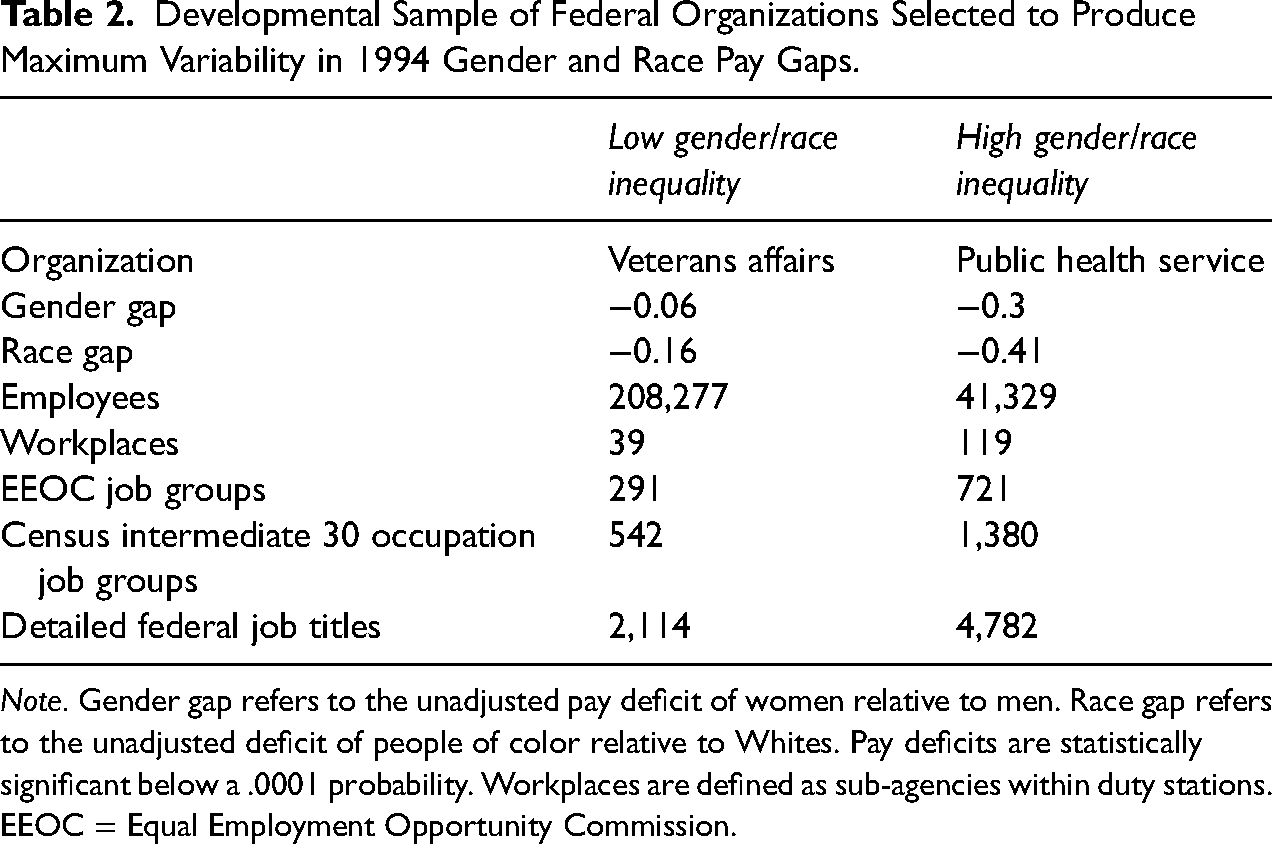
We chose to develop our analysis by focusing on two federal organizations in 1994, maximizing variation on our dependent variable. The first is the Public Health Service which has very high gender and racial inequality. At the other extreme is the Department of Veterans Affairs, which has low inequality on both gender and race. This initial comparison allows us to compare the impact of different operationalizations of job specificity and level of analysis in organizations with wildly different baseline earnings gaps. We then generalize our approach to all federal organizations, workplaces, and EEOC job groups within workplaces in 1994 and 2008.
Table 2 describes these two agencies. In 1994 the Public Health Service (PHS) employed 41,329 people. Men earned 30 percent more per year than women, and whites 41 percent more than non-whites across 119 distinct workplaces. On the other extreme, veteran affairs (VA) was much larger with 208,277 employees and 39 workplaces but relatively low gender (6 percent) and race (16 percent) earnings gaps.
Developmental Sample of Federal Organizations Selected to Produce Maximum Variability in 1994 Gender and Race Pay Gaps.
Note. Gender gap refers to the unadjusted pay deficit of women relative to men. Race gap refers to the unadjusted deficit of people of color relative to Whites. Pay deficits are statistically significant below a .0001 probability. Workplaces are defined as sub-agencies within duty stations. EEOC = Equal Employment Opportunity Commission.
For each organization, we estimate three pay gaps. Model 1 estimates control for individual education and age. Model 2 adjusts for the EEOC job groups. Model 3 substitutes federal job titles for EEOC job groups. In both Models 2 and 3, the coefficients for race and gender are estimates of differences in logarithms of earnings, interpreted as relative within-job pay disparities. Model 2, using EEOC job groups and individual-level controls, corresponds to a comparable worth model of pay discrimination. Model 3 using federal job titles and individual-level controls conforms most closely to the 1963 Equal Pay Act legal theory of discrimination as pay gaps within the same job in the same workplace. We compare estimated pay gaps between Model 2 versus Model 3 and display the results graphically. All estimates are reported in the Appendix Tables A3–A5 of the Supplemental Material. We also ran a fourth model for all analyses which used the Census intermediate coding of 30 occupations, but as the results are quite similar to the EEOC job group models we present results based on the EEOC job group models. Appendix Table A3 of the Supplemental Material reports this fourth model for the developmental sample, Census intermediate job group models for all other analyses are available upon request.
We next move to the workplace level, replicating the same model specifications for EEOC job group and federal job titles, but this time run regression models for each workplace. In this analysis, we get the within-job pay disparities aggregated to the workplace level, which allows us to evaluate workplace-specific pay penalties associated with the two different job concepts. Finally, we move to the EEOC job group within workplace level, calculating the degree to which the EEOC job group, comparable worth conceptualization, compares in terms of estimates and inferences to the legal theory operationalized as federal job titles.
Because these are population data, tests of statistical significance are not strictly speaking appropriate. However, since in legal proceedings tests of statistical significance on population data are routinely relied on by the courts to infer discrimination (Bielby and Coukos 2006; Tomaskovic-Devey 2011), we report such tests and use them to establish differences in inference. When reporting the distributions of estimated pay disparities across organizational, workplace, and EEOC job group levels, we weight the distributions by the number of employees. When analyzing differences in inference, we use unweighted estimates so that the unit of analysis corresponds to the level of interest rather than individuals. For example, 100 percent unweighted consistent disparities at the organizational level mean all “organizations” reach the same conclusions about pay gaps irrespective of precision in job concept measurement. A total of 80 percent unweighted consistent disparities at the workplace level means 80 percent of “workplaces” have consistent patterns between less and more detailed job models. To summarize differences in inference, we created the following classification: (1) federal job title-EEOC job group consistent: the employment units where both comparable worth (i.e., EEOC job group) and legal models (i.e., federal job title) reach the same conclusion as to significance and sign of the pay gaps; (2) EEOC job group only significant disparities, where an insignificant pay gap in the legal model is significant under a comparable worth model; (3) federal job title only significant disparities, where a significant effect in the legal model is insignificant under a comparable worth model; and (4) sign-switch disparities, where significant signs switch when moving from legal to comparable worth models.
Organizational Level Analyses
Figure 1 reports the estimated pay gaps under each model for our two extreme type agencies. Full models are reported in Appendix Table A3 of the Supplemental Material. All coefficients in all models support the conclusion of statistically significant pay gaps relative to white men in both agencies, even in low inequality VA. We also see that detailed federal job titles almost always produce smaller estimated pay gaps.
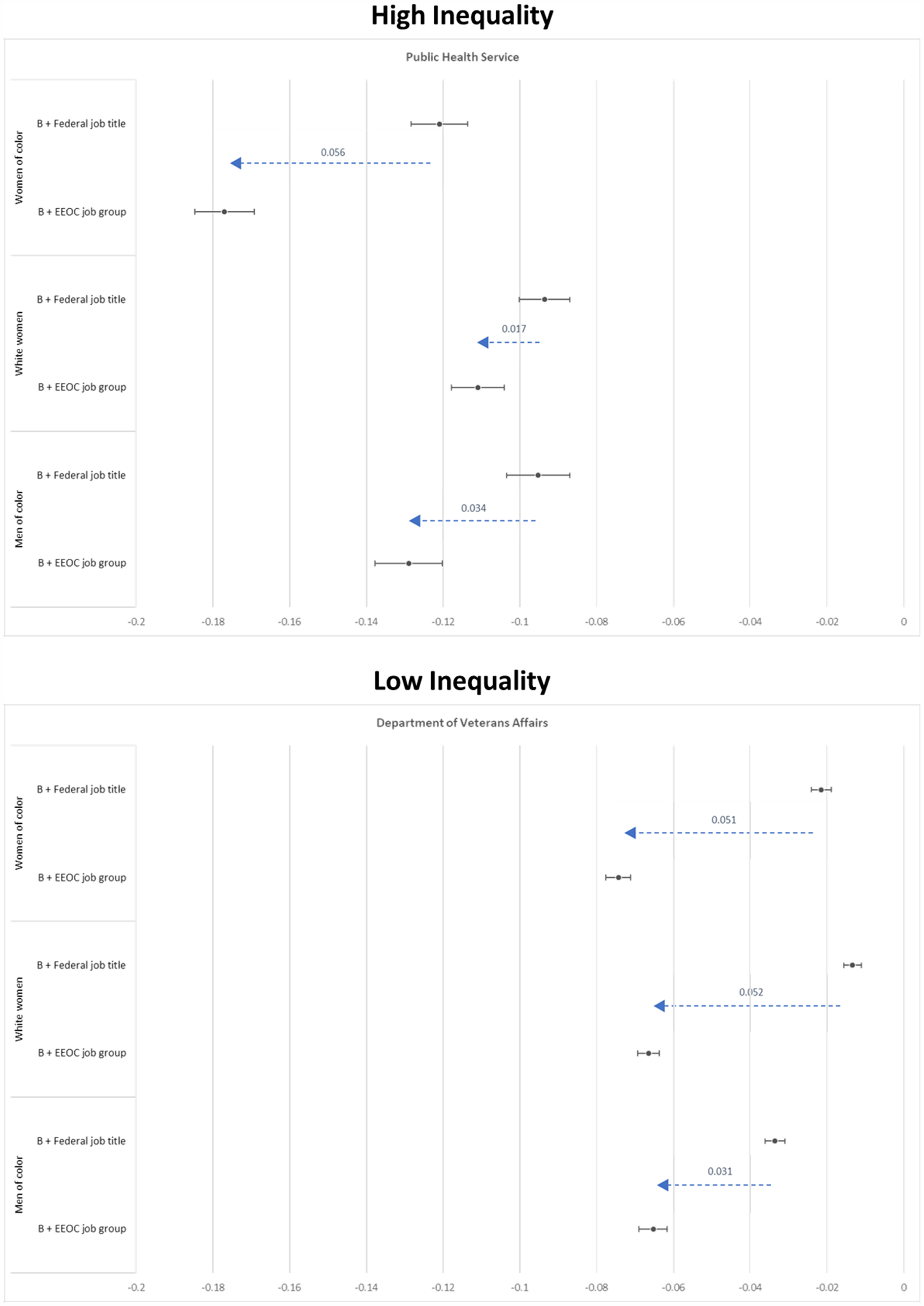
Job adjusted pay gaps relative to white men and absolute differences for the Equal Employment Opportunity Commission (EEOC) job group and federal job title concepts for two ideal type agencies.
Within federal job title pay gaps at the organizational level, while statistically significant, are very small in the low gender and race inequality Department of Veterans’ Affairs. In 1994 within the same detailed federal job title in the same workplace and adjusting for age and education men of color earned 3.4 percent less than white men, while white women and women of color earned 1.5 percent and 2.3 percent less, respectively. The within-federal job title residuals in the high inequality Public Health Service were much higher at 9.5 percent, 9.4 percent, and 12.1 percent for men of color, white women, and women of color.
Using different levels of job detail is unlikely to lead to incorrect inferences as to the presence of significant within-job pay disparity for these two organizations. At the same time, Figure 1 shows that aggregating job concept to a big class EEOC job group categorization will tend to produce 2 to 6 percentage points larger estimates of the level of within-job pay disparity. Large differences are particularly the case for women of color, suggesting strong federal job title sorting within comparably skilled job groups. Appendix Figure A1 of the Supplemental Material reports model R2, explained variance is consistently lower in the less detailed EEOC job group models.
Based on the development sample, we found that the EEOC job groups will generally overestimate within-job pay gaps relative to using actual federal job titles under the legal theory of pay disparities. Conversely, under a comparable worth theoretical standard the job title models consistently underestimate the pay penalties encountered by similarly skilled women and people of color.
In Figure 2, we scale up to all organizations in 1994 and 2008 (for detailed values, see Appendix Table A4 of the Supplemental Material). In 1994 and 2008, almost 99 percent of estimations (white shading bars) show significant negative pay gaps relative to white men for all three comparison groups. There are no significant positive pay disparities in either 1994 or 2008, but between 0.07 percent and 0.6 percent non-significant pay differences in 1994, and 1.11 percent and 2.26 percent in 2008. Non-significant pay gaps relative to white men are mostly found for white women. The few non-significant race pay differences in 2008 may be partly due to missing information about race.
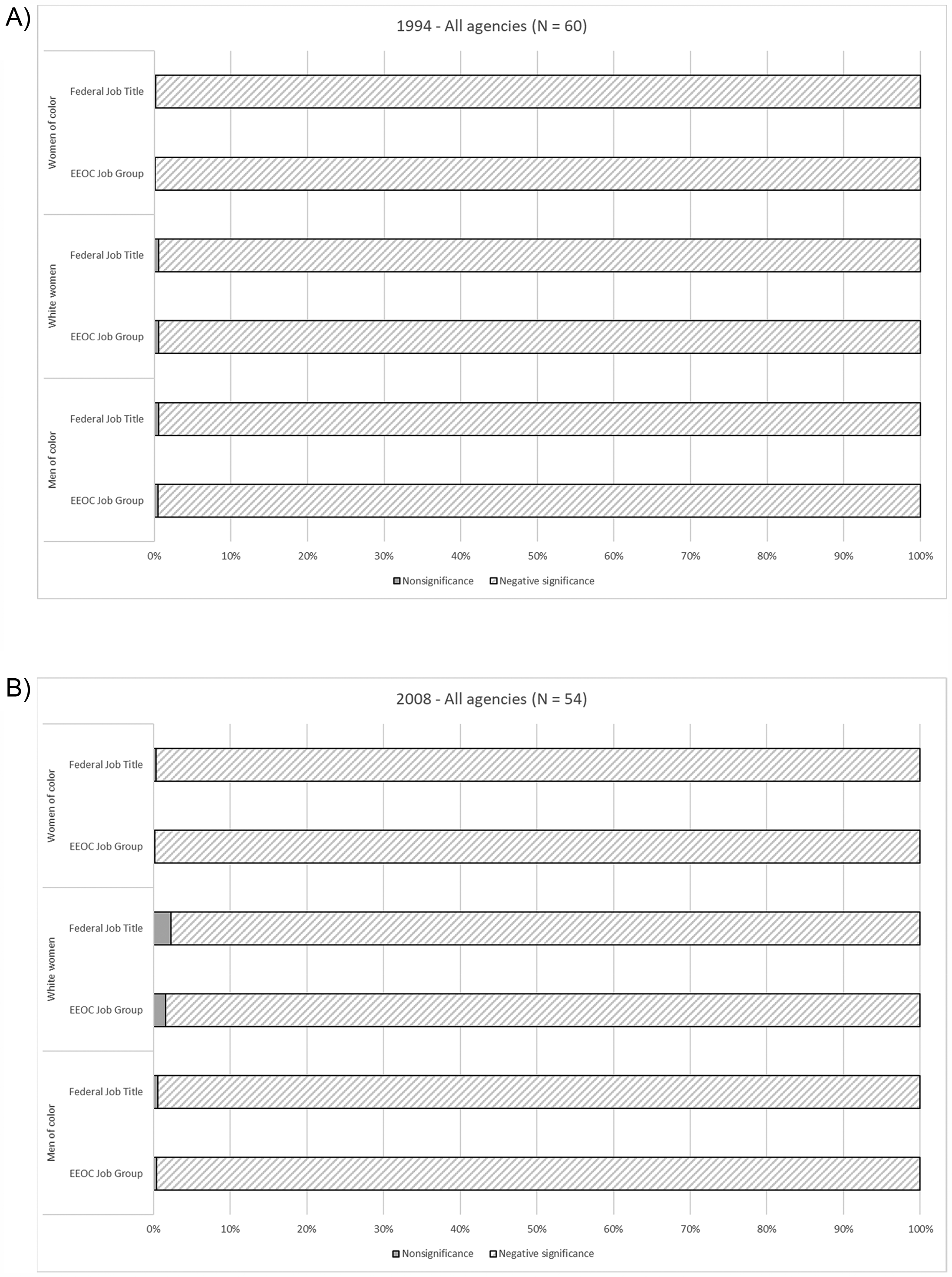
Organization pay estimates by job models in 1994 (Panel A) and 2008 (Panel B). All models regress logged earnings on education and age dummies. The distributions have been weighted by the number of employees in the organizations.
Workplace Level Analyses
When we focus on workplace-level pay practices, we no longer see uniformly significant negative pay differences. Instead, the workplace-level analyses in Figure 3 show that about 21 percent to 63 percent of women and minorities experience non-significant pay gaps and between 0.2 percent and 6.7 percent earn significantly more than the average white man in their workplaces. As we move from EEOC job group to detailed federal job title operationalizations, we find that non-significant workplace pay differences and occasional pay bonuses for white women, men of color, and women of color are more common. For instance, when we look at the detailed federal job title models in 1994, about 43 percent of white women worked in workplaces that approached null pay disparities and about 1.6 percent of white women experienced a pay bonus relative to white men. In lower inequality 2008, about 63 percent of white women worked in workplaces with null pay disparities and 3.2 percent of white women worked in workplaces where they on average earned more than their white men same job co-workers. Conversely, between 33 percent and 78 percent of women and minorities experience significant pay shortfalls, and these percentages are higher in 1994 than in 2008.
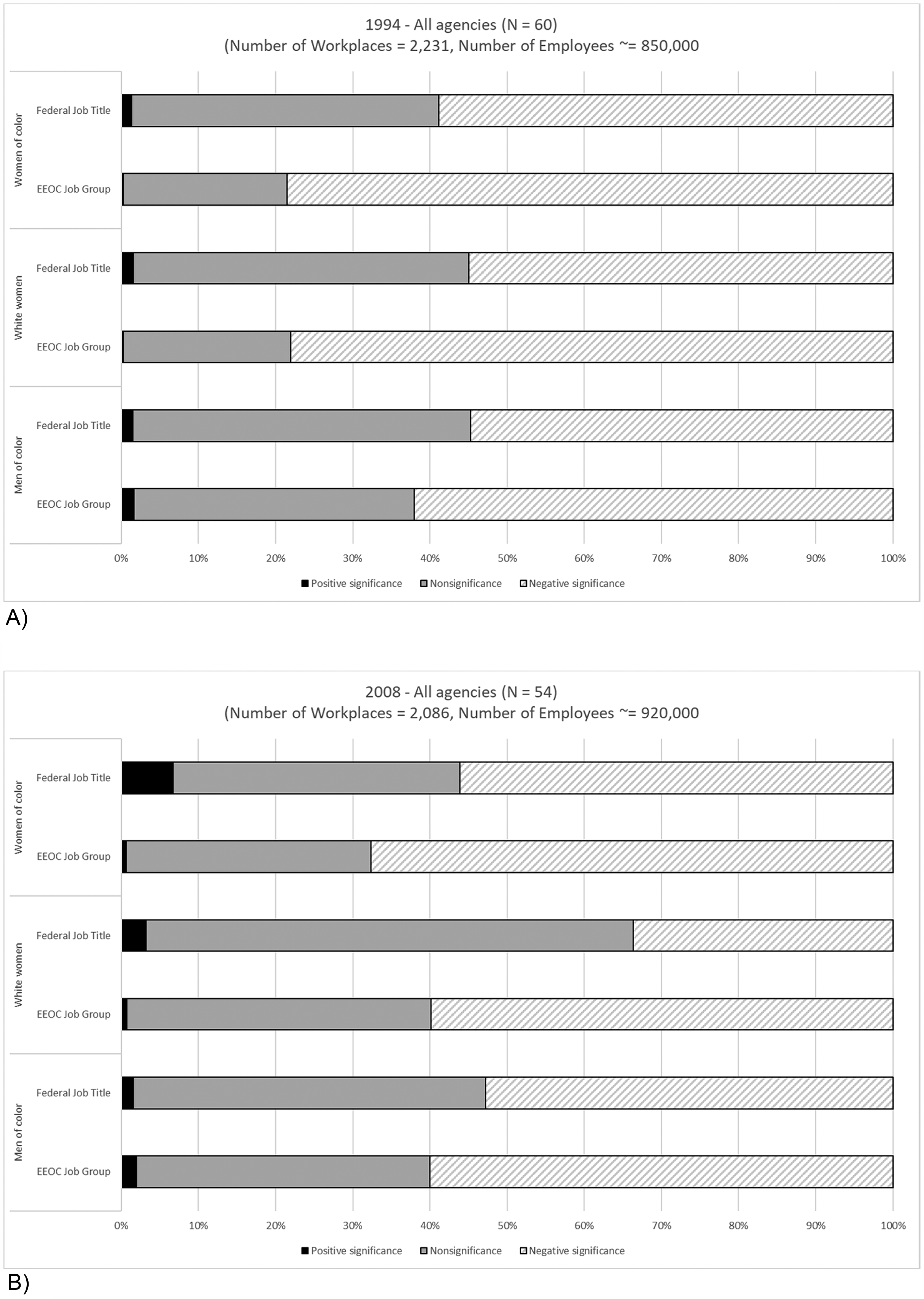
Workplace pay estimates by job models in 1994 (Panel A) and 2008 (Panel B). All models regress logged earnings on education and age dummies. The distributions have been weighted by the number of employees in the workplace.
EEOC Job Group Analyses
Typically, sociologists ask if firms or workplaces have pay disparities. However, when a firm or the EEOC performs a workplace pay gap analysis, they tend to use job titles or job groups as the unit of analysis. The legal and human resource question typically is which jobs have internal pay disparities? Job title analyses under the legal theory framework are common as they match the 1963 Equal Pay Act definition of pay discrimination. Figure 4 replicates the pay disparities analyses shown in Figures 2 and 3, but the level of employment contexts becomes the EEOC job group within workplaces (hereafter EEOC job group analyses). Consistent with the results from organizational and workplace analyses, federal job titles estimated within job groups produced smaller pay disparities compared to EEOC job groups. Also, compared to organizational and workplace analyses, for all intersectional groups, EEOC job groups within workplace models more often approach non-significant pay disparities or even an occasional pay bonus relative to white men. For example, while there were about 43 percent of white women working in workplaces that approached null pay disparities in 1994, this percentage increased to 58 percent in EEOC job group models.
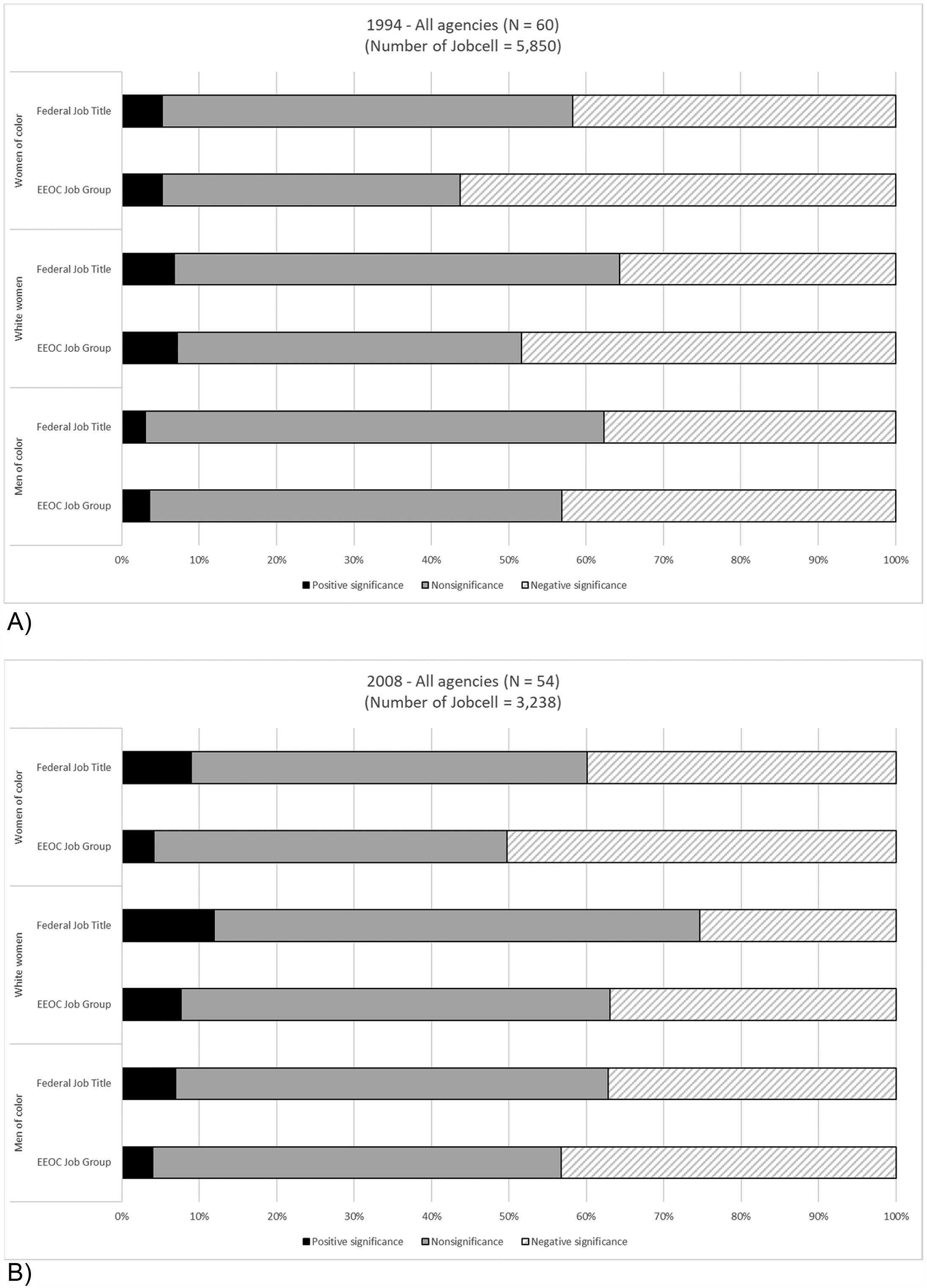
The Equal Employment Opportunity Commission (EEOC) job group pay estimates by job models in 1994 (Panel A) and 2008 (Panel B). All models regress logged earnings on education and age dummies. The distributions have been weighted by the number of employees in EEOC job groups within workplaces.
An important regulatory policy question under the legal theory is if less detailed EEOC job groups lead to different conclusions about pay disparities compared to detailed federal job titles? To answer this question, we use unweighted estimates to investigate how many EEOC job groups within workplaces have consistent or inconsistent disparities between job concepts. Figure 5 illustrates an example with comparisons in 1994 for women of color across the high (public health) and low (veterans affairs) inequality organizational contexts we introduced earlier (see Appendix Table A5 of the Supplemental Material for detailed values).
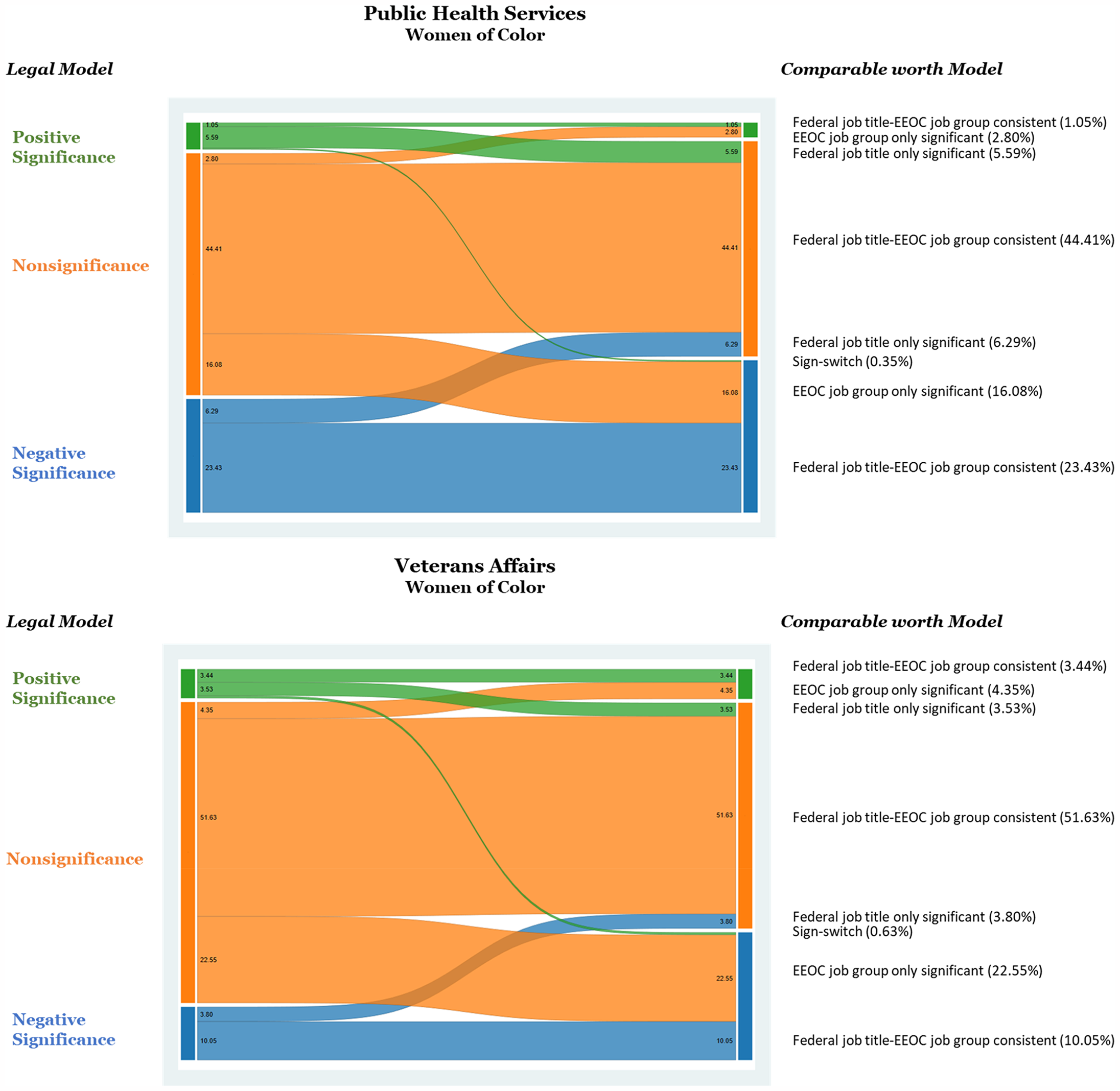
Comparison of women of color's pay gaps relative to white men, federal job titles versus the Equal Employment Opportunity Commission (EEOC) job groups, 1994.
According to Figure 5, the EEOC job group model, which uses only nine occupational categories, reaches the same conclusion (i.e., consistent earnings gap in both comparable worth and legal models) as to significance and sign of the pay gaps between women of color and white men in 69 percent (=44.41 percent + 23.43 percent + 1.05 percent) and 65 percent (=51.63 percent + 10.05 percent + 3.44 percent) of comparisons in Public Health and Veteran Affairs, respectively. EEOC job group only significant pay disparities, where an insignificant pay gap in the job title model is classified as significant with less job group precision (i.e., earnings gap only under comparable worth model), are the most common differences, occurring in 19 percent (= 16.08 percent + 2.80 percent) of job groups within workplaces in high inequality Public Health and 27 percent (22.55 percent + 4.35 percent) in low inequality veteran affairs. Job group null pay disparities accompanying a significant effect in the job title model happen half as often (i.e., federal job title only significant disparities or earnings gap only under legal model), about 12 percent (=6.29 percent + 5.59 percent) of job groups in public health and 7 percent (= 3.80 percent + 3.53 percent) in veteran affairs. There are also in both organizations the rare sign-switch disparities where significant signs switch when moving from federal job title to EEOC job group coding (0.35 percent in public health and 0.63 percent in veteran affairs). Sign-switch disparities are more common when there exists a significant pay bonus for white women and men and women of color in federal job title models (see the comparisons between third green flows in Figure 5 in color).
One of the interesting results in Figure 5 is that there exists a subset of jobs within workplaces in which women of color actually earn significantly more than white men. These jobs are quite rare if we weight by number of employees, but they exist. On the other hand, in most cases, more jobs that show significant pay gaps under less precise EEOC job group codes are non-significant in federal job title models. This pattern of between workplace variation in pay disparities has been pointed out by others using LEED (e.g., Melzer et al. 2018; Tomaskovic-Devey and Avent-Holt 2019), but are under-acknowledged in most stratification analyses. One of the less recognized implications of an organizational-level analysis is that when we drill down to the actual relational context there is much more variation and complexity than is apparent in societal or even organization-wide analyses.
Table 3 presents our summary of inference shifts across employment contexts and job concepts for all intersectional groups. At the organizational level, we observe 100 percent detailed federal job title/EEOC job group consistent statistical inference in terms of pay disparities for all comparisons. However, in workplace—and EEOC job groups within workplace-level analyses, there are more inconsistencies, and in EEOC job groups only statistically significant disparities are the most common. Partly because of the shrinking sample size, federal job title analyses typically will find fewer statistically significant pay gaps. This also explains why there can be relatively large pay gaps organization-wide, even with job title fixed effects, even as many jobs in particular workplaces lack significant internal pay gaps. The role of small sample sizes and the use of statistical tests on population data have long been recognized by social scientists as mistakenly applied and evaluated in pay equity and legal contexts (Bielby and Coukos 2006; Ferree and McQuillan 1998; Hersch and Bullock 2014). At the same time, the increased variation in the direction and magnitude of pay gaps as we move from organization to workplace to EEOC job groups within workplace levels reflects real heterogeneity in the consequences of gender and race for pay. Interestingly, the distributions of types of inconsistency are nearly identical in both workplace and EEOC job group analyses. This may signal that the same actors—local management—are making the decisions as to both job sorting and pay.
Unweighted Summary of Analyses Comparing Federal Job Title and EEOC Job Group Operationalizations of Same Job Concept.
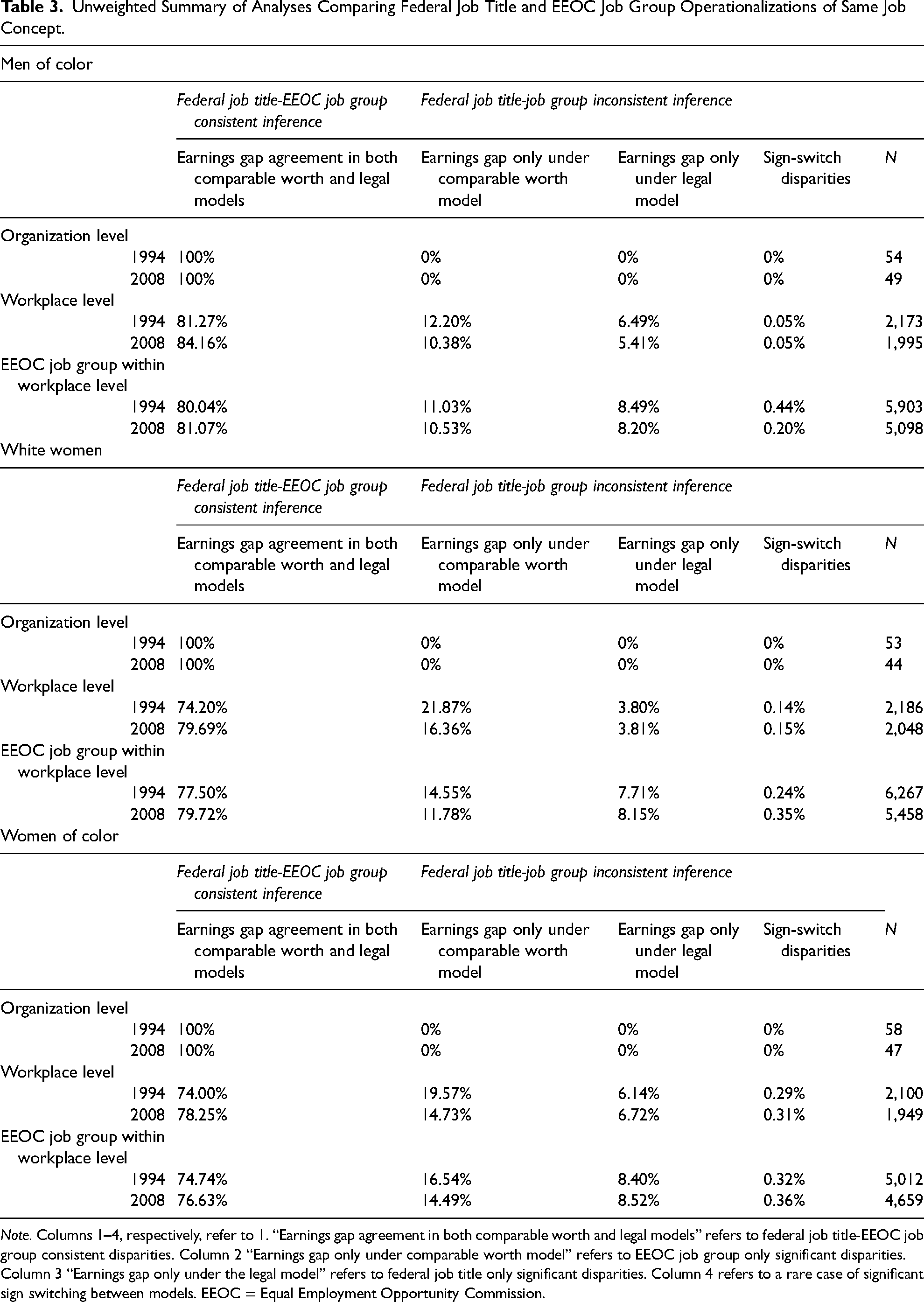
Note. Columns 1–4, respectively, refer to 1. “Earnings gap agreement in both comparable worth and legal models” refers to federal job title-EEOC job group consistent disparities. Column 2 “Earnings gap only under comparable worth model” refers to EEOC job group only significant disparities. Column 3 “Earnings gap only under the legal model” refers to federal job title only significant disparities. Column 4 refers to a rare case of significant sign switching between models. EEOC = Equal Employment Opportunity Commission.
Table 4 allows us to summarize estimated magnitude shifts across different job concept models and across employment contexts. There are three main findings. First, the differences in estimated pay gaps are consistently negative (i.e., within EEOC job group pay inequalities are larger than within federal job title pay inequalities) and smaller in 2008 than in 1994. Second, the magnitude shifts are highest at the organizational and workplace levels and much lower at the EEOC job group within the workplace level. This pattern is particularly salient for men of color, but also for white women and women of color when comparing the differences in workplace and EEOC job groups within workplace levels. Third, at all levels, the variation in magnitude shifts is relatively large relative to average magnitude shifts, and this variation grows strongly as we move from organization to workplace to EEOC job group employment contexts, suggesting much more heterogeneity in the EEOC job group within workplace employment context.
Distributions of Differences in Estimated Pay Gaps Relative to White Men in Federal Job Title Versus EEOC Job Group Models. Mean (Standard Deviation of Estimates Across Employment Units).
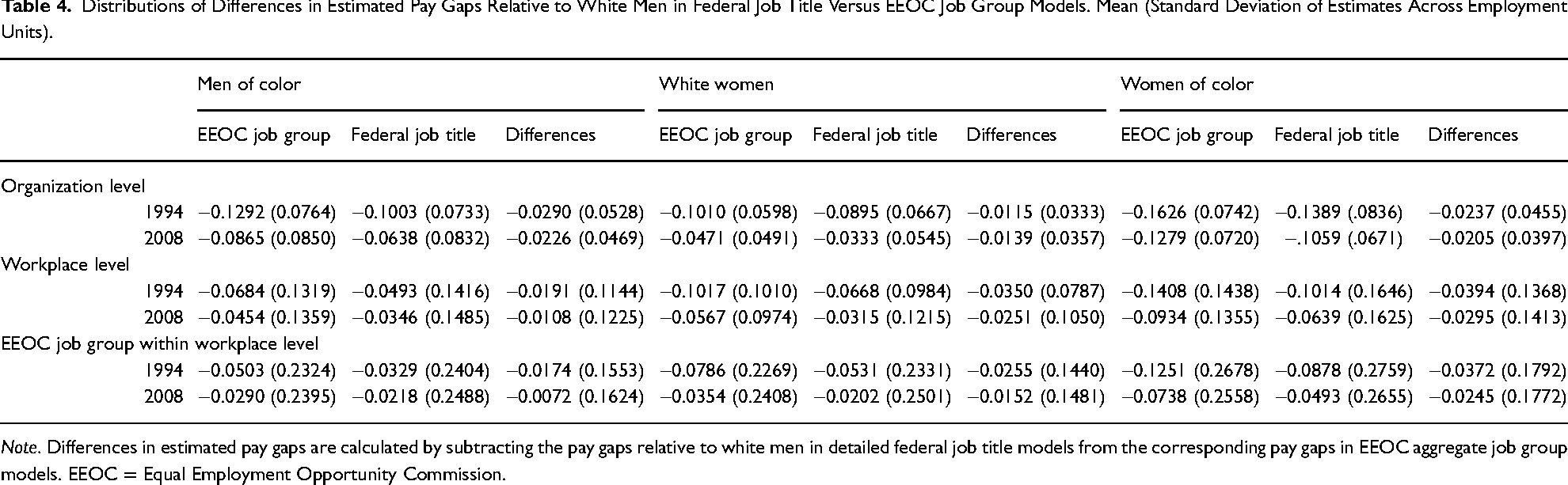
Note. Differences in estimated pay gaps are calculated by subtracting the pay gaps relative to white men in detailed federal job title models from the corresponding pay gaps in EEOC aggregate job group models. EEOC = Equal Employment Opportunity Commission.
In Appendix Figures A2–A4 of the Supplemental Material, we plot the correlations between the estimated within EEOC job group and within federal job title pay inequalities, with a 45-degree line referring to an agreement between the two estimates. The scatterplots show strong positive correlations between within EEOC job group and within federal job title pay inequalities with few outliers regardless of organization, workplace, or EEOC job group levels. At the organizational level, we did find that more estimates fall below the 45-degree lines, meaning that federal job title estimates produce smaller pay disparities relative to the less detailed EEOC job groups. At the workplace and EEOC job groups within workplace levels variation in estimates is more nearly random.
We also examine the top and bottom 10 units which show the largest and smallest EEOC job group pay penalties, as well as their corresponding within federal job title pay inequalities (Appendix Tables A6–A9 of the Supplemental Material). In the workplace and EEOC job group within workplace contexts, we find that if the EEOC job group estimate is a large gap, the federal job title model produces estimates that 90 percent of the time are significant and in the same direction. They correspond much less often when the EEOC estimates are small and significant. Thus, under the legal theory of pay disparities EEOC style large class job codes can be misleading for small estimated pay gaps, but are typically useful indicators of disparity when estimated pay gaps are large. The large relative earnings differences in geometric means correspond closely to large relative differences in arithmetic means in our analyses.
Conclusions
While the U.S. gender pay gap declined rapidly from 1970 to the early 1990s, the movement toward pay equality between men and women has since largely stalled (England, Levine, and Mishel 2020). U.S. racial pay gaps declined steeply until 1980, slowly for the next 20 years, but have actually increased after the turn of this century (Mandel and Semyonov 2016). Understanding the sources of pay inequalities remains a strong focus in sociology and economics, as well as in public debates. A profound limitation of most previous research was the inability to locate earnings analyses in the actual workplaces that hire, segregate, and pay people. This is now changing and social scientists increasingly have access to LEED, allowing us to develop insights on both organizational inequality processes conceptualized through the lenses of social science and practical application to human resource and regulatory policy.
In terms of our core focus on the utility of job concept detail for pay disparity analyses, we can reach some strong conclusions. In general, compared to actual job titles the use of less detailed job group operationalizations will estimate larger pay gaps. This shift in measurement is unlikely, however, to lead to different inferences at the organizational level, but becomes increasingly important when moving to the workplace and job group within workplace levels. Even at these levels, more coarsened job information will lead to consistent inferences under the legal theory of pay discrimination three-quarters or more of the time. Moreover, when coarsened jobs display large significant pay gaps they are nearly always significant in job title estimations.
Whether or not estimation differences are problematic does not depend on the estimation model or even the operationalization of jobs, but on the theory under which the models are developed and the choice of empirical estimands. Under the legal theory of discrimination, less precise job measures will lead to inflated estimates of earnings inequalities, particularly in low-inequality contexts. This is not the case, however, under a comparable worth theoretical framework. Importantly, while comparable worth largely failed in the courts to become a compelling legal theory (England 1992), it is this conceptualization which is closest to contemporary practices in the social sciences.
On the other hand, previous work does not consistently theorize the relationships between theoretical estimands, empirical estimands, and eventual estimates. More precise theoretical statements and empirical linkages are normally worth making. The same can be said about explicitly recognizing the choice between organizations (Schneider and Harknett 2022) and workplaces (e.g., Avent-Holt et al. 2020) as the causal decision-making unit responsible for pay setting.
It is also important to point out that the legal and comparable worth theoretical frames are not the only possible frames for analyzing pay disparities. Smith-Doerr et al. (2019) proposed that employers are also the key causal agents at the point of hire and so also the primary decision-makers responsible for group differences in human capital among their employees. Under this model, total pay gaps should be decomposed into hiring differences, segregation, and within-job pay gaps, all of which are primarily driven by employer decisions. Although they are not explicit as to the appropriate employment level, their models are estimated at the organization level, implying that organizational leadership are ultimately responsible for organizational inequalities.
In this article, we used the standard analytic focus on logged earnings to establish pay disparities. Pay disparities are thus being measured in terms of differences in geometric means which have some desirable statistical qualities, particularly adjusting for skewed population earnings distributions. In the real world, we are typically interested in arithmetic, not geometric, mean differences. As we move from population estimates of pay gaps to workplace-specific estimates we may need to rethink what the standard model should be. At the workplace level earnings distributions are unlikely to have the same right skew we see in population distributions. It might be time to consider moving back to unlogged earnings analyses when the focus is on workplace-specific pay disparities (Hodson 1985; Petersen 2017).
Our contribution to regulatory policy suggests that the focal unit of employment contexts is quite important for making inferences about bias processes. When the unit is entire organizations pay gaps are much more likely to be observed than when they are workplaces or jobs. This represents the presence of many non-significant pay deficits relative to white men in workplaces and especially job groups within the workplace, which when aggregated to the organizational level suggest that bias processes are operating, but are too subtle or sample sizes too small to support strong statistical inferences at lower levels of aggregation. At the same time, inferences about the presence of disparities at the workplace and job levels are fairly consistent, suggesting that pay equity type analyses aggregated to the workplace level, the level where most employment decisions are made, could be preferred depending on the legal theory of culpable decision making. If unified management is the governing theory then workplace level estimates are more appropriate. If dispersed within workplace management is where decisions are actually made, then job groups within workplace analyses may be more appropriate.
The legal framework focuses on earnings gaps within job titles and is used in most pay equity analyses in workplaces and courtrooms. One could, however, decide to privilege coarsened job groups when attempting to advance gender and racial equity, consistent with the more expansive comparable worth standard. Some pay equity studies include “job group” analyses, which combine similarly skilled jobs. This approach corresponds more closely to a comparable worth theory, suggesting that paying similarly skilled jobs differently is a potential basis of discrimination (England 1992; Petersen and Saporta 2004). Job group analyses are also more appropriate if a firm wants to actually reduce inequalities between demographic groups, rather than simply generate a defense against legal threats. If we treat the EEOC job group measure as an operationalization of a comparable worth approach to pay equity, then we will conclude that there are more jobs and workplaces with significant gender and racial pay gaps.
Finally, the EEOC collected pay data in 2017 and 2018 using their nine-category occupational distinctions (National Academies of Sciences 2022). Our estimates based on the EEOC classification suggest that somewhere between three-quarters and four-fifths of the time this level of aggregation will mirror the inference that would have been found with job title information. The larger the EEOC job group estimated pay gap the more likely that significant disparities will be found in an investigation where job title information is available. While job title information is preferable under a legal framework, simpler job group distinctions may be sufficient for preliminary investigations of pay equity disparities, if not for reaching legal conclusions of discrimination. Certainly, outlier workplaces with large pay disparities using EEOC job groups are likely to have significant within-job pay disparities and might be targeted for investigation. For firms that want to proactively reduce pay disparities, or if the EEOC were to attempt to expand the legal definition of discrimination to include treating similarly skilled workers differently, the job group analysis implied by a comparable worth model (England 1992) might be more appropriate. In that case, more aggregate job groupings such as those used by the EEOC might be ideal.
Supplemental Material
sj-docx-1-smr-10.1177_00491241251334124 - Supplemental material for Conceptualizing Job and Employment Concepts for Earnings Inequality Estimands With Linked Employer-Employee Data1
Supplemental material, sj-docx-1-smr-10.1177_00491241251334124 for Conceptualizing Job and Employment Concepts for Earnings Inequality Estimands With Linked Employer-Employee Data1 by Donald Tomaskovic-Devey and Chen-Shuo Hong in Sociological Methods & Research
Footnotes
Data and Code Availability

Declaration of Conflicting Interests
The author(s) declared no potential conflicts of interest with respect to the research, authorship, and/or publication of this article.
Funding
The author(s) disclosed receipt of the following financial support for the research, authorship, and/or publication of this article: This work was supported by the W. K. Kellogg Foundation (grant number P-P0132801-2020).
Notes
Author Biographies
References
Supplementary Material
Please find the following supplemental material available below.
For Open Access articles published under a Creative Commons License, all supplemental material carries the same license as the article it is associated with.
For non-Open Access articles published, all supplemental material carries a non-exclusive license, and permission requests for re-use of supplemental material or any part of supplemental material shall be sent directly to the copyright owner as specified in the copyright notice associated with the article.
