




Abstract
Trust is a foundational concept of contemporary sociological theory. Still, empirical research on trust relies on a relatively small set of measures. These are increasingly debated, potentially undermining large swathes of empirical evidence. Drawing on a combination of open-ended probing data, supervised machine learning, and a U.S. representative quota sample, our study compares the validity of standard measures of generalized social trust with more recent, situation-specific measures of trust. We find that survey measures that refer to “strangers” in their question wording best reflect the concept of generalized trust, also known as trust in unknown others. While situation-specific measures should have the desirable property of further reducing variation in associations, that is, producing more similar frames of reference across respondents, they also seem to increase associations with known others, which is undesirable. In addition, we explore to what extent trust survey questions may evoke negative associations. We find that there is indeed variation across measures, which calls for more research.
Keywords
Introduction
Generalized social trust is one of the fundamental concepts in contemporary social theory (Coleman 1994; Herreros 2004; Putnam, Leonardi, and Nanetti 1994; Schilke, Reimann, and Cook 2021; Smith 2010; Sztompka 1999; Uslaner 2002) and scholarly interest in this concept has grown alongside the increasing number of studies on social capital and social cohesion, as trust is considered a main indicator of these concepts (Larsen 2013; Portes and Vickstrom 2011; Van Deth 2003). Consequently, empirical research investigating the causes and consequences of trust has multiplied (Buskens and Weesie 2000; Cook and Cooper 2003; Dinesen 2012; Dinesen, Sonne Nørgaard, and Klemmensen 2013; Dinesen and Sønderskov 2015; Sønderskov 2011). At the same time, the underlying empirical research program relies on a relatively small set of established survey measures, some of which date back to the 1940s. In recent years, we have seen a growing debate about the validity of these measures, particularly regarding their ability to capture the same concept across all individuals (Bauer and Freitag 2018; Delhey and Newton 2005; Delhey, Newton, and Welzel 2011; Ermisch et al. 2009; Nannestad 2008; Robbins 2019; Sturgis and Smith 2010; Torpe and Lolle 2011).
Our study aims to address this debate by investigating the validity of survey measures of generalized social trust. In doing so, we make several contributions to current research. First, we evaluate three classic trust measures in a U.S. sample, thus extending previous work that examined fewer measures using data from the United Kingdom (Sturgis, Brunton-Smith, and Jackson 2019; Sturgis and Smith 2010). All three measures have been used to measure generalized social trust, specifically trust in unknown others (Sønderskov 2011; Uslaner 2002). The first measure is known as the “most people question” (Rosenberg, 1956), which poses the query “Generally speaking, would you say that most people can be trusted, or that you can’t be too careful in dealing with people?”. The second measure, referred to as the “people first time question” (e.g., Torpe and Lolle 2011), asks respondents about their level of trust in people they meet for the first time. Both of these measures have been established and utilized in numerous large-scale surveys. In contrast, what we call the “stranger question” (Robbins 2019, 2021), which is “Imagine meeting a total stranger for the first time. Please identify how much you would trust this stranger” is a more recent alternative and hopeful contender, expected to alleviate some of the problems that appear to characterize the former two. Our study revolves around exploring the validity of these three measures and scrutinizing whether they genuinely measure trust in unknown others, thus identifying possible measurement errors that might influence estimates of trust levels. To achieve this, we designed a survey experiment in which the different measures were randomly assigned to respondents. Our main findings are derived from using open-ended questions that ask about respondents’ frames of reference, what we call associations, underlying their response.
Second, we contrast classic measures of generalized social trust with situative measures of trust. Such measures differ from the classical ones in that they specify a more refined trustee category (e.g., “most people” is replaced with “stranger”) as well as some behavior at which the expectation is directed (e.g., “keeping a secret”). Ideally, such measures are able to provide a higher degree of interpersonal comparability since they leave less room for different interpretations by the survey respondents. We are the first to probe such measures and provide evidence on whether validity and comparability increases when these measures are used.
Third, we explore the sentiment of associations, a dimension that has been neglected so far in trust research. Theory assumes that trust in known others is higher due to effects of in-group bias and reciprocity (Vollan 2011), which is supported by empirical evidence (e.g., Bauer and Freitag 2018; Sturgis and Smith 2010). However, independently of whether respondents refer to known or unknown others, associations may also vary in terms of their sentiment, for example whether they are positive or negative.
Fourth, we extend the methodological toolbox that is used to evaluate the validity of survey measures, using a combination of open-ended probing questions (e.g., Behr et al. 2012, 2017; Meitinger and Kunz 2022; Neuert, Meitinger, and Behr 2021) and automated text analysis (e.g., Schonlau and Couper 2016). The data we labeled and the resulting supervised classifiers we built are suitable for future applications.
Theory, Hypotheses, and Previous Research
Associations With Known and Unknown Others
Generalized social trust is often referred to as trust in the generalized other and can be described as trust in individuals who are unfamiliar or unknown (Sønderskov 2011; Stolle 2015; Sturgis and Smith 2010; Uslaner 2002:52). Stolle (2015) for example emphasizes the need to distinguish the scope of generalized trust from trust toward people one personally knows (Stolle 2015:398). Notably, other accounts have chosen to expand the concept of generalized or social trust trust to encompass a wider range of trustees, such as trust “in people in general” (Yamagishi and Yamagishi 1994:146), or as trust in the “average person [one] meets” (Coleman 1994:104). Our study, however, uses the understanding of generalized trust that stresses the difference between generalized and particularized trust. Particularized trust is defined as “[…] trust found in close social proximity and extended toward people the individual knows from everyday interactions” (Freitag and Traunmüller 2009:784), including family members, friends, neighbors and co-workers (Freitag and Traunmüller 2009:784) (i.e., known others), whereas generalized trust encompasses “[…] those beyond immediate familiarity, including strangers” (Freitag and Traunmüller 2009:784) (i.e., unknown others). In this study, we argue that when conceptualizing generalized trust, it should ideally be measured as trust towards unknown others.
Currently, the measurement of trust primarily relies on survey questions, although behavioral measures and their combination with survey measures have gained popularity (Barr 2003; Ermisch et al. 2009; Ermisch and Gambetta 2010; Fehr et al. 2002; Naef and Schupp 2009). Various different questions are used in different large-scale surveys. Undoubtedly, the standard measure is the so-called “most people question” which inquires whether most people can be trusted. Different versions of this question were used in thousands of influential studies and underlying surveys, such as the General Social Survey, the World Values Survey or the European Social Survey.
However, the measurement of trust using the most people question has been subject of many debates (cf. Bauer and Freitag 2018) regarding various aspects, such as scale length or balance (Lundmark, Gilljam, and Dahlberg 2016), and the frames of reference employed by respondents when answering it (Delhey, Newton, and Welzel 2014; Nannestad 2008; Sturgis and Smith 2010). These frames of reference, what we call associations, are important as they are linked to the conceptual validity of a measure. Conceptual validity increases when the respective survey questions capture generalized trust without specification or measurement error. Figure 1 depicts our main argument regarding these associations.
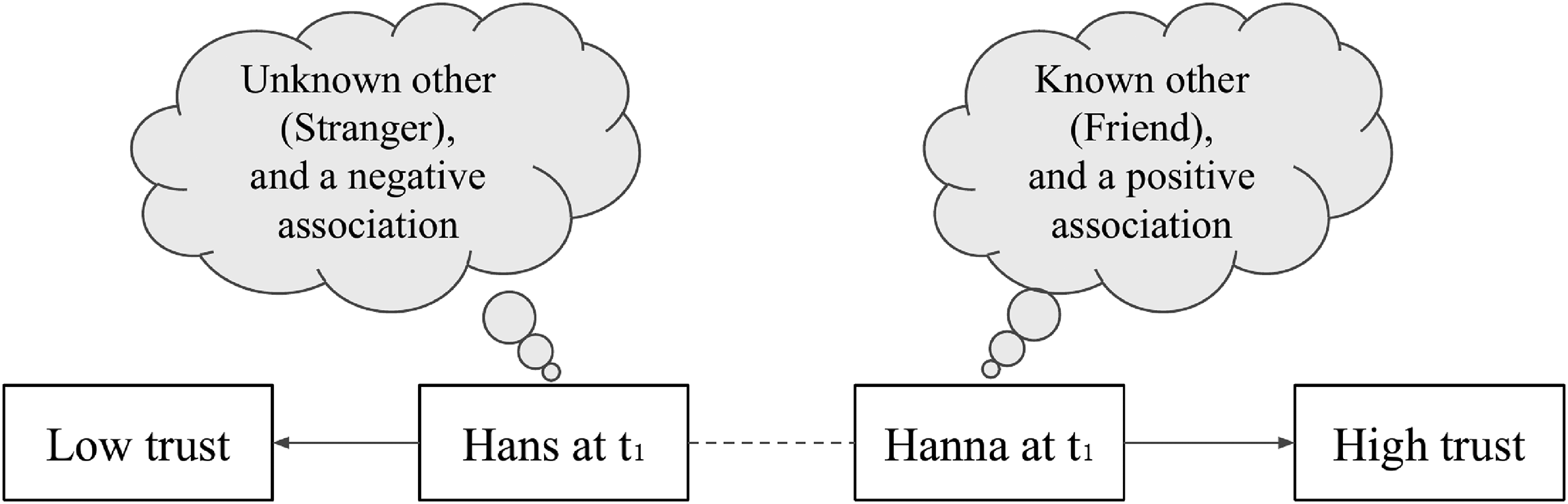
Variation in associations and trust measurement values.
When employing trustee categories such as “most people” in standard trust measures, it is probable that distinct associations may arise among different respondents. For instance, in the illustrated example presented in Figure 1, respondent Hanna envisions a friend, while Hans envisions a stranger when answering the corresponding survey question. This scenario highlights the ongoing debate on equivalence and whether the concepts in the questions are uniformly interpreted by all respondents (Bauer and Freitag 2018). Consequently, due to these varying associations, Hanna’s response reflects particularized trust, resulting in a specification error, while Hans’s response more closely aligns with the notion of the generalized other. These differences in associations can lead to divergent responses on the trust scale between two individuals (e.g., Hans and Hanna) or even within the same individual at different points in time (depicted by the dashed line in Figure 1).
Given that the conceptual definition of generalized (and particularized) trust refers to the distinction between known and unknown others, our study aims to identify the associations arising from the specific wording of survey questions. Empirical evidence in that direction is given by Sturgis and Smith (2010). In examining the most people question using think-aloud probing, they describe six higher-order topics they found respondents to associate with the term “most people.” The two largest categories they found by manually classifying responses to their probing question were “known others” (42 percent) and “unknown others” (22 percent). 1 In a similar approach, Bauer and Freitag (2018) surveys student samples from Switzerland using a probe that asks respondents who they had in mind when answering the most people question. The open-ended text answers reveal that “respondents do not necessarily tend to think of strangers or people that are unknown to them. Many think of situations (e.g., meeting someone in the train/street) or of people they know (e.g., friends, family members, etc.)” (Bauer and Freitag 2018:9). Lastly, Uslaner (2002:72-4), as part of the 2000 ANES Pilot Survey, investigated the most people question via think-aloud techniques and showed that 58 percent of the respondents referred to a “general worldview” while 23 percent mentioned “personal experiences.” While personal experiences do not necessarily involve known others, the 2002 ANES data was also coded into more fine-grained categories by Johnson (cf. ANES 2000): 8 percent of respondents referred to family members, 11 percent to co-workers, and 12 percent to neighbors.
The present study compares three established measures of generalized social trust, the “most people question” (M1), the “people first time question” (M2), and the “stranger question” (M3). Next to M1, M2 is the second most common generalized trust measure used in many large-scale surveys, such as the World Values Survey or the Socio-Economic Panel in Germany. M3 is a more recent measurement approach, which is not yet part of larger surveys, and was developed with the aim that respondents imagine strangers in their answer (Robbins 2019, 2021). Our particular interest for each of these measures lies in the proportion of respondents who think of personally known others (short: known others), when answering expressed as
Additionally, following Sturgis and Smith (2010), we also expect that individual associations with known others positively influence trust scores (H2) across all three measures. For instance, when calculating the aggregate mean level of trust,
Negative Associations
While trust research regularly discusses the impact of experiences on trust (Brehm and Rahn 1997; Cao, Galinsky, and Maddux 2014; Dinesen 2010; Freitag and Traunmüller 2009; Glanville, Andersson, and Paxton 2013; Glanville and Paxton 2007; Uslaner 2002), studies about trust measurement have neglected this dimension. On average, trust in known others is higher (Bauer and Freitag 2018; Sturgis and Smith 2010; Vollan 2011)—as is also evidenced by measures that directly gauge trust in family members, neighbors, etc. (Freitag and Traunmüller 2009; Nannestad 2008). Theoretically, however, this does not always have to be the case. In fact, some of the more important betrayals of trust in our lives may happen through people we know. For instance, a close friend may spill our secrets or a family member may fail to return a loan. Referring to Figure 1, Hans’s response may be based on a negative association as opposed to Hanna’s response. Put differently, we may collect negative (or positive) experiences with known others just as we may collect negative (or positive) experiences with unknown others, that is, strangers. Independently from whether a trustee is known or unknown, individual associations that emerge when answering survey questions may vary in terms of their sentiment. Hence, we also want to measure the proportion of respondents who have negative associations, expressed as
Again, the share of negative associations may depend on the measure we use. Since M2 (in contrast to M1) explicitly asks respondents to think of first-time encounters (“people you meet for the first time”), we expect that this question wording may evoke more negative associations than the most people question. This could be either because respondents remember past first-time interactions that turned out to be negative and/or because we are generally taught to be careful in first-time encounters. M3, then, explicitly specifies the trustee as a stranger. The term “stranger” has a rather negative connotation in English compared to the more neutral terms “people” or “person.” “Stranger danger” describes the idea that all strangers can potentially be dangerous. In countries such as Great Britain, stranger-danger education often conducted by local police force has the objective to teach children to refuse offers from strangers (Moran et al. 1997:11). Postulating H1, we assume that M2 and M3 result in higher conceptual validity (i.e., lower share of associations of known others) which is desirable. However, finding that M3 or M2 in comparison to M1 result in more negative sentiment would be undesirable as it could indicate that using concepts such as “stranger” in M3 affects respondents’ mindset.
We hypothesize that changing trustee categories (most people
Situative Trust Measures
Empirical operationalizations of generalized trust, for example, M1–M3, depict trust as a “one-part relationship, where neither B [the trustee] nor
The measures we investigate (M4.1–4.4) follow this conceptual work and include the context in which a trust decision takes place. This context entails two components, the trustee category, and the trustee’s expected behavior in a certain situation. Importantly, the decision to trust in situation A may not carry over to situation B (Ermisch and Gambetta 2010:4) even though both situations involve the same trustee. We argue that situative trust measures may be able to solve some of the problems that characterize the vaguer standard measures of generalized trust. Since the latter do not specify either of the two components of context, respondents may simply fill in such specifications themselves.
Our study investigates situative trust measures introduced by Robbins (2019, 2021). These novel measures are based on the stranger question (M3) because they specify the trustee to be a stranger (cf. M3) (see Buskens and Weesie 2000; Yamagishi and Yamagishi 1994; Yuki etal. 2005 for similar approaches). Further, they specify the expected behavior of the trustee, namely keeping a secret (M4.1), repaying a loan (M4.2), providing advice on managing money (M4.3), and looking after a child/family member/loved one (M4.4). Unlike the stranger question (M3) that allows for varying interpretations by respondents, these situative measures provide a more specific context, leaving less room for ambiguity. This avoids situations where different respondents envision different scenarios, potentially leading to varying trust values (cf. Figure 1). Analogous to H1, we hypothesize that by specifying the trustee as a total stranger, as opposed to most people or people you meet for the first time, the proportion of respondents associating trust with known people (
Data, Experimental Design, and Methods
Sample
Our target population are U.S. citizens. Data was collected using a two-stage non-probability sample recruited by Prolific, a participant recruitment and payment software to conduct online surveys and experiments (Palan and Schitter 2018). First, respondents were identified to be eligible according to quotas on self-reported gender, age, and ethnicity in accordance with the U.S. Census Bureau population group estimates from 2015.
3
Second, out of 43,131 panelists that were considered eligible, we continued to collect data until our target and final sample size of n=1,500 was reached. Respondents who did not complete the questionnaire (n=87, i.e., overall response rate of 95 percent) were excluded and replaced with other panelists who would fit the quotas. Summary Statistics for all variables and their comparison to population estimates can be found in Online Appendix A.1. The survey was fielded between July 14, 2021, and July 21, 2021. For each completed survey, we paid a wage of
Experimental Design and Measures
Our questionnaire design is depicted in Table 1. Respondents provided their data via an online self-administered survey (created using formR, cf. Arslan, Walther, and Tata 2020). The survey started with information on its objective and a consent form. Subsequently, respondents received two blocks of questions. Block #1 included the standard generalized trust measures with respective probing questions and Block #2 included situative trust measures with respective probing questions. Since we wanted to avoid priming effects (meaning subsequent answers might be influenced by previous questions) we used an experimental design in which the order of questions is randomized. Specifically, the order of Blocks #1 and #2 as well as the question order within these blocks was randomized. This design allows us to conclude that the differences we find between the trust measures for the outcomes we examined (i.e., the proportion of associations that refer to known individuals or are negative) are actually due to the wording of the question and not to the order of the questions.
Experimental Design.
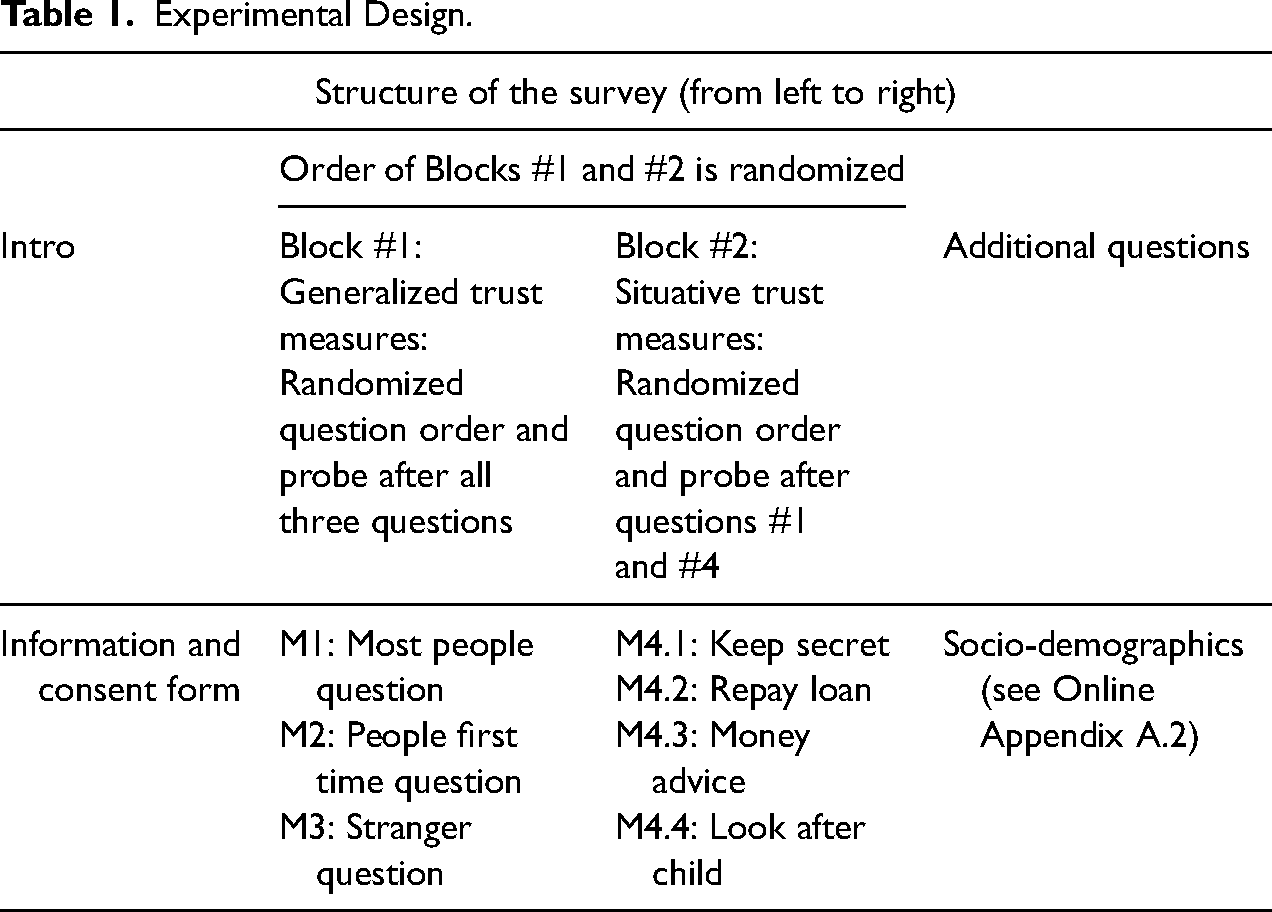
Furthermore, data collected with this questionnaire allows for within- and between-person comparisons for each variable because each respondent received all available trust questions in Blocks #1 and #2 in a randomized order. To allow further examination of the role of question order despite the introduction of random question order, we can consider two data subsets: Subset 1 only includes respondents’ responses to the first trust question they received (ignoring the order of the blocks) and is called “first question only” below; Subset 2 includes respondents’ responses to the first trust question from the first block only and is called “first question and first block only” below. While there might still be priming from the preceeding block for Subset 1, this possibility should be excluded for Subset 2.
Block #1: Generalized trust measures and probing questions
In Block #1, we assessed generalized trust using three established measures: trust towards “most people” (M1), “people you meet for the first time” (M2), and “a total stranger you meet for the first time” (M3). These measures had different response categories: 7-, 4-, and 4-point scales for M1, M2, and M3, respectively. To ensure comparability, we employed min–max normalization, which rescales the responses to a range between 0 and 1 while preserving the original distribution. We treat the resulting variable as continuous for all our analyses. 4 The specific phrasing as well as summary statistics of these questions can be found in Online Appendices A.1 and A.2. Directly after respondents answered these closed-ended questions, each was followed by an open-ended probing question using the following wording (exemplary for M1): “In answering the previous question, who came to your mind when you were thinking about ‘most people’? Please describe.” Our specific interest here is to elicit who respondents had in mind when they were exposed to the three different trustee categories. 5
Block #2: Situative trust measures and probing questions
Block #2 included four situative measures that represent the Imaginary Stranger Trust (IST) scale developed by Robbins (2019, 2021, 2022). These measures specify the trustee category as well as the content of the trust relationship, overall aiming to reduce the vagueness we argued to find for the standard generalized trust measures from Block #1. The four items elicit trust in a total stranger met for the first time to, 6 (1) “keep a secret that is damaging to your reputation” (M4.1), (2) “repay a loan of one thousand dollars” (M4.2), (3) “provide advice about how best to manage your money” (M4.3), and to (4) “look after a child, family member, or loved one while you are away” (M4.4). Each of these items was rated on a 4-point scale. We applied min–max normalization to rescale these items to a range between 0 and 1.
Again, the question order was randomized. Analogous to Block #1, the situative measures were also probed using the following wording: “In answering the previous question, who came to your mind when you were thinking about ‘a total stranger you meet for the first time’? Please describe.” To avoid memory effects as well as errors due to response fatigue, we only probed the situative measures that were randomly assigned to come first and fourth.
Methods
Table 2 illustrates the structure of our data. Due to the intra-person design, there are multiple (i.e., seven) measures of trust (indicated by the column
Illustration of Exemplary Data.
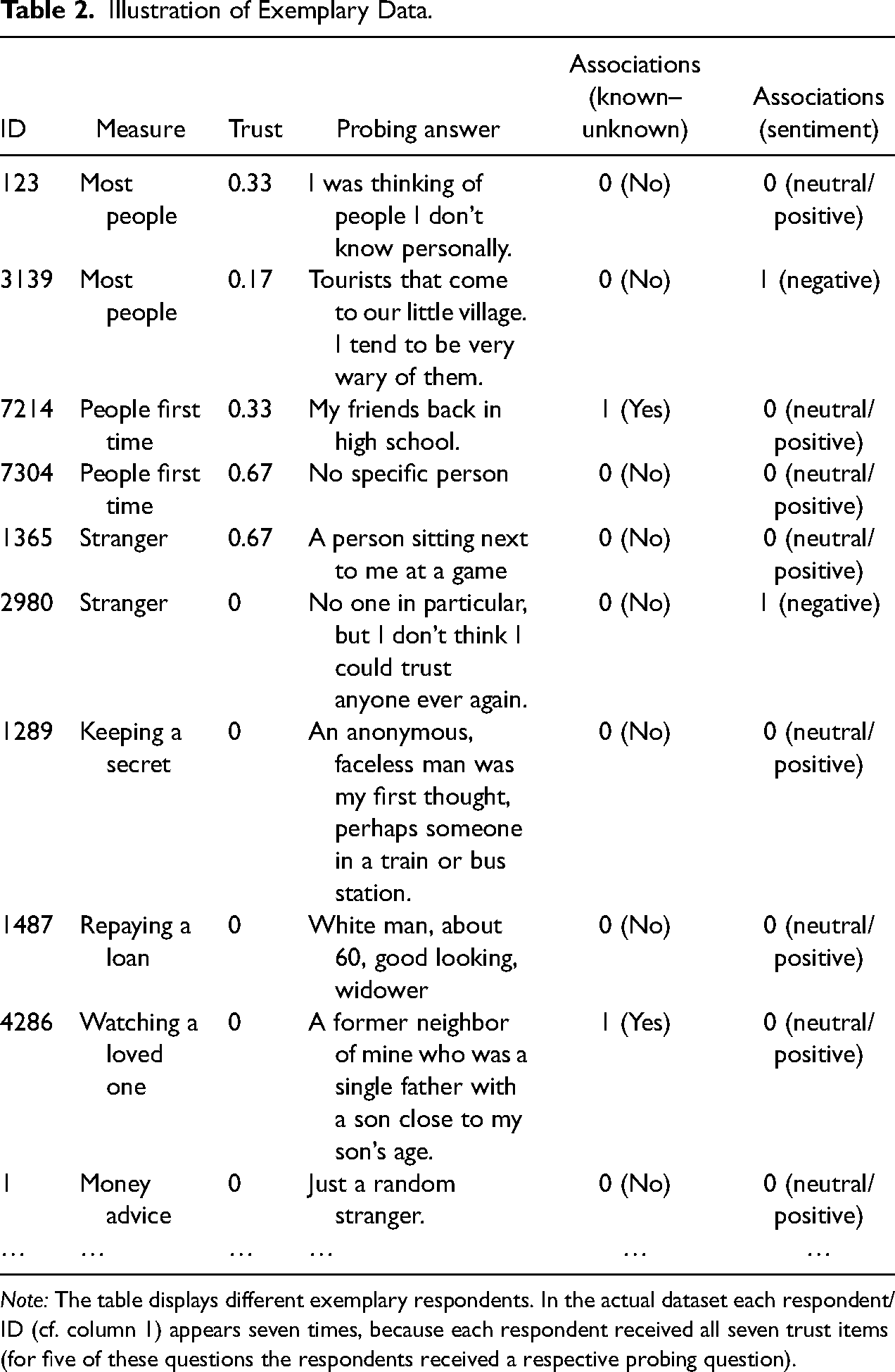
Note: The table displays different exemplary respondents. In the actual dataset each respondent/ID (cf. column 1) appears seven times, because each respondent received all seven trust items (for five of these questions the respondents received a respective probing question).
Both classifications (i.e., known–unknown and sentiment) were achieved using automated text analysis, which in survey data research has become a popular alternative to manual coding (Esuli and Sebastiani 2010; Giorgetti and Sebastiani 2003; Gweon and Schonlau 2023). In particular, we pursued a supervised classification approach in which randomly sampled subsets of text answers were manually labeled and only the remainder were automatically classified using fine-tuned BERT models.
For the known–unknown classification, we manually labeled a sample of n = 1,000 text answers, while for the sentiment classification, we increased this number to n = 1,500. 8 Both samples were a random selection of text answers from the generalized trust measures (see Online Appendix A.5.2 for further details). Based on previous implementations in the literature, we argue that these sample sizes are sufficiently large. 9
Both manual classification tasks were achieved using a hand-crafted coding scheme. For both schemes, the main distinction lies between two categories. In the known–unknown classification, category 0 was assigned when respondents mentioned individuals or groups of individuals that can be identified as “unknown others” in their text answer. Importantly, our primary focus was on identifying respondents’ personal unfamiliarity with these individuals or groups, and not on the specific characteristics of these individuals/groups. For example, an answer that describes personally unknown others that have rather specific characteristics (i.e., tourists in ID 3139 in Table 2 falls into category 0). 10 Code 1, on the other hand, subsumes all statements that made mentions of “others known” to the respondent. Survey answers that had no references to either known or unknown others (e.g., “just people as a whole”) were coded as 0, and survey answers with mixed references to both known and unknown others (e.g., “People I may run into everyday”) were coded as 1. To label sentiment, the main distinction lies between “negative sentiment” (code 1) and “neutral or positive sentiment” (code 0). Online Appendix A.4 provides an overview of the coding schemes with examples and descriptions of all available codes.
The manual classification was carried out by three independent coders. All three coders assigned codes to the same 1,000/1,500 text answers, and conflicts were resolved by finding consensus between the coders or using majority vote.
For the remainder of text answers (i.e., n = 6,500/6,000), we fine-tuned the weights of two bidirectional encoder representations from transformers (BERT) models (BERT base model uncased version), using the manually coded data (n = 1,000/1,500) as training data. BERT (Devlin et al. 2019) is an empirically powerful machine learning technique that can be used for various natural language processing tasks (Devlin et al. 2019:1). BERT comes with two attributes that are of special importance here: first, it is able to model contextual representations by incorporating both the left and right context of a document (i.e., bidirectional). Second, BERT provides pre-trained vector representations for words by using a deep, pre-trained neural network. These so-called embeddings suggest a representation for each term based on its context by using information from the entire input sequence. For our data, this could mean, for example, that terms that appear in the (pre-trained) context of “family,” for example, brother and sister, are likely to be predicted as “known other.” Last but not least, by using BERT, we aim at addressing the class imbalance that is present in our sentiment data insofar as few respondents (8.7 percent) have negative associations. BERT achieves higher class-wise accuracy in the presence of class imbalance than other ngram-based machine learning techniques (Gweon and Schonlau 2023), and is further demonstrated to remove the need to use data augmentation techniques to mitigate problems of imbalanced data (Madabushi, Kochkina, and Castelle 2020). 11 Importantly, the imbalanced data structure and its consequences does not call into question the effects we found but may have resulted in their slight underestimation. Online Appendix A.5.2 shows our findings when using the manually classified data only.
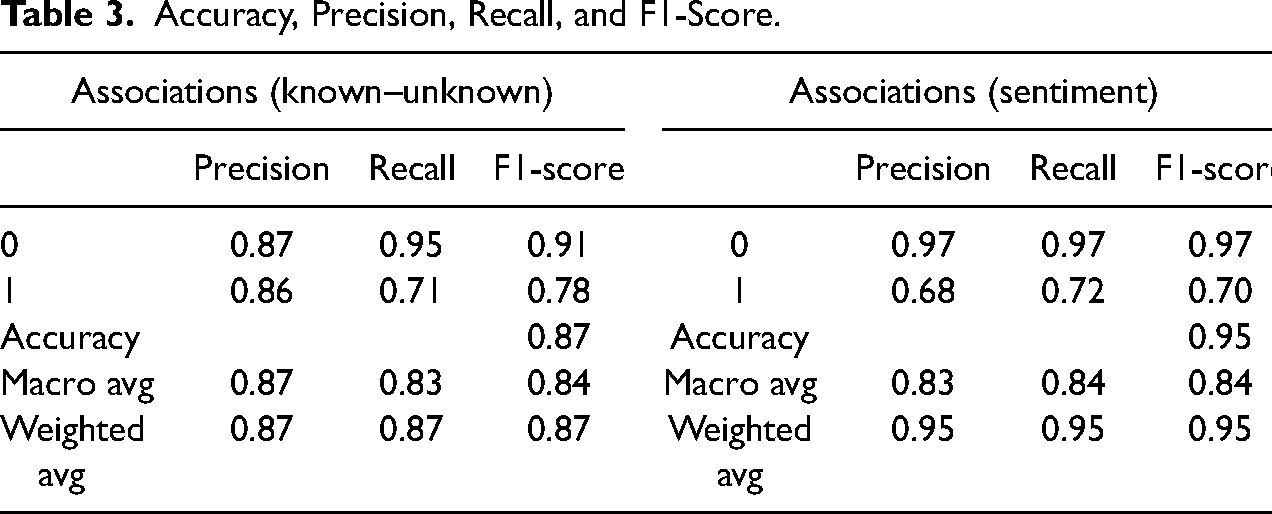
A detailed evaluation of the two classifiers in terms of accuracy, precision, recall, and F1-score is shown in Table 3.
Accuracy, Precision, Recall, and F1-Score.
Alternative approaches with which we classified our data (i.e., regular expressions and random forest) can be found in Online Appendix A.6.
Results
Trust Scores Across Standard and Situative Measures
We begin by assessing the variations in trust scores obtained from our seven trust measures across different sample specifications (Figure 2). Regardless of the subsample, there is a gradual decline in trust from Measure 1 (most people question) to Measure 2 (people first time question), and finally, to Measure 3 (stranger question).
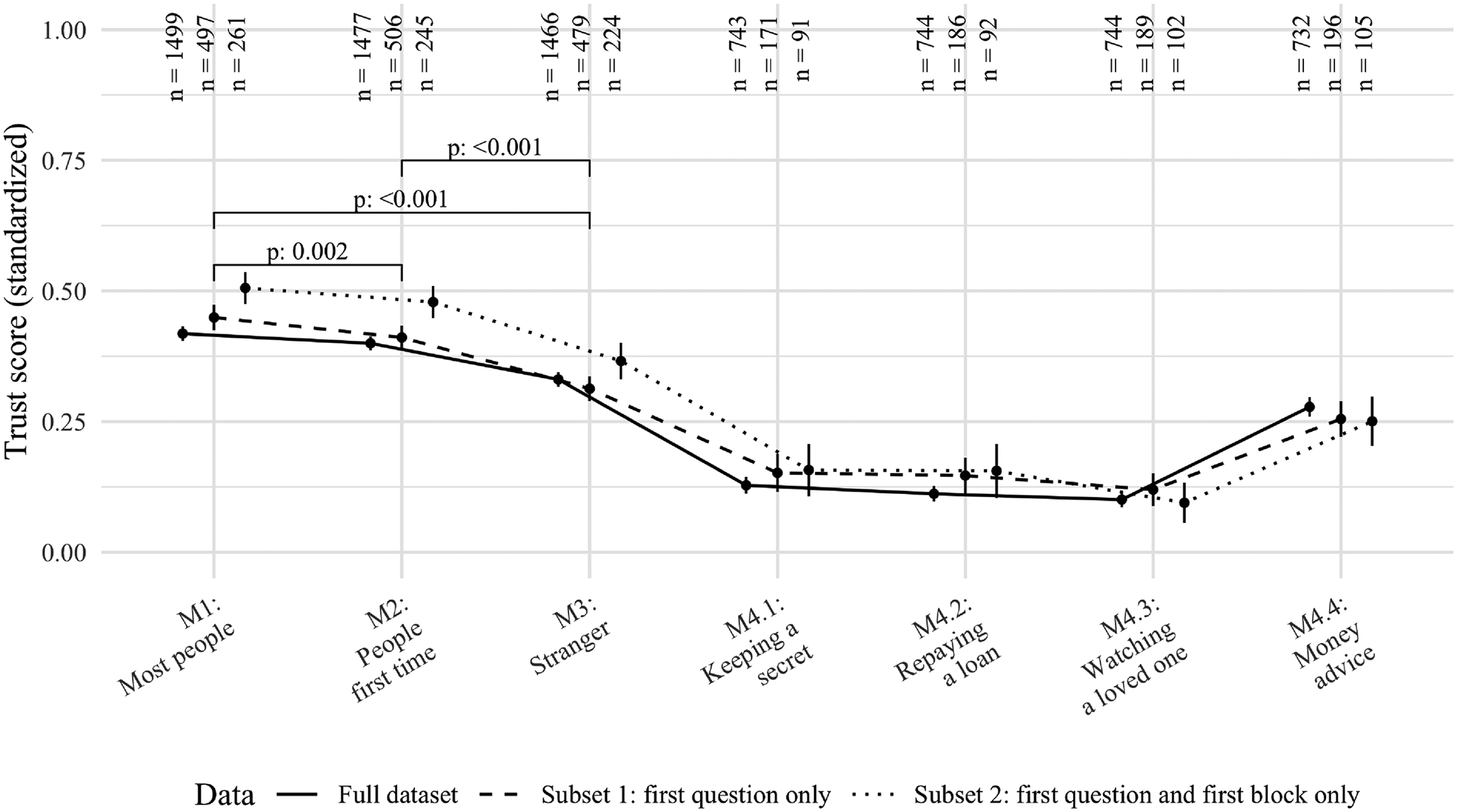
Standardized trust scores across different trust measures and respondent subsets. Note: The figure shows point estimates for average trust scores and 95 percent confidence intervals. Details on the respondent subsets are provided in the “Methods” section. P-values are derived from t-tests for the full dataset, for details see footnote 12. Data for M4.1–4.4 include the “stranger” wording only (see footnote 6).
Within-subjects ANOVA reveals that the generalized trust scores differed statistically significantly for the same individual for the three question wordings (F(1.7, 2,505) = 129,
Additionally, situative trust measures M4.1–4.4 consistently exhibit lower trust levels likely owing to their emphasis on trust decisions where the truster has a lot to lose. 13 It is crucial to note that Figure 2 provides a descriptive overview of the seven measures concerning their sample means. The observed differences may be influenced by various factors, such as question interpretation, demand effects, and scale effects. In our subsequent analysis, we focus on examining one specific factor: the associations formed by respondents when answering our trust survey questions.
Associations Across Standard and Situative Measures
We start by examining the known–unknown dimension. Figure 3 displays the share of respondents who described associations of either known or unknown others across our seven measures. 14 In line with our expectation (H1), the share of respondents referring to a known other statistically significantly decreases for M3 (i.e., 13 percent) while shares for M1 and M2 are similar (31 percent and 30 percent, respectively). The share of respondents referring to a known other again increases for our situative measures M4.1–4.4, however, none of these differences are statistically significant. Nevertheless, it could indicate that referring to specific situations and behaviors in those survey questions could increase the number of respondents who think of known others. This is undesirable from a conceptual perspective.
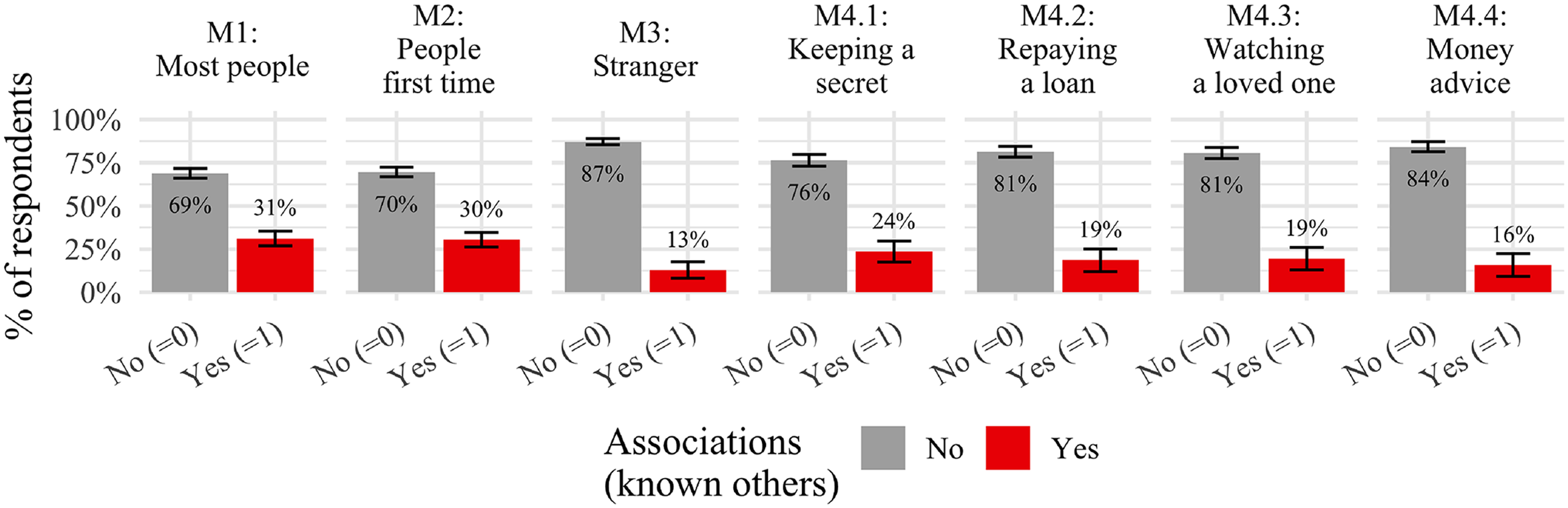
Distribution of associations with known people across trust measures. Note: Error bars represent 95 percent confidence intervals (lower cutoff at 0). Data is the full dataset irrespective of the question or block randomization (details are provided in the “Methods” section). Results for different subsets of the data can be found in Online Appendices A.5.2 and A.5.3.
With regards to the sentiment dimension, we expected to find different shares of negative sentiment for each question wording (see Figure 4). In line with our expectations (H3), the share of negative associations is higher for M3 (i.e., 8.7 percent) compared to M2 (7 percent). Not in line with our hypothesis, the share for M1 is higher (10 percent). However, none of these differences are statistically significant. Moreover, the share of negative associations remains similarly low for the situative measures, which is in accordance with the findings for M3 since the situative measures also describe the trustee category to be a “stranger.”
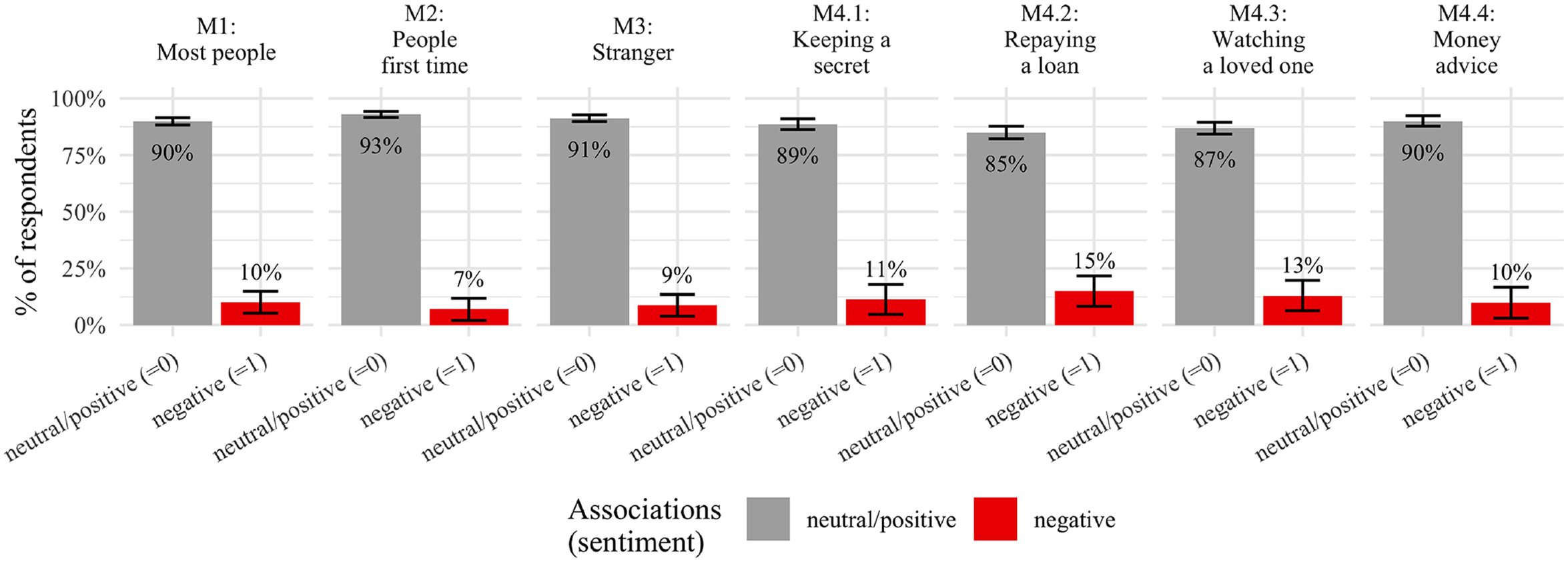
Distribution of associations and their sentiment across trust measures. Note: Error bars represent 95 percent confidence intervals (lower cutoff at 0). Data is the full dataset irrespective of the question or block randomization (details are provided in the “Methods” section).
In sum, we find that, across all seven measures, there are respondents who have associations with known others as well as associations of negative sentiment. However, strong differences between measures in terms of associations can only be found for the known–unknown dimension. The sentiment dimension seems less relevant. The two classification dummies only correlate weakly (r(
Associations and Trust Scores
Above we demonstrated that there is variation in associations across individuals. Next, we examine whether different associations affect the measurement values. Figure 5 visualizes the coefficients for a series of regression models (see Online Appendix A.9 for detailed regression tables). We estimated five models for each of our seven trust measures which are indicated on the left side. Two models are bivariate and only include one of the association dummies (e.g., Models #1 and #2 in Figure 5). We subsequently add covariates to these bivariate regressions (e.g., Models #3 and #4 in Figure 5). 15 Finally, the fifth model includes both dummies in one model and adds covariates.
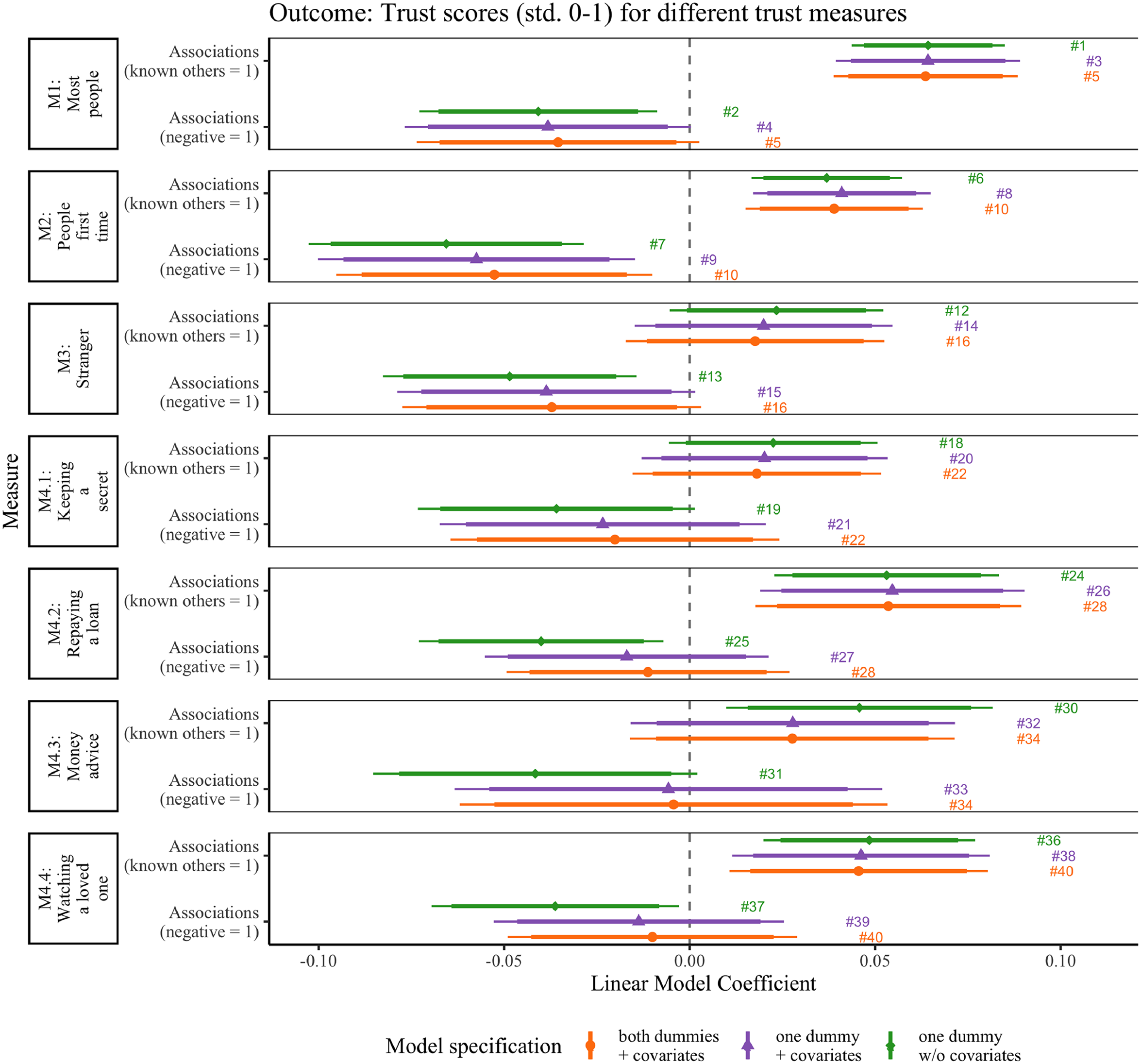
Associations and trust scores across different measures. Note: The figure shows point estimates for coefficients of our dummy variables of interest namely having associations with known others or negative associations. Bars represent 90 percent (thicker) and 95 percent (thinner) confidence intervals. Data is the full dataset irrespective of the question or block randomization (details are provided in the “Methods” section).
In accordance with our expectations (H2), we observe that associations with known others have a positive effect on trust for all of our three generalized trust measures M1, M2, and M3 (
In line with our expectation (H4), we find that negative associations have a negative effect on trust for all of our three generalized trust measures M1, M2, and M3 regardless of the control set specifications (
Also for the four situative measures, the effects are in line with H2. Associations with known people have a positive effect on, for example, M4.4, trusting someone to watched a loved one (
In sum, for the generalized trust measures, we find statistically significant effects in our hypothesized directions, namely that associations with known others (in contrast to unknown others) influences trust scores positively and that negative sentiment (in contrast to neutral/positive sentiment) influences trust scores negatively. Especially the effect of the dummy capturing the known–unknown dimension is undesirable from a conceptual point and its effect varies across measures of generalized trust. We can conclude that estimates based on the three classic measures—M1, M2, or M3—overestimate trust scores because they do not measure generalized trust for a significant share of the respondents. Without these respondents, our estimated trust averages would differ (namely by the coefficients we depict in Figure 5 for the bivariate models). The bias is smallest for the stranger measure M3 and all four of the situative measures seem to be characterized by the same problem.
Discussion and Conclusion
Generalized social trust is a foundational concept in the social sciences. However, there have been doubts about the validity of commonly used measures (Delhey, Newton, and Welzel 2011; Ermisch et al. 2009; Nannestad 2008; Robbins 2019; Sturgis and Smith 2010). In our study, we examined various trust survey measures in a U.S. sample and explored how respondents answered those questions. To eliminate interviewer effects, we used a web probing approach (Behr et al. 2012, 2017; Meitinger and Kunz 2022). Open-ended probing (Neuert, Meitinger, and Behr 2021) is still a novelty in trust research, and similar data has so far only been collected in interviewer-administered settings (Sturgis and Smith 2010; Uslaner 2002). The data collected through open-ended probing was analyzed using a supervised machine learning approach. Our findings can be categorized into four key aspects. First, our study revealed significant variations in overall and intra-individual reported trust levels across different question formats, and the question employing the phrase “most people” yielded the highest average trust score (cf. Figure 2). This finding suggests that the different question formats should not be considered interchangeable measures of generalized trust. However, it is important to note that Figure 2 provides only a descriptive overview, and our subsequent analysis centered on exploring the associations formed by respondents while answering the trust survey questions.
Second, we delved into the associations respondents made when responding to the questions. We described generalized trust as trust in unknown others, and argued that it should ideally be measured accordingly. Remarkably, a notable proportion of respondents (ranging from 13 percent to 31 percent, cf. Figure 3) incorporated thoughts of known individuals in their responses while answering classic trust questions, which is in line with previous research (e.g., Sturgis and Smith 2010). Hence, for this particular group of respondents, classic trust measures actually do seem to capture what is commonly known as particularized trust (cf. Freitag and Traunmüller 2009). In other words, for these respondents, our measures suffer from construct invalidity. However, the proportion of mentions of known individuals in responses decreased for the “stranger” question (M3), suggesting a higher degree of construct validity for this measure (in line with Robbins 2019, 2022). Interestingly, compared to M3, the situative measures (M4.1–4.4) showed an increase in respondents thinking about known individuals (but still considerably smaller than in M1 and M2) (cf. Figure 3), despite being instructed to consider the trustee as a stranger. This outcome may be attributed to respondents drawing upon their past experiences to contextualize and anchor the given situations.
Thirdly, we conducted an examination of the influence of associations on trust levels. If confirmed, this would imply that trust estimates produced by specific measures (e.g., the “most people” wording) could be biased, potentially leading to an overestimation of generalized trust in diverse populations. Indeed, we found that respondents who reported thinking about known others displayed higher levels of trust across all three generalized trust measures (cf. Figure 5). The effects were less robust for the stranger question (M3), which might be due to the smaller share of respondents having known others in mind when answering. This is a desirable feature of the latter measure. 16 Overall, this finding demonstrates that differences in trust between individuals and over time may not be solely reflective of variation in the substantive dimension of trust. Instead, they might be influenced by specification errors and differences in how respondents interpret the question due to inter-individual differences in frames of reference.
Fourth, we also explored a hitherto neglected dimension—the sentiment of association. We found a relatively low proportion of respondents reporting negative associations which remained consistent across measures (cf. Figure 4). Against our expectations, M3, the stranger-question (without situations) does not seem to evoke more negative associations than the most people and people first time question. While negative associations did influence trust scores negatively, the effect was not uniform across measures and models (cf. Figure 5). These findings offer encouraging insights into measurement, yet we call for further research to explore whether specific question formats trigger more emotional responses or negative memories. Our study yields several key findings that not only allow us to draw valuable conclusions but also pave the way for future research directions.
Firstly, among the trust questions we investigated, our various “stranger” questions (M3 and M4.1–4.4) demonstrated the highest level of construct validity, as evidenced by the lower share of respondents thinking of known individuals. However, from an empirical perspective, we may question how many trust situations actually take place among total strangers. For example, the four situations in our study are more likely to take place among individuals who have some knowledge about each other (e.g., acquaintances). Certainly it can be challenging to pinpoint situations that entirely lack associations to known others, but we think that further theoretical work is necessary to classify based on whether a trust measure primarily pertains to strangers or also encompasses acquaintances.
17
Secondly, researchers should carefully consider various factors when selecting measures for their studies, aligning with their specific definition of generalized trust. Our findings indicate that M3 best captures generalized trust when defined as trust towards unknown others (cf. Figure 3). However, for those interested in interpersonal comparability, situative measures like the IST scale offer a viable alternative, since they explicitly define the concrete situation in which trust has to be placed and thus leave less room for different interpretations. Nonetheless, they demand additional questionnaire space due to longer item descriptions.
18
Generally, future studies could make use of additional, situative measures by using vignette designs. The resulting data could be analyzed in such a way, that one caclulates the average trust across a set of situative trust measures, yielding a score of what we call cross-situational trust (Bauer and Freitag 2018; Robbins 2022).
19
However, we would also like to emphasize that the use of traditional measures such as M1 and M2 may be justified if the main objective is comparability with previous studies using these measures or corresponding panel studies. Thirdly, our study focused on a U.S. sample, expanding on prior evidence from the United Kingdom (Sturgis and Smith 2010). While we expect similar findings in other populations, we lack direct evidence to support this claim. The lack of interpersonal comparability within a “homogeneous” sample of U.S. citizens may be amplified when comparing individuals from different cultures, countries, and languages. Nevertheless, we must exercise caution in generalizing our conclusions to other samples. Fourthly, the main aim of this study was to examine established measures as they have been used for decades. This implied that we use original wordings characterized by answer scales of different lengths (e.g., 4pt and 7pt). Although we assume scale length does not significantly affect our main variable of interest (i.e., shares of associations), a potential full-factorial design (
Finally, an open question emerges concerning whether frames of reference are systematically linked to respondents’ demographic characteristics. Preliminary correlational evidence (see Online Appendix A.7) seems to show that this is not the case. This is encouraging and could mean that associations are predominantly random. However, to gain further clarity, future studies could extend the set of covariates considered and potentially employ a randomized design that attempts to induce associations of a particular kind to avoid post-hoc rationalization.
Supplemental Material
sj-pdf-1-smr-10.1177_00491241241234871 - Supplemental material for How Valid Are Trust Survey Measures? New Insights From Open-Ended Probing Data and Supervised Machine Learning
Supplemental material, sj-pdf-1-smr-10.1177_00491241241234871 for How Valid Are Trust Survey Measures? New Insights From Open-Ended Probing Data and Supervised Machine Learning by Camille Landesvatter and Paul C. Bauer in Sociological Methods & Research
Footnotes
Declaration of Conflicting Interests
The author(s) declared no potential conflicts of interest with respect to the research, authorship, and/or publication of this article.
Funding
The author(s) disclosed receipt of the following financial support for the research, authorship, and/or publication of this article: Paul C. Bauer and Camille Landesvatter (Project No. 449946260) gratefully acknowledge support by the German Research Foundation (DFG).
Data Availability Statement
Data and code required to reproduce the findings presented in this study are available in a public repository on Harvard Dataverse (doi:10.7910/DVN/FJXH5G). To access the data and code, please visit the following link:  . For any inquiries or assistance related to accessing the materials, readers are encouraged to contact the corresponding author listed in this manuscript.
Supplemental Material
The supplemental material for this article is available online.
Notes
Author Biographies
References
Supplementary Material
Please find the following supplemental material available below.
For Open Access articles published under a Creative Commons License, all supplemental material carries the same license as the article it is associated with.
For non-Open Access articles published, all supplemental material carries a non-exclusive license, and permission requests for re-use of supplemental material or any part of supplemental material shall be sent directly to the copyright owner as specified in the copyright notice associated with the article.
