



Abstract
One of the social sciences theories that has contributed significantly to the complex understanding of the modern capitalist/colonial world and the situation of Latin America in it has been the world-systems approach. However, world-systems theory cannot be separated from dependency theory since the latter provides theoretical bases for the former, especially regarding the distribution of countries into different special zones according to the functioning of the world economy. But how have these theorists positioned Latin American countries in the world system? How has their understanding of the region evolved? Through the review of the literature, systematised in three stages (pre-theoretical, synchronous, and diachronic), this article examines the historical peripheral and semiperipheral positioning of the Latin American countries and the basis for determining different degrees of peripheralisation and semiperipheralisation. The relative immobility of the countries in the region stands out, which over the decades has not improved their structural position, necessitating a review of the Latin American countries’ development strategies for the twenty-first century.
One of the theories of the social sciences that has contributed significantly to the understanding of the modern capitalist/colonial world and the situation of Latin America in it has been the world-systems theory. Immanuel Wallerstein, founder of this school of thought, wrote: ‘…have been arguing that the social reality within which we live and which determines what our options are has not been the multiple national states of which we are citizens but something larger, which we call a world-system’ (Wallerstein, 2006, p. X).
Enriched with contributions from Braudel (1984), Arrighi and Drangel (1986), Chase-Dunn (1988, 1990), Arghiri (1972), Frank (1979), Abu-Lughod (1987), Flint and Taylor (2018), Hopkins and Wallerstein (1982), Terlouw (2002, 2003), Derudder (2003), Aguirre (2003), Babones and Zhang (2008), and Babones and Chase-Dunn (2017), among others, this theoretical approach situates historical and economic processes as ordering principles of the international system. However, world-system theory cannot be separated from dependency theory. There are such important overlaps and complementarities between them that several authors have even used the expression ‘dependency/world-systems theories’ to refer to a broad and common body of theory (Bollen, 1983; Gulalp, 1987; Petras, 1981).
Since its origins, the capitalist world economy has expanded spatially to encompass the entire world, and states are now an integral part of it. However, this expansion has not been equitable or democratic, but unequal and stratifying; the result of this has been the establishment of the international division of labour (IDL). In the words of Fernand Braudel, ‘the division of labour on a world scale (or on world-economy-scale) cannot be described as a concerted agreement made between equal parties and always open to review. It became established progressively as a chain of subordinations, each conditioning the others’ (Braudel, 1984, p. 48). Wallerstein complemented the above by saying that the division ‘is not merely functional—that is, occupational—but geographical’ (Wallerstein, 2011, p. 349). In this sense, stratification in the world capitalist system has been a constant that has geographically conditioned the international insertion of any state.
Now, in this framework of thought, how have dependency/world-systems theorists positioned Latin American countries in the international structure? How has their understanding of the region evolved? Both the dependency theory and the world-systems theory find the structural ascent of states possible, although in different ways: the first underpins the need to break with the capitalist market, while the second finds the transition in the system possible, but based on efficient policies implemented by the states to take advantage of the market. Although this debate has been fundamental, the results have been fruitless for Latin America. This research hypothesises a relative structural immobility of the countries of the region, which have not improved their position in the geostructure of power (Morales & Rocha, 2022). To verify this, it is essential to explain how understandings, methodologies, and analysis tools have evolved to determine the structural position of Latin American countries, which is the objective of this research.
This work has been organised into four parts: in the first, certain approaches that can be considered as pre-theoretical are reviewed; in the second, the first trials for the observation of the positioning of Latin American countries from dependency/world-systems theories are exposed, which can be characterised as synchronous, as they made limited observations without temporary sequences; in the third, the trials that took place from the mid-1980s are presented, which are distinguished by being of the diachronic type by providing their appreciations with temporal continuity; and, in the last part, a synthesis and an evaluation of the historical performance of the Latin American countries in the international structure is made.
Early Explorations in Latin American Country Stratification: The Pre-Theoretical Phase
Before the formulation and consolidation of world-systems theory, two articles were published in 1966 that contributed to the understanding of the position of Latin American countries in the world.
One of them was elaborated by Johan Galtung, Manuel Mora, and Simon Schwartzman and had as its object the analysis of the structure of the Latin American system of nations. To do this, the researchers formulated an international position index that allowed them to rank countries from 20 to 1 according to their score (Galtung et al., 1966, p. 163): the high-range countries were Argentina (20), Chile and Cuba (18), Venezuela (17), and Brazil and Uruguay (16); the mid-range countries were Colombia (15), Mexico (14), Costa Rica and Peru (11), Panama (9), Ecuador (8); the low-range countries were Bolivia and Paraguay (6), the Dominican Republic (5), El Salvador (4), Guatemala and Nicaragua (2), and Haiti and Honduras (1).
Although the design of an index to weigh the position of the countries in the international system was a new and very ambitious statistical exercise because it was formulated from 10 indicators that were distributed in four dimensions, the results were very questionable. For example, it is surprising that Cuba received the second highest score (above Brazil), that Uruguay surpassed Mexico, or that Costa Rica and Peru were in the same position.
The other work was a continuation of the previous one, but in this case, exclusively by the Brazilian Simon Schwartzman and the Argentine Manuel Mora. They recognised that, methodologically, the stratification of the international system could be achieved by measuring certain statistical indicators of the countries, as they did under Galtung’s leadership, or it could also be done subjectively, that is, by sounding out people’s opinions. In this case, to capture the socially constructed image of stratification in Latin America, the researchers applied a survey to 362 students (327 Latin Americans and 35 Norwegians), who were asked ‘to place the 20 countries in either of the three groups of high, middle and low levels of prestige or importance, to which the values of 3, 2, and 1 were assigned’ (Schwartzman & Mora, 1966, p. 227). The results were Argentina, Mexico, and Brazil as high-ranking countries; Chile, Uruguay, Venezuela, Cuba, Peru, and Colombia as mid-range countries; and the rest as low-ranking countries (Schwartzman & Mora, 1966).
Regarding the subjective stratification of Schwartzman and Mora, it is important to highlight that it takes up the ranks of countries created in the previous work, although now with greater laxity since it is simply stated: ‘three of them (Argentina, Mexico, and Brazil) were almost unanimously placed as upper class, and a group of Central American countries, as well as Bolivia and Ecuador, consistently placed as low class countries’ (Schwartzman & Mora, 1966, p. 184). From these considerations, it is possible to deduce the middle range and complete the lower range.
These works were pioneers when studying the positioning of Latin American countries since they showed rigour in the collection of information and detailed methodologies in data processing, as well as novel formulations of ranges and hypothesis contrasting. However, they exhibited an important limitation: their detachment from a larger theoretical corpus.
Synchronous Explorations in Latin American Country Stratification Within Dependency/World-Systems Theories
Unlike previous analyses that prioritised statistical procedures, starting in the 1970s, studies began to emerge to observe the positioning of Latin American countries with an anchor in dependency/world-systems theories.
The notions of core and periphery originally proposed by the Argentine Prebisch (1949, 1976, 1981) not only became a fundamental axis of the Economic Commission for Latin America and the Caribbean’s analyses (Kay, 1991; Love, 1996; Rodríguez, 1981) but later were expanded by the so-called dependency theorists (Bambirra, 1979 [1999]; Cardoso & Feletto, 1979; Dos Santos, 1978; Ferrer, 1950; Jaguaribe, 1973) and subsequently had a significant influence on the theoretical corpus of world-systems approach.
For the dependentistas, the poor functioning of peripheral economies was the result of low competitiveness in production, high export costs, and, finally, deterioration in the terms of trade with the core. The consequence for peripheral states is that they are induced to situations of external dependency and, at the same time, of internal vulnerability.
Evidently, for dependency theorists, Latin American countries formed part of the periphery of the world capitalist system, although there were no major efforts to determine ranges, as Galtung, Mora, and Schwartzman had previously done. However, for Vânia Bambirra, a classification of states was essential since it would allow a deeper understanding of the forms of dependency. Thus, in 1979, she proposed a typology for the periphery in the following terms (Bambirra, 1979 [1999], pp. 26–28):
Type A countries with early industrialisation: Argentina, Mexico, Brazil, Chile, Uruguay, and Colombia. Type B countries whose industrialisation was the product of monopolistic integration: Peru, Venezuela, Ecuador, Costa Rica, Guatemala, Bolivia, El Salvador, Panama, Nicaragua, Honduras, the Dominican Republic, and Cuba. Type C peripheral countries with an agrarian-export structure without industrial diversification: Paraguay and Haiti.
As can be seen, Bambirra identified a set of Latin American countries that outperformed the rest, thanks to their relatively early industrialisation (Type A). Regarding the rest of the periphery, Bambirra was ahead of other dependentistas because she was able to differentiate and theorise about type B and type C countries. With her research, Bambirra thus provided a significant contribution in demonstrating the different forms of dependency in the periphery.
Immanuel Wallerstein, for his part, established the theoretical basis of the functioning of the world economy at the end of the 1970s. It was in his work Semi-Peripheral Countries and the Contemporary World Crisis’ (1976) that he expanded his reflections on the semiperiphery and, for the first time, identified 29 countries as part of that zone. Thus, he wrote, ‘The “semi-periphery” includes a wide range of countries in terms of economic strength and political background. It includes the economically stronger countries of Latin America: Brazil, Mexico, Argentina, Venezuela, possibly Chile and Cuba’ (Wallerstein, 1976, p. 465). Although he did not deepen into it, it is possible to point out that Wallerstein implicitly detected different degrees of semiperipheralisation in Latin America since he was clear about the first four and enunciated the last two as possible semiperiphery.
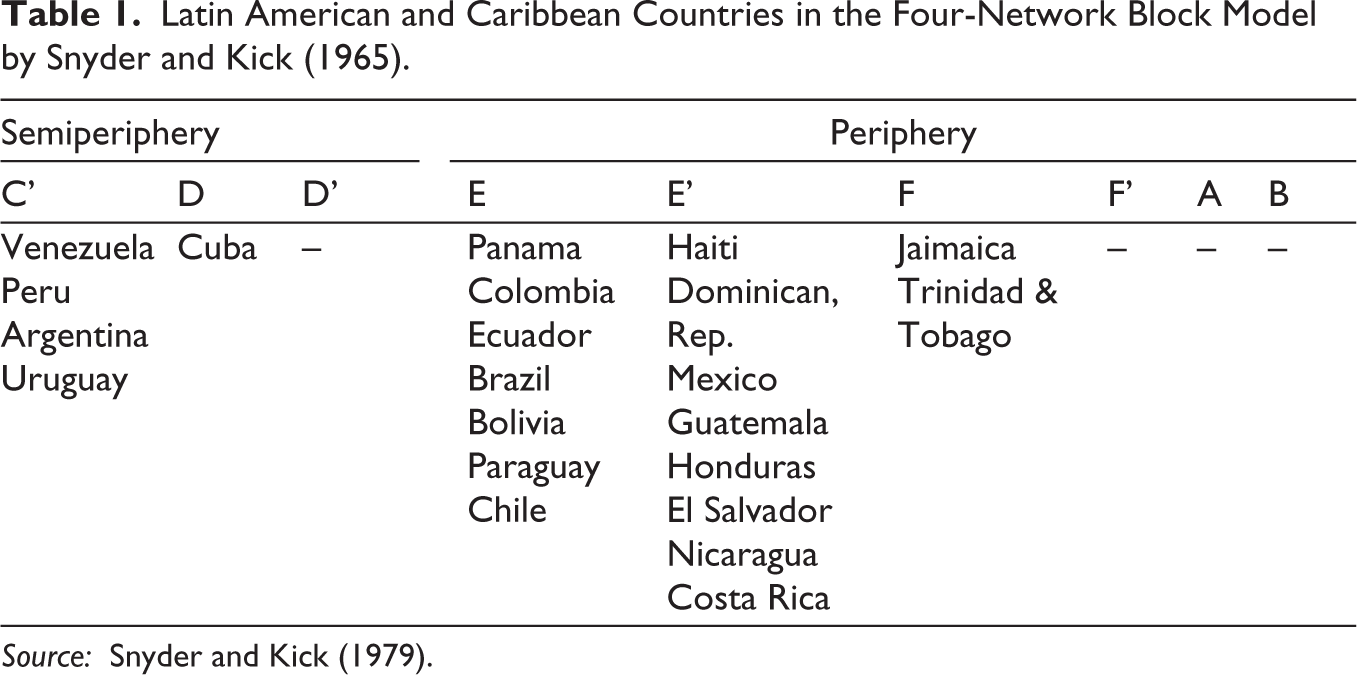
Later, in 1979, David Snyder and Edward Kick published a work on the structural position of states. Their research was explicitly framed in what they enunciated as dependency/world-systems theories, although their position was critical of the empirical status and quantitative treatments generated by such approaches until then. To give a quantitative treatment to the world system, Snyder and Kick built a block model composed of four networks (trade flows, military interventions, diplomatic exchanges, and international treaty memberships), which was nurtured with a collection of data around 1965 (see Table 1 ). This allowed them to determine the position of 118 countries, including 22 Latin American and Caribbean countries.
Latin American and Caribbean Countries in the Four-Network Block Model by Snyder and Kick (1965).
Source: Snyder and Kick (1979).
In their model, ‘(1) block C constitutes the core; (2) blocks E through B (in the order shown) are the periphery; and (3) block D, and perhaps also C’ and D’, are located in the semiperiphery of the world system’ (Snyder & Kick, 1979, p. 1114). Here, it is significant to find that Snyder and Kick coincided with Wallerstein in identifying some Latin American countries within the semiperiphery and with Bambirra in observing different positions in the periphery (E, E’, F). However, as can be seen in Table 1 , important empirical differences also stand out, since, on the one hand, some of the countries with old industrialisation identified by Bambirra were located by Snyder and Kick in the periphery (Brazil and Chile in block E, Mexico in block E’); and, on the other hand, the block model placed in the semiperiphery Argentina and other countries that, until then, had been omitted by Wallerstein (Venezuela, Peru, and Uruguay in block C’; Cuba in block D).
These results generated reactions, including Roger Nemeth and David Smith, who criticised:
The actual groupings that Snyder and Kick obtained also tend to lack theoretical face validity. Several of their groups are clearly geographical in nature (Blocks A and B - Africa; Block E - Central America) […], that have little to do with the mechanisms that would be expected to determine a nation’s role in the world-economy. (Nemeth & Smith, 1985, p. 534)
Despite the discrepancies, Nemeth and Smith continued with the guidelines outlined by Snyder and Kick and published a new study that continued with the analysis of networks of interactions but now focussed only on the trade flows of basic products. With data from 1970, Nemeth and Smith created a model composed of 8 blocks that allowed them to determine the position in the world system of 86 nations.
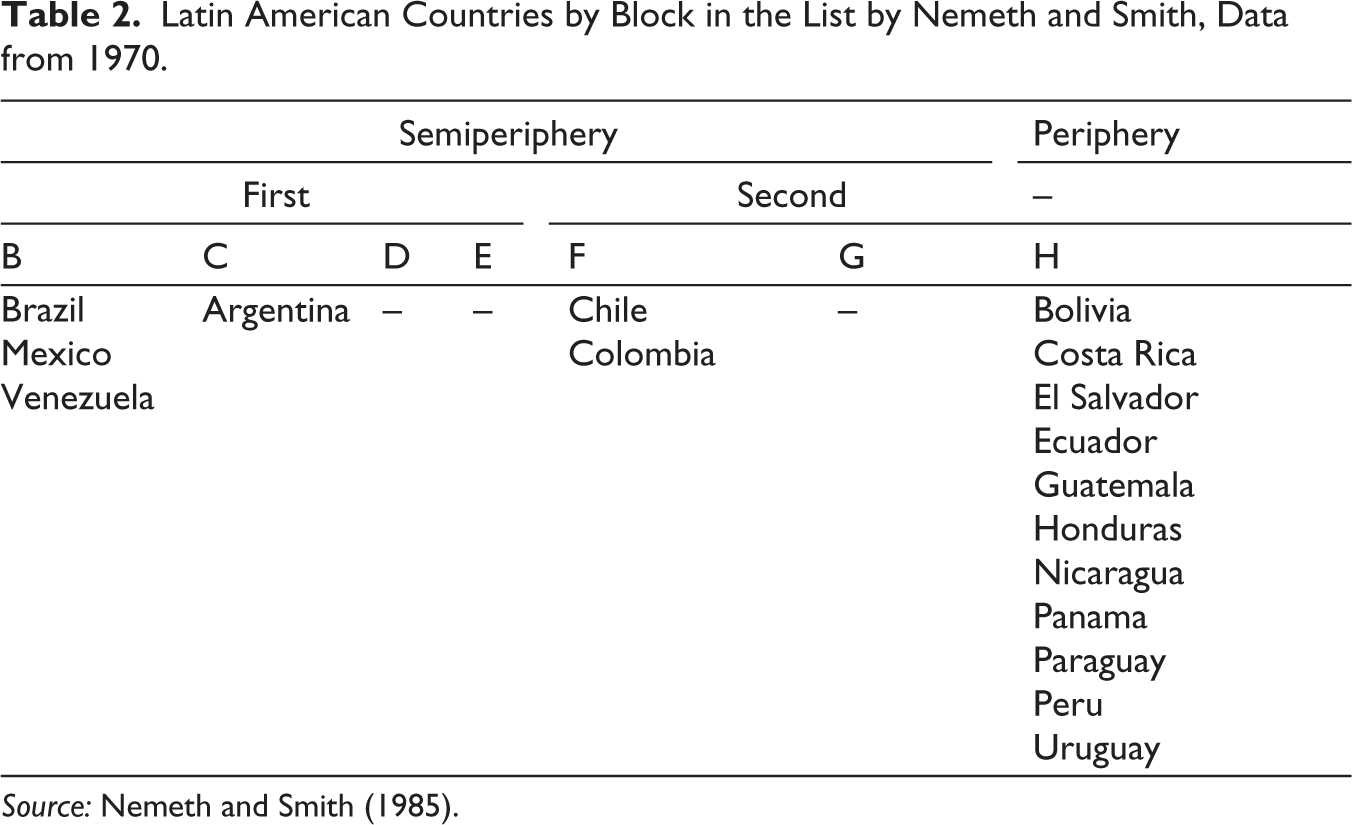
The main contribution of Nemeth and Smith was in the study of the semiperiphery since they were able to identify two positions ( Table 2 ): on the one hand, the first semiperiphery or strong semiperiphery (blocks B, C, D, and E), made up of Brazil, Mexico, Venezuela, and Argentina, which stand out not only for their commercial articulation with the central countries and with other semiperipheral countries, but also for their manufactured and high-tech products; on the other hand, the second semiperiphery or weak semiperiphery (blocks F and G), made up of Chile and Colombia, which are countries with ‘a similar pattern of close integration with the core and strong semiperiphery, but lack exchanges with the periphery or other nations in their own category’ (Nemeth & Smith, 1985, p. 543). The rest of the countries were placed by Nemeth and Smith in the periphery (block H), a broad and diffuse block, which represented a setback concerning the proposals of Bambirra and Snyder and Kick that had achieved greater explanatory power in the stratification of the periphery.
Latin American Countries by Block in the List by Nemeth and Smith, Data from 1970.
Source: Nemeth and Smith (1985).
However, the great analytical limitation that all these works had was their inability to observe and measure the structural movement of the countries in the world system. Wallerstein considered the semiperipheral and possibly semiperipheral states in 1976; Vania Bambirra published her classification of dependent societies in 1979; Snyder and Kick formulated their block model circa 1965; and the list of Nemeth and Smith took data corresponding to 1970, but none of these ranges could be continued or extended over time.
Diachronic Experiments in Latin American Country Stratification Within Dependency/World-Systems Theories
If history is dynamic and there is a continuous movement of states in the world system, as the theory proposes, then it is essential to develop new models or measurement tools that empirically demonstrate this phenomenon. Thus, research began to be developed with a diachronic approach, that is, one that accounted for the evolution and movement of countries in their structural positioning over time.
Although most of the diachronic research in world-systems theory was carried out in the first decade of the twenty-first century, in 1986, a work by Giovanni Arrighi and Jessica Drangel was published that aimed to investigate the different positions of states in the three areas of the world economy, especially in the semiperiphery. Unlike Snyder and Kick, who considered four items for their block model, or Nemeth and Smith, who looked at trade flows, Arrighi and Drangel considered ‘GNP per capita expressed in a common monetary unit as an indirect and approximate measurement of the mix of core-peripheral activities that fall within the jurisdiction of a given state’ (Arrighi & Drangel, 1986, p. 31). While the period analysed covered 45 years (from 1938 to 1983), the researchers recognised their difficulties in finding data for all countries, especially peripheral ones; however, they managed to develop three series of years (1938–1950, 1960–1970, and 1975–1983) that allowed classifying the position of some states and recording their movements.
In theoretical terms, it is necessary to highlight two contributions by Arrighi and Drangel: in addition to the zones of core-semiperiphery-periphery, they enunciated the existence of a perimeter of the core and a perimeter of the periphery, that is, ‘the lower boundary of the core zone and the upper boundary of the peripheral zone’ (Arrighi & Drangel, 1986, p. 29), with which they recognised different degrees of centralisation and peripheralisation in the world system; on the other hand, they showed that all countries have remained in a more or less constant position in the analysed period, but hypothesised that the changes could be more visible in the longue durée.
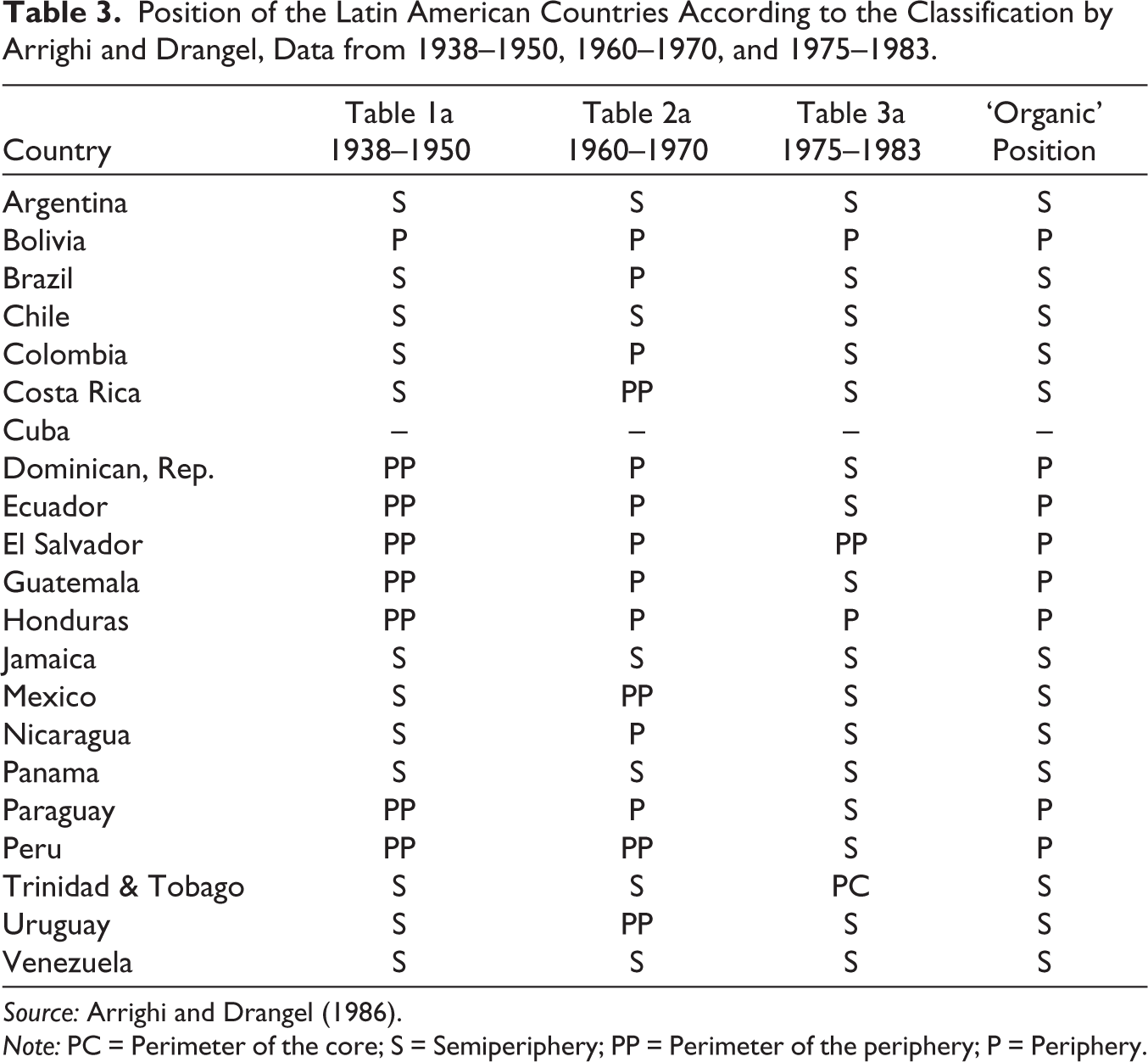
As seen in Table 3 , they confirmed that Argentina, Brazil, Chile, Colombia, Mexico, Uruguay, and Venezuela remain in a more advanced situation and are included for the first time, as part of the semiperiphery, along with Costa Rica, Jamaica, Nicaragua, Panama, and Trinidad and Tobago. The rest of the countries form part of the organic periphery. However, the main novelty with Arrighi and Drangel is that they proved the movements of some countries.
Position of the Latin American Countries According to the Classification by Arrighi and Drangel, Data from 1938–1950, 1960–1970, and 1975–1983.
Source: Arrighi and Drangel (1986).
Note: PC = Perimeter of the core; S = Semiperiphery; PP = Perimeter of the periphery; P = Periphery.
Already in the first decade of the twenty-first century, the diachronic perspective initiated by Arrighi and Drangel was continued, but with new approaches and tools. In 2005, Salvatore Babones found that, until then, two types of tests had been carried out to empirically determine the position of countries in the world system: on the one hand, studies that took into account the volume of foreign trade or other international data, as done by Snyder and Kick or Nemeth and Smith; on the other hand, research that used per capita income as a measure, as was the case of Arrighi and Drangel. However, both remained disjointed. Taking world-systems theory as a framework for analysis, in 2008 Babones and Zhang developed a model with ‘two main data inputs at the country level: trade by partner as a proportion of and a measure of income inequality. An additional input is the categorisation of countries by zone of the world-economy’ (Babones & Zhang, 2008, p. 100). For these authors, the semiperipheral Latin American countries were Argentina, Brazil, Chile, Costa Rica, Jamaica, Mexico, Panama, Trinidad and Tobago, Uruguay, and Venezuela; the rest were considered peripheral countries.
It is important to note that Babones and Zhang did not observe mobility in the structural position of Latin American countries between 1980 and 2000 (Babones & Zhang, 2008, pp. 102–103); however, it corroborated the semiperipheral/peripheral positioning of the cases identified before (with the sole exception of Colombia) and, at the same time, continued the analysis in temporal terms, since while Arrighi and Drangel observed the period from 1938–1950 to 1975–1980, Babones and Zhang continued the analysis from 1980 to 2000.
In theoretical-methodological terms, Babones and Zhang advanced by stating ‘that past studies of the relationship between foreign trade and within-country income inequality may have come to inconsistent conclusions’ (2008, p. 106) and, therefore, that future studies should delve into their interactions; but they also updated the debate by pointing out that the heterogeneity of development situations in the world cannot be summarised in the label of global south, thereby emphasising the validity of the world-systems theory for the analysis.
In this same direction, in 2011, Matthew Mahutga and David Smith published the results of their research, which sought to determine how the structure of the world economy impacts the economic development and wealth of countries. With the support of computational techniques, the researchers organised the information generated by the United Nations Standard International Trade Classification (COMTRADE) to determine the position of 94 countries in the IDL at three different moments: 1965, 1980, and 2000.
In theoretical terms, it is relevant to find that Mahutga and Smith carried out their analysis based on the following categories:
the group we labeled core […] is the most extreme group on the right-hand side. There are two groups between the core and the origin that we’ve labeled (2) core-contenders and (3) upper-tier semiperiphery. Our fourth group—the strong periphery—is at or below the origin, and the two lowest groups—(5) weak periphery and (6) weakest periphery—correspond to an increasing distance from the core. (Mahutga & Smith, 2011, p. 264)
By proposing a broader range of categories, the research of Mahutga and Smith distanced itself from the traditional triadic perspective of world-systems theory and continued the studies carried out during the synchronic phase by Bambirra, Snyder, and Kick, as well as by Nemeth and Smith, who posited different degrees of peripheralisation and semiperipheralisation; but, by making three temporal cuts (1965, 1980, and 2000), Mahutga and Smith contributed to the diachronic type studies initiated by Arrighi and Drangel and continued by Babones and Zhang.
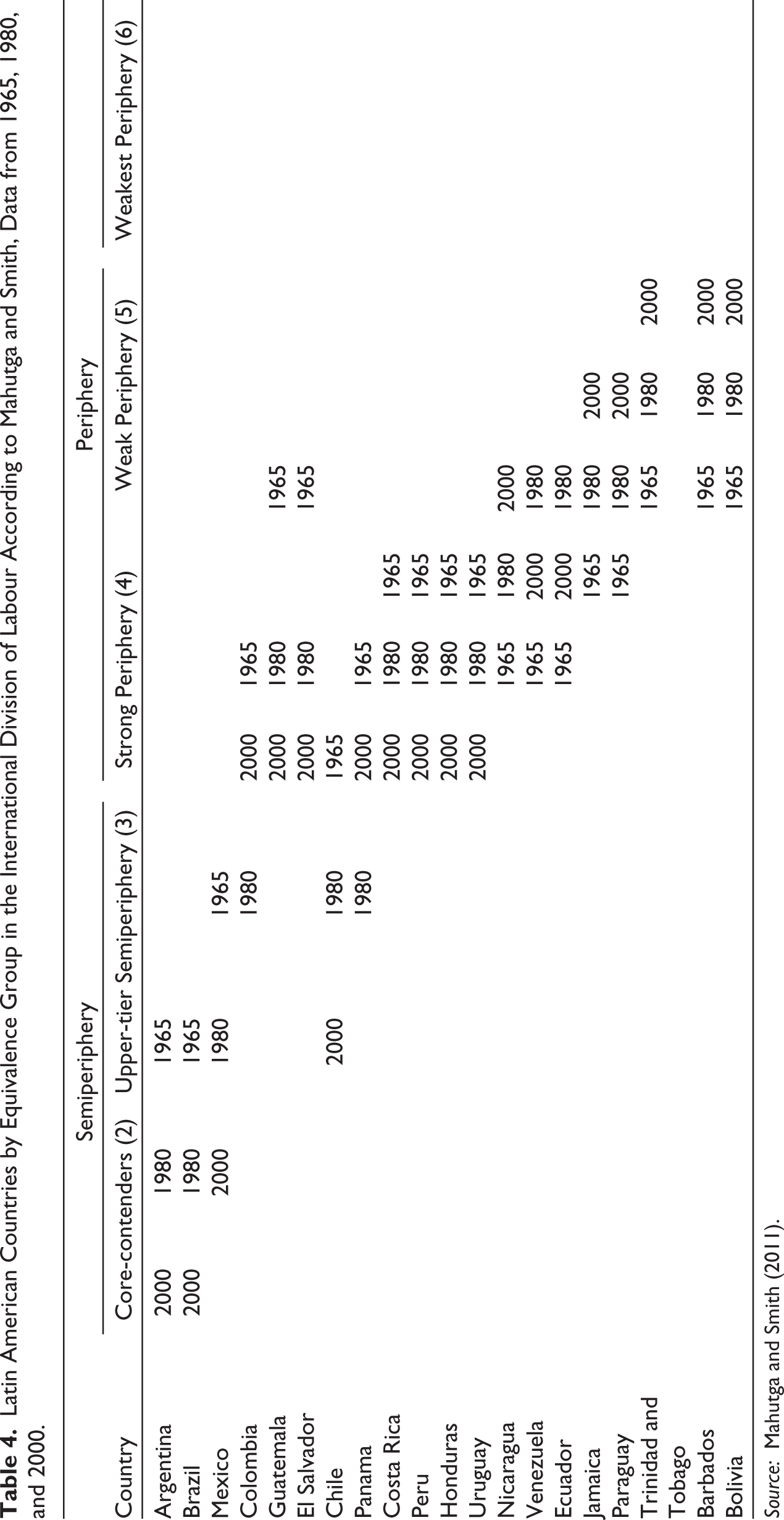
In empirical terms, Mahutga and Smith found that countries in intermediate positions in the IDL, that is, in the semiperiphery, are converging in the level of income/productive force with the core, while the periphery seems stagnant (Mahutga & Smith, 2011). This was particularly relevant for Latin American countries because, as can be seen in Table 4 , their analysis showed that countries in an intermediate position such as Argentina, Brazil, and Mexico achieved upward mobility as they went from an upper-tier semiperiphery in 1965 to a situation of the core-contenders in 2000, while Chile went from the strong periphery to the upper-tier semiperiphery. The rest of the peripheral countries of the region remained stagnant (with the only exceptions of Guatemala and El Salvador) in the same group from 1965 to 2000 or, in some cases, regressed: Nicaragua, Jamaica, and Paraguay went from the strong periphery to the weak periphery.
Latin American Countries by Equivalence Group in the International Division of Labour According to Mahutga and Smith, Data from 1965, 1980, and 2000.
Source: Mahutga and Smith (2011).
Finally, it is worth mentioning an effort made by some Latin American academics to determine the structural positioning of the countries in the region. In that direction, in 2015 Daniel Morales and Alberto Rocha published an article aimed at ‘examining the structural position reached by the states—ascent, stagnation and descent in the hierarchy of power of the states in the regional interstate system—and, secondarily, exploring the level of development economic-social achieved by them in recent decades’ (Morales & Rocha, 2015, pp. 186–187). The analytical instrument that they implemented to identify the structural position of Latin American countries was the World Power Index (WPI).
In methodological terms, Morales and Rocha (2015) presented an advance in the research since they not only identified the position of Latin American countries in 1975 and 2013 to evaluate their performance but also presented annualised information for the period between those years. Regarding their contribution to dependency/world-systems theories, Morales and Rocha considered that historically there have been few Latin American states that have managed to settle in the semiperiphery, although it is possible to distinguish two categories, an upper semiperiphery and a lower semiperiphery, while the large group of Latin American countries are located on the periphery, an area in which there is also stratification or differentiation: a high periphery, another middle, a low, and, finally, a lowest periphery (Morales & Rocha, 2015). This differentiation of subgroups is in tune with the proposals of previous authors, who implemented both diachronic and synchronic methodologies.
Evaluating and Synthesising the Structural Position of Latin American Countries
At this point, a survey has been made of 20 different temporal observations on the positioning of Latin America in the international structure, which come from 10 different sources: Galtung et al. (1966), Schwartzman and Mora (1966), Wallerstein (1976), Bambirra (1979), Snyder and Kick (1965), Nemeth and Smith (1985); two from Morales and Rocha (2015); three from Arrighi and Drangel (1986), as well as Mahutga and Smith (2011); and six from Babones and Zhang (2008).
To enhance the representation of author diversity, alleviate information saturation, and prevent the duplication of estimates in specific years, the calculations of Mahutga and Smith for 1965, Babones and Zhang for 1975, Morales and Rocha for 1975, and Arrighi and Drangel for 1975 and 1983 were excluded. This discrimination is due to an abundance of records in the 1960s and 1970s. Similarly, the Babones and Zhang figures for 1980 and 2000 were omitted, as they coincide with the Mahutga and Smith calculations for those years. After this filtering, the same number of authors remains, but with 14 records ranging from 1938–1950 (Arrighi and Drangel) to 2013 (Morales and Rocha).
To evaluate the position of the Latin American states, they have been organised into six groups: upper and lower semiperiphery; and high, medium, low, and lowest periphery.
Semiperipheral States
Wallerstein argued that the semiperiphery ‘is not an artifice of statistical cutoffs, nor is it a residual category. The semiperiphery is a necessary structural element in the world-economy’ (Wallerstein, 2011, p. 349). Initially, the semiperiphery could be seen simply as an area defined by the negation of the core and the periphery, that is, as a concept loaded with indeterminacy and ambiguity. However, the semiperiphery is the area with the greatest dynamism in the system and is characterised by grouping together a series of states whose political systems are in the process of modernisation, their economies are highly heterogeneous in terms of production (because they have ventured into certain cutting-edge activities but lag in many others); they have great geocultural potential but without becoming dominant at the global level; their societies exhibit wide socioeconomic inequalities; and their national institutions are strong but with notorious vulnerabilities.
Although there is a consensus regarding these theoretical notions about the semiperiphery, this is not entirely clear when empirically defining the countries that make it up and, above all, the positioning of the countries within said category. Therefore, to define the semiperipheral countries of Latin America, Table 5 summarises all the previously reviewed empirical observations to deductively obtain a reading of the high semiperiphery and the low semiperiphery.
The first group of semiperipheral Latin American countries is made up of Brazil, Mexico, and Argentina, countries that at different times in history have also been considered regional powers; the second group of countries is shaped by Chile and, to a lesser extent, Uruguay, which are not seen as powers but as secondary semiperipheral countries (Ardila, 2022; Morales, 2020). Note that these five countries followed Type A industrialisation according to Bambirra.
High Semiperiphery: Brazil, Mexico, and Argentina
Brazil, Mexico, and Argentina have historically been the countries that have made the most progress in their modernisation processes and have achieved the best position in the world system, as shown in Table 5 . Moreover, due to their relevant endowment of capacities, Schwartzman and Mora evaluated the structural positioning of the three countries as high. Mahutga and Smith came to see them as central contenders, while Morales and Rocha considered them regional powers. Indeed, thanks to their relatively favourable position, Brazil, Mexico, and Argentina act as semiperipheral powers with regional leadership capacity and eventually supremacy over their neighbours; in other words, they are regional powers. Nevertheless, while Brazil and Argentina have promoted South American integration in different ways, Mexico has sought to articulate with North America and serve as a link with Latin America.
Semiperipheral Countries of Latin America.
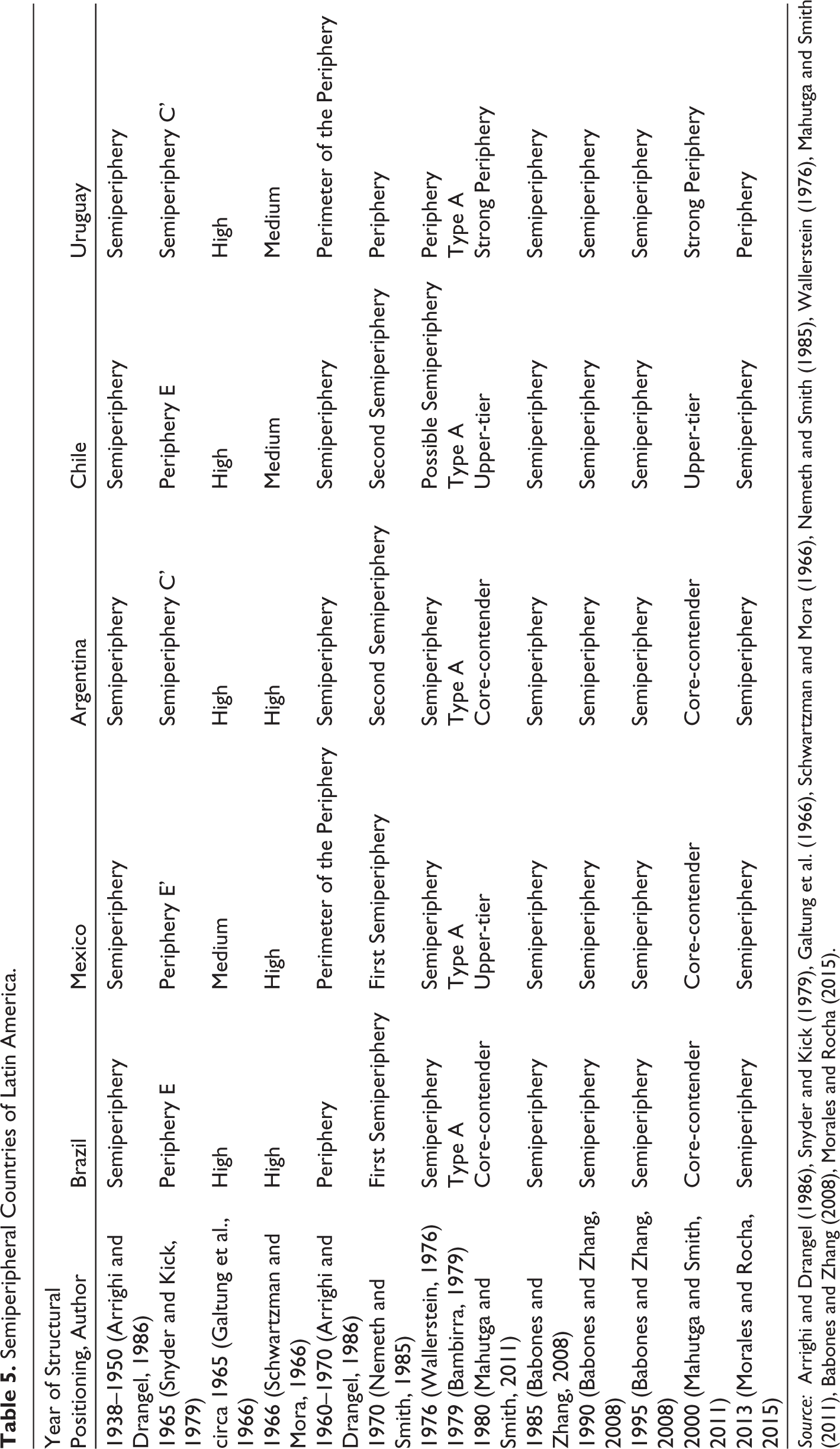
Source: Arrighi and Drangel (1986), Snyder and Kick (1979), Galtung et al. (1966), Schwartzman and Mora (1966), Nemeth and Smith (1985), Wallerstein (1976), Mahutga and Smith (2011), Babones and Zhang (2008), Morales and Rocha (2015).
Low Semiperiphery: Chile and Uruguay
Chile is a country that moved from the periphery to the semiperiphery in the twentieth century. As can be seen in the literature, during the 1960s and until the mid-1970s, all authors doubted Chile’s position in the semiperiphery: for Snyder and Kick, it was part of the periphery E; Schwartzman and Mora placed it in a position media; Nemeth and Smith in the second semiperiphery; and Wallerstein mentioned it as a possibly semiperipheral state. However, starting in the 1980s, all the authors began to place Chile at the same levels as the previous three, observing that, like no other country in the region, it was transcending the periphery to settle in the semiperiphery. Indeed, Chile is widely considered a semiperipheral state, but it is hardly seen as a regional power (like Brazil, Mexico, and Argentina). Chile can be characterised as a secondary semiperipheral state but also with notable possibilities to continue its dynamic of structural ascent.
Uruguay, for its part, is a country that does not end up being widely recognised as a semiperipheral state. Arrighi and Drangel were the first to place Uruguay in the semiperiphery according to their 1930–1950 estimates. However, in the estimates for the following decades, there is a huge disagreement on the situation of Uruguay: for Snyder and Kick it is about a country that surpassed the periphery to reach the semiperiphery, for Galtung et al., it has achieved a high position in the Latin American structure; for Bambirra, it is about an economy that follows a Type A industrialisation; and for Babones and Zhang, this South American country has undoubtedly reached the semiperiphery; but, at the same time, in a different position are Nemeth and Smith, Wallerstein, and Morales and Rocha, who consider it as part of the periphery. However, Uruguay is a country that has visibly modernised its institutions and the general welfare level of its population, in a situation similar to that of other secondary semiperipheral countries.
Peripheral States
There is a broader consensus regarding the peripheral situation of most Latin American countries. However, from the reviewed authors, it was also possible to identify different degrees of periphery: a high periphery, when the states are occasionally in the semiperiphery and mostly in the periphery; a middle periphery, when they are not mentioned in the semiperiphery but frequently in the strong periphery, in the perimeter of the periphery or in the medium; a low periphery, when states are consensually seen as peripheral, low and weak; and the lowest periphery, located in the most marginal part in all the studies.
High Periphery: Colombia and Venezuela
Colombia and Venezuela are positioned in the upper part of the periphery (see Table 6 ), and, in that sense, they are powers, but with a different scope than the regional powers of the semiperiphery: these are subregional powers of the periphery. However, these two countries exhibit very different historical trends.
Major Peripheral Countries of Latin America.
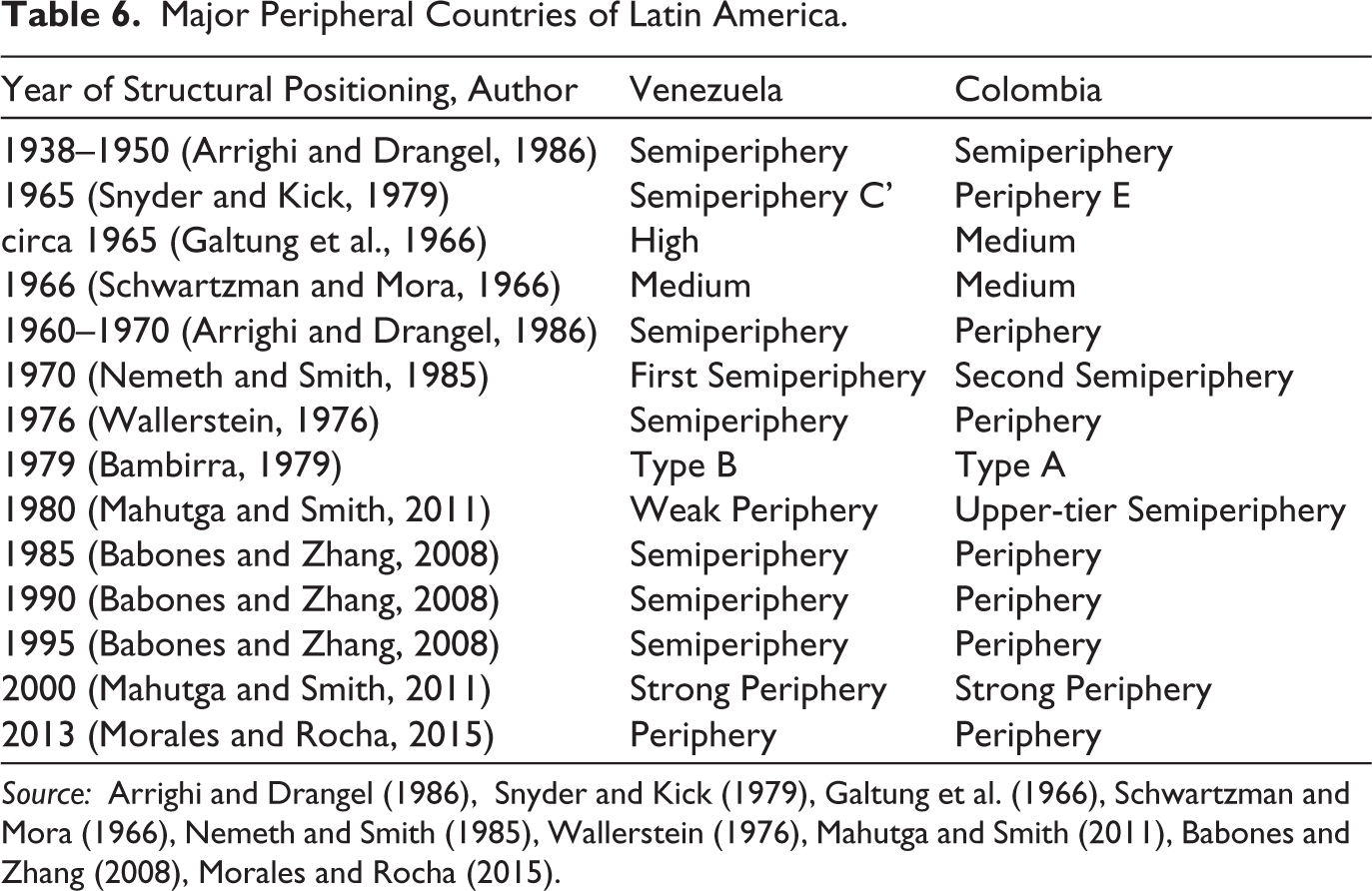
Source: Arrighi and Drangel (1986), Snyder and Kick (1979), Galtung et al. (1966), Schwartzman and Mora (1966), Nemeth and Smith (1985), Wallerstein (1976), Mahutga and Smith (2011), Babones and Zhang (2008), Morales and Rocha (2015).
Venezuela was a semiperipheral country decades ago but has regressed towards the periphery. As can be corroborated, in the first records corresponding to Arrighi and Drangel, Snyder and Kick, Nemeth and Smith, and even Wallerstein, Venezuela was seen as a semiperipheral country, as part of the first semiperiphery or with a high structural position. However, evaluations of Venezuela are less favourable in later records, being considered part of the periphery by Mahutga and Smith, as well as by Morales and Rocha. It should be noted that the high price of oil in the first decade of the twenty-first century and the progressive thrust of President Hugo Chavez placed the country in an ascending dynamic. However, the subsequent drop in oil prices and the harsh international sanctions against the Government of Nicolas Maduro have placed Venezuela in a strong dynamic of peripheralisation, significantly deteriorating its structural position.
On the contrary, Colombia was initially considered by Arrighi and Drangel, Snyder and Kick, like Wallerstein, as part of the periphery, while Galtung et al. and Schwartzman and Mora give it a medium position in the regional hierarchy. However, these considerations begin to change gradually, in such a way that Bambirra qualifies Colombia as a Type A industrialised country, Mahutga and Smith place it as part of the strong periphery, and for Morales and Rocha, it is a subregional power. Indeed, at the dawn of the 1990s, Colombia undertook a dynamic of structural ascent, which has gained greater visibility with the internal pacification process achieved during the Government of Juan Manuel Santos.
In short, Venezuela and Colombia maintain a high peripheral structural position, but while Venezuela is going backwards, Colombia continues to rise and seems to be taking the right steps to reach the semiperiphery.
Middle Periphery: Peru, Ecuador, Costa Rica, Panama,
Guatemala, and Dominican Republic
A third group is made up of countries that are in an intermediate peripheral situation. In this group are Peru, Ecuador, Costa Rica, Panama, and Guatemala. In addition, Cuba could also be located here, although due to the lack of records among the analysed authors, it has been excluded from Table 7 .
Middle Peripheral Countries of Latin America.
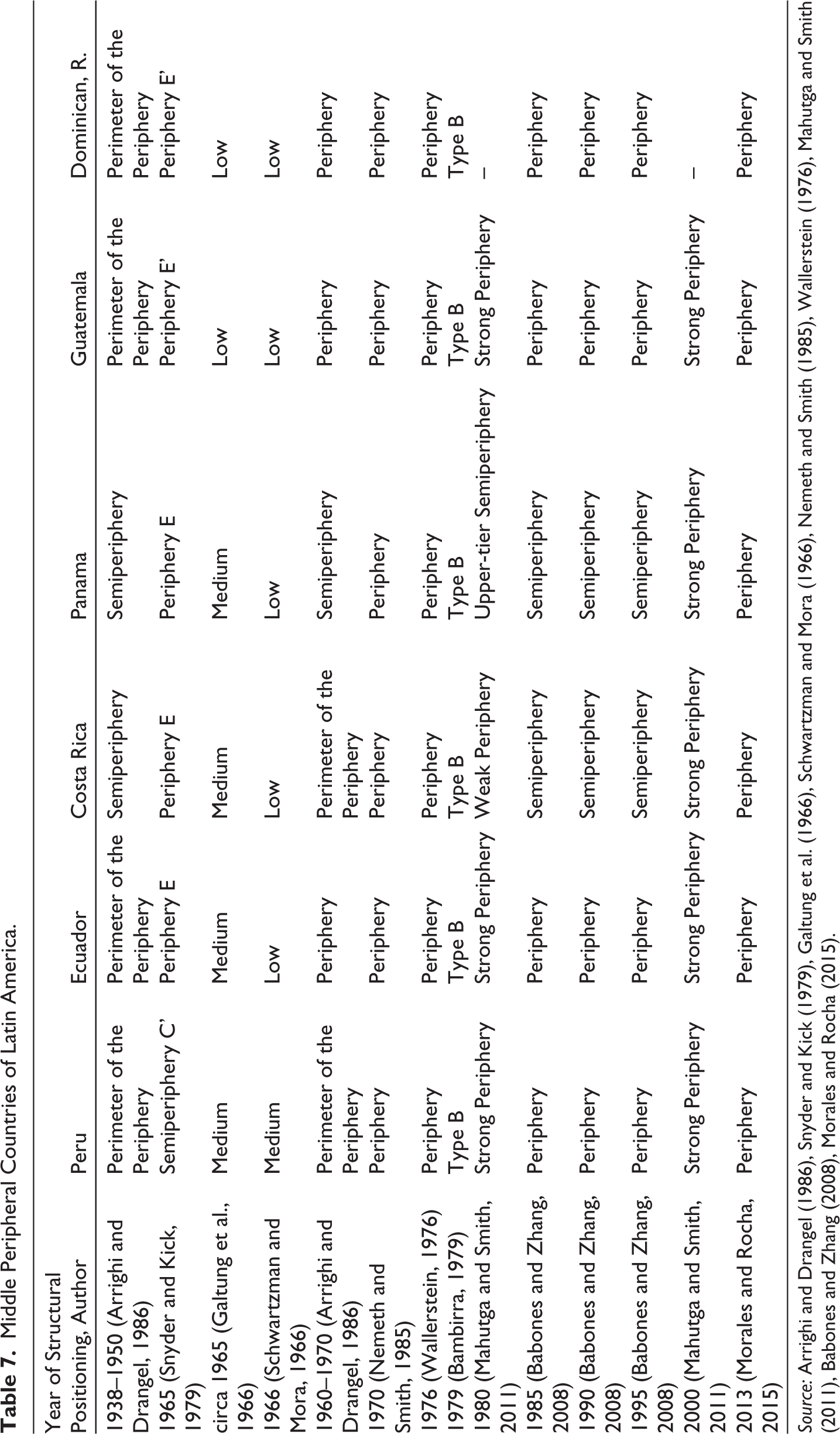
Source: Arrighi and Drangel (1986), Snyder and Kick (1979), Galtung et al. (1966), Schwartzman and Mora (1966), Nemeth and Smith (1985), Wallerstein (1976), Mahutga and Smith (2011), Babones and Zhang (2008), Morales and Rocha (2015).
For Bambirra, all these countries have a Type B industrialisation, and, likewise, for Nemeth and Smith, Wallerstein, and Morales and Rocha, these countries are part of the periphery. However, despite being installed on the periphery, these countries have been gradually endowed, thanks to specific social and political conditions, with moderately efficient governments that have contributed to the undertaking of modernisation processes and a moderate improvement in the welfare conditions of their populations; hence, they have been characterised by Mahutga and Smith as a strong periphery.
Among them, Peru and Ecuador are the countries with the largest geographic and demographic proportions. However, due to its historical relevance and specific weight in the Andean subregion, Peru was seen as part of the semiperiphery C’ by Snyder and Kick, as a strong peripheral country according to Mahutga and Smith, or a mid-range country by both Galtung et al. and Schwartzman and Mora, that is, with a certain preponderance over the rest, while Ecuador has historically been located in a later position in the Andean context, as Snyder and Kick considered it part of the periphery E, for Mahutga and Smith it was part of the weak periphery (1980) and Schwartzman and Mora considered it in a low rank in the Latin American hierarchy.
Costa Rica and Panama, for their part, have been the countries that, in relative terms, have advanced further in their modernisation processes and have improved the socioeconomic levels of their populations; this has been reflected in the records of both Arrighi and Drangel and Babones and Zhang, who have come to place these two Central American countries in the semiperiphery. However, there is a majority opinion that these countries are located on the periphery, although in a moderately advanced situation.
Finally, similarly to Ecuador in the Andean subregion, Guatemala and the Dominican Republic are in a relatively secondary situation in the context of Central America and the Caribbean, since these two countries have been evaluated as the perimeter of the periphery by Arrighi and Drangel, periphery E’ by Snyder and Kick, and low-ranking countries in the Latin American hierarchy by both Galtung et al. and Schwartzman and Mora.
Low Periphery: Paraguay, Bolivia, El Salvador, Honduras,
Nicaragua, and Others
In a structurally minor situation are Paraguay, Bolivia, El Salvador, Honduras, and Nicaragua (see Table 8 ). Although there are no records in the reviewed literature, Trinidad and Tobago, Jamaica, and Bahamas could also be placed in this group.
Minor Peripheral Countries of Latin America.
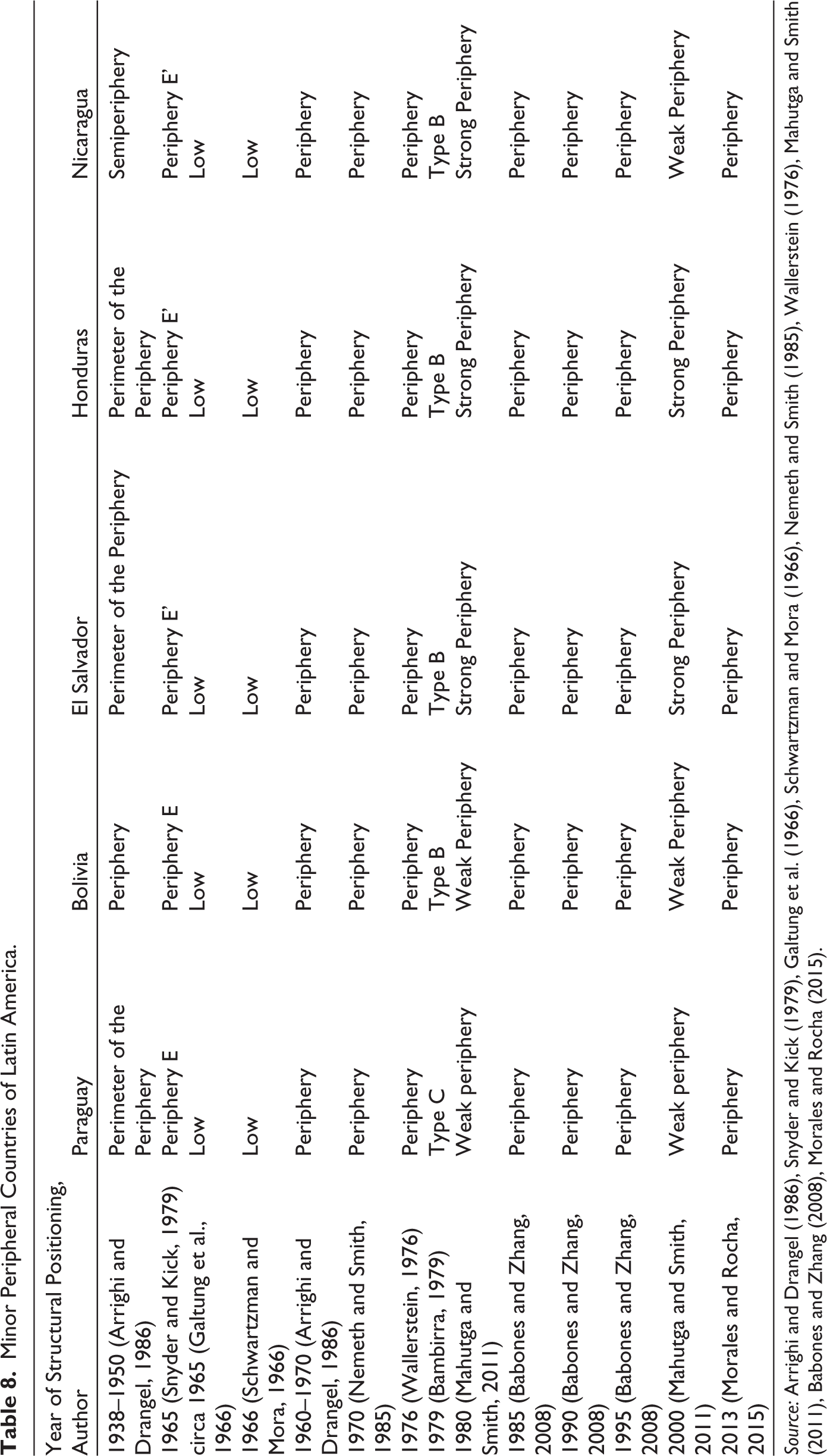
Source: Arrighi and Drangel (1986), Snyder and Kick (1979), Galtung et al. (1966), Schwartzman and Mora (1966), Nemeth and Smith (1985), Wallerstein (1976), Mahutga and Smith (2011), Babones and Zhang (2008), Morales and Rocha (2015).
As can be corroborated, there is a broad consensus that these countries are not only located on the periphery but are also located in a lower stratum of the Latin American hierarchy of power. For this reason, these countries can be considered minor peripheral states.
In general terms, these are countries whose governments face difficulties in capturing public resources and using them efficiently to promote their national development processes. However, despite being located in a low part of the periphery, these countries also have the possibility of ascending structurally, and, at times, some academics have registered this for some cases, as happened with Arrighi and Drangel or Mahutga and Smith, who observed a certain structural advancement by the Central American countries, identifying them as part of the perimeter of the periphery or in the strong periphery.
Lowest Periphery: Haiti and Others
The country in the lowest structural position is Haiti. In addition, other Caribbean countries would be located in the most marginal part of the world system. The vast majority of these states were not considered in the analysis of dependency/world-systems theories for basically two reasons: first, some of them achieved their independence relatively recently (between the 1960s and 1980s); second, others do not release their macroeconomic figures or reports regularly, making it difficult for analysts to assess their performance.
In general terms, it is possible to point out that, due to their structural backwardness, the lowest peripheral states are in a situation of maximum vulnerability, both internally and externally (Morales, 2023). For this reason, these states are always the main ones affected by natural disasters, international economic crises, pandemics, conflicts between neighbouring countries, political crises in territorially close states, etc. One of the most worrying aspects for these countries is that their structural position has improved over the decades.
Conclusion
It is not possible to disarticulate the structural observations raised by world-systems theory from the formulations made by dependency theory. As part of their research agenda, both share an interest in deeply understanding the position of countries in an international structure that, for them, is inherently modern, capitalist, and colonial.
In the structure, historically, it has been relatively easy to refer to the position of great powers and observe the scope of their power. However, when considering Latin America, this is not the case. Undoubtedly, there is a broad consensus around the main powers of the region (Brazil and Mexico, and previously, Argentina), but the task becomes more complicated to the extent that the analyst ‘descends’ in the structure of the region to address the countries of smaller geographic size and economic weight. For this reason, this research has not only surveyed almost a dozen of the structural measurements carried out from dependency/world-systems theories that point to this complex task of observing the major and minor states of Latin America, but in addition, the balance and systematisation of all of them have been carried out, which were organised in phases or stages.
The first phase, mainly in the 1960s, predating the consolidation of world-systems theory, confirmed the existence of a stratified global system in Latin America. However, it fell short of comprehending its root causes, processes, conditions, and repercussions.
The second phase spanned the 1970s and 1980s, aligning with dependency/world-systems theories, which introduced valuable methodologies to enhance the theory’s explanatory power. These studies primarily adopted a synchronous approach, offering static insights without tracking temporal changes.
The third phase, ongoing since the mid-1980s and into the twenty-first century, embraced a diachronic perspective, measuring countries’ positions over multiple years and unveiling their evolution. While rooted in dependency/world-systems theories, this phase displays a growing eclecticism, incorporating new measurement tools and diverse analytical perspectives.
As demonstrated throughout the work, all the authors agreed on the semiperipheral and peripheral situation of the Latin American countries, which speaks to the consensus in the academy. However, what is worrying is that the readings made by researchers in the 1960s largely coincide with the interpretations of the second decade of the twenty-first century: in other words, over half a century, the structural position of the vast majority of Latin American countries has remained unchanged, regardless of systemic events, such as the end of the Cold War, or the impact generated by the emerging powers of the twenty-first century, such as China or India, which have had an economic growth drag effect favourable for the structural mobility of its Asian neighbours.
In this sense, although the nature of this work has been essentially theoretical, the analysis of the stratification of Latin American countries has important consequences. Having a precise diagnosis of the specific weight of each country in the region and its structural position from a historical perspective is increasingly relevant for the future design of socioeconomic policies and international insertion strategies in accordance with the realities and potential of each one.
Footnotes
Acknowledgements
I want to thank the student Shuqing Zhang (School of International Studies, Sun Yat-sen University) for her valuable contribution in the work of gathering information and systematising data for the preparation of this research. Also, I want to express my acknowledgements to Garrett Thompson (Sun Yat-sen University, garrettbt@mail.sysu.edu.cn) for his professional support in proofreading this work.
Declaration of Conflicting Interests
The author declared no potential conflicts of interest with respect to the research, authorship, and/or publication of this article.
Funding
The author received no financial support for the research, authorship, and/or publication of this article.