




Abstract
Through a multi-sited ethnographic study of 30 internal migrants working in informal occupations in Delhi, I show that the everyday lived experience of these migrants in India is negotiated by multiple and often intersecting forms of inequalities and exclusion. To that end, I give an overview of their efforts to access available social welfare schemes. Their interactions with street-level bureaucrats and the paperwork (such as an Aadhaar card or a ration card) required to access welfare schemes show how their mobility is restricted, compelling them to enter into a relationship of dependency with brokers, employers and others. The article explicitly centres on state-migrant relations and provides tools to understand the efficacy of social welfare policies in contemporary Indian bureaucratic transformations. It reveals the multitude of complex factors that motivate workers to move and find work that must be acknowledged in any administrative effort to ensure access to rights and legal aid. In doing so, the article also raises pertinent questions on the move towards digitisation and the creation of a central database of migrant workers.
Introduction
Three recent significant developments and events in India regarding better access to rights and welfare for internal migrant workers have gained wide traction. These are the COVID-19 crisis, the ‘One Nation, One Ration Card’ policy of 2019 and the more recent Supreme Court judgement calling for a central database of unorganised sector workers. This article questions the assumptions underlying these developments and how centring state-migrant relations can help better understand the efficacy of bureaucratic transformations within welfare systems and development programmes. It asks the following question: how is a migrant workers’ mobility enabled or hindered through the design and delivery of welfare schemes? To answer this question, the article highlights the complexity of factors impacting migrants’ motivations to work, modes of securing work and their efforts to access welfare rights.
Based on my PhD fieldwork, conducted between January and July 2019 in New Delhi, India, I will use data from a multi-sited ethnography to reveal the lived experiences of circular migrant workers in their efforts to access welfare rights. Fieldwork techniques included conversational interviewing, participant observation and a study of the legal case files of 30 workers, all from lower castes and from religious minorities. Of the total, 15 were sex workers and 15 were labourers in other informal occupations. Later, follow-up phone conversations took place with workers between August 2019 and May 2021 to gather further data from the participants. These latter interactions enabled me to gather data on their experiences during the multiple lockdowns imposed by the government to contain the COVID-19 pandemic. The workers who participated in the research had come from various parts of the country, including Madhya Pradesh, Uttar Pradesh, Uttarakhand, Bihar, Rajasthan, West Bengal, Andhra Pradesh, Maharashtra, Karnataka, Chhattisgarh and Assam and had located to Delhi and the National Capital Region. They were working as manual scavengers, sex workers, construction workers, brick kiln workers, domestic workers and stone cutters or had been forced into an early marriage.
By discussing why people move, how they move and their difficulties regarding access to socio-economic and political rights, I will demonstrate how multiple factors create inequalities of wealth, caste, gender and also a rural–urban divide and facilitate internal migration. After that, I will describe how workers who participated in the research were recruited for work through informal networks, families, contractors, employers and others. By discussing their motivation to find work and their efforts to access socio-legal rights, I will show that migrants are not a homogenous group, but a heterogeneous category. To this end, the paper willl show that bureaucratic transformations do not entirely replace the existing forms of access and intermediation but instead get reconfigured with the existing informal networks and forms of informal mediation, bureaucracy and structural inequalities in which lower caste workers are embedded (Chambers, 2020; Madon, 1992). Accordingly, any bureaucratic transformation (such as that around digitisation or modes of welfare delivery) needs to acknowledge the multiplicity and complexity of migrant experiences, motivations and decisions.
Centring Migrant-State Relations in India
‘They are asking for a photocopy of the ration card to give food, even during a lockdown! Is this legal? The photocopy shops are not even open. Does state aid mean asking for these documents in return?’ asked Abeera, a lower-class Muslim domestic worker in Delhi from Bihar on 12 April 2020. She had to move houses within Delhi a year later because she could not pay rent. ‘The ration shop near my new house told me to get a new ration card. They said my old one would not work. Are we required to get a new ration card when we move within Delhi?’ After making repeated rounds to the district office for a few months, she finally got her new ration card. However, until it was made, she had to buy more expensive groceries. She still does not understand why the district office in Delhi asked her to make a new ration card, demanding that she make repeated rounds of the concerned office.
I met Abeera in 2019 during my fieldwork when she spent many months going to various government offices and the courts, demanding her right to identity documents, payment of wages by her employer and justice against the physical harassment she had suffered in the workplace for more than half a decade. These were ‘normal times’, the year before the lockdown had been imposed. Abeera was not the only migrant worker who had to make repeated efforts to access essential identity documents like ration cards and other services such as housing and payment of minimum wages. Other workers also reported similar struggles even during ‘normal times’. Subsequently, the COVID-19 crisis impacted these workers even more disproportionately (Manzoor & Kachroo, 2020), stripping them of their already scarce rights to livelihood, food, shelter, water and dignity.
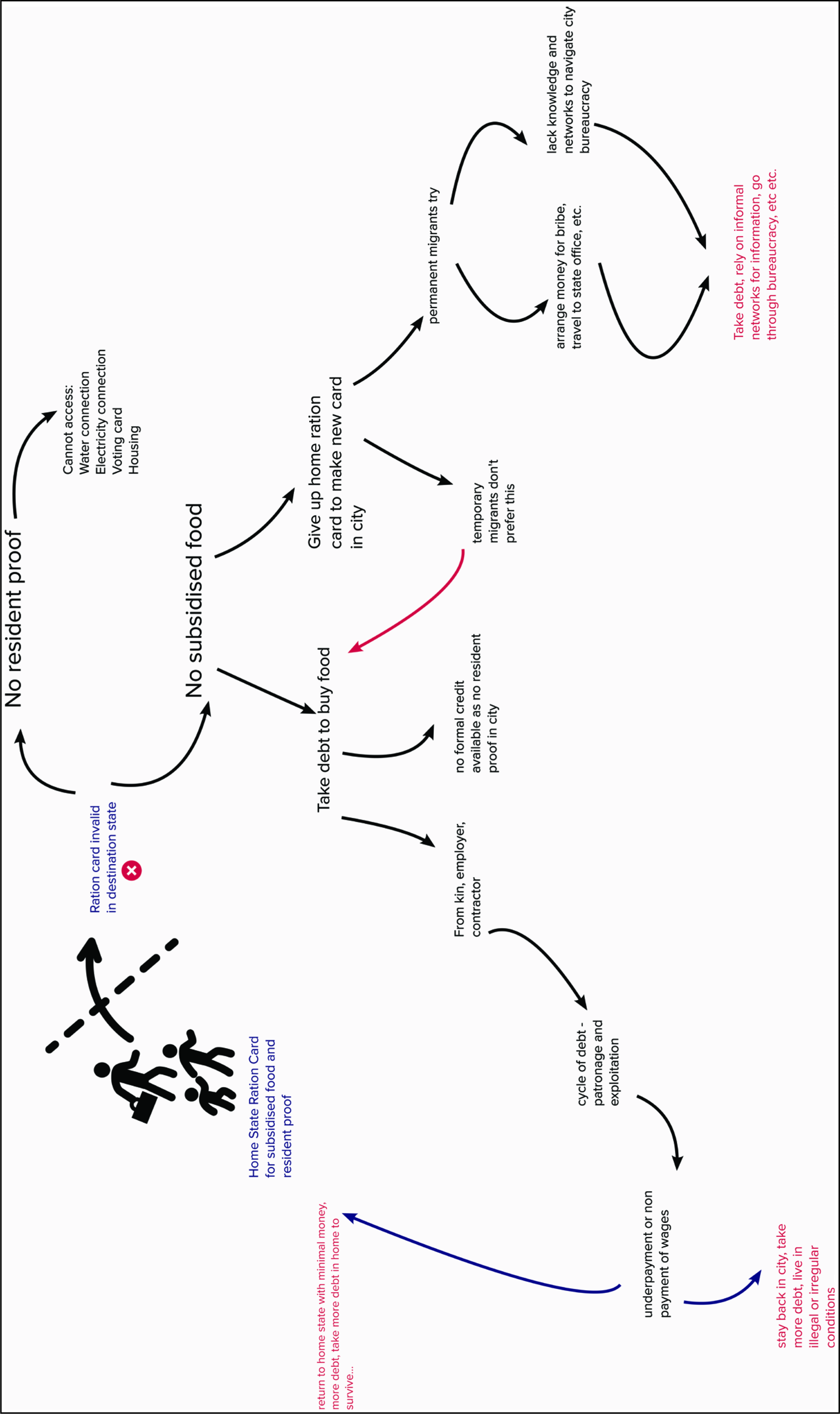
Abeera’s concern and confusion over getting a new ration card when moving within Delhi is based on her knowledge that a new card is required only when one moves across state borders. In India, as soon as one moves from one state to another, access to welfare entitlements such as food, housing, health and other benefits is lost because they are connected to the proof of residence in one’s home state. Accessing socio-economic rights in their destination of choice requires dealing with complicated bureaucratic procedures to make new identity documents and forgoing residency in one’s home state. This becomes problematic for two reasons: One, workers need to provide proof of residence in their destination area to access welfare schemes, which is difficult as their living arrangements are often irregular providing no documentation such as a lease., Two, many workers do not want to give up their access to welfare schemes in the home state as they are circular or seasonal migrants. This becomes a cause for tension: Welfare entitlements are tied to proof of residence which suggests ‘stability’, but being a citizen migrant entails ‘mobility’. Thus, despite being citizens, internal migrants lack rights in practice, making it difficult to legitimise their existence in the destination state. They must take the risk of relying and depending on informal relationships in the city, with their contractors, employers, friends, distant or near-relatives or even unscrupulous moneylenders.
Several researchers have shown how work in the informal sector can be exploitative and underpaid, often involving a chain of multiple contractors or agents (Breman, 1996; Mosse & Gupta, 2005). It is essential to understand that the informal sector has varied ways of organising work and labour and that patterns of pay and recruitment practices are not uniform or cannot be generalised. Many of these recruitment and work practices are based on paying advances or informal debt (Guérin, 2014; Picherit, 2009). Contractors or employers usually give advances to migrants to travel to the city (Mosse & Gupta, 2005; Picherit, 2009) and some kharcha pani 1 for food and water (Mishra, 2021).
Sometimes, while in the cities, migrants may also need informal credit, essential for weddings, religious travel and other social purposes for which formal banks do not extend loans. Thus, these workers need to risk trusting their contractors for both work and informal sources of borrowing money. As Priya Deshingkar (2017, p. 122), referring to these unexpected expenses, says, migrants ‘view it as a necessary cost that must be met now to secure a better future for themselves and their children’. Often, workers have no other recourse to money. Resultantly, migrant labourers negotiate everyday survival to essential services through a network of informal relationships and negotiate a simultaneous relationship between patronage and exploitation. In this way, migrants in the city suffer from double exclusion—legal exclusion due to a lack of non-portability of identity and social exclusion due to their lower social standing, resulting in exploitation, violence, deprivation and indebtedness. The arduous journey of obtaining identity proof and documentation is demonstrated in Figure 1 .
Source: The author.
To help migrants access fundamental rights and identity documents, there have been many administrative and bureaucratic changes in India. These efforts, such as e-governance, digitisation of identity documents and the creation of a central database to register migrant workers have focussed on reducing barriers to portability and easing administrative processes related to accessing services. However, these efforts have been mostly introduced from a Western perspective and assumptions. For instance, the Indian state and Western donors argue that digitising identity documents will help reduce dependency on labour market intermediaries. And so there has been a growing focus on a ‘Digital India’ to increase access and portability of welfare for the nation’s marginalised citizens. This was first attempted through the USAID project on developing telecentres in countries of the Global South to bridge the digital divide, and it was later undertaken by the Indian government under the National E-Governance Action Plan in 2003–07 (Paul & Das, 2020).
The ‘One Nation, One Ration Card’ policy mentioned earlier was also affirmed in March 2019 to enable the portability of subsidised food for below poverty line (BPL) families irrespective of their proof of residence (Press Information Bureau [PIB], 2019). Despite this rhetoric, internal migrant workers could not access food during the COVID-19 pandemic because of factors such as district officers and ration shop owners of one state not recognising another state’s ration card or district officers shunning workers stating that they should ask for help in their home state (Bakhla et al., 2020; Jayaram & Varma, 2020; Masiero, 2020). In this way, India’s temporary assistance programmes did not reach a majority of circular migrant workers (Bakhla et al., 2020; Jayaram & Varma, 2020). Even those who were residents of Delhi, lower-class residents in urban cities, reported that they had endured considerable waiting time in queues at internet cafes or enrollment centres (Chambers, 2020; Paul & Das, 2020).
While the USAID-supported e-governance programme is believed to have overcome some significant bureaucratic barriers—such as increased accountability, reduced intermediaries and addressing the digital divide in the Global South—less is known about the specific informal institutions that circular migrant workers have deployed to overcome obstacles placed by red tape. In this context, the recent Supreme Court judgement in June 2021 on the centralised registration of migrant workers is welcome. It stresses that authorities should not ask for identity proof from workers to access welfare benefits. Deshingkar (2021) writes that the judgement ‘stands up for the rights of the weakest and recognises their critical contribution to the economy. But a challenge to its implementation remains’.
The migrant workers in my research provide insights into how their socio-economic marginalisation prevents access to state services, placing a question on the implementation of the aforementioned initiatives. In home states, where workers are eligible to access welfare benefits, the usual forms of delay in registration for any welfare benefit during ‘normal’ times include the following factors––not being able to fill the required paper or digital forms, absence of the concerned officer from the office and the presence of caste politics which excludes certain communities. Further, in their home states, even when workers did have the required documents, for example, the health card under the Ayushman Bharat Yojana, or eligibility for getting a pucca house, 2 the respondents said that since many administrative processes were digitised, officers could get away by saying that the migrant’s name was not on the list of beneficiaries or simply that the ‘computers were not working’. This then became an additional way of exercising power and excluding people from lower castes. In destination states in which the ‘One Nation, One Ration Card’ policy is theoretically present, workers reported that officials demanded other documents such as an Aadhaar card or a BPL card, apart from the ration card when distributing ration to migrant workers. With many workers not carrying all these cards from the village to the city, they were deprived of their legitimate provisions.
This interplay of state-migrant relations is crucial in the Indian context because, as several researchers have already shown, instead of fighting for labour rights and traditional worker protection, they use their power as voters to demand welfare rights (through a rhetoric of citizenship) from the state, thus forcing the state to play a more central role in their daily lives (Aggarwala, 2013; Shah & Lerche, 2018). Workers strive to achieve this in two ways: their political power as voters and their economic power, that is, exchanging cheap labour to support the state’s neoliberal growth project. On asking about why workers did not always pressurise their employers for fair working conditions, Adhit, a worker in the construction sector, insisted, ‘[b]ut it is the sarkar 3 which should give us everything. We are citizens of this country. Why is the sarkar not asking the employers to give us wages?’ Thus, Adhit resisted by holding on to the one major player who cannot escape, the central government, responsible for delivering rights.
By bringing the state at the centre of claim and delivery of rights, this insight has several implications for its role in the working lives of the informal migrant workers in India. The engagement between informal workers and the state in India requires the migration literature to expand its understanding of the liberal modern democracy in India. Here, the relationship between workers and the state operates not just within the labour–capital framework, but in a reciprocal relationship between the state and labour (Kotiswaran, 2019).
Why Do People Move?
Socially and economically marginalised persons in India move for intersecting reasons: financial necessity, disaster or state-induced displacement, poverty and hunger, marriage, health, domestic violence, udhaar (loans) non-availability of work, building financial and social capital, aspiration to thrive and entrepreneurship, non-availability of essential services at home, informal relationships and networks. The motivation to move is further bound by their social identity, including gender, sex, race, caste, sexuality, class and nationality. Being linked to social identity, migration is also fundamental in defining one’s social standing within the country’s home, community and broader existence.
Two of my interviewees, Achar and Mana, both lower caste circular migrants from Madhya Pradesh, working in the construction industry in Delhi, angrily talked about the regional disparity in response to a question as to why they came to work in Delhi:
There is absolute poverty from where we come, otherwise why else would we move? People there [in the village] are under so much debt because of health emergencies and marriage-related expenditures. There is no regular work, farm work, factory work or regular construction work available in the village. So, we come here. If we do not, what will we eat?
Official statistics on New Delhi, the study site for this research, confirm this narrative. The population of Delhi has increased from 13.8 million in 2001 to 16.7 million in 2011 (Census, 2011); 42 per cent of this population comprise migrants (National Sample Survey Office [NSS], 2012). Studies show that a majority of rural migrants move to urban areas for reasons of employment (Bhagat, 2011). They move from states such as Andhra Pradesh, Bihar, Chhattisgarh, Jharkhand, Madhya Pradesh, Odisha, Rajasthan, Tamil Nadu, Uttarakhand and Uttar Pradesh mainly to Delhi and cities in Gujarat, Haryana, Karnataka, Maharashtra and Punjab (Behera, 2018). Baduri, a former stone quarry worker, now permanently settled in Delhi, said as follows: ‘In our village, there is no water, no farm, not even mazdoori (manual labour). So, we come to work in Delhi’.
People move because destination cities like Delhi are a hub of many development activities, generating employment for a sea of essentially seasonal, circular and short-term migrants (Deshingkar & Farrington, 2009; Keshri & Bhagat, 2013). This kind of development thrives on incorporating lower socio-economic caste and class workers into casualised, precarious and exploitative work relationships (Kundu & Mohanan, 2017). In this way, short-term migrants form the backbone of India’s neoliberal growth model as the accumulation of profits are achieved at the expense of increased casual informalised work (Mitra et al., 2017). Employers prefer migrants as they do not need to pay them minimum wages or offer reasonable living conditions, or give health benefits, food and educational facilities for their families. In addition, due to the lack of proof of residence in the city, they cannot approach the local administration in Delhi for these benefits (Aajeevika Bureau, 2020). So, in the city, migrants tend to engage in a range of informal employment including, but not limited to, working in brick kilns, stone quarries and construction sites, as domestic labour, in the area of transportation, as rickshaw pullers/drivers, in manufacturing units, electricians, hawkers and vendors, plumbers, masons and security personnel (Behera, 2018; Bhagat, 2011).
The literature on internal migration in India offers various explanations as to why people move. Migration for these groups is a livelihood strategy, a survival strategy (Keshri & Bhagat, 2013) or simply a coping strategy (Mander & Sahgal, 2010). The term ‘footloose labour’ (Breman, 1996) indicates that rural workers move to cities due to a lack of agricultural work. The term ‘distress migration’ (Deshingkar & Start, 2003; Keshri & Bhagat, 2013; Mosse & Gupta, 2005; Rogaly, 1999) is based on the premise that this movement results from problems that arise in rural areas. These concepts tend to portray migrants as lacking agency, driven by forces beyond their control. Studies show that the poor and socially disadvantaged engage in less permanent migration than the better-off migrants (Bhagat, 2011). Several socio-economic factors also contribute to the decision to move—such as age, gender, educational levels, caste, religion and land dispossession—depending on the type of work and the destination city (Deshingkar, 2006).
Migrants’ narratives in this research show that their decision and motivation to move do not neatly fit into these scholarly conceptualisations and can result from a combination of intersecting reasons. Deshingkar explains the following in the context of migrant construction workers in India:
There are a host of complex social and economic reasons for migrating into construction work, including better earning prospects (higher income, more regular work and the ability to remit money home) as well as the desire to experience [an] urban lifestyle and become a modern person. (Deshingkar, 2017, p. 120)
Escaping caste-based discrimination in rural areas is another reason why people move (Deshingkar & Farrington, 2009). Adhit, a former stone quarry worker and a permanent migrant in Delhi, said that ‘[i]n the village, there is a lot of untouchability. Tired of this, I came to Delhi. I like it here’. Sanjay, a circular migrant from Madhya Pradesh working in the construction sector in Delhi, affirmed as follows:
In my village, when we go to buy food, they throw it into our hands because they cannot touch us. The officials also do not allow us to drink water from the same tap as everyone else. In the city, where I work, nobody cares about this.
Another reason to understand why people move is the locus of household decision-making where a worker ‘uses migration as part of a portfolio of options to increase income and mitigate risk’ (Zeitlyn et al., 2014, p. 10). The household supports this movement to the city: older members stay behind to take care of the young children; family members pool money incurring some loan to finance the journey and other expenses as part of a well-thought-out investment strategy; workers use their social networks to gather knowledge about their movements; all in the hope that the workers will save and send back or take money home (Deshingkar & Start, 2003). Malin, a lower caste, semi-permanent migrant
4
from Uttarakhand and a watchman in Delhi recounted in an interview,
I did various jobs, from cutting glass to driving in different cities. Then I came to Delhi to work with my uncle as a full-time driver to earn money and build a house for my family back home. I saved money and sent it back home.
Dhira, an older construction worker and a circular migrant, also from Madhya Pradesh, told me as follows: ‘We go wherever we find mazdoori (work). 5 Our parents stay back and take care of the children’.
In addition, factors such as domestic violence, inability to work due to gender-based discrimination prevalent in their state; the need to follow the husband’s family after marriage; no parents; and more girl children—are also closely related to economic reasons for such movements (Bhagat, 2011; Pettman, 1998). Kumud, a former sex worker and a permanent migrant in Delhi, recounted as follows: ‘My father had five boys and four girls. We were poor and had no food to eat. My father’s sister insisted that she could care for one of his daughters in the city where she lived. So, I came here’.
A former worker in a stone quarry said, ‘I got married, so I followed my parents-in-law and husband’. Bakti, a circular migrant and construction worker in Delhi, also echoed this sentiment: ‘I used to go with my parents for seasonal work and now after marriage, I go to the city with my husband’s family. I must follow. I have no choice’. For others, the decision to move was also based on familial occupation. Basant, a semi-permanent migrant who works in a wholesale shop that prepares and sells betel (paan)
6
leaves, remarked as follows:
We used to harvest betel leaves in the village. For generations we have only done this work. However, it no longer sustains me in the village. The retailers in the nearby towns do not pay much. So, I moved to Delhi to make more money in the same line of work. I can only do the work I know.
There is no doubt that poverty, lack of regular work, poor harvest and caste-based discrimination are significant drivers for people to move to the city. Many workers believe that moving to the city will offer them opportunities to get better wages for the same work they might be doing in rural areas. These findings give further credence to the research of Jan Breman (1996), Ben Rogaly (1999) and others which indicated that migrants’ employment in vulnerable occupations is dominated by economically and socially disadvantaged groups. More importantly, the participants’ motivations to move reveal that migrants are not a homogenous group.
How Do People Move and Find Work?
Participants negotiated their movement to the city in many ways. Some had travelled to cities independently and found work through informal labour markets. A case in point are the labour chowks
7
in Delhi or the nakas
8
in Mumbai (Shah, 2014). Here, workers gather and are recruited by contractors or employers. Mana, a circular migrant and construction worker, informed as follows:
We came to Delhi on our own, and then from the labour chowk, a contractor took us to work. He told us that he would give us ₹1,000 in advance. So, along with 12 other people from my village, I went with him. Many contractors come daily to take workers from this chowk.
Another way migrants found work was through contacts with contractors in the cities who had arranged their travel from the village in large groups. Some of these contractors could also be former workers. Amrapali explained as follows: ‘It is like this, someone from the village who lives in the city asks us to come to Delhi to work and we go with them. We have been doing this for 8–10 years’. Amal, a brick kiln worker and circular migrant, also told me as follows: ‘The contractor from our village brought us here. He said he would find work, so we came with him’. These ways of finding work (through labour chowks and prior contacts with contractors in villages) have also been identified by David Mosse and Sanjiv Gupta (2005) in their study of recruitment practices of adivasi migrants in Rajasthan, Madhya Pradesh and Gujarat.
Another way of finding work was through informal familial or non-familial networks already working as settled or temporary migrants in the city. Mitra (2010) uses the idea of social capital to explain how people use social networks to find work. Basant, a semi-permanent migrant in Delhi, recounted as follows: ‘I knew someone in the village who was working in Delhi. So, I came with him in 1994 and got employed in a wholesale shop that sold betel leaves’. Malin, a semi-permanent driver and watch person, opined as follows: ‘I came with a family member to Delhi searching for work. He first got me into a clerical job in an office where I used to make and serve tea’. Kumud, a permanent migrant and former sex worker, added as follows: ‘The owner of the brothel was from my village. I came with her as a child, and after I grew up, I told her that I would also do the same work’. According to Mander and Sahgal’s research, ‘[t]he migrants may have been poor, but their wealth was their networks. These social networks, of kinship, caste and geography were critical in facilitating and enabling the process of migration’ (Mander & Sahgal, 2010).
Employers adopt various ways of employing their informal workforce so that the modes of pay and recruitment practices cannot be generalised. For example, workers may be paid an initial travel allowance upon recruitment and the remaining wages after work is finished in a brick kiln. For sex workers, the initial period of non-payment of wages can stretch up to three years. This arrangement also means that a part of the wages can be given to workers to cover food and subsistence, while the remaining wages are paid at the end of the contract or carried over to the next season if credit has not been taken by the workers during the work contract.
The relationship between the contractor and the workers can also be highly exploitative (Picherit, 2009), for instance, when workers are transferred to other employers against their will. Loans taken by workers can even be carried forward with the same employer from one season to another. Advances then create indebtedness and a cycle of borrowing and repaying (Deshingkar, 2017), increasing the control on a workers’ mobility. There have been instances of exploitation where workers may have little freedom to choose employment and may be physically, sexually or verbally abused at the slightest attempt to ask questions or protest (National Commission for Enterprises in the Unorganised Sector [NCEUS], 2007). But, the workers need to risk trusting the contractor for both work and informal borrowing.
Accessing Socio-economic Rights and Experiences of Abuse and Violence
Neoliberalism has led to growing exploitation and violence of ‘women, children, and men for domestic or other lowest-paid, unaccounted-for labour, including sexual’ (Bannerji, 2016, p.15). The migrant workers live under very exploitable conditions and are at the mercy of their employers. ‘What has been called “precarious” life or “bare” life is their permanent mode of chance existence’ (Bannerji, 2016, p. 15). Despite such degrading conditions, migrants are often willing to engage in such work because the wage rate is often higher than what they would otherwise earn back home (Bird & Deshingkar, 2007), as is true for workers who migrate from one country to another in search of work (Achilli, 2019). This kind of migration pattern is ‘tantamount to a coping strategy that enables migrants and their families to maintain their current quality of life, which implies surviving on or close to the poverty line’ (Mander & Sahgal, 2010).
Consider the de facto identity document in India like the ration card. The state government issues this card. It enables subsidised food for poor households through the public distribution system (PDS). This ration card is the most common form of identification for accessing other services such as health, education and pension. It is also needed to open a bank account or get a telephone connection (Abbas & Varma, 2014), as it is a government-issued card that shows the bearer’s photograph. Despite the prominence of the ration card in accessing many essential services, it is not portable across the states of India. This means that once a person crosses their home state’s boundary, they cannot use their ration card to access food grains or to services mentioned earlier. Although there have been recent developments in making the ration card portable, Abeera’s earlier narrative shows that it has not translated to portability in practice.
The insistence on producing documentation can be understood better by understanding the design of the PDS itself. The ration card is mainly used for accessing subsidised ration through the PDS. The central government bears the cost of this subsidised ration. The rules for the issue of the ration card varies, and the process is not uniform across the states. As Kone et al. (2017, p. 23) note, ‘issuing officials in the destination province may refuse to accept prior identity documentation provided by poor migrants because they are looking for bribes’. Thus, the process of making the card itself comes with many operational difficulties for the migrants who are poor, illiterate and simply do not know how to navigate the bureaucratic process in cities where government offices may be difficult to approach (Kone et al., 2017).
Like any migrant in a new country, these workers in the city do not always have networks or connections to acquire the requisite proof to get this ration card. Baduri, a permanently settled migrant in Delhi and a former stone quarry worker, told me as follows:
If you go to the concerned office, they will not make it [ration card]. Once, they [the concerned authority] also verbally abused me. There is no help.
9
And even now that I have got it made, after several rounds to the fair price shops, I only get wheat. And I do not get wheat every month; only once in 2–3 months.
Additionally, there is the possibility that migrants will need to face corrupt officials or suffer administrative errors even though they have been staying for a long time in a city. Accessing subsidised grains can be a long drawn-out cumbersome process, even in the villages where workers are residents. Bhurvi, a circular migrant and construction worker from Madhya Pradesh, told me that her card was made in five years after going to the district office many times.
Another example is the Pradhan Mantri Awas Yojana (Rural); a government scheme mandated to provide ‘Housing for All’ by 2022. It aims to provide a ‘pucca house with basic amenities to all homeless persons and those living in kutcha and dilapidated houses’ (Government of India [GoI], 2019). The beneficiaries are selected based on Socio-economic Caste Census (SECC) parametres and not on their BPL status (GoI, 2019). Therefore, a person can be a below poverty cardholder and still not access the housing scheme. All workers in this research showed considerable frustration in accessing housing in their home state. Mana, a circular migrant and construction worker, said as follows:
[The] government gives ₹130,000 to construct a house. But with this amount, you cannot make a house. They also give this amount in installments. I had to take a loan because the installments were delayed. Now I have just four walls with no floor or roof, and we use a lantern instead of electricity.
Adhir, a permanently settled migrant worker in Delhi, explains the situation in detail:
See, [Prime Minister] Modi
10
says that people are being given houses. Now, this is true in one sense. For instance, assume I already have a pucca house in the village. In front of that, I put tin sheds and take a photograph to show a kutcha house.
11
Then I become eligible for the housing scheme. From the amount I get, I give ₹10,000–20,000 as bribe to the officials in the village. Still, I make a profit because I already have a house. People do this, and so the poor who cannot give bribes never get a house.
People do not have access to such housing schemes in the city because it is a rural scheme. The urban equivalent of this scheme requires a person to share the cost and be a resident in the city. As a result, migrants in a city, like Delhi, living in temporary, irregular or illegal housing arrangements face problems. Mana and his wife Bakti, circular migrants and construction workers, share their experience of living inside a construction site: ‘We used to sleep outside our huts because the huts would be flooded in the rainy season. All our belongings used to get wet. When the owner paid us, we could get some food from the market’.
Even where portability was inherent in a welfare scheme such as the Ayushman Bharat—National Health Protection Scheme or Rashtriya Swasthya Bima Yojana (RSBY)—delivery of rights was not guaranteed. Ayushman Bharat aims to provide a benefit cover of ₹500,000 per family in public or private empanelled hospitals across the country. Its premium is paid by the central government annually. In this way, the scheme’s benefits are portable across the country. The status of beneficiaries is determined based on the SECC database (National Health Authority, n.d.). The RSBY is aimed at unorganised sector workers to provide health insurance to BPL families.
However, the eligibility criteria of these two schemes differ a lot: Ayushman Bharat requires people to be in the SECC database; and at the same time, the RSBY needs beneficiaries in the BPL category. The former is based on the caste census and the latter is based on economic status. The workers revealed their frustration while accessing the medical system in the village for the delivery of babies or a significant surgery. They did not know what card they had and where they could use it to access free or subsidised healthcare. They had to go to the nearby city in an emergency since the healthcare infrastructure in the village was not adequate. For such emergencies, they had to take loans. Bakti, a circular migrant and construction worker, recounted as follows: ‘Our child was born in the city. There were complications and the village doctor said he could not help. We were apprehensive. We had to ask 3–4 persons for loans. Now we have to work in Delhi to pay off that loan’.
In the city, health services are not any better either. Both permanent and temporary migrants complained that they had to wait in long queues to access any medical service. Adhit, a former stone quarry worker and a permanent migrant, explained how the Ayushman Bharat healthcare scheme and the availability of portable smart cards in cities worked: ‘This is the card. See. It should provide us with free services in any private hospital here in Delhi. However, there is no service. Some people do not even have cards and get services because they can pay bribes’.
Besides the pursuit of survival and the struggle to access fundamental rights, during fieldwork for this research, the workers spoke painfully of the sense of indignity and humiliation they had to endure at work. The indignity that workers faced included verbal, physical and sexual abuse. The exploitation ranged from non-payment of wages to restriction of movement outside their work sites. Some were physically scarred for life simply for demanding their rightful wages. To quote Malin,
I was working in a roadside dhaba.
12
The owner did not give me wages. Then one day, I told him that he must give me my money, or I would leave. During the night, when I was sleeping, he took a rubber pipe and hit my head again and again. He then verbally abused me, shouting that I deserved this because I was Harijan (a lower caste). Now, I cannot see clearly with this eye.
This experience of physical and verbal violence was closely related to placing several restrictions on workers’ movement from their work sites. Many seasonal and circular migrants also echoed this experience. Bakti explained as follows:
They did not allow us to go out from the work area. Even when we needed something from the market, they only allowed one family member to go so that the others could not run away. If some worker was injured, then they would call a doctor inside the site.
This restriction on movement, as Adhit, Malin and Bakti explained, was possible because the owners had the support of local goons or state officials. Adhit recalled one instance, when the state officials had tried to make sure that some stone quarry workers received wages:
We were paid in front of the officers. Then in the evening, the contractor came and forced us to give back half of the wages we received. Out of fear of losing work, we gave back the money. Despite state intervention, we still ended up with half the money that the contractors ought to have given us.
All participants told me that even though working conditions continuously worsened, they continued to work because it was the only option they had for survival amongst other limited choices. Workers’ narratives show that degradation and choice are not mutually exclusive. It also shows that this type of degrading treatment was not only because they could not approach the state authorities in the city due to being rightless, but also because of their social standing.
The participants of this research are all from the Scheduled Caste, Scheduled Tribes, Other Backward Classes and minority communities such as Muslims. They are most routinely denied almost every right, entitlement or benefits. They live on the edge, ‘marginalised, discriminated against, and often criminalised’ (Centre for Equity Studies [CES], 2017, p. 2). In many cases, they are treated as non-citizens with no access to subsidised food or ration, water, shelter and dignity. They cannot find any refuge in the legal system due to the ‘deemed illegality of their status’ (CES, 2017). The real effects range from hunger to unemployment and severe exploitation, including violence to death. Their status and experience of being treated as social rejects and untouchability are mainly associated with being from a lower caste (Srivastava & Sutradhar, 2016). In this way, the state has over time created second-class persons, a category of persons who find it difficult to receive constitutional protection or access rights.
In the context of India, Alpa Shah and Jens Lerche (2018, p. 19) conceptualise this lack of identity as the ‘internal alien-ness’ experienced by migrants in cities, and so they find it difficult to legitimise their existence in the cities. As migrants who cannot settle in cities and have a lower standing in the villages (Jain, 2018), circular migrants challenge the inherent bias entrenched in institutions that do not account for people’s migrancy across or even within their states.
Add to this the requirement of identity documents in the city, the lack of which makes them invisible, unenumerated, face hostility and suspicion by the state. They do not wish to give up their identity documents, including ration cards and voter cards, to make a new one in the city as ‘their homes, agricultural lands and often families remain in their villages’ (Aajeevika Bureau, 2020, p. 18). These ‘translocal lives’ of internal migrants, as Desai and Sanghvi (2018) argue, are often a combination of their ‘multilocal livelihoods and households’ which can be understood as a survival strategy ‘to retain certain aspects of their lives in their villages, particularly their social and cultural lives, political participation and investments while seeking employment in cities’ (Aajeevika Bureau, 2020, p. 18).
Concluding Remarks
This article has shown that multiple systems of socio-economic inequalities exist that question the effectiveness of recent bureaucratic transformations and efforts to deliver rights to internal migrant workers in India. Any bureaucratic transformation that contends to ensure access to rights must consider the complex motivations of people to move, the informal forms of mediation they are embedded in and the bureaucratic hurdles they face in accessing any rights.
The article has shown that the exclusion and discrimination faced by internal migrants are indirect and take place through political, executive and administrative processes. Processes concerning the disbursal of welfare benefits vary across states and are administered by different ministries and state departments based on different eligibility criteria (BPL status or the SECC status), requiring varied combinations of paperwork. The schemes can, therefore, differ in their implementation even within the same city as I discuss below in the context of Delhi. Because of this, migrant labourers negotiate everyday survival to essential services by depending on a network of informal relationships and negotiate a simultaneous relationship between patronage and exploitation.
Thus, internal migrants’ rights to move freely throughout the country as citizens do not necessarily protect them, for simply being an Indian national does not equate to being a citizen with fully socially recognised persons with rights. The formal, administrative and spatial exclusion makes it nearly impossible for migrant workers to access welfare benefits in the city even if they wanted to. Accordingly, the enactment of citizenship and identity state services are inherently bound to citizens’ socio-economic marginalisation. Workers’ experiences of access to (or a lack of) rights, their motivations for migrating, the modes of finding work through informal networks and the functioning of the Indian bureaucracy at the street level must be at the centre of any developmental effort that aims to deliver rights for marginalised workers in India.
Footnotes
Acknowledgements
I would like to thank the Working Peoples’ Coalition and the research participants for enabling access to research sites and for trusting me with their stories during the fieldwork in 2019. I would also like to express my gratitude to the editors and reviewers for their time, labour and incisive comments that made this article possible.
Declaration of Conflicting Interests
The author declared no potential conflicts of interest with respect to the research, authorship and/or publication of this article.
Funding
The author received no financial support for the research, authorship and/or publication of this article.