




Abstract
This study of three different approaches to social structure finds Pleasants’s ideas for the use of different concepts of social structure intriguing but based on an untenable view about the possibility to discern an empirical modality. Porpora’s approach is based on the idea that the relational concept of social structure cannot be bypassed, ontologically speaking. Easton’s idea is to apply the two relational concepts of higher-order and lower-order structure. Relational structures are also salient in the specific scholarly debate studied, which strengthens the idea that it is this concept of social structure that we primarily should focus on.
1. Introduction
The problem of structure and agency has since long been a subject for conflict and debate in the social sciences. This includes differing positions on the adequate choice of concept of social structure. A common divide runs on the one hand between the methodological individualist, who holds that all social phenomena can be described as or reduced to facts about individuals, and on the other hand the holist, who does not think that this is possible. In a recent article the sociologist Nigel Pleasants claims to present a way not only to dissolve what is typically taken to be the problem of structure and agency; he also develops arguments that open up for the use of different concepts of social structure (2019, 3, 5). In this article I will look closer into both these matters, especially the second one. Should Pleasants’s approach primarily be seen as something to welcome since it opens up previously locked positions, encouraging us to choose more freely between different concepts of social structure, or are his standpoints based on misleading lines of reasoning? Firstly, my intention in section 2 is to study Pleasants’s ideas and approach. What kind of perspective on different concepts of social structure is Pleasants developing and what reasons does he give for doing so? I will also study two other approaches from scholars who are more restrictive than Pleasants when it comes to openness to different concepts of social structure. Secondly, in section 3 I will look at the approach and ideas from the sociologist Douglas V. Porpora, who primarily recommends us to use one specific concept of social structure—the relational one. Thirdly, in section 4 I will put the focus on the political scientist David Easton and his approach, which is based on the idea to apply two concepts of social structure—higher and lower order. The main task in this work is thus to analyze the arguments and ideas behind these three different approaches to social structure—to uncover the logic behind the ideas to encourage us to work either with several different concepts of social structure, or with only one, or two of them. This research is a search for viable concepts of social structure through the study of Pleasants’s, Porpora’s, and Easton’s approaches and ideas. So this study is primarily about how the characteristics, function, and nature of social structure are viewed from each of these three approaches and scholars; it is not so much about the more historical and philosophical background and deeper metaphysical underpinnings behind them, or all the conceivable and different kinds of concepts of social structure in general. Beside my starting point of choosing them from their diverging recommendations to apply one, two, or several concepts of social structure, Pleasants’s approach is chosen not the least because of the apparent need to analyze the arguments behind his idea to use different concepts of social structure. Porpora is a prominent and consistent proponent of the important relational concept of social structure and therefore it seems rather obvious to focus on his approach. Easton is one of the most cited and esteemed political scientists. His ideas about political system analysis are today so spread and utilized that they in several respects nearly stand out as self-evident (cf. Hix and Höyland 1999 [2022]). However, at least to my knowledge his approach has never been examined from the angles that are utilized in this study, and it seems important to do so. Of course, there are much more approaches and ideas from other scholars to look into, but I think that these three look promising and constitute variance enough to lay the ground for reflections about some important aspects and problems in a comparative way. Not least, they represent different ideas on the importance and role for ontology in the social sciences—a subject that has been discussed recently by Daniel Little (2021) among others. Fourthly, in the light of my own arguments and with the ambition to further develop and clarify my findings, in section 5 I will analyze the same example as Pleasants is doing—also as a concluding discussion and test of his line of reasoning, but also, partly to consider to what extent the example in question is in line with the respective approaches of Pleasants, Porpora, and Easton. So, section 5 in this exposition contains several themes. However, its primary focus is on social structure and the ontological character of it; in Christopher Browning’s and Daniel Goldhagen’s explanations of central events in the Holocaust perpetrated by the Reserve Police Battalion 101; in the scholarly debate about these events; and in relation to my analysis of Pleasants’s approach and ideas. Section 6 is a summary and concluding discussion.
2. Pleasants’s Flexible and Minimalistic Approach to Social Structure
Nigel Pleasants starts out by mentioning the different sides historically in the debate about structure and agency, represented for example by the thoughts of Émile Durkheim on the one hand and “interpretive” or “intentionalist” forms of social inquiry on the other (2019, 4). By referring to ideas from Roy Bhaskar, Anthony Giddens, and Colin Hay, he then declares that the theoretical strategy nowadays is to avoid both extremes. But according to Pleasants the problem of structure and agency is still typically taken to be construed as a metaphysical matter regarding free will (“voluntarism”) and determinism. His ambition is to show that, and how, familiarization with the philosophical debates about this matter could bring much needed clarity to the problem of structure and agency. The clarifying philosophical debate that Pleasants has in mind is focused particularly on what he sees as the two most plausible metaphysical theories of free will and causation, namely indeterministic libertarianism and compatibilism. His conclusion on this is that there is no need to decide between determinism and indeterminism and that social scientists can proceed on the assumption that one or the other is the case, and then accept either a compatibilist or an indeterministic theory of free will, or be equanimously agnostic between them, as he himself is (Pleasants 2019, 19). According to him: This clarity issues in the dissolution of the problem as it is typically construed. The crux of my argument is that structure and agency theorists systematically fail to distinguish the metaphysical from the empirical modality of the relation between social structure and individual agency. Once this is recognized it can be seen that the “problem” of structure and agency is not a metaphysical problem, but just an intrinsic aspect of the range of empirical and interpretive issues that it is the social sciences raison d’être to investigate. (Pleasants 2019, 5)
Pleasants sets out to illustrate this contention by a case study of the competing explanations of perpetrator behavior in historian Christopher Browning’s (1992 [2001]) and political scientist Daniel Goldhagen’s (1996a [1997]) studies of the German Order Police in the Holocaust. According to Pleasants, Browning’s explanation is leaning strongly toward the structural side and Goldhagen’s toward the actor side. The purpose with his illustration is not to provide adequate justification or to judge which one of these two scholars that provide the best explanation, but it is important for Pleasants’s argument to show that both Browning’s and Goldhagen’s explanations are consistent with the most plausible metaphysical theories of free will and causation—indeterministic libertarianism and compatibilism—and that the disagreement between Browning and Goldhagen is over structure and agency in the empirical sense, and that both explanations are empirically possible and also plausible (Pleasants 2019, 26). After illustrating this, Pleasants concludes that the truth of either determinism or indeterminism, and compatibilism or indeterministic libertarianism, is irrelevant to the adjudication of their conflicting explanations (2019, 23). Not only does Pleasants argue that no particular metaphysical view is strictly needed when it comes to the question of determinism or indeterminism. He also positions himself in a very decisive way when it comes to the ontology of social structure. He contends that: The ontology of social structure is irrelevant to the question of whether and how, it impacts causally on individuals’ possibilities of action. In my view social structure could just as well exercise causal effects on individuals if it consists solely in the actions, beliefs and understandings of the individuals that constitute it, as it could if it exists at a supra-individual level of reality. (Pleasants 2019, 7)
However, Pleasants does find that there are important questions to ask about the causal effects of social structure on people’s possibilities of acting, but these are empirical and interpretive, not metaphysical questions. In my view, the real questions for the social sciences concern the conditions under which people are able to exercise their free will and in which ways they may be susceptible to various sources and modes of social-structural causation. (Pleasants 2019, 7)
In short, Pleasants positions himself quite decisively in several ways—all of which I soon shall discuss and question from different angles. Firstly, I am thinking of his statements that structure and agency theorists systematically fail to distinguish the metaphysical from the empirical modality of the relation between social structure and individual agency. According to him, once this is recognized it can be seen that the “problem” of structure and agency is not a metaphysical problem, but an empirical and interpretive one, which will dissolve when viewed as such with the help from the application of what Pleasants sees as the two most plausible metaphysical theories of free will and causation. Secondly, he contends that the ontology of social structure is irrelevant to the question of whether and how it impacts causally on individuals’ possibilities of action. And thirdly, for Pleasants the real questions for the social sciences concern the conditions under which people are able to exercise their free will and in which ways they may be susceptible to social-structural causation.
Before looking closer into these ideas or positions—alongside with the introduction of some analytical frameworks or tools aimed to facilitate the understanding and classification of not only Pleasants’s approach but later on also Porpora’s and Easton’s—let me first declare that I agree with Pleasants that there is no ready-made or once and for all given solution to the problem of actor and structure, or rather, that the problem primarily will have to be tackled empirically, and since it will vary so much in this regard “there is no one, general empirical problem to solve either” (Pleasants 2019, 27; cf. Rundqvist 1998).
On the other hand, I argue that Pleasants’s distinction between the metaphysical and the empirical is too strong or strict, in that our applied methods and theories, so to speak, have an ontological bearing. Thereby he underestimates the ways in which ontological aspects come into play also empirically. Put slightly differently, I find that he overstates the difference between the philosophical and the empirical and that the ontology of social structure will matter also when it comes to the empirical modality. So when Pleasants declares that the “problem” of structure and agency is not a metaphysical problem, but just an intrinsic aspect of the range of empirical and interpretive issues, he seems to overlook the ontological dimensions of the specific and different procedures, tools, and theories that we have to use in order to interpret social reality. Derek Layder and others have captured the general idea behind this closeness between ontological assumptions and the procedures we use in order to understand social reality: “The question of what we take to be the basic features of social reality is inseparable from questions relating to the procedures we adopt in coming to know this reality” (Layder 1990, 63). 1
Pleasants does not only declare that structure and agency theorists—or structurationists as he calls them—systematically fail to distinguish between metaphysical and empirical modality. But he also hints that they put too much effort on discussing and reflecting upon the more philosophical aspects of the matter. 2 There is a difference between looking into the question of the ontology of for example social structure in a metaphysical and general way, and working empirically with social structure. And maybe Pleasants has a point here—we should not waste too much effort and ink on isolated philosophical discussions about for example social structure. However, it could be that Pleasants exaggerates the time and effort that structure and agency theorists spend on the philosophical aspect of the matter. But on the other hand I find that Pleasants once again underestimates the role that the ontological aspects have in specific applications of the tools and theories scholars use to understand and interpret social reality. I argue that there is no escape from including ontology also in the latter sense, no matter how empirical that we try to be. Consequently, a main ambition to focus only on the empirical social reality cannot completely bypass the philosophical aspects.
I have previously formulated this matter somewhat differently from what Pleasants is doing. Rather than a distinction between the metaphysical and the empirical I use the distinction between applied research and reflections about research on a programmatical level (Rundqvist 1998, 8). A basic idea with this framework is that philosophical, explanatory, and theoretical aspects do manifest themselves on both these levels. In the light of this distinction, I would still suggest that many social scientists reflecting upon actor and structure are working on a programmatical level rather than making empirical applications of their philosophical assumptions, explanations, and theoretical frameworks (cf. Taylor 1989, 123). But I would say that social scientists nowadays are relatively more aware of this circumstance and do in fact consciously consider actor and structure not only in philosophical ways on the programmatical level—but also in their applications. I will return in some more detail to this matter of ontology in applied research when discussing the example in focus toward the end of this exposition.
But does not the application of Pleasants’s two most plausible metaphysical theories of free will and causation—indeterministic libertarianism and compatibilism—offer a way out here? Pleasants recommends us to distinguish between social structure and individual agency as a metaphysical problem and a relation to be looked at from the empirical modality. He declares that the problem of structure and agency is not a metaphysical problem, but an empirical one, to be looked at as a matter of interpretation, etc. For him there is no need to decide between determinism and indeterminism. According to Pleasants, social scientists can proceed on the assumption that one or the other is the case, and then accept either a compatibilist or an indeterministic theory of free will or be open for both.
The way I see it the problem here is that Pleasants does not really present any concrete or specific tools or even guidelines for how to make the crucial distinction between the metaphysical and the empirical modality from the very beginning. In other words, Pleasants’s line of reasoning does not really clarify that much when it comes to this distinction that is so important for him and for his main conclusions; it is even the crux of his argument according to him. It seems to me that neither a compatibilist nor an indeterministic theory of free will can ultimately do the job, and I cannot really see that Pleasants presents any other way or tool to help us distinguish between the metaphysical and the empirical modality.
Moreover, I am also in doubt when it comes to the question if the clarity that Pleasants has to offer really leads to the dissolution of the problem as it is typically construed. I will come back also to this matter later, but my main objection here is that Pleasants formulates the problem of structure and agency too narrowly. To him the problem is still typically taken to be construed as a metaphysical matter regarding free will and determinism. This is an important part of it all, for sure, but I am not convinced that this is an understanding that is exhaustive enough, both from a purely descriptive perspective—most of the social scientists working with this problem are occupied with so many more aspects of it than this one—and also from my own comprehension of the problem, which is admittedly also primarily normative. For me the problem of structure and agency consists of several aspects, that is, it constitutes a complexity of problems. There are not only philosophical aspects but also theoretical, explanatory, and methodological ones (Rundqvist 1998, 253; see also e.g., Sewell 1992, 2ff). And viewed from this perspective, Pleasants leaves too many things out of the discussion.
Perhaps the most important aspect that Pleasants’s approach or contribution tends to leave out from the problem formulation is the importance of putting social structures also as dependent variables in explanations and theories—whether applied or not. Many social scientists—not the least structure and agency theorists (like Archer, Hay, and Layder)—would agree with this and find Pleasants’s formulation that “the real questions for the social sciences concern the conditions under which people are able to exercise their free will” much to narrow. Social science must be able to explain and understand structural matters in themselves, other matters than in which ways people may be susceptible to various sources and modes of social-structural causation. This aspect will be highlighted in the next section, when I will look closer at the ideas from Douglas Porpora, and in the section after that, at the research of David Easton. 3
Furthermore, Pleasants’s statement that the ontology of social structure is irrelevant to the question of whether and how it impacts causally on individuals’ possibilities of action is both intriguing and puzzling. It is intriguing because if it was true, this could mean an end to many of the philosophical disputes that Pleasants himself talks about. Maybe things would be much easier if we all could be open to the fact that social structure could exercise causal effects on individuals if it consists solely in the actions, beliefs, and understandings of the individuals that constitute it, just as it could if it exists at a supra-individual level of reality. But the philosophical history of the social sciences clearly tells another story. We know that the positions on this matter can be very locked, since they include axioms, values, and worldviews. For example it is not realistic to expect a die-hard methodological individualist to really be open for a social structure that exists at a supra-individual level of reality.
The puzzling part of Pleasants’s position goes beyond the conception of—or quest for—a very open-minded social scientist, ready to change positions in this way when needed. I am thinking about the fact that social structures might not only have different kinds of characteristics as well as effects, but also that different methods and procedures might be needed to detect them. In other words: to capture these different kinds of characteristics and effects with adequate methods and research techniques requires not only a very flexible researcher, using different methods to cover for different types of social structure, but also a scholar ready and able to work with different axioms, values, and worldviews. This is maybe an attractive ideal but also something not that easy to live up to—to say the least.
So how should we comprehend all this? Before concluding this section, I will now characterize and classify Pleasants’s approach in some more detail in order to reach a deeper understanding of it. I find that the framework that Layder has presented is a helpful start for doing so. It gives something fruitful to compare with, and I will now shortly introduce it. In his book The Realist Image in Social Science Layder finds that it is meaningful to unpack different meanings of social scientific theories in order to identify different levels of theoretical presuppositions that bear some relation to research methods. He discerns four types of theoretical presuppositions that are involved here. First of these, and according to Layder the most basic—underpinning any form of knowledge—are the epistemological ones (ranging along the continuum of empiricism and rationalism). The second type concerns the specific model of social science that undergirds particular propositions (positivism, humanism, and realism). The third type of presuppositions is social theoretical discourses, or theoretical schools, such as functionalism and symbolic interactionism. The fourth consists of methodological presuppositions which specify in advance the form that theory should take as it emerges from the research process—i.e., the research theory, such as e.g., grounded theory (Layder 1990, 73ff).
According to Layder, empiricism and rationalism as theories of knowledge, and positivism, humanism, and realism as models of social science, contain and deal with many epistemological elements such as prescriptions about valid forms of knowledge, theories of truth, the nature of social scientific propositions, etc. The theoretical schools also concern themselves with ontological issues (Layder 1990, 78). This means that they contain elements which are pertinent to questions about the nature of social reality as opposed to questions concerned with how we come to know this reality and what the correct form of this knowledge is. “Thus, social theoretical discourses contain ideas and concepts about the way in which society is constituted and operates and have a large ontological component” (Layder 1990, 79). Since the research methods for Layder concern the analytical units and strategies for collecting data, they possess less ontological content than theoretical discourses, but more than purely epistemological ones.
Now, I think that is clear that Pleasants’s approach is not only flexible but also rather minimalistic—seen in the light of Layder’s classificatory scheme—and I would say purposively so. After studying his work, we cannot say for sure where he stands more exactly when it comes to the four types of Layder’s theoretical presuppositions. Even so, I find that it follows from the analyses previously in this section that Pleasants seems to lean rather strongly toward the empiricist end of the continuum in the first type—not the least because of his idea that social scientists can and should be open to apply any plausible conceptualization of social structure and at the same time be able to find the differing and necessary tools to do so. And he does not seem to lean so strongly toward realism as a model of social science in the second—otherwise he would subscribe more clearly to the dictums of this model of social science (see next section). Basically, the possibility of Pleasants’s whole endeavor boils down to the application of the two leading philosophical theories on free will, as he sees them, and the necessity to be clear about the distinction between the metaphysical and the empirical modality regarding the relation between social structure and individual agency. But even though the truth—in a philosophical meaning—of either determinism or indeterminism, and compatibilism or indeterministic liberalism is an irrelevant factor for Pleasants when different explanations are applied (2019, 23), these two alternatives can still be considered as theoretical presuppositions or schools in themselves. I would also suggest that his openness for all kinds of tools might be classified as a methodological presupposition.
In order to try to gain further insights into the main subject for this study I will now give more room for direct reflections on social structure than what Pleasants is doing, by focusing on the ideas from two social scientists that have done so, starting out with Porpora. More specifically the purpose with this is to learn more about the core of the matter—agency and social structure—especially about the latter; to reflect closer upon the question whether the ontology of social structure is relevant or not; to discuss the question that it is not that easy to capture social structure; to highlight the importance of not only putting agency as the dependent variable, but also social structure; and hereby present other perspectives on Pleasants’s view about the real questions for the social sciences.
3. Porpora’s Relational Concept of Social Structure
Douglas V. Porpora is to a large extent occupied with developing the critical realist approach as a meta-theory, or in Layder’s words, as a model of social science. I will present and discuss specific parts of Porpora’s approach here, starting out with his formulation of four different conceptions of social structure, especially the relational alternative that he embraces. In the light of the main heading for this article I think that it is also enlightening to look in some more detail at his criticism of the three other concepts of social structure in order to learn more about the arguments behind Porpora’s approach and ideas. Later in this section the focus will be shifted to some of Porpora’s earlier ideas about levels of social structure.
Porpora states that when we conceptualize social structure more than semantics is at stake. He establishes early on that large disagreements occur between social scientists about the meaning of social structure, and that with different conceptions of social structure come different research agendas and approaches, emphasizing different aspects of social ontology (Porpora 2015, 96, 1989, 195ff). This already indicates a less flexible and less open perspective on social structure, than Pleasants’s, and also another view on the connection between different theoretical approaches and different aspects of social ontology—seen from Layder’s scheme. When Porpora revisits the four concepts of social structure in 2015—in the light of his previous work from 1989—the list looks like this (Porpora 2015, 98): (1) (Material) relations among social positions and social constructs (2) Lawlike regularities that govern the behavior of social facts (3) Stable patterns or regularities of behavior (4) Rules (or schemas) and resources that structure behavior
These are the most frequently used conceptualizations according to Porpora. 4 The alternative that he places himself behind from the outset is of course the first one, and he stresses that the relations critical realists call structure are the relational conditions underlying behavior (Porpora 2015, 100). This means a sense of social structure as relational, material conditions that stand ontologically apart from both behavioral interaction and culture. Moreover, according to this view, social structure consists of human relations in the midst of actors that connect them to each other and to social things. “As actors twist and turn and otherwise act within the structures that bind them, they modify those structures” (Porpora 2015, 104).
Porpora calls attention to the fact that the second concept of social structure emanates from Durkheim and leads to an approach that is positivist, quantitative, and holist. Subjective elements have no room within it. Instead “structure floats above individual actors in an autonomous realm of social facts, governed by its own laws” (Porpora 2015, 105). These laws conform to what Durkheim called relations of concomitant variation, meaning that variations in one social fact construed as a variable are related to variations in other social facts also construed as variables. This conception of structure is closely tied to the positivist covering law model. Porpora emphasizes that laws with the requisite strictness for this model to really work have never been found in human affairs, and that critical realism instead embraces a powers view of causality that is able to cover for causality in terms of mechanisms and conjunctures, and of reasoning too, as involving a kind of non-deterministic, non-lawlike causality (2015, 106; cf. Porpora 1987, 1989).
The third conception of social structure is based on methodological individualism, or what is today sometimes called micro-foundationalism. It is traditionally associated with scholars such as George Homans and Randall Collins. Porpora illustrates this perspective with words from the latter, who establishes that there is no such thing as “state,” “economy,” or “social class,” only collections of individual people acting in particular kinds of micro-situations, and these collections are characterized by a kind of shorthand (2015, 107). For Collins, these abstractions from the behavior of individuals—and also social patterns, institutions, and organizations—can be seen as summaries of the distributions of different micro-behaviors in time and space. They do not do anything in themselves and if they change, it is because the individuals who enact them change their behaviors (Collins 1981, 989). According to Porpora, this conception of structure is conflationary, in the sense identified by Margaret S. Archer (1982), in that Collins collapses structure into agency. “The result is a total loss of structure as an analytical category. As abstractions lack any causal powers, they can do nothing. […] for Collins, social structure is a dependent variable only, an epiphenomenon” (Porpora 2015, 108).
The fourth conception begins with Anthony Giddens, who defines social structure as rules and resources (Giddens 1981). Porpora finds that it is quite a departure from common understanding to consider resources a structure. “Differential access to resources yes, but a differential is a relation” (Porpora 2015, 111). What matters the most structurally about resources for Porpora is not the properties themselves but their distribution across social positions. He establishes that insofar as distribution is a relation and if distribution is what most matters in the case of resources, then what most matters is an objective or material relation. “We see finally that reference to resources is a gloss that can be unpacked only by admitting the non-epiphenomenal status of relations” (Porpora 2015, 111). And the rules, which Porpora says that everyone seems to admit are cultural, where do they reside? He establishes that if rules are held to exist only in their instantiation or enactment, as Giddens suggests, then culture in turn gets swallowed by practice, so that in a single great conflation culture, structure and agency all become one (Porpora 2015, 110ff; cf. Layder 1985; Mouzelis 1991, 27; see however Sewell 1992, 4-13).
Can this be avoided and if so, how? According to Porpora the canonical treatment of social structure within the critical realist approach (CR) has been formulated by Margaret S. Archer. Structure, agency, and culture are kept separate in her framework, in order to save the analytical ability to see how they interrelate. “Seen thus, the acronym SAC stands not just for structure action and culture, but also for CR’s affirmation of their distinctness as separate ontological categories” (Porpora 2015, 119). In other words, Porpora establishes that analytically we do in fact need ontologically objective social relations, and he develops this subject closer, e.g., with an exposition about inequality (2015, 123ff). He also discusses the fact that, conceptually, relations creep back into the very accounts of those who would dismiss them (Porpora 2015, 125; cf. Lukes 1968 [1978]; Ruben 1985, 167ff; Rundqvist 1998).
In several ways Porpora’s ideas are contrary to or at least very different from Pleasants’s. Porpora does not distinguish the metaphysical from the empirical modality in such a strict way as Pleasants is doing. For Pleasants we can safely ignore the ontology of social structure and apply any alternative or concept that is possible or plausible in a specific empirical case or situation, whereas for Porpora the social structures in the real world are always relational and have consequent powers of their own (Porpora 1989, 200). Ontologically speaking the relational structures are there, whatever we think about them. Therefore, they should be applied in a conscious and clear manner also from an analytical point of view. They cannot be totally bypassed or substituted by any other concept of social structure anyway. If we try to do so, they will creep back into our applied descriptions, explanations, and theories and bring poor social scientific research.
So Porpora’s perspective does not really leave any room for switching indifferently or otherwise between different conceptualizations of social structure. I think that it is safe to say that in Porpora’s framework the relational concept of structure is logically prior and almost exclusive (cf. Porpora 1989, 206-209). The reason for this is that societal characteristics are relational (cf. Ruben 1985, 28). Moreover, in comparison with Pleasants’s idea that the ontology of social structure is irrelevant to the question of whether and how it impacts causally on individuals’ possibilities of action, as a critical realist Porpora embraces what he calls a powers view of causality. This means to think of causality in terms of mechanisms and conjunctures and reasoning too—as involving a kind of non-deterministic, non-lawlike causality—to be compared with Pleasants’s view that you do not have to choose between indeterministic libertarianism and compatibilism.
From this follows another crucial difference between the two scholars. For Porpora and other critical realists what Pleasants formulates as the real questions for the social sciences concerns much more than the conditions under which people are able to exercise their free will, and in what ways they may be susceptible to social-structural causation. In Porpora’s framework it is self-evident to put structure also as a dependent variable. Critical realism stands in principle behind the idea about the necessity of alternately putting both agency and structure as explanans as well as explanandum since they both have causal powers (cf. Layder 1985, 1993, 8, 72, 1994, 142; Sztompka 1991, 94; Wight 2006, 290-299).
But what about the question of different levels of social structure, suggestibly to be placed directly both as dependent and independent variables? This seems to be a relevant question in this context, also considered in various ways by Porpora and Easton. It is possibly also a part of the complexity of problems of structure and agency. Other questions in turn follow with it, for example, would levels of social structure indicate yet another concept of structure—to consider or choose between—that cannot be bypassed easily? And what about the nature of the different structural levels? Are they real somehow or are they analytical constructions? Do we need them, and if so, why? I will devote the rest of this section and a large part of the next one to the matter of levels of social structure. I will once again start out with Porpora and his ideas on the subject. He is more skeptical to this enterprise than Easton.
The purpose of his article “Are there Levels of Social Structure?” is namely to question if there “are any such things as transcontextual levels of social structure, levels of structure that can be identified, as it were, a priori—across analytical contexts” (Porpora 1996, 16; cf. Piiroinen 2014, introducing process instead of levels, and Dépelteau 2013, 175-183). If so, Porpora declares, these structures need to be based on or ordered according to some kind of criteria. Porpora can think of five various criteria according to which levels of social structure might be established: (1) Ontological priority, (2) The part/whole distinction, (3) Causal priority, (4) Embeddedness, encompassment, or inclusion, and (5) Scope or locality.
Porpora presents his arguments and reasons for why neither of these criteria gives any exhaustive order of social structures, starting out with ontological priority. He explains that in critical realist terms we may consider organizations to be an emergent form of structural generating mechanisms in social reality. “Once we do, we immediately realize that there are many other structurally emergent generating mechanisms that do not take the form of formal organizations; social and kinship networks, gender relations, modes of production, and systems of racial exclusion” (Porpora 1996, 23). Individual actors will simultaneously be positioned within these structural generating mechanisms as well, and each of these structural generating mechanisms may have its own levels of structure that do not carry over to the other mechanisms. “We may, then, not have one uniform hierarchy of social structural levels but multiple, overlapping hierarchies, each arising from a distinct structural generating mechanism” (Porpora 1996, 23).
Can the part/whole distinction impose greater order and coherence? Porpora does not think so. Since social reality contains too many different generating mechanisms that are not related in this way, the distinction between part and whole is not that helpful either. “Patriarchy, for example, is not a part of capitalism, and capitalism is not a part of patriarchy” (Porpora 1996, 24).
Neither can causal priority do the job. Porpora develops the reason for this by reference to Kontopoulus (1993) and Archer (1995). Kontopoulous is anxious to avoid what Archer (1995) refers to as either upward or downward conflation. “Both types of conflation are reductionistic” (Porpora 1996, 24). To avoid reductionistic conflation, Kontopoulous argues, we must envision the logic of structuration as always heterarchial with causality going both ways, with lower levels always causally affecting higher levels, and higher levels always causally affecting lower levels. Porpora finds it very likely that Kontopoulous is right. “At the very least, the relationship between any structure and the elements it connects is dialectical: The structure affects the elements, and the elements affect the structure” (Porpora 1996, 24ff). While a heterarchial conception of structuration avoids upward or downward reductionism, Porpora argues that it raises problems for the establishment of social levels through causal priority—that the determination of causal priority becomes more difficult. “In fact, if heterarchy is the norm, then we will need some criterion other than a mere causal arrow to identify levels in the first place” (Porpora 1996, 25).
When it comes to the criteria embeddedness, encompassment, or inclusion, Porpora finds that one social form may be embedded in or encompassed by another, and that we just have observed that causality in such cases likely goes both ways. “Yet the two directions of causality differ in nature […] Embedded forms are neither the environment nor the context for the embedding forms. Embedded forms are rather, internal to embedding forms” (Porpora 1996, 25). And since social forms cannot be placed into overall and well-ordered levels, the use of the encompassment criteria seems to be bounded (Porpora 1996, 26).
However, Porpora finds that there is still sense in describing our research pursuits as more or less macro or micro, but we have to recognize that no inherent scope or locality naturally resides in any given social form, and that all social forms are likely to appear at all levels of scope or locality. “Thus, as useful as the macro/micro distinction may continue to be, it offers us no ontological basis for distinguishing levels of social structure” (Porpora 1996, 26). As a conclusion then, Porpora shares with others the intuition that there must be levels of social structure: “Yet, the candidate levels that most immediately come to mind do not work, and I do not know what better replacements might be found” (Porpora 1996, 22).
So why bother with this task at all? He is not that outspoken about this, but it is possible to discern several reasons behind Porpora’s endeavor to distinguish levels of social structure—so to speak—beside the relational one. I am not sure to what extent we can find proponents behind this assumption today among the practitioners of social science, but in the 1990s there was an ongoing discussion about this, represented in Porpora’s article by scholars such as Kontopoulous (1993) and Knottnerus and Prendergast (1994). Moreover, Porpora is influenced by science and its application in the physical world, which makes it close at hand to raise the question if there are levels of social structure (cf. Bunge 1967, 203, 1973, 160ff). Furthermore, the primary task that Porpora sets for himself is of an ontological kind, that is, his effort largely consists of arguments and ideas about the real world. This is a crucial aspect, which in its turn raises several questions.
Of course, it is interesting and important to ask the question what the real world would look like if it mainly was in accordance with the idea that there are levels of social structure, of a transcontextual kind, a priori identifiable out there to find, and consistent with one or several of Porpora’s criteria. This would mean that the actual social world would be rather ordered and predictable, almost closed; social structure and the relationship between levels would then be quite easy to establish (cf. Bhaskar 1975 [1978], 118ff, 126ff; Little 2021, 15, 21). Then it would also be relevant to ask the question about to what extent there would be a need for theory and methodology in the social science, at least of a differing kind. Is Porpora’s whole effort in 1996 based on a wish to formulate some kind of general and superfactual theory? If so, to me this is something not possible to do (at least not with realism as meta-theory). The world is not ordered accordingly—we need several factual theories of a differing kind. Be that as it may, Porpora’s effort in 1996 is partly diverging from his more clear-cut meta-theoretical project 20 years later.
So initially, there is something fishy here, which Porpora sorts out better and clearer along the way, not the least when he talks about the presence of asymmetrical relationships, a variety of different causal forms, and that the structure affects the elements, and the elements affects the structure. I am still confident with the standpoint that every adequate inquiry about the relationship between actor and structure would have to start with a close look into the actual empirical situation. Then, we have to make use of our different theories and methodologies within the social sciences, to sort out the closer facts in each specific case (cf. Wight 2006). This position, then, is a big contrast to a situation in which there would be a priori identifiable and transcontextual levels of social structure, consistent with one or several of Porpora’s criteria.
Speaking of Porpora’s criteria, it is a matter in itself to consider the closer relations between them. He is not really that detailed when it comes to this. Sometimes he gives some clues about his standpoint, for example, when he says that the part/whole distinction is more restrictive than encompassment. I agree that they do not seem to exclude each other altogether—that they are to some extent complementary—but I would say that it is not altogether easy to sort out the narrower boundaries between them, between e.g., the part/whole distinction, encompassment, scope, and locality. Moreover, Porpora does not state explicitly if the validity of only one of them would be enough to establish the idea about levels of social structure. Furthermore, he does not expand on the issue if there is a possibility that there can exist more relevant criteria than the ones he considers.
However, maybe the most interesting aspect with Porpora’s article from 1996 is the fact that he really cannot say for sure whether there are levels of social structure or not. 5 His standpoint in 2015 is more straightforwardly that we should treat the relational concept of social structure as one and as superior. Curiously enough, David Easton presents and strongly defends the idea that there are two levels of structure. Consequently, it is to his work I will now turn. What does David Easton have to say about social structure and, not the least, levels of them? How does Easton describe and motivate the existence of lower and higher orders of structure? Do levels of social structure constitute yet another concept of structure that cannot easily be bypassed?
4. Easton’s Lower-Order and Higher-Order Structures
Already in 1957 Easton presented his so-called black box model, about the interpretation of a political system as all those interactions through which values are allocated authoritatively for a society. He argued then that we must find evidence of variations in inputs of demand and support, conversion mechanisms through which these are transformed into outputs, and feedback processes whereby the results of these activities make themselves felt on subsequent support and demands. 33 years later he recognizes some missing aspects in his previous work: Two critical additional factors were missing. One was the determinants of these inputs, outputs and conversion processes. […] A second factor was that “I had little to say about the way in which inputs were transformed into output.” (Easton 1990, ixff) The overarching structure of the political system itself looms large […] The objective of this book is to identify the nature of this structure, to distinguish it from other structures, and to explore a theoretical approach necessary for its understanding. (Easton 1990, 3)
Easton finds that no study of politics could proceed in happy abandonment of the structured relationships we find in political organizations and institutions, and at the same time maintain contact with the real world (1990, 23). For him, structures are not physical things or separable empirical phenomena, out there in space and time: They appear in nature not as concrete, independent entities but only as empirical properties or aspects of such things. […] Structures are stable patterns of relationships among political actors and collectivities. For reasons already given and yet to be developed, I have proposed calling these kinds of structures lower order (observable) in contrast to higher order ones. (Easton 1990, 109)
Clearly then, in his work from 1990 Easton is occupied primarily with developing these two different kinds of concepts of structure within his theoretical framework for a political system—a framework that can be classified as a theoretical school according to Derek Layder’s fourfold scheme. When developing his framework, Easton is influenced by structuralism. He states that if major proponents of structuralism, such as Lévi-Strauss, Althusser, and Foucault (in an early phase) have agreed on very little else, they have shared at least three premises in their search for social structure. Firstly, the main task of the social scientist lies in seeking to account for the observed reality among social relationships, or lower-order structures, to use Easton’s terms. Secondly, we cannot understand these visible and apparent social relationships in society in their own terms. Rather, he finds that an adequate explanation of them requires us to move to a different level of abstraction, to the way the whole system works. And finally, we must differentiate between “deep” and “surface” structures and show the critical influence of the former on the latter (Easton 1990, 112).
Structuralism for Easton is a theory that adopts a system perspective only to the extent necessary to help account for the variability of social relationships, that is, what he is calling the lower-order forms of structures taken by a social system (1990, 122). He recognizes that the apprehension of both observed and deep structures requires abstraction. However, what can and does distinguish identification of the two types of structure is the degree of articulation of self-awareness. He finds that the lower-order one is often more intuitive and, in that sense, less theoretically informed and requires fewer conscious logical operations than the higher-order one. “It is at a lower order of abstraction. That is why we may call some things directly observable. We have an immediately available organizing context into which to put them. The degree of abstracting effort is less” (Easton 1990, 124).
When, however, we look for less familiar and less concrete objects such as the structuralist’s underlying structure, we need to, says Easton—as the adjective “underlying” implies—be somewhat more self-conscious and deliberate about developing a theory to explain our constructs. “This is especially true since we do not directly observe such underlying relationships. They can only be inferred, and we need rules to guide us in these inferences. This is the function of theory” (Easton 1990, 124; cf. Layder 1990, 73ff). By this chain of reasoning, Easton finds that we are brought to the conclusion that the search for a so-called deep structure reflects a newfound awareness of the role that theory plays in social research. He sees that for most structuralists the special purpose of the theory lies in the subject matter with which it deals. The structuralist focus on finding new explanations for lower-order structures is important, but structuralism was not fruitful when it comes to developing a useful theory of social systems (Easton 1990, 127). Easton admits that the task is difficult and that the answers are lacking also in a broader sense. We have no easy or summary methods for describing the differences in the ways that complex political systems are organized. And we have invented even fewer conceptual and technical tools for isolating the possible effects of such differences. (Easton 1990, 150)
Easton looks deeper into the structuralism of Nicos Poulantzas in the second part of his book—finding himself being left with no greater help in establishing the effect of the whole on the parts. In the third and final part of his book Easton puts his focus on the higher-order structures. Before doing that, however, he is careful with telling us that the idea of a lower-order structure is somewhat more complex than it might have appeared initially. He stresses that it comprises of several major interlocking components; patterns of relationships among the basic components of a political system—like elites, legislatures, courts, parties, roles, etc. It is the relationships among such units that enable any system to conduct its normal activities (converting inputs of demands and support into outputs), describable as transformation rules, and a power structure that interweaves and influences (Easton 1990, 264ff). He declares that to be able to explain these differences in patterns of relationships we need to recognize the significance of the higher-order structure, the overall political system itself (Easton 1990, 265; cf. Bhaskar 1993, 71; Layder 1990, 13, 22; Ruben 1985, 65-67).
For Easton, the overarching political structure is nothing more than the nonobvious relationships among observed phenomena. “This higher-order structure is, therefore, inherent in the way in which observed or lower-order ones, in their totality, are interrelated” (Easton 1990, 267). From this perspective, he tells us, the higher-order structure ought not to be thought of as above lower-order ones, any more than we ought to think of them as underlying the latter. System interrelatedness is the concept he applies to cover for this imagery (Easton 1990, 267; cf. Mouzelis 1995, 77ff).
So according to Easton, to speak of the higher-order structure of political systems is to identify the totality of basic political relationships. These, it is true, he says, need to be specified in and derivable from some theory of politics, in this case a systems-analytic one. 6 Moreover, Easton finds, even without the power to command, upper hierarchical levels, by virtue of their nesting character, set limits or, in appropriate instances, physical boundaries on the range of variation available to lower ones, and in that sense, help to organize the lower levels. This means that a comprehensive understanding of properties of a next-lower level requires reference to the totality—in the form of higher levels—in which they are included (Easton 1990, 271). 7
Furthermore, the relationships between the two orders of structure may vary. At times one may in fact determine another. Higher-order structures may also facilitate the proliferation and functioning of the lower-order ones. Also, higher-order structures may at times only limit, rather than determine, lower-order ones (Easton 1990, 273). For Easton, the important point to note is that in concluding that the forms of observed structures are shaped by the overarching structure of which they are part, we need to bear in mind that this influence may derive from the different kinds of relationships as depicted in these three alternatives (Easton 1990, 279). He ends by saying that relatively few years have been spent in exploring methodologically rigorous means for looking at wholes, discovering the properties they give rise to which cannot be inferred from their parts, and isolating the specific influence on their parts (Easton 1990, 285).
Even though we are talking about a theoretical framework, I think that it is adequate to say that Easton’s contribution is of a more specific kind, in comparison with Porpora’s meta-theoretical, in the way that Easton so consistently sticks to his earlier, almost life-long idea about a political system, and the analysis of it. It is also safe to say that his work from 1990 is both a continuation and a development of this idea, as well as a defense of it. Porpora does not really put forward and stick to a specific theoretical perspective to the same extent that Easton does.
But why, according to Easton, establish or introduce levels of structure from the beginning? At least to a large extent it seems that the answer to this question for Easton is a matter of explaining and understanding the reality. The factors that he finds missing in his earlier work call for the introduction and presence of the overarching structure, or the higher-order structure, in order to capture and cover for the inputs, outputs, and conversion processes—i.e., to find and make use of the determinants, etc. of the lower-order structure.
Throughout his book Easton gets back to the nature or character of the two levels of structures several times. Firstly, he finds that the lower-order structures comprise of several interlocking components, or patterns of relationships, among the basic components of a political system. Secondly, he talks about the higher-order structure, or the overall political system itself, as something that is inherent in the way in which the observed or lower-order ones are interrelated—in their totality. The latter is for Easton higher only in the sense that they incorporate the former—in a hierarchically nesting sense.
The way I see it, Easton’s way of describing the relationship between the two levels of structure comes close to Porpora’s exposition of the criteria of macro/micro and encompassment. I also find that Easton makes use of the same idea as Porpora about causality, when it comes to Easton’s talk about system interrelatedness—although Easton also puts a lot of stress on the different kinds of impact (or determinants) from the higher-order structures on the lower-order structures. Easton recognizes that the causality also can be directed from the lower-order structures to the higher-order ones, but he does not come to the same conclusion as Porpora is doing on this, namely that this insight makes it hard to talk about levels of structures at all. But I cannot really see that he uses any other or new criteria in comparison with Porpora.
So how convincing is Easton’s idea about two levels or structure? Easton does not purport that the higher-order structures take their position as such in an ontological sense (from what Porpora calls ontological priority). He discerns the two levels primarily from an analytical point of view. In accordance with this, he stresses the need for the use of theory, in order to depict the higher-order structures, but also to cover for the lower-order ones—which means that this use of theory does not constitute the difference between the two levels either. My understanding here is that Easton finds that we need theory to account for both these two levels, but that it takes more of abstractions to capture the higher-order ones—which leaves us in a situation where the difference between the use of theory to cover for the two kinds of structure can be characterized as a difference not in kind but in degree.
Moreover, I think that Easton is somewhat unclear when he talks about direct observability. Surely, we can rarely directly observe what Easton defines as lower-order structures either, like the relations between different political parties. So, the way I see it, also when it comes to observability the difference between the two types of structure is not a matter of kind, but of degree. A preliminary conclusion from this line of reasoning might be that if we convincingly are to talk about levels of structure, it needs to be done with the help of theory; or—formulated in connection to Layder’s first kind of theoretical presuppositions—Easton’s ideas about the relations between higher-order and lower-order structures of political systems is leaning toward rationalism as a theory of knowledge.
Furthermore, it is interesting to compare Easton’s view on the ontology of social structure with Porpora’s in some more detail. Since Easton so thoroughly sticks to a relational concept of social structure, one might think that he clearly embraces a similar ontological standpoint as Porpora is doing—some kind of ontological dualism (cf. Piiroinen 2014). As far as I can see, Easton does not spend a lot of words about it, but when he does it runs in another direction—in comparison with Porpora’s position. He characterizes himself as a pragmatic holist, and at the same time as a theoretical methodological individualist (Easton 1990, 256ff). According to Easton this implies that in principle the explanation of all empirical phenomena can be reducible to individual behavior or interactions; it is the shortcomings of our technical means of inquiry that forces us to be methodological holists.
Easton’s position on this can be considered as somewhat surprising, since he spends so much effort on developing the idea that properties of a lower level cannot fully be understood without reference to the totality in which they are included as represented by the higher levels. In this light it could be seen as inconsistent to talk about theoretical methodological individualism. Easton’s approach can be seen as a specific analytical and theoretical perspective—containing a certain kind of theory of knowledge on Layder’s continuum of empiricism and rationalism (with Easton stressing the importance of the latter component, for example by some of his explicit references to structuralism). And analytically and theoretically we can of course work in many ways and with various levels of social structure, etc. But looked at from Porpora’s perspective Easton’s position is very likely contradictory: Why analytically separate between different levels of social structure if not even the difference between the characteristics of individuals and social structures exists?
But since Easton ascribes explanatory power both to the higher-order and lower-order structure of a political system, it does not seem to be such a big difference between his applied approach and Porpora’s. A crucial difference between Easton and a more orthodox methodological individualist is that Easton admits the necessity to be a pragmatic holist—at least for the foreseeable future. So, in practice the biggest difference between his approach and Porpora’s approach seems to be that Easton’s two levels are located within the epistemological context of a specific theoretical framework. But in comparison with Porpora’s approach and ideas about social structure the two different levels within Easton’s framework does not represent an essentially different kind of concept of social structure as such.
5. Agency and Social Structure in Browning’s and Goldhagen’s Research
In this section I will discuss and reflect upon arguments and themes raised in the exposition above—in the light of the same illustration that Pleasants is using. The exposition revolves around the main question what we can learn about agency and social structure from this illustration, more specifically: How different are Christopher Browning’s and Daniel Goldhagen’s approaches when it comes to agency and social structure? To what extent do the explanations and interpretations from scholars involved in this debate contain philosophical aspects—ontological elements? Do the scholars in this illustration pose questions that bring clarity around individual choice, agency, and social structure, and, if so, in what way? Is it possible to discern if any of the three approaches introduced above stands out as more adequate than the others, or maybe rather, whether Browning’s and Goldhagen’s explanations are more in line with the approaches of either Pleasants, Porpora, or Easton?
I agree of course with Pleasants that the illustration in question is brutal. It features explanations of central events of the Holocaust offered by the historian Christopher Browning (1992 [2001]) and the political scientist Daniel Goldhagen (1996a [1997]). The events in question consist of massacres and deportations perpetrated by the Reserve Police Battalion 101. The members of this almost 500 men strong battalion killed approximately 38,000 Jews—at close-range and with small-arms gunfire—and sent a further 45,000 to death camp (Treblinka) during its 16-month posting in Poland in the years 1942–1943 (Goldhagen 1996a [1997], 232ff). Pleasants selects this example for the clarity with which he finds that it poses questions on individual choice, agency, and social-structural causation. I choose to reanalyze it not the least because it gives an opportunity to reflect upon Pleasants’s statement that Browning’s and Goldhagen’s explanations exhibit as clear a bifurcation over structure and agency as there could be (Pleasants 2019, 23). The focus here will basically be on the respective explanations and concepts of social structure that Browning and Goldhagen are using. Do they primarily adhere to Pleasants’s, Porpora’s, or Easton’s perspective, or do they use other kinds of perspectives and concepts of social structure? And how convincing are Browning’s and Goldhagen’s applications, methodologically and theoretically—and according to which criteria?
When it comes to the study of the massacres and deportations perpetrated by Reserve Police Battalion 101, Browning and Goldhagen draw on the same body of evidence (Browning 1992 [2001], 210). They both work with the documents from the investigations and legal prosecution of Reserve Police Battalion 101, which took place between 1962 and 1972, and was conducted by the state Prosecutor in Hamburg. Browning explains that he was able to study the interrogations of 210 men, and that about 125 of the testimonies were sufficiently substantive to permit both detailed narrative reconstruction and analysis of the internal dynamic of this killing unit. He declares that: “Never before had I seen the monstrous deeds of the Holocaust so starkly juxtaposed with the human faces of the killers” (Browning 1992 [2001], xiv).
Pleasants is basically correct in establishing that Browning and Goldhagen largely agree on the basic facts of what took place, including that the policemen of Battalion 101 were ordinary German citizens who were not specially selected and had no advance preparation for their genocidal tasks (Pleasants 2019, 20; cf. Goldhagen 1996a [1997], 546). On the other hand, I disagree with Pleasants’s conclusion that Browning’s and Goldhagen’s explanations exhibit as clear a bifurcation over structure and agency as there could be. Let us start with Browning’s work. Now, if Browning is supposed to represent the most structural explanation of the central events of the deeds of Battalion 101 that we possibly can imagine, he should present for us that the men in it are acting deterministically because of some social structure that exists at—with Pleasants’s words—a supra-individual level of reality—leaving no room at all for individual choice and reflection. But his applied explanations do not correspond with such a picture since Browning gives a rather varied exposition of actors and structures in the central events (cf. Breitman 1993; Turner 1995).
Browning himself says that he offers a multilayered portrayal of the battalion, meaning that different groups within the battalion behaved in different ways (1992 [2001], 215). So, within the battalion we have the “eager killers”—increasing in number over time—and the non-shooters, the smallest group within it. This group was made possible not the least by an extraordinary order from the highest commander of the battalion, Major Wilhelm Trapp, when the killing started, namely that any of the older men that did not feel up to the task that lay before them could step out (Browning 1992 [2001], 57). Being too weak or having children did also occur as reasons for the exempting from shooting. “The largest group within the battalion did whatever they were asked to do, without ever risking the onus of confronting authority or appearing weak, but they did not volunteer for or celebrate the killing” (Browning 1992 [2001], 215). Because the killing was sanctioned by legitimate authority, Browning finds that they basically did not think that what they were doing was wrong or immoral; for the most part they did not try to think or reflect about it at all. Heavy drinking helped (Browning 1992 [2001], 216). Browning explains that 80 to 90% of the men proceeded to kill, though almost all of them—at least initially—were horrified and disgusted by what they were doing. “To break ranks and step out, to adopt overtly nonconformist behavior was simply beyond most of the men. It was easier for them to shoot” (Browning 1992 [2001], 184) Why? Since the battalion had to shoot even if individuals did not, by breaking ranks non-shooters were leaving the “dirty work” to their comrades. And those who did not shoot risked isolation, rejection, and ostracism (Browning 1992 [2001], 185).
Furthermore, Browning declares that he offers a multicausal explanation of motivation. This means that he notes the importance of conformity, peer pressure, deference to authority, and the legitimizing capacities of government. He also emphasizes the intensifying effects of war and racism, as the dichotomy of racially superior Germans and racially inferior Jews—central to Nazi ideology—could easily merge with the image of a beleaguered Germany surrounded by enemies. He establishes that ordinary Germans did not have to be of one mind with Hitler’s demonological view of the Jews to carry out genocide. “A combination of situational factors and ideological overlap that concurred on the enemy status and dehumanization of the victims was sufficient to turn ‘ordinary men’ into ‘willing executioners’” (Browning 1992 [2001], 216).
In short, Browning’s approach and applied explanations can easily be fitted into Douglas Porpora’s approach, including several relational social structures—like peer pressure and deference to authority connected to the military hierarchy and the war—and putting both agency and structure as explanans as well as explanandum, also possibly separating structure and culture. Since the illustration in question does not focus so much on social structure also as a dependent variable, it is maybe somewhat more far-fetched, but I think that Browning’s achievements also could be fitted into David Easton’s framework. Easton’s system analytical framework is largely working on other levels within political systems—rather than focusing on the kind of very specific and gruesome agency in question—but obviously leaves room also for this, since he presents a hierarchy of structures including individual behavior patterns and political roles (Easton 1990, 270). I do not think that it ever has been done, but it would be perfectly possible to place the actions and killing of the Reserve Police Battalion 101 as individual administrative implementation or military behavior under the Nazi regime, emanating from an Easton-like conceptualization of the political system in Germany during the second world war. Of course, the closer workings both of the relations between the different levels—probably with a lot of stress on the different kinds of impact from the higher-order structure on the lower-order structures—and of the individual roles would have to be carved out in more detail, but, in a way, this would be the case for any application of Easton’s framework, since the framework does not contain specifications of the narrower mechanisms between the different components within it from the very beginning. In other words, specific empirical phenomena and processes within the example in question cannot be pinpointed exactly beforehand by Easton’s framework.
In the discussion with Browning and other scholars Goldhagen establishes that what he labels conventional explanations cannot account for the perpetrators killing activities. For him, the notions that the perpetrators contributed to genocide because they were coerced, because they were unthinking, obedient executors of state order, because of social psychological pressure, because of the prospects of personal advancement, or because they did not comprehend or feel responsible for what they were doing, owing to the putative fragmentation of tasks, can each be demonstrated to be untenable (Goldhagen 1996a [1997], 379). Instead, he finds that Germans’ antisemitic beliefs about Jews were the central causal agent of the Holocaust (Goldhagen 1996a [1997], 9). Accordingly, Goldhagen finds that the perpetrators antisemitism explains the Germans’ willingness to carry out orders, and the initiative they took both in killing and in brutalizing Jews, as well as the general brutality, both institutionally structured and individually produced. For him, eliminationist antisemitism was a German cultural cognitive model that predated Nazi political power. “A consonance between the macro, the meso and the micro existed, because the same beliefs moved policymakers, infused and shaped the character of the institutions of killing, and motivated the executors of genocidal policy” (Goldhagen 1996a [1997], 399).
According to Goldhagen, these common beliefs and values provided an invisible coordination, which meant that an absence of central coordination and the difference that the circumstances and setting might otherwise produce in people—who were simply responding to situational factors—did not result in greatly divergent treatment of Jews. Goldhagen finds that the perpetrators’ eliminationist antisemitism was such a powerful motivation to action that it enormously diminished the influence of other structures and factors in shaping their actions. “Since all of the other structures varied, only the common structure of cognition can account for the essential constancy of Germans’ actions towards Jews” (Goldhagen 1996a [1997], 400).
Clearly, Goldhagen does not present the same kind of a varied explanation as Browning does. He refers to Anthony Giddens’s structuration theory, and states that structures are always interpreted by the actors in question (Goldhagen 1996a [1997], 493n47), but, as we soon shall see, the kind of concept of social structure that Goldhagen actually seems to be closest to, in his applied explanations, is Durkheim’s—at least when it comes to putting eliminationist antisemitism as the independent variable (explanans). Therefore, it seems quite far-fetched to try to adapt Goldhagen’s approach either to Porpora’s meta-theoretical approach or to Easton’s theoretical framework.
Consequently, several scholars have criticized Goldhagen’s strong focus on eliminationist antisemitism as the single cause—together with the heavily downplaying of other causes such as official coercion and manipulation—and the generalization of this single cause to cover the whole German people, without clearly established criteria of evidence, and, also, the poor comparative perspective in his study (Browning 1992 [2001], 203; Crick 1997; Groth 2003, 118ff; Hay 2000, 125; Mahoney and Ellsberg 1999, 431ff; Monroe 1997; Stern 1996, 129ff). A. D. Moses finds that Goldhagen’s methodological underpinnings are unsuccessful, even incommensurable: “By investing antisemitism with ontological status—eliminationist antisemitism as prime mover—Goldhagen undermines the agency and responsibility of his individual agents, which he elsewhere takes pains to establish” (Moses 1998, 217).
Andriy Zayarnyuk establishes that the critics who emphasize the question of agency and structure as the main problem of the debate are correct. Zayarnyuk finds that Goldhagen has tried to develop a framework that would overcome the division between agency and structure, and the deficiencies of approaches based on one or the other, but that Goldhagen unfortunately not only failed to overcome this division but instead reinforced it (Zayarnyuk 2000, 111). He says that cause is transposed by Goldhagen into the realm of the idealist, and the cultural cognitive model is transformed into the cluster of beliefs or idealist “cause” that is somehow culturally reproduced in the mindset of generations of Germans (Zayarnyuk 2000, 112). But according to Zayarnyuk, Goldhagen fails in connecting antisemitism and the motivation of individual killers. “What is striking in the book is the scarcity or even the absence of empirical evidence showing the link between antisemitism and the killing of Jews” (Zayarnyuk 2000, 113; cf. Browning 1992 [2001], 207-215). Goldhagen does not approach antisemitism as an ideology functioning in society on different levels, negotiated, contested, and used; antisemitism transforms into an idea existing independently of its carriers (Zayarnyuk 2000, 114). Zayarnyuk’s conclusion is that Goldhagen’s book ultimately does not deal with the perpetrators. In it, we do not see the simple everyday Germans who killed Jews. Instead, Goldhagen presents a simplified model of perpetrators’ behavior written from the idealist or intentionalist perspective (Zayarnyuk 2000, 116ff). From Porpora’s perspective, Goldhagen conflates agency, structure, and culture into one. I find that the criticism against Goldhagen’s work is adequate to apply to the questions formulated in the beginning of this section. 8
Firstly, about the question of how different Goldhagen’s approach is from Browning’s when it comes to agency and social structure—although this question and the answers to it do not have the same meaning and consequences, and possibly also weight, for me as it does for Nigel Pleasants. Now, to be really leaning toward the actor side—solidly harmonizing with an orthodox (or programmatical) methodological individualism—Goldhagen would have to show that every killer exhibited all the motives and indicators of eliminationist antisemitism. The words from Browning and others on this matter clearly runs in another direction, namely that even though the material in question is among the best there is on the subject, it cannot by far support such a far-reaching conclusion—that all other structures varied and only the common structure of cognition can account for the essential constancy of Germans’ actions toward Jews. Moreover, when it comes to the question of free will and determinism it could be argued that it is not even that obvious who falls nearest to either one of these two end points, or poles—Browning or Goldhagen. When Goldhagen, with guidance from his cultural cognitive model, presents antisemitism as omnipresent in the German society at the time—and instills it into every German in general and into the members of the Police Battalion 101 in particular—the individual room for maneuver becomes almost nonexistent, or at least diminishes drastically. 9
However, in a reply to his critics Goldhagen himself in fact explains that the existing data regarding antisemitism in Germany are less than ideal, which means that legitimate disagreements can exist about its extent and nature, and that the conclusions drawn depend greatly on the methodology and the interpretative framework employed. Furthermore, in his reply he also seems to mitigate his initial position—and move himself even further away from a pure one-sided perspective—when he declares that many developments that were not inevitable had to occur for the Holocaust to happen. “I wish to be clear. No adequate explanation for the Holocaust can be monocausal. Many factors contributed to creating the conditions necessary for the Holocaust to be possible and to be realized” (Goldhagen 1996b, 42). He particularly mentions three factors that only came together in Germany at the time, namely that antisemitism took state power, that these views were widely shared, and that Germany was in a military situation to carry out a genocide of this sort. He says that he does not dwell on these factors in his book; it focuses instead on the motivational element of the Holocaust (Goldhagen 1996b, 42ff). Even so, factors like state power and a military situation of warfare between countries also matter for Goldhagen to cover for the fuller picture, and these factors can easily be comprehended as structures that are not completely coherent with a strict methodological individualism, or, to put this in another way, factors like state power and warfare involve many other aspects than a common structure of cognition.
Secondly, to what extent do the explanations and interpretations from the scholars involved in the so-called Goldhagen-debate contain philosophical, ontological aspects? I would say on several crucial accounts that concern the different explanations in question, involving both agency and social structure. The massive criticism against Goldhagen’s contribution is ultimately based on the conviction that maybe eliminationist antisemitism was a necessary but not a sufficient condition—suggestibly, in Goldhagen’s book it was both. According to many of the debating scholars the reality at the time contained many other crucial elements that were decisive for the Holocaust and the killings to happen. Antisemitism is of course a crucial element, but far from the only active mechanism in all individual killings in question. Put shortly, their understanding of the reality at the time and the driving forces within it differs from Goldhagen’s ontological view of eliminationist antisemitism as prime mover.
A clear example of the different views on what there is to find in the real world can be found in the debate about the comparative perspective in Goldhagen’s study. Goldhagen emphasizes repeatedly that the German cruelty toward Jews clearly is unprecedented. Browning is among those who question this: “If only that were the case. Unfortunately, accounts of Romanian and Croatian killings would readily demonstrate that these collaborators not only equaled but routinely surpassed the Germans in cruelty. And that leaves myriad possible non-Holocaust examples from Cambodia to Rwanda totally aside” (Browning 1992 [2001], 207). Browning also finds that Goldhagen downplays the cruelty in the Nazi murder of other victims, and that Goldhagen does not apply the same evidentiary standard and high exclusionary threshold when the victims are Poles rather than Jews, etc. (Browning 1992 [2001], 211; see also Hay 2000, 126).
Also, Zayarnyuk questions Goldhagen’s way of arguing for the uniqueness of the Holocaust. He finds that according to Goldhagen, in the German case, a set of ideas drove people into mass killing, while in the case of other genocides it was social structure, or existing social (including national and religious) conflicts. “Most studies of the 20th century genocides stress the opposite, and it seems that in no case did mass killing happen without any obvious ideology playing some role. Social conflicts are perennial, but the killings happen only when these social conflicts are presented in a particular way, and these are perceived in a corresponding manner” (Zayarnyuk 2000, 116). The conclusion from this is for Zayarnyuk that the difference between various mass killings of the 20th century lies not in the existence or non-existence of social conflicts but in various ideologies that are played out in different sets of social relations. Moses finds that the paradoxes and processes at work in the Holocaust cannot be captured by a one-sided reliance on structure or agency. “Such are its enormity and multidimensionality that no aspect of it can be singled out at the expense of others” (Moses 1998, 219).
Pleasants puts forward three requirements for his argument to be valid in the Goldhagen-debate. I do not really have any problem with the first one of these, that is, that Browning’s and Goldhagen’s explanations are consistent with the two most plausible metaphysical theories of free will and causation—as Pleasants formulates them. But we differ in our interpretations and understandings when it comes to Pleasants’s second condition—that the disagreement between Browning and Goldhagen is about structure and agency in the empirical sense—and his third condition—that both are empirically possible and also plausible. The main reason for this is our different standpoints regarding the possibility of discerning an empirical modality more or less free from ontological elements and considerations. I agree with Pleasants that this is not a debate on the most philosophical level, much of it is about empirical matters. Nevertheless, the debate also contains other elements, such as components including ontology—about being and about the character of social structure. 10
This is the case for example when Goldhagen applies his cultural cognitive model and depicts antisemitism as decisive and all other factors as less important. For this approach to be adequate, antisemitism really has to play this role, both as a structure—affecting the individuals involved—and also working within them as driving forces, according to Giddens’s structuration theory, which Goldhagen wishes to apply. I think that it is clear from the exposition above that Goldhagen’s critics find his explanation less plausible because of its obvious shortcomings when it comes to the basic perception of the real world. According to them, neither of the factors that Goldhagen points to with his theory, the structural—cultural cognitive antisemitism—or the virulent antisemitism on the individual level within the Police Battalion 101, was present to the extent necessary for this explanation to really be convincing as the only one; other relational social structures such as peer pressure and deference to authority connected to the military hierarchy and the war were involved.
In Porpora’s words, the concept of social structure that Goldhagen puts forward does not emphasize enough aspects of the social ontology in question. Goldhagen’s application of the cultural cognitive model resembles Porpora’s description of Durkheim’s applied approach rather than Giddens’s—with antisemitism transformed into an idea existing independently of its carriers and applied as the supreme explanation. To me the Goldhagen-debate and the positioning within it indicates that philosophical considerations and empirical ones do not preclude each other. Or, in other words, we cannot create an empirical modality totally free from metaphysical aspects. I find that Pleasants’s exposition on causality is quite adequate, but that he overstates the consequences of it. Even if the question of free will and determinism is irrelevant to the disagreement between Browning and Goldhagen (Pleasants 2019, 21), this does not mean that other aspects of structure and agency in a metaphysical sense come into play in this illustration, for example when deciding what is empirically plausible or not; assessments of social structure belong to this category.
This is also a matter about clarity, congruence, and consistency. According to for example Porpora, factors such as peer pressure and deference to authority connected to the military hierarchy and the war would count as relational structures, as generative mechanisms in themselves. A methodological individualist could also consider factors like these—or rather, can almost not bypass them—because they are there (in the real world), but does often in a more or less conscious and reflected way build them directly into the individuals in question, as some kind of pregiven circumstances. This leaves less room for consideration of the interplay between the specific relational structures and the individual intentions and actions in question. Instead of this camouflaging or blurring treatment of the relational structures, critical realists find it much clearer and more consistent to treat them as such, and also to admit their existence from the beginning. This also results in a better congruence of the treatment of social structure between the programmatical level and the applied level.
Thirdly, does this debate pose questions that bring clarity around agency and social structure, and, if so, in what way(s)? On the one hand we have Goldhagen, putting so much reliance on eliminationist antisemitism, thinking that he has isolated the common structure of cognition that can account for the essential constancy of Germans’ actions toward Jews. On the other hand, we have several scholars questioning this sole, or at least strong, focus and reliance on a single cause as too simplistic and unrealistic. I think that there are several things to learn from the Goldhagen-debate and the interesting and important discussions within it (e.g., Moses 1998, 216). I find that the exposition above proves that this is not a debate starting out with two scholars, Browning and Goldhagen, with completely opposite positions on agency and structure. Rather, they differ when it comes to the number of explaining causes or variables they put forward, at least for starters. Furthermore, Goldhagen is far from proving that every killer exhibited all the motives and indicators of eliminationist antisemitism, and he does not really pose thorough questions on individual choice. Moreover, when it comes to the concept of social structure, applied by Goldhagen, I find that Zayarnyuk basically is correct when he establishes that Goldhagen transforms antisemitism into an idea existing independently of its carriers—an idea which Goldhagen anyway subsequently ascribes to the perpetrators in what Porpora labels as a conflating way—and that Goldhagen hereby presents a simplified model of perpetrators’ behavior written from the idealist or intentionalist perspective. Goldhagen’s implementation of this simplified model is neither an example of exemplary or full-fledged methodological individualism, nor of a framework that overcomes divisions between agency and structure, but instead of a not uncommon phenomenon in the social sciences, namely applied research that does not live up to the expectations and promises presented beforehand. 11
In a way this concluding picture of disagreement and incompleteness is not that dramatic. Just as much as the problem of agency and structure does not have a once and for all solution on the programmatical philosophical or theoretical level, this is the way it often is within the social sciences also when it comes to applied explanations of complex or contested events and processes. Moreover, empirical cases, illustrations, or situations cannot constitute ultimate discriminating criteria between different approaches on agency and social structure. There are some philosophical questions that cannot be adjudicated by appeal to empirical evidence (Layder 1990, 6, 13). And most likely, even if we successfully would expand thoroughly on Pleasants’s quite open approach, Porpora’s meta-theoretical, or Easton’s general theory of political systems—for example according to Layder’s fourfold scheme on theoretical presuppositions—this would not end the scholarly discussion on crucial illustrations such as this one. 12
6. Summary and Concluding Discussion
So, what can we learn from all this? Do we have to choose between different concepts of social structure? I have presented ideas from three scholars and analyzed their different approaches. Theirs three approaches are summarized in Figure 1—in a somewhat different way from my previous application of Layder’s framework: Three different approaches to the conceptualization of social structure.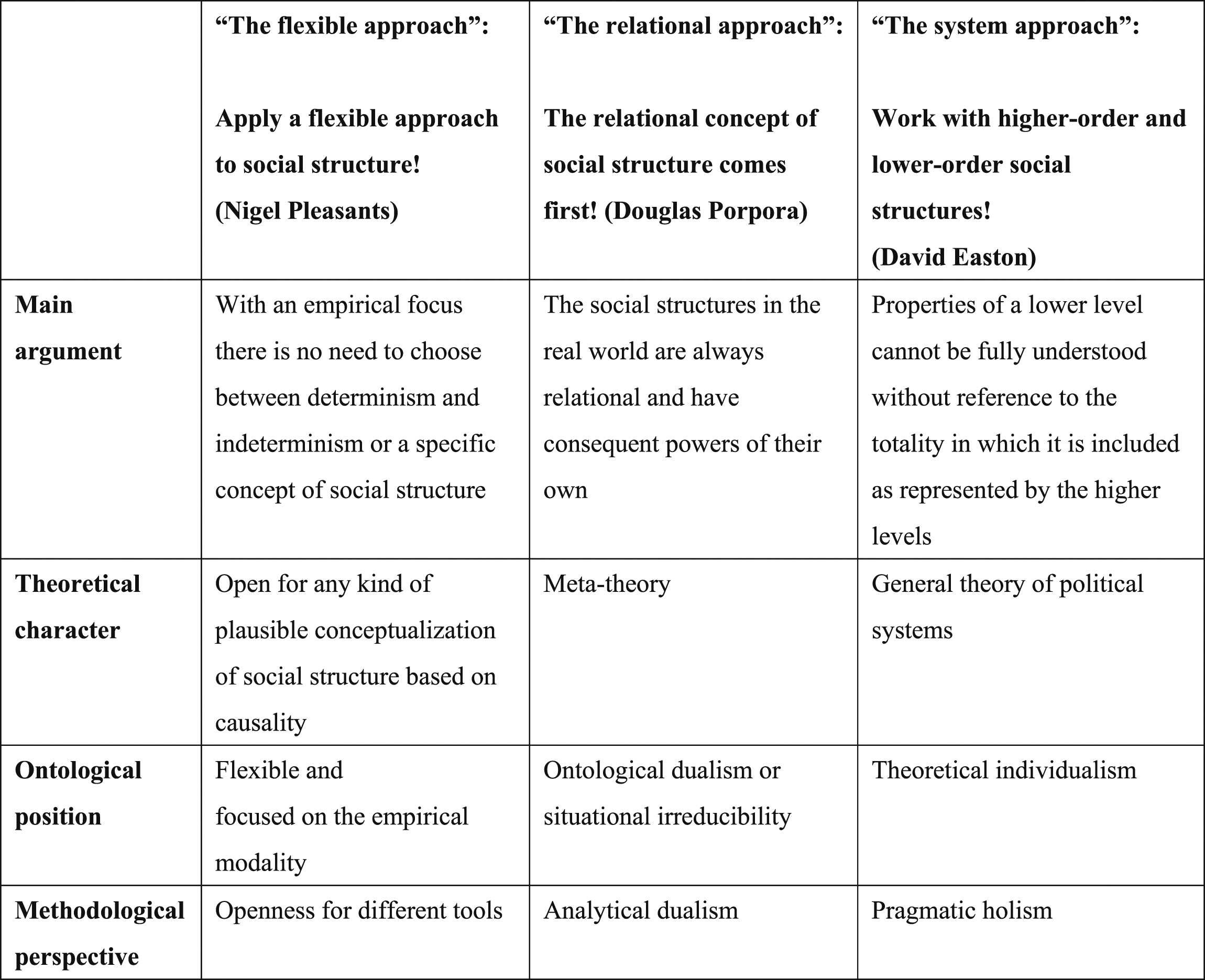
For Nigel Pleasants it all comes down to the application of the two leading philosophical theories on free will, as he formulates them, and the necessity to be clear about the distinction between the metaphysical and the empirical modality, regarding the relation between social structure and individual agency, and if these conditions are met, any empirically possible and plausible concept of social structure can be applied. According to Douglas V. Porpora the relational concept of social structure comes first, because of the way the real social world is constituted; the social structures in the real world are always relational and have consequent powers of their own. So, ontologically speaking, the relational structures are there, whatever we think about them. Therefore, they should be applied in a conscious and clear manner also from an analytical point of view. David Easton recommends us to work with two kinds of social structures, higher-order and lower-order ones. For him, properties of a lower level cannot fully be understood without reference to the totality in which they are included, as represented by higher levels. He finds that we need theory to account for both these two levels, but that it takes more abstractions to capture the higher-order ones. In contrast to Porpora, Easton explicitly rejects ontological dualism, but because of the shortcomings of our technical means of inquiry, he finds himself forced to be a pragmatic methodological holist. The three approaches are imperative or even normative; they are giving us advice on how many and what structures to use or not and under what circumstances (and this is why I have formulated them as such in the top three boxes in the figure above).
But what is this matter ultimately about? It is shown in the figure above that the three approaches differ in several respects beside their respective main arguments, also when it comes to their theoretical character and their methodological perspectives. Maybe most importantly, they differ when it comes to their ontological positions. Above I have looked closer into the same case as Nigel Pleasants, and have reached several different conclusions from his, not the least regarding ontology. Pleasants finds that the truth of either determinism or indeterminism is irrelevant for Browning’s and Goldhagen’s conflicting explanations, and that this insight is the key not only to open up for different plausible conceptualizations of social structure, but also a way to dissolve what is typically taken to be the problem of structure and agency. His idea is that it is possible to discern an empirical modality where social scientists can work more or less free from ontological elements and considerations. My angle on this is rather different from Pleasants’s; I do not think that this is possible, which I have tried to show above. The analysis in the illustration revolves not the least around what explanations seem to be most valid, which in turn rests upon the ontology—the understanding of aspects in the real world—that is, the philosophical perspective on the empirical issues in question. Of course, also the epistemology of the concepts and theories to conceptualize structure and agency comes into play here. If this is what Pleasants means by working in a plausible and interpretive way with empirical issues, we are speaking the same language. But if plausible means precluding all other philosophical aspects than the strict ones about causality from the applied explanations, etc., we are not in agreeance. Pleasants’s suggested solution takes us back to the beginning again. Finding out what is empirically possible and plausible includes also ontological aspects and considerations—aspects and considerations about what agency and social structure in the real world look like.
Furthermore, I think that it is possible to take at least one more step in this matter of ontology, a step that concerns the very nature of social structures in the real world. Porpora’s approach straightforwardly precludes or rejects the ontology behind an orthodox and thorough methodological individualism. Easton’s approach is also doing so when it comes to the actual research practice. And I think that it has been proven enough by critical realists, like Porpora and others, that relations creep back into the very accounts of those who programmatically would dismiss them. For Porpora, myself and many other scholars this indicates that actor and structure are not the same thing, something that to me can be labeled situational irreducibility, meaning that it is not possible to reduce the situational factors of actor and structure to each other, despite their actual closeness in the real world, and the relational concept of social structure is linked in a fundamental way to this idea of situational irreducibility. However, this does not mean that social structure has presences or influences completely devoid of human beings (and I think that this worry for reification is the main reason behind Easton’s refusal to completely drop his individualism). The irreducibility that I am talking about here is precisely this; situational, here and now. Social structures of the relational kind have effects, but at the same time they do not exist without the individuals that constitute them. And it is intuitively hard to accept the dictum that social structures do not exist without the actual individuals in the situation, but when there, cannot be completely reduced to them. But I think that it helps to think about and compare with certain individual phenomena, like intentions, which we cannot easily observe either. So, relations are there—not like bodies, chairs, or roads—but the two-sidedness of society; agency together with relational social structures must be covered for somehow. The relational concept of social structure is paramount, but it can be formulated in many ways, applied with different theories and methods, etc.
It has been found that the three approaches in this study differ in crucial ways. For Pleasants the real questions for the social sciences concern the conditions under which people are able to exercise their free will. But in Porpora’s approach social structure must also be placed as a dependent variable, and for Easton it is a main task to study the effect of the whole (higher-order structure) on the parts (lower-order structures). I do not think that Easton elaborates on this possibility that close, but on the other hand he primarily provides a framework to be applied and developed further. Above I have mentioned his combined pragmatic holism and theoretical methodological individualism. It has not been a main task in this study, but it is an interesting aspect to consider, if the application of Easton’s framework necessarily would have to end up treating social structure as an epiphenomenon to individual behavior or interactions, as e.g., Porpora most likely would argue. Maybe this is so, but on the other hand Easton’s system analytical framework is so ingrained with relational structures—like ease of change, levels of performance, feedback, and conversion processes—that I do not find it self-evident. Moreover, a quite fruitful revision to do, I think, would be to ground Easton’s approach firmly in the kind of realism formulated by e.g., Porpora or Layder. Anyway, this would not be the end of the story. Even though more than three decades have passed since Easton stated that we do not have any easy or summary methods for describing the ways that complex political systems are organized, and even fewer conceptual and technical tools for isolating the possible effects of such differences, I think that his words on this are still valid, at least to a large extent. In other words, we have much more work to do on this, to convincingly demonstrate the impact of specific relational structures, not the least to develop and elaborate on the closer details and effects of relational social structures as generative mechanisms. And, therefore, I suggest that it is primarily from that vantage point we should continue to develop and work with our conceptual and technical tools. 13
Footnotes
Declaration of Conflicting Interests
The author(s) declared no potential conflicts of interest with respect to the research, authorship, and/or publication of this article.
Funding
The author(s) received no financial support for the research, authorship, and/or publication of this article.
