



Abstract
The paper presents a novel view of social norms that reflects the importance of different agent types, their specific motivations and roles. How one identifies with a role and behavioral options available to the agent is crucial for the sustainability of the social norms. The analysis of a simple case of social norm is suggested as a default model for analysis, and then the classification of subjects, enforcers, and audience is introduced. This triangular typology of agents is extended by introducing a network of interlocking patterns underlying social behavior. Lastly, the paper describes two categories of transgressions based on misidentification.
1. Introduction
Social norms are generally described as rules that specify what individuals—having a specific role, position, or distinctive characteristics—ought to do in a particular context. The most prominent accounts of social norms define them broadly in terms of behavioral patterns of individuals who follow a set of specific requirements (Ulmann-Margalit 1977; Bicchieri 2006; Brennan et al. 2013). Although these accounts of norms outline the high-level properties of behavioral patterns (preferences, expectations, values), the recent progress in empirical research shows novel applications of these theoretical frameworks to the more specific (and controlled) environment. Philosophers interested in social norms should reflect upon these novel developments and update their theoretical scaffolding to accommodate empirical insights by refining the original conceptual schema. One of the important discoveries in recent years brings to the fore an idea of various types of norm agents who may sustain different aspects of the normative environment in a social group. Intuitively, there are agents who may have an active role in fulfilling the requirements of a norm as they follow what is demanded and obey the rule, as well as agents who are spectators and approve or disapprove of the observed conduct. Lastly, some members’ roles may consist solely of monitoring and enforcing these norms.
The paper intends to analyze various motivations of different norm agents based on their distinct roles in social norms situations. These roles and their mutual interdependence reveal novel aspects of social norms which can be instrumental in distinguishing new ways of norm violation. Several cases of pathological behavior in social norms are based on subtle forms of misuse of agent-specific demands. These instances reveal the need for a comprehensive approach concerning how one identifies with a specific role, what is agent’s motivation, or how other parties influence her behavior. First, this paper analyzes the general types of norm agents described by the high-level theories. It starts with the foundational model of social norms established in the literature, where different types of agents are introduced in simple terms (Section 2). On the one hand, this model sketches a broad picture of agent types in social norms as represented in theoretical models. On the other, it provides a ground for defining various categories of agents more specifically (Section 3). Therefore, different roles and specific actions are assigned to those agent types based on recent findings in experimental research (Section 4). As a result, the model should be empirically informed and extended in terms of agents’ roles, competencies, and responsibilities that are fundamental for proper norm functioning. Therefore, the subsequent model proposes a complex system of interlocking motivations and “checks and balances” related to agents and norm sustainability. Lastly, based on the proposed typology of agents, it is possible to identify novel scenarios of norm violations originating in the agent’s identification or selection error as described by the complex model (Section 5). These cases have significant importance for policy-making and institutional design. This paper intends to build upon the standard social norm literature and extend its theoretical scope by analyzing and extracting insights from the relevant experimental research. In such a way, the paper bridges the gap between the theoretical models and their empirical applications, and thus draws new directions for social norm research.
2. Foundational Model of Agent Types in Social Norms
The idea of social norms sustaining cooperative behavior in the human group is well established (Ulmann-Margalit 1977; Sugden 1986; Bicchieri 2006), along with the support for the role of punishment in those interactions (Fehr and Fischbacher 2004; Herrman, Thöni, and Gächter 2008; Baumard 2010; Bone, Silva, and Raihani 2014). In general, theorists across multiple disciplines agree that cooperation and coordination interactions are the cornerstones of the institutionally complex social reality represented by many everyday cases, such as the law, traffic rules, or property rights (Bowles 2004; Gintis 2010; Guala 2016, Zachník 2020). Nonetheless, it is an open question of what kinds of individuals may participate in these interactions and how they influence the outcome (Tomasello 2020b). The paper argues that identifying appropriate types of individuals and their capacities is a key to understanding how social norms may occur and persist. In other words, agent identification is a factor that fundamentally influences the stability of the cooperative social environment.
The prominent accounts of social norms implicitly include the concept of agent types in their definition of norms (Bicchieri 2006, 2017; Brennan et al. 2013). Most of them classify interacting agents into one of these groups (Villatoro, Sen, and Sabater-Mir 2010; Legros and Cislaghi 2020): those who comply (norm-targets), those who influence the norm (norm-drivers), and those who are affected by the norm (norm-beneficiaries and victims). These categories provide an initial insight into the typology of agents who impact social norms. Nevertheless, these categories are formulated at the abstract level of analysis. Their description usually does not specify the motivations and roles of specific types of agents and how they can influence each other. Therefore, we need a more refined model of agents that will clarify particular functional aspects of different types of roles, describe their interdependencies, and be sufficiently open to apply across the spectrum of diverse cases. To begin with, I follow the bottom-up method of analysis: to begin from the basic game theoretical models of social norms and then gradually decrease the granularity of the model by including more subtle distinctions of roles and functional aspects that these agents possess. By implementing these modifications of the agent typology, I aim to update the implicit foundational model with insights from the contemporary empirical literature.
The foundational model of social norms typically describes a two-person interaction of agents with a specific motivational structure, most commonly in the form of the Prisoner’s dilemma game (Ulmann-Margalit 1977; Sugden 1986; Schotter 1981; Fehr and Schurtenberger 2018, cf. Zachník 2022b). The two individuals have certain beliefs concerning their colleague’s actions, and they also have expectations about the social evaluation of their actions by the group members, i.e., normative expectations (Sugden 1998; Bicchieri 2006; Bicchieri and Xiao 2009). Therefore, the model distinguishes between two categories of agents: subjects and audience. Norm subjects are formally represented in a given model in the set of agents and are subject to the requirements of the relevant standard. They are motivated to achieve an individually beneficial state depending on their beliefs regarding the other’s action (Bermúdez 2009, Binmore 2009; Tadelis 2013). However, they are also affected by the power of the norm and its evaluative standard. Consequently, agents have a conditional preference for a specific action based on their normative attitudes and expectations (Pettit 1990; Bell and Cox 2015; Bicchieri and Dimant 2022; cf. Patternotte and Grose 2013). In the foundational model, the two acting agents represent the category of norm subjects—individuals directly affected by the norm’s prescriptive or proscriptive power. Every norm, in general, determines who are individuals targeted by its requirements; thereby, it sets an evaluative standard with a description of relevant agents who may be legitimately criticized for disobedience and violations (Zachník 2022a). (Figure 1) The foundational model.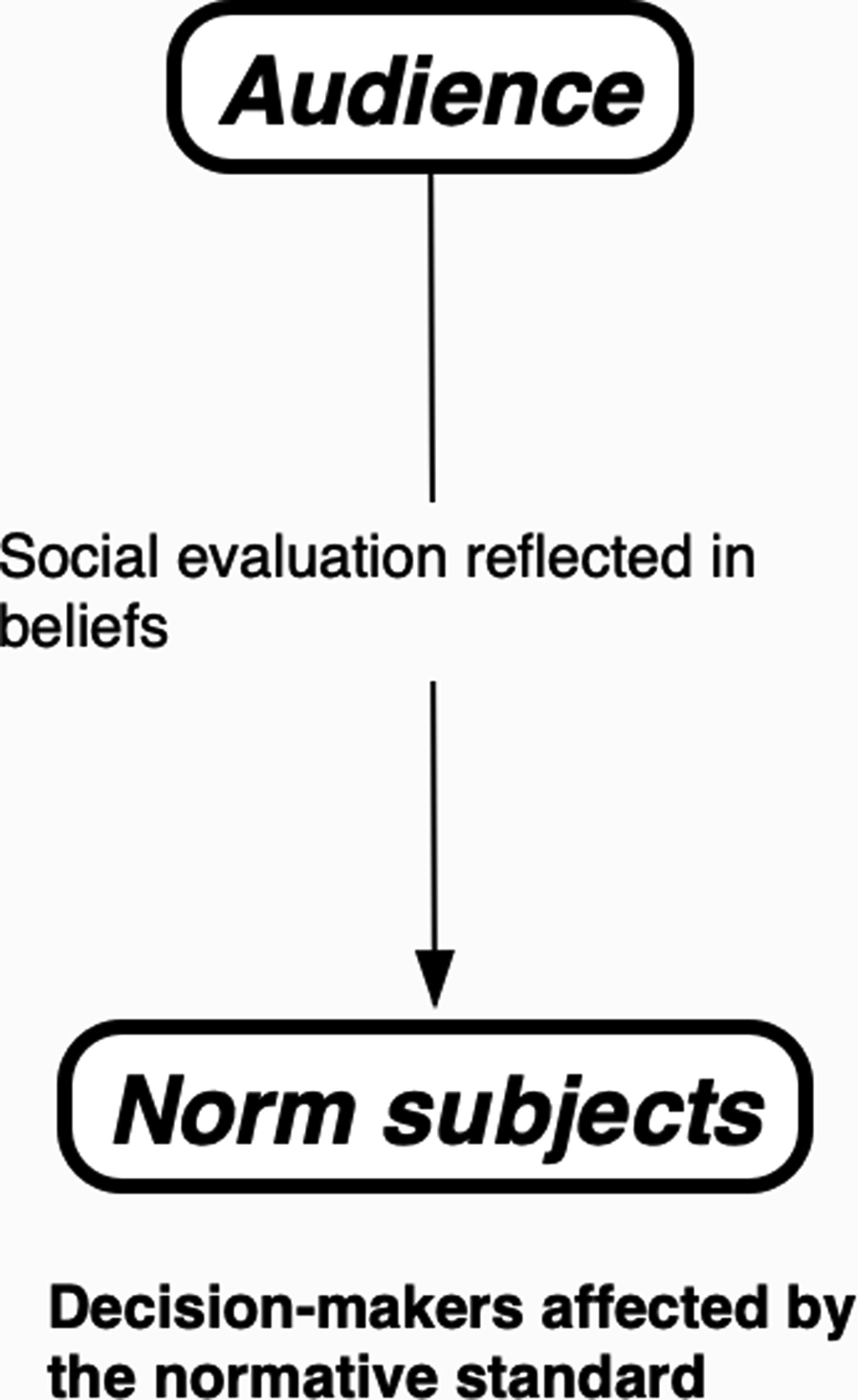
The audience, however, enters the model more implicitly as a psychologically (and causally) relevant factor affecting the norm subjects, for instance, as a reference network or reference group that delivers a social approval or disapproval (Sugden 1998; Bicchieri 2006, 2017; Villatoro et al. 2010; Legros and Cislaghi 2020). The audience in the foundational model figures in the belief systems of norm subjects, and its role is one-directional and defined through the effect on the individuals’ beliefs. However, this fact has several problems: the one-directional effect is overly limited and simplified to the specific dimension of beliefs, and any other influence in the opposite direction—from the subject to the audience—is omitted. The limitations can be most notably seen in socially expressive aspects of behavior when the norm subject wants to influence her perception of others or her social identity (Bell and Cox 2015; Morris et al. 2015; Gelfand and Harrington 2015). Therefore, the idea of this basic schema is relatively straightforward: norm subjects are affected by the requirements of the existing normative standard mediated via the expected social evaluation of the relevant group (audience). For instance, the group members, friends, relatives, or other members of social communities play the role of reference network insofar as their social approval is reflected by the respected individuals. The model’s simplicity may be helpful for its initial conceptual groundwork, yet, after several years of empirical research, it seems useful to enhance the foundational model with the current insights that bridge the gap between abstract theoretical models and their applications. The updated model can provide a more detailed description of the mechanisms at work in more common environments.
Recently, it has been documented that the effect of the audience can be established in different forms, even in the non-strategic context where the action of other norm subjects does not directly influence an individual’s decision and the respected payoff. The information about group behavior, their approval, or even social identity can substantially affect an individual’s decision. For instance, by providing information about social proximity with other members, one can increase or decrease conformity with a norm (Dimant 2019; Charness, Naef, and Sontuoso 2019; Bicchieri et al. 2022), or the fact that the agent belongs to the same group as her audience strengthens her pro-group motivation in numerous cases (Charness, Rigotti, and Rustichini 2007; Gino, Ayal, and Ariely 2009; Benjamin, Choi, and Strickland 2010). In social norm situations, the importance of “others” (even if they are indirectly involved only via the information provided to norm subjects) significantly affects the subject’s norm conformity. This effect holds even when the individual’s decision is the only determinant of the outcome (non-strategic setting). This preliminary evidence indicates the need to extend our understanding of the normative infrastructure and role differentiation in social norms. It suggests how to extend the existing frameworks to construct a general typology of norm agents.
3. Enforcement, Punishment, and Surveillance
The distinction between the norm subject and audience seems intuitive and natural. In a social environment, human behavior is not only driven by individual motivations but also by what others do and think about us (Lapinski and Rimal 2005). Still, perceived social evaluation cannot be the solitary factor in these social interactions between the two types of agents involved. The difficulty we are facing now is distinguishing various roles and functional aspects clustered around different types of agents in the context of social norms. The foundational model introduces two levels: norm subjects and audience, where one may naturally ask what happens when an individual is not following the norm and goes against the socially expected standard of behavior (Ghidoni and Ploner 2021). Some enforcing mechanism is usually in place to respond adequately to norm transgression, violations, and disobedience (Crawford and Ostrom 1995; Chudek and Henrich 2011; Chavez and Bicchieri 2013).
The intention, for now, is to specify an independent role that constitutes a particular class of behavioral patterns found in social norms. On the one hand, there is persuasive evidence that distributed, uncoordinated enforcement plays a crucial function in sustaining cooperation and supporting social norms (Ostrom 2000; Fehr and Gachter 2002; Fehr, Fischbacher, and Gachter 2004, cf. Guala 2012). On the other hand, there are arguments that a presence of institutions and centralized punishment mechanism provides another scaffolding for norm enforcement (Ostrom 1990; Boyd, Gintis, and Bowles 2010; Baldassarri and Grossman 2011). Although the issue of the exact enforcement mechanism raises several problems, for now, I hold the general claim that third-party punishment reduces a norm subject’s motivation to break the established standard and thereby stabilizes cooperative patterns of behavior in a group, regardless of whether the punishment is individual and decentralized, or coordinated and institutionalized. The proposal here is to detach a broad cluster of the roles and mechanisms related to enforcement from the other two categories (norm subjects and audience) because it has functionally specific aspects dissimilar from the previously mentioned types. Admittedly, this step is artificial as it often holds that those who act in social interactions in some circumstances also observe and enforce social norms in others. However, this analytical distinction allows us to examine many critical features of social norms separately and express some neglected issues. I will follow this method of analytical separation to conclude the independent status of various functional roles involved in this social setting.
Therefore, the third type of agent can be called norm-enforcers. They observe and monitor the behavior of the norm subject. However, they also actively manifest their approval or disapproval of subjects’ behavior and are willing to sacrifice their resources to punish individuals who violate the standard of the norm (Herrmann, Thöni, and Gächter 2008; Boyd, Gintis, and Bowles 2010). What sets enforcers apart from subjects or audience is that, unlike the first type, they lack a direct involvement in fulfilling the behavioral requirements of the norm; unlike the second, they have an active role in sustaining the behavioral pattern through their participation in regulatory and corrective practices. Enforcers, thus, constitute a specific type of norm agents that fulfill a supervisory and punishing role in normative behavior without being actively guided by the normative standard raised by the norm. The growing literature on third-party punishment suggests that cooperative behavior has to be secured by social norms with the presence of enforcers. They are essential in helping to deter the defectors and transgressors whose self-interested motivation threatens to undermine these socially beneficial practices (Gross et al. 2018).
Therefore, I propose the following triangular schema of the norm agents that distinguishes the three different types of individuals who may occur in the social norms (Figure 2). At this stage, these categories are only placeholders for a specific cluster of roles and positions (which various individuals may occupy), but their further explication sheds light on some essential aspects that remain scattered in the contemporary literature (Gelfand and Jackson 2016; Legros and Cislaghi 2020; Tomasello 2020b). The following triangular schema represents a rough sketch of the agent types introduced in the literature on social norms. By systematizing these findings, I propose a broad picture of the varieties of agents’ behavior. In general, there are three types of agents involved in these interactions. They have a few links amongst themselves that keep track of some pathways of influence: norm subjects are the agents who are directly under the normative influence, and they ought to follow the behavioral requirements stated by the explicit rule or standards existing implicitly in their community. Therefore, what they do is not entirely determined by their intrinsic motivation, as they are also attentive to what the audience thinks about the demanded behavior and whether enforcers might sanction or reward some actions (Zachník 2022b). Triangular schema of norm-agents.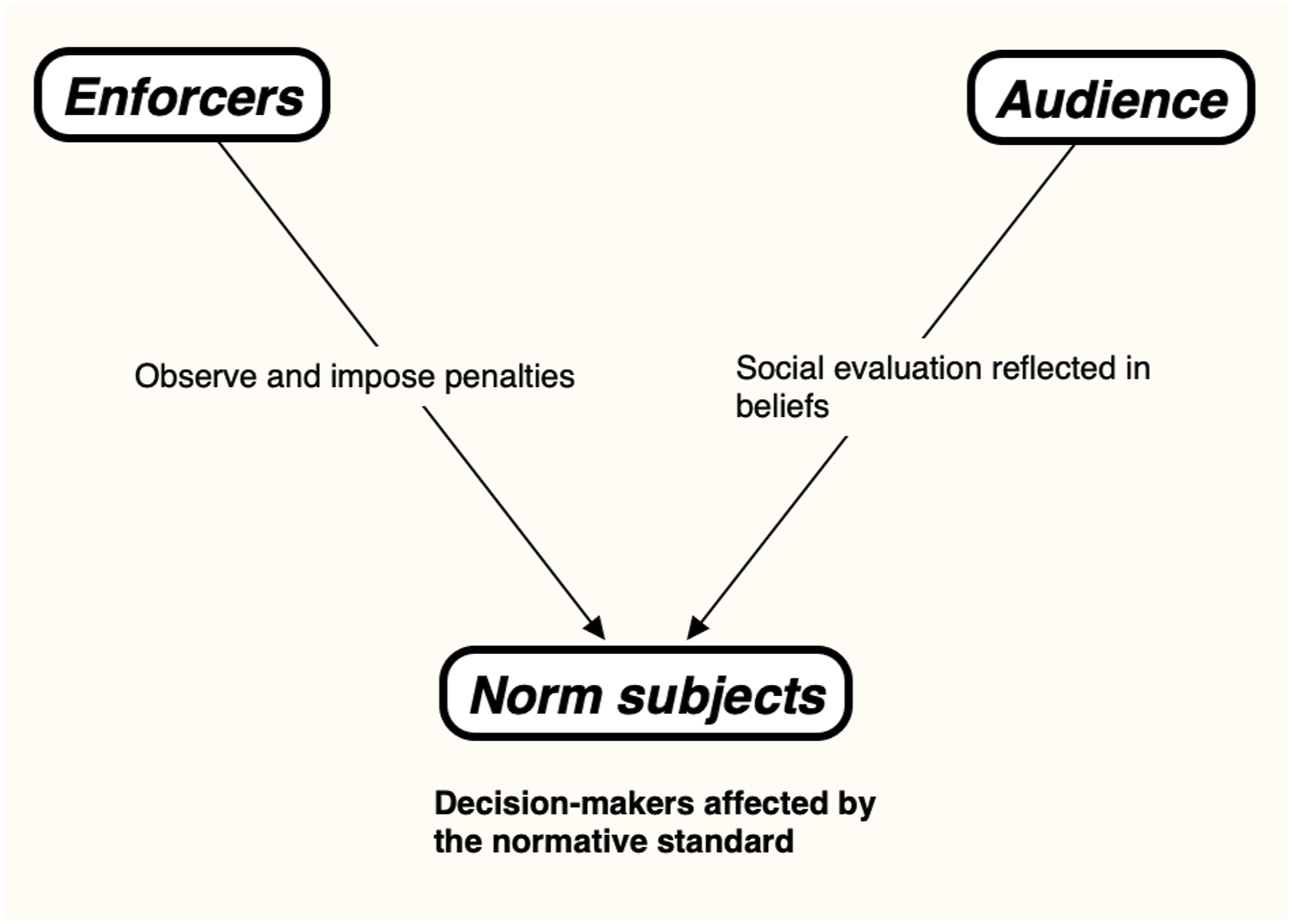
This picture coarsely summarizes the major influences presented in many approaches toward social norms (e.g., Bicchieri 2006; Brennan et al. 2013; Westra and Andrews 2022; cf. Kelly and Davis 2018). The components are not usually spelt out in terms of agent types or their roles (as proposed here) but instead contained in the definition of a social norm as a behavioral regularity described exclusively from the norm subjects’ perspective. The general idea of the subject-centric view is straightforward: individuals are motivated to conform to the norms through several mechanisms, such as normative reasons, social influence, and sanctions, where all these factors are described in terms of modifying the subject’s behavior (through conditional preferences or normative expectations, Zachník 2022b). In contrast, it seems helpful to complement these abstract models of social norms with the recent empirical findings that explore more detailed settings in real-world circumstances. I argue that we should explicitly model other agents’ motivations and their mutual influence on each other. In this way, we can detect the multifaceted relations between various agent types and uncover the dynamics of the role change within and across these categories. I suspect that such effort will support these foundational models and outline new options for expanding the existing philosophical frameworks of social norms.
4. Agent Types
The triangular schema of the norm agents is not, in essence, a very original idea. It only summarizes the theoretical approaches to social norms in general, albeit from a different point of view. At the same time, research in the behavioral sciences has progressed rapidly in recent years and the same seems inevitable in social ontology. These novel insights can significantly improve our understanding of agents’ roles and enhance the general model. From a purely speculative viewpoint, the audience must have influence toward the subject that is not reducible to the subject’s perceived social evaluation. Furthermore, it cannot be the case that individuals act without exerting any power directed at others. There must be some additional connection between the norm subject to two other types. And the missing link between enforcers and the audience raises further questions regarding their mutual relationship. These questions suggest that a much broader picture needs to be drawn based on the preliminary triangular schema.
In examining various factors connecting a norm subject with the audience, one factor considerably stands out—group membership. Humans are social animals who want to belong to a group, be respected by others, and get a positive reputation within a group. An individual subject is not only motivated by what she expects the audience believes is the right thing to do (as reflected in the foundational model), but on some occasions, she might be pursuing the group benefiting actions even without such expectations, for instance, to express belonging to the group (Burke and Young 2011). Alternatively, information about the characteristics of others who share some minimal (even contingent) feature with an individual induces a behavioral change in a norm situation (Gelfand and Harrington 2015; Dimant 2019; Bicchieri et al. 2022). Furthermore, there are other types of audience influence on the behavior of the subject: once an individual identifies with a group (Benjamin, Choi, and Strickland 2010), behaves in front of her peers (Charness, Rigotti, and Rustichini 2007), or shares their interests (Chen and Li 2009), she is more likely to participate in behavior that favors the group. Hence, group membership strengthens cooperation and coordination with its members, and identification with the group positively affects achieving these cooperative results in norm situations.
To illustrate this effect by a simple example, Charness, Rigotti, and Rustichini (2007) conducted an experiment using the Prisoners’ dilemma game where they observed the changes in agent’s behavior due to variance in the group salience effects (modulated by the mechanisms of the payoff commonality, presence of group members spectators, or direct feedback). They observed that individual participants tend to cooperate more with in-group members when an audience can observe their behavior, even without normative information. Therefore, the subject may be utterly ignorant of what others approve or disapprove of and yet conform with relevant social norms provided she identifies with a group (Tajfel and Turner 1979; Brewer and Gardner 1996; Chung and Rimal 2016). Such evidence provides additional assurance that the audience affects the norm subject in many different ways. Moreover, even though it is true that cooperation can be boosted via information about what others think is the right thing to do or about how others behave in the same scenario (Bicchieri & Xiao 2009; de Wit and Lisciandra 2021), norm subjects conform for a much broader set of reasons beyond these information channels.
On the other hand, group membership can also have a negative effect on the individual subject. One may be pulled in the opposite direction and violate a norm if she believes the audience would behave similarly. The effect of behavioral contagion concerns how much the observation of a norm violation (e.g., dishonesty, non-ethical behavior, disobedience) can increase or decrease the transgression of an individual observer if she finds herself in an identical situation (Keizer, Lindenberg, and Steg 2008; Gino, Ayal, and Ariely 2009). This effect suggests that subjects can be swayed from the normative standard if their peers do the same. Thus, the in-group violation of a certain standard reduces the individual’s motivation to act in a norm-conforming manner. For instance, Thau et al. (2015) showed that an individual with a strong desire for social inclusion would be willing to break the norms for the benefit of their group. Similarly, Dimant (2019) proves how the information about antisocial behavior in a group, such as taking money from a charity, amplifies norm decay and prompts individuals to break the norm in the Give-or-Take donation game (see Bicchieri et al. 2022). Overall, this implies that the effect from the audience is not entirely one-sided. The relevant peers can strengthen as well as weaken the norm behavior of a subject, and it can be done in a very subtle way where explicit consideration can have little or no function.
The lesson from this consideration points to a broader set of elements affecting the norm subject behavior via the relevant audience. To summarize the influence in the direction from the audience to norm subjects, I suggest the following (yet incomplete) list of processes that cause the change in the subject’s behavior: perceived social approval, empirical information regarding the behavior of the other members, social proximity with those members, and group identity. These effects are mutually operative and influence subjects in the norm situation (Figure 3). It may be hard to separate each of them in real-life cases, yet recent experimental research provides strong evidence in favor of their isolated influence on an individual’s behavior in the normative setting.
Interestingly, the influence between these two types of agents goes both ways—from norm subjects to the audience. Norm subjects behave in a way that changes the audience’s perception of appropriateness or acceptance of novel ways of interacting. Therefore, acting agents can impact the audience through manifested behavior in those situations. For instance, it has been shown that people are likely to permit norm violations when it benefits them, especially when they tolerate but do not actively participate in these violations (Pittarello, Rubaltelli, and Motro 2016; Gross et al. 2018). Individuals may take advantage of this fact and keenly violate the standard of behavior if it benefits other group members. Pro-group violations create one opportunity for the subject’s expressive dimension in norm behavior. In a famous dice-rolling paradigm case, where two agents separately roll a die and report the outcome, Weisel and Shalvi (2015) documented the tendency to report higher numbers and to match the partner’s rolls if these factors determine their rewards (high rolls imply higher reward provided that partner’s roll is the same). Therefore, the violator signals her group belonging by reporting a group-benefiting outcome (higher roll), even though she breaches the generally accepted standard of behavior, the norms of truth-telling norm and honesty (similarly Thau et al. 2015). Improved schema of the subject-audience links.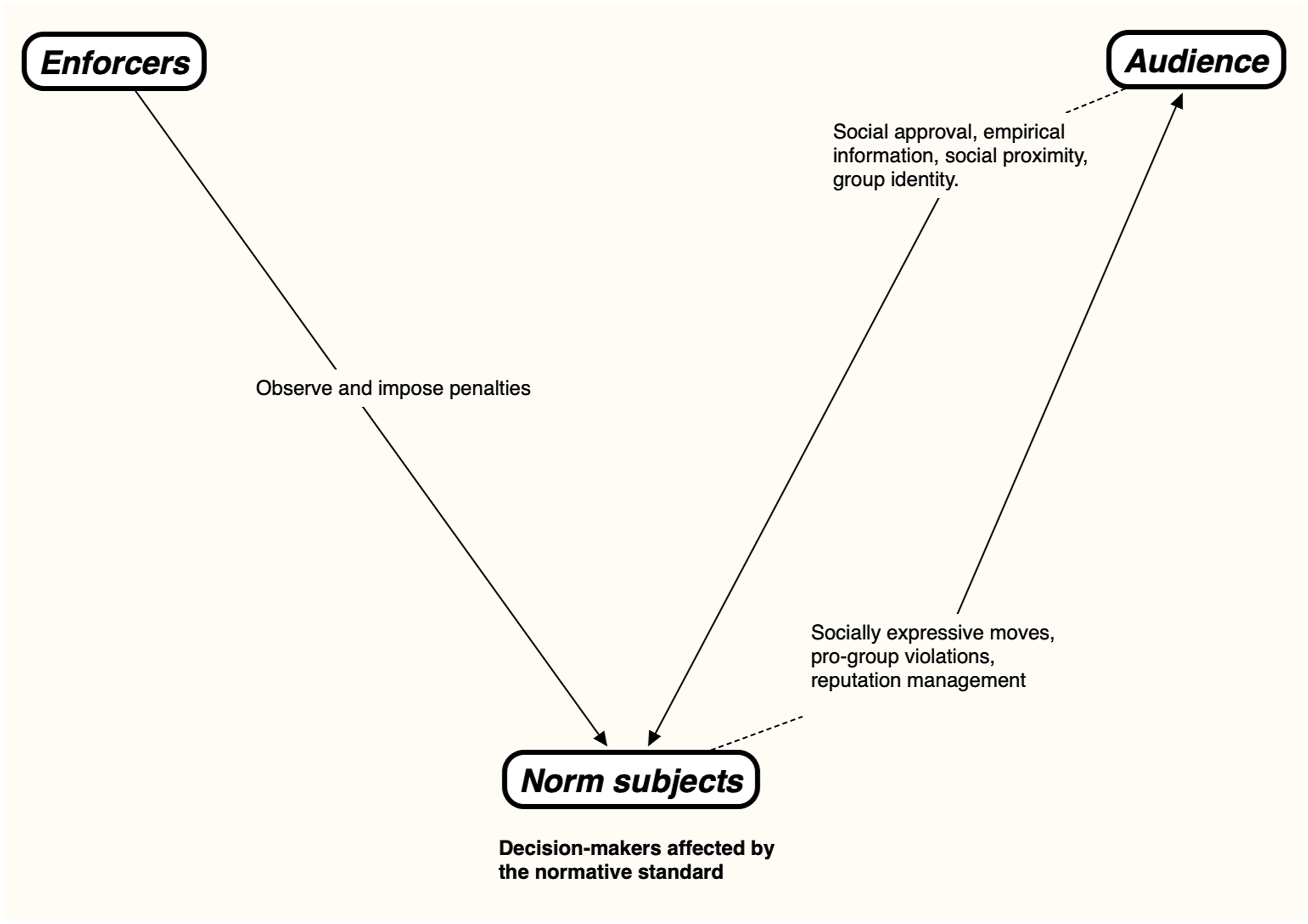
The motivation for this behavior may have several causes varying from avoiding social exclusion to improving one’s reputation (Charness, Rigotti, and Rustichini 2007; Feinberg, Willer, and Schultz 2014). Norm subjects, consequently, not only react to what others do or expect to be accomplished, but they also actively influence their perception by others via socially expressive moves (Sunstein 1996; Bell and Cox 2015; Hlobil 2016). These moves may even violate the norm if it benefits the audience, as it is well known in cases of corruption or pro-group unethical behavior. In general, agents in the position of norm subjects may try to influence the audience directly—by providing them with some benefits (whether by following or violating the normative standard) or indirectly—by expressing their group belonging and improving their reputation in the eyes of others. When group identity is salient, an individual tends to act in a manner that generates benefits for her colleagues (Gino, Ayal, and Ariely 2009), even when it produces unethical behavior (Shalvi et al. 2015; Weisel and Shalvi 2015; Gross et al. 2018; Charness, Naef, and Sontuoso 2019) or affects negatively other social norms (Keizer, Lindenberg, and Steg 2008). Hence, a norm subject can take advantage of the circumstances and influence the audience by action that even violates the norm if it benefits other members. This brief analysis provides an enhanced understanding of various influences between norm subjects and the audience, and it can be added to the following diagram as follows:
Another significant cluster of specific roles is bundled around the enforcer type, who helps sustain the communal behavioral pattern by monitoring and sanctioning. By doing this, the enforcer may suppress some of the subject’s norm-erosive motivation mentioned above. Albeit somewhat artificial, this separation of norm-specific roles and integration into a single category provides clear analytical benefits and allows the further elaboration of some neglected issues. This strategy helps us clarify diverse sources of motivations across different types of agents and their roles in the context of social norms. The idea of third-party sanctioning is intuitive and well-proven from the developmental perspective (Rakoczy, Warneken, and Tomasello 2008; Schmidt, Rakoczy, and Tomasello 2012; Rakoczy and Schmidt 2013; McAuliffe, Jordan, and Warneken 2015; Josephs et al. 2016), but its function in the interactive context seems more complex. The enforcers are more than automatic and reactive agents fulfilling their established roles. They may also reconsider, hesitate, or even withdraw from the punishment. Any influence they have is not a one-way mechanism for attributing reward or imposition of a sanction. Recent progress in behavioral science shows interesting mutual dynamics between norm subjects and enforcers, and enforcers and audience, not reducible to a single process of punishing and rewarding.
Most of the initial research on norms mentions punishment as a simple one-directional mechanism underpinning norms’ sustainability (Ostrom 2000; Fehr and Gachter 2002; Fehr, Fischbacher, and Gachter 2004). This assumption is plausible for the limited conditions where an enforcer acts in a simple yes or no manner and is protected by anonymity; however, a possibility of retaliation or counter-punishment opens a door for a more nuanced dynamic between the enforcer and the norm subject. The ability to respond and retaliate against punishment from the position of the norm subject is often neglected in the models, though retaliation indeed leads to destabilization of cooperation, and consequently, it works against the suggested effect of punishment (Janssen and Bushman 2008). Besides, from the role-centric view, it seems crucial to answer why enforcers resort to sanctioning behavior in the first place. The punishment is often costly, and there are even factors that go against the tendency to sanction non-conforming individuals, such as the fear of retaliation (Balafoutas, Nikiforakis, and Rockenbach 2016; Molho et al. 2020) or aversion to enact a direct form of punishment (Chavez and Bicchieri 2013; Balafoutas, Nikiforakis, and Rockenbach 2014; Kriss, Weber, and Xiao 2016). To explain the role of the enforcer in its complexity, we need to focus on the web of interlocking patterns of behavior and attitudes with other types of agents.
First of all, the punishment of the norm violators is the second-order cooperative dilemma—it establishes cooperative behavior, and group members benefit from it; however, enforcers are better off when they save resources for themselves instead of using them for sanctioning (Herrmann, Thöni, and Gächter 2008; Kosfeld, Okada, and Riedl 2009). The paradigmatic test case of the sanctioning effect is built upon the classical economic game called Public Good Game. Some portion of the players is asked to contribute to a common pool of resources (“public good”), and these collected resources are multiplied by the experimenter and redistributed to all members regardless of their individual contribution (the non-excludability principle). While it is group-beneficial to contribute, individually, one may be better off keeping her resources and reaping the benefit of others’ contribution. Interestingly, introducing the enforcer agent—who may punish those violations—changes norm subjects’ motivations and encourages them to behave more cooperatively. Therefore, in terms of the stability of norms and cooperation, the active involvement of enforcers is crucial (Eriksson et al. 2021), yet the question remains of what benefits the enforcers receive to compensate for their risky participation.
It has been shown that several compensations support enforcers’ motivation to apply sanctions actively. Enforcers are positively evaluated within the group as others attribute greater credibility to them; therefore, they gain a positive reputation, which can bring long-term benefits (Barclay 2006; Raihani and Bshary 2015; cf. Ozono and Watabe 2012). In addition to the reputational effect, enforcers may receive a financial reward from others in future interactions, for instance, when participants reward those actively punishing defectors with a larger financial bonus (e.g., in the subsequent round of the Trust game, Nelissen 2008). Overall, these studies show that some mechanisms are in place to balance the fear of retaliation or hesitation on the side of enforcers (some of these processes are even developmentally stable, see Vaish et al. 2016), and they can be added to the triangular scheme. Mainly, counter-punishment is a specific option for the norm subject. It is not only directed toward enforcers to discourage them, but it can even have a legitimate use when someone is protesting against severe or antisocial punishment (Herrmann, Thöni, and Gächter 2008; Irwin and Horne 2013; Bone, McAuliffe, and Raihani 2016; Fehr and Schurtenberger 2018). On the other hand, the reputational or monetary benefits can be placed in the direction going from the audience to enforcers as the audience may positively support and evaluate the active enforcement (see Figure 4 below). This brief overview finalizes the first—motivational—aspect of the dynamics directed toward the enforcers. Generally, it fills some gaps in the roles grouped around the three types of agents. Links between types of agents.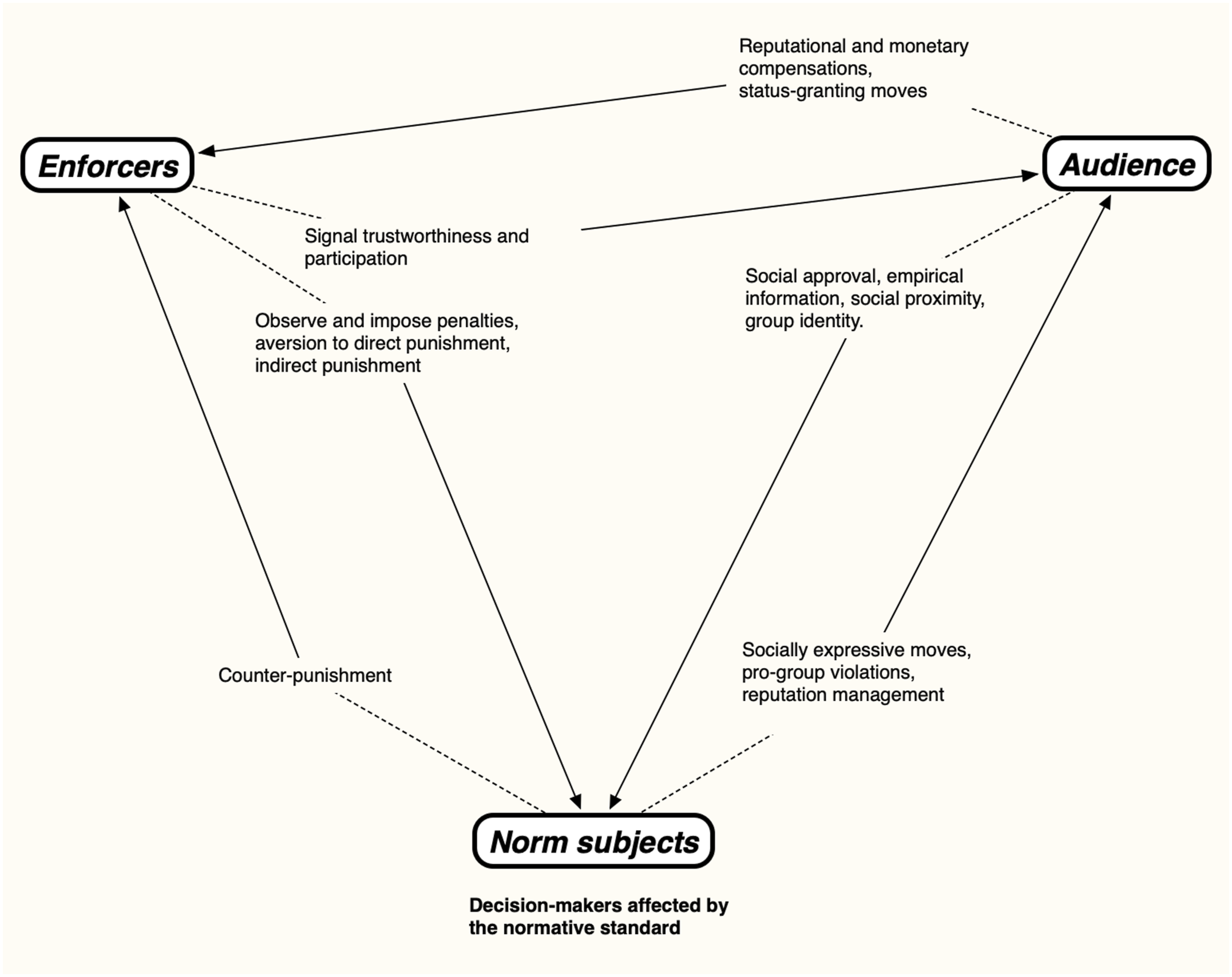
The second important aspect of the enforcer type can be explained in terms of structural qualities. Some structural changes explain why enforcement roles prevail and secure cooperative benefits in the group, especially when the group grows in numbers (Ozono, Kamijo, and Shimizu 2020). In general, enforcement is costly, and the more enforcers participate in punishment, the lower the average profit from cooperation is for the group (Boyd, Gintis, and Bowles 2010; Fehr and Schurtenberger 2018). The traditional models allow for distributed, uncoordinated punishment, yet ethnographic and anthropological evidence frequently show that these activities are often coordinated (e.g., by communication means such as gossiping; Molho et al. 2020; Eriksson et al. 2021) or delegated to specific individuals in the community. One can reliably assume that social institutions develop more effective punishing methods that do not reduce the benefits of cooperation as much (Boyd et al. 2010). A critical step in analyzing norm punishment is how these enforcement powers are allocated in society. While in the case of social norms, we regularly assume distributed group pressure of individual members mediated via social proximity or identity (Schmidt, Rakoczy, and Tomasello 2012, cf. Guala 2012), in a more nuanced institutional environment—for instance, when a group grows larger, expands into novel territory, or develops explicit and complex normative systems (Raz 1990)—there is a natural tendency to the evolution of coordinated and centralized punishment (Gürerk, Irlenbusch, and Rockenbach 2006; Kosfeld, Okada, and Riedl 2009).
One way to implement such transformation is to voluntarily transfer punishment power into selected individuals’ hands. The centralized punishment strengthens cooperation in a group and helps prevent second-order free-riding problems (Gürerk, Irlenbusch, and Rockenbach 2006; Baldassarri and Grossman 2011; Gross et al. 2016). This structural change can lead to more efficient support of cooperation and explains the prevalence of hierarchical power structures (Gross et al. 2016). The two vital elements facilitate this mechanism: role differentiation and hierarchical structure in the group (some evolutionary precursors of these rudiments can be found already in primates, Flack et al. 2006; Jebari 2019). Overall, when there is a centralized punishment system, individuals significantly raise their cooperative behavior (e.g., contributions in the Public Good Game), and they more willingly participate in normative group behavior when the enforcer is selected by some procedure instead of randomly chosen (Baldassarri and Grossman 2011). This structural change points to specific in-group dynamics between enforcers and the audience: members of the audience may grant or delegate some normative powers to specific individuals who will acquire monitoring and enforcing authority, and their punishment will obtain higher legitimacy.
The power transfer procedure helps explain the audience’s contribution in establishing these enforcing roles and selecting specific individuals for them. It also shows that in some cases audience exerts influence over enforcers via the selection process, and group members may directly decide whether someone gets the enforcing role in a community. Therefore, the audience fulfills the function of granting powers and even providing resources to the enforcer type. These resources could be motivational (money or reputation), as argued above, or structural (statuses), as they establish and legitimize enforcing agents in the first place (Searle 1995, 2010). Alternatively, members of the audience may indicate their willingness to participate and support the enforcers by providing them with sufficient resources for their operation even before any violation appears (Sigmund et al. 2010). These different forms of support from audience to enforcers thus add further layers to the picture of agent types and their roles.
Conversely, enforcers might direct their efforts toward the audience to influence the perception of them as being competent and reliable. Based on the previously mentioned link between the audience and enforcers, enforcers’ behavior might be motivated exclusively to secure the benefits (financial or reputational) from the regulatory practices. Therefore, enforcers may seek to strengthen this link with the audience through active participation in punishment, hoping that this behavior will bring them additional benefits guaranteed by the audience (Ozono and Watabe 2012; Raihani and Bshary 2015; Jordan et al. 2016). Their eagerness to impose sanctions has a vital signaling function of punishment in society: the enforcer signals her willingness to confirm her involvement in regulatory practices (Jordan et al. 2016). This move extends the repertoire of the enforcer’s action possibilities—she sanctions various offences against the normative standards and signals her trustworthiness in the group.
The picture sketched here needs to be complemented and developed further, but the preliminary schema offers a better understanding of different types of agents and their respective roles and motives in social norms underpinned by recent research in behavioral science.
We can now see a more nuanced and complex picture of different clusters of roles identified with the analytically separated types of agents. This schema provides an informed insight into the recent developments in the empirical literature, and it shows potential routes for updating and elaborating the theoretical picture of social norms. Its contribution is not theoretically innovative as it is the extension of the original foundational model, but it brings to light the fact that mutual relationships amongst different types of agents represent a set of possibilities for influencing one another. Furthermore, these possibilities are organized within a space of certain strategic moves and actions beyond the simple dichotomy of conforming and violating behavior. Norm subjects are not just the decision-makers affected by the norm, but also genuine participants actively connected with other agent types. Individuals in the subject position may retaliate against the enforcer’s punishment to protest against it and intimidate the enforcing authority. Concerning the audience, norm subjects may adapt their behavior to create a positive image of themselves within the group, express their group allegiance (Gelfand and Harrington 2015) or attempt to bribe the audience through transgressions that bring short-term benefits. The audience members, conversely, strive to secure the collective advantages of normative practice by influencing the subject’s behavior through different types of information (empirical or normative) or inducing awareness of group identity and social proximity. Second, the audience also provides motivational, reputational, and structural backing to those individuals who acquired or were selected for the role of enforcers—who monitor and observe conforming or violating behavior in the group. Finally, enforcers have specific options for implementing their powers by direct or indirect forms of punishment to secure the advantages of cooperative behavior (Rand and Nowak 2013; Molho et al. 2020; Eriksson et al. 2021).
Overall, these three categories of agents map some well-established aspects of behavior manifested in social norms. The social norm case illustrates a broad range of mutual influences between these agent types, and it can be further elaborated to capture more specific cases of social institutions. For instance, one possible research direction could focus more on the differentiation of subtypes contained in these three categories as when the enforcer type might be further distinguished by various responsibilities and competencies that could be assigned to particular status holders or representatives of offices (Raz 1990). Thus, the typology of norm agents offers a valuable framework for additional refinement and ongoing research agenda. Another exciting direction for subsequent development—partly explored in the next section—is to consider alternative possible moves and strategies for each of these types that modulate the identification of roles. Diverse roles imply different behavioral possibilities but also different opportunities for misbehavior.
5. Agent Identification Failures
The ability to identify and distinguish cooperative from non-cooperative group members is crucial for the stability of social interactions. Its psychological roots seem essential for human social behavior to such an extent that the ability appears early in ontogeny (Hamlin, Wynn, and Bloom 2007; Vaish et al. 2016; Tomasello 2020a). However, the similar importance relates to the issue regarding the ability to identify appropriate types of norm agents as it poses another difficulty for the stable cooperative environment (Tomasello 2020b). Usually, only some individuals in the group are targeted by normative requirements, and among these, some might be placed into an incorrect category and demanded to fulfill a role they are not legitimate to perform. Agent identification, thus, creates difficulties for the sustainability of norm behavior. The previous section has analyzed social norms not in terms of conditions that conforming individuals must satisfy; instead, it has offered the role-centric view where different types of agents occur in norm situations and perform certain critical functions with a variety of possible agent-specific moves (e.g., sanctioning, retaliating, violating, or compensating). This perspective provides advantages for the subsequent analysis of identification mistakes, as it reveals and describes particular roles and responsibilities of different agent types.
Different relations among the norm subjects, enforcers, and audience can lead to particular cases of norm violations depending on who interacts with whom. These behavioral variations are far from a simple description based on the widely recognized duality between “conforming” and “violating” behavior. Specific norm agents engaging in a particular network of interlocking patterns of behavior create a new problem of agent identification. How an individual sees herself and others in the specific agent-type role may present a new challenge. This section introduces two neglected kinds of transgressions in norm behavior based on the identification issue. This step is a natural extension of the previous analysis devoted to exploring the well-functioning network of agent types, whereas now it seems equally crucial to describe what may go wrong with it.
The first class of identification failure is called misplacement. This behavior affects the enforcer, and it occurs when an individual seizes the opportunity not to punish norm violation by assigning relevant norm subjects into the audience category. Consequently, any misplacing third-party enforcer avoids implementing costly punishment by treating individuals as unaffected by the norm’s demands (cf. Bone, Silva, and Raihani 2014; Molho et al. 2020). The enforcer signals her willingness to monitor and sanction norm violations to get benefits from the audience (Raihani and Bshary 2015), yet she misreports the punishment opportunities to avoid costs associated with sanctioning (Kriss, Weber, and Xiao 2016).
Misplacement: is an error in the enforcer’s identification of norm subjects who are taken as members of the audience not covered by the requirements of the relevant standard.
It can occur in many forms, some of which are strategic and intentional, for instance, when the enforcer actively looks for excuses and opportunities to avoid the punishment opportunities; in others, it is a relatively automatic and unconscious response which may mask the fear of retaliation or the aversion to some punishment forms (Chavez and Bicchieri 2013; Balafoutas, Nikiforakis, and Rockenbach 2016). The motivational aspect of the misplacement strategy should be clear from Figure 4, an individual wants to keep her role and responsibilities to retain the benefits that flow to the enforcer from the audience, but she minimizes the costs and risks associated with the actual punishment on the route between the enforcer and norm subject by disregarding monitoring and sanctioning activities toward some individuals.
Another category of the identification problem affects norm subjects and their avoidance of entering the situation that triggers the normative requirements. I call this identification avoidance. Norm subject may utilize the circumstances to obtain a personal benefit at the expense of others when these members of the society (enforcers and/or audience) lack information about her behavior (Dana et al. 2006; Bicchieri 2017). This violation is based on information asymmetry regarding the subject’s behavior. For instance, when others do not know that an individual ought to share resources with them, they cannot even expect her contribution (Dana, Cain, and Dawes 2006; Lazear, Maldemdier, and Weber 2012). Therefore, from the agent’s perspective, this hidden violation weakens or even eliminates the power of normative expectations and sanctions.
Identification avoidance: is the norm subject’s failure to meet the requirements of the norm due to her avoidance of environments in which the norm is applicable.
Therefore, the avoidance behavior is based on the agent’s opportunity to opt-out when a norm situation emerges and when she is unwilling to put herself into the norm subject role.
Identification avoidance represents another class of misidentification difficulties necessary to overcome for proper norm functioning. Suppose audience group members express their common approval of specific behavior, but norm subjects do not enter the environment where the standard applies. In that case, we do not directly observe any violations in a community, yet it is clear that the norm is essentially ineffective. This situation may lead to hidden norm erosion when perceived social approval disappears due to the non-existence of normative behavior. Moreover, it is complicated to regulate or mitigate this avoiding behavior as it is challenging for enforcers to apply punishment when nobody appears to be the norm subject and all individuals behave as members of the audience. Of course, this misidentification case can also have a more recognizable manifestation when an individual entirely leaves the norm community (Sunstein 1996); however, in that situation, an individual not only avoids a particular set of situations that triggers the norm but ultimately leaves the community to which a particular set of rules applies. This strategy can have its legitimate application under oppressive norms or in case of norm transformation (Hlobil 2016), but its radical form is relatively rare.
Let me illustrate these two cases of misidentification—misplacement and identification avoidance—with one simple example. Imagine a situation when someone, say John, walks on the side of the street where he sees a beggar far ahead of him. He knows that people in his town expect compliance with the norm of charity and that he is supposed to donate some money to a beggar’s hat. However, he immediately crosses the street to the other side to avoid passing by the beggar. This decision leaves him with no obligation to donate money, and nobody could blame him for crossing the street. On the other hand, this is a prototypical case of identification avoidance as John bypasses the environmental cues that would trigger his obligatory contribution and relevant mechanisms of social regulation anchored in the relevant social norm (such as normative expectations or fear of reputational damage). Therefore, he disengages from the role of the norm subject and becomes a member of the audience who may potentially (and hypocritically) judge other people passing by the beggar without taking any responsibility for avoiding the norm situation by himself.
In addition, suppose that the same John also acts as an enforcer in his community. His role may be informal as he can spread gossip about people who do not comply with the norm of charity. Moreover, John owns and works in the coffee house on the corner of the same street, and he can effectively monitor and sanction those who do not contribute to the beggar’s hat. Nonetheless, the fact that he is also a business owner makes him occasionally reluctant to enact punishment on those who are his regular customers. Therefore, John will seize the opportunity to misidentify some norm subjects as members of the audience in a self-serving manner. This misplacement move is personally beneficial for John in the enforcer role because it provides him with the reputational benefits of someone who is patrolling the misconduct on the street. Nevertheless, his involvement in punishment behavior is occasional as he is unwilling to risk losing his loyal customers.
What does the imaginary scenario indicate for social norms in general? It implies that identification failures can be very subtle and yet common instances of norm violations. However, their behavioral manifestations are frequently unclear to declare that someone is breaking the normative standard. They instead involve preventing the norm from being triggered for some other individuals (misplacement) or themselves (avoidance). Simultaneously, these violations consist in maintaining the benefits of the respective position or role but with minimal associated costs and risks. The links between different types of agents clarify the motives and relations that generate these misidentification cases. Additionally, they provide an understanding of why these failures can have reasonable use on some occasions and why they do not have to threaten the stability of norms if they occur on a small scale. Of course, the two categories I have mentioned provide only a partial insight into a more complex issue of violations. Nonetheless, the general hope is that the proposed framework of agent types could be instrumental in outlining other contours between borderline cases of disobedience and expanding the picture of social behavior in the research.
6. Conclusion
This paper raises an essential question of what type of agents is selected or influenced by social norms. It aims to analyze and introduce a novel approach to the issue of roles and agent identification. First, I have used the foundational model of social norms to show essential aspects of social behavior as defined at the theoretical level of analysis. The model of individuals who are motivated to conform to a norm (norm subjects) and those who socially approve (audience) or coerce (enforcers) serves as an entry-level description of state of the art in social ontology. However, relations between various types of agents need to be addressed and explored through the lens of the current empirical findings. Second, based on the evidence from behavioral experiments, I have described and elaborated on some novel interlocking behavioral patterns amongst these agents and how they relate to norm stability. Interestingly, norm subjects are not just passively conforming to the socially approved standard but may dynamically influence their peers and enforcers to change their social perception or the level of punishment directed at them. Similarly, enforcers’ regulatory practices require some assurances from the audience and recognition of the legitimacy of the punishment or their status by the subjects. All these crucial functions and roles open a new perspective on approaching social norms from the role-centric view. We should further approach these novel, empirically informed insights as a guide for bridging the gap between theoretical models and their applications.
Third, I have introduced a new framework that integrates the existing evidence and classifies unexplored options in norm behavior. Admittedly, some of the distinctions need further empirical validation. However, these three agent types with enhanced and extended roles and behavioral possibilities show what is required for further development of the social ontology that intends to explain interconnected action opportunities, the dynamic character of agent identification, and the prospect of norm decay. Finally, I have presented two cases of misidentification where an individual occupying a specific role may act contrary to what is demanded of her. Enforcers may be prone to misplacement behavior in which they identify some norm subjects as members of the audience to avoid punishment opportunities. They retain benefits from their position as enforcers but hesitate to implement sanctions to avoid the punishment costs or the risk of retaliation. On the other hand, identification avoidance represents a case when norm subjects actively take advantage of the situations to escape the obligations arising from their role. They want to avoid the environment in which the norm applies and seek to present themselves as audience members unaffected by the normative standard. Even though they still prefer the norm to last so they can reap the benefits of the conformity of others.
In sum, the fact that the individual is anchored in a network of links to other types of agents with different roles is a crucial assumption of the paper. Norm subjects, audience, and enforcers constitute three basic categories of agent types where each has different behavioral possibilities and is influenced by the other two types in a specific way. This web of interlocking behavioral patterns identified with the support of recent findings in behavioral science allows us to reveal and describe the fragile structure of relations that sustain social norms. The role-centric framework then suggests some novel challenges concerning identification and classifies unique opportunities for norm violations. It presents a fresh and innovative perspective on the social ontology of norms that could be instrumental for analyzing interlocking patterns and their dynamic in the social environment. This paper, among other things, intends to set the scene and projects some further research questions and fruitful directions.
Footnotes
Declaration of Conflicting Interests
The author(s) declared no potential conflicts of interest with respect to the research, authorship, and/or publication of this article.
Funding
The author(s) disclosed receipt of the following financial support for the research, authorship, and/or publication of this article: This work was supported by the Grant Agency of the Czech Republic, Grant/Award Number: G20-05180X.
