



Abstract
In this paper we explore the hypothesis that constrained uses of imagination are crucial to economic modeling. We propose a theoretical framework to develop this thesis through a number of specific hypotheses that we test and refine through six new, representative case studies. Our ultimate goal is to develop a philosophical account that is practice oriented and informed by empirical evidence. To do this, we deploy an abductive reasoning strategy. We start from a robust set of hypotheses and leave space for the generation of further hypotheses and theoretical claims based on the qualitative analysis of new empirical data.
1. Introduction
Imagination and economics may seem like strange bedfellows. Imagination is a cognitive ability that is often conceived as completely free and unconstrained. In this vein, many think of imagination as a means to escape reality, as when we engage in daydreams and fantasies that provide diversion and create new things that depart from reality, impossible objects, and even conceptual and logical contradictions. Economics, on the other hand, is a social science that centers on mathematical modeling and dedicates itself to the analysis, explanation, and prediction of economic phenomena. Imagination is often contrasted with rational thought, while economic modeling works under theoretical and mathematical assumptions that are aimed at formulating theoretical relationships through rigorous logical inferences. In these respects, imagination and economics seem to be incompatible with each other.
By contrast, in this paper we explore the hypothesis that imagination and economics are not only compatible with each other, but that economic modeling crucially relies on imagination. Mathematical modeling, and economic modeling in particular, depart from reality in certain respects and to certain degrees based on assumptions that simplify and even distort reality. Economic models are especially interesting because they are highly mathematized and unrealistic. When modeling particular aspects of the economy, economists might assume that economic agents are perfectly rational utility maximizers, that they can make consistent preference rankings in all areas of choice, that buyers and sellers engaging in the exchange of goods have perfectly symmetric information. And while the “rational man” of most economic models may not indulge in imagination, it is through the imagination that economists as scientific modelers can explore alternative possible explanations of real-world phenomena and make forecasts about possible future scenarios. But how can imagination, which is often conceived as free and unconstrained, support these theoretical investigations? Our main hypothesis is that the key is in constrained uses of imagination. But how can imagination be constrained in ways that support economists’ efforts to improve their understanding of the economy? This is the question we want to answer in this paper.
To answer this question, we have conducted six in vivo qualitative case studies of modelers in action. In vivo qualitative studies on the ways that imagination is deployed, conceived and evaluated by modelers are rare in the philosophical literature. 1 Yet, this sort of case study is especially relevant to gaining fresh evidence of the ways in which scientists think and work during the dynamic process of modeling, which is practically unavailable in historical case studies. The evidence gathered through observations and interviews of modelers in action is thus key to providing a richer, practice-based individuation of the constraints operating in distinct modeling practices and of the different types of knowledge and justification afforded by imagination in modeling.
Our paper is structured as follows. In Section 2, we motivate the idea that there is a place for viewing economic modeling as involving constrained imagination; lay out our preferred theoretical framework; and articulate a number of specific hypotheses concerning features of theoretical modeling which we would expect to find in economic modeling. In Section 3, we present six representative case studies and emphasize the aspects of these studies that are relevant to the refinement of our hypotheses. In Section 4, we discuss our results to identify the relevant similarities and differences in types of constraints offering support to our initial hypotheses but also drawing out some additional features of modeling that emerge from consideration of the case studies.
Our ultimate goal is to develop a philosophical account that is practice oriented and informed by empirical evidence. To do this, we will deploy an abductive reasoning strategy: we will start from a robust set of hypotheses but leave space for the generation of further hypotheses and theoretical claims based on the qualitative analysis of the data. We note that an account of modeling cannot be read directly off from what our modelers tell us: modelers do not usually analyze their own practices in terms of the cognitive abilities that afford and constrain them. Rather, the argument in terms of constrained uses of imagination is that this is the account that best explains the evidence. This new understanding will potentially provide economic modelers with a new and distinct understanding of their own practice, as well as inform further philosophical work on modeling by highlighting features that have been overlooked in more theoretical accounts and in accounts that take their examples from modeling practices in the “hard” sciences. Economics combines the mathematical tools of any hard science with the hermeneutic tools that are distinctive of the social sciences. Economics deals with the complexities of the economic aspects of the social world, and it is thus more likely than some of the hard sciences to face difficult questions about how the model fits the system modeled. Furthermore, in some cases economic modeling is aimed at supporting policy change. Because of these particular aspects, we expect features to crop up that are less evident in accounts that focus on the classical examples of models in physics or biology.
2. A Framework for Constrained Imagination
From the standard literature in philosophy and theoretical economics emerge three different attitudes toward the role of imagination in modeling: neutral, positive, and negative. A neutral attitude is characterized by a lack of emphasis on the role of imagination (e.g., Weisberg 2007; Mäki 1992). A positive attitude is characterized by the explicit recognition of the essential role of imagination (e.g., Godfrey-Smith 2006; Sugden 2000). A negative attitude is characterized by a distinct pessimism toward the imagination (e.g., Weisberg 2013; Knuuttila 2021).
We hold that a specific propositional variety of imagination is key to modeling, in line with the positive attitude exhibited by Godfrey-Smith (2006). On Godfrey-Smith’s proposal, the strategy of model-based science is characterized by a deliberate detour through imaginary systems that are akin to the imaginary objects of literary fiction. He submits that “modelers often treat model-systems in a ‘concrete’ way that suggests a strong analogy with ordinary fictions” (2006, 739), and that they often think of themselves as describing “imaginary biological populations, imaginary neural networks, or imaginary economies” that “might be treated as similar to [...] the imagined objects of literary fiction” (2006, 735). His proposal inspired a family of ontological accounts known as the fiction view of models. 2
Upholders of the fiction view do not usually analyze the nature of the imagination involved in modeling, but they seem to endorse one of two main varieties: imagistic or propositional. Imagistic imagination corresponds to the ordinary notion of imagination as mental imagery. Levy, for example, observes that “[i]magining typically involves having a visual or other sensory-like mental state—a ‘seeing in the mind’s eye’” (2015, 785). While some authors, most notably Nersessian (1999) and Stuart and Nersessian (2019), affirm the imagistic character of the scientific imagination and see it as an asset in theoretical modeling, most authors retract as soon as the imagination is linked to mental imagery. In particular, Salis and Frigg (2020) argue that imagery is neither necessary nor sufficient for theoretical modeling. It is not sufficient because not all factors that matter to the successful construction and development of a model have sensory-like correlates. It is not necessary because the ability to form mental images is highly subjective and idiosyncratic, and it is distinct from the ability to grasp theoretical concepts and draw conclusions from a model’s linguistic and mathematical assumptions.
We follow Salis and Frigg (2020) here in adopting a propositional, as opposed to imagistic, approach to imagination, which seems to fit better with scientific thought, including the ability to make assumptions and consider alternative possibilities, and to use symbols and representations of things. In recent work, Godfrey-Smith (2020) argues that counterfactual conditional claims and, therefore, propositional imagination of the counterfactual variety, are key to modeling. In a similar vein, Sugden (2000, 2009) develops an account of economic models as credible counterfactual worlds. This variety of propositional imagination faces a number of well-known challenges, especially concerning the constraint of reality-orientation, which is not privileged in models (Salis and Frigg 2020; Weisberg 2013). Furthermore, modelers work as members of a scientific community and an account in terms of counterfactual imagination does not have the resources to explain the social dimension of their imaginative activities. This social dimension, as we will argue, is the key feature of a different notion, compatible and yet distinct from the counterfactual imagination. This is the notion of propositional imagination of the make-believe variety.
The theoretical framework in which we are working to understand the role of imagination in modeling views models as a kind of fiction. It is generally agreed that model assumptions specify a surrogate system, or model system. 3 The scientist’s cognitive mode of access to the model system is via imagination. Hence, the model system is imaginary, or fictional. The investigation of the model system is conducted with a specific purpose, usually the confirmation or disconfirmation of some hypothesis about contingent features of the real world. Different types of imagination, however, enable different types of reasoning. What sort of imagination affords model-based reasoning and how is this constrained in ways that afford knowledge? Our first hypothesis is:
The scientific imagination is propositional imagination of the make-believe variety. Like other upholders of the fiction view, we make use of Walton’s (1990) theory of fiction as a form of make-believe. We do this in order to account for how the content of models is generated via the imagination, and how models are used to discover truths about the real world. Viewing engagement with models as a kind of imaginative “make-believe” may suggest the kind of imaginative freedom that goes with less constrained imaginative activities, and if this were the case it would be implausible that this kind of imaginative engagement could reliably yield scientific knowledge. However, central to Walton’s account of fiction is the idea that make-believe is a highly constrained, social, imaginative activity. In particular, Walton’s games of make-believe are played with props which, together with contextually provided principles of generation place significant normative constraints on the question of what is to be imagined in the game in question. It is these constraints that will ensure that our imaginative engagement with theoretical models does not stray too far from the reality that our models will ideally help us to describe. For literary fiction, Walton takes the text of novels to be the prop, with contextually determined principles of generation arising out of conventions for understanding literature. These include the Reality Principle and the Mutual Belief Principle (Walton 1990, 149). If p1, …, pn are propositions that are directly generated by a fiction (where there is no indication of an unreliable narrator), then the Reality Principle tells us that, if q would be true were p1, …, pn true, then q is to be imagined to be true in the fiction. Similarly, the Mutual Belief Principle tells us that, if it is mutually believed in the society in which the author of the fiction presents their work that, were p1, …, pn to be true, then q would be true, then q is to be imagined to be true. While there may be cases where there is legitimate debate over whether the text of a novel requires us to imagine that q, there will also be many clear-cut cases of inferences that are and are not warranted given the text as prop. So, our imaginative engagement with a novel, while open-ended and not fully determined by the fictional text, is nevertheless highly constrained by principles of generation. Walton’s theoretical framework has been used in the literature on scientific modeling by a number of authors in order to account for the nature of theoretical models and to answer questions about how models can be used to represent reality. Focusing on the question of how representation works, Frigg (2010) has suggested an indirect picture of representation by means of models whereby model descriptions prescribe imaginings about a model system, which we then compare with the real-world system that is our model’s target. Toon (2012), on the other hand, offers a direct picture of representation, holding that model descriptions prescribe imaginings directly about the real objects in a target system. Our preferred account of modeling, while also making use of Walton’s ideas, departs somewhat from both of these alternatives, looking instead to an account that takes theoretical models in science to be more closely analogous with literary texts (Salis 2020, 2021a, 2021b). Thus, in accordance with Knuutilla’s (2021) emphasis on the importance of model descriptions as providing a means of intersubjective access to model systems, we view model descriptions as analogous to the texts of novels in Walton’s account of fictions: they are the props which, together with principles of generation, are responsible for the objective content of models-as-fictions. However, still following the Waltonian framework, imagination remains key. In building models, transcendent imagination is engaged to divert our attention from the complexities of real systems for the purpose of specifying an imaginary system as the object of study. In working with our models once specified, the inferences made within the context of our models will typically involve the predication of properties that only concrete objects could have, and hence will have correctness-conditions only within the imaginary context of the model. Adapting Walton’s picture to apply to scientific models in this way raises questions concerning the nature of the constraints on uses of imagination to develop the content of models-as-fictions. That is, what are the correctness-conditions for inferences within an imagined model system, constraining what is “to-be-imagined” by those working with a given model? Coherently with Salis (2020), our second hypothesis is:
Constraints operating on models fall into three categories: architectural, contextual, and epistemic. Architectural constraints are determined by the cognitive structure of the imagination and operate on all uses of imagination across contexts. These include constraints of mirroring (the imagination mirrors reasoning as far as possible in beliefs about real world situations) and quarantining (episodes of imagination do not typically motivate action and do not enter our belief system). These constraints have been identified as the key two features of propositional imagination (together with a third one, which is the typical freedom of imagination) in the contemporary literature in philosophy and cognitive science.
4
Contextual constraints, by contrast, are determined by discipline specific conventions and interpretative practices. These include theoretical constraints imposed by the particular theoretical paradigm in which the model is embedded; as well as the reality oriented and mutual-belief oriented constraints that are also at work in Walton’s account of literary fiction, albeit adjusted to the context of a scientific community. In scientific modeling, contextual constraints will also include mathematical constraints, requiring us to unfold the mathematical elements of our models in accordance with the assumptions of the mathematical theories in which they are embedded. Finally, epistemic constraints are imposed by the epistemic purpose of an episode of modeling. The new true beliefs formed through model-based reasoning are supposed to constitute new knowledge that was not previously available. Assuming, for the sake of simplicity, that the traditional tripartite notion of knowledge as justified true belief is adequate for the present purpose, what sort of new knowledge is afforded by exploration of an imaginary scenario and how is this justified? Investigation of an imaginary system cannot provide direct justification for new true beliefs about the world. At most, it can provide indirect justification for these beliefs. Thus, our third hypothesis is:
Different types of knowledge and standards of justification are involved in distinct stages of modeling and in distinct modeling practices. The more specific hypothesis is that at least two types of knowledge claims are relevant in scientific modeling: knowledge about the imaginary system itself (knowledge of which claims are fictionally true—true according to the fiction generated by the model), and knowledge about the model’s real-world target system. We label these KI-claims (where KI stands for knowledge of the imaginary system) and KR-claims (where KR stands for knowledge of reality) respectively. One clear difference between our imaginative engagement with literature and with theoretical models concerns our epistemic interests in this regard: in engaging with literature, when it comes to epistemic matters, we are primarily interested in understanding what is true in the world of the fiction (although we may have an additional interest in what we can learn from that about our own world). In engaging with theoretical fictions, although it matters to us which claims are true in the fiction generated by the model, this is generally as a means to drawing epistemically justified conclusions about the real world. In the context of theoretical modeling, we have noted that despite some overlap, we should expect to see different contextual constraints on our imaginative activity than are at work when engaging imaginatively with literary fiction. Furthermore, given that epistemic concerns are more central to our interests in engaging with theoretical models as compared with literary fictions (especially as concerns KR-claims), we may expect that in theoretical modeling, these epistemic constraints play a more central role. It might also be expected that we will find different contextual constraints depending on the scientific context, and perhaps even different epistemic constraints depending on the specific epistemic purposes at work. To fully understand the nature of the contextual and epistemic constraints at work in theoretical modeling in the sciences, we need to take a closer look at case studies of modelers in action. It is with this in mind that we have undertaken the case studies that we discuss below, which involve the use of imagination in economic modeling. Economic modeling is of particular interest to us since it seems to require both a central role for the imagination (in building, and engaging with, highly idealized theoretical models), and is highly mathematical. Does, then, the activity of economic modelers fit our Waltonian picture whereby the imagination is engaged at two steps, first in specifying highly idealized theoretical models, and second in working out what is fictional in those models in order ultimately to draw comparisons that enable us to draw conclusions about the models’ target systems? And are there specific contextual or epistemic constraints at work in economic modeling that might be less visible in other theoretical contexts?
3. Case Studies
In this section we illustrate the results of the six representative case studies (CS) in some detail. The case studies involved observations (OBS) and structured interviews (INT) with individual economic modelers recruited through direct communication with European universities. Their participation was entirely voluntary. The data reported here was gathered through iterations of two steps, OBS and INT, which were audio-recorded, transcribed, and then analyzed by us. During OBS, the modelers were asked to describe some of the models they were currently developing. On these occasions, modelers described their day-to-day activities, how their research questions emerged in different circumstances, what the aims of their modeling were. During INT, a set of open questions was posed to better understand the details of their modeling and thereby also the constraints (contextual and epistemic) operating on their imaginative activities while modeling. Questions were tailored to the specific cases and were prompted by what the modelers said during OBS. For this reason, the specific questions changed on each occasion. The questions revolved around the three main stages of modeling: model-building, model-development, and model-results.
5
Typical questions focused on the role of theories, mathematics and empirical evidence, existent conventions, and, of course, the types and roles of imagination in their modeling practices. The audio recordings and transcriptions provided the qualitative data for the study, which were anonymized and used only for the purpose of informing our research questions. A detailed examination of this data was conducted through qualitative analysis, which enabled the identification of repeated themes that emerged during OBS and INT and were organized under our taxonomy of constraints on imagination. Figure 1 offers a summary of the case studies and our findings in relation to the role of imagination.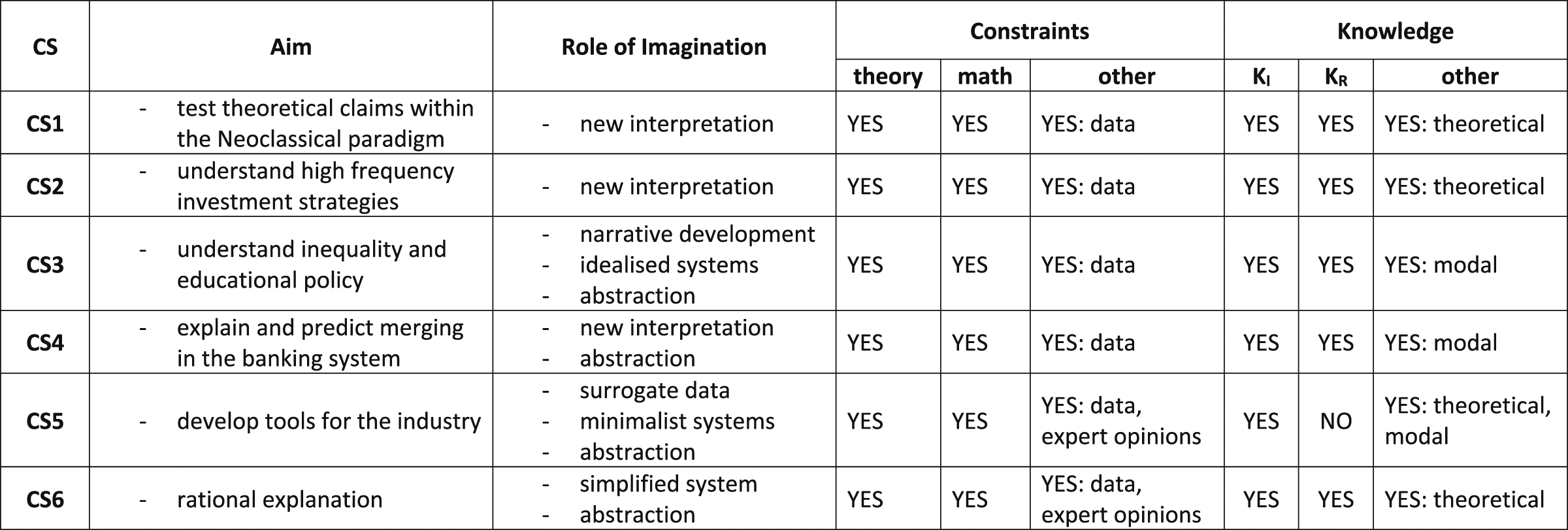
3.1. CS1: Investment under Uncertainty
CS1 involves a number of models of investment under uncertainty, with a particular focus on evaluation at optimal timing of investment projects. The modeling is driven by practical questions that ultimately can lead to theoretical developments within the Neoclassical economic paradigm by testing the limits, coherence, and plausibility of particular theoretical claims. The model’s initial assumptions could be backed up by theory, data sets, or empirical research that was relevant to the particular purposes of the modeling. This case is especially significant because of the explicit emphasis on the role of mathematics in the model’s assumptions and in its development, and thus the light it sheds on how mathematics contributes to contextual constraints (H2) to drive model development. In some cases, the mathematical representation of the model assumptions is quite obvious, as when uncertainty is standardly represented by using geometric Brownian motion. In other cases, model assumptions are not standard but new, and the mathematical representation may precede their interpretation, as when the equations of a topological structure involve infinity and the modeler has to think hard about what “infinity” means in an economic context. In this last case, mathematics drives the interpretation and it is key to the production of new results.
A second, related aspect of interest, and something that we had not emphasized in any of our initial hypotheses (H1-3), concerns the rhetorical role of mathematics. The modeler noted that one cannot experimentally verify most of the results. So, one has to come up with a narrative, or a rhetoric, to convince others of the correctness of the model. The mathematical nature of the model is central to this rhetoric, as once the mathematical assumptions have been conceded the conclusions cannot be resisted: … these models, it’s not physics, we can’t simply say: ah well, you know, you drop a stone and it falls. And you can’t experimentally verify much of what you do. So, we’re coming up with a narrative, with a rhetoric, and in order to convince people of the correctness of your conclusions, you first have to convince them of the reasonableness of your assumptions. So, you’re really setting the stage within which your rhetoric works. So, that’s, I think, one of the advantages of using mathematics. Once people accept the assumptions, they have to agree with the conclusions. Unless you’ve made mistakes in the math, but if the math is right, your conclusions are right. Which is why the assumptions are often heavily debated. (OBS March 29, 2019)
A third, and final aspect of interest concerns the nature of models and the role of imagination in modeling. To the question “What is a model, in your view?” the modeler answered with an anecdotal remark: When I first joined the […] School, I got involved in some dissertations written by people in different fields. I just could not get over the fact that a lot of these people start writing things like “this is my model,” and then they just have a bunch of arrows, circles and arrows. […] And I was really… That’s no model, where are your equations? (INT April 10, 2019)
For this modeler (in line with H1), a true model is a detailed mathematical description, not an intuitive, easily visualizable picture. The modeler further emphasized that imagination is crucial to modeling, but only as an ability to study alternative, idealized scenarios that are mathematically rather than visually described: “…we write down the mathematics, but we never actually write down the boxes and the arrows. The closest that you get is that someone draws a timeline, the sequencing of decision steps agents are assumed to make” (OBS March 29, 2019). Interestingly, the modeler recognized that the mathematical equations are always interpreted. In some cases, the interpretation is standard. But the most interesting cases are those where the interpretation follows the mathematics: “What on earth can this be? What is the interpretation behind this? In fact, it’s part of the industry. […] You’re looking for results that are counterintuitive” (INT April 10, 2019). In relation to H3, knowledge about the target (KR) can thus be generated through interpretation of emergent and unexpected features of the mathematics used in the model.
3.2. CS2: Stock Prices
CS2 concentrates on a model of stock prices, with a particular focus on the strategies that investors adopt when they price stocks on a day-to-day basis and even during the day. The modeling is driven by historical data showing certain investment patterns that are analyzed through theoretical and technical assumptions, which are mathematically represented in line with the constraints identified in H2. Its aim is to understand investment strategies at very high frequency. There are two features of this case study that are particularly interesting. First, the modeling displays a dynamic aspect in its development. The model is successful if it generates a pattern that fits with the one identified in the data. If, however, the model outcomes do not match the data within certain margins of error, then the modeler must go back to the assumptions and change them.
Second, the modeler emphasized that the particular challenges posed by high frequency data required a special imaginative effort. The modeler had to develop standard ideas about investment strategies into the new theoretical framework of high frequency analysis. Traditionally, one would look “at how the investors chose between strategies based on fundamentals and strategies based on historical patterns in the data” (OBS April 3, 2019). Fundamentals are the dividends that individuals receive from buying stocks. High frequency data, however, does not allow an analysis in terms of fundamentals. So, the modeler’s creative solution was to look at strategies based on historical patterns in the data and a market efficiency belief, “which means that changes in the stock price are not predictable” (OBS April 3, 2019). The modeler emphasized that: “You have to give credit to the individuals who first imagined these ideas to begin with. But even in our case, there is certainly a degree of imagination component because of the new issues [raised by high frequency data]. […] So, it’s much about how imagination varies from work to work” (INT May 2, 2019). Note that there is no indication of imagistic imagination being central here.
3.3. CS3: Inequality and Education Policy
CS3 involves models of inequality, with a particular focus on education investment and taxation. The aim of the modeling was to explore ways in which governments could improve policies to foster equality of education opportunities for children coming from different social and economic backgrounds. The modeling develops within the framework of macroeconomics and optimal choice theory and the initial assumptions can be backed up by theory, data sets, or empirical research based on the interpretation of the data produced by econometricians and statisticians. There are four aspects of this case study that are particularly interesting from our perspective. The first is that, in line with H1, the modeler explicitly recognized that “models are usually stories told in a specific language” (OBS April 10, 2019), which involve only what the modeler considers as “the essential ingredients that a story has to have” (OBS April 10, 2019), those that are needed to generate the pattern observed in the data. These include a type of benevolent government that does a limited number of things, a particular tax policy system, a central bank with its own policies, and a number of individuals exposed to different degrees of luck.
The second aspect concerns the role of mathematics in the development of the model. Once the core elements have been identified, the modeler writes them down as a set of mathematical equations, plugs in some numbers and sees what happens. If there is some sign of the original pattern in the data emerging from the model, then one can zoom in on the aspects of the data that generate that pattern. If not, then one has to think about what is missing and rethink the assumptions. Among these were the standard assumption that individuals are all identical and that “inequality arises because […] there are different degrees of luck for them” (OBS April 10, 2019). The modeler further introduced a number of idealized individuals from different socio-economic backgrounds having different innate cognitive skills, which “would make it more or less difficult for them to study” (OBS April 10, 2019) and “later on, when they go on the market, the bright people, even with lower education, would have different or better chances” (OBS April 10, 2019). This amounted to “adding another dimension of inequality that is realistic and is important for the thing that we want to capture” (OBS April 10, 2019). These assumptions were represented mathematically in ways that effectively reproduced the data reported by statistical agencies: “indeed, it turned out that we can generate, in this environment, a result where we have the middle class invest a lot relative to a benchmark where these inequalities would not be there” (OBS April 10, 2019). This suggests a dynamic process of model building and model development that supplements the more static picture of the role of the constraints identified in H2, that uses mathematics as epistemic scaffolding for the exploration of imaginary scenarios that reproduce particular patterns originally identified in the data.
The third aspect relates to the kinds of knowledge claims arising from the model (H3). The insights garnered through the model can be conveyed to policy makers as potentially reliable predictors. The model is developed so as to interrogate modal questions about what would happen were a certain policy intervention to be tried. This offers an additional form of knowledge not highlighted in discussion of H3. Knowledge of what might be expected to happen were a particular policy proposal to be pursued is neither knowledge of the imagined model (KI) nor of any real target system (KR), but rather modal knowledge of how events might unfold should a particular intervention be adopted.
Finally, the modeler explicitly recognized a role for imagination in modeling in two ways. First, imagination is linked with abstraction, which (as the modeler describes) is the process through which the irrelevant aspects of the phenomenon under investigation are sealed off to produce a minimal, essential set of ingredients. Second, imagination is invoked in invitations to engage with the scenario specified by the model: We usually talk about abstraction rather than imagination. But then I think that when we talk about models then the word “imagine” comes up quite often even when we talk about these things in a pub. The sentence would be, you know: “Imagine a simple model where you would have this and that.” (INT April 16, 2019)
In this case, as in the previous two, imagery does not seem to play a fundamental role.
3.4. CS4: Banking Mergers
CS4 involves a number of models of the British banking sector, with a particular focus on long-term trends in the size and population of the sector. The models are built within the framework of system modeling with two different aims: explanation of the observed changes in size and population of the banking system and prediction of how the system will evolve in the future. In both cases, the modeling builds on the strategy of amalgamation and it is driven by the assumption that banks are agents in a certain business system where they amalgamate or fail to do so. There are three main aspects of this case that are relevant for our study. The first, in relation to the kind of knowledge claims sought via the model (H3), is that the modeler explicitly aimed at producing mechanistic explanations similar to those produced in biology, where agents in a certain business system are conceived as cells in an organism. In the model, all the banks are agents in the system, so that’s an abstraction of a bank […] they don’t really do anything, there isn’t any bank functionality going on, really. But they can merge with each other, they can fail, and they can change their identity, take each other over. (OBS March 29, 2019)
This contrasts with traditional, accepted theories of how the banking sector evolved, which work under the hypothesis that the banks that survive do so because of some special features of the banks or of the people who run them (the so-called “titans of the industry”). The models test a different hypothesis, namely that the observed behavior could be explained in terms of a random process at the systems level, which would undermine the explanatory role of those traditional features. The models successfully challenge the traditional theoretical hypotheses if their results match the data on the change in the size of the population of the sector (explanation) or if they contribute to selecting the possible future developments in the system (prediction).
The second aspect concerns the emphasis the modeler put on the dynamic aspects of model development. If a particular model does not match the observed behavior in the data, that’s an indication that the mechanistic understanding may be wrong. So, one could be missing something, or some of the underlying assumptions might not be quite right, or the simulation based on the model may be wrong. One has to go back to those different elements of the modeling and try to figure out what that might be. In this sense, the model is always a sort of tool for exploring alternative explanations of real-world phenomena, or how things might be, rather than confirming what one already knows.
The third and last aspect concerns the importance of both mathematical and visual representations. The modeler emphasized that mathematics is crucial to the modeling, but network models are also fundamental tools for the study of the particular ways in which the banking system evolved or could evolve in the future. These network representations, which emerge from a computer simulation, afford a fundamental tool for the analysis of the data in terms of explanation and prediction. A network model is a database model that is typically represented as a graph in which objects are nodes and their relations are arcs. Effectively, the computer simulation provides a visual picture of the network. This seems to challenge the anti-imagistic picture of imagination in modeling, but we would like to note that such visualizations are intersubjectively available (displayed on a computer screen for all to see) and as such they do not face the challenges about subjectivity raised against imagistic imagination. Indeed, we hypothesize that they could be seen as tools to prompt further propositional imagining because the interpretation of the objects and relations represented in the network requires a theoretical interpretation. One might even argue that these computer-generated networks are a new kind of prop in the make-believe. Interestingly, when asked about whether imagination has any special role in modeling during interview, the modeler’s answer was vague: “You need imagination to build models, but you do not need imagination to do most things. Whether it has a special role, I don’t know, really” (INT April 16, 2019).
3.5. CS5: Managing Risk
CS5 involves models of risk management built within the framework of probability theory, including valuation models and forecasting models, or models that can be used for both purposes. The aim of the modeling is to produce new tools that people in the industry can improve, use for calculation, and test for different purposes. There are three main aspects of this case that are particularly interesting to us. First, the modeler emphasized that model assumptions come directly from the theory but also from a combination of data and expert opinion. In order that the view is not entirely backward looking, sometimes the models are enriched with scenarios and opinions about what might happen, including what the real-world probability measures really are.
Second, the modeler emphasized, in relation to the kinds of knowledge claims supported by the model (H3), that the modeling itself is not aimed at drawing any empirical conclusions. Instead, it is aimed at justifying the use of certain methodologies, and providing tools for end users who might themselves want to draw conclusions about valuation or make forecasts: “My work is actually a lot about providing techniques and tools that can be used, or good methods, in particular situations in risk modeling” (INT May 22, 2019). The measure of success of the models is in their adoption by the industry. In the modeler’s words, “adoption is the best validation” (INT May 22, 2019). This idea of models as tools (along, indeed, with some of the uses of the previous models discussed, e.g., the use of the education model to provide policy recommendations) somewhat complicates the picture of the kinds of knowledge provided by models presented above in discussion of H3. Here we see an episode of modeling being used to support the development of new theoretical tools, which are one step away from making claims about the real world, or KR: … to get a test of the power and size of statistical tests you run Monte Carlo experiments. But we needed data generating mechanisms where we can calculate many things. So, in fact the first model I told you about was a data generating mechanism that was designed to be used in Monte Carlo simulation studies because we could quantify exactly its behavior. (OBS May 2, 2019)
Effectively, the new model was not needed to gain any new knowledge of reality. Instead, it was aimed at validating other models (models of valuation of banks).
Finally, the modeler described a particularly interesting way in which a toy model of volatility can be developed. The model is not supposed to be a faithful record of any real-world mechanisms. The modeler described this as “a very much stripped-down, simplified story of how these mechanisms work” (OBS May 2, 2019). The model is built on theoretical assumptions, to which new, more specific assumptions are added. These more specific assumptions come from data or from what one believes about the underlying data generating mechanisms through knowledge of the problem (new core features) to produce more realistic models. So, when asked about the nature and origin of the model assumptions, the modeler admits that “it’s a combination of what other people say ought to be in the model and what I’ve seen with my own eyes looking at the data” (INT May 22, 2019).
3.6. CS6: Business Cycle Fluctuations
CS6 focuses on a number of models of business fluctuations developed within the framework of endogenous growth theory and business cycle fluctuations. The purpose of the models is to rationalize certain traditional theoretical claims about economic cycles and wave-like fluctuations based on the analysis of new data. As in the previous cases, the model assumptions come from theory, data, empirical research based on statistical analysis of the data, expert opinions, mathematics, and the modeler’s hypotheses about the particular phenomena under investigation. Interestingly the modeler identified the model with certain equations, which are reached through the development of the initial theoretical assumptions through the further types of assumption just mentioned. The equations that are reached through this development are then used to draw inferences to make certain predictions about reality, in line with the kinds of constraints discussed above in relation to H2. The mathematical development is thus driven by the constraints that come from reality (data) and from expert opinions and the modeler’s hypotheses about the correct causal explanation of the phenomena under study. The mathematical equations clearly emerge as the epistemic tools and scaffolding that need to be developed from theory, reality, expert opinions, and hypotheses to make predictions about reality. And through these, one can test the adequacy and predictive power of the theory. In an email exchange that preceded OBS, the modeler described the modeling practice by appealing to an analogy with children’s ways of representing real world in the following way: Among economists and applied mathematicians, a model is generally defined as a simplification of the reality; the model is a “good” model if it can reproduce some stylized facts observed in the actual data. So the first step for a modeler is to observe something in the real word (a stylized fact) and try to find a “reasonable” way to describe it in a simplified way; it is like a child that combines a rectangle and a triangle to represent a house. Exactly as Euclidean objects (such as rectangles and triangles) do not exist in the physical world but only in the metaphysical world so I think we can claim that the model does not exist in the physical world and are [sic] not physical objects as you are suggesting.
The modeler did not have a definition of imagination in mind, but in the same email exchange and during OBS associated the notion to the “capacity of abstraction.”
4. Constrained Uses of Imagination in Economic Modeling
On our favored version of the fiction view of models, modelers are participants in games of make-believe wherein imagination is constrained by the use of props and by those principles of generation understood as being in force in each particular case. The intersubjective dimension of modeling that is afforded by the props and the principles of generation avoids psychologism (and the issues raised by the subjectivity of certain forms of imagination) and enables the social dimension of modeling. In the case studies described above, modelers recognize that imagination plays an important role in modeling without, however, having a single, clear notion of imagination. By “imagination” some of them mean an ability to entertain or create alternative abstract systems of study that depart from reality in certain ways (CS5, CS6). One modeler expressed skepticism toward the role of images and visual representations in modeling (CS1). Others neglected the role of images entirely, and therefore also the idea that the sort of imagination involved in modeling would be imagistic (CS2, CS3, CS5, CS6). One modeler emphasized the role of network models, where their outcomes, obtained through mathematical modeling, are visually represented (CS4), though we note that these representations, in the form of computer graphics, are public and available to all as “props” to support further inferences within a make-believe, and thus avoid the subjectivity challenge that arise from seeing imagination as essentially involving mental images. One modeler linked imagination with creativity (CS2). Finally, one modeler linked imagination with the narrative dimension of modeling, or what Sugden (2000, 9) calls “the story” in the model (CS3). This evidence shows two things. First, that modelers themselves recognize that imagination is crucial to economic modeling. Second, that the sort of imagination they have in mind is conceived as an ability to engage with states of affairs that depart from reality without necessarily involving mental images. The theoretical considerations made above and the evidence provided by the case studies seem to be coherent with H1 and the idea that the sort of imagination involved in modeling is propositional imagination of the make-believe variety.
Modelers also emphasized the roles of certain constraints operating on their modeling. These are what we, following Walton’s theory, call the principles of generation. Coherently with H2, we hypothesized that there are three main kinds of these principles, architectural (operating on all uses of imagination), context-specific (operating on particular uses in specific modeling practices), and epistemic (operating on those uses that enable knowledge). All case studies are compatible with the hypothesis. But they also contribute a fresh perspective on the ways in which these constraints operate in economic modeling. Let us begin by considering a number of interesting refinements of context-specific constraints. We hypothesized that there are at least four types of these constraints, theoretical (determined by theory), mathematical (determined by mathematics), reality oriented (determined by reality), and mutual-belief oriented (determined by the shared beliefs of the scientific community). The case studies show that theoretical and mathematical constraints play a crucial role in model building through the specification of the relevant model assumptions, and in model development through the manipulation of the mathematical equations interpreted according to the relevant theory and concrete specifications (CS1-CS6). The case studies contribute also an interesting perspective on the different roles that reality can play in modeling. Empirical facts enter the model directly as the results of data analysis that contributes to the determination of the model assumptions (CS1-CS6). In some but not all cases, they are used to test the model outcomes (CS2-CS4, CS6). Interestingly, in one case empirical facts are attributed also a rhetorical function to indirectly back up novel assumptions that would otherwise be too difficult to justify (CS1). Finally, in two cases the beliefs of the scientific community—conceived as expert opinions that go beyond a mere restatement of well-known theoretical and mathematical principles—are recognized as crucial to both model building and model development (CS5, CS6).
What sort of knowledge is generated through uses of imagination constrained in the ways described above? Coherently with H3, we hypothesized that there are at least two different types of knowledge acquired through modeling, knowledge of which claims are true according to the fiction generated by the model—or KI-claims—and knowledge about the model’s real-world target system—or KR-claims. The case studies confirmed this distinction, but they also revealed some important differences. In some cases, the modeler explicitly avoided the formulation of any KR-claims and emphasized that their work is purely theoretical and it is not up for empirical testing (CS5). The knowledge afforded by these models is different in nature, and it deals only with the formulation of new theoretical claims—or KT-claims—that can ultimately be used as innovative tools for measurement, analysis, and forecasting. In some other cases, the theoretical development afforded by the model, and hence the formulation of new KT-claims, is enabled by the formulation of KR-claims (CS1-CS4, CS6). In these cases, alternative explanations of the same phenomena are constructed through the introduction of novel concepts, e.g., a reconceptualization of the notion of infinity in an economic system (CS1), a more realistic view of the different, innate cognitive abilities of individuals (CS3), an analysis at the system level rather than the individual level (CS4), a new understanding of the rationality of particular economic systems (CS6). Finally, some of the case studies involved a number of models that were used for both explanation and prediction, and in the latter case they enabled modal claims about possible future scenarios—or KM-claims. To emphasize, these claims are not about the alternative states of affairs described in the model, but rather about future possible states of affairs that might arise, for example, if a particular policy intervention were to be adopted. Hence, in a sense, they are claims about possible future states of reality. In some cases, the model results were used to inform policy makers about how to best pursue certain results based on the scenarios and causal relations revealed by the modeling (CS1, CS3). In another case, they were used to provide members of the industry with the adequate forecasting tools (CS5). Hence, the case studies showed that there are not only two types of knowledge afforded by models but four, KI-claims, KR-claims, KT-claims, and KM-claims. These types of knowledge claims can relate to each other in interesting ways and are shaped by the specific epistemic objectives of the modeling.
A number of further, interesting features emerged from the case studies that can help us understand the ways in which imagination is constrained in modeling and further develop the fiction view of models in a practice-oriented way. The first feature concerns KR-claims and the model development. Three different types of model development emerged from the case studies, basic, dynamic, and progressive. We call a model development basic when the only mechanism of model development is one of inferential reasoning from certain premises (the model assumptions) to certain conclusions (the model outcome). A classical hypothesis is that these inferences are deductive, because they start from general theoretical and mathematical principles (Bueno and Colyvan 2011). These principles are always interpreted in some particular way, through the specification of a particular, imaginary system as the object of study. And the consequences of these inferences are usually about the particular system of study in the model. When one considers historical case studies, especially of models that are well-known and ready to be analyzed, it is natural to look at the original assumptions (mathematically represented), add some numbers, and draw the relevant conclusions. All case studies confirmed this basic notion of model development (CS1-CS6). A second mechanism of model development, which we call dynamic, emerged from a number of case studies (CS2-CS5). When the model outcomes (the conclusion of the inferences) contradict the expected results, one has to go back to the assumptions (or to some intermediate step) to modify them. For example, when the model outcomes are taken to the data and they are outside of certain margins of error, something must be wrong with the model, and one has to revise the model assumption or some particular step of the mathematical development. Or, when working with a dynamic model, one runs 10,000 simulations and they should all more or less overlap in their results. When they differ from each other too much, when one obtains results that are incoherent or divergent, one has to go back to the assumptions and re-work on the model. In this way, model building and model development integrate as different aspects of the same dynamic process of refinement. Finally, there is also a third type of mechanism of development of the model, which we call progressive, consisting in a gradual process of growth of a system of models from the more general and simpler to the more specific and complex (CS5) 6 . In this case, the modeler starts from a generalized model built on purely theoretical and mathematical assumptions. To build more concrete and realistic models, the modeler progressively adds new, more specific assumptions that come from data or from what one believes about the underlying data generating mechanisms through knowledge of the problem (new core features). In this case, the model development is guided by a combination of what other people say ought to be in the model and what the modeler sees when looking at the data.
The second feature that can help us understand the ways in which imagination is constrained in modeling concerns the number of different roles that mathematics has in modeling, as they emerge from the case studies. Mathematics is used as a constitutive tool for the representation of the model’s theoretical assumptions, as a tool for the development of the model, as an epistemic tool for the cognitive support of the modeler’s exploration of the model and, ultimately, for the generation of new conceptual developments, explanations, and predictions, as a rhetorical tool for convincing the scientific community of the model outcomes. In the first three of these roles, the uses of mathematics seen in these examples are in line with the picture offered by Bueno and Colyvan’s (2011) inferential conception of applied mathematics, which identifies three steps in applying mathematics. The first is an immersion step, whereby a mapping is established between the empirical system and a mathematical representation (this corresponds to the constitutive role of mathematics in our case studies). The second is a derivation step, whereby inferences are drawn within the mathematical model to explore consequences of the model’s assumptions (this corresponds to the development aspect of mathematics in our case studies). Finally Bueno and Colyvan identify an interpretation step, whereby the results of an episode of mathematical reasoning are interpretated as they concern the original empirical system (this is an important aspect of the epistemic role played by mathematics in our case studies, though we note that Bueno and Colyvan’s focus is on the use of mathematics to support what we have called KR claims, while we have noted that other epistemic roles at this stage can involve also KI-claims, KT-claims, and KM-claims). The final role for mathematics that we identify, its rhetorical role in convincing the scientific community of model outcomes, is perhaps of particular sociological relevance in economics as a social science. But it is also worth considering non-sociological reasons why a successful mathematical model might be convincing where mere hypothesizing about economic forces might not. One reason might be that the scientific community sees mathematical models in economics as playing an important explanatory role. An account of how mathematical models can explain is offered in Leng (2021), where it is argued that mathematical explanations are structural explanations, explanations that explain their explananda by showing them to follow from structure-characterizing mathematical axioms that are (approximately) instantiated in the model’s target system.
Finally, an anonymous referee pointed out that the analysis of the case studies shows a distinctive feature of scientific modeling, including of economic modeling, that is, the great variety of aims, techniques, validation criteria, and more. The referee wonders why a single account—a sophisticated version of the fiction view of models—can accommodate for such a variety of modeling practices. But the main motivation for the fiction view is the theoretical requirement of naturalism, according to which any account of how scientists learn with models should be able to explain what Thomson-Jones (2010) calls the “face-value practice” of modeling (Frigg 2010; Salis 2021a). A model description, which is usually a set of linguistic and mathematical descriptions, “has the surface appearance of an accurate description of an actual, concrete system (or kind of system) from the domain of inquiry” (Thomson-Jones 2010, 284). Competent scientists, however, know very well that there is no actual concrete object that fits the description. Indeed, this awareness emerged from all six case studies, with some modelers explicitly mentioning the unrealistic nature of the (minimalist/simplified/abstract/idealized/imaginary) systems specified by model descriptions (CS3-6). 7 Furthermore, modelers working in different modeling practices often use the word “model” in different ways and a rigorous analysis requires regimentation so as to avoid potential ambiguities (and the confusions that might emerge from them). But coherently with the way in which modelers identify theoretical models in other practices, in the six case studies the modelers identified the model with the model descriptions, and in particular with the set of mathematical equations emerging from their modeling. One modeler referred also to network models, which are (visual) model descriptions that need to be interpreted through domain specific knowledge, in the context of the particular modeling, to specify the relevant system of study.
5. Conclusion
In this paper we argued that economic modeling crucially relies on constrained uses of imagination that enable scientific knowledge. We offered a detailed argument in favor of this main hypothesis, and we developed a theoretical framework through which we articulated a number of more specific hypotheses about the types of constraints involved in modeling and the types of knowledge enabled by modeling. To test and refine these hypotheses, we conducted six case studies based on observation and interview of economic modelers. We discussed the results of these case studies by deploying an abductive reasoning strategy based on the qualitative analysis of the data. And this led to the identification of a number of relevant similarities and differences in types of constraints and types of knowledge generated through modeling that went well beyond our original hypotheses, including the use of models to support the development of new theoretical tools (KT knowledge claims) and to support modal claims (KM knowledge claims), as well as to the dynamic nature of modeling practice, whereby model assumptions are refined and revisited in light of their fit with observation. While the number of the case studies conducted for this work was limited to six, we believe that the variety of modeling practices described by modelers working at the forefront of contemporary economics provides a first good evidential base for the refinement and the enrichment of our present hypotheses. Further lines of research should focus on the ways in which imaginative practices in economics are currently conceived, developed, and taught.
Footnotes
Acknowledgements
We would like to thank two anonymous referees for very helpful comments on previous versions of this paper. We are also grateful to Mike Stuart for useful advice on qualitative research. Finally, we would like to thank the audiences of two events where this work has been presented, at the Workshop on Imagination and Fiction in Scientific Modeling held at the University of York in 2019, and at the CamPos Wednesday Afternoon Seminar Series at the University of Cambridge in November 2022.
Declaration of Conflicting Interests
The author(s) declared no potential conflicts of interest with respect to the research, authorship, and/or publication of this article.
Funding
The author(s) disclosed receipt of the following financial support for the research, authorship, and/or publication of this article: This work was supported by the University of York through its Creativity Theme Priming Funds.
