



Abstract
In The Origins of Unfairness, Cailin O’Connor develops a series of evolutionary game models to show that gender might have emerged to solve coordination problems in the division of labor. One assumption of those models is that agents engage in gendered social learning. This assumption puts the explanatory cart before the horse. How did early humans have a well-developed system of gendered social learning before the gendered division of labor? This paper develops a pair of models that show it is possible for the gendered division of labor to arise on more minimal assumptions.
In The Origins of Unfairness, Cailin O’Connor outlines a novel theory of the origins of gender (O’Connor 2019). She draws on the tools of evolutionary game theory to show how gender might have emerged as a device for solving certain classes of coordination problems. Some tasks are best completed through a specialized division of labor. But without social roles, it can be difficult to coordinate on the issue of who should perform which tasks. Who should fish and who should make pottery? Sexual differences are one salient feature in early human societies that could provide a basis for the division of labor. Once endowed with social significance, sexual difference can transform into the autonomous cultural force of modern systems of gender.
Her models are illuminating but have a difficulty. She assumes that agents engage in gendered social learning as the mechanism by which successful strategies spread through a population. But this seems to put the explanatory cart before the horse—how did early humans have a well-developed system of gendered social learning before the gendered division of labor? If we want to explain the origins of gender, one should not help themself to gender-like behavior. One possibility is that gendered social learning and the division of labor incrementally co-evolved. But no formal model of such a process is currently available.
This paper closes that explanatory gap. It develops a pair of agent-based models for exploring how various learning mechanisms interact with gendered behaviors. It finds that adding fairly minimal assumptions makes it unnecessary to stipulate that agents engage in gendered social learning. The general picture these models suggest is this: a partial gendered division of labor can emerge merely by introducing distinctive agent identities. The partial division of labor, in turn, produces an environment in which gendered social learning can evolve endogenously. The growth of gendered social learning subsequently strengthens the division of labor.
This paper is organized into three sections. The first motivates O’Connor’s broad theoretical picture and diagnoses a problem of explanatory circularity. The second describes a model that produces a partial gendered division of labor via a mechanism dubbed “strategic inertia.” The third describes a model that represents how gendered strategic behavior and gendered social learning may co-evolve.
1. Gender as an Evolved Coordination Device
This section describes a game-theoretic model of the evolution of gender that has been developed in previous work (O’Connor 2019). This paper is not a broad defense or critique of O’Connor’s view. The aim is narrower. But motivating the theory makes it easier to understand this paper’s contribution.
1.1. Gender and Social Convention
Gender organizes our social behavior based on real or perceived sexual differences. A variety of activities—ways of talking, laboring, having sex, dressing, expressing emotions, positioning one’s body—are coded as feminine or masculine. Cultural conventions indicate that people are supposed to engage in gender-specific activities. In some cases, gendered conventions can enable smooth social coordination. 1 When two people approach a door at the same time, there is ambiguity about who should open the door for whom. If both people reach for the handle, they might awkwardly collide. If neither reaches for the door, they will awkwardly stand outside. It is a slight inconvenience to open the door, but both people prefer that someone open the door most of all. The convention of men opening the door for women removes ambiguity.
One way of modeling these facts in game-theoretic terms is to treat them as part of a convention. Game theorists understand conventions as behavioral regularities in a group, where those behaviors constitute an equilibrium in repeated coordination problems 2 (O’Connor 2019, chap. 1). Gendered behaviors are a kind of convention that facilitate coordination in the division of labor. Centering the division of labor in the explanation of the evolution of gender has considerable empirical motivation. Anthropological research finds a fairly stable, cross-cultural connection between gender and the division of labor (Bird and Codding 2015; Murdock and Provost 1973; Wood and Eagly 2012). Many societies, perhaps all of them, utilize gender as a social category to assign a range of tasks to individuals. Exactly which tasks are assigned to which gender varies significantly cross culturally. But the role of gender in dividing labor remains invariant. O’Connor encapsulates those observations with the game in Table 1.
Division of Labor Games.
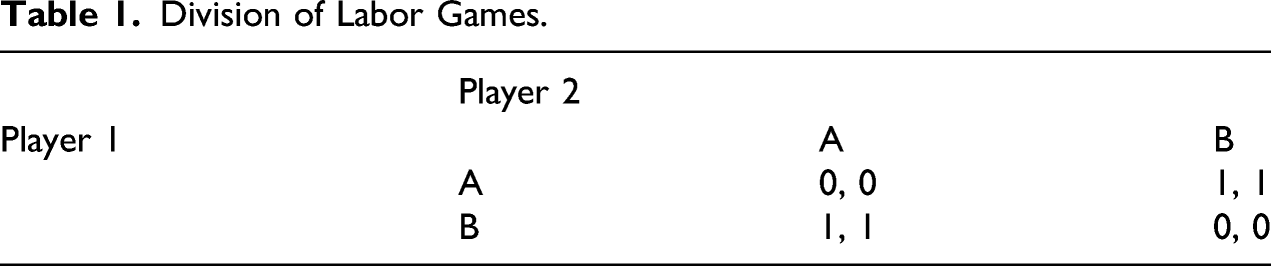
In this game, we can think of the strategy pairs (A, B) and (B, A) as representing a division of labor. Each agent does a different task. Under the division of labor, each individual benefits due to specialization. If the men in a society pursue fishing, they will grow more skilled in it over time. The same is true for gender roles that assign pottery to women. The payoffs do not stem from merely accomplishing the task. Instead, the payoffs represent the returns to specialization relative to what they would accomplish without a division of labor. In principle, everyone could perform a little bit of every task. Men could fish in the morning and do pottery in the afternoon. But a society that managed labor in this way would miss out on the benefits of specialization.
Despite their mutual interests, there is a good chance the agents fail to coordinate. Neither agent knows which equilibrium the other agent will aim for. Worse, even if they agreed on a particular equilibrium, they would still need to figure out who occupies the positions of player 1 and player 2. Absent some additional piece of information, they have no way of knowing. 3 Each agent has just as much reason to think they are player 1 as player 2. O’Connor suggests that sexual difference is a salient piece of information that breaks the informational symmetry. 4 If a male and female pair are faced with a division of labor problem, they can assign player positions by sex and develop a convention wherein player 1 performs action A and player 2 performs action B.
This provides a functional account of what gender is. But the interest of this paper is in its evolutionary origins. How could an early human population with only sexual differences develop a gendered division of labor?
1.2. Evolving Gender in Models
To explore this, O’Connor turns to evolutionary game theory. Suppose there is a population of agents that play the coordination game in Table 1 over several rounds. The initial population is assigned a distribution of strategies. More successful strategies grow over time in proportion to their success. The growth of successful strategies represents the mechanisms of cultural transmission. We tend to mimic successful people. If some members of the group are more successful at producing food or pottery, others will copy their strategies. The process by which successful strategies spread is governed by an equation known as the replicator dynamics. 5 At some point, the population stops evolving—it has reached equilibrium in terms of the distribution of strategies.
The simplest strategies are to take the same action every round. These are referred to as unconditional strategies: 1. Always perform A 2. Always perform B
The strategies we are most interested in are ones that condition the agent’s action on the other player’s sex. These will be referred to as type-conditional strategies: 3. Perform A when playing against males; B when playing against females 4. Perform B when playing against males; A when playing against females
By exploring a range of evolutionary game models, we can gain an understanding of which conventions a population is likely to settle on through simple processes of cultural evolution. Two iterations of models are important for the purpose of this paper.
First, imagine a population that starts with a random distribution of unconditional strategies. O’Connor shows this population will evolve until it achieves a 50-50 split in strategies. This is straightforward. “Always A” does well when most people are playing “always B.” If there is a surplus of “always B” players, then “always A” will grow until they achieve parity. The same goes for “always B.”
The average payoff for both strategies at equilibrium is 0.5. Half the time agents play against agents with the same strategy and get nothing. The other half the time, they play against agents with complementary strategies and receive a payoff of one. This corresponds to the situation where the population has no gendered social conventions.
Second, now imagine we have two sub-populations, males and females. Agents can interact with anyone, but successful strategies are spread internally to each sub-population. There is also a larger pool of strategies; agents are randomly assigned any of the four strategies described above. This makes it possible for agents to evolve a gendered social convention.
The result is that the average payoff increases to 0.75. The population will converge to either one of two states. In the first state, males will always play A against females and females will reciprocate by playing B. When agents play against the opposite sex, they always receive a payoff of one. Internal to each sub-population, they still only coordinate half the time. They do not have sexual differences to break role symmetry, so each sub-population is in a state akin to the first model. In the second state, they simply switch actions; males always play B against females and females play A against males. The other dynamics remain the same in the second state. This shows that there is something evolutionarily attractive about gender. It allows agents to improve their performance in coordinating over a division of labor.
1.3. The Circularity Problem
In the move from the first model to the second, O’Connor adds the assumption that strategies only transmit within each sexual sub-population, never across sub-populations. The assumption is equivalent to assuming the relevant mechanism of cultural transmission is entirely internal to each sex. Or simply, social learning is gendered. There is good empirical support for this assumption. A large body of experimental literature finds humans prefer to imitate the behaviors of others who shared their sex (Losin et al. 2012; Perry and Bussey 1979; Bussey and Bandura 1984; Shutts, Banaji, and Spelke 2010).
Despite the empirical support, assuming gendered social learning introduces a degree of explanatory circularity into these models. To form stable gendered conventions, we need agents to engage in a gendered kind of social learning. Early human societies would need gender, or something gender-like, in place to organize the learning experience. But the model is supposed to explain how early humans got gender in the first place.
O’Connor acknowledges the difficulty:
There is a worry here, which is that same-gender imitation, and other mechanisms for enforcing proper-gendered learning are surely at least in part a response to the existence of gender roles and norms. In other words, while the models assume this sort of learning in order to get gendered division of labor, perhaps that is putting the cart before the horse. (O’Connor 2019, 66)
But she leaves it as a task for future research, “a full account of how groups manage to get all these features in place at once is beyond this book.” (67)
The remainder of this paper develops an account of how it is possible for gendered strategic behavior and gendered social learning to co-evolve.
2. From Equations to Agents
This section and the next describe ways of extending O’Connor’s model to either mitigate or eliminate the circularity problem. Each section relies on a technique known as agent-based modeling. It would be useful to contrast the equation-based approach described in the previous section with the agent-based approach. In replicator dynamic models, agent identity is unimportant. What matters instead is simply the proportion of the population playing the various strategies. Equation-based models effectively abstract over individual agents to represent the population-level strategic dynamics more easily. In an agent-based model (ABM), each agent is a discrete entity. Instead of describing the behavior of the system through equations, agents are programmed to follow rules that govern their interactions. 6 Equilibria are discovered by allowing the agents to carry out their programs until the population achieves some stable pattern of interaction.
2.1. An Agent-Based Model
Suppose there is a population of 100 agents. Half are male and half are female. They are randomly assigned a strategy at the beginning of each simulation. The strategy specifies which actions they should play during interactions with other agents. The model evolves over a series of rounds. 7
Each round the agents take these actions: 1. Play—Agents pick a random partner and play the coordination game. If they play complementary strategies, they get a payoff of 1. Otherwise, they get a payoff of 0. 2. Learn—Agents pick a new partner. If that partner received a higher payoff, the learning agent switches to playing their partner’s strategy. 3. Mutate—Agents have a small probability of randomly switching to a new strategy. The mutation rate is controlled by a parameter and is set to zero for most trials unless indicated.
Generally, the population evolves toward a dynamic, stochastic equilibrium. The distribution of strategies fluctuates around, but does not settle on, some fixed point.
It is easy to show that the agent-based model achieves similar results to the replicator dynamic models. The average payoff in the population provides an indication of how well the agents are coordinating. In the first condition, only the unconditional strategies are present in the population and the average payoff fluctuates around 0.5, as O’Connor found.
In the second condition, the learning rule is modified so agents only learn from partners of the same sex. The average payoff rises to 0.75. Figure 1 visualizes the distribution of strategies across the population for a single round after the population reaches equilibrium. Circles represent females and squares represent males. The colors correspond to strategies: • Black players always perform action A. • Dark grey players always perform action B. • Light grey players perform action A versus males and B versus females. • White players perform action B versus males and A versus females. Strategy Distribution at Equilibrium.
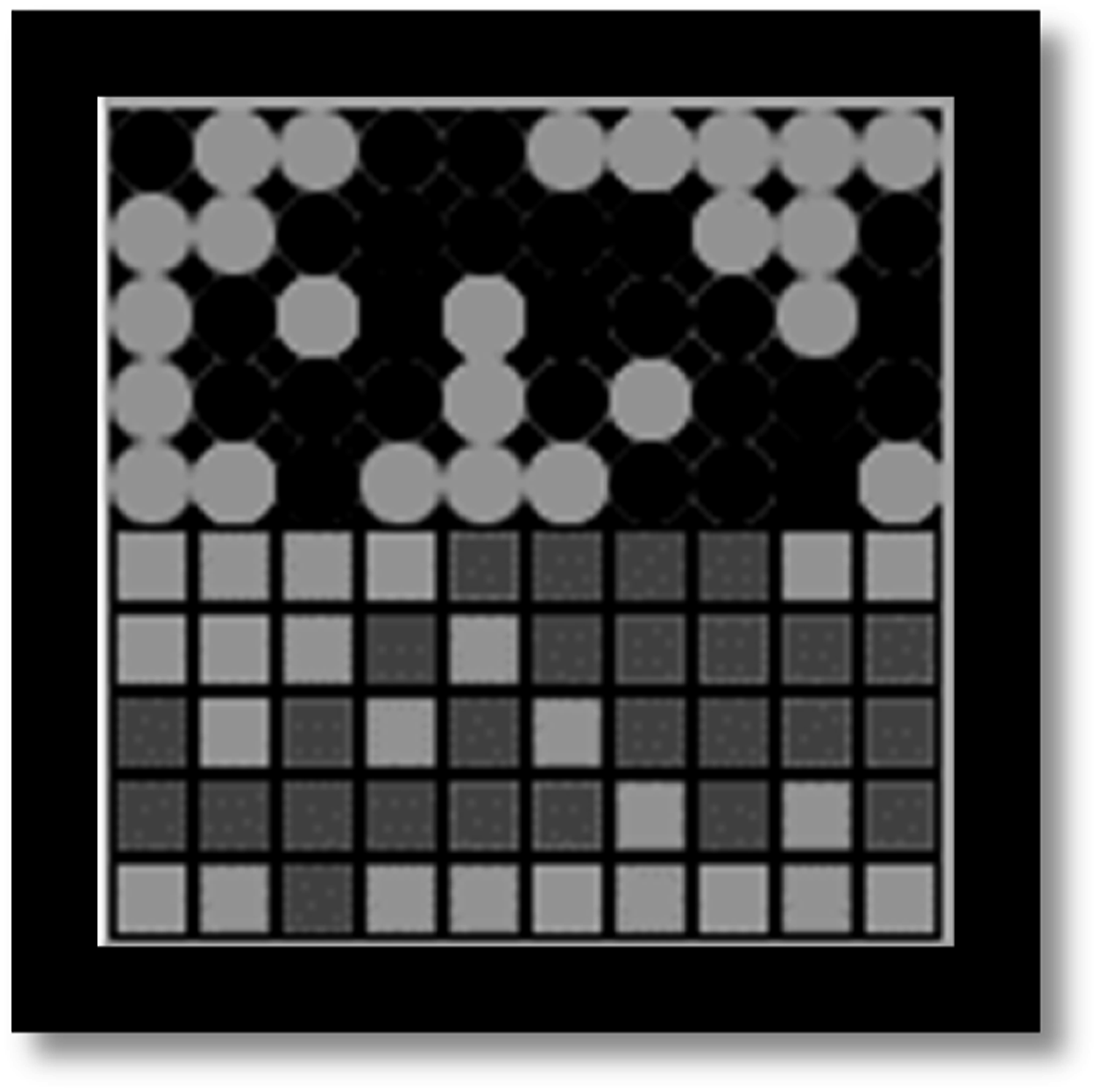
The remaining sections present several data visualizations which employ the same color scheme.
There are a few things to notice about Figure 1. First, only circles are black while only squares are dark grey. This indicates strategic assortment by sex. Second, light grey is found in both sexes. Given that light grey conditions its behavior, it will pick the complimentary action whenever it plays against agents from the opposite sex. Third, white makes no appearance. The population has selected one of the two possible conventional divisions of labor, the one that white is incompatible with. On other runs of the model, the population may reach an equilibrium in which light grey is replaced with white.
2.2. The Inertial Mechanism
The first approach to the circularity problem is motivated by a simple question. What would happen if agents could employ conditional and unconditional strategies but did not engage in gendered social learning? In O’Connor’s first model, agents only use unconditional strategies, and the replication of strategies is not influenced by sex. In her second model, she introduces the full set of strategies but also adds gendered social learning. This section explores the space in between these two models. The mixture of strategies permits agents to engage in gendered interaction, but the learning mechanisms do not force strategic assortment by sex.
If one runs the model with all four strategies but turns off gendered social learning, the average payoff in the population rises to ≈ 0.625. This is halfway between the average payoff of the first model and the second. Figure 2 depicts the average payoff over time. One interesting feature is that the average payoff starts around 0.5 but then grows until it stabilizes around the 0.625 mark. This indicates that the population is, in some sense, learning how to coordinate better than the population with only two strategies. Average Payoff Over Time Under the Inertial Mechanism.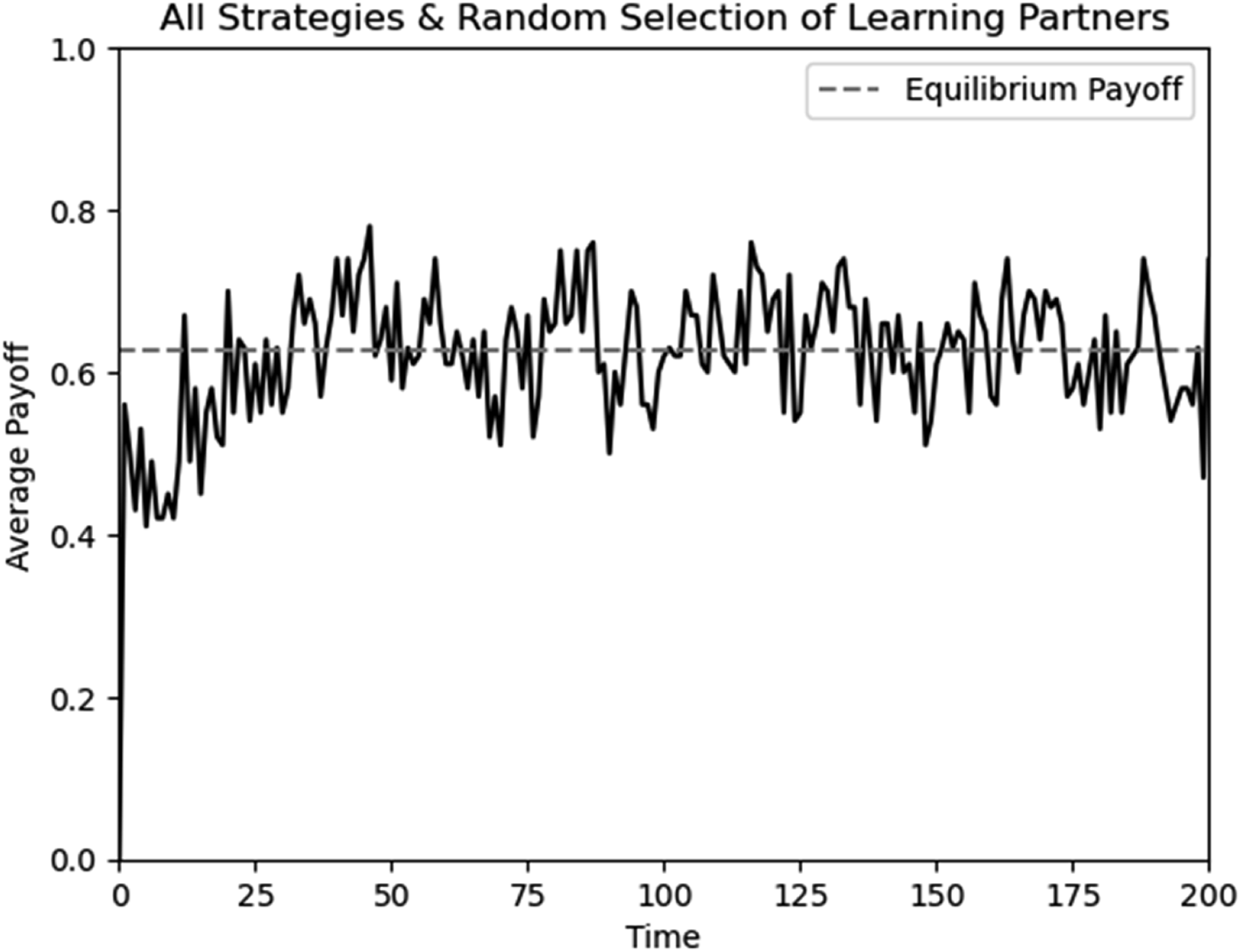
This result is rather surprising. If the strategies are evenly distributed by sex and pairing is random, the expected payoff for all the strategies is 0.5. The type-conditional strategies do not offer any inherent advantage over the unconditional ones. Their expected utility is only higher than 0.5 when a player’s sex is predictive of what action they will take. The mere inclusion of type-conditional strategies should not make a difference unless strategies are unevenly sorted by sex. Figure 3 depicts the distribution of strategies in the population for a single round. It indicates that uneven assortment is precisely what is happening. Recall that circles represent females and squares represent males. There are three things to notice. First, about half the agents in the population are playing the white type-conditional strategy. Second, within each sex group, there is one popular unconditional strategy. For females, that is dark grey. For males, that is black. Third, there is one strategy that is rare for each sex. Only a handful of males play dark grey, and a minority of females play black. Strategy Distribution Under the Inertial Mechanism.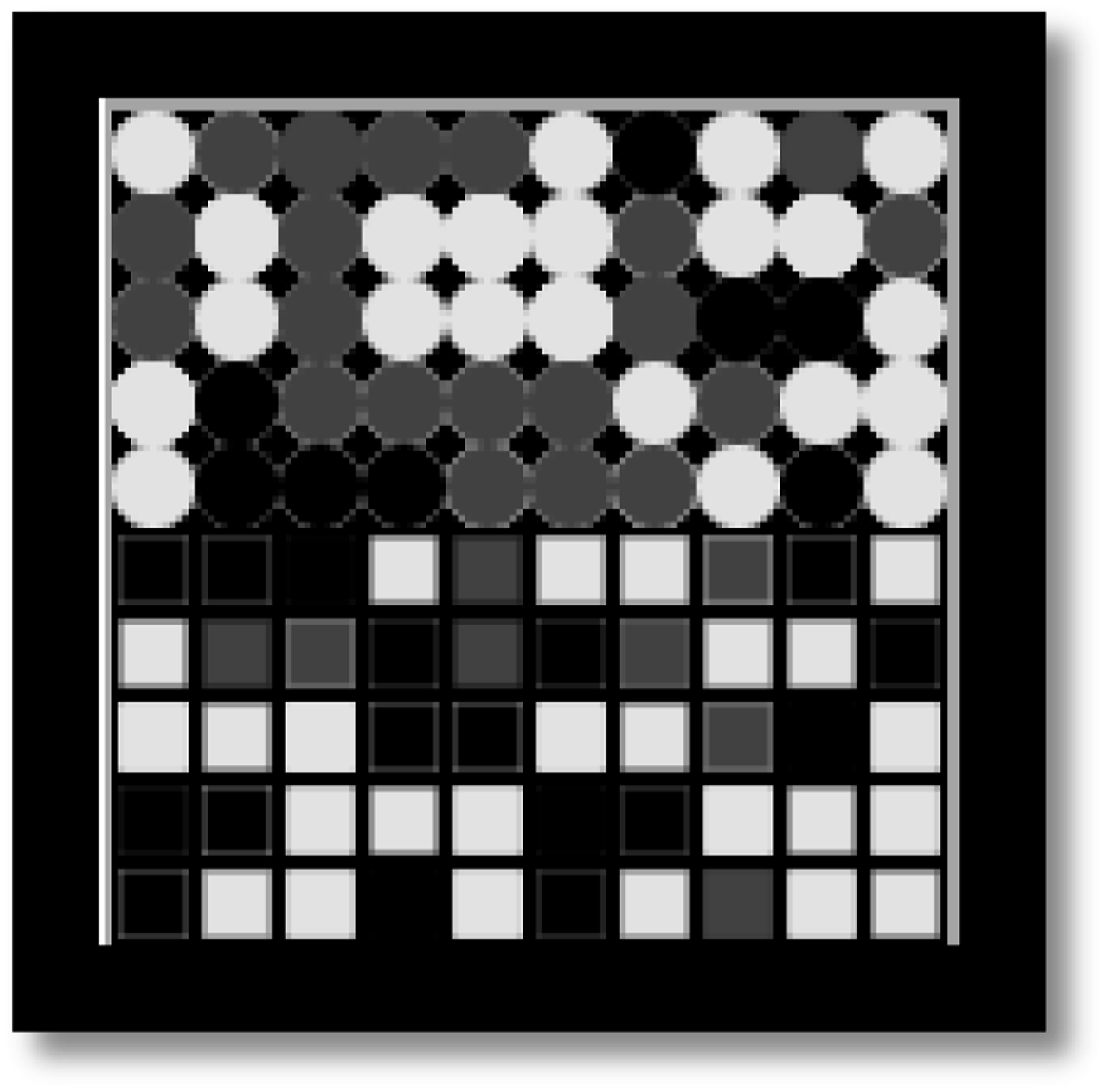
Figures 4 and 5 depict the frequency of each strategy in the population for each sex. They illustrate that the snapshot above is consistent with the behavior of the model over time. Frequency of Strategies over Time for Males. Frequency of Strategies over Time for Females.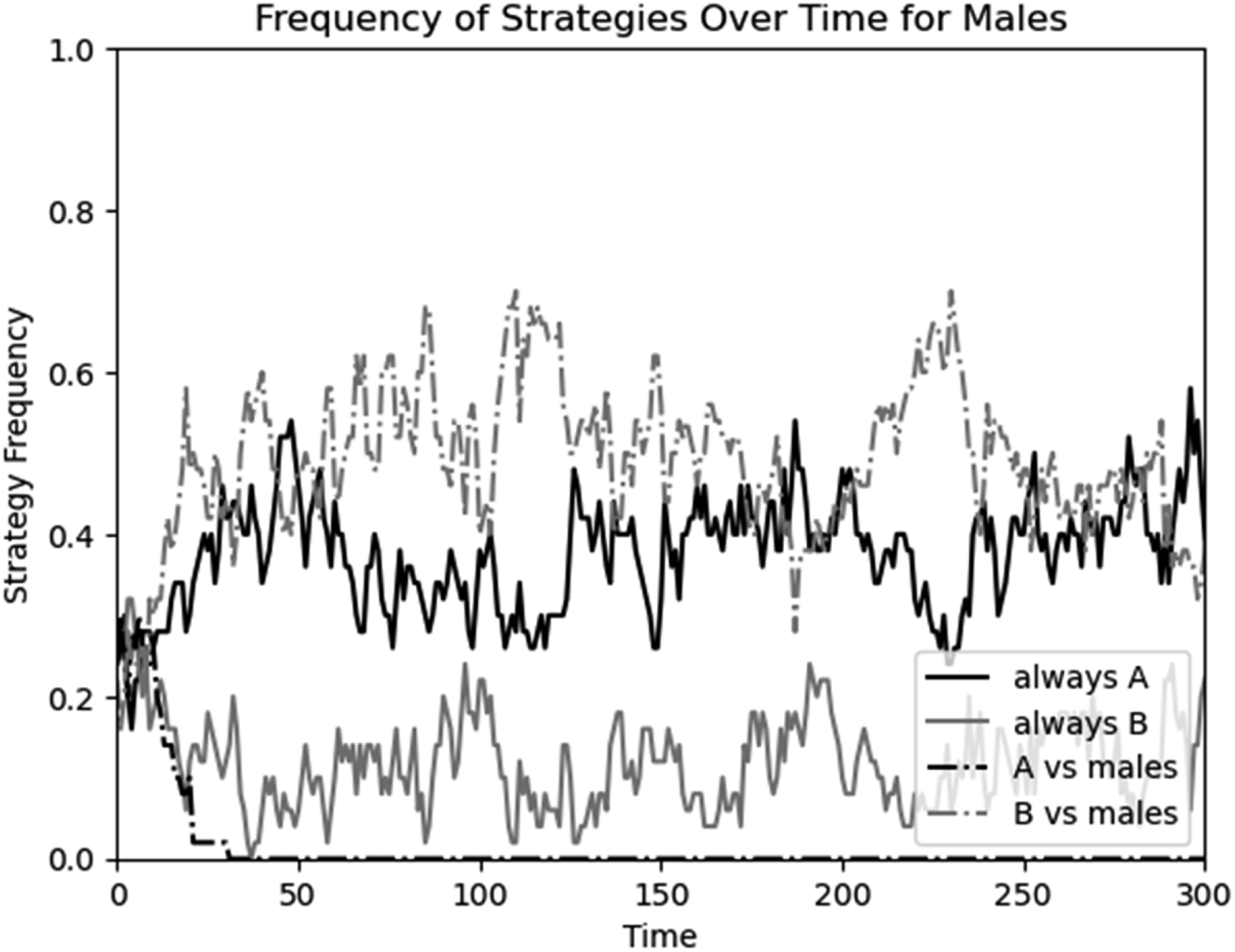
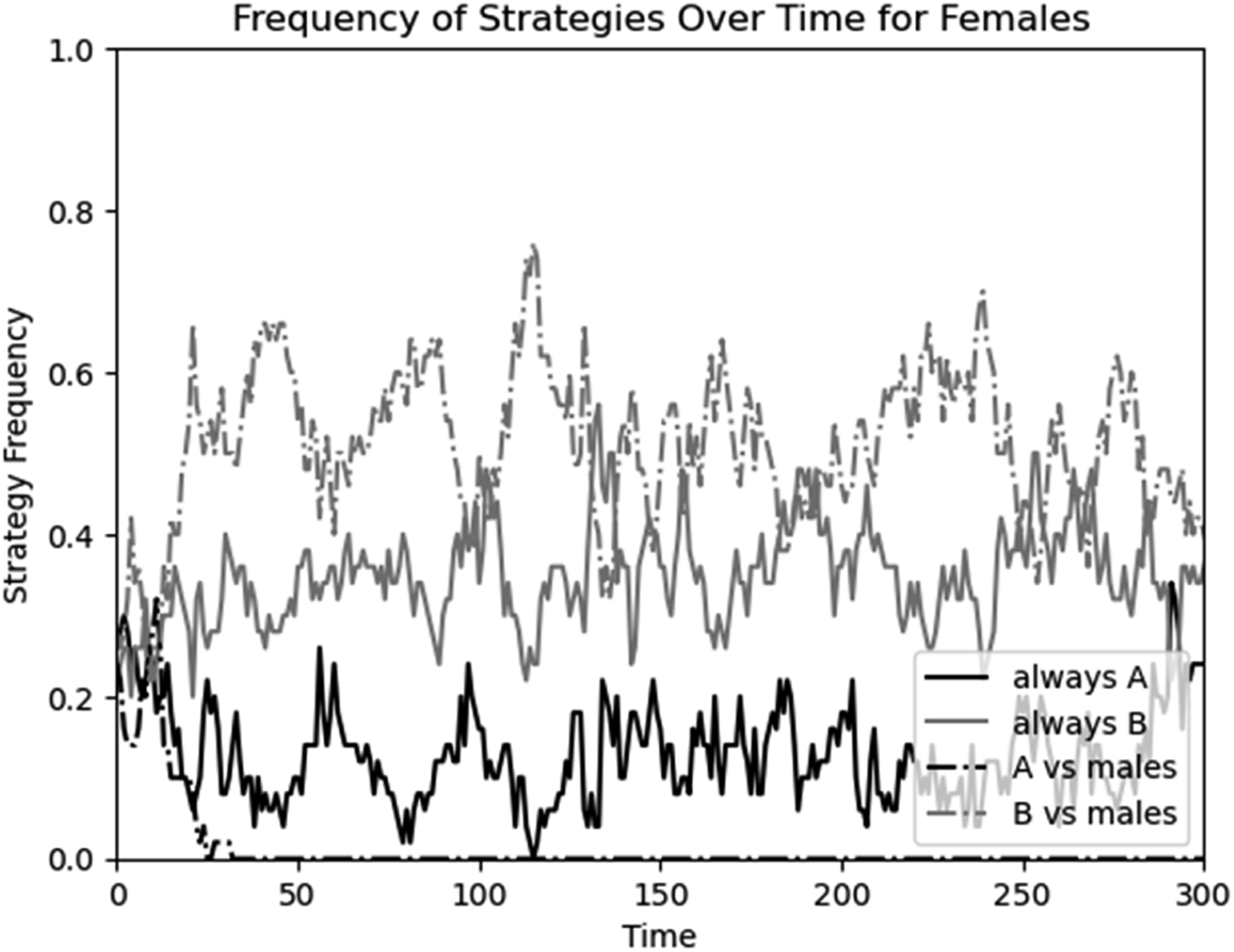
In this run of the model, one of the type-conditional strategies (white, represented by the dashed grey line) quickly grows in both groups. Whatever unconditional strategy pairs well with the popular conditional strategy follows. Black males play well with white agents of either sex. They also play well against the large number of dark grey females. But there are still some black females who do not pair well with the black males. Repeated runs of the model produce similar behavior except the strategies may be inverted: light grey grows quickly, males gravitate toward dark grey and females gravitate toward black.
This much explains why the average payoff rises to ≈0.625. Strategies are partially assorted by sex. But it remains to be explained what produces this assortment in the absence of gendered social learning. The mechanism that drives these dynamics is subtle. It arises from a feature one might call “strategic inertia.” More successful agents have little reason to change their strategy. If an agent receives a payoff on a given round, they will decline to switch strategies during learning. The result is that the population can stumble into a beneficial distribution of strategies by chance and then hold onto to it via strategic inertia. In the iteration graphically depicted above, black males win more often than dark grey males. As such, the dark grey males will be in the market for a new strategy more often. This decreases the number of dark grey males over time, as many agents are switching away from the strategy. Sometimes, the dark grey males will switch to black or white. When they do, they will tend to keep those strategies for longer than they kept the dark grey strategy.
Strategic inertia is less effective in driving assortment than gendered social learning. Under conditions of equilibrium, agents employing gendered social learning will always pick a strategy that plays well against the opposite sex. Males always pick black or white because they never look toward the females for strategies. But strategic inertia does not have this restrictive feature. Males are just as likely to pick up the popular female strategy. It will just not work out very well for them.
This section underscores one of the advantages of agent-based models over equation-based models. The replicator dynamics are well suited to modeling properties that are heritable. They assume that each strategy receives a certain expected payoff, and the strategies grow in proportion to that payoff. But when the payoff depends on the interaction effect between a heritable trait (strategy) and a non-heritable trait (sex), they struggle. O’Connor avoids this problem by representing sex groups as reproductively closed sub-populations. But if one wanted to relax that assumption, there is no sensible way to do that with the replicator dynamics. Introducing discrete agents solves this problem. Agents can have an immutable sex property that interacts with a mutable strategic property. Moving to an agent-based representation allows one to identify effects not found in the equation-based approach.
2.3. Implications
These results show that gendered strategic behavior can emerge in the absence of gendered social learning. The agents in this model, for the most part, perform gender-specific actions when interacting with the other sex. Men usually hunt and women usually make pottery in this artificial world. Whether this solves or only mitigates the circularity problem depends on how you specify the explanandum. Some gendered conventions are very strict; in Catholic societies, only men can perform the role of a priest. Other conventions are more permissive. Today, in North America, it is not uncommon for women to hold the door open for men. The degree of strictness varies across time and place. This model shows that, when it comes to explaining at least the permissive conventions, it is unnecessary to assume gendered social learning. Strategic inertia can produce a stable but incomplete gendered convention.
The next section explores a model which can explain the formation and maintenance of the strict gendered conventions. Gendered social learning can evolve alongside gendered behaviors.
3. The Co-Evolution of Gendered Learning and Strategic Interaction
The goal of this section is to explore the conditions under which gendered social learning can evolve. The basic setup is to introduce a variety of learning styles into the population and a mechanism for them to be selected for. This model retains all the assumptions of the previous one except agents employ one of three learning styles: 1. Learn from anyone 2. Learn from only agents of the same sex 3. Learn from only agents of the opposite sex
Agents begin with a random learning style but can update their learning style in the same way they previously updated their strategies—by selecting another agent at random, checking their payoff, and copying their learning style if they have a better payoff. The motivating assumption is that agents who tend to be more successful in strategic play will also tend to be better at discovering the right strategy. If successful agents find better strategies, others should copy their learning style. 8
This model has agents take an additional two actions each round: 4. Update learning style—Agents pick a new random partner. If the partner received a larger payoff on this round, the agent switches to their learning style. 5. Mutate learning style—Agents have a small probability of randomly switching to a new learning style. The parameter is controlled in the same way and is set to zero for most trials unless indicated.
3.1. Core Results
1000 simulations were run in which the agents started with a random distribution of learning styles and strategies. If the population converged to uniform gendered social learning and the average payoff rose to 0.75, the run was considered a success. The success condition represents that state that O’Connor was able to achieve by assuming gendered social learning. If the model ran for 1000 rounds without achieving the success condition, it was a failure. 885 simulations were successful. This is an important result for solving the circularity problem. It demonstrates that gendered social learning is a strong attractor for populations playing coordination games where they can also employ gendered strategies. If a population could achieve some benefit from allocating strategies by gender, then populations will also be inclined toward gendered social learning. The presence of one encourages the growth of the other, in a mutually reinforcing cycle. In the other trials, random learning takes over the population and they remain stuck there until the trial expires. These simulations assume no mutations of either kind.
3.2. Robustness by Mutation Rates

The general behavior displayed in the table is that adding some level of mutation positively contributes to success but adding more causes a sharp decline. At an LS mutation rate of 1%, only 3.4% of trials were successful. One might interpret this as indicating a general lack of robustness. A more moderate interpretation is appropriate. Inspecting the behavior of simulations under this condition reveals the level of gendered learning can fluctuate dramatically but generally stays between 100% and 50% of the population. This indicates that gendered social learning is still evolutionarily attractive, despite a disruptive mutation rate. Figures 6, 7, and 8 depict a typical trial run for each of three LS mutation rates. The graphs display the percentage of agents using gendered social learning as a function of time. Low Mutation Rate. Medium Mutation Rates. High Mutation Rates.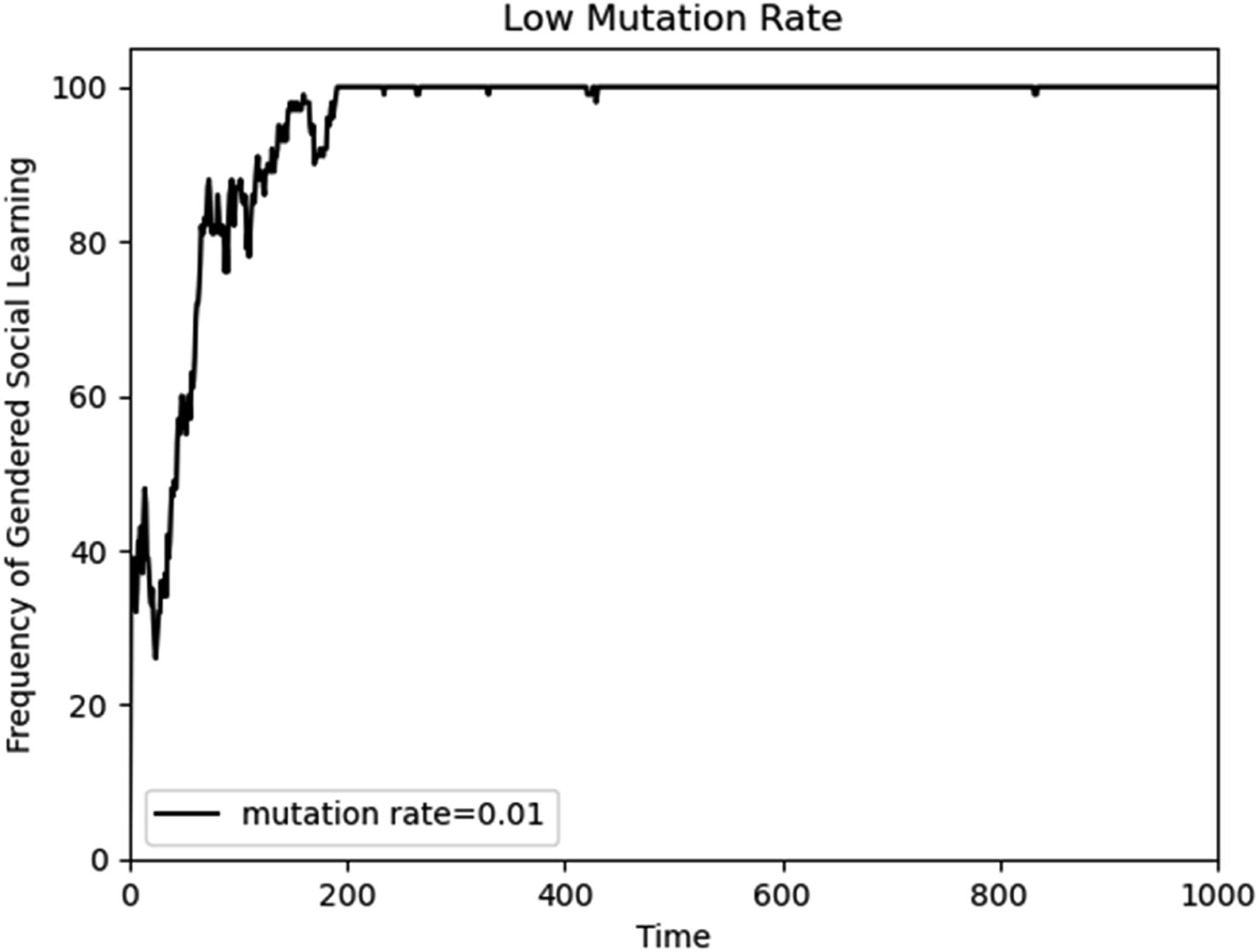
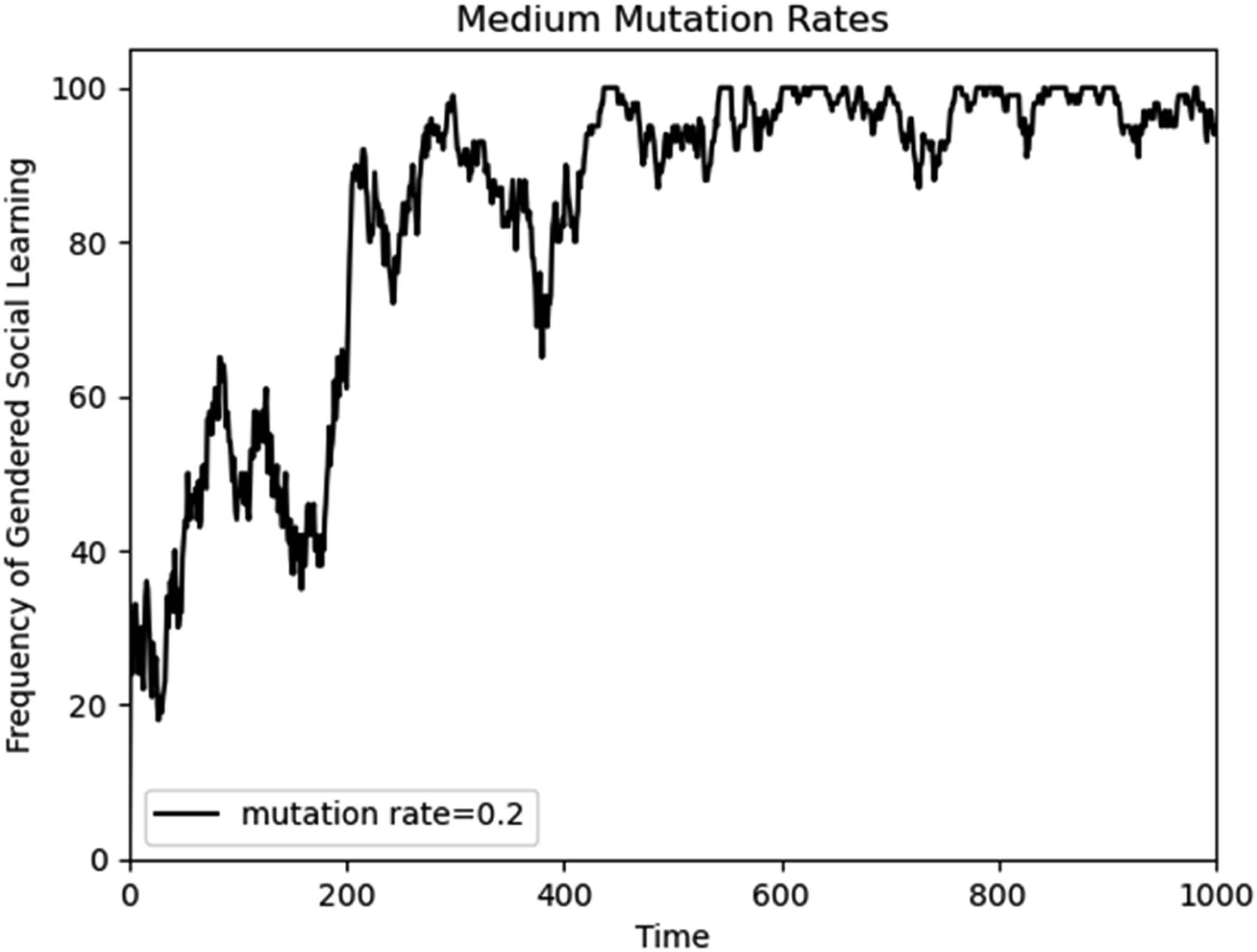
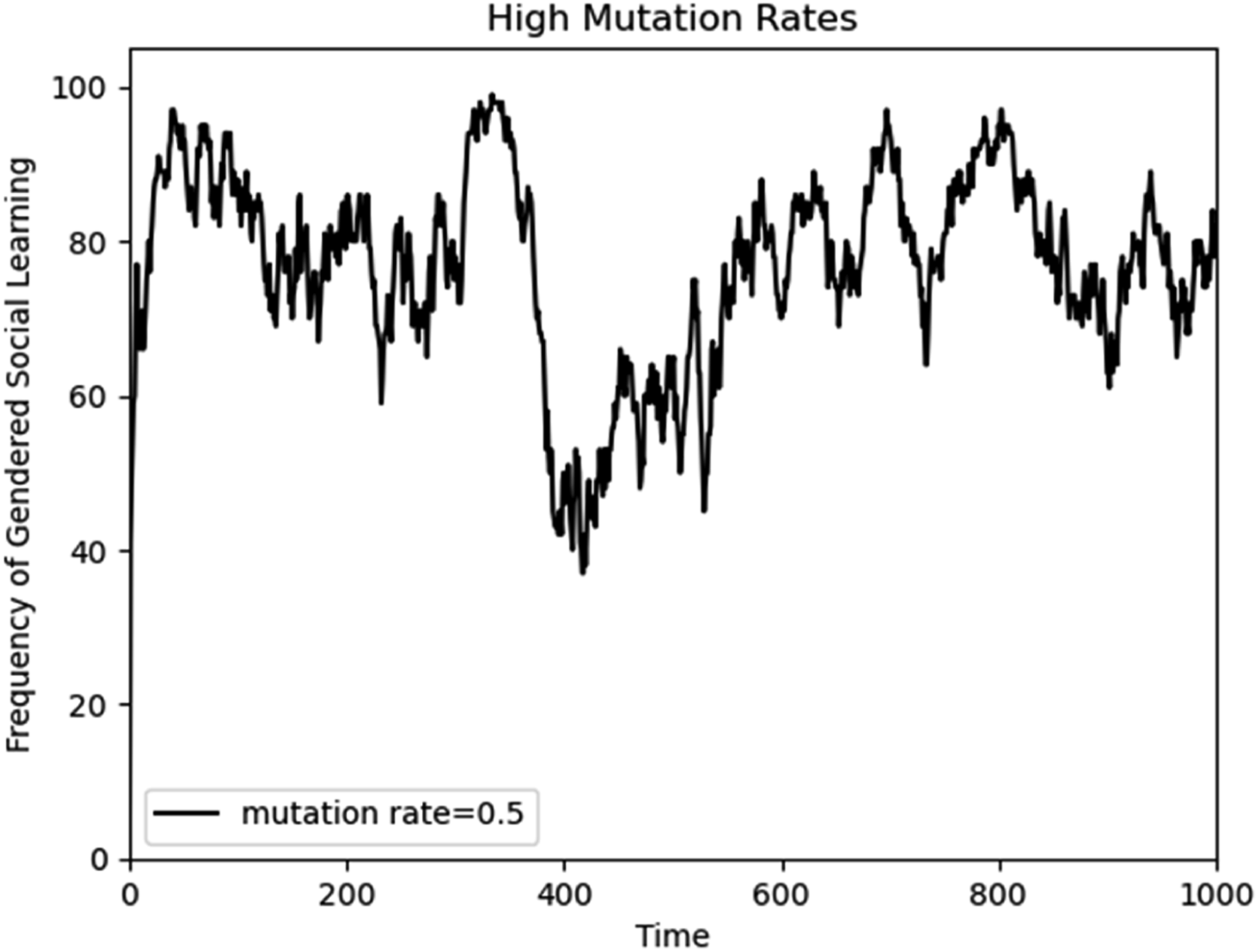
There are two basic insights from these data. First, the force that pulls the population toward gendered social learning is gentle. Small changes to the population can disrupt the process. If agents begin changing their learning strategy randomly, it introduces enough noise into the process that uniformity is hard to achieve. Second, despite the fragility of the process and the lack of uniformity, high rates of gendered social learning are still achieved under high mutation rates. This is broadly supportive of O’Connor’s larger theory. It is also worth noting that, even in the absence of uniform social learning behavior, the average payoff in the population remains near 0.75.
Robustness analysis for strategic and learning style mutation rates
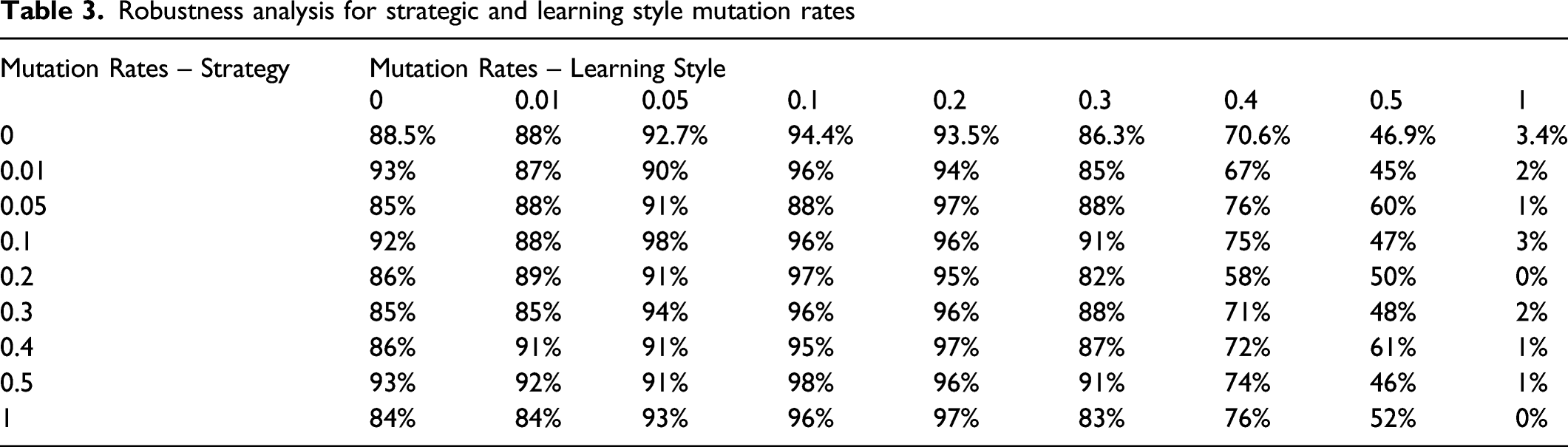
Robustness analysis with 1000 simulations.

Notice, again, the lack of variation. The model is successful at a rate of 88.5% ± 1.5% for any mutation rate. The general conclusion is that the behavior of the model is highly robust with respect to the strategic mutation rate.
3.3. Growing Gender from Scratch
The above results go some of the way to solving the circularity problem. But they do not go all the way. In those trials, the population starts with a large proportion of type-conditioners in the mix. There could be a kind of critical mass phenomenon; gendered social learning is only culturally selected for in populations that have sufficiently high levels of gendered strategic interaction. The next set of results rules out that possibility.
The model was simulated with populations that initially only contain unconditional strategies and randomly distributed preferences for learning. Type-conditional strategies only enter the population via mutations. The main effect of this change is that the model takes far longer to discover the advantage of gendered social learning. But over the long run, it is still consistently successful. How long it takes depends heavily on the strategic mutation rate.
Designing experiments that are both informative and feasible is more difficult for this setup. A time limit of 1000 rounds is usually too short to observe the convergence, but longer time limits massively increase computing time for performing large samples of trials. Fortunately, they are unnecessary. Once a large enough group of type-conditioners have entered the population, the behavior of the model becomes identical with previous sections. Instead of studying the model statistically, it is more informative to discuss the mechanisms that allow for the growth of type-conditioning strategies.
In the absence of type-conditioners, there is no advantage to using one type of social learning over another. Importantly, when agents are only using unconditional strategies, nothing penalizes any type of learning. The population drifts between uniformity over the three learning strategies. Depending on which learning strategy is dominant, three different things can happen.
First, if gendered social learning happens to be dominant, the conditions are favorable for the invasion of type-conditioners. The population will tend to segregate strategies by sex and the presence of type-conditioners will raise the average payoff of those who play their sex-specific strategy.
Second, if indiscriminate social learning happens to be dominant, type-conditioners can still invade but they offer only a limited advantage to the population. Sometimes type-conditioning spreads to a sizable group of the population but it does not drive the payoffs up to 0.75.
Third, if anti-gendered social learning is dominant, type-conditioners cannot successfully invade. Anti-gendered social learning effectively sorts the unconditional strategies evenly between the two sexes. This means type-conditional strategies offer no advantage to their users or other members of the population. Invaders must wait until the learning environment mutates and drifts into one of the other two states. But that random transformation is inevitable given sufficient time. The general conclusion is that changing the initial distribution of strategies only changes how long it takes for gender to emerge, not the core dynamics that drive that emergence.
4. Conclusion
This paper has developed two models which either mitigate or solve the circularity problem in O’Connor’s explanation of the evolution of gender. The general conclusion is that no complicated story is necessary to explain why agents would engage in gendered social learning while faced with coordination problems of the sort investigated here. Very simple mechanisms are sufficient to produce this learning behavior. The inertial mechanism can generate a modest gendered division of labor. This generates an environment that makes gendered social learning selectively advantageous. If we have reason to think that gendered social learning is subject to (cultural or biological) selection, then we should expect gendered social learning to emerge.
The explanatory contribution of this paper goes beyond a technical issue in O’Connor’s book. This also provides a framework for understanding why there is variance in the strictness of gendered conventions. Building gendered social learning into the assumptions of the model produces gendered conventions that are much stronger than many observed in real life. Many gendered conventions are sustained with only partial compliance. Each of the two mechanisms described in this paper underscores the fragility of gendered conventions. The inertial mechanism produces a stable and consistent level of nonconformist behavior. The co-evolutionary mechanism produces uniform gendered social learning only when it is undisturbed by mutations. The presence of mutations drives the population into a state with small but regular deviations from gendered conventions. These results suggest that there is likely a spectrum of gendered conventions and learning mechanisms that could evolve with various levels of strictness. Predicting whether strict or permissive conventions are likely to evolve in each context requires further investigation.
Footnotes
Acknowledgments
I would like to thank Chris Stephens, Alison Wylie, Emily Tilton, and audiences at the ANPOSS/ENPOSS/POSS-RT 2021 Joint Conference and the 2021 Canadian Society for History and Philosophy of Science Conference for their questions, suggestions, and encouragement on this project.
Declaration of Conflicting Interests
The author declared no potential conflicts of interest with respect to the research, authorship, and/or publication of this article.
Funding
The author received no financial support for the research, authorship, and/or publication of this article.
Notes
Author’s Biography
 .
.