



Abstract
This paper argues that social trust is the emergent product of a complex system of property relations, backed up by a sub-system of mutual monitoring. This happens in a context similar to Ostrom’s commons, where cooperation is necessary for the management of resources, in the absence of external authorities to enforce sanctions. I show that social trust emerges in this context because of an institutional structure that enables individuals to develop a generalized disposition to internalize the external effects of their actions. This is made possible by the “patrimonial” nature of this structure.
1. Introduction
1.1. The Problem: Origin of Social Trust and Cooperation
“I will if you will” (Ostrom 1990, 186; Wilson 2007): this formula summarizes the dilemma that cooperation represents in the context of the “commons.” It shows how cooperation is essentially of matter of trust: I need to trust others and they need to trust me. Trust is generally not an issue in any established society, where it appears to be an essential component of the “social capital” (Coleman 1987; Putnam 1993) that enables human beings to interact and cooperate, in the most complex ways. If one example is needed, our trust in money proves this point (Guala 2016, chap. 3; Luhmann 1979). This “sense of general trust” is considered as an explanation of cooperative tendencies, including in games like Prisoner Dilemmas, along with other factors such as a “sense of control” (Hayashi et al. 1999).
However, the accumulation of this “social capital” must have started at some point in human history. Even within already existing societies, trust is not always a given and must be established (e.g., Edwards and Ogilvie 2012). This is why trust is often understood as the product of an evolutionary process (Greif 1989), but also as a paradox: trust seems to need institutions to appear, and institutions need trusting and trustworthy individuals to emerge. Arguing that trust and institutions reinforce one another in a kind of virtuous circle (Bowles 2016) is not enough, as it still leads to an infinite regress problem.
My argument in this paper is that the rules that emerge in the context of the commons allow individuals to solve a fundamental social dilemma (Bicchieri 2006, 140) and develop social trust because of the specific structure of rights they are integrated to, which generates positive feedback loops. My point focuses on the institutional context and explores the idea of an evolutionary genetic process that would have improved human beings’ ability to cooperate and trust each other, even though I do not exclude this argument. It is however compatible with claims that human beings might have a kind of natural “moral sense”, or that our ability to behave fairly is a natural product of our evolution as a species (Tomasello 2016). Nonetheless, any genetic pre-disposition to cooperate still requires the proper institutional context to be fulfilled (Ostrom 2003, 44) and it is in such contexts that humans might have learned to solve essential cooperation problems. Similarly, group identity is likely a mere “instrument” for the deployment of norms, and not necessarily their “cause” (Bicchieri 2006, 141).
1.2. The Commons as a Starting Point
If social trust is an evolutionary product, it must have emerged at the simplest level of social interactions. Cristina Bicchieri hinted at this problem at the very end of The Grammar of Society, where she noted that the wide distribution of individuals that are highly sensitive to the existence of social norms is left to be explained. According to Bicchieri, this sensitivity and the disposition “to punish transgressors” would have “evolved out of social dilemma-type situations” (Bicchieri 2006, 234). Additionally, she argues that groups solved social dilemmas before there were institutions “devoted to monitor and punish transgression,” which means that “norm-complying” evolved from the solving of these problems, only to be expanded later to other social norms that are “unnecessary to the survival of society” (Bicchieri 2006, 234).
Interestingly, Bicchieri regularly points to the more local nature of trust, compared to other social norms, like fairness (Bicchieri 2006, 76-77). I claim that this fundamental level of social interactions, where trust emerges locally, could be similar to that of the “commons” (Ostrom 1990): a quasi-self-sustaining small community where individuals need basic forms of cooperation to manage resources at the local level. Such communities are even more interesting because trust emerges in them despite the absence of an external authority to enforce rules. In such contexts, the presence of more “conditional cooperators” within a group accounts for an important though limited part of success in managing resources, while enforcement mechanisms seem crucial (Rustagi, Engel and Kosfeld 2010).
In addition, since regulating the collective uses of a resource is the main challenge at this basic level, I believe that the very structure of property rights of the commons might be necessary for social trust to emerge. More precisely, I argue that the specific organization of property relations in the commons as a “bundle of rights” (Schlager and Ostrom 1992) helps solve fundamental collective action problems by enabling individuals to start trusting each other. The expression “bundle of rights” or “bundle of sticks” usually means that property is not one right, but a set of rights and privileges. It often implies that there are as many “bundles” as there can be different arrangements of flowers in a bouquet. Under this view, no specific right is essential to property. For instance, an owner can be deprived of the right to sell their house if someone has usufructuary rights on it. On the contrary, I contend that there are underlying principles, or ground rules, that all the “bundles” in the commons share.
These bundles take the shape of specific networks of correlated rights and duties, sufficient to solve challenges pertaining to the collective management of resources and supported by customary enforcement mechanisms. They are structured by two ground rules with complimentary goals: balancing the potentially diverging interests of individuals in appropriating resources on the one hand and ensuring the sustainability of such appropriation in the long-term on the other. I hold that this double purpose structures the content of these individual rights in a way that produces a “situation of stable adjustment” (Bicchieri 2006, 22) or an “effective institution” (Guala 2016, 18) equilibrium. This happens quite literally, since all individual rights balance each other and are co-defined to be consistent with structuring ground rules. I further argue that this structure exhibits the typical feature found in patrimonial structure of property rights (Xifaras 2004) and that it helps solve primary cooperation problems that are linked to resource management which consequently lays the foundations for the emergence of social trust.
1.3. Cooperation Problems and Property Structures
In order to understand why trust emerges thanks to this structure, one must turn to the exact problem it solves. Put broadly, social trust helps solve social dilemmas which are situations “in which each group member gets a higher outcome if she pursues her individual interest, but everyone in the group is better off if all group members further the common interest” (Bicchieri 2006, 140). In other words, the most basic cooperation problems or social dilemmas are problems of externalities, either positive or negative: in the absence of a social norm, individual and self-interested actions may inflict important costs on a social group or lead to free-riding. If this is the first problem that needs solving for cooperation to emerge, and if trust is the result of solving it, then trust may emerge from the shared belief that the members of a specific group will take the externalities of their actions into account.
In the absence of an external authority to enforce rules that make individuals take these externalities into account, this leap of faith remains rational on two conditions. First, there needs to be enforcement mechanisms, despite the absence of an external enforcing entity. Ostrom defended that position by demonstration that “mutual monitoring” (Ostrom 1990) is viable. I elaborate on some of her observations to argue, following recent literature on the deontic nature of legal rules (Kletzer 2018), that the equilibrium of the commons holds in a structure made of the distribution and regulation of the uses of force.
This structure is the starting point of the virtuous circle of trust, from which individuals will find empirical confirmations of their normative expectations. In other words: by providing them guarantees and direct empirical confirmations that others can be trustworthy, these mechanisms reinforce their ability to build expectations about the behavior of other individuals. However, even though it explains why individuals would accept trusting each other, it leaves open the question of the type of rules individuals expect others to follow in order to trust each other. This paper’s main hypothesis is thus that individuals can start trusting each other when they share the belief that they will take the external effects of their actions into account. They do so when the structure of property relations drives them to develop a general disposition to include the external effects of their actions within the scope of their moral horizon. My account differs from Pettit’s (1995) idea that social trust relies on a “disposition” of individuals to desire to be well-considered, but it is not incompatible with it.
The rest of the paper goes as follows: the next section (2) explains why the structure of property relations that emerges in the commons must enable individuals to develop a disposition to interiorize the external effects of their actions for social trust to emerge. Then, I describe how this structure holds thanks to what Ostrom calls “mutual monitoring,” by connecting her work to Christoph Kletzer’s legal ontology to highlight the role of customary mechanisms in the process (3). Finally, I argue that this structure is designed according to two fundamental ground rules, balancing individual interests and ensuring sustainability, which is possible through the constitution of a patrimonial structure of property relations (4).
2. Trust and the Interiorization of Externalities
2.1. Property Structures, Cooperation, and Externalities
For social trust to emerge at any given point, individuals need to believe that certain specific expectations will not be disappointed. Moreover, in the commons and in any system of collective management of resources, the question of externalities is central.
Bringing these two points together, one can say that to start cooperating, individuals need to:
Believe that other individuals will in fact take the external effects of their actions into account
Internalize this belief and the correlated belief that it is expected of them to reciprocate and take the external effects of their actions into account.
This conjunction of empirical and normative expectations is what makes trust a social norm, according to Bicchieri’s definition (Bicchieri 2006, 11), a norm which affects individual behavior somehow implicitely and modifies the result of social interactions. Social trust will only fulfill its specific function if it allows for cooperation to be a behavior by default.
As I will explain in the next session, Ostrom shows that this disposition to trust may emerge in the commons despite the absence of a third-party to enforce rules. The core of Ostrom’s argument, a response to Hardin’s “The Tragedy of the Commons,” was to show that the problem of enforcement was solved in the commons, despite the absence of a “Leviathan.” However, I believe that this argument is partial: the importance of the way rules are designed is overshadowed by the problem of enforcement. Ostrom’s defense of the efficiency of “mutual monitoring” focuses on the emergence of what Bicchieri would describe as empirical expectations (Bicchieri 2006, 13) by explaining how individuals can start cooperating in the absence of previous signs of trustworthiness from others. It does not explain why these rules and the way they are designed are fitting to address the central problem of cooperation in the commons: externalities. My argument is that the specific structure of property relations in the commons provides the “building blocks” of social trust, by fostering the development of norms that broaden the moral scope of individual actions by making them accountable, to others, for the external effects of their actions. This social norm needs to be widespread and internalized to perform its function.
2.2. The Commons as a Moral Problem
This is why I propose to revisit Hardin’s argument in the “The Tragedy of the Commons,” to underline its moral component. Hardin (1968) argued that, especially with overpopulation, the “commons” cannot be sustainable because the mere moralization of individuals is self-defeating (p. 1246). By “moralization,” Hardin means the way individuals could willingly sacrifice by foregoing the benefits they would get by overexploiting resources. The awareness of the negative externalities of their actions on others and on the future availability of resources would instill in them the feeling that they must obey a general moral imperative to restraint their own consumption, regardless of others’ behavior. This strategy is naturally self-defeating for Hardin. Those who do “moralize” themselves are disadvantaged compared to anyone who does not, which makes it necessary to have a “Leviathan” to bring limitations to individual freedom (Hardin 1978, 314).
Hardin’s belief in the limited efficiency of moral responsibility calls for a two-pronged solution: the individualization of property and the intervention of a third-party rule enforcer. Using Frankel’s (1956) definition of responsibility, Hardin considers that one acts responsibly only when the damage to the resource are also damages to oneself (Hardin 1978). This is not the case in the commons, seen by Hardin as an open-access regime since one is not responsible for the negative externalities of one’s action. Individual property is therefore the solution because any damage to the resource is a damage directly to oneself. Nonetheless, this is only one part of the problem. The “Leviathan” is necessary as it brings external sanctions to force individuals to respect each other’s property rights.
I believe this means that Hardin’s main misunderstanding about the commons did not only come from his inability to distinguish between open-access and collectively managed resources. In fact, Hardin later acknowledged the validity of such a distinction, without considering it as an objection to his own point (Hardin 1998). Long before this, “The Tragedy of the Commons” accepted the possibility of managed commons, but simply classified them as a kind of socialism. This latter claim also points to the root of the problem: Hardin’s philosophical background provided him with a binary vision (see Frankel 1956; Ophuls 1973). In his mind, either individuals were left completely free to do whatever they wanted, and only moral principles could restrain them from harming others, or a central authority would impose itself with the full force of direct sanctions to regulate interactions between individuals.
Hardin does not consider the possibility of obligations emerging horizontally from individual interactions and shaping their perception of the world. Hardin sees norms as moral principles, like religious commands, that individuals explicitly contemplate in the space of their own conscience, and which they respect because of credible threats. This explains Hardin’s conclusions about the commons: moral principles are worthless, therefore external constraint and individual interest are the only solutions to the problem of resource management when the population increases. On the contrary, moral duties can be seen as emerging from mutual obligations and reciprocity. Norms may also be internalized by individuals: Hardin also forgets that a moral act can come from a disposition to behave that way, and not only from the application of a general moral principle to a specific case (Hardin 1968, 1245). In fact, the “Leviathan” itself cannot rule if the governed are not used and disposed to follow rules.
2.3. A Disposition to Internalize the Externalities of One’s Actions
Therefore, the question is the following: which kind of individual disposition does the collective management of resources rely on? I argue that the ubiquity of externality problems in the literature on the commons and collective action problems shows that the collective management of resources relies on the development of a disposition to internalize the externalities of one’s actions. Further, I believe that this disposition is essential in the development of social trust. This does not mean that the concept of externalities in its economic understanding is adapted to this discussion. Claassen (2016) showed that even when dealing with State policies, the concept needs a specific moral theory to fill it.
My own perspective implies a transposition of the concept to the domain of moral responsibility. Stéphane Chauvier’s (2013) analysis of the concept of externalities from the point of view of moral philosophy is of great help here. As defined by Meade (1973, 15), an externality is an event that has a positive or negative impact on an individual who was not a consenting party to the decision that directly or indirectly created the event. So, broadly defined in its specific economic context, an externality is all that happens beyond the contractual relationships that take place in markets. Chauvier attempts to broaden the meaning of the concept, because not everything that is an external effect is an externality. External effects, more than mere economic externalities, pose a moral problem, especially when one considers the harm principle as morally relevant (Mill 1859, 223). We seem to be fully responsible for the effects that were necessary components of our actions, whether we wanted them or not, and those which were direct intentions. But can all the external effects of our actions be treated like the internal and/or intentional effects of our actions? An intuitive answer would be that it is not possible, but a clear definition of what external effects are is needed to understand why.
First and foremost, an agent’s intention is not enough to distinguish between the internal and the external effects of our actions. Some effects of our actions are unintended but remain internal collateral consequences because, even if producing them was not our intention, they were necessary consequences of the ends of our action. Direct external effects will rather be defined as such: they are the combined result of one’s action and its environment (simply, how the world is). Indirect external effects then result from the combination of an action, the environment, and other people’s actions. The agent’s responsibility diminishes at every level, from internal and collateral effects, to direct external effects, and eventually to indirect external effects. Nevertheless, responsibility does not disappear: the problem only needs a new frame to be tackled.
Chauvier’s interest is in fact not in the commons specifically, but he does mention the commons when he asserts that co-ownership facilitates the “moral interiorization” of the effects resulting from the collective management of a common-pool resource (Chauvier 2013, 56-57). For instance, there is no difference between the action of polluting a beach that is collectively managed by a community and that of polluting a beach that belongs to no one. It remains the same action, with the same effects and consequences on people who might also want to use the beach but, in the case of collective management, those effects are integrated to the horizon of my actions, even when they are technically external effects. This is possible because in such a context, when my relation to other people is mediated through institutions, I can develop a disposition to integrate the external effects of my actions in my decision process.
This argument is undeniably inspired by a “virtue ethics” approach to morality and environmental issues (Hill 1983; Pelluchon 2017, 6; Sandler 2007; van Wensveen 2000). According to this perspective, ethics is long-lasting process of self-transformation and of internalization of habits. This internalization means that there is an “automatic component” (Bicchieri 2006, 4) in the action of following norms, which guide behaviors as “default rules” that are valid in specific contexts (Bicchieri 2006, 5). This is how institutions and rules allow cooperation by modifying games (Guala 2016, 47 and 80-81). Therefore, littering will more likely be perceived as wrong and possibly not even considered as a possibility to one individual who belongs to the local community that has rules about a specific beach. This does not mean that individuals cannot transpose these automatic behaviors and unconscious norms to new contexts (Bicchieri 2006, 48): on the contrary, this might exactly be the reason why the context of the commons is where trust was originally accumulated as a social capital that facilitates cooperation. Studies such as Braaten’s (2014) tend to confirm this assumption. Now that this part of my hypothesis has been clarified, I proceed to analyze Ostrom’s response to Hardin, before complementing it with my own perspective.
3. Initiating Trust and Cooperation with Customary Mechanisms
3.1. Ostrom’s Argument: Mutual Monitoring
The institutional structure that allows communities to manage common-pool resources sustainably is an answer to a two-fold cooperation problem (Ostrom 1990). Not only a community needs to design rules that are adequate to its situation, but enforcement represents an additional challenge. In the absence of a “Leviathan,” there is no third-party to enforce sanctions, and rules are mere possibilities that individuals would only respect if they trusted that others would do the same. Unfortunately, social trust is lacking as a “capital” on which individuals can rely.
The pro-Leviathan view simply assumes that individual interactions are not self-regulating. The Leviathan therefore imposes, with the threat of sanctions, an order that structures the relations of individuals. Ostrom famously demonstrated that conceptualizing this situation as Prisoner’s Dilemma (Dawes 1973) was misleading, and that the costs of mutual monitoring were, in fact, much lower than expected. This section relies on this demonstration but pulls it toward social and legal ontology: using Kletzer’s (2018) legal theory, I argue that customary mechanisms provide stability to this structure, as a system that legitimizes the direct use of force, by members of the community themselves, to punish non-cooperative behavior.
3.2. A Structural Approach to Mutual Monitoring: Systematicity Instead of Reciprocity
Ostrom focuses on the cost of mutual monitoring. Her conclusion is that mutual monitoring is realistic because, on a small scale, it is in the individuals’ self-interest to enforce rules that benefit them, especially as they can observe offenses directly. Irrigation structures are, of course, a paradigmatic example, with the famous case of the Huertas in the region of Valencia in Spain (Maass and Anderson 1978; Ostrom 1990, 24): cultivator A will watch her neighbor, cultivator B, to see if he raises the ditches that will let water flow into his own fields.
I believe that Ostrom’s demonstration shows that mutual monitoring is systemic in the commons, since everyone is watching everyone, and most people can either report offenses or enforce sanctions directly. The example of the Huertas of Valencia thus illustrates perfectly what Ostrom calls “reciprocity,” as shown in Figure 1:
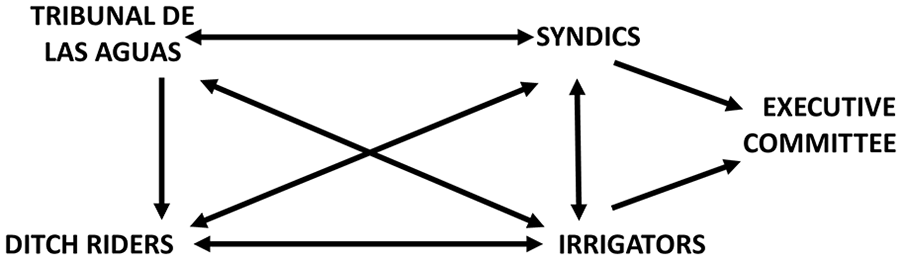
The example of the Huertas of Valencia from Ostrom (1990, 74).
As a matter of fact, I consider the term “reciprocity” as potentially misleading. Applied to the example of irrigation structures, it is rather deceptive because it depicts the interaction between cultivators A and B as an isolated relationship between two entities that conduct two-way exchanges. On the contrary, A is watching B to verify that he respects a rule and vice-versa. Their interaction as co-owners of the water that goes through the fields they both cultivate privately presupposes an entire structure of relationships. In fact, the property structures of the Huertas of the region of Valencia exhibit features that are typical of complex systems (Bar-Yam 2002): they are constituted by elements that are parts of the same whole, which constitute a system that works like a network. In a way, it is also a spontaneous order with emergent properties, including trust. As such, this structure is nothing but a set of relationships: there is no entity beyond these relations (the “group”), and it is only the equilibrium constituted by individual interactions that produces emergent properties. It therefore illustrates the basic principles of structural or “anthropological holism” (Descombes 2014).
The systemic nature of these systems plays an essential part in the development of a virtuous circle of trust, as individuals are provided with information that support their normative expectations. As I put it, they acquire empirical confirmations of the normative efficiency of the system (see Ostrom 1990, 187), as non-compliers are sanctioned, and most members visibly respect the rules. The leap of faith that mutual monitoring initially allowed them to take is thus validated by the direct proof they have of the other members trustworthiness. In the commons, therefore, facts directly confirm the efficiency of norms, which fosters a shared belief that others are trustworthy. Later, immediate evidence will then no longer be required in more complex societies. Trust may, at this point, become part of a social capital that makes cooperative endeavors easier.
2.3. The “Redundancy” of the Capacity to Sanction: An Approach from Legal Ontology
Additionally, Ostrom draws our attention to the “redundancy” of the capacity to sanction in the commons. However, she mentions this feature only cursorily, giving it limited weight, while I believe it has strong implications that can be connected to issues of legal and social ontology. It appears to be a fundamental property for customary systems to function, where the capacity to sanction has not been centralized into the hands of an external enforcer. It is also the only way this kind of social structure can hold simply by the network of relations that composes it.
Ostrom claims to be borrowing the concept of redundancy from computer sciences (Ostrom 1990, 96), where the multiplication of similar and essential components is necessary to ensure the stability of a system. Of course, some members of a common-property system may operate as a kind of police, but even this role tends to be played by different members on a rotational basis. Even if it were not the case, their power is not so concentrated that all other members are deprived of their own capacity to report offenses and sanction free riders themselves. A fisherman may, very legitimately, cut the fishing nets of a member of his community who is using narrower nets than others, which would benefit him directly but would catch small fish and jeopardize the renewal of the resource. The ability to report and sanction other individuals (including those that are designated watchers, such as the ditch-riders in the Huertas system) is thus equally distributed in these systems. The structure depicted above therefore appears to hold in a fragile equilibrium, and has its integrity relying on opposing forces balancing each other, reminding us of the architectural concept of “tensegrity” (Hanaor 1997).
What makes the “redundancy” of the capacity to sanction so important in the commons? It is an essential support to the system of rules that is established to allow members of a community to appropriate resources without conflicts. A rule is efficient because individuals may legitimately use force against free riders in certain cases. Indeed, this system would not hold if certain uses of force were not forbidden, while others are allowed. This simple division between legitimate and illegitimate uses of force is the basis of Kletzer’s (2018) legal ontology, a theory I propose to connect to Ostrom’s commons.
According to Kletzer, the primary legal operation is not to apply sanctions following rule infringements. On the contrary, the “germ” of law, broadly conceived, is to declare that some uses of force are legitimate, while others are not, long before there is any institution that monopolizes the ability to sanction (Kletzer 2018, 6). For Kletzer, legal rules are not religious or moral commands, which would exist independently of a sanction. Law is not meant to guarantee obedience to rules like “Do not attack the property of others,” that would come first, thanks to sanctions that would then come to support them. Instead, legal rules emerge when the use of force to defend one’s property is declared legitimate and, conversely, that using force to attack the property of others is illegitimate (Kletzer 2018, 72). From the perspective of deontic logic, therefore, legality is first expressed using permissions (“you may use force against others in this case”) rather than obligations (“you must not attack the property of others”).
2.4. Exiting the “State of Nature” with Appropriation Rules
I propose to use this framework to read some of Ostrom’s work with Roy Gardner anew (Gardner and Ostrom 1991). According to them, a system is in a “state of nature” when the interactions of all actors are strictly determined by the physical and natural characteristics of their environment. Second, it is not a normative void as one deontic mode can be found in it: permission. For Ostrom, a rule may indeed forbid, demand or permit an action (Ostrom 1990, 139) so there are minimal rules in the “state of nature.” Leaving it is therefore a lesser normative jump than expected: it merely implies going from one state in which everything is permitted by default, “regardless of the effects on others” (Ostrom 1990, 139) to another state where some things are permitted, and others are not (Ostrom 1990, 139-140). I put an emphasis on one’s “effects on others,” as it underlines that social trust begins when one believes that others will take the external effects of their behavior into account.
A group of fishermen is in a “state of nature” if no rules determine the occupation of fishing spots that only one fisher could exploit at the same time. In that case, fishermen will compete for the best spot, and pure force mixed with geographical and environmental factors will determine the outcome, with all players having to bear important costs because of conflicts (Anderson and Anderson 1977). This cooperation problem may be solved by simple rules like a “first in time, first in right” (Forman 1970; Raychaudhuri 1980). Members of the fishing community therefore watch each other and are legitimate in enforcing sanctions directly (Berkes 1986; Gardner and Ostrom 1991, 130). Getting out of the “state of nature” requires, according to Kletzer’s legal ontology, to permit some uses of force against others.
From this point, members of the community will not only be able to start trusting each other, but they will even gather information on each other’s trustworthiness. This will allow them to develop a disposition to trust that will not depend on prior signs of trustworthiness, but that will have had a rational start. Simple appropriation rules appear to be playing a determining role in this process, and their main effect is to drive individuals to modify their action patterns to interiorize the external effects of their actions on other individuals.
4. Property Structures and Cooperative Dispositions
4.1. Externalities and Social Structures
The fundamental idea behind the concept of “externalities” is that there is a harm done to a non-consensual third party C, as a consequence of the actions of A when it interacted with B in a market transaction, through a contract, but not necessarily (Hausman 1992). It is either solipsistic actions from A or the isolated interactions between A and B as they disregard C that are considered problematic. What is implied is that some right or interest of C was not considered. Pigou (1960) also explains externalities as a divergence between marginal private cost and marginal social cost. Individuals thus make profits as the cost of their actions does not include the cost they impose on the rest of society. This means that individuals disregard the effects of their actions beyond either their own interaction with resources or the effect their interaction with others have on third parties.
This is similar to critiques of the idea that property establishes the absolute “dominion” of an individual over a thing (Blackstone 1725) or, more precisely, that property, unlike contractual obligations, is a real and not a personal right. Any description of property as an absolute and real right forgets that property rights are in fact part of a network of mutual relationships (Singer 2000) and should be defined “in terms of human relationships,” which may include external resources, “rather than relations between persons and things” (Singer 1988, 8).
As a consequence, when A exploits resources or interacts with B without considering C, they isolate their actions from the network of relations they should be included in. I argue that, in the commons, precisely because individual property rights are not absolute but correspond to collective imperatives, any individual action or dual relation is integrated in a network of relations that pushes individuals to take the external effects of their actions into account. I believe that the systematic nature of this network, in which every right is explicitly other-regarding and correlated to personal duties, cultivates the ability, in individuals, to integrate the external effects of their actions into their decision process, explicitly or not. This mirrors the system of mutual monitoring described earlier, which shows that there are two layers to this network. The interactions between individuals in these different layers, just like between the elements of a complex system, lead to a feedback loop, as described by Hacking (1995, 370) and discussed by Guala (2016, 121-122), of which social trust is an emergent product. This generally contributes to the establishment of a “complex system of interlocking beliefs” (Guala 2016, 91).
Let us suppose that A has a right to fish in the area that “belongs” to her fishing community. This right is not absolute. It takes a wealth of considerations into account. Every aspect of A’s appropriation of the resource will be limited, either by other individuals’ rights or by long-term goals such as sustainability. This means that A will only be allowed to fish for a limited quantity, at a specific time of the year. Also, this may mean that all fishermen will go fishing together, because they can help each other and because it allows them to watch each other. If A overfishes, imposing external effects on B, then B is entitled to cut her nets, a possibility that gives B a reason to trust A. This legitimate use of force, distributed in the entire community, is part of the system of mutual monitoring that holds the whole structure of together.
In other words, A’s appropriation rights are not only limited externally by the claims of other individuals: they are also structured, from within, by larger imperatives that make them a part of a larger network of rights and duties. This structure is precisely what individuals need to develop a general disposition to interiorize the external effects of their actions. While customary mechanisms make this structure possible and, consequently, made trust a reasonable option, it is the way it is built, integrating every claim into a network of rights and obligations, that initiates the process of learning and developing a disposition to trust that will turn into social capital.
Let us remember Chauvier’s (2013) typology: direct external effects are unintentional effects that come from the interaction of A’s actions with the state of the world. Indirect external effects come from the interaction of A’s actions with the state of the world and the actions of others. The structure of property rights that is characteristic of the commons is specifically concerned with these external effects, and much less with intentional or internal collateral damages individuals inflict upon each other. As a matter of fact, direct conflicts are often the result of much deeper cooperation problems with resource management and external effects. They are prevented by structures that enable individuals to internalize the external effects of their actions. Most importantly, individuals must develop a disposition to internalize them as, in the commons, external enforcement is either unavailable or inefficient. Indeed, since the system holds in the distributed ability to use force to sanction offenses to rules, the constant enforcement of rules would lead to a vicious circle of violence. In fact, sanctions are rare and fairly low in the commons, as Ostrom (1990) observed (p. 59) and it is safe to assume that they are forms of altruistic punishment (Fehr and Gachter 2000) when they occur.
4.2. The Commons as a Patrimonial Structure
As previously hinted at, the structure that seems to be lying beneath the specific “bundle of rights” of each community is fundamentally different from the modern institution of private property. The modern ideology around private property (Rose 1998) gives absolute and extended powers to individuals over things, disregarding the overlapping claims that other individuals might have to these things.
As Xifaras (2004) argued, present-day institutions still reveal alternative conceptions of property. In modern inheritance laws, the fundamental idea behind a patrimony is the preservation of resources over several generations of individuals belonging to the same lineage. The current “owner” of a patrimony is bound by duties she has toward other people and future generations, which makes her property rights anything but absolute. Even the ways she may exploit the resources that are part of her patrimony can be restricted. Common law trusts are excellent examples of such structures of relations: a trust is a fund the uses of which are defined by a trustor or settlor. The trustor gives a trustee the responsibility of managing the fund according to his or her wishes, usually for a beneficiary. Therefore, neither the trustee nor the beneficiaries are owners of this patrimony in the strong sense of the word: their rights and duties are defined by the ways the trustor decided the fund may be used.
In his description of the nature of patrimonial property in civil law systems, Mikhaïl Xifaras, explains how a patrimony is constituted by the attribution of a specific end, or purpose, to a set of resources (Xifaras 2004, 299). For instance, an art foundation is a trustee that must take care a set of art pieces. That means the foundation might not sell them, but that it must make money in order to ensure their preservation within the same collection. These rights and the positions individuals may occupy within the foundation are strictly defined by the constitutive purpose of the fund. Usually, this purpose articulates two complementary objectives: preservation and management (Xifaras 2004, 330). Some parts of the fund may be used, sold or even destroyed in order to preserve what constitutes the core of the patrimony, which is declared absolutely untouchable.
Similarly, the members of the commons are co-managers of a fund that none of them owns exclusively, and their rights and duties are co-determined. The “bundle of rights” one finds in the commons (Schlager and Ostrom 1992) is therefore much more than an arranged collection of rights and duties: in this frame, the property rights of individuals are interconnected and co-defined, without forgetting the fundamental objective of enabling individual appropriation. From this point of view, the commons are structures of property-relations that are built with the purpose of managing the external effects of individual behaviors. This structure maximizes everyone’s benefit out of cooperation, while ensuring its sustainability. In order to achieve this goal, a delicate balance must be found, on the one hand, between potentially competing individual claims at a given point in time and, on the other hand, the interests of the present and future generations. The fact that this structure influences the way individuals normatively assess their actions seems consistent with findings in game theory that show that in many games, individuals cooperate even when it is not strictly rational to do so. Backward induction, which should lead individuals to stop cooperating at a certain point, is in fact quite absent from the individual’s behavior (Ostrom 2003, 36).
My hypothesis would be, in line with the developments of this paper, that the structure of the commons drives individuals to broaden the scope of what they believe is expected of them, so that they take into account the external effects of their actions toward future generations. If they did not do so, it would be acceptable for them to overuse resources and leave very little to future generations. Many elements of the recurrent institutional features of the commons point in that direction: restrictions on alienation rights, for instance, are justified by the need to maintain the integrity of the community while preventing individuals from cashing in on the sale of their share of the land, when selling it could be very profitable. This restriction is made possible by the separation between the statuses that members of the community may have in relation to the fund: as managers and/or beneficiaries of it, they do not possess the rights of “full-fledged” owners. As a matter of fact, several studies have shown that when land was commodified and individuals got full alienation rights, they tended to volunteer less for communal work and to demonstrate lesser cooperative dispositions (Braaten 2014; Lanjouw and Stern 1998).
4.3. Schematizing the Feedback Loop in the Patrimonial Structure
I now propose a schematized description of the “patrimonial” structure of the commons in several steps. As depicted in Figure 2, let us assume that A is a lonely fisher in an area of six units of fish and that A can only fish three units per season. There is enough fish so that A can fish again next season. This way, A imposes absolutely no harm to anyone, including herself: there are no direct or indirect effects to her actions, according to Chauvier’s typology.

Appropriation by one individual.
If B fishes in the same area and both A and B can fish a maximum of three units of fish per season, they are perfectly capable of coming up with an understanding to split the six units available and will therefore avoid conflicts, which leads to the following structure of co-defined rights (Figure 3):
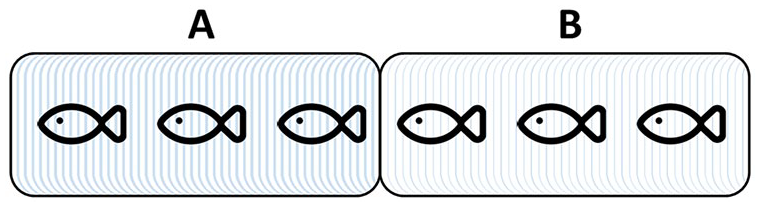
Appropriation by two individuals and overexploitation.
However, this leaves absolutely no fish for the next season. This is a case of overexploitation that causes no direct harm to either A or B but causes harm to their future selves (or other people after them). This harm is the consequence of the combination of A and B’s actions with each other and their environment (an indirect external effect according to Chauvier). At least for their future selves, A and B, who act as settlors or trustors, need to decide to preserve part of the resource so that it is renewed (for instance, two units of fish, which leaves them both with two units to fish). This works provided they believe that the reproductive rate of fish is neither too low nor too high to make such a cooperative endeavor irrational.
In other words, A and B become the future (A* and B*) and present (A″ and B″) beneficiaries of a set of resources constituted by themselves as a patrimony (Figure 4). Their own rights as future beneficiaries (along with C’s) limit their current rights to resources, and their resulting rights to resources are quite literally “bundled” together and are the result of the distribution they operate, as the mere managers or trustees (A′ and B′) of a fund, and not owners, between different beneficiaries: their present and future selves, as well as future “others.” In my opinion, this division of the same individuals between different “legal personalities” whose rights and duties interact with each other is an essential part in the process of learning the possibilities and benefits of social trust:
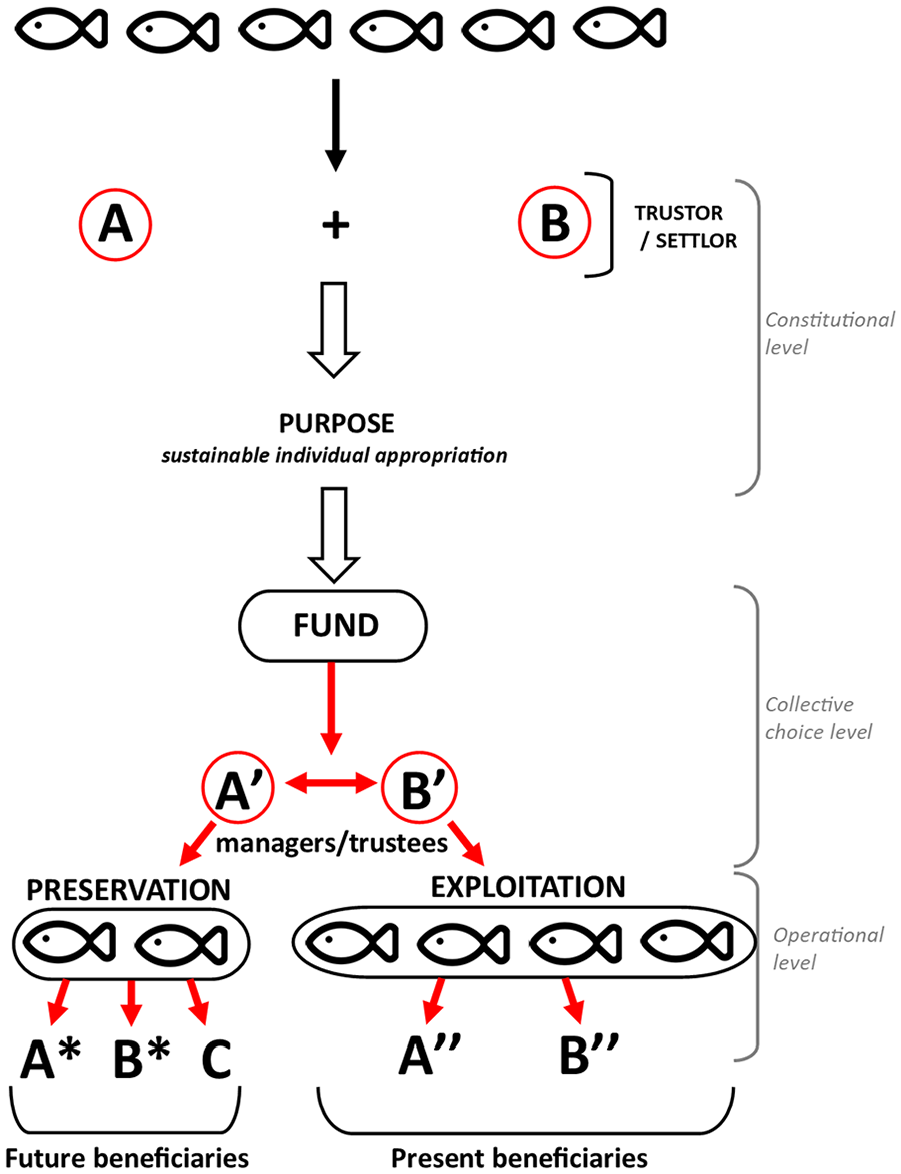
Role distribution in the constitution of a patrimonial fund.
Two main factors seem instrumental in the emergence of social trust as the product of the feedback loop, greatly simplified in Figure 5, that takes place within the property structures of the commons:
The rights, privileges and duties of all individuals are co-determined.
Individuals internalize cooperative behaviors thanks to the multiple statuses they have within the system, as they are at the same time the settlors of a trust, its beneficiaries in the present and the past and the managers of the fund.
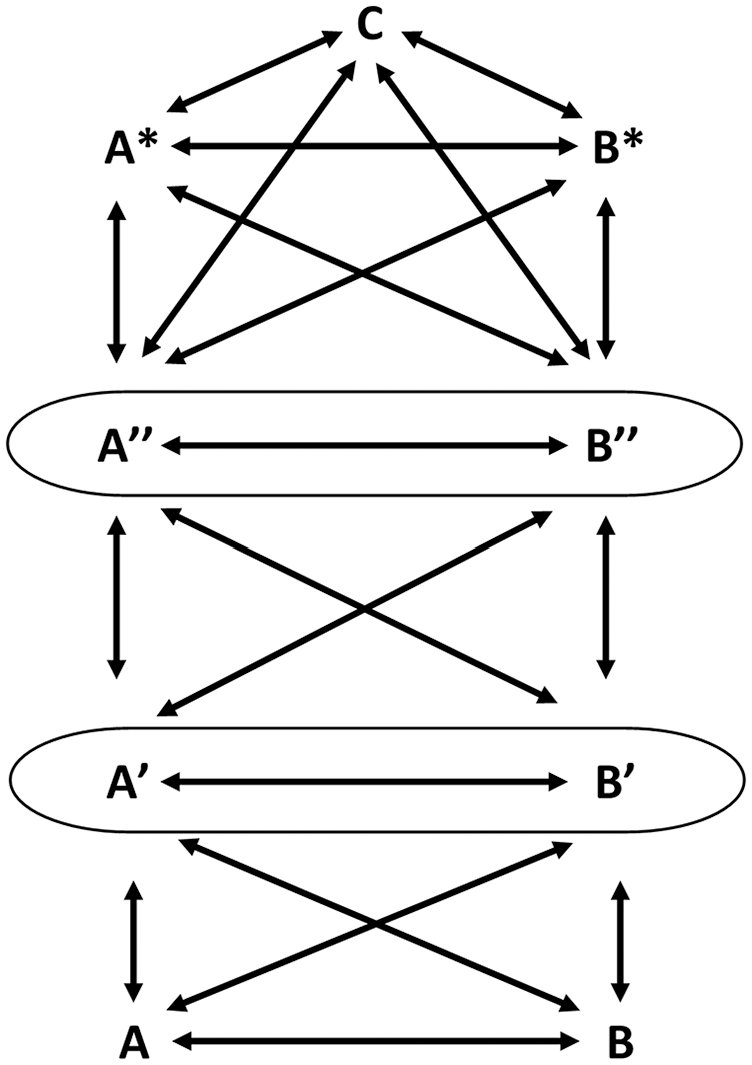
A feedback loop of mutually binding interests.
One can therefore positively say that this institutional context and the roles it distributes “change the ways in which individuals experience themselves” (Hacking 1999, 104) since “classifying X as Y contributes to her becoming Y” (Guala 2016, 123).
I also connect this to Schlager and Ostrom’s distinction between two or three levels of rights in this structure, operational, collective choice and constitutional rights (Figure 4), the third being only rarely mentioned (Schlager and Ostrom 1992, 249-251), which was a way to hint at the hierarchical organization of property rights in the commons, but that the “bundle” metaphor does not adequately reflect.
5. Conclusion
In this paper, I argued that social trust was the emergent product of a complex system of property relations, backed up by a sub-system of mutual monitoring. Indeed, before being able to trust each other to comply with rules, the proper rules must be designed to make cooperation possible. If cooperation is first and foremost a solution to problems of both externalities and resource management, then rules must ensure not only that individuals do not harm each other directly, but also that their actions do not cause indirect harm to others and themselves in the present and in the future. Two ground rules, from which other rules are merely specifications, are thus necessary: A/ that all individuals, present and future, have access to resources and B/ that their exploitation is sustainable and not mutually harmful.
Structures of property rights that propose solutions to these problems, which I described as patrimonial, make cooperation safe for individuals and help them learn to trust each other and to use previous cooperative successes to trust each other to achieve new ones. The structure of the commons may then very well be a learning ground for cooperation, in which communities “accumulate” social trust that will then be transposed, as a generalized disposition, to new problems.
The fact that the commons provide direct proofs of trustworthiness is essential. I have showed, extending Ostrom’s remarks to the field of legal ontology, that trustworthiness may still be established in this context, in a way that avoids an infinite regress. I did so by contending that the commons exhibit a structure that holds “on its own,” thanks to the balance created by the systematicity of mutual monitoring and the legitimization of direct uses of force against rule-breakers. Thanks to this, not only individuals get empirical confirmations of each other’s trustworthiness, but they also learn to trust without relying on sanctions. Conjoined with adequate rules, these mechanisms strengthen a shared belief that individuals will take the external effects of their actions into account. The gradual internalization of this social norm as a background norm is then the foundation of social trust, which is a result of a feedback loop that is initiated thanks to a patrimonial structure that distributes different roles to individuals.
In the end, this reflection points to a potential specific feature of social trust, beyond the fact that it tends to be an implicit background possibility for cooperation: when I pay my taxes because I trust that others do as well, I believe that none of us will try to free-ride. The context of emergence of social trust resonates in the ability that it gave us to take the external effects of our actions into account, even though it has outgrown its context of origin in complex societies.
Footnotes
Acknowledgements
I am very thankful to the organizing committee of the 2020 Conference of the European Network for the Philosophy of Social Sciences, which eventually led to this publication. I want to thank Alban Bouvier for his very kind comments after my presentation. A (quite different) first version of this paper was presented for the first time at a workshop on “The Value of the Commons,” organized by Yara Al-Salman and Rutger Claassen at Utrecht University in March 2019. Their support, as well as the enthusiasm of other participants such as Hanoch Dagan from the University of Tel Aviv was essential to motivate me to work on this paper further. Then, of course, I want to express my gratitude to the two anonymous reviewers whose insight and rigorous though fair criticisms helped me make this paper the best version of itself.
Declaration of Conflicting Interests
The author declared no potential conflicts of interest with respect to the research, authorship, and/or publication of this article.
Funding
The author disclosed receipt of the following financial support for the research, authorship, and/or publication of this article: The author received funding to support the publication of this paper by the University of Tel Aviv and the Edmond J. Safra Center for Ethics at the Buchmann Law School.