




Abstract
Building critically on anthropology’s “ontological turn,” this article isolates conceptualization (as distinct from explanation and interpretation) as a core concern for anthropological thinking: anthropology as the activity of transfiguring the contingency of ethnographic materials in the formal language of conceptual relations and distinctions. Focusing on works by Mauss and Evans-Pritchard, as well as my own research, the article articulates the morphological character of such a project. While akin also to philosophy, such attention to the “shapes” of conceptual relations is analogous to the practice of art in its concern for the expressive potentials of these acts of conceptual transfiguration.
1. Introduction: The Ontological Turn as Conceptualization
One way to think of anthropology’s so-called “ontological turn” is as an attempt to offer a way out of the by now quite hackneyed dilemma in the philosophy of social sciences, between explanation and interpretation (e.g., D’Andrade 1986; Geertz 1973). The problem with explanation and interpretation, goes anthropology’s ontological argument, 1 is that they both presuppose that anthropologists are in principle equipped even to describe the social phenomena in which they are interested, by which I mean simply that anthropologists are able to express in a way that makes sense what the phenomena in question actually are. In the case of explanation, this is quite obvious. If you think that as an anthropologist your prime task, when faced with a given social phenomenon (Maori gift exchange, say, or Cuban spirit-possession, or the Covid 19 pandemic), is to explain it with reference to its causes and consequences, you must be assuming from the start that you can describe what the phenomenon in question actually is in the first place. To ask why something is as it is, you must first know what it is. In the case of interpretation, however, the same assumption features not as the premise of anthropological analysis but rather as its presumed outcome. When faced with gifts, spirits, or Covid 19, says the interpretive anthropologist, our task must be to understand what these phenomena mean for the people who engage in them. In other words, we must perform a cultural translation: take the phenomenon that initially seems opaque and, by placing it sensitively in its local context, translate it into terms that you and your anthropological readers can understand. But again, this presupposes in principle that anthropologists must have at their disposal the vocabulary—the concepts—that are able to express the otherwise local meaning of the phenomena in question. Initially, we may not know how best to describe the phenomena that (therefore) pique our anthropological interest, but, given sufficient local knowledge and interpretive panache, we should be able to do so.
But what if that is not the case, ask proponents of the ontological turn. What if what makes things like gifts, spirits, and the Covid 19 pandemic interesting to anthropologists is the fact that they are not actually able to describe them, because in one way of other they go beyond the concepts they have at their disposal? Take the gift for example. According to one of the most famous arguments anthropology has produced, thanks to Marcel Mauss (2016), Maori and other people Mauss imagined as “archaic” feel obliged to reciprocate the ceremonial gifts that are at the center of their social life because they believe that these gifts contain something of the spirit of the donor. For the Maori, when I give you a gift, I am giving you a part of myself—the “spiritual essence” the Maori call hau—and therefore you are obliged “morally, physically and spiritually,” as Mauss (2016, 73) puts it, to give me something in return. Now, beguiling as it has been to generations of anthropologists, Mauss’s description of the Maori gift as “something of oneself,” a thing that “has a soul” (Mauss 2016, 72) (elsewhere he describes it as “not an inert thing”—Mauss 2016) is profoundly ambiguous. The thing about “things,” if we know what we mean by the term at all, is that they are not, precisely, parts of people’s selves, do not have souls, and are, indeed, inert. So, when Mauss says that Maori gifts are things that are parts of people, have souls, and are not inert, he is not, as it may seem, telling us something fascinating about what the Maori take gifts to be like. He is merely proving the limits of our ability as anthropologists to express what these Maori gifts are from within a conceptual repertoire consisting of ideas such as “things,” “people,” “souls,” the “physical,” the “spiritual,” the “moral,” and so on. If the best we can say about Maori gifts is that they contain the spirit of the donor, then we might as well admit that we are unable sensibly to describe what these things are at all. We simply do not have the concepts.
Never mind explanation and interpretation, then. The most basic task for anthropology must be conceptualization. Is there a way to conceive of gifts, for example, that will allow us to make sense of the Maori notion that they contain what they call the “hau”? Where would such a concept leave the distinction between things and people—the physical and the spiritual—that seems to stand in the way in Mauss’s famous account? Is there, perhaps, a different way of defining what a person is, and what a thing, that renders the two logically compatible? And so on. These are all ontological questions, pertaining to what such things as “things,” “people,” “spirits,” and the relationships between them might be, and hence the designation of this whole approach as an “ontological turn.” Indeed, the philosophical overtones of that heavy word, which have caused a lot of suspicion and misunderstanding (e.g., Bessire and Bond 2014; Graeber 2015; Vigh and Sausdal 2014), are nevertheless not accidental. To the extent that what is at stake here are questions about basic categories of understanding, anthropology on this account must involve an activity that many would associate with philosophy, namely, the critical analysis, reconfiguration, and, when necessary, even the generation of concepts (see also Holbraad 2017; Venkatesan et al. 2010).
In this article, however, I propose that the concern with conceptualization can fruitfully be disembedded from this argument about ontology. The activity of turning ethnographic materials—just life, really—into concepts is far more basic to what anthropologists do than the somewhat rarefied-looking concern with the limits of intelligibility that the ontological argument just outlined brings to the fore. We may even reverse the logical priority of anthropology’s ontological argument. Conceptualization is what anthropology most basically involves anyway, I suggest, and the need for the kind of conceptual invention that arises in situations where we reach the limits of our own capacity to describe our material is really a consequence of this core anthropological delight in turning life into ideas. In fact, one might best see this concern for concepts and their relationships as an anthropological sensibility—a kind of intellectual aesthetic that permeates anthropology even though it is not necessarily always recognized for what it is. This sensibility, I will also suggest, is morphological through and through inasmuch as it involves giving ethnographic phenomena particular conceptual shapes. Indeed, at the conclusion, I will go as far as suggesting that for this reason there may be some mileage in comparing anthropology, not to science, nor to the humanities, and nor even to philosophy, but instead to art practice—anthropology, if you like, as painting by concepts.
2. Life in Concepts
To get a sense of this core morphological component of anthropological thinking operating in action it pays to return to the example of Mauss on the “spirit of the gift,” as his famous argument has come to be known. In using this to illustrate the motivation of the ontological argument in anthropology earlier, I drew attention to the basic ambiguity of Mauss’s idea that Maori gifts are to be conceived as parts of people, or even as part-people that have souls of their own. We may note here, however, that this misgiving can only arise in the first place because this gloss—the very notion of a thing that is part of a person or even itself part-person—is an act of conceptualization (albeit a deficient one, as I have suggested). In particular, what makes this a conceptualization in the relevant sense here is the fact that, more than just a translation or interpretative gloss on the Maori materials with which he was working, Mauss’s statement about things and people here serves to transpose those materials into the analytical language in which his prime anthropological problem with reciprocity is cast. Mauss’s point about the connection between people and things in Maori gift exchange, in other words, does not merely translate Maori concepts and actions—horizontally, so to speak—into European ones, but also transposes them “vertically” into the anthropological terms in which a particular analytical problem is framed (see Figure 1). Consider how Mauss’s argument is developed.
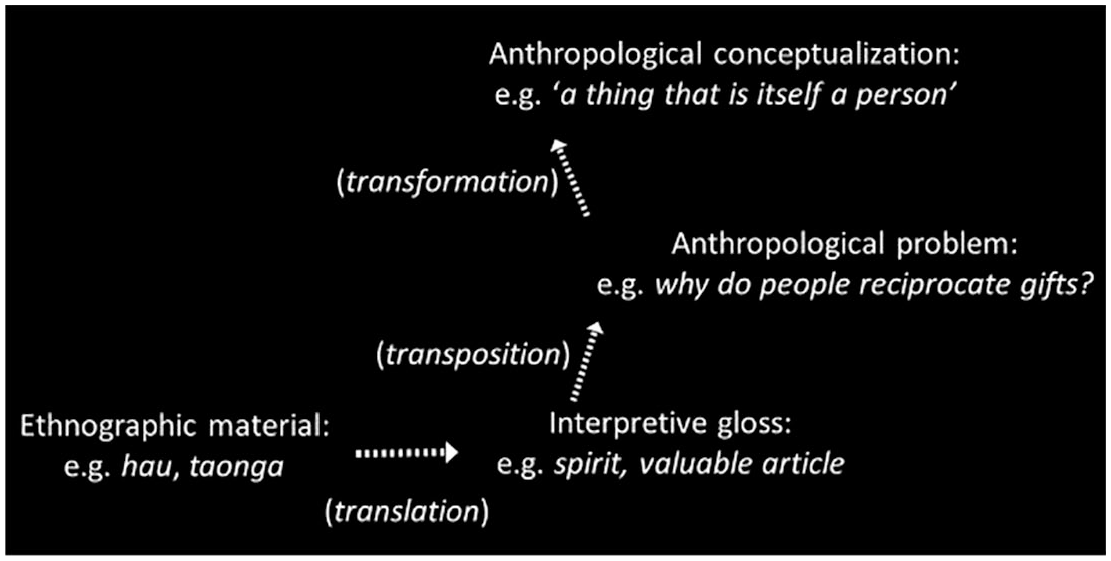
Translation, transposition, transformation: turning life into concepts (via problems).
Initially, we have a statement of the overall problem: why do people in “archaic societies,” as Mauss calls them, feel obliged to reciprocate the gifts they receive—the “objects” they are given, as he puts it? So, we have people, and we have things, and we have relationships between them (both between people, and between people and things). Then, we are given the Maori ethnography, which famously consists of an indigenous exegesis in which the Maori elder Tamati Ranaipiri explains to the New Zealand ethnographer Elsdon Best the meaning of the Maori notion of hau. This material, note, presents itself as immediately relevant to Mauss’s problem concerning reciprocity, since, seen from within the conceptual coordinates of that problem (namely, the distinction between people and things), it seems to be an account of Maori understandings of, precisely, the exchange of things between people, that is, of reciprocity as Mauss expects his readers to understand it. So goes the Ranaipiri’s famous exegesis: if you give me a taonga—a “valuable article,” in Mauss’s translation—and I give it on to someone else, and then that person gives me a taonga of his own in return, then I must give that taonga back to you, since it has the hau associated with your original gift to me, which, as Mauss interprets it, is your own “spiritual essence.”
Mauss’s reconceptualization of the gift, then, develops in three steps, shown in Figure 1. First, Mauss takes the indigenous exegesis of hau and taonga and translates it “horizontally” by glossing it in terms of such concepts as “spirit,” “person” (“me,” “you,” “someone”), “object,” or “valuable article.” This act of translation is necessary because it renders the Maori material relevant to the broader problem of reciprocity on which Mauss wants to bring the material to bear. A story about hau and taonga becomes a story about people and things and the relationships between them, which is what the problem of reciprocity is about. This then sets the conditions for the second step of Mauss’s analysis, in which the account of Maori gift exchange is transposed “vertically” into the conceptual framework of Mauss’s initial problem about the relationships between persons and things. Having been translated into terms that are relevant to the problem of reciprocity, the Maori ethnography is then molded conceptually into the shape Mauss has given to this problem, namely, as a question about the relationship between persons and the things that pass between them. Ranaipiri’s account, in other words, is transposed into the conceptual vocabulary of an argument about reciprocity. But this, finally, sets up the third step of Mauss’s argument—its most famous moment, indeed, its whole point—in which the Maori material is put to work on the conceptual framework of the problem of reciprocity so as to shift its most basic conceptual coordinates. From being a thing that is exchanged between people, the gift is recast as a thing that is itself part of a person or even part-person in its own right. Having been first translated into the terms of a problem about reciprocity and then transposed into the conceptual relationships this problem involves, the Maori material ends up transforming those conceptual relationships, by shifting the most basic assumptions on which they are built.
Indeed, if the “work” of Mauss argument becomes most vividly (and memorably) apparent at this moment of conceptual transformation, that is because its nature is morphological—a matter of refiguring the relationships that the problem of reciprocity implies by giving them a particular shape (see Figures 2 and 3). While we, as readers, can be expected to assume that spirits are attributes of people rather than things, Mauss’s Maori materials force us to imagine a situation in which things are bound spiritually with the people that give them. But note how this bond is given a particular shape in Mauss’s conceptualization, namely, as a form of “containment”—the gift has within it the spirit of the donor (Figure 4). This conceptual shape-shift then allows Mauss completely to transform the way we imagine gift exchange—a big “a-ha” moment every undergraduate in anthropology must go through—again, by changing its basic shape (Figure 5). If gifts contain within them the spirit of their donor, then gift exchange cannot be conceived as just the circulation of things between people, but must rather be understood as the interpenetration of people by each other (Figure 6). If the gift contains within it a part of the donor (an aspect of his spirit or “soul”), then the person who receives it effectively receives a part of another person. In that sense, the gift itself is a shape-shifter: as it moves from hand to hand it changes the shape of the people its motion co-opts, involving them in an ever-unfolding dynamic of mutual, gift-mediated inter-penetration.
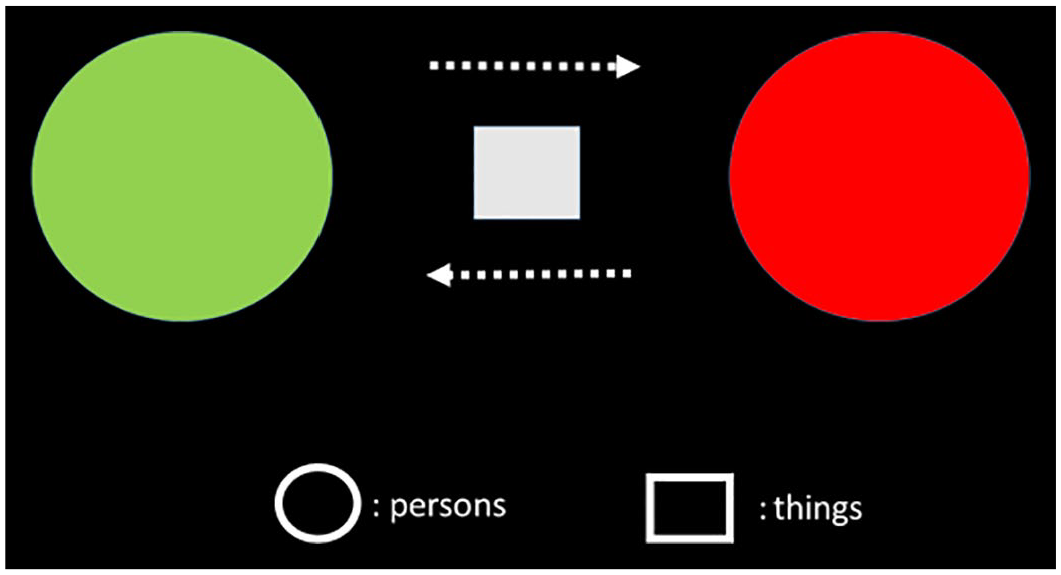
The standard image of the gift: inanimate things moving between people.
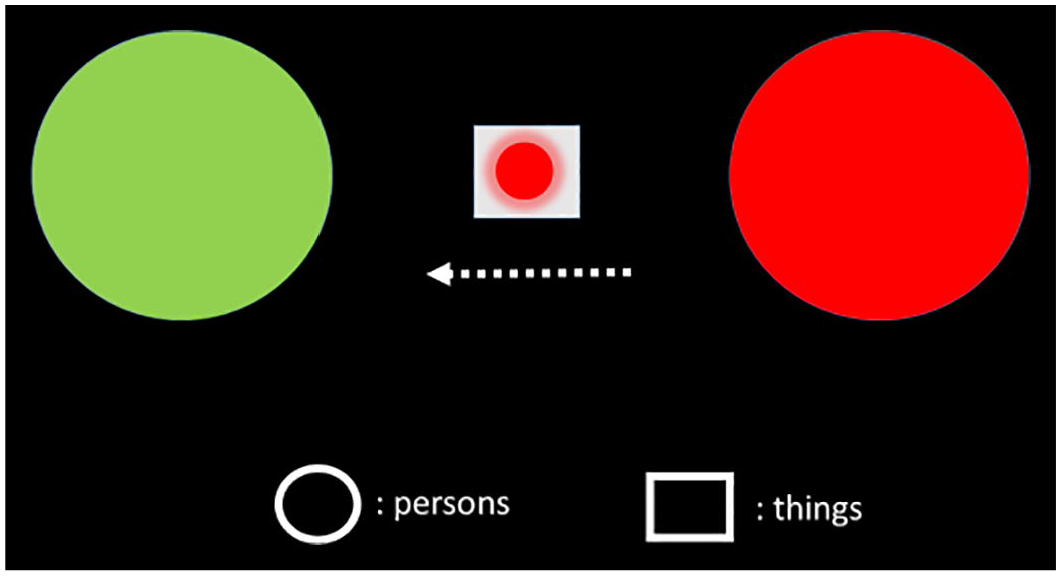
Mauss’s Maori gift: the gift contains the “spirit” (hau) of the donor.
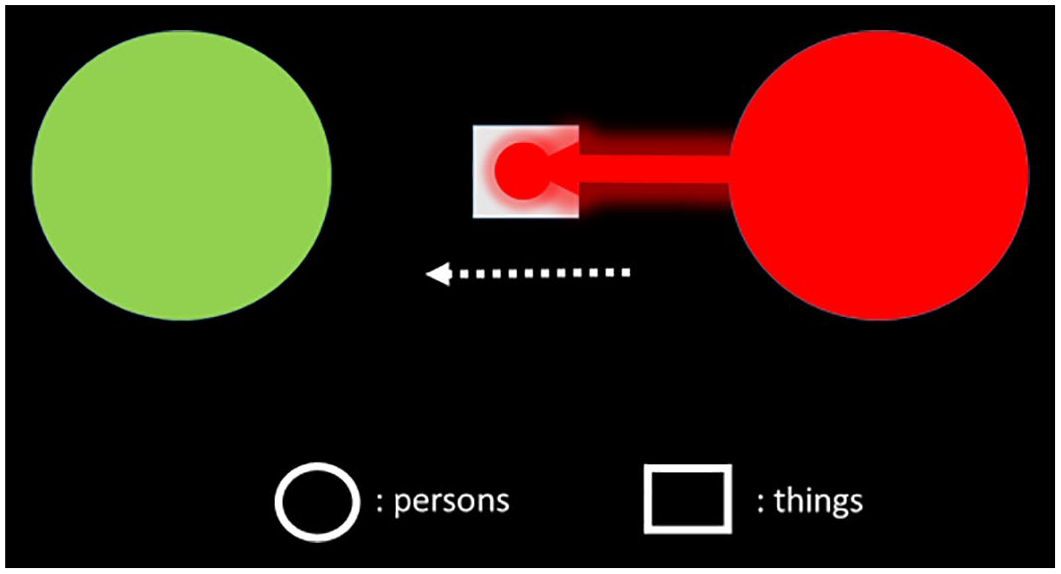
By containing his hau, the gift is bound to the donor.
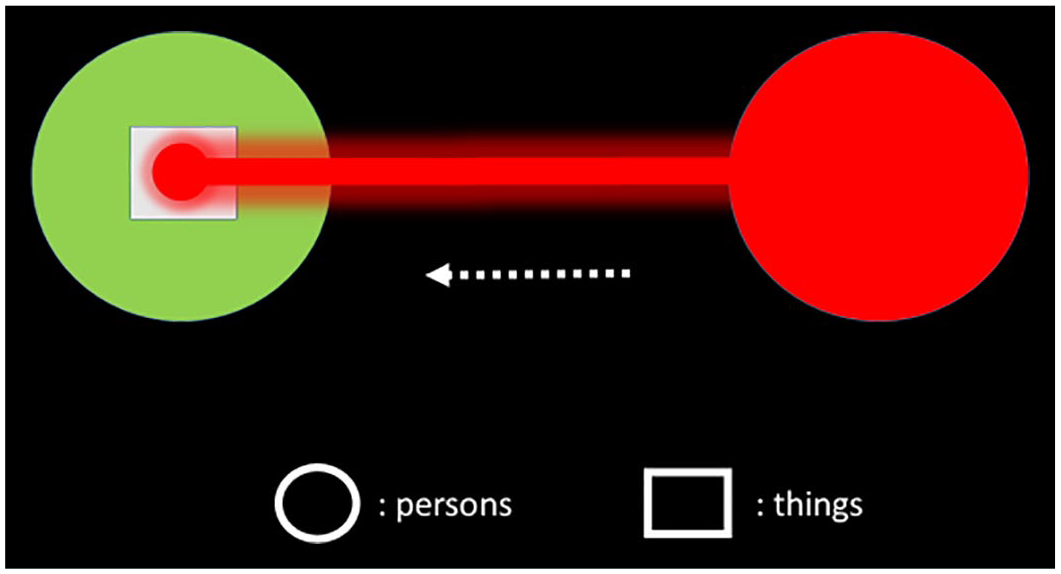
As the gift moves, it expands the donor into the recipient.
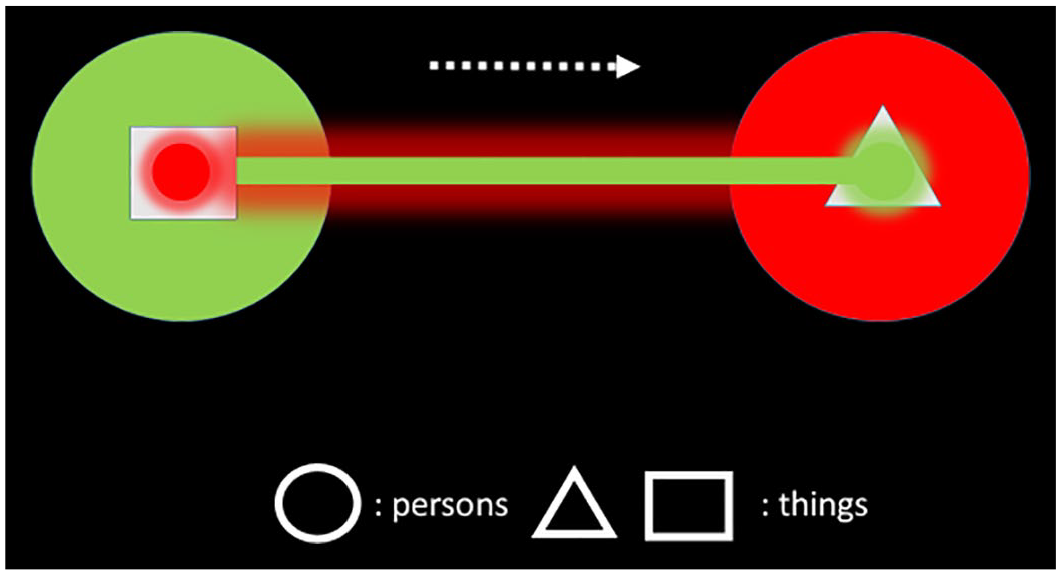
The recipient is compelled to “return” the donor’s original hau, thereby expanding himself reciprocally too.
It is worth noting here that in advancing this argument Mauss (2016, 73) himself purported to be providing an “explanation” of why people in places like Oceania feel compelled to reciprocate gifts. Like his uncle, Emile Durkheim (1982), Mauss was invested in the idea that such “social facts” could be explained causally. But we may note here how weak Mauss’s actual argument is if it is understood in this “positivist” way. The problem is that the conceptual shift of thinking of gifts as part-persons and, therefore, of gift exchange as a matter of mutual interpenetration is not in itself causal in nature. It gives us a compelling new way to think of gifts, not the reason why people are compelled to reciprocate them. Indeed, in teaching the argument over the years, I have found myself sounding rather unconvincing when trying to answer students’ inevitably straight question “ok, fine, for Mauss the gift is a person, but why does that mean one has to return it?” All I can do in such cases is resort to Mauss’s own rather transparent attempt to dress up his analysis in causal language, invoking reasons that may at best be described as auxiliary to the main idea I have just described. “In this system of ideas,” he writes, we realize clearly and logically that one must give back to the other what is in reality a part of his own nature and substance; for to accept something from someone is to accept something of his spiritual essence, of his soul. (Mauss 2016, 72-73)
Well, clearly and logically, this is just a tautology—and Mauss himself must have known this, since he then immediately goes on to supplement his explanation by saying that for the Maori the obligation to reciprocate is underwritten by the mortal threat of magical or divine retribution (Mauss 2016, 73).
The power of Mauss’s argument on the gift, then, is not so much explanatory as conceptual. Indeed, lest this be deemed to be a characteristic that is somehow peculiar to Mauss’s thinking, one could adduce more 101-style examples from across the different national and theoretical traditions of anthropology to show how, even as they are presented as attempts as explanation, interpretation, or whatever else, some of the most memorable and powerful ideas to have come out this discipline have at their heart the intellectual operation I have just described. Particular ethnographic materials are transposed in terms of particular analytical problems and then “work” upon these problems by shifting their conceptual shape. So, Lévi-Strauss (1990) transposing Amerindian myths in terms of the Kantian antinomies of the continuous (Nature) and the discontinuous (Culture); Clifford Geertz (1973, 360-411) using Balinese ritual calendars to conceptualize time as a static order of qualitatively differentiated days rather than a linear flow that is quantified sequentially (in Bali, as Geertz puts it so memorably, calendars don’t tell you what day it is but what kind of day it is); or Mary Douglas (1966) taking the concern with pollution in the kosher rules of the Leviticus and transposing it conceptually as a matter of anomalous classification operating at the interstices of established categories—pollution, famously, as “matter out of place.” What classic analyses such as these have in common, I suggest, is a concern with turning empirical materials into concepts, and the tell-tale sign is their morphological character. The continuous and the discontinuous, stasis and movement, qualitative difference and quantitative sequence, staying within categories or straying across them: all means of giving determinate shapes to the conceptual relations involved in articulating ethnographic particulars as objects of thought.
Rather than just exemplifying this process, however, we might explore its operation a little further, by showing how conceptualizations travel across different contexts of research, and in doing so mark trajectories of thinking we might call “comparative.” Seen in this light, I suggest, comparison itself must be understood as a form of conceptualization, which turns most crucially, not on comparing comparanda with reference to fixed axes of comparison, but rather in acting to transform the way those very axes are themselves conceptualized. To show how this works, I shall use some of my own work as an example, tracking what happens to a move of conceptualization made originally, and famously, by E.E. Evans Pritchard in relation to the operation of Zande oracles, when it is transposed onto certain divinatory practices I have been studying in Cuba more recently.
3. Traveling Conceptualizations
Much like Mauss’s argument on the spirit of the gift, Evans-Pritchard’s distinction between causal explanation of “how” things happen and divinatory accounts of “why” they happen at particular times and to particular people has become a signature of anthropological thinking. Famously based on his towering ethnography of the Azande people with whom he lived in South Sudan in the late 1920s (Evans-Pritchard [1937] 1976), Evans-Pritchard’s brilliant insight has been conveyed to generations of undergraduate students with reference of his arresting story of the burning Zande beer-hut. A Zande man who accidentally sets fire to his beer hut, Evans-Pritchard tells us, is well aware of how the fire was caused: he walked into the beer-hut at night with his torch lit, the hut’s roof is flammable, so it caught fire on contact with the flame. Yet, at the same time, the man may be equally convinced that the incident was brought about by witchcraft, a suspicion that he can only verify by consulting a qualified diviner. His reasoning, according to Evans-Pritchard ([1937] 1976, 21-22), runs something like this: Every year hundreds of Azande go and inspect their beer by night and they always take with them a handful of straw to illuminate the hut [. . .]. Why then should [I] on this single occasion have ignited the thatch of [my] hut?
So what the oracle explains for the Azande are not the causal conditions that led to the fire, but rather “the particular conditions in a chain of causation which relate an individual to natural happenings in such a way that he sustained injury” (Evans-Pritchard [1937] 1976, 21).
It may be helpful here to note, as an aside, that Evans-Pritchard’s argument can be understood as a major precursor to the ontological approach outlined above. Evans-Pritchard makes it explicit that his distinction between how- and why-questions pertains to the limits of our capacity to understand, from within the circle of assumptions about how explanations work that we (as anthropologists)
2
take as standard, what is at stake for Zande oracles. “To our minds,” he writes, the only relationship between . . . two independently caused facts is their coincidence in time and space. We have no explanation of why the two chains of causation intersected at a certain time and in a certain place, for there is no interdependence between them. Zande philosophy (sic) can supply the missing link . . . Witchcraft explains the coincidence of these two happenings. (Evans-Pritchard [1937] 1976, 23)
The Azande, in other words, have ways of thinking about things that we find altogether unintelligible. Where we can only shrug our shoulders and say, “coincidence,” they have a whole cosmology of witchcraft and divinatory procedures for detecting it.
Still, as with Mauss, Evans-Pritchard’s analysis is rather better at identifying the conceptual problem posed (in his case) by the Zande ethnography than it is at providing its solution. After all, his brilliant idea that Zande oracles answer a different order of question from the causal ones we are accustomed to asking does not in itself help us much to make sense of why the Azande might take oracles to be the appropriate means for answering them. Evans-Pritchard does provide a separate argument about why this may be so—the idea that Zande witchcraft, oracles and magic form a circle of mutually supporting beliefs which traps the Azande into their mystical ways of thinking. But, as I have argued elsewhere (Holbraad 2012, 60-64), this line of argument does not so much explain the practice of Zande divination as explain it away. Be that as it may, here we may focus on the distinction between how- and why-questions, to show that in its conceptual morphology it is powerful enough to furnish a more complete analysis of divination, if not among the Azande, then certainly in Cuba.
On the how-side, we have causal explanations, which account for a given event in terms of the sequence of causes that brought it about: this happened, because that happened, because of that, and so on. On the why-side, by contrast, we have the collision between two otherwise independent causal sequences at a certain time and place (Figure 7). From the point of view of causal thinking, this time and place is arbitrary—just a coincidence, and that is that. But Evans-Pritchard’s whole point is that the why-questions of the Azande involve a kind of thinking that is altogether different, so calling them coincidences is just a category mistake—they look like that when we try to understand them using causal concepts. What, then, if we try to understand them in their own terms? Here, Evans-Pritchard’s lucidly morphological conception of the distinction, which Figure 7 depicts, is illuminating. For while he may not have filled out its conceptual shape in this way himself, Evans-Pritchard’s characterization of why-questions as intersections of mutually independent causal chains tells us two basic things about the way of thinking they instantiate. First, that they deal in motions and, second, that when these motions intersect they produce events. In fact, in this basic sense why-questions are like how-questions back-to-front—a kind of conceptual figure-ground reversal. The chains of causation that how-questions rely on start with discrete events (this happened, that happened, and so on) and then set them into motion by connecting them sequentially, like a cascade of dominoes. Inversely, the non-causal intersections that why-questions involve begin with vectors of motion (namely, the unfolding of two separate causal chains) from which a discrete event is derived, by way of collision (namely, the moment of “coincidence” Evans-Pritchard invokes). In short, the “how” starts with discrete events and ends up with moving trajectories, while the “why” starts with trajectories of motion and ends up with discrete events.
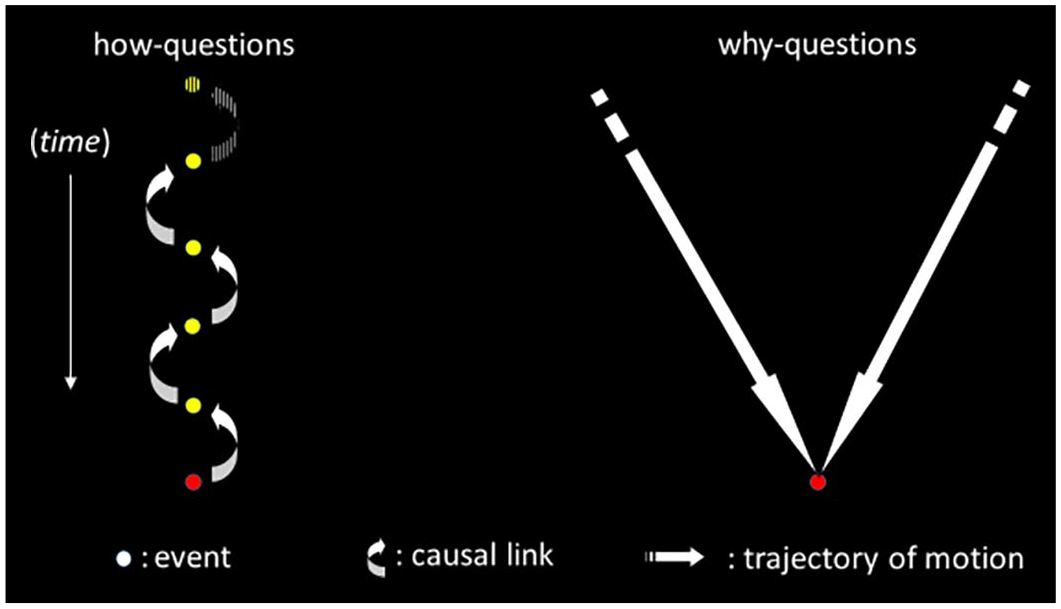
Evans-Pritchard ([1937] 1976) on Zande divination.
Now, all this may sound like logical overdrive—taking Evans-Pritchard’s pithy distinction and turning it into some form of neo-scholastic conceptualism (cf. Werbner 2015, 29). Still, as I want to show, it is precisely by working at that deliberately abstract level that Evans-Pritchard’s ideas can be transposed half the way across the globe, from Sudan to Cuba, to furnish a conceptual framework that can make sense of the Afro-Cuban divinatory tradition of Ifá. Brought to Cuba in the 19th century by slaves who were imported from West Africa primarily to work at the island’s booming sugar economy, Ifá today sits at the top of a vibrant constellation of Afro-Cuban religious practices as the most prestigious form of divination. 3 Initiates of Ifá are positioned as the ultimate arbiters of truth due to the supremacy of their oracle, through which the god of divination, Orunmila or Orula for short, is able to speak. Orula’s trademark, in fact, is the truth—as initiates say themselves, his oracle never lies and never makes mistakes. This awesome power of veracity is owed to the fact that Orula was witness to the creation of the world—the “birth” of all things, as they put it, which is described in an inordinately complex corpus of myths that narrate the exploits of Orula and a host of other divinities in the primordial times of creation, in Africa. These mythical narratives, to which initiates refer as the “paths” of Ifá, are classified into 256 divinatory configurations or “signs,” as practitioners call them, which operate a little like star signs do in Indo-European astrology. Each of them has its own name, and is considered a divinity in its own right, or an avatar of Orula himself. So, in the ceremony of divination, the diviner casts 16 nuts or shells to determine which of the 256 signs of Orula will be “speaking” and then proceeds to narrate some of the many mythical “paths” associated with the sign, which he then interprets so as to bring it to bear on the particular circumstances of the consultation. Diviners themselves sometimes speak of this process as one of “metamorphosis”—to reveal its message, the mythical narrative about originary times in Africa needs to be transformed: its path, to use their metaphor, needs to be curved.
Now, at the level of its content, Evans-Pritchard’s idea about why-questions has only a limited purchase on Ifá divination. While clients often do bring these kinds of questions to the diviners (e.g., why is my child sick?), oracles in Ifá are used also in other ways, particularly when it comes to their role in regulating the ceremonial life of the initiates. In what sense, for example, is deciding on the date of an initiation ceremony a why-question in Evans-Pritchard’s sense? As soon as one moves from content to conceptual form, however, the analytical purchase of Evans-Pritchard’s distinction proves quite stunning. Very much in line with the why-question universe of moving trajectories colliding to produce singular events, what we have in Ifá divination is a veritable choreography, in which different kinds of moving trajectories are carefully modulated by the diviners who control their speed and direction, making them collide to produce particular kinds of effects. Perhaps, the most emblematic example is the act of casting on which the ceremony of divination is focused. “Coincidental” in exactly the sense Evans-Pritchard suggested, the success of the cast depends on the diviner’s ability to ensure that the trajectories of each of the 16 nuts that he clasps in his hands remain above any suspicion of manipulation, so as it to allow Orula—the divinity—to speak through them unimpeded, in the form of the sign that is cast. The sign itself, then, emerges at the point of collision between 16 otherwise independent trajectories of motion that are made to intersect and chaotically interfere with each other inside the diviner’s hands, as depicted in Figure 8.
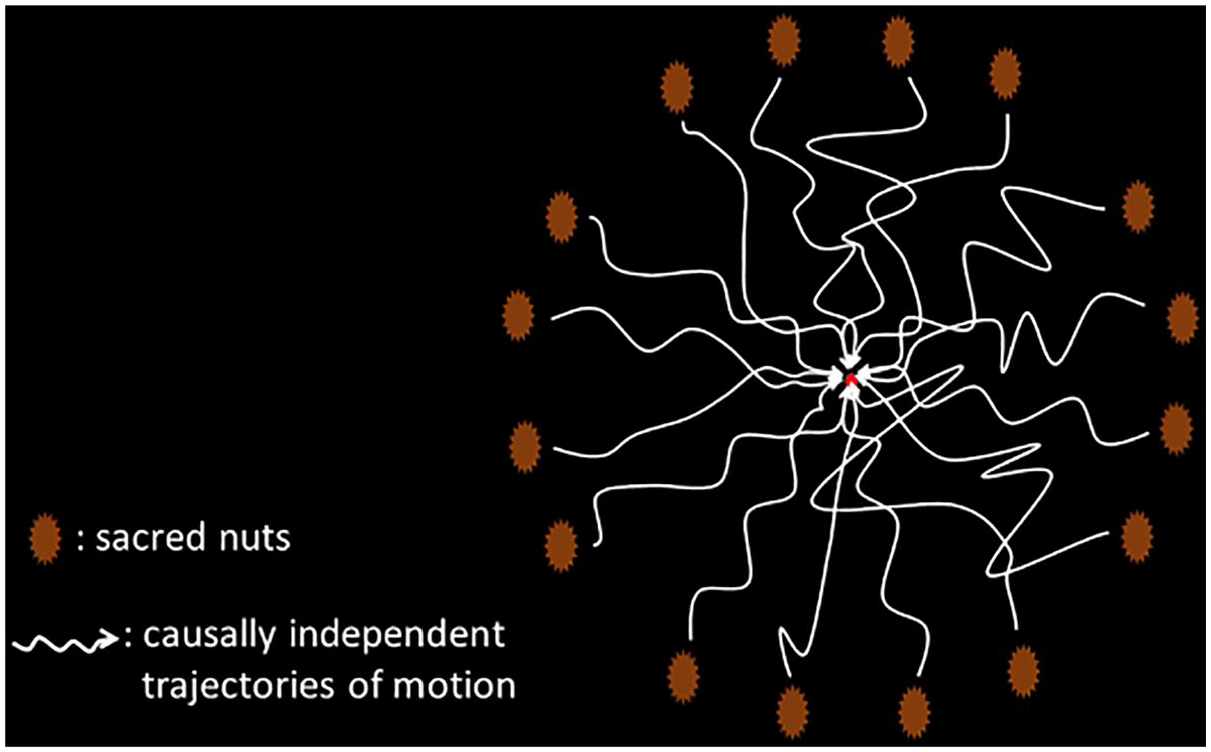
Divinatory casts as “coincidental” events.
The analytical power of this way of thinking, however, becomes most apparent when one runs it on the process of mythical interpretation that, as we saw, lies at the heart of Ifá diviners’ claim to be delivering the truth—indeed, not just any sort of truth, but a divine truth that is deemed to be immune to doubt (in Ifá, as stated, there are no lies and no mistakes). As we saw, Ifá diviners source the truths they deliver to their clients in mythical narratives, which they conceive as “paths,” that are first recounted and then interpreted—a process of “metamorphosis.” A mythical path recounting the incursion of one divinity into the kingdom of another is interpreted in the light of people’s abiding concern with migration in Cuba today and delivered to the consultant as a divine message about her prospects for traveling to the United States; a myth about a lion playing dead in order to find out what people will say about him at his funeral gets recast by the diviner as an admonition about a relative of his client who has gone into hiding in order to avoid paying his debts; or even, as I describe in detail elsewhere (Holbraad 2012, 189-90), a path that speaks of an island made of ice is metamorphosed interpretatively into an account of a client’s broken refrigerator and its prospects for repair (fridges being a major headache for most people in Cuba, due to the lack of spare parts, as well as the heat).
The diviner’s skill, then, lies in his capacity to set in motion the meaning of the myths so as to bring them to bear on the circumstances of the consultant, whose own meaning is also shifted as a result. So, Evans-Pritchard’s why-logic, if we may call it that, is borne out point-for-point: two mutually independent trajectories—that of the mythical path and that of the consultant on whose life the myth is brought to bear—are made to collide with each other. Furthermore, a major analytical dividend of this way of conceptualizing the situation is that it allows us drastically to change the way we conceive of the truth diviners deliver. For note how this image runs contrary to the standard assumption (made also by Evans-Pritchard [1937] 1976, 150) that diviners are in the business of providing particular kinds of “representations” of their clients’ circumstances, by which I mean discursive claims about the way things are in the world (e.g., just like the truth of my claim “this apple is red” depends on whether the apple is actually red, the truth of the diviner’s assertion that his client’s fridge needs fixing would depend on whether the fridge is actually broken). By contrast, the analysis of divination I have offered yields a different conceptualization of truth. Diviners’ claim to truth, on this account, consists not in representing the world but rather in transforming its meaning. Truth is the event that corresponds to the moment at which the mythical path is made to collide with the life circumstances of the consultant, and thereby redefines them (Figure 9). The divinatory message “you’ll be traveling to the US,” for example, changes the meaning of the client’s circumstances: from being a person with no particular travel prospects the client is rendered into a person who can expect an imminent journey. Understood as an event of redefinition, then, the diviner’s truth-claim is indeed special, beyond doubt, as I noted earlier, since it is true, precisely, by definition.
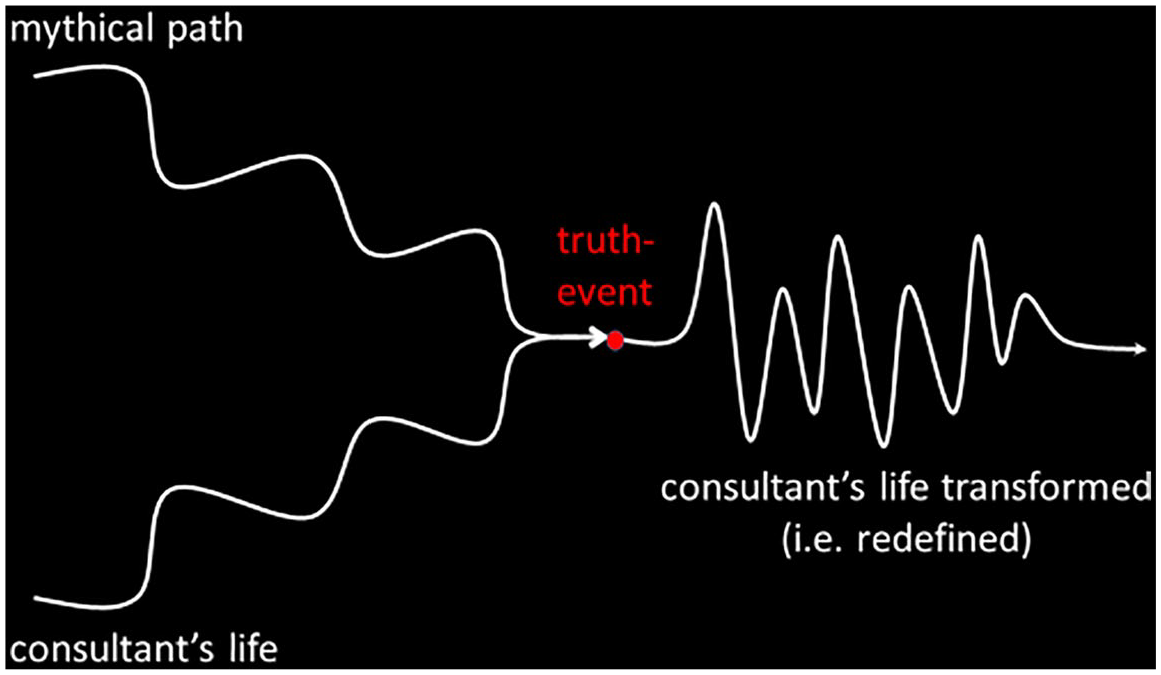
Ifá truth as event of redefinition.
It is instructive, here, to make explicit the sequencing of this argument about divinatory truth, and of the role that Evans-Pritchard’s original conceptualization comes to play in it. To start with, we may note that the point of the argument—its punchline, as it were—takes form in the same way as we saw earlier in relation to Mauss on the Maori gift (see Figure 1). First, a problem is set up: how are we to understand the claim by practitioners of divination that their oracles are able to deliver truth? Then we have the ethnography of Ifá in Cuba, which, among other things, shows that Ifá diviners take the truth of their oracles to be indubitable by its very nature, since it is the product of interpretively “metamorphosing” the myths of Orula’s witness of the “birth” of things, so as to bring them to bear on the personal life circumstances of the client. As with the Maori exegesis about the hau of taonga and the anthropological problem of reciprocity, then, this indigenous exegesis of Ifá truth is first (horizontally) translated and glossed interpretatively (e.g., the claim that Ifá does not lie or make mistakes is glossed as a claim about its inherent indubitability), and then transposed (vertically) into the framework that the question about truth sets up (Figure 10). In particular, the ethnography of Ifá is pressed into the service of an argument about truth by being molded conceptually into the shape of that problem, namely, as a question about the relationship between mythical narratives on one hand and the personal circumstances they are meant to illuminate on the other.
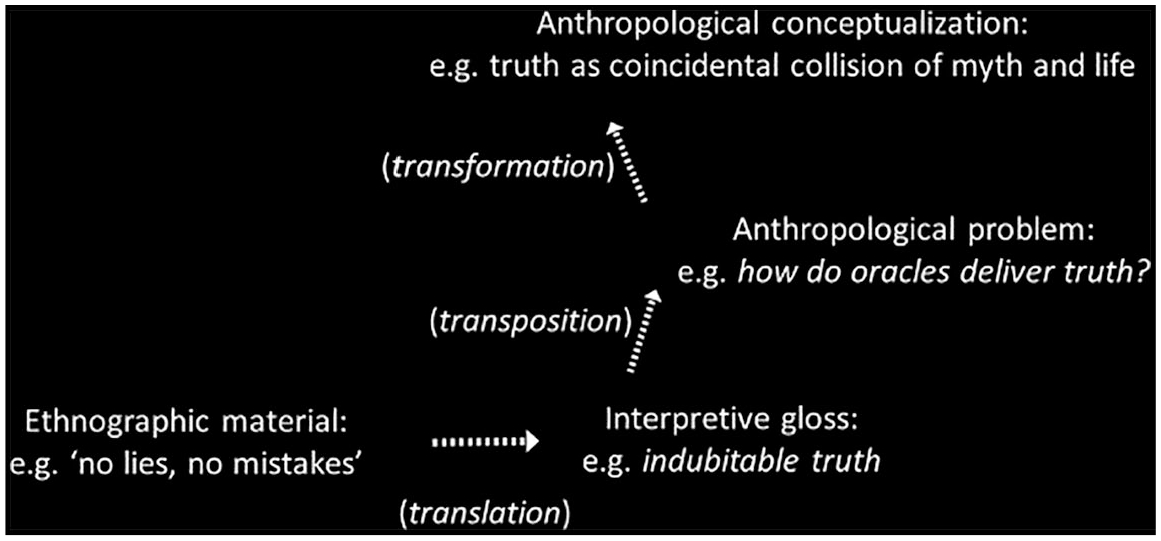
Turning Ifá divination into concepts.
And, as with Mauss’s argument again, this conceptual transposition sets the stage for the conceptual transformation that delivers the “punchline” of the argument by refiguring the shape of the relationships that the problem of truth implies. While one might assume, as Evans-Pritchard did too, that the question of truth in divination must concern the relationship between divinatory “beliefs” and the events or states of affairs they may seek to “represent,” the ethnography of Ifá forces us to imagine a situation where both sides of this relationship are, rather, in motion and can collide with each other. The point of the argument, in other words, consists in a conceptual shape-shift—one that, as we have seen, lends itself to diagrammatic depiction due to its morphological nature.
Evans-Pritchard’s why-logic, as I have called it, furnishes a vital part of this conceptual shape-shift, which lies at the heart of the argument’s punchline. In order to understand the argument’s comparative character, therefore, we may locate two comparative moments in its sequence (Figure 11). First, as we saw, Evans-Pritchard’s original distinction between “how” and “why,” articulated with reference to his Zande ethnography (e.g., the story of the beer-hut), is (vertically) transposed into a conceptual contrast between casual chains that connect discrete events in sequences (namely, how-logic), on one hand, and, on the other, trajectories of motion that generate events when they collide with one another (why-logic). Then, this conceptual contrast is (horizontally) translated into the terms of the problem of truth that the ethnography of Ifá divination poses. A distinction extracted, so to speak, from an argument about the kinds of questions Zande divination answers, is redeployed for the analysis of the kind of truth Afro-Cuban divination delivers. In this way, the meaning of the conceptual figure of colliding trajectories of motion is reassigned: from causal sequences colliding to produce the kind of “coincidence” Zande oracles explain, we move, horizontally, to trajectories of meaning metamorphosing so as to produce an event of redefinition, presenting, perforce, a reconceptualization of divinatory truth.
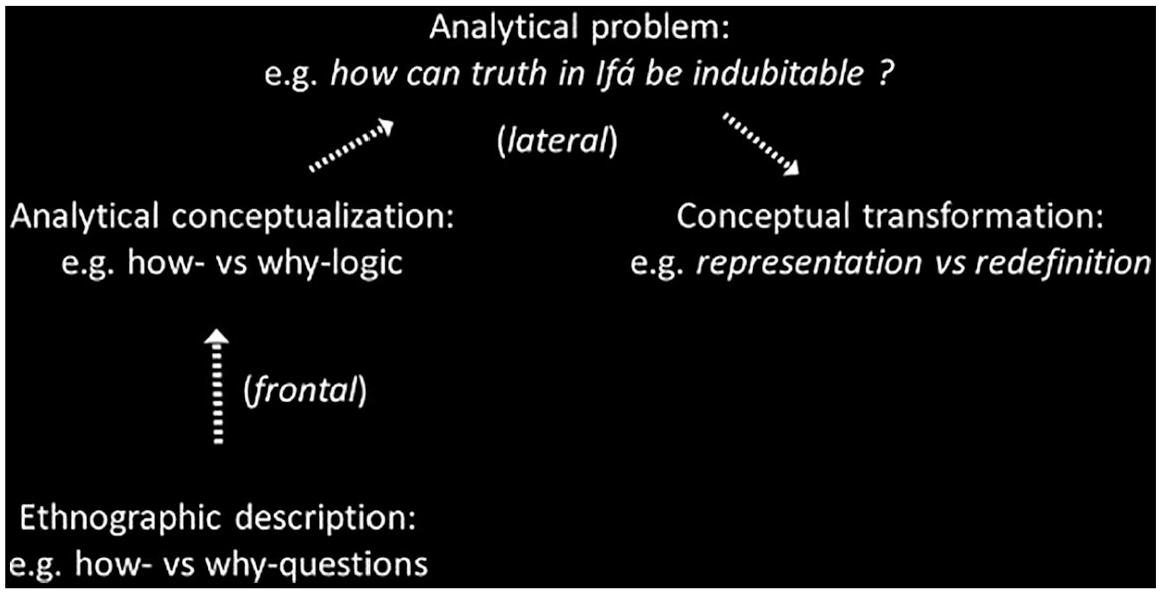
Comparison as conceptualization in two moves.
This double move of conceptualization, I suggest, is integral to the kinds of acts of anthropological comparison the “Evans-Pritchardian” analysis of Afro-Cuban divination I have presented exemplifies. Certainly, it is an active ingredient (perhaps the most active one) of the two operations of comparison distinguished so helpfully by Matei Candea (2017, 90), namely, “frontal comparisons,” in which “an unfamiliar ethnographic entity is contrasted to a putatively familiar background,” and “lateral comparisons,” in which “cases [are] set side by side to highlight their similarities and differences” (Candea 2017, 93). The vertical transposition of Evans-Pritchard’s analysis of how- and why-questions in Zande divination into a conceptual contrast between how- and why-logics concerning relationships between trajectories of movement and discrete events creates the conditions for the subsequent comparison with Ifá in Cuba, by providing the conceptual kernel that has a purchase in a different ethnographic context. And that transformation (from ethnography into its conceptualization) is indeed “frontal” inasmuch as it pertains to the relationship between (constitutively) “unfamiliar” ethnographic materials and (putatively) “familiar” background assumptions about, in this case, the relationship between causation, events, motion, coincidence, and so on. Moreover, the subsequent horizontal translation of this conceptualization into the framework set up by the problem of truth that the ethnography of Ifá divination presents is indeed the punchline of the comparison with Evans-Pritchard’s analysis. What was a conceptualization of his distinction between kinds of questions one might ask an oracle becomes a conceptualization of the kinds of truth one might be given by it. So, horizontally translated from one set of problems into another, moving “laterally” from case to case, in Candea’s terms, Evans-Pritchard’s analysis is comparatively recast as an anthropological reconceptualization of divinatory truth.
The key point to notice, here, is that these irreducibly “conceptualizing” ingredients—or perhaps they are “phases”—render anthropological comparison as a matter of conceptual transformation through and through. In contrast to the assumption that comparison must involve holding “axes of comparison” stable in order to gauge with reference to them the differences and similarities between varying comparanda, this way of imagining comparison makes virtue of the ways in which putative axes of comparison—that is, the comparans themselves—can be varied as they travel from one ethnographic situation to the next (see also Holbraad and Willerslev 2007). The “purchase” of the comparison, in other words, is found in the ways in which it can transform the very terms in which it is conducted in each new context, rather than in the ways in which the same terms of comparison might be shown to “apply” (or not to apply) in different contexts. The ethnography of Zande divination is transformed conceptually into the why-logic of motions producing coincidental events and then that figure of motile coincidence is further transformed into a conception of divinatory truth as a redefinition of meanings.
To be sure, such conceptual transformations need not be as smooth as this particular example might suggest—more or less the same idea, that is, changing its own terms of conceptual reference at different stages of analysis. To see this I will add one further step to this (alas self-referential) trajectory of anthropological analysis, with reference to a more recent publication in which I have sought to correct a significant error in my Evans-Pritchard-inspired account of divinatory truth in Ifá (Holbraad 2018). For, while the account already presented brings into focus some of the salient characteristics of Ifá truth (e.g., the idea of metamorphosis, of colliding paths, of truth as an event of redefinition), it gets wrong the cosmological coordinates within which these truth-events take place. In particular, what it misses is the basic asymmetry of the relationship between mythical paths on the one hand and the life trajectories that they transform by way of redefinition on the other. The key problem is that, contrary to the image presented in Figure 9, the transformations that Ifá divination induces only really go one way. The mythical paths of Ifá are so powerful precisely because, deemed to contain within them the truth about “everything,” as practitioners say, they can have a transformative effect on “anything,” that is, any particular life-circumstances that happen to occasion the consultation. To move in the opposite direction and try to alter the content of the mythical corpus of Ifá by bringing to bear on it the contingencies of any given personal life circumstance—the imponderabilia of everyday life—would for the practitioners of Ifá be a cosmological non sequitur. It would be something equivalent to a Catholic pilgrim saying that he goes to Our Lady of Lourdes to cure the ailments of the Virgin Mary. So, perhaps Figure 12 provides a better conceptual image: a corpus of myths intensively containing “everything” within its 256 signs which, by that virtue, is able to transform the meaning of any particular life circumstances, altering the very course of their extensively unfolding trajectory in the process.
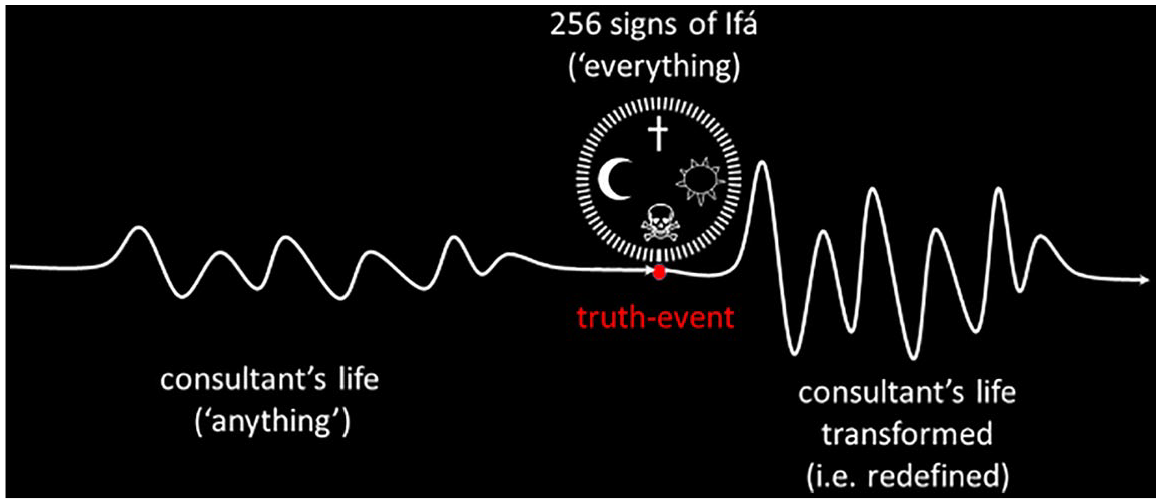
The asymmetry of myth and life in Ifá truth.
4. Conclusion: The Shapes of Relations
The present attempt to unpack conceptualization as the most active ingredient of anthropological thinking may appear banal. After all, if such bread-and-butter instances of anthropological analysis as Mauss on the gift and Evans-Pritchard on Zande oracles can be enlisted as examples, then surely there cannot be much that is new here. To be sure, one could bite the bullet on this score. Finding more, perhaps new, value in some of the best anthropology has had to offer may itself be worth something. Nevertheless, by way of conclusion, we can single out four consequences of this way of thinking about anthropological thinking, which illustrate ways in which it might go beyond what one already expects of it.
The first has been stated already in the foregoing, namely, that conceptualization on this account emerges not merely as a step toward some other, weightier anthropological goal, such as social explanation or cross-cultural translation, but as a sui generis end in itself. Echoing the old suggestion that something called “social morphology” could be developed as a domain of inquiry in its own right within the social sciences (e.g., Durkheim 1982, 111-12), we may tag this activity as “conceptual morphology.” Indeed the contrast with the classical project of social morphology, as conceived by Durkheim and his circle a century ago (e.g., Mauss 2004), makes the point. For Durkheim, the study of social morphology involved charting the demographic and geographic configurations of social relationships (the density of social groups, their distribution and seasonal movements, and so on), in order to work out their effects on social institutions and the collective representations they generate. By contrast, the version of morphology I have sought to outline charts out the conceptual relationships that the analyst has to imagine in order to describe such phenomena—that is to say, the kinds of social phenomena at large in which anthropologists have always been interested. This is a morphology not of the social world but of the analytical operations required to describe it.
A second point has to do with the deliberate contingency of these operations, and here the contrast with another famous proposal about the role of concepts in anthropology is useful, namely, Edmund Leach’s (1961) influential suggestion that in order rigorously to generalize about social phenomena one should conceive of them in terms of the mathematical patterns they form. For Leach (1961, 2), the abstraction of algebra is necessary if anthropology is to avoid merely describing one contingent case of social organization after another—an activity he famously disparaged as a kind of “butterfly collecting”—in order to focus instead on the general laws that may underlie them. By contrast, the version of morphology proposed here takes off from the idea that the abstraction of concepts furnishes the language in which anthropologists can embrace the very contingency Leach found so irritating. In other words, the forms of conceptualization illustrated above are not acts of generalization but of expression—a matter not of abstracting away from life, if you like, but of moving toward it. In fact, Leach’s image of butterfly collection is apposite to the activity: one might imagine anthropology as an act of conceptual butterfly collecting, in which the varieties of social experience the world over are transfigured in our conceptual imagination and expressed in the language of conceptual morphology.
This point about expression leads to a third observation, concerning the notion of the “shapes of relations,” which has surfaced a number of times in the foregoing account of anthropological conceptualization, and lends the present article its title. Here Marilyn Strathern’s (1992, 1995, 2014, 2020) ever-unfolding argument about the peculiar role that relations play in anthropological thinking may serve as the foil. At the core of Strathern’s approach lies an idea that appears in different guises across her work, namely, that relations are so compelling to anthropologists because they traverse across—indeed relate—imagined divides between the content and the form of anthropological inquiry. Anthropologists par excellence, for Strathern, study social relations (indeed “relation” in English has connotations of kinship) and in doing so establish analytical relations between (and therefore also about) them. Referring in particular to developments in mid-20th century social anthropology in Britain, she has suggested that behind them lay “a creative appropriation of The Relation, at once the abstract construct and the concrete person” (Strathern 1995, 10)—a point she then extends to social anthropologists in general, who “route connections through persons” (Strathern 1995, 11). The present argument about the role of conceptualization in anthropological thinking, then, can be understood as one attempt to give Strathern’s conception of the duplex character of the relation a determinate form: conceptualization as the activity of turning life (namely, the relationships that comprise social phenomena) into ideas (namely, the relationships between the concepts deployed in order to describe those phenomena) in the ways I have sought to articulate.
This very suggestion, however, also indicates a way in which the present proposal departs from Strathern’s approach, if only in a matter of emphasis. That my argument should give Strathern’ conception of the relation a “determinate form,” I suggest, is not accidental. At least as anthropologists understand and deploy them, relations are “determinate forms,” in the sense that they just are the kind of thing that has (always, already) what here we may call a shape. 4 In reading Strathern’s accounts of relations in anthropology one is often left with the impression that for her relations, simpliciter, are the common denominator of all social-cum-conceptual complexity. In a diagram (see Figure 13), they might be depicted as lines that serve to connect in any manner of ways, traversing different and otherwise heterogeneous scales at which relations’ potential for producing as well reflecting complexity may be realized, making “everything seem . . . connected” (Strathern [1991] 2004, xx). According to such a conception, in other words, relations seem to be imagined in a “bare” state, as elements of which all forms and structures are composed and decomposed. Hence, for example, Strathern’s (2005, 135) frequent appeal to the notion of “arithmetic”: aggregation, subtraction, multiplication and division are the kinds of operations one can imagine performing with and upon relations, provided one takes the latter, somewhat paradoxically, as the base “unit” of analysis.
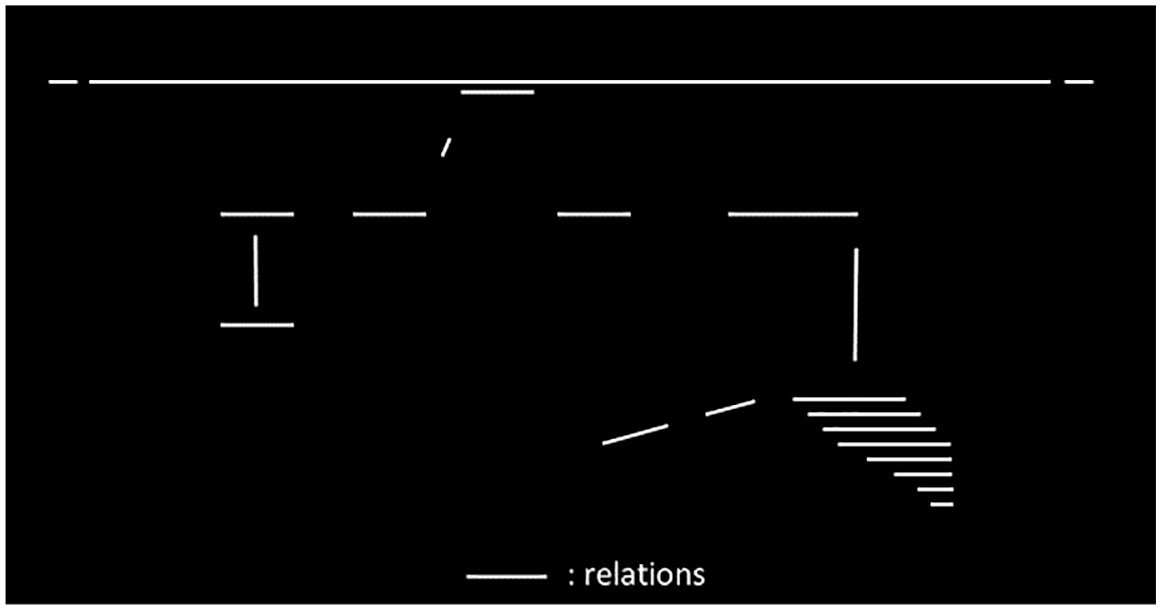
Shapes of Strathern’s relations (arbitrarily imagined—though cf. Strathern [1991] 2004, 3).
But what if one were to forego the very idea of a base unit (in the sense of a common conceptual denominator) for the kind of morphology I am articulating? To do so would be to recognize that shape is not a property that emerges out of relations, but rather one that is inherent to them as a primitive feature. Even the minimal “links” of Figure 13 have a determinate shape—they mark, for instance, particular distances that locate “relative” positions and proportions. On this understanding, shape is itself inherently variable, allowing one kind of relation to be distinguished from another (indeed: that relation, namely, “distinction,” itself marks its own shape, which is different, for example, from that of a “link,” although the two may indeed be related [though again in a determinate shape (and so on)]—cf. Strathern 2011). So, the morphological character of anthropological conceptualization comes down to just that: finding ways of expressing in conceptual form those parts of life that hold our anthropological interest by articulating the shapes in which they are configured.
Perhaps what is needed, then, is not so much an arithmetic of relations as a geometry, as Sarah Green has suggested in her own figuration of Strathern’s thinking (Green 2017). Certainly, heeding also a call put forward powerfully by Alberto Jiménez Corsín (2003, 2013), that would bring us closer to expressing the particular proportions of the conceptual relations through which anthropological thinking takes its shape. Still, as indicated by the various diagrams with which I have accompanied my attempt to articulate the character of such an endeavor, the appeal to the language of geometry can only be figurative in this context (and I mean figurative, here, in both its literal and its, well, figurative sense). At stake, as I have insisted, are the relational shapes of concepts, and the question of how far these can always be spatialized geometrically is an open one. For example, one can see how the shapes of “continuity and discontinuity,” “motion and rest,” or “inside and outside” may be understood in geometrical terms. It is not clear, however, that the same could be said, say, of such standard concepts of anthropological analysis as “transcendence and immanence” or “self and other,” or even of more basic logical quantifiers like “every,” “some,” “any,” and “none,” as illustrated by the final example of the foregoing discussion, in which geometrical renderings are tellingly aided by more figurative ones (see Figure 12).
All of which raises a final observation, which relates to my earlier point about the affinity between anthropological conceptualization and philosophical inquiry. For while the comparison between anthropologists’ and philosophers’ investments in the analysis of concepts is fruitful, the essentially expressive character of anthropology’s morphological project invites an analogy with the practice of art, too. Without presuming any particular definition of art, 5 for purposes of such an analogy we may say that, whatever it might be, art is in some sense an act of expression. By this, I mean only, and minimally, that in art (or at least in some art) something—some part of life: an image, an activity, a thought, a deed, indeed, a relationship—is transfigured and conveyed in a different medium. That activity, furthermore, need not have any “point” other than itself (although it very well may do so). Indeed, it might make no difference to anything or anyone, other than to itself, and perhaps those who appreciate it for itself, starting with the artist who performs it. While anthropology may certainly involve, or indeed be, a whole array of other things as well (that much is obvious!), the project of anthropological conceptualization I have argued lies at its core is similar to art in these ways. It is the activity of taking anything—any part of life—and transfiguring it in the language of concepts, molding it into the shapes of (its) relations. It is an activity that, as I have sought to show, has always been at the heart of what anthropologists have been doing. And it is one in which, I hope, we can continue to delight. A part of life itself, after all, anthropology is as valuable as any part of life to which it seeks, perforce, to give expression.
Footnotes
Acknowledgements
This article is based on an Inaugural Lecture delivered on 21 February 2017 at UCL, to mark my promotion to a Professorship in Social Anthropology. It was written during research for a project on the Comparative Anthropologies of Revolutionary Politics, funded by a Consolidator Grant of the European Research Council (ERC-2013-CoG, 617970, CARP). The central idea of “shapes of relations” and their role in anthropological comparison was developed in conversation with the project’s core members: Narges Ansari, Igor Cherstich, Myriam Lamrani, Charlotte Loris-Rodionoff, and Nico Tassi. Also, in the context of this research, I have benefited immensely by my collaboration with David Burrows and other participants in our Social Morphologies Research Unit, studying the diagrammatic qualities of social forms and the conceptual effects of drawing them. Hermione Spriggs helped me get the hang of making the diagrams on the computer. Finally, for comments on drafts of the article itself, I am grateful to the anonymous reviewers, Alice Elliot, Caroline Humphrey, and Kriszta Sajber, whose insights in the phenomenology of thought have been inspiring.
Declaration of Conflicting Interests
The author(s) declared no potential conflicts of interest with respect to the research, authorship, and/or publication of this article.
Funding
The author(s) disclosed receipt of the following financial support for the research, authorship, and/or publication of this article: The author received financial support from a Consolidator Grant of the European Research Council (ERC-2013-CoG, 617970, CARP).
1
“Ontology” has been the subject of heated debate in recent years in anthropology and has been used in a variety of different senses and with a host of different purposes (e.g., Argyrou 2002; de la Cadena 2015; Descola 2013; Evens 2008; Scott 2007—for helpful critical reviews see Kohn 2015 and Argyrou 2017). Here, I present just one line of argument, to which I have sought to contribute myself (e.g., Henare et al. 2007; Holbraad 2017 see also de Castro 2003, 2015), and which is presented in detail in a recent book I wrote together with Morten Axel Pedersen ( ). There we outline also some of the alternative approaches to ontology in recent anthropological writings, explaining how our own approach, which I summarize here, is related to them, as well as how it is distinct from them.
2
Much is made of the use of the first plural in the building of such anthropological arguments from “alterity.” Who is the “we” here? Is not this “we” constitutively “Euro-American,” “Western” or “modern”? And why assume that all anthropologists are such? (see for a critique along such lines). These are all pertinent questions that go to the heart of the history and geopolitics of anthropology as a social phenomenon in its own right and have profound implications for the epistemological politics of the discipline, too. For purposes of the present argument about anthropological conceptualization, however, it is necessary to be clear on a single point. The significance of the “we” here is not cultural, historical, or geopolitical (even as the “we” invoked obviously has a culture, a history and a geopolitics, and those are significant in their own right!) Rather, its significance is conceptual. The “we” is the figure to which an anthropologist minded to reconceptualize an object of inquiry attaches the initial conceptual assumptions they are attempting critically to shift. The “we,” in other words, refers to the anthropologist and their readers, in their capacity as anthropologists and readers, that is, in their capacity as figures involved in a line of anthropological argumentation. So the “we” of anthropological arguments is significant and operative as the carrier of any initial set of assumptions the anthropologist may need critically to reconceptualize in the light of the materials the anthropologist seeks to understand. There is no requirement that the anthropologist themselves, or their readers, subscribe to those assumptions, nor for that matter do they need to include themselves in the scope of a “we” that does so. All that is necessary is for the anthropologist to posit the initial assumptions that require critical interrogation in light of the materials in question, and to take them as the point of departure for their critical argument. The “we,” then, designates the anthropologist and their readers as participants in that line of argument. And that’s all.
3
4
While in many ways these are synonyms, and I sometimes treat them as such in this text, here I prefer the term “shape” over such terms as “form” or “structure.” In its simplicity and theoretical lightness, the term “shape” does a better job of conveying the gist of the idea that acts of conceptualization mould thoughts in particular ways. Terms such as “form” and “structure” are so saturated with debate in anthropology that they risk weighing this suggestion down with unnecessary theoretical baggage (although, admittedly, comparisons between the present argument about the shapes of relations and standing debates in anthropology about, say, “formalism” or “structuralism” would hardly be irrelevant).
5
As this article seeks to exemplify for the case of anthropology also, I take it that the definition of art is itself a question of and for art.