



Abstract
Hard adventure tourism, characterized by high risk and physical challenge, is a recognized context for personal transformation. However, the process through which this transformation occurs, particularly the synergistic interplay between the social context of the subculture and embodied experience, remains underexplored. This ethnographic study, employing participant observation and in-depth interviews with 23 hard adventurers, investigates this process. Our findings reveal that self-transformation unfolds through three distinct phases of the self: (1) the controlled self, developed as the subculture disciplines the body through rigorous preparation; (2) the radial self, performed and validated through shared bodily practices within the subcultural group; and (3) the fragmented self, sustained by the subcultural community that keeps the embodied identity alive. The study demonstrates that the hard adventure subculture actively shapes, gives meaning to, and reinforces the very embodied practices that drive personal change, with transformation strengthening both the self and social bonds.
Introduction
Tourists vary widely in their preferences, behavior, desires, and goals (Kotiloglu et al., 2017; Uriely, 2005; Zheng & Liao, 2019). Contemporary travelers increasingly prioritize inner journeys (Ballantyne et al., 2017), though such transitions can be difficult. Correia et al. (2013) noted that the promise of novel, personalized experiences inspires tourists who seek adventure and knowledge. Ballantyne et al. (2017) labeled these travelers “transumers”—consumers drawn to tourism offerings that are distinctive, immersive, extraordinary, educational, environmentally appealing, and memorable rather than conventional or fixed (p. 29). This interest reflects a broader shift from purely hedonic motives toward meaningful pursuits and personal growth (Kirillova et al., 2017a). Associated activities often involve voluntary hardship. Tourism is a potent force in modern culture, influencing people’s lives and personalities via experiential engagement (Cohen & Cohen, 2019; Ryan, 2010). This pursuit of meaningful personal change is central to the concept of transformative tourism, which we define as tourism experiences that lead to profound, enduring changes in a person’s worldview or self-perception (Sheldon, 2020).
A particularly intense context for transformative tourism is adventure tourism, which involves elements of risk, challenge, and physical skill (Pomfret, 2006). Within this domain, hard adventure tourism—encompassing activities such as high-altitude mountaineering, free solo climbing, and extreme white-water kayaking, where there is a significant risk of injury and success relies heavily on individual skill and perseverance—involves substantial, real risk and holds great transformative potential (Loynes & Smallwood, 2022; Pomfret, 2006). Hard adventurers, unlike soft adventurers who may seek thrills with managed risk, are often driven by a desire to enhance their mental and physical capabilities and overcome significant challenges (Albayrak & Caber, 2018; Pomfret, 2021). Crucially, participation in hard adventure fosters a distinct subculture—a social group with shared values, specialized knowledge, unique jargon, and common practices centered around risk-taking and mastery (Haenfler, 2006; Williams, 2006). This subculture plays a vital role in transformation by providing a social context that normalizes risk, validates experiences, and shapes the meanings that individuals derive from their embodied practices.
The transformative potential of hard adventure lies in its ability to push individuals beyond their comfort zones, facilitating critical self-reflection. Because these experiences are intensely physical, the body is the primary site of engagement and learning. Therefore, our focus on hard adventurers’ body use—their embodied experiences—is fundamental to understanding the mechanism of transformation. We define embodied experiences as the ways in which knowledge, meaning, and identity are derived from direct physical engagement, sensory immersion, and bodily performance. It is through these embodied practices within the subculture that transformation is catalyzed.
Despite recognizing tourism’s transformative potential, the literature lacks a deep understanding of how these transformations are catalyzed within specific tourist subcultures. The specific research gap this study addresses is the lack of empirical investigation into the ways in which the hard adventure subculture facilitates personal transformation. While scholars acknowledge that transformation occurs through multidimensional means (Sheldon, 2020), it remains unclear how the embodied practices of hard adventure—the specific physical actions and sensory engagements—relate to self-fulfillment and identity change (Matteucci, 2022). In particular, it is not apparent how the subcultural context, with its unique norms and narratives, shapes these embodied experiences of self-expression. Understanding this process is significant because it moves beyond acknowledging that transformation happens to explaining the mechanisms through which it occurs within a high-intensity context, offering deeper insights into the interplay between physical experience, subculture, and identity formation.
To address this gap, our study is underpinned by theories of embodiment and subcultural identity. These theoretical foundations are highly suitable as they provide a lens to examine the physical, lived experiences of adventurers (embodiment) and the social context that gives meaning to those experiences (subculture). Therefore, the purpose of this study is to investigate how the hard adventure subculture catalyzes transformation through embodied experiences. Our work is based on two objectives: (1) to determine how hard adventurers perceive and use their bodies in tourism; and (2) to understand how their embodied practices influence self-reproduction before and after their transformative journeys via subculture communities. Using an ethnographic participatory approach, including participant observation and in-depth semi-structured interviews with 23 hard adventurers, we co-interpreted their embodied experiences of self-expression through tourism. This method enabled us to explore transumers’ lived experiences and opinions about their own engagement in the subculture. Subcultural narratives of hard adventure and transformation, continually produced and reshaped through embodied experiences, were found to persistently mold tourists’ selves.
Literature Review
Adventure Tourism’s Transformative Potential
Personal transformation is viewed as a widening of consciousness that fundamentally alters one’s worldview and life (Mezirow, 1978). It represents a process, not simply an outcome (Mezirow, 2006). This study adopts Holland-Wade’s definition (1998) of personal transformation (also referred to as self-transformation) as “a dynamic, uniquely individualized process of expanding consciousness whereby individuals become critically aware of old and new self-views and choose to integrate these views into a new self-definition” (p. 713). This process is non-linear and involves positive changes in attitudes, values, and behavior (Christie & Mason, 2003). This pursuit of self-transformation is central to transformative tourism, which occurs during travel experiences that lead to such profound, enduring change (Sheldon, 2020). The process often involves transformative triggers—specific events that disrupt worldviews and initiate change (i.e., a moment of extreme challenge during a climb)—and rites of passage—rituals marking a transition in personal status (i.e., successfully summiting a dangerous peak; Van Gennep, 1960).
Adventure tourism, particularly hard adventure tourism—characterized by high risk, intense physical commitment, and the need for advanced skills (i.e., high-altitude mountaineering, free solo climbing; Gross & Sand, 2020)—is a potent context for transformation. The transformative potential of hard adventure lies in its ability to create extraordinary experiences—intense, memorable events that stand out from daily life (Arnould & Price, 1993)—through voluntary hardship. These experiences push individuals beyond their comfort zones, facilitating the critical self-reflection and “inward gaze” necessary for transformation (Kahana, 2024; Mezirow, 2003). However, while the outcomes of adventure (i.e., enhanced self-efficacy, resilience) are documented (Brymer & Schweitzer, 2013), the process of how the hard adventure context facilitates self-transformation remains underexplored (Nandasena et al., 2022). This study posits that this process is fundamentally embodied and shaped by a specific subculture.
Recent studies on serious leisure activities, such as wilderness hiking and silent hiking, provide deeper insights into this transformative process. For instance, Chen et al. (2024) found that participants in the Hexi Corridor silent hiking activity experienced a journey from self-doubt to self-mastery through physical challenges and functional disconnection (i.e., digital detox and silence), which fostered self-reflection and spiritual connection. This aligns with the concept of transformative triggers, where physical suffering and boredom in harsh environments act as catalysts for inner change (Chen et al., 2024). Similarly, Yu and Gu (2022) documented how female bicycle tourists on the Sichuan-Tibet route used cycling as a means to break gender conventions and achieve self-awareness and subject construction, highlighting the role of embodied practices in challenging societal norms and facilitating personal growth. These studies emphasize that transformation in adventure tourism is not merely psychological but is deeply rooted in bodily experiences and the overcoming of physical limits.
Embodied Experience and Subculture
To understand the mechanism of transformation in hard adventure, it is essential to focus on the body. Embodiment posits that knowledge, meaning, and identity are derived from direct physical engagement and sensory immersion (Matteucci, 2014). Hard adventure is intensely physical, making the body the primary site of experience. This can be analyzed through two interconnected lenses: the physiological body (the physical sensations, discomfort, and intense exertion inherent in high-risk activities; Cater & Cloke, 2007; Farkić & Kennell, 2021) and the constructive body (how bodily practices are used to generate and express identity, or self-construction; Jamalian et al., 2020). For example, long-distance hikers construct meanings and achieve self-identity through their bodily movement in the landscaping processes (Zhu & Jiang, 2019). This deep, embodied engagement can induce flow states, described as becoming one with the activity and environment, which is a key motivation and transformative trigger for adventurers (Brymer et al., 2024; X. Wang et al., 2019).
These embodied experiences do not occur in a vacuum; they are shaped by a social context. We contend that hard adventure functions as a subculture that a social group with shared values, specialized knowledge, and common practices (Haenfler, 2006). This aligns with subculture theory, which examines how groups form identities distinct from mainstream culture. As Guo and Luo (2025) explored, subcultural leisure practices (i.e., visiting cat villages) allow urban people to compensate for emotional deficits in daily life, leading to self-healing and identity reconstruction. German philosopher Friedrich Nietzsche elucidated mainstream cultures and subcultures through the Dionysian (the god of wine) and Apollonian (the god of the sun) dichotomy. Mainstream culture, symbolized by the Apollonian, emphasizes order, ordinariness, secularism, comfort, and safety; subcultures, represented by the Dionysian, are characterized by passion, irrationality, charm, and creativity (Ulusoy, 2016). Nietzsche’s commentary contests everyday dominance, instead advocating for self-actualization, self-awareness, critical thinking, and freedom—all of which encourage self-creation, expression, and transformative change in oneself and the world (Nietzsche, 1993). Goulding et al. (2002) applied postmodernist perspectives to dance subcultures, considering self-fragmentation and the emergence of new communities. Subcultures are commonly viewed as evolving expressions of originality (Ulusoy & Fuat Firat, 2011): they represent platforms for meaning creation and personal development.
Adventure tourism routinely involves group activities, thereby nurturing a collective identity with clear “group boundaries” (i.e., group membership; Jin et al., 2023). These experiences, such as canoeing, stargazing, or foraging, are marked by a slowed passage of time, immersion in nature, and a sense of belonging within small groups (Farkić et al., 2020). Empirical studies on tourism subcultures further illustrate this social dimension. For example, Luo et al. (2022) found that community interactions and shared experiences (i.e., evening tea sessions) enhanced participants’ sense of belonging and identity, leading to stronger place dependence and identity. This presents the idea that subcultures provide adaptive cues—shared signals or norms that guide behavior and interpretation of experiences. Similarly, Zhang and Wu (2024) analyzed CityWalk among Chinese youth, showing how this practice serves as a form of subculture that allows participants to resist the pressures of modern life (i.e., “involution” or internal competition) through slow, embodied exploration of urban spaces.
What’s more, hard adventurers usually form group connections through pre-trip physical training and logistical preparation, during which roles and responsibilities are assigned. This phase enhances group cohesion. Participants thus begin to support each other, respond jointly to obstacles, and later share post-trip activities. These dynamics promote equality, mutual objectives, and a communal experience, culminating in a peak experience of group harmony (Wei et al., 2021).
Adventure tourism can be regarded as a subcultural praxis that merits exploration in this context. Mainstream culture is conceptualized as encompassing the conventions of daily life (i.e., order, routine, safety; Ulusoy, 2016). It is important to note that subculture and mainstream are not always mutually exclusive; individuals navigate both. However, the hard adventure subculture provides a distinct, meaning-making framework for its members, characterized by values of passion, resilience, and a focus on embodied mastery. It offers shared signals or norms within the group that guide participants’ behavior and interpretation of their experiences. For instance, subcultural norms might reframe fear as a cue to be managed rather than a signal to retreat, thereby facilitating transformation. Through group activities, shared rituals, and a collective identity, this subculture provides the social reinforcement that helps individuals interpret challenging embodied experiences as positive transformation (Jin et al., 2023; Wei et al., 2021). However, relevant research has mainly neglected the micro-discourses of consumption—how tourists ascribe meaning to subcultural practices that elicit transformative, extraordinary experiences. Such encounters result in narratives of identity, self-transformation, and shared meanings based on subcultural involvement. This oversight has led to superficial comprehension of how tourists’ identities transform within a harmonious setting.
The Embodied Subcultural Ritual as a Transformative Mechanism
While the lenses of embodiment and subculture are each valuable, a critical theoretical gap remains in understanding their synergistic interplay in driving transformation within hard adventure tourism. We argue that the transformative power of this context arises not merely from the co-presence of intense bodily experiences and a distinct social group, but from their fusion into an embodied subcultural ritual.
Drawing from ritual studies (Turner, 1969) and the aforementioned theories, we posit that hard adventure tourism functions as a potent rite of passage (van Gennep, 1960). In this ritual, the subculture provides the script—the shared values (i.e., resilience, mastery), narratives, symbols, and performance norms that give the experience collective meaning (i.e., summiting as an achievement of identity). The body is the primary medium—through grueling physical exertion, risk management, and learned skills, individuals enact this script. The physiological body endures and adapts, while the constructive body interprets and performs identity (Cater & Cloke, 2007; Jamalian et al., 2020).
This fusion creates a powerful, self-reinforcing cycle in which subcultural meanings motivate and give significance to bodily suffering, while the successful completion of bodily challenges validates and deepens one’s belonging to and understanding of the subculture. It is within this cycle, the embodied subcultural ritual, that transformative triggers (i.e., a moment of extreme fear or flow) are framed not as random events, but as expected and meaningful parts of the journey. The ritual structure (separation from daily life, liminal adventure phase, reintegration) guides individuals through this process, with the subculture offering adaptive cues for interpretation and the body serving as the site of experiential learning (Mezirow, 2003). This synthesized framework moves beyond viewing embodiment and subculture as parallel factors, instead theorizing their integration as the core engine of self-transformation in hard adventure.
Positioning the Research: An Integrated Framework
Grounded in the synthesized perspective developed above, this study is positioned within an integrated conceptual framework that places the embodied subcultural ritual at its core. While transformative theory (Mezirow, 1978) explains the structure of profound psychological change, and subculture theory (Haenfler, 2006) illuminates the formative social context, we contend that in hard adventure tourism, transformation is catalyzed specifically at their intersection. This research argues that the subculture and embodied experience are not merely concurrent influences but are dialectically intertwined in a ritualized process that produces transformation.
Consequently, this study aims to address the identified gap by investigating how the hard adventure subculture facilitates self-transformation through embodied experiences. We achieve this by examining the embodied subcultural ritual as a unified mechanism. Specifically, this study seeks to explore how subcultural narratives and values are physically enacted and felt by participants during the adventure; and how these intense bodily experiences, in turn, are interpreted and given meaning through the subcultural lens, thereby molding a transformed self-identity across the ritual cycle (from departure, through the liminal travel phase, to reintegration).
This process is illustrated in our refined conceptual framework (Figure 1). The framework depicts the transition from mainstream daily life into the subcultural context of hard adventure tourism as a rite of passage. The transformative phase (Tourist life) is driven by the embodied subcultural ritual, where bodily practices and subcultural meanings fuse. Triggers (i.e., challenges, shared moments) emerge from and are processed within this ritual, leading to self-transformation upon the individual’s return to daily life, now carrying the integrated experience.

An integrated framework.
Methodology
Ethnography
We conducted ethnographic research for 2 years, an approach that embodies the principles of ethnography through immersive engagement, prolonged fieldwork, and the generation of “thick description” (Geertz, 1973; Goulding, 2005). Ethnography was particularly suitable for this study as it allows for an in-depth exploration of the hard adventure subculture in its natural setting, enabling us to observe and interpret embodied experiences and social practices firsthand. Our participants consisted of “hard adventurers,” such as those climbing Mount Everest, exploring Antarctica, and undertaking extreme challenges. We sought to discern the interconnections that develop between the self and embodied experiences, with an aim to explain how transformation occurs within this subculture. Methods included participant observation and phenomenological interviewing, which aligned with the interpretivist paradigm that frames experiences as dynamic realities co-created by researchers and participants (Willis et al., 2007). To address these perceptions’ personal and complicated nature, we performed two qualitative studies over 2 years.
Stage I spanned from 2022 to 2023. Pandemic-related travel restrictions hindered ethnographic observation, so this phase primarily involved phenomenological interviews. The purpose of Stage I was to collect detailed narratives on hard adventurers’ perceptions of their bodily experiences and self-transformation. Participants were primarily selected based on their rich, embodied experiences in transformative tourism. We used a non-probability snowball sampling technique to recruit informants from personal contacts and attendees of hard adventure activities, ensuring that all participants were engaged in hard adventure practices. Thirteen individuals were interviewed until theoretical saturation was reached (i.e., no new significant insights emerged, and data began to be redundant; R. Kozinets & Handelman, 2004). Table 1 outlines participants’ profiles. In-depth interviews lasted 1 to 2 hr and were designed to capture informants’ narratives about hard adventure experiences and perceived transformative impacts. The interview protocol included open-ended questions aligned with the objectives, such as: “Can you describe a specific moment during your adventure where you were highly aware of your body?” “How did your physical experiences during the adventure influence your sense of self?” and “What did you do before/after the adventure trip?” All interviews were recorded and transcribed with participants’ consent. Stage I was intended to obtain comprehensive accounts of informants’ experiences, namely the events, moments, and themes (i.e., recurring patterns or concepts related to embodiment, risk, and identity) most salient to them.
Participant Profile (Stage I).

Stage II took place from August to September 2024. Stage II was to directly observe embodied practices in context, thus complementing the interview data from Stage I. Two of the authors completed a customized tour of a nearby extreme challenge, spending 5 days in Gansu, China. This event, which has been held for 12 years, required participants to complete a 100 km trek across the Gobi Desert within 3 days (i.e., traversing more than 30 km per day on average). The authors conducted ethnographic participant observation of underground, subcultural activities (i.e., the event’s opening, departure, and final ceremonies) as well as daily activities in the town center and the farewell night walk. Participants’ subjective experiences and interpretations of situations can then be accessed simultaneously (Kusenbach, 2003). The application of this method is characterized by its capacity to cultivate a grounded, intimate perspective, enabling the identification of underlying interactive dynamics and cultural phenomena (Butler & Derrett, 2014). It thereby facilitates a deeper comprehension of the immediate experiences of all involved, as their understanding is shaped by direct engagement within a multisensory, context-rich setting (Evans & Jones, 2011). Researchers recorded field notes in real-time when possible, using a structured template that included participants’ bodily movements, feelings, thoughts, the environment (physical setting and social dynamics), and group interactions. After each observation, mental notes and brief records were expanded into comprehensive field notes to ensure rigor and reflexivity. The collected materials encompassed multimodal elements such as photos and videos, providing a rich dataset to analyze informants’ embodied experiences.
Participants were voluntarily recruited through random sampling with the help of the hosting organization. Interviews were held at the camp face to face, involving nine repeat participants and two event organizers (see Table 2). All informants were assigned pseudonyms for privacy. The distinction between Stage I and Stage II allowed for triangulation. Stage I provided retrospective accounts (with precautions for credibility, as noted below), while Stage II offered real-time observations to validate and deepen understanding. Stage II ethnography provides direct, thick description of the embodied subcultural rituals within the hard adventure community, which is the core phenomenon under investigation. Stage I interviews serve a complementary and contextualizing role. They provide valuable background on the personal motivations and pre-subcultural mental states that often lead individuals to seek out such communities. Insights from Stage I are incorporated where they meaningfully illustrate common preparatory experiences or post-hoc reflections that align with and enrich the primary findings derived from the subcultural context observed in Stage II.
Participant Profile (Stage II).

Note. The Chinese term “laoge” refers to individuals who frequently participate in desert trail running.
Data Analysis
After the interviews were transcribed word for word, the qualitative data from participant observation (field notes) and in-depth interviews (transcripts) were examined using a hermeneutic method (Thompson, 1997). This approach permitted us to extract shared meanings and experiences from participants’ stories related to embodiment and self-transformation. Through the integration of inductive coding emerging from the data and deductive analysis guided by existing theoretical constructs, this research used a dynamic, iterative process that enriched both empirical understanding and conceptual development. It entails an ongoing process of interpreting data, oscillating between individual parts and the overall dataset to pinpoint common patterns of experience.
Our iterative examination involved multiple reviews of the transcripts; each interpretation was reassessed in the context of our broader dataset and adjusted as new textual evidence was integrated. The process commenced with an inductive coding phase, where no pre-existing theoretical categories were imposed. Following transcription, the interview transcripts, field notes, and supplementary materials were imported into the software NVivo 12. Two researchers first familiarized themselves with the data before performing a manual, line-by-line coding of the transcripts. This process grouped analogous concepts into preliminary categories, with latent meanings identified through constant comparative analysis.
Subsequently, the inductively generated themes were interpreted deductively through the lens of the proposed research framework (see Figure 1). This strategy ensured the analysis remained empirically grounded while being theoretically anchored (Z. Wang et al., 2025). The deductive framework provided structure for organizing the emergent thematic categories, and its interpretive dimensions were dynamically refined as new data-driven categories, such as “transformation timing,” arose. The final analytical synthesis constructed an emergent conceptual framework to explain transitions among hard adventure travelers. For example, prevalent participant experiences like “bodily resistance,” “emotional burnout,” and “physical hardship” were analyzed as emergent patterns, leading to the development of the subtheme “intensified emotions and bodies.” This subtheme was then theorized within the broader context of self-transformation phases in hard adventure.
Our review of the extant literature and theories clarified the emerging themes. Phrases, categories, and themes were continually evaluated during analysis, such that codes, categories, and connections were constantly refined (Denzin & Lincoln, 1995). Table 3 offers examples from our coding process. The results showcase the interplay between adventurers’ subjective lived experiences and changing, transferable selves.
Thematic Analysis.

Ethics and Trustworthiness
All participant observation and interviewing adhered to the general ethical standards of ethnographic research (Dingwall, 1980). We adopted several strategies to ensure findings’ trustworthiness, with specific attention to credibility, transferability, and dependability. For credibility, we used triangulation by combining data from interviews and observation, member checking by sharing preliminary findings with participants for feedback, and reflexivity through researcher journals to minimize bias. To address the credibility of retrospective accounts from Stage I (where some experiences dated back several years), we used probing questions during interviews to elicit detailed memories and triangulated with Stage II observations to confirm consistency. Transferability was enhanced through thick description of the context and participants, allowing readers to assess applicability to other settings. Dependability was achieved by maintaining an audit trail of data collection and analysis decisions. One author, an avid adventure tourism participant and a long-time member of this subculture, was intimately familiar with the industry. His extensive experience enabled him to critically appraise potential effects while minimizing biases (Creswell, 2014). His background also facilitated participant observation, as he could easily reflect on others’ behavior, and his insider status helped build rapport and ensure accurate interpretation.
Findings
This section presents that how self-transformation is catalyzed by the synergy between subcultural scripts and bodily performances. Three interrelated themes, corresponding to the phases of this ritual, emerged from our analysis. Each theme represents a distinct stage in the transformative process, as outlined in Figure 5. The first theme captures how the subculture actively shapes participants by imposing disciplined training regimens and norms, thereby forging a readiness to manage risk and chaos. The second theme demonstrates the core ritual performance, where identity is enacted and validated through collective bodily ordeals and shared meaning-making within the group. The third theme explores the post-ritual phase, examining how the subculture provides a lasting community and narrative framework that nurtures the reintegrated self in daily life. Collectively, these themes illustrate the progressive journey of how the subculture, through structuring and giving meaning to embodied practices, facilitates a transformative rite of passage.
The Controlled Self: Subcultural Discipline Through Bodily Preparation
Many interviewees reported struggling to control their unruly selves, particularly before transformative travel. This phase, which we term the controlled self, reveals how the hard adventure subculture begins to shape individuals even before the journey, primarily through the disciplining of the body. The difficulty encountered by participants in our study aligns closely with the concept of a “disorienting dilemma” as theorized by Soulard and Lundin (2023). Such dilemmas act as critical junctures in transformative learning processes, where individuals confront contradictions between their existing beliefs and new experiences, leading to profound shifts in perspective. Furthermore, Kirillova et al. (2017b) and Matteucci (2022) provide an explanation of how disorienting dilemmas frequently coincide with major life events—such as career transitions or personal crises—which amplify their transformative potential by disrupting routine and forcing introspection.
Participants in our study who engaged in hard adventure tourism faced similar situations. Some were grappling with abrupt changes in their circumstances, including the loss of loved ones, marital transitions, and career obstacles. Most experienced emotional burnout under these circumstances. For example, participant T2-01 shared compelling reasons for taking up Gobi Desert speed hiking: “At that time, life was just too difficult. . . . Consider this—losing loved ones, experiencing betrayal, and facing career obstacles all at the same time. I felt like I couldn’t bear it anymore. . . . I urgently needed an escape, and that’s when I met Brother Chao [an experienced member of the group]. He suggested I try running in the Gobi Desert. So, I came. . . and I’ve been coming back every year for many years now.” This narrative highlights a key function of the subculture that it provides a socially prescribed “solution” or script that channels personal chaos into a specific, demanding activity. The suggestion from an experienced member like Brother Chao represents the subculture actively recruiting and guiding individuals toward its transformative path.
The timing of transformation has come under debate, with some academics arguing that change occurs abruptly whereas others believe it requires preparation (Kirillova et al., 2017b; Soulard et al., 2019). As stated, due to hard adventure tourism’s demands, most of our interviewees prepared extensively for their trips in physical and mental respects. This necessity for rigorous, sustained preparation is a hallmark of hard adventure and distinguishes it from many other tourist experiences (i.e., wellness retreats or educational tours) where transformation might be more serendipitous. The commitment to training itself becomes a formative part of the transformative process, whereby individuals consciously discipline their bodies according to the subculture’s explicit standards of fitness and mental fortitude. Critically, this preparation was often guided by subcultural knowledge—shared training regimens, advice from seasoned members like Brother Chao, and an understanding of the standards required for acceptance. This phase represents the initial embodiment of the subcultural ethos, as the body is molded to meet the community’s expectations.
Regular physical activity enhances psychological well-being through neurobiological mechanisms, including endorphin release and improved stress resilience (i.e., Deslandes et al., 2009; Mikkelsen et al., 2017). Our participants often report improved mood states, such as reduced stress and increased tranquility, following periods of sustained physical activity. Interviewee T2-06 remarked, “Without regular training, completing high-intensity tasks would be impossible. . . . I’ve been preparing for races since last year, committing to three long-distance runs each week, each exceeding 5 km. . . . That’s why I feel confident to participate.” Consistently preparing for physically rigorous tests granted participants the self-assurance to engage, demonstrating how the subcultural discipline of the body directly builds the psychological resilience required for the adventure.
Regarding their motivation for taking part in hard adventure tourism, interviewee T1-09 expressed a desire to “just see if I can do it.” This focus on testing one’s absolute limits under conditions of real risk and physical duress is central to hard adventure’s distinctiveness. The hard adventure subculture provides a clear, albeit difficult, path for this self-transcendence, offering a tangible set of physical challenges to overcome. The aspiration to overcome these subculturally-defined challenges acts as a proxy for overcoming life’s larger complexities, with the body serving as the primary medium through which this mastery is pursued and demonstrated.
The Radical Self: Performing Subcultural Identity Through Shared Embodiment
Hard adventure tourism offers participants abundant chances for unconventional forms of self-expression, both physically and psychologically. What distinguishes this expression in the hard adventure context is the high-stakes environment, where real risk and physical extremity force a level of authenticity. Critically, the subculture that forms around these activities provides the essential stage and script for this performance. The subculture that forms around these activities is not just a social group but a shared interpretive framework that validates and gives collective meaning to intense embodied experiences. These practices afforded interviewees the liberty to immerse themselves in each moment for the sheer experience and sensory thrills. This subculture creates a dedicated social space where individuals can display and reshape their identities by physically performing shared values. Within this framework, informants discussed how they harnessed extreme conditions to articulate and enact alternative—and potentially extraordinary—selves and identities. This process is fundamentally one of performing subcultural identity through shared, often arduous, bodily co-presence.
Interviewee T2-05, affectionately referred to as “laoge” (meaning “veteran participant” in Chinese) due to his extensive participation in the Gobi Challenge, recounted his transformative experiences of crossing the desert on foot. He described solitary journeys: “In this step-by-step walk, all I can hear are my own footsteps and breathing. All I can see are my feet and the path beneath them. I find myself in a state of emptiness, as if in those moments, I am encountering my true self.” This introspection, however, is framed by the subculture. His reflection, “only those who walk this path can truly understand,” underscores how the shared, embodied ordeal creates a unique epistemic community that a bond forged through common physical suffering and triumph that is inaccessible to outsiders.
In our analysis, participants’ identities emerged as inherently performative, continually constructed through social interactions during adventure activities. This aligns with Goffman’s (1959) dramaturgical theory, which posits that identity is not static but is enacted and re-enacted in response to social contexts. Similarly, Evans’ (1997) assertion that subcultural identities are “constructed and replayed through everyday actions, attire, adornments, and other cultural practices” (p. 181) provides a lens through which to interpret the symbolic practices of hard adventure travelers, such as their use of specialized gear or trail names as active identity work. Interviewee T2-02 emphasized material symbols (i.e., bright bandanas, sunglasses, and trekking poles) in signifying these dynamic selves. The symbolic practices of hard adventure travelers can be interpreted as active identity work, where material objects become props in the performance of a subcultural role. In hard adventure, this performance is not just about style; it is a demonstration of competence and a badge of shared experience with essential, life-supporting equipment.
For participants, the surrounding adventure activities yielded an autonomous social space to communicate values, form organic relationships, and undergo transformative experiences. Individuals could thus defy mainstream culture and everyday monotony in unconventional ways. The hard adventure subculture comes with tangible appeal and genuine creativity, fostering connections between novice and experienced individuals. It also prompts direct participation and immersion in intense, potentially remarkable events within close-knit social groups. Concurrently, this subculture subtly critiques mass culture’s homogenizing and totalizing tendencies; participants generally found mainstream culture to promote a superficial, simplified, mechanized way of life. This critical perspective finds clear echoes among a wider range of participants. As one individual in Stage I (T1-05) commented: “In this unique environment, where everyone gathers due to shared hobbies and interests, I find myself more open to being myself. . . . In everyday life, I tend to conceal or hide aspects of my personality, but here, perhaps because of the unfamiliarity or because everyone is here for the same reason—to dive—I feel very safe. This setting allows me to be a more passionate, brave, and even charming version of myself. . .” This sense of safety and freedom is a direct function of the subculture, which establishes norms of acceptance distinct from mainstream society, enabling the performance of this radical self.
Subcultures frequently encapsulate the importance of resistance, with members engaged in an ongoing quest for existence and identity (Ulusoy & Fuat Firat, 2011). Hard adventure travelers found that their identities were not just accepted but appreciated. This respect engendered a strong sense of community and belonging. Interviewee T2-03 explained: “I think the most significant feeling here is that everyone is acknowledged. Normally, we only celebrate the ‘winners’—those who perform the best or score the highest. But here, even if you’re the last one to cross the finish line, everyone cheers and celebrates for you. This recognition makes me feel like a success, even though I’m far behind the first-place finisher. . . [even though] I didn’t finish until it was dark. . .” This commentary highlights a core subcultural value that the redefinition of success from winning (a mainstream competitive value) to personal completion and group support. This value is performed and reinforced through the collective, embodied act of celebrating every finisher, regardless of ranking.
We found adventurers’ physical expressions particularly striking. Our research documented how adventurers would ready their bodies at the start of each day in a shared, ritualized preparation guided by the team leader. This practice, involving stretching and discussions about physical aches, is a key subcultural ritual that builds group cohesion and focuses collective intent, transforming individual bodily awareness into a communal experience: . . . Each morning begins with participants freely stretching their limbs, guided by the commands of the team leader and host. They engage in standard stretching exercises while conversing with nearby friends. Discussions vary from the physical aches resulting from the previous day’s activities and competitions to expectations for today’s outcomes. Many also share concerns about their bodies’ performance for the day ahead. . . (see Figure 2).
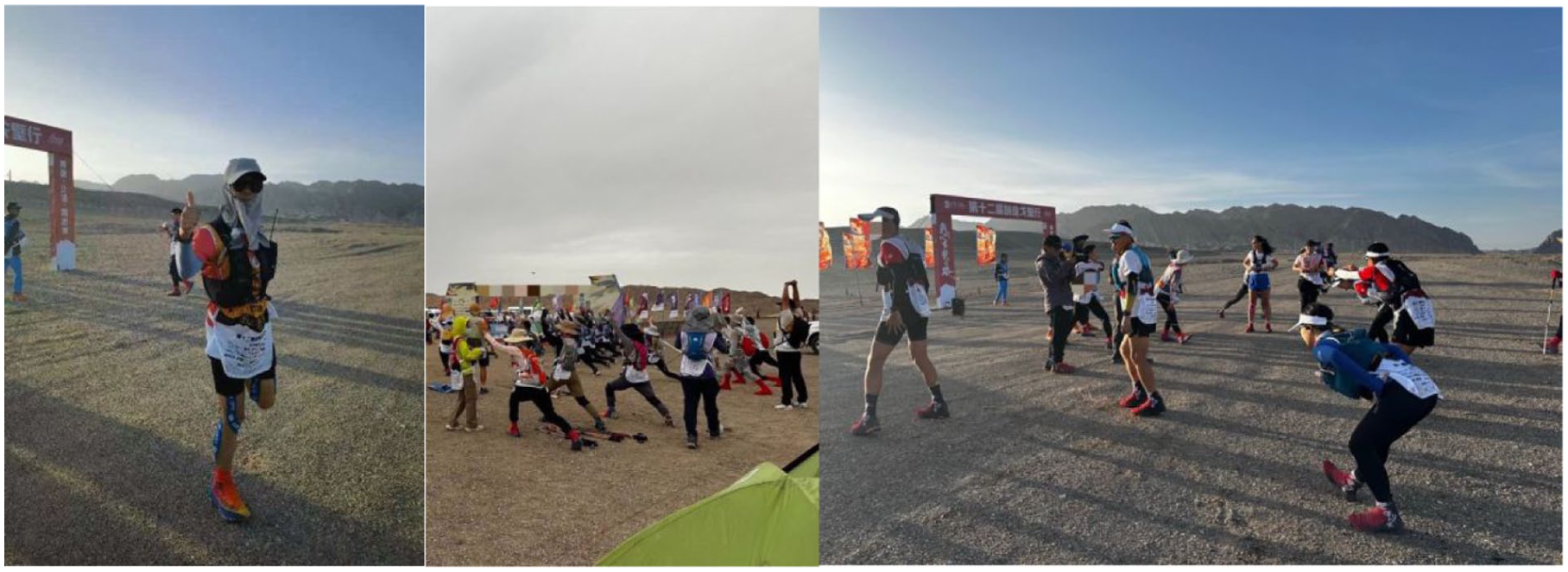
Bodily preparation.
As corroborated by interviewee T2-04, heightened sensitivity to bodily sensations during the trek further individualizes the shared physical ordeal, “I became more sensitive to my body’s sensations. During the trek, when I could only focus on my own body, I saw no one ahead or behind me. I could only feel my feet making contact with the ground of the Gobi Desert. I was acutely aware of any pain—my knees, thighs, calves. . .”
Participants often showed intense emotions physically, such as by yelling, laughing, or even kissing after crossing the finish line. These moments of release—crying, hugging companions, shouting declarations like “I did it!” and “It was soooooo hard!”—were rare outside of these events. Several photos that we took exemplify these reactions (Figure 3). Interviewee T2-07, a 7-year veteran of the Gobi Challenge, was visibly overwhelmed and in tears while embracing a companion after finishing the third day’s individual sprint. She later mused, “People who haven’t walked this path can’t understand. My emotions are different each year I participate. . . I don’t believe there’s such a thing as true empathy. At that moment, my emotions reached a peak I couldn’t control, and also I didn’t want to control them.”

Bodily celebration.
The much-talked phrase, “People who haven’t walked this path can’t understand,” powerfully signifies the subcultural boundary. The emotional release is not just personal; it is a collective performance of shared struggle and triumph, validated and understood only by other subculture members, making it a powerful bonding mechanism.
Self-expression is analogous to a performance (Goffman, 1959). One’s self-perception may manifest through subcultural activities in a communal setting (Ulusoy, 2016). The hard adventure subculture serves as a unique arena where travelers take on the roles. Radical self-expression is performative because the subcultural stage provides the audience (the community), the script (the values and narratives), and the permission for a performance of a radical self that would be incongruous in mainstream life. This performance is intrinsically tied to the shared embodiment of the challenge, making the group the essential witness and validator of the transformed self.
The Fragmented Self: Sustaining Transformation Through Subcultural Continuity
This final phase reveals how the hard adventure subculture provides the essential continuity that sustains the transformed self beyond the liminal trip experience.Informants channeled their anger and frustration through extreme activities. Typically, tourism provides a relatively safe setting: trip organizers’ norms, values, and rituals tend to anchor this experience. Subcultural practices conversely evoke feelings of disorder and passion. Participants must then rely on the sense of security, friendship, trust, respect, and community that these subcultures establish. The hard adventure subculture is in fact a platform where Dionysian principles (i.e., spontaneity and irrationality) can be enacted within a mainstream culture characterized by order and routine (Nietzsche, 1993; Ulusoy, 2016). Hard adventurers’ safe, regulated, niche collective thus emerges from individual self-differentiation. The fragmented self does not signify a failure of integration, but rather the ongoing negotiation between the subcultural identity internalized during the adventure and the demands of daily life. This negotiation is actively mediated by the subculture’s extension into everyday existence through sustained communal practices.
The interviewees described daily life as oppressive, in that it intensified their loneliness and frustration. These feelings propelled a search for meaning and liberation. Their participation in hard adventure tourism embodied a response to, and a form of resistance against, the alienation of usual life. They derived comfort from their subcultural identities, which they used to articulate their dissatisfaction with the everyday. Informants also expressed a need to vent about such conditions; hard adventure tourism presented an avenue to do so. Interviewee T2-08 recalled his experiences: “This place feels like a spiritual sanctuary to me. . . . Here, all my troubles and worries seem to dissipate. . . . Even though I know some issues will still be there when I return, while I’m here, my focus is solely on my own goals. I don’t compare myself to anyone; I aim to surpass my previous self. . . . Being with these familiar faces and accomplishing this task together brings a sense of comfort. . .” The subculture, therefore, functions as a temporary sanctuary from mainstream pressures, and the familiar faces represent the enduring community that sustains the transformed self. The sense of fragmentation arises from the contrast between the meaningful, embodied existence within the subculture and the often-alienating routine of daily life.
For seasoned adventurers, the subculture provides a long-term identity project. For interviewee T1-03, who had traveled to Tibet more than 10 times, adventure had transcended physical challenges to symbolize spiritual significance. He discussed the personal importance of climbing; this activity intertwined with navigating illness in his family and confronting his own debilitating condition that was preventing him from climbing at the time of this study. Despite these barriers, he confessed that he still dreamt of scaling Mount Everest. When queried about his motivation, he replied, “I don’t know why, I just want to go. Maybe it has become a pillar of support for me. I am now diligently working on my recovery, taking care of my body, actively rebuilding, all so that one day I can make it to Everest again. . .” Here, the subcultural narrative (i.e., the value of perseverance and mastery) is sustained through a future-oriented, bodily goal, demonstrating how the subculture offers a meaningful framework that extends far beyond the trip itself.
Critically, this continuity is institutionalized through deliberate subcultural practices in daily life. Gobi adventurers forged a community called “geyou” (in Chinese, meaning friends who have participated in Gobi Desert hiking), meeting regularly to discuss their experiences, exchange training routines, and share life insights. While no hard adventure occurs at these gatherings, the interactions persistently center on the embodied memories and future physical goals derived from the shared ritual (see Figure 4). This community is the mechanism that brings the hard adventure subculture into the mainstream, allowing the values and identity forged in the desert to be continually rehearsed and reinforced.

Typical community gathering.
Even solo transformative tourists could form temporary subcultural groups during their trips, although spatial and temporal constraints may prevent these people from reuniting in daily life post-travel. However, the experiences’ effects frequently compelled solo travelers to either reconnect with groups in their usual environments or to join new offline or online communities. The experience created a pull toward community based on the presumption of shared values. Indeed, this sentiment finds broader resonance among hard adventure participants. For instance, Interviewee T1-12 shared her thoughts on this phenomenon: “I am naturally someone with social anxiety who usually does not initiate conversations. But during this trip, I discovered that even those of us with social anxiety can gradually find like-minded individuals. . . . Initially, I felt awkward in the group [which was a spontaneous group composed of travelers on the same itinerary], always concerned about fitting in and connecting with others. . . . But I soon realized that there must be others who resonate at the same frequency as me, otherwise we wouldn’t have chosen the same activities and itinerary. . . . And indeed, I met. . .” The transformative effect often compelled them to seek out like-minded individuals or join new communities post-travel.
The youngest of our interviewees (T2-10) said that as he was embarking on his college journey, he planned to either create or join a hiking club. His intentions suggest that transformative travel experiences can drive people to seek out subcultural coexistence within their everyday lives. That is, individuals yearn to infuse these experiences into more permanent aspects of their identities and social interactions. The role of subculture does not end with the trip; it inspires individuals to actively reproduce the subculture in new contexts, ensuring its survival and the persistence of their transformed identities.
In conclusion, the hard adventure subculture fosters cohesion that outlasts the trip. As Goulding et al. (2002) found, the collective appreciation of shared meanings brings people together. The fragmented self is not an endpoint but a dynamic state managed through the subculture’s continuity. The subculture, through institutionalized communities and shared narratives, provides the “soil” in which the seeds of transformation, sown during the embodied ritual, can take root and grow in the landscape of daily life.
Discussion and Conclusion
This study has addressed the integrative processes (Neuhofer, 2024) before and after transformative tourism journeys. Moving beyond identifying the co-presence of embodied and subcultural factors, we have introduced and empirically substantiated the framework of the embodied subcultural ritual as the core mechanism driving transformation. Our ethnographic investigation revealed how transformations unfolds through the dynamic interplay between the subculture (providing the script) and embodied practices (the performance) across three ritual phases. Building on Neuhofer and Dulbecco’s (2024) findings, the results of this research show that personal transformation is not confined to peak moments (Maslow, 1964) but is a process cultivated through sustained physical and mental engagement within a meaningful social context.
Hard adventure tourism generates meaning for participants through the fusion of embodied and subcultural experiences within the ritual. Such value creation spawns transformation, typified by subcultural praxis that encompasses the progression of the controlled self that forged through bodily discipline guided by the subculture, the radical self that performed through shared embodiment within the group), and the fragmented self that sustained through the subculture’s continuity in daily life. Our findings suggest a contrast between the passion, release, and visibility often associated with hard adventures and the restraint, suppression, and control that can characterize daily life. Our depiction of hard adventure is grounded in Dionysian principles. These tenets reflect some tourists’ hunger for extreme embodied experiences and exceptional performance—namely that which feels active, limitless, and transcendent. For these travelers, transformation is accelerated at the nexus of the subcultural script and the bodily performance, a synergy visually summarized in Figure 5.

The process of self-transformation through the embodied subcultural ritual.
Figure 5 illustrates this process of self-transformation through the embodied subcultural ritual. The process begins with the controlled self amid chaos achieved through bodily preparation, scripted by subcultural norms. This evolves into the radical self in group expression through bodily performance, where identity is expressed and validated by the subcultural community. Finally, sustained involvement leads to the fragmented self within subcultural communitas, where the individual’s identity becomes deeply intertwined with the subculture through ongoing communal practices.
In this context, subcultural adventurers differentiate themselves from mass tourists by creating “emancipated spaces” (Firat & Venkatesh, 1995, p. 235) that evoke feelings of passion, irrationality, enchantment, unpredictability, and creativity. This study demonstrates that the emancipation is not merely spatial but is fundamentally achieved through the ritualized, collective performance of the body, which evokes feelings of passion and creativity. The critical theoretical advancement here is showing how these subcultural practices are transferred into everyday life, enabling individuals to reconstruct their identities through communities like the “geyou,” which act as institutionalized extensions of the ritual (R. V. Kozinets, 2002).
While much consumer research has focused on how subcultures deviate from mainstream cultural and market norms, our findings highlight a deeper, complementary function that subcultures act as salves for modern alienation by providing a script for meaningful, embodied existence. Hard adventurers pursue not only meaning and personal empowerment but also reconnection through the communal body. Subcultures can thus play a vital role in establishing enduring community ties that people often fulfill their needs for care, emotion, respect, sincerity, and a sense of social belonging in these spaces. The hard adventure subculture accordingly fosters authentic relationships and experiences by empowering group members through shared embodied trials.
Our findings echo yet refine previous research on transformation stages (i.e., Cavender et al., 2020; Mezirow, 1994). This ethnographic study contextualizes the transformative process by theorizing the disorienting dilemma as the trigger for ritual recruitment, self-reflection as an embodied practice within the ritual, and critical discourse as the narrative work of the subcultural community. The identified phases align with the integration process (Neuhofer, 2024), framing mainstream life as pre-liminal preparation, the subcultural adventure as the liminal phase of the embodied ritual, and the return as a post-liminal phase where integration is actively mediated by the sustained subcultural community (Kirillova et al., 2017a; Neuhofer & Dulbecco, 2024).
Theoretical Implications
This research makes several theoretical contributions. First, it introduces and empirically validates the integrative framework of the embodied subcultural ritual as the core mechanism for self-transformation in hard adventure tourism. Moving beyond a dialectical perspective that merely juxtaposes subculture and tourism, this framework theorizes that the subculture provides the script that is physically performed and experienced through embodied practices. The hard adventure subculture actively orchestrates the transformative journey through a continuous process that begins by shaping embodied practices in the preparatory phase, imposing disciplined scripts through shared training regimens that forge the controlled self. This preparatory discipline seamlessly transitions into the adventure itself, where the subculture gives profound meaning to physical hardship by reframing it as a valued rite of passage; the shared rituals and collective celebration of endurance at the finish line serve to validate the radical self in real-time. Ultimately, the subculture reinforces this transformation post-trip by sustaining communities, which perpetuate the embodied memory and provide a social structure that nurtures the fragmented self upon reintegration into daily life. Thus, the subculture’s influence is not confined to a single phase but operates as a dynamic, reinforcing loop—disciplining, meaning-making, and sustaining—to ensure the enduring impact of the embodied experience. The primary theoretical advancement lies in modeling the transformation process not as a sequence of factors but as a dynamic, ritualized interaction between the social script and the bodily performance.
Second, based on our conclusions, we call for greater attention to the temporal dynamics of transformative tourism experiences. Facing challenges in adventure tourism produces effects that evolve with time. We additionally explored the dialectical, fluid relationships between (a) difficulty and transformation and (b) self and community as per hard adventurers’ narratives. While many transformation-focused studies revolve around how transformation happens through instances of disequilibrium and discomfort (Kirillova et al., 2017a; Soulard et al., 2019; Teoh et al., 2021), this research is among the earliest to demonstrate how subcultural communitas shapes adventure tourists’ reintegration into everyday life after liminoid encounters. This approach offers fresh insights into how transformative experiences persist amid the relative mundanity of daily life by showing that the relationship between the self and the community is not static but evolves through a process of mutual reinforcement, as illustrated in our model.
Third, this study adds to the literature on adventure tourism and transformative tourism by referencing the consumer theory of subculture. We considered how subcultural identities and practices shape consumers’ behavior within the travel context. This approach speaks to how subcultural affiliations influence tourists’ experiences. Our study goes beyond common triggers, facilitators, and inhibitors of transformative tourism experiences identified in preceding work (Kirillova et al., 2017b; Pung et al., 2024) by explicitly demonstrating that sustained engagement within subcultural communities yields profound personal change. This is achieved through a cumulative “exposure dose,” a concept critical to the transformation process as argued by Bethelmy and Corraliza (2019) and Neuhofer and Dulbecco (2024). The present research thus transcends the situational analyses prevalent in transformative studies by showing that the subculture provides a lasting framework that shapes behavior, defines values, and facilitates the interpretation of experiences long after the journey ends.
Practical Implications
With respect to industry, tourism practitioners should adopt impact-centered and culturally specific approaches (Janowski et al., 2021) in their product design and marketing. These strategies should address hard adventure tourism’s immediate and long-term social and psychological effects while embracing travelers’ embodied and subcultural experiences. Service providers should enhance their programs to help adventurers realize authentic, diverse embodiment. As Li and Chan (2023) suggested, difficult encounters can enrich one’s overall experience by promoting personal fulfillment. Our research revealed a clear journey involving the controlled self, the radical self, and the fragmented self. Tourism operators can intentionally design itineraries to support this progression by structuring adventures with explicit phases. The pre-trip “entrance stage” could include mandatory physical training and workshops to help tourists build the “controlled self.” The adventure’s climax should be framed as an “immersive stage” where guides foster the “radical self” through shared group challenges. Finally, a dedicated “extraction stage,” such as a post-trip debriefing or an alumni community, can help travelers navigate the “fragmented self” and solidify long-term transformation upon returning to daily life.
Moreover, the findings underscore the necessity of designing for subcultural “communitas” and authentic embodiment. The subculture’s value lies in its creation of authentic community and its focus on embodied mastery. Practitioners should, therefore, devise up-to-date, culturally tailored strategies that cater to hard adventurers’ demands. Incorporating the subcultural context into product and service design can enliven tourism by encouraging interaction and emotional engagement. This can be achieved by creating “emancipated spaces” at basecamps that feel distinct from mainstream environments through the use of unique symbols and rituals. It is also crucial to employ guides who are genuine members of the hard adventure subculture, positioning them as mentors who model values and facilitate connections, rather than mere logistical managers. The activity design itself must prioritize direct, physical engagement and skill development, as these embodied experiences are the very mechanism of transformation. These techniques are not intended to discard usual means of maximizing tourist satisfaction. Instead, they emphasize subcultural experiences’ value in bolstering creativity and productivity (Bennett, 2013; Ustymenko, 2019) through adventure tourism planning and management.
Finally, the profound personal outcomes reported by participants highlight the need for a coordinated, impact-centered approach among all stakeholders. Local governments, volunteer associations, and private companies should collaborate to create “transformation-led” safety and service standards that enable hyper-customization. This partnership could facilitate itineraries with varying levels of physical difficulty that clearly articulate intended personal outcomes, such as resilience-building or community-connection. Consequently, marketing materials should shift their focus from showcasing destinations to promising a transformative journey, using authentic testimonials that speak directly to the subcultural belonging and self-discovery identified in this research. By grounding their strategies in the specific mechanisms of transformation uncovered here, industry stakeholders can move beyond superficial satisfaction to facilitate deeply meaningful and enduring changes for hard adventure tourists.
Limitations and Future Research
Like any research endeavor, this study has limitations. First, adventure tourism holds transformative potential, but hard adventure’s effects are not universal: this option provides a snapshot of transformation in certain settings. The effects of hard adventure are not universal, and the specific attributes of the activities covered (i.e., extreme endurance, significant risk) directly informed participants’ views and experiences. Consequently, our theoretical framework detailing the transformation process may be less applicable to softer forms of adventure tourism or other transformative travel contexts that lack a strong subcultural element or intense physical embodiment.
Second, our chosen methodology, ethnography, while rich in depth, presents inherent constraints. The combination of participant observation and interviewing can introduce challenges related to researcher subjectivity. Although we employed strategies to ensure trustworthiness, the researchers’ immersion in the subculture could have influenced both the data collection (i.e., what was observed and how questions were asked) and the interpretation of narratives and behaviors. This may have led to a perspective that is particularly attuned to the subcultural values we set out to study, potentially overlooking alternative interpretations of the experiences.
Third, potential opportunity-based disparities are also a concern given that 2 years separate data collection from earlier and more recent interviews with desert hikers and participant observation. This raises the possibility that participants’ retrospective accounts in Stage I were subject to recall bias or post-hoc rationalization of their transformative journeys, which may not have been fully aligned with the real-time observations in Stage II. While this allowed for a broader view, it may have introduced inconsistencies in the data regarding the immediacy and nature of the transformative process.
Building on these limitations, future research has several promising pathways. To gain a firmer understanding of transformative experiences across different contexts, studies should include participants of diverse backgrounds, age groups, and engagement levels. This would help test the boundaries and transferability of the model. Furthermore, scholars can gather data across multiple periods or employ methods such as the biographical approach to more deeply explore the dynamics of, and the change processes within, subcultural relationships (Breckner & Rupp, 2002). This approach would allow for a richer analysis of how personal and subcultural histories evolve.
Supplemental Material
sj-docx-1-jtr-10.1177_00472875261447265 – Supplemental material for Subcultural Praxis via Sparking Journeys: Self-Transformation and Embodied Experiences Among Hard Adventurers
Supplemental material, sj-docx-1-jtr-10.1177_00472875261447265 for Subcultural Praxis via Sparking Journeys: Self-Transformation and Embodied Experiences Among Hard Adventurers by Wenqing Xu, Yi Wang, Hongtao Wang and Mimi Li in Journal of Travel Research
Footnotes

Author Contributions
Funding
The authors disclosed receipt of the following financial support for the research, authorship, and/or publication of this article: This paper is funded by a Research Grant of School of Hotel and Tourism Management, The Hong Kong Polytechnic University (G-UAM4).
Declaration of Conflicting Interests
The authors declared no potential conflicts of interest with respect to the research, authorship, and/or publication of this article.
Supplemental Material
Supplemental material for this article is available online.
Author Biographies
References
Supplementary Material
Please find the following supplemental material available below.
For Open Access articles published under a Creative Commons License, all supplemental material carries the same license as the article it is associated with.
For non-Open Access articles published, all supplemental material carries a non-exclusive license, and permission requests for re-use of supplemental material or any part of supplemental material shall be sent directly to the copyright owner as specified in the copyright notice associated with the article.
