




Abstract
Luxury tourism is known for projecting status and prestige, largely considered a positive outcome for tourists. However, a dark side may emerge in the form of imposter syndrome, especially for aspiring luxury tourists. This research is the first tourism study examining status-related imposter thoughts (beliefs that others overestimate one’s status) and their emotional and behavioural consequences. Through four experiments across different luxury tourism settings, we find that luxury experiences trigger imposter thoughts, which link to increased authenticity-seeking, anxiety, and dejection. Effects diminish when tourists possess prior similar experiences or perceive preferential treatment as deserved. Additionally, the absence of other tourists reduces imposter-driven anxiety, while their presence amplifies it. Our contributions lie in establishing imposter thoughts as an overlooked but consequential cognition in luxury tourism for tourists, and in guiding managers toward tackling their effects through authenticity provision and practices that ensure luxury is perceived as deserved.
Keywords
Introduction
When I stayed at a luxury resort, I felt like people thought I had more money and status than I really do, which made me feel uneasy (Luxury resort guest, male, age 55)
Luxury tourism is highly popular and has attracted decades of attention from scholars (Luna-Cortés et al., 2022). At five-star hotels, luxurious safaris, Michelin-star restaurants, or during first-class air travel, people are drawn by the quality, comfort, and unique hedonistic experiences (Vigneron & Johnson, 1999). Although historically associated with the ultra-wealthy, luxury travel has become increasingly accessible, through providers offering ‘affordable luxury’ experiences (Lo & Yeung, 2020). In 2023, the largest share of global spending on luxury leisure hospitality came from “aspiring luxury” tourists, defined as individuals with household net worths between $100,000 and $1 million who pursue premium experiences motivated by aspirational goals (Statista Research Department, 2025; Kelleher, 2024). Given that roughly 80% of U.S. households fall below the $1 million threshold (Grace, 2024), this segment represents a critical focus for luxury tourism managers and scholars. Aspiring luxury tourists may not regularly engage in luxury consumption but selectively invest in prestige-driven experiences, such as high-end resort stays after careful budgeting and deal hunting (Marsh, 2024). This raises an intriguing question: when individuals with relatively modest means immerse themselves in such high-end settings, do they sometimes feel like imposters?
Imposter phenomenon (often referred to as imposter syndrome) was first introduced by Clance and Imes (1978) in their study of professional women, which found they felt a sense of inauthenticity and phoniness in the workplace (see also Badawy et al., 2018; Canning et al., 2020). Over the past decade, the phenomenon has garnered significant academic attention largely in the management, organisational, and psychology literature (see Tewfik et al., 2025 for a review). This is due to its relevance to the working public and frequent media coverage (Gullifor et al., 2024). The sociocognitive framework of imposter phenomenon (which guides the present research) maintains the core aspect of its original conceptualisation: an individual’s belief that others overestimate their desirable traits. Tewfik (2022) defines this cognition as imposter thoughts, referring to the belief in a discrepancy between how one thinks others perceive a trait they possess and how they perceive it themselves.
At present, imposter research has focused almost exclusively on competence as the underlying trait, reflecting both the construct’s origins and its dominant application in employee contexts (Tewfik et al., 2025). Within tourism, the only study to date has examined female hospitality managers (Forson et al., 2025), demonstrating the construct’s relevance to the industry, but restricting insights to the employee perspective. Yet, imposter thoughts need not be limited to competence (and thus naturally situated with employees); they can arise from any desirable self-trait, offering wide potential for application in broader contexts and stakeholders. Extending this lens beyond employees is important, as imposter thoughts are known to elicit negative emotions and shape how people act and consume (Marder et al., 2024). At present, imposter thoughts among luxury tourists remain entirely overlooked, representing a significant gap in current understandings. Should they occur, such thoughts may undermine well-being and the overall experience while also shaping destination visitation choices, making their recognition vital for both tourists and tourism managers.
Engaging in luxury tourism carries symbolic meaning, signalling status and prestige to others; an effect well acknowledged as a motivator for luxury travel (Iloranta, 2022; Wang & Griskevicius 2014). While signalling high status is often viewed as desirable (Sivanathan & Pettit, 2010), it may also carry a darker side by triggering status-related imposter thoughts, which based on Tewfik (2022), we define here as the belief that others overestimate one’s status during tourism experiences.
As the link between status-related imposter thoughts and luxury tourism remains underexplored, we conducted a small supplementary survey study to ground this research in actual experiences of the phenomenon, providing a sense of how commonly such experiences arise in luxury travel contexts. The study involved 106 U.S. residents who had recently engaged in luxury travel. Participants were presented with a definition of status-related imposter thoughts and asked whether they had experienced such thoughts during a luxury travel encounter (Yes/No). Those who responded affirmatively were invited to describe their associated feelings and behaviours in open-ended text boxes. Full details of the data collection and analyses are provided in Supplemental Appendix A.
Findings indicate that 70% of respondents reported experiencing status-related imposter thoughts to some degree during their luxury travel experiences. An exemplar of this is provided by the opening quote (taken from the supplementary study), which describes a tourist staying in an overwater villa at a luxury resort in the Maldives who experienced discomfort arising from the belief that others perceived him as having higher status than he actually possesses (male, age 55).
Considering these findings, status-related imposter thoughts appear to be a meaningful feature of luxury tourism experiences, highlighting the importance of the current lack of systematic understanding of this phenomenon – a gap that the present research seeks to address. For this we adopt the sociocognitive imposter framework, conceptualising and testing, “if” luxury tourism acts as stimulus for imposter thoughts and whether these thoughts lead to behavioural and affective responses (Tewfik 2022; Marder et al 2024). We further explore “when” and for “whom” these effects are most pronounced.
We focus on personal authenticity seeking as the key behavioural outcome of imposter thoughts, defined as the pursuit of tourism offerings perceived as congruent with one’s true self (Bartsch et al., 2022). Personal authenticity is closely tied to identity and the drive to be true to oneself (Reisinger & Steiner, 2006). To illustrate, our supplementary study reveals tourists deliberately opting for public transport, local interactions, cultural visits, and non-VIP services as a method of reducing their imposter thoughts through engaging in experiences that felt truer to themselves. Although imposter thoughts may spur various behavioural responses, such as wanting to increase one’s status or avoiding luxury (Mandel et al., 2017; Tewfik et al., 2025), we focus on authenticity seeking for two core reasons. First, authentic experience research is an important area within tourism literature and has been shown to enhance traveller well-being and satisfaction within tourism (e.g., Eck et al., 2023; Yi et al., 2022). Second, it is a natural antidote to imposter feelings, which are rooted in perceived inauthenticity and phoniness (Badawy et al., 2018; Canning et al., 2020). When people feel others see them as something they are not, they are motivated to pursue experiences that represent who they truly are.
The overarching purpose of this research is to advance understandings of status-related imposter thoughts in luxury tourism and their implications for aspiring luxury tourists’ experiences. Specifically, we aim to examine (a) whether engaging in luxury tourism experiences triggers status-related imposter thoughts; (b) how such thoughts influence tourists’ pursuit of personal authenticity-seeking experiences; and (c) the conditions under which these thoughts are more or less likely to arise, including tourists’ perceived deservingness of luxury and prior experience with similar offerings. Finally, we investigate the emotional consequences of status-related imposter thoughts, focusing on feelings of anxiety and dejection, particularly in socially interactive luxury settings.
We offer four contributions to both luxury tourism and imposter literature. First, we advance tourism research by identifying imposter thoughts as a critical yet overlooked psychological effect of luxury tourism consumption for aspiring luxury tourists, introducing a new operationalisation based on status perceptions and outlining boundary conditions, such as deservingness and prior experience. Second, we contribute to luxury tourism’s “dark side” literature (Jones, 2020; Nghiêm-Phú & Shibuya, 2021; Zhang et al., 2019) by showing that status displays can trigger imposter thoughts, producing internal costs for tourists in the form of negative emotion. Third, we enrich both areas of literature by positioning personal authenticity-seeking as a novel outcome of imposter thoughts, and moreover luxury tourism, extending authenticity research in tourism while also answering calls to investigate positive consequences of imposter thoughts (Tewfik, 2022). Finally, we extend work on preferential treatment in tourism and services more broadly (Colliander et al., 2019; Mattila et al., 2013) by demonstrating that imposter thoughts are especially pronounced in undeserved contexts, offering a new explanation for the discomfort observed in prior studies.
Sociocognitive Framework of Imposter Thoughts
Imposter phenomenon was coined by clinical psychologists Clance and Imes (1978) in a study of high-achieving, middle-class, white women. Since then, the imposter phenomenon garnered significant attention in work-related settings, presenting itself across genders, professions, and racial groups (Bravata et al., 2020). Most theoretical and empirical work has conceptualised the phenomenon primarily through an affective lens, emphasising feelings of phoniness, inauthenticity, and fear of exposure (e.g., Hutchins et al., 2018). While this perspective has yielded valuable insights, Tewfik (2022) highlights a critical limitation: much of this work has shifted away from the phenomenon’s fundamental sociocognitive roots. At its core, the imposter phenomenon is understood as a cognition rather than affect, specifically it is a belief that others in the social environment overestimate oneself (Clance & Imes, 1978). This sociocognitive perspective is further supported by Leary et al. (2000). Building on this foundation, Tewfik (2022) advances a sociocognitive conceptualisation of imposter thoughts, which we adopt as the overarching framework for our examination.
To maintain cognition at the centre, this framework conceptualises the imposter phenomenon as imposter thoughts, which Tewfik (2022) defines in the work context as “the belief that others overestimate one’s competence at work” (p. 991). At its core, the sociocognitive framework understands imposter thoughts as a perceived discrepancy between two cognitions: what one believes about one’s own traits or characteristics (e.g., ability) and what one believes others attribute to them. For instance, an individual may view themselves as not particularly intelligent yet assume that others regard them as highly capable. This sociocognitive framework is grounded in long-established cognitive psychological theories such as self-discrepancy theory (Higgins, 1987), self-regulation theory (Carver & Scheier, 1998), and objective self-awareness theory (Wicklund, 1975), which explain how mismatches within the self-concept become salient and generate affective and behavioural responses.
Building on these foundations, the sociocognitive imposter framework proposes that certain experiences (the stimulus experience) elicit imposter thoughts, which in turn motivate behaviour (the behavioural response) and evoke negative affect (the affective response). To illustrate, Marder et al. (2024) applied this framework (i.e., stimulus experience → imposter thoughts → behavioural & affective response) to examine imposter thoughts in the context of LinkedIn use. They found that both scrolling one’s LinkedIn feed and posting a success update served as stimulus experiences that activated imposter thoughts, which subsequently led to a desire to purchase professional training (behavioural response) and heightened anxiety (affective response). It is important to note that for imposter thoughts to influence behaviour and emotion, the cognition need not reflect reality; the mere perception of a discrepancy is a sufficient catalyst (e.g., Meister, Jehn, & Thatcher, 2014).
It is critical to acknowledge that existing research on the imposter phenomenon (predominately within management, organisation, and psychology studies) has focused almost exclusively on competence-related traits of employees within work contexts. In this vein, the only tourism study to date has examined the imposter phenomenon among female hospitality employees, finding that it negatively affects organisational commitment, career advancement, and employee engagement (Forson, Hao, & Cheung, 2025). However, imposter thoughts are not confined to perceptions of competence; they can arise in relation to any characteristic or trait that individuals believe others overestimate (Tewfik, 2022). For example, people may feel like imposters if they believe others see them as more attractive than they see themselves (Windingwheel, 2013). Similarly, imposter thoughts can arise in relationships when one partner feels the other overestimates their qualities, such as status, kindness, morality, or sexual ability (Gulino, 2020).
Since imposter thoughts function as drivers of both behaviour and affect, it is essential to investigate them across broader domains and traits (Marder et al., 2024). Indeed, such thoughts may also arise among tourists, uncovering important implications for behaviours and well-being outcomes during travel experiences. In the following section, we turn to the context of luxury tourism. Drawing on the sociocognitive framework, we propose that luxury tourism experiences can serve as stimuli that elicit imposter thoughts related to one’s perceived status, resulting in subsequent behavioural and emotional consequences.
Luxury Tourism as a Stimulus for Imposter Thoughts
The definition of luxury tourism is complex (Iloranta, 2022). Two broad stances on the definition exist, the former based on objective characteristics (e.g., price, quality, exclusivity), and the latter founded on the subjective experience of tourists, that is, what luxury means to the individual (Wirtz et al., 2020). Given our attention is on tourists’ psychological processes, we consider luxury through the eyes of consumers (Tynan et al., 2010).
While much of the existing literature centres on elite travellers, the demographic landscape of luxury tourism is evolving. As noted earlier, the aspirational luxury segment, comprising individuals who do not belong to the traditional elite, including those with net worths below the U.S. median, is now the largest group within the luxury travel market (Statista Research Department, 2025). These travellers frequently engage in “prestige splurging,” selectively investing in high-end experiences such as Michelin-starred dining or helicopter tours, while maintaining an overall value-conscious mindset (Tufft et al., 2024). Their consumption aligns with the notion of masstige, or mass prestige, wherein luxury is sought for symbolic rather than habitual purposes (Silverstein & Fiske, 2003). Many luxury brands now cater to these travellers through accessible premium offerings, such as limited indulgence packages (Fortune Business Insights, 2025; Tufft et al., 2024).
Luxury tourism can be intrinsically motivated with tourists wishing to enjoy the experiential perks of luxury, such as comfort or fine food (Vigneron & Johnson, 1999). However, it can also be extrinsically (socially) motivated, as it is well known to project status (Iloranta, 2022), and is therefore a form of conspicuous consumption, that is, socially signalled consumption that sustains or enriches a person's social position (Correia et al., 2016; Woodside et al., 2005). For instance, Hwang and Lyu (2018) show that being perceived as prestigious drives first-class air travel. Furthermore, social media has allowed such status signalling en masse. Cohen et al. (2022) in their analysis of images connected to #richkidsofinstagram found luxury transport usage (e.g., private jets, high-end sport utility vehicles) was employed to project status to followers.
Conspicuous consumption has been found to have positive effects on individuals. For example, Sivanathan and Pettit (2010) show that consuming status goods provides reparative effects on consumer’s egos and protection against future threats. However, although luxury consumption and status signalling may be desirable from an individual’s perspective, it can backfire socially. For example, Garcia et al. (2019) evidence with multiple studies, the status signals paradox; although people think wearing an expensive watch or driving a luxury car enhances their attractiveness, it can have the reverse effect. Imposter thoughts may also be an important but currently overlooked implication of aspiring luxury tourists.
Given luxury tourism’s association with status projections, it is logical that status-related imposter thoughts may be engendered during these experiences. Drawing from Tewfik (2022), we define tourist status-related imposter thoughts as the belief that others overestimate one’s status during a tourism experience. That is, aspiring luxury tourists may believe a discrepancy exists between others’ perceived view of their status and their actual held status. Though no existing studies directly examine imposter thoughts of luxury tourists, indirect support is provided by Goor et al. (2020) who show feelings of inauthenticity arise from luxury consumption (e.g., expensive clothes) due to undue perceptions of privilege. Further indirect support is found within online forums. On Reddit, one user discusses anxiety related to going to a Michelin-star restaurant, saying they are “afraid of being an imposter” (Reddit, 2024), while another user expresses worries about fitting in within a posh hotel (Reddit, 2021).
It is useful to note, related constructs such as social identity threat (concern about being devalued based on one’s social identity; Steele et al., 2002), status anxiety (worry over one’s social standing; De Botton, 2004), and stigma consciousness (expectation of being stereotyped; Pinel, 1999) are also plausible outcomes of luxury tourism, especially for aspiring luxury tourists who may feel lower status relative to others in luxury settings. Though valuable avenues for study, these constructs primarily capture responses to perceptions of lower status, whereas imposter thoughts reflect a more complex interplay between self-perceived lower status and the belief that others over-ascribe status. This nuance introduces a novel construct into tourism research with important emotional and behavioural implications. Accordingly, imposter thoughts offer a novel and useful lens for understanding the psychological consequences of luxury tourism.
Within the sociocognitive imposter framework, we position luxury tourism experiences as stimuli for status-related imposter thoughts. As Marder et al. (2024) note, for a stimulus experience to elicit imposter thoughts, it must simply possess “applicability” to the trait underpinning the imposter cognition (see Higgins, 1989; Higgins, 1996). In parallel, competence-related imposter thoughts emerge in professional contexts where competence is inherently salient, such as interviews or presentations (Hall & Gosha, 2018; Hutchins & Rainbolt, 2017). Similarly, status-related imposter thoughts (hereafter, imposter thoughts) are likely to arise among aspirational luxury tourists when engaging in luxury tourism experiences, which are closely bound to social status (e.g., Iloranta, 2022). Luxury tourism as a stimulus for imposter thoughts was strongly supported within our supplementary study, for example, while staying at a luxury resort, one guest (Female, Age 37) revealed they “felt like people thought I had more money and status than I really do, which made me feel uneasy and out of place, almost like I didn’t belong there.” Similarly, a participant (Female, Age 23) stated that being a VIP guest at Disney World made them feel like they were “playing the part of a rich person.” Accordingly, we propose:
Personal Authenticity-Seeking as the Behavioural Response
Authenticity holds a rich history within tourism research, explored in a multitude of ways (Rickly, 2022). Of relevance here, scholars have examined authenticity as a motivator for travel. This is often referred to as authenticity-seeking behaviour, that is, actions undertaken to satisfy a need for authenticity, such as visiting a destination to experience a stronger sense of something true in some sense. (e.g., Waller & Lea, 1999). Beverland and Farrelly (2010) state, “consumers actively seek authenticity to find meaning in their lives,” preferring brands and experiences that support this (p. 839). Bartsch et al. (2022) offer three dimensions of authenticity-seeking: true, iconic, and personal, which represent the demand side of consumer authenticity. They define true authenticity-seeking as peoples’ search for offerings they perceive as corresponding to the actual state of being; people seek the “real deal” rather than a “fake experience.” Iconic authenticity-seeking is defined as the search for offerings which resemble a socially determined iconic standard. Lastly, personal authenticity-seeking, which is the focal variable in the present study, is defined as individuals’ search for offerings they perceive to be congruent with their true selves (Bartsch et al., 2022). Personal authenticity is inextricably linked with one’s identity and one’s drive to be true to oneself (Reisinger & Steiner, 2006). In this vein, tourism experiences have long been recognised as a means of helping individuals “get in touch with their true selves,” serving as a key vehicle for personal authenticity-seeking (Yeoman et al., 2007, p. 1135).
Within the sociocognitive imposter framework, we propose that luxury tourism experiences may trigger personal authenticity-seeking as a behavioural response to address arising imposter thoughts. In line with long-established work in psychology, active self-discrepancies drive behaviour to reduce related psychological discomfort, known as self-regulation (Carver & Scheier 1998; Higgins, 1987). Mandel et al. (2017) categorise self-regulatory consumption behaviour, two of which are notable here as they are both well aligned with seeking new products or experiences: direct resolution and fluid compensation.
Direct resolution behaviour involves addressing the source of the self-discrepancy head on. Exemplified, direct resolution may manifest in joining a gym or buying makeup in individuals whose actual attractiveness fails to match their ideal state (Schouten, 1991). Such direct resolving of status-related imposter thoughts would require aligning one’s perceived actual status with that ascribed by others, which is problematic given one’s own perceived status is typically stable and resistant to short-term change (Goodman et al., 2015). In contrast, fluid compensation involves resolving a self-discrepancy by affirming alternative traits distinct from the source of the self-discrepancy. Mandel et al. (2017) state that the notion of fluid compensation is a core tenet of self-affirmation theory. Hence, when self-discrepancy is active, individuals often reinforce other valued facets of the self (Steele, 1988). In a tourism context, Marder et al. (2019) found viewing idealised vacation posts increased purchase intentions of products that enhanced feelings of general success, to reduce self-discrepancies related to belonging and adventure.
We position personal authenticity-seeking as a form of fluid compensation and a principal self-regulatory strategy for addressing imposter thoughts in the context of luxury tourism. Personal authenticity-seeking is a natural fit as an antidote to the imposter phenomenon, given that the very notion of being an “imposter” is rooted in perceived inauthenticity. Multiple studies in workplace settings (Badawy et al., 2018; Canning et al., 2020) and one in the luxury consumption context (Goor et al., 2020) link imposter experiences with feelings of phoniness and fakeness. Given the logic above on fluid compensation, it is rational that when an experience triggers people to feel that others see them as something they believe they are not (i.e., perceived inauthenticity), they are driven toward other experiences that they believe better align their self-view with the views of others (i.e., authenticity).
Although no prior research has directly demonstrated that personal authenticity-seeking mitigates imposter thoughts, media accounts often suggest that overcoming imposter syndrome requires embracing one’s “true self” (Hemphill, 2023). Our supplementary study provides further reinforcement. For example, a 5-star luxury hotel guest (Male, Age 31) recalls, “being out-of-place, particularly at the formal dinners or spa treatments” (i.e., luxury stimulus experiences) feeling like “people thought that I was a member of some elite lifestyle that I was not” (i.e., imposter thoughts). Further, he chose to relieve these imposter feelings through engaging in “more relaxed or local experiences beyond the resort, such as eating at a family run trattoria, going to local villages, or taking a cooking course with a local chef” (i.e., authenticity seeking). In a similar vein, another participant (Male, Age 29) expressed “People thought that I was rich since I was doing luxury vacation, but it was not the case” so they “started taking public transportation rather than taxis”.
Following the sociocognitive framework previously specified, our central proposition is that luxury tourism experiences heighten motivations for personally authentic tourism as individuals attempt to resolve imposter thoughts. The way this motivation manifests, however, depends on each individual’s perception of what constitutes authenticity for themselves. Accordingly:
The cornerstone of the sociocognitive framework is that imposter thoughts reflect a discrepancy between self-perceived and others’ perceived status during luxury tourism. We now turn to boundary conditions that may narrow or widen this imposter gap, specifically deservingness and prior experience. Recent work has emphasised that boundary conditions for imposter thoughts remain underexplored (Tewfik et al., 2025). One such condition is deservingness: when tourists perceive a luxury experience as deserved, their self-perceived status is likely elevated, thereby narrowing the imposter gap. Conversely, when the experience is perceived as undeserved, the gap is presumedly widened. In the following section, we therefore introduce the crucial concept of deservingness.
Deservingness
Feather et al. (2011) conceptualises deservingness as a judgement of how well one’s actions align with the outcomes produced. Outcomes consistent with inputs are considered deserved, while mismatched ones are not. This is rooted in deeply ingrained perceptions of justice in humans (Adams, 1963). A mismatch between inputs and outputs creates adverse feelings whereas a match does not. Deservingness is an important construct in tourism research (Huili et al., 2024) and is commonly used to explain the effects of preferential treatment (e.g., premium room or business class upgrades), whether unearned or earned (Colliander et al., 2019). Unearned preferential treatments, such as receiving a free upgrade, are known to have consequences such as discomfort, shame, and guilt for receivers (e.g., Mattila et al., 2013), with downstream behavioural effects such as reduced sustainability behaviour (Hu et al., 2025). Studies show, however, that if preferential treatment is perceived as deserved, fewer such feelings arise (Colliander et al., 2019). Beyond its importance in tourism, deservingness has a natural association with the imposter phenomenon. In Clance and Imes (1978) seminal paper, imposter syndrome is linked to the perception of undeserved accomplishment in the workplace, a sense that success is attributed to external rather than internal factors, often luck (see also Leary et al., 2000).
Here, we propose that deserved vs. undeserved luxury tourism experiences may shape imposter thoughts. Specifically, luxury experiences perceived as deserved affirm tourists’ status during the experience, thus reducing imposter thoughts, whereas luxury perceived as undeserved increases imposter thoughts. Though this relationship lacks direct examination, Goor et al. (2020) show that psychological entitlement weakens the link between luxury consumption and inauthenticity, while Gibson-Beverly and Schwartz (2008) find in an education setting that female students who possess greater self-assurance (similar to deservingness) report fewer imposter feelings. We find further support within our supplementary study; a luxury resort guest (Female, Age 31) staying at a private villa stated the exclusive environment made them feel like an imposter, as they perceived they “hadn’t really ‘earned’ the experience.” Similarly, another resort guest (Female, Age 24) articulated that to make themselves feel like less of an imposter, they “reminded” themselves that they “had worked hard and saved for this experience” to assure themselves they were deserving indeed having “every right to be there.” Based on the above, we propose:
Prior Luxury Tourism Experience
Research on the imposter phenomenon in professional contexts suggests that prior experience shapes how imposter thoughts arise (e.g., MacInnis et al., 2019). Given the established importance of experience in workplace settings, its intuitive relevance for aspirational luxury tourists who often lack extensive prior exposure to luxury tourism, and its likely role as a segmentation criterion for tourism providers, we examine prior luxury tourism experience as yet another boundary condition for imposter effects.
Gullifor et al. (2014) assert that lack of experience in a job role is associated with increased imposter syndrome, suggesting increased exposure reduces this negative cognition. Extending this logic to the present work, we propose individuals with greater prior luxury tourism experience will exhibit reduced imposter thoughts. Two explanations support this notion. First, prior experience of luxury tourism (e.g., going to a five-star resort) may reflect their generally greater financial means and thus a higher perceived “actual” status, thereby reducing the imposter discrepancy from the side of the self (and vice versa). In this vein, from our supplementary study, a tourist (Male, Age 38) at a luxury wellness resort in Bali stated that “It was my first luxury trip, and I always felt a bit of an outsider [. . .] being a first time made me feel out of place.” Second, prior experience may help individuals challenge the belief that others will assume they have high status simply for being at a luxury resort. This may arise from past interactions with similar-status tourists or a broader sense that luxury is now more accessible (see Kumar et al., 2020). Based on these arguments, we predict:
Affective Response and Direct Social Interaction
Returning now to the main sociocognitive imposter framework, we now investigate affective responses alongside behavioural. Tewfik (2022) argues that imposter thoughts can lead to range of affective responses, including burnout, exhaustion, shame, and fear (see Tewfik et al., 2025 for a review). Albeit the case, anxiety and depression (or dejection) appear most commonly, evidenced among students (Wang et al., 2019), medical professionals (Freeman & Peisah, 2022), and general employees (Haar & de Jong, 2022). The emotional intensity is driven by the magnitude of the discrepancy; the greater the gap between the two states, the more intense the emotion (Higgins, 1987). Thus, for the imposter discrepancy, the level of emotion experienced positively relates to the difference between how much status a tourist perceives others are ascribing to them and their actual self-ascribed status. Marder et al. (2024) who adopts the sociocognitive imposter framework provides direct support for imposter thoughts mediating the relationship between a stimulus experience (using LinkedIn) and levels of both anxiety and dejection. In a similar vein, we propose that luxury tourism experiences act as stimuli increasing negative affect (anxiety and dejection) through imposter thoughts (i.e., the mediator). We find initial support within our supplementary study that showed multiple incidences of negative affect stemming from imposter thoughts, triggered by luxury tourism experiences, for example: “anxious,” “uneasy,” “on-edge,” and “in-secure.” We thus propose the following:
Finally, we explore another boundary condition, specifically for the affective response. Situational factors are known to moderate affective responses to imposter thoughts, but knowledge on specific situations remains limited (Tewfik et al., 2025). Drawing further from established psychological research, the intensity of emotion arising from self-discrepancy is moderated by the situational relevance of the activated discrepancy. Boldero and Francis (2000) support that the greater this relevance, the more intense the emotional reaction is. Similarly, Schlenker and Leary (1982) assert that anxiety from social discrepancies depends on situational importance. For example, anxiety following an inadequate speech will be commensurate with the importance of the speech (see Leary & Kowalski, 1997).
Given that imposter thoughts are sociocognitive (Tewfik, 2022), we propose tourism contexts with high social presence will have greater relevance, thus driving heightened emotions. Prior work supports social situations, such as giving presentations and job interviewers, are potent triggers for imposter effects (Hutchins & Rainbolt, 2017). Moreover, social interactions were found to heighten negative affect within the supplementary study. For example, a one-time first-class passenger (Male, Age 38), stated another passenger commented they “should be flying first class all the time [. . .] this made me feel uncomfortable”. Similarly, a luxury resort guest (Female, Age 24), expressed “even small moments, like listening to the person who describe wines in detail, made me feel out of place and unsure of myself.” We therefore predict social interaction heightens negative affect resulting from imposter thoughts in luxury tourism situations:
Studies
Four studies test the above hypotheses, which are summarised in Figure 1. Study 1 examines if luxury tourism triggers imposter thoughts and heightened authenticity-seeking (H1 and H2). Study 2 replicates support for H1/H2 and tests the effect of deservingness in a preferential treatment setting (H3). In Study 3, we test the moderating role of prior experience in the core process (H4), negative emotions as a consequence (H5a/b), and potential alternative mediators. Finally, in Study 4, we examine social presence as a moderator for the relationship between imposter thoughts and negative emotions (H6a/b).
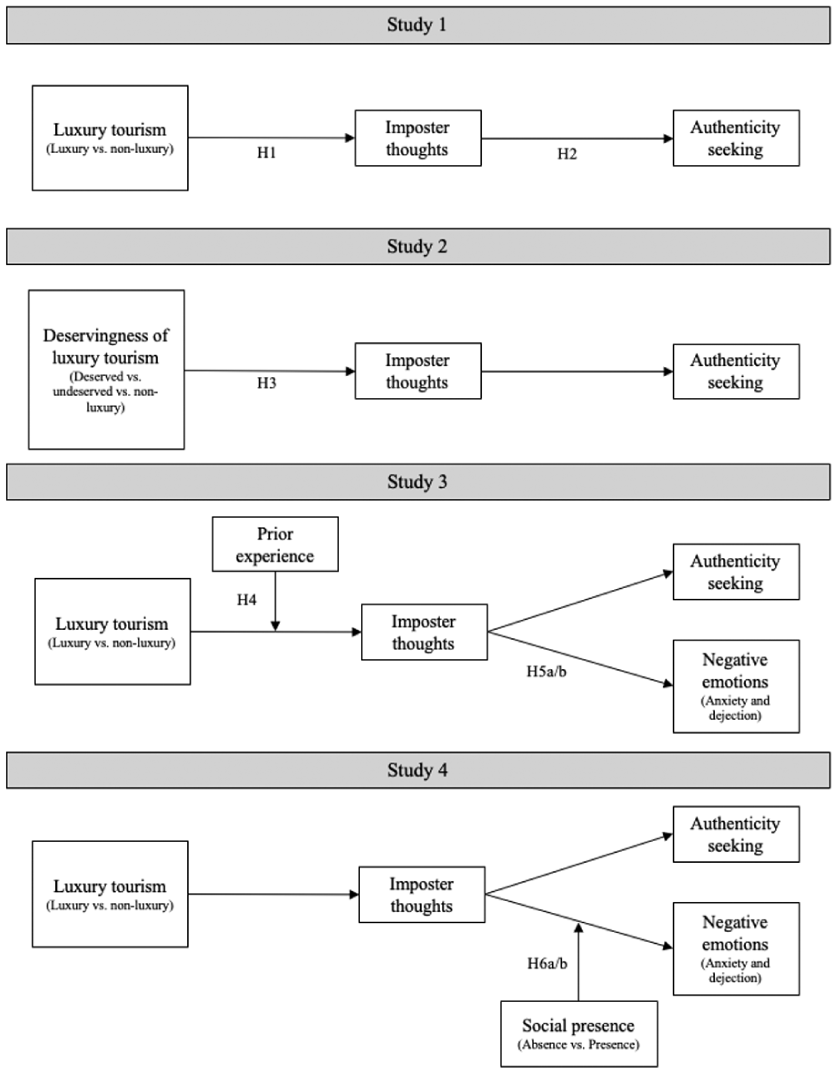
Tested models for luxury tourism as a stimulus for imposter thoughts and downstream effects across studies.
Study 1: Testing the Mediated Process
We begin by examining whether engaging in a luxury tourism experience is associated with heightened authenticity-seeking, which is driven by increased imposter thoughts (H1 & H2). An online between-subjects scenario-based experiment contrasting travel dining experiences at a high-end vs. a low- to mid-end restaurant (luxury vs. non-luxury) is employed.
Stimuli, Procedure, and Sample
The samples for all studies in our series are US-based adults who would be reasonably assumed to be in the aspiring luxury tourist bracket (see Statistia, 2025) 1 and have had recent experience in the context of the specific study (e.g., dining out while on vacation, staying at a hotel etc.). The final sample here was 216 US-based adults (49.1% male; Mage = 40.40, SD = 11.85; the income distribution was bimodal, with $20,001–$40,000 and $40,001–$60,000 being the most frequently reported brackets), who had dined at a restaurant within the last 90 days.
Recruitment occurred through Cloud Research (targeting US-based respondents), a commonly used panel data platform with tourism research for this and all subsequent studies (Kim, 2024; Shin et al., 2025). The platform offers respondents a small monetary reward for survey completion. Supplemental Appendix B details the data quality checks, and exclusions for all studies in the series. Given there is no current understanding of the effect size of the relationships between our model variables, we followed a conservative guidance of 100 per condition to maintain adequate power and to detect meaningful small effects (Brysbaert, 2019; Lakens, 2015).
Participants imagined that they were on vacation in a city they had not been to before and decided to try a local restaurant as part of their travel experience. They looked at an online city dining guide to choose a place to dine. They were then randomly allocated through the Qualtrics survey platform randomiser tool into one of the two conditions (the same randomiser technique was used for all subsequent studies). In the Luxury condition, the restaurant was high-end with a Michelin star, luxurious interior, menu offering exquisite gourmet food and large range of drinks to choose from. Whereas in the Non-luxury condition, the restaurant was low to mid-end with a pleasant interior, menu offering regular food and small range of drinks. In both conditions, participants were told the waiting staff and other diners appeared how they would expect at the type of restaurant. Full scenarios of all studies are provided in Supplemental Appendix C.
Following the scenario, a manipulation check was included asking them to rate how much they agreed the restaurant they dined at while on vacation was luxurious. Imposter thoughts during the dining experience were measured through an adaption of Tewfik’s (2022) five-item scale. Although other measures of the imposter phenomenon exist, they primarily capture its affective dimension (e.g., Leary et al., 2000). In contrast, Tewfik’s scale directly targets the cognitive component, specifically the perceived self-other discrepancy, making it true to the sociocognitive conceptualisation (see Tewfik, 2022, p. 997 for further discussion). While originally designed to assess imposter thoughts about workplace competence, we adapted the five-item scale to evaluate perceptions of status in a tourism context (e.g., People in the restaurant think I am higher status than I think I am, α = .94). Personal authenticity-seeking motivation was assessed through an adaption of Bartsch et al. (2022) four-item measure to focus on seeking further tourist experiences, (rather than including “products” within the original scale), an example item is as follows; I would crave other experiences that reflect important values I care about (α = .86). Responses to all the above measure were recorded a 7-point Likert scale (Strongly disagree = 1 to Strongly agree = 7). Finally, age, gender, and income were measured as control variables. Prior studies suggest that all three factors may impact imposter syndrome (Marder et al., 2024). Supplemental Appendix D provides full details of all measures here and subsequent studies.
Results and Discussion
An analysis of variance (ANOVA) confirmed the success of the manipulation. Supplemental Appendix E details these results and all other manipulation checks for subsequent studies. Analyses of covariance (ANCOVAs) were first run with luxury conditions as the independent variable and imposter thoughts and authenticity-seeking as the dependents. Age, gender, and income were included as covariates. In support of H1, imposter thoughts were more prevalent within the high-end restaurant experience (F[1,211] = 51.42, p < .001, η2 = .20, MLuxury = 4.25, SD = 1.45 vs. MNon-lux = 2.87, SD = 1.40). Similarly, authenticity-seeking motivation was significantly higher for the luxury diners (F[1,211] = 9.14, p = .003, η2 = .03, MLuxury = 5.33, SD = 1.07 vs. MNon-lux = 4.85, SD = 1.19). These results are shown in Figure 2.
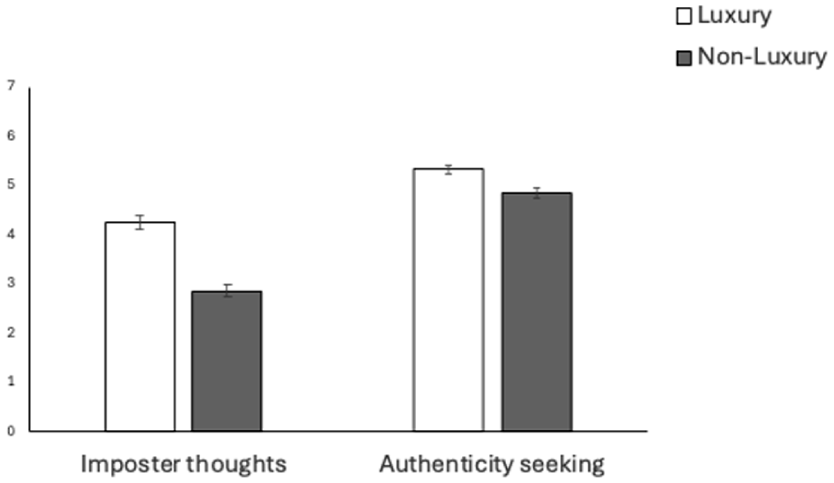
Imposter thoughts and authenticity-seeking based on luxury conditions (Study 1).
The mediating role of imposter thoughts between luxury dining and authenticity-seeking was tested using model 4 in the PROCESS macro (Hayes, 2018) in SPSS. A bootstrap analysis with 5,000 samples confirmed the viability of this mediated model, supporting H2, indirect effect: βImposter = .25, SE = 0.09, 95% CI [0.087, 0.427]). Table 1 provides the results of mediation analyses in this and subsequent studies. Following the procedure of Davvetas et al. (2015), all analyses above were conducted again without covariates as a stability check. This deemed the findings stable. See Supplemental Appendix F for the results of tests without covariates for all studies.
Bootstrapping Results for Direct and Indirect Effects across Studies.
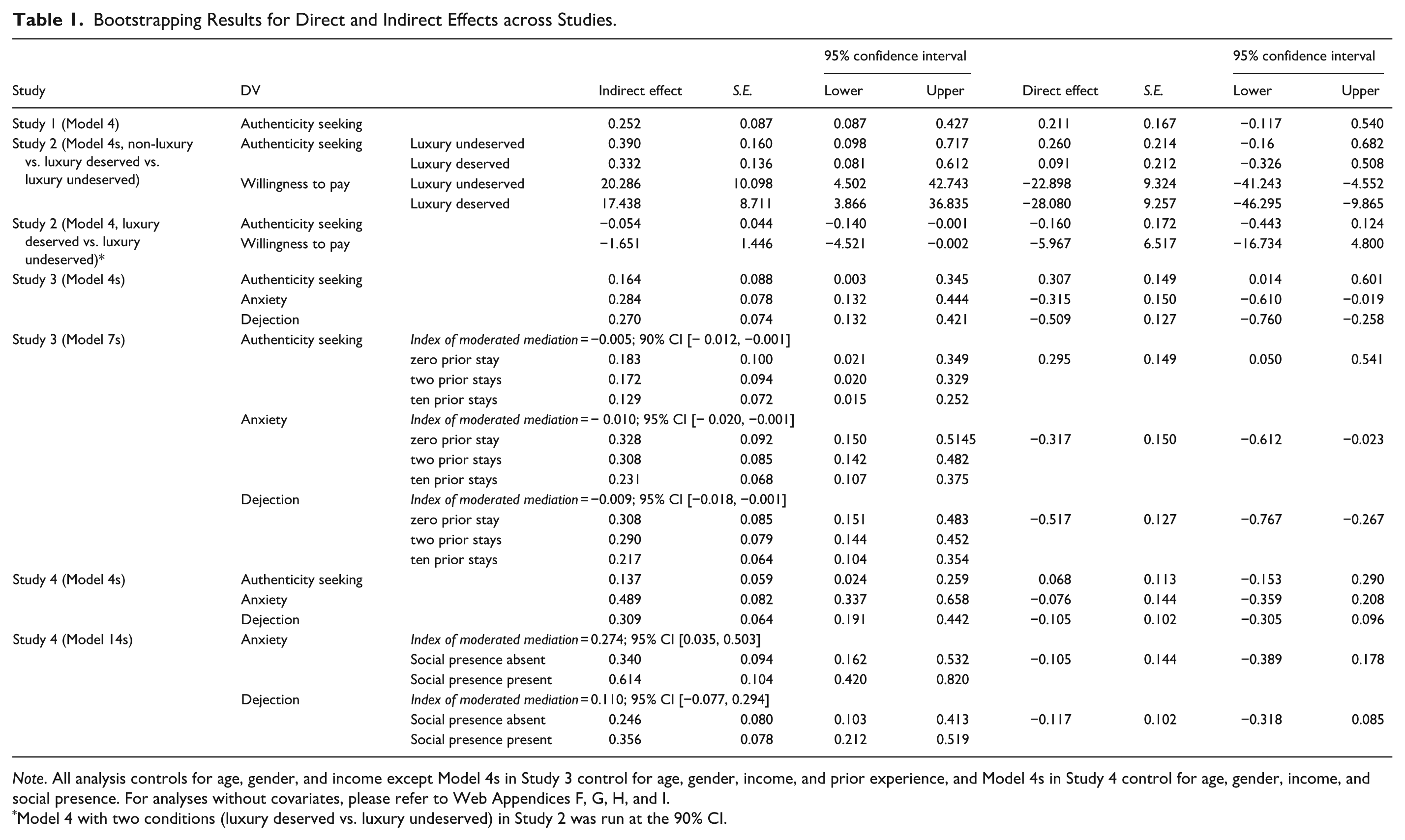
Note. All analysis controls for age, gender, and income except Model 4s in Study 3 control for age, gender, income, and prior experience, and Model 4s in Study 4 control for age, gender, income, and social presence. For analyses without covariates, please refer to Web Appendices F, G, H, and I.
Model 4 with two conditions (luxury deserved vs. luxury undeserved) in Study 2 was run at the 90% CI.
In line with the sociocognitive imposter framework, the findings confirm that luxury tourism can act as a trigger for status–related imposter thoughts, which leads to an increased authenticity-seeking motivation to address the negative cognition (Marder et al., 2024; Tewfik, 2022). Indeed, similar to the experience of imposter thoughts in one’s professional life where it is perceived that others are overestimating one’s competence, in luxury tourism the same belief can exist related to status. The following study aims to replicate these findings and test how deservingness shapes the rise of imposter thoughts.
Study 2: Deservingness as a Mitigator
This study examines whether deservingness buffers imposter thoughts associated with a luxury tourism experience (H3). We operationalise this within a preferential treatment situation, specifically receiving a first-class ticket airline upgrade in response to overbooked economy seating. A scenario-based between-subjects design was employed with three conditions (Luxury undeserved vs. Luxury deserved vs. Non-luxury).
Stimuli, Procedure, and Sample
A final sample of 319 US-based adults (54.9% male; Mage = 43.41, SD = 11.99; modal income bracket $40,001–$60,000) who had taken a flight within the last year were recruited. Participants imagined they were flying from the US to London on vacation and as always, they booked an economy ticket (to reduce any belief about their prior first-class travel experience). At the check-in desk at the airport, those in the Luxury deserved condition were told due to overbooking they had been selected for an upgrade to a first-class seat, based on being identified as a frequent flyer. Whereas in the Luxury undeserved condition, they had been selected at random for the upgrade. Both conditions received the same description of first-class travel (e.g., highly luxurious, seats fold into beds). In the Non-luxury condition, they proceeded with their economy ticket (there was no mention of overbooking or upgrading) and were given a description of the economy travel (e.g., basic but comfortable seats). In all three conditions, they were instructed that fellow passengers appeared how they would expect for the seating class.
After the scenarios, the same measures for the manipulation check, dependent variables and demographics were included as per Study 1. A manipulation check for deservingness was included for the two luxury conditions. This involved two items for deservingness (e.g., I deserve to fly in the seating class I was allocated, r = .65) measured on a 7-point (Strongly disagree – strongly agree) scale, amended from Pancer et al. (2017). In addition, an alternative measure for authenticity-seeking motivation was included in the form of an economic variable. Specifically, we asked participants, once they are in London, how much they would be willing to pay (economic measure for authenticity-seeking) in US dollars for a taxi to get to an attraction which is very authentic to who they are (approx. 10 km away). Responses were typed into a box.
Results and Discussion
After confirming the success of the manipulations (luxury and deservingness), see Web Appendix E, one-way ANCOVAs tested the effects of the conditions on the three dependent variables (including the same covariates as Study 12). A significant overall effect on imposter thoughts was revealed, with all pairwise differences significant (F[2,312] = 98.68, p < .001, η2 = .39; MLux-undeserved = 4.69, SD = 1.26; MLux-deserved = 4.33, SD = 1.28 vs. MNon-lux = 2.44, SD = 1.22, all pairwise ps < .05). This supports H3, in that imposter thoughts are lessened when the luxury is deserved (vs. undeserved), as well as supporting that imposter thoughts are greater for the luxury conditions vs. the non-luxury, replicating H1 (see Figure 3). A main effect was found for the conditions on authenticity-seeking (F[2,312] = 7.11, p < .001, η2 = .04). Here, pairwise comparison revealed both luxury conditions engendered greater authenticity-seeking than the non-luxury (MLux-undeserved = 4.86, SD = 1.15, p < .001; MLux-deserved = 4.63, SD = 1.37, p = .02 vs. MNon-lux = 4.22, SD = 1.32). However, there was no significant difference in authenticity-seeking across the deserved and undeserved luxury conditions (p = .20). For the economic measure of authenticity-seeking, no significant main effect was found across conditions (p = .39).
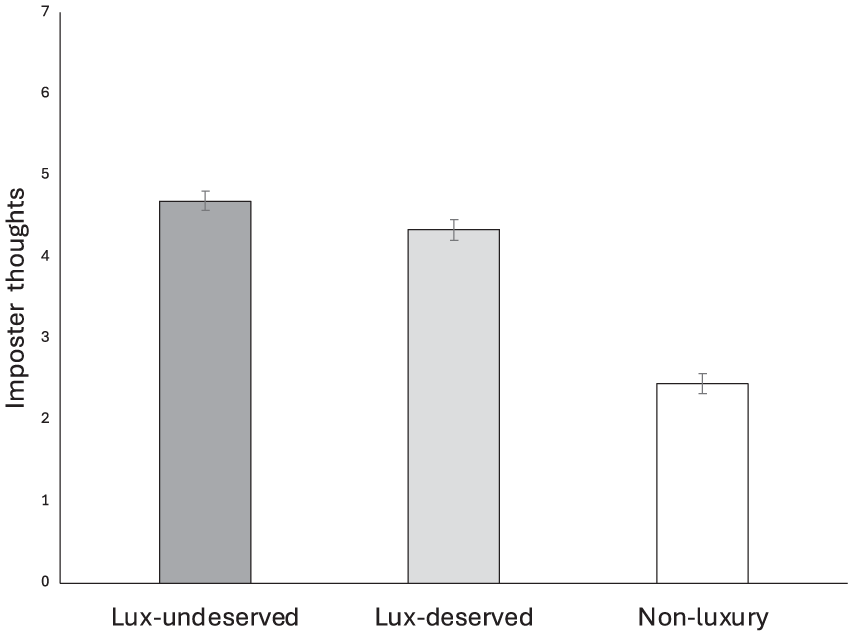
Imposter thought based on luxury and deservingness conditions (Study 2).
To replicate H2, we ran a mediation model in Process (Model 4), using a multi-categorical independent variable (the three conditions: Non-luxury was positioned as the baseline group) predicting authenticity-seeking (dependent variable), through imposter thoughts (mediator). The results further support H2 (Luxury deserved, βImposter = .33, SE = 0.14, 95% CI [0.081, 0.612], Luxury undeserved βImposter = .39, SE = 0.16, 95% CI [0.098, 0.717]). Note that the indirect effect size is greater for undeserved group, suggesting that imposter thoughts is a stronger driver of authenticity seeking under this condition. We further re-ran the same analysis with our economic measure for authenticity-seeking (willingness to pay in Table 1) as the dependent variable, the results reinforce H2. Specifically, we show people are willing to pay more for a taxi to an attraction that is authentic to who they are the greater the imposter thoughts they experience stemming from the first-class flight (Luxury deserved, βImposter = 17.44, SE = 8.71, 95% CI [3.866, 36.835]; Luxury undeserved βImposter = 20.29, SE = 10.10, 95% CI [4.502, 42.743]).
For completeness, we ran two mediation analyses using PROCESS Model 4, focusing only on the two luxury conditions (deserved vs. undeserved) as the independent variable and imposter thoughts as the mediator. In the first analysis, authenticity seeking served as the dependent variable, and the results supported an indirect effect through imposter thoughts, β = −.05, SE = 0.04, 90% CI [−0.140, −0.001]. In the second analysis, an economic measure of authenticity seeking (willingness to pay in Table 1) was used as the dependent variable, and the results supported an indirect effect through imposter thoughts, β = −1.65, SE = 1.45, 90% CI [−4.521, −0.002]. 3 Results from the above mediation analyses are provided in Table 1. Again, we confirm the stability and robustness of the above findings through replicating these analyses without covariates (see Supplemental Appendix F).
Beyond reinforcing the findings of Study 1, we show deservingness of luxury tourism reduces (but does not remove) the rise of the imposter thoughts associated with luxury travel. This thus extends imposter thoughts as a previously unexamined outcome of preferential treatment, important to tourism and broader service work (Colliander et al., 2019; Goor et al., 2020). We note that deservingness did not have a main effect on authenticity seeking, but support that an indirect-only effect exists through imposter thoughts (see Zhao et al., 2010). We now turn our attention to the ability of prior experience to shape imposter thoughts that arise, and the resultant negative emotion.
Study 3: Prior Experience as a Moderator
Here, we first determine whether the greater prior experience of similar luxury tourism moderates the rise in imposter thoughts (H4). Second, we test if luxury tourism leads to anxiety and dejection, through imposter thoughts (H5a/b). Third, we address potential alternative mediators (overindulgence, boredom) to further help support H2. A two-condition scenario-based between-subjects design was employed similar to Study 1 (Luxury vs. Non-luxury). Here this is operationalised within a hotel stay context.
Stimuli, Procedure, and Sample
The sample consisted of 321 US-based adults (46.7 % male; Mage = 43.44, SD = 12.79; modal income bracket $40,001–$60,000) who stayed in a hotel within the last 2 years. Participants were all told they booked a long weekend away in a coastal city for a vacation. In the Luxury condition, they stayed at a 5-star hotel including concierge service to their room, very large bedroom, infinity pool etc. Whereas in the Non-luxury condition, it was a 3-star hotel including being pointed to their room, reasonable sized room, small pool etc.
The manipulation check, core dependent variables and covariates were measured as per Study 1. Prior experience of luxury hotel stays was assessed by asking how many times their life had stayed at a 5-star hotel, answers were typed in an open-ended box. Dejection and anxiety were measured through four items each (e.g., sad, α = .94; nervous, α = .94); respectively) drawn from the Positive Affect and Negative Affect Schedule scale (Watson et al., 1988) along a 7-point scale (Not at all = 1 – A lot = 7). Two alternative mediators were measured (rationale included before tests below). First, overindulgence through two items (e.g., too much luxury, r = .95) adapted from Slinger and Bredehoft (2010). Second, boredom, was recorded through three items (I often find myself at “loose ends,” not knowing what to do. α = .87) adapted from the boredom proneness scale (Struk et al., 2017). Both alternative mediators were assessed based on “during the stay” and reported along a 7-point Likert (Strongly disagree = 1 – Strongly agree = 7).
Results and Discussion
The luxury manipulation was confirmed as before (see Supplemental Appendix E). To assess the main effect of the luxury conditions on the dependent variables (imposter thoughts, anxiety, dejection, and authenticity-seeking), ANCOVAs were run. The three controls 4 were included as before. Main effects were found on imposter thoughts (F(1,312) = 110.22, p < .001, η2 = 0.26, MLuxury = 4.26, SD = 1.16 vs. MNon-lux = 2.86, SD = 1.22) and authenticity-seeking (F[1,312] = 12.50, p < .001, η2 = .04, MLuxury = 5.19, SD = 1.01 vs. MNon-lux = 4.74, SD = 1.27), in line with Study 1.
To test H4, the moderating effect of prior experience on the relationship between luxury tourism and imposter thoughts, we employed Process Model 1 (simple moderation between X and Y). Conditioning values were set to the 16th, 50th, and 84th percentiles. The model revealed a significant interaction effect between luxury condition and prior experience on imposter thoughts (β = −0.05, t = −2.89, p = .004). The conditional effects are as follows, 16th percentile [zero prior stay] β = 1.58, t = 10.44, p < .001, 95% CI [1.283, 1.879]; 50th percentile [two prior stays], β = 1.49, t = 10.77, p < .001, 95% CI [1.216, 1.759], and 84th percentile [ten prior stays] β = 1.11, t = 7.11, p < .001, CI [0.805, 1.421]. Figure 4 depicts this relationship, illustrating that as prior experience increases, imposter thoughts stemming from luxury tourism decrease. For completeness, we ran Model 7s with luxury conditions as the independent variable, imposter thoughts as the mediator and either anxiety, dejection or authenticity-seeking as the dependent variable, including prior experience as the moderator for the [a] path. These models provided significant indexes of moderated mediation. 5 Full results are provided in the Supplemental Appendix G.
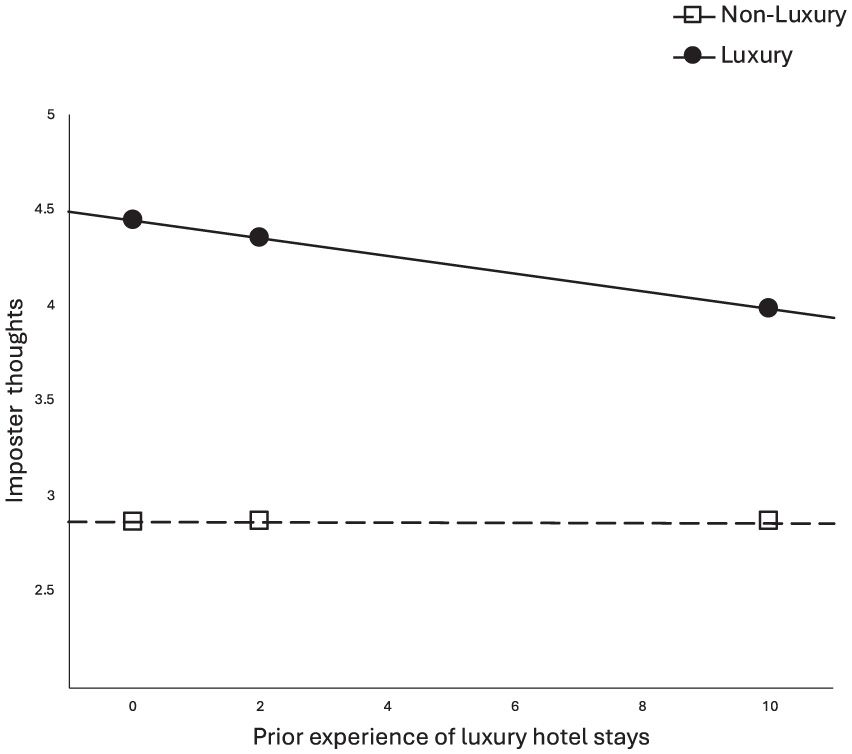
The moderating effect of prior experience on the relationship between luxury conditions and imposter thoughts (Study 3, testing H4).
To test H5a/b, Hayes Model 4s (simple mediation) were run for each emotional outcome (anxiety, dejection, authenticity-seeking). 6 Significant indirect effects were revealed for both anxiety (βImposter = .29, SE = 0.08, 95% CI [0.132, 0.444]) and dejection (βImposter = .27, SE = 0.07, 95% CI [0.132, 0.421]). To replicate H2 further, Model 4 was run predicting authenticity-seeking, supporting a significant indirect effect (βImposter = .16, SE = 0.09, 95% CI [0.003, 0.345]).
To reinforce imposter thoughts as the mediator, it is important to rule out possible alternative mediators, such as overindulgence and boredom; in other words, variables that could also explain the relationship between luxury tourism and authenticity seeking. First, overindulgence: prior work on luxury consumption establishes that people feel a need to reconcile excess, conspicuousness, and overindulgence, with modest and sustainable consumption. It is this plausible, that perceptions of overindulgence may motivate tourists to seek down-to-earth authentic meaningful experience (Halwani 2021; see also Christou, 2020). Second, boredom: as luxury hotels take care of people’ needs (e.g., in-house excursions etc.), offering curated and sometimes rather pre-structured experiences, this arguably limits self-directed engagement creating a sense of monotony, making boredom more likely than in non-luxury settings (Iso-Ahola & Weissinger, 1990; Wang et al., 2012). As boredom motivates the search for stimulation and meaning (Maddi, 2012), it too offers a conceivable alternative pathway to authenticity-seeking. Mediation tests using Hayes model 4 were run to assess these alternatives, neither provided a significant indirect effect, reinforcing our process through imposter thoughts (βBoredom = −.01, SE = 0.02, 95% CI [−0.051, 0.009]; βOverindulgence = .01, SE = 0.04, 95% CI [−0.079, 0.093]). As per prior studies, the above analyses were rerun without covariates and outcomes were maintained (see Supplemental Appendices F and G).
The study shows that akin with prior work in the professional domain that supports novelty in a situation can trigger greater imposter effects (Hernandez & Lacerenza, 2023; Hutchins & Rainbolt, 2017), this also occurs for status-related imposter thoughts experiences in luxury travel. More specifically, imposter thoughts are highest when the tourist has had no prior experience staying in a 5-star hotel and reduces with a greater number of previous stays. It is important to note that luxury hotels significantly trigger imposter thoughts irrespective of the number of stays, only the size of the effect changed. We further show that imposter thoughts lead to both anxiety and dejection, in line with prior imposter work (Haar & de Jong, 2022; Marder et al., 2024), thus we highlight a darker side of luxury tourism. In the final study, we turn our attention to a situational determinant of the rise of negative emotion from imposter thoughts.
Study 4: Social Presence as a Moderator
Here our primary aim is testing social presence (Present vs. Absent) as a moderator of the relationship between imposter thoughts and negative emotions (H6a/b). In essence, does being around and interacting with other tourists increase negative emotions stemming from imposter thoughts? For this, we run a two-factor between-subject experiment, Luxury (Luxury vs. Non-luxury) and Social presence (Present vs. Absent). This is carried out in a hotel lobby context.
Stimuli, Procedure, and Sample
The sample consisted of 460 US-based adults (42.6% male; Mage = 42.53, SD = 11.31; modal income bracket $40,001–$60,000) who stayed in a hotel within the last 2 years. In the Luxury condition, they were staying at a 5-star hotel and choose to sit down in the lobby at a table before checking in, due to a queue at the counter. The table had brochures about travel excursions and about limousine and private yacht hire. In the Non-luxury condition, the same scenario was given, but the stay was at a 3-star hotel, and brochures were about taxis and small boat hire. In the Social Presence present condition, a group of other guests are at the table and one strikes up a conversation with the participant about their vacation. Whereas in the Social Presence absence condition, no one else is at the table and they sit alone waiting for the queue to go down.
The luxury manipulation check, dependent variables and demographics were measured as per Study 3, with the addition of a manipulation check of social presence adapted from Nowak (2001). This involved two items (e.g., there were people sitting at the same table with me, r = .97) answered along a 7-point Likert scale (1 = strongly disagree – strongly agree = 7). We note while multiple social presence measures exist across diverse contexts (often virtual or mediated), our choice of items aligned with our aim to capture physical social presence, specifically copresence, in situ within a tourist setting.
Results and Discussion
Both manipulations were confirmed (see Web Appendix E). To test H6 whether social presence moderates the relationship between imposter thoughts and emotional outcomes, we ran two Process Model 14s (mediation with moderation in the [b] path) one for anxiety and one for dejection. Three control variables (age, gender, 7 and income) were included. The results confirmed a significant interaction effect between imposter thoughts and social presence (β = .22, t = 2.44, p = .015) and a significant index of moderated mediation on anxiety (β = .27, SE = 0.12, 95% CI [0.035, 0.503]). The conditional effects reveal that imposter thoughts are associated with greater anxiety when there is social presence (β = .50, t = 7.33, p < .001, CI [0.362, 0.628]) vs. absence (β = .27, t = 4.04, p < .001, CI [0.141, 0.407]). This is illustrated in Figure 5. No significant index of moderated mediation was found on dejection (β = .11, SE = 0.09, 95% CI [−0.077, 0.294]). Thus, H6a is supported but H6b is not. Full results are shown in Supplemental Appendix H. For completeness, we include Model 4s (controlling for social presence) that replicate H2 and H5 in Supplemental Appendix I. Again, all above analyses were tested without covariates which confirm stability, see Web Appendices F, H, and I.
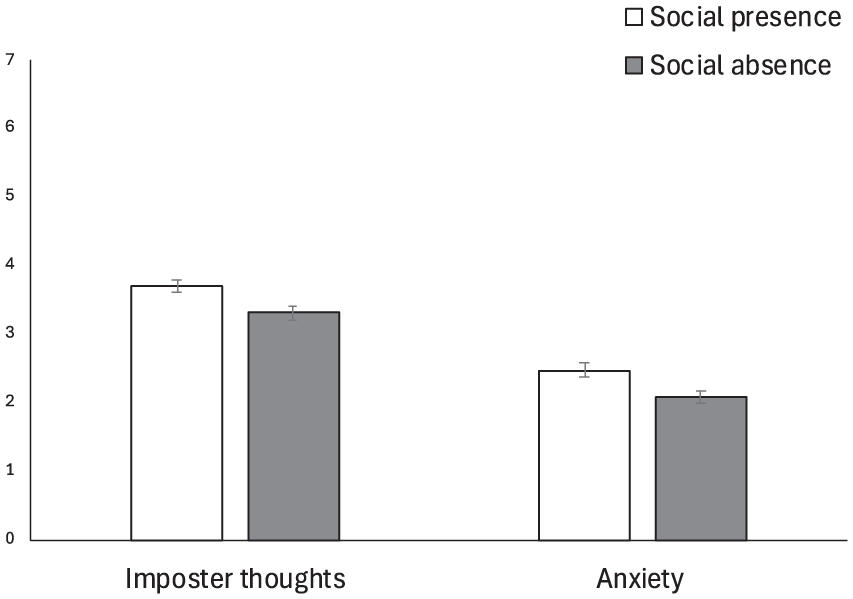
The moderating effect of social presence on the relationship between imposter thoughts and anxiety (Study 4, testing H6a).
This study provides an understanding of situational factors that shape how much imposter thoughts manifest into anxiety. Indeed, social presence increases anxiety from imposter thoughts, this is in line with studies in psychology finding social self-discrepancies can trigger greater anxiety depending on an audience's presence and characteristics (Leary & Kowalski, 1997). When no others are present (social absence), the size of the effect of imposter thoughts on anxiety reduces but remains significant. Social presence did not have moderated effects on dejection, this may be due to the nature of social interaction being naturally associated with anxiety, given the performance element (Leary, 2001).
Overall Discussion
Luxury tourism has long been of interest to tourism scholars (Iloranta, 2022), yet important psychological consequences remained unexplored. Through four experiments, we reveal that luxury tourism evokes status-related imposter thoughts, which drive negative emotions and personal authenticity-seeking. Thus, we reveal a previously hidden psychological cost of luxury tourism, presenting new challenges and opportunities for researchers and practitioners alike.
Theoretical Implications
For researchers, we provide four key contributions to tourism and imposter phenomenon research. First, we advance knowledge on the interdisciplinary study of imposter phenomena (Clance & Imes, 1978; Tewfik, 2022) by identifying imposter thoughts as a significant yet overlooked psychological effect of luxury tourism, which we show have important well-being and behavioural implications for tourists. We offer a new operationalisation of imposter thoughts based on status perceptions, applicable to tourism phenomena where status projections are central, such as luxury tourism. In doing so, we also respond to Marder et al.’s (2024) call to examine imposter thoughts beyond the workplace. Imposter thoughts offer a complementary lens to established perspectives on status in tourism. Whereas other approaches (e.g., status anxiety, stigma consciousness) emphasise the feelings and consequences of being perceived as low status, imposter thoughts instead capture the belief that others over-ascribe status. This misperception generates a distinct form of tension, particularly for aspiring luxury tourists, and offers a novel angle for scholars studying status dynamics in tourism experiences. In this vein, we offer deservingness and prior experience as significant boundary conditions to be considered.
Second, we contribute to the growing recognition of the dark sides of luxury tourism. Prior work has highlighted its external costs, such as negative impacts on the environment and host communities (Jones, 2020; Nghiêm-Phú & Shibuya, 2021; Zhang et al., 2019), yet little attention has been given to the internal costs for luxury tourists themselves. Although luxury tourism is often associated with positive symbolic value, projecting prestige and boosting pride, power, and ego protection (Hwang & Lyu, 2018; Sivanathan & Pettit, 2010), our findings reveal a darker side for aspiring luxury tourists. Status displays can induce an uncomfortable internal state resembling “faking” one’s standing, much like exaggerating competence in a job interview or LinkedIn post. This dynamic is likely to grow with the rise of “masstige” or affordable luxury (Wang et al., 2022), which broadens access to projecting status beyond one’s perceived position. Consistent with research linking imposter thoughts to anxiety and fear of exposure (Marder et al., 2024; Haar & de Jong, 2022; Wang et al., 2019), we extend anxiety and dejection as emotional outcomes of luxury tourism and furthermore introduce the presence of social interactions as a novel moderator to imposter-associated anxiety. We also complement work such as that by Feng et al. (2021), who found that travellers feel anxious posting luxury reviews due to fear of envy; such reactions may, in part, be explained by imposter thoughts. By introducing this novel mechanism and its emotional consequences, we provide a foundation for understanding the negative psychological outcomes of luxury tourism and motivate further research into this overlooked cognition.
Our third contribution positions and supports personal authenticity-seeking as a novel outcome of luxury tourism for aspiring luxury tourists, arising from imposter thoughts felt during a luxury experience. Indeed, we find authenticity-seeking is not only a driver of travel but also a psychological consequence of luxury consumption (Waller & Lea, 1999). When tourists feel inauthentic because others over-ascribe them higher status, they compensate by pursuing experiences that feel true to themselves. The finding that personal authenticity-seeking operates here as a form of fluid compensatory consumption used to affirm oneself in response to the imposter discrepancy (Mandel et al., 2017), also extends imposter literature by identifying a naturally fitting but unexamined behavioural outcome. Given that authenticity seeking and authentic, personally meaningful travel experiences are generally considered positive for tourists and have been shown to support well-being and satisfaction (Eck et al., 2023; Yi et al., 2022), our finding answers Tewfik’s (2022) call to explore the positive consequences of imposter thoughts. Together, these insights highlight an interesting potential double-edged sword: imposter thoughts reflect a negative cognitive state (and associate with negative affect) yet may motivate tourists toward personally authentic experiences, which has positive self-effects. We must note, although we reveal this personal authenticity seeking as a consequence of imposter thoughts, we cannot offer comprehensive knowledge of this type of authenticity-seeking, nor pinpoint the exact types of experiences sought, as these are inherently personal (though we offer strategies for identifying such experiences in the practical implications below).
Lastly, we contribute to the sub-domain of unearned and earned preferential treatment in tourism (and services more broadly). Existing research highlights negative emotions associated with preferential treatment, such as shame, discomfort, and guilt (Colliander et al., 2019; Mattila et al., 2013). Our findings introduce imposter thoughts as an additional or complementary outcome. Specifically, we show that imposter thoughts are more pronounced in undeserved preferential treatment compared to deserved, potentially acting as a first-order mediator for discomfort observed in previous studies.
Practical Implications
For tourism managers, our core finding indicates that engaging in luxury tourism can trigger imposter thoughts for tourists during their experience, giving rise to anxiety and a motivation to address these unwanted outcomes. Such negative experiences contrast with the core of luxury tourism: to provide enjoyment and a worry-free time. Consequently, luxury tourism practitioners face the challenge of proactively reducing imposter thoughts.
To do so, it is important to instil deservingness, particularly for guests with little or no prior experience in luxury travel. This can be done through website content and direct communications (email, social media, apps), using statements like, “We’re looking forward to welcoming you on your very well-deserved stay with us.” This messaging can be further supported by service employees and in-experience interactions. For preferential treatments such as upgrades, it is essential to ensure these are perceived as deserved. For instance, room upgrades, even if random due to overbooking, could be justified based on information provided in booking forms (e.g., birthdays, celebrations, or special family trips). Additionally, guests might be asked to complete small tasks, such as providing feedback, before receiving an upgrade, thereby increasing their sense of deservingness. To further reduce anxiety from imposter thoughts, tourists need opportunities to distance themselves from other luxury travellers. This could involve designing seating areas with options for reduced social interaction, such as small table options instead of larger ones which encourage guests mixing.
Our findings also have implications for broader tourism providers, particularly those serving customers engaged in luxury travel. Local excursion providers near luxury resorts may benefit from framing their offerings as opportunities for personal authenticity-seeking, defined as individuals’ search for experiences congruent with their true selves. For instance, a guided nature walk could be framed as “an experience that allows you to slow down and be yourself in a genuine setting.” Finally, aspiring luxury tourists should be reminded that imposter thoughts are common. Research suggests that knowing others share similar feelings can reduce negative emotions (Chatterjee et al., 2013). Indeed, the authors here acknowledge having experienced imposter thoughts during luxury experiences.
Should such imposter thoughts arise, providers can offer personally authentic experiences as an add-on. Insights into individual preferences can be gathered through booking forms or check-in questions (e.g., “Which travel experiences truly represent who you are?” with tick-box options). Alternatively, market research on target segments (e.g., by prior luxury experience) can identify common manifestations of authenticity-seeking. Indeed, personal authenticity is often associated with sustainable, ancestral, cultural, heritage, or ‘down-to-earth’ experiences (Mead & Williams, 2023). Luxury providers could integrate such experiences by adding services (e.g., heritage excursions) or modifying existing offerings (e.g., down-to-earth menu options or curated reading materials). However, care must be taken to ensure these adjustments do not detract from the luxury experience.
Limitations and Future Research
We acknowledge the limitations of our research. First, our study is grounded in the socio-cognitive approach to imposter phenomena (Tewfik 2022). We therefore do not directly attend to this phenomenon’s affective component, measuring feelings of phoniness (Clance & Imes, 1978). For a fuller picture, affective manifestations should be considered individually and alongside imposter thoughts as a second-order processor. Second, our studies are scenario-based; while they offer strong internal validity, they lack ecological validity. While this is enhanced by the real-life accounts within our supplementary study, future studies are needed within field settings to replicate our findings (e.g., surveying guests at a hotel). In addition, we have conducted our studies with US-based participants, effects found may be shaped by norms of conspicuous consumption based on culture and deserve investigation.
Third, although we examine prior experience as a moderator in one tourism context (thus further validation is encouraged), other tourist-level factors (e.g., personality, education) and provider-level factors (e.g., brand identity, accessibility) may also shape the effects. Future research should consider habitual luxury travellers. While familiarity might be expected to reduce imposter thoughts, evidence shows that even long-term high achievers such as CEOs, doctors, and professors continue to experience imposter syndrome (Clance & Imes, 1978; Vergauwe et al., 2015). This highlights that more complex interactions are potentially present.
Fourth, we show that deservingness can reduce imposter thoughts, though our findings are limited to first-class flight upgrades based on frequent-flyer status, with possible confounds such as loyalty or flying experience. Future research should validate and generalise this effect across other forms of deserved luxury (e.g., special celebrations, saving diligently, personal achievements).
Fifth, we are unable to answer, “can non-status-related imposter thoughts be triggered by luxury tourism?”. Luxury tourism may evoke expectations of expertise, such as in wine tasting, cultural knowledge, or activities such as history tours or bird watching, which could trigger imposter thoughts if tourists feel overestimated. Likewise, eco-tourism may sometimes elicit morality-based imposter thoughts as environmental values become salient (Levy, 2024; Chiu et al., 2014). Future research is needed to explore how different self-traits and tourism forms imposter thoughts. In a similar vein, attention should be paid to how imposter thoughts may coexist and interact with related phenomena such as status anxiety, social identity threat, and stigma consciousness during luxury tourism experiences. Exploring these dynamics could clarify whether these constructs operate independently, reinforce one another, or jointly shape tourists’ emotional and behavioural responses.
Finally, beyond personal authenticity-seeking, tourists may also pursue iconic or true authenticity (Bartsch et al., 2022), or adopt broader compensatory strategies such as avoidance (e.g., forgoing future luxury travel or repeat visits), social withdrawal during the experience, or escapism through alcohol consumption or high-adrenaline activities. Future research should examine the full range of behavioural responses that imposter thoughts may elicit in tourism.
Supplemental Material
sj-docx-1-jtr-10.1177_00472875261424437 – Supplemental material for Living the Luxury Lie: How Luxury Tourism Triggers Imposter Syndrome and Drives Negative Emotions and Authenticity-Seeking
Supplemental material, sj-docx-1-jtr-10.1177_00472875261424437 for Living the Luxury Lie: How Luxury Tourism Triggers Imposter Syndrome and Drives Negative Emotions and Authenticity-Seeking by Ben Marder, Liyu Gao, Sebastian Oliver, Jonas Colliander and Ms. Xiaoyin Pan in Journal of Travel Research
Footnotes

Ethical Considerations
The University of Edinburgh Ethics Review Procedure approved the present research on April 14th, 2023.
Consent to Participate
Respondents gave their consent by clicking “agree”" at the start of the survey.
Consent for Publication
Not applicable.
Author Contributions
Funding
The authors received no financial support for the research, authorship, and/or publication of this article.
Declaration of Conflicting Interests
The authors declared no potential conflicts of interest with respect to the research, authorship, and/or publication of this article.
The datasets generated during and/or analysed during the current study are available from the corresponding author on reasonable request.
Declaration of AI Usage
This manuscript was prepared using generative artificial intelligence (Gen-AI) tools to assist in refining the text flow and clarity. No content or ideas in this paper were generated by Gen-AI. The Gen-AI tools were used for language enhancement and text revision.
Supplemental Material
Supplemental material for this article is available online.
Notes
Author Biographies
References
Supplementary Material
Please find the following supplemental material available below.
For Open Access articles published under a Creative Commons License, all supplemental material carries the same license as the article it is associated with.
For non-Open Access articles published, all supplemental material carries a non-exclusive license, and permission requests for re-use of supplemental material or any part of supplemental material shall be sent directly to the copyright owner as specified in the copyright notice associated with the article.
