




Abstract
Water conservation is essential for sustainable tourism, but enticing tourists to take shorter showers is challenging. Electronic shower meters providing live water use feedback are effective but costly to implement and may raise autonomy and privacy concerns. This study proposes to overcome these challenges by using analog hourglasses with varying durations accompanied by targeted messages, and investigates the underlying theoretical mechanisms. A stated preference experiment (N = 1,000) shows that offering feasible shower durations (3, 5, or 7 min) combined with a sad anthropomorphized water message performs best in terms of both intended hourglass engagement and intention to stop showering once the hourglass ends. This intervention activates the targeted theoretical constructs (perceived anthropomorphism, empathy, self-efficacy), elicits only mild negative emotions, and increases inspiration. This low-cost solution offers hotels a practical strategy to promote sustainable water use while aligning with the United Nations’ sustainable development goals on water conservation.
Introduction
Sustainability, grounded in three interconnected pillars—environmental, social, and economic—has become a global priority to safeguard the well-being of current and future generations. Among these pillars, environmental sustainability is particularly urgent, as challenges such as climate change, biodiversity loss, and water scarcity pose significant risks to global ecosystems. Water scarcity, ranked among the top five global risks, affects more than 40% of the world’s population (Sustainable Hospitality Alliance, 2021).
The tourism industry, known for its water-intensive operations, exacerbates this issue. Hotels use an average of 1,500 l of water per room daily—far exceeding local usage in water-scarce areas (Sustainable Hospitality Alliance, 2021). Showering is a major contributor to this consumption and is also energy-intensive due to the need to heat water (Tiefenbeck et al., 2018). While technological solutions like low-flow showerheads can save water (Gatt & Schranz, 2015), behavioral changes are essential for achieving significant reductions. According to the Intergovernmental Panel on Climate Change (IPCC) (2022), behavioral changes could reduce global emissions by 40% to 70% by 2050. To address water issues in tourism, it is crucial to place tourists at the core of research and experimentally test how to encourage them to behave in environmentally sustainable ways.
Using electronic shower meters to provide real-time feedback on shower duration and water use is a new technology that shortens shower time. Real-time feedback decreases: water consumption in hotel showers by 22% (Warren et al., 2018); energy use to heat the water in hotel showers by 11% (Tiefenbeck et al., 2019), and shower time in hotels by 26% (Pereira-Doel et al., 2024). When using electronic shower meters, people are passive recipients of real-time feedback on water use; they are unable to make any choices, except for trying to ignore the feedback. Following J. W. Brehm’s (1966) reactance theory, this may induce unintended negative emotions (such as distress, resistance, and anxiety) in individuals who perceive their freedom to be restricted or threatened. The feedback approach may also be perceived as a privacy concern (Asghar et al., 2017). Showering is a private activity, and seeing water use on an electronic display during the shower may signal to hotel guests that water use is being recorded, thus triggering discomfort or explicit objections to being monitored. The overarching aim of the present study is to develop an alternative approach that leverages the effectiveness of the real-time feedback mechanism while empowering individuals to make sustainable choices and avoiding any privacy concerns: the use of hourglasses of varying duration. We view the existing smart meter approach and the hourglass approach developed in this study as complementary, rather than competitive. The different approaches are suitable for different contexts. Even if the use of smart meters outperforms the hourglass approach in water savings, most accommodation providers are small and medium enterprises that cannot afford the smart meter approach. The hourglass approach offers an alternative. Between the smart meter and the hourglass approach, maximum accommodation coverage could be achieved.
Sets of hourglasses with varying duration allow people to actively make two choices: (1) whether to receive real-time feedback and, if they choose to do so, (2) which hourglass duration to choose. The latter is possible because hourglasses of different durations can be made available to hotel guests. Although this approach does not allow hotel guests to alter the time frame, it does make them aware of default option frames, thus shaping their perception of reality (Thompson & Rayner, 1998). Notably, the feasibility of self-selected time frames can significantly influence water-saving behavior. According to self-efficacy theory (Bandura, 1982), the perceived ability to succeed affects decisions and behaviors. When a self-selected time frame is perceived as achievable, people are more likely to believe they can adhere to it, thus increasing their engagement in the behavior. Conversely, if standards of the self-selected time frame are too high (e.g., a choice between a 1, 2, or 3-min shower) this might lead to behavioral avoidance. Empirical evidence on this topic is lacking. Therefore, the second aim of the study is to examine the impact of the hourglass duration options (self-selected time frames) on water-saving intentions.
Moreover, the message explaining to hotel guests the purpose of the hourglasses can substantially influence uptake. We will study the impact of two different messaging approaches. The first approach leverages the environmental beliefs of tourists by providing information about the sustainability implications of showering. Environmental messages can shape or activate beliefs, subsequently influencing their behavior (Bromberg-Martin & Sharot, 2020). This first approach targets cognitive attitude. In contrast, the second approach is emotional in nature; it targets affective attitude by triggering empathy. Empathy plays a crucial role in conservation efforts (Tam, 2013). To elicit empathy, we use anthropomorphism – the attribution of human-like characteristics to non-human entities (Duffy, 2003). Anthropomorphizing nature has already shown promise in influencing environmentally friendly behavior (Williams et al., 2021); it increases people’s connection to nature and their conservation behavior (Tam, 2013). Thus, the third aim is to design two messages encouraging people to use the hourglasses and test if the messages trigger the hypothesized theoretical pathways to attitude formation (a cognitive pathway via environmental messages and an emotional pathway via empathy, respectively).
To summarize: Our study investigates the potential of an alternative intervention approach designed to reduce the shower time of hotel guests using hourglasses of varying duration to provide real-time feedback. Specifically, we address two key research questions: (1) How do different hourglass duration options (self-selected time frames) influence water-saving intentions? (2) Which pathways—cognitive or affective—are more effective in enhancing the impact of the hourglass intervention? By investigating these questions, this study deepens our understanding of sustainability-oriented behavior change interventions within the tourism context. The findings contribute to theoretical advancements in designing effective interventions while offering practical, cost-effective solutions for hotel managers to promote sustainable practices. By targeting water and energy conservation in tourism accommodations, this study aligns with and supports global sustainability goals, particularly SDG 6 (Clean Water and Sanitation), which focuses on ensuring the availability and sustainable management of water, and SDG 12 (Responsible Consumption and Production), which promotes the efficient use of resources and encourages sustainable practices across industries.
Literature Review
Existing Interventions to Reduce Water Consumption by Tourists
We searched Web of Science and Scopus for English peer-reviewed articles on interventions to reduce water consumption by tourists. Within the title, abstract, and keywords search fields, we used the search terms “water OR shower* OR bath* OR wash*” AND “experiment* OR intervention*” AND “tourism OR hotel* OR camping OR restaurant* OR hospitality OR accommodation*.” We excluded studies conducted in non-hedonic contexts (e.g., households, schools) because the incentive mechanisms are different from the highly hedonic context of a vacation. For example, in a hotel setting, guests are not paying water bills. Saving water, therefore, does not translate into monetary savings for them. As a result, hotel guests have little motivation to shorten their shower times, while the hedonic nature of the context entices them to do the exact opposite: enjoy long showers. This lack of inherent motivation underscores the challenge of encouraging pro-environmental behavior in tourism. However, if we cannot develop interventions that work under these least favorable conditions, we risk failing to mitigate the growing environmental footprint of tourism. It is for this reason that theory-driven behavior change interventions are worth investigating, even in highly hedonic contexts. We identified additional articles through the reference sections of the identified articles, resulting in a total of 12 articles as of 2023 detailing interventions designed to reduce water use among tourists.
The most frequently tested intervention (six studies) involved using electronic devices to provide real-time feedback on water consumption and shower duration. A noteworthy example is the installation of the Triton Xerophyte, a water-saving smart shower that reduces water consumption by 30% (Smit & de Bruyn, 2022). Smart water-saving technologies can reduce hotel shower water usage by 22%, energy usage by 11.4% (0.21 kWh), and shower duration by 12% (Pereira-Doel et al., 2019; Tiefenbeck et al., 2019; Warren et al., 2018). These outcomes are attributed to real-time feedback increasing people’s knowledge of environmental repercussions (via displayed water usage) and reinforcing social norms through energy efficiency ratings (Günther et al., 2020). Additional water-saving interventions include combining strategies such as messages and commitment (Joo et al., 2018; Warren et al., 2017), education campaigns (Serrano et al., 2019), user-pays operations (Preston, 1994), and low-flow retrofitting (Barberán et al., 2013; Gatt & Schranz, 2015).
Despite the proven effectiveness of using electronic devices to provide real-time feedback in research contexts, they have some disadvantages. Firstly, people receive real-time water use feedback passively, having no choice but to either look at it or try to disregard it. As postulated by reactance theory (S. S. Brehm & Brehm, 2013), a perceived limitation of freedom can trigger emotional reactance and a strong desire to reclaim freedom. People may turn to coping strategies, such as avoidance (Youn & Kim, 2019). Giving customers more freedom to choose enhances their level of satisfaction and streamlines behavioral transactions (Deci & Ryan, 1987; Johnson et al., 2008). Secondly, monitoring individual showers can raise privacy concerns, including whether the data is linked to the person and how it is stored, used, and shared. Thirdly, implementing electronic devices to provide real-time feedback requires specialized infrastructure. For example, each device, such as the Triton Xerophyte, costs approximately $550, not accounting for installation costs (Triton Xerophyte, 2024). Because of those disadvantages, an affordable approach to providing real-time feedback while preserving guest autonomy and privacy is needed. While additional water-saving interventions have shown promise, they also suffer from limitations such as high implementation costs, the need for ongoing maintenance, or limited engagement from users, making them less feasible for widespread adoption. This study investigates whether using hourglasses of self-selected duration could overcome the limitations of existing water-saving interventions, while still effectively reducing shower time.
Self-Selected Framing
Since their introduction by Nobel laureate Kahneman in 1981, framing effects have been extensively studied (Allard et al., 2019; Ropret Homar & Knežević Cvelbar, 2023; L. Wang et al., 2022). Framing effects occur when a change in perspective impacts both the cognitive processing of information and the outcome of the decision (Tversky & Kahneman, 1981). An example of the power of framing is that individuals are more likely to consent to a medical operation when told it has a 90% survival rate rather than a 10% mortality rate (Tversky & Kahneman, 1981). The differential effects of framing can be explained by the fact that people typically make assessments and decisions by referring to some reference points as opposed to in isolation (Kahneman & Tversky, 1984).
Self-selected framing is a distinct type of option framing. As opposed to framing information from external sources (e.g., service providers), self-selected framing is a subjective frame where people see several available options and choose from those based on their circumstances and values (M. Wang & Fischbeck, 2004). Actively involving individuals in the decision-making process can lead to increased autonomy and satisfaction (Jin et al., 2012). For example, in the context of purchasing packaged tours, people can be offered the choice of upgrading and downgrading service levels within a set of pre-defined service attributes (Jin et al., 2012). Consumers prefer upgrading to downgrading in situations where both options are available and allowing customers to specify preferred product or service attributes has the potential to enhance value perception and customer satisfaction.
In hotel shower water usage, the available duration of self-selected time frames can significantly influence water-saving behavior. Tversky and Kahneman (1981) state that the framing of a problem can shape people’s responses, influenced by their norms, habits, and personal characteristics. Self-efficacy theory (Bandura, 1982) further suggests that the perceived ability to succeed affects decisions and behaviors. When a self-selected time frame is perceived as achievable, people are more likely to believe they can adhere to it, thereby increasing their engagement in the behavior. This study aims to test how the duration of self-selected time frames impacts intended hourglass engagement and water-saving intentions.
Messages Leveraging Cognitive and Affective Attitudes
Attitudes toward environmental issues are a critical factor in achieving behavior change (Lévy-Leboyer et al., 1996; Zsóka et al., 2013). Attitudes have three main components: a cognitive, an affective, and a behavioral one. Most interventions aiming to encourage tourists to behave in more environmentally sustainable ways target the cognitive component of attitudes by attempting to strengthen beliefs – the cognitive basis for attitude development (Passafaro, 2020). Providing factual messages about environmental harm has proven effective in altering people’s beliefs about environmental issues, which can subsequently impact both behavioral intention and actual behavior (Huang, 2016). Value-belief-norm theory (Stern, 2000) states that pro-environmental behavior is the consequence of pro-environmental values, personal norms, and beliefs. According to value-belief-norm theory – because values and norms are not easy to change directly – targeting beliefs is the primary pathway to behavioral change.
Using information to alter or activate beliefs is the most common approach currently used to entice tourists to behave in more environmentally sustainable ways (Demeter, Fechner, & Dolnicar, 2023), although recent reviews (Demeter, Fechner, & Dolnicar, 2023) and meta-analyses (Greene et al., 2023) conclude that such interventions are not as effective as previously thought. For instance, installing the Triton Xerophyte, a smart water-saving shower, reduced hotel water consumption by 30%. Adding an environmental message (“1 minute less showering = daily water for two impalas”) only marginally increased this saving, showing minimal impact (Smit & de Bruyn, 2022). Possibly as a result, the focus has shifted from focusing primarily on cognitive processes to incorporating emotional processes in models of human choice (De Martino et al., 2006). One way of activating emotional processes is to elicit empathy via anthropomorphizing, which has been successfully used to elicit pro-environmental behavior. For example, giving imperfect potatoes human-like qualities increases purchase intentions, thus potentially reducing food waste (Chen et al., 2021). In the context of water conservation, anthropomorphizing water has proven effective in reducing household water usage (Chan, 2021). In the study, one group of households received monthly email newsletters with water-saving tips that included anthropomorphized water, while the other group received the same tips without any anthropomorphic elements. The households exposed to the anthropomorphized tips used less water. Considering that most people shower daily, the potential environmental benefits of shortening shower duration are material.
In the present study, we contribute to the current body of work in two ways. First, prior research was conducted in households, where financial motives play a key role in water use behavior change. In contrast, hotel guests can indulge in extended warm showers at no additional cost above and beyond the daily room rate. Additionally, people tend to be less environmentally conscious on vacation than they are at home (Dolnicar & Grün, 2009). Findings relating to water savings in response to anthropomorphized water derived from studies in the home context, therefore, cannot be assumed to generalize to the vacation context. Second, Chan (2021) concludes that anthropomorphized water with a neutral expression induces water-saving behavior. We extend this work by examining whether the emotions portrayed by anthropomorphized water influence water-saving intentions and behaviors differently. Within the anthropomorphic context, there is an indication that anthropomorphized nature with sad expressions can be more effective than happy expressions in promoting green behaviors (Ketron & Naletelich, 2019). The idea is that anthropomorphizing nature as a potential victim increases personal empathy for the environment. Empathy is a psychological response elicited by perceiving another individual’s emotions when they are in a needy situation (Mercer, 1972). Invoking empathy, as opposed to other negative emotions (e.g., anger, and remorse) is crucial for promoting moral thinking, prosocial behavior, and readiness to help, all of which are linked with sustainability (Carlo et al., 2011). For these reasons, we argue that anthropomorphized water with a sad expression will be more effective than anthropomorphized water with a happy expression in eliciting empathy and increasing water-saving intention.
Methods
Research Design
We conducted a stated preference experiment. Participants saw hypothetical scenarios and reported behavioral intentions. We asked participants to imagine experiencing a specific hotel shower intervention and then report their intended behavioral response. We used a two (feasibility of hourglass duration: low vs. high) ×4 (type of message: none, belief, positive anthropomorphism, negative anthropomorphism) between-subjects design, plus two additional conditions: a pure control condition (no hourglasses and no message) and a message only condition (no hourglasses and belief message). In the low feasibility groups, survey respondents saw three hourglasses – 1 min, 3 min, and 5 min. In the high feasibility groups, respondents saw a 3-min, a 5-min, and a 7-min hourglass. We randomly assigned participants to one of 10 experimental conditions. All conditions are shown in Appendix A. 1
We selected hourglasses as the device to provide tourists with shower time feedback because they are user-friendly, esthetically appealing, and battery-free. To minimize information overload and enhance decision clarity (I. J. Park et al., 2022; J. Y. Park & Jang, 2013), the study simplified the selection framework by offering only three hourglass options in each scenario. We do not develop and test nudging approaches, which in this case would imply stopping water flow automatically after a specific period of time, because of the potential for consumer backlash (Acuti et al., 2022).
Given that the average shower time in the UK is 8 min (Anglian Water, 2024) and the average shower time in Australia is 7 min (Bright Renovation, 2021), both of which exceed the recommended 5 min, we designed two shower time selection schemes: 1, 3, or 5 min, and 3, 5, or 7 min. The first scheme offers choices of 1, 3, or 5 min, encouraging significantly shorter showers, but this low reference point may be challenging for people to achieve. The second scheme provides options of 3, 5, or 7 min, which are more gradual reductions from the current averages, making the reference point relatively high and potentially more engaging and attainable for participants.
We selected 1 min as the minimum in the first scheme to represent an extreme aspirational target, emphasizing maximum water savings. However, this low reference point is intentionally challenging and unlikely to be chosen by most participants, reinforcing the perceived in-feasibility of the first scheme. The 3-min lower limit, although challenging for some participants, serves as an aspirational goal consistent with water-saving recommendations in water-scarce regions (World Travel & Tourism Council, 2017). This option also provides a meaningful benchmark for participants already inclined to take shorter showers, encouraging further reductions in shower duration. The inclusion of 5 min in both schemes aligns with the widely recommended shower duration for water conservation (Leigh, 2017) and serves as a practical target for individuals aiming to reduce their water usage without feeling overly restricted. We set 7 min as the upper limit to closely align with current average shower times (Bright Renovation, 2021), making it a more feasible and attainable target while still promoting shorter showers to save water. Extending the upper limit beyond this average could risk normalizing longer showers, undermining the study’s goal of reducing overall shower duration.
In the beliefs message condition, we display the message “1 min less showering = 19 liters water saved” above the hourglass selection. Figure 1 illustrates the two anthropomorphism conditions; all hypothetical conditions are included in Appendix A.
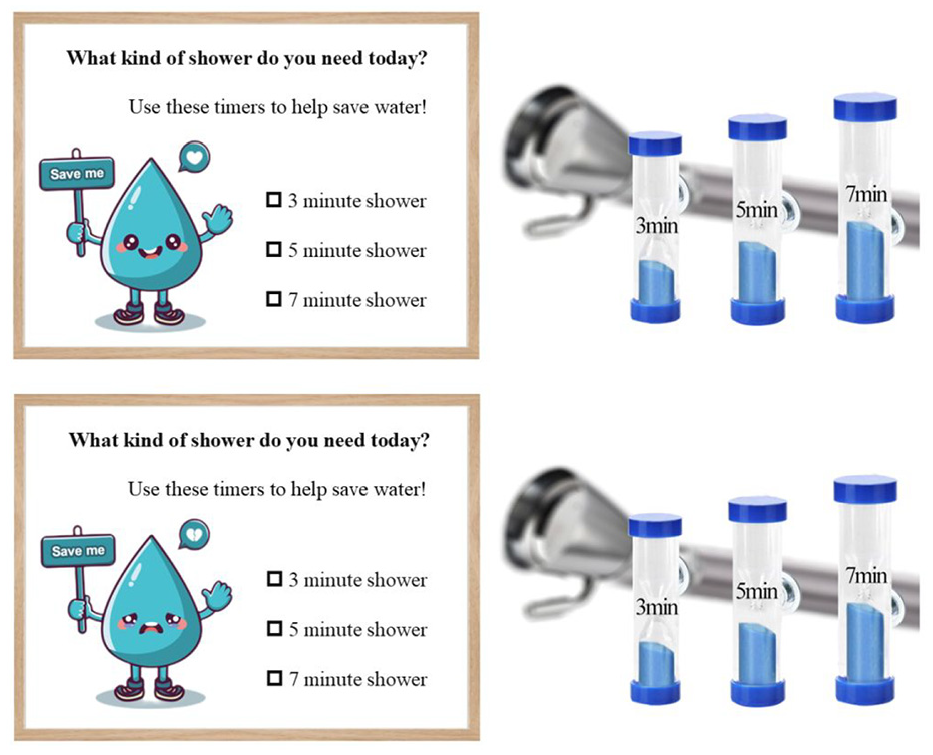
Example of stimuli.
Participants and Procedure
We recruited participants using Prolific Academic, an online survey platform known to generate high-quality data (Peer et al., 2021). Participants on Prolific self-select to join the platform’s panel and self-select to participate in any given survey study they are invited to contribute. To be eligible for our study, participants had to reside either in Australia or the UK, be at least 18 years old, and be fluent in English. The age restriction was due to practical considerations related to human ethics approval, as the process becomes significantly more complex when involving children in Australia. Additionally, our study focused on the adult traveling population rather than children. We selected participants from both the UK and Australia to ensure sample consistency, as the cultural backgrounds (Ward & Masgoret, 2008) and average shower durations in these countries are similar—7 minutes in Australia (Bright Renovation, 2021) and 8 min in the UK (Anglian Water, 2024). This similarity allowed us to maintain homogeneity in the sample while leveraging a diverse respondent pool without the need for translation or back-translation.
We randomly assigned participants to one of eight hypothetical conditions, with each condition including between 98 and 101 respondents. The final sample size (N = 1,000) corresponds to sample calculations that suggest enrolling at least 100 participants per condition for an effect size of d = 0.40 and a power of 0.80 (Brysbaert, 2019). Most participants (82.7%) were from the UK; 17.1% were from Australia. The average age was 43 years (SD = 13.35). In terms of gender, 48.0% identified as female, 51.1% as male, 0.6% as non-binary, 0.1% preferred not to say, and 0.2% provided a self-described gender identity.
In the online survey, which took approximately 5 min to complete, participants first provided informed consent to participate in the study (Ethics approval number: 2023/HE000955). They then provided basic demographic information (i.e., age, country of residence, and gender) and saw the following holiday scenario (in line with suggestions made by Demeter, MacInnes, & Dolnicar, 2023): “Imagine you stay in a four-star resort for a relaxing holiday. Please imagine yourself in this situation. What would it feel like, look like, smell like to be in this resort? Immerse yourself in the sights, sounds, and smells. Answer the following questions as if you were there in that moment.” Participants further envisioned, “After you have checked in, you decide to go to the bathroom to take a shower.” Following this, they were then randomly allocated to one of the 10 hypothetical conditions and saw the corresponding hourglasses and signs (see Appendix A). In the next section, we summarize the study measures in the order they were presented to participants. After completing these measures, participants had the opportunity to leave any comments, were thanked, and reimbursed £0.75 via the platform Prolific.
Study Measures
Hourglass Selection
Directly after seeing the hourglasses and sign, participants reported which hourglasses they intended to use if any (“Which shower duration would you choose?”). Participants selected one of the hourglass options (1, 3, or 5 min in the less feasible condition; 3, 5, or 7 min in the more feasible condition) or indicated they would not engage with the hourglass. For the primary analysis, these options were categorized as using hourglasses of any duration versus not using them (i.e., not engaging with the hourglasses).
Attention Check
We then conducted an attention check by asking “What expression did the water droplet on your message have?” Participants selected one of the following options: (1) Happy; (2) Sad; (3) It did not have an expression; (4) I don’t know.
Water-Saving Intentions
Participants indicated their intended shower times (“While at this hotel, how long would you likely shower for (in minutes)?”) on a sliding scale ranging from 0 to 20 min. Given that average shower times in Australia and the UK typically are in the 7 to 8 min range, the 20-min upper limit was not restrictive, reflecting typical showering behavior without introducing unnecessary variability. Study participants also answered the following two additional questions: “While at this hotel, how likely would you stop showering when the hourglass runs out?” and “While at this hotel, how likely are you to limit your shower time to save water?” Participants responded to the two items on a sliding scale from 0 (strongly disagree) to 100 (strongly agree). We used slider scales where possible in the questionnaire to collect continuous metric data rather than ordinal data. Ordinal data limits data analytic approaches and ordinal answer formats are prone to capturing response biases (Dolnicar, 2013).
Self-Efficacy Measure
We measure self-efficacy using two validated questions adapted from Czyz et al. (2014) to suit showering behavior: “How certain are you that you could resist showering for too long at this hotel?,” and “How certain are you that you could use the hourglass at this hotel?” Both questions were on a sliding scale that ranged from 0 (very uncertain) to 100 (very certain). Although, in this instance, the validated question could capture an aspect of willingness to use, we chose them to ensure validity and comparability of results across self-efficacy studies.
Emotional Reaction
We measure participants’ hypothetical emotional reactions with the Positive and Negative Affect Schedule adapted from Watson et al. (1988). Participants were asked, “Think about this imaginary shower experience and any signs or equipment you might have seen. How did it make you feel?,” and offered a list of 11 emotions, six measuring negative emotions (e.g., annoyed, guilt) and five measuring positive emotions (e.g., excited, enthusiastic), which they rated from 0 (not at all) to 100 (extremely). We randomized the order of the listed emotions.
Anthropomorphism Measure
Participants rated the following items: “It’s as if the water droplet I just saw at the imaginary hotel was alive.” and “It’s as if the water droplet I just saw at the imaginary hotel had a personality of its own.,” both adapted from Delbaere et al. (2011) on a sliding scale from 0 (strongly disagree) to 100 (strongly agree). We combined the two items into a composite score, which demonstrated excellent internal consistency (Cronbach’s α = .81).
Empathy Measure
Participants indicated their empathy toward water droplets on three items adapted from Ketron and Naletelich (2019): “I felt sorry for the water droplet I saw.,” “I wanted to save the water droplet I saw.,” and “I had empathy for the water droplet I saw.” Participants responded to the items on a sliding scale from 0 (strongly disagree) to 100 (strongly agree). We calculated the average of the three items, and the scale exhibited excellent internal consistency, with a Cronbach’s alpha of .87.
Environmental Beliefs Measure
We used modified versions of Kaiser et al.’s (2005) questionnaires to measure the value belief norm theory belief variables (Stern, 2000). We presented participants with the following statements: “It would be advantageous for the environment if I limited the shower time to save water at this hotel.” (awareness of consequences) and “I can take on responsibility for the environment and/or for other people by limiting the shower time to save water at this hotel.” (ascription of responsibility). We further included the item “Because I feel an obligation towards the environment, I would limit the shower time to save water at this hotel.” (obligation). Participants responded to the items on a sliding scale that ranged from −50 (disagree) on the left to +50 (agree) on the right. 2 We computed the mean of the three items, yielding a reliable scale with a Cronbach’s alpha of .83.
Results
To identify the most promising water-saving intervention, we adhered to the extended pre-testing protocol outlined by Zinn et al. (2024) and tested whether: (1) the messaging interventions effectively activated the corresponding theoretical constructs (e.g., environmental beliefs, perceived anthropomorphism, and empathy); (2) each theoretical construct was associated with higher water-saving intentions; (3) theory-driven messages led to higher water-saving intentions compared to control condition; (4) these interventions negatively affected consumer emotions.
Effect of Message on Theoretical Construct (Manipulation Check)
To test whether each message evoked the relevant theoretical constructs, we conducted independent samples t-tests comparing each condition to its appropriate comparison group. For belief-related constructs, the pure control condition (no message and no hourglasses) served as the comparison group. For anthropomorphism and empathy constructs, the hourglasses only conditions (both 1–3–5 and 3–5–7 combined) served as the comparison group. We also compared the negative to the positive anthropomorphism conditions for empathy. For self-efficacy, we used the pure control as the comparison for the first item (resisting long showers), and the hourglasses only conditions for the second item (using the hourglasses). Table 1 provides a summary of the manipulation checks, with self-efficacy measures detailed in Appendix B.
Manipulation Check Results for Theoretical Constructs.
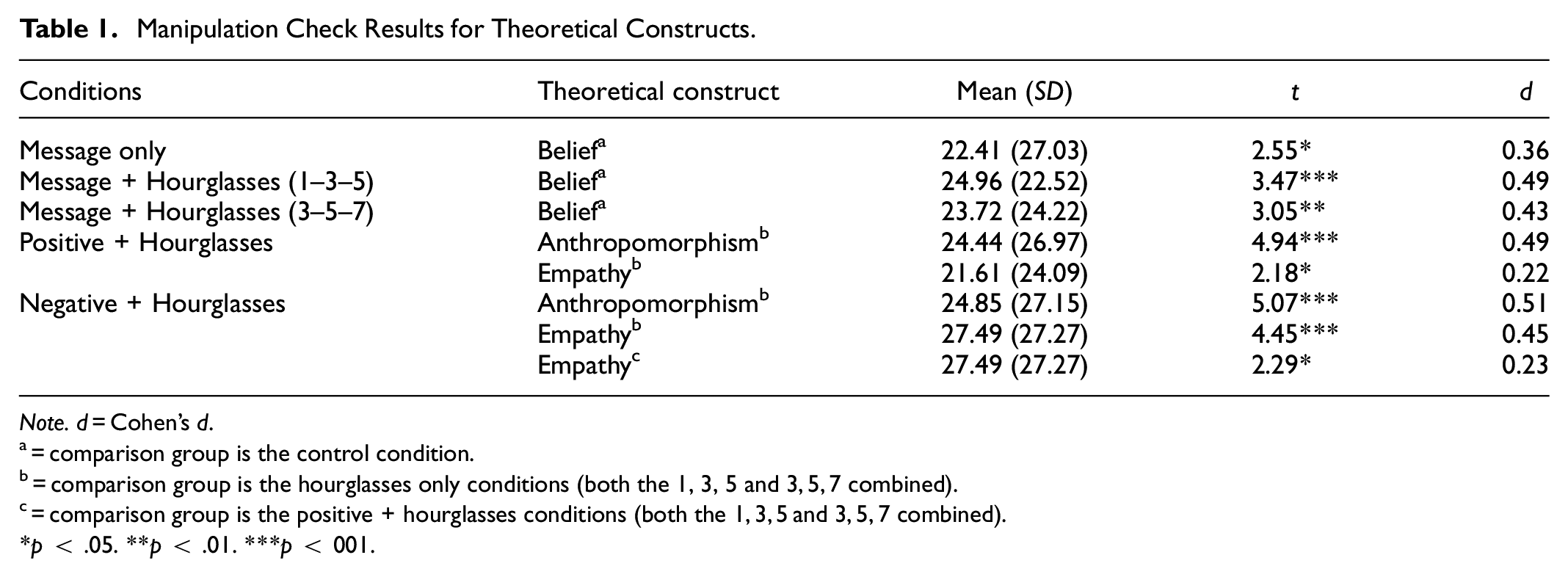
Note. d = Cohen’s d.
= comparison group is the control condition.
= comparison group is the hourglasses only conditions (both the 1, 3, 5 and 3, 5, 7 combined).
= comparison group is the positive + hourglasses conditions (both the 1, 3, 5 and 3, 5, 7 combined).
p < .05. **p < .01. ***p < 001.
For the belief measures, all belief message conditions (message only, message + hourglasses [1–3–5], and message + hourglasses [3–5–7]) scored significantly higher than the pure control condition. For the anthropomorphism measure, both the positive and negative anthropomorphism + hourglasses conditions scored significantly higher than the hourglasses only conditions. For the empathy measure, both anthropomorphism conditions also scored significantly higher than the hourglasses only conditions. Notably, participants in the negative anthropomorphism condition reported significantly higher empathy than those in the positive anthropomorphism condition.
For the first self-efficacy measure (resisting long showers), participants in all conditions - except message only and hourglasses only (1–3–5) - reported significantly higher certainty compared to the control condition. For the second self-efficacy measure (using the hourglasses), only participants in the message + hourglasses (1–3–5), positive anthropomorphism (3–5–7), and negative anthropomorphism (3–5–7) conditions reported significantly higher scores compared to the hourglasses only (1–3–5) condition. However, no significant differences were observed when comparing these conditions to the hourglasses only (3–5–7) conditions.
Overall, the message only, positive + hourglasses (3–5–7), and negative + hourglasses (3–5–7) conditions showed significantly higher scores than their respective comparison groups across the relevant theoretical constructs: belief, perceived anthropomorphism, empathy, and self-efficacy. Moreover, the negative + hourglasses conditions elicited significantly higher empathy than the positive + hourglasses conditions.
Water-Saving Intentions
To assess the potential of the underlying intervention mechanisms, we conducted correlation tests to examine the correlation between theoretical constructs and behavioral intentions (e.g., intended hourglass engagement, intended shower duration, intention to stop showering once the hourglass ends, and intention to limit shower time). All theoretical constructs showed significant correlations with behavioral intentions, indicating their relevance in predicting water-saving behavioral intentions (see Appendix C).
To investigate differences in hourglass engagement across conditions, we conducted independent-sample proportion tests using a binary engagement variable. As shown in Figure 2 (see Appendix D for detailed results), participants in the positive + hourglasses (3–5–7) condition were significantly more likely to engage with the hourglasses than those in the hourglasses only (1–3–5) condition. Notably, the negative + hourglasses (3–5–7) condition yielded the highest engagement rate (82.8%) and reported significantly greater engagement compared to both hourglasses only conditions.
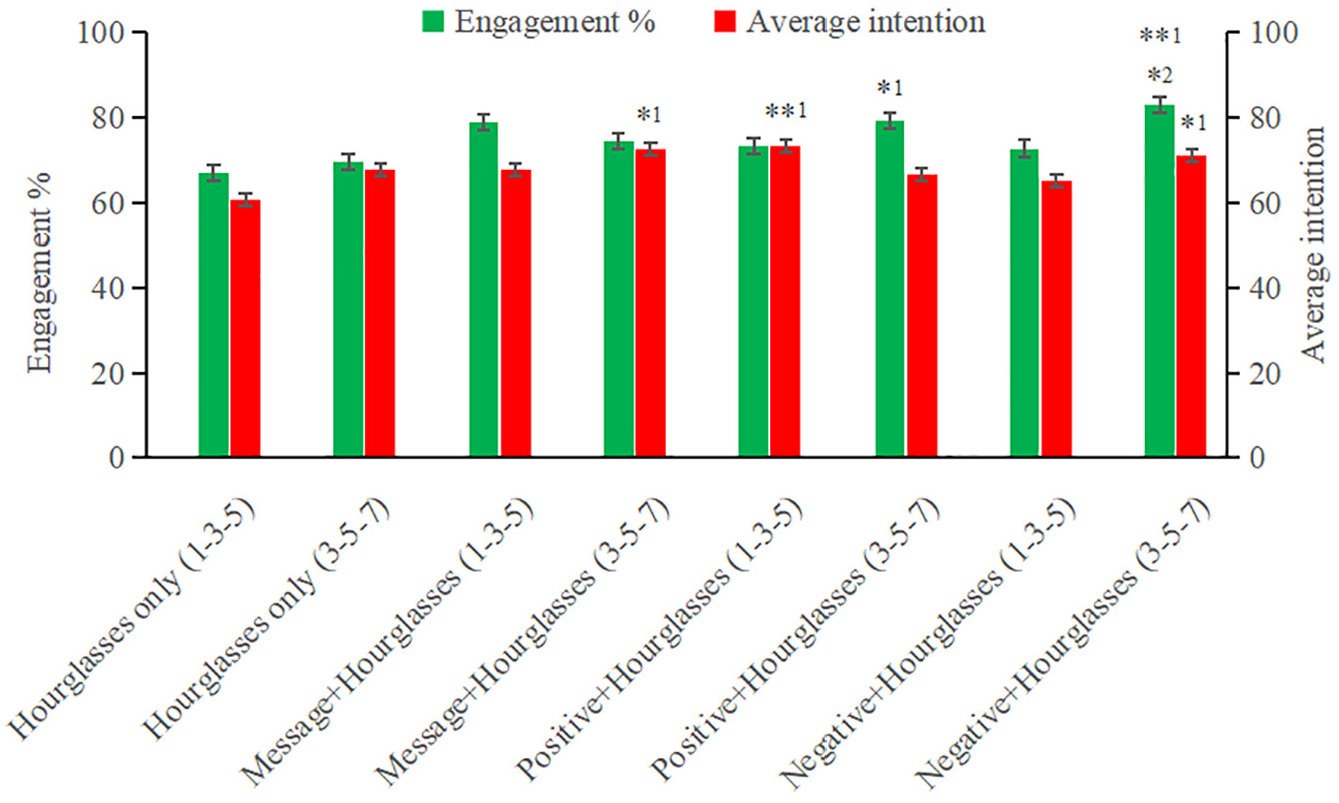
Comparison of intended hourglass engagement (%) and intention to stop showering once the hourglass ends (mean score) across experimental conditions.
For exploratory analyses on shower intentions, we used independent samples t-tests to compare mean scores across conditions. For the intention to stop showering once the hourglass ends, we used the hourglasses only conditions (both 1–3-5 and 3–5-7 combined) as the comparison group. For intended shower duration and intention to limit shower time, the pure control condition served as the comparison group.
As shown in Figure 2 (see Appendix D for detailed results), participants in the message + hourglasses (3–5–7), positive + hourglasses (1–3–5), and negative + hourglasses (3–5–7) conditions reported significantly stronger intentions to stop showering once the hourglass ends compared to those in the hourglasses-only conditions. In terms of intended shower duration (see Appendix D), all experimental conditions were associated with significantly shorter self-reported shower duration than the control condition, with the largest effect observed in the message + hourglasses (1–3–5) condition (d = 0.99). Similarly, participants in all experimental conditions also reported significantly stronger intentions to limit their shower time to save water compared to the control condition, with the strongest effect in the negative + hourglasses (3–5–7) condition (d = 1.01).
Overall, the negative + hourglasses (3–5–7) condition significantly enhanced all key behavioral outcomes, including intended hourglass engagement, intention to stop showering once the hourglass ends, intended shower duration, and intention to limit shower time. Among all conditions, it yielded the highest engagement rate and the strongest intention to limit shower duration, highlighting its potential as an effective water conservation intervention.
Emotional Reactions to Intervention Materials
To analyze participants’ emotional reactions, we ran independent samples t-tests comparing each experimental condition to the control condition on both positive and negative emotional responses (see Figure 3 and Appendix E for detailed emotion results).
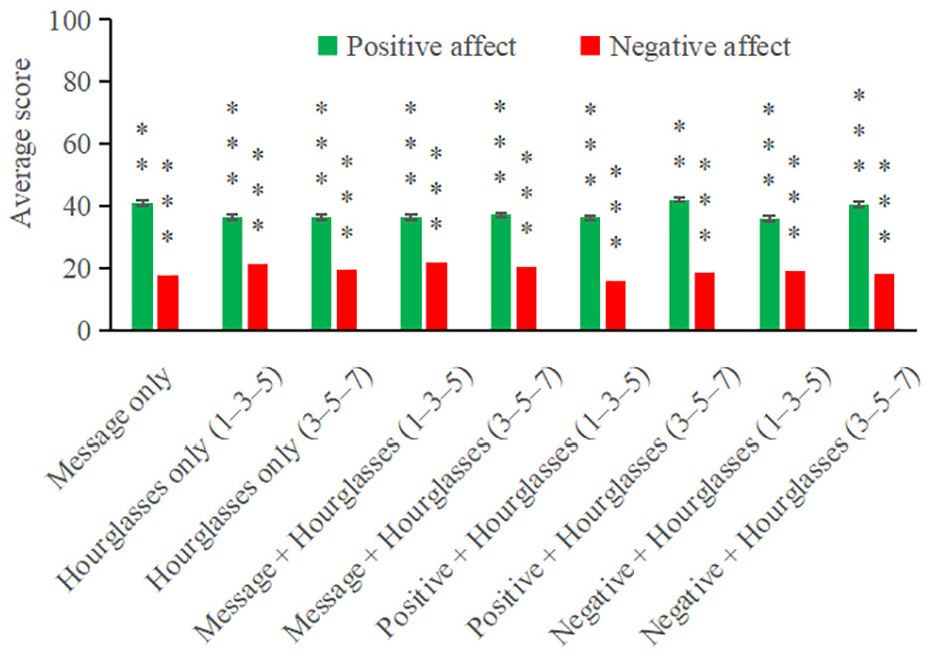
Comparison of positive and negative affect between experimental conditions and the control condition.
Overall, participants reported low levels of negative emotion and relatively high levels of positive emotion across all conditions. As illustrated in Figure 3, positive affect consistently exceeded negative affect in every condition. Specifically, negative affect scores—including irritability, upset, annoyance, and distress—remained below 30 across all conditions. Given the scale midpoint of 50, this indicates that participants experienced generally low levels of negative emotion throughout. Notably, guilt consistently emerged as the most salient negative emotion. This is meaningful, as guilt is often associated with moral responsibility and pro-environmental motivation (Baek & Yoon, 2017; Shipley & van Riper, 2022). In contrast, positive emotions were strongly expressed, with interest and inspiration rated highest across all conditions. In particular, the positive + hourglasses (3–5–7), negative + hourglasses (1–3–5), and negative + hourglasses (3–5–7) conditions elicited the highest inspiration scores, all surpassing those of the control condition. These findings highlight the value of emotionally engaging interventions - especially those that elicit guilt and inspiration - may serve as effective tools for encouraging pro-environmental action.
Discussion
Developing water-saving interventions in the tourism context is critical for promoting environmental sustainability and achieving the United Nations Sustainable Development Goals (SDGs), particularly SDG 6 (Clean Water and Sanitation). Although electronic devices that provide real-time feedback reduce shower duration, such devices have several disadvantages, including potential negative emotions from lack of autonomy, privacy concerns, and high device and system maintenance costs. To overcome these challenges, this study tests the potential of an alternative intervention using hourglasses of varying durations to provide real-time feedback. More feasible shower duration options (3, 5, or 7 min) combined with the sad anthropomorphized water message emerge as the most promising intervention. This hypothetical intervention successfully activated the corresponding theoretical construct—perceived anthropomorphism, empathy, and self-efficacy—while eliciting only mild negative emotion (mean score below 20) and notably increasing inspiration. Importantly, it also led to the most favorable behavioral outcomes: 83% of participants stated their intention to use the hourglasses; 71% believed that they would stop showering when the hourglass ran out; and 65% expressed a willingness to limit their shower time to save water.
Given that shortening a shower by 1 min saves 19 l of water and there were approximately 1.3 billion international tourists in 2023 (World Tourism Organization, 2024), the newly developed intervention shows substantial potential for saving water in hotel showers. If indeed 65% of tourists would reduce their hotel shower time (as suggested by the willingness to do so in our study) by only 1 min, the total water saved would amount to more than 16.1 billion, reducing the risk of “Day Zero” when water supply becomes insufficient to support humankind. Even if not all intentions translate to behavior and, say, only 20% of tourists shorten their showers by only 1 min in response to the hourglass interventions, water savings would still amount to approximately 4.94 billion liters—a significant contribution to global sustainability efforts.
Theoretical Implications
This study contributes to the sustainability literature by offering insights into designing behavior change interventions that align with global environmental goals. First, it is novel in investigating the potential of self-selected framing to encourage tourists to adopt environmentally sustainable behaviors. Prior research has primarily focused on how self-selected framing affects tourists’ purchase behavior, such as package-tour customizing products (Jin et al., 2012). This study extends the concept to sustainable tourism. By involving tourists in the decision-making process for real-time shower feedback in our hypothetical scenarios, we enhance their autonomy and avoid potentially negative emotions associated with the lack of autonomy when using electronic feedback devices. According to the framing effect (Thompson & Rayner, 1998), establishing recommended shower time reference points can make hotel guests aware of default option frames, potentially influencing their perceptions of shower duration. Notably, this research identifies a critical and relevant factor that may affect hotel guests’ water conservation behavior: the feasibility of self-selected time frames. This study offers insights into how self-selected frameworks could be optimized to promote water conservation practices among tourists.
Second, this study provides empirical evidence that affective-based constructs, such as empathy, represent a promising direction for designing water conservation behavior interventions and possibly interventions targeting other environmentally sustainable behaviors. Recognizing the significance of attitudes in behavioral change, we evaluated the efficacy of two interventions targeting the cognitive and affective dimensions of attitudes, respectively (Lévy-Leboyer et al., 1996). We specifically examined how an affective-based construct, rarely applied in tourism—using anthropomorphism to evoke empathy—may be able to increase tourists’ water-saving intentions. In contrast, the cognitive-based intervention, which focused on altering tourists’ beliefs about environmental issues, showed comparatively weaker effects. This finding aligns with recent empirical evidence suggesting that information alone is insufficient to change direct water-use behavior in hotel settings (López-Rodríguez et al., 2025). Our study contributes to a growing body of research questioning the dominant theoretical assumption that changing beliefs is the most effective pathway to behavioral change (Dolnicar & Demeter, 2024; Greene et al., 2023). This work also responds to De Martino et al.’s (2006) call to incorporate emotional processes in models of human choice.
Third, this research enriches the understanding of how anthropomorphizing water may impact water-saving behavior. Chan (2021) demonstrated that anthropomorphized water with a neutral expression increases water conservation behavior. We extend this literature by investigating the effects of different anthropomorphic expressions of water (i.e., sad and happy expressions). The results of the survey experiment show that anthropomorphized water with a sad expression is more effective than a happy expression in eliciting empathy and increasing water-saving intention. This effect is likely because portraying nature as a potential victim enhances personal empathy for the environment. When nature is perceived as suffering, individuals are more motivated to engage in pro-environmental behaviors, such as saving water, to alleviate the perceived distress. This aligns with research suggesting that framing environmental issues in terms of harm and suffering can be a powerful motivator for behavior change (Markowitz & Shariff, 2012; Schultz, 2000). Moreover, findings suggest that prior findings of anthropomorphized water interventions representing an effective approach to inducing more pro-environmental behavior in the home context (Chan, 2021) are likely to generalize to the hedonic (tourism) context.
Practical Implications
The findings have significant practical implications for promoting environmental sustainability in the tourism sector. Governments seeking effective water-saving strategies can draw valuable insights from this study. Alternative interventions, such as offering more feasible shower duration options (3, 5, or 7 min) combined with a sad anthropomorphized water message, provide a practical and cost-effective alternative to electronic feedback devices. Each electronic device typically costs around $550 (Triton Xerophyte, 2024), whereas the design, production, and distribution of hourglass packs cost approximately $1 per unit. Yet, the environmental benefits could be substantial. As demonstrated by the City of Burnside in the household context, potential savings on water and electricity per household are approximately $77 per year, with a reduction of 427 kg of carbon dioxide (CO2e) emissions (City of Burnside, 2024). Governments could easily distribute the hourglass as part of water conservation campaigns, similar to past initiatives, thus encouraging sustainable water-saving behaviors in the tourism sector without substantial financial burden.
This proposed intervention is also valuable for hotels, as it offers a cost-effective solution without requiring extensive plumbing work. Hotels can test whether the intervention translates to significant water savings with no risk of upsetting guests. The cost-effectiveness of this proposed approach is critical to potentially maximizing uptake among hotels, especially given that the accommodation sector is dominated by small and medium enterprises (Smith, 2006). Notably, the potential savings are substantial, as showering is a major source of water and energy consumption in tourism accommodations, primarily due to the need to heat shower water. Reduced water consumption leads to lower water and energy bills, thereby enhancing overall profitability. Hotels adopting such interventions can also strengthen their reputation as environmentally responsible entities, potentially attracting environmentally conscious travelers and gaining a competitive edge in the market. This dual benefit of cost savings and enhanced market positioning makes the intervention a strategic investment for the hospitality industry. Most importantly, in line with the United Nations Sustainable Development Goals, reduced water consumption alleviates the environmental impact of business activities in tourism and hospitality.
Limitations and Future Direction
The current study measures if interventions trigger their intended theoretical constructs (e.g., environmental beliefs, anthropomorphism, empathy, and self-efficacy) and measure emotional reactions to intervention materials. These independent variables cannot easily be captured in field experiments. This is why the emotional responses of tourists to behavior change interventions are rarely considered when testing interventions in the field. Individuals can become irritated, annoyed, defensive, or even distressed when they are instructed to act in pro-environmental ways (Sparks et al., 2010). Most concerning, people who experience adverse negative reactions to behavioral requests can act in a contrary manner (Clee & Wicklund, 1980). For example, they might deliberately take a longer shower. Hotels cannot risk upsetting their guests. Therefore, it is essential for researchers to pre-test their interventions for negative emotional reactions (Zinn et al., 2024). The limitation of the approach we have taken, however, is that conclusions can be drawn only about latent constructs and behavior intentions, not actual behavior. Future work is needed to test the proposed interventions in real hotels, capturing real behavior.
The generalizability of our findings is limited due to the culturally homogeneous participant group, comprising only Australian and UK residents. While this choice allowed us to draw from a similar respondent pool, it also restricted the applicability of our findings to other cultural settings. Showering behaviors often carry socio-cultural connotations, and the interventions tested in this study may not yield similar effectiveness in countries with different cultural norms and values regarding water use. Future studies could address this limitation by including participants from a broader range of nationalities and cultural contexts to explore potential variations in intervention effectiveness. Another limitation of the current study is that participants were self-selected from the Prolific platform. While this approach allowed for efficient data collection, it may introduce selection bias, as the sample may not fully represent the broader population. Future studies could consider employing random sampling methods to enhance the generalizability of the findings.
In the current experiment, we did not collect baseline data on participants’ average shower durations at home. Future studies could incorporate baseline data to gain insights into how home showering behavior is associated with shower behavior on vacation.
The use of hourglasses to provide real-time feedback on shower duration offers a cost-effective alternative that enhances guest autonomy and respects privacy, making it particularly suitable for small and medium-sized hotels. However, the effectiveness of this intervention ultimately depends on guest engagement. If guests choose not to use the hourglass, the intervention becomes ineffective—highlighting that freedom of choice is necessary for guest satisfaction but may not be sufficient to ensure behavioral change. Moreover, luxury hotels may find hourglasses less aligned with their high-end image, potentially limiting their applicability in certain market segments. Additionally, unlike smart meters, hourglasses do not actively track water usage or provide precise consumption data, which could influence their effectiveness in contexts where detailed usage monitoring is critical, such as monitoring compliance with strict water usage limits in drought-affected regions. Future research could address this gap by conducting comparative studies between hourglasses and smart meters to evaluate their respective impacts on water-saving behaviors and guest satisfaction. Such studies could provide valuable insights into the trade-offs between behavioral interventions and technological solutions, informing the development of more effective and guest-friendly water conservation strategies.
A further direction for future research is to investigate additional underlying mechanisms of the hourglasses. Doing so can provide more information on potential leverage points to increase uptake. One such mechanism is gamification –“the use of game design elements in non-game contexts” (Deterding et al., 2011). The hourglasses presented in this study do indeed meet two common elements of games: they provide feedback and time pressure (Reeves & Read, 2009). However, it is not clear whether these game elements are enough for participants to view the hourglasses as a game or whether they are merely perceived as objects containing some game elements. The differentiation between these can be blurry and sometimes the addition of just one additional game element can determine whether something is perceived as a game (Deterding et al., 2011). Future research could firstly investigate whether participants do already perceive the hourglasses as a game and how this drives uptake; whether there are specific subgroups of participants (e.g., children) who are more likely to perceive the hourglasses as a game; and whether adding additional game elements might be a successful intervention to increase uptake.
Conclusions
This is the first study to propose and empirically test the potential of self-selected real-time feedback using hourglasses of varying durations to reduce hotel shower water use. Results indicate that offering more feasible shower duration options (3, 5, or 7 min) combined with the sad anthropomorphized water message shows the most potential. This approach enhances choices rather than limiting them, allowing tourists to decide whether to receive real-time feedback and to choose shower durations that align with sustainable principles. Hourglasses, like manual shower timers, avoid privacy concerns because it is evident that the sand moving inside the hourglass is not being recorded. The proposed intervention also presents a cost-effective solution that minimizes the need for expensive electronic devices and maintenance, making it accessible for widespread implementation across tourist accommodations of all sizes. Crucially, this intervention increases water-saving intentions without triggering negative emotions in tourists. Future water conservation research could direct more attention to developing self-selected real-time feedback interventions to further enhance water-saving efforts.
Footnotes
Appendixes
Author Contributions
Declaration of Conflicting Interests
The author(s) declared no potential conflicts of interest with respect to the research, authorship, and/or publication of this article.
Funding
The author(s) disclosed receipt of the following financial support for the research, authorship, and/or publication of this article: This work was supported by the Australian Research Council (FL190100143).
Data Availability Statement
The data that support the findings of this study are available from the corresponding author, Qingqing Chen, upon reasonable request.
