




Abstract
This study applies human ecology theory to examine community resilience and adaptive capacity in a nature-based tourism destination. Data were collected through a survey of 207 residents in Corrientes, Argentina in communities where internationally recognized efforts to drive tourism, protect large landscapes, and restore natural resources have taken place. The results of the analysis revealed six domains of community resilience through a confirmatory factor analysis and illustrated that tourism and conservation investments increase tourism involvement, which leads to direct and indirect paths of increases in community resilience and adaptive capacity. Multivariate relationships were detected between tourism involvement and four of the six identified community resilience domains, and between tourism involvement and adaptive capacity through three community resilience domains acting as mediating variables. Using human ecology theory as a framework, this study provides insights into how communities’ adaptive capacity develops through residents’ engagement in entrepreneurial and self-organization opportunities offered by tourism.
Keywords
Introduction
Major investments to protect large landscapes, restore natural resources, and convert agricultural areas into tourism destinations for uplifting community well-being have taken place at select sites around the world (Clark & Nyaupane, 2022). The proliferation of investments in new protected areas and their accompanying nature-based tourism activities, however, raises the important question of how well do these actions contribute to the resilience of communities located around them? Abundant research discusses the need for local support and involvement in tourism and conservation for tourism and conservation initiatives to be fully embraced as important stakeholders (Black & Cobbinah, 2018; Clark & Nyaupane, 2020; Kegamba et al., 2023; Y. Kim et al., 2019; Nyaupane & Poudel, 2011; Stone et al., 2021; Strzelecka et al., 2024). Similarly, for tourism and conservation initiatives to be sustainable, they must offer substantial benefits to local communities (Holland et al., 2022; Naidoo et al., 2019). However, an important measure of a socioecological system’s sustainability is its resilience to disturbances and adaptive capacity (Espiner et al., 2017). Thus, it is important to understand what constitutes resilience at the community level, how this form of resilience can be measured, and how it interacts with a community’s adaptive capacity (Berkes & Ross, 2013; Guo et al., 2018).
While scholars acknowledge the lack of a definitive framework for measuring community resilience (Pennington-Gray, 2018; Shin et al., 2023), research demonstrates the usefulness of measuring community resilience using residents’ perceptions (see Guo et al., 2018; Holladay & Powell, 2013; Holland et al., 2022). Further, residents’ involvement in tourism is an important consideration for researchers as it can be a vehicle for adapting to changing socioecological conditions (Cáceres-Feria et al., 2021; Holland et al., 2022). Because of the importance of understanding resilience traits at the community level and the way they can be measured, this study focuses on community resilience at a relatively new and rapidly growing nature-based tourism destination. Further, applying human ecology theory can help with identifying and measuring community resilience constructs as this theory considers ways in which humans interact with their community and surrounding environment to survive (Duncan et al., 1959; Mohammad et al., 2022; Poplin, 1972). This study seeks to answer the question raised above using a quantitative approach in communities surrounding the Iberá wetlands of Argentina. The following section will review literature pertaining to the connection between tourism, community, adaptive capacity, and resilience.
Literature Review
Resilience and Adaptive Capacity
Resilience as a construct has been used across a wide variety of academic fields over many decades. First utilized in ecological research to discuss the strength and adaptability of ecosystems (Holling, 1973), resilience thinking during the 21st century has since expanded to myriad fields, including business, sociology, psychology, and tourism (Adger, 2000; Bruneau et al., 2003; Norris et al., 2008; Prayag et al., 2020; Salignac et al., 2019). According to scholars, resilience is the ability of an individual, ecosystem, or socioecological system to thrive despite adversity and absorb an external shock or change and return to a functioning, though perhaps altered, state (Ellis & Dietz, 2017; Espiner et al., 2017; Norris et al., 2008; Zautra et al., 2008). This definition differs from other definitions of resilience that emphasize a system’s return to its original state following an external shock (Lew, 2014; Musavengane & Kloppers, 2020). This latter definition, however, is inadequate as it does not account for the need to adapt to significant changes following both single massive shocks, such as a natural disaster, and slow and steady shocks, such as climate change (Espiner et al., 2017). Alternatively, previous research has identified four domains of resilience, including social, institutional, ecological, and economic (Holladay & Powell, 2013). These domains illustrate the versatile application of resilience across numerous fields and contexts and have important implications for a system’s adaptive capacity.
Adaptive capacity is an individual, organization, community, or system’s ability to adapt to change (Engle, 2011), and is interdependent with resilience (Smit & Wandel, 2006). The concepts of adaptive capacity and resilience differ, however, as the former refers to the capacity of a system to manage resilience (Walker et al., 2004). Adaptive capacity is reflective of broader conditions, which are affected by various resilience factors such as infrastructure, social capital, institutions, financial resources, and culture (Smit & Wandel, 2006). Further, adaptative capacity embodies a positive change toward a new condition or status quo conducive to desirable outcomes, whereas resilience may not always result in positive change. For example, increased cultural resilience may sometimes impede a positive transformation. Hence, the concepts of adaptive capacity and resilience differ, as the former refers to the capacity of a system, which is impacted by various domains of resilience (Walker et al., 2004).
Copious research identifies adaptive capacity as a core element of resilience as socioecological systems must be able to harness and withstand exogenous forces, such as climate and economic disturbances, to maintain functionality, even while in a vulnerable state (Amir et al., 2015; Cochrane, 2010; Espiner et al., 2017; Norris et al., 2008; Wallace, 2022; Zautra et al., 2008). As such, adaptive capacity is crucial for social-ecological systems and organizations, which face constant and evolving challenges (Espeso-Molinero & Pastor-Alfonso, 2020; Guo et al., 2018; Holladay & Powell, 2013; Lee et al., 2013). In fact, Bec et al. (2016) claim that the inclusion of adaptive capacity in the resilience paradigm is what allows resilience thinking to extend beyond a purely ecological context to one that includes socioecological systems. However, since exogenous social, political, ecological, and economic forces influence a community’s adaptive capacity and community resilience (endogenous variables measured in this study), local adaptations to change at the community level can be seen as attempts to mitigate these outside influences (Smit & Wandel, 2006). Given that adaptive capacity is a key outcome of resilience, this study aims to test how various constructs of resilience influence a community’s adaptive capacity.
With the essential role of adaptive capacity in the resilience paradigm established in research, it is also important to understand various constructs that make up the resilience paradigm. For example, preparedness is shown to be a key characteristic of building resilience (Amore et al., 2018; Lee et al., 2013; Nyaupane et al., 2022), and researchers have documented among small tourism businesses how their resilience is significantly influenced by efforts to plan for emergency situations (Prayag et al., 2020; Sobaih et al., 2020). According to scholars, social and environmental changes require resilience planning at the governmental and individual level to achieve sustainable development (Lew, 2014; Partelow, 2021). Due to the central role of planning in the resilience paradigm, previous research has incorporated planning and preparedness into survey instruments to measure organizations’ resilience (see Jia et al., 2020; Lee et al., 2013; Prayag et al., 2020; Sobaih et al., 2020). For example, Sobaih et al.’s (2020) study reveals how community preparedness facilitates post-disaster recovery and positively influences organizations’ abilities to adapt during disaster situations.
While community preparedness is a key element of resilience at the organizational and community level, psychological resilience is crucial at the individual level, making it another important element to include in the study of resilience. According to research, psychological resilience entails one’s ability to regain equilibrium physiologically, psychologically, and socially after stressful events (Zautra et al., 2008). Similarly, psychological resilience is seen as a measure of stress coping ability that can help individuals navigate anxiety, depression, and stressful situations (Connor & Davidson, 2003; Smith et al., 2008). Given the central role of psychological resilience in handling life’s challenges, Connor and Davidson (2003) developed the Connor-Davidson Resilience Scale and recommended its use for both the public and psychiatric patients. In an organizational context, the psychological resilience of individuals is important as this has positive impacts on professional work environments, suggesting the need for organizational leaders to nurture a positive organizational culture (Prayag et al., 2020). Further, psychological resilience is one of six community capitals that comprise resilience at the community level (Wakil et al., 2021), suggesting the need to integrate the different components of resilience to examine resilience from a community perspective.
Ecological and social resilience are additional key areas to understand in the study of resilience. From an ecological perspective, resilience considers how ecosystems properly function and maintain themselves (Adger, 2000). By analyzing ecological functions of ecosystems, resilience thinking often requires taking a regional rather than a local perspective (Holling, 1973). This large-scale approach toward ecological resilience makes it incredibly difficult to quantify how resilient an ecosystem is, though theoretical approximations are still fruitful (Dakos & Kéfi, 2022). In the 21st century, researchers began to take a much stronger consideration of the social elements of resilience (Berkes & Ross, 2013), which does not occur at the individual level but at the community level and refers to a group or community’s ability to grapple with stressors that stem from social, political, or environmental change (Adger, 2000).
Social and ecological resilience are intertwined as social systems depend on ecological systems (Adger, 2000; Smit & Wandel, 2006). Moreover, social capital is a core element of resilience and is important to consider in the study of community resilience (Chen et al., 2020; Gascón & Mamani, 2022; Jia et al., 2020; Pham et al., 2021; Sherrieb et al., 2010). Further, when communities or organizations successfully establish bonds with social networks and institutions, the likelihood of increasing resilience greatly increases because of social expectations and lowered social transaction costs of trust and communication (Lo et al., 2019; Partelow, 2021). In other words, building trust and social networks are important for individuals, communities, and organizations, including businesses and institutions.
In addition to social and ecological elements, culture is another important aspect of resilience in a socioecological system. According to Holtorf (2018), cultural resilience is a cultural system’s ability to deal with adversity and change, and cultural heritage can be a source of inspiration for communities to become more resilient, embrace uncertainty, and believe in the human potential to continue developing over time. Similarly, cultural resilience in a socioecological system involves a community’s ability to maintain livelihoods during an external shock or disturbance (Crane, 2010). Moreover, communities can create cultural resilience through the production of culture through cultural activities, fostering community identity and community development in the process (Beel et al., 2017; Moayerian et al., 2022). The need for cultures and communities to adapt to challenges further highlights the role of adaptive capacity in building resilience in socioecological systems.
Academic research on organizational and institutional resilience provides additional venues for understanding resilience. From an organizational perspective, organizations are more resilient when they have strong relationships within and outside of their organizations (Jia et al., 2020; Ngoasong & Kimbu, 2016). Further, by creating a safe working environment, thinking beyond the status quo, including the right people in decisions, and using effective long-term planning, organizations and institutions can enhance community resilience (Nyaupane et al., 2022). In addition, while institutions may be formal or informal, their interactions with each other and their inclusive governance practices promote resilience and trust in the communities where they operate (Holland et al., 2022; Larsen et al., 2011). Conversely, institutional resilience can be strengthened as institutions develop local leaders and increase local involvement in decision making (Holladay & Powell, 2013).
These factors of organizational and institutional resilience also have application to financial resilience, as this is a key element of individual and organizational resilience. At the individual business level, smaller-sized businesses rely more on engagements with local institutions to build resilience and are thus more vulnerable to environmental disasters (Dahles & Susilowati, 2015; Lo et al., 2019; Sobaih et al., 2020). In addition to size, the type, physical location, and supply chain partners of a business are key factors that influence its resilience (Ngin et al., 2020). For small businesses, becoming financially resilient can be challenging as they typically lack financial resources and strategic planning, especially during a global disaster (Sobaih et al., 2020). For individuals, financial resilience goes beyond having access to credit but also includes financial literacy, amount of savings, and ability to cover emergency expenses in a time of need (Salignac et al., 2019). At an economic level, however, economic leakage caused by foreign-owned businesses reduces the financial resilience of local economies in certain regions where many tourism enterprises are not locally owned and operated (Holladay & Powell, 2013).
As illustrated in resilience literature, there is a need to examine resilience beyond an ecological or organizational perspective and toward a community perspective. While there is no one universal definition of community resilience (Guo et al., 2018), this concept expands upon traditional resilience thinking in that it applies to a socioecological system and not purely to ecological systems where it was first applied (Chen et al., 2020). Further, community resilience differs from ecological resilience as it focuses on understanding the role of social dimensions in a system’s adaptive capacity and acknowledges the important role of human agency (Guo et al., 2018). Further, community resilience refers to a community’s ability to cope with and adapt to external forces, changes, and disturbances and work toward a communal objective (Adger, 2000; Amir et al., 2015; Bec et al., 2016; Berkes & Ross, 2013). Similarly, safeguarding resources is key for strengthening community capitals, an essential element in building community resilience in a tourism destination context (Wakil et al., 2021). As such, the next section will review the use of resilience in tourism contexts.
Tourism and Community Resilience
Despite the wide application of resilience in other fields, scholars claim that tourism research has been slow to adopt resilience frameworks and overly focuses on recovery from immediate disasters rather than on preparing and planning for developing challenges, such as climate change (Amir et al., 2015; Bec et al., 2016; Lew, 2014; Nyaupane et al., 2022; Schroeder & Pennington-Gray, 2018; Sobaih et al., 2020). Likewise, a plethora of tourism research narrowly examines resilience at tourism destinations affected by natural disasters (see Dahles & Susilowati, 2015; Espiner et al., 2017; Pyke et al., 2018; Yang et al., 2021). While this focus on the impact of natural disasters on tourism destinations is important for understanding resilience, the ability of a tourism destination to adapt, survive, and recover from a broader array of disruptions is at the core of resilience for tourism destinations (Waller & Bartlett, 2022). Still, scholars suggest that resilience research in the tourism field is in its early stages (Guo et al., 2018) and that more research is needed to understand community resilience as it relates to tourism destination communities (Koliou et al., 2018). Furthermore, tourism research on resilience has largely remained exploratory and conceptual, lacking substantial empirical data (Guo et al., 2018).
Many researchers document a positive relationship between tourism development, conservation, and resilience building. For example, Clark and Nyaupane (2022, 2024) illustrate the economic and ecological benefits of developing nature-based tourism in rural areas. Further, Ruiz-Ballesteros (2011) claims that community-based tourism encourages resilience as it helps communities live with change and uncertainty, nurture ecosystem diversity, combine Indigenous and scientific knowledge, and create opportunities for self-organization that focuses on equity in access and distribution of resources. Other scholars echo this notion and claim that sustainable tourism development in rural areas strengthens resilience because it protects culture, increases local pride, increases income, and gives incentive to protect culture and nature (Amir et al., 2015; Wakil et al., 2021). Due to the natural and social elements under focus, this study operationalizes human ecology theory to analyze the relationship between resilience, adaptive capacity, and tourism.
Human ecology theory provides a framework for understanding how human communities organize themselves and interact within a given environment to sustain their survival (Duncan et al., 1959; Hawley, 1986; Poplin, 1972). This theory focuses on human sustenance within an ecosystem and integrates other disciplines, such as economics, biology, geography, archeology, anthropology, and demography (Bates & Tucker, 2010; Gibbs & Martin, 1959). According to human ecology scholars, human communities form interdependent relationships within an ecosystem that serve as an adaptive mechanism, or system, in response to changing social and environmental conditions (Hawley, 1944, 1986; Matarrita-Cascante & Brennan, 2012). This interdependent relationship within human communities and between humans and the environment is essential for communities’ survival, quality of life, and conservation of resources– all of which are outcomes of their ability to adapt (Bubolz & Sontag, 1993). Further, human ecology theory considers the biological, psychological, economic, and sociocultural factors at the intra- and interpersonal levels behind human behavior (Mohammad et al., 2022). In other words, human ecology situates human communities and culture within an ecosystem and considers how the environment impacts humans, how humans in turn impact the environment, and how technology, communication, institutions, and other sociocultural factors form systems of adaptative mechanisms (Hawley, 1986; Steiner, 2016).
Although abundant tourism research considers the interactions between tourism, communities, and the environment, the application of human ecology theory into a research design is limited (for an example, see Taveras Dalmau & Coghlan, 2022). Hence, this study seeks to apply human ecology theory to contribute to our understanding of community resilience and adaptive capacity in a tourism context. Hawley’s (1986) three propositions of the human ecology paradigm will be considered in this pursuit: (1) Humans and their environments are interdependent; changes in one impact the other. (2) Humans adapt to the environments using technological innovation, institutions, and cultural practices. (3) Human populations’ interaction with each other and the environment is shaped by settlement, land use, social networks, and socioeconomic activities.
To apply Human Ecology Theory in a destination’s community resilience context, we drew from Human Ecology literature, placing a particular focus on Hawley’s (1986) three propositions of the human ecology paradigm. First, drawing on the first and second propositions, we identified different aspects of community resilience and tested their relationship with their overall adaptive capacity. Second, building on the third proposition, we examined how communities’ evolving relationship with the environment has been influenced by the substantial investments in developing tourism infrastructure and resulting participation in tourism—a non-farm socioeconomic activity—as an adaptive strategy to shifting economic and environment conditions. This was done by testing how involvement in tourism fosters community resilience and adaptive capacity.
The relationship between tourism involvement and resilience leads many scholars to view resilience planning as a necessary component of sustainable tourism development (Espiner et al., 2017; Sobaih et al., 2020; Wakil et al., 2021) or even as an alternative to the sustainable development paradigm (Lew, 2014). In terms of preparing for the future, the main impacts of change that tourism destinations must plan for include the modification, deterioration or complete loss of tourism facilities, services, and infrastructure; environmental and cultural resources; and skilled employees (Lew, 2014). Alternatively, fragmented communication among tourism stakeholders and failing to recognize the role of communities and the tourism industry play can limit resilience building and adaptive capacity in disaster planning, emergency management, and recovery (Cartier & Taylor, 2020; Pyke et al., 2018). Based on these findings, we formulate the following hypotheses by utilizing human ecology theory to understand the relationship between tourism involvement systems (i.e., employment in tourism businesses and institutions) and community resilience:
H1. Systems of tourism involvement positively influence community resilience.
H1a: Tourism involvement systems positively influence the ecological resilience of communities.
H1b: Tourism involvement systems positively influence the social-cultural resilience of communities.
H1c: Tourism involvement systems positively influence community preparedness.
H1d: Tourism involvement systems positively influence the institutional resilience of communities.
Even at the individual tourist level, psychological and financial resilience traits are shown to have benefits on perceived safety, travel intention, and biosecurity behavior (M. J. Kim et al., 2022; Xie et al., 2023). The relationship between an individual’s psychological resilience and their employment at a tourism organization that prioritizes their workers is shown to be strong (Prayag et al., 2020; Wakil et al., 2021). Similarly, research shows that involvement in the tourism industry can add to the financial resilience of individuals and businesses who utilize tourism infrastructure to earn income across different sectors, especially during a crisis, and have family and institutional support (Dahles & Susilowati, 2015; Lo et al., 2019; Sobaih et al., 2020). These findings have important implications regarding the impact of various resilience domains on tourism industry players at different levels. Thus, the following hypotheses were proposed by employing previous research and human ecology theory:
H1e: Tourism involvement systems positively influence the psychological resilience of communities.
H1f: Tourism involvement systems positively influence the financial resilience of communities.
At the business level, scholars suggest that pre-crisis strategic planning, adaptation, and innovation are common strategies for small tourism businesses during a crisis (Dahles & Susilowati, 2015; Sobaih et al., 2020). For example, Prayag et al. (2018) find that strong leadership instills adaptive capacity, which then positively affects financial performance for small tourism businesses. Similarly, resilient leadership behaviors are shown to positively impact employee and organizational resilience (Prayag et al., 2024). Moreover, because of the vulnerability of small tourism businesses, scholars urge government leaders to support tourism enterprises during times of sustained disruption from disasters, such as a global pandemic, to promote a quick recovery and contribute to sustainable tourism development (Sobaih et al., 2020). Conversely, scholars also argue that community resilience requires active community participation, empowering communities to support themselves during crises rather than depending solely on external assistance (Stark & Taylor, 2014). Given the vulnerability of tourism organizations and destinations and the dearth of research focusing on resilience at the communal level (Berkes & Ross, 2013), this study will utilize a community resilience approach.
More recently, tourism scholars have been paying more attention to the importance of community resilience at tourism destinations (see Holland et al., 2022; Wakil et al., 2021; Yang et al., 2021). This focus on community resilience at tourism destinations is important given how the resilience of individuals and households are directly linked to the resilience of their communities (Berkes & Ross, 2013). Recent research indicates that tourism development can foster community resilience by building community solidarity among those who have not traditionally been involved in tourism (Clark & Nyaupane, 2024; Lin et al., 2018) and creating new job opportunities (Yang et al., 2021). Given this correlation between sustainable destinations and community resilience, researchers call for tourism development efforts to incorporate community resilience frameworks (Wakil et al., 2021). Interestingly, research also demonstrates the need for communities to find a tourism development “sweet spot” as too little or too much tourism development can diminish community members’ perceived community resilience levels (Holland et al., 2022). Despite these findings, tourism research lacks a focus on the impact of tourism on building community resilience (Yang et al., 2021).
Community involvement in tourism is also shown to contribute to various domains of resilience, such as social capital, which has a reciprocal relationship with community building and community resilience (Cáceres-Feria et al., 2021; Guo et al., 2018). Given this dynamic between involvement and community resilience, tourism development initiatives need to engage local stakeholders to build community resilience at tourism destinations (Pyke et al., 2018). Further, conservation and community-based tourism can help build social capital as it leads to partnerships and involvement with nonprofits, government agencies, and community members, which in turn can generate community resilience (Musavengane & Kloppers, 2020). Tourism scholars have also indicated that community-based tourism helps increase adaptive capacity through participation, empowerment, power distribution, collaboration, and the creation of social capital (Ruiz-Ballesteros, 2011). Due to the connection between community resilience, involvement in tourism, and social capital, building resilience in tourist destinations requires establishing a common vision for tourism development and cross-organization collaborations, creating opportunities for increased community participation in community affairs, and improving the trust relationship between residents and governments (Guo et al., 2018). Moreover, community involvement and economic gain from tourism are shown to improve support for tourism and conservation and perceptions toward community resilience and well-being (Holland et al., 2022; Rasoolimanesh et al., 2015).
The interrelationships between tourism and communities occur within a socioecological system and can be better understood through human ecology theory (Bubolz & Sontag, 1993; Nyaupane et al., 2018). Hence, we are also interested in learning if involvement in tourism systems lead to adaptive capacity, which, according to human ecology theory, is a system for adapting to change (Hawley, 1986). Thus, we propose:
H2. Tourism involvement systems have a positive impact on adaptive capacity.
Based on the community resilience, human ecology, and adaptive capacity literature, we formulated the following hypotheses to complete our model that seeks to understand how community resilience domains influence adaptive capacity in a socioecological system:
H3: Community resilience has significant impacts on adaptive capacity.
H3a: Community preparedness has a significant impact on adaptive capacity.
H3b: Psychological resilience has a significant impact on adaptive capacity.
H3c: Ecological resilience has a significant impact on adaptive capacity.
H3d: Sociocultural resilience has a significant impact on adaptive capacity.
H3e: Institutional resilience has a significant impact on adaptive capacity.
H3f: Financial resilience has a significant impact on adaptive capacity.
Methods
Study Area
The study area for this research included the communities and protected areas within the Iberá wetlands in Corrientes Province of northern Argentina (Figure 1). This site was selected due to the substantial investments in developing tourism infrastructure, access to parkland, and conservation projects in the decades leading up to the study to convert the region from a marginal agricultural area to a premier tourist destination. Within the Iberá wetlands is a conservation complex encompassing the Iberá Provincial Reserve, created in 1983; Iberá Provincial Park, created in 2009; and Iberá National Park, created in 2018 (Rewilding Argentina, 2023). Iberá National Park was created through the help of a land donation from the nonprofit, Tompkins Conservation, which now operates as the Rewilding Argentina Foundation. The Rewilding Argentina Foundation began purchasing ranches in the area in 1997 with the intent of accumulating a sufficient land area to donate toward the creation of a new national park (Tompkins Conservation, 2023).
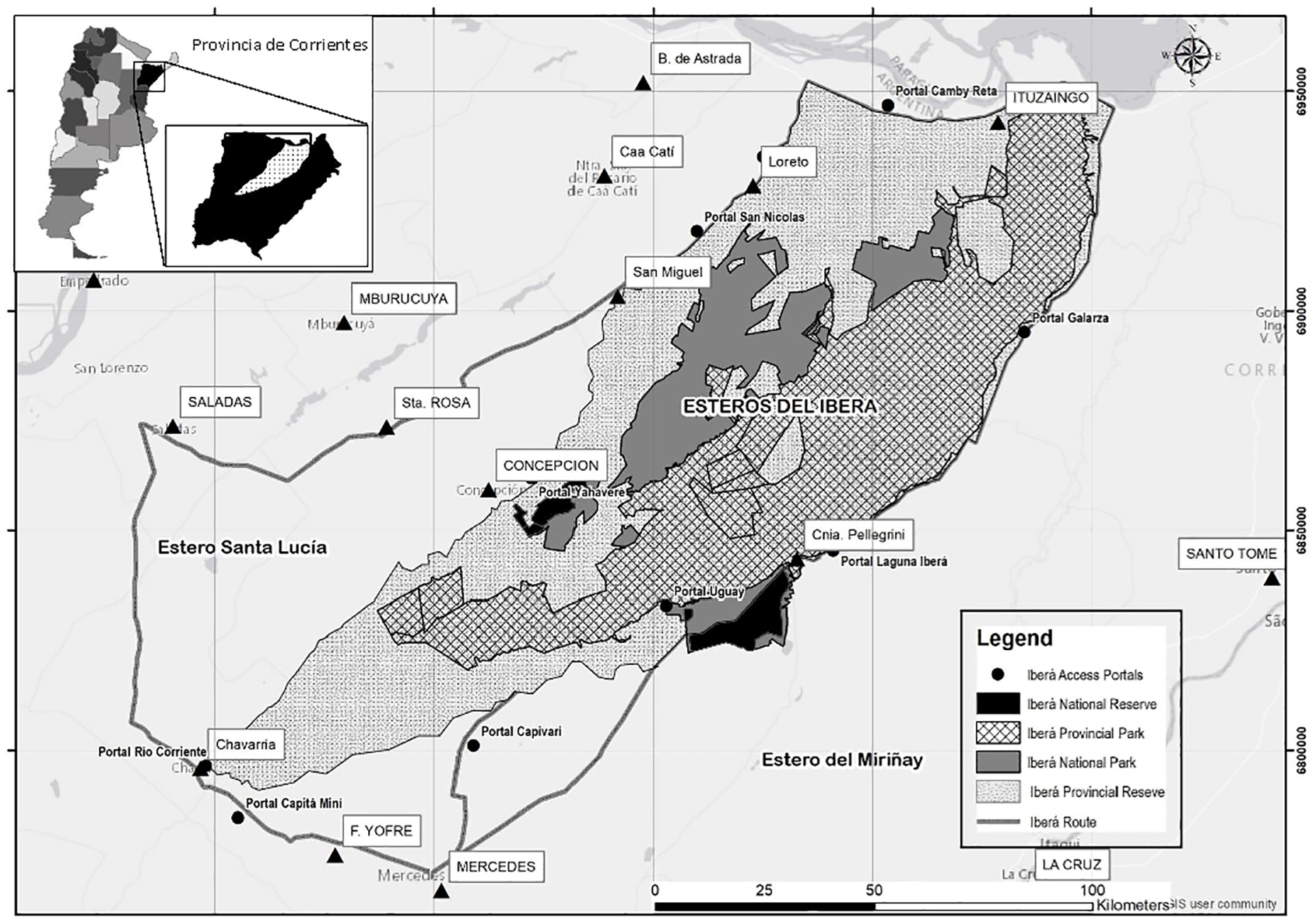
Iberá wetlands and its surrounding communities and protected areas.
While Tompkins Conservation was purchasing land, they also pursued rewilding initiatives that focused on restoring extirpated species, such as the red-and-green macaw, marsh deer, lesser rhea, collared peccary, and jaguar. Beyond rewilding landscapes, a core pillar of the foundation is to stimulate economic activity through nature-based tourism. Given this focus, Tompkins Conservation worked extensively with provincial politicians and other stakeholders to develop access portals to the Iberá wetlands and develop tourism activities. As this effort had been understudied, this research was designed with the help of local collaborators to assess local perspectives regarding the contribution of tourism development and conservation investments to community resilience.
Data Collection and Instrument Development
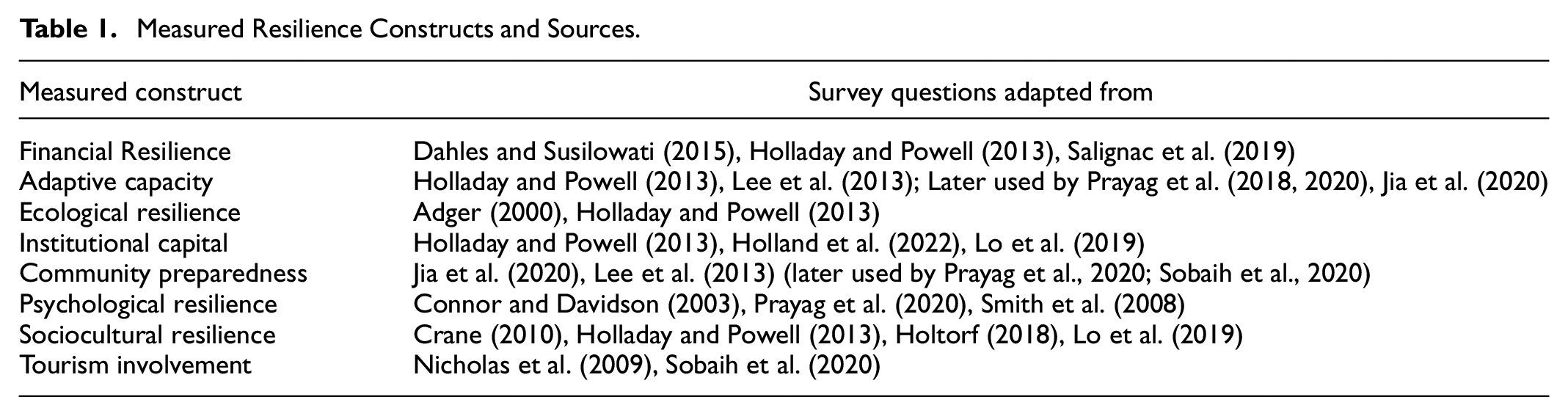
Data for this study were collected through a survey of residents living in communities surrounding the Iberá wetlands in Corrientes, Argentina. The survey was developed through a synthesis of resilience literature to produce a group of community resilience constructs and items along with adaptive capacity and tourism involvement items. The identified community resilience constructs found in the literature expanded upon Holladay and Powell’s (2013) four domains of resilience by including ecological (Dakos & Kéfi, 2022; Holling), psychological (Prayag et al., 2020), institutional (Nyaupane et al., 2022), sociocultural (Holtorf, 2018), community preparedness (Wakil et al., 2021), and financial resilience (Sobaih et al., 2020). Adaptive capacity items were also assessed in the survey, as were additional items related to involvement in tourism that were adapted from previous studies (see Nicholas et al., 2009; Sobaih et al., 2020). In total, the initial survey contained 97 resilience items adapted from previous studies listed in Table 1. To gain an understanding of resilience and adaptive capacity across time and space, the survey was distributed in towns across a large portion of the study area and all the adaptive capacity items asked respondents to assess various conditions of their community at the moment of data collection versus the 10 years prior.
Measured Resilience Constructs and Sources.
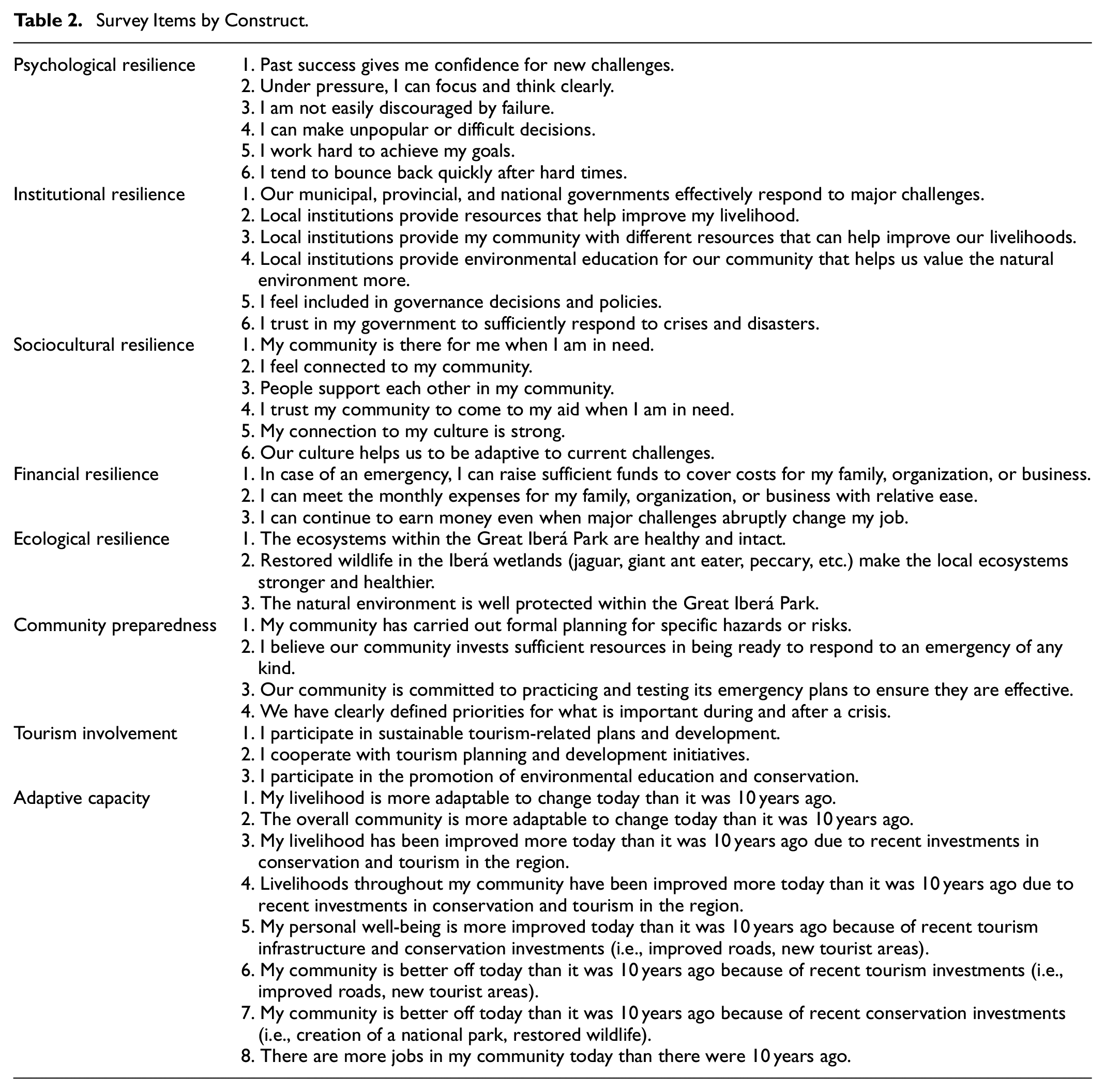
Once 97 resilience items were generated, the authors analyzed and discussed which items were the most important and which were redundant or unnecessary for measuring each construct. During this process, the authors reduced the number of items to 39, which were distributed in the following manner: six items for psychological resilience, six items for sociocultural resilience, three items for financial resilience, three items for ecological resilience, four items for community preparedness, six items for institutional capital, eight items for adaptive capacity, and three items to measure tourism involvement. The exact wording of each survey items can be seen in Table 2. Once the survey was created, it was then translated into Spanish by one of the authors. The translated survey was then pilot tested with a group of tourism students and sustainability professionals from Buenos Aires and Corrientes Provinces in Argentina, who provided their feedback on the clarity of the questions and the time it took them to complete the survey. After receiving feedback from the pilot group, the authors made slight adjustments to enhance the clarity of the survey questions.
Survey Items by Construct.
The research team collected data in December 2022 from several towns surrounding the protected areas within the Iberá wetlands. Crucial to obtaining sufficient surveys was the support of local tourism and conservation leaders who worked for local tourism offices and conservation organizations. The study authors trained these local collaborators on survey techniques who then collected most of the completed surveys while the authors met with key stakeholders and oversaw the data collection process. To obtain a sample of residents that best represented the target population, the authors’ relied on their knowledge of the study area’s occupational strata, and the research team applied stratified random sampling in three different towns: Ituzaingó, Loreto, and San Miguel. The research team intentionally chose public spaces, such as parks and streets, that were near municipal and provincial tourism offices, hotels, and other tourism and hospitality businesses. As part of the stratified random sampling method, the authors created predefined groups to best represent the diverse occupations of residents. As such, the research team also entered various public spaces and business complexes containing businesses across different sectors and invited workers to participate in the survey. This process was repeated at different times of the day and on different days to ensure a diversity of respondents in these sampling areas and to best represent the population. The survey process involved a member of the research team approaching residents in public spaces and in their places of work and inviting them to participate in the survey. The researchers positioned themselves in areas where people entered or exited, such as sidewalks, pathways, and entrance gates. The researchers selected the next person upon completion of each interview, fostering randomness.
The research team asked the survey questions in an interview format and filled out the survey for residents (researcher-administered) in most cases based on participant preference, although some participants opted to fill it out on their own (self-administered) while a member of the research team stood by to answer any questions. Altogether, 208 residents were invited to participate in the survey and 207 surveys were completed, yielding more than a 99.5% response rate.
Data Analysis
After all the surveys were collected, the data were entered into SPSS and the authors took note of the descriptive statistics. Before performing a descriptive analysis and measure model assessment, a common method bias assessment was conducted using R programing. Due to the relatively small sample size (n = 207), the study used a Partial Least Square Structural Equation Model (PLS-SEM), which could address the issue of small sample size and non-normality. The common method basis (CMB) of the data was assessed for the hypothesized model. Also, an assessment of the hypothesized SEM model was conducted to evaluate the reliability, convergent validity, and discriminant validity of constructs. The descriptive characteristics (e.g., means, standard deviation) of the measurement items of each construct was also analyzed. Finally, the coefficients of SEM paths were estimated using R 4.2 programing software.
Results
Descriptive Statistics and Sample Demographics
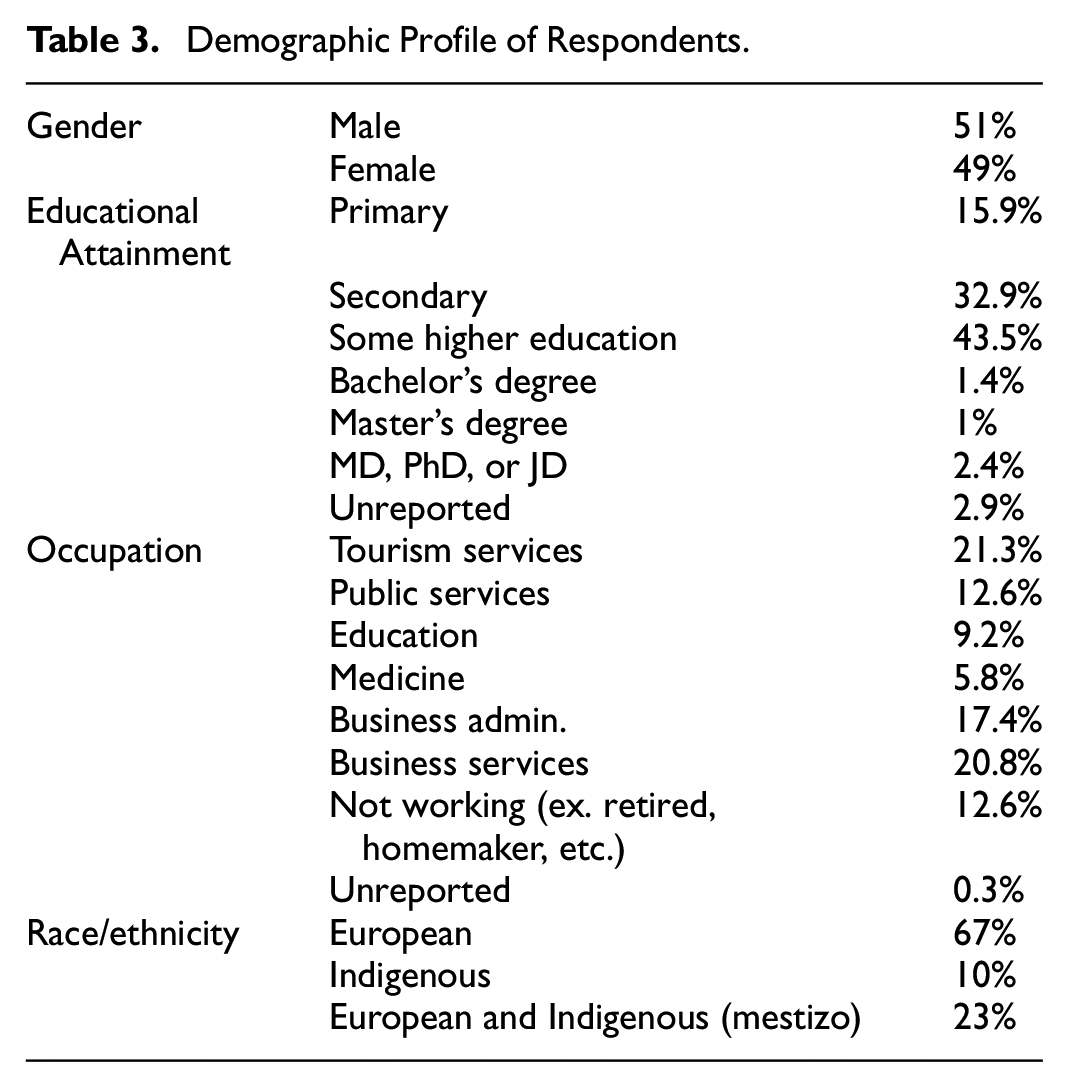
The demographic data for the study sample are presented in Table 3 below. The sampled population generally resembled the target population in terms of gender, racial demographics, education attainment, and occupation, according to available data for Corrientes and Argentina (CIA World Factbook, 2024; Organization for Economic Cooperation and Development [OECD], 2019). The study results also illustrated high support for tourism and conservation investments made during the 10-year period prior to the study and strong agreement that these investments had increased the overall resilience of the region. For example, the mean responses for the impact of tourism and conservation investments on the adaptability, improvement, wellbeing, and number of jobs in the region’s communities ranged from 5.42 to 5.86 on a 7-point scale.
Demographic Profile of Respondents.
Common Method Bias
The common method bias (CMB) is a potential issue that may be induced by the measurement model in SEM, where the variables in the SEM may share a certain level of common variation (Kock, 2017). Therefore, a test for CMB is required before the PLS-SEM analysis. We used the Harman’s single factor test to assess the CMB, and the results indicated that the maximum variation by a single factor was 12% (Psychological Resilience), and variations of other factors were (12%, 11%, 10%, 8%, 7%, 7%, and 5%), respectively, which are lower than the 50% threshold (Podsakoff et al., 2003). Therefore, our measurement model passed the CBM test and could be used to test the hypotheses in the measurement model.
Assessment of Measurement Model
The measurement model was assessed by reliability, convergent validity, and discriminant validity models. The items with factor loadings that were lower than 0.60 were excluded from each construct (Hair et al., 2021). After removing the item with a low factor loading, the cross-loadings of all variables in the measurement model ranged from 0.648 to 0.937 (Table 4), indicating sufficient variance for each. The component reliability (CR) of financial resilience was 0.959, higher than the other seven constructs. The Cronbach’s α and composite reliability (CR) values were nearly all higher than .80, which is well above the threshold of 0.70 and an indication of good internal consistency in the measurement model (Cheung et al., 2024). The only exception was ecological resilience’s Cronbach’s α value of .702, still an acceptable level of fit.
Assessment of Measurement Model.
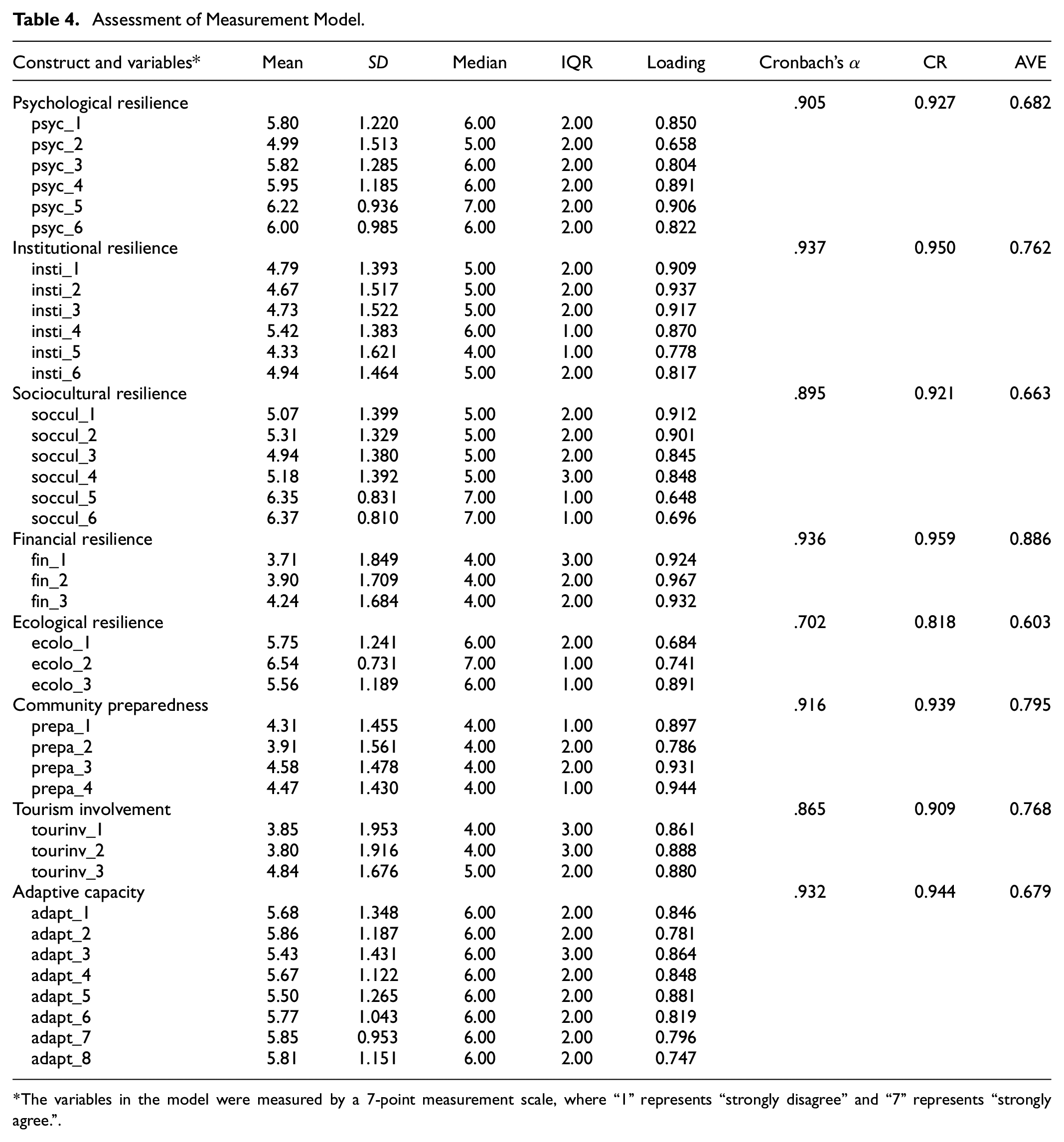
The variables in the model were measured by a 7-point measurement scale, where “1” represents “strongly disagree” and “7” represents “strongly agree.”
The convergent validity was assessed by the average variance extracted (AVE) values. The AVE values of the measurement model ranged from 0.663 to 0.886 (greater than 0.50), indicating the convergent validity was acceptable for each measurement construct (Fornell & Larcker, 1981). Moreover, the collinearity of all variables in each construct was assessed by the variance inflation factor (VIF), and the values ranged from 1.291 to 4.697, indicating the model had no multicollinearity among observed variables (J. H. Kim, 2019). To assess discriminant validity of constructs in the model, the heterotrait–monotrait ratio (HTMT) of correlations was calculated. The results indicated that all HTMT values were less than 0.90 (Table 5), indicating our measurement model’s discriminant validity was acceptable (Henseler et al., 2015).
Discriminant Validity: HTMT Ratio of Correlations.
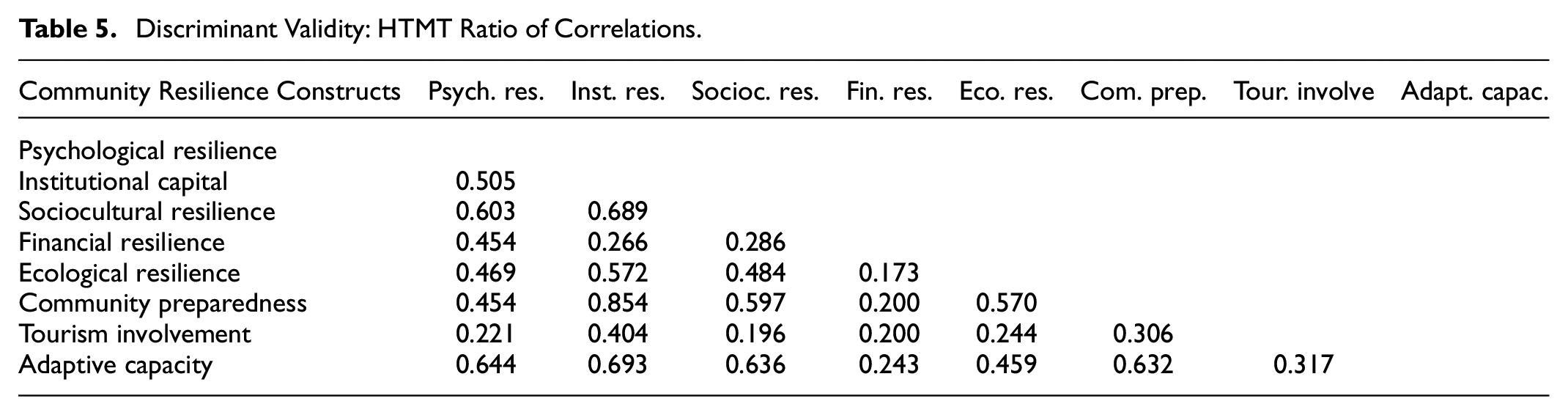
Among the six dimensions of community resilience constructs, ecological resilience (M = 5.95), psychological resilience (M = 5.80), and socio-cultural resilience (M = 5.54) had the highest mean scores, demonstrating a stronger agreement among residents that these constructs were higher in resilience. Financial resilience had the lowest mean score (M = 3.95, followed by community preparedness (M = 4.32) and institutional resilience (M = 4.81).
Assessment of Structural Model
After the development of the measurement model and assessment of its reliability and validity, the structural model (Figure 2) was established based on the hypotheses and tested by the R “SEMinr” package using a bootstrapping procedure. The model explained 57.3% of the variance between the variables (R2 = .573). The results indicated that tourism involvement had significant positive impacts on psychological resilience (p = .050), institutional resilience (p < .001), ecological resilience (p = .049), and community preparedness (p = .003), with varying path coefficients (Table 6). In addition, the model results indicated that several constructs of community resilience had significant positive impacts on adaptive capacity, including psychological resilience (p < .001), sociocultural resilience (p = .012), and community preparedness (p = .047). Among these constructs of community resilience, psychological resilience had the most salient impacts on adaptive capacity (f2 = 0.101).
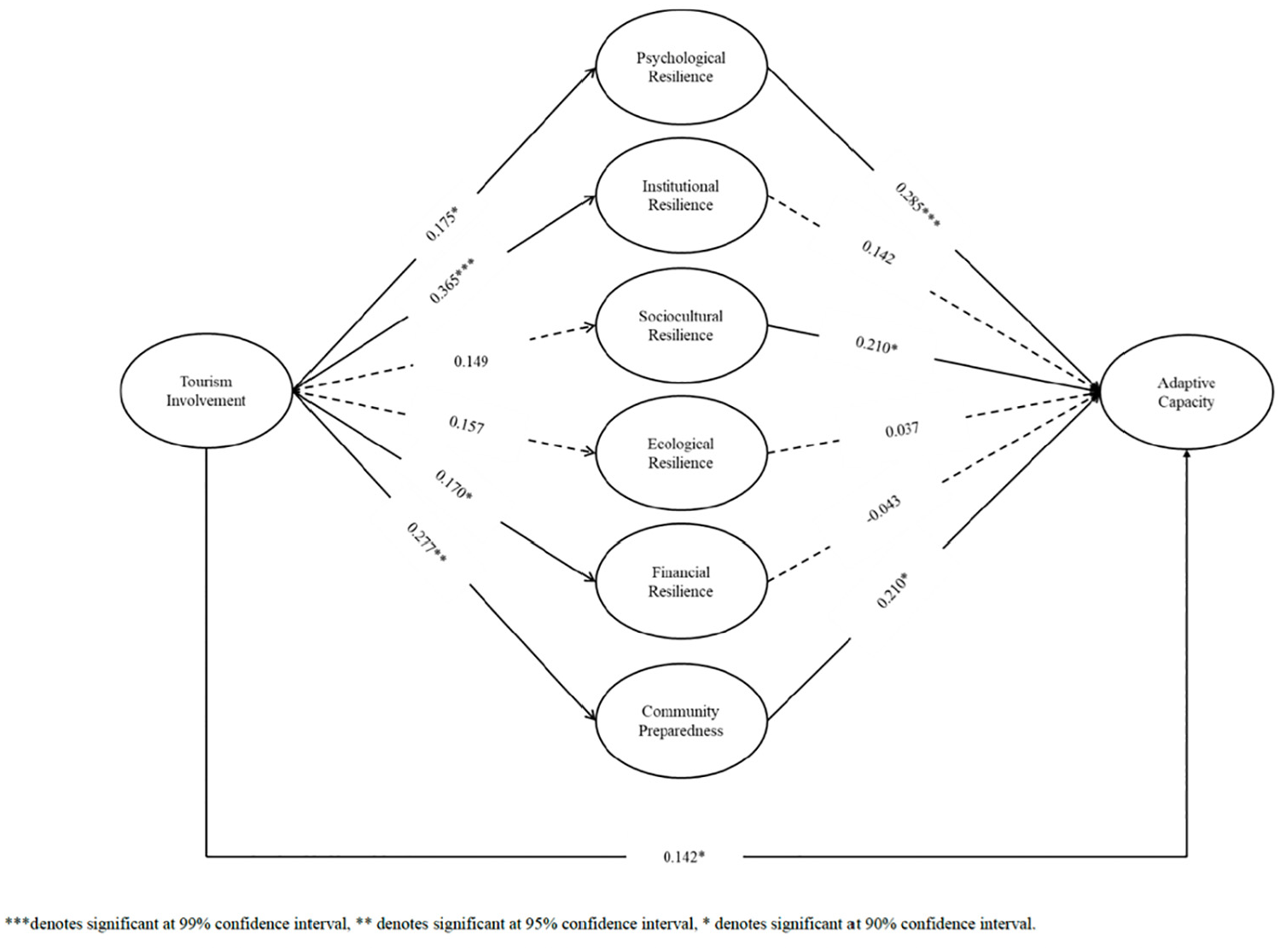
Coefficients of the structural equation model (SEM).
Structural Model and Path Analysis of Resilience Constructs.
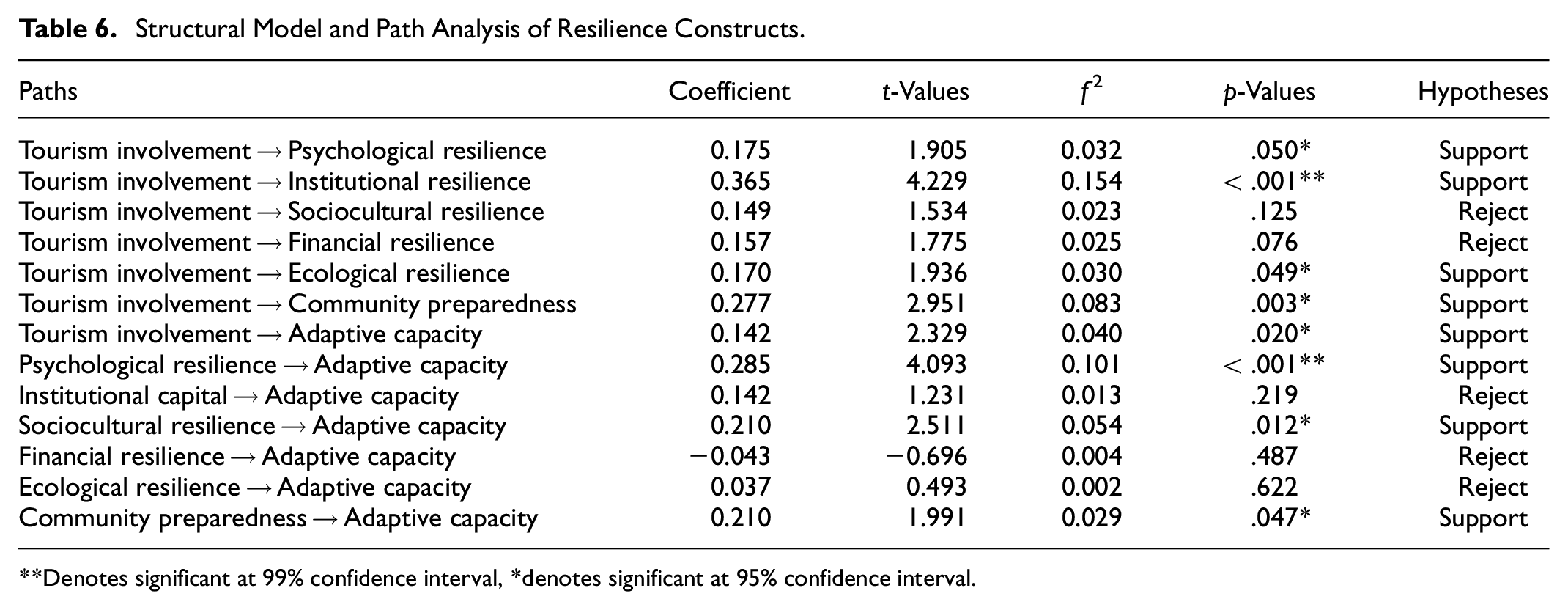
Denotes significant at 99% confidence interval, *denotes significant at 95% confidence interval.
The model also demonstrated that tourism involvement significantly facilitates adaptive capacity through direct and indirect paths of community resilience. Specifically, tourism involvement had a directly positive impact on adaptive capacity (p = .020, f = 0.040) and indirect impacts through psychological resilience, sociocultural resilience, and community preparedness. These results suggested that psychological resilience, sociocultural resilience, and community preparedness were important mediators between tourism involvement and adaptive capacity. The ecological resilience, institutional resilience, and financial resilience constructs, however, had no significant impacts on adaptive capacity, rejecting H3c, H3e, and H3f. The following section articulates possible explanations for why these resilience constructs failed to achieve a significant impact on adaptive capacity, along with the conceptual and practical implications of these findings.
Discussion
Based on the data collected from the study area, a region that had received substantial tourism and conservation investments over the prior decade, the study provides support for the existence of six dimensions of community resilience as they relate to nature-based tourism destinations. Among them, ecological resilience was the strongest (Table 2), because of major investment made in conservation and associated nature-based tourism. While the communities also exhibited strong resilience in psychological and sociocultural dimensions, three dimensions, namely financial, institutional and community preparedness, exhibited relatively weaker resilience. Likely due to the challenging financial situation the country was facing with rampant inflation, the financial resilience dimension was rated as the lowest among the six dimensions. Other factors contributing to weaker resilience included a lack of trust in the government’s ability to respond to crises, insufficient connection with the government at multiple levels, and ineffective planning (Guo et al., 2018; Lo et al., 2019; Nyaupane et al., 2022).
This study also demonstrates how tourism involvement promotes community resilience and adaptive capacity. For example, participants agreed that their individual and collective wellbeing had improved because of tourism development in the Iberá region. Further, the interdependent relationship between resilience and adaptive capacity (Smit & Wandel, 2006) suggests that tourism plays an important role in promoting community resilience and adaptive capacity. Adding to this claim is our finding that tourism involvement has a direct significant relationship with psychological resilience, institutional resilience, ecological resilience, community preparedness, and adaptive capacity, and an indirect significant relationship with adaptive capacity through psychological resilience, sociocultural resilience, and community preparedness (Table 6). These findings suggest that community investments in developing nature-based tourism and protected areas can contribute to the overall resilience and adaptive capacity of nature-based destinations. This study validates prior research documenting the important role of tourism in fostering psychological wellbeing (Prayag et al., 2020; Wakil et al., 2021), preparedness for uncertainties (Espiner et al., 2017; Lew, 2014), sociocultural elements (Amir et al., 2015; Cáceres-Feria et al., 2021; Guo et al., 2018), communities’ ability to adapt to changes (Ruiz-Ballesteros, 2011), the strengthening of community institutions and ecosystems (Clark & Nyaupane, 2022, 2024; Holladay & Powell, 2013), and overall community resilience (Holland et al., 2022). To the best of the authors’ knowledge, this type of approach to examine the relationship between tourism involvement, community resilience, and adaptive capacity has not been tested before in the tourism literature.
The study further demonstrates multiple significant relationships between the various dimensions of community resilience and the region’s adaptive capacity using PLS-SEM models. These findings validate prior research that underscores the interdependent relationship between resilience and adaptive capacity (Smit & Wandel, 2006; Sobaih et al., 2020). Further, these findings illustrate the cumulative impacts of investing in tourism infrastructure, access, and development and ecological restoration as a strategy for development through nature-based tourism, expanding earlier research on the benefits of these development approaches (Clark & Nyaupane, 2022, 2024). Unlike the conceptual and exploratory nature of these earlier studies, this relationship between tourism and conservation investments and resilience was tested through structural equation modeling, contributing to the literature by providing empirical evidence on the relationship.
The finding that some community resilience constructs did not significantly influence adaptive capacity, as was the case with financial resilience, requires additional discussion as national, regional, and local factors and conditions can provide context. The authors believe that the nonsignificant relationship between financial resilience and adaptive capacity was linked to the spatial and temporal dynamics of resilience and adaptability and their interactions (Smit & Wandel, 2006). For example, Argentina had an annual inflation rate of over 200% by January 2024, a cause of major financial stress and hardship for millions of Argentinians (Nugent, 2024). These results also suggest that those who have been the most impacted by the national economic crisis, and therefore feel less financially resilient, may have had to enact some adaptive measures to survive at the local level, as seen in other destinations during the COVID-19 pandemic (see Sobaih et al., 2020). Further, as financial resilience largely relates to one’s ability to meet current financial obligations (Salignac et al., 2019), its relationship with adaptiveness is complex when studying communities that face financial struggles yet manage to overcome them in the long term. Moreover, the lack of significance between ecological resilience and adaptive capacity may be explained by the mixed outlooks on the wetlands’ current resilience status. For example, survey respondents reflected high levels of optimism toward the ecological resilience of the Iberá wetlands due to the recent achievements of creating a national park and reintroducing wildlife species. Despite these local achievements, the relationship between ecological resilience and adaptability might be impacted by local, regional, and global environmental challenges, such as poaching, droughts, and wildfires, the latter two being exacerbated by climate change (Ngin et al., 2020). This can be explained by the fact that while resilience and adaptive capacities are manifested at the local level, stressors are both local and external, which makes the relationship more complex (Smit & Wandel, 2006).
A key finding of this study is the strong link between one’s involvement in tourism and their measure of resilience and adaptive capacity. This relationship highlights a key benefit of working in an evolving, dynamic, and vulnerable industry where quickly adapting to changes is key to survival and success (Sobaih et al., 2020; Waller & Bartlett, 2022). Our model indicates that tourism involvement can facilitate adaptive capacity through both direct path and indirect paths of community resilience and adaptive capacity. As has been shown in previous research, involvement in tourism leads to higher levels of social capital and community resilience (Cáceres-Feria et al., 2021; Guo et al., 2018), and adaptive capacity forms a critical element of the resilience framework (Smit & Wandel, 2006). Thus, as community members become involved in tourism, they form additional social connections with other industry players and stakeholders, increasing their resilience and adaptability to change. This enhanced ability of a community to survive and thrive by being involved in the tourism system can be supported and explained by extending the human ecology framework. Using this framework, researchers and practitioners can better understand why community members involved in a certain industry need to consider how they organize systems and interact with their environments (Duncan et al., 1959; Hawley, 1986; Steiner, 2016), and why their need to adapt to changing social and environmental conditions is paramount for a sustainable future (Dyball & Newell, 2014; Matarrita-Cascante & Brennan, 2012). In the case of tourism development and conservation in the Iberá wetlands, the adaptive mechanism of human communities can be described by extending human ecology theory as people self-organize to provide tourism services and adapt to their changing social and environmental conditions brought on by tourism and conservation investments. This adaptation occurs not only to ensure survival but an increased quality of life connected to the conservation of vital resources (Bubolz & Sontag, 1993).
Given the significant relationships between tourism involvement, the identified community resilience domains, and adaptive capacity found in our study, the community resilience framework proposed in this paper strengthens existing resilience research and the rationale behind ongoing and proposed efforts to invest in protected areas and their neighboring communities. This contribution to resilience research has important conceptual and practical implications related to the study and continued development of nature-based destinations around the world.
Conceptual Implications
This study provides several important conceptual implications for tourism research. First, the community resilience dimensions identified in this study address the lack of empirical data and established framework for measuring community resilience (Guo et al., 2018; Pennington-Gray, 2018; Shin et al., 2023) and reveal key elements of this construct that are central for understanding the resilience of tourism destinations. Examining resilience across a tourism destination is an important implication of this research as previous research highlights different resilience dimensions at the individual tourist level (M. J. Kim et al., 2022; Xie et al., 2023). While previous research highlighted several domains of resilience for tourism destinations, such as economic, environmental, institutional, and social (Holladay & Powell, 2013), this study expanded on these domains to build a more complete framework that has been shown to be key for tourism destinations, such as community preparedness (Jia et al., 2020), sociocultural resilience (Holtorf, 2018), psychological resilience (Prayag et al., 2020), and tourism involvement (Sobaih et al., 2020). By including these constructs together and measuring these collective effects on adaptive capacity in the same model (Waller & Bartlett, 2022), a more cohesive, holistic, and transparent picture of a tourism community’s resilience can be used for analysis.
Second, this study provides empirical evidence that tourism involvement promotes community resilience in a newly established nature-based tourism destination. Despite national-level economic distress, resilience at the community level was fueled by the tourism and conservation investment made at the regional level. Third, this study highlights how a tourism destination’s adaptive capacity is a key output of its community resilience (Waller & Bartlett, 2022) by testing its relationship with the six community resilience constructs in a structural model. This finding expands previous knowledge on what resilience attributes are crucial for tourism destinations as they face abundant uncertainties from natural, economic, social, and political forces (Sobaih et al., 2020; Yang et al., 2021). Further, this finding demonstrates that in addition to a community’s resilience, including strong sociocultural and psychological capitals and community preparedness, involvement in tourism can contribute to greater adaptive capacity.
Fourth, the significant relationship between tourism involvement and adaptive capacity is another conceptual contribution when seeking to understand the adaptive capacity of tourism destinations. This finding suggests that communities involved in tourism are better prepared to adapt to changing conditions that impact tourism-related livelihoods. These changing conditions or disruptions come in many forms, such as natural disasters (Pyke et al., 2018; Yang et al., 2021), global pandemics (Sobaih et al., 2020), or adverse impacts brought by tourists (Holland et al., 2022). The adaptability is possibly contributed to by increased economic diversity and innovation, openness, and developed broader skills to navigate change. Further, the necessity of adaptation to changing conditions demonstrates the vulnerable and volatile conditions that tourism destinations will often encounter (Yang et al., 2021). Hence, the various traits of community resilience are vital for the overall resilience of tourism destinations and their ability to adapt to constantly changing conditions (Waller & Bartlett, 2022).
A fifth theoretical contribution of this study is a demonstration of how the relationship between tourism involvement, community resilience, and adaptive capacity expands current understanding and use of human ecology theory in the context of tourism growth in a nature-based tourism destination. For example, this study extends human ecology theory to explain how tourism involvement enhances a community’s adaptive mechanism, or newly developed system (Hawley, 1986), in response to changing conditions brought on by tourism and conservation investments, illustrating the dynamics between communities and socioecological conditions when tourism is introduced to a new region. The positive relationships between tourism involvement and adaptive capacity through community resilience constructs as mediating variables is a clear demonstration that tourism is an effective tool for human adaptations to the local environment, a concept not previously discussed in human ecology literature. Tourism is a relatively new phenomenon within human-environment systems, which stimulates new relations and functions. This view toward tourism-induced adaptation, such as building new social networks and institutions and non-consumptive use of natural capitals for sustenance, goes beyond previous research analyzing human-environmental interactions in tourist areas through a human ecology lens (see Taveras Dalmau & Coghlan, 2022). This view demonstrates how tourism can be an interdependent vehicle for generating sustainable outcomes and community development in a socioecological system (Bubolz & Sontag, 1993; Dyball & Newell, 2014; Steiner, 2016). As indicated by previous research, this study confirms that a stronger ability to exercise adaptive capacity is an important feature for a community and can be developed through the intricate process of tourism involvement (see Ruiz-Ballesteros, 2011).
Practical Implications
The community resilience framework and results of this study also offer several key practical implications for tourism and conservation researchers, planners, decision makers, and practitioners at nature/community-based tourism destinations. First, tourism and conservation stakeholders have additional evidence from this study that efforts to protect and restore natural and cultural resources at a tourist destination can lead to an increase of community resilience. This finding expands on earlier literature that discuss the importance of sociocultural, institutional, psychological, ecological, and financial strength and community preparedness for community resilience (Beel et al., 2017; Holladay & Powell, 2013; Moayerian et al., 2022; Prayag et al., 2020; Salignac et al., 2019). Moreover, the output of increased adaptive capacity from community resilience will be critical as the impacts of climate change are only projected to get worse in the future (Ngin et al., 2020) and given the volatility of the global tourism industry (Amir et al., 2015; Espiner et al., 2017; Waller & Bartlett, 2022).
Similarly, the study results highlight the community resilience benefits of developing tourism through investing in tourism infrastructure, protected areas, access to protected areas and surrounding communities, and the communities themselves. This finding coincides with past research discussing the importance of tourism development for community resilience (Shin et al., 2023; Wakil et al., 2021). Further, by increasing the accessibility and connectivity to and between protected areas and communities, the benefits of tourism are more easily dispersed across a larger landscape (Clark & Nyaupane, 2022; Steiner, 2016). Further, this study reveals how communities are more adaptable to change when tourism and conservation investments strengthen institutions, psychological wellbeing, sociocultural aspects, and involvement in tourism (Lee et al., 2013; Nyaupane et al., 2022). A third practical implication of this study is the utility of selecting sites for study that have undergone significant and substantial investments in developing nature-based tourism through creating new protected areas and reintroducing wildlife. As there has been a new emerging model of protected areas supported by philanthropists (Clark & Nyaupane, 2022), this study offers a unique opportunity to empirically measure the impacts of developing nature-based tourism for surrounding communities under these new protected area models.
Conclusion
This study establishes how community resilience in a nature-based tourist destination comprises six resilience constructs, expanding existing research which emphasize the various domains of resilience (Adger, 2000; Holladay & Powell, 2013; Lee et al., 2013; Prayag et al., 2020). The study also highlights the significant relationship between tourism involvement systems, community resilience constructs and adaptive capacity using survey data obtained from community residents at a rapidly growing nature-based tourism destination. These findings demonstrate the conceptual contributions of this study to tourism research by testing the relationship between tourism involvement, community resilience constructs, and adaptive capacity. The findings further demonstrate the significant relationship between community resilience constructs and adaptive capacity, bolstering previous research on the interrelationship between these two concepts (Bec et al., 2016; Smit & Wandel, 2006).
The study also contributes to tourism research by examining resident perceptions toward their community’s resilience and adaptive capacity in a nature-based tourism destination that had recently received substantial tourism and conservation investments. By selecting a site where ranching and agriculture had been the dominant economic activities until these recent investments provided new opportunities, resident perspectives on how their resilience and adaptive capacity have been improved through nature-based tourism can provide key insights to researchers. Another contribution of this study is the demonstration of how the relationship between tourism involvement and adaptive capacity, as mediated by community resilience constructs, expands human ecology literature by applying it in a nature-based tourism context. As human communities evolve in their interactions with local environments, tourism is proven to be an effective adaptive mechanism for creating new livelihoods and stronger communities, especially when investments are made to enhance tourism infrastructure and ecological integrity (Duncan et al., 1959; Hawley, 1986; Matarrita-Cascante & Brennan, 2012). This theoretical approach expands previous research explaining how tourism involvement can fortify a community’s adaptive capacity—an essential trait for a dynamic yet vulnerable tourism industry. Together, these conceptual and practical implications constitute the study’s key contributions to tourism research.
Study Limitations and Future Research
A limitation of this study that may reduce the ability to generalize its findings on community resilience and adaptive capacity across all tourism destinations is its specific focus on a nature-based tourism context in a country that has gone through major economic turmoil. This economic downturn caused by inflation may explain the lack of significant relationship between financial resilience and adaptive capacity.
While the selected site may be a limitation in this regard, the study site also presents a unique opportunity to examine the contribution of large tourism development and conservation investments to a destination’s community resilience. Future research may offer valuable contributions to the literature by focusing on the impact of other forms of major tourism investments on community resilience and adaptive capacity across different types of communities and tourism activities. For example, research could examine how investing in a new sports arena or urban greenway builds community resilience and adaptive capacity in a wide range of settings. Future studies can benefit tourism research by using the community resilience constructs identified in this study and testing their relationship with tourism involvement and adaptive capacity across a variety of tourism destination types.
Footnotes
Acknowledgements
We would like to express gratitude to our research collaborators in Corrientes and Buenos Aires, Argentina who provided invaluable help proofreading and conducting surveys, providing transportation, and serving as cultural guides.
Declaration of Conflicting Interests
The author(s) declared no potential conflicts of interest with respect to the research, authorship, and/or publication of this article.
Funding
The author(s) received no financial support for the research, authorship, and/or publication of this article.
