




Abstract
The purpose of this study was to develop a reliable and valid measurement scale for animal welfare literacy in tourism. Based on an established conceptual framework, this study follows a systematic scale development process consisting of four steps: generating initial items, reviewing the item pool, data collection, and assessing the reliability and validity of the scale. The created scale consists of six dimensions capturing the distinct components of animal welfare literacy in tourism. The scale can serve as a foundation for future research involving several animal species, different geographical contexts and scales, and guide efforts aimed at increasing the welfare of animals used in tourism.
Introduction
In efforts to broaden the landscape of responsibility and sustainability in tourism, a focus on animals has slowly but steadily taken root in both applied and theoretical domains. The move into the tourism industry represents an essential shift beyond traditional animal welfare concerns in factory farming and research laboratories, where animals have been a topic of study for decades. As representative of this shift into tourism, the World Wide Web provides a litany of examples of non-government organizations that share advice on being a mindful tourist when it comes to interactions with animals. The Four Paws, for example, provides advice on how to behave in the form of a code of ethics. Advice is given on the avoidance of animal riding attractions, avoidance of animal shows, frowning on taking animal selfies, care in taking home animal souvenirs, insistence on not feeding animals, and the avoidance of dubious wildlife parks (Four Paws, 2023). The NGO Wild Welfare (2023) states that You can make a difference, though. Put animal welfare first and do not disturb wildlife, keep a respectful distance, avoid photo opportunities, animal handling interactions, riding animals and buying animal products. And trust your instincts, if something doesn’t feel right – don’t do it.
However, how do we know when it “feels right”? What do our instincts tell us? Our ability to judge what is morally right or wrong has much to do with how literate we are as individuals and organizations over matters that have social and/or ecological consequences. According to Fennell et al. (2023), it is important to focus on animal welfare literacy since it can help tourists make better-informed decisions regarding their participation in animal-based attractions and activities and contribute to the reduction or even elimination of negative impacts of tourism on animals. In order to better understand the potential role of animal welfare literacy in shaping tourists’ behaviors and attitudes, it is critical to first know how to measure it. As Carroll (2000) stressed, “measurement is one part dealing seriously with an important matter” (Carroll, 2000, p. 473) and animal welfare literacy is no exception. Measurement represents a fundamental activity in knowledge discovery, provides valuable insight into phenomena of interest and enables further investigation of their consequences and correlates (DeVellis & Thorpe, 2022; Morgado et al., 2017). Development of reliable and valid scales is a crucial step in this process. Standardized measures improve objectivity of social science research and enable testing of theories (Netemeyer et al., 2003).
Because of the hospitality and tourism industry’s size, growth, and scale of impacts, Koc and Ayyildiz (2022) argue that the development and use of scales that provide more insight into how tourists interact with each other, processes and systems are both worthwhile and important for the future research and practice in the field. They especially encourage further work on scales that do not overlap with existing scales but address novel applications and relate to specific tourism activities. In the context of animal-based tourism, a scale for measuring animal welfare literacy would provide a much-needed tool to gain insight into tourists’ attitudes, knowledge and choices and further advance the field. Tourists are among the most important stakeholders of animal based-tourism. They engage in social, emotional and financial exchanges with service providers and have direct effect on animals used in tourism and their wellbeing. A tool for assessing tourists’ levels of animal-welfare literacy may provide insight into these impacts and guide future initiatives and policies to advance sustainable development goals in the context of animal-based tourism. An animal-welfare literacy in tourism scale can be used by the scientific community to better understand animal welfare literacy in tourism, to evaluate the current state of animal welfare literacy worldwide, and inform further research in this area. It can also be used by industry when developing sustainable animal-based tourist experiences and by policy makers and educators to evaluate changes in literacy levels and to design effective policies and interventions.
Given the dearth of research in the literacy aspect of tourism and animal ethics, it is the purpose of this paper to develop a reliable and valid measure of animal welfare literacy in the tourism context building on Fennell et al.’s (2023) conceptual study on moving from animal welfare illiteracy in tourism to literacy. While recognizing that complete scale finalization would involve multiple steps and studies over time, our approach is built upon construct definition, measurement item generation and purification, and initial assessment of reliability and validity. The long-term aim is to use the scale to initiate a broad program of research that provides a benchmark on animal welfare literacy across several demographics and regions in the hope of developing a level of “grammar” that takes shape normatively in elevating the needs and interests of animals used in tourism.
Literature Review
At its foundation, the field of animal ethics explores the theoretical nature of why we should include animals in our moral decision-making, as well as the applied consequences of these decisions. Not unlike ethics in general, there is a wide spectrum of different theoretical positions guiding us on how and why we should act for or against the interests and wellbeing of animals. These theories are discussed in other studies but generally range from contractarianism, in which animals are given secondary moral consideration, to animal rights and posthumanism, where the abolition of animal use is accepted as the norm (Fennell, 2012). Animal welfare, existing less as a theoretical position and more as a constellation of different approaches to our care for animals, occupies an intermediary position in the range of different theories and approaches. Animal welfare is characterized by how an animal copes with its environment (Hill & Broom, 2009) and involves the quantity and quality of care that humans provide for animals. As such, animal use is the norm, not abolition, which has generated many ways to help protect the needs and interests of animals, including the Five Freedoms (Farm Animal Welfare Council, 2009) and the Five Domains (Mellor et al., 2020) models of animal welfare. While animal welfare advocates argue that the quantity and quality of care provided for animals determines the moral limit of what we can and should do for animals (Maple, 2007), on balance, critics contend that it is still speciesist in the violation of an animal’s moral rights (Dunayer, 2004; Francione, 1996).
Tourism has long relied on the visual and cultural (including gustatory) consumption of animals in a variety of settings, contexts, and practices to help bolster the profit and pleasure motives of the industry. Animals are used as captives, workers, for competition, sport and subsistence, as food, and as objects to be viewed (Fennell, 2012). In many countries, wildlife-based tourism represents a significant market, projected to be US$ 219.9 billion globally by the year 2032 (Future Market Insights, 2022). The magnitude of the animal-based tourism industry means that it is also the grand decision-maker of how, or even if, animals are afforded levels of care.
The literature is now replete with examples of how the tourism industry, with its outdated methods centered on profit and pleasure, must change to be more responsible, ethical, and sustainable. Scholars have embraced animal welfare as the most rational ethical approach owing to the entrenched nature of animals as focal points in tourism business (Carr & Broom, 2018; Fennell, 2013; Rickly & Kline, 2021; Winter, 2020). Work in Nordic countries, especially Finland, shows how the principles of animal welfare are being used to improve animal-human relationships in activities such as horses, reindeer, and sled dogs (Haanpää et al., 2021; Tallberg et al., 2021). While change is needed by infusing the principles of other more protectionist theories of animal ethics in achieving deeper justice for animals used in tourism is germane (Fennell & Sheppard, 2021), instituting these changes will take considerably more political, economic, social, cultural, and legal will.
Industry organizations have also made strides in championing animal welfare. But while large organizations such as the Dutch Association of Travel Agents and Tour Operators (ANVR, 2013) have well-developed animal welfare standards, their motives are more utilitarian and instrumental than genuine when it comes to the welfare of animals (Font et al., 2019). In a related study on the tourism policies of national and state jurisdictions, animal welfare and other animal-based protective mechanisms were fleeting in these policies emphasizing utilitarian and ecocentric motives (Sheppard & Fennell, 2019). Even the UNWTO, a supposed global champion of responsibility and sustainability through their Global Code of Ethics for Tourism, gives only passing mention of animals based on an ecocentric perspective (Fennell, 2013).
In a comprehensive study of wildlife tourism attractions hosting millions of tourists with significant welfare and conservation impacts on animals, Moorhouse et al. (2015, 2017) concluded that in the absence of regulation, WTA standards are determined by what tourists find to be acceptable or unacceptable. If tourists do not leave reputationally damaging feedback to these venues, they remain profitable, and there is no motivation for WTAs to ultimately change. Part of the mandate of WTAs is to educate tourists on the conservation and welfare challenges facing captive and wild animals. One of the management implications stated by Ballantyne et al. (2011) in their work on tourist visits to marine-based attractions in Queensland, Australia, was to “Give examples of practical and achievable things that individuals can do to contribute to the welfare of the animals being observed, wildlife in general, and their own local environment” (p. 778).
Such was a point of departure for Fennell et al. (2023) in a recent paper on an animal welfare literacy framework, as well as the development of an animal welfare syllabus for post-secondary institutions (Fennell et al., 2023). Given the pressures that tourism companies are under to realize financial goals, Fennell (2022) and Fennell et al. (2023) reasoned that consumer education (tourists) is key to elevating the welfare of animals used as tourist attractions. Research indicates that although tourists often have a short-term focus on self-related benefits when it comes to sustainability benchmarks, there are significant differences based on gender (Tasci, 2017). Other studies have found that activating consumer demand for sustainable products is essential for growing sustainable consumption (van Trijp & Fischer, 2010). Galbreth and Ghosh (2013) found that two factors influence consumers when it comes to sustainability. The first is the level of concern that each consumer has regarding sustainability, and the second is their awareness of the sustainability of competing products. We take these findings as a further point of departure in theorizing that a more literate animal-based tourist would seek products that correspond with their level of literacy. Low-level literacy in tourists would correspond to acceptance of WTAs that have little regard for the welfare of animals. Higher-level literacy, in contrast, would necessitate the seeking of WTAs that correspond to an expectation that animal welfare is a strong feature of the venue. Henceforth, we describe in more detail the conceptual framework that attends to this rationale.
Literacy and Sustainable Tourism
According to UNESCO (2005), literacy “involves a continuum of learning in enabling individuals to achieve their goals, to develop their knowledge and potential, and to participate fully in community and wider society” (p. 21). It is a concept that has been increasingly discussed in the context of tourism. It is viewed as means of closing the gap between the growing scientific knowledge about sustainability challenges and the lack of progress in addressing them (Becken & Coghlan, 2024). Research demonstrates that knowledge alone does not guarantee sustainable action. Instead, in order to successfully address environmental crises, knowledge needs to be accompanied by the ability to transform this knowledge into the action (Becken and Coghlan, 2024). Literacy can play this role, since it focuses not only on knowledge but also on its use and the changes in attitudes and behaviors that can bring. For example, in the context of environmental sustainability, Zheng et al. (2020) argue that environmental education and resulting literacy can lead to public engagement in environmental issues and can help solve environmental issues faced by tourism.
Different types of literacy have been conceptualized and applied in the context of tourism. These include environmental literacy (O’Brien, 2007; Zheng et al., 2020), energy literacy (DeWaters & Powers, 2013; Wu et al., 2023; Zhang & Zhang, 2020), carbon literacy (Horng et al., 2013), avi-tourism literacy (Tustin & Conradie, 2016), disaster planning literacy (Tsai et al, 2020), or regenerative literacy (Becken & Coghlan, 2024). Much of this literature focuses on environmental literacy and energy literacy given the scale of environmental impacts of tourism and the potential of environmental literacy to bring about positive change. In the wider context, the concept of literacy is viewed as an important driver of change towards sustainable tourism (Becken & Coghlan, 2024).
Conceptualization of Animal Welfare Literacy in Tourism
On the basis of the theoretical background developed by Fennell et al. (2023), we define animal welfare literacy in tourism as “the awareness of, understanding, and ability to make informed and responsible decisions regarding animals in tourism” and conceptualize it as a multidimensional construct, consisting of five components, awareness, knowledge, attitudes, skills, and action. Awareness refers to an individual’s general impression and consciousnesses about animal welfare in tourism and the adverse consequences of animal-based tourism activities for animals (de Groot & Steg, 2009; Fennell et al., 2023; Han, 2015; Steg & de Groot, 2010; Tustin & Conradie, 2016). Knowledge represents an individual’s knowledge and understanding of a wide range of animal welfare facts, concepts, problems and issues in tourism and solutions to these problems. This includes an understanding of the physiological, behavioral, and emotional impacts tourism has on animals (Fennell et al., 2023; Han, 2021; Hollweg et al., 2011; Tang et al., 2022). Attitudes capture an individual’s sensitivity, appreciation, and sense of responsibility for animal welfare and conservation in tourism (Fennell et al., 2023; Sudarmadi et al., 2001). Skills encompass critical thinking and problem-solving skills and strategies to seek, access, evaluate and use information about animal welfare in tourism; identify and analyze animal welfare problems in tourism and possible solutions; consider alternative actions and assess their consequences; and apply knowledge and understanding in order to make effective decisions (Fennell et al., 2023; Hollweg et al., 2011). Finally, action refers to behavior patterns that are designed to consciously reduce and limit individual impact on animals in tourism or to contribute to broader societal efforts to protect animals in the tourism context. This includes public-sphere behaviors (animal welfare activism and advocacy) and private-sphere behaviors (tourism purchase behaviors, lifestyle; Fennell et al., 2023; Negev et al., 2008; Stern, 2000).
All five dimensions are considered critical components of literacy and animal welfare in tourism. A literate person would, therefore, exhibit high levels of all of them. Specifically, such a person is conceptualized as someone who is aware of animal welfare issues in tourism; possesses the knowledge and understanding of a wide range of animal welfare concepts, problems, and issues related to tourism; has high sense of responsibility for welfare of animals used in tourism; has skills and strategies to apply the knowledge and understanding in order to make sound and effective decisions regarding a range of animal welfare issues in tourism; and finally undertakes actions to limits their own impact on animals in tourism and contribute to animal conservation efforts in tourism.
Scale Development
In order to develop a psychometrically valid scale of animal welfare literacy in tourism, the current study proceeded in accordance with established procedures and prior scale development literature (Bagozzi et al., 1991; Churchill, 1979; DeVellis & Thorpe, 2022; Netemeyer et al., 2003). Specifically, the process proposed by Netemeyer et al. (2003) was used as a general guide for the current study. Netemeyer et al. (2003) recommend four steps in scale development: construct definition and content domain, generating and judging measurement items, designing and conducting studies to develop and refine the scale, and finalizing the scale. The construct definition and content domain step for the current study is based on the theoretical background developed by Fennell et al. (2023) and provided in the previous section. The remaining parts of the scale development process completed in this study are reported in the following four phases. In Phase 1, an item pool was generated based on an extensive review of literature and assessed by experts in the field. Phase 2 involved converting the generated items into a questionnaire, pretesting the questionnaire, collecting data from a Canadian adult population (n = 804), and scale purification through exploratory factor analysis (EFA) using a random subsample of the collected responses (n = 402). As part of finalizing the scale, in Phase 4, a confirmatory factor analysis (CFA) was applied to the second subsample using the model developed in Phase 2 in order to cross-validate the scale with a new set of data. Additionally, an initial assessment of nomological validity of the animal welfare literacy in tourism scale was conducted by testing relationships between TAWL, wildlife welfare orientation and motivation to learn using combined samples from previous steps. Complete development and finalizing of the scale, as recommended by Netemeyer et al. (2003), requires a number of further studies which are outside of the scope of this paper and are discussed as directions of further research. The results from each phase are reported in the following sections.
Phase 1: Identification of Domain and Item Pool Generation
The boundaries of the domain and the construct definition have been established in a study by Fennell et al. (2023) and further expanded in the previous section on conceptualization of animal welfare literacy in tourism. Once the dimensions were specified and defined, the initial item pool was created by using a list of statements obtained from relevant scales in the literature and by developing new items based on the proposed definitions. Since there was no previous animal welfare literacy in tourism scale, studies from several related areas were reviewed in order to identify items that could constitute a tourism animal welfare literacy scale. The largest body of literature that was reviewed was research devoted to the development of different literacy scales, including environmental or eco-literacy in general (Fang et al., 2018; Hollweg et al., 2011; Hui et al., 2023; Negev et al., 2008; O’Brien, 2007), topic-specific environmental literacy such as energy literacy (DeWaters & Powers, 2013; Lee et al., 2015); animal-specific literacy scales, for example, avi-tourism literacy (Tustin & Conradie, 2016); and information literacy (Kurbanoglu et al., 2006). Secondly, studies on attitudes to animal welfare (Carnovale et al., 2022; Małecki et al., 2016; Mazas et al., 2013; Platto et al., 2022) and attitudes toward animal-based attractions in tourism (Flower et al., 2021; Moorhouse et al., 2019; Shani, 2012) were reviewed. Finally, relevant literature measuring individual domains of environmental literacy was reviewed to further identify items to include in the tourism and animal welfare literacy scale. Specifically, papers that measured environmental concern (Chen & Tung, 2014), environmental knowledge (Tang et al., 2022), environmental attitude (Steg & de Groot, 2010; Sun et al., 2018), sense of responsibility (Han, 2015; Steg & de Groot, 2010), and social issues advocacy (Nilsson et al., 2011) were reviewed. The review of previous scales revealed that the existing measures provide many relevant items but do not sufficiently cover all potential aspects of animal welfare literacy in tourism.
The items identified from the literature were modified to make them appropriate to the context of the present study and combined with new items which were proposed based on the animal welfare literacy conceptualization adopted in the present study. In total, 91 items were generated at this stage. The item pool was next reviewed by the authors to eliminate unclear, unrelated or redundant items. This process resulted in the initial list of 64 items. In the next stage, a panel of five experts reviewed the initial pool of items to ensure their content validity (Schriesheim et al., 1993). The experts were selected on the basis of their research in the fields of animal welfare, tourism ethics, and/or environmental performance. All invited experts agreed to participate and provided their feedback in July 2023. The experts were asked to assess the degree of representation of each item, identify missing aspects, if any, and edit and comment on the items to enhance their clarity and relevance. The experts provided feedback with respect to content validity and clarity, avoiding double-barreled statements and avoiding social desirability bias (DeVellis & Thorpe, 2022). This step was critical in significantly reducing and modifying the item pool and led to a revised list of 41 items. The items were then converted into statements, which were measured using a 7-point Likert-type scale from “Extremely disagree” (1) to “Extremely agree” (7). The next step of the validation of the scale involved pre-testing the initial version of the questionnaire in a convenience sample of 12 undergraduate students. The pre-test resulted in the identification of items that were ambiguous or difficult to rate. Based on the feedback, some statements were modified, and minor corrections were made with respect to the wording, phrasing, and layout of the questionnaire.
Phase 2: Data Collection and Item Purification
A questionnaire consisting of all 41 scale items and demographic questions was designed to collect the data for the study. Since the study design involved using self-reported items to develop the scale, there is a risk of common method bias due to factors such as image and impression management, limited introspective abilities, and response bias (Koc & Ayyildiz, 2022). Common method bias can negatively affect scale reliability and validity. Several actions recommended by Podsakoff (2003) were implemented during the study to minimize this problem, including ensuring participants’ anonymity, counterbalancing question order, and explicitly asking respondents to be truthful while answering the questions.
The data was collected in Canada. The questionnaire was distributed to an online market research panel, representative of the Canadian population, maintained by Léger. The company recruited participants from the panel, using a generic invitation letter with a link to the questionnaire. The questionnaire was hosted on the Qualtrics platform. Only Canadian residents over the age of 18 were eligible to participate in the survey. Quotas were set to ensure the sample is representative based on gender and geographical location (10 provinces). Upon accepting the invitation, respondents were given an informed consent letter and, if they met the eligibility criteria, access to the questionnaire. The questionnaire was available in English. Data collection took place in October 2023. The respondents were compensated for their participation in the study. A total of 886 respondents agreed to participate in the study, and their responses were collected. Data were analyzed using the SPSS for Windows (version 29) and AMOS (version 29) software. Responses with over 10% of scale items missing and responses with identical scores for all scale items were removed, resulting in a usable sample of 803. Missing-value analysis revealed that none of the items had more than 1.5% missing data, so all were retained for further analysis.
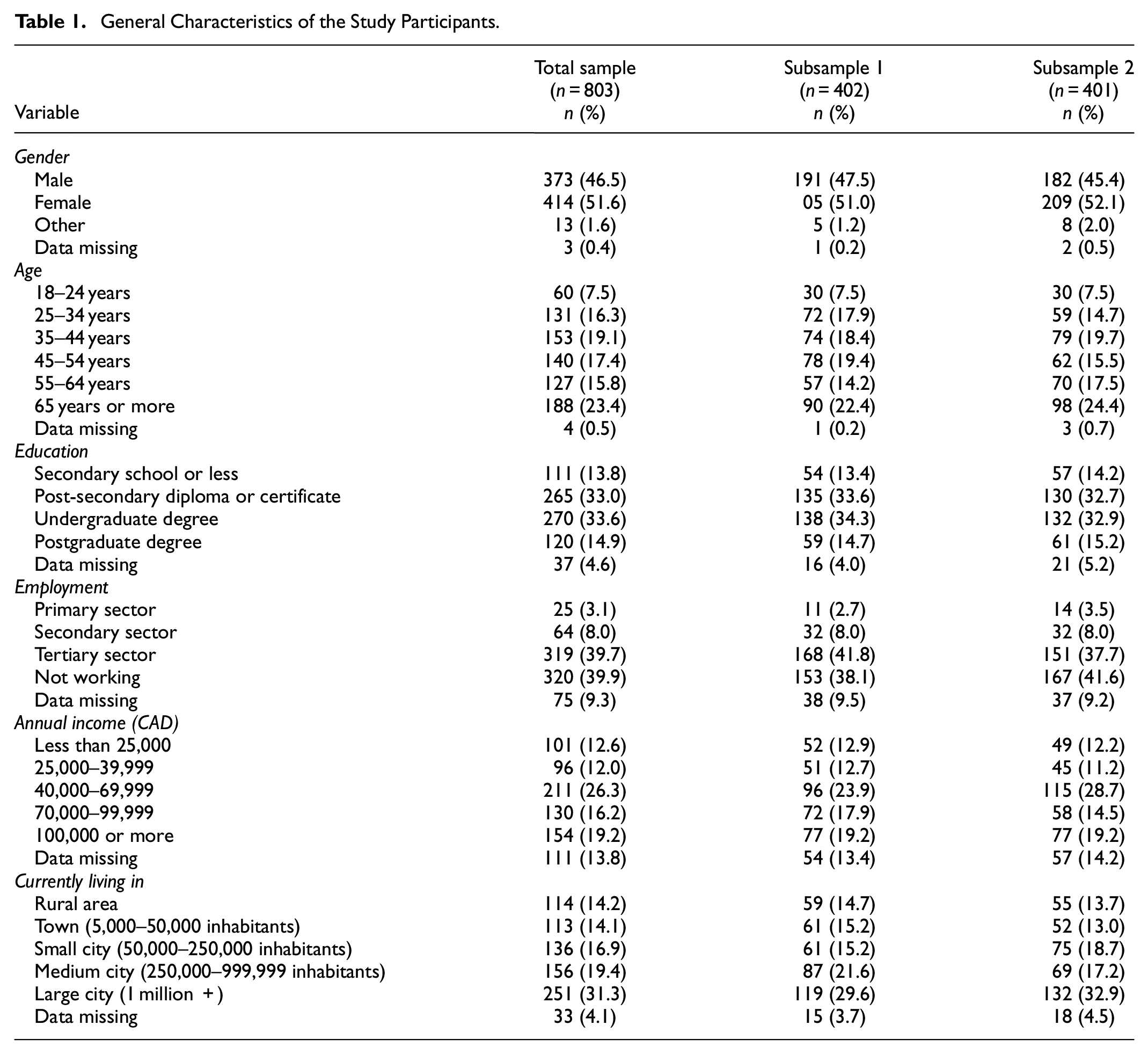
Harman’s single-factor analysis was conducted to examine potential common method variance (Podsakoff, 2003). The findings indicated that each factor accounted for less than 50% of the variance in the dependent variables, suggesting that common method variance was not a problem in the current study (Fuller et al., 2016). Next, item performance was evaluated using corrected item-to-total correlations (DeVellis & Thorpe, 2022). Three items with low correlations with the total scores were discovered and removed from the model. Following the approach described by DeVellis and Thorpe (2022), the total sample was randomly split into two subsamples: subsample 1 (n = 402) and subsample 2 (n = 401). Subsample 1 served as the primary scale development sample in Phase 2, while subsample 2 was used for cross-validation of the scale during Phase 3. Table 1 provides descriptive statistics for the total sample and both subsamples.
General Characteristics of the Study Participants.
The size of subsample 1 met the recommended criterion for exploratory factor analysis, requiring 10 times more observations than the number of scale items (Nunnally & Bernstein, 1994). The Kaiser–Meyer–Olkin (KMO) measure of sampling adequacy was acceptable, with values of 0.937 for the total model and 0.86 to 0.97 for each of the items (Kaiser, 1974). Bartlett’s test of sphericity (Bartlett, 1950) rejected the hypothesis that the correlation matrix is an identity matrix (χ2(703) = 11,764.4, p < .01). These results indicate that the data is appropriate for EFA, and an iterative EFA was conducted using subsample 1 in order to purify the scale and explore the underlying dimensions. A principal axis extraction method was applied, and factors with eigenvalues greater than 1 were extracted. In each iteration, items with factor loadings below .6 and high cross-loadings were removed (Hair, 2006). The final EFA identified a six-factor structure consisting of 26 items and explaining 68% of the total variance. The item’s loadings ranged from .62 to .92, with no cross-loadings above .22. The procedure resulted in very good scale reliability with Cronbach’s alpha values for all factors above the threshold of .70 (Hair, 2006).Table 2 presents the results of the final EFA.
EFA Results.
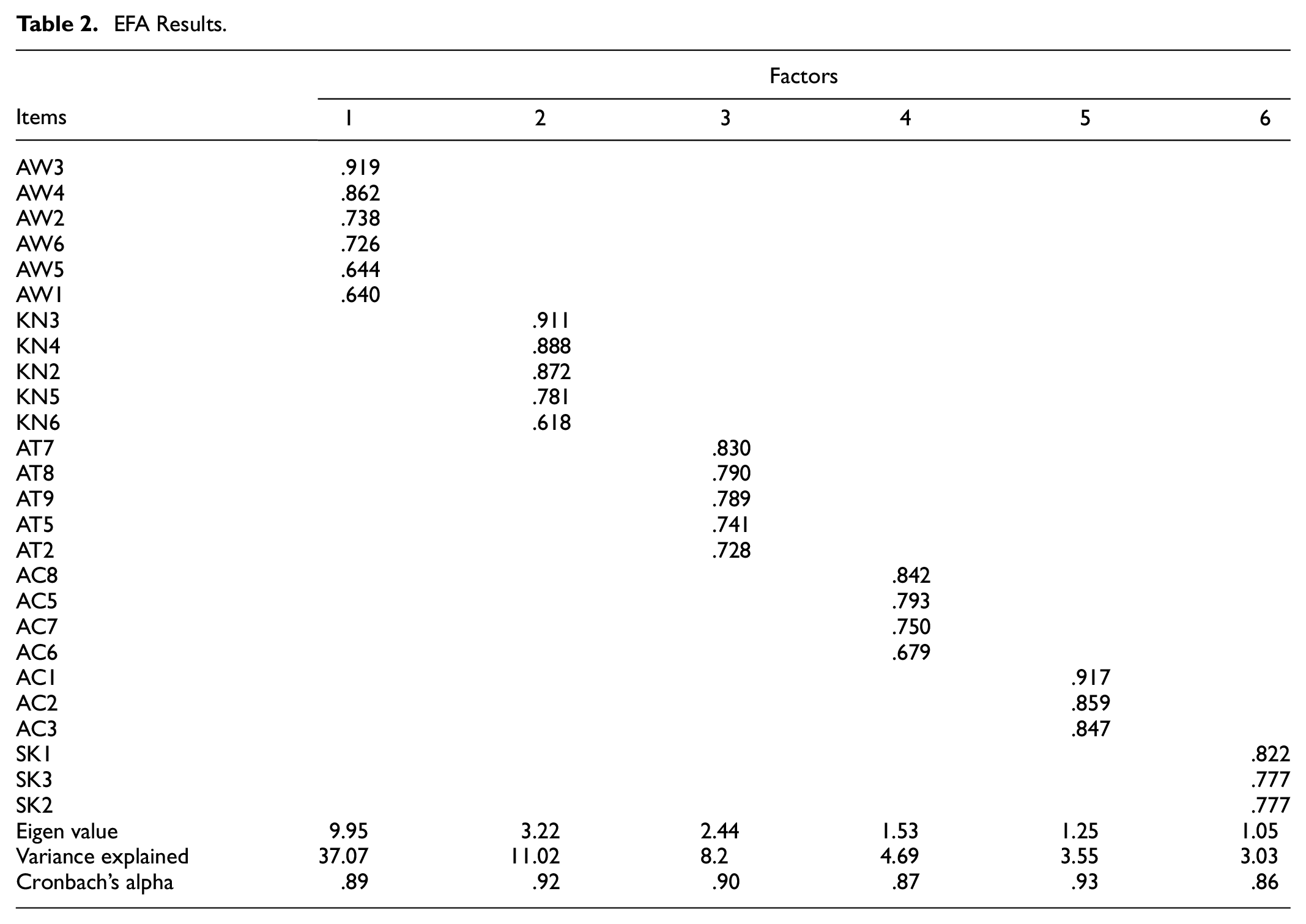
The identified factors largely corresponded to the theoretical dimensions of animal welfare literacy in tourism, as proposed by Fennell et al. (2023). The first factor is composed of items measuring knowledge of the factors affecting animal welfare in the tourism context, the negative impacts tourism activities can have on animals’ physiology, emotions and behavior, and the actions that tourism operators can implement to improve animal welfare. The second factor covers items related to awareness. It includes items measuring awareness that tourism in general, as well as the conditions of shelter, quality of food, nature of training, and interactions with animals affect their welfare. The next factor, attitude, consists of factors capturing the sense of responsibility for the welfare of animals in tourism and the perceived need for local and global measures to prevent animal suffering in tourism. The fourth factor, named social action, captured items related to public-sphere behaviors related to promoting animal welfare in tourism, such as encouraging and supporting others to make responsible decisions with respect to animals in tourism and supporting efforts aimed at improving animal welfare in tourism in general. The fifth factor, individual action, encompasses behaviors meant to consciously reduce and limit an individual’s impact on animals in tourism. The last factor, skills, captures items that measure the ability to find and evaluate information about animal welfare in tourism.
Phase 3: Scale Validation
The scale was next validated with a new set of data, the subsample 2. The subsample 2 met the recommended criterion of at least 200 cases for CFA. Additionally, the absolute values of skewness (0.31–1.31) and kurtosis (0.07–1.97) for all items were between 0 and 2 (Hair et al., 2022), indicating that the data did not violate the assumptions of normality.
The results of the CFA (Table 3) illustrate that the scale had an acceptable model fit when all items from the EFA were included. Specifically, the goodness-of-fit indices [χ/degrees of freedom (df) = 2.07, normed fit index (NFI) = 0.93, comparative fit index (CFI) = 0.96, incremental fit index (IFI) = 0.96, RFI = 0.92 and root mean square error of approximation (RMSEA) = 0.052] exceeded the cut-off values recommended by Hair (2006). Factor loadings ranged from .63 to .94 and were all significant at p = .05 level. This indicates that the overall fitness of the measurement model is good and the indicators are appropriate.
Phase 3 CFA Results. Set of Items Retained in the Model.
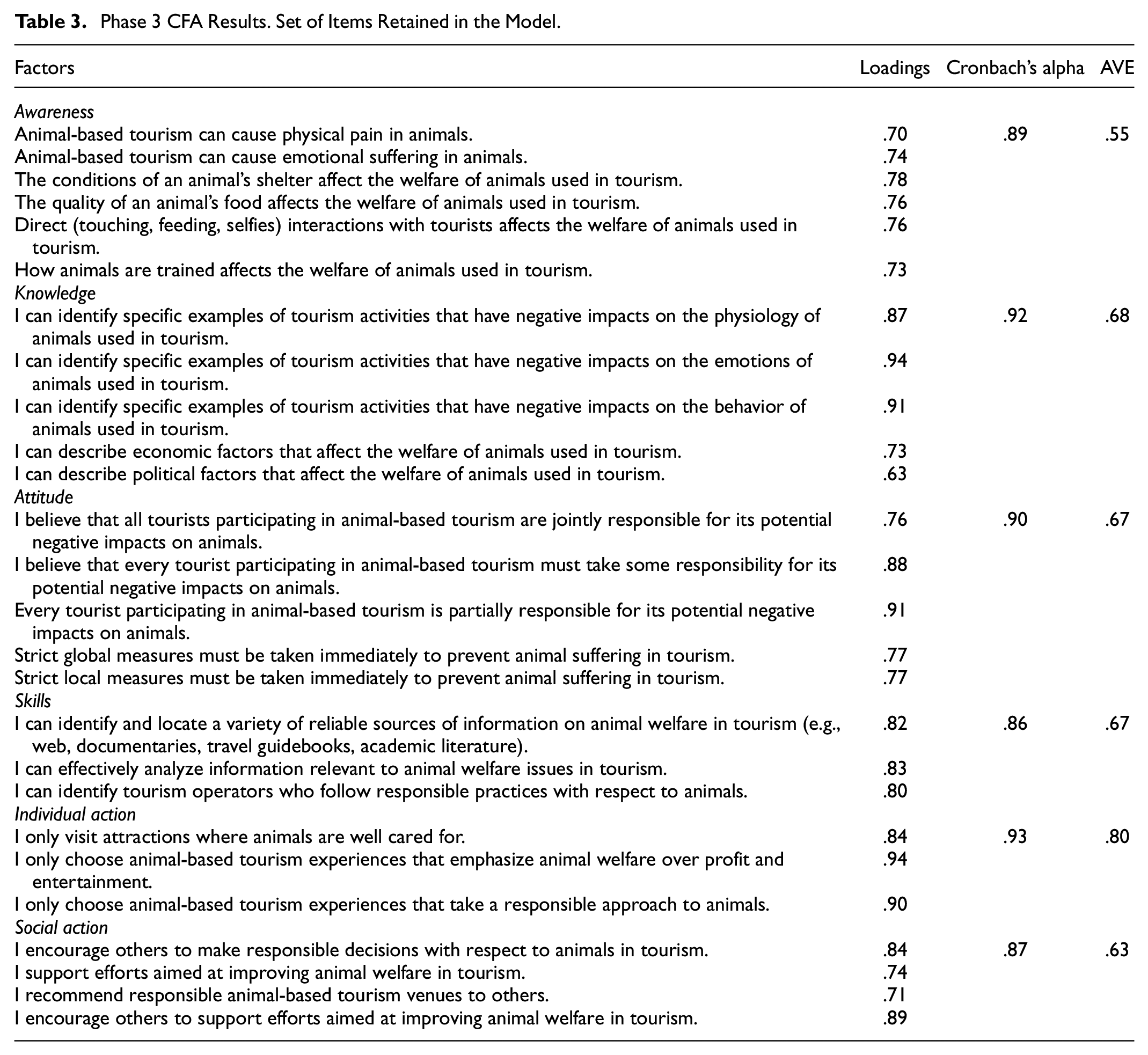
The average variance extracted (AVE) for each factor exceeded the standard value of .5 (Fornell & Larcker, 1981), indicating satisfactory convergent validity of the scale. The square roots of the AVEs of all factors were between .74 and .89, exceeding the correlation coefficients with the other factors (Fornell & Larcker, 1981), indicating that the scale also had satisfactory discriminant validity (see Table 4). The Cronbach’s alpha values for all the factors were also above the cut-off value of .70 (Hair, 2006), confirming scale reliability.
Discriminant Validity.
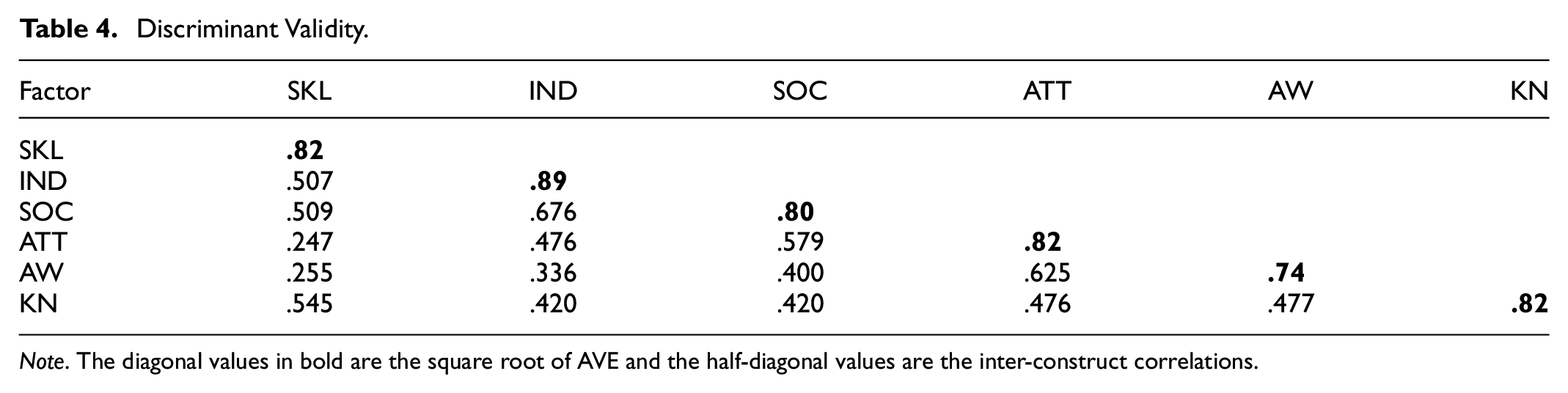
Note. The diagonal values in bold are the square root of AVE and the half-diagonal values are the inter-construct correlations.
Phase 4: Nomological Validity Assessment
To establish the nomological validity of the TAWL scale, two additional constructs were included in the analysis, namely motivation to learn and mutualistic wildlife value orientation. These constructs were chosen because of their established presence in previous research and expected relationships with the TAWL. Motivation is widely recognized as one of the most important factors affecting the learning process (Minnaert & Janssen, 2011). It provides the initial impetus to initiate learning and the drive to sustain learning over a longer period of time (Guilloteaux & Dörnyei, 2008). Motivation has been found to positively influence student learning outcomes and achievement and is considered one of the most significant determinants of students’ success or failure at school (Bailey & Phillips, 2015; Zhang et al., 2022). A number of motivational theories have been proposed to study motivation, including self-determination theory (Deci & Ryan, 1985), social cognitive theory (Bandura, 1989), and expectancy theory (Van Eerde & Thierry, 1996). According to the self-determination theory, individuals have inborn tendencies toward psychological growth and development and tend to pursue fulfillment of three basic needs: competence, autonomy, and relatedness (Deci & Ryan, 1985). Deci and Ryan (2000) further distinguish between intrinsic motivation, defined as engaging in an activity as a consequence of a person’s interest and personal beliefs, and extrinsic motivation, which refers to engaging in an activity due to an anticipated reward, compulsion or punishment. Both types of motivation have been found to have a positive relationship with students’ learning outcomes (Zhu & Leung, 2011). Previous studies in the context of literacy found that motivation to learn is an important driver of financial literacy (Mandell & Klein, 2007) and health literacy (Fretian et al., 2020). Given the previous research, it is hypothesized that motivation to learn will be positively associated with animal welfare literacy in tourism and the following hypothesis is proposed:
H1: Motivation to learn positively influences animal welfare literacy in tourism.
The second construct included in the nomological model is the mutualistic wildlife value orientation. Wildlife value orientations demonstrate individual thoughts about wildlife and wildlife-related issues and have been used to predict human behavior toward wildlife (Cerri et al., 2017; Fulton et al., 1996). Research on wildlife value orientations is situated within the wider area of research on human-wildlife interactions, which focuses on explaining human attitudes towards wildlife and the resulting interactions. It frequently applies the cognitive hierarchy approach, which explains how values, value orientations and attitudes shape human behavior toward wildlife (Jacobs et al., 2012). Numerous studies on wildlife value orientation have been conducted, resulting in a well-developed and reliable scale (e.g., Cerri et al., 2017), which has previously been applied in the tourism context (KC et al., 2022). The research in North America suggests that a shift towards mutualism is taking place due to social changes in education, economic income, and urbanization (Manfredo et al., 2009). In their study, Manfredo et al. (2009) identified two types of wildlife value orientation: domination and mutualism. Domination wildlife value orientation “reflects the extent to which an individual’s (or group’s) values are shaped by a view of human mastery over wildlife” (Manfredo et al., 2009, p. 411). Individuals who hold a strong domination orientation would be more likely to prioritize human well-being over wildlife and accept animal use for utilitarian purposes. In contrast, mutualistic wildlife value orientation is an attitude which “views wildlife as capable of living in relationships of trust with humans, as life forms having rights like humans” (Manfredo et al., 2009, p. 412). According to previous research, people who hold a mutualistic perspective on wildlife tend to consider animals in a non-utilitarian way and engage in actions that improve animal welfare. They are also more likely to promote caring behavior and welfare-enhancing actions while opposing actions that may result in death or harm to wildlife (Clergeau & Vergnes, 2015). Mutualistic wildlife value orientation is expected to be positively associated with animal welfare in tourism literacy. Accordingly, the following hypothesis is proposed:
H2: Mutualistic wildlife value orientation positively influences animal welfare literacy in tourism.
Motivation to learn was measured using three items based on previous literature. Mutualistic wildlife value orientation was measured using a social affiliation beliefs subscale of the well-established and widely used wildlife value orientation scale (Cerri et al., 2017; Jacobs et al., 2012; Manfredo et al., 2009). The CB-SEM approach was used to test the hypotheses. Evaluation of the measurement model indicated that the model had a good fit (RMSEA = 0.045, CFI = 0.96, IFI = 0.96, NFI = 0.94, GFI = 0.91) and all the scales were satisfactory, based on values of Cronbach’s alpha, AVE (between .55 and .80) and standardized factor loadings ranging from .64 to .93. All AVE values were greater than .50, indicating that the measures were highly reliable. Average variance extracted for Motivation to learn and for Mutualistic wildlife value were respectively .77 and .76, indicating that both the constructs capture a significant amount of variance and are reliable measures of the underlying concepts. All constructs met the Fornell–Lacker criterion, indicating their discriminant validity. Figure 1 presents the standardized path coefficients of the structural model. The goodness-of-fit indices (χ2/df = 3.63, p < .001, CFI = 0.94, TLI = 0.93, NFI = 0.92, RMSEA = 0.057) indicated the appropriateness of the structural model (Hair, 2006).
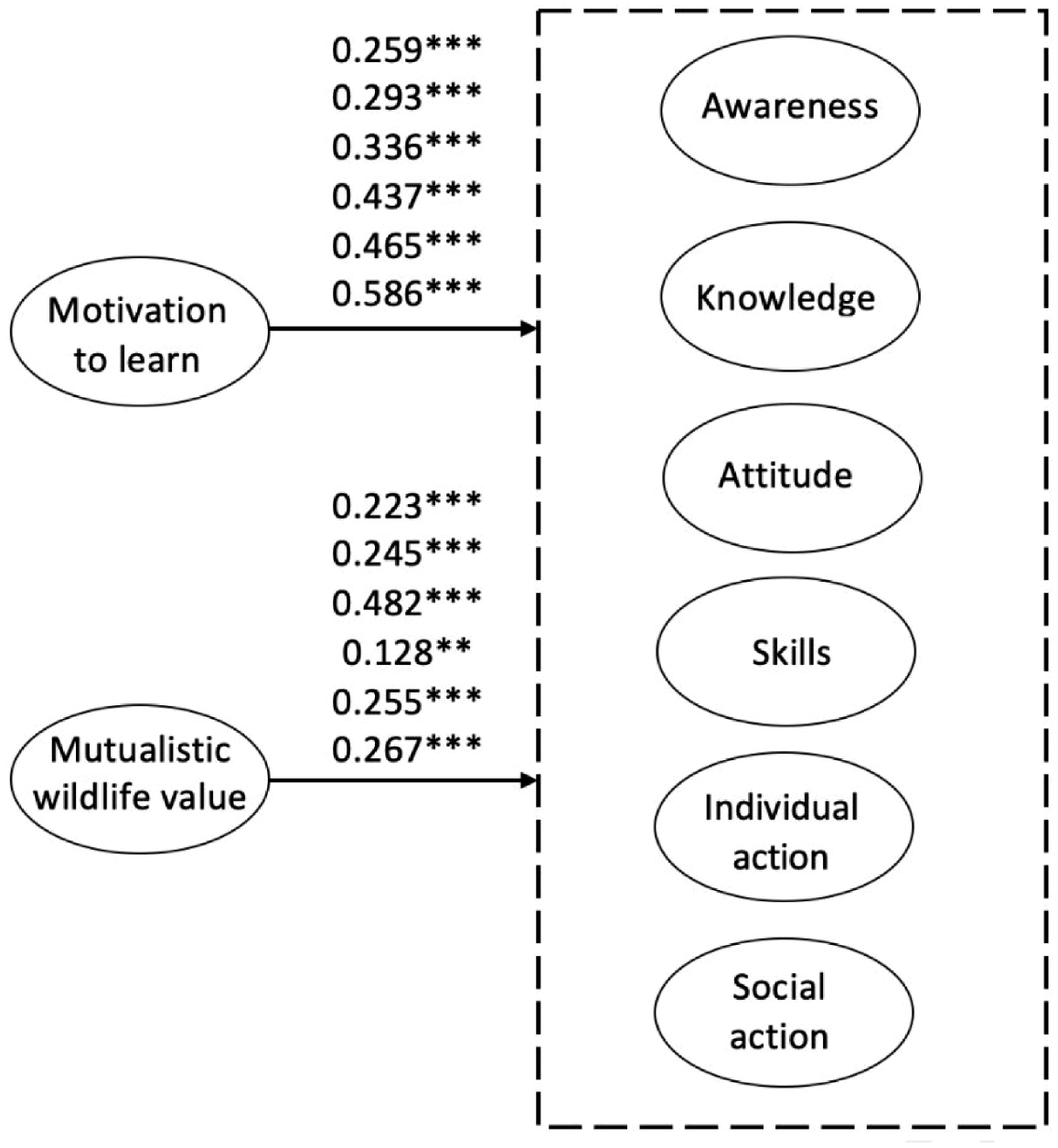
Test of nomological validity with AWLT dimensions.
As expected, positive and significant relationships between motivation to learn and all dimensions of animal welfare literacy in tourism were found, providing support for H1 (see Figure 1). Specifically, it has been found that motivation to learn is positively associated with awareness of animal welfare in tourism (
Discussion and Conclusion
This study developed and validated a measurement scale for the tourism and animal welfare literacy by following established procedures proposed in previous research (Churchill, 1979; DeVellis & Thorpe, 2022). The proposed TAWL scale comprises 26 items scored on a 7-point Likert scale, grouped into six dimensions. The factorial structure of TAWL was cross validated using both EFA and CFA in different subsamples. The scale exhibits good psychometric properties for validity and reliability. By developing and validating the TAWL scale, the current study addresses a significant gap in previous research, which did not provide an operationalization of animal welfare literacy in tourism of any kind despite recognizing its importance.
From the theoretical perspective, this study extends and empirically validates the preliminary work by Fennell (2022), which conceptualized animal welfare literacy in tourism as a five-dimensional construct consisting of awareness, knowledge, attitudes, skills, and actions. Through further investigation of these dimensions, a distinction between individual action and social action has been identified, and both these aspects were incorporated into the scale. Development of the scale provides further opportunities to investigate animal welfare literacy in both academic and policy milieus. We see tremendous value in using the scale as a catalyst for curriculum and educational development that places the value of animals on a much higher plane in the preparation of students who will later work in the field. From a research perspective, one of the most important outcomes of the study is advancing research on animal welfare literacy in tourism from a conceptual level to an empirical one by developing a scale that can be applied in different contexts to assess the levels of animal welfare literacy of tourists. As such, the scale can assist in developing tourism policies (Sheppard & Fennell, 2019), and improving tourism practices (Font et al., 2019). It can also be used to better understand factors affecting animal welfare literacy in tourism and to gain insight into the role animal welfare literacy in tourism can play in reducing the negative impacts of tourism on animals.
The assessment of animal welfare literacy in tourism has yet to become an established practice. There is growing appreciation that promotion programs focusing on raising awareness of animal welfare issues in tourism would help improve tourists’ literacy and, ultimately, the outcomes for animals used in tourism. The TAWL assessment can assist in evaluating the effectiveness of such programs in increasing animal welfare literacy in tourism. We see a myriad of possibilities along these lines in moving from what appears to be an illiterate tourist and service provider situation to a literate one (Fennell, 2022). In the case of tourists, when they are able to successfully recognize the animal welfare transgressions of service providers, they will be able to press for more active change in the quantity and quality of care extended to animals in use. For Moorhouse et al. (2015, 2017) this means leaving reputationally damaging feedback on derelict venues through social media. Other scholars have shown just how effective social media can be in ensuring that the wellbeing of target species is protected. Giant panda enthusiasts of the Chengdu Research Base of Giant Panda Breeding, for example, represent a global base of giant panda fans who regularly monitor the wellbeing of pandas and are vociferous over any violation of the pandas’ best interests (Guo & Fennell, 2023). Tourists, as such, can have a considerable impact on the expectations of heightened management and welfare of animals used in tourism.
Although this research provides new contribution to the growing body of literature on animal ethics and welfare in tourism, it also has some limitations that must be taken into account when interpreting the findings. The study has used a sample obtained from a market research panel maintained by a research company. Since only individuals who were part of the panel were invited to participate in the study, it is possible that the sample is not completely representative of the adult population in Canada. Given that the participants were Canadian residents, the study results cannot be generalized to other cultural contexts. Additionally, the data was collected using online survey, which introduces coverage bias, where the potential participants with no access to the internet were excluded. Since the questionnaire was only administered in English, it could introduce bias where the French-speaking population of Canada is underrepresented in the sample. Another limitation stems from the fact that the scale is based on data self-reported by participants. Despite implementing a number of recommendations proposed by Podsakoff (2003), the current study may still suffer from the common method bias. The respondents may have either not been able to fully assess their own knowledge or may have provided responses that put them in a positive light. Future research could strengthen the scale by using scenario-based research designs and experiments to test participants’ literacy (Kim & Jang, 2014).
It is important to note that the scale was developed and validated using a split sample approach, as described in the scale development section. While it is an accepted method of cross-validation if the initial sample is large enough (Hinkin, 1998; Krzystofiak et al., 1988; So et al., 2014), it is less effective than conducting two separate studies and may lead to results that are sample-specific and inclined toward high reliability due to problems related to common method variance. It is recommended that separate samples are used for EFA and CFA (Morgado et al., 2017) and further research to validate the scale in independent samples would provide stronger insight into its validity.
Additionally, although the study provided an initial assessment of nomological validity, it was based on the same data that was used for scale development. Hinkin (1998) points out that the data collected from the samples used in previous analyses (EFA and CFA) can be used for that purpose, provided that data for additional measures is collected during the original questionnaire administration. However, this approach provides only initial estimates of validity and using an independent sample to validate the scale would enhance its generalizability (Hinkin, 1995). Further studies are therefore needed to replicate and validate the scale in other samples. Boateng et al. (2018) recommend nine steps of scale development and validation, which provide valuable indication of future work needed. Additional reliability and validity tests, focused on test-retest reliability, split-half reliability, inter-observer reliability, criterion validity and predictive validity, among others, would advance the scale development (Boateng et al., 2018). Some of the work could include developing a more complex nomological network, consisting of additional antecedents and consequences of AWLT and testing it in an independent sample. Future research could also look at testing replicability across different contexts, such as cultural or geographical settings. Once more studies have been done across various settings, the generalizability theory could be applied to the final form of the scale, following Netemeyer et al. (2003) recommendation for Step 4 of their scale development process.
Once established, the proposed scale could serve as a benchmark measure for animal welfare literacy in tourism. Future research could apply it in longitudinal settings to assess how literacy changes over time or cross-sectional settings to compare the levels of literacy across different populations. Applying the scale to distinct populations can be further used to explore the universality of the scale or, alternatively, demonstrate a need for its adaptation to specific animal-based tourism experiences or different animal species.
Footnotes
Declaration of Conflicting Interests
The author(s) declared no potential conflicts of interest with respect to the research, authorship, and/or publication of this article.
Funding
The author(s) received no financial support for the research, authorship, and/or publication of this article.
